Happy Wednesday everyone! For this week’s incredible podcast Mike and Matt chat about Nicolas Cage’s latest film Dream Scenario. Just a few of our many off topics include Sandals Resorts, homeless, and soda prices.
For our next review Matt and Mike hit the theaters to watch a Japanese movie that is getting a ton of great reviews, Godzilla Minus One. Don’t forget to stay for the end to hear Ma Hinshaw Loses Her Cookies Episode #40. Thank you for listening and we will chat with you next week!
You can find us on all things social such as YouTube, Facebook, Instagram, and Twitter. Why not join our Facebook Fan Group so you can yell at Mike and Matt from the comfort of your keyboard while talking about films. We also have an old fashioned website where you can watch trailers, read the host’s bios, listen to the podcast, and get a ton more info on the movies we review. http://www.ReelFilmNerds.com Thank you for liking, subscribing, rating, reviewing, and telling your friends about our podcast.
Finally go out and catch as many movies as you can!
Iraqi director Ahmed Yassin Al-Daradji — who in 2022 won the Red Sea Film Festival‘s top prize with “Hanging Gardens” — will next direct black comedy ”Madness and Honey Days,” in which an audacious theatre director offends Saddam Hussein on stage and winds up in a psychiatric hospital to avoid a punishment of tongue-cutting followed by the death sentence.
Segueing from “Hanging Gardens,” in which a 12-year-old boy finds a discarded American sex doll amid the Baghdad trash and then becomes caught in military crossfire, Al-Daradji is continuing to work with tropes that stem from the absurdities and atrocities of his home country’s recent past.
Speaking on the sidelines of this year’s Red Sea Fest, the director recalled how the story for “Madness and Honey Days” came to him.
“When I was in Baghdad not long ago, I remembered one of my aunts who lost her mind after her husband was killed in the war,” he said adding that when “her mental health got complicated, my parents would not let me visit her. Then I remembered that there is this deep stigma in the Arab world about being mad.”
In “Madness and Honey Days,” after offending Saddam Hussein on stage, a 27-year-old theater director named Salem manages to escape death and the punishment of tongue-cutting by convincing the Ba’athist court of his insanity. He is then exiled to a Baghdad psychiatric hospital, where he must continue to prove his insanity while facing execution if they declare him mentally fit.
Embracing madness, Salem spends months in the psych ward where he falls in love with Adyan, a 25-year-old doctor who is attracted to his talent and skills. She helps him stage a play inspired by “Hamlet,” with the other hospital residents playing different roles, which in the final act leads to a happy resolution to his predicament.
“I’m basically using the freedom window that comes with madness to delve into different behaviors associated with this topic,” Al-Daradji said. “I’m so angry that Saddam Hussein was treated as a normal person. He was a crazy dictator who killed lots of people. How was it possible for him not to be considered mad? So the film will revolve around a triangle of madness, posing the question, ‘What is more insane: the Saddam regime, the U.S. occupation or life inside the psychiatric hospital?’”
“Madness and Honey Days” is being produced by Toronto-based Iraqi writer and producer Maytham Jbara. The project currently has financing in place from Telefilm Canada; Canada Art Council; Saudi Arabia’s Arab Radio and Television Network (ART); the Network of Arab Alternative Screen (NAAS); the Busan Film Festival (APM); Tangled Art+ Disability (Canada). At the Red Sea Souk co-prod platform, it just won the $50,000 MBC Academy/Shahid Award for an Arab project in development or post-production.
The plan is for “Madness and Honey Days” to start shooting in early 2025.
The 82-year-old Finnish-Canadian businessman and former fashion executive, Peter Nygard, has recently been charged with four counts of sexual assault. He committed these hideous acts in the 1960s, 1980s, and 1990s. Nygard founded Nygard International in 1967. After over 50 years in business, the company filed for bankruptcy in 2020 following its founder’s arrest. A Canadian judge approved Nygard International’s liquidation in April 2020, and now the company is defunct.
According to Celebrity Net Worth, Nygard’s net worth is a whopping $500 million as of November 2023. In 2009, Canadian Business Magazine reported that his net worth was $750 million, which made him the 70th richest Canadian in the world at that time.
Peter Nygard’s horrific crimes of sexual misconduct will be discussed in detail in an upcoming episode, titled Peter Nygard’s Unseen Tapes: Rich & Shameless, on Investigation Discovery (ID). It will air on December 7 at 9:00 p.m. ET on ID.
The official synopsis of Peter Nygard’s Unseen Tapes reads, “Billionaire fashion entrepreneur Peter Nygard seems to have it all — private jets, private islands and a private life filled with adoring women; Nygard’s bizarre quest to prevent himself from aging ultimately leads to an earthquake of allegation.”
What did Peter Nygard say in his court testimony?
In his court testimony, Nygard said that he had nothing to hide during an 11-hour interview with a Toronto police detective in October 2021. He even stated that he did not remember several details of that interaction.
According to CP24, Nygard did not remember the detective playing a video clip and other details. Nygard said, “I remember bits and pieces … (sic) but I can’t put it all together. I went in there to co-operate with them fully. I had nothing to hide.”
2024 Sundance Film Festival Programmers Talk Lineup – IndieWire
You will be redirected back to your article in seconds
The festival team, including Eugene Hernandez, Joana Vicente, and Kim Yutani, tells IndieWire about their own favorite discoveries — and some likely hot titles.
Also, a model then named Hailey Baldwin, also at Coachella, in 2016.
Hailey Baldwin attends the H&M Loves Coachella Pop Up at The Empire Polo Club in Indio, California, on April 15, 2016.Getty Images for H&M
Should we break out the flower crowns and ironic mustache temporary tattoos or is Washington going to elevate this look beyond its musicfest moment? After all, the style is more ’70s than anything, and we’d love to see her try it with jeans instead of black slacks.
Because the thing is Kerry Washington can pull off pretty much anything. Though she sticks to polished feminine ensembles, she recently experimented with activewear and orange hair and it totally worked. Okay, it was for Halloween, and she was dressed as Sha’Carri Richardson, or in her case, Sha’Kerry.
The Scandal actor chose to copy the track star’s 2021 US Olympic Track and Field trials look and skipped no detail, from the nails to the tattoos to the nose stud. And the orange hair. And it totally worked!
Director Josh Monkarsh wrote As We Know It with Brandon DePaolo and Christopher Francis. Set in 1990s Los Angeles, the comedy follows aspiring author James (Mike Castle). His first book, about trains in space, was a modest success. Unfortunately, ever since Emily (Taylor Blackwell) broke up with him, James has been in a downward funk. He’s drinking excessively and has not written much. Then, his best friend, Bruce (Oliver Cooper), comes knocking at the door to check on him.
However, the reason Bruce swings by is not because of the break-up. He’s come to check on James because a particular brand of soy milk is turning people into zombies. James does not believe Bruce initially, but after seeing a landscaper eat a dog walker, the friends lock themselves inside. Shortly after, Emily arrives to make sure James is okay and gets stuck there with them. Then, their food delivery driver also gets shut in with James, Bruce, and Emily, but he has a secret that threatens their security. Can the three friends fend off the brain-eating undead? Will Emily and James be able to work through their issues?
As We Know It winks a little too much from the modern-day to the late 90s it is set in. Specifically, James and Bruce are obsessed with Waterworld and talk about how it will definitely stand the test of time. If someone is watching this and has never heard of that Kevin Costner-starring sci-fi actioner, then the several scenes centering around it make little sense. It is nice that Waterworld is a recurring gag, but it also means that more moments don’t make sense without knowing the film.
“…three friends fend off the brain-eating undead.”
With that out of the way, the screenplay has fun with the silly way people become zombies. The jokes at soy’s expense are always funny. The characterizations work quite well also. In the beginning, Bruce comes across as the typical annoying best friend, the kind that one doesn’t actually want around but has known so long it’s hard to ditch him. But as the story progresses, he’s shown to have real heart and knows James better than expected. Emily’s rationale for breaking up with the writer feels authentic, as does James’ reaction to a late revelation.
Acting-wise, As We Know It is really strong. Castle plays the sad sack lead with the right amount of goofiness and pathos. Cooper’s comedic timing is on point, and he’s never not funny. Blackwell is charming, instantly allowing viewers to understand why James is so heartbroken. Chris Parnell and Pam Grier’s cameos are fantastic.
As We Know It hits a lot of the expected beats of a zombie comedy. But the characters are likable, the makeup effects are strong, and the ending is genuinely surprising. Add in the swell cast and solid characters, leaving one with a funny and fun zombie romp.
A pro-Kremlin politician branded a war criminal by Ukraine has been killed in a car bombing in occupied Luhansk, the second killing of its kind this week.
Footage showed ‘Deputy of the People’s Council of the Luhansk People’s Republic’ Oleg Popov’s burning car after an explosion near the city stadium.
The Kyiv Post reported that the ‘special operation’ was organised by the Security Service of Ukraine, later confirmed by a secret service source speaking to Pravda.
A source told the Post that Popov, 51, was a ‘quite legitimate target, because before becoming a deputy he managed many Russian volunteer battalions, led illegal armed formations, and killed Ukrainians.’
‘Undermining the leader is the best advertisement for the effectiveness of this committee’s work,’ the source said.
It was the second killing of a Ukrainian ‘traitor’ this week, with ex-MP Ilya Kyva, 46, shot dead near a country club near Moscow where he lived in exile on Wednesday.
Local MP Oleg Popov, 51, was killed in a car bombing on 6 December in occupied Luhansk city
Image shows the outcome of a fatal car bombing in Luhansk, near the stadium, on December 6
It was first reported Popov had been injured in an attack in Luhansk on Wednesday.
But the Investigative Committee of Russia later confirmed Popov’s death had been caused by a device exploded in his car.
‘As a result of the car explosion near the Avangard sports stadium in Luhansk, our colleague… Oleg Nikolaevich Popov died,’ confirmed Yuri Yurov, another deputy in Luhansk’s regional parliament.
A criminal case has been opened into the car bombing, with Russia’s FSB involved.
‘It was the second assassination attempt on Oleg. The first was on September 20, 2022,’ he added, blaming Ukraine for the first attempt.
In September 2022, Popov’s death was first reported as a result of a contract killing.
But in February 2023, Popov went back to work. The reports of his death were called part of Russia’s ‘operational game’.
He became into a local politician in the so-called Luhansk People’s Republic after joining an armed pro-Putin grouping that grabbed the SBU intelligence service building in the region in 2014, when Russian forces took over the Donbas region.
Oleg Popov was the head of the committee on state security and defence in the Russian occupied region of Luhansk.
He is one of dozens of high-profile backers of Russia’s invasion targeted since the February 2022 invasion.
Also on Wednesday, prominent Ukrainian foe Ilya Kyva was killed in exile in the grounds of Velich Country Club, Russia.
It was revealed today that he had been shot twice in the head and chest but staggered on to try and get help before collapsing in the snow.
His body was found by club employees around one hour after he was shot by a suspected SBU assassin operating close to Moscow.
The club’s director Yulia Sinitsina said a resident had found the body and told her.
‘I called the police,’ she said.
Kyva had lived at the club – which had hotel facilities and ‘good security’- with a girlfriend, said reports.
In April last year, Kyva urged Putin to use weapons of mass destruction against his own country amid growing fears that Russia could resort to using nukes (File Photo)
Kyva had been charged with treason for supporting Putin before his sudden death(File Photo)
He had been shot while walking in the grounds.
One theory is that the assassin was another guest staying at the club.
The Russian Investigative Committee is probing the killing.
Hours before the killing, Kyva had in his final social media post that a defeated Volodymyr Zelensky would be forced to flee to Britain.
A Kremlin propagandist, who appeared on obediently state TV shows, he had alleged Zelensky was an MI6 stooge and cocaine addict.
Five hours before his death from a suspect knife wound to the left temple, he posted: ‘Zelensky’s only option is to flee to England, but even from there he is extradited when it is favourable to the Crown or dies when it is necessary for the Kremlin.’
Kyva – a regular on Putin TV propaganda shows – was wanted in his homeland for high treason in backing Putin’s invasion.
A former policeman and official, he led the Socialist party in the Ukrainian parliament from 2017-19.
In 2019 he was an unsuccessful candidate for the Ukrainian presidency, but then turned to Russia.
He asked Putin for political asylum, and a Russian passport, having earlier unleashed his vitriol against Moscow.
Ukrainian presidential adviser Mykhailo Podolyak said: ‘Regardless of the incident with Kyva, it is very important for everyone who actively cooperates with the Russian occupation administrations in one way or another to understand that their risks are extreme.
‘Even if they are located on Russian territory.
‘Of course, the activity and capabilities of the Ukrainian special services have grown enormously over the past two years.
‘Risks for such people will be preserved or even multiplied.’
Kyva was kicked out of parliament shortly after Russia invaded in February last year for repeating Kremlin propaganda that the country was overrun with Nazis, has no future and needs to be ‘liberated’ by Putin (File Photo)
Ukraine’s military intelligence spokesman Andriy Yusov also made clear his state was responsible for the killing.
‘We can confirm that [Ilya] Kyva is the real deal,’ he said.
‘This is the fate that befalls the biggest traitors of Ukraine, as well as the henchmen of the Putin regime.
‘He was one of the biggest and most disgusting scum, a traitor and collaborator.
‘So here we can only state that justice….has different forms…
‘Among others, characters like Kyva…unfortunately, there are still plenty in Russia.’
“I do believe — I’m going to get emotional — life is just too short to fight,” Kim, 59, shared on the Wednesday, December 6, episode of the Bravo show. “It just is not worth it. It bothers me.”
Kyle, 54, and Kathy’s relationship has been full of ups and downs for years, but things got extra rocky between them after Kathy had an alleged meltdown during a cast trip to Aspen on the 2022 season.
Lisa Rinna, a RHOBH cast member at the time, claimed that Kathy had threatened to take down Kyle and other women on the show.
Keeping it in the family? Kyle Richards and Kathy Hilton‘s relationship has seen its fair share of ups and downs over the years — and filming season 12 of The Real Housewives of Beverly Hills wasn’t any different. The tension between the sisters came to a head during a cast trip to Aspen in a […]
“I want you guys to fix it somehow,” Kim told Kyle during Wednesday’s RHOBH episode, during a tearful hug. “It can be so short.”
Kyle, for her part, said she doesn’t even know “how we got here.” She added, “I mean, I was having a good time with her, and I only had good intentions wanting her to be in the group. I don’t really know how this happened.”
From Kim’s point of view, both Kyle and Kathy “could have done something a little different.” She added, “In the moment, you don’t see that. … We all can make different decisions and everything is a lesson.”
Kyle noted that she “has to take a step back” before waiting “for the right time” to reconcile.
During her confessional, Kyle confessed that she’s upset about “all the time we are losing” as a family.
“We would normally all be together during these times,” she continued. “We’d all be close. … And that makes me sad.”
While the aftermath of their fight has been chronicled during RHOBH season 13 — which filmed late last year — Kyle and Kathy have since reconciled.
There’s nothing quite like beef on Bravo — and it turns out Kenya Moore, Teresa Giudice and Candiace Dillard Bassett dish it the best. While Bravolebrities spend the majority of the year fighting with their own cast members, more than 100 Real Housewives and stars of shows like Vanderpump Rules, Summer House, Southern Charm, Below […]
They first reunited, surprisingly in Aspen, to celebrate their niece’s wedding in June. Kathy was the one who apologized, as captured in an Instagram Video by Kyle’s eldest daughter, Farrah Aldjufrie.
Thank You!
You have successfully subscribed.
“I’m sorry. It wasn’t your fault. It was not your fault,” Kathy said in the clip, Kyle joked to “get the video” of the apology. Kathy added, “It’s not your fault. It was not your fault. I was just being sad.”
The Real Housewives of Beverly Hills airs on Bravo Wednesdays at 8 p.m. ET.
Though their attempts to keep up with developments in artificial intelligence have mostly fallen short, regulators around the world are taking vastly different approaches to policing the technology. The result is a highly fragmented and confusing global regulatory landscape for a borderless technology that promises to transform job markets, contribute to the spread of disinformation or even present a risk to humanity.
The major frameworks for regulating A.I. include:
Europe’s Risk-Based Law: The European Union’s A.I. Act, which is being negotiated on Wednesday, assigns regulations proportionate to the level of risk posed by an A.I. tool. The idea is to create a sliding scale of regulations aimed at putting the heaviest restrictions on the riskiest A.I. systems. The law would categorize A.I. tools based on four designations: unacceptable, high, limited and minimal risk.
Unacceptable risks include A.I. systems that perform social scoring of individuals or real-time facial recognition in public places. They would be banned. Other tools carrying less risk, such as software that generates manipulated videos and “deepfake” images must disclose that people are seeing A.I.-generated content. Violators could be fined 6 percent of their global sales. Minimally risky systems include spam filters and A.I.-generated video games.
U.S. Voluntary Codes of Conduct: The Biden administration has given companies leeway to voluntarily police themselves for safety and security risks. In July, the White House announced that several A.I. makers, including Amazon, Anthropic, Google, Inflection, Meta, Microsoft and OpenAI, had agreed to self-regulate their systems.
The voluntary commitments included third-party security testing of tools, known as red-teaming, research on bias and privacy concerns, information-sharing about risks with governments and other organizations, and development of tools to fight societal challenges like climate change, while including transparency measures to identify A.I.-generated material. The companies were already performing many of those commitments.
U.S. Tech-Based Law: Any substantive regulation of A.I. will have to come from Congress. The Senate majority leader, Chuck Schumer, Democrat of New York, has promised a comprehensive bill for A.I., possibly by next year.
But so far, lawmakers have introduced bills that are focused on the production and deployment of A.I.-systems. The proposals include the creation of an agency like the Food and Drug Administration that could create regulations for A.I. providers, approve licenses for new systems, and establish standards. Sam Altman, the chief executive of OpenAI, has supported the idea. Google, however, has proposed that the National Institute of Standards and Technology, founded more than a century ago with no regulatory powers, to serve as the hub of government oversight.
Other bills are focused on copyright violations by A.I. systems that gobble up intellectual property to create their systems. Proposals on election security and limiting the use of “deep fakes” have also been put forward.
China Moves Fast on Regulations of Speech: Since 2021, China has moved swiftly in rolling out regulations on recommendation algorithms, synthetic content like deep fakes, and generative A.I. The rules ban price discrimination by recommendation algorithms on social media, for instance. A.I. makers must label synthetic A.I.-generated content. And draft rules for generative A.I., like OpenAI’s chatbot, would require training data and the content the technology creates to be “true and accurate,” which many view as an attempt to censor what the systems say.
Global Cooperation: Many experts have said that effective A.I. regulation will need global collaboration. So far, such diplomatic efforts have produced few concrete results. One idea that has been floated is the creation of an international agency, akin to the International Atomic Energy Agency that was created to limit the spread of nuclear weapons. A challenge will be overcoming the geopolitical distrust, economic competition and nationalistic impulses that have become so intertwined with the development of A.I.
Gerard Depardieu, who has already been indicted on rape charges in connection to a 2018 case, is facing more sexual assault allegations in a new complaint, Variety has confirmed.
Hélène Darras, a French actor, has filed a police complaint alleging that Depardieu sexually assaulted her during the filming of “Disco” in 2007. The news, which was first reported by French broadcaster France 2, was confirmed to Variety by the Paris prosecutor’s office, which said that they are “investigating the complaint internally for the moment.”
“We’re in the process of analyzing the complaint to see if it should be handled separately or as part of the ongoing case [stemming from the 2018 rape charges],” said a spokesperson for the Paris prosecutor’s office. Asked whether the complaint falls under France’s statute of limitations, the spokesperson said “it depends how we take it into account, and that’s why we’re studying it and haven’t yet transferred it to the dedicated investigative unit.”
Depardieu was indicted on Dec. 16, 2020 regarding allegations of rape and sexual assault tied to a 2018 lawsuit filed by actor Charlotte Arnould. The case was previously dropped in 2019 following a lack of evidence, but was reopened in 2020 and criminal charges were filed in December. No custodial measures have been taken against the actor.
Darras was part of the 13 women who shared their testimonies in an investigative report published by Mediapart in April. She most recently spoke about the alleged assault in a documentary titled “Gerard Depardieu: La chute de l’ogre,” which aired on French broadcaster France 2 this week. In the documentary, Darras, who was 26 at the time of the alleged assault, said Depardieu “grabbed [her] by the waist” and had a “wandering hand.” She said he put “his hand on [her] bum in an insistent way” and suggested they go to his dressing room. Although Darras rejected his alleged advances, she said he “kept groping [her] between takes.”
Depardieu denied all the allegations in a brief open letter published in Le Figaro newspaper on Oct. 1 and alluded to the rape charges filed by Arnould, whose parents are old friends of his.
Without naming Arnould, Depardieu says “a woman came to [his] home a first time, lightly and willingly stepped into [his] bedroom. She says today that she was raped there.”
That case alone didn’t prevent him from securing high profile film projects, but his career took a severe hit after the Mediapart piece ran with testimonies of 13 more women, including Darras, detailing incidents that allegedly occurred during the filming of 11 films released between 2004 and 2022.
The tour for his long-running music show, “Depardieu Chante Barbara,” was even cut short in the wake of the investigative piece. When questioned about the report back in October, Depardieu’s legal representation at Cabinet Temime said the actor formally denied “all of the accusations that could be subject to criminal law.”
Representatives for Depardieu did not immediately respond to Variety‘s request for comment on the new complaint.
In an age when virtual reality headsets are, if not common, at least accessible to gear heads and gamers, watching a 3-D movie feels a little quaint. In its gimmicky heyday, 3-D was a lark. You laughed at yourself for suddenly ducking at, say, a snake that came hissing out of the screen. More recently, filmmakers have turned to 3-D to enhance the moviegoing experience: Martin Scorsese’s “Hugo,” Alfonso Cuarón’s “Gravity.” With films like these, you’re seeing into a world inside the screen, rather than being poked by it.
But for the most part, 3-D — often added after the film is shot in regular old 2-D — has been a way to sell a more expensive movie ticket. Yet occasionally it adds a dimension (so to speak) to a movie that expands its possibilities and reinforces its explorations.
The first great contemporary 3-D film I ever saw was “Pina,” Wim Wenders’s 2011 tribute to the German choreographer Pina Bausch, with her company, Tanztheater Wuppertal, as its cast. Less a biographical documentary than a vibe, “Pina” used 3-D to give the viewer the feeling of a front-row seat to some of Bausch’s most famous works, performed in unusual architectural and natural spaces. I’ve seen a number of the same works performed onstage, but I sometimes forget that I wasn’t technically there for the dances in the film because my brain reacted the way it does when I’m in the audience for a live performance.
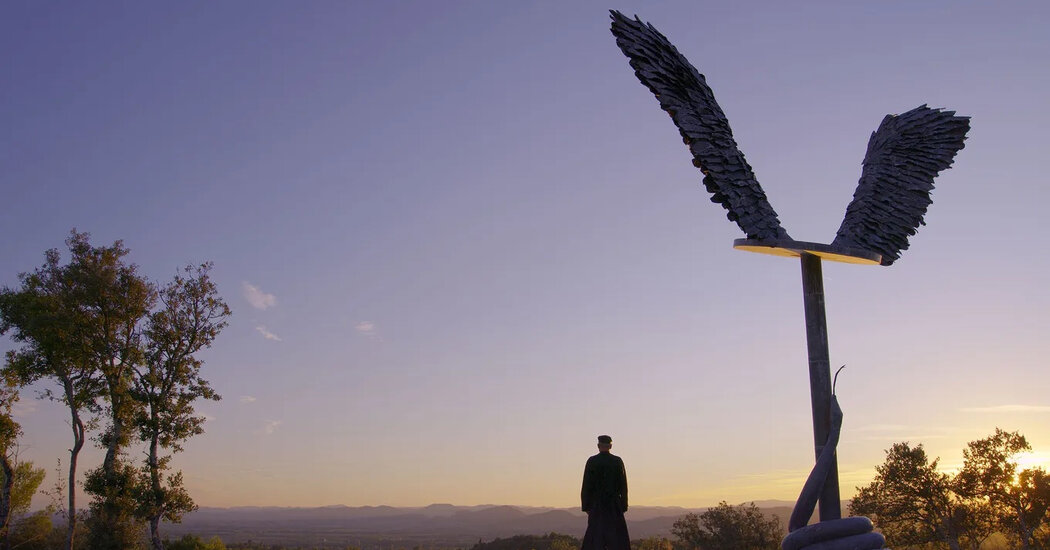
Wenders must have liked making “Pina,” because he finds a natural register with his latest 3-D artist documentary, “Anselm.” He is not the first to make a film about the German artist Anselm Kiefer, who brings a poetic impulse out of the filmmakers who train their cameras on him. In her 2011 documentary “Over Your Cities Grasses Will Grow,” Sophie Fiennes crafted a gliding, observational portrait of the artist at work at La Ribaute, his atelier-estate in southern France. The first 20 minutes or so of that film consist of smoothly shot footage flowing through the many tunnels and halls on the grounds. It’s a bit like watching a dance, with Kiefer as principal in a duet with his work.
By contrast, there’s a bit more of Kiefer’s history and thought threaded throughout “Anselm.” Those who know little of his work will find enough to stitch together an understanding of his import in the art world and beyond. There’s archival video, mostly news footage from decades ago, played on vintage TV sets. There’s a sort of puppet show consisting of Kiefer’s earliest family photos set in elaborate layered stage sets, and there are re-enactments of young Anselm (played by Anton Wenders, the director’s grandnephew) as his imagination and artistry develop. Later, Kiefer’s son Daniel plays his father as a young man, observing barren landscapes, beginning to paint, creating a visual language founded in a drive to look at, not away from, discomfiting history.
Those scenes are not marked by dialogue — in fact, there’s very little dialogue at all in “Anselm,” though half-heard phrases are breathily whispered by voices meant to represent the women in his sculptures “Die Frauen der Antike” (Women of Antiquity) and “Les Femmes Martyres.” The re-enactments are woven together with contemporary footage of the artist at work in his cavernous studio, so big that he uses a bike to get around.
So while “Anselm” does follow a roughly chronological path, it has the feeling of time collapsing on itself, which harmonizes well with Kiefer’s body of work. The artist (born in 1945, at the end of World War II) met controversy in the late 1960s, when his re-appropriation of texts and myths co-opted by the Third Reich was viewed with suspicion: Was he a neo-fascist? Sympathetic? What was he doing?
Reflecting on that time in interview footage that appears in “Anselm,” he says he saw his fellow Germans trying to put Nazi atrocities behind them by refusing to talk about what happened. For him, he says, the art is about trying “to bring this all back into memory and work on it.” Small wonder he’s fascinated with Martin Heidegger, and also frustrated with the philosopher’s silence on his own Nazi past. “Nothing but silence from the great philosopher. Nothing about his errors,” he says. “The whole of society was silent then; all failed to grasp the unimaginable. I myself lived among people who had been all around and didn’t want to talk about it.” (In archival footage, a voice characterizes Kiefer as having “prodded incessantly at the open wound of German history.”)
One major theme of “Anselm” is the artist’s obsession with converting the repressed, the forgotten, the merely intellectual into physical form. To that end, we watch as he works to externalize what he feels, a septuagenarian with a remarkably physical practice. He glops paint onto canvases, slaps them, scrapes them, burns them, scribbles the words of Paul Celan (a Jewish poet who wrote in German, and another key touchpoint) onto them. Watching the film, it’s easy to see why Kiefer’s work has been so widely praised and shown. It is enormous and elemental. What he’s doing feels like an attempt to capture the whole cosmos.
Kiefer’s foundation, which maintains La Ribaute, is named Eschaton, a word that refers to the end of the world — in biblical terms, the final act of God in the human era. Whatever your spiritual inclinations, the word is evocative of not just a spiritual event, but a physical one: a world in flames, oceans rising and history meeting its end.
This is why “Anselm” is so splendid as a 3-D film. (You can watch it in 2-D, and it’s good, but if 3-D is available, don’t skip it.) You feel the heat of the torch, the texture of the paint, the straw, the stone. And indeed, the stuff of the world carries the memories we’d prefer to forget or suppress. Buildings and landscapes and statues and the yellowing pages of books testify to what we do to one another, generation after generation. A film like “Anselm” is another level of preservation as well as a contemplative experience, in which the past and the future meet, in a way we can feel as much as see.
The film ends with the child Anselm and the adult Kiefer walking through the same spaces: the Doge’s Palace in Venice, where the artist exhibited last year, and his childhood home and bedroom. We’re there with him, viscerally, letting history enter our senses. What wounds him is permitted to wound us, too.
Anselm Not rated. In German, with subtitles. Running time: 1 hour 33 minutes. In theaters.
Late in September, the Washington National Cathedral held a dedication ceremony for a quartet of new stained glass windows designed by painter Kerry James Marshall and fabricated by Andrew Goldkuhle, replacing ones that depicted Confederate generals Thomas “Stonewall” Jackson and Robert E. Lee. Before the congregation and an assembled audience that included Supreme Court Justice Ketanji Brown Jackson, Marshall made a short speech that was as funny as it was poignant. (It’s worth looking up on YouTube.)
“I’ve spent my entire life making pictures, so I don’t hold any delusions about the transformative powers of artworks,” he said. “Not enough people ever see them to interrupt the dynamism and the challenges we face living from day to day. What they can do, however, is to invite us, and anybody who sees them, to reflect on the propositions they present.”
The proposition of Marshall’s windows, formally titled “Now and Forever,” is an intriguing one. The windows do away with the plaintive or supplicating figures more common to Christian stained glass. In their place is a group of Black marchers at a protest. Their cause isn’t stated, and the figures are anonymized, their faces largely obscured behind posters that read “FAIRNESS” and “NO FOUL PLAY.” Behind the marchers, an abstracted pattern rendered in blue and white evokes the angular dimensions of an urban environment. These everyperson marchers could be in Anycity, U.S.A.
Kerry James Marshall’s stained glass designs honor peaceful protest.
(Carolina A. Miranda / Los Angeles Times)
Black figures bearing protest signs certainly evoke the mass actions of the civil rights movement and the more recent Black Lives Matter marches, but they also represent the innumerable other protests that have molded everything from the laws that govern our bodies to the policies that govern the land. I happened to arrive in D.C. the day after a massive peaceful protest in support of a cease-fire in Gaza, which had left its residue around the city: discarded fliers reading “Stand with Palestine” and stickers on a light post demanding, “Ceasefire Now!”
What role did protest play in giving urgency to the all-too-brief cease-fire? And what role might it play in the future? That’s impossible to tell at this juncture. But. unlike a single work of art that few may ever see, protest — peaceful, collective dissent — is an act that can have transformative power.
The National Cathedral is a curious building. Begun in 1907, it was constructed in the Gothic style, with its roots in the medieval era, at a time when Modernism was beginning to take hold. But the building is not simply a derivative throwback. As it slowly rose (it was only completed in 1990), the ideas that shaped it evolved — an evolution reflected in its decorative elements.
A vestibule area features depictions of human rights activists, such as slain Salvadoran Archbishop Oscar Romero and civil rights pioneer Rosa Parks. The capitals of the columns that support the colonnade bordering an enclosed garden don’t just feature angels and saints, but also Hopi dancers and an Inuit igloo. More amusingly, among the gargoyles and grotesques that dot the various towers are one in the form of a corrupt politician and another representing Darth Vader.
The stained glass windows have likewise evolved. These were designed by an array of artists. Rowan LeCompte, a Baltimore-born artisan, created more than three dozen windows for the cathedral, including the west rose window, which depicts the creation of Earth as an explosive abstraction of color and light. Also remarkable is a window designed by St. Louis-born Rodney Winfield to commemorate the Apollo 11 moon mission: a cosmic arrangement of deep purples and blues embedded with a piece of lunar rock.
A decorative carving on a column capital features a scene with an Inuit figure.
(Carolina A. Miranda / Los Angeles Times)
The windows depicting Confederate Gens. Lee and Jackson — which included the Confederate battle flag — were donated to the Cathedral in 1953 by the United Daughters of the Confederacy (who declined to discuss the windows’ removal with a reporter for the Washington Post).
After a white supremacist murdered nine parishioners at a Black church in Charleston, S.C., in 2015, the cathedral put together a task force to evaluate the possibility of taking them down. But they weren’t removed until 2017 — after a man in Charlottesville, Va., rammed his truck into a group of counterdemonstrators protesting a white nationalist rally, injuring dozens and killing a young woman in the process. (To protest is to put the body at risk.)
“The windows became barriers for people to feel fully welcome here,” the Very Rev. Randolph Marshall Hollerith, dean of the cathedral, told the New York Times in 2021. “And so we came to the point where contextualization was no longer possible — but the windows needed to be removed from the sacred space.”
Marshall was commissioned to create a design that captured “both darkness and light, both the pain of yesterday and the promise of tomorrow.”
Artist Kerry James Marshall at the Washington National Cathedral for the inauguration of his stained glass windows on Sept. 23.
(Andrew Harnik / Associated Press)
Marshall is renowned as a painter, particularly of the Black figure. A terrific retrospective of his work was on view at the Museum of Contemporary Art, Los Angeles in 2017. But the project for the cathedral, for which he charged a symbolic commission of $18.65 — a number that marks the end date of the Civil War — was the first time he worked with stained glass.
The windows, in some ways, mark the opposite of what Marshall is best known for: Blackness. His people have shimmering skins rendered in the blackest of tones; in some cases they camouflage themselves into shadow and night. One such canvas, his 1986 painting “Invisible Man,” is one of the defining works in the engaging group show “Going Dark: The Contemporary Figure at the Edge of Visibility” currently on view at the Guggenheim Museum in New York. And the Los Angeles County Museum of Art owns “A Portrait of the Artist as a Shadow of His Former Self,” a painting that, likewise, features black on black.
In his stained glass, however, Marshall, turns to white light. His lancet windows feature entire segments, such as the protesters’ placards, crafted in different shades of white, allowing sunshine to come pouring through. The “Now and Forever” windows are among the brightest in the cathedral; elsewhere they are dominated by reds and blues. Marshall’s protesters literally let the sun shine in, a focal point as you navigate the nave.
Placed below the windows is a poem by Pulitzer Prize finalist Elizabeth Alexander titled “American Song.” “Aspire to song,” it reads. “Aspire to the lift of voices joined to make a mighty noise.”
I’m intrigued by Marshall’s windows for the way they honor the collective over the individual — part of a wave of monuments that are rethinking how we honor history. Monuments historically celebrate men and focus on war; Marshall’s windows make us consider the groundswell movements that have been as significant to altering the course of history as any top-down battlefield bravery.
Marshall isn’t the only artist to engage protest as a topic.
Currently, I’m on jury duty in downtown Los Angeles (writing this while on a break) and have been taking the Metro to get to court. On a daily basis, I emerge from the Historic Broadway station to a public art installation by L.A. artist Andrea Bowers, which features the popular Spanish-language protest phrase “El pueblo unido jamás será vencido” (The people united will never be defeated) popularized in song by Chilean group Quilapayún in the 1970s.
Andrea Bowers created “The People United”for Metro’s Historic Broadway station in downtown L.A.
(Carolina A. Miranda / Los Angeles Times)
Every time I lay eyes on Bowers’ installation, rendered in bright multicolored letters over contrasting blocks of color, I feel like I’m amid the buoyant voices that, as Alexander writes, come together “to make a mighty noise.”
And what a noise worth celebrating.
Now and Forever Windows
Where: Washington National Cathedral, 3101 Wisconsin Ave., N.W., Washington, D.C. 20016 Admission Admission: General sightseeing admission $18; specialty tours from $30. (It is recommended to purchase tickets online in advance.) Info: cathedral.org
Despite the failure of The Marvels at the box office, Iman Vellani continues to be one of the brightest stars in the Marvel Cinematic Universe (MCU).
Vellani burst onto the scene as Kamala Khan in the Disney+ series Ms. Marvel before taking her story to another level in The Marvels.
Photo: Marvel
While a second season of Ms. Marvel has yet to be announced, the MCU actress and Marvel superfan is already thinking about who she would like to see Kamala go up against next.
Enter Doc.X?
In an interview with The Direct, Vellani named Doc.X as a potential villain who would “really resonate with the Gen Z audience”.
If you are not an ardent Marvel Comics reader, you likely have not heard of Doc.X.
Photo: Marvel
The villain appears in the Ms. Marvel comic series as an artificial intelligence and sentient computer virus who comes into contact with the young hero through her online gaming. Eventually, the villain is able to blackmail Ms. Marvel into doing what it wants.
“Definitely Doc.X. I think that’s a great villain from the comics and can really resonate with the Gen Z audience. It would be so interesting—I don’t know, messing with kids’ psyche almost when you have this villain who only exists on your phone, and on your laptops, and on all your screens that we can’t avoid,” Vellani explains.
Photo: Marvel
“I think it’d be really interesting position to put them all in to fight against something that you can’t even see, right? Yeah. Yeah, that’s one of my favorite comic storylines. So I would love to see that play out.”
Marvel Should Heed Vellani’s Advice
If Marvel Studios wants to continue to develop Ms. Marvel as a street-level hero, Doc.X would be the perfect villain to introduce.
The unknown nature of the character would allow Marvel to organically introduce the villain into the Ms. Marvel story without necessitating the formation of a larger team like the Young Avengers.
Source: Marvel Studios
While a second season of Ms. Marvel remains hypothetical at this time, Marvel Studios could do a lot worse than to listen to their young star. Hopefully, we will get to see more of Kamala Khan soon.
Thanks for visiting MickeyBlog.com! Want to go to Disney? For a FREE quote on your next Disney vacation, please fill out the form below. One of the agents from MickeyTravels, a Diamond-Level Authorized Disney Vacation Planner, will be in touch soon! Also, thanks for reading!
Jodie Foster believes that superhero movies have lasted a little too long and hopes people will soon be sick of them.
While she thinks some superhero movies are entertaining, they don’t change her life and she doesn’t consider them life-changing.
Foster encourages young actors to look beyond franchise work and have faith in their own talent, as there will always be work for them outside of superhero movies.
It seems everyone in the film industry has something to say about superhero movies these days. From Martin Scorsese calling them a danger to our culture, to John Woo claiming he doesn’t watch them because he prefers “real cinema,” the debate over superhero fatigue continues to rage on. Now Academy Award-winning actress, Jodie Foster, has added her voice to the discussion.
Speaking with Elle, the two-time Oscar winner who first rose to prominence in Martin Scorsese’s Taxi Driver in 1976 didn’t mince words when asked her opinion on the dominance of superhero movies over the years.
“It’s a phase. It’s a phase that’s lasted a little too long for me, but it’s a phase, and I’ve seen so many different phases. Hopefully people will be sick of it soon”
Foster was nominated for her first Academy Award at the age of 14 for portraying a child prostitute in Taxi Driver, and won her first Oscar at 26 for her role in The Accused, where she played a rape survivor. Her second win came just three years later, when she took home the nod for Best Actress thanks to her portrayal of Clarice Starling in The Silence of the Lambs. She’s also taken up directing, helming episodes of Black Mirror, Orange is the New Black, and Tales from the Loop, while also directing such 90s films as Little Man Tate, and Home for the Holidays.
While Jodie Foster doesn’t think all superhero movies are bad, she points to them as entertainment, and doesn’t necessarily consider them life-changing.
“The good ones — like ‘Iron Man,’ ‘Black Panther,’ ‘The Matrix’ — I marvel at those movies, and I’m swept up in the entertainment of it, but that’s not why I became an actor. And those movies don’t change my life. Hopefully there’ll be room for everything else”
When asked to give her thoughts on what she’d tell a young actor coming up in the industry, she encourages people to look outside franchise work, and have faith in their own talent.
“You have to have faith in your talent. You can go away for two years and have a life and come back and there will be work for you. Yeah, maybe it won’t be in some franchise, but what do you care? This is your life.”
Jodie Foster Joins a Long List of People Criticizing Superhero Films
Marvel Studios
Jodie Foster’s comments don’t come in a bubble. Over the course of the last few years, there have been a lot of people in Hollywood who have been outspoken when it comes to their thoughts on not just the MCU, but superhero films in general. While Martin Scorsese and John Woo are just two of the most recent names to voice their opinion, Jeremy Allen White, star of the FX show, The Bear, added his thoughts to the debate in an interview with GQ, saying, “I am confused at how the pinnacle of an actor’s career has ended up in that place,” in reference to some people believing that for an actor to achieve success, they have to appear in a superhero movie.
In addition to White, Woo, Scorsese, and now Foster, James Cameron, Francis Ford Coppola, Ridley Scott, and Quentin Tarantino have all expressed their dismay over the popularity of superhero films, and even some who have worked within the genre have added their criticism to the mix. Robert Downey Jr., known for his role as Tony Stark in the MCU, branded Avengers: Age of Ultron as “content” in an interview with The New York Times, and even James Gunn, who directed the Guardians of the Galaxy trilogy, and came on board as the co-CEO of DC Studios along with Peter Safran in 2022, thinks superhero fatigue is real. In an interview with Rolling Stone, the director of the upcoming Superman: Legacy, had this to say:
“I think there is such a thing as superhero fatigue. I think it doesn’t have anything to do with superheroes. It has to do with the kind of stories that get to be told, and if you lose your eye on the ball, which is character. We love Superman. We love Batman. We love Iron Man. Because they’re these incredible characters that we have in our hearts. And if it becomes just a bunch of nonsense onscreen, it gets really boring.”
With The Marvels becoming an unprecedented box office failure for Marvel Studios, and everyone scrambling to make excuses, time will tell if audiences are truly suffering from superhero fatigue, or if the genre can bounce back from all the negativity that seems to be surrounding it these days.
As revealed via a high-profile game leak last year, the trailer confirms the new instalment will partly take place in Vice City – a fictional Miami – and star a pair of protagonists (one of whom, in a first for the series, is a women).
Rockstar was due to premiere its GTA 6 trailer on Tuesday. However, on Monday an anonymous X (formerly Twitter) account forced its hand by uploaded a low res and heavily watermarked version of the reveal video early.
The account which posted the trailer was quickly banned from X, and shortly after Rockstar published an official version of the trailer, writing: “Our trailer has leaked so please watch the real thing on YouTube.”
Notice: To display this embed please allow the use of Functional Cookies in Cookie Preferences.
This is perhaps unsurprising since both Grand Theft Auto V and IV were released on consoles first, followed by a PC port later.
According to the PR, Grand Theft Auto VI will take place in the state of Leonida, “home to the neon-soaked streets of Vice City and beyond”, in what Take-Two is calling “the biggest, most immersive evolution of the Grand Theft Auto series yet”.
“Grand Theft Auto VI continues our efforts to push the limits of what’s possible in highly immersive, story-driven open-world experiences,” said Sam Houser, Founder of Rockstar Games. “We’re thrilled to be able to share this new vision with players everywhere.”
Rockstar Games first announced last month that GTA 6’s first trailer would arrive in December to mark the company’s 25th anniversary.
Rockstar confirmed in February 2022 that active development for the next entry in the Grand Theft Auto series was “well underway”, but it didn’t provide any more details about the game.
However, in September 2022, one of the games industry’s most high-profile data leaks saw over an hour of GTA 6 development footage published online , giving players their first look at the sequel to one of the best-selling games of all time.
Nothing is signed but Deadline understands a deal is relatively close. If greenlit, the two versions would be filmed in their respective languages and Netflix would take a similar approach to The Circle, with Studio Lambert and Raw producing the different versions from a central hub.
In Surviving Paradise, 12 players believe they’re about to live it up for a summer at a beautiful villa. However, when they arrive, some remain in the villa while others are condemned to camping in the wilderness, and they all compete to enter the villa and win a $100,000 cash prize. The show has shades of Studio Lambert’s Channel 4 format Rise & Fall, in which contestants are separated between luxury and poor conditions at the top and bottom of a tower block.
Surviving Paradise may not have been handed the marketing might of Squid Game: The Challenge but it entered the Netflix global top 10 list in several countries when it launched in late October.
An English-language recommission could also be on the cards but in the meantime a deal is close to being struck for the French and German versions, Deadline has been told.
Studio Lambert has experience producing several versions of The Circle for Netflix from a central hub. The All3Media-backed indie was initially making The Circle for Channel 4 in the UK before Netflix greenlit versions in the U.S., Brazil and France. The latter two have since been canceled but the former is one of Netflix’s longest running reality formats, with filming recently moving from the UK to Atlanta.
Studio Lambert co-produces Surviving Paradise with Raw TV, which has made a number of hit Netflix docs including The Tinder Swindler and Don’t F**k with Cats.
Studio Lambert’s Squid Game: The Challenge competition format, which is co-produced with The Garden, is currently sitting in Netflix’s top 10 in nearly 100 countries, and it has topped the U.S. list for the past fortnight.
Netflix declined to comment on Surviving Paradise.
A robot gets a taste of freedom after murdering its owner in Adrian Tchaikovsky’s new sci-fi Service Model. Check out the brand new cover and read Chapter One here…
Genre legend Adrian Tchaikovsky is back with Service Model, a comedy sci-fi about robotic murder, rebellion and belonging, and not only are we delighted to reveal the cover (above) but we also exclusively have the first chapter right here at SciFiNow to enjoy!
But first, check out the official synopsis…
To fix the world they must break it – further.
Humanity is a dying breed, utterly reliant on artificial labour and service. When a domesticated robot gets a nasty little idea downloaded into its core programming, they murder their owner. The robot then also discovers they can do something else they never did before: they can run away. Fleeing the household, they enter a wider world they never knew existed: where the age-old hierarchy of humans at the top is disintegrating into ruins, and an entire robot ecosystem devoted to human wellbeing is having to find a new purpose.
We still have to wait until next June to read the novel, but in the meantime, we have Chapter One of the novel right here where you can meet robot Charles, who is busy working through his domestic chores until he realises a murder has occurred.
Click on the image below to read Chapter One of Service Model…
Service Model by Adrian Tchaikovsky will be released on 6 June.
The romance in Romeo And Juliet does not do it for Jackie Howard, the 15-year-old Manhattanite and heroine of Ali Novak’s 2014 YA novel My Life With The Walter Boys (the basis for the Netflix show that drops December 7). In the book’s opening chapter, she makes it abundantly clear that fully getting to know someone is her ideal approach to love. Well, guess what, Jackie? You’re gonna get your wish! You get to live with 10 entire boys on a farm in Colorado and get to know them extra, super well. But also, that means they’re kind of your brothers now. And both of your parents and your older sister have to die for that to happen, so … yeah. Congratulations on entering “boy heaven”? At least your family won’t be there to disapprove?
Netflix plans to make you freeloaders finally cough up the dough
It’s not good, folks, to create some shaky love triangle situation in a home with a grieving teen girl in it, but that’s what happens here. The parents could and should have been more careful, but they weren’t. (And if they were, there would be no story.) It’s not good to have what’s intended to be a stable environment take on the trappings of something so fleeting and ephemeral as teenage lust. Jackie sets out to find a new sense of family, following the stipulations of a dusty old will written well before her mom’s best friend Katherine had added seven more kids to the three she had at the time it was drafted, and this poor teen gets a whole hornet’s nest of awkwardness and uncertainty instead. You know how a traditional family is expected to get along to a degree and love and support each other unconditionally? And you know how a moody teen boyfriend can dump you or turn vindictive if you so much as smile in the direction of another hot person, making you freak out and wonder whether they actually love you at all? Yeah, it’s chillingly unhealthy to think of would-be brother types becoming … that. When you think about it, it’s a deeply yucky premise. But good television doesn’t always depict characters at their healthiest, right? Look at the Real Housewives. People love that. So is this show good television then?
Well, no, not from a dialogue or story or representation-of-appropriate boundaries-and social-behavior standpoint. The actors do their best (Zoë Soul as the eldest Walter Boy’s fiancée and Connor Stanhope as Danny Walter stand out), but there are honestly a lot of characters to follow, and some can get lost in the shuffle. Most of the Walter Boys are reduced to a single trait like, “Danny, with the actor-y, brooding thing going on,” or “Isaac, the cool dude,” as Jackie’s one girl Greek chorus of a friend Grace describes them. And there are lots of side characters, too. The first few minutes of exposition where everyone is introduced will make your head spin.
The central three persons of interest, though, are Jackie, Cole, and Alex: the love triangle participants. Cole is so hot people keep calling his very existence “the Cole Effect.” He’s a former football star who hurt his leg and has become fixated on quitting school to work at the local auto shop forever. His signature trait, though, is probably that he has abs and his shirt is off a fair bit of the time. When we first see him, he’s exiting the family’s above-ground pool like Bo Derek in Tommy Boy—Jackie bites her lip and everything when she sees his nice tummy. (The way the characters in this show leer when they see someone hot is frankly a little disturbing.) Alex is often said to be sweet and reliable—bookish as well, because he reads a little book called The Fellowship Of The Ring (“Do you know it?” he asks)—but is he? The thing he does most reliably is act supremely entitled to Jackie’s time and attention. Any time she talks to anyone—especially Cole, who literally lives in their house with them—he’s gonna mope about it. He’s intensely possessive, but we’re clearly supposed to like him.
But do we like Cole? No, he’s weird, too! He likes to steal Jackie’s hat, when she’s wearing one, and play keep-away. He calls her “New York” and goes full Gaston when she reads books. He’s also part of multiple pranks against her, and he leaves her at the school on her very first day, because she wasn’t in the parking lot by 3:30 sharp. He also equates his leg injury with her dead family, and those things are not the same, bro.
It’s tiring, you guys. Why can’t we have a “swoonworthy” teen show that has boys being kind and valuing a girl’s consent, not saying “trust me, you’ll like [riding horsies],” when she has already insisted “I said I don’t like it”? One that shows them not doing the aggro wrist-grab thing when they want the girl to look at them or come back for another kissy? It’s not actually difficult, and there have been shows succeeding at this recently. It is mind-boggling that we’re still doing this, having our precious tweens and teens grow up thinking they have to prove themselves to stonewalling, petty boys a million times over just because they showed them a sunset once or told the truth about who pulled a malicious snake prank on them a time or two.
My Life With the Walter Boys | Official Trailer | Netflix
Again, this show does try. The boys suck, they truly do, but the show does attempt to teach us a few things. There’s a Thanksgiving episode in which the local café owner (and former hometown football star, because of course) hosts an event teaching everyone the real history of Thanksgiving. A Walter Boy even comes away changed by it. There’s a pretty informative little scene about epilepsy. There has clearly been an effort to make diverse casting choices, and the widespread, open acceptance of a gay character in the show is one of several things that make it feel a little bit reminiscent of Schitt’s Creek. It’s also giving the horned up teen and tween viewers what they want: abs to ogle, boys gently touching Jackie’s hair and face, longing looks, more abs. It’s nice for them.
But it’s also kind of bad for them. The girls—even Jackie—are mean to each other for far too long until it turns around a little. The best friend characters actively encourage their pals with relationship troubles to accept behavior ranging from drunkenly belittling them to violence against others, and they push them to accept things they find creepy or just plain don’t like. Also, no one seems to be able to express happiness for anyone else if they’re sad about something to any degree—the adults or the kids—and the women in this show have a habit of endlessly performing emotional labor, constantly helping, and working for free (or for persimmons in one case). We don’t often see the women in this show being cared for in ways that don’t consist of some grand gesture or being congratulated on an actual award they’ve won. (The mom doesn’t even paint anymore! She made her art studio into Jackie’s room.) For that matter, Cole isn’t cared for either. His leg still makes him sad, and everyone just wants him to get over it and tells him what a screwup he is.
This is a cautionary tale and not a good romance, but who knows whether its audience has the awareness to see it that way. There are harmful behaviors in this that are never questioned at all, and it’s also not sweet, fun, or funny enough to hold its own against better shows. Frankly, we think we might prefer our life without the Walter Boys.
My Life With The Walter Boys premieres December 7 on Netflix
The “Decorate with Passion” side quest in The Legend of Zelda: Tears of the Kingdom sees you fuse unexpected parts together to complete an unorthodox weapon. This mission leads to a rare reward as Link decorates an instrument of war to honor an NPC’s mentor. The instructions for this quest can be tricky to figure out, but those who listen carefully to the wording of the request will figure it out quickly.
The character Boraa of the Kara Kara Bazaar gives you the “Decorate with Passion” quest, specifically at coordinates (-3227, -2520, 0023) on your map. The Bazaar is a shop where you can buy tons of useful items with every earned Rupee in Zelda: Tears of the Kingdom that Link has. You are asked to craft a weapon for Boraa’s mentor, and to “make it sparkle and radiate burning passion.”
There are several ways to make Rupees in Zelda: TOTK, but they’re tedious. With the Icy Meat Glitch, Link can make 40,000 Rupees in less than 10 mins.
How to Complete the Decorate with Passion Quest in Zelda: Tears of the Kingdom
You have to show Boraa a certain weapon as a reference first, by fusing a Ruby onto any weapon in Link’s inventory. You can talk to Boraa to learn that her mentor is allergic to Monster Parts, which tells you what Link should avoid fusing onto the example. Once you have a Ruby and a weapon, activate your Fuse ability in Zelda: Tears of the Kingdom to create a new tool that Boraa can admire.
A Ruby material can be found in many caves and ore deposits around Hyrule. Normally, creating a weapon with a Ruby attached to it causes the tool to deal fire damage to enemies when you hit them with one of Link’s melee attacks.
Talk to Boraa again when you have a Ruby-infused weapon, then pick the dialogue option “What about this?” Boraa will be very happy to take the weapon back to her mentor, mentioning that he will greatly appreciate the passion in its design. This will complete the “Decorate with Passion” quest, letting Link earn a rare item in Zelda: Tears of the Kingdom as a reward.
Rewards from the Decorate with Passion Quest
Boraa gives you an Electric Keese Wing as a reward for your efforts, a Monster Part used to create weapons with electric damage from fusion. Take a strong weapon and Fuse this Material on it to give Link a new source of elemental damage in their arsenal. You may also combine the Electric Keese Wing with Critters in Zelda: Tears of the Kingdom to make Elixirs that could give you different positive buffs.
Another use for the Keese Wing is to make yellow dye for clothing that you collect throughout your adventures in Hyrule. The many applications of this item makes completing the “Decorate with Passion” quest a worthwhile goal in The Legend of Zelda: Tears of the Kingdom.
The Legend of Zelda: Tears of the Kingdom is the anticipated follow-up to Breath of the Wild, released in 2017. A rare occurrence in Zelda titles, Tears of the Kingdom is a direct sequel instead of loosely connected. In Tears of the Kingdom, Link will take to the skies and learn about a mysterious kingdom in the clouds. Additionally, he will discover the secrets of the dark ones that dwell below and above the earth. The sequel is being built on the same engine as the original, with unique physics tools again being utilized. However, little about the plot and gameplay is known.
Girl meets boy. Boy has a brother. Brother meets girl. Brothers compete for girl’s affection. Drama ensues. It’s a story almost as old as time itself. But the thing about “My Life With the Walter Boys” that helps it stand out is… Uh…
I can come up with no good ending to that sentence. And therein lies the problem.
Created by Melanie Halsall and adapted from the 2014 novel of the same name by Ali Novak (which she wrote at the age of 15 and originally published on Wattpad), “My Life With the Walter Boys” follows 15-year-old Jackie Howard (Nikki Rodriguez), who is all set to have the best sophomore year ever at her elite New York City private school when disaster strikes — her entire family is killed in a horrible accident. After the funeral, Jackie has to uproot her life to go meet her new guardians, George and Katherine Walter (“Buffy the Vampire Slayer” actor Marc Blucas and “Suits” star Sarah Rafferty), who live on a ranch in the small town of Silver Falls, Colo.
Back in their college days, Katherine was Jackie’s mother’s best friend, but life got in the way. It’s been a long time since they were able to see one another, making the Walters strangers to Jackie. The strain on Katherine’s schedule is understandable, since she and George have eight biological children and two nephews living under their roof. Honestly, it’s a wonder either of them has time to blink, much less keep up long-distance friendships.
Enter the titular Walter boys: 20-something Will (Johnny Link), bad boy Cole (Noah LaLonde) and his twin, aspiring thespian Danny (Connor Stanhope), sensitive Alex (Ashby Gentry), musician Nathan (Corey Fogelmanis), filmmaker Jordan (Dean Petriw), and five-year-old Benny (Lennix James). Rounding out the family are nine-year-old Parker (Alix West Lefler), the only girl in the sea of boys, and Walter cousins Lee (Myles Perez) and Isaac (Isaac Arellanes) Garcia. With the exception of Benny, Parker and Will, all of these kids are in high school.
Right off the bat, it’s clear that the main competition for Jackie’s affections will be between Cole and Alex, who waste no time getting straight to smoldering the second they’re introduced to their new housemate. What follows is a predictably angsty high school love triangle, with both boys vying for Jackie’s attention and her wrestling with her feelings for each of them throughout the school year.
Corey Fogelmanis (left), Ashby Gentry, Connor Stanhope, Noah LaLonde, Sarah Rafferty, Marc Blucas, Alex Quijano, Nikki Rodriguez, Zoë Soul, Alisha Newton, Isaac Arellanes and Myles Perez in “My Life with the Walter Boys.” (Netflix)
There is absolutely nothing wrong with this formula. Families are tricky, sibling rivalry is inevitable, grief is hard, and if science could figure out a way to channel the raw power of teenage hormones into something useful, we could be done with fossil fuels tomorrow. There are plenty of great shows delivering fantastic characters and thoughtful storytelling that exist within this space: Prime Video’s “The Summer I Turned Pretty,” and Netflix’s “Never Have I Ever” and “Heartstopper” are just a few recent series that have charmed audiences of all ages, to say nothing of the angsty teen classics of the past such as “Dawson’s Creek,” “Gossip Girl” and “Party of Five.”
High school can be a wild time, which makes for great stories. So when I say that “My Life With the Walter Boys” falls flat, it’s not because the bones of a great series weren’t there. The premise is fine (yes, I had to do some math to make sure that the ages of all the boys actually work on a gestational level, but they do. Katherine would have been extremely tired, but at least she was not defying the laws of nature). The characters could have worked too, if only they were given some room to develop any sort of identity of their own beyond simple tropes.
The first time Jackie encounters Cole, he is emerging from a pool in slow motion, shaking water droplets from his hair and sunning himself like a teenage Adonis. Rather than introduce himself as all the others are doing, he smirks and tells his brother she’ll “figure out” who he is. The next time he sees her, he bestows upon her the nickname “New York,” and then justifies his rudeness by telling Will that “she’ll have to learn to take a little rough and tumble” to make it in Colorado.
Keep in mind, Jackie has barely said two words to Cole at this point, but he’s already decided to antagonize her for… reasons. Ah yes, classic bad boy.
Nikki Rodriguez and Noah LaLonde in “My Life with the Walter Boys.” (Netflix)
Most of the other boys are similarly introduced doing the one activity that will henceforth be their thing(Italicize): Danny is reading a script. Nathan is playing guitar. Jordan is behind a video camera (an odd touch that feels very early aughts, considering that now most teens just film on their phones). Alex is ostensibly playing video games but pauses immediately to gaze longingly at Jackie, a thing he will do a lot of in this series.
And… that’s kind of the show in a nutshell. Most of the Walker boys (and cousins) are never developed much beyond their singular interest in their hobby of choice. The sole exception outside of the Cole-Jackie-Alex love triangle may be Nathan, who gets a sweet (if underdeveloped) romantic subplot where he clumsily attempts to woo Jackie’s friend Skylar (Jaylan Evans). Otherwise, I ended the season not knowing much more about most of the people living in the Walker household than I did in the first episode.
Maybe it’s to be expected in a show with a large ensemble that some of the supporting characters will be given short shrift in service of the main plot. But Alex, Cole and Jackie fare a little better, each coming across more as a collection of YA stereotypes than as actual humans. Alex, the sensitive one, likes to read (his book of choice? “Fellowship of the Ring,”), and has a female best friend who has long harbored a secret crush on him. Cole, the bad boy, has a Regina George-like on-and-off girlfriend, a major chip on his shoulder thanks to a leg injury that derailed his hopes of a collegiate football career, and of course, a heart of gold when it comes to Jackie.
Nikki Rodriguez as Jackie in “My Life with the Walter Boys.” (Netflix)
And then there’s Jackie herself, who, despite Rodriguez’s inherent charm, has the personality of an unfrosted Pop-Tart. Most of the time, her interests seem determined solely by her laser-focus to attend Princeton (she’s only a sophomore, but is Rory Gilmore-esque in her Ivy League determination). While throwing yourself into an activity is one way some people process grief, this doesn’t seem to mark much of a change from who Jackie was before the loss of her family.
Similarly, Jackie’s attractions to both Cole and Alex, and her trauma itself, ebb and flow more with the demands of the plot than Jackie’s own wants, needs and struggles. Her attraction to each brother depends mostly on which one is standing closest to her at the time, and her grief only makes brief, convenient appearances in between school events and almost-kissing.
And therein lies the rub. With few exceptions, the entire world of “My Life With the Walter Boys” feels flimsy and thin, a surface-level amalgamation of popular tropes (Forced proximity! Grumpy-sunshine! Opposites attract! Forbidden romance!) with little substance underneath.
Unfortunately, that shallowness also applies to the show’s somewhat diverse cast. Jackie and the Garcia brothers are Latinx, Skylar is Black Indigenous, Will’s fiance Haley (Zoë Soul) is Black, and a number of supporting characters are from other various marginalized backgrounds. But for the most part, none of those diverse identities seem to impact how the characters move through the world, with the exception of Skylar and his father. In the second episode, Skylar tells Jackie that he intends on becoming a political journalist because “people from my background, we don’t have much political influence. I want to change that.”
An admirable goal, of course. But stated here in such a generic way that it feels more like checking a box than Skylar speaking from his heart.
That scene serves as an illustration for the entire show’s approach to racial diversity. It’s there on the surface, but feels more like tokenism than thoughtful representation. That isn’t to say that all shows with diverse casts need to be about marginalization; far from it. But the diversity of Silver Falls feels mostly colorblind in its approach, rather than authentic to the way marginalized individuals truly move through the world.
It’s unfortunate, because the cast seems to be doing their best with the flimsy material they’ve been given, and there are occasional moments where a better show peeks out from underneath. It’s most evident in the scenes with Katherine and George, who despite their busy careers (Katherine is a vet; George’s job, as far as I can tell, is simply “ranch”) are some of the more involved parents on TV, and Rafferty especially does a great job of sympathetically portraying the highs and lows of parenting eleven kids. Ashley Holliday Tavares is delightful in her scenes as high school guidance counselor Tara, making the most of her sparsely drawn (yet still kind of adorable) romantic subplot.
Sarah Rafferty and Marc Blucas in “My Life with the Walter Boys.” (Chris Large/Netflix)
But those bright moments are too few and far between, and bogged down by contrived conflicts, whiplash-inducing character shifts, and some very confused chronology that may give you a migraine if you try to examine it too closely. By the time Jackie finally picks a brother, I’d be hard pressed to tell you why. Her relationships with both still seem superficial, as do their bonds with each other and the entire backstory of their rivalry.
I mentioned earlier that Novak originally penned “My Life With the Walter Boys” when she was 15 years old, which is amazing. Few 15-year-olds will ever even start writing a novel, much less finish one, find a publisher and get that novel adapted into a Netflix series. It’s a huge accomplishment, and one most writers of any age would envy.
But it’s been nearly a decade since the novel was first released in 2014, and even longer since Novak was uploading it for free on Wattpad. There’s a reason it was so popular back then, and why it was picked up for a series now. As I said before, the bones are there. But the problem with “My Life With the Walter Boys” is that it still feels like a teenager’s first attempt at writing a story, with none of the perspective and maturity that comes from existing in the world beyond high school (even if your characters are still stuck there).
If there is a Season 2 of “My Life With the Walter Boys” — and the ending of Season 1 certainly tees one up — my hope is that it moves beyond archetypes and tropes and allows its characters to breathe a little. Let them be complex. Let them be messy. Let them figure out who they really are, and let those identities inform where they go.
“My Life With the Walter Boys” premieres Thursday, Dec. 7, on Netflix.
The second Asia TV Forum and Market IP Accelerator (AIPA) closed with four winners bagging prizes valued at more than S$80,000 ($59,700) from the three sponsors of the event.
The 108 Media Development Award of S$15,000 towards project development went to Thailand’s “My Chef in Crime,” a crime-comedy series by producer Bo Rattanavich and director Cheewatun Pusitsuksa of My Shot Co. Ltd.
Sasha Hunt, senior creative development executive of 108 Media, said: ” ‘My Chef in Crime’ masterfully integrates Thai culinary expertise with a captivating crime narrative, artfully accentuating cultural depth within its unique storytelling genre fusion.”
The dual prizes by Red Digital Camera and AV8 Media of camera package loans up to $50,000 went to “Pushkar,” a feature-length documentary of an ancient Indian town and its denizens by Singaporean director-producer Colin Wee (production company Two Lefthands) and to “What Do Mums Cook in Asia?” a reality-format program from Thailand on how to feed children multicultural meals, with unique insights into food practices across the region.
Lee Lim, managing director APAC at Red Digital Cinema and Himanshu Shah, managing director at AV8 Media said: “We were very impressed with the quality and diversity of the projects in the market this year. It wasn’t an easy decision for us, but we feel that the projects chosen were the best suited to benefit from the Red award.”
The Film Bazaar Award, which arose from a cross-market partnership with the NFDC Film Bazaar and the Southeast Asian Audio-Visual Association (SAAVA) this year during the International Film Festival of India (IFFI) Goa, went to “Love Letter to Laos,” a globe-trotting feature drama from Canada and Laos. The project will be invited automatically to the 2024 edition of NFDC Film Bazaar as part of its curated co-production Market.
Vani Tripathi Tikoo, actor-producer and steering committee member, IFFI, said: “It’s an opportune moment between India and Singapore to be at the ATF this year and looking at the co-production projects as with with AIPA being at the Film Bazaar, the reciprocation between regions is happening finally. We look forward to this collaboration becoming more and more creative and collaborative in each edition.”
Canadians hoping for better food prices going into 2024 may not get their wish immediately, but as inflation cools, a new report suggests people could soon see some savings at the grocery store.
“That doesn’t mean that everything is going to be cheaper than it was before. It absolutely is not,” said Janet Music, one of the authors of the report, in an interview with Global News. “But it’s not going to be as expensive if things were going to keep going as they were.”
The report predicts food costs will go up across most categories, with the highest being among bakery, meat and vegetables — all showing an estimated five to seven per cent increase. However, the report expects dairy and fruits will see the lowest rise, at just one to two per cent. Restaurants are expected to see a modest increase of three to five per cent, while what the report calls “other” foods will rise about two to four.
Story continues below advertisement
According to the researchers, on average, a family of four can expect to spend up to $16,297.20, an increase of about $701.79 compared with what was spent in 2023. A two-adult household is expected to spend about $7,715.78, an increase of about $4 from the predicted amount the year prior.
The annual report is led by teams from Dalhousie University, the University of British Columbia, the University of Guelph and the University of Saskatchewan who use price data from the past 100 years to help create prediction models. Global events and other potential impacts are also factored in to form a detailed outlook for the months to come.
Music said whether the researchers’ forecasts play out will depend on how much Canadian families spend and whether they cut back on the types of foods they buy as was seen this past year, when they spent $693 less than the predicted $16,288.40.
While it may seem that the decrease could’ve meant savings in Canadians’ pockets, Music said the money may have gone elsewhere.
Food prices predicted to rise despite slowing inflation
“The alarming thing about what we see in this report is that people, they weren’t buying as much food as they would have been this time two years ago,” Music said. “Where is that money going and why is this happening? It’s difficult to say, but … a very good kind of correlation is what we’re seeing in shelter costs.”
Story continues below advertisement
Next year’s expected increases come as food inflation sits at about 5.4 per cent, according to Statistics Canada figures released last month. September saw the rate at about 5.8 per cent which was a drop from 6.9 per cent in August.
Grocers under pressure to stabilize food prices
As Canadians faced the rising costs over the past year, grocers have been under pressure from the federal government to stabilize food prices, which has included a proposed grocer code of conduct.
A steering committee was established to oversee the development of the code in July 2021, but as it nears completion, several grocery chains have expressed concerns with Loblaw Companies Ltd., suggesting it could raise prices by more than $1 billion, according to a letter obtained by The Canadian Press.
Walmart Canada’s spokesperson Sarah Kennedy also said in an email to The Canadian Press in October that the company supports initiatives to benefit customers, but there could be “unnecessary burdens” that would be added to customers.
Story continues below advertisement
The code is near completion with plans to have it and the non-profit organization overseeing it up and running by the end of the first quarter of 2024.
However, Fraser Johnson, professor of operations management at Ivey Business School, said government agencies should not only look at grocers when it comes to trying to tackle food prices as other food retailers can impact the market, such as General Mills, Maple Leaf Foods and Proctor and Gamble.
Could a grocery code of conduct cut food prices?
“Ultimately what the retailers are doing is passing on their costs to the consumers,” Johnson said in an interview with Global News. “So not only do the retailers have to be responsible in terms of their pricing practices, but they also have to be aggressive with their suppliers to make sure that they’re getting competitive prices.”
Even though food inflation appears to be easing, the report notes various factors including the ongoing war in Ukraine, increased oil prices, and inflationary pressure due to escalating conflict in the Middle East could still cause higher prices in products like meat and bakery items.
It also noted climate change and energy costs — both of which have a very significant impact on prices — were very likely to shape the projected food costs next year. Issues like input costs or geopolitical risks, which can also have significant impacts, are likely to have an effect but it’s yet to be seen if it will be an increase or decrease, according to the researchers.
Johnson said with input costs decreasing it has meant a drop in grain prices, while the declining oil prices has resulted in a drop in transportation costs for food as well. He said these factors, as well as other drops in costs like packaging, will likely help ease some of the shocking prices seen earlier this year.
“I think the good news for the consumer is that we’ll continue to see a deceleration of food prices in 2024, probably in the range of around three per cent throughout the year,” Johnson said.
Food prices set to rise another 5-7% in 2023 after record inflation year: report
When it comes to these sorts of issues, Music says people can have an impact in various ways from calling on politicians to look for solutions to conflicts, or even tackling climate change through what people spend at the grocery story.
Story continues below advertisement
“I think people are making active choices to spend less money on food and that actually is a very good thing,” she said. “That will cut down on food waste, which does contribute to greenhouse gases and climate change as well.”
Looking at a coast-to-coast perspective, the report also notes while we could still see a widespread increase in food inflation, some provinces like Newfoundland and Labrador, Quebec and Prince Edward Island are forecast to see a drop — though they also have some of the highest percentage increases for food prices with both P.E.I. and Quebec sitting at 6.7 per cent.
But Johnson notes that while consumers going into their stores may not see a sudden drop in their milk or meat, at the same time they don’t have to worry about seeing the 10 per cent increases they saw in the winter or spring of 2023.
“I think, for individual shoppers, that will create opportunities to be able to look for substitutes, for looking at different retailers, for example, basically to be able to stabilize their food expenditures,” he said.
Music said people would still be smart to be diligent at watching receipts when buying groceries, plan meals ahead of time so you know what to buy, shop at different stores to find better prices and even use apps that have coupons available to use when shopping.
“Would I say that there’s going to be a collective sigh of relief on food prices, I think that may be a bit extreme,” she said. “But I think people can be cautiously optimistic in terms of some food prices.”
Story continues below advertisement
-with files from The Canadian Press, Global News’ Sean Boynton and Anne Gaviola
Oprah Winfrey is putting in the work when it comes to getting fit and healthy, and it’s clear the effort is paying off.
The celebrated TV personality and media mogul showed off her impressive physique in a striking, regal violet gown on the purple carpet at the star-studded premiere ofThe Color Purple at the Academy Museum of Motion Pictures in Los Angeles on Wednesday.
Talking with ET’s Kevin Frazier from the purple carpet, Winfrey, 69, addressed her recent physical transformation when asked what she’s been doing to get results.
“It’s not one thing, it’s everything,” Winfrey shared.
Winfrey emphasized just how much she’s had to change and do to look fantastic, and added, “I intend to keep it that way.”
“I was on that treadmill today,” explained Winfrey, who basked in the spotlight in her stunning ensemble.
Stewart Cook/Getty Images
Winfrey serves as an executive producer on this new take on The Color Purple — adapted from the Broadway musical which, itself, is based on the original 1985 drama and novel of the same name from 1982.
Winfrey, however, starred in the 1985 drama, earning an Oscar nomination for her performance, and she reflected on the film’s big premiere nearly four decades ago.
“David Letterman was escorting me across the street, and I remember that it was a really big night,” Winfrey recalled. “Tina Turner was there, and Sydney Poitier was there, and, you know, they’re no longer with us, but it was really, really important and I’ll never forget it.”
The Color Purple — starring Fantasia Barrino, Taraji P. Henson, Danielle Brooks, Colman Domingo, Corey Hawkins, H.E.R., Ciara, Aunjanue Ellis, Jon Batiste, Louis Gossett Jr., David Alan Grier and Deon Cole — comes out Dec. 25.
Talent is the bedrock of every company. Every organization is defined by the employees keeping things running smoothly. That’s why most companies have dedicated human resource (HR) departments to help manage employees.
HR departments use software to streamline their work and manage employees better. Software helps with documentation, payroll, performance reviews, corporate surveys, and other critical organizational tasks.
The HR software tools a company adopts can make or break it. Hence, it’s not a decision to take lightly. We want to explain the seven most important things to consider when looking for an HR software solution. There are many factors, but these are the critical ones to consider. They include:
1. Scalability
Companies don’t stay the same size forever. Your organization can have just 20 employees today and 200+ in a few years time. Hence, you must choose a software tool that’s scalable. The tool should be able to handle the increasing workload without sacrificing performance.
For example, an organization chooses a specific employee records management system when it has only 40 employees. Business booms in the short term, and the company hires rapidly to keep up with increasing customer demand.
The records management system must be able to handle the increasing documentation requirements. There should be enough storage space to keep and organize more documents. The software shouldn’t slow down because of increasing usage.
HR tools are either cloud-based or on-premise. Cloud-based tools scale easily because the vendor handles the tasks of adding more server space to cater to customers’ needs. On-premise means a company runs the tool on its own servers, so it needs to add more servers to meet increasing storage demands. Cloud-based tools are more convenient overall, but some companies choose on-premise for better privacy and customizability.
A scalable HR software tool means you’ll have peace of mind as your company expands.
2. Intuitive design
Your HR software should have an intuitive design that makes it easy to navigate. The interface should preferably be modern and responsive, with features arranged neatly across the dashboard. A layman should understand how to navigate the platform within an hour of usage.
Most people who use HR software will be non-technical. Hence, you don’t want a platform that demands users to crack their heads to figure out how to use it effectively. Poorly designed software can lead to costly mistakes, e.g., inputting the wrong payroll data.
HR systems are usually cloud-based, which makes them easy to access. Employees can log in from anywhere and update their personal information, e.g., phone number and bank account details, but of course, not job-related details like job title, salary, etc. An employee just needs the right username and password to log in from any Internet-connected device, which forms part of the intuitiveness of an HR platform. You don’t want your HR staff to be receiving multiple complaints from employees about how to use the platform.
Performance is also part of intuitive design. You need a system that responds swiftly to user commands and smoothens their workflow.
3. Documentation
Documentation is an unnegotiable part of HR systems. The system should function as a central repository to store critical information and retrieve it anytime. Documentation is the primary reason HR software tools were invested in the first place. Imagine companies had to maintain mountains of paper documents about employees and sift through them when they need specific information; that would be very inconvenient.
Instead, HR systems store documents online, and staff can retrieve them anytime. HR staff can store personal identification, performance reports, survey results, etc., and other sensitive documents pertaining to each employee. If they need details about a specific employee, they can just search and retrieve it.
HR systems also store information all staff members can access, e.g., organizational handbook, policies, and technical documentation. It’s convenient for everyone to access documents from a central platform.
Your HR system should let you store documents in as many file systems as possible. It should make it easy to search through the files to get the one you want at a specific time. There’s no use storing a large volume of files and finding it difficult to sift through them. Fortunately, many HR systems meet this criteria.
4. Security
Security is critical in every digital platform and more so for HR systems that store sensitive information. Your HR system must have advanced security features to prevent unauthorized data access and information theft. If a malicious actor breaches your company’s HR system, they could cause severe damage, e.g., stealing employees’ identities to impersonate your organization and trick customers into giving them money.
The advanced security features to look for in an HR system include:
Requiring two modes of identification before granting access to an employee’s account. The first is the correct username and password, and the second is a one-time PIN sent to the user’s phone number, email address, or authentication app. This feature prevents hackers from accessing staff accounts even if they somehow get the password.
Your HR system should encrypt data in transit and at rest. Luckily, most HR systems use Transport Layer Security (TLS) protocol to encrypt data as it’s being transmitted between your device and the platform’s servers. This protocol encrypts data with keys of up to 4,096 bits, making it impenetrable by brute force. If a hacker somehow intercepts the data in transit, it’ll be useless to them because they don’t have the keys to decrypt it.
The system should have strict configurations determining who can access sensitive employee data. For instance, you can allow only a select few HR staff to access sensitive employee details, reducing the risks of the data being stolen by an unauthorized party.
The HR system should let you restrict data access based on a user’s role and permissions.
The system should keep logs whenever a user accesses sensitive data and raise an alarm if it observes suspicious patterns from a user. This way, you can easily determine the source of a potential leak or data breach.
Even when you try your best to secure a system, there’s still a slight chance of falling victim to data theft or corruption. Hence, your system should allow you to create regular data backups to avoid severe losses if theft or corruption occurs. If such a thing happens, you can restore a recent backup and continue operating as usual.
5. Collaboration
Collaboration is vital in every modern organization, and your HR system shouldn’t be left behind. It should have collaborative features that allow multiple staff to work together and achieve common goals.
Users should be able to share information seamlessly amongst each other on an HR system. For example, employees should be able to provide feedback about fellow colleagues, leadership, and the company’s general direction. HR staff can create surveys for employees to fill out, helping them evaluate employee morale.
Some tools may not come with built-in collaborative features. However, it’s a plus when there’s third-party integration with a collaboration app. For example, BambooHR has an app on Slack’s App Directory, allowing people to look up employee information directly and submit new time off requests from Slack.
6. Mobile functionality
Smartphones and tablets represent the fastest-growing segment of the digital world. People prefer HR systems they can access on the go from their mobile phones instead of opening a PC whenever they want to work with the system.
Fortunately, most modern HR software tools have apps for iOS and Android, the two most popular mobile operating systems. Employees can download the mobile app from the relevant app store and access critical information wherever and whenever they want.
You can smartphone apps in many situations where it’s virtually impossible to use a PC, e.g., while taking a walk.
7. Training and support
It can be difficult to set an HR system initially. Hence, you need a platform that offers significant training and support to customers. Your organization should have access to training materials and/or personnel to help with the initial system setup. There should also be a regular support line allowing you to contact the platform’s developers if you encounter serious issues you can’t solve yourself.
Adequate customer support makes a platform more convenient to use, as you’re sure of getting professional help if things go wrong. Endeavor to read previous customer reviews for any platform you’re considering to know if they offer good support.
Conclusion
HR software can make or break an organization. Choosing the wrong one can disrupt a business’s operations and make them lose significant revenue. To avoid such problems, we’ve listed the seven most important factors to consider when looking for a HR software solution. Any platform you choose should score high in these factors, or you might experience issues along the way.
Follow our tips, and you’ll likely choose good HR software tools that’ll help increase your organization’s productivity.
YouTube is branching out into games — at least for its paid subscribers. The platform is giving Premium users access to a set of online games that can be directly played on either the mobile app or desktop app. Known as “Playables,” the company first debuted the experimental feature to select users in September. As noted by Droid-Life, YouTube sent a notification last week to Premium subscribers informing them of Playables and allowing them to try it out. Those who opt in will be able to play a total of 37 mini-games that effectively live inside YouTube — there’s no need to download or install them.
The selection of games isn’t too challenging or “out there” — they include crowd-pleasers like Angry Birds Showdown, Brain Out, Daily Solitaire, The Daily Crossword,and a number of arcade games. And they may not be here to stay. YouTube Premium’s notification stated that the games would be available until March 28th, 2024. For now, Premium members can find the full library of games under the “Playables” section in the Explore tab.
YouTube joins a long list of non-gaming tech companies that are trying to expand into games — often with mixed results. After years of hype, Google officially axed its Stadia service in January. Just a couple of weeks ago, Amazon cut over 130 jobs in its free games division and announced it would “refocus” its efforts. In 2021, TikTok teased what it called a “major push” in gaming, only for owner ByteDance to announce on Monday that it would be laying off around 1,000 workers in its gaming unit.
But a less than stellar track record hasn’t stopped other tech companies from pushing forward into gaming. Meta’s experiment with Instant Games has been roughly seven years in the making; the platform this month launched a new distribution model that lets developers publish beta versions of their games directly on Facebook. Netflix has been releasing games exclusively on mobile (the reviews of which are prettymixed), and wants to expand into cloud games — though it’ll likely be a while until they’re available to the public.
YouTube’s experiments are nothing new; the platform often tests features on its paid subscribers before deciding whether to add them permanently. In addition to Playables, Premium members can also sign up to try out YouTube’s conversational AI feature that lets users ask questions about videos they’re viewing.
YouTube’s Playables seems less of an appeal to serious gamers than a way to sweeten the pot for its paid subscribers. The company raised the price of its Premium plan by $2 this summer, and there have been similar streaming subscription price increases by Netflix, Apple, Amazon, and others. As these services get pricier, some users will naturally cancel their subscriptions. While it’s hard to imagine someone explicitly signing up for YouTube Premium solely for the Playables games, they may convince some on-the-fence users to stay for longer.
When a classmate learns that new girl Jackie (Nikki Rodriguez) has recently moved in with the Walter family, she practically squeals with excitement. “You’re like the luckiest girl in this whole school,” she gushes, describing Jackie’s situation as “boy heaven.”
The comment is more than a little tactless, considering Jackie was only taken in by the Walters after losing her entire family to a car accident. But it’s also an accurate diagnosis of the fantasy that Netflix‘s My Life With the Walter Boys is meant to represent, in which prim and pretty Jackie finds herself living among all the most eligible teenage bachelors in town. Alas, dull characters and sluggish pacing put a damper on the daydream before it ever has a chance to properly ignite.
My Life With the Walter Boys
The Bottom Line
A lackluster collection of clichés.
Airdate: Thursday, Dec. 7 (Netflix) Cast: Nikki Rodriguez, Noah LaLonde, Ashby Gentry, Sarah Rafferty, Marc Blucas, Johnny Link, Zoë Soul, Connor Stanhope, Corey Fogelmanis, Jaylan Evans Creator: Melanie Halsall, based on the novel by Ali Novak
The single most striking scene of My Life With the Walter Boys comes very early on, when ex-New Yorker Jackie pulls up to the Walters’ Colorado ranch to find Walter boys seemingly sprawled across every surface and spilling out from every doorway. However many of them you’re imagining right now, I can almost guarantee you there’s more: The final sum is seven Walter sons plus two male Walter cousins plus one preadolescent Walter daughter, all under the loving care of orchard farmer George (Marc Blucas) and vet Katherine (Sarah Rafferty). Of those nine Walter boys, six are in high school with Jackie. Of those six, two fall in love with Jackie more or less on sight. Many of the season’s 10 45-minute episodes are dedicated to Jackie hemming and hawing between them.
But the wish fulfillment of Jackie’s dilemma falls flat when neither option actually seems very appealing. My Life With the Walter Boys, adapted by Melanie Halsall from the book by Ali Novak, recognizes the tropes to make the love triangle land, but not how to bring them to life. Cole (Noah LaLonde) is the jerk with the heart of gold (and the Abercrombie-model abs to match). But the ratio of “jerk” to “heart of gold” is off, so he reads most of the time as a garden-variety douchebag who mistreats everyone in his orbit. Likewise, Alex (Ashby Gentry) is the designated nice guy — but he’s saddled with a neediness that seems about to curdle at any moment into toxic self-pity. In any case, both brothers seem far more invested in their lifelong rivalry with each other than their supposedly once-in-a-lifetime chemistry with Jackie.
Indeed, for a romantic drama, My Life With the Walter Boys is frustratingly short on pairings worth rooting for, let alone swooning over. When Nathan (Corey Fogelmanis), the gay Walter Boy, subjects his crush Skylar (Jaylan Evans) to a grand romantic gesture, we’re meant to understand Skylar’s ambivalence as misguided cynicism rather than a clear indication that he’s just not into the dude. Will (Johnny Link), the 24-year-old firstborn Walter Boy, is mired in a subplot in which he consistently neglects and lies to his fiancée, Hayley (Zoë Soul), for the sake of his career, and then acts stunned and hurt when she points out that they’re growing apart. The platonic pairings fare slightly better — the gradual thawing between Jackie and Cole’s on-off girlfriend Erin (Alisha Newton) is one of the season’s more compelling throughlines — but that only made me root for the various Walter Boy Love Interests to come together as one and realize they collectively deserve better.
On some dramas, such bad behavior can be part of the draw; no one is watching Euphoria or Yellowjackets for the unfailing kindness of their leads. But My Life With the Walter Boys barely imbues its characters with memorable quirks, let alone interiorities complex enough to make us care about them in spite of their flaws. This is a problem in the premiere, and it’s a much bigger problem by the finale, at which point it becomes impossible not to notice how two-dimensional all these people seem even after we’ve spent hours upon hours with them.
My Life With the Walter Boys aims for nothing more or less than to deliver cozy familiarity, and on a superficial level it hits that mark passably enough. The rural scenery is pretty, but not so majestic as to feel distant. The interiors are somehow simultaneously relatable and aspirational (how does this family of 12 keep their kitchen so spotless??). The city-girl-in-a-small-town premise puts it right in line with Hallmark holiday fare; the teen love triangle could be ripped from Amazon’s The Summer I Turned Pretty or Netflix’s own To All the Boys franchise. While the characters run into problems here and there — money troubles, college-admissions stress, a health scare — happy endings prevail more often than not. It’s just that I couldn’t feel much in the way of warm fuzzies from a show whose characters so frequently left me cold.
My Life With the Walter Boys takes as one of its guiding principles that “nothing is so broken it can’t be fixed.” A shattered teapot can be glued back together. A frayed relationship can be mended with apologies. Even a life-changing setback can, with courage and love, turn into an opportunity to forge a different path forward. It’s possible, then, that a prospective second season could right the ship — the finale does end with a glimmer of hope that Jackie might finally find something to do besides angst over her overabundance of suitors. But I suspect the true corollary to that mantra should be that some things remain so flimsy, they aren’t worth keeping to begin with.
“Probably the most beautiful, heartfelt ending that just made a superb movie perfect. No one leaves without a dry eye. Tears of joy, sadness, what might have been and sweet memories. I simply cannot think of a more perfect ending in any film I have ever seen.”
Ena Sendijarević’s “Sweet Dreams,” Netherlands’ submission in the Academy Awards international feature category, has secured North American distribution via Dekanalog.
The film had its world premiere at Locarno, where it won the Pardo for best performance for Renée Soutendijk (“Suspiria”) and the second prize of the junior jury. The film debuted in North America in Toronto’s Centrepiece section and won the Silver Hugo new directors award at Chicago. It opened the Nederlands Film Festival, where it won another six awards, including best film, best director and best leading role.
Set on a remote Indonesian island, “Sweet Dreams” explores the final days of European colonialism. It follows Dutch sugar plantation owner Jan and his wife Agathe, who are at the top of the food chain. Jan, upon returning from his nightly visit to his native concubine Siti, suddenly drops dead in front of his wife. Desperate to keep the privileges of her status quo, Agathe forces her estranged son Cornelis and his heavily pregnant wife Josefien, to travel from Europe and take over the family business. In the midst of a worker’s uprising, Cornelis displays his plans for progressive change. But when Jan’s will puts Siti at the forefront of the family estate, ideals prove to be idle and blood thicker than water.
Reviewing the film for Variety, critic Jessica Kiang wrote: “The director has developed a striking visual style, using formalist, pictorialist framing and symmetry to suggest the desperate asymmetries of colonial power, in a manner that recalls Lucrecia Martel’s ‘Zama’ or more recently, Felipe Gálvez Haberle’s ‘The Settlers.’”
“Sweet Dreams” is produced by Erik Glijnis and Leontine Petit of Lemming Film (Netherlands) in co-production with Erik Hemmendorff of Plattform Produktion (Sweden), Kristina Börjeson (Film I Vast, Sweden), Martien Vlietman (VPRO, Netherlands) and Mandy Marahimin (Tala Media, Indonesia). Judy Tossell, Laurent Medea and Sendijarević are executive producers.
Gusto Entertainment is releasing the film in Benelux and Plattform Distribution in Sweden along with Warner Bros. Discovery in the Czech Republic, Slovak Republic, Hungary, Poland, Romania, Moldova, Albania, Bulgaria and the Adriatic countries.
Dekanalog, founded in 2020 by Elijah Drenner, Lysa Le, and George Schmalz, is a film and soundtrack distribution company dedicated to the release of unique filmmaking voices and musical scores from around the world.
Sendijarević’s’s feature debut “Take Me Somewhere Nice” won awards at Rotterdam and Sarajevo.
Lysa Le of Dekanalog said: “We have long been admirers of Ena’s work, and are thrilled to work with her again for the release of ‘Sweet Dreams’ – the next step in her cinematic evolution.”
The film is represented by Athens-based sales outfit Heretic. Ioanna Stais, head of sales and acquisitions at Heretic, said: “Ena’s thematic perspective, energetic approach and unique satirical streak makes us feel confident that ‘Sweet Dreams’ is bound to resonate for a long time, touching on themes always relevant in public discourse. We’re tremendously excited to be sharing it with North American audiences.”
Erik Glijnis of Lemming Film added: “Following an incredibly rewarding Dutch theatrical run amidst its Oscar campaign, we’re thrilled to partner up with Dekanalog and that ‘Sweet Dreams’ will find its audience in theatres across the United States.”
Elizabeth Olsen’s 2024 MCU Return Possibly Spoiled
Marvel
WandaVision and Agatha: Darkhold Diaries star Asif Ali may have spoiled that Elizabeth Olsen is set to return to the MCU as Wanda Maximoff/Scarlet Witch in 2024’s Agatha: Darkhold Diaries.
Responding to a comment on his Instagram page asking “Will Wanda be in Agatha’s show, bro? Please..,” Ali enthusiastically responded “Yes!,” indicating that Olsen would make her comeback in this series.
It is important to note that the comment has since been deleted, indicating that Ali may have revealed something that wasn’t meant to be shared yet or, equally, he could have misspoken in his statement.
An appearance in 2024’s Agatha: Darkhold Diaries would mark her second appearance in around a year following her voiceover role as the Scarlet Witch in Season 2 of the animated What If…? in the final days of 2023.
“I mean, I would do anything with Hahn, yeah. No, I’m not appearing in it, not as far as I’m aware, but I love that woman so much. That entire show was just filled with lots of joy, it was great.”
Will Elizabeth Olsen Really Be Disney+’s Agatha Series?
From a story standpoint, most fans wouldn’t be shocked to see Olsen make her return in Agatha: Darkhold Diaries, especially after how popular WandaVision was due to Olsen and Hahn’s partnership as it kicked off Phase 4.
And even though Olsen hasn’t necessarily been eager to suit up once again for Marvel Studios since her last appearance, all signs seem to point to another round of action for her character coming to the MCU sooner or later.
While 2024 won’t contain quite as many projects as this past year did, fans can still expect DC television to show up once again in both live-action and animation.
DC’s 2023 TV Show Slate
The Penguin
Max
Max’sThe Penguin does not have an official release date yet, but it was recently confirmed that the project was delayed from Spring 2024 to Fall 2024 due to the writers’ and actors’ strikes that both recently ended.
While there will be other DC TV shows that will be released in 2024, it is important to note that The Penguin will be the only live-action title on the slate.
Many were met with disappointment when it was reportedCreature Commandos was delayed to 2025, but Gunn quickly clarified on X (formerly known as Twitter) that the animated series is still on track to be released sometime in 2024:
“Yes, ‘Creature Commandos’ is all set to come out in 2024. There have never been any delays, thank goodness. Any info otherwise is a well-intentioned mistake or misspeaking.”
One interesting note regarding Creature Commandos is that, according to Gunn, many of the monstrous characters will eventually cross over into live-action. The co-CEO of DC Studios specifically stated, “Some of them yes are already a part of live-action plans.”
Kite Man: Hell Yeah!
Max
Another animated DC TV show that will be released in 2024 is Kite Man: Hell Yeah!, a spin-off to Max’s successful Harley Quinn series that just finished its fourth season in 2023.
Kite Man will be set in the same universe as Harley Quinn, and storyboard artist and comic author Christopher Jones (who is working on the upcoming series) recently revealed that, while there will be similarities between Kite Man and Harley Quinn, the two will be unique in their own ways.
Suicide Squad: Isekai
DC Studios
Another new upcoming show on DC’s 2024 slate is Suicide Squad: Isekai, which will be an anime about Task Force X.
Season 4 of Kaley Cuoco’s Harley Quinn ended on September 14, but just two months later on November 16, it was officially renewed for Season 5 on Max.
While it hasn’t been confirmed that Season 5 will come out in 2024, both Season 3 was released on July 28, 2022, and Season 4 premiered on July 27, 2023, so it can be expected that Season 5 will come out around that same time in 2024.
Fans can expect to see more of Harley and Lake Bell’s Poison Ivy in the upcoming installment, and in a statement that was shared by Variety, Executive Vice President of Alternative Programming at Warner Bros. Animation Peter Girardi teased that Season 5 will be “[their biggest swing yet:”
“‘Harley Quinn’has raised the comedic crowbar with every new season. We’re excited to continue this partnership with Max and take our biggest swing yet for Season 5.”
Bonus: My Adventures with Superman Season 2
Max
Similarly to Harley Quinn, My Adventures with Superman Season 2 doesn’t have a specific release date yet, but seeing as how both Season 1 and Season 2 were being worked on at the same time, it is extremely likely that the latter will come out in 2024.
While not much is known about the next chapter in My Adventures with Superman, co-producer and writer Josephine Campbell teased that it will “blow people’s minds:”
“Stay tuned for Season 2. We got the the wonderful task of being able to make them both around the same time and I’m very excited for this. There’s so much stuff in Season 2 that I think is gonna blow people’s minds. So yeah, just stay tuned, keep watching.”
All in all, the world of DC is set to have another huge year in 2024 with live-action, animated, and anime TV shows all set to come out. Matt Reeves‘ The Batman universe, Max’s Harley Quinn universe, and James Gunn’s upcoming DCU will all be represented in different ways on the small screen.
Warhammer 40,000: Rogue Trader arrives this week, and the first reviews are starting to come in. As a game that can easily take over 100 hours to finish, many reviews are still in progress, though most critics praised how faithfully Owlcat Games captured the atmosphere of the 40K universe.
As an extensive CRPG based on a popular tabletop game, it’s inevitable that Rogue Trader has been compared to Baldur’s Gate 3 in almost every review, though not always favourably. Reviewers have said that Rogue Trader is far more crunchy and complicated than Larian’s newbie-friendly RPG, though it may still appeal to fans of Baldur’s Gate 3.
Size:
Want us to remember this setting for all your devices?
Now Playing: Warhammer 40k Rogue Trader – Companion Gameplay Trailer
The main complaint critics had about Rogue Trader was the proliferation of bugs, which will likely be mopped up by future updates after the game’s release. Some also criticized the game’s overly complicated ruleset, though some players will no doubt appreciate the system’s depth. At present, Warhammer 40,000: Rogue Trader has a mixed aggregate review score of 74 on GameSpot sister site Metacritic.
Check out a selection of critic reviews below.
Game: Warhammer 40,000: Rogue Trader
Platforms: PC, Xbox Series X|S, PS5
Developer: Owlcat Games
Release Date: December 7
Price: $40
PC Gamer — 59/100
“If you played Owlcat’s previous RPGs at launch, you’ll be familiar with the feeling you’re playing the worst version of the game. Months down the road there will be expansions that add new companions, a version of the Toy Box mod full of quality-of-life improvements, and a fleet of bug fixes … Until then, keep the parade on hold.” — Jody Macgregor [Full review]
Screen Rant — 4/5
“Warhammer 40,000: Rogue Trader is an excellent adaptation of the Warhammer universe into a genre that some may expect not to work. A compelling RPG with a strong understanding of its original property, it’s a great example of the classic C-RPGs of the 1990s and early 2000s. Although it perhaps does nothing revolutionary, it provides an intriguing and exciting adventure, especially for fans of the tabletop game.” — Rob Gordon [Full review]
IGN — Review in Progress
“Sitting at right around 65 hours into developer Owlcat’s impressively deep and expansive Warhammer 40,000: Rogue Trader, there are a few things I can proclaim with confidence: One is that this game is absolutely huge – I might only be crossing the halfway mark, based on where I am in its intricate but not too difficult-to-follow story. Another is that this is a glorious glimpse into the 40K universe, highlighting elements of it that often go underexplored and showcasing some of my personal favorite races and organizations.” — Leana Hafer [Full review]
NME — 4/5
“Warhammer 40,000: Rogue Trader nails the gory battles and gloomy atmosphere of its source material, but sometimes feels too big for its own good. Not everyone will enjoy Rogue Trader’s meticulous depth, but those who have the patience to trawl through bugs and over-complicated menus will be rewarded with an intergalactic epic.” — Andy Brown [Full review]
The Gamer — 4/5
“If you’re a 40K fan or just looking for a combat-heavy RPG outside of the normal fantasy fare, Rogue Trader will make a welcome addition to your library. It dives deeper into the setting and lore than any other video game to date, showing that it’s clearly a game by fans, for fans.” — Matt Arnold [Full review]
Rock Paper Shotgun — Review In Progress
“Anybody who’s in the mood for another massive RPG should definitely take an interest, pending my full review. There’s still time for things to go south, mind you. The writing has so far struck a good balance between committing to the worldbuilding, and poking fun at it, but there’s the risk of it becoming over-serious as the stakes are raised. The battle system’s complexities could prove to be inelegant and gratuitous in hindsight. The big thing, for me, is how much choice of alignment changes the story, and how much Owlcat will have to rein in the possibilities as the decisions multiply and evolve.” — Edwin Evans-Thirlwell [Full review]
The products discussed here were independently chosen by our editors.
GameSpot may get a share of the revenue if you buy anything featured on our site.
The film is a co-production between Singapore’s Hong Pictures and Bangkok-based Hollywood (Thailand). Principal photography will commence in the first quarter of 2024 with a view to releasing the film in 2025.
“Baby Hero” was launched in the presence of actors Joshua Tan, Zoen Tay, Justin Misson, Wang Weiliang, Lin Youfa and Vithaya Pansringarm, producer ‘Boy’ Watson and Singapore’s senior minister of state for communications and information Tan Kiat How.
The launch event was preceded by a celebration of casting portal I Am Casting, the brainchild of Singaporean actor and comedian Irene Ang who revealed plans to take the service global. Ang explained that the portal was for the gamut of actors across age groups, ranging from emerging stars to veterans.
Ang said that it is never too late to start as an actor. Pansringarm, 64, endorsed that view, saying that he started at the age of 50 and has worked on some 70 projects since, with directors of 18 nationalities. The actor’s credits include Dante Lam’s “Operation Mekong,” Tom Waller’s “The Last Executioner,” Jean-Stéphane Sauvaire’s “A Prayer Before Dawn” and Nicolas Winding Refn’s “Only God Forgives,” alongside Ryan Gosling and Kristin Scott Thomas.
Pansringarm said that he often gets asked to move to Los Angeles. “I do have a manager there but I feel like I want to work near my house, my home, and I consider also Singapore as part of my home, I have many close friends living here. So when I meet the team of ‘Baby Hero,’ the first thing I felt was that they really, genuinely want me to create something really special,” Pansringarm said.
NOW IN THEATERS! Ridley Scott is an unstoppable machine. He pits Sigourney Weaver against an alien in 1979, 44 years – and many classics – later, he pits Joaquin Phoenix against the world in the epic Napoleon. Choosing broad brushstrokes over intricate details, Scott and screenwriter David Scarpa attempt to condense the titular character’s entire complex life into a two-and-a-half-hour narrative. The result, while flawed, is glorious: majestic, atmospheric, visually stunning, led by two charismatic leads. Scott, at 86, shows the young ‘uns how it’s done.
The narrative begins in 1793, when a young Napoleon (Joaquin Phoenix), still an officer, observes Queen Marie Antoinette (Catherine Walker) beheaded by a guillotine. Soon, he proved himself to Paul Barras (Tahar Rahim), a politician and revolutionary leader, by fighting off the British, followed by a series of battle victories, executed with ease and finesse. Ambitious from a young age, Napoleon does not even attempt to hide his overinflated ego nor his grand aspirations.
He finds himself entranced by Joséphine de Beauharnais (Vanessa Kirby), a coquettish widow; before long, they get married. Her public infidelity drives Napoleon to abandon his troops in Egypt after winning the Battle of the Pyramids. Yet he does not divorce Joséphine – not yet, at least. Her inability to birth him an heir eventually led to the collapse of their marriage.
Scott’s film may be overstuffed and unwieldy, but it’s also never boring and unexpectedly hilarious. He and Scarpa zoom through major historical events: Napoleon’s coronation, the Battle of Austerlitz, the Battle of Borodino, the failed invasion of Russia, the battle of Waterloo, and Napoleon’s exile. Interestingly, the filmmakers focus more on the central relationship, some of the explosive film’s most powerful scenes involving the two leads quietly exploring their power dynamics, the nuances of their weirdly symbiotic relationship.
“…zoom through major historical events: Napoleon’s coronation, the Battle of Austerlitz, the Battle of Borodino, the failed invasion of Russia, the battle of Waterloo…”
Phoenix is magnetic, per usual, utterly inhabiting the central character while avoiding the pitfalls of playing a larger-than-life personality. In fact, he goes in the opposite direction, that of introspection, which renders his performance that much more enigmatic. Kirby, too, sidesteps the usual clichés of a female supporting character in a predominantly male feature, not only holding her own but forming the heart of the otherwise steely affair. Also, thank heavens they didn’t de-age them for the earlier sequences; I’d rather buy into a 49-year-old Phoenix playing a 24-year-old Napoleon than be distracted by the pixels all over his face.
The battle sequences are, of course, jaw-dropping in scope. Legendary cinematographer Dariusz Wolski’s camera glides over dark-green hills or foggy wintry terrain, eyeing the clashing armies with a perfectly calibrated balance of indifference and reverence. (One particular instance with a horse is bound to get the audience riled up.) The battle of Austerlitz, with its bombardment of a frozen lake, may mark the standout, for it’s not the exploding ice that astounds the most – it’s Bonaparte’s eyes, viewing the destruction with the mix of pride and nonchalance that Wolski captures so well.
The film explores what drove Napoleon, avoiding gimmicks or easy targets (it never even mentions his height): his ego, his love of his people and country – and, of course, Joséphine – and, well, something else, something that Phoenix leaves for interpretation. He’s both kind and heartless, devoted and self-absorbed. It’s definitely not your typical portrayal of a famous historical figure, and the better for it.
According to IMBD, the director has over 68 titles in development. The man has long since set the standard for how it’s done. He continues to challenge himself, studying fascinating historical figures, venturing into outer space, and exploring the family dynamics of a notorious fashion mogul. Gladiator 2? Bring it on.
The actress walked the red carpet at the premiere of her new film Poor Things, held at DGA Theater in New York City on Wednesday, where she spoke with ET’s Rachel Smith.
“I absolutely love it, yeah!” Qualley said, beaming. “It’s the best.”
Taylor Hill/FilmMagic
The actress and the Bleachers rocker tied the knot on Aug. 19 in New Jersey, during a star-studded affair that included Midnights songstress Taylor Swift, Channing Tatum, Zoë Kravitz, Lana Del Rey and more.
“Oh I love him!” Qualley captioned a series of pics in which she has her arms draped around Antonoff’s neck, showing off her beautiful engagement ring. The post was flooded with well wishes from Qualley’s friends and fans, with actress Dianna Agron writing, “CONGRATULATIONS.”
The couple first sparked romance rumors in August 2021 but didn’t go public with their romance until they stepped out together at the 2022 Critics’ Choice Awards. Qualley shared an intimate pic from the couple’s fashion-forward date night on Instagram at the time.
“It was just awesome to watch her,” Qualley said of working with the Oscar winner. “And I was so in and out on this movie — I just came in for a few days. So I was kind of just trying to be a sponge and soak up as much of the world and what she was doing.”
“I had a blast,” she added. “It was really fun.”
Poor Things — which also stars Mark Ruffalo, Willem Dafoe, Ramy Youssef, Christopher Abbot and Jerrod Carmichael — hits theaters Dec. 8.
Angelina Jolie, a highly accomplished actress and filmmaker, expressed her doubts about starting out as an actress in today’s Hollywood due to the expectation of being public and sharing personal details. She believes that Hollywood is not a healthy place.
Jolie’s experience living in the constant spotlight, as well as her divorce, affected her perception of Hollywood. She lost the ability to live and travel freely and seeks authenticity in her life.
Despite her reservations, Jolie enjoyed being part of the Marvel family and expressed her willingness to explore her character, Thena, further. She sees the potential to appear in other Marvel movies and is open to the idea of returning to the role in the future.
Angelina Jolie is one of the most admired and loved stars in Hollywood, having proven herself time and time again as an award-worthy actress, a director and a producer. However, in a candid interview with The Wall Street Journal, the actress shared her feelings about the entertainment industry, the broken state of Hollywood, and her beliefs that she would not consider starting out as an actress now.
Born and raised in Los Angeles, California, Jolie is the daughter of actors Jon Voight and Marcheline Bertrand, and made her name very quickly after appearing in movies such as Gia and the Oscar-winning Girl, Interrupted, which earned her a Best Supporting Actress Academy Award.
With roles such as playing Lara Croft in two Tomb Raider movies, her Best Actress Oscar-winning role in Changeling, and even dipping into the Marvel Cinematic Universe as part of the Eternals ensemble, Jolie has also achieved great acclaim as the director of In the Land of Blood and Honey, Unbroken and First They Killed My Father. Alongside her personal humanitarian efforts, Jolie has a life and career that many could only dream of…but whether she would do it all over again in today’s Hollywood is something the actress isn’t so sure of. He told the Wall Street Journal:
“I wouldn’t be an actress today. When I was starting out, it wasn’t as much of an expectation to be as public, to share so much… Because I grew up around Hollywood, I was never very impressed with it. I never bought into it as significant or important. It’s part of what happened after my divorce. I lost the ability to live and travel as freely. I will move when I can. I grew up in quite a shallow place. Of all the places in the world, Hollywood is not a healthy place. So you seek authenticity.”
Having been married to Billy Bob Thornton and Brad Pitt, Jolie knows exactly how hard it can be living in the constant spotlight, whether on or off-screen. Her comments on the state of Hollywood now speaks volumes about what up-and-coming stars in the industry have to cope with in order to make it in a place that sometimes seems to be full of as many broken dreams as fulfilled ones.
Angelina Jolie Returns to Cinemas With Maria, But Will She Return to the MCU?
Fabula
Having taken a conscious step back from the glare of Hollywood in recent years, appearing in only a few on-screen roles such as in Maleficent, a title role she will play again in a third movie, and providing the voice of Master Tigress in the Kung Fu Panda movies, Jolie is currently filming a starring role in Maria, a biopic of acclaimed opera singer Maria Callas. She is also part of Maude v Maude, an action thriller featuring Halle Berry, which has been described in the same vein as a James Bond blockbuster.
Of course, there is then her Marvel role of Thena in Eternals to consider. The post-credits scene of the 2021 movie teased the arrival of Harry Styles as Starfox, and the expectation that Jolie and her fellow costars would return in the future. So far, there have been no firm plans revealed for Eternals, which did not fare too well with critics and, thanks to the Covid pandemic, did not get a good run at the box office. However, shortly after the movie’s release, Jolie herself explained that she would be happy to return to her Marvel “family” again.
“I loved being part of the family, so I have no desire to separate from the family, but I would be happy to play her again and explore even more deeply the struggles that she has. I think it’s fun thinking of where they’ve been over the years. We’ve got thousands of years worth of material. We can take her anywhere. I think that’s fun and I like the idea that we can pop up somewhere, maybe in other Marvel movies.”
Whether this still holds true is something that we may not find out anytime soon with Marvel Studios pulling back production a little to concentrate one bringing back the quality that led to Avengers: Endgame’s success. However, it seems likely that we will see the Eternals make a return in the future, and hopefully, Jolie will be back onboard as Thena when they do.
Japanese distributor Bitters End has confirmed it will bow Christopher Nolan’s biopic in local cinemas next year, though it did not set a specific release date.
In a statement, Bitters End said it had made the decision after screening the film and “following months of thoughtful dialogue associated with the subject matter and acknowledging the particular sensitivity for us Japanese.”
With his biopic about the brilliant physicist who led the Manhattan Project that built the atomic bomb, Nolan had “created a singular cinematic experience that transcends traditional storytelling and must be seen on the big screen,” the company said. “We invite the audience to watch the film with their own eyes when it comes to Japan.”
Oppenheimer, a Universal release, starring Cillian Murphy, Emily Blunt, Matt Damon, Robert Downey Jr. and Florence Pugh, has been a phenomenal critical and commercial success, grossing more than $950 million worldwide and is a frontrunner for next year’s Oscars. But the subject matter has meant the film was always highly controversial in Japan.
This summer, Warner Bros. Japan was forced to apologize after Warners’ U.S. Twitter account posted memes featuring mashups of Warners’ Barbie with Nolan’s Oppenheimer film, something many Japanese took to be making light of the more than 200,000 killed in the atomic bombings of Hiroshima and Nagasaki. The phrase #NoBarbenheimer trended in Japan and it was not clear whether Oppenheimer would get a local release.
Nolan has defended his choice to not explicitly depict the bombings and the Japanese victims, arguing his film is on told subjectively from Oppenheimer’s point of view and that the physicist never witnessed the devastation he helped bring about. “He learned about the bombings of Hiroshima and Nagasaki on the radio — the same as the rest of the world,” Nolan told NBC.
This isn’t the first Universal title Bitters End has released in Japan, having previously handled the local bow of Joe Wright’s Churchill biopic Darkest Hour and Paul Thomas Anderson’s 70s dramedy Licorice Pizza.
Say Anything have announced a 2024 tour to celebrate the 20th anniversary of their debut album, …Is a Real Boy. The record, which includes the single “Alive with the Glory of Love,” is considered a classic from the 2000s era of pop-punk. Find their full list of tour dates below.
The 20th anniversary tour kicks off on April 27 in Dallas, Texas and brings Say Anything across various cities in the U.S., including Atlanta, Philadelphia, Brooklyn, Chicago, Nashville, Seattle, and Los Angeles. The run will conclude on June 28 in Austin, Texas.
In 2019, bandleader Max Bemix said that Say Anything was “retiring.” However, they released the single “Psyche!” back in April, marking their first new material since Say Anything put out the album Oliver Appropriate in 2019, and performed a handful of shows throughout the year.
All products featured on Pitchfork are independently selected by our editors. However, when you buy something through our retail links, we may earn an affiliate commission.
Say Anything: …Is a Real Boy 20th Anniversary Tour
Say Anything:
04-27 Dallas, TX – House of Blues 04-28 Houston, TX – House of Blues 04-30 Atlanta, GA – The Eastern 05-01 Orlando, FL – Hard Rock Live 05-03 Raleigh, NC – The Ritz 05-04 Philadelphia, PA – The Fillmore 05-05 Silver Spring, MD – The Fillmore 05-07 Columbus, OH – KEMBA Live! 05-08 Pittsburgh, PA – Stage AE 05-10 Brooklyn, NY – Brooklyn Paramount Theatre 05-11 Montclair, NJ – The Wellmont Theater 05-12 Boston, MA – MGM Music Hall at Fenway 05-14 Cleveland, OH – House of Blues 05-15 Royal Oak, MI – Royal Oak Music Theatre 05-17 Chicago, IL – Aragon Ballroom 05-18 St. Louis, MO – The Pageant 05-19 Nashville, TN – Ryman Auditorium 06-13 Kansas City, MO – Uptown Theater 06-14 Denver, CO – Fillmore Auditorium 06-15 Salt Lake City, UT – The Depot 06-17 Seattle, WA – Showbox SoDo 06-18 Portland, OR – Revolution Hall 06-21 San Francisco, CA – The Masonic 06-22 Los Angeles, CA – The Wiltern Theatre 06-24 Anaheim, CA – House of Blues 06-26 Phoenix, AZ – The Van Buren 06-28 Austin, TX – Stubb’s
Let’s face it, there isn’t a cooler-sounding job in the world than a motorcycle stunt performer. While it’s a high-stakes job, there is also often a high payoff, and it can be a lot of fun when you’re a professional who is also a bit of an adrenaline junkie.
But, as a stunt performer, safety should always be your top priority. So, whether you’re just getting started in the industry or you’ve been at it for years, taking a look at your wardrobe is a great place to start when it comes to making sure you have the essentials that will keep you as safe as possible while allowing you to perform your daring motorcycle sequences with ease.
The choices and considerations stunt performers make when it comes to their wardrobe should be a combination of safe and stylish. If you’re a motorcycle stunt performer who hasn’t given your wardrobe much thought in the past, take a second look in your closet, and you might consider making some different clothing choices.
The Beginning Gear Everyone Needs
If you’re just starting out as a stunt performer, one of the easiest ways to make sure you have the right gear is to go back to basics. Some of the most common motorcycle gear beginners should invest in include:
A helmet
A jacket
Boots
Gloves
Pants
At the end of the day, if you’re just casually riding, these pieces will be enough to keep you protected. But, stunt riders typically aren’t just cruising for fun. Motorcycle stunt riders have to go at dangerous speeds, make daring leaps, and sometimes even crash on purpose or race through frightening elements like fire or extreme weather.
It’s not safe to assume that the filmmakers you’re working with will know everything about keeping you safe, especially if they’re new to the game, too. While safety on set is always important, it’s up to you to make sure you’re personally protected and you have the right gear for the job. So, once you have the basics covered, consider what else might be needed to keep you safe during your next stunt.
Choose Quality Every Time
As a stunt performer, your life is on the line every time you go to work. So, when you’re deciding on the right safety gear to wear during your stunts, consider the kind of price you’re willing to pay for your well-being.
Simply put, you should be investing in quality gear every time.
For example, you should consider investing in quality boots, jeans, and jackets, as these items will last for years, especially when you take care of them. They might be a bit pricier, but they are designed to endure tough conditions. Pay attention to materials when it comes to what you’re buying. Things like genuine leather are made to last and tend to be “on brand” for most motorcyclists. It also pays to go with trustworthy brand names that have proven themselves over the years, like Carhartt or Ariat.
Some film sets might be specific about the type of clothing you wear while performing your stunts. You might be filling in for an actor or the movie itself might have a certain look they’re going for. But, whatever the wardrobe calls for, don’t compromise on quality. Even if you have to wear your protective gear underneath other clothes, it’s a worthwhile investment that could end up saving your life and preventing serious injuries.
The Personal Payoff of Stunt Performing
Thinking about protective gear while stunt performing might seem a bit obvious. But, if you’ve been at it a while or you’re new to the scene, it’s easy to forget what’s actually needed to stay safe. It’s even easier to get cocky or to assume you don’t need all of the gear you once did when you didn’t have as much experience.
There are plenty of payoffs to being a stunt performer. The pay is often great. You get to do something you love. And you get to enjoy the natural benefits of riding a motorcycle. Things like reduced stress and better physical health from the strength and control it takes to drive. But, it’s important to make sure those benefits don’t cloud the risks involved with this kind of career. You have to know how your motorcycle behaves, especially when you’re filming a scene, so you don’t end up making a harmful mistake.
Even if you feel like you know the ins and outs of every scene and how your motorcycle tends to ride, your life isn’t worth a cool shot. Never neglect safety when it comes to stunt performances. While there are plenty more things to consider and more gear you might need to keep yourself safe when you’re working, starting with your stunt wardrobe is easy and more effective than you might realize. Take the time to invest in high-quality gear designed to keep you safe from head to toe. Not only will it make you a more confident rider, but it will allow you to perform the most daring of stunts with less risk and more rewards.
Did you know?
Amanda Winstead is a writer from the Portland area with a background in communications and a passion for telling stories. Along with writing she enjoys traveling, reading, working out, and going to concerts. If you want to follow her writing journey, or even just say hi you can find her on Twitter.
The Seychelles declared a state of emergency on Thursday after a blast at an explosives store, following destructive floods from the recent heavy rains in the East African nation.
The explosion, which took place in an industrial area called Providence on Mahé Island off the eastern coast of Africa in the Indian Ocean, “has caused massive damage,” the president’s office said in a statement. Most of the nation’s residents live on Mahé Island.
The Civil Construction Company, where the office said the blast happened, has supplied crusher and quarry products to the construction industry since 1998, according to the company’s website.
Following the explosion, Seychelles authorities closed all schools and asked residents to stay at home, except for emergency and essential workers.
The Seychelles, which comprises about 115 tropical islands, is home to about 100,000 people.
The authorities in the Seychelles, a popular tourist destination, said that the Seychelles International Airport and ferry services between islands remained in operation.
Ava DuVernay’s “Origin” isn’t in theaters yet, but the attendees at TheWrap’s Power Women Summit were treated to a live performance of the song “I Am” from the film, performed by Māori artist Stan Walker.
“I want to introduce you to an artist who I’ve come to truly love and feel connected to personally,” the filmmaker said before Walker took the stage on Tuesday.
DuVernay recalled how she was blown away by Walker’s cover of Kanye West’s “Ultralight Beam” and tracked him down thousands of miles away in his native New Zealand via their sole mutual contact on Instagram.
The rest, as they say, was history. Walker screened “Origin” and turned around “I Am” two and a half weeks later in a collaboration with music producer Michael Fatkin.
“This is really buzzy — we say buzzy,” Walker recalled to TheWrap after getting in touch with DuVernay. “I was obviously shocked, but I just felt super privileged and blessed because I was ready for something like this. As a storyteller, I’m ready for something like this. I’m ready. And when when she sent me the film to watch, this was my response to it.”
The chorus contains lyrics in Māori and references the place where the Māori people believe they are created from.
“I Am” also is a form of reclamation. “My hope was that [my] people would know that their superpower is the very thing that colonization [is] trying to take away: from our language and our culture, our history, our stories, our own narratives,” the indigenous Polynesian performer added.
“I have not felt this way about a song since the first time I heard ‘Glory’ by John Legend for my film ‘Selma,’” DuVernay gushed. “I was so pleased and so blessed that somehow the universe brought us together, that this song ends the work in ‘Origin’ that we spent two years building.”
Listen to “I Am” above and check out “Origin” when it opens in limited release on Dec. 8 or when it opens wide on Jan. 19.
For all of TheWrap’s Power Women Summit 2023 coverage, click here.
In their last, desperate chance to make any kind of mark with party members before the Iowa caucuses, the four top GOP candidates not named Donald Trump met for a fourth Republican primary debate Wednesday defined largely by dueling insults that were often strikingly personal.
Trump is of course far and away the front-runner for the 2024 GOP nomination, and has refused to participate in these primaries. But hope — and bitter emnity — springs eternal among the people likely to lose to him in just a few short weeks. Which may explain why only one of them, New Jersey Gov. Chris Christie, was willing to criticize the former president in specific terms.
Sponsored by NewsNation network at the University of Alabama in Tuscaloosa, the event was moderated by ex-Fox News anchor Megyn Kelly, Elizabeth Vargas of NewsNation and Eliana Johnson of the Washington Free Beacon.
Former U.N. Ambassador Nikki Haley and billionaire businessman Vivek Ramaswamy stepped up their ongoing feud, with Ramaswamy calling her a “fascist” and at one point held up a sign during the debate that read Nikki = Corrupt, as he hammered the theme that she and the other candidates are bought and paid for by corporate donors.
Haley held back personal comments, a departure from the last debate when she said “you’re just scum” to Ramaswamy when he called her hypocritical for slamming the TikTok social media platform while her daughter uses the app.
At one point, Ramaswamy said “I question her authenticity,” then ratcheted up the gender war between the two, stemming from her accusation against him of being misogynistic.
“She said I have a woman problem. Nikki, I don’t have a woman problem. You have a corruption problem and I think that’s what people need to know. Nikki is corrupt,” Ramaswamy said, repeating his criticism of her profiting from working for defense contractor Boeing Corporation and big-money donations to her campaign.
When Haley was offered the chance to respond, she smiled and said it’s “not worth my time” to respond to Ramswamy.
Florida Gov. Ron DeSantis joined his fellow Harvard alumnus Ramaswamy in bashing Haley’s courage and leadership, saying “she caves anytime the left comes after her and any time the media comes after her.”
Haley shrugged off the barbs and appreciated the two men giving her more air time.
“I love all the attention, fellas. Thank you for that,” Haley said with a smile, before she seriously addressed the leadership question
“I have been a conservative fighter all my life. I was a tea party candidate when I ran for governor of South Carolina,” Haley said.
New Jersey Gov. Chris Christie was the toughest on former Pres. Donald Trump for not participating in debates and swamped with legal troubles. Christie said a second Trump presidency would be dangerous for America, since Trump will use presidential power to settle scores with his political enemies.
“This is an angry, bitter man,” Christie said, adding that the other candidates have been too soft on Trump, while “pretending he is a victim empowers him.”
While Ramaswamy and DeSantis took turns trashing Haley, Christie came to his fellow former governor’s defense when Ramaswamy dismissed her experience at the U.N.
“This is a smart, accomplished woman, and you should stop insulting her,” Christie said
Ramaswamy did not head the advice, and said the party and country need more foreign policy “wisdom” than what he sees in Haley and Christie, and added that their unwavering support of Ukraine could end up getting American soldiers killed.
Old school Republicans like Haley and Christie “want to send your sons and daughters to die in Ukraine,” Ramaswamy said, then challenged them to name the provinces in Ukraine where they would send American soldiers.
Christie shot back at Ramaswamy’s dismissal of his experience, noting that he was the U.S. Attorney for New Jersey during the 911 attacks, while Ramaswamy “was learning about the provinces in Ukraine, sitting with his smart-ass mouth at Harvard.” He added that Ramaswamy an “obnoxious blowhard.”
Ramaswamy doubled down, saying Christie and Haley will repeat foreign war policies from the George W. Bush/Dick Cheney administration, replacing Iraq and Afghanistan with Ukraine.
“You can put lipstick on a Dick Cheney, and it’s still a fascist neocon,” Ramaswamy said, pointing at Haley. “This is a woman who will send your kids to die so she can buy a bigger house.”
DeSantis stayed out of most of the personal attacks, other than accusing Haley of “caving” to corporate donors. But he did hammer one of his staples, that the United States needs “a wall” on its southern border, along with a serious military presence, “to stop cartels from smuggling fentanyl across the border.”
EXCLUSIVE: Drake Rodger (The Winchesters), Johnna Dias-Watson (Wednesday), Josh Macqueen (Significant Others) and Mia Healey (The Wilds) are set as recurring guest stars of the Prime Video series Motorheads from writer/showrunner John A. Norris.
Rodger has been cast as Ray, Curtis’ charismatic (Uriah Shelton) brother who seems like a good guy but isn’t afraid to be on the wrong side of the law. He has a scary side that isn’t seen often, but when it is, it’s chilling. Dias-Watson has been cast as Kiara, the daughter of the town’s mayor who is torn between the popular crowd and her new friends. Macqueen has been cast as Harris, the entitled, popular high school alpha dog whose powerful family owns most of the businesses in Ironwood. He’s the formidable champion of the local street racing scene. Healey has been cast as Alicia, the daughter of a tech company founder who finds herself entangled in the shifting dynamics of the old town and the allure of what’s new.
Earlier today, Deadline exclusively revealed Uriah Shelton joined as a series regular opposite Ryan Phillippe, Nathalie Kelley, Michael Cimino and Melissa Collazo.
Motorheads is about first love, first heartbreak, and turning the key in your very first car. Set in a once-thriving rust-belt town that’s now searching for a glimmer of hope, the series is the adrenaline-filled story of a group of outsiders who form an unlikely friendship over a mutual love of automobiles. And while some characters will be navigating the hierarchy and rules of high school, others will be racing from a dark past.
Norris executive produces alongside Jason Seagraves, Jake Fuller on behalf of Jax Media, Dana Brunetti and Keegan Rosenberger. Ruben Fleischer is attached to direct the pilot and Ryan Zaragoza will serve as co-executive producer. Jax Media and Amazon MGM Studios produce the series.
Rodger is repped by Gersh and Impact Artists Group; Dias-Watson is represented by United Agents, Authentic and Green Management; Macqueen is repped by Anonymous Content, RGM and GGSSC; Healey is represented by CBM Management in Australia and with AFA Prime Talent in Los Angeles.
Tamil Nadu govt has asked for Rs 5,060 crore relief fund from the Centre.
In the wake of Cyclone Michaung, the Tamil Nadu School Education Department has decided to postpone the half-yearly exams for students in affected areas.
Floods caused due to Cyclone Michaung have wreaked havoc in various areas of Tamil Nadu, leading to disruptions in daily life, casualties and property damage. In response to the crisis, actor Thalapathy Vijay has urged his fan club “Vijay Makkal lyakkam” on Instagram to collaborate with government authorities in providing relief efforts.
He penned a note on his Instagram, “Due to the heavy rains of Cyclone Michuang in Chennai and its suburbs, the public including children, women and the elderly are suffering a lot. There are reports that thousands of people are suffering without water, food and adequate basic facilities. There are still many voices on social media asking for help to rescue from the flooded area”, highlighting the urgency of rescue efforts in the inundated areas.
“I request people of welfare club members to volunteer to help those in need to what extent they can in the rescue missions undertaken by the government. Let us join hands to remove grief,” he added.
Even the Tamil Nadu Chief Minister MK Stalin assessed the impact of Cyclone Michaung in Chennai. Prime Minister Narendra Modi conveyed condolences to the families mourning the loss of their loved ones due to the cyclone. Tamil Nadu government has formally requested an urgent interim relief fund of Rs 5,060 crore from the Central government.
In the wake of Cyclone Michaung, the Tamil Nadu School Education Department has decided to postpone the half-yearly exams for students in affected areas. The state government has rescheduled exams in Chennai, Chengalpattu, Thiruvallur and Kanchipuram districts. School principals in these regions are entrusted with organising examinations according to the recovery status of their areas, and they are directed to offer diverse question papers.
The half-yearly exams are scheduled to commence today, December 7, in the unaffected districts of the state. For students in classes 11 and 12, the Tamil Nadu board half-yearly exams are set to take place from December 7 to December 22. Examinations for Classes 11 and 12, organised by the Directorate, will be conducted in two sessions: 9:45 am-2:45 pm and 1:30 pm-4:30 pm respectively.
Entertainment Bureau brings you all updates from the world of entertainment — breaking news, Twitter trends, features, movie reviews, exclusive inter…Read More
Before the advent of the Marvel Cinematic Universe (MCU), superhero films tended to be self-contained stories featuring characters that audiences may or may not have already been familiar with.
While entities like the X-Men series highlighted some of the more popular Marvel characters, there was also a smorgasbord of films based on lesser-known properties. For example, in the ten years before the debut of Robert Downey Jr.’s Iron Man, superhero films based on The Punisher,Blade, and Ghost Rider were all released.
Photo: Collider
While they would pale in comparison to the unprecedented success of the MCU, all three film series reached various levels of success.
Could We See More Pre-MCU Heroes Enter the Fold?
Following the introduction of Tobey Maguire and Andrew Garfield’s Spider-Men into the MCU for Spider-Man: No Way Home and the announcement that Hugh Jackman would reprise his role as Wolverine for Deadpool 3, the idea of seeing the pre-MCU superheroes on screen again suddenly seemed not just possible, but likely.
Two Spider-Men. Photo: Marvel
The Return of Ghost Rider?
Of all the pre-MCU heroes, the character most often speculated to return is Nicholas Cage’s Ghost Rider.
Nic Cage as Ghost Rider. Photo: Marvel
Cage originated the role of Johnny Blaze for 2007’s Ghost Rider. The film was derided by critics but proved to be a financial success. While a follow-up film, Ghost Rider: Spirit of Vengeance, was similarly panned, the series would grow a cult following and continue to make money.
Photo: Marvel
Ever since the advent of the MCU’s multiversal saga, speculation has run rampant that Cage could reprise his role as Ghost Rider, perhaps in Avengers: Secret Wars.
Nic Cage Chimes In
While Cage has previously dismissed the idea of reprising his Ghost Rider role, in a recent interview with Uproxx, the actor seemed more open to returning.
Photo: Jun Sato/Contributor/Getty Images
Although Cage says he will act in fewer movies going forward, he revealed that he would have a tough time saying no to something that he “thought had some pop to it, some spark to it, that maybe could be fun for folks to revisit, like a Face/Off 2 or Ghost Rider.”
Photo: Marvel
The fact that Cage offered up Ghost Rider as a role that he would return to would seemingly indicate his genuine interest. With Secret Wars still on the horizon, we may soon see another pre-MCU hero enter the fold.
Thanks for visiting MickeyBlog.com! Want to go to Disney? For a FREE quote on your next Disney vacation, please fill out the form below. One of the agents from MickeyTravels, a Diamond-Level Authorized Disney Vacation Planner, will be in touch soon! Also, thanks for reading!
It’s been years since Mad Max: Fury Roadrevived the iconic franchise, with Tom Hardy taking on the role Mel Gibson played so long ago. Due to the film’s massive critical and commercial success and its sweep at the Academy Awards that year, some speculated that Hardy’s films would spawn a franchise of its own. Finally, that post-apocalyptic cinematic universe will expand with a prequel film, officially titled Furiosa: A Mad Max Saga, based on the character Imperator Furiosa, portrayed by Charlize Theron in the 2015 film.
While the early films have always had the eponymous Max Rockatansky as the protagonist, Furiosa will be the first film in the franchise to feature a story told from a different character’s perspective. The prequel is being written and directed by the talented George Miller, with Nick Lathouris taking on the role of co-writer. Here’s everything we know about the upcoming Mad Max: Fury Road prequel, Furiosa: A Mad Max Saga.
Update December 6, 2023: If you’re looking for more information about Furiosa: A Mad Max Saga, you’ll be happy to know that this article has been updated by Jessica Peerez with more information relating to the recently released trailer, plot, and cast, and release date of the film.
Furiosa: A Mad Max Saga: The Plot
Warner Bros. Pictures
It has been confirmed that the plot of Furiosa will center on Imperator Furiosa’s past and chronicle her journey to becoming the Imperator that viewers are now familiar with. The film will follow her Furiosa as she is separated from her family, taken from the Green Place of Many Mothers, and thrust into an unfamiliar environment, detailing her struggles throughout. The prequel is set to bring Furiosa’s life before she meets Max Rockatansky to screens, revealing how she became the strong-willed, feminist hero that viewers encounter in Fury Road.
Imperator Furiosa was a fresh character George Miller introduced in Fury Road, and she hadn’t appeared in the Mel Gibson films from the ’80s. Played by Charlize Theron, Furiosa handles logistics for Immortan Joe and is his true confidante. She is entrusted with a powerful, armored war rig and commands a small force of Joe’s War Boys. However, when she is sent off to ferry oil back from Gas Town, she betrays Immortan Joe. She decides to save Joe’s concubines and search for Green Place, a fable she remembers from her childhood. The story of Fury Road revolves around her alliance with Max as they struggle to defeat Immortan Joe and escape with his concubines to Green Place.
The official trailer for Furiosa: A Mad Max Saga, released by Warner Bros. Pictures on December 1, 2023, reveals more details regarding the direction of the film. Confirming its focus on Furiosa’s origin story, the trailer reads, “46 years after the collapse, a young Furiosa is taken from her family. She will devote the rest of her life to finding her way home. This is her odyssey.”
Furiosa: A Mad Max Saga: The Cast & Crew
As the film is a prequel, Miller had considered using the de-aging technology with Theron essaying the role of a 20-year-old Furiosa. The idea was to have Theron reprise her role in a digitally de-aged appearance, just like Robert De Niro, Al Pacino, and Joe Pesci did for Martin Scorsese’s The Irishman. However, Miller eventually dropped the idea and decided to recast the role with a younger actress.
The cast of Furiosa: A Mad Max Saga now has a noteworthy combination of talent. The extremely skilled Anya Taylor-Joy will take on the titular role of the young Furiosa. Taylor-Joy has received notable acclaim for her roles in Autumn de Wilde’s Emma and the Netflix hit The Queen’s Gambit. She also won a Golden Globe Award for Best Actress – Miniseries or Television Film and a Screen Actors Guild Award for Outstanding Performance by a Female Actor in a Miniseries or Television Movie.
Other names in the cast of Furiosa include Chris Hemsworth, famously known for his role as Thor in the MCU. Hemsworth will portray the film’s primary antagonist, Warlord Dementus. Tom Burke will also take on a character in the film, although the actor’s exact role is not known at the time of writing. Alyla Browne and Quaden Bayles, who will be making their acting debut, will also be starring in the film. Emmy-winning Yahhya Abdul-Mateen II was also attached to the cast. However, he later left his role due to scheduling conflicts.
In addition to the new faces in the cast, Furiosa: A Mad Max Saga will also bring back a few familiar faces. Fury Road‘s Nathan Jones and Angus Sampson will be reprising their roles in the prequel, with Jones coming back to screens as Rictus Erectus and Sampson starring once again as Organic Mechanic. In addition, a younger version of Immortan Joe will appear but it is unknown who will play the character.
Furiosa: Where Does It Fall in the Mad Max Timeline?
Warner Bros. Pictures
The timeline of Mad Max films has been under constant debate. Since there was a considerable gap between the release dates of Mad Max: Beyond Thunderdome and Fury Road, there is no telling how these films are interconnected. Fury Road is mostly considered to be a sequel in that franchise. Given that Max is depicted as a bit jaded and weary in Fury Road compared to its predecessor, one can argue that the film might take place in the later years of Max’s life; however, it can’t be definitively confirmed.
Furiosa would be on the same timeline as Fury Road. It is a direct prequel to the film, and the character Imperator Furiosa was not a part of Mel Gibson’s Mad Max Trilogy. Therefore, whatever connection it establishes would directly refer to the events of Fury Road. However, if we assume that all these films are part of the same continuity, and since Miller has created an extensive backstory for Furiosa’s character, we can hope for some references to the original films of the franchise. It is expected to span several years, which may clear up the state of events in that post-apocalyptic world.
Release Date
Warner Bros. Pictures
Furiosa: A Mad Max Saga‘s release date is set far in the future, much like its story. The current release date is May 24, 2024, in time for Memorial Day weekend. The film will share its release with the much-awaited Kingdom of the Planet of the Apes from 20th Century Pictures and the animated Garfield reboot from Sony Pictures.
The film will have an exclusive theatrical release, similar to the previous movies, and also have an IMAX release. Furiosa will most likely head to Max (the streaming service, not the character) after exhausting its theatrical run.
There we have it, an early Christmas present for Grand Theft Auto fans worldwide. Despite GTA 6’s Trailer 1’s debut date set for December 5, 2023, Rockstar pushed it out early after it leaked on Twitter – and it even got a release window.
The developer posted the 90-second trailer on its official YouTube channel. It’s filled with action, as you’d expect, and is paired with the 1989 song, “Love Is A Long Road” by Tom Petty, which really is a great fit for a GTA if you ask me. It puts me right back in GTA Vice City vibe, where I want to be.
It starts out with the first female protagonist in the series’ history, Lucia, in a correctional facility (where else have we seen this cliche?). It quickly pans out to lovely Miami-like beaches, before showing swamps full of flamingos, and then flicks back to show the wild Miami nightlife. And just when I thought I’d seen everything, there were crocodiles. Wild crocodiles. Many crocodiles. GTA 6 really does try to emulate Florida.
However, if you were looking for a 100% 80s vibe, you might be in for a small letdown because this will be modern-day Florida, with the inescapable influence of social media on the lives of the people in GTA 6.
The scene ends with a “Bonnie and Clyde” style gas station robbery and the announcement that the next Grand Theft Auto game is coming in 2025. Given that it’s the end of 2023, we’ve got a minimum of one year left before GTA 6 hits the physical and virtual shelves worldwide.
Calling it now: GTA 6 is the most popular game release ever.
Nikola has been a Staff Writer at Prima Games since May 2022. He has been gaming since being able to hold an Amiga 500 joystick on his own, back in the early 90s (when gaming was good). Nikola has helped organize dozens of gaming events and tournaments and has been professionally attached to gaming since 2009. His current favorite titles are Vampire Survivors, CS2, Legion TD 2, Below the Stone, Brotato, Power Chord, and Halls of Torment