Are you ready for singing and dancing Captain Christopher Pike?
Paramount+ confirmed rumors of a musical Star Trek episode with the release of a surprise trailer (below) for an upcoming episode of Strange New Worlds season two. The episode is titled “Subspace Rhapsody,” and it’s billed as the first-ever musical-themed episode in the franchise’s 57-year history (there have previously been musical scenes). “Subspace Rhapsody” will feature 10 original songs, plus a musical version of the series’ main title, with music and lyrics by Kay Hanley (Letters to Cleo) and Tom Polce (Crazy Ex-Girlfriend).
The announcement was made at San Diego Comic-Con on Saturday, where Paramount+ had a Star Trek franchise session in Hall H.
Based on what’s shown in the trailer, the U.S.S. Enterprise gets zapped by a space anomaly which makes the crew break into song.
In addition, Paramount+ is releasing the Strange New Worlds and Lower Decks live-action vs. animation crossover episode early. The episode will be available on the streaming service starting at 4 p.m. today. The rest of the season will premiere Sept. 7.
The company also released some first-look art of the episode and the trailer for Lower Decks season four.
Here is a look at the crossover episode, which brings Lower Decks voice actors Tawny Newsome and Jack Quaid into live action:
The panel showed the first five minutes of episode one of season five of Star Trek Discovery, which featured Sonequa Martin-Green as Captain Michael Burnham on top of a ship in the middle of a warp jump while two Federation starships are in pursuit. The scene can be seen here. The fifth and final season will premiere in early 2024.
Discovery “will find Captain Burnham and the crew of the U.S.S. Discovery uncovering a mystery that will send them on an epic adventure across the galaxy to find an ancient power whose very existence has been deliberately hidden for centuries. But there are others on the hunt as well … dangerous foes who are desperate to claim the prize for themselves and will stop at nothing to get it.”
Season 4 of the animated series will debut with two episodes on September 7 on Paramount+. Along with the release date, which was announced during San Diego Comic-Con, Paramount+ also released a trailer for the new season. Watch that above.
In season 4, an unknown force is destroying starships and threatening galactic peace. Luckily, the crew of the U.S.S. Cerritos isn’t important enough for stuff like that! Instead, Ensigns Mariner, Boimler, Tendi, Rutherford and Provisional Ensign T’Lyn are keeping up with their Starfleet duties, avoiding malevolent computers and getting stuck in a couple caves – all while encountering new and classic aliens along the way.
Additionally, Star Trek: Discovery is paying homage to Star Trek: IV: The Voyage Home with its new teaser art.
The Starfleet crew residing in the “lower decks” of the U.S.S. Cerritos includes Ensign Beckett Mariner, voiced by Tawny Newsome; Ensign Brad Boimler, voiced by Jack Quaid; Ensign Tendi, voiced by Noël Wells; and Ensign Rutherford, voiced by Eugene Cordero. The Starfleet characters that comprise the U.S.S. Cerritos’ bridge crew include Captain Carol Freeman, voiced by Dawnn Lewis; Commander Jack Ransom, voiced by Jerry O’Connell; Lieutenant Shaxs, voiced by Fred Tatasciore; and Doctor T’Ana, voiced by Gillian Vigman.
Star Trek: Lower Decks is produced by CBS’ Eye Animation Productions, CBS Studios’ animation arm; Secret Hideout; and Roddenberry Entertainment. Secret Hideout’s Alex Kurtzman, Roddenberry Entertainment’s Rod Roddenberry and Trevor Roth and Katie Krentz (219 Productions) serve as executive producers alongside creator and showrunner Mike McMahan.
Aaron Baiers (Secret Hideout), who brought McMahan to the project, also serves as an executive producer. Titmouse (Big Mouth), the Emmy Award-winning independent animation production company, serves as the animation studio for the series.
The biggest names in Hollywood are showing their support for the ongoing SAG-AFTRA strike by joining their fellow union members on the picket lines.
In July, the labor union — which represents more than 160,000 TV and film actors — voted to go on strike after the Alliance of Motion Picture and Television Producers (AMPTP) did not reach an agreement on fair wages and the use of artificial intelligence in the industry. Back in May, the Writers Guild of America (WGA) also voted to go on strike. SAG president, Fran Drescher, confirmed that the group would be striking alongside WGA.
“This is a very seminal hour for us. I went in thinking that we would be able to avert a strike. The gravity of this move is not lost on me,” Drescher stated in a press conference on July 13. “It’s a very serious thing that impacts thousands, if not millions of people all across this country and around the world. Not only members of this union, but people who work in other industries that service the people that work in this industry. … We had no choice. We are the victims here. We are being victimized by a very greedy entity.”
Meanwhile, the AMPTP shared in a statement that they were “deeply disappointed that SAG-AFTRA has decided to walk away from negotiations,” adding, “This is the Union’s choice, not ours. In doing so, it has dismissed our offer of historic pay and residual increases, substantially higher caps on pension and health contributions, audition protections, shortened series option periods, a groundbreaking AI proposal that protects actors’ digital likenesses, and more.”
Sign up for Us Weekly’s free, daily newsletter and never miss breaking news or exclusive stories about your favorite celebrities, TV shows and more!
Keep scrolling to see which celebrities have joined the SAG-AFTRA strike picket lines:
During the first-ever episode of Dave Coulier’s new Full House Rewind podcast, show creator Jeff Franklin sat down to reminisce about the early days of the show and spilled what went down during the cast’s very first table read — which resulted in John almost quitting the show.
“The first person to be cast was Jodie Sweetin,” Jeff recalled. He remembered being impressed by her talents as a mere 4-year-old. “This is Shirley Temple incarnate,” he said. “What is going on with this little girl? She’s knocking jokes out of the park.”
“So, we sent Jodie the script. I don’t know if she read it — or it was read to her,” Jeff jokingly said. “So, Jodie was the first.”
At that first table read with the cast, Jodie’s talents shined bright once more and consequently had John quaking.
“I remember walking out with John, and he’s like, ‘The whole show’s going to be her! We can’t do this,'” Dave recalled.
“We had our very first table read where there’s a room full of studio and network executives and everybody who could possibly be there,” said Jeff. “They were all there to see Stamos, I think.” However, Jeff continued, “There were probably a hundred people in the room — and Jodie, just stole the show.”
“I learned this much later that he was so upset about having to play second fiddle to these really funny kids that he went out and called his agent and said, ‘Ah, this is a mistake. Get me off the show.'”
In a recent episode of Hot Ones, John shared his side of the story: “We did a table read of it, and I was the star. I was coming off of General Hospital, and all the mothers were like [fawning]. And we sit down, and we start reading. And Jodie Sweetin, who plays Stephanie, reads her lines, and people are dying laughing. I mean screaming. I was like, ‘What’s happening here?’ You couldn’t even hear my lines they were laughing so hard at [Jodie].”
Jeff joked that: “Eventually, he made his peace with the fact that he’s working with the kids and animals and being upstaged.”
A Full House without John Stamos?? Or any of the cast members for that matter??
?? Really glad it all worked out.
‘Cause the show really wouldn’t have been the same without any of its cast members.
Now, that success can be credited to a lot of people, with the likes of Marvel Studios President Kevin Feige taking their experiences from years in Hollywood and translating them into the interwoven narrative tapestry that is the MCU.
Tim Burton Credited for the MCU’s Success
DC
Warner Bros. executive producer Michael Uslan said that the MCU can credit some of its success to renowned director Tim Burton.
In an interview on Traversing the Stars, Uslan, a former DC Comics writer and executive producer on every theatrically released Batman film, revealed that Burton’s vision while working on 1989’s Batman provided the MCU with – what he called – “the big idea” that led to its success:
“I was fortunate enough to be in projects involved with geniuses. On that first movie, it’s Tim Burton, because he had the vision, it’s Anton Furst, who created Gotham City, the Batmobile, the whole look of the picture, and Danny Elfman. And the influence they have, I claim is, to this very opening weekend, every genre picture, you can hear the influence of Danny Elfman’s notes, Anton’s design work, and Tim’s vision. And let me just add one thing because, this is really important. It was Tim Burton who came up with what I always refer to as ‘the big idea.’”
Uslan elaborated, remarking that “the big idea” was not focusing on the Dark Knight in the film, as Burton told him, “This movie cannot be about Batman,“but the man under the mask, Burce Wayne:
“This is the game changer. This is the big idea that not only made Batman a success, but open the door to the Marvel Cinematic Universe. He said to me, ‘Michael, if we’re going to do the first ever dark and serious comic book superhero movie this movie cannot be about Batman.’ Okay. That was my the most apoplectic moment of my entire existence. And then he explained. He said, ’This movie must be about Bruce Wayne.”
He recalled the Batman director talking about showing a hero who’s “so driven, so obsessed” that “audiences around the world who have never read a comic book will go, ’Oh yeah, I believe that:'”
“We have to show a Bruce Wayne, who’s so driven, so obsessed to the point of being psychotic that audiences around the world who have never read a comic book will go, ’Oh yeah, I believe that that’s a guy who would get dressed up like a bat, and go out, and fight a guy who looks like the Joker. And his corollary to it was that Gotham City had to be the third most important character. Literally from the opening frames, we had to get audiences to believe in Gotham City in order to get them then to believe in a Batman and a Joker.”
It was this shifting of focus not just on the hero, but the person first that has made the MCU so successful, with movies like Iron Man being Tony Stark stories first and foremost:
“And he was absolutely right. Look at the Marvel movies. Stan [Lee] admitted this to me and I’m sure Kevin Feige would agree: the ‘Iron Man’ movies, I love them, they should be called Tony Stark. The ‘Spider-Man’ movie should really be called Peter Parker. So it’s an idea that has worked and brought comic books into a contemporary global world.”
Did Tim Burton’s Formula Work in the MCU?
While some may discount Michael Uslan’s points here simply because he is from the ‘other side’ of the comic book fandom line he does make a fair point.
Tim Burton’s Batman was a watershed moment for the genre, changing what a comic book movie could be forever. Without Batman, the MCU probably doesn’t exist in the way it does today.
And this “big idea” that Uslan brings up is largely part of the reason for that.
He is right. Since the beginning of comic books as a medium, the best stories bring the secret identity to the forefront. The reason heroes like Spider-Man are so popular is because his adventures usually blur the line between Peter Parker and Spider-Man.
From day one, that has been something Marvel Studios has injected into all of their most successful projects.
So maybe Tim Burton did not solely create the MCU, his mentality working on films like Batman is just one of the ingredients that went into Marvel Studios’ super-powered stew of success.
Daryl Dixon, France, mysterious nuns, potential murder, a revival, and a mission involving a kid named Laurent. That’s what we are getting with The Walking Dead: Daryl Dixon, the highly-anticipated spinoff heading our way on September 10. We have gotten quite a few teasers and first-look photos of Daryl’s unexpected trip to France that left us with more questions than answers. Thankfully, an official The Walking Dead: Daryl Dixon trailer made its debut at SDCC 2023 and we have a little more clarity about what he will face in France.
In the trailer for this The Walking Dead spinoff, Daryl Dixon reveals to a nun that a string of bad decisions led to his new locale. And it seems that there is a group that’s been waiting for his arrival. Why? He’s the “messenger” to deliver Laurent, a kid who has some sort of importance. It feels kinda reminiscent of the relationship that Joel and Ellie have in The Last of Us. However, the powers behind The Walking Dead have always maintained that this world is not about finding a complete cure. (No, that radiation treatment in Fear the Walking Dead doesn’t count.) Maybe they are singing a different tune now.
Of course, nothing is ever simple for Daryl Dixon. In the trailer, there’s someone trying to hunt Daryl down and kill him. We know this won’t work because 1) he’s Daryl Dixon and 2) this show is getting another season. But it is always fun to see him fight his way out of deadly predicaments.
AMC
Towards the end of the Daryl Dixon trailer, we learn that there’s some sort of “revival of humanity” going on that Daryl will lead. Also, in equally important news, Daryl is wearing suspenders and a sweater. This is a good look for him. It seems Daryl will be a very important figure in France. Whatever mission he is going on, he will be victorious. I believe in you, Daryl Dixon.
Sony’s infamous E3 2006 press conference has been uploaded to YouTube in full HD for the first time.
Arguably one of the most memorable E3 showcases ever saw PlayStation fully unveil the PlayStation 3, with many of its most awkward moments, such as ‘giant enemy crab’ and ‘Riiidge Racer’ becoming early internet memes.
The upload is made possible by the Noclip Game History Archive, an initiative that is seeing the game documentary channel convert and preserve tapes and discs containing early game assets.
NoClip says it’s obtained hundreds of videotapes containing trailers, making of features and news reports of classic video games, which it wants to digitise so that they don’t disappear forever.
Notice: To display this embed please allow the use of Functional Cookies in Cookie Preferences.
Greta Gerwig had a clear vision for the story she wanted to tell with Barbie and rejected the idea of cutting a scene with Margot Robbie and an older woman on a bench.
When Barbie crosses over to the real world, she comes across an older woman sitting on a bench. As the women exchange glances, Barbie compliments the older woman and tells her she is beautiful. When it was time to edit the film, Gerwig came under pressure to cut that particular scene from the final cut but ultimately opted to keep it.
“I love that scene so much,” Gerwig told Rolling Stone. “And the older woman on the bench is the costume designer Ann Roth. She’s a legend. It’s a cul-de-sac of a moment, in a way — it doesn’t lead anywhere. And in early cuts, looking at the movie, it was suggested, ‘Well, you could cut it. And actually, the story would move on just the same.’ And I said, ‘If I cut the scene, I don’t know what this movie is about.’”
Gerwig said she saw the scene as a “key moment” in Barbie’s journey adding, “To me, this is the heart of the movie. The way Margot plays that moment is so gentle and so unforced. There’s the more outrageous elements in the movie that people say, ‘Oh, my God, I can’t believe Mattel let you do this,’ or, ‘I can’t believe Warner Bros. let you do this.’ But to me, the part that I can’t believe that is still in the movie is this little cul-de-sac that doesn’t lead anywhere — except for, it’s the heart of the movie.”
Barbie is out in theaters now and it also stars Ryan Gosling as Ken, Issa Rae, Kate McKinnon, Simu Liu, America Ferrera, Will Ferrell, Ariana Greenblatt, Emma Mackey, Alexandra Shipp, Michael Cera, Hari Nef, Kingsley Ben-Adir, Rhea Perlman, Ncuti Gatwa, Emerald Fennell, Sharon Rooney, Scott Evans, Ana Cruz Kayne, Connor Swindells, Ritu Arya, Jamie Demetriou and Marisa Abela.
While he spent more time with Batman than Iron Man, director Christopher Nolan has praised the move to cast Downey Jr. in the title role.
Although he had been on a minor roll by 2008, starring in Zodiac, A Scanner Darkly and, uh, The Shaggy Dog, Robert Downey Jr. was far from being a box office draw. So it was a major risk for Jon Favreau to even consider casting Robert Downey Jr. in the movie that would launch the Marvel Cinematic Universe, Iron Man. It of course paid off in huge dividends and the casting has been cited as a major reason for the MCU’s success. Now, it’s someone with ties not to Iron Man but Batman that has praised the move.
Speaking on the Happy Sad Confused podcast, Christopher Nolan lauded director Jon Favreau for taking the risk of casting Robert Downey Jr. as Iron Man aka Tony Stark. “I thought when [Jon] Favreau had the insight to cast him as Iron Man…It’s one of the greatest casting decisions in the history of movies. And you look at what that did and where that went with everything. And I think that was Jon just knowing what an incredible actor, what incredible potential it was from Downey. And then the movie star charisma, that wonderful charisma comes into play.” However, Nolan also noted that the star had to tone down that charisma to play Lewis Strauss – a key antagonist to J. Robert Oppenheimer – urging Downey Jr. to instead “lose yourself in this real life human being.”
With Iron Man headlined by Robert Downey Jr., the movie would go on to be the second-highest grossing movie of 2008, behind only Nolan’s The Dark Knight, something of a miracle considering the actor’s reputation at the time and that many didn’t think Iron Man had quite the box office appeal of any of the bigger Marvel properties. Yet, it clearly did, putting the wheels in motion for the most profitable franchise in movie history. As Marvel president Kevin Feige put it, “I do think, still, the biggest risk — which seems outrageous to say now — was casting Robert Downey Jr. It was both the biggest risk and the most important thing in the founding of the Marvel Cinematic Universe. Without Robert, we wouldn’t be sitting here today. I really believe that.” Downey Jr. would go on to play the character multiple times, including in his own trilogy and the four Avengers movies. One wonders if it would have turned out that way had Timothy Olyphant gotten the part…
What is your favorite performance from Robert Downey Jr. as Iron Man? Let us know below!
ComingSoon Editor-in-Chief Tyler Treese spoke with rock and roll legend Slash about his work for the horror movie The Breach. Slash discussed working on movies, collaborating with Michael Jackson, and appearing in Guitar Hero 3. The Breach is now available digitally and through video-on-demand platforms.
“Counting down his last days as Chief of Police in the tiny town of Lone Crow, John Hawkins must investigate one last case when a mangled body with uncanny wounds washes up on the shores of the Porcupine River,” reads the movie‘s synopsis.
Tyler Treese: Can you tell me about how this all came about and how you got this opportunity to executive produce and do the music for The Breach?
Slash: When it comes to producing, one of the turn-ons to producing is to be able to be involved with the music, so it’s almost a prerequisite. If I’m going to produce something, I want to have something to do with the music, given that I’m a musician [Laughs]. Anyway, with The Breach, I loved the story and we got into it and so I told Rodrigo [Gudiño, director] I definitely want to write some melodies for this, but I don’t want to actually score the whole movie. It’s one of those things where I don’t have the wherewithal to be able to sit still that long and score an entire movie. So I like to work with other composers so I can give them an idea and then they can actually deal with the instrumentation and we can sort of work on it together, but they can do the heavy lifting, because I just don’t have the patience for it.
So on this one, I wrote a bunch of stuff and then Andrew Thomas Hunt, who’s one of the production partners on this, introduced me to a guy named Aybars Altay, who is the composer. And Aybars and I communicated — this was all during Covid, so everything was done sort of long distance –and he and I communicated via email and sending recordings back and forth. I had my ideas and how he interpreted those ideas and back and forth. And so we finally arrived at something that I thought sounded really cool. So that was the intro and a couple [of] other bits in the movie. Then there’s a couple scenes that I recorded just on a single acoustic guitar that are incorporated in other parts of the movie that I actually sort of timed to the dailies [Laughs], so anyway, that’s sort of the process
What was most unique about creating music for a movie versus more traditional songwriting? Because you’re really there to elevate the story and complement what’s happening on screen.
Yeah, as a songwriter even, I’m more of a composer than a songwriter. I really put musical ideas together in certain kind of song arrangements, but I’m really thinking about how the music works off itself as opposed to what the vocal is. I don’t sing along with it necessarily, but when I’m working on something off of a script or a visual or both, I use a completely different part of my musical mind. It’s a different part of me than writing for a record for a rock band. I start basing everything off of my visual imagination to what the story is and what it looks like in my mind. And I start coming up with those ideas, and it’s really sort of new for me, because obviously, I didn’t start doing this until … the first movie I worked on was 2013.
I love when you put the right piece of music to the right visual, even if it’s a prerecorded song by a band on a soundtrack. But when you put it together with the right visual, it’s the ultimate entertainment experience. So being able to write to a concept of a story invokes a whole different part of my imagination musically. And it’s a lot of fun to do it.
That’s awesome. I saw on a Reddit AMA that you said that you listened to a lot of movie scores. Do you have some particular composers or some film scores that have really served as an influence?
Right. Well, I said Ennio Morricone, who was somebody that I always loved it. He also did The Thing, which was one of John Carpenter’s movies. That was one of my favorite horror movie scores. But he also did a lot of great spaghetti Westerns and stuff. I really do like Han Zimmer and I have to say that I love John Williams — one of my all time favorite film composers.
But there’s some obscure people that have just done these really great scores that … they’re not big household names and I can’t remember the name of the girl who won an award for doing The Joker [Hildur Guðnadóttir], but that particular score was fantastic. Then Jonny Greenwood’s score for There Will Be Blood was amazing. If I sat here and thought about it, I could give you hundreds of different scores that are really amazing. But those are a couple that come off the top of my head.
The movie starts with this body being found and there’s a slow burn, but then we get some awesome body horror by the end. How was using your music to build that tension and aid the narrative there in that manner?
It’s not something that there was a lot of forethought [for]. That that body in the water scene was one of those tension moments where the boat’s floating down the river and the group of picnickers see it and then they discover it and they’re horrified and they come screaming. That was something that I wrote a certain kind of a riff for, and then I worked with Aybars to do this sort of build thing. So it wasn’t like a conscious effort, “We’re going to build this,” but it was just a natural thing to do. It just lent itself to that. I think, throughout the movie, you just get a feel for what’s happening and you don’t really even consciously identify it. You just go with it the way that it feels like it’s going to go, you know?
Rock music and horror as genres have always gone together. There’s a gel between them and it’s just a natural fit. Why do you think those genres work so well together?
I have a theory on that … I think a lot of it has to do with horror and rock and roll having a kindred spirit. They’re are a kindred spirit because they’re both rebellious. They’re both antisocial in a sort of general society type of way. They both use individualistic thinking and disturbing social commentary and subject matter [Laughs]. They’re perfect for each other. They just work, you know? But I also think that that great classical obviously works with horror, but a lot of, especially, modern horror — especially when you get into stuff that involves teenagers and slashers and that sort of frenetic pace stuff — rock and roll works really well for that, because it’s got a certain energy that helps support that. I could theorize about it all I want, but there definitely is a relationship there. I don’t know why fusion jazz works for porn though. [Laughs].
That’s a great question. You also had a cameo as a DJ in the Buffy the Vampire Slayer movie. How did that come about?
You know, that’s so funny to bring that up. I didn’t even know that. I forgot. I don’t even know when that was done. I don’t know what state of mind I was in, because I was recently reminded of that a few months ago. I had completely forgotten about it, and I still can’t remember actually doing it.
One thing you probably remember is your great collaborations with Michael Jackson. How did you find Michael as a collaborator? You worked together so well.
Mike just does his thing and he does it so incredibly well. I mean, he just exudes … it just comes out of him and he just let me do my thing. So I just did what came natural to me and he just let me have the floor — that was basically it. There wasn’t, again, a lot of forethought. When I did “Give in to Me,” I went down to the studio [and] met up with Michael for like 15 minutes. He went to dinner, and I worked with the producer, and I just put guitars on the thing and left. Then Michael heard it, and I got a call back the next day. “Loves it. It’s great.” So it wasn’t what you’d call “true” collaborating, it was just like, “Slash do your thing on this.” [Laughs]. That kind of deal.
It’s pretty incredible that such an artist would have that full trust in you and give that sign-off, like he knows that you would do it best.
It was. It evolved into a lot of live performances and stuff during that period in the 90s. I guess he sort of related to what he thought my trip was all about and just let me do my thing. So it was great for me because I loved working with Michael because he’s such a phenomenal talent, and I would’ve been probably not into it if he tried to get me to conform to some other person or style or whatever, and it probably would’ve never have happened.
You’re front and center for the Guitar Hero 3 video game, and that really got a lot of people back into different aspects of rock music at the time and was hugely popular. Did you feel like that introduced you to a whole different audience through that game?
There are some funny Guitar Hero stories. I mean, when Guitar Hero first came out, I stayed clear of it. I didn’t want to have anything to do with it. It just looked like a silly toy, right? And so, the second iteration of Guitar Hero, there was one on the Gibson tour bus, and I was having a meeting on the Gibson Tour bus, and my kids were with me. My kids were — I don’t even know what year that was — but they were pretty young. So we took them in the back lounge, and they had that game, and I said, “Oh, here, check this out.” And I got it set up so that they could play it. And in doing so, I was like, “Oh, this is actually sort of cool! I know all these songs. What is this?” [Laughs].
So because of my interest in it, Guitar Hero contacted me not too long after that and got me involved in Guitar Hero 3. And so I did the motion capture video thing with them and all that to be a character in the game and they ended up putting me on the box. So I was introduced to a legion of kids, all under the age of 10, from that game. I actually went over to go visit a producer friend of mine’s place one night and I went over there and his kid came out of the dressing room and he freaked out when he saw me because he couldn’t believe the guy on the box was actually a real person — lost his mind! And that’s stuck with me ever since. I’d never witnessed that before. [Laughs]. So it was an interesting new reality, that Guitar Hero period.
There appears to be a collective disdain toward reboots in films and television, yet, at this point, Hollywood is locked into the format. Creators are reviving some of their most precious and well-received works, but resurrecting something that meant so much to an audience during a particular moment is no small feat. Of course, there have been successful attempts, such as the TV adaptation of the film “Fargo,” and the revivals of “Twin Peaks” and “Star Trek: The Next Generation.”
Other efforts like “Charlie’s Angels” and “Heroes Reborn” should have been left in the vault, especially since streaming has made original series more readily accessible to fans. Still, as much as audiences, fans and critics have begged for more originality, when a reboot is done well, it is a wholly enjoyable viewing experience.
Created by “The Simpsons” mastermind Matt Groening and scribe David X. Cohen, fans were first introduced to “Futurama” in 1999. The series follows the underachieving Philip J. Fry (Billy West), a pizza delivery boy living in New York City on the eve of the new millennium. After a foolish mishap, Fry inadvertently freezes himself for a thousand years, only to be awakened and defrosted on New Year’s Eve 2999, where he must learn the ends and outs of the futuristic city, New New York.
Eager to do life differently this time, Fry finds employment at Planet Express Delivery Company, founded by his elderly and distant nephew, Professor Hubert Farnsworth, aka The Professor (voiced by West). Fry also meets a kindred spirit in Bender (John DiMaggio), a crass, alcohol-filled robot who becomes Fry’s best friend and roommate. Despite his often moronic choices and views, Fry falls in love with Leela (Katey Sagal), the spunky and competent cyclops who serves as captain of the Planet Express Ship.
In addition to West, DiMaggio and Sagal, in this fourth iteration of “Futurama,” (the first running on Fox from 1999-2003, the second a direct to DVD format from 2007-2009, and the most recent running on Comedy Central from 2010-2013), the entire original cast has reprised their roles with hilarious storylines and the same satirical tone that made the initial series a cult classic. There’s the limbo connoisseur Hermes (Phil LaMarr), Planet Express’ accountant who wears his Jamaican heritage as a badge of honor while delighting in the monotony of his job, the universally loathed Zoidberg (voiced by West) who always manages to make things worse and, of course, Amy Wong (Lauren Tom) Plant Express’ ditzy but well-meaning intern who finally earned her PhD and has made a life with her lover, Lieutenant Kif Kroker (Maurice LaMarche), much to her wealthy parents’ disgust.
For a series that has been a part of the fabric of television for nearly two and a half decades, there is a wealth of lore that newcomers or the casual viewer of “Futurama” will undoubtedly miss. The nuanced information about Leela’s beloved pet Nibbler’s (Frank Welker) poop, the horrors of Evil Santa, and what became of Amy and Kif’s offspring might not signal as crucial information for some. Therefore, it can feel alienating when entire episodes are dedicated to these narratives. However, for those aware of the series’ biggest secrets, it’s hard not to shriek with laughter when these puzzle pieces click into place.
Despite its accolades, including a dozen Emmy nominations and six wins, those who didn’t watch “Futurama” when it was last airing regularly a decade ago may not flock to Hulu to screen the new episodes. After all, it is a series that speaks to a particular audience. Still, Groening, Cohen and the cast welcome everyone in, orienting viewers quickly into the ins and outs of Planet Express, while providing sharp commentary on everything from society’s collective obsession with free express shipping, imbalanced parenting loads, NFTs and bitcoin, a growing disdain for reading, labor issues and so much more. Episode 5, “Related to Items You Viewed,” is particularly brilliant and frighteningly relevant.
With its varied humor styles, “Futurama” also has no qualms about looking inward. The series acknowledges its new streaming home, Hulu, which has ushered in a new way to view TV while making the jobs of many writers and actors untenable. From those quippy jokes in the title sequence, Fry’s imbecilic antics, to a dazzling cameo by an iconic rapper, there is something in the newly reemerged series for everyone. Yet, though “Futurama” remains true to its roots, our society sits at a very different place than it did a decade ago. Thus, whether or not “Futurama” can make the same punchy impact it made so many years ago remains to be seen.
“Futurama” premieres on Hulu on July 24, with new episodes dropping weekly on Mondays.
Jason Aldean played his first concert Friday since his vigilante anthem “Try That in a Small Town” stirred up a national firestorm, soaking up a Cincinnati crowd’s adoration Friday night as he railed against “cancel culture” being responsible for the opposition to his divisive, violence-threatening song and video.
“It’s been a long week. I’ve seen a lot of stuff suggesting I’m this, suggesting I’m that,” Aldean said, as the audience at the Riverbend Music Center booed the opposition he’s faced. “I feel everybody’s entitled to their opinion. You can think something all you want to, it doesn’t mean it’s true. What I am is a proud American… I love our country. I want to see it restored to what it once was before all this bullshit started happening to us. I love my country. I love my family. And I will do anything to protect that,” he declared, as the crowd began chanting “USA! USA!”
He continued, “You guys know how it is this day and age, cancel culture… This day and age, if people don’t like what you say, they try to make sure they can cancel you, which means try to ruin your life. Ruin everything. One thing I saw this week was a bunch of country music fans that can see through a lot of the bullshit. I saw country music fans rally like I’ve never seen before and it was pretty badass, I gotta say. Thank you guys so much.”
Some of the criticism over the song and video have had to do with the long list of things that the lyrics maintains will be subject to swift retributive action, should big city types bring them to a small town — some involving violent crime (carjackings, liquor store holdups), some having to do with hooliganism that would be common even in small towns (“cussing” at cops), some involving exercising legal, First Amendment-protected rights (flag burning, the only reference to protests in the song itself). The music video goes further, though, mostly showing footage of demonstrators — some of it stock footage of Canadian protests — along with brief shots of violent crime. The targets of the song’s vigilante threats seem to be scattershot., so to speak.
But the only example that Aldean offered in his defense of the song at the Cincinnati concert was something that doesn’t come up in either the lyrics or the music video: mass shootings.
“I know a lot of you guys grew up like I did,” Aldean said. “You kind of have the same values, the same principles that I have, which is we want to take our kids to a movie and not worry about some asshole coming in there shooting up the theater. So somebody asked me, ‘Hey man, you think you’re going to play this song tonight?’ The answer was simple. The people have spoken and you guys spoke very, very loudly this week.”
Some critics have said that, by projecting footage of demonstrators onto a courthouse where a Black man was famously hung from a second-story window in the 1920s, the music video means to impart that modern-day protesters are deserving of the same. Although Aldean has defended the song on social media, he has not addressed the filming site issue directly, except to strongly maintain that the tune is not “pro-lynching.”
Few major country artists have spoken up about Aldean’s song one way or another so far, even as politicians and commentators on the right have rushed to align themselves with the MAGA-supporting singer.
Contrary to a false meme that was widely distributed among conservative country fans on social media Friday, Luke Bryan did not move to have his videos pulled from CMT as a response to the network removing Aldean’s video from its playlist this week. However, Bryan made a show of support for Aldean at his own concert, introducing “Huntin’, Fishin’, and Lovin’ Everyday” by telling the crowd, “Wanna send this one out to my buddy Jason Aldean, all right,” and then adding, “If you like to love one another, where you at?“
Artists based in Tennessee who lean toward the Americana side have not been shy about taking on Aldean’s proudly xenophobic track, or what some see as an either inherently or blatantly racist video.
Adeem the Artist took to his social media to post “Sundown Town,” a parody track making clear what Adeem sees as historic racial undertones between the lines in the song. Margo Price re-posted a story about Aldean wearing blackface eight years ago and wrote: ““Just popping on here to say Jason Aldean is a clown. What else do y’all expect from a man who wore black face in 2015?” Sheryl Crow wrote, “I’m from a small town. Even people in small towns are sick of violence. There’s nothing small-town or American about promoting violence. You should know that better than anyone having survived a mass shooting. This is not American or small town-like. It’s just lame.”
Americana artist Jason Isbell and mainstream country singer Jake Owen got into a brief back-and-forth on Twitter, with Owen telling Isbell that he should challenge Aldean to a fight in person if he has an issue, not deride him publicly.
Owen admonished Isbell after the latter artist mocked the fact that throughout his two-decade recording career, Aldean has almost never participated in the writing of the songs he’s recorded (including “Try That in a Small Town”). Jibed Isbell: “Dare Aldean to write his next single himself. That’s what we try in my small town… I’m challenging you to write a song yourself. All alone. If you’re a recording artist, make some art. I want to hear it… Seriously, how do you defend the content of a song you weren’t even in the room for? You just got it from your producer.”
Owen clapped back: “Jason, you’re always the first to get behind your keyboard and spout off with this stupid shit. In ‘my small town’ you just walk up to the guy and be a man to his face if you want the smoke… not tweet it at him…. Tough guy.” Responded Isbell to Owen: “What really gets me about this is that it’s saying ‘if you don’t believe you can physically overpower me, you aren’t allowed to publicly disagree with me.’ What does that say to the people in your life who aren’t big strong boys? They just have to shut up?”
Not surprisingly, Aldean found a fervent defender in John Rich, who tweeted, “Why did CMT originally add Aldean’s song? If it’s so terrible in July, why wasn’t it terrible last May? Is anyone going to interview CMT? Or nah?” (Although the single came out in May, and had climbed as high as No. 25 on the most recent weekly radio airplay chart, the video did not come out till July 14.) Other artists known for their conservative viewpoints, such as Travis Tritt and Lee Greenwood, have also offered Aldean their support. But with most performers most interested in growing country’s audience rather than shrinking it, the majority may just be hoping the controversy goes away, whatever their political stripes.
Read Variety‘s earlier commentary about the Aldean song and video here.
Police said the male motorcyclist was pronounced dead at the scene and a youth passenger was transported to a nearby hospital by Shock Trauma Air Rescue Service (STARS).
A distressingly large number of first-time American indie films focus on coming-of-age stories. In cases where the director is gay, there’s a good chance said that first feature will be a coming-of-age/coming-out story. What else should we expect? The directors haven’t been on earth all that long, and they write what they know, or else, what they’ve seen in other movies.
That said, “Big Boys” surprised me. Corey Sherman’s deliciously uncomfortable debut features a lot of the usual ingredients: a misfit teenage protagonist, a transformative couple days (in this case, a “cousins’ camping trip” to Lake Arrowhead), a series of embarrassing but life-altering experiences. But I hadn’t seen anyone like his main character at the center of a movie before and loved how awkwardly this kid navigates trying to figure himself out.
Fourteen-year-old Jamie (Isaac Krasner, the movie’s immensely likable discovery) doesn’t know what to make of his identity. At one point, wrestling with conflicting desires, he sits alone with his notebook and lists the reasons he might not be gay: “I’ve had crushes on girls. I don’t care about fashion. I don’t have a lisp.” But Jamie is gay, and though he’s never acted on his fantasies, he has a very specific type: He likes beefy guys, grown men with beards and beer bellies.
“Big Boys” got its start playing LGBT and queer-friendly festivals, like London’s BFI Flare, Provincetown, Frameline and Outfest, but given the right exposure, it’s positioned to cross over in a big way. That’s because, however specific Jamie’s predilection, there’s something universal in his crisis. The gay community has a word for the category of guys that Jamie’s into: “bears.”
Sherman scores his first good wince by dropping that word while everyone’s standing around Jamie’s living room, getting ready to leave for the trip. His cousin Allie (Dora Madison) has brought along her boyfriend, a brawny bro named Dan (David Johnson III), who wears his baseball cap backwards and a T-shirt with one or more X’s before the L. When Jamie’s mom (Emily Deschanel) thanks the couple for taking her boys camping, Dan cracks, “I’m sure they’ll be fine. But, if not, we can always feed ’em to the bears.” Jamie misses the double entendre, but audiences won’t, since they’ve already observed Jamie scoping out the tall, husky guy who lives next door.
Jamie is a “big boy” himself, nearly twice the size of older brother Will (Taj Cross, terrific). The kid is clumsy and uncomfortable in his own body, like a puppy that grew up too fast and hasn’t adapted to its new size. There’s a purity to Jamie’s personality, which comes through in his excitement for drawing and cooking, and his overwhelming hunger for Dan’s approval. Jamie has no clue how someone like him could ever become — much less get to be with — the manly men he admires. (There’s an element of that same homoerotic psychology at play in Sundance breakout “Magazine Dreams,” though Sherman’s character isn’t nearly so tortured, landing closer to the squirmy end of the indie spectrum occupied by Mike White and Todd Solondz.)
Sherman’s smart to let subtext go unspoken, providing just enough background for audiences to sense that the character, who grew up without a dad or positive male role models, is struggling to reconcile conflicting messages about masculinity — this despite the fact that practically everyone accepts Jamie for the quirky, dorky kid that he is. Well, almost everyone. Jamie’s brother is a homophobic horndog who tries to pressure him into hooking up with two girls they meet at the campsite. Will goes after conventionally attractive Quinn (Emma Broz) while leaving Jamie to deal with relatably insecure Erika (Marion Van Cuyck, another of MVP casting director Kristi Lugo’s promising finds).
Considering the dozens of movies in which teen boys obsess about losing their virginity, there’s something truly special about the scene where Jamie tries to back out of “getting laid.” He pretends to be tipsy, but is so mindful of Erika’s self-esteem that he launches into a long spiel about how it’s “my fault that I’m so drunk.” Then he sneaks back and steals a raw hot dog from the cooler, as if trying to eat his feelings.
So many of the situations in Sherman’s script overlap with other movies in the overcrowded coming-of-age genre, but the ensemble seems so comfortable in their roles that even generic scenes that have no good reason for working — like everyone playing Taboo around the campfire or Dan taking off his shirt after Jamie skins his knee — feel convincing. Or convincing enough.
With low-budget “Big Boys,” Sherman crafts a memorable outing on limited means, brought to life by an unusually endearing cast. While the ending is “nice” enough (in the affirmational sense), it’s a little too easy, a vestige of the director’s short-film background. Jamie will be fine. Krasner, the breakout who plays him, seems all but certain to go on to big things. The real question is whether Sherman can scale up from here.
This week, the White House announced that it had secured “voluntary commitments” from seven leading A.I. companies to manage the risks posed by artificial intelligence.
Getting the companies — Amazon, Anthropic, Google, Inflection, Meta, Microsoft and OpenAI — to agree to anything is a step forward. They include bitter rivals with subtle but important differences in the ways they’re approaching A.I. research and development.
Meta, for example, is so eager to get its A.I. models into developers’ hands that it has open-sourced many of them, putting their code out into the open for anyone to use. Other labs, such as Anthropic, have taken a more cautious approach, releasing their technology in more limited ways.
But what do these commitments actually mean? And are they likely to change much about how A.I. companies operate, given that they aren’t backed by the force of law?
Given the potential stakes of A.I. regulation, the details matter. So let’s take a closer look at what’s being agreed to here and size up the potential impact.
Commitment 1: The companies commit to internal and external security testing of their A.I. systems before their release.
Each of these A.I. companies already does security testing — what is often called “red-teaming” — of its models before they’re released. On one level, this isn’t really a new commitment. And it’s a vague promise. It doesn’t come with many details about what kind of testing is required, or who will do the testing.
In a statement accompanying the commitments, the White House said only that testing of A.I. models “will be carried out in part by independent experts” and focus on A.I. risks “such as biosecurity and cybersecurity, as well as its broader societal effects.”
It’s a good idea to get A.I. companies to publicly commit to continue doing this kind of testing, and to encourage more transparency in the testing process. And there are some types of A.I. risk — such as the danger that A.I. models could be used to develop bioweapons — that government and military officials are probably better suited than companies to evaluate.
I’d love to see the A.I. industry agree on a standard battery of safety tests, such as the “autonomous replication” tests that the Alignment Research Center conducts on prereleased models by OpenAI and Anthropic. I’d also like to see the federal government fund these kinds of tests, which can be expensive and require engineers with significant technical expertise. Right now, many safety tests are funded and overseen by the companies, which raises obvious conflict-of-interest questions.
Commitment 2: The companies commit to sharing information across the industry and with governments, civil society and academia on managing A.I. risks.
This commitment is also a bit vague. Several of these companies already publish information about their A.I. models — typically in academic papers or corporate blog posts. A few of them, including OpenAI and Anthropic, also publish documents called “system cards,” which outline the steps they’ve taken to make those models safer.
But they have also held back information on occasion, citing safety concerns. When OpenAI released its latest A.I. model, GPT-4, this year, it broke with industry customs and chose not to disclose how much data it was trained on, or how big the model was (a metric known as “parameters”). It said it declined to release this information because of concerns about competition and safety. It also happens to be the kind of data that tech companies like to keep away from competitors.
Under these new commitments, will A.I. companies be compelled to make that kind of information public? What if doing so risks accelerating the A.I. arms race?
I suspect that the White House’s goal is less about forcing companies to disclose their parameter counts and more about encouraging them to trade information with one another about the risks that their models do (or don’t) pose.
But even that kind of information-sharing can be risky. If Google’s A.I. team prevented a new model from being used to engineer a deadly bioweapon during prerelease testing, should it share that information outside Google? Would that risk giving bad actors ideas about how they might get a less guarded model to perform the same task?
Commitment 3: The companies commit to investing in cybersecurity and insider-threat safeguards to protect proprietary and unreleased model weights.
This one is pretty straightforward, and uncontroversial among the A.I. insiders I’ve talked to. “Model weights” is a technical term for the mathematical instructions that give A.I. models the ability to function. Weights are what you’d want to steal if you were an agent of a foreign government (or a rival corporation) who wanted to build your own version of ChatGPT or another A.I. product. And it’s something A.I. companies have a vested interest in keeping tightly controlled.
There have already been well-publicized issues with model weights leaking. The weights for Meta’s original LLaMA language model, for example, were leaked on 4chan and other websites just days after the model was publicly released. Given the risks of more leaks — and the interest that other nations may have in stealing this technology from U.S. companies — asking A.I. companies to invest more in their own security feels like a no-brainer.
Commitment 4: The companies commit to facilitating third-party discovery and reporting of vulnerabilities in their A.I. systems.
I’m not really sure what this means. Every A.I. company has discovered vulnerabilities in its models after releasing them, usually because users try to do bad things with the models or circumvent their guardrails (a practice known as “jailbreaking”) in ways the companies hadn’t foreseen.
The White House’s commitment calls for companies to establish a “robust reporting mechanism” for these vulnerabilities, but it’s not clear what that might mean. An in-app feedback button, similar to the ones that allow Facebook and Twitter users to report rule-violating posts? A bug bounty program, like the one OpenAI started this year to reward users who find flaws in its systems? Something else? We’ll have to wait for more details.
Commitment 5: The companies commit to developing robust technical mechanisms to ensure that users know when content is A.I. generated, such as a watermarking system.
This is an interesting idea but leaves a lot of room for interpretation. So far, A.I. companies have struggled to devise tools that allow people to tell whether or not they’re looking at A.I. generated content. There are good technical reasons for this, but it’s a real problem when people can pass off A.I.-generated work as their own. (Ask any high school teacher.) And many of the tools currently promoted as being able to detect A.I. outputs really can’t do so with any degree of accuracy.
I’m not optimistic that this problem is fully fixable. But I’m glad that companies are pledging to work on it.
Commitment 6: The companies commit to publicly reporting their A.I. systems’ capabilities, limitations, and areas of appropriate and inappropriate use.
Another sensible-sounding pledge with lots of wiggle room. How often will companies be required to report on their systems’ capabilities and limitations? How detailed will that information have to be? And given that many of the companies building A.I. systems have been surprised by their own systems’ capabilities after the fact, how well can they really be expected to describe them in advance?
Commitment 7: The companies commit to prioritizing research on the societal risks that A.I. systems can pose, including on avoiding harmful bias and discrimination and protecting privacy.
Committing to “prioritizing research” is about as fuzzy as a commitment gets. Still, I’m sure this commitment will be received well by many in the A.I. ethics crowd, who want A.I. companies to make preventing near-term harms like bias and discrimination a priority over worrying about doomsday scenarios, as the A.I. safety folks do.
If you’re confused by the difference between “A.I. ethics” and “A.I. safety,” just know that there are two warring factions within the A.I. research community, each of which thinks the other is focused on preventing the wrong kinds of harms.
Commitment 8: The companies commit to develop and deploy advanced A.I. systems to help address society’s greatest challenges.
I don’t think many people would argue that advanced A.I. should not be used to help address society’s greatest challenges. The White House lists “cancer prevention” and “mitigating climate change” as two of the areas where it would like A.I. companies to focus their efforts, and it will get no disagreement from me there.
What makes this goal somewhat complicated, though, is that in A.I. research, what starts off looking frivolous often turns out to have more serious implications. Some of the technology that went into DeepMind’s AlphaGo — an A.I. system that was trained to play the board game Go — turned out to be useful in predicting the three-dimensional structures of proteins, a major discovery that boosted basic scientific research.
Overall, the White House’s deal with A.I. companies seems more symbolic than substantive. There is no enforcement mechanism to make sure companies follow these commitments, and many of them reflect precautions that A.I. companies are already taking.
Still, it’s a reasonable first step. And agreeing to follow these rules shows that the A.I. companies have learned from the failures of earlier tech companies, which waited to engage with the government until they got into trouble. In Washington, at least where tech regulation is concerned, it pays to show up early.
In Jericho Ridge, viewers are taken on an intense and claustrophobic journey as North Washington County Sheriff, Tabby, finds herself in a perilous situation. Set in a small police station in a close-knit town, the film manages to be surprisingly cozy and comforting despite its thrilling and entertaining premise. With an outstanding lead performance from Nikki Amuka-Bird and stunning cinematography by Ruairí O’Brien, Jericho Ridge captures the attention and emotions of its audience. However, the breakneck pacing and an annoying character hinder the film’s overall impact.
The film’s most significant strength lies in its setting and atmosphere. The extremely small police station in the quaint town creates a sense of familiarity and coziness. As the audience is introduced to the characters and the tight-knit community, they feel connected to the world of Jericho Ridge. This comforting backdrop sharply contrasts with the harrowing events that unfold, adding an intriguing layer to the thriller.
Nikki Amuka-Bird delivers an absolutely incredible lead performance as Tabby. Her portrayal is multifaceted, showcasing both an intimidating and emotionally driven character. Having gained recognition from her work in M. Night Shyamalan’s Old, Amuka-Bird proves her versatility as an actress once again. She becomes the heart and soul of the film, making viewers genuinely care about Tabby’s survival and the safety of her son. Her presence elevates the movie, and it’s fascinating to witness the depth she brings to this character.
Adding to the film’s brilliance is the exceptional cinematography by Ruairí O’Brien. His visual storytelling truly enhances the experience, capturing the tense and claustrophobic atmosphere of the police station. The tight shots and skillful use of lighting create an immersive sense of danger and suspense, further immersing the audience in the story. O’Brien’s work is deserving of praise and plays a pivotal role in making Jericho Ridge visually captivating.
Despite these strengths, the film’s pacing is a notable issue. With a runtime of under ninety minutes, the story moves along at a relentless pace. While the constant action maintains tension, there are moments when a breather would have been appreciated. Some scenes feel rushed, preventing the audience from fully absorbing the impact of certain character developments. A more balanced pacing could have allowed for better character exploration and a deeper connection to the overall narrative.
Another drawback is the character of Monty, portrayed by Zack Morris. While Morris delivers a fine performance, Monty’s character tends to get on the nerves of the audience. His actions and decisions can be frustrating, sometimes even distracting from the otherwise captivating storyline. Though it’s essential to have conflicts and complex characters, Monty’s portrayal seems to miss the mark, causing a slight disruption to the film’s overall flow.
Nevertheless, Jericho Ridge is undeniably a well-crafted and engaging thriller. The small-town setting and outstanding lead performance by Nikki Amuka-Bird make the film compelling and immersive. The tension and danger that surround Tabby’s struggle for survival keep audiences invested throughout. Ruairí O’Brien’s cinematography adds a visually stunning layer, accentuating the film’s suspenseful moments.
Jericho Ridge succeeds in providing a gripping and suspenseful experience, despite its pacing issues and a somewhat annoying character. Will Gilbey’s direction, coupled with Nikki Amuka-Bird’s phenomenal performance, truly shines, making the film a commendable addition to the thriller genre. If you can overlook the occasional pacing hiccups and an annoying character, it’s definitely worth a watch for its cozy yet intense atmosphere and captivating storytelling.
Rekha’s biographer refuted claims of the actress’s live-in relationship reports with her secretary. Oppenheimer beats Barbie at the Indian box office on Day 1.
Biographer refutes reports suggesting that Rekha is in a live-in relationship with her secretary. Oppenheimer surpassed Barbie at the Indian box office on Day 1.
Rekha’s personal life has always been under the scanner. Her alleged love affair with superstar Amitabh Bachchan is still talked about a lot. Amid all this, Rekha’s biography has now made some shocking allegations. According to reports, her biography, Rekha: The Untold Story, written by Yasser Usman, says that the veteran actress is in a live-in relationship with her secretary Farzana. It alleges that nobody other than the secretary is allowed to enter Rekha’s bedroom. “Farzana is a perfect partner for Rekha. She is her consultant, her friend, and her supporter, and Rekha simply can’t live without her. In fact, only Rekha’s trusted secretary Farzana — who some have claimed is her lover — is permitted inside her bedroom; not even domestic help are allowed entry,” an excerpt from Rekha’s biography reads as quoted by E-Times.
Two of the biggest Hollywood movies hit theatres on July 21, Oppenheimer and Barbie. While both movies are getting an overwhelming response from the audience, it has now been reported that Christopher Nolan’s movie has surpassed Margot Robbie’s Barbie at the Indian box office.
As per the tracker Sacnilk.com, Oppenheimer earned Rs 13.50 crore nett in India on its opening day for all languages. On the other hand, Barbie collected Rs 5 crore nett in India on its first day. Reportedly, Barbie had sold 16,000 tickets in its advance booking across three multiple chains – PVR, INOX and Cinepolis, for the opening day. However, Oppenheimer had sold close to 1.30 lakh tickets for its first day across the same cinema hall chains.
Mouni Roy left her fans shocked and worried on Saturday after she announced that she was hospitalised for nine days. The Brahmastra actress shared a series of pictures on her Instagram handle and revealed that she is now back home. Mouni also specified that she is ‘recovery slowly’ but is ‘very well’. However, Mouni Roy did not reveal the reason behind her hospitalisation.
Superstar Shah Rukh Khan’s son, Aryan Khan will make his directorial debut with his upcoming web series Stardom. According to reports, Stardom’s team has recently shot an important scene at Yash Raj Films Studios where all the main cast came to the set. A behind-the-scenes video from the film’s set shows Aryan and his crew preparing for the shoot in front of a green screen.
On Saturday, Narendra Modi tweeted through his official Twitter handle, “Remembering the maestro of melody, Mukesh, on his 100th birth anniversary. His timeless songs evoke a wide range of emotions and have left an indelible mark on Indian music. His golden voice and soul-stirring renditions will continue to enchant generations.”
Yatamanyu is a multi-disciplinary Journalist & Photographer who dabbles in Films, Poetry, Music, Politics, Pop-Culture and everything in between. …Read More
In late 2014 I was hired to play friend #3 in a new commercial for Garnier Nutrisse, the at-home hair color line. The company offered me a payout of $100 for my likeness, which they would use online and elsewhere.
I spent that paycheck on a cab to and from the shooting location in a desolate area of industrial Brooklyn that inspired “A Clockwork Orange” kind of anxiety. This is a risk that many actors have to take, particularly actors who are nonunion or work without talent representation. The marketing team had chosen one of YouTube’s top fashion and beauty bloggers to “star” in their commercial. Her mother sat next to me on set.
“Do you do this for fun?” she asked.
“I’m sorry?” I replied, crumpling my script of “Pygmalion,” which I’d been memorizing for my scene study class. As I searched for the irony in her face, all I could think of was how I’d spent my childhood on stages, lived in a crowded hostel to study Lee Strasberg’s “The Method” at 16 before finally moving to New York to attend musical theatre school. “No, this is my job.”
Around that time, casting directors began asking for an actor’s number of YouTube subscribers or Twitter and Instagram followers. They no longer wanted trained performers; they wanted personalities. Someone who could help market their product online in perpetuity.
In 2023, the value of personality over performer is now one of many threats to the integrity of actors, with SAG-AFTRA members joining the Writers Guild strike against the Alliance of Motion Picture and Television Producers.
SAG-AFTRA has trenchantly described how streaming services and AI technology are transforming and threatening the existing creative landscape of Hollywood. But this dispute is not at its heart about new technology or AI. The crux of the union’s argument is that actors finally deserve proper compensation for their work. Our profession isn’t suddenly in crisis in 2023. Actors have always been in crisis.
An actor is out of work 90% of the time. Most spend much of their days working a job that has nothing to do with their skill set or passion so they can pay their rent and utility bills. It’s not implausible to watch someone on an episode of “The Marvelous Mrs. Maisel” and then spot them dressed as an elf at Christmastime when heading up an escalator at a department store. It’s also not implausible to see an actor make their debut on Broadway one year and then find them passing hors d’oeuvres at a Tony awards after-party the next.
Unless it’s a contract for a long show, an actor seldom gets an opportunity to work numerous times in a row. Even if they do, if they’re new to the industry they often start off nonunion, have to work in low-budget productions and get paid little. I can’t count the times I’ve been on a set where we shot hours past the time we were scheduled to wrap filming.
Though I mainly worked in film and TV, I never joined SAG-AFTRA. I was part of Actors Equity, the theater union. Actors join these unions hoping to work on large-scale projects and make more money, though sometimes the union card makes little difference. I once did a New York play production with a contract where both union and nonunion actors could work on the same show — but union actors like me received $300 for three months of rehearsals and performances, while nonunion actors got nothing.
Actors have long been conditioned to feel grateful that they are being included and paid for it. We learn very early on to settle for little if it means getting to do our art. We tell ourselves that the job may come with a small paycheck, but the exposure may lead to bigger and better opportunities. Streaming hasn’t helped; in today’s market, commercial and critical success often fails to translate into fair pay. An actor can fall into the aspirational loop for years without ever getting ahead, struggling to make ends meet. Some decide to give up on their passion altogether.
“Do you do this for fun?” was a question I grappled with for many years. An honest answer would’ve been: “No. Being poor all of the time, being unable to do the kind of work I want to do every day, and being looked over for roles because of YouTube stars like your daughter is not what I would call fun.”
When I took a lengthy break from acting to go back to school, I had a revelation. I’d spent all that time trying to make myself seem exceptional and essential because I was in an industry trying to make me and so many others like me feel small.
Actors have always been worthy. That’s why SAG-AFTRA members are willing to strike, to sacrifice the pay and exposure they need right now. They’re tired of always getting a bad deal.
Maria Prudente is a writer, actor and researcher for SIGNAL: Tech and Society Lab at Columbia University.
A major twist set for Secret Invasion‘s finale was seemingly spoiled by director Ali Selim.
When asked by TVLine how the end of the streaming will compare to the “typical Marvel series CGI punch-fest”, Selim remarked that he “can’t give it away” but did hint at this story being “less about Nick Fury vanquishing Gravik” and “more about Nick Fury reconciling with Gravik:”
“I can’t give it away. The thing that I love about this [show] is that the story is less about Nick Fury vanquishing Gravik and is more about Nick Fury reconciling with Gravik.”
This is the first mention of Nick Fury’s potential reconciliation with Kinglsey Ben-Adir’s Skrull villain, which would be a twist from what many were expecting where the series would go.
It does appear that Samuel L. Jackson’s Marvel hero will still throw hands with Gravik based on released footage.
Marvel Studios
However, one frame from this showdown does have Nick Fury holding his hands in the air, which could be the moment Selim is talking about in the above quote.
What Will Happen in the Secret Invasion Finale?
Given the way the series had gone so far, many expected Secret Invasion to end with Kingsley Ben-Adir’s Gravik being taken off the board as his Skrull invasion plan is inevitably thwarted.
However, this talk of “reconciling” may change some things.
If, in fact, Nick Fury doesn’t take down Gravik in the finale that has been hyped up as “sooo good” by Jackson himself, Ben-Adir’s Secret Invasion villain could end up being a valuable resource going forward in the MCU.
Despite the middling reception to Secret Invasion, Ben-Adir has been a bright spot and could shine if he is kept around in the franchise. It would actually be a shame to let such a great young actor come and go without ever getting to really show what he is capable of.
While this twist may come as a shock, it could ultimately be the best choice for Fury and Gravik to come to some sort of agreement rather than partake in a battle to the death.
Even if the two reconcile, it remains unknown if Gravik still makes it out of the Secret Invasion finale alive, but Marvel Studios would be smart to keep him around.
Secret Invasion‘s finale comes to Disney+ on Wednesday, July 26.
Director Andy Muschietti’s involvement in “Batman: The Brave and the Bold” supports the rumor that Bill Skarsgård could be cast as the Joker, thanks to their previous working relationship in “IT.”
Skarsgård’s experience playing villains, his popularity as an actor, and his suitable age make him a great choice for the Joker in the DC Universe.
While it’s still early for casting to begin and nothing has been confirmed, it’s likely that the Joker will make an appearance in the new DCU, although he may not be the primary villain in “Batman: The Brave and the Bold.” Other characters like Damian Wayne’s family members may take precedence over the Joker in the film.
Batman: The Brave and the Bold’s confirmed director supports one of the best Joker casting rumors. Set to feature a brand-new Batman whose son Damian will join his crusade as a new Robin, there haven’t been very many details about the upcoming DCU movie, let alone who the villain might be. However, that hasn’t stopped rumors regarding DC’s infamous Clown Prince of Crime.
It’s recently been confirmed that The Flash’s Andy Muschietti will be directing Batman: The Brave and the Bold. Having most notably directed both chapters of IT, Muschietti will likely be able to provide an adequate amount of darkness and suspense for both Gotham City and its Caped Crusader. However, Muschietti’s previous directing career also supports one of the most exciting casting rumors regarding the Joker, Batman’s arch-nemesis and one of Gotham’s most frightening figures.
Andy Muschietti Directing The Brave And The Bold Makes Bill Skarsgård’s Joker More Likely
Naturally, the confirmation that Andy Muschietti will be directing Batman: The Brave and the Bold has further motivated rumors that actor Bill Skarsgård could be up to play the Joker. Having played Pennywise the Clown in both chapters of IT, Skarsgård has previous experience playing a villanous and terrifying clown hence the initial rumors for the Joker. Now, Muschietti directing the next Batman film has certainly made a Joker casting for Skarsgård far more likely.
Bill Skarsgård has been quite a popular fancast for a while ever since playing Pennywise. Likewise, Skarsgård’s growing popularity as an actor combined with the fact that he’s already played a deranged clown for the next Batman director has to at least put him on Muschietti’s radar. While Batman: Brave and the Bold is likely still in the very earliest development stages, Muschietti and Skarsgård’s previous working relationship is certainly a key advantage worthy of consideration.
Why Bill Skarsgård Is A Great Choice For The DC Universe’s Joker
Bill Skarsgård has plenty of experience playing villains, even beyond playing Pennywise in Muschietti’s IT duology. He also seems to be in that sweet spot between being proven and established enough to handle such an iconic role while not being so overwhelmingly popular that his presence would dominate the movie or the Joker role itself. Skarsgård is also at the right age where he could continue playing the Clown Prince of Crime for years when and if the new Batman franchise within the connected DCU grows and expands beyond The Brave and the Bold over time.
The dedication to his various roles is also a benefit that would help make Skarsgård a compelling and intimidating Joker. Whether it’s the unhinged terror of Pennywise or the barely contained rage beneath the forced calm of the Marquis as seen in John Wick 4, it’s clear that Skarsgård throws himself into his characters. That does seem to be a prerequisite for any actor chosen to take on a role as villainous and iconic as the Joker’s. It’s also worth noting that Skarsgård very much looks the part, having the right build and face perfect for green hair, red lips, and white makeup.
Will The Joker Be In Batman: The Brave And The Bold?
Again, nothing has been confirmed and it’s still quite early for casting to begin for Batman: The Brave and the Bold. That being said, it’s almost a guarantee that the Joker will be in the rebooted DCU at some point even if he isn’t right away in the new universe envisioned by DC Studios heads James Gunn and Peter Safran. To that end, it’s unlikely that the Joker would be the primary villain in Batman: The Brave and the Bold.
Damian Wayne as Batman’s new Robin has been confirmed as a key focus for the upcoming movie. As such, villains like Damian’s grandfather R’as al Ghul and mother Talia arguably make more sense. After all, Damian’s darker origins will likely need to be explored before he joins his father in his Gotham crusade.
Additionally, Joker 2 is still set for release starring Joaquin Phoenix in the titular role while Barry Keoghan’s Joker stands to potentially have an increased role with The Batman trilogy from director Matt Reeves. As a result, it wouldn’t be all that surprising if Andy Muschietti decides to avoid Joker completely in an effort to avoid over saturation of the character. Nevertheless, if a version of Joker does end up being featured in Muschietti’s Batman: The Brave and the Bold, it seems like a no-brainer for Bill Skarsgård to be cast in the iconic DC role.
Just in time for One Piece Day, a new trailer for Netflix’s upcoming live-action One Piece series has arrived. Like the manga and anime source material, this new look at the show kicks off with one of the most iconic moments of the long-running series, as it shows the legendary pirate king Gol D. Roger, starting a new golden age of piracy right before his execution by the World Government.
Additionally, the trailer also shows a few other faces that’ll antagonize the Straw Hat Pirates crew, as Devil Fruit-user Buggy the Clown and the fish-man Arlong appear in this teaser to menace Monkey D. Luffy, Roronoa Zoro, Nami, Usopp, and Sanji. In a letter penned by One Piece creator by Eiichiro Oda, the legendary mangaka remarked that there “were no compromises” on the show and that his creative input helped shape the direction of this input, even leading to several re-shoots to fit his and the production crew’s vision.
“There was so much that went into it–all of the efforts by the actors, the building of the world and the costumes, presenting things in a way that can only be done in live action, the dialogue–and the entire process of so many people putting their heads together was a festivity in and of itself,” Oda wrote.
One Piece stars Inaki Godoy as Monkey D. Luffy, Mackenyu as Roronoa Zoro, Emily Rudd as Nami, Jacob Romero Gibson as Usopp, and Taz Skylar as Sanji, and arrives on Netflix on August 31. Additional cast members includes Vincent Regan, Ilia Isorelys Paulino, Morgan Davies, Aidan Scott, Langley Kirkwood, Jeff Ward, Celeste Loots, Alexander Maniatis, McKinley Belcher III, Craig Fairbrass, Steven Ward, and Chioma Umeala.
The products discussed here were independently chosen by our editors.
GameSpot may get a share of the revenue if you buy anything featured on our site.
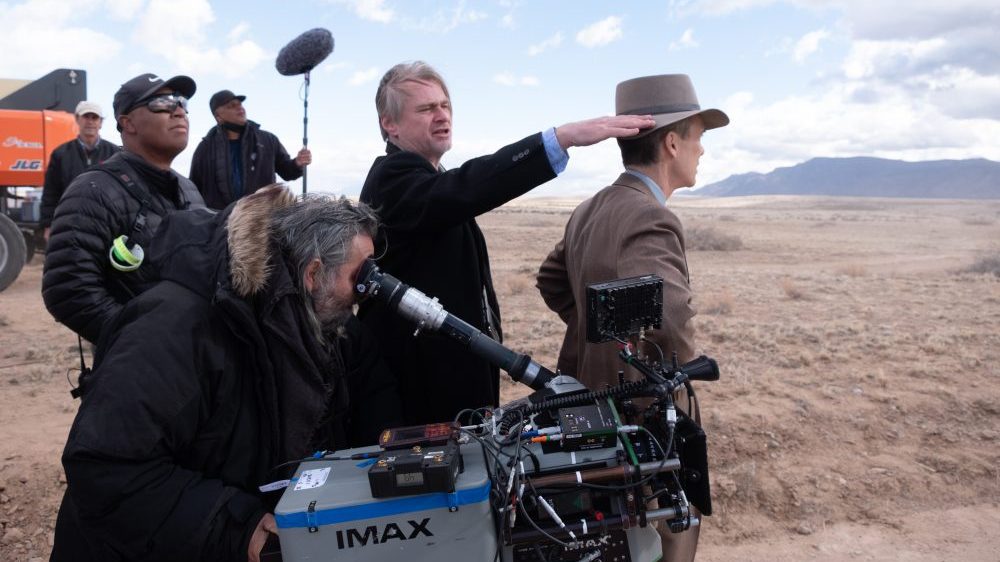
In 2020’s “Tenet,” Christopher Nolan blew up a 747, and for his latest feature, “Oppenheimer,” he recreated the Trinity Test without using visual effects, opting to find a way to do it in-camera instead.
“Obviously, we couldn’t make an explosion the size of the actual explosion so we used trickery,” cinematographer Hoyte van Hoytema explains, and no, they didn’t detonate a real atomic bomb.
The ten-minute sequence capturing the first-ever successful atomic bomb detonation came together through many experiments. It was a given that Nolan would do the scene in-camera. “We’re suckers for this absolute depth of resolution that IMAX give us,” van Hoytema says. “But when you go to VFX, you have to scan it, and the moment you do that, it loses half of its resolution.”
Their goal was to preserve the quality of the film stock.
Despite not using VFX, Nolan and van Hoytema worked closely with special effects supervisor Scott Fisher and visual effects supervisor Andrew Jackson on a number of experiments to see how the scene could play out.
Van Hoytema says, “We created science experiments. We built aquariums with power in it. We dropped silver particles in it. We had molded metallic balloons which were lit up from the inside. We had things slamming and smashing into one another such as ping-pong balls, or just had objects spinning.”
“We had long shutter speeds, short shutter speeds, wide negative color, negative overexposure, underexposure. It was like a giant playground for all of us,” the D.P. recalls.
How van Hoytema and the team actually pulled off the jaw-droppingly spectacular moment remains a mystery. With each experiment, Nolan and van Hoytema would look at how the combination came across on screen.
“The Trinty Test was something that came together and was cobbled from the miniatures of that science experiment, under the guidance of Chris and my guidance, that we pushed slowly in certain directions in order to serve specific functions in these sequences,” is all he can say.
In total, the sequence took several weeks to film. Van Hoytema explains, “The build-up was fragmented. There’s a lot of cross-cutting and people doing different things before it culminates.” He adds, “It’s this immense group of people from all over the country who put their heads’ energy together, and under the guidance of Oppenheimer lead this project into that final bang.”
Known for his widescreen vista shots, van Hoytema says his assignment this time was to capture the intimacy, since the story was being told from Oppenheimer’s point of view. Van Hoytema explains, “It was very much about what was going on inside his head, what he’s thinking and what we can read in his eyes, so we really needed to be there with him and progress that throughout the story.”
However, there was another story threaded into “Oppenheimer,” that of the confirmation hearings of Lewis Strauss, played by Robert Downey Jr., and that was where Nolan and Hoytema chose to integrate black and white. “It was a way to separate Strauss’ experience away from the color stuff,” the D.P. says.
But black and white IMAX stock in 70mm did not exist. The cinematographer went to Kodak and asked if the film supplier could manufacture the stock. Van Hoytema says, “They came out with test rolls for us to run through our camera. We had to re-engineer our cameras a little bit, and we had to remake our pressure plates and our backend lab work needed to be readjusted.” He adds that what he thought was going to be very simple became a “big engineering feat of a work pipeline from pre-production to production and then on to post.”
Says Hoytema, “I do remember when Chris and I were sitting in the cinema and watching the results of our first black and white test and it was just freaking amazing. We had never seen anything like it.”
Prime Video teased the return of “Invincible” at San Diego Comic-Con with a new trailer, unveiling a star-studded lineup of new characters joining the fun in Season 2. The show is set to return for the first half of its eight-episode second season Nov. 3, with the remaining episodes set for release in early 2024.
The adult animated superhero series, which comes from Skybound Entertainment, is based on the groundbreaking comic book by co-creator and executive producer Robert Kirkman, Cory Walker and Ryan Ottley.
Season 2 will continue to follow 18-year-old Mark Grayson, who struggles to rebuild his life as he faces a host of threats, all while battling his greatest fear — that he might become his father without even knowing it.
The show’s cast includes Steven Yeun, Sandra Oh, Zazie Beetz, Grey DeLisle, Chris Diamantopoulos, Walton Goggins, Gillian Jacobs, Jason Mantzoukas, Ross Marquand, Khary Payton, Zachary Quinto, Andrew Rannells, Kevin Michael Richardson, Seth Rogen and J.K. Simmons.
The teaser also unveiled a slate of talent sharing their voice in the new episodes, including Sterling K. Brown, Chloe Bennet, Calista Flockhart, Scoot McNairy and others.
In addition to Kirkman, the series is executive produced by David Alpert, Catherine Winder, Simon Racioppa, Margaret M. Dean, Rogen and Evan Goldberg. Walker and Helen Leigh serve as co-executive producers.
The release date for Season 2 was revealed during a panel at this year’s San Diego Comic-Con.
Additionally, Kirkman revealed during the panel that a special standalone screening of “Invincible Atom Eve,” an origin episode focused on the character, will premiere on the Amazon-owned streamer on July 21 and screen at the convention.
Eleven’s character development has come a long way since season 1, with her timid and isolated personality contrasting sharply with her later spunky and beloved persona.
Steve started off as a real jerk in season 1, fulfilling the role of a high school bully, but has since evolved into a lovable character and a good friend to the rest of the group.
The show seemed to introduce some intriguing storylines, such as the Demogorgon eggs and the deepening mysteries of the Upside Down, but these plot points were never explored further in subsequent seasons.
There’s no better way to beat the hiatus blues while waiting for the upcoming season than to rewatch Stranger Thingsseason 1, but there are a few harsh realities about watching the first season today. When it was released in 2016, season 1 was a massive success. The iconography of Joyce using the Christmas lights to talk to Will was everywhere, and people especially loved all the clever references and 80s nostalgia that permeated every episode of the first season.
When audiences first entered Hawkins, the show truly was full of mysteries that only began to unravel in the seasons to follow. In season one, especially in the beginning, no one knew where Will had ended up, or why Eleven had the telekinetic powers that she does. However, returning to the show’s earliest days does leave room for a few realizations that viewers may not have necessarily had the first time they watched. Now, though, it’s difficult not to think about how drastic some Stranger Things characters’ arcs have been or which details have never come up again.
10 Eleven Hasn’t Come Into Herself Yet
Over the years, the Duffer Brothers have dedicated many hours of screen time to Eleven’s identity, powers, and backstory. In season 1, though, Eleven has only the beginnings of the spunk and personality that audiences have come to love her for. When Mike and the boys find her, she speaks very little and has to spend most of her time hiding. It goes to show how far she’s come when she is so isolated and timid in the first season. She’s even become enough of a fan favorite that people are hoping Stranger Things will give Eleven a happy ending.
9 Steve Was A Real Dick
Stranger Things has always been an homage to 80s media and tropes. At the show’s inception, Steve fulfilled the archetypal high school bully role, the handsome heartbreaker that the heroine, Nancy, falls for. In later seasons, Steve becomes far more lovable, even having a good friendship with Dustin. In season one, though, he was a real dick. When he spots Jonathan in Nancy’s room, he confronts her by calling her a slut rather than asking for the real story. Lucky for the audience, the Duffer brothers decided to cut one problematic Steve scene from Stranger Things to make room for his current character evolution.
8 Everyone Forgot About The Guy Who Saved Eleven
Before Mike, Lucas, and Dustin found Eleven, she had wandered into a diner. The man who worked there, named Benny, saw Eleven by herself and gave her a burger, fries, and ice cream while trying to help her by calling Social Services. Unfortunately, Dr. Brenner and his agents arrived posing as Social Services, and shot Benny dead. When Hopper and the police find the body, Hopper expresses that having to investigate his death feels more personal because he knew Benny. Despite that, no one, not even Eleven or Hopper, ever brings him up again. R.I.P, Benny.
7 Hopper Was In A Bad Place
Hopper may have been in a literally bad place at the beginning of season 4, since he was trapped in a Russian prison, but he began Stranger Things season 1 in an emotionally bad place. The scene that introduces him to the audience shows him passed out on the couch, alone, before waking up and washing down his pills with a morning beer. His attitude toward Joyce is dismissive and sour. Even at the end of the season, he sells out Eleven’s location to Brenner for the chance to save Will – ironic considering the parental role he later steps into for Eleven.
6 That Egg Tease Went Nowhere
Stranger Things season 1 showed the Demogorgon feeding off some kind of yellow egg before Eleven was able to establish a telekinetic connection with it. When Joyce and Hopper finally make it into the Upside Down to save Will, Hopper finds an egg cracked open on the ground, seemingly as if it hatched. Between the first and second seasons, fans theorized about what kind of Upside Down nightmare could’ve hatched from these eggs, and if the audience would ever get to see it. But the show never called attention to the eggs again or showed anything that resembled them.
5 Yes, You’re Old
It may not feel like it, but Stranger Things is seven years old. The show was released in 2016 and became a pop culture phenomenon in the following years. Audiences have seen the child stars grow up before their eyes, especially when the pandemic delayed the release of more seasons. No amount of awkward haircuts in season 4 can hide the fact they’re all grown up now, which is likely the reason that season 5 will have some kind of time jump. Many fans have their own theories about Stranger Things season 5’s time jump, and how it can do more than just rectify how grown-up everyone is now.
4 Will Isn’t Really A Character
Though Will is a character in the literal sense of the word, and the entirety of Stranger Things season 1 revolves around finding him, he doesn’t get all that much screen time. That’s a necessary consequence of being trapped in the Upside Down for the majority of season 1, but he feels far more fleshed out as a character when the audience has time to bond with him and follow his conflicts in season 2. Hopefully, as the show is heading toward its conclusion, the Duffer Brothers will give his character more importance, like Will potentially saving Max in Stranger Things season 5.
3 Barb’s Death Is Still A Low Point
Returning to season 1, Barb’s death was dramatic irony in the cruelest sense. On the last night of her life, she tells Nancy before they go into Steve’s house that she should go home. The viewer can’t help but wonder if Barb would still be alive and well in season 4 and beyond if she had followed her instincts, or if Nancy had shown a little more regard for her friend’s feelings. She quickly became a fan favorite, so Barb’s death in Stranger Things season 1 was controversial at the time, and it still leaves a sour taste years later.
2 The Absence Of More Female Characters Like Max, Erica, and Robin Is Noticeable
Especially after Barb is gone, the lack of main female characters besides Nancy, Joyce, and Eleven becomes far more noticeable. Nancy is caught between Jonathan and Steve, Eleven spends all her time with Mike and his friends, and Joyce is largely isolated while consumed with the search for her son. The addition of characters like Max, Erica, and Robin in later seasons was a welcome change, particularly when Max and Eleven formed a friendship and Nancy and Robin went on a mission together. Giving Erica a larger role to play in season 4 was also a smart move, as she has become a fan favorite as she gets to show more of her personality.
1 The Kids Have No Idea How Deep This Goes
At times, it’s hard to watch Stranger Things season 1 and remember how innocent all the young characters were. The disappearance of Will and the arrival of Eleven in their lives marked the end of these kids’ childhoods, in a way, because it opened up the gates for so many, bigger scarier problems in their world. The kids have no idea yet about the Mind Flayer, Vecna, or even the scope of the Upside Down – those threats are so massive that Stranger Things season 5 may be a different show in terms of tone and scope. Upon a rewatch of Stranger Things season 1, it almost makes the audience wish that Mike, Will, Lucas, and Dustin could sit down for one more playful game of Dungeons & Dragons, but that’s not likely to happen for them anytime soon.
While Charlie Kaufman and Guillermo Del Toro have announced new emphases on animation, Refn exclusively told IndieWire that he is current working on an animated TV series.
“I’m doing an animation show which I’m very, very, actually really excited about,” the “Only God Forgives” auteur said. “I’ve been concentrating on for a year. I was so tired, I forgot about that. That is my new project.”
Refn is also creating an adaptation of famed British sleuth series “The Famous Five.”
“In Europe, it’s like institution. It’s like British royalty when it comes to pop culture of literature,” Refn said. “They are these old children’s books from the ’30s from England and everyone read them who as growing up all over Europe. Everyone has had their parents read them ‘The Famous Five.’ My kids know them backwards and forwards. And so it was something that myself and my partner at [production company] Moonage, Matthew Read, had just been discussing for years.”
Refn continued, “It could be fun to make ‘The Famous Five’ again because the options keep on coming up and going and he was able to secure the rights suddenly. After ‘Neon Demon,’ we were actually discussing it and then he was able to get the rights recently and so I just signed on to create it. I don’t run for production. I’m not directing it. I’m purely just creating my version of ‘The Famous Five.’”
Refn is listed on IMDb as creator, writer, and executive producer for the upcoming series. The “Drive” director linked “The Famous Five” to the creation of “Scooby Doo,” a property he may be interested in exploring down the road.
“Fun fact: I’m told that ‘The Famous Five’ was also the inspiration for ‘Scooby Doo.’ So that’s a little Wikipedia footnote,” Refn said. “But apparently the story is – at least this is what Matthew told me – that at one point they were trying to sell ‘The Famous Five’ brand to the U.S. and something happened that didn’t really go through. And so someone then took it on and then that became ‘Scooby Doo.’ I don’t know if it’s true or not. So obviously, you know, take it with a grain of salt, but it’s a great story.”
Refn’s own personal history with “Scooby Doo” has influenced his filmmaking style.
“I grew up on ‘Scooby Doo’ as well. The older ’70s versions, those were of my time,” Refn said. “I loved them and I always loved Scooby Doo, Shaggy, and all those characters. I think they’re terrific. What I like about the old versions is that they had that romanticism. And I like the 2D drawings and stuff like that.”
Refn stayed mum on additional series “Les Italiens,” teasing that it is a “larger concept than just on the drawing boards.”
And when asked whether he is looking for his next project to write and direct, Refn replied, “I think you’re always looking. It’s like oxygen, it’s like you want to breathe. I mean, sure, we all have plans. I think I’m going to paint actually, but that’s just something new that’s come my way.”
Bennett considered Count Basie and Duke Ellington the two greatest bandleaders he’d ever heard, and with the great Milt Hinton on bass and the Basie and Dizzy Gillespie sideman Joe Wilder on trumpet, he swings effortlessly and joyfully on this Ellington jazz standard. Bennett had something close to awe for great jazz musicians, which may be why he never claimed to be part of that tradition. “I’m not a jazz singer,” he often said. “I’m a singer who likes jazz.”
Between 1951 and 1963, Bennett released 19 songs that reached the Top 20 of the Billboard singles chart. Then the Beatles came along and the hits stopped. The Columbia Records honcho Clive Davis pushed Bennett to cover modern pop hits, and on the day he began a new record a new record that included Beatles and Stevie Wonder songs, Bennett vomited, Davis recalled. The singer was a trouper, though; the “woo!” he interjects in the middle of George Harrison’s “Something” is almost convincing.
Bennett had an affinity for pianists: Art Tatum was an enduring influence, he had a long partnership with Ralph Sharon, and he made one of his best albums with Bill Evans. Though he wasn’t a master of urban ennui on the level of Sinatra, Bennett does wring all the bittersweet rue out of this song, written by Leonard Bernstein, Betty Comden and Adolph Green for the musical “On the Town,” by singing in parallel with Evans’s lyrical, prudent piano.
For much of the ’70s, the toll of drugs, divorce, tax problems and depression wore Bennett down. Then his son Danny took over as his manager and engineered a return to Columbia Records. Maybe more significantly, Bennett reunited with Sharon and recorded his acclaimed comeback with just piano, bass, drums and an orchestra. His voice was now rougher, but especially on his version of Irving Berlin’s “I Got Lost in Her Arms,” he adjusted by infusing his lower register with savvy understatement.
Bennett loved the Great American Songbook, but eventually, a prolific singer runs out of pre-rock standards and needs to find slightly younger material. So Bennett was delighted when, in a restaurant one night, he heard the piano bar stalwart Charles DeForest perform a song he’d written, “When Do the Bells Ring for Me.” It became a concert showcase for Bennett, thanks to its climactic high notes, and when he sang it at the Grammys in 1991, he got a standing ovation.
Biographically, Bennett couldn’t have had less in common with Cole Porter, a Midwesterner born to substantial privilege. But Porter’s giddy use of double and triple rhymes was perfect for Bennett’s rubato trickery, so his second album with Lady Gaga was a Porter-only affair, released five years after Bennett was given a diagnosis of Alzheimer’s disease. And let’s be honest, it’s a kick to hear a 95-year-old master sing, “Some, they may go for cocaine.”
Often neglected by the oversaturated production industry in London and the south of the UK, the north has faced limitless challenges for independent filmmaking. Directors struggle to find producers, and without a producer there is no film to be made. Government support and funding are lackluster in their efforts, as they focus on the production hub that is London. Of the 170 million spent by the BFI, only 9 million is spent in the northwest. Stories and storytellers don’t just exist in the UK’s capital city, but throughout the country and up north. The future of independent film in the UK rests on the chance that production in the north is put back on track.
I was lucky to have the opportunity to speak with director Keith Farrell about his work in film and journey through the industry. Being a filmmaker up north while the production scene in London dominates the entire country, he holds a very personal and important perspective. Farrell is a Manchester based director, who’s done both documentary and narrative work. Just this year he won Best Director at Manchester International Film Festival, for his debut feature, Wait For Me. He’s previously directed docudramas for networks such as RTÉ, PBS, Channel 5, and The Smithsonian Network. Many of his short films have been screened at Oscar qualifying festivals and have won plentiful awards.
You began your directing career making documentaries; what initially drew you to that type of filmmaking? Was there one story you wanted to tell specifically or did you intentionally look for a story to tell?
My background actually began when I left school. I started working as a journalist for my local newspaper. So my background was in journalism. And it’s kind of an easy step from journalism, documentary making. And when I moved to the UK around 2000, I decided I wanted to study filmmaking. I went to Born University, and then I moved up to Manchester and got an opportunity to work with Granada Television. I was hired to work in their department of documentaries. It was a really great place to learn. There were so many fantastic documentarians there. And on my first day of the job I sat besides a BAFTA winner, two time BAFTA winner… there was an Emmy winner across the floor. It was just a kind of experience you don’t get anywhere else except in one of those kinds of places… what would have been a traditional British television company, the kind that don’t exist anymore.
So that’s kind of how I found my way into documentary making. I didn’t initially want to be a director. I was initially on a route to producing. I started my career as a researcher, then an assistant producer, then I became a producer. And then in about 2005 had an idea for a documentary, which looked at how Ireland allowed Nazi war criminals and collaborators into the country at the end of the Second World War, and at the same time refusing to allow Jewish refugees in. At that time my boss said, “look, we’d never get [that] off the ground with ITV”. We really struggled to get it in the UK, but there might be a good [chance] in Ireland. So I went over to Ireland, worked with a producer over there called Stephen Rook. We got a commission, and I decided to direct that documentary. It explored a real kind of dark part of Irish history which had not been explored before. I got the book for making docs after that, and I kind of started making docs that often were historical subjects that covered kind of difficult periods in Irish history. I also started making stuff as a doctorate director in the UK as well. So I started dividing my time between the UK and Ireland. I had a particular interest in UK Irish stories, immigrant stories, or stories that link these two islands. And that’s how it kind of came about.
From about 2015, I started doing short films, narrative shorts. My first one was called Rabbit Punch, which looked at a refugee story in Manchester, and then I grew from there. That’s how I ended up making feature films. Now, I still make docs. I’ve actually just finished a three part series about the Irish Civil War for Irish TV.
Was your initial background in journalism something easy to translate to filmmaking? Did it help with the research part of documentary making?
Yeah, the skills were transferable. I had a really good grounding in research from my work as a journalist. I was pretty good at kind of digging and finding stories I needed to find. I was pretty good on the phone, speaking to people and kind of working my way around bureaucracy. You do a lot of that as a journalist, even if it’s just local reporting, ringing councils and finding information. So that kind of felt natural fitting with where I came from as a documentary maker.
You’ve done both documentaries and narratives. What’s the biggest difference for you as a director between a documentary and a narrative? Do you think there’s a big difference in how you go about it or do you kind of have the same mindset?
There is a huge difference in some respects, and in some ways there’s not. You’re still telling stories with pictures, let’s be honest. Whether it’s a drama or documentary, you’re still telling a story visually. It’s a visual storytelling medium. But I think the key thing you have when you start a drama is you have a script, which is really great. You know the story’s beginning, middle, and end. In a documentary, you don’t necessarily know that at the start.
You also have a much bigger team around you when you’re making a [narrative] film. While with documentary making, you’re a much smaller team and you’re kind of a little bit more on your own. And it’s easier to fall. You can fall farther and harder in documentary making. If you make a mistake in a drama, you have a support network around you. So that was the first thing getting used to. I’m very independent from documentaries, so getting used to it for me, I found it quite hard to get used to letting other people do their roles.
Your most recent film, Wait for Me; Why was it a story you wanted to direct? What drew you to it?
As an Irish emigrant to Britain, I’m interested and fascinated by Irish emigrant stories. Not all of them are success stories. We love in Ireland to trumpet the success stories, the person who goes with two pennies in his pocket and builds up a business empire, whether that’s in the United States or the UK. They have pretty ordinary lives, they work, they have kids, and they settle in. They become good immigrants. But there’s those who get left behind. The case of our central protagonist, what I really liked about her when I read it was, as a journalist, I’ve met those people.
When I first moved over here I still was working as a journalist, did a bit of writing for the Irish Post, and I met people like Alison who have been left behind, haven’t been successful, haven’t even had the moderate immigrant story of settling down, having a good job and having a reasonable life. There are actually a lot of emigrants who end up falling into that trap, and it can happen for many different circumstances, dragged into criminality. And so I think that’s what attracted me to the story as well. Bernard’s writing was really impressive as well. I like the idea of two kinds of outsiders coming together, find each other, but it’d be a platonic relationship, not a love story as such. Two different kinds of people who have by chance found each other and go on this road together. And then for Alison, it’s a redemption story. She fixes her past. One of the things that’s in the film is that they had to leave Belfast really quickly because of something her father had done. And they’d been driven out by paramilitaries, which is quite a common story. It was quite a common story in the early 2000s, and still goes on today.
Paramilitaries are still excluding people from Northern Ireland and they literally have to jump on a bus with minutes to go and find themselves in the city and they’ve no idea where they are, so it’s easy to fall into that life of crime. I don’t think people realize it. It’s easy to fall into poverty and criminality and go about your current life in a way you don’t expect. So that’s what appealed to me because I knew the stories, I knew these people. And in a weird way it seems like there’s a lot going on, but actually there’s so much more that could have been told. I think sometimes you can get criticized for being too dark, and maybe we were a little bit too dark, but this is the reality.
How involved were you in the casting process? I feel like it was very well cast. What was the main thing you looked for? They all felt like very real people.
With the exception of Neil Bell, who plays Max [we really struggled to cast Max], we did auditions for everyone. And we chose our cast based on the best addition, we did blind additions. So none of the characters had any distinctions, we didn’t say what race they were or where they’re from. The only thing we did insist on was that you had to be able to do a northern accent, because it was set in North England, and for the Irish role you had to be able to do an Irish accent. Those were the two key only things we insisted upon. So, for example, Theo isn’t a native Yorkshire man, even though his accent comes across. He’s from Croydon. But he just blew us away when he read for Barry. He was really good.
And Elva Trill, I’d worked with Elva before on two shorts, so I knew her really well. And she’d actually originally read for the Allison part, but I didn’t feel she was right for Alison. We chatted and I thought she’d be a great Karen, which she was. And then, obviously, Karen Asan as Alison, is just outstanding. She just ties the whole film together.
And then randomly, Max. We just really struggled to cast a Max. And then I saw Neil Bell in a short. He wasn’t playing a bad guy, he was playing this guy racked by grief, but there was just something about his performance in that short that I just went, oh, my God, he’d be brilliant. Because he [Neil] normally plays that kind of lost soul type character, or a gruff type character, but not necessarily evil or bad. So it was quite a bit of a departure from him. But he was brilliant in the role. I mean, he was really good. His sense of menace on screen is incredible. So, yeah, so that’s where that came from.
With regards to filmmaking in the north of the UK, what were the challenges you faced while filming?
I mean, the biggest challenge was access to support, both in terms of finance and practical support. We were very lucky that we got an investor to invest in the film. But we really struggled to initially get a sales agent to give us figures to help us raise finance, and we really struggled to get any support from London based operations. We did get support from screen Yorkshire, I just want to stress that we got support from Screen Yorkshire! And without that, I mean, both financially and in a practical manner, screen Yorkshire was just invaluable. If something in your case falls through or you’re struggling, they’re brilliant. But they also provided all our trainees, they came from Screen Yorkshire, so they paid [the trainees] fees. Without them, we couldn’t have made the film. But outside of the north, we had no support whatsoever. And we are very much kind of left to our own devices. As a filmmaker in the north of England, you have no support whatsoever. 70% of all production companies are based in London, so obviously there’s a natural focus there. But since 2010, there has been a failure to try and support emerging production companies and producers in the northwest. And so it was really hard for me to find a producer to begin with. I was very lucky. I found Theo Burrows, who was an advertising producer, who had won Cannes Lion, who was looking to produce a feature film. And then I found Margaret Douglas, who was an award winning producer of short films, who was looking to make a feature film.
Before 2010, there was Northwest Vision, and there were regional screen agencies that supported filmmakers, and they were gotten rid of by the coalition government. And there’s been no replacement. And all the funding was handed to the BFI. And the BFI, don’t get me wrong, they’re a cultural organization, they do an amazing job preserving and protecting British film, but they’re not an economic organization. And where Screen Yorkshire stands out, as opposed to say the BFI is, screen Yorkshire is an economic organization. Its job is to support the economy of filmmaking and filmmakers. So I’ve been very lucky.
In the last few years, I’ve managed to work in Northern Ireland and I’ve managed to work in the Republic of Ireland, and I’ve worked with their screen agencies, Northern Ireland Screen and Screen Ireland, which are both economic bodies. And I’ve realized that what we’re lacking in the north of England is a body, a champion that can help not so much emerging directors, even though I am a director, but producers. Really the hardest part for any director is finding a producer, because there’s no support in the north of England. So we are one of only two films to be released this year from the northwest of England. To the best of my knowledge, it’s ourselves and a film called Poland Shoes, which was produced out of Liverpool. Now, that’s a shocking indictment of the British film industry. That only two films in northwest England. And to put that in context, the northwest of England is the third largest population in the United Kingdom. So the fact that only two feature films have come out of the third largest population area compared to Northern Ireland Screen, with a population of 1.5 million, who produced, I think, 5,000,000 films in the last 18 months. So you could see the difference, why I think we need a screen agency for the north.
And the other problem is, it’s a telling indictment that 70% of all film production companies are in the south of England. There is this lack of support, there are no new companies emerging. I can’t think of a major production company that has emerged out of the north, out of Manchester since 2010, without either A, getting funding from a major broadcaster, like ITV, or B, having to set up a London office to survive.So it’s really hard to set up for production companies. And without producers, we don’t have directors who create films. And without my producers, I couldn’t have made this film. And I think that’s my calling card as a director, that sounds strange, but we’re not given any support by production companies, we’re not giving any supporting producers. Either they’ll end up having to move to London to work, or they’ll have to leave the film industry and television industry completely, or take jobs that are below their pay and skill set, to survive. And I think that’s the biggest challenge of making films in the north of England. We lack a network of support and system of support because we don’t have the right economic bodies in place to allow filmmakers to move from short films. And there’s lots of support from the BFI for short filmmakers in the north, but not feature films.
So you make your short films as a producer in the northwest, then you either have to go into advertising or go into television. We’re losing film. Filmmaking is fantastic. There’s nothing like sitting in a cinema with, you know, fifty to sixty people and watching a film together. It’s one of the last great collective experiences, you know what I mean? In the dark, and everyone just transfixed on the screen. It shouldn’t always be Hollywood blockbusters. We should be supporting our own filmmakers. And the best way to do that is support the whole of the UK.
What’s special to you about independent filmmaking to you, specifically in the north of England?
I was at a cinema called The Rex and Ellen. It’s a beautiful 120 year old cinema, and the man who owns it owns about five or six of these small independent cinemas. And he has a passion for independent cinema. And what he said to me is, we don’t get films that suit our audience. We do not get films that our audience wants to see or relate to. And that’s what we lose by not supporting northern film. That’s what I love about the filmmaking in the north, is that you have an opportunity as an independent filmmaker to tell stories on the big screen that don’t normally get told.
What’s your favorite part about filmmaking? What makes you think, this is why I am happy with what I do?
I love controlling the chaos, I’ll be honest with you. Filmmaking is a chaotic process, and things go wrong all the time. Weather changes, especially in the north of England. This may be constant with documentary making, but I’m really good at handling things and working. Just making it work. And then to add to that, I love being on set. I just love working with actors and making scenes work with actors and kind of getting the actors to have their voice, but also making sure that their voice matches the script of the story as it has to be told. And that’s what I love. And when you work with great actors, it’s a pleasure, but it’s also a pleasure working with new and emerging actors like Izzy Dawson, who played Ruby. It’s great working with them and nurturing them through that process.
That’s one of the skills I have as a director. I was able to do that and really enjoy it. And then when things go wrong, being able to cope with that, I mean, you’ve got to be decisive. The key thing about being a director is you’ve got to be in control, decisive, even if things go wrong. And I love that, actually. I love being able to handle that pressure and then get the best performances out.
Kaleen Gendreau is an intern at Raindance, and she previously earned her BA in Mass Communications and Production from the University of South Florida, Tampa, in the spring of 2023. She’s written and directed two student film projects, and spent a lot of her time at university working and filming in a virtual production studio.
Saturday AM: Refresh for more analysis and chart…At a time when Hollywood fears that the Q3 and Q4 2023 release schedule will fall apart due to the dual SAG-AFTRA and WGA strikes, the motion picture industry is reaping one of the biggest domestic box office weekends on record with Warner Bros.’ Barbieand Universal’s Oppenheimerlighting up an estimated $308M+ overall three-day. That’s the biggest weekend post pandemic easily burying the weekend when Spider-Man: No Way Home opened over Dec. 17-19, 2021 and all pics tottaled $282.9M. Per Comscore, this weekend will be the fourth biggest of all-time after Avengers: Endgame frame (April 26-28, 2019; $402M), Avengers: Infinity War‘s weekend (April 27-29, 2018; $314.8M) and the weekend when Star Wars: Force Awakens debuted (all pics over Dec. 18-20, 2015 grossing $313.2M).
Barbie has a lot of bragging rights beyond owning a dream house: Warners says $150M+ still for Barbie, but industry calculations believe it’s well over $161M, any way you cut it, it’s the biggest opening weekend of 2023 to dateafter an opening day, also best YTD, of $70.5M. Oppenheimeris eyeing $77M after a $33M opening day — just mindblowing that a 3-hour adult drama could emulate what’s akin to a superhero movie in its first installment. Oppenheimer is Christopher Nolan’s third best career opening at the box office; it’s also the best opening for an R-rated movie YTD, outpegging John Wick: Chapter 4 ($73.8M). It’s also a testament to his fan power, which he accumulated from his Dark Knight days, the 18-34 bunch here still strong at 59%. Both movies get solid A CinemaScores. Note, whatever the industry is calling safely here this morning could payout like a broken slot machine by tonight: Whenever there’s heat on a movie, it just keeps going up and up and up at the box office.
One distrib points out that never before in the history of box office has a weekend seen one movie open to $100M+ and a second to $50M+.
This moment should be a come-to-Jesus for the major studios: Get back to the bargaining tables with SAG-AFTRA and come to a deal. The guild’s National Executive Director and Chief Negotiator Duncan Crabtree-Ireland told Deadline yesterday that they’re still waiting to hear back from the AMPTP and ready to talk. After the industry and exhibition struggled to get box office back to this point after a year of closures in major markets during Covid, why should the ecosystem potentially be capsized again? Already there are whispers that Dune: Part Two is moving off its first weekend in November release date. If that happens, it will leave an enormous crater in the schedule. Why ruin a good thing?
TOPSHOT – Barbie cosplayers pose outside the convention center during San Diego Comic-Con International in San Diego, California, on July 20, 2023. (Photo by Chris Delmas / AFP) (Photo by CHRIS DELMAS/AFP via Getty Images)
While David Zaslav’s Warner Bros Discovery has had clunky times recently with DC Studios’ Shazam: Fury of the Gods and The Flash tanking, the studio is a phoenix rising here with Barbie having lassoed this pop culture whale from the onset. Zaslav, I’m told, declared this summer, the summer of Barbie and had all units working to open this film. Warner Bros. social media marketing promptly stoked millennials and every single woman on Earth with memes whereby folks placed their own photos into the Barbie logo. It was an old internet marketing tactic made new, giving early fans an ownership of the movie.
Now they’re dressing up like Barbie and heading out to the theater and taking over San Diego Comic-Con this weekend. However, they’re taking ownership of both pics, Barbenheimerin a frenzy on social….this is absolute ecstasy for any Hollywood studio marketing exec.
The pure joy of our audiences last night for Barbie/Oppenheimer was intoxicating. Have not felt this kind of cinema energy in our lobby in I don’t know how long. For all the sour grapes complaints abt Barbenheimer, I hope folks understand what a HUGE deal this for indie cinemas pic.twitter.com/WIDRNnA6ax
Record breakdown: Barbie per Warner Bros had the largest presales in the studio’s history, and the pic is repping record openings for filmmaker Greta Gerwig, Margot Robbie (besting Suicide Squad‘s $134M) and Ryan Gosling (Beating Blade Runn 2049‘s $33M start). Barbie‘s opening is one of the best of all-time for a female skewing movie (68% currently) after Beauty and the Beast ($174.7M), The Hunger Games: Catching Fire ($158M), Captain Marvel ($153.4M), The Hunger Games ($152.5M). The feature take of the Mattel doll has an opening day that’s above such female-fave titles as Hunger Games ($67.2M), Beauty and the Beast ($63.7M) and 2010’s Twilight Saga: Eclipse ($68.5M).
Females under 25 on CinemaScore (at 26%) give Barbie an A+. PostTrak exits are currently at 89% positive and a 79% recommend with kids under 12 giving it 87% in the top two and a 75% must see. Largest demo was 18-24 year olds at 27%. Diversity demos were 42% Caucasian, 29% Latino and Hispanic, 12% Black, & 17% Asian/other. “Barbie played strongest….everywhere,” beamed one distribution source today. Warners wound up securing the AMC Dolby Vision screens in all spots where an Imax screen also exists, which I’m told was a smart move here since the movie is overperforming. PLFs, largely Dolby Vision, are greasing 10% of ticket sales and less than 700 auditoriums are generating that. The AMC Burbank is Barbie‘s top hub in the nation with $194K so far, including previews.
Zaslav’s conglom power promo plan for Barbie was themed around “Barbie In the Real World”. Some of the highlights included: The Barbie Dreamhouse Challenge on HGTVA, a four-part competition series that debuted on July 16 which had HGTV show talent compete in teams to redesign a home in various Barbie inspired rooms from across the decades. The film was featured throughout the program with fun clips as well as in promos leading up to its debut and on-air graphics across the network. There was a Summer Baking Championship on Food Network which was a Barbie-themed competition segment within the Summer Baking Championship show on June 16. There were Barbie logo takeovers across the Warner Bros Discovery 15 network suite including Discovery, Food, HGTV, TLC, TNT, TLC, Tru and more.
Oppenheimer‘s Imax screens and a chunk of PLFs (non Dolby Vision) rep close to half of this weekend’s gross (yowza). 70MM prints, another format of choice for Nolan; those venues are sold out, I hear. PostTrak still high at 93% positive and a 74% definite recommend. Guy leaning here at 64%, and the 18-24 year olds the biggest demo at 33%. Diversity swath is 53% Caucasian, 22% Latino and Hispanic, 9% Black, & 15% Asian/other. Oppenheimer played strongest in the East, Mid-West & Mountain regions, but was nuclear everywhere. Pic’s best theater in the country is Hollywood’s TCL Chinese Theatre with $153K including previews so far.
8.) Spider-Man: Across the Spider-Verse (Sony) 1,669 (-908) theaters, Fri $855K (-50%) 3-day $2.9M (-52%) Total $375.2M /Wk 8
9.) Transformers: Rise of the Beasts (Par) 834 (-1,207) theaters, Fri $311K (-68%) 3-day $1.1M (-67%) Total $155.6M/Wk 7
10.) No Hard Feelings (Sony) 1,017 (-1036) theaters, Fri $345K (-65%) 3-day $1.08M (-67%), Total $49.2M /Wk 5
Friday Miday: Warner Bros.’ Barbie is eyeing $68M-70M today, including last night’s previews, for what’s shaping up to be the best opening of the year with $150M at 4,243 theaters. That would beat the 3-day of Super Mario Bros‘ $146.3M. Some rivals see higher like $165M-$170M but it’s still early and everyone is getting excited. Remember, female skewing movies are very front-loaded (remember a movie called Twilight?).
Universal’s Oppenheimer is certainly not getting scraps: It’s headed for $32M today, including previews, and a $75M 3-day at 3,610 theaters. That’s higher than Indiana Jones and the Dial of Destiny‘s $60.3M start. Wow.
Do your math, the two titles are fueling $225M alone this weekend.
So far, Paramount’s Mission: Impossible – Dead Reckoningdespite shedding Imax, isn’t taking a horrible hit, -54% in weekend 2 with $25M with a $124.2M running total. Friday is looking like $6.6M.
Angel Studios’ Sound of Freedomat 3,285 is resilient as well with an amazing $20M, -26%, weekend 3 and running total of $124.6M. Disney’s Indiana Jones and the Dial of Destinyis fifth with an estimated fourth weekend of $7M, -43% and running cume by Sunday of $159.3M.
UPDATED after Thursday exclusive: Warner Bros has made it official thatBarbiehas collected the best previews of not only this summer but all of 2023 with $22.3M, which bests Guardians of the Galaxy Vol. 3‘s $17.5M. It’s a great weekend for the house of Zaslav in the wake of The Flash stumbling last month. All eyes are on the Warner Bros Discovery share price which as of this post is around $13.02 (-0.7%).
Meanwhile, Universal says Oppenheimerdid $10.5M at 3,150 theaters.
Barbie’s cash includes the $1.1M from Wednesday previews at 500 locations. Even if you take those out, Thursday’s $21.2M are still the best of 2023. In all, Thursday previews were booked at 3,400 locations.
Warner Bros
We had said from the beginning that Barbie was ahead of Diseny’s The Little Mermaid in presales — well, she’s double what the fish brought in, which was $10.3M (translating into a $96M 3-day). Early Rotten Tomatoes audiences scores show 90% for Barbie and 94% for Oppenheimer. Early PostTrak shows 4½ stars for Barbie and a 79% definite recommend. 82% were general audiences, with 11% kids under 12 and parents repping 7%. A massive 71% female. Broken down, that’s 30% women over 25, 41% women under 25, 14% men over 25, and 16% men under 25. Parents gave it 4½ stars, with moms showing up at 79%. Kids under 12 gave the same grade, with 88% girls under 12 giving pic a 92%. The Boxoffice Company also is noting a higher rate of tickets per transaction — with some theater chains reporting an average of three tickets per purchase for Barbie — than they would normally see for a comedy, indicating healthy group sales.
Universal
Oppenheimer‘s preview gross, as we told you last night, is in the range of superhero films and blockbusters like It Chapter Two, which also posted a Thursday of $10.5M from showtimes that began at 5 p.m., a $37M Friday and wound up doing a $91M opening. However, preview math isn’t dollar-for-dollar in 3-day projections. No one is seeing Oppenheimer heatseeking past that threshold yet, with comps right now pegged to the older-guy stuff like John Wick: Chapter Four ($8.9M, $29.4M Friday, $73.8M 3-day). However, as of last night, we can’t call Oppenheimer older dude, as the 18-34 moviegoing crowd showed up at 66% for the 3-hour pic.
It earned a solid five stars from moviegoers Thursday night for the ensemble pic led by Cillian Murphy, Emily Blunt, Matt Damon, Robert Downey Jr, Florence Pugh and Josh Hartnett. Guys dominated overall at 65%. Broken down there were 40% men over 25, 24% men under 25, 19% women over 25, and 16% women under 25.
As we told you, Oppenheimer is ahead of the $5.5M previews of Dunkirk, and duly note that the footprint of PLFs is greater now than it was back in 2017.
Hayley Atwell and Tom Cruise in ‘Mission: Impossible – Dead Reckoning Part One’
Paramount
How is last week’s champ Mission: Impossible – Dead ReckoningPart Onedoing in the midst of the Barbenheimer box office atom bomb? Well, the pic’s nine-day gross stands at an estimated $99.2M at 4,327 theaters. Indiana Jones and the Dial of Destiny‘s nine-day was $113.5M. Note that Indy launched on a Friday, while Mission was a Wednesday. The Cruise sequel will keep some PLFs this weekend but hand over Imax to Oppenheimer, which will own them for three weeks. Again, it’s all about foreign for the Cruise pic; the feature cost around the same $300M as Indy. If Cruise can pull off a second-weekend decline of 50% ($27.3M) against Barbenheimer, that’s amazing. However, losing the big screens puts the odds against it. Mission: Impossible – Fallout launched in late-July 2018 and relished a second weekend that was only down 42%.
Early AM estimates show Sound of Freedomwinning Thursday over Dead Reckoning,$3.6M (-23% from Wednesday) to $3.4M (-27%) and that’s off pure Comscore estimates (that excludes crowdfunding juicing from the Jim Caviezel movie). Sound of Freedom‘s running total is $104.5M in Week 2. Dial of Destinywas third on Thursday with $1.36M, -14% from Wednesday for a third week of $18.9M, running total of $152.3M. Sony/Blumhouse’s Insidious: The Red Doorends Week 2 with $19.4M and running total of $64.4M. Thursday was $1.2M at 3,188, -21% from Wednesday. Disney/Pixar’s Elemental booked at 3,235 ends week 5 with $14.8M, a running total of $131.4M and a Thursday of $1.16M, -16%.
PREVIOUS EXCLUSIVE: The box office event of the year which has Warner Bros. mass female attraction, Barbie, and Universal’s Christopher Nolan directed, Oppenheimer, has officially fired off its confetti guns with the movies seeing respectively an estimated $20M and $9M+ from their previews. Again, these numbers could fluctuate by morning.
Even if Barbie falls short of $20M, she’s bound to post the best previews of this summer; Disney’s Guardians of the Galaxy Vol. 3 having grossed $17.5M on its Thursday night (which included $400K Imax showtimes on Wednesday). The Greta Gerwig directed feature take on the Mattel doll has previews which will include the Wednesday “Barbie Blowout Parties” at 500 sites as well as money from showtimes which began tonight at 3,400 locations at 3PM.
The R-rated 3-hour Oppenheimer started showtimes today at 5PM. Barbie will play in 4,200 theaters by Friday, while Oppenheimer, juiced by Imax, will count 3,600 theaters.
It’s an understatement to say that projections are bullish. Barbie presales are the best the industry has seen since Avatar: The Way of Water according to the Box Office Company, rivals confident the film will clear $100M-$130M. Ditto for Oppenheimer tipping the scale past $50M+; all-in-all the third time this year the entire weekend should total around $200M for all films. Critics love both films with Barbie at 89% certified fresh and Oppenheimer at 93% certified fresh.
Sizing up Barbie: That preview figure is bigger than other female skewing pics like Beauty and the Beast ($16.3M Thursday, $63.7M Friday and $174.7M 3-day), near Hunger Games ($19.7M Thursday, $67.2M Friday and $152.5M 3-day), and below 2009’s Twilight Saga: New Moon ($26.3M Thursday, $72.7M Friday and $142.8M 3-day.
Oppenheimer decimates the previews of Nolan’s Dunkirk‘s ($5.5M Thursday, $19.7M Friday, $50.5M 3-day), and is in the neighborhood of such fanboys films like Doctor Strange, Eternals, Logan and Shang-Chi. As a very talky adult drama, Oppenheimer is breaking the mold as far as comps go. Dunkirk wasn’t frontloaded, its Thursday repping 28% of Friday. Back out Thursday and Friday grossed $14.2M with Saturday up 23% with $17.5M. The question is whether Oppenheimer follows the path of a fanboy film, like the R-rated Logan which at 2 hours and 17 minutes which had a $9.5M Thursday, $33M Friday and $88.4M 3-day. A fun weekend is in store.
iPhone owners have been able to make use of ChatGPT for iOS for a couple of months now, and those of you on Android won’t have to miss out for very much longer: ChatGPT for Android is launching next week.
The news comes via a tweet from ChatGPT developer OpenAI, and the app is already listed on the Google Play Store. You can’t download the app yet, but you can indicate your interest by clicking or tapping on the Pre-register button. That basically means you’ll get an alert when it’s available.
Details on the app are rather thin on the ground at the moment, but from the app screenshots and description, this looks to be very much like the iOS version. You can use the iOS app with both free and paid-for Plus ChatGPT accounts.
There’s no indication yet as to whether ChatGPT for Android will be launching in every country at the same time – it took a week or so for ChatGPT for iOS to expand outside the US. For what it’s worth, we were able to successfully pre-register for the Android app in the UK, so make of that what you will.
The usual ChatGPT experience
The ChatGPT mobile experience is almost identical to the desktop experience, only on a smaller screen. Your conversations get synced across all the devices you’re logged in on, and you can ask about anything from gift ideas to ancient history.
It’s not clear yet whether you’ll be able to use voice input on ChatGPT for Android as you can with ChatGPT for iOS – but we’ll be trying out the app just as soon as we can and giving you the lowdown on everything it offers. OpenAI has done well at integrating its app with iOS, and we’re hoping for the same on Google‘s mobile platform.
With Apple reportedly working on its own ChatGPT rival, and Google busy pushing AI into just about all of its products, OpenAI knows that it needs to keep ChatGPT relevant and fresh – and making the bot available for the billions of smartphones running Android worldwide should certainly help with that.
In a summer that has often been a boon for theaters but a struggle for studios, Warner Bros.’ “Barbie” and Universal’s “Oppenheimer” have given the box office a weekend that is a resounding triumph for everyone as overall totals are set to reach the highest of any weekend since the 2019 opening weekend of “Avengers: Endgame.”
“Barbie” is leading the way with an utterly spectacular $70 million opening day and an opening weekend of at least $150 million, the highest Fri.-Sun. weekend total earned this year. Universal’s “The Super Mario Bros. Movie” earned $144 million on its first weekend, though it launched on a Wednesday ahead of Easter and took in $204 million over five days.
As it stands, “Barbie” would rank fifth on Warner Bros.’ all-time opening weekend charts before inflation adjustment. If it keeps overperforming estimates, it could pass $160.8 million opening of “The Dark Knight Rises” in 2012, and get within within reach of Warner’s record of $169.1 million for “Harry Potter and the Deathly Hallows Part II” in 2011.
Lifted by arguably the most successful movie marketing campaign since the end of pandemic theater closures, “Barbie” has become the rare blockbuster event driven primarily by adult female audiences, as 65% of the film’s opening day audience were women, according to CinemaScore polls.
It remains to be seen whether “Barbie” can leg out like a summer tentpole or if it will be more frontloaded like past hit films driven primarily by women like “Twilight.” But with an A on CinemaScore and Rotten Tomatoes scores of 90% for both critics and audiences, “Barbie” has the early signs of strong post-release buzz and a good chance of winning repeat viewings from moviegoers that embrace its meta humor and satirical commentary.
Meanwhile, Christopher Nolan is proving once again why he is one of the most potent box office draws among directors with “Oppenheimer,” which is earning an excellent $77 million opening weekend from 3,610 locations. Only “The Dark Knight” and “The Dark Knight Rises” have earned higher launches in Nolan’s career, as this sobering three-hour biopic about the father of the atomic bomb has topped the unadjusted $62.7 million opening of “Inception” in 2010.
Simply matching the $50.5 million opening of Nolan’s 2017 film “Dunkirk” would have been a win for Universal, which spent a reported $200 million in combined production and marketing on “Oppenheimer.”
But like “Barbie,” Universal boosted Nolan’s name recognition with a strong marketing campaign that sold this dialogue-heavy drama as a film that must be seen on the big screen, preferably on Imax, where the film has a guaranteed three weeks of exclusive play and where “Oppenheimer” has earn 27% of its estimated opening weekend gross, with 49% coming from all premium formats.
And of course, “Oppenheimer” got some help from the endless memes connecting it to “Barbie,” at least raising awareness of the film among moviegoers who usually wouldn’t seek out dramatic prestige fare with Oscar potential even if they aren’t doing the “Barbenheimer” double feature.
But like “Barbie,” “Oppenheimer” is winning over audiences. After a 2022 in which films about real world issues largely fell by the wayside, the bleak and chilling “Oppenheimer” has earned an A on CinemaScore along with Rotten Tomatoes scores of 93% critics and 94% audience. The result is an opening weekend that is just beating the $73 million opening of fellow R-rated film “John Wick: Chapter 4” earlier this year.
Among holdovers, Angel Studios’ breakout hit “Sound of Freedom” has the chance to do something truly remarkable and top the second weekend of Paramount’s “Mission: Impossible — Dead Reckoning.” Currently, “Mission: Impossible 7” has the edge for the No. 3 spot on the charts with $21 million, but industry estimates have “Sound of Freedom” just behind it with $20 million.
With an estimated $124 million grossed so far, “Sound of Freedom” has passed the domestic box office total of “The Flash” and should pass the totals of “Elemental” and “Fast X” in the coming weeks as it continues its run off of overwhelming word of mouth among conservative moviegoers.
“Mission: Impossible 7,” meanwhile,” is set to have a total of around $120 million after 12 days in theaters, behind the $134.9 million grossed by “Mission: Impossible — Fallout” five years ago. While still performing consistently with past “Mission: Impossible” films, “Dead Reckoning” will continue to face competition from “Barbie” and “Oppenheimer” as it tries to turn a profit against its $290 million budget.
As celeb-focused docs become increasingly prevalent in this era of tightening commissioning budgets, there’s growing concern that these powerful participants could be using non-fiction filmmaking as another arm of their …
In 1985, when fear and homophobia were still driving much of the conversation surrounding AIDS, the Rev. A. Stephen Pieters, a gay pastor who had the disease, was a decidedly different voice.
That May, at the St. Augustine by-the-Sea Episcopal Church in Santa Monica, Calif., presiding at a mass for people with AIDS attended by hundreds, he declared: “Rather than feel deserted by God, I have never been more sure of God’s love for me. God did not give me this disease. God is with me in this disease.”
That September, he spoke to The Los Angeles Times about the ostracism people with AIDS were encountering.
“Some people ask, ‘How is it different from cancer?’” he said. “Well, most people with cancer aren’t asked not to use the bathroom in a friend’s house or served dinner on paper plates. I’ve had more meals on paper plates in the last year than I’ve had in my whole life.”
One appearance he made that year had a particularly profound impact: In November 1985 he was interviewed by Tammy Faye Bakker on the PTL (Praise the Lord) television network, which reached millions of Christian viewers, most of them conservative.
It was a sympathetic interview in which Mr. Pieters spoke forthrightly about being gay and about his illness, and Ms. Bakker (who was then married to the televangelist Jim Bakker) urged her audience to be governed by compassion rather than intolerance and fear.
“How sad,” she said, “that we as Christians, who are to be the salt of the earth, and we who are supposed to be able to love everyone, are afraid so badly of an AIDS patient that we will not go up and put our arm around them and tell them that we care.”
In the years since, that interview has been credited with helping to change at least some viewers’ perceptions of gay people, AIDS and faith. Some televangelists had been implying or stating outright that AIDS was divine retribution for homosexuality. Ms. Bakker (who after a divorce and remarriage was later known as Tammy Faye Messner) called on Christians to instead show empathy.
Among those impressed with her stand, many years later, was the actress Jessica Chastain, who won an Oscar last year for her role as Ms. Bakker in “The Eyes of Tammy Faye,” in which the interview with Mr. Pieters, portrayed by Randy Havens, was a pivotal scene. (A stage musical, “Tammy Faye,” which opened last year in London, also incorporated the 1985 interview.)
“That interview was why I needed to make the movie,” Ms. Chastain told Variety at the movie’s New York premiere in 2021. “It was rebellious and brave and courageous and badass. I’m 100 percent convinced that there were people — conservative Christians watching at home — who realized that they had judged their family members unlovingly. I’m convinced that that interview saved families and saved lives.”
If Ms. Bakker defied expectations with that interview, Mr. Pieters long defied AIDS, surviving for decades despite repeated health struggles. He died on July 8 at a hospital in Glendale, Calif., near Los Angeles. He was 70.
His spokesman, Harlan Boll, said the cause was a sepsis infection.
Mr. Pieters, who had continued his ministry and since 1994 had performed with the Gay Men’s Chorus of Los Angeles, was looking forward to the publication next year of his book, “Love Is Greater Than AIDS: A Memoir of Survival, Healing, and Hope.” In it, he said he was often asked why he thought he survived AIDS when so many others didn’t.
“Whatever the reason,” he wrote, “I feel deeply grateful to be alive. So many gay men of my generation did not get to grow old. What a privilege to have reached the age of 70, still dancing with joy.”
Albert Stephen Pieters was born on Aug. 2, 1952, in Lawrence, Mass. His father, Richard, was a mathematics teacher and wrestling coach at Phillips Academy, and his mother, Norma (Kenfield) Pieters, was a tax accountant and homemaker.
“I knew that I was different from the time that I was about 3,” Mr. Pieters told Ms. Bakker in the 1985 interview, “and I grew up feeling like I didn’t quite fit in.”
When he was a teenager, he said, he recognized that he was gay and talked to his pastor at a Congregational church about it.
“He was freaked out,” he said. “He told me, ‘Don’t tell anybody; never say anything to anybody about it.’”
He said that after graduating from Northwestern University in 1974 with a bachelor’s degree in speech, he joined the Metropolitan Community Church in Chicago and felt called to a ministry focused on gay people, that church’s main audience. He earned a master of divinity degree at McCormick Theological Seminary in Chicago in 1979, then became pastor of the Metropolitan Community Church of Hartford, Conn., before moving to Los Angeles in the early 1980s. There he took a post at the Metropolitan Community Church of North Hollywood.
He received his AIDS diagnosis in 1984, although he had been showing symptoms as early as 1982.
Mr. Pieters faced numerous health problems over the years, but just being around to face them was something of a victory: He said he’d been told in 1984 that he wouldn’t live out that year. The next year he spoke before a task force on AIDS in Los Angeles convened by Mayor Tom Bradley and Ed Edelman, a county supervisor, urging officials not to write off those who had already been diagnosed.
“If I had succumbed to the hopelessness I constantly hear about AIDS,” he said, “I might have given up and not lived to see 1985.”
He is survived by a brother.
At the 2021 opening of “The Eyes of Tammy Faye,” Mr. Pieters commented on the impact of his 1985 interview.
“I’ve had so many people over the years come up to me and say, ‘I saw your interview live, because my mother always had PTL on, and it changed my life because I realized I could be gay and Christian at the same time,’” he said. “Or, ‘It changed my life because I realized that AIDS was a reality, and I had to start taking care of myself.’”
Greta Gerwig’s hot pink fantasia “Barbie” and Christopher Nolan’s intricately bleak historical drama “Oppenheimer” are both putting up box office openings to remember. In a summer movie season that has largely failed to keep spirits up, two bona fide blockbusters are showing that everyone can be a winner.
But the more winning winner between the two — the number one movie in North America — is Warner Bros. Discovery’s “Barbie.” After scoring $22.2 million on Thursday, the highest preview ticket sales of the year, the big screen bonanza about Mattel’s ubiquitous doll kept the superlatives going on Friday, with rivals estimating another $48.2 million from 4,243 theaters. That’s a $70.5 million total — the biggest opening day of the year, blasting past the $51.8 million earned by “Spider-Man: Across the Spider-Verse” in June. Numbers from Warner Bros. still aren’t in, but it’s safe to say the 2023 record has been shattered.
The pink wave may not stop there, as “Barbie” now looks to score the biggest three-day debut of 2023. In the crosshairs is another branding flex — “The Super Mario Bros. Movie,” which landed $146.3 million in three days in April (as a caveat, the film opened with Tuesday previews and also played through the Easter holiday, drawing $224 million through that stretch). That animated feature currently stands as the highest-grossing release of the year, with $573 million domestically and $1.34 billion worldwide.
Gerwig’s “Barbie” also has a shot at scoring the biggest opening weekend ever for a feature with a female director. “Captain Marvel,” co-helmed by Anna Boden and Ryan Fleck, earned $153 million in its 2019 opening. The record for a feature solely directed by a woman is currently held by Patty Jenkins’ “Wonder Woman” at $103 million, which “Barbie” will easily surpass.
All of this is to say, “Barbie” has gone boom. The film was a gambit by Mattel to enter the filmmaking space, costing $145 million to produce, not to mention more spending for a ubiquitous marketing campaign that went down to bus stop benches being painted pink and a Dreamhouse in Malibu. Reviews are glowing with a 90% approval rating from top critics on aggregate website Rotten Tomatoes and audiences are also ecstatic, as indicated by the enthusiastic “A” Cinema Score grade determined by surveying the first round of moviegoers. This weekend is proving to be an eruption, but the summer is far from over for “Barbie.”
Starring Margot Robbie as Barbie and Ryan Gosling as Ken, the comedy follows the iconic doll as she travels from the fantastical Barbieland to the real world — which has some problems! The deep bench of ensemble talent includes Issa Rae, America Ferrera, Kate McKinnon, Michael Cera, Simu Liu, Helen Mirren, Will Ferrell and many more.
The penultimate weekend of July had become Christopher Nolan territory over the past few years, as the renowned filmmaker opened two of his last four features (“The Dark Knight Rises,” “Dunkirk”) in that slot. (“Tenet” was also originally slated for it, but faced release delays due to the COVID pandemic.) Months after Nolan exited Warner Bros. and voiced blistering frustrations about the then-current leadership’s lack of commitment to exclusive theatrical releases, Warner Bros. followed up — arguably retaliated — by dating “Barbie” for the same weekend as Nolan’s “Oppenheimer,” which the director had brought to Universal.
What once seemed like a contentious collision course now seems to have proven nothing but fruitful. “Barbie” may be winning the weekend, but “Oppenheimer” is still impressing. Playing in 3,610 locations, the sweeping biopic earned $33 million on its opening day, which includes $10.5 million in Thursday previews.
“Oppenheimer” is now looking to rank among the biggest opening weekends ever for an R-rated release. At the top of that list are a swath of franchise films, like “Deadpool” and its sequel, “It” and its sequel, plus the “Batman” spinoff “Joker” (which has already shot its own sequel). The film is currently projecting $77 million through Sunday, which would put it behind only “The Passion of the Christ” ($83 million) among the highest openings ever for an original R-rated film — and the titular role of “Passion” has a bit more of a built-in fanbase than J. Robert Oppenheimer, to say the least.
The Nolan feature is also strongly benefitting from its showtimes in Imax auditoriums and other premium formats, which come with increased ticket prices. The filmmaker has a longstanding relationship with Imax, shooting large fractions of his features with the company’s heavy-duty cameras. (Also of note, the performance of “Barbie” is all the more impressive because it isn’t playing Imax auditoriums.) “Oppenheimer” is shaping up to be the third-biggest opening of Nolan’s career, behind “The Dark Knight” and “The Dark Knight Rises.”
On top of that, Nolan features tend to stick around in theaters. “Interstellar” and “Dunkirk” nearly quadrupled their opening weekend numbers in their final domestic earnings. Even “Tenet” legged out to $58.5 million after its wide release debut of $9 million — in a time before a widely distributed COVID vaccine no less. “Oppenheimer” has drawn some of the strongest reviews of Nolan’s career (a 96% approval rating from top critics on Rotten Tomatoes), but — even more encouraging — audiences seem to have truly taken to the despairing three-hour epic, as inferred by the sterling “A” grade through Cinema Score. With strong buzz and already some good fortunes for awards season, “Oppenheimer” has the right stuff to keep drawing audiences in.
The film follows the life of physicist J. Robert Oppenheimer, played by Cillian Murphy, who was tapped by the U.S. military to spearhead the construction of the first atomic bomb. Emily Blunt, Matt Damon, Robert Downey Jr., Florence Pugh, Casey Affleck, Josh Hartnett, Benny Safdie, Kenneth Branagh, Rami Malek and many others also star.
The iconic super-powered team is finally set to get the Marvel Studios treatment, appearing in a big-screen blockbuster of its own set to release on May 2, 2025.
Marvel Studios’ Fantastic Fouris the latest in a long line of movies centered on the group, with two different live-action iterations of the character having already made themselves known on the big screen.
A new Fantastic Four section has been added to Disney+ in some regions, as the Marvel team heads toward its MCU debut.
The section is titled “Fantastic Adventures” and is available on Disney+ UK.
It features five pre-existing non-MCU movies and series, including every live-action film centered on the team, as well as two animated TV shows.
These titles all previously existed in the “Marvel Legacy” section alongside the Fox X-Men movies.
This comes ahead of the Fantastic Four’s MCU introduction, something that has been rumored to come initially in a Silver Surfer Disney+ project of some kind. However, given Disney’s shifting in streaming strategy, that may no longer be the case.
The full list is as follows:
Fantastic Four animated series (1994)
Silver Surfer animated series (1998)
Fantastic 4 (2005)
Fantastic 4: Rise of the Silver Surfer (2007)
Fantastic 4 (2015)
What Does Disney Have Planned for the Fantastic Four?
Since buying Marvel back in 2009, Disney has yet to get to play with some of the biggest names associated with the brand.
So, the introduction of the Fantastic Four will be a major watershed moment for Marvel Studios, and this is simply Disney preparing audiences for the iconic team.
Over the past year or so, Disney has really made an effort to cement Disney+ as the place for all things Marvel, Disney-owned or not.
There are similar collections for heroes like the X-Men, the Defenders (ie Daredevil), and Spider-Man.
While some may read into this new section and thinks this could be the first tease that Fantastic Four news may be imminent, it is likely a simple step in organizing Disney+’s continually-growing superhero catalog (albeit in one region of the service).
Fantastic Four is currently set to release in theaters on May 2, 2025.
San Diego Comic Con 2023 is now underway, and we have several images from the event. Displaying all manner of costumes, props, and more from the likes of such major franchises as Star Wars, the Marvel Cinematic Universe, and the world of DC, SDCC once again looks like a comic fan’s dream come real and offers a closer look at the work and level of detail that goes into bringing some of our favorite movies to life. Check out a few of the images from SDCC below.
The event shows off several of the costumes, characters, and creatures from the upcoming Star Wars Disney+ series, Ahsoka, which will follow Rosario Dawson as the titular Jedi Ahsoka Tano as she investigates an emerging threat to the galaxy following the fall of the Empire. Scheduled to premiere on August 23, 2023, on Disney+, SDCC has the look of the main character as well as several droids and critters on display.
The event also shows off several costumes from the MCU, including those of Captain Marvel and new character Adam Warlock, who was introduced as a conflicted villain in Guardians of the Galaxy Vol. 3. Portrayed by The Maze Runner and Detroit star Will Poulter, Adam Warlock is a character that Marvel fans have been waiting some time to see on the big screen, with his costume bringing in some familiar elements from the comics in its transition to live action.
We also have a new look at the costumes set to be worn by Jason Momoa in the upcoming DC sequel, Aquaman and the Lost Kingdom. Much like the first movie, the new suit sticks to the orange-and-green color scheme of the source material and brings Aquaman’s armor to glorious live action life. We also get a closer look at another wonderfully realized DC costume, that of Blue Beetle, which is due to land in theaters on August 18, 2023.
Due to the ongoing strike action being undertaken by the Screen Actors Guild – American Federation of Television and Radio Artists (SAG-AFTRA), who are asking for better regulations when it comes the use of artificial intelligence and fair pay with streaming residuals, SDCC will look a little different this year as actors are unable to make appearances to events such as this.
However, the event will still have a lot to show off, including a presentation from Max Original Animation featuring Harley Quinn, a panel for Teenage Mutant Ninja Turtles: Mutant Mayhem, an Archer season 14 panel, a screening of My Adventures with Superman, and The Creator and Haunted Mansion director presentations. Also scheduled are a Walking Dead universe panel, a Rick and Morty and Solar Opposites panel, a panel for the John Wick prequel, a Futurama panel, a Star Trek universe panel, and a panel for the second season of Invincible.
Of course, without the actors and the writers, none of this would even exist, so we must be patient and hope that they get the results they rightly deserve.
Thanks to Niantic, Pokemon GO fans have a lot to be excited about. From the newly announced Routes feature to Zygarde finally being introduced in the game. Zygarde is yet another Pokemon that has a unique method of obtainment. Niantic will release the special research quest ‘From A to Zygarde’ alongside the release of the legendary Pokemon itself which will provide further information as to what makes Zygarde special and how that will play out in Pokemon GO.
Legendary Pokemon Zygarde to Debut in Pokemon GO
The Blaze New Trails Pokemon GO event runs from July 21, 2023, at 10 AM local time to July 24, 2023, at 8 PM local time. This event has players incredibly excited due to both the introduction of Routes, and the introduction of Zygarde. Zygarde will be introduced alongside the ‘From A to Zygarde’ special research that will be available at the same time as the Blaze New Trails event.
Image via Pokemon GO Live
Through the special event, players will be given a Zygarde Cube which will allow them to collect Zygarde Cells as they interact with the newly implemented Routes. When players have collected 10% of Zygarde’s total cells, they will be able to produce a 10% Zygarde. Currently, this is the only Zygarde form that will be available, with the other two forms coming in future updates.
The ‘From A to Zygarde’ research is just the tip of the iceberg and serves as a way to introduce Pokemon GO players who may not be familiar with how both Zygarde and Zygarde Cells worked in Pokemon Sun and Moon. Players can expect to see more updates relating to the multiple forms of Zygarde as well as the Routes feature in the coming Pokemon GO updates.
About the Author
Priscilla Wells
Priscilla is a weekend editor and freelance writer for Prima Games. She is an Australian living in the United States with her family. Priscilla has grown up playing video games, and most often plays her PS5 and Nintendo Switch consoles.
When the Cut page was added to Resolve, it was definitely a head-scratcher. But it all made sense once the iPad version of DaVinci Resolve was released. It was a truncated editing UI designed for quick edits on a tablet.
With 18.5, the Cut page gets more love, so editing is more efficient. Here are a few of our favorite updates from the release notes.
Multiple timeline display and action improvements.
Support for subtitles in the cut timeline.
Automatically detect and create captions from timeline audio.
Perform DaVinci Neural Engine scene cuts in the cut timeline.
Ability to create split edits by rolling or trimming audio.
Cut page track numbering unified with other pages.
Export current frame as still from media, cut and edit viewers.
New motion graphic effects templates and transitions in cut and edit.
The Edit Page
But with the new Cut page evolving how we edit, that doesn’t mean the traditional Edit page is getting left in the dust. This update sees the addition of some AI tools powered by the DaVinci Neural Engine. Here are some of our favorites for the Edit page.
DaVinci Neural Engine-based subtitles from audio in Studio.
DaVinci Neural Engine powered text-based editing in Studio.
Ability to add and delete keyframes using keyboard shortcuts.
Export the current frame as still from media, cut, and edit viewers.
Ability to stabilize multiple selected clips from the timeline.
Retime curve now invokes the speed curve by default.
Option to copy grades from flattened multicams to multicam angles..
Ability to manually relink missing VFX Connect clips.
Ability to select all clips under playhead in cut, edit, and Fairlight.
Improved text wrapping for caption previews in the subtitle inspector.
The timecode display window now shows timecode entry previews.
The Export Edit Index action is now part of the edit index options.
For those of us like me who work with multicam footage, seeing these updates really helps my editing anxiety. It’s also exciting to see the AI-powered subtitle tools and text-based editing workflow finally get a full release!
Media, Color, Resolve FX
The release notes are massive, with over 150 updates to DaVinci Resolve. Check out the full release if you’d like to get the full rundown.
But we’ve parsed through the massive list of updates to give you some of our favorites that we plan on using on a day-to-day basis.
Support for AI-based audio classification in Studio.
AI-based Resolve FX Relight to add virtual lighting in Studio.
Import and export timelines using the OpenTimelineIO format.
New 2x Enhanced Super Scale algorithm.
Introduction of the USD toolset for managing USD assets.
Support for USD Hydra-based renderers, including Storm.
Support for a native AI-based depth map tool in Studio.
GPU accelerated Clean Plate and Anaglyph.
Up to 3x faster renders when using the Fusion splitter tool.
Per-timeline Resolve Color Management.
Support for matte finesse post-filter controls in Magic Mask.
Ability to manage missing LUTs from the LUT manager.
Generated LUTs now include spatial Resolve FX DCTL effects.
Up to 2x faster spatial noise reduction in Apple silicon.
Support for Leica L Log color management.
Color space and gamma options are now organized by vendor.
Ability to swap in and out colorspaces in Resolve FX Color Transform.
Up to 2x faster Beauty, Water Color, and Stylize on Nvidia systems.
Up to 1.5x faster Lens Blur and Aperture Diffraction on Nvidia systems.
Support for Blackmagic Cloud Presentations.
Sign in and upload videos directly to TikTok from DaVinci Resolve.
New vertical resolution timelines and projects default to full frame with crop.
Support for rendering animated GIF clips.
Editor’s Thoughts
Not only am I the Tech Editor at NFS, but I’m also an editor, editor. For 20 years, I edited theater and stage productions, making heavy use of Multicam tools found in FCPX. Moving to Resolve was a dream, as I had better color controls. I desperately needed these as each show I worked on ran for about two hours.
With DaVinci Resolve 18.5, I’m not only seeing a push towards making the suite social media friendly but also powerful enough to throw down on any high-end production. AI-supported text-based editing is a dream for documentary filmmakers. The FX Relight tool could save scenes you messed up during production. And with the new 2x Enhanced Super Scale algorithm, no one will know I still shoot on HD.
This is why DaVinci Resolve 18.5 should belong in every editor’s toolkit. There will be times this suite can support your existing workflow or even replace it entirely. Sticking to one brand isn’t always best for every project. In my career, I’ve jumped from Avid to FCP. But now, I hop between Adobe and Resolve, depending on my needs.
Whatever your needs are, having such a powerful software suite at your fingertips, all for the price of free 99, feels like a no-brainer.
His name may be most closely associated withLaugh–In, the television comedy phenom of the late 1960s/early 70s, but George Schlatter has spent a lifetime in show business, with countless credentials and friendships to show for it At the age of 94 he’sStillLaughing—which is the name of his newly published autobiography. He kept Leonard and Jessie laughing as he spun tales of working with Judy Garland, Frank Sinatra, and the stars he launched onLaugh–Inlike Goldie Hawn and Lily Tomlin. The stories never stop…
This week, lost in the chaos of the SAG-AFTRA strike and its impact on the fall movie season, the Canadian investment studio BRON struck through the news cycle with a major update: They’re going bankrupt.
Last summer, I reported on layoffs at the once-ambitious venture co-founded by Aaron and Brenda Gilbert in 2010, as the financier behind “Joker” and “Licorice Pizza” faced the music: Cinema is not a growth business. While BRON made a late pivot to Web3 (remember NFTs …anyone?) the window of opportunity had passed. However, while BRON’s fate may have been inevitable, I found it notable that the company tried to message to the industry that it hadn’t abandoned its interest in film investments; it just wasn’t looking for projects that exceeded $10 million.
This pivot came too late, but it was the right idea, and I was reminded of it within the context of recent SAG waivers the union has been handing out to projects unaffiliated with the AMPTP. While I have long argued that filmmaking benefits from a “less is more mentality” — movies aren’t dying, they’re just getting smaller — the strike has created a unique opportunity for creatives in the filmmaking business to better grasp the sustainability of working outside the system.
That’s not a bad place to hang out for a spell. Time and again I find that anyone who claims it has been a bad year for movies hasn’t seen enough of them. That’s because even in these content-dense times, the number of movies produced by major U.S. studios (aka, the most powerful signatories of the AMPTP) represent only a fraction of cinematic activity at any given moment. The best filmmaking, the work that often pops on the festival circuit whether or not it finds its way to success in the American market, gets made outside the system.
And if it’s good enough, it worms its way in there anyway. That remains true. SAG has said that it won’t stand in the way of any non-AMPTP projects made with waivers ultimately securing distribution with AMPTP members. You don’t have to make a Netflix movie to get some Netflix money at the end of the day.
Of course, that outcome could yield the impression of adding fuel to the fire. Why would Netflix or any other studio feel compelled to negotiate when they can simply wait for the end result and pony up? That question, however, misses the point. If studios can only do business with filmmaking made outside the auspices of their control, it stands an even greater chance of getting out there. Maybe…everybody wins?
Prominent actors with SAG waivers are doing the right thing by getting back to work. Whether it’s Anne Hathaway in David Lowery’s upcoming “Mother Mary,” which can now resume in Europe, or Matthew McConaughey in “The Rivals of Amziah King,” now shooting in Alabama, these projects provide an important distinction between the targets of the strike (AMPTP members and the deals they make with talent) and the artistry itself, which doesn’t have to go underground just because the most commercial side of the industry has become untenable.
The strike is already wreacking untold havoc on the movie business. The most fragile members of the industry are freelancers, and craftspeople in particular, who have faced instant repurcussions for losing work. While reporting on the destabilzation of the fall festival circuit earlier this week, I spoke to one producer who told me that “if this lasts until January, we won’t have an industry.” That may be true — but only in the precise terms in which the industry has dictated the business.
Recent developments mean that projects produced independently could play a greater role in the content wars than ever before. Goodbye, crappy Netflix romcoms and overpriced-but-forgettable Amazon action movies; hello, modestly-priced (and probably much better) alternatives.
The conditions of the strike may also force established actors to take on better, riskier opportunities. Last April, as Jim Carrey announced his retirement after the release of “Sonic 2,” I bemoaned how so many A-listers evaded more exciting filmmakers in favor of bland studio tentpoles. Sure, it can feel nice to relax on a mountain of cash, but wealthy actors who thrive on some measure of creative fulfillment can get pretty disillusioned by the options of the blockbuster system. Now more than ever, major stars can get a taste of the alternative, and they might not be disappointed by what they find.
None of this means that the strike is good for the business of making movies. However, as anyone involved in that business knows, very few filmmaking prospects have a guaranteed ROI unless the work has something to offer in the first place. As audiences gradually lose interest in the sea of homogeneity that has come from an overabundance of Marvel content and the like, the time is ripe for originality.
As usual, I welcome feedback to this column: eric@indiewire.com
Last week, I wrote about the absence of a documentary union against the backdrop of the strikes. Here’s some of the valuable feedback I received.
“As someone who’s worked off and on in the doc-series space for 10 years as a Writer, Producer and Researcher, I can’t tell you how much I appreciated the article on the doc space and unions/ unionization. It is a very weird moment in time for us and I shared the article with several colleagues. In addition to Jigsaw going WGA, I believe Sharp Entertainment, part of Sony, recently went WGA as well. However, unfortunately, the majority of these companies (including a number of other Sony owned production companies), still are not union and will even employ sneaky tactics to avoid calls for unionization — especially in the practice of calling ‘writers’ producers and story-producers. While it is true a tremendous amount of the writing is also done in the post production process of documentary, especially on a series, there is quite a bit of writing work that is done prior to filming.”
“Folks involved in making those docs could absolutely be members of current unions, many of the crew may already are be union. Some documentarians like the really big hitters such as Barbara Koppel and Ken Burns are in the DGA. The DGA awards have a documentary category. They don’t give awards to anyone who’s not a DGA member so even just a review of who has been nominated in that category will show you who’s DGA. … The fact of the matter is, union benefits are expensive but it’s totally doable.”
Most adults would agree that swearing is a part of life. Although we don’t try to use profanity, it inevitably slips out when we accidentally bang an elbow on a desk, spill coffee on the newspaper, or get through a truly terrible movie, like Winnie the Pooh: Blood and Honey. The occasional f-bomb at work typically doesn’t bother anyone, but when someone uses bad words like it’s second nature, it’s a little easier to get offended.
In movies, profanity is used to emphasize characters and exaggerate plot points, usually to get the effect. The Wolf of Wall Street, for instance, plays up the swearing as a comedic device. Some movies are particularly good at filling up the swear jar with quarters. Here are the films with actors that deserve to have their mouths washed out with soap for all the profanities they used.
10 Casino
Universal Pictures
Casino came out in 1995 and is still considered one of the best Robert De Niro movies. Directed by lengarday filmmaker Martin Scorsese, the movie follows Sam “Ace” Rothstein (De Niro), an excellent gambler and mobster who is tasked with running the Tangiers Casino in Las Vegas for the mafia. While everything is going well at first, Ace soon realizes that he can no longer trust some of his closest associates, including his ex-wife, his head bouncer, and even his mob bosses.
Over three hours, De Niro and his fellow actors drop an astounding 422 f-bombs. There are countless other objectionable words in the film, not to mention blatant nudity, excessive violence, and tons of blood. It’s safe to say that Casino was not made for the faint of heart.
9 The Wolf of Wall Street
Martin Scorsese’s epic drama/comedy The Wolf of Wall Street is over-the-top in almost every way imaginable. The film takes place in 1987 and follows stockbroker Jordan Belfort as he moves from small-time hustler to full-time crook. Along the way, Belfort indulges in drugs, women, and profanity. Maybe too much of it, some would argue.
There are a lot of things you might not know about The Wolf of Wall Street. Among them is that the movie sets a record for most F-bombs in a single film, with 569 of them coming out of the actor’s mouths. Leonardo is brilliant at portraying Belfort and gives the character a self-indulgent, egotistical sensibility that’s mesmerizing to follow. Despite its dirty words (or perhaps because of them), The Wolf of Wall Street is deliciously fun to watch.
8 Uncut Gems
A24
Uncut Gems stars Adams Sandler as Howard Ratner, a jewel dealer who owes $100,000 in gambling debts. Ratner takes a huge risk and bets money on NBA star Kevin Garnett, hoping that the basketball player will play well because he’s holding on to an opal for good luck that Ratner recently brought into his store. When the bet doesn’t pay out, Ratner is left holding the bag without the opal or the money that he’s owed.
Directed by the Safdie brothers, Uncut Gems is supposedly the third most profane film in movie history. The film contains over 560 expletives, including f-bombs and other foul words. It premiered at the Telluride Film Festival in 2019 and made its way to Netflix shortly after in 2020. Fans everywhere are now able to witness Sandler’s potty mouth like never before.
It’s not often that an animated feature makes a list of the most profane movies of all time. South Park: Bigger, Longer, and Uncut does just that. Based on the TV show of the same name that premiered in 1997, the South Park movie sees the gang sneaking into a movie about their favorite Canadian foul-mouthed stars, Terrence and Phillip. Legions of offended Americans try to block the movie, so it’s up to Cartman and his friends to use their newfound language skills to try to stop a war stemming from the controversy.
According to the Guinness Book of World Records, South Park: Bigger, Longer, and Uncut hold the record for the most swear words in an animated feature film. The movie has an incredible 399 swear words, more than any other cartoon characters have ever spoken on the big screen. 144 of those words are f-bombs, helping give the film a well-deserved R-rating.
6 Narc
Paramount Pictures
Jason Patric stars as an undercover police officer named Nick Tellis in Paramount Pictures’ 2002 crime thriller Narc. When Tellis is drawn back into the force to investigate the murder of a young officer killed in the line of duty, he’s paired with tough guy Henry Oak (played by the late Ray Liotta). Oak’s methods are old-school, and he’s hell-bent on revenge as the officer that was killed was his partner.
Narc contains enough swear words to make any moviegoer perk up and listen. The film packs 242 f-words into a tight 105-minute runtime. For all of its blatant cursing, Narc scored generally positive reviews and currently holds an 83% rating on Rotten Tomatoes. It’s also considered one of Ray Liotta’s best movies.
5 Scarface
Universal Pictures
The 1993 Brian De Palma film Scarface is considered a crime classic. Not only does it contain one of the best movie death scenes, but it also made Al Pacino a household name. Pacino stars as Tony Montana, a drug lord who quickly takes over the illegal narcotics scene in Miami. With power comes new challenges, as Tony is caught up in both a cartel drug war and an attempt by the FBI to take down his syndicate.
Viewers are familiar with Pacino’s epic line “Say hello to my little friend!” as he blasts a room full of enemies with a machine gun. That’s not the only dialogue Scarface is known for. The movie contains 226 f-bombs along with a ton of gratuitous violence. Tony Montana is one of the most memorable characters in film history and his dirty words contribute to his legendary status.
4 End of Watch
Open Road Films
End of Watch is a 2012 action movie directed by David Ayer. Jake Gyllenhaal plays Brian Taylor, a Los Angeles police officer who patrols the streets of the dangerous South Central neighborhood. Taylor and his partner are constantly dealing with gang members and their illegal moves. It’s one of Jake Gyllenhaal’s most emotional movies.
Ayer isn’t one to shy away from directing gritty movies. His repertoire includes films like Street Kings, Suicide Squad, and Fury. Gyllenhaal, on the other hand, isn’t particularly known for playing characters with a foul mouth. End of Watch packs in 326 f-words into its 109-minute runtime. Roger Ebert loved the movie, giving it a perfect 4 out of 4 stars.
Summer of Sam is about the 1977 murders in The Bronx committed by David Berkowitz, otherwise known as the Son of Sam killer. The events in the movie are viewed through the eyes of two young guys, Vinny (John Leguizamo) and his buddy Ritchie (Adrien Brody). Vinny is a suave dude but his marriage is falling apart, while Ritchie is an outcast who embraces punk music and ethos.
As more murders happen in their neighborhood, the duo starts to feel more and more on edge. When Ritchie is falsely accused of being the Son of Sam killer, he’s attacked by a local gang. Vinny is unable to help him, which strains their friendship. Summer of Sam is one of the most obscene movies of the 1990s, with almost 400 objectionable words and swears being spoken by the cast.
2 Swearnet: The Movie
SwearNet
Swearnet: The Movie is a film that was pretty much made just to break the Guinness Book of World record for the most swear words in a movie. It’s a dark comedy starring the guys from the popular Trailer Park Boys TV show. The show aired for 12 seasons, so it’s natural that it would inspire a movie with the same characters as well.
Swearnet: The Movie is aCanadian production that follows the gang as they start up a new internet channel. Fed up with being censored on traditional TV, the Trailer Park Boys decide to run their network so that they can swear as much as they want. The movie contains an impressive 935 f-bombs but only holds a depressing 20% rating on Rotten Tomatoes.
1 The Outpost
Screen Media Films
One of the most recent movies in memory to crush the profanity barrier is 2020’s The Outpost. The movie is based on the 2009 Battle of Kamdesh in which U.S. soldiers stationed at a remote outpost in Afghanistan were ambushed by over 400 Taliban troops. In the film, Scott Eastwood, Caleb Landry Jones, Orlando Bloom, and others play the brave soldiers fighting for their lives during the attack.
The Outpost is an emotionally-charged movie, so it’s not surprising that it contains upwards of 350 f-bombs and about 400 objectionable words. There’s also strong violence and some light nudity. The film earned positive reviews for its honest and raw depictions of war.
Note: This interview was conducted ahead of the onset of the SAG-AFTRA strike.
“Schitt’s Creek” star Annie Murphy is finally getting the chance to dust off her iconic Alexis Rose voice for Freeform’s new cult-centric adult animated series “Praise Petey.”
“Petey came to me entirely perfectly developed, so I just really had to throw my voice in there, and you had a fully formed character,” Murphy told TheWrap. “I got to take my Alexis voice out of the closet again, and I’ve been missing it.”
“Praise Petey,” which premieres Friday, follows the misadventures of “It Girl” Petey St. Barts, whose crumbling life — characterized by her plank of wood boyfriend cheating on her — takes a turn for the better before she receives an intriguing present from her deceased father: He’s handed over the reins of his small-town cult to her.
It’s not just Petey’s voice that reminds Murphy of Alexis Rose, as both characters share an adventuring spirit and attraction to “wildly attractive men” — and their determination to get them.
“There’s real nice overlap there — It was fun to bring back traces of Alexis, but then Petey is a very different lady,” Murphy said, adding that Alexis has far more confidence than Petey does at the start of the show. “Petey just goes off-roading so far with the humor that would never in a million years have ended up in ‘Schitt’s.’”
TheWrap: You’ve now done a fair amount of voice acting roles. How was the experience of playing this role different without facial expression and body language?
Annie Murphy: I’m going nuts in the booth, and it’s probably a good thing that you can’t see that. It’s so much fun to do voice work, because you get to be way more over the top than you would ever dare to be doing film and TV.
The strange thing, though, is that you’re not acting with anybody, so it’s a little bit solitary. That’s the one thing I really missed about film and TV acting was just being in a scene with somebody. But no, you’re all alone in your sweatpants, which is a big perk, looking like a total goof in the sound booth, and I had so much fun doing it.
When we meet Petey her life is basically in shambles. What do you think Petey needs to make a triumphant come back?
Some gosh-darn confidence, and belief in herself, and she gets there. What I like about Petey is that she’s an incredibly flawed character, which I think is always the more interesting choice. So there’s lots of room for growth and improvement. And she tries and fails a lot, but learns from her failures, which I think is also an important thing to do in life.
What do you think the wood plank boyfriend signifies?
I don’t want to be too harsh on men, but if Anna’s saying that the best guy in New York City is a plank of wood, it’s a pretty bold and intentional statement.
Petey had no clue about her father — or his involvement with the cult. What is her initial reaction to learning all of this?
It’s a lot to process — first of all, that you have a dad, then you have a dead dad, and that you have a dead dad who’s a cult leader. So there’s lots going on.
Initially, she’s quite horrified that her dad was the leader of a cult and immediately abolished human sacrifices, much to the dismay of some of the townspeople. She thinks that she’s going to be this very morally perfect leader to these people, but then we start to realize that maybe she isn’t as morally perfect as she thought that she was, and maybe she does kind of want to be a cult leader.
If you were in Petey’s shoes, what would you do after learning that you’ve been put in charge of a cult?
I would immediately pass the baton to someone else — cult leader is not in my wheelhouse.
“Praise Petey” is a little bit different than some of the other adult animation shows out there. What did you find compelling about this story?
The animation gives such freedom. You can do absolutely anything you want, whatever you can imagine, you can create with animation. The animation, itself, is so vivid and beautiful and unexpected — the decisions made between script and watching it in a completed context [are] so cool.
Is there anything you can tell us about the rest of the season that you’re excited for viewers to see?
It does not disappoint in the bizarre humor. I think it gets even more off the deep end, and it continuously surprises me the jokes that people gave permission to be in a TV show.
You also recently starred in a popular “Black Mirror” episode, “Joan is Awful.” How do these two projects exemplify what type of projects you’re looking for in the next part of your career?
I feel so lucky to have recently done a whole bunch of really cool projects with very, very talented people who are also very kind and collaborative. I hope that continues — I hope I don’t get pigeonholed. I really want to do as many different kinds of roles and genres as I can, while people still want me to do it.
“Praise Petey” airs Fridays at 10 p.m. ET with new episodes available the next day on Hulu.
“What Is ‘Girl Dinner’? TikTok Trend Courts Controversy,” wrote the Today Show, saying some online were concerned the trend could just be “starvation short shrift.” The New York Post called it “Gen Z’s disturbing new ‘girl dinner’ trend,” saying that some Girl Dinners, like a can of Coke or just a few pickles, seem like just disordered eating under a fancy new disguise.
“What is going on! Where are the hungry girls?” the Post asked.
It’s true that Girl Dinners that consist of just a few snacks or a lone dessert would not be nutritionally sound if eaten every night, and no one should feel like they can only eat Girl Dinners. But are we overthinking a fun treat, or is it actually cause for concern?
We asked Vanessa Rissetto, a registered dietitian and CEO of Culina Health, to weigh in, and she tells Glamour that it’s not so black and white.
“It’s totally fine once in a while to add a bunch of cheese, meat, fruit, and veggies to a plate and call it ‘dinner,’” she says. “It’s summer and currently 95 degrees in NYC (and in many cities) each and every day. The last thing any of us want to do is turn on the stove… That being said, be sure the plate includes protein, vegetables, and carbohydrates.”
She agrees, though, that if you are doing Girl Dinner every night, or using it as an excuse to under eat, it can be a slippery slope.
“Eating only pickles for dinner, drinking Coke Zero as your meal—this trend can fall into the disordered eating territory, especially when it comes to people promoting and applauding it,” she says. “Remember, it’s all about the messaging and who’s delivering it.”
Of course we should all focus, most of the time, on making sure we are eating a balanced diet. If you are having a soda and a pickle for dinner every single night, that could be a sign to speak to your doctor about developing healthier eating habits.
But does that mean Girl Dinners on their own are promoting disordered eating? I don’t think so, personally. When I watch the videos of Girl Dinners, what I’m noticing isn’t actually the meals themselves (which in truth, are sometimes disgusting) but the delight the women are taking in the beauty of not caring. In a world where it sometimes feels like women need to optimize every second of their existences, where we are told to count calories and macros and double wash our vegetables and make gluten-free substitutes and avoid dairy, sometimes it can be delicious to just pile up a big mound of hummus and crackers and call it a day. It’s not about restriction, it’s about indulging in the freedom of not giving a F. Of eating what you want, even if it is just soda and a pickle.
At least, that was the creator’s original intention. In an interview with the Today show, Maher emphasized that Girl Dinner isn’t about the ingredients at all. Anything can be a Girl Dinner, if it makes you happy.
Three things in life can bring anyone together, no matter race, culture, creed, status, or any other potential divide. They are good food, shared experiences/memories, and Weird Al (this has been scientifically proven). Directed by Brad M. King, Bancoco hones in on the power of memories and the emotions they bring. Specifically, it speaks to photographs and video and how these things, when seen years later, unlock forgotten parts of oneself.
Two decades ago, King was in the Darien Gap of Panama. In the jungle, he comes across the Embera tribe. The people take him in and give him shelter and food. King takes pictures and videos of the various kids and adults in the community. Now, he’s heading back there to track down the Embera and give the kids their memories back, so to speak.
“…heading back there to track down the Embera and give the kids their memories back…”
Bancoco is only 64 minutes long. It is efficiently structured, wasting no time getting King into the jungle and with the tribe he longs to see again. The vast majority of the documentary is him in the Embera village tracking out who this or that child is now. People’s reactions to the photos and video King shows them vary. Most laugh or cry at the happiness these images bring. One young man walks away out of embarrassment. Parents of a deceased girl in one of the videos are so happy to get to see their little one run around again. It’s quite the emotional rollercoaster in the best possible way.
On a technical level, the film is quite polished. The editing is tight and effective. The cinematography lovingly captures the jungle’s wonders and colors and the tribe’s traditional clothing/jewelry. But the point is the people in those photos and how they react.
Bancoco is much like its namesake: short, sturdy, and strong. King clearly loved his first visit to the Embera. Likewise, audiences will be delighted and moved by returning with the filmmaker to the Darien Gap and meeting its lovely citizens
As Canadians grapple with interest rate hikes and high mortgage payments, there is a growing demand for houses with secondary units, like basement apartments and laneway homes, real estate experts say.
Recent changes in zoning bylaws in cities across Ontario and Alberta have offered greater flexibility for building new secondary suites that have their own private entrance in pre-existing homes.
This comes at a time when the country is in the midst of a housing crisis with not enough properties being built for a growing population.
Secondary dwellings “are a low-hanging fruit” that can not only help solve the housing supply issue Canadians are facing but can also offer much-needed rental income to homeowners facing high mortgages, says Ken Bekendam, CEO and founder of legalsecondsuites.com.
His company helps homeowners and real estate investors in Ontario create additional units in pre-existing properties.
Story continues below advertisement
“We’re seeing an increasing demand for (such services),” Bekendam told Global News.
“A lot of first-time homebuyers are more interested in homes that already have an income-producing suite in it or that can easily be added.”
Upsizing buyers drove demand in Canada’s housing market this spring, new report says
Why is demand for secondary units growing in Canada?
The Bank of Canada raised its key interest rate for a second consecutive decision last week, and there are concerns about how possible future hikes could further put a wrench in home-buying plans for many Canadians.
Story continues below advertisement
Higher mortgage rates make it harder for a homebuyer to qualify for a loan, says Anthony Passarelli, senior analyst at the Canada Mortgage Housing Corporation (CMHC).
This is why a secondary suite is an attractive option that could make the difference in making your home ownership dream a reality, he said.
“You would think it would become more appealing to be able to have that extra income boost, to be able to qualify to purchase a home, so it may play into the decision of a buyer whether there is that income potential,” Passarelli said in an interview with Global News.
A Royal LePage survey published in May showed that 11 per cent of Canadians – 4.4 million people – currently own an investment property, with single-family detached homes most popular among investors.
However, increased mortgage payments for variable-rate holders have caused one-third of investors to consider selling one or more of their properties, the survey found.
“Certainly, as we see borrowing costs and the cost of homeownership increase, homeownership remains a Canadian dream and many buyers and homeowners will look for ways to achieve that Canadian dream,” said Mike Heddle, broker at Royal LePage State Realty.
Airbnb: Are short-term rentals making housing less affordable in Canada?
In Toronto, there were approximately 75,000 secondary units across the city in 2019, CMHC data shows. That number has also gone up since, based on the number of building permits issued in the city, Passarelli said.
“There does seem to be an increased demand for that and part of that can be attributed to … the City of Toronto has relaxed some of the guidelines around this, particularly that policy where they allow for laneway homes.”
The CMHC report — published in June 2021 — looking at secondary units in Ontario specifically argued that a lack of options in the province’s primary rental market was driving the demand for other forms of rental housing, like basement apartments, in-law suites or laneway homes.
“They are a practical solution to addressing rental supply gaps, particularly in neighbourhoods with predominantly low-density housing,” the CMHC said.
Besides the monthly rental income, a legal accessory dwelling can increase the value of the property, provide additional living space for family members to live together and make it more attractive to a larger demographic, said Heddle.
Having a tenant stay in a basement apartment is also good from a safety standpoint, argued Bekendam,
“Just having an actual person living in the property also brings an extra level of sense of security,” he said.
Story continues below advertisement
Laneway housing gaining more popularity across Canada amidst housing crunch
What problems can homeowners run into?
However, as landlords, homeowners could run into some problems, like noise complaints and temperature differences, said Bekendam.
That is why he advised installing sound-proofing products and keeping separate heating and cooling systems so residents have individual control.
“The more separate that you can make the units, the better it is for everybody.”
Story continues below advertisement
Trudeau announces housing initiative to provide $4 billion in funding for municipalities
The additional living space also comes with added costs.
Bekendam said it is getting pricier to build secondary units because of a shortage in skilled trade and contract labour.
And with every interest rate hike that takes place, there is a slowdown in construction activity and demand dips for these units from a cost of construction perspective, he said.
“It’s a complicated issue, right? We need more of these units … but it’s getting very expensive to build.”
He said the government needs to provide more grants and incentives to encourage homeowners to build secondary units in their homes.
Jamie Foxx, 55, shared more details about the “medical complication” that left him hospitalized in April in an Instagram video on July 22. The Beat Shazam star filmed himself speaking to fans, where he began by thanking everyone for their love and support. Although he did not get into the specifics of what landed him in the hospital, he did say that he was “sick,” and shut down rumors that he was left “blind” or “paralyzed.”
“I went through something that I thought I would never, ever go through,” Jamie admitted. “I know a lot of people were waiting and wanting to hear updates, but to be honest with you, I just didn’t want you to see me like that. I didn’t want you to see me with tubes running out of me, trying to figure out if I was going to make it through.”
Jamie gave a special shoutout to his daughter and his sister for helping him through the difficult time, and for keeping the details about his condition “airtight” as he recovered. He said they “saved [his] life” as they assisted in his recovery. The actor also added, “I went to hell and back. My road to recovery also had some potholes, but I’m coming back and I’m able to work. I wanna thank the people that let me work and say I love everybody and I love all the love that I got.”
Jamie was first hospitalized for a “medical complication” on Apr. 12, per an official statement shared via his daughter Corinne Foxx’s social media account. “From the Foxx family. We wanted to share that, my father, Jamie Foxx, experienced a medical complication yesterday. Luckily, due to quick action and great care, he is already on his way to recovery,” the statement read.
Exactly one month later, on May 12, Corinne again addressed the incident, insisting that the actor had been out of the hospital “for weeks,” despite vaarious reports that his health was declining. “Update from the family: Sad to see how the media runs wild,” she wrote via Instagram Stories. “My Dad has been out of the hospital for weeks, recuperating. In fact, he was playing pickleball yesterday! Thanks for everyone’s prayers and support!”
On May 15, TMZreported that Jamie had begun physical therapy at a rehab center in Chicago. Corinne has visited her famous father at the physical rehab center several times since he’s been there. Jamie’s friend and management team member, Dave Brown, was also present to check in on the Oscar winner’s recovery.
In early July, Jamie was seen out in public for the first time when fans caught him riding on a boat in Chicago. He has since been seen playing golf and has even gotten back to work, per an Instagram post on July 19.
Greg Gutfeld gladly took the bait James Cameron dangled when the “Terminator” director joked he warned society about the dangers of AI way back in 1984 with the making of the classic Arnold Schwarzenegger film.
It was all the Fox News host needed to crack one back at Cameron.
And Gutfeld being Gutfeld, it got personal.
“Cameron’s had five failed marriages,” Gutfeld said, delivering the punchline at the close of a five-minute segment on “The Five” about Cameron’s comments. “Didn’t predict that.”
“Let’s not call them failures,” cohost Jesse Watters piled on, before moving the show onto other topics.
For his part, Gutfeld, 58, appears to have waited until the tender age of 40 to get married. Nearly 20 years later, his marriage to former Russian model, fashion stylist and Maxim Russia photo editor, Elena Moussa — whom he “foolishly hit on for three days” after meeting her — seems to be working out.
Watch the full Fox News segment courtesy of YouTube at the top of this page.