Categories
Widget Image
Trending
Recent Posts
Monday, Oct 19th, 2026
HomeStandard Blog Whole Post (Page 964)

Barry has always been a tough show to get a handle on. Seemingly hellbent on staying three steps ahead of the viewer, the show positioned itself as Breaking Bad speedball. Ostensibly, a half-hour comedy about a disgraced Afghanistan veteran who becomes a hitman when he realizes his murderous set of skills has no real use in modern life. Well, outside of killing people for money. Still, Barry learns that maybe he could express some of his rage, PTSD, and the wide array of emotional problems that neither he nor the country that set him to war seems capable of solving through theater. Imagine what this country could be with an arts program as robust as its military-industrial complex. But it’s not. In the country where this recap is being written, Barry yells “Gun!” at a Walmart clerk, and neither she nor anyone in this bustling store of shoppers, clerks, security guards, and likely fellow veterans does a thing about it. Barry straps on two military-grade assault rifles, holsters his pistols, and walks purposefully through the automatic doors to his car unbothered by the heavy artillery attached to his person. Like the gangster who rides leisurely to NoHo Hank’s crime utopia earlier in the season, violence seemingly doesn’t register with people in the world of Barry.

Part of that, as the episode unravels, is the absolute hunger we as a society have for a clean narrative. This happened because of that. It’s been Barry’s guiding light for the last four seasons as one bad decision begets another, and so on, until NoHo Hank clutches the bronze hand of the love of his life, his last breath heard only by the few barely living soldiers bleeding out around him. Sure, now, Livewire sees the value of human life as he pleads with Groove Tube to wake up. But it’s the narrative that compels us, right? Why did Barry do all this? Why did Fuches? Hank? The answer to why men do the things that they do is innocuous, an everyday evil, a banal response from Fuches: “I was a man with no heart.” It’s a charge that fits the bill for basically every man on this show.

Barry has long been a show about a bunch of Hollywood assholes who refuse to accept accountability for their actions. That it came out in the middle of the first wave of #MeToo allegations makes its satire a little overblown and on the nose. In a world where no one cares that a wanted, armed killer is walking through a department store with a face like Barry’s and the means to do it, the blind eye we all turn to these mundane evils is as much a part of the show’s narrative as anything. Of course, Barry wants us to have fun with this idea too. It is funny, says the critic who has been enjoying the show’s descent into darkness while still finding the bright spots of humor the show’s best attribute. How fun are we supposed to have with this stuff? What’s so funny about all this killing anyway? Through Barry’s perspective, we always had a detached view of the subject, allowing moments of horror to happen casually.
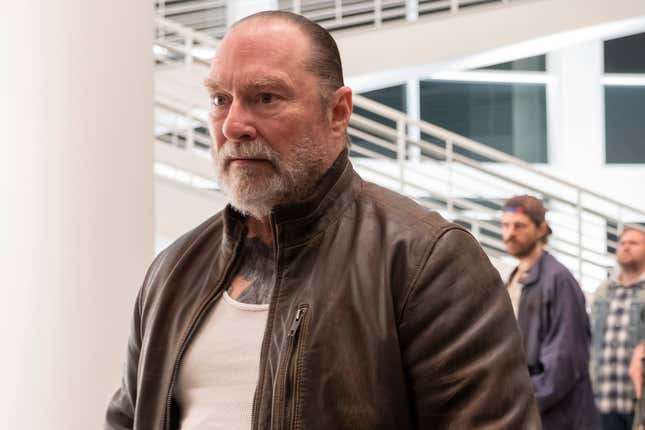
Stephen Root

Stephen Root
Photo: HBO

In Barry’s final half hour, nothing’s really that funny until the narrative takes over. That narrative isn’t the one the show has been telling this whole time, the one with detours in the middle of nowhere or Hank’s NoHo hourglass. It’s the one that the people inside the world of Barry concocted to make sense of it. What do they do to the “Barry Berkman Story,” the tale of a lost veteran trying to understand himself through art and murder? They turn it into a Jack Reacher movie, an actioneer that could be charitably called “Paul Schrader lite.” After all, the only narrative left is the one where Barry is a hero, buried at Arlington Cemetery with full accommodations. I mused earlier this week about how I couldn’t see this show having its Taxi Driver ending, where he ends up the hero. And, aside from the whole getting shot in the forehead thing, that’s what happens. By the end of Barry, Barry’s a hero to the world and his son. That was God’s plan for Mr. Berkman.

And God answers Barry’s wishes. When the episode starts, we hear the same discordant sound cue we left off on last week. Hoping to draw that same line of intensity from the previous installment, we cut to The Raven, sitting pretty in his palatial tub when Hank calls with a deal. He’s got Sally and John, but Fuches is only interested in the latter. He’s barely interested in Barry.

While “The Mask Collector” has a very specific and stupid meaning come the episode’s end, it could very well apply to Fuches here. When Raven arrives at NoHobal to face off with Hank’s spectrum of goons that create a color profile that would make Roy G. Biv proud, he tells Hank that he had a come to Jesus moment in prison. After daily beatings, he realized exactly who he was: the aforementioned man with no heart. He sees the same in Hank. And while he calls Hank for what he is, a snake, he also demands that he drop the act, the denial that fuels Hank’s continued success as a businessman. And it crushes Hank.

Mostly told through a series of close-ups, the episode really gets a look at these characters’ faces, the lines, and the weariness. For years, Barry has presented masks of its characters as they pretend and insist they’re good people. Sometimes that mask is obscured through performance—this is a show about acting, after all. This is an episode about unmasking and what it takes to do that. Unsurprisingly, it’s Sally who gives the straight story first. In a tight profile with the back of John’s head hanging in the frame, Sally comes clean, telling John that she and Barry are fugitives and that she is a killer. She murdered a man, and it’s the first time she admitted it on the show, and God bless Sarah Goldberg, who looks as though 600 pounds had been slowly lifted from her chest, as she finally takes off the Emily mask and shows him Sally. He hugs her for the first time, and the two, in her honesty, share the second loving moment between child and mother on the show. It’s a moment of redemption for Sally and one that sets the course for her behavior in the rest of the episode as she becomes a more decisive and confident person. All it took was living through a firefight.
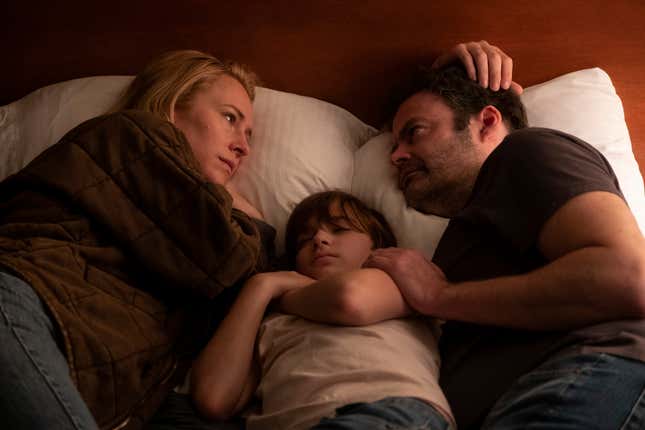
Sarah Goldberg, Zachary Golinger, and Bill Hader

Sarah Goldberg, Zachary Golinger, and Bill Hader
Photo: HBO

Hank isn’t so forthcoming. The close-ups between Fuches and Hank in their showdown were the moment when I missed Barry the most. How many shows are giving Stephen Root and Anthony Carrigan these lingering long takes to stare at each other, manipulating, crying, laughing, and saying everything without saying it? As with Sally’s mournful admission, Hader really lets the actor work while he simply captures their stunning performances with the camera. And they are stunning performances. Consider how far Carrigan has gone from season one, when he was mostly known for sending Bitmoji that undersell the danger they’re constantly in. Here, he’s a quivering mess, clearly and utterly devastated by Cristabol’s murder, with Fuches forcing him to take accountability, and he can’t. What follows is a quick firefight and one hilariously deadpan grenade that ends the conversation before it can happen.

As the scene comes to a close, with Hank’s last breath escaping his body, as dramatic as ever this one, Barry arrives with his arsenal just in time to catch Fuches and John on the way out the door. In the end, Fuches saved John and delivered him to Barry. Again, another pair of close-ups seemingly tells the audience that there’s an understanding between them now. In exchange for John’s safety, Fuches is no longer on the list. No words were exchanged. Fuches disappears into the night.

So Barry, Sally, and John escape the clutches of NoHo Hank, more or less, unscathed. Of course, John is fucked psychologically anyway because of who his parents are, but at least the better angles of Barry’s writers’ room won out. John, after all, is alive. Still, now with her admission to John on the table, Sally shows off her inner Fuches and pushes Barry to turn himself in.

Barry’s religion has really become the last level of evading accountability. Who is he to judge himself? Only the Lord can do that. What’s more, he was ready to exchange his life for John’s safety, and considering God spared Barry, maybe they should just continue on their awful way, regroup and find a new place to hide out for the rest of their lives. However, the new and improved assertive Sally has been reading about Cousineau’s situation, how the cops have pinned all of Barry’s crimes on him, and how unfair all that is. She pushes Barry to turn himself in, and when he refuses, she turns her back to him. The next morning, she absconds with John, leaving Barry to fend for himself.

Like many series finales, Barry’s has distinct sections, a few scenes for audiences to say goodbye to specific characters and versions of them. First, we said goodbye to Fuches and Hank, Barry’s crime world. The next one, though, is more personal, and like another season finale, it has a very abrupt finish. Barry arrives at Cousineau’s ready to do the right thing. Catching Tom as he sneaks out the door, Barry walks into Cousineau’s as his old teacher takes out Rip Torn’s pistol, a Chekov’s gun many times over, that has been the subject of one of Barry’s greatest sound gags and the source of one of its greatest cliffhangers. The latter was brilliantly memorialized by a Los Angeles Times headline in the episode. As Barry sits on the couch, he tells Tom to call the cops and begins to cry. It will be our last close-up of Bill Hader before Cousineau shoots him in the chest and head. It’s a stunning shot from the acting teacher, who must’ve done some target practice in Israel. But it seals the deal on Barry’s legacy.

The episode cuts to black, á la The Sopranos, immediately after the shot to the head. It’s so abrupt that for half a second, it felt like the real thing. Would Hader be so overt to court comparisons to television’s most prestigious prestige show? No, we’d fade back in and see Cousineau sit on his couch, seemingly serene. His nightmare is both over and just beginning because he’s going to jail, and to the rest of the world, he’s the masterful kingpin behind all these murders.

But that’s not all. In a move that can only be described as for the Our Town heads in the audience, the show does another time jump, taking us several years down the line to an older, wiser, and yes, slightly more confident Sally Reed. Now a theater teacher lapping applause for a well-received adaptation of Our Town, she beams with pride as she accepts her flowers. Outside, she quickly shoots down a date and lets John go sleep over at a friend’s house. She doesn’t overthink it. All the bad men are gone. She’s no longer seeing Shane’s bleeding eye in the cold light of day. Sally seems content without Barry in her life. Though, the way she looks at the flowers on her ride home does have a reminder of the flowers that Barry used to bring—er, the ones she asked him to bring her on the set of “Joplin.” There’s a sadness to her as she stares at the empty passenger seat, but it’s probably better than her life with Barry.

It’s at this point in a very short episode of television (relatively speaking) that it starts to feel a little like Hader is spinning his wheels. How is this all going to wrap up? It’s starting to feel a little anti-climactic, as if there’s even supposed to be some grand unified Barry theory that makes sense of everything we’ve seen over the last four years.
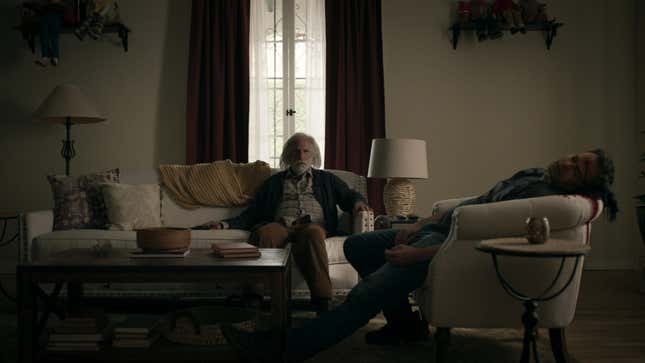
Henry Winkler and Bill Hader

Henry Winkler and Bill Hader
Photo: HBO

In the end, there is. It’s all about narrative. It’s all about how we consume, venerate, and celebrate violence and the violent people in society. John (now played by Hader’s fellow It alumni Jaeden Martell) and his friend sit down to watch “The Mask Collector,” a sub-Lifetime adaptation of the Barry TV show. To pull another comparison to the Sopranos, its fidelity to show is very “Cleaver,” a bloody, cheap, and sensationalized account of the reality we’ve seen on TV. Moreover, it turns Barry into the hero of the story, the story that John’s heard before. It’s the story that, as Clark, Barry told John on the steps of their home. Poor Barry was manipulated by Cousineau and forced to do unspeakable things before saving his family and dying in a final confrontation. After years of telling people he’s a good person, Barry is the hero, a lost vet trying to understand himself and being taken advantage of by a capable older man.

Through that story, Barry escapes accountability forever. Print the legend of Barry, and that’s all everyone will ever know. It doesn’t matter that he was a man with no heart. It doesn’t matter about the truth. It doesn’t matter that Barry was a cruel, despicable human being who often killed because he didn’t have the skills for anything else. It’s a narrative that we can understand. That’s really what Barry was about. Violence is chaos, and in the process of making sense of it, we assign good guys and bad guys—a good guy with a gun takes out a bad guy with a gun.

Forgiveness needs to be earned, Hank reminds us in season three. Fuches seemingly earned it when he delivered John. Sally earned it when she told John the truth. Barry came ever so close to starting a path to redemption—well, sort of, Barry can’t really be redeemed—but it was too late. His crimes have already spawned another violent killer because that’s what violence does; it starts a cycle of violence, one we’ve seen play out numerous times on the show, particularly last season when the families of Barry’s victims disastrously tried and failed to get revenge.

Who knows what the secret knowledge of having seen “The Mask Collector” will mean for John. Maybe he’ll follow in his father’s footsteps. Or maybe he’ll be an actor like his mom. In its final frame, Barry asks us to consider what effect watching violence has on us as viewers. With John’s slight smile of relief, the mayhem that Barry presented is now fodder for mindless entertainment that belittle the real victims. At least Ryan Maddison’s father, who killed himself after driving Barry to the hospital, isn’t alive to see what Hollywood has made of his son and his son’s killer.

For all the darkness this season, it feels fair to ask one last time: Was Barry a comedy? Ultimately, it’s hard to laugh at the show because it started to look a lot like real life. The crimes on Barry aren’t so dissimilar from what we in the U.S. see on the news every day. In a country where multiple mass shootings happen daily, and domestic gunfire is a leading cause of death, what on this show is exaggerated? It takes Hank combing the ACME catalog and going full Looney Tunes to get a laugh out of this stuff. Over its short run, Barry became a show about the ways we perceive, mythologize, and try to shed ourselves of the responsibility of the violence around us. The ways we turn our heads from it and try to process it. Barry treated its characters as bad guys in a society that celebrates them. Barry was a bad guy with no heart, a product of a violent culture that gave him nothing but a gun and told him to kill. Now, he’s a hero. Tricky legacies.

Stray observations

  • “I figured out my dad bought my house with drug money… So he shot me.”
  • I’m starting a campaign to have the national anthem changed to a Bill Hader yelling “Guns!”
  • Fred Melamed creeping out of Cousineau’s house was one of the few laughs tonight, but it was a hardy one.
  • CeCe Peniston’s “Finally” gets a hell of a needle drop when Barry marches to the gun counter. 
  • I can’t say how happy I am that Hader gave us so much Fuches and Hank business last week. As great as it has been to watch Carrigan really stretch out, there’s nothing quite like watching Hank figure out or escape a murder.
  • Alas, no more Larry Chowder from this show. I was really hoping that we’d get a taste of Chowder in a trailer when John started watching “The Mask Collector.”
  • It would’ve been easy for “The Mask Collector” to go overboard with the Cousineau character, but I thought Michael Cumpsty found a real solid balance. It must’ve been hard not to go even harder with it. His restraint is appreciated.
  • Thank you so much for reading our Barry recaps this season, and thank you for the great discussion in the comments, which always challenged my thinking on the show. It was a weird and difficult season, but more than other shows, I think Barry committed to its characters by not redeeming them, ultimately dragging the show down where it needed to be. It’s honest, in a way, about the type of show it is because none of this should really be all that funny anyway. That Barry could be so many things and do it in a half hour is an incredible achievement and a rewarding watch, even if it made us queasy sometimes.

Source link

Barry has always been a tough show to

Ukrainian forces today shelled several frontier settlements in the Russian border region of Belgorod just days after anti-Putin rebel groups briefly captured territory there, the local governor said.

Vyacheslav Gladkov said two industrial facilities in the border town of Shebekino had been shelled and four employees had been wounded while several settlements were left without electricity.

The governor ordered some 300 children to be evacuated from Shebekino and the border district of Graivoron and sent to summer camps away from the front lines.

Belgorod, which borders Ukraine’s Kharkiv region, has repeatedly come under attack from Kyiv‘s forces since the beginning Russia’s full-scale invasion of Ukraine in February last year.

Today’s strike is the heaviest shelling on the region since the beginning of Russia’s invasion of Ukraine, local media reported, and it comes as the Ukrainian capital of Kyiv was rocked by missiles yet again.

Vyacheslav Gladkov said two industrial facilities in the border town of Shebekino (pictured) had been shelled and four employees had been wounded while several settlements were left without electricity

Ukrainian forces today shelled several frontier settlements  including Shebekino (pictured) in the Russian border region of Belgorod

Ukrainian forces today shelled several frontier settlements  including Shebekino (pictured) in the Russian border region of Belgorod

Black smoke rises up in the air after Ukrainian forces subjected Belgorod region to heaviest shelling yet

Black smoke rises up in the air after Ukrainian forces subjected Belgorod region to heaviest shelling yet

Local residents try to put out a fire after Russian missile strikes hit the Kyiv region on Friday

Local residents try to put out a fire after Russian missile strikes hit the Kyiv region on Friday

Gladkov admitted today that ‘several settlements of the Belgorod region are under fire from the armed forces of Ukraine’, adding that two industrial enterprises had been targeted. 

He continued: ‘Shells hit one enterprise, and a production building with paint and varnish liquids caught fire.

‘There are four victims – men, employees of the enterprise, who were delivered to the Central District Hospital with burns of the respiratory tract and carbon monoxide poisoning.

‘One is in intensive care in a serious condition, three are in a state of moderate severity. All necessary medical assistance is provided.’

Other villages including Novaya Tavolzhanka were also hit, Gladkov said.

Today’s attack on Belgorod comes as Russia unleashed a barrage of missiles at Kyiv this morning.

Ukrainian air defences managed to shoot down all missiles fired at the capital in the daytime attack and no targets were hit there, the city’s military administration said.

A series of explosions rang out in the capital today as authorities told residents to seek shelter after another night of Russian strikes.

Authorities in the western city of Khmelnytsky said Russian forces also attacked a military facility overnight and damaged five aircraft.

At least ten explosions were heard from around 11.10 am local time (0810 GMT) in Kyiv, and the blasts took place soon after the air raid warning sounded.

Mayor Vitali Klitschko reported explosions ‘in the central districts’ of the Ukrainian capital, a rare occurrence in daytime, and told residents to ‘stay in shelters’.

‘The attack on Kyiv continues,’ he added minutes after.

Authorities reported rocket fragments falling in three city districts.

Klitschko said emergency services were working to extinguish rocket debris burning on the road in Kyiv’s northern Obolonskiy district.

A firefighter puts out a fire following a massive Russian drone attack on May 28

A firefighter puts out a fire following a massive Russian drone attack on May 28 

A cargo trailer burns after having been damaged during a massive Russian air strike in the Kyiv region of Ukraine in the early hours of May 29

A cargo trailer burns after having been damaged during a massive Russian air strike in the Kyiv region of Ukraine in the early hours of May 29 

A Russian drone is shot down by Ukrainian forces in Kyiv, Ukraine, on May 28

A Russian drone is shot down by Ukrainian forces in Kyiv, Ukraine, on May 28

A police officer inspects damages after a Russian missile strike in the Kyiv region on Monday

A police officer inspects damages after a Russian missile strike in the Kyiv region on Monday

A firefighter works at a site of a private house damaged by remains of a cruise missile in the Kyiv region on Friday

A firefighter works at a site of a private house damaged by remains of a cruise missile in the Kyiv region on Friday 

The mayor said fragments of rockets had fallen in the city’s northwestern Podilskiy district, injuring one and setting fire to a building.

The Kyiv city administration said air defences were at work over the capital.

Kyiv, which had been relatively spared from attacks since the beginning of the year, has faced nearly nightly aerial raids this month.

The May attacks, however, have usually happened during the night.

Authorities said earlier Monday that Kyiv repelled another large volley of overnight air strikes, with no casualties.

Valery Zaluzhny, commander-in-chief of Ukraine’s armed forces, said on social media that a total of ‘up to 40 missiles’ and ‘around 35 drones’ had been launched, of which 37 and 29 were downed.

The latest figures showed the percentage of downed missiles and drones appeared to be decreasing.

The latest barrages hit Kyiv as locals were still recovering from an overnight Saturday drone attack, the biggest since Russia’s invasion began in February last year.

In the western city of Khmelnytsky, regional authorities said Russian troops attacked a military facility overnight.

In a rare admission of the damage, they said ‘five aircraft have been put out of action.’

Work was underway to localise fires at fuel and lubricant warehouses and repair a runway, the statement said.

The Kremlin was left furious last week after native Russian anti-Kremlin fighters carried out a major cross-border raid on a series of border villages in Belgorod, briefly seizing several settlements before withdrawing over the frontier.

Last week, native Russian anti-Kremlin fighters (pictured) carried out a major cross-border raid on a series of border villages in Belgorod, briefly seizing several settlements before withdrawing over the frontier

Last week, native Russian anti-Kremlin fighters (pictured) carried out a major cross-border raid on a series of border villages in Belgorod, briefly seizing several settlements before withdrawing over the frontier 

An anti-Kremlin volunteer fighter is pictured alongside a captured Russian armoured personnel carrier last week

An anti-Kremlin volunteer fighter is pictured alongside a captured Russian armoured personnel carrier last week 

.

.

Members of the Russian Volunteer Corps (RVC) are seen riding on armoured personnel carriers in Russia’s Belgorod region last week

Kyiv almost never publicly claims responsibility for attacks inside Russia and on Russian-controlled territory in Ukraine, but has said that destroying infrastructure is preparation for a planned ground assault.

Who are the anti-Kremlin rebel groups responsible for attacks in Belgorod? 

RUSSIAN VOLUNTEER CORPS

The Russian Volunteer Corps was founded by a far-right Russian national last August and comprises Russians who have been fighting in and for Ukraine against their own country.

The group has also been active over the border in Russian territory, and claimed responsibility for a raid there in March as well as the incursion into Belgorod.

The Ukrainian military intelligence agency says the RVC is an independent underground group inside Russia that also has a unit in the Ukrainian Foreign Legion. The Foreign Legion says it has nothing to do with the RVC.

A video posted by the RVC on Monday showed two men claiming to have captured a Russian armoured personnel carrier. 

One of the men was identified as Ilya Bogdanov, a Russian national who received Ukrainian citizenship in 2015 after fighting for Kyiv against Russian-backed forces in Ukraine’s east.

FREEDOM OF RUSSIA LEGION

The Freedom of Russia Legion says it was formed in spring 2022 ‘out of the wish of Russians to fight in the ranks of the Armed Forces of Ukraine against Putin’s armed gang’.

It says it cooperates with the Ukrainian armed forces and operates under Ukrainian command. It has claimed responsibility for the attack in Belgorod and says it has been fighting in eastern Ukraine.

The Ukrainian military intelligence agency’s spokesperson said on Monday that the attacks in Belgorod only involved Russian citizens and that they were creating a ‘security zone’ to protect Ukrainian civilians. 

He did not confirm or deny that the forces operating there are a Ukrainian unit. 

Mark Galeotti, author of several books on the Russian military, said the two groups comprised anti-Kremlin Russians ranging from liberals and anarchists to neo-Nazis.

Ukrainian presidential aide Mykhailo Podolyak repeated Kyiv’s position that it had nothing to do with the operation.

<!- – ad: https://mads.dailymail.co.uk/v8/us/news/none/article/other/mpu_factbox.html?id=mpu_factbox_2 – ->

Advertisement

Russian President Vladimir Putin on Sunday ordered stronger border security to ensure ‘fast’ Russian military and civilian movement into the Ukrainian regions now under Moscow’s control.

But Gladkov today demanded that the Kremlin take more action to defend his region amid the Ukrainian strikes. 

He called on Russian forces to take the extreme measure of annexing neighbouring Kharkiv in Ukraine to save his region.

He said: ‘What can be done to secure our territory, especially the border areas?

‘Kharkiv [in Ukraine] has to be annexed to Belgorod region. 

‘Do you believe in this possibility? This is the best way to solve the problem of shelling in Belgorod region.’

‘We are living in the conditions of what essentially is war,’ Gladkov warned Moscow. 

‘Whether people like it or not, this is happening. The enemy comes in. Before the latest events in Graivoron, five sabotage groups had entered.’

Last week, the Russian Volunteer Corps (RVC) and Freedom of Russia Legion, armed with armoured vehicles, small arms and a pair of tanks, surged over the border from Ukraine’s Kharkiv region and took a string of urban settlements to occupy roughly 3-5 miles of Russian soil.

They later launched a pair of drone attacks on FSB and Interior Ministry buildings in Belgorod city on Tuesday, prompting Gladkov to order the evacuation of nine Russian towns and the Kremlin to admit ‘serious cause for concern’. 

By Tuesday afternoon, Russia’s defence ministry claimed it had ‘wiped out’ the rebels, whom they refused to acknowledge as Russian and instead described them as Ukrainian nationalists. 

Ukrainian officials meanwhile retorted they were not involved in the orchestration of the incursion, claiming the attack was carried out by Russian citizens and casting it as homegrown, internal Russian strife. 

Kyiv has been preparing to launch an offensive although its timing and focus have been the subject of months of speculation. 

Ukrainian authorities have said almost nothing except that they need more weapons from Kyiv’s backers.

Deputy Defence Minister Ganna Malyar said Monday that in the frontline hotspot of Bakhmut ‘the intensity of the enemy’s offensive has significantly decreased’ as Russian mercenary group Wagner was handing over its positions to Moscow’s regular troops.

‘Our troops are making this process much more difficult for the enemy,’ she said.

‘At the same time, the intensity of enemy artillery shelling has not decreased.’

Source link

Ukrainian forces today shelled several frontier settlements

Source link

Long before race car drive Josef Newgarden

Gov. Tim Walz of Minnesota on Thursday vetoed a bill that would have guaranteed a minimum wage and other protections for Uber and Lyft drivers.

“Ride-share drivers deserve safe working conditions and fair wages, and I am committed to finding solutions to these issues that balance the interests of all Minnesotans, drivers and riders alike,” Mr. Walz, a Democrat, wrote in a letter to the speaker of the Minnesota House of Representatives. But he said that the legislation, which passed the state legislature last week, “is not the right bill to achieve these goals.”

The bill had been seen as a significant victory for labor advocates, who have been fighting for greater benefits for gig drivers across the country. Uber and Lyft treat their drivers as independent contractors rather than employees, meaning the drivers are responsible for their own expenses and do not receive health care or other benefits. The companies say their business model allows drivers to maintain the flexibility they want.

The legislation would have required Uber and Lyft to pay their drivers at least $1.45 per mile they drive with a passenger, or $1.34 per mile outside the Minneapolis-St. Paul area, as well as $0.34 per minute. It also would have established a review process letting drivers protest cases where they were deactivated from the platforms.

Mr. Walz sided with the arguments of Uber and Lyft, which said the minimum pay was too high for a region like Minnesota and would require them to drastically curtail their ride-sharing businesses in the state as costs increased for riders.

Earlier on Thursday, Uber said it would pull out of Minnesota at the beginning of August if the bill passed, leaving only its premium service in the state’s largest metropolitan region.

“This bill could make Minnesota one of the most expensive states in the country for ride share, potentially putting us on par with the cost of rides in New York City and Seattle — cities with dramatically higher costs of living than Minnesota,” Mr. Walz wrote in his letter.

Aside from the veto — his first — Mr. Walz also issued an executive order establishing a commission to study the ride-share business in Minnesota and recommend policy changes to ensure drivers receive fair compensation.

Uber cheered the news and said it would support a different bill that would offer slightly lower minimum pay and ensure that drivers were classified as independent contractors rather than employees in Minnesota, a longstanding goal of the company that it has advanced in other states.

“We appreciate the opportunity to get this right, and hope the legislature quickly passes a compromise in February,” said Freddi Goldstein, an Uber spokeswoman.

CJ Macklin, a Lyft spokesman, added that “lawmakers should pass fair pay and other protections, but it must be done in a way that doesn’t jeopardize the affordability and safety of those who rely on the service.”

State Senator Omar Fateh, an author of the bill, criticized Mr. Walz’s decision on Twitter.

“Today, we saw the power corporations hold on our government,” he wrote. “The fight is not over, and I promise you I won’t back down.”

Source link

Gov. Tim Walz of Minnesota on Thursday

STRANGE WAY OF LIFE
Section:
 Special Screenings
Director: Pedro Almodovar
Screenwriter: Pedro Almodovar
Logline: Ethan Hawke and Pedro Pascal play onetime lovers who are reunited for a night of passion after 25 years. Sheriff Jake (Hawke) was once a hired gunfighter along with Mexican-born Silva (Pascal). At one time they wanted to just fade into the sunset together, but that dream never materialized and they went their separate ways. While on a specific mission, Silva stops by for a visit with his old friend, both now in their 50s. When morning comes Jake’s demeanor has noticeably changed and suddenly he is back to business: a search to bring in someone thought to be Silva’s son who is wanted for murder.
Panelist: Pedro Almodovar
Premiered: Saturday, May 20
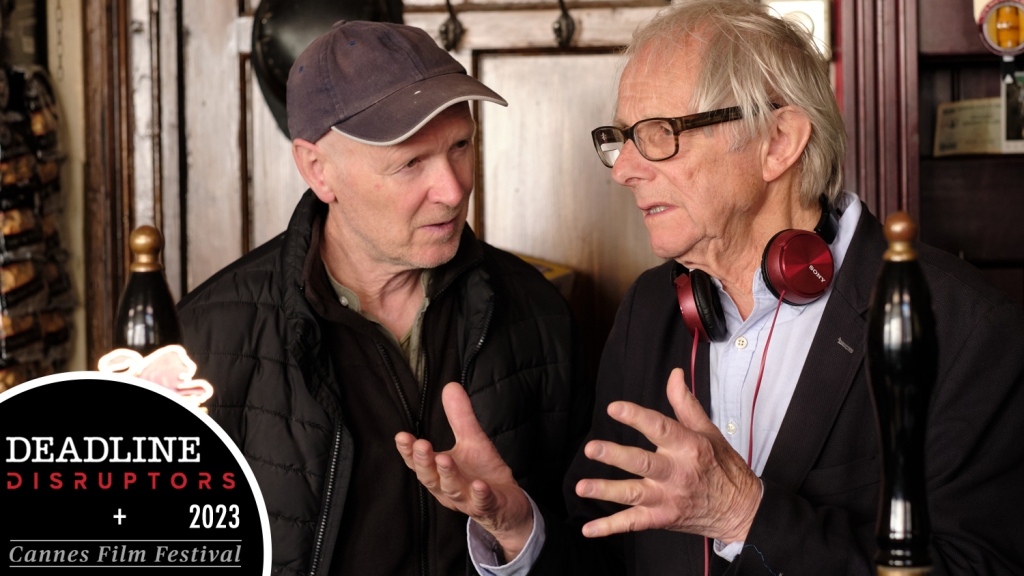
Key Quote: “I don’t visualize the faces, the colors, the style until I have finished the script. The script is always the first stone and just then immediately appears the faces, the type of actors – everything – and also visually, I feel out what kind of movie I want to do. Pedro Pascal and Ethan Hawke were my first choice. Fortunately, I knew them personally so I could call them and send them directly the script; and they just answered me the same day. They were very enthusiastic. It gives you a lot of confidence when someone reacts like that. It was the fastest casting that I did and also the more appropriate because I wanted two actors at that age, but very different, even different cultures, different origins and physically different. It was a chemistry that immediately appeared.” — Pedro Almodovar

Click above to watch the interview.

The 2023 Cannes Film Festival runs May 16-27. Follow Deadline’s complete coverage of the deals and doings on the Croisette here.

Source link

STRANGE WAY OF LIFESection: Special ScreeningsDirector: Pedro AlmodovarScreenwriter: Pedro AlmodovarLogline: Ethan

Q: Do you have anything to declare?
A: I’m sick of being a woman. That’s what I want to declare.

One track that didn’t make the cut for Sheryl Crow is a killer B-side called “Free Man.” Structured like a country song but bashed out like a scrappy garage band, it tells a story of a woman who hitches her wagon to a free-thinking, self-styled anarchist. She’s momentarily entranced until her casual observations start to form a larger picture. His friends seem a little off; he’s teaching her how to shoot a gun. Soon, she’s cooking for him, mothering him, sitting shotgun while he goes off on a racist rant. It all concludes with a punchline as she files for divorce: “I’d appreciate a little bit of government!”

Crow never ended up starting her own label, but she did start operating her own recording studio out of her Nashville home, where, among others, Kacey Musgraves booked some time to work on 2018’s Golden Hour. For someone who had spent a rollercoaster decade playing by the industry’s rules and wrestling, over and over again, with its ugly power dynamics, the splendid, isolated comfort of a recording studio seems a better fit, anyway.

On Sheryl Crow, you can hear her settle into this eventual legacy behind the boards, searching until she finds just the right sound. In the liner notes, Crow, who worked as a music teacher before she left Missouri for California, is credited with playing acoustic, electric, and bass guitar, along with Moog bass, harmonium, keyboards, Hammond organ, Wurlitzer, a Penny-Owsley piano, and loops. Deep within the buzz and clatter of these masterfully written songs, you can hear an even more elusive quality that makes them stick: an artist having fun. “There was a huge spectrum of emotions that went along with that record,” Crow recalled to Rolling Stone last year. “One of being burned out, two of being misunderstood… and very underestimated. But also euphoric: The euphoria of feeling like, ‘Well, nobody believes I can do anything anyway. So I’m going to do what I want to do.”

Later in the Charlie Rose interview, Crow performs “Home,” the best song on Sheryl Crow and one of three on the tracklist without a co-writer. She tells Rose it was the only one that arrived to her “on the mic,” claiming the whole thing came together in just 10 minutes. (“That’s probably why I still have a certain affinity for that song,” she says, cracking a smile.) The recording backs up her memory of this impromptu bolt of inspiration. It fades in and out, as if we are receiving a transmission of just the most crucial bit of a long, ongoing investigation.

At first blush, it might sound like a love song. “I woke up this morning and now I understand/What it means to give your life to just one man,” Crow begins. “This is home,” goes the chorus. Every detail, however, tugs at the sense of certainty in those words. The music sways and swells, in a cosmic country kind of way, as she traces a path from her teen years to the present day, her fantasies of wandering the world to the suffocating rooms where she now looks into the eyes of someone she used to love. Meanwhile, she measures the distance between their two breaking hearts: “Mine,” she observes, “is full of questions.” This may be where the relationship ends, she acknowledges. But it’s also the precise moment where any good story begins.

Source link

Q: Do you have anything to declare?A: I’m sick

Dhoom was originally supposed to have sports cars, but director Sanjay Gadhvi finally went for bikes.

Salman Khan and Sanjay Dutt were originally approached for John Abraham’s role in Dhoom.

John Abraham has been a part of the Hindi film industry for two decades now. Ever since his debut in 2003 with the film Jism, he has delivered several box-office hits. However, those who follow his career closely know that just after his initial few releases, it was believed that his time in Bollywood would be short-lived. His movies such as Saya, Aitbaar, Paap, and Lakeer turned out to be one flop after the other at the ticket counters.

Meanwhile, John Abraham was later offered a project that turned out to be a game-changer for him. What if we told you that the film almost went to someone else? If you have not guessed the drama till now, it is none other than the 2004 action thriller Dhoom. Made under the direction of filmmaker Sanjay Gadhvi, the action entertainer positioned John Abraham as a bankable star at the box office.

Refreshing your memory, the actor was seen in a negative role in the film, alongside Abhishek Bachchan as the protagonist. The cast of the movie also included Uday Chopra, Esha Doel, Rimmi Sen, Manoj Joshi as Shekhar, Aarav Chowdhary, Farid Amiri, Mehul Bhojak as Manu, and Rohit Chopra in pivotal roles, along with others.

Meanwhile, if the reports are to be believed, John Abraham was not the first choice for the role of Kabir. The Sultan actor was the first to be approached for the role; however, he turned down the offer for some unknown reason. Later on, the makers were in talks with Sanjay Dutt, but he also could not do the film.

The reports further claim that Dhoom was originally supposed to feature sports cars, but director Sanjay Gadhvi went for motorcycles as the faces of the actors were not clearly visible in cars. For the uninitiated, it was also the first action film by Yash Raj Films after a long gap of 16 years. Their last action-packed release was the 1988 film Vijay.

Source link

Dhoom was originally supposed to have sports


“Fast X” predictably won a second weekend on top of the mainland China box office, driving its total past the $100 million mark. But the disappointing start for Disney’s live-action “The Little Mermaid” was the bigger talking point.

“Fast X” earned $17.6 million in China according to data from consultancy Artisan Gateway. That was a 66% drop compared with its opening weekend, but still gave the film a $110 million cumulative after 12 days and has caused estimates to be further revised upwards.

Ticketing agency Maoyan is now forecasting that the film will finish with RMB880 million ($126 million), having previously predicted RMB728 million ($104 million), and then RMB840 million.

That would make the film the top-scoring Hollywood title of the year (excluding 2022 release “Avatar: The Way of Water”). But the numbers are way down on past outings by the franchise.

To date, “Fast X” only ranks as the 49th best-performing Hollywood film in Chinese local currency terms. If Maoyan’s forecast proves accurate “Fast X” could climb to 40th place. In contrast, “Fast 8” and “Fast 7” are second and third on the list of imported films in China, with totals of RMB2.67 billion and RMB2.43 billion respectively.

“The Little Mermaid,” Disney’s live-action revision of its classic animation tale was only the second best-performing new release of the weekend and placed fifth on the weekend chart with a poor $2.5 million. It was beaten by new release Japanese animation “Sword Art Online The Movie,” with $3.8 million in fourth place.

(Second place was held by China’s “Godspeed” with $6.8 million for a four-weekend cumulative of $148 million, while “Guardians of the Galaxy Vol 3” took $4.9 million for a three-weekend cumulative of $79.6 million.)

Discussion of “The Little Mermaid,” in which actor and singer Halle Bailey portrays the title role, again raised the question about how willing Chinese audiences are to watch films with prominent Black characters. This has previously been debated around “The Black Panther” titles and “Star Wars” promotional materials.

Midweek, The Global Times, a state-controlled tabloid paper, lashed out at Disney and accused it of lowering the film’s potential in China by casting a Black actor in the role.

“Many Chinese netizens said that like ‘Snow White’ the image of the mermaid princess in Hans Christian Andersen’s fairy tales has long been rooted in their hearts and it takes a leap of imagination to accept the new cast.” The same editorial accused Disney of “political correctness” – an argument similar to the “woke” accusations made by political Right-Wing in the U.S. – and said that the film would likely not perform well in East Asian markets.

It doubled down by saying, “The controversy surrounding Disney’s forced inclusion of minorities in classic films is not about racism, but its lazy and irresponsible storytelling strategy.”

A day later, after online discussion of how Chinese posters for the film had seemingly turned the mermaid’s skin color to blue, a Global Times op-ed went further. It used discussion of the film to launch wide-ranging criticism of Hollywood and western colonialism. It also stretched the debate to promote China’s anti-COVID policies and even its building of power generation plants in Africa.

“A number of netizens from Western countries on Twitter have attacked Chinese audiences, alleging that poor box office numbers are due to ‘racial discrimination.’ This is to impose their politically correct standards on Chinese audiences, and use this to sow discord between China and African groups,” it said. “China has always maintained brotherly relations with Africa and has never needed an ‘atonement’ mentality prevalent in Hollywood.”

Disney has a particularly difficult line to tread in China. It operates theme parks in Shanghai and Hong Kong and has long been the Hollywood studio that is most invested in the Middle Kingdom. But, as the past controverses over “Mulan” and the Chloe Zhao-directed “The Eternals” also demonstrate, finding a happy medium between China and the U.S. is tricky for the multinational when national security concerns and political sensitivities take such a prominent position in many debates.

Cold War attitudes recently caused the Mouse House to close its Disney English language school operations in China and lose more than two years of Marvel film releases.

Strangely, while audience ratings on a scale of 1-10 are a common feature of popular film discussion in China, neither Maoyan nor rival ticketing firm Taopiaopiao, currently provide an audience rating figure for “The Little Mermaid.” Readers on the film review site Douban give the film a limp 5.3 score, based on over 18,000 assessments.

Artisan Gateway reported that the weekend box office aggregate in China slipped back to $42.2 million, the lowest figure in a month. It calculates that the year-to-date total is 45% better than the equivalent figure in 2022, but 18% behind 2019.

Source link

“Fast X” predictably won a second weekend

Wondering who you can trust? Find out in one month on Disney+. 

In Marvel Studios’ Secret Invasion, set in the present-day MCU, Fury learns of a clandestine invasion of Earth by a faction of shapeshifting Skrulls. Fury joins his allies, including Everett Ross, Maria Hill, and the Skrull Talos, who has made a life for himself on Earth. Together they race against time to thwart an imminent Skrull invasion and save humanity.

Brand new character posters for the upcoming series have arrived, featuring the likes of Fury, Talos, Maria, and Ross — but they’re not the only ones trying to untangle the truth. Discover character posters for Sonya, G’iah, Gravik, Priscilla, Pagon, and Rhodey, too, in the image gallery below. 

Secret Invasion stars Samuel L. Jackson, Ben Mendelsohn, Cobie Smulders, Martin Freeman, Kingsley Ben-Adir, Charlayne Woodard, Killian Scott, Samuel Adewunmi, Dermot Mulroney, Christopher McDonald, Katie Finneran, with Emilia Clarke and Olivia Colman, and Don Cheadle.


Ali Selim directs the series and executive-produces, along with fellow executive producers Kevin Feige, Jonathan Schwartz, Louis D’Esposito, Victoria Alonso, Brad Winderbaum, Samuel L. Jackson, Ali Selim, Kyle Bradstreet, and Brian Tucker. Kyle Bradstreet is also the head writer, and Jennifer L. Booth, Allana Williams, and Brant Englestein serve as co-executive producers. 

Who do you trust? Secret Invasion premieres June 21 on Disney+. 

Source link

Wondering who you can trust? Find out

Eric Wallace, showrunner of The Flash, gave an optimistic response on the possibility of more Arrowverse crossovers.

After nine seasons over nine years, The Flash has reached its finish line, airing its final episode on May 24. All of its Arrowverse sister shows have ended or were canceled, and thus The CW’s mainline DC universe that bloomed with eight spin-off shows throughout the mid-to-late 2010s has essentially concluded.

While the Arrowverse lasted 10 years, there hasn’t been much in the way of hope that the shared DCTV universe could continue on, especially considering that Superman & Lois takes place on another Earth and Justice U was abandoned.

What’s Next for DC TV After The Flash?

DC

Speaking to Entertainment Weekly, The Flash’s showrunner Eric Wallace shared a message of hope in the notion that the Arrowverse could live on:

“I still am hopeful that the Arrowverse is not over. I’ve approached it as ‘The Flash’ is over and I want to make the best Flash series finale as possible.”

The producer teased that he intends to convince Todd Helbing, who oversees Superman & Lois, to sneak an Arrowverse crossover into the show, should it receive a Season 4 renewal:

“I’m going to have lunch with [‘Superman & Lois’ showrunner] Todd [Helbing] in the next couple weeks. And I’m going to tell him, ‘If you get a fourth season, you’ve got to sneak some Arrowverse in there. You are now carrying the torch.'”

As for Helbing, he too expressed a desire to include some cross-pollination between Superman & Lois and Flash, stating that he’d “love to bring Grant [Gustin] on:”

“I will say this, it sure is a lot easier now that the other shows aren’t on the air, people’s schedules are a lot easier to work around, so… maybe. I would love to bring Grant on, and I think it would be a lot of fun to have Candice, to have Iris with [Elizabeth Tulloch’s] Lois Lane. So we’ll see.”

Could There Actually Be Another Arrowverse Crossover?

Over time, The CW’s roster of interconnected superhero shows became famous for their elaborate annual crossover events. But when the pandemic hit, it obliterated any plans for such events.

There was an attempt made with 2021’s Armageddon, but most would agree that it felt much too limited and self-contained in its scope.

It was established in a Season 2 episode of Superman & Lois that the CW series takes place in an entirely separate alternate universe to that of The Flash and Arrow, one where Clark Kent is the only superhero. 

This isolated setting would seem to make any character crossovers difficult, but these shows are no strangers to Multiversal travel. It’s a device that The Flash utilized countless times, especially in its early seasons.

So, perhaps Eric Wallace and Todd Helbing will indeed be able to cook something up for the fans but it all hinges on Superman & Lois getting another season. With The CW under new a leadership that wants to revamp its content, this could prove unlikely.

And if it’s not to be, then perhaps an Arrowverse movie could be produced? Stephen Amell, who starred as Oliver Queen on all eight seasons of Arrow (and who recently reprised the role on The Flash) has expressed interest in playing the character for a film or limited series. 

Superman & Lois drops new episodes on Tuesdays on The CW.

Source link

CEO Jensen Hiang made a string of announcements during his Computex keynote, including details about the company’s next DGX supercomputer. Given where the industry is clearly heading, it shouldn’t come as a surprise that the DGX GH200 is largely about helping companies develop models.

The supercomputer uses a new NVLink Switch System to enable 256 GH200 Grace Hopper superchips to act as a single GPU (each of the chips has an Arm-based Grace CPU and an H100 Tensor Core GPU). This, according to NVIDIA, allows the DGX GH200 to deliver 1 exaflop of performance and to have 144 terabytes of shared memory. The company says that’s nearly 500 times as much memory as you’d find in a single DGX A100 system.

For comparison, the of the Top500 supercomputers lists as the only known exascale system, having reached a performance of nearly 1.2 exaflops on the Linmark benchmark. That’s over twice the peak performance of the second-placed system, Japan’s .

In effect, NVIDIA claims to have developed a supercomputer that can stand alongside the most powerful known system on the planet (Meta is building one that it claims will be the fastest AI supercomputer in the world once it’s fully built out). NVIDIA says the architecture of the DGX GH200 offers 10 times more bandwidth than the previous generation, “delivering the power of a massive AI supercomputer with the simplicity of programming a single GPU.”

Some big names are interested in the DGX GH200. Google Cloud, Meta and Microsoft should be among the first companies to gain access to the supercomputer to test how it can handle generative AI workloads. NVIDIA says DGX GH200 supercomputers should be available by the end of 2023.

The company is also building its own supercomputer, Helios, that combines four DGX GH200 systems. NVIDIA expects Helios to be online by the end of the year.

Huang discussed other generative AI developments during his keynote, including one on the gaming front. NVIDIA Avatar Cloud Engine (ACE) for Games is a service developers will be able to tap into in order to create custom AI models for speech, conversation and animation. NVIDIA says ACE for Games can “give non-playable characters conversational skills so they can respond to questions with lifelike personalities that evolve.”

Source link

CEO Jensen Hiang made a string

A year after collecting his second Palme d‘Or for “Triangle of Sadness,” Ruben Östlund bestowed the same honor to Justine Triet’s “Anatomy of a Fall,” a thought-provoking legal drama which purports to investigate the guilt or innocence of a popular novelist (Sandra Hüller), accused of murdering her husband. But the film is every bit as much an inquest into their marriage, bringing private details from the couple’s personal life into the courtroom for the press, public and audience to dissect, as if under a microscope.

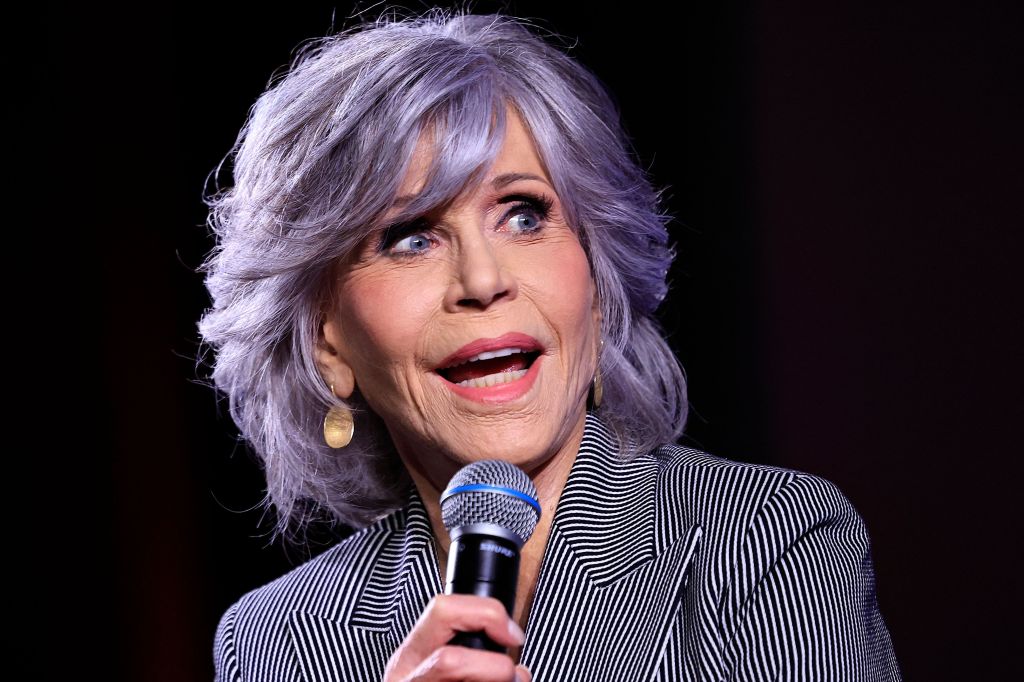
Triet is only the third woman to win the Palme d’Or (after Jane Campion for “The Piano” and “Titane” helmer Julia Ducournau, who joined Östlund on the jury this year). The prize was presented by Jane Fonda, who remarked on how far Cannes has come — setting a record for female representation, with seven woman helmers in competition this year — since the American star first attended. In accepting the award, Triet made a point of acknowledging the protests against French pension reform, which were forbidden from the festival.

Ducournau presented the Grand Prix to “The Zone of Interest” by Jonathan Glazer. An adaptation of the World War 2 novel by Martin Amis (who passed away during the festival), the haunting film depicts the private life of the German commandant (Christian Friedel) responsible for executing countless Jews at Auschwitz. The film leaves those horrors largely off-screen, while focusing on the officer and his wife (Hüller, who also starred in the Palme winner), asking audiences to consider the morality of the perpetrators.

The best actor award went to Kōji Yakusho, who plays a working-class Tokyo man in Wim Wenders’ “Perfect Days.” The character spends his mornings cleaning public toilets around the city, while leaving himself free time to read books, raise trees and observe the people around him. The best actress prize took the room by surprise, honoring Turkish actor Merve Dizdar for her role as a rural school teacher who challenges the self-centered male protagonist in Nuri Bilge Ceylan’s long and philosophical “About Dry Grasses.”

Sakamoto Yûji won the screenplay prize for Kore-eda Hirokazu’s “Monster,” which also received the Queer Palm the night before, while Finnish director Aki Kaurismaki took the Jury Prize for “Fallen Leaves,” a seemingly timeless love story between two strangers struggling to keep their jobs, forced into the present by radio dispatches from the war in Ukraine.

Directing honors went to Tran Anh Hung for “The Pot au Feu.” Set in 19th-century France, the mouthwatering feature focuses on the shared passion between a celebrated gourmet (Benoît Magimel) and his cook (Juliette Binoche) of nearly 20 years, which extends from the kitchen to their personal lives. In accepting the prize, the director thanked his wife, then corrected himself, identifying her as “his cook” instead.

Östlund co-presented the awards with fellow jurors Paul Dano and Brie Larson, Moroccan director Maryam Touzani, French actor Denis Ménochet, British-Zambian writer-director Rungano Nyoni, Afghan author Atiq Rahimi, Argentinian writer-director Damián Szifrón and French director Ducournau.

A separate jury decides the Camera d’Or prize for best first feature. That award went to Vietnamese director Thien An Pham’s three-hour art film “Inside the Yellow Cocoon Shell,” which premiered in the Directors’ Fortnight section.

Full list of prizes below.

COMPETITION

Palme d’Or: “Anatomy of a Fall,” Justine Triet

Grand Prix: “The Zone of Interest,” Jonathan Glazer

Director: Tran Anh Hung, “The Pot au Feu”

Actor: Kōji Yakusho, “Perfect Days”

Actress: Merve Dizdar, “About Dry Grasses”

Jury Prize: “Fallen Leaves,” Aki Kaurismaki

Screenplay: Sakamoto Yûji, “Monster”

OTHER PRIZES

Camera d’Or: “Inside the Yellow Cocoon Shell,” Thien An Pham

Short Films Palme d’Or: “27,” Flóra Anna Buda.

Short Films Special Mention: “Fár,” Gunnur Martinsdóttir Schlüter

Golden Eye Documentary Prize: TBA

Queer Palm: “Monster”

UN CERTAIN REGARD

Un Certain Regard Award: “How to Have Sex,” Molly Manning Walker

Jury Prize: “Hounds,” Kamal Lazraq

Best Director Prize: “The Mother of All Lies,” Asmae El Moudir

Freedom Prize: “Goodbye Julia,” Mohamed Kordofani

Ensemble Prize: “The Buriti Flower,” João Salaviza, Renée Nader Messora, cast and crew

New Voice Prize: “Omen,” Baloji

DIRECTORS’ FORTNIGHT

Europa Cinemas Label: “Creatura,” Elena Martín

Society of Dramatic Authors and Composers Prize: “A Prince,” Pierre Creton

CRITICS’ WEEK

Grand Prize: “Tiger Stripes,” Amanda Nell Eu

French Touch Prize: “It’s raining in the house,” Paloma Sermon-Daï

GAN Foundation Award for Distribution: Pyramide Films, “Inshallah a boy”

Louis Roederer Foundation Rising Star Award: Jovan Ginić, “Lost Country”

Source link

A year after collecting his second Palme

SPOILER ALERT: The following story contains details from the series finale of HBO‘s Barry.

“Wow.”

Not only is this the title of the Barry series finale, written and directed by co-creator and star, Bill Hader. It’s also, naturally, the sentiment with which we, as an audience, are left.

By the end of the episode, Hader’s hitman-turned-actor is dead, even if he was about to turn himself in to the police, shot in the chest and head by his one-time acting teacher Gene Cousineau (Henry Winkler). Also dead is NoHo Hank (Anthony Carrigan), who’s shot after a stand-off with Fuches (Stephen Root). 

HBO

Barry’s acting-class love Sally (Sarah Goldberg) and son John (Zachary Golinger) survive the shoutout at NoHo Hank’s offices, where they were being held captive, after Sally admits to John that both she and Barry are murderers, with Fuches disappearing into the wind. We then move forward in time and find an older John (Jaeden Martell) taking in a school play directed by his mother, who now works as a teacher in a snowy town that isn’t identified by name. After the play ends, she’s asked out by new teacher Robert but quickly rejects him and gets on her way, leaving John to go stay the night at a friend’s. And it’s there that John works up the courage to watch The Mask Collector, a film that casts Cousineau as the villain in Barry’s story, as society now believes him to be, explaining that Cousineau is serving life in prison for murder, and that his father was laid to rest in Arlington National Cemetery with full honors. 

Speaking with Deadline ahead of the airing of tonight’s finale was Goldberg, who in 2019 scored her first Emmy nomination for her breakout role as Sally. Here, the actress gives her take on the fate of Barry, Sally and John, also touching on an upcoming role on HBO’s Industry and more.

DEADLINE: When did you learn how the events of Barry‘s finale would play out? What was your first impression when you did?

SARAH GOLDBERG: They started writing [the final season] back in 2020 because we were due to go back to Season 3 when the pandemic hit, and when we couldn’t go back to set, the writers went back. So, some of the arc of the season was pitched to me back in 2020, including the time jump, which I loved, because I just felt like, “Oh, that’s going to open us up to so many possibilities.” But Barry’s ultimate death and all of the details of the finale were things that Bill pitched in pieces throughout the season, as we were shooting. Normally for previous seasons, we would get all the scripts before we started shooting, which is a real luxury in TV, to know your whole arc before you start shooting. But for many reasons, including making sure that we didn’t blab about it, we didn’t see that script until quite close to shooting it.

HBO

But yeah, there were details. Bill pitched out to me where we were going with the second half fairly early, and that was something that we wanted to do all the way back in Season 1. I’d hoped that we would go really dark with Sally’s storyline, and I was like, “I don’t care what we do. I just want to go full Woman Under the Influence or Opening Night, and do something surprising with her.” So, that direction was always there, but the final details, we found out very late.

I was pleasantly surprised by all of it, but also, everything in the story felt right to me, so it felt like it was ending where it should end. I loved the idea of the film at the end. That just made me laugh, and it felt so true to the tone of the show, and like a callback to previous seasons, as well.

DEADLINE: It is very funny, the kind of Hollywood movie where the actors are completely wrong for the real people they’re portraying, as is the characterization of events…

GOLDBERG: Exactly. And all the tropes and all the things we tried to avoid all these years for Sally, coming through in this Hollywood version, played so brilliantly by Louisa Krause, who I just think is genius. I’ve seen her in lots of plays in New York, and she’s so talented, and it was just so funny.

In terms of Sally’s final moments, I didn’t know anything about those until I read it on the page. And I remember thinking, “Okay, interesting. There’s no big fireworks, no murder scene, no suicide, no big, dramatic event. It’s just a very simple end, driving in the car with a bouquet of sh**ty flowers in the passenger seat. And she’s happy?”

Then, in the shooting of it, it just felt so lovely and so right, and I felt like, here’s this actress we met all these seasons ago who wanted to be a star, who wanted an Oscar, who had this kind of myopic narcissism. And we leave her in a place of, she’s working in a small town, she’s doing a high school production of Our Town. And the joy of that is so real for her that it may as well be an Oscar in that passenger seat, for what those flowers represent. I just loved that. I thought it was so poetic and simple, and yet we still see a glimmer of the old Sally when her son says, “I love you.” And instead of saying, “I love you, too,” she says, “Was it good? It was good, wasn’t it?”

She still needs that external validation. There’s still a callback to the old Sally, somebody who does have that twinkle of narcissism. That piece of her is still alive. The duality in her still exists, it’s just kind of muted. And there’s a real contentment there. I had hope for her, which surprised me. I wasn’t expecting any hope at the end of this show.

HBO

DEADLINE: What was discussed as far as that final moment, lingering on her in the car? There is the sense that she maybe has hit on a happy ending of sorts.

GOLDBERG: I felt that she’s in a place where she’s become maybe not a good mother, but maybe a good enough mother, and maybe she’s getting joy out of teaching. She’s turned down a date, so she’s finally out of the cycle of these abusive relationships. I feel like she’s changed and evolved. I don’t know whether she’s arrived to a place where her demons can’t still rear their head, with needing that external validation as an example. But I think that she’s definitely taken a huge leap forward and there’s reason to hope that she’s going to be okay.

DEADLINE: Do you see her fully swearing off of dating?

GOLDBERG: I think so, yeah. I feel sad for Sally. I don’t know that love is something she’s ever even really experienced. Her marriage was loveless and brutal, and her relationship with Barry was so toxic. They each saw what they wanted to see, and then by the time they let those guards down, they were in such a terrible situation, there was no room for love. It was survival. So, I don’t know that she’s ever had a healthy, loving relationship. I think she’s happy now raising her son and teaching these students, and I think that relationships are not on the cards for her.

DEADLINE: It is very fitting to see her come around to teaching, which Cousineau had suggested she explore.

HBO

GOLDBERG: It’s great. Definitely, love was not something that was real there either, but I think maybe the closest thing she’s felt to love was her relationship with Cousineau. It was a place where she felt seen, where she felt challenged, where she felt heard. He’s not a licensed therapist, so I’d say it was actually kind of a dangerous dynamic. [Laughs] But I think that she really loved that class, and teaching is something that I don’t think she ever saw…for herself. Certainly, not when she started out in Los Angeles. But I think there’s a contentment that’s come from taking on that role.

DEADLINE: Did you speak with Bill and co-creator Alec Bergabout how things played out prior to the show’s final time jump? How exactly Gene came to take the fall for Barry’s crimes, with Sally getting away scot-free and being able to start over, without looking over her shoulder?

GOLDBERG: We did talk about it briefly, and I’ve been asked about the other time jump as well. And I don’t want to sound like a lazy actor, but we didn’t write their journals for eight years, and go method on it, and figure out all the places that they’d been and things that they’d done. But just in terms of practicalities, I suppose, my big question was around, what did Sally do when she found out Cousineau was in prison for this crime? Because she obviously has such an averse response to it earlier in the episode.

So, we talked about that, that there’s multiple versions, and it would really be up to the audience to decide what they thought was right. But a few things we thought were that she did try to come to his defense and speak up, but she was so far gone at that time, no one took her seriously, which I think is a generous read that I’d like to go with. But the other version is that she was too afraid to come forward in any way because Barry was dead, and John would be left parentless if her crimes came out and she was in any way sent to jail for the man that she killed.

HBO

So, there’s different paths there, different story that the audience can fill in. Any way you cut it, Gene went down for the crimes, which is terrible. But I feel like Sally, where she was at, where we left her, and her trying to get Barry to see what was right in the world, I think she would’ve tried. I feel like she would’ve run in a frenzy to the police and maybe came off as just somebody who was hysterical in Los Angeles. But I feel like she would’ve given it a shot, to try to come to his defense.

DEADLINE: This was one of the big questions the episode left me with. She comes off as maybe a bit of a hypocrite after lecturing Barry for taking responsibility for his actions, given that she’s managed to evade doing so for hers. But at the same time, it feels like the show itself doesn’t view her as a bad person at the end of the day, in the way it does Barry.

GOLDBERG: It’s interesting because I’ve always felt that Barry is a morality tale, and the thesis has always been, am I a good person? And ultimately, Barry is not. He has the one moment just before he dies where he is about to do the right thing, and I thought it was such brilliant writing that it gets cut short, that he does have that sudden change of heart, and yet we don’t get to see the follow-through. I think for Sally, it’s interesting. I’ve always said I never wanted her to become the moral barometer on the show by virtue of being the only female series regular. I always wanted to keep her as morally bankrupt as the men on the show, and for her choices to be as ambiguous and self-serving. But I felt like I enjoyed coming to the end of the story and seeing the final pivots, her having these self-realizations in real time, in the face of death.

HBO

Ultimately, the scene with her and John, when NoHo has her captive, is the first time in four seasons, essentially, where we’ve seen Sally really drop everything — drop all masks, all performance, and be completely honest, and not in a self-serving way, either. So, I thought it was a beautifully written scene, and a kind of pivotal shift for that character. It’s in the face of death. She thinks that her and John are going to be killed at that poin, and with nothing left to lose, she does drop everything and has a genuine, honest moment. I think in that moment, she has a bunch of realizations in real time, and has a kind of moment where she is stacking up her life choices and going, “Am I a good person?” And ultimately deciding, “I’m not,” but looking at this human that she’s made, that she’s completely ignored and isn’t raising in any real way, and going, “Somehow, despite your two doses of crappy DNA, you’ve turned out okay.”

I think that after that moment, she’s changed. And I don’t think she’s become a saint. I don’t think that she’s necessarily making all the best life choices going forward, but I think that something in her has changed, and for the better. And she is not a bad person at that point. She is making better decisions that are about other humans, including her son.

You know, I didn’t want a bow on it, and our writers would never reduce this show to that, which I’m so grateful for. I didn’t want it to tie up in it in a way that was one thing. Sally’s never been one thing, and I wanted to keep it complex, but at the same time I was delighted that there was some peace for her.

DEADLINE: How did you prepare for that incredible scene where she drops the act and tells her son the whole, ugly truth of her situation?

GOLDBERG: Again, not to sound like a lazy actor, but I didn’t really prepare. I didn’t know how to prepare for that. It’s such a big moment, I felt like I had to take a leap and trust that we would find it on the day. Barry changes tone so much; the tone is very elastic, and within the tone there’s so many pivots. And over the various seasons, there’s been different ways to prep different scenes. Sometimes, it would require serious technical rehearsal, or being backwards-forwards, front to back with your lines. If you were doing a huge speech that’s all tight comedy beats, [there’d be a] precision you’d have to bring to the way you would prepare that. And then in the more dramatic moments of the show, or the more horror thriller moments of the show, it was almost like you couldn’t really prepare.
HBO

It sounds kind of cheesy to say, but you had to just be incredibly present, and I feel like with that scene, I liked Bill’s choice of shooting it with my back to the camera to begin with. I think that allowed for a real privacy in the moment…so to be able to be alone in that way to start the scene was really useful for me. Then, as it turned and I was able to look at John and speak just to him, it was really just about being incredibly focused in that moment and really looking at this kid who’s such a great actor and such a present performer, Zach, and just delivering it as simply as possible, just dropping all the performance. I feel like the fun of Sally has always been performances within the performances. She’s performing Shakespeare, or she’s performing some crappy TV script, or she’s performing herself, as an actress in Los Angeles. And to be able to drop all of that, I think the only way to prepare was to not prepare, and get out of my own way to let the story out.
DEADLINE: What was it like having Jaeden Martell come in, just for a couple of scenes, to bring to life an older John?

GOLDBERG: It was great. That’s something that is so good on Barry, where we were able to have so many different people come in and play different roles. And it was important at the end to keep us fresh. On my last day shooting, it was a scene in the snowscape outside the college, and that’s their first day. It’s my last day of Barry and it’s their first day, so you’re sitting at cast chairs just doing the regular chat. “Where are you from? Where do you live? Where’d you go to school?” That was, I think, really helpful in keeping the story alive and fresh, and not letting our nostalgia, as we were finishing the show, take hold and take over.

DEADLINE: Do you think John is going to be okay?

HBO

GOLDBERG: Questionable. [Laughs] I love the ambiguity of his response, watching the film. It’s like you’re watching his face move from relief… “Okay, this is the story that the world has about my father, and that’s a relief, to know the world see’s him as a hero, not a bad guy.” And yet you can see…He’s so wonderful; he’s such a brilliant, nuanced actor, you can see in his face he’s not buying it, as well. Obviously, he remembers. Like, “That’s not what happened when we escaped the Chechens.” He can remember what his mother told him, which is that his father was in prison for killing a lot of people. He’s old enough at that age. So I feel like what’s obvious is he’s a decent person — again, despite his DNA. So I hope he’s going to be okay. I feel like if he’s not, he got it honestly. [Laughs] Like, that’s a tough break, having Sally and Barry for parents.

DEADLINE: What do you see as the ultimate takeaway from the way this story ends?

GOLDBERG: Well, I’ve only just seen it myself as well, so I’m still digesting and trying to figure out words to articulate what I feel about that ending. I mean, I thought it was brilliant in that it just feels like such a bleak but humorous commentary on where we are, really, as a society. I feel like there’s the version of events, and then there’s the version that we want to believe, and I just felt like there’s something really twisted about that.

We’re in a world where the internet has become gospel somehow, and yet the technology is so new and our morality hasn’t caught up to the technology. I feel like we’re in a world where show business is changing, and what is presented as fact isn’t always the case. And we have leaders that lie. At least, thank God, [Donald Trump] is not in power anymore. But the world has changed in such an extreme way since we started Barry. We started in 2016, before Trump was elected. The world has changed [with] the pandemic, all of these things. And I feel like satirizing that, but also showing the bleakness of that, I thought it was pretty powerful.

It’s not a happy ending. I know that Sally has something adjacent to a happy ending, but I think that there is a bleakness to the ending, and that is sadly a little bit of a match for some things that are happening in our world. I thought it was pretty moving while being very funny.

DEADLINE: What has this show meant to you, personally and professionally?

HBO

GOLDBERG: That’s such a huge question. It’s difficult to even sum up, but personally, it was seven years, so it’s a full life cycle. We’ve become a family, and the friendships that I formed on that show are people I’ll have in my life for the rest of my life. I’m so grateful for that. And professionally it was a wild ride. It’s what you hope for. You read so many terrible scripts, and you audition for them anyway because you need to pay your bills, and then something like this comes along and it’s such a gift. The writing only got better and stronger as the seasons went on, and we made a point of never repeating ourselves, so the challenges within it were so satisfying.

I feel like I really learned to let go, as an actor. I came from a theater background and most of what I would do would be very rehearsed. I always joke that when we started out, I’d come to set having rehearsed in such a meticulous way, and Bill would come to set and he didn’t know his lines. [Laughs] And I’d be like, “Bill, I know you wrote it, but you’ve got to learn your lines or we’re not going to get to scene.” And equally for him with me, he was like, “Don’t worry so much about the lines, or don’t worry about getting it perfect. Just let it go and let’s see what we find.”

So, somewhere, we met in the middle. And I think I learned a lot as a performer. Going back to that scene when you were asking how I prepared, there’s something about trusting yourself that something can happen between action and cut if you’re with the right group of people who are as focused on telling the story as you are. And you can get out of your own way and just have fun with it. I think that was a big adjustment for me, and I hope I can bring it to other jobs. I felt like the freedom we found within the show, because of the trust we had in each other, was pretty profound and unparalleled. I hope I can sustain it. I mean, starting a new job you’re going to get first-day-of-school jitters, of course. But I hope that we can take what we found creatively onto other jobs.

DEADLINE: You’ve already found your next job, joining the cast of Industry for Season 3. What can you tell us about your experience with that show so far?

GOLDBERG: Listen, talk about preparation. That’s a show you’ve got to prep for. [Laughs] I’ve got to say a lot of things about money that I don’t understand, really quickly, and look like I do. So, that is not one you can phone in. It’s great. The character’s called Petra and she couldn’t be more opposite to Sally. Mickey [Down] and Konrad [Kay], the showrunners, are such smart guys, and there’s also a collaborative atmosphere on that set which I love. It’s very cool. It’s shot in a completely different way to Barry. Barry, this season in particular, it had such a cinematic scope, and we’d have these huge wides, or the landscape would be a character in the scene, [with] these locked-off shots and these oners.

HBO

On Industry, the camera plays a very voyeuristic role and is kind of roaming with you all the time, and catching things in real time as they happen. So, it’s a very different technical exercise, and it’s really fun. It’s a total change for me, and the cast are just so talented.

I do feel old. [Laughs] I got to be the youngest on Barry, and not on this set.

DEADLINE: What are your goals as you look ahead to the next stages of your career?

GOLDBERG: I’m really hoping to write and create my own work. I feel like one thing that I really learned on Barry was, it can take 10 s**t ideas to get to the 11th one that’s the good one, and you’ve just got to keep throwing muck against the wall and not have an ego about it. It was such a collaborative set and I was given a lot of creative freedom with Sally, which was such a gift, that it gave me a lot of confidence in my own writing. Sally was a brilliant part, and it’s not always the case for women. Things are getting better, but sometimes I look at my inbox and it can be a bleak Tuesday, when you’re looking at another worried wife role where every line she has is a question or a piece of exposition.

So, I feel inspired to write my own material. I’m not really supposed to be promoting Sisters, but I made my own show called Sisters, and I enjoy being on the other side of the camera so much. I love acting, and I’ll hopefully always be able to do that, but it was very fun to explore all the other sides [behind the scenes], and humbling. You just realize how much work goes into it for years, so that you might stand on a little mark and say a few lines. I’ll never approach acting the same way after understanding just how much blood, sweat and tears goes in before and after that moment.

Source link

SPOILER ALERT: The following story contains details

Source link

Season 10 of The Blacklist has started

Only nine directors have ever won the Palme d’Or twice. Francis Ford Coppola did it in the ’70s with The Conversation and Apocalypse Now. Ruben Östlund joined the club last year after following The Square with Triangle of Sadness. But this year, there is a very real possibility that, at 86, Ken Loach may go above and beyond that by winning a third Palme for his new film, The Old Oak. Loach first won in 2006 with the historical Irish drama The Wind That Shakes the Barley, then doubled up in 2016 with I, Daniel Blake, a caustic study of Britain’s healthcare crisis. After that came Sorry, We Missed You, a no-less withering look at the punitive gig economy. Like the latter two films, The Old Oak is set in the North East of England and completes an unofficial trilogy, this time with a slightly more optimistic bent. Like all of Loach’s output since 1996, it was written by Paul Laverty, and the pair sat down with Damon Wise to discuss the film’s themes of humanity and social responsibility.

Ken, what persuaded you to go back into directing? Were you prepared to hang up your spurs after the last movie?

LOACH: Well, I think there was an essential story to tell. We did two films in the North East, and they were both very positive experiences, in terms of the people we worked with, their overall strength and cheerfulness and understanding of their own situation, and their warmth and humanity. But it was very clear that there were huge contradictions at work within the social pattern that had emerged over the last decades. And it was crystallized in the old coal fields of County Durham. I mean, the other old industries have gone too, like ship-building and steel. But you could see most acutely where the mines had been — the villages are very clearly identified because they were centered around the pits.

The pits closed, as we know, as a straight political decision. Not to do with environmental issues but to do with destroying the miners’ union and their strength and solidarity. The consequences of that have been accumulating here over 40 years, and the communities are devastated. They’ve been left to rot, abandoned. And it was the area in which there were more refugees from the Syrian war than any other place in the United Kingdom. So you have two communities, both devastated, one with the additional trauma of experiencing a war. How do they live together? And in the course of exploring that, you see all the different elements in the local community. Deprivation leads to anger, leads to alienation, and leads to people wanting someone to blame. And there is an element that will find scapegoats.

And so a sense of racism develops, and there’s a foundation for it, which is how the community has been abandoned. But on the other hand, you’ve got the tradition of the old solidarity of the mine workers and the strength of that. So there’s a struggle between those two elements within, refracted in many different ways and many different gradations within the village community. How on earth are they going to find a way of living together? Will they find each other’s weaknesses, or will they find each other’s strengths? It just seemed a story we had to tell.

Do you see it as the third film in a trilogy, or is it separate to the previous two films?

LAVERTY: That’s a very good question. We didn’t set out to make three films. But what was very, very clear was that they were intimately connected. I mean, look at the world of Sorry We Missed You. It seemed unimaginable that, all these years after getting the right to an eight-hour day, workers were totally fragmented and sometimes working 14 or 16 hours. So there was a seismic shift there. Those people were tied to an app and an algorithm more firmly than they were to the factory whistle, and it’s all happened stage by stage by stage. And it’s remarkable to see the journey from an organized trade union like the miners in 1984 to this fragmentation where someone’s life is measured in that way.

But not only that, it was in their minds. We talked about this in Sorry We Missed You. “Mind-forg’d manacles” [as poet William Blake wrote]. People believed they were entrepreneurs of the road, and they totally swallowed the free enterprise culture. They were even told, “You don’t get hired — you come on board.” The language had changed. Now, that’s a remarkable trip, from 1984 to the world of Sorry We Missed You.

We talked about austerity in I, Daniel Blake. Who did they target? They targeted — just like they do now with immigrants — people on welfare. They set out to make their lives unbearable. That’s not just rhetoric. The sanctions regime was absolutely remarkable:  what you saw was a bureaucratic state indulge in massive cruelty. But how did we get to that stage? How did a man like Daniel Blake, a decent man who’d worked all his life, end up just being so isolated and treated so brutally?

So, in a way, rooted in The Old Oak is the notion of the past. Where have we come from? How did we get from there to the world of I, Daniel Blake and that brutality, and the free-enterprise mega culture of Sorry We Missed You? So the three of them really, really tied up together. And those two films were brutal and we had to be true to that premise. But, for this film, the notion of hope — where do you find nourishment and how do you find human connection again? — was absolutely central.

How would you describe The Old Oak?

KEN LOACH: The story that Paul wrote is about a pub named The Old Oak. It’s a name that has resonance for national identity, and the landlord who owns the pub, T.J. [Dave Turner], is a man who embodies the history of the past few decades. He began as a young miner in the [1984-85] miners’ strike, fought as hard as anyone. In the following years, he did various jobs and then, after his father was killed in an accident, became the landlord of the pub. All the other public spaces have gone around the village, so there’s only the pub left. And it’s falling apart. The customers are dwindling and he’s struggling to keep it going.

Those struggles have taken their toll, and he’s a man with personal difficulties. He doesn’t really see a future for himself. And he meets a Syrian woman, Yara [Ebla Mari], who’s bright, imaginative, positive, worked in the refugee camps, has learned English, and is determined to make a go of things. He can’t help but be captivated by her enthusiasm. It’s an entirely platonic friendship. But she’s also got her struggles.

Ken Loach on the set of The Old Oak.

Sixteen Films

PAUL LAVERTY: Another key thing for us was that when we went to these villages [to research the film], what was really, really apparent was the sense that distant forces were dictating people’s lives. We’d seen that during the miners’ strike, the effect that had in the community, and that was now magnified in a very personal way for many of these people. Especially when it came to their own houses. Because of the crises in these communities, property prices dropped like crazy. So, the past was implicit. You could see everything closing all around you. And what was very painful for so many people was to find out the only asset they had left was their home.

When we were there, houses were being sold for as little as £8,000 ($10,000). Some were bought online at auctions by people the locals didn’t know—sometimes by a company registered outside the U.K. — so anybody could arrive. Many times, the people who arrived were lost souls who had been dumped there either from prison, from another local authority, or from another area. The locals had no control over it, and that only magnified the sense of hurt and also the fear that they were being dumped upon. They were not consulted. In other words, things were being done to them instead of them having agency in their own lives. And that was palpable.

It’s a really massive issue for so many people, still. And the right have used that fear, they’ve used that lack of agency to say, “Find another scapegoat.” And who do they blame? The Syrians. Who did they blame after austerity? They blamed people on welfare. It’s a hymn we’ve heard before.

How do you build a project like this?

LOACH: It’s the writer who faces the blank sheet of paper there. As we’ve just done, we talk about the overall situation. Paul went around the villages, and then we went around them together for a bit. I’d worked in Easington [in County Durham] during the miners’ strike, and I did a Labour Party broadcast there when Jeremy Corbyn was leader, so I knew the area quite well. We talked about the overall situation, but Paul wrote the characters and the story. We talk at every level, but it’s Paul’s pen that he licks the end of.

LAVERTY: It’s a very organic process. But throughout all the films we’ve made, I suppose what is key to us is trying to examine the notion of hope. Even if it’s absent in a film, that’s a really, really important question. And you have to be truthful to the premise to each film. But for this one, we felt there was really unfinished business [in the North East]. We really felt that we had to try to examine that hope and see how those human connections can be made and nourished in a setting where you don’t have control of the most important things in your life, like the economy or housing.

When we start off, we don’t know what we’re going to find. You can’t copy a script from the street. But the more you talk and the more you think, you start to make connections. What was amazing was talking to the older people. There were people in their 90s who had lived there through the time when the mining communities functioned well when there were workers there. And there really was a sense of community, identity and pride. Even the way they dressed, how they looked after their hair. And then you’d go to another part of the same village, and you’d meet many, many lost souls. Literally lost.

I don’t want to stereotype them, but a lot of people were really struggling. There were big stories of addiction. Many stories of hopelessness. I found some marvelous people there, working in church groups, and they told us about some people who had recently committed suicide. So, we saw both extremes. And the more we talked about it, the more it became apparent that the past was a real character in this film. But how do you give that life? Then we noticed that so many of the public institutions were closing down: the places where people met were closing down. We thought, what if we put The Old Oak right at the center of this community? And, dramatically, that really helped us make the past not just something that’s added on or stuck on with bolts but absolutely integral to the story.

LOACH: One thing that was very much in our minds was that these circumstances were consciously created. This was not some accident; this was not an act of god. It was a conscious political decision by the Thatcher government to destroy these communities. And that was endorsed by Blair’s New Labour governments. They were left to rot. Tony Blair was an MP for Sedgefield in County Durham. Peter Mandelson was the MP for Hartlepool, just at the edge of the mining area. And they consciously allowed it. They consciously allowed it. That’s the wickedness at the heart of the political decision. Knowing. And [the government], and their friends in the media, create the scapegoats. It’s part of the same politics. So this isn’t some accident, this is a calculated determination to undermine the strength of those who could oppose it. And I think as a society, as a political discourse, we never nailed that. These situations are caused, and they take advantage of them in the most malicious way they can, to keep the class division alive.

The Old Oak

Ebla Mari and Dave Turner in The Old Oak.

Sixteen Films

This is a slightly leading question, but do you ever feel like you are the only people in the U.K. willing to tell these stories? Because they’re becoming increasingly rare.

LOACH: Well, it depends on where you listen. My skills don’t extend to social media, so I miss a lot. But I mean, there are events on social media where people are saying exactly this. I mean, look at the whole movement to elect Jeremy Corbyn. Although it arose by accident, suddenly, the Labour Party went from 250,000 or so members to over 600,000. There’s a huge wealth of information that is totally bypassed by the mainstream media. Absolutely bypassed. You don’t hear a whisper of it. I’ve got a pal called Crispin Flintoff who has a Sunday morning program that you subscribe to called Not the Andrew Marr Show. And the brilliant people there, week after week, are laying this down, but they’re totally excluded from the public discourse. So yes, there are people there. And yes they have a voice. But the manipulation of consciousness is what we’re talking about.

Paul, do you have anything to add to that?

LAVERTY: Everywhere you go, there are activists on the street trying to join up the dots. There are some absolutely brilliant community activists who understand that the crisis is even more acute now, after the crisis of living standards. The people that we talked to way back in 2019 while we were researching for this film, I’ve been in contact with some of them recently, and they said, “There’s actually a bigger need now. There’s more hunger, there’s a bigger crisis in housing, and there’s more racism.”

So, some people are saying that there has to be a joined up, coherent plan to deal with systematic poverty. And all the figures show us, objectively speaking, that poverty and the very fabric of life itself, is now worse than it was when we made the film. All you have to do is speak to people who will tell you their stories. But, again, it goes back to what Ken was saying previously. Unless this is part of a joined-up, systematic plan, nothing will change. Because you have to change how power operates. You have to change the grand political system so that housing, economy, work and direct employment — all those big, huge issues affect people’s standard of living — fall into line.

And unless we do that, if it’s left to the free market — and as we saw, these communities are a living expression of free market policies — it’s just a disaster. So that is the great challenge: how will all those brilliant activists come together? And unless that happens, we’re going to be in the same shit 10 years from now. There’s no doubt about it.

LOACH: Many of these activists are in the film. Claire Rogerson plays a big part, and a wonderful woman called Heather Ward is in the film too. She organized the food kitchen during the miners’ strike. The actor who plays T.J. himself, Dave Turner, was a trade union official. And there are many more, in the village and in the film. They’re there. People who actually understand the struggle, but you never hear their voices.

When you first started working together on Carla’s Song in 1996, did you realize you’d be working together for so many years and on so many movies? How did you first meet?

LAVERTY: To cut a very long story short, I was working in Nicaragua for a human rights organization. I suppose you could say I was an eyewitness to the war in Central America. I got pissed off writing human rights reports and giving the same interview again and again, so, in my innocence, I thought we would try and make a film about it. When I came back [to Glasgow], I wrote to Ken, and I was more gobsmacked than anyone winning the lottery when he got in contact and said, “Let’s have a cup of tea.”

Thatcher had just deregulated all the buses, so I got on a bus for a fiver, came down to London, and I met Ken for a cup of tea. I have to thank Margaret Thatcher for that, really. Anyway, we met, and he said, “Well, this is a very long shot. I don’t speak Spanish. There’s a war on in Central America. There’s no film industry there.” He says, “But try and write a few scenes.” And that was my very, very, very lucky moment. So, it’s just been a long conversation since then.

Ebla Mari

Mari at work in The Old Oak.

What keeps you going as a unit?

LOACH:Mainly an interest in football, really. We exchange scores of an evening. [Laughs] No, I think we see the world in the same way, we understand the structures that create the situation we’re in, and this ongoing struggle. It’s a view of history, it’s a shared sense of humor, and a friendship, really. I mean, I must say if it hadn’t been for his lordship here, I think I’d probably be mowing the grass more frequently than I do now. So I’ve got him to blame for the brutal treatment of pensioners. [Laughs] We keep pottering along and giving each other a giggle now and then.

LAVERTY: He’ll be glad to see the back of me, I’ll tell you that.

When did you first go to Cannes? What was your first experience of the festival?

LOACH: It was in 1970, I think. Kes went. That was in Critics Week, and we’ve been going for-ever since. It was very exciting; it’s always been very exciting. Cannes is full of contradictions. But at its heart, there are people who care about film. There’s all this stupidity of the yachts in the harbor and the parties on the beach. All that goes on.

But if you’re there with a film, you’re just basically doing what we’re doing now: talking to people who care about cinema, journalists from across the world, and the conversations are really rewarding. You’re there for, say, three days, and if there’s any interest in your film, then the reverberations carry on for some time. It’s the most important film event in the world, I think, for that reason, because it covers films from across the world.

What’s your most striking memory of Cannes?

LOACH: Oh, there’s so many. The Wind That Shakes the Barley, the film Paul and I and [long-time producer] Rebecca O’Brien did together, about the Irish War of Independence. Winning the main event for that was fantastic. Went and had a cup of tea with the French distributor afterward. He was a lovely man. And then [we won] again with I, Daniel Blake. It was extraordinary. But it wasn’t always like that; I mean, I went once or twice in the ’80s when we were desperately trying to raise money, staying in the cheapest hotel near the station. I made a fruitless attempt to raise money and then had to borrow some to get back.

LAVERTY: I remember you running out of money, Ken [laughs]. But, going back to what Ken said earlier, we’ve been lucky to be here. I mean, I know Ken’s been here many more times than me, and so has Rebecca. But we’ve been very lucky to be here 11 times. What is absolutely remarkable is that every time you go, you meet someone amazing. And they’re all dreamers. They’re all trying to do something.

Disruptors

Read the digital edition of Deadline’s Disruptors/Cannes magazine here.

Do you feel pressure for a third Palme d’Or?

LAVERTY: Nah. We don’t think like that. You can’t think like that.

LOACH: As Paul said, the enjoyment of it, and the excitement of it, is just meeting people. And seeing the film on a big screen like [the Grand Théâtre Lumière] is immensely gratifying. It’s extraordinary because you spend six weeks running around with a small crew in a little village in County Durham, and suddenly there it is, on probably the most impressive screen you could ever imagine.

LAVERTY: That’s true. When you’re in the middle of it, it always feels very, very fragile. Will the script work? Will the casting work? Will we raise the finance for it? It all sounds very simple when it’s all done, but it’s not when you’re in the middle of it. I learned this from Ken right at the very beginning: you never know what’s going to happen. You just don’t know. All you can do is enjoy the journey.

Ken, do you see yourself retiring any time soon?

LOACH: Yeah, it’s a certainty until the coffee every morning. And then the revival kicks in [laughs]. I don’t know. I think it’ll be a bit difficult to get around the course again for a future film. But maybe other kinds of filmmaking are still possible. I don’t know. You just live day by day. But the time goes very quickly, and the more you do, the faster the bloody world turns. So, seize the day comrade!

Source link

Only nine directors have ever won the

It’s “full of sounds I didn’t know existed,” Jeff Rowe, director of the CG-animated Mutant Mayhem, says

Trent Reznor and Atticus Ross have been tapped to score the CG-animated Teenage Mutant Ninja Turtles: Mutant Mayhem movie, director Jeff Rowe revealed on Sunday. The film arrives on Aug. 2 via Paramount Pictures.

Rowe confirmed the score news after Tony Hawk had recently leaked during a podcast that Ross and Reznor were working on it when the skateboarding legend had visited them.

“Well now that my teenage hero @tonyhawk has leaked that my music heroes are doing this I can add that the score is absolutely AMAZING,” Rowe tweeted on Sunday. “Exhilarating, terrifying, heartbreaking, full of sounds I didn’t know existed. I don’t have the vocabulary to describe it. I love it so much.”

Trending

Reznor and Ross most recently composed the scores for Sam Mendes’ 2022 film Empire of Light and Luca Guadagnino’s Bones and All; the duo will also score Guadagnino’s upcoming 2023 movie Challengers. The Academy Award-winning duo is also re-teaming with David Fincher to score The Killer, which is due out in November.

Reznor and Ross’ score involvement adds more star power to the upcoming TMNT’s already stacked voice cast. Co-produced and co-written by Seth Rogen who is also part of the cast, it features Hannibal Buress (Genghis Frog), Rose Byrne (Leatherhead), John Cena (Rocksteady), Jackie Chan (Splinter), Ice Cube (Superfly), Natasia Demetriou (Wingnut), Ayo Edebiri (April O’Neil), Giancarlo Esposito (Baxter Stockman), Post Malone (Ray Fillet), Seth Rogen (Bebop), Paul Rudd (Mondo Gecko), Maya Rudolph (Cynthia Utrom); alongside Micah Abbey (Donatello), Shamon Brown Jr. (Michelangelo), Nicolas Cantu (Leonardo), and Brady Noon (Raphael).

Source link

It’s “full of sounds I didn’t know

B.C.’s lowest-paid workers will soon be getting a raise. Minimum wage is set to increase by more than a dollar on Thursday.

But the change means prices could go up too as restaurants and retailers try to offset the additional cost.

The hike will make the B.C. minimum wage the second highest in the country, only trailing Yukon by a few cents.

“It’s a tough move on top of all the other things that we’re dealing with right now in our industry,” said Ian Tostenson, president and CEO of the BC Restaurant and Food Services Association.

“Our two major costs in a restaurant are labour and food. Our labour costs are about to go up by almost seven per cent as of June 1st.”


Click to play video: 'Restaurant challenges continue'


Restaurant challenges continue


Over the last six years, wages have gone up by over four dollars in the province and by the end of the week, it will go from $15.65 an hour to $16.75.

Story continues below advertisement

This is following the government’s commitment last year to tie minimum wage to inflation.

In Kelowna, businesses have already been bracing for the minimum wage hike. However, they don’t believe the increase will do much for workers.

“When you hear politicians say well this is going to help the poor, give them a hand up actually it’s not going to do anything because at the end of the day, everything’s going to go up in price,” said local business owner Amarjit Singh Lalli.


Click to play video: 'How businesses feel about B.C.’s minimum wage going up in June'


How businesses feel about B.C.’s minimum wage going up in June


The BC Restaurant and Food Services Association says this could put restaurants in a tough position.

“You have two choices: first of all, you’ve got to try and make some profit and a lot of restaurants are not. You put your prices up — that’s a risk, and if you start reducing your labour expense then you run the risk of not providing great service. So there’s a real balance between that,” said Tostenson.

Story continues below advertisement

Lalli says the wage increase will offset inflation-related costs for now, but hopes the government explores other options.

“My employees can’t find places to stay and it’s really challenging. A different way as opposed to just increasing the minimum wage — because, you know, when it comes to votes, it’s kind of a nice catchphrase like, ‘Hey we just increased the minimum wage’ but in actual reality, it doesn’t do anything,” Lalli said.

The government says the wage increase on Thursday will affect nearly 150,000 workers in the province.

&copy 2023 Global News, a division of Corus Entertainment Inc.

Source link

B.C.’s lowest-paid workers will soon be getting

‘Succession’ Series Finale Has Fans Bidding Farewell to the Roy Family — See all the Big Reactions | Entertainment Tonight


Source link

It’s time for your daily dose of Quordle hints – now with added Daily Sequence answers! 

Yes, that’s right: the makers of Quordle have a new game, which sees you complete four Wordle puzzles consecutively. The twist is that the letters you’ve already used on the first game are repeated on the second and so on. 

It’s good fun, but also difficult – so if you already find yourself searching for Wordle hints, you’ll probably need some for Quordle and the Daily Sequence too. 

I’m a Quordle and Wordle fanatic who’s been playing since December 2021, so I can definitely help you solve Quordle today and improve your game for tomorrow. Read on for my Quordle hints to game #490 and the answers to the Daily Sequence. 

SPOILER WARNING: Information about Quordle today is below, so don’t read on if you don’t want to know the answers. 

Your Quordle expert

Your Quordle expert

Marc McLaren

Marc is TechRadar’s UK Editor in Chief and has been playing Wordle and Quordle for more than a year. He’s authored dozens of articles on the game for TechRadar and its sister site Tom’s Guide, including a detailed analysis of the most common letters in every position. His Wordle streak recently reached the 500 mark and he’ll be inconsolable if he loses it. Yes, he takes it all too seriously. 

Quordle today (game #490) – hint #1 – Vowels

How many different vowels are in Quordle today?

• The number of different vowels in Quordle today is 4*.

* Note that by vowel we mean the five standard vowels (A, E, I, O, U), not Y (which is sometimes counted as a vowel too). 

Quordle today (game #490) – hint #2 – total vowels

What is the total number of vowels in Quordle today?

• The total number of vowels across today’s Quordle answers is 8.

Quordle today (game #490) – hint #3 – repeated letters

Do any of today’s Quordle answers contain repeated letters?

• The number of Quordle answers containing a repeated letter today is 2.

Quordle today (game #490) – hint #4 – total letters

How many different letters are used in Quordle today?

• The total number of different letters used in Quordle today is 12.

Quordle today (game #490) – hint #5 – uncommon letters

Do the letters Q, Z, X or J appear in Quordle today?

• No. None of Q, Z, X or J appear among today’s Quordle answers.

Quordle today (game #490) – hint #6 – starting letters (1)

Do any of today’s Quordle puzzles start with the same letter?

• The number of today’s Quordle answers starting with the same letter is 0.

If you just want to know the answers at this stage, simply scroll down. If you’re not ready yet then here’s one more clue to make things a lot easier:

Quordle today (game #490) – hint #7 – starting letters (2)

What letters do today’s Quordle answers start with?

• A

• E

• S

• T

Right, the answers are below, so DO NOT SCROLL ANY FURTHER IF YOU DON’T WANT TO SEE THEM.

Quordle today (game #490) – the answers

Quordle answers for game 490 on a yellow background

(Image credit: Merriam-Webster)

The answers to today’s Quordle, game #490, are…

How did you do today? Send me an email and let me know.


Daily Sequence today (game #490) – the answers

Quordle Daily Sequence answers for game 490 on a yellow background

(Image credit: Merriam-Webster)

The answers to today’s Quordle Daily Sequence, game #490, are…


Quordle answers: The past 20

  • Quordle #489, Sunday 28 May: GULLY, RISEN, CHAFE, CHEAT
  • Quordle #488, Saturday 27 May: GRASS, BELCH, CROWD, SHOWN
  • Quordle #487, Friday 26 May: LOATH, MEALY, BEGAN, REUSE
  • Quordle #486, Thursday 25 May: ALARM, PAUSE, COLON, BURLY
  • Quordle #485, Wednesday 24 May: WHINY, LUSTY, NOISE, BOOTH
  • Quordle #484, Tuesday 23 May: WIDER, AWAIT, CROSS, MEATY
  • Quordle #483, Monday 22 May: EAGLE, SLICK, SOLID, TAKEN
  • Quordle #482, Sunday 21 May: DEVIL, EVOKE, GUISE, FUNNY
  • Quordle #481, Saturday 20 May: LINGO, HOWDY, GRASP, THIRD
  • Quordle #480, Friday 19 May: ARBOR, MEDAL, TRIAL, WOOZY
  • Quordle #479, Thursday 18 May: ENNUI, SPRIG, LATER, SLUNK
  • Quordle #478, Wednesday 17 May: SKIMP, GLEAN, PAYEE, BRAVO
  • Quordle #477, Tuesday 16 May: HARRY, COLON, SHEAR, LARVA
  • Quordle #476, Monday 15 May: ULCER, APNEA, CANDY, ADULT
  • Quordle #475, Sunday 14 May: CLONE, SKUNK, SWEPT, SASSY
  • Quordle #474, Saturday 13 May: TRACT, PREEN, BUDGE, SNARE
  • Quordle #473, Friday 12 May: HONEY, CYNIC, DAUNT, CHIRP
  • Quordle #472, Thursday 11 May: CRYPT, DUNCE, WHEEL, NOBLE
  • Quordle #471, Wednesday 10 May: PRINT, VICAR, GAFFE, PLAIT
  • Quordle #470, Tuesday 9 May: PROSE, MUNCH, PIVOT, CONDO
  • Quordle #469, Monday 8 May: PUSHY, GRIPE, BLOAT, ASSET
  • Quordle #468, Sunday 7 May: TOOTH, SKULK, BRISK, SLOSH

Quordle FAQs: Everything you need to know

What is Quordle?

Where Wordle challenges you to guess a new five-letter word each day, Quordle presents you with four puzzles to solve. And rather than complete them in turn, you do so simultaneously. You get nine guesses, rather than the six for Wordle, but the rules are otherwise very similar. 

It’s played online via the Quordle website and you can also get to it via the Merriam-Webster site, after the dictionary purchased Quordle last year. 

As with Wordle, the answers are the same for every player each day, meaning that you’re competing against the rest of the world. And also as with Wordle, the puzzle resets at midnight so you have a fresh challenge each day.

The website also includes a practice mode – which I definitely recommend using before attempting the game proper! – and there are daily stats including a streak count. You also get Quordle Achievements – specific badges for winning a game in a certain number of turns, playing lots of times, or guessing particularly hard words.

Oh, and it’s difficult. Really difficult.

What are the Quordle rules?

The rules of Quordle are almost identical to those of Wordle.

1. Letters that are in the answer and in the right place turn green.

2. Letters that are in the answer but in the wrong place turn yellow. 

3. Letters that are not in the answer turn gray…

4. …BUT the word you guess appears in all quadrants of the puzzle at the same time, so an A could turn green in one square, yellow in another and gray in the final two. 

5. Answers are never plural.

6. Letters can appear more than once. So if your guess includes two of one letter, they may both turn yellow, both turn green, or one could be yellow and the other green.

7. Each guess must be a valid word in Quordle’s dictionary. You can’t guess ABCDE, for instance.

8. You do not have to include correct letters in subsequent guesses and there is no equivalent of Wordle’s Hard mode.

9. You have nine guesses to find the Quordle answers.

10. You must complete the daily Quordle before midnight in your timezone.

What is a good Quordle strategy?

Quordle needs to be approached in a different way to Wordle. With four puzzles to solve in nine guesses, you can’t blindly throw letters at it and expect to win – you’ll stand a far better chance if you think strategically.

That’s the case in Wordle too, of course, but it’s even more important in Quordle.

There are two key things to remember. 

1. Use several starting words

Firstly, you won’t want just a single starting word, but almost certainly two or three starting words. 

The first of these should probably be one of the best Wordle starting words, because the same things that make them work well will apply here too. But after that, you should select another word or possibly two that use up lots more of the most common consonants and that include any remaining vowels.

For instance, I currently use STARE > DOILY > PUNCH. Between them, these three words use 15 of the 26 letters in the alphabet including all five vowels, Y, and nine of the most common consonants (S, T, R, D, L, P, N, C and H). There are plenty of other options – you might want to get an M, B, F or G in there instead of the H, maybe – but something like that should do the trick.

If all goes well, that will give you a good lead on what one or sometimes two of the answers might be. If not, well good luck!

2. Narrow things down

Secondly, if you’re faced with a word where the answer might easily be one of several options – for instance -ATCH, where it could be MATCH, BATCH, LATCH, CATCH, WATCH, HATCH or PATCH – you’ll definitely want to guess a word that would narrow down those options. 

In Wordle, you can instead try several of those in succession and hope one is right, assuming you have enough guesses left. It’s risky, but will sometimes work. Plus, it’s the only option in Hard mode. But in Quordle, this will almost certainly result in a failure – you simply don’t have enough guesses.

In the scenario above, CLAMP would be a great guess, as it could point the way to four of the seven words in one go.

Source link

It's time for your daily dose of

Note: This article contains spoilers from the series finale of “Succession.”

“This show has always been a tragedy,” said director Mark Mylod of “Succession” in a segment that aired after the series finale of the Emmy-winning HBO series Sunday night.

Mylod, who has directed 16 episodes of the series, called the finale “perfectly painful,” as the Roys literally came to blows before completely losing control of their father’s company.

He praised series creator Jesse Armstrong, saying, “Jesse stuck the landing with this climactic showdown between the three siblings,” referring to the brutal scene where Kendall (Jeremy Strong), Roman (Kieran Culkin) and Shiv (Sarah Snook), lashed out physically and verbally over the decision to sell the company.

“The final ripping off of the bandage to expose that terrible, terrible truth put so simply by Roman,” he said of the scene in which Roman proclaims, “We are bulls—t. We’re nothing.”

Added Mylod, “It was such a heartrending moment. And yet, so inevitable. And that’s again, good tragedy should be essential, shouldn’t it?… Everything led to that one moment, so on that level, it was perfect. Perfectly painful.”

He admitted there was “an odd emotional kind of tension” while shooting the last episode, which was partly filmed in Barbados.

“The counterpoint to that was the lovely, symbolical meal fit for a king. That sense or recaptured innocence, kids being kids, no matter what their income. Everything seemed possible,” he said of the playful scenes between Kendall, Roman and Shiv, when they were, for once, on the same side.

He added, “And yet… my understanding of the show has always been that it’s a tragedy. And therefore every moment of hope like that is so cruel, because you’re just waiting for that [other] shoe to drop and waiting for their essential natures to be exposed and to break your heart again.”

All episodes of “Succession” are now streaming on Max.

Source link

Note: This article contains spoilers from the

Source link

Who’s next in line? Succession may have

When it comes to Nick Fury’s big 2023 MCU return, Marvel Studios had certain requirements for the character in Secret Invasion.

The last time Samuel L. Jackson’s Nicholas Fury had a big role in the Marvel Cinematic Universe was in Spider-Man: Far From Home—and that wasn’t even really him. Prior to the Tom Holland adventure, he fought alongside Brie Larson in Captain Marvel, where he met the Skrulls for the first time.

The mysterious character is now back in the spotlight with the shape-changing Skrulls in tow.

This time around, however, “[Nick]’s trying to solve a problem without people who have superpowers.”

Nicky Fury’s Film-Noir Arrival

Marvel

In an interview with Total Film, Secret Invasion director Ali Selim revealed that Marvel Studios required Samuel L. Jackson’s Nick Fury to show up “as a film-noir character” when he made his MCU return. 

From there, Selim shared that Fury then “transitions into more of a lone wolf, western character as the show goes on:”

“We leaned into the notion that Nick Fury shows up as a film-noir character, and transitions into more of a lone wolf, western character as the show goes on. So we were looking at ‘The Third Man’. We were looking at Clint Eastwood, ‘Unforgiven’. There are little tips of the hat to ‘The Searchers’. Ultimately, that’s what Marvel required and requested, and, I’d like to think, appreciated.”

Selim’s experience on the television series The Looming Tower, which explored the inner workings of the FBI and the CIA, was something he utilized when creating Secret Invasion.

One plot element that makes the upcoming Marvel Studios project unique is how its key antagonists have the ability to shape-shift, something the director called “a really great spy and espionage device:”

“It’s a really great spy and espionage device… And then there’s also this sense that interested me and Sam Jackson, which is the sense of ‘other’. Nick has a deep friendship with Talos, and yet he is of the enemy. So there’s this constant, shifting sense of ‘other’ that is interesting to explore.”

Nick Fury Is on His Own

Nick Fury has always been prone to paranoia, but it seems that his time in Secret Invasion will not only bring those tendencies back to the forefront but also strengthen them as well.

Given that the entire premise of Secret Invasion centers around not being able to trust anyone, even one’s closest allies, it makes sense—and sounds like Fury’s worst nightmare realized.

It’s likely not only Skrulls that he’ll be up against, either. Olivia Colman is cast as a villain named Sonya Falsworth, an MI6 agent who Samuel L. Jackson described as “coldblooded.”

While it’s always possible she, too, is a Skrull, the show will probably retain some form of human threat to keep audiences guessing.

But, if the show is going to push Nick Fury into being more of a “lone wolf,” does that mean his days as Talos friend are behind him? And that he’ll no longer be going around assembling big superhero teams?

Secret Invasion hits Disney+ on Wednesday, June 21.

Source link

It’s been a quarter of a century since legendary funnyman Phil Hartman tragically passed away, and his presence is still badly missed by fans across the world. Revered for his work in comedy, from his voiceover work on The Simpsons to his many memorable sketches from Saturday Night Live, Hartman was just 49 years old when he died on May 28, 1998. The actor was murdered by his wife, Brynn Omdahl, who shot Hartman in his sleep before turning the gun on herself. The incident was just as shocking as it was saddening when the news was broken on that day 25 years ago, and the fans are still mourning the senseless loss.


“I vividly remember the day Phil Hartman was murdered,” one fan recalls. “I was in school and a lot of kids were sad because we watched him on SNL and he was in some of our favorite comedies, and I remember one kid said, ‘It felt like my dad died.’ Such a shame. Such a talent.”

MOVIEWEB VIDEO OF THE DAYSCROLL TO CONTINUE WITH CONTENT

“RIP Phil Hartman,” says another fan on Twitter, including an SNL sketch featuring the actor. “25 years ago today he was taken away from us far too soon. Even in the most unhinged SNL sketch of all time Hartman was able to steal the show.”

Posting a collage of Hartman in his various roles, another fan said, “Today marks 25 years to the day that the world sadly lost the greatest SNL cast member that ever lived, the hilarious Phil Hartman. Timeless comedy. Great in everything he ever did.”

“I love people sharing their memories of Phil Hartman today,” writes another fan who shared a clip from NewsRadio that greatly inspired her. “The sheer number of *different* characters and clips being shared is a testament to his comic genius. I think about this NewsRadio ‘when life gives you lemons’ line often.”

If you didn’t watch the clip, Hartman hilariously says, “Have you ever heard the expression, ‘When life gives you lemons, make lemonade, and then toss it in the face of the person who gave you the lemons until they give you the oranges you asked for in the first place?'”

Related: Kenan Thompson Recalls Landing Robin Williams for Surprise SNL Spot: ‘He Was Just an Angel’


Phil Hartman Was One of a Kind

Many fans of The Simpsons have also been sharing some of their favorite clips of Hartman’s characters, attorney Lionel Hutz and washed-up actor Troy McClure. Both are widely considered to be among the funniest characters there have ever been on The Simpsons, having some of the most memorable quotes from the golden years of the animated show. The characters were retired following Hartman’s passing as there was just no replacing the one-of-a-kind actor.

Hartman will clearly never be forgotten. You can revisit some of his classic comedy by streaming old episodes of SNL on Peacock, and you can view some more of the tribute posts for Hartman from Twitter below.

Source link

It's been a quarter of a century

The latest character reveal for Tekken 8 was seemingly posted too early, causing the game’s director Katsuhiro Harada to complain about it on Twitter.

A video showing as-yet-unannounced fighter Bryan Fury was reportedly posted on an official Instagram account before Bandai Namco had planned to.

It’s expected that the announcement will be ‘officially’ made during the ongoing Combo Breaker fighting game tournament, the Tekken segment of which is being streamed by the  official Bandai Namco Esports YouTube channel.

Although the trailer was promptly pulled, it was up long enough for other YouTube channels to start sharing it online.

Notice: To display this embed please allow the use of Functional Cookies in Cookie Preferences.

In a now-deleted tweet, Tekken series director Katsuhiro Harada seemingly blamed Bandai Namco’s European arm for the accidental leak.

“What the xxxx Bandai Namco Euro”, Harada tweeted. “That’s why I warned you years ago not to post on a timer. Well, I’m going home now, thanks! Ha ha ha.”

Tekken 8 producer Michael Murray also took to Twitter to apologise to fans for the leak.

“I apologize to the fans who saw that particular thing in not the way [Harada] and I had wanted it to happen,” he wrote.

“I feel bad for all you guys and also the dev team who gave up weekends to work on it.”

Tekken 8 was officially announced in September 2022 during a PlayStation State of Play livestream.

While a release date still hasn’t been confirmed, the game is planned for release on PS5, Xbox Series X/S and PC via Steam.

In February, Bandai Namco streamed a 36-minute breakdown of the fighting sequel’s gameplay mechanics, including its heat system, rage system, and recovery gauge.