Categories
Widget Image
Trending
Recent Posts
Monday, Oct 19th, 2026
HomeStandard Blog Whole Post (Page 1325)

Who is the I who calls this Pride? Originally, the phrase “Now that’s what I call music” appeared on an antique poster advertising Danish bacon, written in the voice of a pig listening to a squawking hen. Then, it was British media mogul Richard Branson, who saw the poster and borrowed its sentiment for the long-running compilation series. The annual compendium of mainstream hits began in 1983 and runs to this day, as does the American version that launched in 1998. NOW’s authority is popularity, and that’s part of its appeal: If the market supports a track, on it goes. People around the world have bought some 250 million copies of NOW compilations. The albums have topped the U.S. Billboard charts 19 times. In the flagship series, the I is a kind of we. 

At times, the I became political. The American series embraced popular right-wing movements like evangelical Christianity (NOW That’s What I Call Faith) and nationalism (NOW That’s What I Call the USA: The Patriotic Country Collection, which culminates with country music’s own Triumph of the Will, Lee Greenwood’s “God Bless the U.S.A.”). This summer, whether as atonement or a pot of gold at the end of Rainbow Capitalism, I is proud.

NOW That’s What I Call Pride comes out in two ways: an 18-track U.S. version, and a bulging UK edition with 84 tracks spread across four CDs. Neither claim to be NOW That’s What I Call the LGBTQ+ Community. It’s about “celebrating and paying tribute to Pride,” per the press release, an orientation that allows the UK edition to slide in artists like the Weeknd as allies despite their iffy history. It includes undisputed allies, like Liza Minnelli, feeling her “Love Pains” in collaboration with the gay heroes Pet Shop Boys, who offer their revolutionary cover of “Go West” by Village People. With Village People’s own ode to cruising, “Y.M.C.A.,” positioned between Baccara’s tantalizing “Yes Sir, I Can Boogie” and Chaka Khan’s masterpiece “I’m Every Woman,” the three-way is a good time.

The sounds of celebration fill the fourth UK disc, which concludes on a truly fabulous run of the Scissor Sisters’ aptly-titled “Filthy/Gorgeous,” CeCe Peniston’s eternal “Finally,” and Ultra Naté’s “Free,” a pledge of allegiance to a truly queer nation. Tributes arrive on the third and strongest disc, which centers queer saints like Divine (“You Think You’re a Man,” a song that eviscerates toxic masculinity with a shit-eating grin), Grace Jones (“I Need a Man,” still voracious), and Patrick Cowley and Sylvester with their ribald, rhetorical “Do You Wanna Funk?” George Michael’s homage to public sex, “Outside” is, to this day, the fiercest retort to homophobia to ever make the pop charts.

Source link

Who is the I who calls this

Siddhesh Kamble alias Mahakal, an alleged member of the Lawrence Bishnoi gang, has told investigators that Bollywood filmmaker Karan Johar was on the list of persons whom the gang planned to target for extortion, a police official said on Saturday. But a senior official also warned that these claims have not been verified yet, and there was a possibility that there was an element of bragging in Kamble’s statements.

Kamble was a close aide of Santosh Jadhav, a suspected shooter in the Punjabi singer Sidhu Moosewala murder case, and well aware of the murder conspiracy, a police official said. While Kamble is in the custody of Pune rural police for an earlier case registered in the district, teams of Delhi Police’s Special Cell, Punjab Police and Mumbai Crime branch have questioned him in connection with the Moosewala murder and a threat letter received by Bollywood actor Salman Khan and his father Salim Khan earlier this month.

In his statements before the investigating teams, Kamble disclosed a lot of information about the Moosewala murder conspiracy and named Santosh Jadhav and one Nagnath Suryavanshi as having been involved in the killing, the official told PTI. He also provided information about future plans of the Bishnoi gang, which is suspected to be behind Moosewala’s killing, the official said.

The gang had allegedly planned to extort Rs 5 crore from Johar by threatening him, he said. As per Kamble’s statement, Vikram Brar, brother of Canada-based gangster Goldie Brar, had discussed these plans with him on Instagram and Signal apps. A woman involved in drug trafficking and a doctor who had allegedly desecrated a holy book of the Sikh community were also on the target list, the official said. Investigating agencies are still verifying Kamble’s claims, he added.

Jadhav and his aide Navnath Suryavanshi were arrested by Pune rural police from Bhuj in Gujarat earlier this week. After Moosewala’s murder in May, the Bishnoi gang was trying to take advantage of the sensation it had caused and had decided to threaten Bollywood celebrities, the official claimed. Threatening Salman Khan for extortion was part of this plan, hatched by Vikram Brar, he said.

Police had earlier claimed, citing information given by Kamble, that Vikram Brar had sent three members of the Bishnoi gang to Mumbai to deliver the threat letter to Salman Khan. But a senior official of Pune rural police cautioned that they were still verifying Kamble’s claim about Karan Johar being a target for extortion.

“With some accused, there is an element of bragging in their confessions. The motive behind bragging is to gain publicity and get bigger extortion amounts. This phenomenon is common in Punjab and other neighbouring states. They (gangsters) want their names to get associated with high-profile cases,” said the officer. Five gangsters have taken responsibility for the Moosewala murder, but none of them was present on the spot when the crime took place on May 29 in Punjab’s Mansa district, he said.

“Mahakal is a small fish. Vikram Brar told him about Karan Johar. Why Brar told this to Mahakal, who is just a foot soldier? Because Brar wants to increase his clout and impress youths like Mahakal,” he added.

Read all the Latest News , Breaking News , watch Top Videos and Live TV here.

Source link

Siddhesh Kamble alias Mahakal, an alleged member

Joey King on ‘Intense’ Combat Scenes in ‘The Princess’ & Learning From Brad Pitt in ‘Bullet Train’ (Exclusive) | Entertainment Tonight


Source link

Today’s trailer roundup includes Hulu’s Only Murders in the Building Season 2 and Netflix’s Persuasion.

Hulu released a new trailer for the second season of Only Murders in the Building, which premieres on June 28th with two new episodes. Weekly episodes follow on Tuesdays.

In the series, Steve Martin, Martin Short and Selena Gomez are back as three amateur sleuths investigating a series of ongoing murders in their building.

Based on the Jane Austen novel, Persuasion stars Dakota Johnson, Henry Golding and Cosmo Jarvis. Johnson plays Anne Elliot, a non-conforming woman with modern sensibilities who gets caught up in a love triangle with an old flame (Jarvis). Now, she must choose between her family obligations or her heart’s desire.

Persuasion debuts on Netflix on July 15 and is directed by Carrie Cracknell with a screenplay by Ron Bass and Alice Victoria Winslow.

Source link

Today’s trailer roundup includes Hulu’s Only Murders

Disney’s upcoming live-action Hercules remake has found its director in a familiar face.

Guy Ritchie, who also directed Disney’s Aladdin remake in 2019, is set to helm the upcoming project per Variety. Ritchie most recently finished filming an action thriller starring Jake Gyllenhaal and previously directed Operation Fortune: Ruse de guerre, which is pending release.

In addition to Ritchie, Disney has hired Dave Callaham (Shang-Chi and the Legend of the Ten Rings) to write a first draft for the film, which is promising given Callaham’s expertise in action films. Avengers: Infinity War and Endgame directors Joe and Anthony Russo are attached to the upcoming remake to produce via their AGBO banner.

RELATED: Strange World Cast Expands for Star-Studded Disney Animated Film

The original film, which starred Tate Donovan (Rocketman) in the titular role, was a musical retelling of the iconic Hercules legend in which the son of Zeus is stripped of his immortality by Hades in an effort to ensure he would be able to conquer Mount Olympus in 18 years’ time. His plans don’t go as successfully as he intended as Hercules is left with his superhuman strength intact and the hero goes on a journey to protect his home along with humanity.

The animated film is notable for going through constant retooling over the many years of development, with 18 credited writers contributing to the final product and Ron Clements and Jon Muker directing. The cast for the original film also included Danny DeVito (It’s Always Sunny in Philadelphia), James Woods (Videodrome), and Susan Egan (Steven Universe).

RELATED: Lightyear Review: A Beyond Fun Film

Hercules joins a growing list of animated films from the Disney catalog to be getting the live-action treatment from the studio, including Mulan, Aladdin, and The Lion King.

Source link

Disney’s upcoming live-action Hercules remake has found its

For the biggest portion of “New Rules” on Friday’s “Real Time,” Bill Maher talked at length about the recent drama at the Washington Post, which he saw as yet another example of (in his opinion) Millennial immaturity, and a problem with journalism as well.

“If someone knows of a story that more effective captures what’s wrong with today’s journalism, that the sad saga of what happened last week at the Washington Post, they need to keep it to themselves because it would be too depressing,” Maher said.

What he was talking about, in case you aren’t familiar, is a bit hard to sum up, but basically, last week Washington Post political reporter David Weigel retweeted a joke by YouTuber Cam Harless that read “Every girl is bi. You just have to figure out if it’s polar or sexual.”

Fellow political reporter Felicia Somnez publicly called Weigel out for that. (Weigel, to be clear, didn’t write the joke, he just retweeted it.) Weigel later removed the retweet and apologized, and then for reasons that remain unclear, he was suspended for a month without pay, something that a lot of people felt was disproportional. Including some other WaPo employees. Many colleagues voiced support for Sonmez on Twitter, while others publicly disagreed, including one reporter even going so far as to accuse her of bullying.

In the end, Somnez was fired for “misconduct that includes insubordination, maligning your co-workers online and violating The Post’s standards on workplace collegiality and inclusivity.” You can read more about it here.

Anyway, Maher recapped that situation. Naturally he thought the joke was at worst a throw-away gag, easily forgotten and an example of the huge amount of jokes that have been told about the differences between men and women.

He described the Washington Post as an “unlicensed day care center” that “went apes—” over this — and he argued that Somnez behaved unfairly and in bad faith. He also castigated bosses at the Washington Post, saying they “folded like a Miami condo” by suspending Weigel.

He said this continued “until the bell rang and they all went to 7th period,” at which point he began talking about this as a generational issue. “Note that I haven’t told you what age Felicia Somnez and her quarreling coworkers are. Why? ‘Cause I didn’t have to. Because you can’t imagine someone my age, acting like this in an office.”

From here you can likely fill in the blanks as far as Maher’s criticisms of Millennials goes, as he references many common complaints Boomers in particular make. He argued that the reason America’s many industries are still dominated by increasingly old Boomers is because “you kids are too f—ed up to manage it.”

Maher then compared the Washington Post of the Watergate era to what he sees as the deficiencies of the current era, referring to the current younger generations as “emotional hemophiliacs.”

In the end, Maher argued that people need to get thicker skins and a sense of humor, moving the lines they believe shouldn’t be crossed “much closer to sanity, and find it much sooner, because democracy dies in dumbess.” That of course was a reference to the Post’s motto, “Democracy dies in darkness.”

Watch the whole clip above.

Source link

For the biggest portion of “New Rules”

Erin Rae is one of our favorite artists to emerge in the past year. The singer-songwriter is one of Nashville’s finest rising talents. Her breakthrough album, Lighten Up, produced by Jonathan Wilson, is shaping the latest generation of cosmic country.

Earlier this year, we spoke with the 31-year-old and she explained to us how everything came together, from a creative and mental wellness place. “I think I have realized in the last couple of years, I was born with a certain set of anxious tendencies. Kind of an overactive, maybe hypervigilant mind. But then I also got to learn that I can sing, and that has always provided a soothing antidote to my brain.”

In her 15 Minute Live Performance, she showcases her earnest songwriting and her outstanding ability to connect through live performance.

Here’s the setlist:

1. California Belongs To You
2. Cosmic Sigh
3. Modern Woman
4. Four Strong Winds [Ian Tyson cover]

In our last session, we featured singer-songwriter WYATT. Born Wyatt Sanders, the guy does it all, literally. He’s a songwriter, producer, vocalist, and multi-instrumentalist who can dazzle with the best of them. Other artists who have dazzled during our 15-minute sets include Robert Finley, Neal Francis UPSAHL, John R. Miller, Cedric Burnside and the Grammy-nominated ensemble Cha Wa. You can watch all of the previous episodes here.

Source link

Erin Rae is one of our favorite

Some people arriving in the UK in small boats or the back of lorries will be electronically tagged under a 12-month pilot scheme run by the Home Office.

The 12-month pilot, which began on Wednesday, has been launched to test whether electronic monitoring is an effective way to give immigration bail to those who arrive in the country using “unnecessary and dangerous” routes.

The BBC reported the first to be tagged under the bail programme were likely to be those who had avoided being removed to Rwanda.

Enver Solomon, the chief executive of the Refugee Council, said: “It’s appalling that this government is intent on treating men, women and children who have fled war, bloodshed and persecution as criminals.

“This draconian and punitive approach not only shows no compassion for very vulnerable people; it will also do nothing to deter those who are desperately seeking safety in the UK.”

The European court of guman rights (ECHR) on Tuesday granted an injunction that resulted in a chartered aircraft to Kigali being unable to depart Wiltshire.

The home secretary, Priti Patel, accused the ECHR of being politically motivated in its “absolutely scandalous” decision.

In an interview with the Telegraph she said: “You’ve got to look at the motivation. How and why did they make that decision? Was it politically motivated? I’m of the view that it is, absolutely.

“The opaque way this court has operated is absolutely scandalous. That needs to be questioned.

“We don’t know who the judges are, we don’t know who the panel are, we haven’t actually had a judgment – just a press release and a letter saying we can’t move this person under rule 39.

“They’ve not used this ruling previously, which does make you question the motivation and the lack of transparency.”

The justice secretary, Dominic Raab, has suggested new laws could ensure that interim measures from the Strasbourg court could in effect be ignored by the government.

The Home Office said the trial would test whether tagging would aid regular contact with those given bail and progress their claims more effectively.

Those tagged will have to regularly report in person to authorities, may be subject to a curfew or excluded from certain locations, and failure to comply could result in them being returned to detention or prosecuted.

New figures revealed the number of people crossing the Channel to reach Britain this year has passed 11,000.

Sign up to First Edition, our free daily newsletter – every weekday morning at 7am BST

On Thursday, 146 people on four small boats were brought to Britain.

The daily number has been decreasing steadily throughout the week after a high of 444 on Tuesday. That was the highest number since 562 on 14 April.

At least 48 people were brought ashore at Dover on Thursday.

Source link

Some people arriving in the UK in

“T-commerce” — letting consumers purchase stuff they see on TV using a remote control — has been around for decades. But it’s never really taken off.

Now Roku, in an exclusive deal with Walmart, thinks it has a shot at cracking the code on making connected TVs a significant ecommerce shopping destination.

Roku will sell shoppable ads in its streaming inventory that will let viewers purchase featured products from Walmart, using just a few clicks (if they’re already entered their credit card info in Roku). Viewers press “OK” with the remote on a shoppable ad and proceed to checkout with their payment details pre-populated from Roku Pay, the streaming platform’s payments platform. From there, tapping “OK” on the Walmart checkout page places the order. A Walmart purchase confirmation is then emailed with shipping, return and support information.

One of the reasons T-commerce hasn’t come to fruition is that it’s just easier to navigate online checkout using a mobile phone — something abundantly clear if you’ve ever had to type in a credit card number using a TV remote. It remains to be seen whether the Roku/Walmart pact will be able to move the needle on people making actual purchases triggered by TV ads.

“We’re working to connect with customers where they are already spending time, shortening the distance from discovery and inspiration to purchase,” Walmart CMO William White said. “By working with Roku, we’re the first-to-market retailer to bring customers a new shoppable experience and seamless checkout on the largest screen in their homes — their TV.”

Under the deal, Roku’s OneView connected TV ad-buying platform has the exclusive capability to activate and measure the shoppable ads linked to Walmart. “We’re making shopping on TV as easy as it is on social,” said Peter Hamilton, Roku’s head of TV commerce.

(Pictured above: A mockup of Walmart’s ecommerce pop-up on Roku)

Source link

“T-commerce” — letting consumers purchase stuff they

EXCLUSIVE: Voter suppression in this country is not a new phenomenon. In fact, it goes all the way back to Reconstruction following the Civil War, the moment when African Americans ostensibly first gained access to the ballot box.

The passage of the Voting Rights Act in 1965 was meant to correct systemic and deliberate barriers to voting and to be a crowning achievement in the struggle for civil rights. Instead, as the new documentary Lowndes County and the Road to Black Power reveals, that legislation “represented not the culmination of the Civil Rights Movement, but the beginning of a new, crucial chapter.”

Lowndes County and the Road to Black Power, directed by Sam Pollard and Geeta Gandbhir, held its world premiere at the Tribeca Film Festival on Tuesday and will screen again on Saturday afternoon (at Village East at Angelika). The documentary is a Peacock Original presented by Participant, produced by Multitude Films in association with The Atlantic. It will stream on NBC Universal’s Peacock platform at a date to be announced.

“Nowhere was this next battle [in the Civil Rights Movement] better epitomized than in Lowndes County, Alabama, a rural, impoverished county with a vicious history of racist terrorism,” notes a release about the film. “In a county that was 80 percent Black but had zero Black voters, laws were just paper without power. This isn’t a story of hope but of action. Through first person accounts and searing archival footage, Lowndes County and the Road to Black Power tells the story of the local movement and young Student Nonviolent Coordinating Committee (SNCC) organizers who fought not just for voting rights, but for Black Power in Lowndes County.”

Both Pollard and Gandbhir are Emmy winners. Pollard’s credits include MLK/FBI, Citizen Ashe (co-directed with Rex Miller), and the Peabody Award-winning Mr. Soul! (co-directed with Melissa Haizlip). Gandbhir’s credits include I Am Evidence (co-directed with Trish Adlesic), and Call Center Blues.

“What stood out to us about the history of Lowndes County’s role in the Civil Rights Movement was that it was locally led and that a key piece of SNCC’s strategy was to leave behind a community that could continue working on its own behalf,” Gandbhir and Pollard said in a statement. “As the struggle for racial justice and racial equity continues in this country, it was important for us to find values-led partners in Multitude, The Atlantic, and Participant, and we’re excited that Peacock is now on board to share the film with audiences.”

Tribeca praises the film for “expertly [weaving] rarely seen archival footage and first-person testimony to create a solid sense of place and capture the high-stakes tension on the ground.” Festival programmer Karen McMullen writes, “The story here is told by the Black and white people who were there at the time, including grassroots organizers and citizens content with the status quo, who share their personal anecdotes of that tumultuous time, lending an uncommon intimacy and authenticity to this historical documentary. Against a backdrop of blatant and brutal violence against freedom fighters, a young Stokely Carmichael brings passion to the crusade, and we witness the evolution of the SNCC into a powerful force on the frontlines, fanning the cause outward throughout the South.”

Carmichael became chairman of SNCC in 1966, succeeding John Lewis. He would go on to become the most visible leader of the Black Power movement (he changed his name to Kwame Ture in 1978, after moving to Africa amid CIA harassment. He died in Guinea in 1998 at the age of 57).

Archive of Carmichael reflecting on his time in Lowndes County features prominently in the exclusive clip above. It begins with contemporary recollections of a Carmichael associate, looking back at her experiences during that pivotal time in Alabama.

Source link

EXCLUSIVE: Voter suppression in this country is

Source link

While some roses stand the test of

Do you want to generate an RSS Feed?

Our Free Online Tool provides a really easy way to create an RSS Feed from anywhere.
Just enter web page URL to start creating a feed:

With us, creating an RSS Feed is simpler than ever.


Follow or syndicate your favorite social media profiles, affiliate content or other online resources you need via RSS feeds that you can sync with your web apps or any RSS reader.

Share your news content with millions of readers on the top search engines and news aggregators
by easily setting up your site’s full-text feed to sync with publisher platforms.

Our RSS generator service allows you to create an RSS feed from almost any web resource.
No technical skills are required. Our bot will generate a feed in seconds.

Learn more

Create RSS channel for your website and attract subscribers and traffic through RSS readers and news aggregators

Public Free

$0 USD
absolutely free

Updateable

from $1 USD
a month

Feeds for Web Publishers

Create RSS feeds for your Website to attract subscribers and content distribution

Basic RSS
Basic RSS

Create a basic RSS feed for any Website.

Google Publisher Center
Publisher Center

Promote and monetize your website content through Google News Publisher Center.

Yandex Turbo
Yandex Turbo

Create your optimized content for Yandex Mobile Search.

Yandex Zen
Yandex Zen

Feed-based spread your awesome content with Yandex Zen.

Yandex News
Yandex News

Provide your news content to Yandex News and other compatible news aggregation platforms.

RSS from Social Networks

Keeping track of Social Networks using RSS 2.0, which is compatible with any RSS reader

Twitter
Twitter to RSS

Create RSS feeds of Twitter accounts that your interested in.

Youtube
Youtube to RSS

Receive a list of the latest videos uploaded to Youtube channels.

VK
VK to RSS

An easy way to access the list of public posts on VK.

RSS Feeds for Affiliate Marketers

Drive affiliate marketing revenue through RSS

Amazon
Amazon RSS

Create RSS feeds to promote Amazon products.

eBay
eBay RSS

Create RSS feeds to promote eBay products.

Fiverr
Fiverr RSS

Create RSS feeds to promote Fiverr products.

Additionally, our generator allows you to create full-text RSS feeds for synchronization with news aggregation services provided by Google and Yandex.

Supports full-text RSS feeds for Google News Producer, Yandex News, Yandex Zen, and Yandex Turbo Pages.

The process of creating RSS feeds is very simple:

  1. Choose a page of your website, where the content is regularly updated (for example, news page)
  2. Convert it into RSS feed. To automatically update RSS feed create updateable RSS-channel in your account
  3. Attract subscribers by providing RSS-channel on your website and promoting it into popular online-aggregators.

Generate free RSS feeds or creates persistent updateable RSS channels for:

  • Website news
  • Affiliate promo content
  • Social networking profiles
  • …and much more!

RSS is the most widely used and convenient technology for distributing content on the Web.

How it works?

Source link

Do you want to generate an RSS

This week on The Treatment, Elvis welcomes Seth Meyers, host of NBC’s “Late Night with Seth Meyers.” Meyers talks about how the show has changed for the better since the pandemic began. Next, “We Own This City” writer and producer David Simon explains how we’re continuing to lose the drug war. And finally, on The Treat, menswear designer Emily Bode talks about the vintage clothing items that inspire her.

Source link

This week on The Treatment, Elvis welcomes

Amber Heard said during a Dateline interview that notes taken by her doctor, who she was reporting abuse to, would have led jurors to side with her in her defamation case against Johnny Depp if they were allowed into the trial.

“There’s a binder [of] years of notes dating back to 2011 from the very beginning of my relationship that were taken by my doctor,” Heard said.

In Heard’s full interview with with NBC News’ Savannah Guthrie on the trial, which aired on the newsmagazine on Friday, the actress said that the notes would have corroborated claims that Depp abused her, including an incident in 2013 in which she told her therapist that Depp threw her against a wall and threatened to kill her.

“I’m talking about what happened to me in real time,” Heard said. “She’s taking contemporaneous notes of what’s happening.”

The notes were reviewed by NBC. Guthrie said, “As far back as 2012, Amber was talking about physical abuse. In January of that year, she told her therapist Depp hit her, threw her on the floor. Eight months after that, ripped her nightgown, threw her on bed.”

Judge Penney Azcarate had ruled the notes as “hearsay” and refused to allow the evidence into the trial, unlike proceedings in the United Kingdom, where Depp lost his defamation case against The Sun for calling him a “wife beater.” In that trial, the judge ruled that The Sun proved that 12 of the 14 incidents of abuse were substantially true.

Heard also took issue with texts that weren’t allowed into the trial. In one to her father, she wrote that Depp “kicked me in front of everyone.” She was referring to a fight heavily litigated in the trial in which she claimed that Depp was intoxicated and verbally and physically abused her.

A spokesperson for Depp told NBC News: “It’s unfortunate that while Johnny is looking to move forward with his life, the defendant and her team are back to repeating, reimagining and re-litigating matters that have already been decided by the Court and a verdict that was unanimously and unequivocally decided by a jury in Johnny’s favor.”

In a statement obtained by The Hollywood Reporter, a spokesperson for Heard said in response, “If Mr. Depp or his team have a problem with this, we recommend that Johnny himself sit down with Savannah Guthrie for an hour and answer all her questions.”

In the portions that previously aired on Today, Heard spoke of the emotional toll of the verdict, which saw a Virginia jury ruling in Depp’s favor and awarding him $10.35 million in his suit against Heard. And while she vehemently stood by her testimony, she also said she didn’t “blame” the jury for not believing her claims of abuse, given the fandom surrounding the trial. “Even if you think that I’m lying, you still couldn’t look me in the eye and tell me that you think on social media there’s been a fair representation,” she said, in part.

While clips aired on Today, the full sit-down aired in a special Dateline episode Friday. The first 20 minutes of the interview released early Friday on Peacock, the network’s streaming site, and the portion includes new evidence that Heard’s lawyers shared with NBC News.

On June 1, the Virginia jury ruled in Depp’s favor on all three claims that he was defamed when Heard wrote an op-ed in The Washington Post in which she called herself a domestic abuse survivor. He was also mostly vindicated of allegations that he defamed Heard by calling her accusations a hoax. Heard won one of her three claims that a statement from Depp’s lawyer was defamatory.

Heard’s NBC News interview follows morning talk-show appearances from both Heard’s and Depp’s lawyers following the verdict.

Heard plans to appeal and move on, as she discussed in the portions of her interview that aired this week on Today. “I will continue to walk through this with my chin up,” she told Guthrie.

Toward the end of the interview, Heard was asked how she sees her future and whether she still wants to act.

“I get to be a mom,” Heard replied. “I get to be a mom full-time.”

Source link

Amber Heard said during a Dateline interview

The Bachelorette season 18 couple Michelle Young and Nayte Olukoya have announced their breakup after getting engaged last year on the show.

The Bachelorette season 18 couple Michelle Young and Nayte Olukoya have announced their breakup. Michelle, a 28-year-old elementary school teacher from Minnesota and Nayte, a 27-year-old sales executive originally from Winnipeg, Manitoba, Canada, fell in love on the show in 2021 and had been building a life together ever since. Although they initially appeared to be very different, Michelle was drawn to Nayte from the first night of the show when she gave him her first impression rose. Throughout the season, Nayte had some trouble expressing his feelings because he had never been in love. However, at the end, Nayte told Michelle that he loved her and proposed.

SCREENRANT VIDEO OF THE DAY

Throughout the last few months, some fans have speculated that Michelle and Nayte broke up, but Michelle attributed the vibes that people were picking up to the fact that she was upset about leaving her teaching career at the end of the school year. They both repeatedly denied that they had broken off their engagement. Michelle even reminded her fans that she and Nayte are humans and not a “zoo exhibit.” Unfortunately, their social media followers were right about their breakup.

Related: The Bachelorette: Why Fans Are So Excited About Rachel & Gabby’s Season

In an Instagram story, Michelle wrote a message about the breakup, addressing those who have supported her and Nayte, including Bachelor Nation, saying, “I know I speak for the both of us when saying having a relationship in the public eye has not been easy.” She went on to say that she was struggling to say that she and Nayte will be going their “separate ways,” but “I stand with him in knowing the heaviness that is present in both of our hearts as this relationship has been very real for us.” Michelle wrote directly to Nayte saying, “you quickly became my best friend and the love I have for you is incredibly strong. I will never stop wanting to see you succeed.” She added that she will always “acknowledge and appreciate the adventures, support, and growth both Nayte and this experience have brought me.” She concluded by saying that she is “deeply hurting and will need time and space to work through this heartbreak.”


In his own Instagram story, Nayte also addressed the breakup, writing that when he and Michelle started this journey, they were both looking for their soulmates, their forever, and their best friends. However, Nayte acknowledged that “as we grow and learn, we also realize that sometimes somebody that you hold dear to your heart isn’t somebody that you’re meant to spend the rest of your life with.” Nayte wrote, “Hearts are heavy, emotions are high, and we are dealing with this the best way we can.” He explained that he and Michelle are naturally private people and would like to keep the breakup private. However, he said that what he does want to share with everyone is “that this was real. We genuinely fell in love, and we genuinely became each other’s best friends. Michelle and I will always cheer each other on, but moving forward, we will be cheering from a distance.” Nayte thanked the public who supported them and asked everyone to remember that the emotions and heartbreak are real and that he and Michelle are real people. Nayte concluded his post by saying, “We’re human beings going through a breakup, and we all know breakups are difficult. So we’re asking that you allow us our privacy so that we can mend our hearts in the privacy of our own lives. Thank you.”


Michelle and Nayte were a fan-favorite Bachelorette couple. The news of their split is heart-wrenching because they really seemed like they had found their forever in each other. Hopefully, the public will respect their wishes of allowing them to go through this breakup in private. Michelle and Nayte deserve time to heal and to find true happiness and love.

Next: Bachelorette: How Gabby & Rachel Can Support Each Other As Leads

The Bachelorette season 19 premieres July 11 at 8 p.m. EDT on ABC.

Source: Michelle Young/Instagram, Nayte Olukoya/Instagram

The Boys’ Homelander Shows His Horrific Powers in Electrifying New Cover


Source link

The 2022 Tribeca Festival presented awards in its competition categories on Thursday, with Good Girl Jane and The Cave of Adullam among this year’s top winners.

Good Girl Jane won the Founders’ Award for best U.S. narrative feature, with a $20,000 prize, with star Rain Spencer winning best performance in the U.S. narrative competition. The film, written and directed by Sarah Elizabeth Mintz, also stars Andie MacDowell, Patrick Gibson, Odessa A’Zion, Olan Prenatt and Eloisa Huggins.

The movie follows Spencer’s lonely high schooler Jane, bullied out of private school and at odds with her divorced parents, as she spirals out of control after falling for a charismatic drug dealer. Other awards in the U.S. Narrative Competition went to Allswell (best screenplay) and Next Exit (best cinematography), with the screenplay winner receiving $2,500. The U.S. narrative jury also gave a special mention for best performance to Liz Carbel Sierra in God’s Time.

In the documentary competition, the top prize of best documentary feature went to The Cave of Adullam, which also won best editing, winning $20,000 and $2,500, respectively, for those awards.

Michelle Garza Cervera won two awards for Huesera, best new narrative director, a $10,000 prize, and the Nora Ephron Award, a $20,000 prize.

The HBO documentary Katrina Babies, about the short- and long-term devastation of Hurricane Katrina as told by young people who were between the ages of 3 and 19 when the levees broke, also won two awards: Helmer Edward Buckles Jr. won the Albert Maysles Award for best new documentary director in the documentary competition, a $5,000 prize. And the film won the Human/Nature Prize, a $5,000 prize.

Best cinematography went to The Wild One, while Pink Moon earned a special jury mention for best new narrative director.

In the international narrative competition category, January won best feature, a $20,000 prize. The Visitor won best screenplay, a $2,500 prize. We Might As Well Be Dead won best cinematography and Dorota Pomykala won best performance for Woman on a Roof.

Awards were also presented in the short film, audio storytelling, immersive, games and Tribeca X categories.

The ceremony, taking place at Thalassa eatery in Tribeca awarded a total of $165,000 in cash prizes.

“Today’s honorees are a testament to the vitality of cinematic storytelling, representing the most exciting achievements across countries, genres, and platforms,” said festival director and vp, programming, Cara Cusumano. “We are proud to recognize such a diverse and innovative group of works and creators with today’s well-deserved award winners.”

The 2022 Tribeca Festival runs through Sunday, June 19.

More information about the winners and special jury mentions for each competition is listed below.

U.S. NARRATIVE COMPETITION
The Founders’ Award for Best U.S. Narrative Feature: Good Girl Jane, (United States) – World Premiere, presented by OKX. Bullied out of private school and at odds with her divorced parents, lonely high schooler Jane spirals out of control after falling in with a hard-partying crowd and becoming smitten with a dangerously charismatic bad boy. Directed and written by Sarah Elizabeth Mintz. Produced by Fred Bernstein, Dominique Telson, Lauren Pratt, Sarah Elizabeth Mintz, Simone Williams. With Rain Spencer, Patrick Gibson, Andie MacDowell, Odessa A’Zion, Olan Prenatt, Eloisa Huggins. The winner receives $20,000.

Best Screenplay: Allswell, (United States) – World Premiere. Three Nuyorican sisters navigate the daunting life challenges of single motherhood, career, and family, all while finding humor and solace within the bonds of sisterhood in this absorbing dramedy. Directed and written by Ben Snyder, and written by Elizabeth Rodriguez. Produced by Gia Walsh, Elizabeth Rodriguez, Vince Jolivette, Ben Snyder, Ari Issler, Paul Jarrett, Kara Baker. With Elizabeth Rodriguez, Liza Colon-Zayas, Daphne Rubin-Vega, Felix Solis, Max Cassella, Michael Rispoli, Shirley Rodriguez, MacKenzie Lansing, and J. Cameron Barnett. The winner received $2,500.

Best Cinematography: Next Exit, (United States) – World Premiere. In a world where ghosts are real and front-page news, a controversial new medical procedure allows people to peacefully kill themselves. In the midst of this breakthrough, two strangers travel cross country together to end their lives, only to unexpectedly find what they’ve been missing along the way. Directed and written by Mali Elfman. Produced by Derek Bishé, Narineh Hacopian. With Katie Parker, Rahul Kohli, Rose McIver, Karen Gillan, Tongayi Chirisa, Diva Zappa.

Best Performance: Rain Spencer in Good Girl Jane, (United States) – World Premiere. Bullied out of private school and at odds with her divorced parents, lonely high schooler Jane spirals out of control after falling in with a hard-partying crowd and becoming smitten with a dangerously charismatic bad boy. Directed and written by Sarah Elizabeth Mintz. Produced by Fred Bernstein, Dominique Telson, Lauren Pratt, Sarah Elizabeth Mintz, Simone Williams. With Rain Spencer, Patrick Gibson, Andie MacDowell, Odessa A’Zion, Olan Prenatt, Eloisa Huggins.

Special Jury Mention for Best Performance: Liz Carbel Sierra in God’s Time, (United States) – World Premiere. A heart-racing, NYC-set dark comedy that sees two best bros in recovery for addiction trying to prevent the potential murder of their mutual crush’s ex-boyfriend. Directed and written by Daniel Antebi. Produced by Emily Korteweg, Andrew Hutcheson, Reid Hannaford. With Ben Groh, Dion Costelloe, Liz Caribel Sierra, Jared Abrahamson, Christiane Seidel.

INTERNATIONAL NARRATIVE COMPETITION
Best International Narrative Feature: January (Janvaris), (Latvia, Lithuania, Poland) – World Premiere. An aspiring filmmaker tries to search for who he is against the backdrop of Latvian independence in this dark but dreamy coming-of-age story. Directed by Viesturs Kairiss. Written by Viesturs Kairiss, Andris Feldmanis, Livia Ulman. Produced by Inese Boka-Grūbe, Gints Grūbe. With Kārlis Arnolds Avots, Alise Danovska, Sandis Runge, Baiba Broka, Aleksas Kazanavičius, Juhan Ulfsak. In Latvian, Lithuanian, Russian, with English subtitles. The winner received $20,000.

Best Screenplay: The Visitor, (Bolivia, Uruguay) – World Premiere. In the atmospheric and visually-compelling drama The Visitor, an ex-convict returns home in search of a new life and a chance to reconnect with his estranged young daughter, only to be met with resistance from his father-in-law – an influential pastor in the Evangelical community in town. Directed by Martín Boulocq. Written by Martín Boulocq, Rodrigo Hasbún. Produced by Andrea Camponovo, Alvaro Olmos. With Enrique Aráoz, César Troncoso, Mirella Pascual, Svet Ailyn Mena, Romel Vargas, Teresa Gutiérrez. In Spanish with English subtitles. The winner received $2,500.

Best Cinematography: We Might As Well Be Dead (Wir könnten genauso gut tot sein), (Germany, Romania) – International Premiere. The disappearance of a dog and the sudden isolation of a security guard’s daughter start a bizarre chain of events in an apartment complex obsessed with keeping up appearances. Directed by Natalia Sinelnikova. Written by Natalia Sinelnikova, Viktor Gallandi. Produced by Julia Wagner. With Ioana Iacob, Pola Geiger, Jörg Schüttauf, Şiir Eloğlu, Moritz Jahn, Susanne Wuest, Knut Berger, Mina Özlem Sağdıç. In German, Polish with English subtitles.

Best Performance: Dorota Pomykala for Woman on a Roof, (Poland, France, Sweden) – World Premiere. One morning a 60-year-old midwife does something extremely unexpected, which breaks her family and life apart. Inspired by a true story, this is a complex character portrayal told with outstanding cinematic realism. Directed and written by Anna Jadowska. Produced by Maria Blicharska. With Dorota Pomykala, Bogdan Koca, Adam Bobik. In Polish with English subtitles.

DOCUMENTARY COMPETITION
Best Documentary Feature: The Cave of Adullam, (United States) – World Premiere. Living by the mantra ‘it’s easier to raise boys than to repair broken men’, martial arts sensei Jason Wilson tenderly guides his often-troubled young Detroit students with a beautifully effective blend of compassion and tough love. Directed by Laura Checkoway. Produced by Laurence Fishburne, Helen Sugland, Roy Bank, Joe Plummer, Laura Checkoway, Jenifer Westphal. With Jason Wilson, Kevin L. Collins Jr., Gabriel Davenport, Daniel White, Tamarkus Williams. The winner receives $20,000.

Best Cinematography: The Wild One, (France) – World Premiere. Jack Garfein — Holocaust survivor, theater and film director, key figure in the formation of the Actors Studio — vividly, animatedly, passionately recalls a life where historical tragedy and personal art formed a unique, driving, uncompromising vision. Directed, written, and produced by Tessa Louise-Salomé. With Jack Garfein, Willem Dafoe, Peter Bogdanovich, Irène Jacob, Boby Sotto, Dick Guttman, Blanche Baker, Patricia Bosworth, Foster Hirsch, Geoffrey Horne, Kate Rennebohm. The winner receives $2,500.

Best Editing: The Cave of Adullam, (United States) – World Premiere. Living by the mantra ‘it’s easier to raise boys than to repair broken men’, martial arts sensei Jason Wilson tenderly guides his often-troubled young Detroit students with a beautifully effective blend of compassion and tough love. Directed by Laura Checkoway. Produced by Laurence Fishburne, Helen Sugland, Roy Bank, Joe Plummer, Laura Checkoway. With Jason Wilson, Kevin L. Collins Jr., Gabriel Davenport, Daniel White, Tamarkus Williams. The winner receives $2,500.

The Albert Maysles Award for Best New Documentary Director: Edward Buckles Jr. for Katrina Babies, (United States) – World Premiere. Katrina Babies is a first-person account of the short-term and long-term devastation wrought by Hurricane Katrina, as told by young people who were between the ages of 3 and 19 when the levees broke. Directed by Edward Buckles Jr.. Written by Edward Buckles Jr., Luther Clement Lam, Audrey Rosenberg. Produced by Edward Buckles Jr., Audrey Rosenberg, Rebecca Teitel. With Miesha Williams, Cierra Chenier, Arnold Burks, Damaris Calliet, Calvin Baxter, Quintina Thomas Green. An HBO Documentary Films release. The winner receives $10,000.

Best New Narrative Director: Michelle Garza Cervera for Huesera, (Mexico) – Feature Narrative, World Premiere. Valeria has long dreamed about becoming a mother. After learning that she’s pregnant, she expects to feel happy, yet something’s off. Nightmarish visions and an unshakeable paranoia have her questioning what she wants, and an ancient evil spirit may be the cause. Directed by Michelle Garza Cervera. Written by Michelle Garza Cervera, Abia Castillo. Produced by Paulina Villavicencio, Edher Campos. With Natalia Solián, Alfonso Dosal, Mayra Batalla, Mercedes Hernández, Aída López, Martha Claudia Moreno. In Spanish with English subtitles. An XYZ release. The winner receives $10,000.

Special Jury Mention for Best New Narrative Director: Pink Moon, (Italy, Netherlands, Slovenia) – World Premiere. An adult daughter kidnaps her father, whisking him away to a cabin in the snow, hoping to alter his unexpected announcement that he has had enough of life and will end it by his next birthday. Directed by Floor van der Meulen. Written by Bastiaan Kroeger. Produced by Derk-Jan Warrink and Koji Nelissen. With Julia Akkermans, Johan Leysen, Eelco Smits, Anniek Pheifer, Sinem Kavus.

The Nora Ephron Award: Michelle Garza Cervera for Huesera, (Mexico) – Feature Narrative, World Premiere. Valeria has long dreamed about becoming a mother. After learning that she’s pregnant, she expects to feel happy, yet something’s off. Nightmarish visions and an unshakeable paranoia have her questioning what she wants, and an ancient evil spirit may be the cause. Directed by Michelle Garza Cervera. Written by Michelle Garza Cervera, Abia Castillo. Produced by Paulina Villavicencio, Edher Campos. With Natalia Solián, Alfonso Dosal, Mayra Batalla, Mercedes Hernández, Aída López, Martha Claudia Moreno. In Spanish with English subtitles. An XYZ release. The winner receives $20,000.

SHORT FILM
Best Narrative Short: Night Ride (Nattrikken), (Norway) – New York Premiere, Short Narrative. It is a cold night in December. As Ebba waits for the tram, an unexpected turn of events transforms the ride home into something she was not expecting. Directed and written by Eirik Tveiten. Produced by Gaute Lid Larssen, Heidi Arnesen. With Sigrid Husjord, Ola Hoemsnes Sandum, Axel Barø Aasen. In Norwegian with English subtitles. The winner receives $5,000.

Best Documentary Short: Heart Valley, (UK, Wales) – World Premiere, Short Documentary. Heart Valley follows a day in the life of solitary Welsh shepherd Wilf Davies. Directed by Christian Cargill. Written by Kiran Sidhu. Produced by Christian Cargill, Lily Wakeley, Kiran Sidhu. With Evan Wilf Davies.

Special Jury Mention for Best Documentary Short: Stranger at the Gate, (United States) – New York Premiere, Short Documentary. A U.S. Marine plots a terrorist attack on a small-town American mosque. His plan takes an unexpected turn when he comes face-to-face with the people he sets out to kill. Directed by Joshua Seftel. Produced by Mohannad Malas, Suzanne Hillinger, Conall Jones, Jeremy Mack, Anna Rowe, Eric Nichols. With Bibi Bahrami, Dr. Saber Bahrami, Dana McKinney, Emily McKinney, Richard “Mac” McKinney, Jomo Williams.

Best Animated Short: More Than I Remember, (United States) – New York Premiere, Short Animation. Fourteen-year-old Mugeni awakes to the sounds of bombs. As her family scatters to the surrounding forests to save themselves, Mugeni finds herself completely alone. Directed by Amy Bench. Written by Mugeni Ornella, Amy Bench, Carolyn Merriman. Produced by Amy Bench, Carolyn Merriman. With Mugeni Ornella. The winner receives $5,000.

Student Visionary: Daydreamers, (Belgium) – North American Premiere, Short Narrative. A father and his daughter are very passionate about motorcycles. An eye condition jeopardizes their shared hobby. Directed by Ante Pask. Written by Ante Pask, Emiel van Wouwe. Produced by Ella Bal, Ante Pask.With Jurgen Delnaet, Flo Martens, Robby Cleiren. In Dutch with English subtitles. The winner receives $5,000.

AUDIO STORYTELLING
Best Audio Storytelling in Nonfiction: Mother Country Radicals.
In 1970, Bernardine Dohrn declared war on the United States. Now, her son Zayd tells the story of how she was radicalized, and became the most wanted woman in America. Created by Zayd Ayers Dohrn, executive produced by Zayd Ayers Dohrn, Jon Favreau, Sarah Geismer, Lyra Smith, Alison Falzetta, Misha Euceph, with sound design by Arwen Nicks, Stephanie Cohn, Ariana Gharib Lee, and Misha Euceph, and music by Andy Clausen.

Special Jury Mention Best Audio Storytelling in Nonfiction: I Was Never There. 
Take a trip into the countercultural movements swirling through West Virginia in the 1970s and 80s. Jamie Zelermyer and her mother Karen investigate the shocking disappearance of their friend Marsha “Mudd” Ferber and explore her evolution from suburban housewife to back-to-the-land hippie to drug-dealing bar owner. As mother and daughter venture deeper into the mystery of Marsha’s disappearance, the two process their own history: Jamie reflects on her nontraditional upbringing and Karen reckons with the joyful and complicated consequences of her decisions. Created by Jamie and Karen Zelermeyer, produced by Adesuwa Agbonile, Lindsey Kratochwill, Liz Smith, Alessandra Wollner, edited by Jenny Kaplan and Liz Smith. Executive produced by Jamie Zelermyer, Jenny Kaplan (Wonder Media Network), and Karen Zelermyer, with sound design by Liz Smith.

Best Audio Storytelling in Fiction: The Hollowed Out.
When a journalist returns to her hometown to investigate a suspicious accident involving a friend, she finds fractured relationships and mysterious rumors about what’s really going on in her town. Created, written, edited, and produced by Brit and Nick Kewin. Starring Stephanie Costa, Carolyn Taylor, Moynan King, Madison Cheeatow, Shomari Downer, Rodrigo Fernandez-Stoll, with sound design by Justin Helle.

IMMERSIVE
Storyscapes Award: Kubo Walks The City, (France, South Korea) – North American Premiere. Seoul, 1934. Korea is under Japanese occupation. Like “ethno-detectives,” viewers follow in the footsteps of Kubo, a Korean writer, in his urban flânerie. Through caricatures that mock the shortcomings of a Korean society emerging from the poverty and archaisms of the past, explore a city recklessly discovering the modernity and prosperity that come with occupation. Directed by Hayoun Kwon and produced by Innerspace VR. The winner receives $10,000.

Special Jury Mention for Storyscapes Award: EVOLVER, (United Kingdom, France, United States) – World Premiere. EVOLVER from Marshmallow Laser Feast is a collective virtual reality experience which drops audiences deep inside the landscape of the body, following the flow of oxygen through our branching ecosystem, to a single ‘breathing’ cell. Through this transcendental narrative, it becomes clear that breath not only sparks life, but also connects us to the natural world through the cycle of respiration.
Project Creators: Marshmallow Laser Feast, Jonny Greenwood, Meredith Monk, Jóhann Jóhannsson, Howard Skempton. Producers: Nicole Shanahan (Bia-Echo), Edward R. Pressman, and & Sam Pressman (Pressman Film), Terrence Malick (TF Malick Productions), Antoine Cayrol (Atlas V), and Mike Jones (Marshmallow Laser Feast).

New Voices Award: LGBTQ + VR Museum, (United Kingdom, Denmark) – North American Premiere. LGBTQ + VR Museum is the world’s first virtual reality museum dedicated to celebrating the stories and artwork of LGBTQ people by preserving queer personal histories. The museum contains 3D scans of touching personal artifacts, from wedding shoes to a teddy bear, chosen by people in the LGBTQ community and accompanied by their stories told in their own words. The in-person version presented at Tribeca is a never-before-seen multiplayer biometric experience controlled by users’ emotions in real-time. Project Creators: Antonia Forster and Thomas Terkildsen. Producer: Albert Millis.

GAMES
Tribeca Games Award: Thirsty Suitors, (United States) – World Premiere. Jala is a young woman returning home for her sister’s wedding and confronting her past. With wildly varied gameplay, Jala will fight skate punks, random suitors, and ultimately, her exes, in the ultimate battle to heal old hurts and ignite new truths, bringing Jala closer to understanding what she wants from her future. Can she learn to love herself and heal the wounds of her past? Created by Outerloop Games. Published by Annapurna Interactive

Special Jury Mention for Tribeca Games Award: Oxenfree II: Lost Signals (United States) – World Premiere. OXENFREE II: Lost Signals is the mind-bending follow-up to the critically-acclaimed narrative adventure game OXENFREE from Night School Studio. In the small coastal town of Camena, unnaturally occurring electromagnetic waves are causing interference with electrical and radio equipment. Reluctantly, Riley Poverly returns to her hometown to investigate the mystery. What she finds is more than she bargained for. Created by Night School Studios. Published by Netflix.

HUMAN/NATURE PRIZE
HUMAN/NATURE Prize: Katrina Babies, (United States) – World Premiere, presented by Bulleit. Katrina Babies is a first-person account of the short-term and long-term devastation wrought by Hurricane Katrina, as told by young people who were between the ages of 3 and 19 when the levees broke. Directed by Edward Buckles Jr.. Written by Edward Buckles Jr., Luther Clement Lam, Audrey Rosenberg. Produced by Edward Buckles Jr., Audrey Rosenberg, Rebecca Teitel. With Miesha Williams, Cierra Chenier, Arnold Burks, Damaris Calliet, Calvin Baxter, Quintina Thomas Green. An HBO Documentary Films release. The winner receives $5,000.

TRIBECA X
Best Feature: The Beauty of Blackness. Brand: Sephora. Agency: Epic Digital, VOX Creative, Digitas, Ventureland. Directors: Kianna Moore and Tiffany Johnson.  In 1973, Eunice Johnson, the founder of Ebony and Jet, noticed a problem: Black women had to mix their own foundation in order to find a color that matched their skin. To tackle the problem, Johnson launched Fashion Fair, the first national cosmetics company that focused entirely on Black women. The brand triggered a renaissance in style among Black women and the global cosmetics industry took notice. Now, Fashion Fair is staging its comeback as a Black-owned business in a new era defined by massive cultural shifts and increased competition. The Beauty of Blackness follows current Fashion Fair CEO Desiree Rogers and President Cheryl Mayberry McKissack as they face the massive undertaking that goes into reviving an iconic beauty brand amidst a new cultural context and gives a front-row look to how the industry has changed, and how much progress we still have to make.

Best Short: The Comeback. Brand: Apple. Agency: TBWA\Media Arts Lab Shanghai. Director: Zhang Meng. The story follows a disheartened young stunt double-slash-wannabe director, his father, and a rag-tag crew of villagers as they set out to shoot an out-of-this-world movie in hopes of reviving their fading village and making it “internet famous”. This 23-minute heartwarming story is set to encourage everyone to never stop believing in their dreams, even if that dream is as far aways as Mars. Will they succeed in the end? A multi-genre movie mixes up Hollywood sci-fi, traditional Kung Fu action and nostalgic feel-good comedy, entirely shot on iPhone.

Best Episodic: Stories About Helpful People. Brand: Zendesk. Creative Studio: Even/Odd. Directors: Sindha Agha, Erin Brethauer, and Tim Hussin. As a customer support company, everything Zendesk does — from how they build their customer experience software to the way they work with customers, is all about being helpful. It’s the spirit they believe in. “Stories About Helpful People” is a series of mini-documentaries and photo stories. It’s a series intended to inspire the Zendesk community to rally around the spirit of helpfulness. In GOLDEN AGE KARATE, a high school student helps a group of senior citizens get through a vulnerable time, by teaching them karate. In ERIC AND THE BEES, a U.S. military veteran discovers that beekeeping helps him cope with PTSD — and teaches other vets the healing powers of the hive.

Best Immersive: Emerging Radiance: Honoring the Nikkei Farmers of Bellevue. Brand: Meta. Creators: Tani Ikeda and Michelle Kumata. Emerging Radiance, directed by Tani Ikeda and illustrated by Michelle Kumata, celebrates the untold stories of Japanese American strawberry farmers who lived in Bellevue from 1920 to 1942. With a hand-painted mural and Spark AR Instagram filters, visitors have the opportunity to meet Toshio Ito, Rae Matsuoka Takekawa, and Mitsuko Hashiguchi, three survivors of the World War II incarceration camps, as they share in their own words their connections to the land before World War II, during incarceration, and post-World War II. Produced by Meta Open Arts.

Source link

The 2022 Tribeca Festival presented awards in

Music stars are well represented on the list of entertainment figures who will receive stars on the Hollywood Walk of Fame in 2023. Half of the 24 honorees who were announced on Friday (June 17) come from the world of music.

Eight honorees were named in the category of recording — Marc Anthony, Irving Azoff, Jonas Brothers, Sheila E., Lenny Kravitz, Jenni Rivera, Blake Shelton and Charlie Wilson. In addition, Ludacris, though named in the category of motion pictures, is probably even better known for music. And all three honorees named in the category of live theatre/live performance are music notables — Lang Lang, Melba Moore and Pentatonix.

Explore

See latest videos, charts and news

See latest videos, charts and news

Four of this year’s honorees have had multiple No. 1 albums on the Billboard 200 – Ludacris (four No. 1 albums), Jonas Brothers (three), and Pentatonix and Shelton (two each).

Jonas Brothers and Pentatonix are the only groups or duos to be honored this year. All the other honorees are individuals.

Three of the awards are posthumous. Rivera, a top star of Regional Mexican music, died in a plane crash in 2012. Paul Walker, a core cast member of The Fast and the Furious franchise, died in a car crash in 2013. Juanita Moore, who received an Oscar nomination for her performance in 1959’s Imitation of Life, died at age 99 in 2014. Walker’s death inspired the Wiz Khalifa featuring Charlie Puth smash “See You Again,” which topped the Billboard Hot 100 for 12 weeks in 2015.

At least three of this year’s Walk of Fame honorees have received career-capping awards elsewhere. Azoff was inducted into the Rock and Roll Hall of Fame in 2020 in the non-performer category. Garrett Morris was inducted into the Television Academy Hall of Fame in 2017 along with the other original cast members of NBC’s Saturday Night Live. And Wilson received a lifetime achievement award at the BET Awards in 2013.

The honorees are chosen by the Walk of Fame selection panel of the Hollywood Chamber of Commerce. Ellen K, chair of the selection panel and a top radio personality, announced the new honorees on www.walkoffame.com.

This year’s total of 24 honorees is down sharply from last year’s tally of 38. No stars were awarded this year in the categories of radio or sports entertainment. The latter category was added last year.

The Hollywood Walk of Fame originated in 1958. While some think it’s corny and consider it less serious than other top awards, it’s a tangible sign of success in the entertainment field, one that is recognized around the world. The star will be there on Hollywood Boulevard or Vine Street permanently for the honoree’s family, friends and fans to visit at will. Even superstars and jaded industry professionals often find that hard to say no to.

Dates have not yet been scheduled for these star ceremonies. Recipients have two years to schedule star ceremonies from the date of selection before the offers expire. Upcoming star ceremonies are usually announced 10 days prior to dedication on the official website.

Here’s a complete list of the Class of 2023 selections to the Hollywood Walk of Fame:

In the category of recording: Marc Anthony, Irving Azoff, Jonas Brothers, Sheila E, Lenny Kravitz, Jenni Rivera (posthumous), Blake Shelton, Charlie Wilson

In the category of motion pictures: Juanita Moore (posthumous), Bill Pullman, Uma Thurman, Vince Vaughn, John Waters, Ludacris, Paul Walker (posthumous)

In the category of television: Jon Favreau, Mindy Kaling, Martin Lawrence, Ralph Macchio, Garrett Morris, Ellen Pompeo

In the category of live theatre/live performance: Lang Lang, Melba Moore, Pentatonix


Source link

Music stars are well represented on the

Disputes over Antonio Campos’ HBO Max adaptation of “The Staircase” have some in the documentary community questioning whether they would readily allow a narrative director to turn their facts into fiction.

“The Staircase” revolves around the death of Kathleen Peterson and the murder trial of her husband Michael, as the filmmakers chronicling the case for a docuseries of the same name become central characters in the storytelling. Kathleen Peterson was found dead at the bottom of the staircase of their North Carolina home in 2001, and Michael was convicted of murder in 2003 before accepting an Alford plea for manslaughter charges in 2017, which freed him for good. The HBO Max series, which concluded this week, stars Colin Firth as Michael and Toni Collette as Kathleen; documentary filmmaker Jean-Xavier de Lestrade is portrayed by Vincent Vermignon and editor Sophie Brunet by Juliette Binoche.

Shortly after the May 5 premiere of the HBO Max miniseries, in a Vanity Fair story, de Lestrade and Brunet both went public with their unhappiness with the miniseries, which depicts each acting in ethically questionable ways. Michael Peterson has since expressed his own unhappiness about the role de Lestrade had as a co-executive producer in the miniseries, telling Variety that the filmmaker “pimped out” his family for financial gain.

Campos did not respond to a request for comment for this story, and HBO Max declined to comment.

In a series of emails sent to Variety, published this week, Peterson took issue with the way HBO Max’s “The Staircase” depicted him and his family, accusing the series of “egregious fabrications and distortions of the truth.” While de Lestrade maintains that he was paid just €7,500 ($9370) for the materials he sold to Campos, Peterson asserts that the director should have been wary of the deal and concerned for the Peterson family.

“He was compensated — paid off,” Peterson said of de Lestrade. “But we didn’t sell our story to Campos.”

Documentary filmmakers have been closely watching the debate about the adaptation since the show’s debut early last month. For Dawn Porter, director of “John Lewis: Good Trouble” and “The Way I See It,” the risks of such adaptations are clear.

“Probably many more people are going to see the fictionalized account than will see the docuseries, even as popular as it was,” says Porter. “The risk of allowing someone else to fictionalize your story is that you can’t reclaim that narrative even if it’s so clear that the fiction is false. So while it’s probably flattering to have somebody say, ‘I want to fictionalize your film,’ the key word is fiction.”

She says agreeing to the project was a risk for de Lestrade, and the show “ultimately is really unfortunate for the documentary community.

“Part of the popularity of documentaries is that it’s the truth,” she continues. “So, anything that calls into question that it’s true, or as true as you can make it because there is no absolute truth, is a problem.”

De Lestrade, who sold Campos the rights to the story and gave him access to archives over a decade ago, tells Variety he was fine with being a character in the adaptation, and that he “trusted” Campos to the point that he did not ask to look at scripts or see cuts of the series. It’s a decision he now regrets — mainly because in Campos’ dramatization of the story, de Lestrade is depicted as a docu helmer who asks for multiple takes and more emotion. Brunet, meanwhile, is portrayed as someone who edited the docuseries to benefit Peterson because she’s in love with him.

De Lestrade denies ever directing subjects, saying that it’s “against all my beliefs as a filmmaker.” And Brunet says that Campos’ “was very unfair to me” in his characterization of her in “The Staircase.” “Throughout the whole series, despite Juliette Binoche’s wonderful acting, I look rather crazy, manipulative, stupid and pathetic,” she said via email.

Brunet states that although she did have a romantic relationship with Peterson, it began after she completed the docuseries’ first eight episodes. “I started writing to Michael in November 2004, one month after he was taken to prison at a time when I was not working on the series anymore,” Brunet wrote in an earlier email to Variety.

The miniseries also implies that Brunet edited Peterson’s trial courtroom scenes and the testimony of Deborah Radisch, former chief medical examiner for the state of North Carolina. Brunet refutes that, stating that she edited “mostly everything that didn’t take place in the courtroom” in the first eight episodes.

Complicating matters: Updates to the original docuseries aired over a 14-year period, some of which Brunet edited while she was involved with Peterson. She edited three of those final episodes while she was involved with Peterson, and completed the final two after they had broken up.

The dispute over the HBO Max series went public shortly after its debut. In the Vanity Fair story last month, key players in the original docuseries – including de Lestrade, Brunet, producers Allyson Luchak and Matthieu Belghiti, editor Scott Stevenson and defense attorney David Rudolf — accused Campos, as well as co-showrunner Maggie Cohn, of taking their narrative license too far. They asked HBO Max to place a title card stating the drama was “inspired” by their docuseries at the beginning of each episode of the eight-part series. Each episode already contains a disclaimer that it is “a dramatization based on certain facts.”

Veteran docu director and editor Sam Pollard (“MLK/FBI”) feels that audiences should know that docus are already coming from a filmmaker’s point of view.

“This notion of documentary truth is a false one,” says Pollard. “It never really made sense, because you always manipulate the material. Always. The question is how far do you go?”

While documentary filmmakers have never been a part of the fourth estate, many documentarians, like Porter and Pollard, set out to expose a truth using journalistic tactics.

Producer-director Marc Smerling (“The Jinx”), for example, is adamant that while he would never ask a subject to be more emotional and do another take, as depicted in “The Staircase,” he believes that Campos simply did his job.

“He seems to be mining this idea that storytelling in itself crosses different truths and realities, and it’s really hard at some point to understand what the truth and what the fiction is,” says Smerling. “He had a story that he wanted to tell, and he’s trying to tell it in a very clear way to an audience. He’s amplifying certain parts of the story and he’s compressing time. We all do that.”

But by compressing time, Campos implies that Brunet was in love with Peterson while she was editing the first part of the docuseries, and that she edited the docuseries to assist Peterson’s appeal, which calls into question the ethics of the production.

“The first letter she wrote came after she left the project,” says de Lestrade. “She didn’t want to put me in the situation where I would ask her to leave the project because she was writing to him.”

In the HBO Max series, Brunet is in the courtroom when Peterson took the Alford plea to manslaughter charges in 2017, maintaining his innocence while doing so. Brunet’s character asks Kathleen Peterson’s daughter Caitlin (Olivia DeJonge) to give permission to exhume her mother’s body, and she examines evidence at a police station. Brunet says that none of that happened.

“I never had any meeting with Michael and his children in prison,” she says. “I did not write a single line of the letters read in the series, nor did I have any of the conversations that take place in prison. I never had any of the conversations with Jean-Xavier or [“The Staircase” producer] Denis Poncet that are in Antonio Campos’ series.”

But some documentary filmmakers point to Brunet’s decision to edit the last five episodes of the docuseries during and after her relationship with Peterson as problematic.

“To me, it’s overstepping the boundaries,” Pollard says. “That shouldn’t have happened.”

Smerling points out that de Lestrade and his team “are asking for a disclaimer to be put on the front of the drama series, which I agree with, but there’s no disclaimer on those episodes of ‘The Staircase’ that were edited by [Brunet] when she was in a relationship with Peterson. So, it’s a murky area.”

But Brunet is adamant that her romantic relationship with Peterson did not influence her work as an editor on the latter half of the project, and that she would have bowed out if it had.

“Jean-Xavier is an immensely talented director,” she says. “He would have noticed if anything was wrong in my work and he would never had allowed it. Trying to get as close as possible to the truth is what gives real value to what we are doing, and I believe it applies to both of us. It is precisely what makes Campos’ series so shocking to us: he didn’t capture that, but to the contrary he pictured us manipulating reality in a way that is the complete opposite of our practice.”

De Lestrade says that he understands the documentary community’s reaction to Brunet’s involvement at that point, acknowledging that if he were outside the story, he might have “said exactly the same thing, because it’s tricky.

“But again, being a filmmaker and being a storyteller, it’s a lot about relationships, about feelings, and I know Sophie, and I know how she works and how she worked,” he says.

Despite the reservations others might have about her continued involvement, de Lestrade says “if I could do it again, I will do it again.” He tells Variety: “When I look back at the last five episodes of the series, I feel very comfortable the way we cut the pieces. There is no bias there. And again, an editor is never alone in the editor room. At the end of day, the director will decide what to cut and the way to cut it.”

Peterson’s daughter Margaret Ratliff, who is portrayed by Sophie Turner in the HBO Max series, has known both de Lestrade and Brunet for close two decades, and currently works as a documentary filmmaker.

“Sophie is a professional,” Ratliff says. “I can’t imagine that if Sophie did push some sort of agenda, which I don’t think she did, Jean-Xavier would allow it. So as a documentary filmmaker myself it’s complicated, but I do have an insider look at my dad and Sophie’s relationship, as well as Sophie as an editor.”

After watching HBO Max’s “The Staircase,” Pollard would have a few rules if anyone approached him about making one of his docus a work of fiction.

“My stipulation would be that I wouldn’t want to be part of the dramatization.”

Pollard, Porter and Smerling all agree that before allowing someone to fictionalize their work, they would have to get the approval of their respective doc subjects.

“There’s the opportunity for a lot of damage, and a lot of the people that filmmakers are interested in already have difficult lives,” Porter says. “It’s my film, but it’s their story.”

Ratliff says she became aware of the project when she met Campos during a 2011 court hearing that resulted in her father’s release from prison.

“We spoke, and he told me that he was interested in making a film about the relationship between my dad and the filmmakers, and really what the filmmakers go through,” Ratliff remembers. “I always had an interest in it, because as a documentary filmmaker, it is interesting to examine the relationships between the subjects and the documentary filmmakers and how everything unfolded.

“But I did not agree to, and I did not know that it would be a broad fictionalization of my family,” she continues. “I also didn’t know how sensational the show would be. I didn’t know how violent it would be. And I didn’t know that they would misrepresent the filmmakers.”

Source link

Disputes over Antonio Campos’ HBO Max adaptation

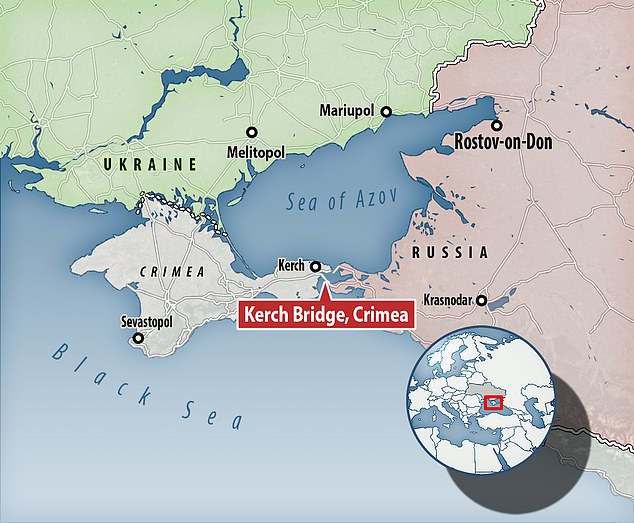
A top Ukrainian general this week threatened to destroy a huge bridge that links Russia to the occupied Crimean peninsula using long-range Western weapons.

Major General Dmytro Marchenko said on Wednesday night that Kyiv considered the 745-foot Kerch bridge a legitimate military target in his country’s on-going war against Vladimir Putin‘s invading forces.

Speaking to the the Krym.Realii website, the general – who has been leading Ukraine’s defence of the Mykolaiv region in the south – described the £2.7billion bridge as an ‘umbilical cord’ supplying Russian reinforcements to the south.

When asked what Ukraine’s military planned to do with new advanced weapons that Kyiv is urging the West to deliver, he told the publication the bridge would ‘be our number one target’.

‘We have to tear this umbilical cord to cut off (Russian) reinforcements. As soon as it’s done, (Moscow) will panic,’ he said.

Ukraine’s Major General Dmytro Marchenko said on Wednesday night that Kyiv considered the 745-foot Kerch bridge (pictured, file photo) a legitimate military target in his country’s on-going war against Vladimir Putin’s invading forces

Ukraine has urged its allies to rush more and better weapons to the country, saying it cannot hold off Russia’s more powerful forces without more support. Western weapons have been critical to the embattled nation’s surprising success so far.

However, Western countries have been reluctant to send long-range weapons that could be used to attack deeper inside Russian territory, fearing this could drag more countries into an even bigger contract.

Russia annexed Crimea in 2014 from Ukraine. Construction on the bridge was completed in 2018, and Russia has been using the bridge that crosses the Strait of Kerch to deliver troops and military equipment to the Black Sea region.

When the invasion began eight years later on February 24, 2022, this was used as a launch pad for Russia to attack Ukraine from. 

Following Marchenko’s comments, Kremlin spokesman Dmitry Peskov said on Thursday that the bridge was well protected by Russia’s ‘preventive measures’ and safe for passengers to cross.

In response to his comments, Ukraine’s military intelligence agency released what appeared to be full blueprints detailing the plans the bridge across 242 pages.

The bridge connects Russia to the Crimean peninsula, which Moscow annexed in 2014

The bridge connects Russia to the Crimean peninsula, which Moscow annexed in 2014

Pictured: A screengrab of a page from the blueprints released by Ukraine's special forces on Thursday showing the bridge. The release came after the Kremlin claimed the bridge was defended

Pictured: A screengrab of a page from the blueprints released by Ukraine’s special forces on Thursday showing the bridge. The release came after the Kremlin claimed the bridge was defended

Marchenko said he believes that such weapons would help Ukraine win the war by the end of the summer, and that if they arrive sooner it would prevent Russian forces from digging in further and holding onto the territory they have so far captured.

‘Perhaps my information is not enough to predict this,’ he said. ‘But the fact that this will not end quickly is a fact. But then again: they will give us all the weapons that we need, the counteroffensive will probably end by the end of the summer.

He went on to say that never thought his soldiers would be facing down so many Russian enemies, and that a ‘point of no return’ had been reached on the issue of peace being reached with Russia.

We have already passed the point of no return. It was at the very beginning, when it was possible to stop all this, at the stage of negotiations, but after what they did, we passed the point of no return,’ he said.

‘And I will tell those who want peace and tranquillity there in any way, it will not be.’

On Friday, the Ukrainian navy claimed it had struck a Russian boat carrying air defence systems to a strategic island in the Black Sea.

General Marchenko - who has been leading Ukraine's defence of Ukraine's Mykolaiv region - described the £2.7billion bridge as an 'umbilical cord' supplying Russian reinforcements

General Marchenko – who has been leading Ukraine’s defence of Ukraine’s Mykolaiv region – described the £2.7billion bridge as an ‘umbilical cord’ supplying Russian reinforcements

The navy said the Vasily Bekh was used to transport ammunition, weapons and personnel to Snake Island, which is vital for protecting sea lanes out of the key port of Odesa. It did not say how much damage it inflicted with the strike.

Snake Island, 20 miles off the coast, figured memorably early in the war when Ukrainian border guards stationed there defied Russian orders to surrender, using colourful language that later became a rallying cry.

The flagship of Russia’s Black Sea fleet, used in the seizure of Snake Island, was sunk in April by Ukraine – a major coup for the outmanned and outgunned Ukrainian forces, which used technology and intelligence from the US to target the ship.

The Ukrainian navy said on Friday that after the sinking of the flagship Moskva, the Russians began to install an anti-aircraft missile system called TOR on the decks of their ships. It said that was not enough to prevent Ukraine’s naval forces from ‘demilitarising the Russian occupiers’.

There was no immediate reaction from Russian authorities about the Ukrainian claim.

Russia pressed its offensive in the country’s eastern Donbas region on Friday, leaving desperate residents struggling to make sense of what the future holds for them.

‘We are old people, we do not have a place to go. Where will I go?’ asked Vira Miedientseva, one of the elderly residents grappling with the aftermath of an attack on Thursday in Lysychansk, which lies just across the river from Severodonetsk, a key focus of battles in recent weeks that Russians have nearly captured.

Ukrainian servicemen ride BMP-1 infantry fighting vehicle, amid Russia's attack on Ukraine, in Donetsk region, Ukraine June 14, 2022

Ukrainian servicemen ride BMP-1 infantry fighting vehicle, amid Russia’s attack on Ukraine, in Donetsk region, Ukraine June 14, 2022

Smoke and dirt rise from the city of Severodonetsk during fighting between Ukrainian and Russian troops at the eastern Ukrainian region of Donbas on June 14, 2022

Smoke and dirt rise from the city of Severodonetsk during fighting between Ukrainian and Russian troops at the eastern Ukrainian region of Donbas on June 14, 2022

After a series of setbacks early in the war, including the failure to seize Ukraine’s capital, Russian forces have switched their focus to the Donbas, pressing a grinding offensive.

In recent weeks, they have moved in on Severodonetsk and surrounding villages – the last pocket of the Luhansk region not yet claimed by Russia or its allies.

‘The Russians are pouring fire on the city,’ said Luhansk governor Serhiy Haidai. ‘It’s getting harder and harder for us to fight in Severodonetsk, because the Russians outnumber us in artillery and manpower, and it’s very difficult for us to resist this barrage of fire.’

The constant shelling made it impossible for 568 people, including 38 children, sheltering in the Azot chemical plant in the city to escape, he said.

Russian forces have destroyed all three bridges leading out of the city, but Mr Haidai said it had still not been fully blocked off.

The Moscow envoy for Russia-backed separatists who control much of the territory around Severodonetsk said an evacuation from the Azot plant could take place, under certain conditions.

Writing on social media on Friday, Rodion Miroshnik of the self-proclaimed Luhansk’s People’s Republic, said Russian troops and separatists are ‘ready to consider options for opening a humanitarian corridor for the exit of civilians, but subject to strict adherence to the ceasefire’.

Earlier this week, Mr Miroshnik accused Kyiv’s troops of trying to disrupt the evacuation of civilians from Azot, a claim denied by Ukrainian officials.

Kyiv has also pushed for increased political support, including a fast track to membership in the European Union.

On a visit to Ukraine on Thursday, four European Union leaders vowed to back Kyiv’s candidacy to eventually join the bloc. The European Commission is set to meet on Friday to make its official recommendation.

The war has increased pressure on EU governments to move more quickly on Ukraine’s candidate status, and Thursday’s pledge to support candidacy status for Ukraine and neighbouring Moldova pushes the 27-nation union closer to doing so.

But the process is expected to take years, and EU members remain divided over how quickly and fully to open their arms to new members.  

Source link

A top Ukrainian general this week threatened

Lulu Garcia-Navarro, formerly the host of NPR’s Weekend Edition and now a podcast host at The New York Times, has signed with CAA.

The journalist and on-air talent spent 17 years at NPR, where she was the first Latina to host a flagship show for public broadcaster. In addition to Weekend Edition, Garcia-Navarro also co-hosted NPR’s Up First and served as a foreign correspondent in Brazil, Israel, Mexico and Iraq. In addition to winning two Peabody Awards, Garcia-Navarro has received a Lowell Thomas Award from the Overseas Press Club, an Edward R. Murrow Award from the Corporation for Public Broadcasting and a Gracie Award for outstanding individual achievement from the Alliance for Women and the Media.

Late last year, Garcia-Navarro left NPR to join the Times as a podcast host. She is now the host of First Person, an audio series from the Times’ opinion audio division that features intimate conversations with people living through some of the major news stories of the day. The series debuted earlier this month on June 9.

Garcia-Navarro continues to be represented by attorney Cody Brown at Ritholz Levy Fields LLP.

Source link

Lulu Garcia-Navarro, formerly the host of NPR’s Weekend

Kimié Miner takes her responsibility as a Hawaiian artist very seriously. The Grammy-nominated singer, songwriter, producer and publisher, who has released four albums and, in 2018, won several regional awards — including female vocalist of the year, song of the year (for “Bamboo”) and female artist of the year — also sits on the Board of Governors for the Recording Academy and served two terms for the Hawai‘i Academy of Recording Arts.

Furthering her advocacy, she launched the Haku Collective in 2016, a full-service music, audio, and talent production group. “I started Haku Collective because, like many other artists, I’ve heard this many times: ‘I wish I had that when I was young,’” she says. “I saw a big gap that needed to be filled. … The music world is big but it’s also pretty small, [where] everybody knows everybody. I had a job opportunity, I invited all of my friends to join it, and I started a company by artists, for artists. We’re here to lift each other up and create opportunities and resources for each other.”

The word Haku means “to weave together,” she explains. “Because when you weave many things together, it makes it stronger. So that was the moment, or the Ho‘ailona, as we call it here — a gift sent from somewhere else. We do artist management, we’re an agency, we do booking, and we also have many programs and resources that we offer to the music community. We’re trying to create more opportunities for the music here, and the musicians here, in Hawai‘i.”

Miner, whose first name is pronounced Kim-ye, is the child of parents of Hawaiian and Portuguese descent. She started early, at the age of 14, while attending the Kamehameha Schools as a boarding student on Oʻahu, where this episode of the Artist’s Den special edition, “Live From My Den,” was recorded.

There, she found inspiration listening to a variety of artists, including Stevie Wonder, Lauryn Hill, Erykah Badu, Eva Cassidy and James Taylor.

“It’s an evolution,” she says of her music. “I didn’t really understand that these things made my identity. But I really believe that because I am Hawaiian, the music coming out of me is Hawaiian and it’s not defined by one genre. It’s the tapestry of Hawai‘i and all the influences that I’ve had. So I’ve really given myself the freedom as a Native Hawaiian to create whatever I want — whatever is coming out of me.”

She credits her Kamehameha education for helping her identify her own roots. “We lived it, so it was in our na’auao — like it’s engrained in your DNA. But I didn’t realize the part of our identity and our culture as Hawaiians,” says Miner. “So coming here, and having things brought to our attention that were unique to Hawai‘i, or unique to us and our identity, was eye-opening. And being around so many other Hawaiians in that same way and then sharing our stories with each other was so cool. It helped me in discovering who I really was.”

During the pandemic, Miner had her third child which helped her realize the importance of roots. “I learned how to play ukulele when I was in 4th grade,” she recalls. “I was listening to Mariah Carey and Whitney Houston. It was a fun experiment where I would be singing Hawaiian songs on my ukulele and then I would try to sing a Mariah Carey song. It’s like I was saying, ‘my roots give me wings.’ I knew where I came from, I knew the music of this place, but I also loved the music of the mainland and of other places. And I loved to put them all together and sing all of them.”

Her latest album, “Hawaiian Lullaby,” is a nod to her past while but also plated firmly in the present. “My dad always wanted me to sing Mele Hawai‘i or Hawaiian music, so I did this ‘Hawaiian Lullaby’ [because] I wanted to teach my kids, my babies, how to speak Olelo Hawai‘i or Hawaiian language,” she says. “When I put out the album, my dad said to me, ‘You know, I always wanted you to sing Mele Hawaii and now you are and I don’t even know what you’re saying.’ And I was like, ‘Dad! You see? So you’re going to learn too.’ Because part of our thing was our language. Not a lot of Hawaiians can speak our language. So it was a learning and a teaching and a growing moment for our whole family.”

Watch the “Live From My Den: Hawai‘i” episode above.

This Live from My Den Special Edition is made possible by The Hawaiian Islands with additional support from Creative Services – DBEDT and NaHHA.

Source link

Kimié Miner takes her responsibility as a

KYIV, Ukraine — A majority of Ukrainians and the country’s political elite have for years favored joining the European Union and yet the country has stumbled on most major governance overhauls needed to do so.

Many Ukrainians, in making their case, point out that they are the only Europeans who have fought and died for the cause of aligning with the union, noting that Russia’s military interventions began in 2014 in response to street protests demanding a free-trade agreement with Europe.

But whatever the sympathy for Ukraine in Europe, nobody is waiving the rules for joining, which include cracking down on corruption. For the country, a pluralistic democracy with sharp-elbowed politics and, until the war at least, an oversized role for the business elites known as oligarchs, meeting the requirements will be a tough row to hoe. Interlinked and deeply ingrained problems of political and business influence on the courts are a central obstacle.

Politicians who are also businessmen pull strings to appoint judges, who in turn rule in their favor in commercial disputes. As recently as two years ago, the prime minister in President Volodymyr Zelensky’s government at the time resigned in part to protest how a politically connected businessman was able to profit from the electrical utility serving Kyiv, the capital. Mr. Zelensky has denied granting the businessman, Ihor Kolomoisky, any special favors.

The European Commission has made Ukraine’s candidate status conditional on seven main overhauls in the country’s judicial system and government. Ukraine will have to guarantee an independent judiciary, weed out high-level corruption, adopt laws on the media, limit the influence of oligarchs and improve legislation on money laundering and protecting minorities, the commission said.

In some ways, the war appears to have eased these tasks. The status of the oligarchs has plummeted, as some fled and others lost assets and revenue in the fighting, while for the foreseeable future the economy will rely more on foreign aid than oligarchic-controlled commodity exports.

The security services, once in part controlled behind the scenes by business titans, solidified their positions defending the country as a whole, not business interests.

In other ways, the war created new obstacles for Ukraine’s European aspirations, beyond the obvious threat of the country being conquered by Russia.

Under martial law, opposition television stations were excluded from a national cable system. If the war and martial law persist for months or years, it is unlikely regularly scheduled elections will be held.

“The government deserves only applause” for winning Ukraine’s long-sought acceptance as a candidate for E.U. membership, Volodymyr Ariyev, a member of Parliament in the opposition European Solidarity party, said in an interview. “But we need to maintain our development in a democratic way, or we could lose our candidate status.”

Oleksandr Chubko contributed reporting from Kyiv.

Source link

KYIV, Ukraine — A majority of Ukrainians

The debut of a Toronto film at the American Black Film Festival has writers, directors and actors pumped and for good reason.

“It’s the first Toronto movie that got into the American Black Film Festival and has a lot of nuances from Toronto,” said director Ron Dias, who wrote and produced “Bite of a Mango” with Joanne Jansen.

The Toronto-based filmmaker continued: “In terms of just being recognized across the border by all these amazing Black executives that have been in Hollywood for decades, watching our movie and putting it in a competition with 10 other movies, and then being nominated for Best Director, Best Screenplay and Best Feature. It’s just overwhelming and there’s nothing but gratitude in my heart. And of course, all these lovely actors get to shine now.”

Ryan Rosery, who stars as Tray in the film, said he was humbled by the opportunity and how far the film has come.

“I’ve always believed that Toronto has such amazing talent, but it felt like there was a lack of authenticity with the type of projects that were being made here in Toronto. For Ron to take a risk and really bet on himself and cast people that are authentic and to tell this authentic Toronto story … and then to make it to the States, it’s humbling. It’s very humbling.

“We’ve always been kind of the underdogs and you see it with everything when it comes to music, even with the Toronto Raptors winning and it’s like now there’s another opportunity where we’re out here to showcase that this is what we do. We have stories, we have real situations that we deal with, just like everybody else, and this is an opportunity to showcase it.”

Rosery’s co-star, actor Jayne Kamara, said she was “was really frustrated with how my auditions were going and with the type of roles I was getting. (There was) nothing of any substance and nothing I can really relate to. Ron and Joanne brought this opportunity to me and it was phenomenal. I loved it.”

Dias and Jansen wrote the script in two days and filmed it during the pandemic. The Black Lives Matter movement had a huge effect on the film’s storyline.

“There’s nothing as big in 2020 as George Floyd and how it affected everybody. The way we saw these protests all over the world, I’d never seen anything in my lifetime that way and I’ve seen a lot of protests. I grew up in Atlanta, Georgia, so I was able to write off his inspiration for Tray’s character. But I also saw a lot of racism and nothing had hit this big. There’s no way I could tell a story in 2020 and not deal with the racism we had,” Dias said.

Nathan Taylor, who made his feature film debut in “Bite of a Mango,” said: “I did really take in the effects of the Black Lives Matter movement that was happening during 2020 and how heavy that had weighed on my heart just by being a Black person. Even though I’m in Canada, Black people are affected by this around the world and we lost people in Toronto and people all over the world. So I brought that to the character.”

Besides conversations about the BLM movement, actor Orville Cummings hopes that the film shines a light on Toronto.

“There’s a lack of representation in Toronto and a lot of people in the States or anywhere in the world don’t really know what’s going on over here and don’t really know how rich the culture is over here.”

Dias previously wrote, directed and produced the short film “Mariposa,” which appeared at the Cannes Film Festival in 2018. With this film, he also hopes to see the narrative change with how local films have to be recognized in the States before doors open in Canada.

“I hate the narrative that we always have to go to America so we can get recognized in Canada, which is always the case they said about Drake or the Weeknd or anybody who has to go across to America to be recognized here. But we’re from here and the talent’s here,” he said.

Dias and his team also want to see a change with the way dark-skinned actors are cast.

“So typically what would happen is they would pick Jayne, a dark-skin lead, but then there had to be someone white or lighter skin tone. I just didn’t want that neither did Joanne or Jayne. So we constantly looked for our Tray, which happened to be Ryan,” Dias said.

The American Black Film Festival, which returned with a hybrid presentation in Miami on Wednesday, runs until Sunday.

“Bite of a Mango” makes its world premiere at the American Black Film Festival on Saturday.

JOIN THE CONVERSATION

Conversations are opinions of our readers and are subject to the Code of Conduct. The Star does not endorse these opinions.

Source link

The debut of a Toronto film at

Posted on: June 17th, 2022

A sequel to the violent action-thriller Becky is on the way, and Lulu Wilson is reprising the title role!

In the 2020 original, which was directed by Jonathan Millot and Cary Murnion, Becky (Wilson) and her father (Joel McHale) went for a weekend getaway to a lake house in an attempt to reconnect. But their trip took a deadly turn when a group of escaped convicts, led by the merciless Dominick (Kevin James) arrived and invaded the house.

Matt Angel and Suzanne Coote (The Open House) wrote and directed the sequel, which is called Becky 2: The Wrath of Becky. The film will follow the rebellious teen, who has been living off the grid for two years, as she goes toe to toe against Daryll, the leader of a fascist organisation on the eve of an organised attack. Daryll is played by Seann William Scott (Bloodline).

“Audiences have been asking for a Becky sequel since the film’s 2020 premiere and we’re proud to work with Quiver [Distribution] again to extend the franchise,” said producer Russ Posternak in a statement. “Our goal was to up the ante from Becky 1 in every way imaginable and with Matt and Suz’s wild script and Seann William Scott’s turn as our terrifying villain opposite Lulu’s Becky, we know we’ll deliver the thrills, gore and heart that audiences loved in the original.”

According to Deadline, production on the new chapter recently wrapped.

Words: Samantha McLaren (@themeatispeople)

Source link

Posted on: June 17th, 2022

Everett Peck, whose comic-book creation Duckman was adapted into a late-1990s animated series with Jason Alexander voicing the lewd private-eye title character, died Tuesday, June 14, of cancer in California. He was 71.

On the illustrator’s Instagram page, a simple announcement reads, “Mr. Peck has left the studio… Oct. 9, 1950 – June 14, 2022.”

Alexander, who was co-starring on Seinfeld during the 1994-97 Duckman series run on USA Network, called Peck “a genius animator and cartoonist who brought Duckman to life.”

“It was an honor to voice his beloved creation and a joy to have known Everett,” Alexander tweeted yesterday. “He was one of a glorious kind. My best to his family&friends.”

Jason Alexander
Everett Collection

The animated series – the full rarely used title was Duckman: Private Dick/Family Man – was based on the character Peck created for a 1990 comic book published by Dark Horse Comics. Peck created and developed the series, which also featured the voices of Gregg Berger, Nancy Travis, Dana Hill, Pat Musick, E. G. Daily and Dweezil Zappa.

Critically well-received, Duckman was nominated for three Primetime Emmy Awards for Outstanding Animated Program (in 1994, 1996, and 1997).

A native of Oceanside, California, Peck also created the Cartoon Network’s Squirrel Boy series (2006-2008), and contributed character design for the animated series The Real Ghostbusters, Extreme Ghostbusters, Godzilla: The Series and Jumanji, among others, and wrote for Rugrats.

He also worked on print advertising for such companies as Nike and Honda, and his illustrations and drawings appeared in Time magazine, Playboy and The New Yorker.

In a 2008 interview with Animation Magazine, Peck described the origins of his most popular character: “I never really got the whole superhero thing anyway. I mean it’s easy to fight evil when you’re ripped and have a bunch of super powers and a cool suit. Where’s the fun in that? I liked the idea of taking a skinny duck with a big mouth and no genitalia and throwing him up against the world. Now that’s entertainment!”

Source link

Everett Peck, whose comic-book creation Duckman was

Sometimes, the most terrifying thing in the world is being a kid. Too young to fully comprehend the complicated machinations of the world, and too small to protect oneself from threats both physical and emotional, childhood can be scary. Whether it’s monsters under the bed or screaming matches between parents, bullies at school or the crushing social anxiety of young romance, being a vulnerable kid is often painful, difficult, and confusing. This is probably why so many films are about coming-of-age, and so much media in the horror or supernatural genre draws on childhood to tell their stories.

MOVIEWEB VIDEO OF THE DAY

The Black Phone is yet another one, and it’s a brutal depiction of childhood. In the film, Finney Shaw essentially suffers everything a kid can — one dead parent and one who’s drunk and abusive, very violent bullies, social anxiety with his crush, a sometimes scaredy-cat disposition, loneliness, and a lack of a friend group; he even opens the film costing his softball team the game. This barrage of suffering doesn’t compare to what’s in store for him though, after being kidnaped by a psychotic masked man known as The Grabber.

The Black Phone and the Violence of Childhood

Finney’s life, like The Black Phone, is pretty bleak and getting bleaker, but there are streaks of luminescence in this darkness. His sister Gwen is a shining beacon of hope in his dark world, a wonderfully multifaceted character who’s tough enough to cuss out cops and smash kids with rocks if they mess with her brother, but sweet enough to open her dollhouse and arrange her religious iconography every day to pray. She’s a wonderful character, protective of Finney and afraid of little in this cruel world except, perhaps, for her father, a wrecked nightmare of a man. A severely alcoholic and diseased person angry over the death of his wife, whom he sees in Gwen and can’t stand, Mr. Shaw uses violence to pathetically prop up what’s left of his rotten ego.


This is the crux of The Black Phone — violence as a human ritual for protection. In this small Denver suburb in 1978, the school bullies perennially beat up others to protect their status and pride, the drunken father engages in belt-whipping in a routine to protect his position of authority and fragile ego, Gwen uses violence to protect Finney, and so does Finney’s only friend in the world, Robin. (A key scene finds Robin beating the bloody viscera out of a bully, with Finney walking away in disgust). The Grabber uses an explicitly ritualized system of violence to protect his very sense of self and crumbling psyche. Interestingly, until the movie’s final scenes, The Grabber is practically the only character to not draw blood.

The Black Phone is Not a True Story But is True to Childhood

That’s because the world that writer/director Scott Derrickson and his frequent co-writer C. Robert Cargill (who both also worked with Ethan Hawke in Sinister) has painted in The Black Phone is a misanthropic and cruel one, perhaps needlessly so. However, there’s an argument to be made that the violence in this small town is exaggerated to represent how Finney feels as a child.

Related: Scott Derrickson Says Walking Away From Doctor Strange 2 Was ‘Most Difficult Decision’ of His Career

This might explain some leaps of logic in The Black Phone, small things which require a tight suspension of disbelief that allegories often use, like the fact that five children have gone missing in a very small town and yet there’s no curfew or heavy police presence on the streets for when a glaringly obvious, huge black van pulls up in broad daylight to abduct kids. Or how kids’ skulls are smashed with rocks or their faces bashed into a pulp without seemingly any ramifications or consequences. All of this means that, while not the most realistic film, The Black Phone uses its exaggerations to be true to the nature of a traumatic childhood.


The Allegorical Horror of The Black Phone

If it’s taken a while for this review to get to the horror of The Black Phone, that’s because the film does the same. Though it has a very engaging first half, the actual scares and horror elements of the film take a while to develop (though when they do, there are a few solid jump scares and some wonderfully creepy moments).

Those seeking a straight-up horror film might be a bit disappointed by the patience the film sometimes demands, because The Black Phone is horror the way The Sixth Sense was horror — using genre elements to tell a dramatic and often suspenseful story about childhood. The film feels more like Room remade by Stephen King (whose son, Joe Hill, actually wrote the short story it’s based on).

The allegorical nature of The Black Phone is made clear by its titular supernatural device. Antiquated and disconnected on the concrete walls of the bare basement in which Finney is held, the phone nonetheless rings. Through its dark receiver, Finney is able to communicate with the five dead boys that The Grabber has kidnaped; each one provides tips from their experience in the basement, helping Finney with clues, riddles, and objects they discovered during their stay.


Meanwhile, Gwen’s dreams give her hints about The Grabber, as the girl is imbued with the same ‘touched’ powers of her deceased mother (which is part of Mr. Shaw’s resentment of her). Though each dead victim and psychic dream leads to a frustrating impasse, they build up the suspense and come together ingeniously in the final sequences.

Scott Derrickson Uses Horror For Coming-of-Age

The finale of The Black Phone makes it clear that a lot of the film is a coming-of-age allegory about standing up for yourself and dealing with the world’s onslaught of threats; it’s about Finney coming to terms with his childhood. This is made clear by some similarities between the two different violent male adults in the film, The Grabber and Mr. Shaw, and the way they each hold a belt for punishment. The basement is symbolic of Finney’s childhood itself and is the basement every tortured, self-conscious, lonely kid has to metaphorically escape to grow up.

Related: The Best Coming-Of-Age Films of the ’80s

The Black Phone is Scott Derrickson’s escape from his own proverbial basement. The Doctor Strange director’s childhood town impacted him heavily, as he tells Wenlei Ma for an Australian news site. “I was inclined to tell a story like this, because I felt that I had a lot of work at reckoning with aspects of my past and the impact it had on my life and who I was becoming as a person.” Derrickson continues:

I grew up in an area of north Denver that was pretty violent, a lot of bullying, a lot of fighting, a lot of kids were bleeding all the time. It was also right after Ted Bundy had come through Colorado, killing people. And the Manson murders had just happened. When I was eight years old, my friend next door came knocking at my front door and said, ‘Somebody murdered my mum.’ The mother of my friend next door was murdered. And there was a lot of domestic violence, even in my own home and in the homes of a lot of these kids that I knew. Parents punished children much more aggressively, and so it was a very violent, scary kind of place to grow up in a lot of ways. And I tried to bring that environment realistically into the movie.

“The Black Phone is essentially about childhood trauma, and it really is about what that is like and what it feels like,” Derrickson says, and the world he and Cargill creates in The Black Phone helps process this expertly.

Ethan Hawke, Mason Thames, and Madeleine McGraw Are Amazing in The Black Phone

Of course, this kind of catharsis would only be personal and not an excellent film without the talent of so many people involved. The young Mason Thames leads the proceedings as Finney and does an incredible job, even when he has practically nothing to work with, alone in a sparse basement. His resolution and arc from cowardice to courage is perfectly expressed despite his surprisingly stoic face. Madeleine McGraw might just be the best part of The Black Phone as Gwen, a delightful combination of precociousness and innocence, suffering and strength. Whether she’s incongruously cussing out Jesus in her otherwise sweet prayers or fighting with her father, the young actor explodes in every scene she’s in.

Related: How Ethan Hawke Has Mastered the Art of Being a Villain

Then, of course, there’s Ethan Hawke as The Grabber. Much has been made of his performance and his recent turn to villainy in roles like this, Moon Knight, and Valerian and the City of a Thousand Planets, and for good reason. While Hawke is obviously a master of his craft (and a great writer), it’s been fascinating to see him take on such menace recently. The actor was worried about playing villains, telling Entertainment Weekly, “I’ve always had this theory that when you teach an audience how to see the demon inside you, they don’t un-see it for the rest of your career.” While hopefully this isn’t true, it wouldn’t exactly be a negative thing to have more Hawke villains.

That’s because he’s amazing here. Hawke hides his face in a variety of ways behind a combination of masks with detachable parts designed by the great Tom Savini (who did make-up and effects for films such as Dawn of the Dead, Creepshow, Texas Chainsaw Massacre 2, and Friday the 13th). Nonetheless, Hawke’s great performance is incredibly expressive both physically and vocally, exuding psychotic menace with a kind of sick grace, but also childlike and unstable on occasion. With a long career as a true artist, it’d be presumptuous and perhaps unfair to say he’s at the top of his game here, but he’s close.

Hawke is the perfect manifestation of the horror Derickson wanted to exorcize. “Catharsis can come from using horror to confront the spoken or unspeakable evils in our lives, in ourselves, in our families, in strangers and nature, in the world. That’s what the genre is for; it’s all about in some ways confronting and facing what is frightening and traumatic in the world.” While there should be ‘think pieces’ on the arguably problematic conclusions The Black Phone comes to regarding violence and self-defense, the film itself is a great accomplishment. Wonderfully directed, expertly acted, and intelligently scripted, The Black Phone rings true.

From Universal Pictures, The Black Phone will be released theatrically on June 24th and can be streamed on Peacock 45 days after its release (August 8th).

Source link

Sometimes, the most terrifying thing in the

EXCLUSIVE: Following the infamous Oscar slap, Chris Rock has been in demand. There already is a call for him to host next year’s Oscars, and he has also been asked to host the Primetime Emmys on NBC this September, I have learned. Also approached about hosting the Emmys is Dwayne Johnson, who was at the top of the host wish list for the 2022 Oscars too, sources tell Deadline.

We hear Rock, who is yet to publicly speak about the Will Smith Oscar attack beyond his comedy tour, has turned down the informal offer, and it does not appear likely that Johnson would take on emcee duties either.

Primetime Emmy producers Done+Dusted in association with Reginald Hudlin’s Hudlin Entertainment are starting with ambitious top choices as they are believed to be casting a wide net that goes beyond NBC talent.

Both Rock and Johnson have ties to NBC, which is carrying the Primetime Emmys this year. Rock was a cast member on Saturday Night Live early in his career, while Johnson is an executive producer on the network’s comedy series Young Rock, inspired by his life. It was just renewed for a third season.

TV Talk Podcast: Emmy Voting Begins Today; Here Are Our Top Picks In The Acting Categories

NBC/Peacock talent is still expected to be considered for the hosting job as showcasing stars from the network carrying the Emmys is a tradition; just last year, Cedric the Entertainer from CBS’ The Neighborhood presided over the ceremony, which aired on the network. This year’s list may not include the obvious late-night choices as some top NBC personalities that have hosted the Emmys before, including Seth Meyers, are said to not be interested in an encore.

The 74th Primetime Emmy Awards will air September 12 on NBC.

Source link

EXCLUSIVE: Following the infamous Oscar slap, Chris

Austin Butler Says Getting Priscilla Presley’s Blessing for ‘Elvis’ Was ‘So Moving’ (Exclusive) | Entertainment Tonight


Source link

The Ontario Provincial Police say the QEW in Mississauga has reopened in both directions after a fatal crash claimed the lives of two people and injured two others.

The OPP said the three-vehicle crash happened at around 10:36 p.m. Thursday in the eastbound lanes of the QEW near Cawthra Road.

Peel Paramedics said they arrived to assess four patients at the crash scene.

One person was pronounced dead at the scene, paramedics said.

Read more:

21-year-old woman critically injured after crash on QEW in Oakville

Another person was also pronounced dead en route to the hospital or at the hospital, paramedics said.

The third person was taken to a trauma centre in critical condition. The fourth person was taken to a local hospital with non-critical injuries, paramedics said.

Story continues below advertisement

The OPP shut down the highway in both directions. It was closed for several hours but has since reopened.


QEW crash near Cawthra Road.


Global News

© 2022 Global News, a division of Corus Entertainment Inc.

Source link

The Ontario Provincial Police say the QEW

Chances are you’re either deeply familiar with the wide world of gamers and streamers, or you’re so completely unaware of how far it reaches that the very idea of “esports” is enough to make your head spin. As part of the latter camp, but with a sister very much entrenched in the former, I approached “Players” — the new Paramount+ comedy about a professional gaming team wrestling for relevance — with equal parts caution and curiosity. Could this scripted show delving into what makes gaming so huge make me finally understand why? Or would it rely on niche enough jargon and humor that it’d fly right over my head?

After watching the better part of its 10-episode season, the answer is…well, a bit of both. But in framing the series like a classic sports docuseries in the vein of a “Last Dance,” co-creators Dan Perrault and Tony Yacenda (of Netflix’s fantastic “American Vandal”) make it easier to come to the show with even scant knowledge of the arena in which its characters are playing. By making all its team members recognizable archetypes (e.g. the cocky star; the mysterious ingenue; the steadfast coach; and so on), “Players” doesn’t need you to understand everything that’s going on in order to grasp the stakes and what drives its characters. All you really need to know is that “Players” is a show about competitors who started playing a game they love, turned that passion into lucrative careers, and have grappled with the consequences of that choice ever since.

Even when it strays into the weeds, you don’t have to understand all the intricacies of Twitch to understand why these themes work on a basic story level (though as with anything, some base knowledge certainly wouldn’t hurt). As with Apple TV+’s “Mystic Quest,” “Players” is about gaming, but also about what happens when friends become coworkers, and when you turn your favorite thing in the world into your job.

The first episode picks up with the once dominant gaming collective Fugitive trying to recapture their glory days by winning an elusive League of Legends championship. Ringleader “Creamcheese,” (Misha Brooks) aka Trevor (but they all go by their gaming handles), is nowhere near the titan he used to be, so can’t help but feel threatened by the arrival of 17-year-old phenom, Organizm (Da’Jour Jones). Throw in the fact that his best friends Kyle (Ely Henry), April (Holly Chou), and Frugger (Matt Shively) have become his coach, business manager, and weakest teammate, respectively, and it’s safe to say that Fugitive’s runaway success has thoroughly rocked Creamcheese’s once unfailingly awesome world.

Though Creamcheese and Brooks’ performance both gain more depth as the season goes on, centering his story above all others is “Players”’ weakest choice. Despite Organizm’s importance as the future of gaming and Fugitive alike, his relative introversion makes him a difficult character to crack in this format, and it takes the show too long to do it. A player like Nightfall (Youngbin Chung), or teammate turned streaming shock jock Guru (Moses Storm), make for entertaining enough side quests, but still deserve more than they get in their ostensible spotlight episodes as Creamcheese’s arc still takes center stage. There’s a version of “Players” that might’ve worked, too, if it had focused more on Kyle and April, a committed couple and the adults in the room even when they don’t want to be.

Toggling between the present day and the timeline that led to this point, the series unfolds in half-hour mockumentary style episodes that let everyone talk straight to the camera about how they see their parts in Fugitive’s ongoing history. As with “American Vandal,” Perrault and Yacenda mimic the tone, look, and feel of their inspirations — in this case, docuseries like “The Last Dance” and “Formula 1: Drive to Survive” — so exactly that it becomes easy to forget that the show is, in fact, scripted. The punchlines of “Players” aren’t as overt as those on “Vandal,” a show that followed two more obviously ridiculous mysteries set in high school. In fact, calling “Players” a “mockumentary” might be technically accurate, but feels spiritually wrong. That might make it less laugh-out-loud funny, but it also makes it more complex. While so many others might have approached the world of esports with an eye for the hyperbolic, there’s absolutely nothing mocking about the way “Players” explores it as a community, and it’s a better show for it.

The first three episodes of “Players” are now available to stream on Paramount+.

Source link

Chances are you’re either deeply familiar with

SpaceX, the private rocket company, on Thursday fired employees who helped write and distribute an open letter criticizing the behavior of chief executive Elon Musk, said three employees with knowledge of the situation.

Some SpaceX employees began circulating the letter, which denounced Mr. Musk’s activity on Twitter, on Wednesday. The letter called the billionaire’s public behavior and tweeting “a frequent source of distraction and embarrassment” and asked the company to rein him in. Mr. Musk is currently closing a $44 billion deal to buy Twitter.

By Thursday afternoon, SpaceX had fired some of the letter’s organizers, according to the three employees and an email from Gwynne Shotwell, SpaceX’s president and chief operating officer. In her email, which was obtained by The New York Times, she said the company had investigated and “terminated a number of employees involved” with the letter.

“The letter, solicitations and general process made employees feel uncomfortable, intimidated and bullied, and/or angry because the letter pressured them to sign onto something that did not reflect their views,” Ms. Shotwell wrote. “We have too much critical work to accomplish and no need for this kind of overreaching activism.”

It was unclear how many employees were fired. James Gleeson, a SpaceX spokesman, did not immediately return a request for comment.

The open letter followed recently publicized accusations of sexual misconduct against Mr. Musk amid his contentious acquisition of Twitter. On Thursday, Mr. Musk addressed Twitter employees for the first time since his takeover offer via a video call to answer their questions.

In May, Insider reported that a flight attendant said Mr. Musk propositioned her for a sexual massage during a flight to London in 2016. The flight attendant said he also exposed himself to her and offered her a horse, according to the article, the details of which were not independently verified by The Times.

Mr. Musk called the accusations “utterly untrue” and joked about horses and his genitalia on Twitter. Last month, Ms. Shotwell said in an email to SpaceX employees that she “personally” believed the sexual harassment allegations against Mr. Musk were false.

At SpaceX, Mr. Musk is rarely challenged by his own workers, said the three employees, who spoke on the condition of anonymity. Earlier this month, he notified the company’s workers via email that they must spend at least 40 hours in the office or face firing.

The open letter about Mr. Musk’s online activity asked that SpaceX’s leaders “publicly address and condemn Elon’s harmful Twitter behavior” and “define and uniformly respond to all forms of unacceptable behavior.”

In her email to staff, Ms. Shotwell wrote, “Blanketing thousands of people across the company with repeated unsolicited emails and asking them to sign letters and fill out unsponsored surveys during the work day is not acceptable.”

“Please stay focused on the SpaceX mission, and use your time to do your best work,” she continued. “This is how we will get to Mars.”

Source link

SpaceX, the private rocket company, on Thursday

Tribeca: Holmes writes, directs, produces, and stars in a YOLO pandemic love story at the start of the pandemic, opposite Jim Sturgess.

Don’t let this film fool you: It’s not great, but it is a cozy reminder of rom-coms past.

“Alone Together,” while set in 2020 amid the start of the COVID-19 pandemic, infuses the genre with the comfort of a matching cashmere bralette and cardigan sweater from the late 2010s, per the trend writer-director-producer-star Katie Holmes made famous then.

It’s easy to get lost in the nostalgic parts of “Alone Together,” like the effortlessly picturesque Anthropologie home furnishings and stylish wardrobes of a “woman on the go in the Big Apple.” It’s even easier to get lost in Jim Sturgess and Holmes’ simple yet charming banter. But don’t get too dreamy-eyed for the rom-coms of days past: the film, which premiered at Tribeca 2022, has a jarring reminder that the world is a heartbreaking place, full of death, betrayal, and traumatic loss. So goes our cute and quirky escape.

“Alone Together” centers on June (Holmes), a restaurant critic who is suddenly out of a job and on a relationship hiatus with her boyfriend John (Derek Luke, with whom Holmes is set to work again on another film, “Rare Objects”) starting March 15, 2020 when Manhattan is at a standstill and COVID-19 leads to a city-wide exodus. June travels upstate to Hudson, NY to camp out at an Airbnb which John booked; John, however, opts to stay behind in New York City to care for his parents. Upon arriving at the rental, June is confronted by Charlie (Jim Sturgess), who apparently double-booked the same French chateau-inspired cottage.

The opening of Holmes’ sophomore directorial effort “Alone Together” makes for a stomach-gripping drag: A cover of “Blue Moon” plays as a Lifetime-type font rolls out the credits. (And yes, we judge films based on font.) But seeing Holmes onscreen again on her own terms has a “you go, girl” sense of empowerment. Sure, this could just be our projection that “Alone Together” quietly debuts the same summer as “Top Gun: Maverick” and the “M:I 7” trailer, but Holmes seems happiest writing, directing, and producing, while also starring as the lead. The whole “world’s ending” backdrop is where “Alone Together” fumbles, and it’s quite a fumble indeed.

June starts crying when she sees a deer on the drive to Hudson, and Charlie’s career is rooted in “fixing things,” such as June’s hardened heart. Charlie is devoted to having Indiana-born career woman June take a pause and return to her beer-drinking, Big Mac-eating authentic self. Ugh, June’s boyfriend John was pressuring her to become a vegan, and who really sticks to their diet goals during a pandemic?!

The small classic rom-com details like a large and extensively furnished home only having one bathroom and one bedroom make for an already claustrophobic pandemic premise feel even closer: June and Charlie aren’t necessarily worried about getting COVID from one another — although Charlie at one point adorably sews homemade masks for both him and June — but rather the concern is that their “we may die tomorrow anyway” attitude will lead to a romance rooted in both of them taking advantage of each other being in vulnerable states.

June resorts to first banging a bottle of white wine against a wall to uncork it (…OK…) and then, inevitably, banging Charlie himself. We could get used to this. But nope, here is yet another voiceover by former New York Governor Andrew Cuomo talking about PPE when June is only really focused on BDE. And then comes all the death.

June’s Alzheimer’s-addled grandfather dies in a nursing home (cue up some more Cuomo soundbites, perhaps?), and she reveals to Charlie that her grandpa raised her after her parents died in a murder-suicide. Yes, this rom-com has a murder-suicide reference. The last time a domestic violence murder-suicide was paired with this much hooking up was in Season 1 of “Temptation Island” (it’s on Peacock, watch it ASAP.) And while June opening up to Charlie could have been an emotional moment, less than 12 hours later she’s back biking with him through the forest and musing over the romanticism of Instagram-friendly motels. Everything is magnified until it’s not. Everything matters until nothing does.

Charlie, meanwhile, bonds with June over the loss of a parent. His father passed away years ago, and his mother (Melissa Leo) raised him and his brother by herself. If there was a manic pixie dream man, Charlie would be it. He dresses impeccably in Brooklyn thrift store-salvaged GQ-ready ensembles, pairing flannel pullovers with sherpa jackets featuring obscure karate dojo logos. Zosia Mamet occupies the voice of reason BFF role as per her “Flight Attendant” and “Girls” arcs, and seems supportive of June’s McDonald’s dates with Charlie. From picnics in the front yard to at-home karaoke and making love on a pink velvet couch with monochromatic floral prints, June and Charlie’s romance seems like the best thing to come out of the start of the pandemic….

….until John crashes the Airbnb to retrieve his girlfriend and tell her that while she was falling in love with another man, his dad died of COVID. You know, the dad that June was annoyed John stayed behind in Manhattan for. Well, guess he was right. It’s only when June and John are together do we see the true “Alone” aspect; June cooks alone, bikes alone, even watches movies by herself. John only chimes in to tell her that she should be thankful she’s free of her “dead end job” and doubts her abilities to write a novel.

But John isn’t a bad guy: Who is the bad guy? Does there have to be one? June wasn’t there for John in his grief, but then again, neither was he for hers. The film sidesteps guilt or emotional tolls; the rush of the pandemic shutdowns are used only for YOLO hook-ups that apparently bloom into true love sponsored by endless bottles of white wine. June sheds her self-conscious attitude about her makeup-less appearance and ticking biological clock when she’s with Charlie, and their awkward ease with one another feels real.

When Charlie warns that if June gets back with John, she’ll be either “dating yourself or losing yourself,” it feels like Holmes is giving a PSA for the audience. “Alone Together” has the momentum of a reclamation of sorts, but the plot tries to do too much, say too much, when it really should just be about love. Who cares if it’s formulaic or not? In the middle of this pandemic, maybe being something we can rely on is a good thing.

Grade: C

“Alone Together” premiered at the 2022 Tribeca Film Festival. Vertical Entertainment will release the film in theaters on Friday, July 22.

Sign Up: Stay on top of the latest breaking film and TV news! Sign up for our Email Newsletters here.

Source link

Tribeca: Holmes writes, directs, produces, and stars

Dreamchaser adds trio of Australian producers to team

Endeavor Content–backed TV production and distribution studio Dreamchaser has completed a multi-year development and production deal with some of Australia’s top unscripted producers.

Debbie Cuell (Old People’s Home for 4 Year Olds, Ambulance Australia), Leigh Aramberri (The Voice) and Emma Lamb (Married at First Sight, Byron Baes) will join Dreamchaser as production partners. The trio will develop and produce new projects for TV and streaming platforms for the studio’s factual and entertainment divisions. Dreamchaser will serve as executive producer on all projects and take them out internationally.

Cuell (pictured, left) joins Dreamchaser as executive producer, partner: documentary and factual entertainment. She has more than 20 years of experience in factual and entertainment genres in Australian TV, and has previously worked with Endemol Shine Australia. Her projects will be made by Dreamchaser through her own production company, Sparkle Pictures.

Aramberri (pictured, right), joining the team as executive producer, partner: non-scripted entertainment, has worked on The Voice since its inception a decade ago, serving as executive producer for the past seven seasons and helping to produce spin-offs like The Voice Kids and The Voice Generations. He also has credits on MasterChef, Australia’s Next Top Model, The Apprentice, Project Runway, The Biggest Loser and The X Factor.

Lamb (pictured, center), who joins the team as executive producer, partner: non-scripted entertainment, has worked as co-executive producer on Married at First Sight for four years, and recently executive produced Netflix Australia’s first original unscripted series, Byron Baes. She’ll launch her production label Mischief Maker in July, as an exclusive partnership with Dreamchaser.

Dreamchaser also announced it will have further producer partner announcements to make later this year.

Vice World News acquires Pleistocene Park doc

Vice World News has acquired Java Films’ Pleistocene Park for the third season of its spotlight documentary series, The Short List with Suroosh Alvi.

Vice picked up worldwide broadcast and streaming rights to the documentary, which looks at Russian geophysicist Sergey Zimov’s Pleistocene Park project that aims to rewild a remote corner of Siberia. The film is produced by Jed Riffe Films and directed by Luke Griswold-Tergis, who spent eight years filming Zimov and his son Nikita as they searched around the globe for holdovers from the Ice Age and transported them to the Pleistocene Park site.

The documentary was selected for CPH:Dox, Hot Docs and Thessaloniki earlier this year.

Beck Media acquires pair of PR agencies

Entertainment and technology communications firm Beck Media & Marketing has acquired San Francisco–based media technology boutique Big Noise PR, as well as Nashville-based bespoke agency Beacoup Media.

The combined companies will operate under the Beck Media banner, effective immediately. Both deals closed earlier this year.

Big Noise PR is led by industry veteran Bronagh Hanley, and its clients and staff have already been integrated into Beck. Hanley will join Beck in an advisory role while pursuing other ventures, Beck announced.

“After more than a dozen years of running Big Noise PR independently, this feels like the right time to trade independence for a new opportunity,” Hanley said in a news release. “The refreshing combination of professional excellence and personal kindness that Todd and the entire team at Beck embody is exceedingly rare in our business, and I know Big Noise’s clients and staff will truly benefit from this deal.”

Beacoup Media was founded in 2019 by executive Amber Williams-Wright, who has joined Beck as a vice president managing special projects; she will still be based in Nashville, and will work closely with Beck’s Atlanta office. Previously, Williams-Wright opened Beck’s New York City office in 2011, and led it for six years. She later worked for the Country Music Association before launching her own firm to represent music artists, songwriters, labels, publishing houses and other entertainment clients in Nashville.

“I’ve seen a lot of companies from the inside and out during my career, and Beck Media rises above with the best colleagues and clients and the most conscientious leadership,” Williams-Wright said. “I’m honored to be back and look forward to contributing to this amazing agency culture.”

Source link

A maverick of stop-motion animation and a restless Renaissance man, Phil Tippett is the visual effects alchemist responsible for emblematic sequences in some of the most popular American film productions of the 1980s and ’90s.

Tippett’s indelible gifts to cinema include animating the AT-AT walkers in “The Empire Strikes Back,” lending his deep knowledge of dinosaurs to visualize the velociraptor kitchen scene in “Jurassic Park,” and building and animating the imposing ED-209 robot seen in the “RoboCop” franchise.

The director of “RoboCob,” Paul Verhoeven, has long been impressed with Tippett’s handcrafted style.

“Personally, with a lot of digital stuff I often don’t believe it, but with Phil, I believe it,” Verhoeven said in a phone interview. “He can make characters move in a way that you don’t doubt for a second that they are there. And he can integrate these stop-motion creatures with the rest of the shots, which is very difficult to do.”

Tippett, 70, also worked on sequences for Verhoeven’s “Starship Troopers.” The filmmaker emphasized the value of Tippett’s contributions.

“In my eyes, his participation was as important as my own,” Verhoeven said. “I really thank him for what he did for my movies.”

For Tippett, a prosperous profession began as a childhood fascination with the tactile magic of the monsters in “King Kong” (1933) and “The 7th Voyage of Sinbad” (1958). After pursuing a conceptual art education at the University of California, Irvine, he honed his unique skill set experimenting with stop-motion, and then making commercials at the Cascade Pictures studio in Los Angeles.

As a part of the teams that helped realize the imaginative worlds of George Lucas and Steven Spielberg, Tippett earned two Academy Awards.

“I always thought of myself as a choreographer working on movies, and that was my relationship with directors,” Tippett said. “Everything that I did was performance-based.”

During a recent video interview, Tippett wore a comfortable sleeveless black shirt and sat caressing his long white beard, like a biblical figure lost in our current era. He was at his work space at Tippett Studio in Berkeley, Calif., where his ventures are born.

Of all of the feats to his name, “Mad God,” a stop-motion feature now in theaters and streaming on Shudder, proved the most taxing. Thirty-three years in the making — from his earliest sketches and storyboards in 1987 to its completion in 2020 — this macabre magnum opus tracks an enigmatic character as he descends into the bowels of a Dante-like realm plagued with death, violence and grotesque creatures.

“‘Mad God’ was motivated by the unconscious and not by intention,” Tippett said. “It was a religious experience for me in the sense that I just I felt like I was transcribing messages from the great beyond. I do not seek; I find.”

In the early 1990s, Tippett conceived three minutes of what would become “Mad God” with the help of the crew that worked on the “RoboCop” films. But after they moved on, proceeding on his own became too daunting.

Unsure of precisely where the kernel of inspiration for “Mad God” had originated, Tippett spent the next two decades devouring information on a variety of subjects to expand on it: theology, archaeology, paleontology and psychoanalysis.

It wasn’t until about 12 years ago, when young colleagues at Tippett’s studio saw him archiving that original footage and galvanized to support him, that the fulfillment of his vague concept seemed possible.

Volunteers from local schools also joined the makeshift production, which slowly began taking shape with resources gathered from several successful Kickstarter campaigns. After a few years, Tippett had completed 45 minutes (in three separate segments) of this free-flowing idea, at which point he decided to double the running time to make a feature.

Tippett, who is not fond of digital techniques, pushed to achieve nearly every aspect of this gruesome parable via in-camera, practical means — the way he has always done it. This can be seen in the meticulously detailed craft on display in each increasingly bleak frame.

He used a fish tank and corn syrup to conjure up the cloudy opening sequence that features a plastic replica of the Tower of Babel he bought online. He shot a surgery scene with live-action actors at a low frame rate to mimic the movement of stop-motion animation, and for three years he enlisted the assistance of up to six students, one day a week, to fabricate piles of melted plastic soldiers.

“I wanted to make something ugly and beautiful at once,” said Tippett, who cited the work of the painter Hieronymus Bosch as a major influence.

Tippett also mined his own subconscious for creative fuel. “During the period that I was working on ‘Mad God,’ I was a prolific dreamer,” he said. “Every night I’d have these amazing dreams that I would write down and use.”

“Mad God” constitutes the most complete expression of his erudite image-making expertise, but its consummation nearly drove him to real madness. Hyper-focused on finishing, working obsessively for hours on end and drinking daily, Tippett subjected himself to such exhaustion he landed in a mental health facility. He was later diagnosed with bipolar disorder.

“As it happens to many artists like Beethoven or Carl Jung, particularly if what they’re working on is over a protracted period of time, it really popped my cork at the end of it,” he said. “My manic side is my superpower, but if I don’t manage that, it can destroy me.”

“The strongest thing about Phil as an artist is that he feels everything to the extreme,” Dennis Muren, an Oscar-winning veteran in the visual effects industry and a longtime friend of Tippett’s, said in a phone interview. “He wants that feeling to come across on the screen and it doesn’t matter how it gets there.”

“This movie taught me a lot about myself,” Tippett said. “I didn’t even think that I had the capacity to do something of this magnitude.”

Tippett is relieved that “Mad God” has left his psyche and his studio, and has now haunted film festival audiences to great reception; he mischievously recounted the time a family with young children walked in to watch the film, only to run away soon after.

“That was amusing because if you hear, ‘It’s an animation film by the guy who worked on ‘Star Wars,’ people think, ‘Kids will love it. It’s like a Pixar film.’ And well, it ain’t,” he said.

A grateful Tippett confessed that, because of the priceless creative opportunities he’d been given, he could easily be convinced that our reality is a simulation. While he said he would never again attempt a project as all-consuming as “Mad God,” he doesn’t regret having gone through the ordeal. And he’s already written a sequel.

“It would be very embarrassing to die and not have taken the opportunities that were handed to me, not to make something that was unique,” he said.

Source link

A maverick of stop-motion animation and a

As the entire industry was forced to halt production, some chose to wait out the pandemic by pushing release dates, others chose to make the most of the captive audience as the world was trapped in front of their TV’s. Dealing with the evolving realities of the pandemic meant that studios and distributors were incentivised to release movies via streaming or on demand the same day as the cinematic release, bringing the short-lived era of ‘day and date’ cinema.


Related:Box Office Flops That Are Actually Worth Watching

Spare the rare exception, the pandemic box office was dominated by sequels, cinematic universes and existing IP. Taking into account worldwide total gross earnings, here are the most successful movies released during our lockdown period.

COLLIDER VIDEO OF THE DAY

Wonder Woman 1984 — $166 million

Starring Gal Gadot and Kristen Wiig, the follow-up to the hugely successful 2017 Wonder Woman received mixed reviews upon its release early on in the pandemic.

As one of the first major releases of the ‘day and date’ release era via HBOMax, Wonder Woman 1984 did not receive a wide cinematic release, instead it was used to launch the newly rebranded streaming service.

The Suicide Squad – $167 million

Suicide Squad 2021

Director James Gunn aimed to breathe new life into the DC Comics franchise that spawned the universally critiqued 2016 Suicide Squad. Also premiering on HBOMax The Suicide Squad was a carefully calculated reimagining of the property, as the movie this time successfully blends the grim violence with offbeat comedy that the first film was aiming for.

Even spawning a HBOMax spinoff for John Cena as Peacemaker, the modest box office is not quite telling of the film’s success with both audiences and critics.

A Quiet Place Part II – $297 million

A Quiet Place Part II

​​​​​Helmed by Hollywood power couple, star Emily Blunt and Director/Co-star John Krasinski, the sequel to the 2018 hit A Quiet Place almost surpassed its predecessor even during a pandemic.

The modern prestige horror subgenre has continued to prove financially viable, continuing the trend of similar hits like Herditary, Midsommar or Get Out.

Tenet – $363 million

Tenet - John David Washington

Starring John David Washington and Robert Pattinson alongside Elizabeth Debicki, the latest entry into Christopher Nolan‘s trademark slick sci-fi canon was both written and directed by Nolan.

Featuring the usual mind-bending, high concept, premise conventions of Nolan’s work, the movie’s unique take on time travel interspersed with grounded action made this movie must see pandemic viewing.


Dune – $400 million

Timothée-Chalamet-dune

Timothée Chalemet led the way for the latest adaption of Frank Herbert‘s classic sci-fi epic, starring as the messianic Paul Atreides. With Oscar Isaac and Rebecca Ferguson also playing large roles, the stacked cast and award-winning visual effects were enough to land the film the greenlight for a much anticipated sequel.

Related:The Highest-Grossing Cinematographers of All Time at the Domestic Box Office

Plus notable appearances by Josh Brolin and Jason Mamoa, the film also managed 10 academy award nominations including Best Picture, winning for best sound, best visual effects and best cinematography.

Shang-Chi and the Legend of the Ten Rings – $432 million

Shang-Chi Fighting Inside a Bus Cropped

While a far cry from the usual billion-dollar Marvel box office baseline of years past, not even the pandemic could stop audiences from the studio’s latest entry. Released exclusively in cinemas, the superhero and martial arts movie crossover starred Simu Liu as the titular Shang-Chi.

Also featuring Awkwafina, plus powerful performances by Tony Leung and Michelle Yeoh, the film was largely well received by Marvel fans and critics alike.

Godzilla vs. Kong — $468 million

Godzilla vs Kong

The sequel to the 2017 Kong: Skull Island and the 2019 Godzilla: King of Monsters, this clash of the iconic giants reached almost half a billion dollars in the box office while the world was still deep within the midst of the pandemic.

As a ‘day and date’ release on HBOMax and on demand, the movie was simultaneously released in cinemas and making its financial success even more surprising.

Venom: Let There Be Carnage – $506 million

venom-let-there-be-carnage-tom-hardy-social-featured Cropped

The Tom Hardy starring follow up to the 2018 Venom, Let There Be Carnage looked to continue the Spider-man villain led cinematic universe in the works at Sony. Introducing Woody Harrelson as serial killer Cletus Kasady, the sequel maintained the same campy energy of the first film.

Related:2021 Movies With The Biggest Budgets, Ranked

Avoiding many of the downfalls of the later entry into the Sony series, Morbius, Venom 2 instead gained audience favor by focussing on the fun tone and performances of the original.

F9: The Fast Saga – $726 million

John Cena & Vin Diesel

A far cry from the series’ humble roots, the latest entry into the franchise now boasts an expansive roster of both friends and foes, including Cardi B, Helen Mirren, Kurt Russell and Charlize Theron.

Also introducing John Cena as a long-lost Torretto brother, the ninth entry of the franchise continued its expansion into the world of high-tech cyber criminals and international spies. With the same focus on family and bringing back once dead characters, while entirely reimagining others, the franchise still excels when behind the wheel.


No Time To Die – $774 million

no-time-to-die-daniel-craig-ana-de-armas

The latest entry into the modern Bond franchise held out almost two years for a full international cinematic release for Daniel Craig‘s final appearance after a decade in the tuxedo.

Featuring the first villainous turn for Oscar winner Rami Malek, Lashana Lynch as the new 007 and Ana de Armis as a rookie spy, the movie earns it’s near three hour runtime as it attempts to respect the entirety of the franchise, concluding the modern incarnation of the character.

Source link

As the entire industry was forced

A “Game of Thrones” spinoff series based around Jon Snow is in early development at HBO, Variety has confirmed.

Kit Harington is attached to reprise his role as the fan-favorite hero in the live-action show, which would take place after the events of “Game of Thrones” — potentially opening up what many thought was an iron-clad ending to the wildly popular series.

In the final season of “Game of Thrones,” Snow realized his true identity and that he could be an heir to the Iron Throne. The series concluded with his exile from Westeros as he rides into the Haunted Forest with Ghost and the Wildlings to begin a new life.

Since the potential Jon Snow sequel series would take place after the final season of “Game of Thrones,” it’s possible that familiar characters — such as his half-siblings Arya Stark (Maisie Williams) and Sansa Stark (Sophie Turner) — could show their faces.

HBO’s upcoming spinoff “House of the Dragon,” which is set 200 years before the original series, premieres on Aug. 21. Other “Game of Thrones” spinoffs in development include “Tales of Dunk and Egg,” “10,000 Ships,” “9 Voyages,” “Flea Bottom” and an animated series.

Harington was nominated for two Emmys, in supporting actor and lead actor in a drama series, during his time on “Game of Thrones.” After the series ended in 2019, Harington has starred in Marvel’s “Eternals” as Dane Whitman, appeared in an episode of Amazon’s “Modern Love” and headlined Shakespeare’s “Henry V” at the Donmar Warehouse in London.

HBO declined to comment on the matter. Representatives for Harington did not immediately respond to Variety‘s request for comment.

The Hollywood Reporter was the first to report news of the potential spinoff.

Emily Longeretta contributed to this report.

Source link

A “Game of Thrones” spinoff series based

Netflix subscription is required to watch on Netflix


Great news! “Surviving R. Kelly” is available to watch on Netflix USA!


Date Added: 16th June 2022

Want to keep forever? Try looking for ‘Surviving R. Kelly’ on Amazon (paid link)


History:

   09/15/2019: Added to Netflix

   04/13/2022: Removed from Netflix

   06/16/2022: Streaming Again


Watch Season 1 now

Description:

In this documentary series on the tangled history of allegations against musician R. Kelly, women give detailed accounts of sexual and mental abuse.


Certificate: TV-MA
For Mature Audiences. May not be suitable for ages 17 and under.


Year: 2019

Duration: 1 Season

Available Seasons: Season 1 (6 Ep)

Audio: Arabic, German, English [Original], Spanish, French

Subtitles: Arabic, German, English, Spanish, French

Episode Length: 50min


Cast and Crew

Production & Season Details:

Status: Ended”Surviving R. Kelly” is a TV show produced by Kreativ Inc.. The show was originally broadcast on Lifetime (United States) and premiered on January 3rd 2019. “Surviving R. Kelly” ended after 2 seasons and a total of 11 episodes. The final episode aired on January 4th 2020.

TMDb logo


Watch the trailer for “Surviving R. Kelly”


RATINGS:

IMDB

The Movie Database

Average Rating

LISTS:

Trakt.tv Letterboxd


DISCUSS ON…:
FacebookFacebook TwitterTwitter


Login or register for updates…


Available on Netflix USA!

Netflix subscription is required to watch on Netflix

Where else can you watch ‘Surviving R. Kelly’ on Netflix?


Want to keep forever? Why not rent or buy ‘Surviving R. Kelly’ from one of the online services below?


Powered by
JustWatch

Source link

Makeup department head Carleigh Herbert has always been obsessed with period pieces, and the ’70s have always been a favorite.“There was so much self-expression,” she says. So, when the chance to work on HBO Max’s “Minx” came along, she snapped it up.

One particular scene, halfway through the show’s first episode, posed a unique challenge for Herbert. Ophelia Lovibond’s Joyce is tasked with casting models for Minx, the first porn magazine designed for women. What follows is a parade of male models baring and strutting their stuff for the casting call.

Herbert, whose credits include “The Sex Life of College Girls,” “Ratched” and “American Horror Story,” says both director Rachel Lee Goldenberg and the show’s creator and writer Ellen Rapoport were excited to have her on board with her prosthetics background.

“They said, ‘It’s great you do prosthetics because we’re going to have some,’” says Herbert. “I asked, ‘What are we going to do?’”

The makeup head has run the gamut of prosthetics — from slitting throats to bleeding out body parts. She had even done a penis, but, Herbert says, “I’ve never done a full prosthetic penis.” With that, she happily accepted the challenge.

The trend of penis prosthetics, Herbert notes, is something that has seen a surge in the past few years with shows such as “Scenes From a Marriage,” “Euphoria,” “Outlander” featuring full-frontal nudity.

“We’re still figuring the penis prosthetic out,” Herbert says.

It began with the script for Herbert and collaborating with Rapoport, as well as each actor. “It would depend on the character, the actor and what they were supposed to look like physically,” she says.

Herbert relied on Jason Collins, owner of Autonomous F/X. He was shown photos approved by Rapoport and tasked with making the prosthetics needed.

“We had plastic pieces, and one character had a hard-on,” explains Herbert of the different “looks, shapes and sizes.” She then left it to Collins to sculpt and build what she needed.

Sometimes Herbert would use glue during the application process and other times a belt.“It really depended on how we used the prosthetic,” Herbert says. She also paid attention to dressing pubic areas, she says. Through it all, Herbert learned about tucking tape, which is used by drag queens and trans folks. She found it came in handy and incorporated it into her application process.

Comfort was of the utmost importance for everyone involved. “A big part of the application was making sure the actors were comfortable and going through the steps,” she says. “It’s a challenging prosthetic to have to wear anywhere from 10 to 14 hours a day.”

As for that talked about audition scene, Herbert says that was actually not prosthetics: “That was everybody’s penises.”

Aside from prosthetics, Herbert got to indulge in her love for ’70s makeup. And while old makeup lines from Max Factor, Revlon and Yardley were key to the women’s looks, she had as much fun doing the male makeup.

“We would shave them and do their faces differently,” says Herbert, who is used to doing minimal makeup on men.

For “Minx,” facial hair was important. The world of Bottom Dollar Publishing had a funkier look. That meant giving the men in that environment scroungy beards and longer sideburns to reflect the era. In contrast, Glenn’s (Michael Angarano) world is a conservative one. “He is clean-shaven with sideburns hidden into the middle of the ear,” Herbert says.

Source link

Makeup department head Carleigh Herbert has always

After too many nights where the theater sat dark, the 75th Annual Tony Awards showcased a vibrant, diverse, and thriving theater scene that is ready to welcome its audience yet again. From crowning another member of the EGOT elite to firsts across many categories, the Great White Way became a prism of inclusion.

The past couple of years have been a struggle for live theater. While many people longed to fill that open seat, the perils of COVID have caused numerous changes. Even this year’s Tony Awards was not immune. The cast of Tony-nominated Six The Musical had one of its understudies help close the show.

Looking at the nominated shows and performances, there were many icons that were part of the celebration as well as firsts that need to be acknowledged. Other award shows might want to look to the Tonys as an example of diversity.

As Ariana DeBose kicked off the show with her medley of iconic musicals, it set the tone for the night. Blending the old and the new seemed to be the theme for the evening. From the revivals of Company with the incomparable Patti LuPone to newcomers Miles Frost in MJ, the pool of talent is quite deep.

The list of firsts was long. From the first openly transgender nominee to Deirdre O’Connell earning recognition for Dana H, where she lip-synced to recordings, the theater shows that it can evolve in ways that push both the creator and the audience.

Whether or not there were big upsets, predicted winners, or something in between, it was a night where everyone was feeling the love for the stage. From telling inspirational stories to basking in the spotlight, this award show seemed to celebrate the dedication to the craft.

Sometimes the Tony Awards are a way for some productions to get a needed boost, either in New York City or via a National Tour. Although productions like Six the Musical are already slated for a National Tour, other shows the new production of Company or A Strange Loop could get more interest outside of the theater world.

Speaking of A Strange Loop, the critically acclaimed musical earned Jennifer Hudson a unique honor. As one of the show’s producers, she became an EGOT, winning an Emmy, Grammy, Oscar, and Tony.

Here are some of the winners from the 75th Annual Tony Awards.

Best Musical

Best Play

  • “The Lehman Trilogy,” Stefano Massini and Ben Power

Best Revival of a Play

Best Revival of a Musical

Best Book of a Musical

  • “A Strange Loop,” Michael R. Jackson

Best Original Score Written for the Theater

  • “SIX: The Musical,” Music and Lyrics: Toby Marlow & Lucy Moss

Best Performance by an Actor in a Leading Role in a Play

  • Simon Russell Beale, “The Lehman Trilogy”

Best Performance by an Actress in a Leading Role in a Play

  • Deirdre O’Connell, “Dana H.”

Best Performance by an Actor in a Leading Role in a Musical

Best Performance by an Actress in a Leading Role in a Musical

  • Joaquina Kalukango, “Paradise Square”

Best Performance by an Actor in a Featured Role in a Play

  • Jesse Tyler Ferguson, “Take Me Out”

Best Performance by an Actress in a Featured Role in a Play

  • Phylicia Rashad, “Skeleton Crew”

Best Performance by an Actor in a Featured Role in a Musical

  • Matt Doyle, “Company”

Best Performance by an Actress in a Featured Role in a Musical

  • Patti LuPone, “Company”

Source link

After too many nights where the

Making my debut feature documentary about four of the world’s greatest rock climbers was a thrilling proposition. The film’s culmination was due to centre on the Tokyo Olympics, the first time climbing had ever featured at the Games. The stakes were off the chart. Four emotionally rich stories, a dramatic narrative arc, a plethora of international locations, and a year to make it all happen. Then the pandemic hit…

We began filming The Wall – Climb for Gold in Summer 2019, following our cast of climbers in Japan as they qualified for the Olympics: Janja Garnbret from Slovenia, Shauna Coxsey from the UK, Brooke Raboutou from the US and Miho Nonaka from Japan. I was immediately struck by their exceptional strength and talent. 

Next followed a flurry of shoots, capturing as much of these women’s lives as I could – climbing competitions in Germany and Slovenia, a back-story shoot with Brooke in San Diego, USA, before finishing the Winter season filming Janja scale the stunning rock faces of the Catalonian mountains in Spain. As Christmas approached, the first act of the film was taking shape in the edit.

But soon, March 2020 arrived and the first signs of the pandemic were upon us. For the climbers, whose lives revolve around huge competitions with thousands of fans and relentless international travel, the effect was instantaneous. Brooke, our American climber, fled the UK for home, narrowly missing the US flight ban. Slovenia and the UK went into full lockdown. Japan was soon to follow. The next time I saw each of them would be on grainy Zoom calls. 

News came through that the 2020 climbing season was to be postponed indefinitely, and as broadcasters and investors across the industry put the brakes on, our film’s production officially ground to a halt. Then came the biggest news for the athletes – the Olympics would be delayed for a year, possibly even cancelled. A frantic 48 hours ensued trying to capture the unfolding drama, from my living room, via Zoom interviews and phone-calls. 

As the weeks passed, concerns grew. The pandemic itself was a huge turning point for the athletes – their whole lives and careers had led them to the Olympics, and months and years of preparation were dissolving to nothing without the ability to maintain training. Worse still, what would they do if the Games were cancelled altogether? My thoughts were with them, but also on what that would mean for the climax of the film. The climbers were all battling with psychological and physical ramifications of lockdown; it was an existential moment in the film that we needed to capture. But global flight bans were in place and we knew audiences would only stomach a few minutes of Zoom interviews. 

By Autumn 2020, while most countries were still in lockdown, the possibility of flying to Slovenia to film with Janja surfaced. But as with all documentary decisions, ethics played a crucial role. Vaccines were months away from being rolled out, and it was still the early stages of the Alpha variant. Travelling to film with Janja meant opening her up to the potential threat of the virus, which I may catch in transit. Equally, I could get trapped in country, or bring the virus back to my family. 

We methodically planned out how to manage the risks with extensive new covid filming protocols, two metre distancing, masks and constant hand sanitising. At that time, there was a 48-hour window to get into Slovenia, film, and get out to avoid incurring in-country isolation. I would need governmental permission to enter the country, police passes to cross regional borders, then two weeks isolating from my family on returning home to the UK. I also took the decision to film this and all remaining shoots on my own to lower the risk of transmission to the climbers and reduce the complexity of managing the new Covid protocols with a larger crew. 

The gamble paid off. Those poignant lockdown shoots with Janja, and then with Shauna, continued in this paired-back way for the next eight months: Shauna fighting through injury rehabilitation in Sheffield; Janja battling her innermost demons with the help of her new climbing coach in Slovenia. Despite the drawbacks of a one-man film crew, it did at least aid my ability to fade into the background during these sensitive moments. 

While restrictions were still in place for the US and Japan, we hired local DOPs and I would direct scenes with Brooke and Miho via Zoom. Our brilliant Editor Emily West and I juggled the technical and logistical challenges of eight months of remote editing (from our respective bedrooms), while our composer Nainita Desai wrote the epic score from her remote studio.

Finally, as Summer 2021 drew closer and the world began to open up, the US flight ban lifted and I flew out solo to the Colorado mountains for a final shoot with Brooke, days before she and the other climbers would retreat into their pre-Olympic Covid bubbles. Two weeks prior to the Games, rumours were still pervasive that they would be cancelled. Reports were trickling in from Tokyo that some athletes had made it out, only to test positive on arrival. I remember the constant fear that our climbers wouldn’t even make it out there.

We took the difficult decision not to go to the Games in person. It became clear that even if we succeeded in obtaining Japanese visas, our access to the athletes would be virtually non-existent as they would be restricted to contact with only their immediate team. That posed the question of how we would we cover the climax of the film, the emotional peak we’d been working towards for two years, without being there. Relying purely on the sports coverage would leave the ending bereft of the intimacy and access we’d fought so hard to gain. 

Throughout its conception, one of the film’s sub themes had always been how crucial a role the climbers’ parents had played in their success. Like with any elite sport, that cradle of early support and encouragement was fundamental. And we knew their parents would be facing the same yearning frustration we were of having to watch the Games from the other side of the planet. So, we pooled our team of remote DOP’s and placed one with each family for the two days of climbing events at the Olympic Games. The aim – to capture the event through the eyes of the parents and feel the unbridled fear and pride that any of us would watching their child compete on the world’s biggest stage.   

Fortunately for us all, the climbers avoided the virus and took on the Games fiercely, and as we filmed alongside their families, the atmosphere was electric and heart rending. For me, being in the village square where Janja grew up, surrounded by her family and hundreds of champagne spraying Slovenians was a memory I won’t forget. We were privileged to have been able to capture their moment in history and bring the stories of these four heroines to the big screen. 

Source link

Making my debut feature documentary about four

Albanese says private investment in renewables key to resolving energy crisis

The PM is making the rounds this morning, appearing on Sunrise and repeating his line that almost a decade of “delay and denial” under the former Coalition government led to the current energy crisis (I feel like this will be a recurring theme today.)

People want an end to the nonsense that’s gone on for the last decade.

You can’t fix 10 years of inaction in just 10 days but we are taking immediate action through AEMO to make sure that the lights stay on. At the same time, we’re making sure that we create the investment environment to make sure we get it right.

We need new investment in the system, and the cheapest form of new investment is clean energy.

Once you make that outlay, then energy becomes cheaper in the future and then you become so competitive. So if we get this right, this can be an opportunity to drive new jobs, new industries.

SA Premier Peter Malinauskas jokes he’s “proud” to be on the new list of Russian sanctions against Australians, but that Russia wasn’t exactly on his “to-do list” anyway pic.twitter.com/2OjUGZlhO0

— Josh Butler (@JoshButler) June 16, 2022

McGowan calls for national gas reserve

West Australian premier Mark McGowan said it was “very strange” that some parts of the nation are lacking in gas supply, and called for the implementation of a national gas reserve.

Speaking on RN Breakfast, McGowan referred to WA’s decision in 2006 to implement a 15% gas reservation policy, which has shielded the state from the energy crisis.

The gas is actually the property of the people of the state, whichever state that is, and there should have always been enough for the state and the country in question. It just seems to me to be very strange that there’s no gas for local people yet.

Coal-fired power generation is very old technology and very difficult for coal plants to cope with renewables coming onto the grid, basically, new renewables every minute

So essentially, we’ve given a timeframe to close down the coal fired power stations because they will no longer be required by late 2029.

Albanese says productivity key to boosting profits

And a final question to the PM was on the Fair Work Commission’s decision earlier this week to raise the minimum wage.

Albanese was asked if he was concerned at a potential inflationary spiral, which the PM dismissed, saying the commission considered these issues at length before coming to their decision:

You look at what the Fair Work Commission head Ian Ross said in his statement – that this wouldn’t be inflationary, this was in the context of a relatively low unemployment rate which is there.

And, they made the decision that given the cost-of-living pressures that people are under, if you didn’t have at least a 5.1% increase in at the minimum wage what you would be saying is that people who are the lowest paid workers in this country would get a real wage cut, and they couldn’t afford to do that, so I welcome the decision by the Fair Work Commission.

It was based upon their assessments about the economy and the impact on it as well. What we need to do in the medium and longer term, and I will be talking with premiers and chief ministers about this today, is that if you want to increase profits and increase wages, the key to that is boosting productivity and we need a productivity agenda. And, I am pleased that the states and territories want to be a part of that as well.

Albanese: there are real pressures in the health system

Albanese is next asked about health funding in the context of the national cabinet meeting due today.

Albanese was asked what his government would be doing in the short term, denying that any of his election pledges were only long-term solutions:

There are real pressures in the health system and we understand that that is the case. But, when you look at those pressures, it isn’t just a matter of hospital funding, it is the way the hospital system is operating in general.

That’s why we announced during the election campaign our urgent care clinics. That’s why we announced our Medicare-strengthening GP payments as well for every GP clinic in the country. That’s why we announced $750m to our Medicare program.

We will have discussions today about the pressures that the system is under. We note that the Covid payments in terms of the hospital system due to end at the end of September, but was something that was put in place by the former government and we will have constructive discussions about better this morning with state premiers and territory leaders.

Albanese says 10 years of ‘denial and delays’ led to energy crisis

Next up is the prime minister himself, who was on ABC News Breakfast, who was asked about the government’s short-term strategy to deal with the energy crisis on the east coast.

Albanese, though, said there was little reform his government could do in the immediate term, adding that it would be “dishonest” to try and say he could fix the transmission grid overnight:

AEMO has made clear it will stay in place while it is deemed to be necessary. What I can’t do is stand here in my office in Parliament House and create a new power plan or fix the transmission grid. It is just dishonest.

The problem is, we have had 10 years of denial and delays. We haven’t had the investment, we haven’t had the grid effects, and as a result we have problems with the energy system. We had 22 policies announced and not landed. It is just dishonest. If I stood here and said that I could create a new power grid in a day – you simply can’t do that. What we simply needed to do was to have a short-term measure in place, but also to make sure that we get that investment, so that in the future we don’t have these problems.

Prime minister Anthony Albanese.
Prime minister Anthony Albanese. Photograph: Lukas Coch/AAP

Richard Marles says Australia should be ‘partner of choice’ for the Pacific

Deputy prime minister Richard Marles is first off the bench this morning, and said the government is focusing on building a more robust relationship with Pacific nations, while adding that “the door is open” to more discussions with China.

Marles was on Sunrise this morning, and said Australia wanted to be the “partner of choice” for the Pacific, adding that his meeting with Chinese counterpart General Wei Fenghe was “purposeful”.

I think the important point is that both of us went into that meeting at the beginning with a sense of wanting to take the bilateral relationship to a better place, and that is also how the meeting ended.

It’s only a first step. There is a long way to go, but I think the door is open to more dialogue with China.

It is important that around defence issues you do have a dialogue, so there is no issue of miscalculation, and so we will do that in a much more professional way than what we saw with the Morrison government.

Australian deputy prime minister and defence minister Richard Marles inspects an honour guard prior to a meeting at the Ministry of Defence on Wednesday in Tokyo.
Australian deputy prime minister and defence minister Richard Marles inspects an honour guard prior to a meeting at the Japanese ministry of defence on Wednesday in Tokyo. Photograph: Shuji Kajiyama/AP

Russia sanctions 121 more Australians

Here is the full AAP report on the Russian sanctions on Australians:

The Russian government says it is sanctioning a further 121 Australian citizens including business people, army officials and journalists.

Russia’s foreign ministry on Thursday night said the move to bar entry to the Australians was in response to Australian government sanctions against Russian individuals, put in place following the Russian invasion of Ukraine on 24 February.

It accused those on the list of promoting a “Russophobic agenda” in Australia.

Names include ABC chair Ita Buttrose, News Corp co-chair Lachlan Murdoch, South Australian premier Peter Malinauskas and Defence Force chief General Angus Campbell alongside various business people, newspaper editors, academics and thinktank heads.
Media personalities Stan Grant, Andrew Bolt and Liz Hayes were included as well as Atlassian co-founders Mike Cannon-Brookes and Scott Farquhar, mining magnates Andrew “Twiggy” Forrest and Gina Rinehart as well as Nine Entertainment Group chair Peter Costello and Meriton apartment developer Harry Triguboff.

Those mentioned on the list are barred from entering Russia indefinitely, the foreign ministry said.

It added that it could expand the blacklist as the Australian government “does not seem inclined to abandon its anti-Russia policy line and continues to produce new sanctions”.

Russia describes the incursion of its forces into Ukraine as a “special military operation” to disarm and “denazify” its neighbour.

Ukraine and its allies have rejected this as nonsense.

Australia in May sanctioned more than 70 Russian politicians and more than 30 local officials in the eastern Ukrainian separatist regions of Donetsk and Luhansk.

Good morning

Good morning and happy Friday, Mostafa Rachwani with you this morning, taking you through the day’s news.

We begin with a report that the Russian government says it is sanctioning a further 121 Australian citizens including business people, army officials and journalists. Russia’s foreign ministry on Thursday night said the move to bar entry to the Australians was in response to Australian government sanctions against Russian individuals, put in place following the Russian invasion of Ukraine on 24 February.

In Canberra, national cabinet is reconvening with a new prime minister today, with expectations premiers will ask the federal government for more consistent health funding and improvements to primary care.

In NSW, energy minister Matt Kean last night took the extraordinary step of taking emergency powers that force coal companies to guarantee fuel supplies to the local electricity market, as stockpiles run low. It was another night where blackouts were narrowly avoided, and the energy crisis continues.

There is still much going on, so let’s dive in.

Source link

Albanese says private investment in renewables key

EXCLUSIVE: Buffalo 8 has struck a $15-million deal with BarBHouse Productions for production, post and distribution on three features. News of the strategic partnership follows the recent Tribeca premiere of BarBHouse’s acclaimed horror feature, A Wounded Fawn. Films to be made under the deal include the horror  Mr. Yokai, the psychological thriller Bait and Switch and the fantasy pic Watermark.

Mr. Yokai centers on the addict Ellie, who finds herself in rehab. When a demonic entity named Mr. Yokai begins to hunt down her and her fellow patients, she must fight against her inner demons in order to defeat him. Alex Merkin will direct from A Wounded Fawn scribe Nathan Faudree’s script.

In Bait and Switch, the reunion of a mentally unstable war vet and his childhood best friend erupts into a violent battle for survival, after a brutal psychotic snap. The screenplay was written by Zack Kahn, who penned the Christmas horror pic, Better Watch Out.

Then, there’s Watermark, in which a physics professor struggling to explain paranormal events in his life is surprised by encounters with his childhood friend who drowned at age twelve. The third film under the deal will be written by Mark Schnug.

BarBHouse and Buffalo 8 have partnered with the goal of leveraging the former’s creative development expertise within the backdrop of the latter’s indie-studio infrastructure. (Buffalo 8, along with ABS Payroll, are sister companies of indie film and television financier BondIt Media Capital.) Lee Forsyth, the Chief Operating Officer of BarBHouse, structured the deal with Grady Craig, who serves as VP of Business Development at BondIt and Buffalo 8.

“BarBHouse’s recent expansion is fueled by forming robust strategic partnerships,” said Forsyth. “Relationships, trust, and the ability to deliver the amazing content we create can only be done when you have the right ingredients at hand. Streamlining our financing and distribution channels means we can accelerate film deliveries and make our unique brand of content more accessible in a timelier fashion. On behalf of the BarBHouse team, we are excited to partner with our friends at Buffalo 8 on our upcoming ventures.”

“We are beyond excited for this partnership,” added BarBHouse founder, Joe Barbagallo. “I have been following Buffalo 8 and BondIt as it has expanded over the past decade. Our company has been growing and with the new additions to our team including Lee, as well as this partnership, I believe we will make a more significant impact together.”

Matthew Helderman and Luke Taylor co-founded Buffalo 8 in 2010, launching the film, television, and media finance company BondIt Media Capital in 2013. On average, BondIt and Buffalo 8 package, finance and exec produce around 50 projects per year, with recent credits including The Kill Room, starring Uma Thurman and Samuel L. Jackson; Brittany Snow’s feature directorial debut, September 17th, Neil Labute’s Fear the Night with Maggie Q; the action-thriller Ambush, with Aaron Eckhart and Jonathan Rhys Meyers; the sci-fi thriller Dual with Karen Gillan and Aaron Paul; the action-adventure pic Sheroes; National Champions, with Stephan James and J.K. Simmons; Kevin Smith’s Clerks III; Wash Me in the River, starring Robert De Niro & John Malkovich; and Paradise City, starring John Travolta & Bruce Willis.

Travis Stevens directed BarBHouse’s A Wounded Fawn, in which a serial killer brings an unsuspecting new victim on a weekend getaway, in hopes of adding another body to his ever-growing count. Other projects from the company include the romantic drama On Our Way and the horror pic Cryptid.

Source link

EXCLUSIVE: Buffalo 8 has struck a $15-million

Various video streaming platforms have their advocates, with Roku and Apple TV hardware, along with Google’s Chromecast, frequently getting the nod from viewers in the know. But Amazon’s Fire TV sticks (and cube and TV) are also major players on the streaming scene, and they have the distinct advantage of integration with the ever-popular Amazon Alexa for everything from voice search to smart home automation.

TechRadar has knocked the Fire TV platform down a notch In previous reviews for having a somewhat confusing and ad-filled interface. Another Fire TV complaint: its search feature turned up unrelated content and also aggressively steered viewers toward options for purchase on Amazon Prime Video. Amazon must have been paying attention, because it just dropped a series of enhancements that aim to streamline the look of the Fire TV interface while improving its search function.

“The recent updates bring Search and My Stuff to the top of our Home page so customers can quickly find content and access their watchlists, rentals, and purchases,” said Joshua Danovitz, Director, Fire TV Experience. 

What does that mean for viewers who depend on a Fire TV Stick, Cube, or TV for their video streaming experience? There are several specific changes to note:

  • An icon-based navigation bar has replaced the text-based one previously used by Fire TV. Not only does this look better, but it streamlines access to key features like Home, Find, and Live. The updated bar also provides easy access to a user’s favorite apps and their personal profile.
  • Search and Find features have been combined into a unified content discovery destination. After clicking on the magnifying glass Find icon, viewers will get whisked to a page where they can search for movies and TV shows, as well as browse trending and recommended content categories.
  • The stodgy Library destination has been replaced with the casual My Stuff. This is the place where viewers can access both their watch lists and rented and purchased content, as well as browse recently launched and regularly used apps.

I reached out to an Amazon spokesperson to check if the Fire TV update addressed our ad-clutter concerns. Here’s the response I received:

“Advertising on Fire TV serves two purposes. The first is content discovery – helping customers find new content that they may not have otherwise seen. The second is ad-supported content, which enables customers to enjoy a larger breadth of free content.”

Amazon’s earlier Fire TV interface tended toward clutter. (Image credit: Amazon)

Analysis: is Amazon Fire TV primed for success? 

Comparing the screen shot of the new Fire TV interface at the top of this post with the image of the earlier version further down the page, it’s clear that Amazon has made some well-considered tweaks. The new UI is clean, streamlined, and engaging. It also doesn’t appear cluttered with the company’s own content, ad-supported or otherwise, and makes space for offerings from streaming services other than Amazon Prime Video.

Does the updated Search function live up to the hype? That’s something we look forward to checking on our next encounter with a Fire TV streamer, whether in stick, cube, or flat-panel TV form.

For now, let’s say that Fire TV has plenty of competition on the streaming platform front. Roku and Apple TV hardware offerings in particular provide a clean, highly user-friendly screen interface for selecting apps and browsing content. Both also have voice search options that provide consistently good results. I’m not sure why anyone would necessarily select Fire TV over those platforms, unless they were all-in on the Amazon universe – something the company strongly encourages through its Amazon Prime subscription, which gives you free expedited shipping of products bought on the company’s website and then throws in free streaming from Amazon Prime Video and Amazon Music.

A main thing that Amazon streaming sticks have going for them is value: at just under $50, the flagship Fire TV Stick 4K Max is competitively priced with Roku’s Streaming Stick 4K, and it’s a relative steal compared with Apple’s pricey Apple TV 4K streaming box. And the Fire TV Stick 4K Max hardly skimps on premium features, offering up Dolby Vision and HDR10+ compatibility plus a speedy processor and Wi-Fi 6 antenna. 

Alexa integration on Amazon hardware also provides a built-in advantage over Roku for those who want to dabble in automated activity like lighting, temperature, and security camera control via Fire TV’s Smart Home Dashboard. When you add it all up, Fire TV hardware is offering a lot at a low price, and the company’s efforts to make the user interface and search more neutral and coherent could go far in making it more of a star player.

Source link

Various video streaming platforms have their advocates,

The 2022 Tribeca Film Festival has started with hundreds of films culminating in a week-long pop culture/celebrity event. This year the festival has returned to in-person screenings but has added additional time to its festival for an online screening platform. This online platform will allow anyone to screen a select number of films from the comfort of their own home. As excitement has begun building for the festival, we have had the opportunity to screen some of the films in this year’s lineup and have listed five that we highly recommend. Here’s a look at our must-see movies, from documentaries to dramas and possible Oscar contenders.


Courtesy of Tribeca Film Festival

Space Oddity

Synopsis: Planets and lives collide in this Kyra Sedgwick-directed feature. Alex (Kyle Allen) longs to travel to outer space and finally gets the opportunity to do so thanks to a privately-funded Mars colonization program. In the midst of his rigorous preparation, he meets Daisy (Alexandra Shipp), the new girl in town who’s trying to start over.

Starring: Kyle Allen, Alexandra Shipp, Madeline Brewer, Carrie Preston, Simon Helberg, Kevin Bacon, and Andrew Polk.

Reason to go: This is one of our favorite films at the festival. Audience reactions aided in making this a charming communal film with a beautiful message behind it about living life to the fullest. In our post-Covid times, there has never been a sentiment we needed more. Allen does a fantastic job of making you feel all the emotions of trying to escape life while at the same time living it. A charming movie that all should see. We should also note there are some seriously great performances from all involved.

Buy tickets here: https://tribecafilm.com/films/space-oddity-2022

Stars: ⭐️⭐️⭐️⭐️⭐️ 5/5


Courtesy of Tribeca Film Festival

Body Parts

Synopsis: For too long cinema has been dominated by the male gaze. An insightful and revealing documentary feature, BODY PARTS shows the evolution of desire and “sex” on-screen from a female perspective––allowing women to reclaim the parts of themselves that have been objectified and exploited for decades. Illuminating the closely-held secrets of a tight-lipped industry still ruled by capitalism, patriarchy, and white supremacy, BODY PARTS uncovers the often invisible processes involved in creating intimacy for mainstream American film and television, the toll these scenes exact on those directly involved, and the impact on women and girls in the real world. The documentary features courageous and candid interviews with actors and creators who are advocating for real change, including Jane Fonda, Rosanna Arquette, Joey Soloway, Angela Robinson, Karyn Kusama, Rose McGowan, Alexandra Billings, Emily Meade, and David Simon. It highlights the voices of women like Sarah Scott and Sarah Tither-Kaplan who bravely spoke out against abusive behavior on their sets, were punished for it, and who helped spark lasting improvements at major studios, including the groundbreaking introduction of intimacy coordinators.

Starring: Jane Fonda, Joey Soloway, Angela Robinson, Karyn Kusama, Rose McGowan, and David Simon.

Reason to go: In an era of the #Metoo Movement and women empowerment this film is one to be reckoned with at the festival. This documentary really takes you on set and behind the camera to understand what it means to film any type of sex scene on camera. The film talks about not only the exploration of women but points out the serious lack of industry standards and protections for the actors. This is a true look behind the lens and into a world that most of us have never even seen. Did you know there is a document that lists all of the sexual positions or sexual content that might be shown on camera that an actor needs to sign before coming on to set to film? We didn’t either. Go see this film.

Buy tickets here: https://tribecafilm.com/films/body-parts-2022

Stars: ⭐️⭐️⭐️⭐️⭐️ 5/5


Courtesy of Tribeca Film Festival

Peace in the Valley

 Synopsis: The specter of gun violence hangs over Peace In The Valley, a new drama about a family’s struggle to make sense out of a senseless act. In the opening scene, Ashley Rhodes (Brit Shaw) and her husband John (Michael Abbott Jr.) are in a supermarket with their son Jesse (William Samiri) when a gunman begins randomly firing into the store. John, a firefighter and a veteran, rushes towards the attacker and dies a hero. But that brings little comfort to Ashley, who’s not only mourning her husband but struggling with Jesse’s budding interest in hunting. The re-emergence of John’s identical twin Billy — also played by Abbott Jr. — into Ashley and Jesse’s lives further complicates this already volatile situation, forcing Ashley to conquer her grief for the sake of both herself and her son. Anchored by Shaw’s wrenching lead performance, this timely, resonant film illuminates the sobering, real-world consequences of gun violence.

 Starring: Brit Shaw, Michael Abbott Jr., Dendrie Taylor and William Samiri.

Reason to go: An impressive film about survivor grief that would have stood on its own as a successful film. However, this film goes further into the exploration of what it’s like to survive a shooting, how to move on from losing someone, and what happens after the media leaves. It doesn’t spend too much time on the shooting itself, instead, it explores the aftermath and the ripple effect. While this film can be triggering to some, it is delicate in that you never see the shooting, and spends a lot of time on character development. This movie is sure to cause some much needed conversations afterward.

Buy tickets here: https://tribecafilm.com/films/peace-in-the-valley-2022

Stars: ⭐️⭐️⭐️⭐️⭐️ 5/5


Courtesy of Tribeca Film Festival

Vengeance:

Synopsis: Vengeance is B.J. Novak’s feature directorial debut, a darkly comic thriller about a journalist who travels from New York City to West Texas to investigate the mysterious death of a young woman.

Starring: B.J. Novak, Issa Rae, Ashton Kutcher, Boyd Holbrook, J. Smith-Cameron, Dove Cameron, and Isabella Amara.

Reason to go: This is a coming-of-age story about a thirtysomething man finding his voice through some weird twists. Through this story, Novak (who plays a simple man trying to create a podcast) is able to show his personal frustrations with the divisions that have taken over the United States. He harps on the “truth” and even goes as far as showing the fundamental differences between those who consider themselves conservative versus libral. The film is able to accomplish this through a slew of characters you get introduced to along Ben’s journey. While a lot of mind-opening scenes happen at a funeral, this film is really able to thrust controversial ideas in your face through the mass amount of talent that appears throughout the film. This is a thematically ambitious screenplay that cuts deep to the heart of many issues plaguing the country to this day on how disconnected we are from each other and reality itself, B.J. Novak’s writing is the film’s most significant asset. This is worth the watch.

Buy Tickets here: https://tribecafilm.com/films/vengeance-2022

Stars: ⭐️⭐️⭐️⭐️⭐️ 5/5


Courtesy of Tribeca Film Festival

Acidman

Synopsis: Maggie (Dianna Agron) arrives at a small, run-down house in the middle of nowhere to find it defaced by big orange letters reading ACIDMAN and learns that this is the locals’ nickname for her reclusive father (Thomas Haden Church). After a decade apart, Maggie’s offhand explanation for her visit is that she just wanted to check in on him, but this doesn’t ring true considering how difficult he was to find. The two awkwardly want to get to know one another (Dad seems more comfortable talking through his dog Migo, or through Bobby, Maggie’s childhood sock puppet friend), but are at the same time scared about what increasing familiarity will bring. After Dad reluctantly brings her on one of his nighttime outings, Maggie realizes that his obsession with UFOs and communicating with extraterrestrial beings has only intensified over the years. She struggles to understand him, his single-mindedness and deteriorating mental health, all the while with her own life-changing news to share. Letting their relationship ebb and flow through anger, silly jokes, tender gestures, and sadness, director Alex Lehmann leads the film in a beautiful meditation on the cyclical nature of parenthood and the longing for connection.

Starring: Thomas Haden Church, Dianna Agron, and Sameerah Luqmaan-Harris.

Reason to go: Whether or not there is life out there, Acidman is a meaningful story about a father and daughter finding connection at their most vulnerable. Although there has been a significant separation between Lloyd and Maggie, there is something about the acting that makes the viewer feel right at home. Agron and Church are able to tug at your heartstrings as the two awkwardly spend time together trying to reconnect. There are a ton of stand-out moments sprinkled throughout the film. These moments allow the viewer to become emotionally attached to their relationship and remain invested from beginning to end. Although the movie focuses solely on the relationship between father and daughter, it gives just enough space and time to mental health, isolation, and the need for connection. This film can not be missed. Also, little side note, do not forget your yellow tape.

Buy tickets here: https://tribecafilm.com/films/acidman-2022

Stars: ⭐️⭐️⭐️⭐️⭐️ 5/5

The 2022 Tribeca Film Festival has started

YouTube is introducing new seasonal recaps of your top artists, songs, albums, and playlists to YouTube Music, starting first with the Spring Recap. YouTube rolled out a Spotify Wrapped-style annual recap at the end of last year, but now YouTube owner Google is taking the concept further with seasonal rundowns.

“Similar to the 2021 Recap, you’ll find your personalized content in the Spring Recap landing page on the YouTube Music app along with your personalized Spring Recap playlist,” YouTube product manager Ayshaw Khan wrote in a blog post. “Want to tell your friends about your favorite songs of the Spring? Easily share your Spring Recap playlist and stats by simply tapping the arrow at the bottom of your stats card.”

YouTube’s screenshot showing off what the recap looks like.
Image: YouTube

The release of Spotify’s annual recaps typically mark a delightful few days on the internet every year — it’s always fun to judge thoughtfully observe what music people listened to the most. It seems that YouTube is trying to make that shared experience a more frequent tradition, though I haven’t yet seen any YouTube Music recaps cross my Twitter timeline just yet.

If you have a recap available, please share it, I’m begging you. I’d return the favor, but in scanning my own YouTube Music page, the recap doesn’t seem to be showing up. I recently resubscribed to Apple Music, and I’d offer up my Apple Music Replay 2022 playlist, but the service is telling me I haven’t listened to enough music yet to generate one. Ouch.

Source link

YouTube is introducing new seasonal

Source link