Actress Angourie Rice had to get past Jennifer Garner’s inherent sweetness to embody her stubborn stepdaughter Bailey Michaels in the Apple TV+ television adaptation of “The Last Thing He Told Me” by Laura Dave.
The story follows Hannah Hall (Jennifer Garner) and Rice’s character Bailey as they face the mysterious disappearance of Hannah’s husband and Bailey’s dad Owen Michaels (Nikolaj Coster-Waldau) right as his his tech employer comes under investigation for fraud.
Bailey didn’t fully accept Hannah when Hannah married Owen, and she still hasn’t warmed up to her stepmom, but Owen’s disappearance forces them to work together to figure out why he left and where he could have gone. The dynamic was very different from how the two actresses would normally interact.
“Jennifer is the sweetest, kindest scene partner. She is so generous and giving and honestly, I think that helped. It does make it hard when you just want to, after a take, say ‘I’m so sorry,’” Rice told TheWrap. “But I think building that trust and that connection actually helps because then you get the freedom to explore that conflict and to explore those uncomfortable moments.”
Bailey has always been close with her dad after the death of her mother in a car accident when she was young. In the typical prickly teenager style, she does not exactly show the same affection for Hannah as she does to her dad. Bailey realizes that Hannah is now her main guardian in the absence of her father, which presents a challenge to her in her relationship with her stepmom.
“I’m always interested in characters who have a big change in their lives and characters who change over time. We see that with Bailey. She has a big catalyst at the beginning of her story that propel[s] her into a big time of change,” Rice said. “And so for finding that there were a few things that I drew on from my experiences with my parents or my sister or growing up and traveling and childhood memories and things like that. That’s where I found her.”
Rice connected to Bailey’s love of singing and acting partly because her own mom is also very musical.
“What was really interesting to me is the first episode when we see Bailey before she knows that her dad has disappeared, and we see that she’s really into musical theater. In pre-production, we spoke about what that means to Bailey,” Rice told TheWrap. “‘Why is she so into musical theater and singing?’ Does that come from one of the only stories she knows about her mum? Maybe she just knows that her mom liked to sing and that’s where she kind of held on and drew from that.”
At the end of the show’s first episode, Rice belts out a theater ballad at rehearsal. According to music supervisor Frankie Pine, there was also a scene with Bailey singing and playing piano, but it got cut. Rice will show off her voice more fully in the upcoming “Mean Girls” musical.
The first two episodes of “The Last Thing He Told Me” are now available to stream on Apple TV+.
EXCLUSIVE: We have your first look at Between the Rains, the documentary set in Northern Kenya that will hold its world premiere in June at the Tribeca Festival.
The film directed by Andrew H. Brown and Moses Thuranira tells the coming-of-age story of Kole, a shepherd boy “caught within a traditional culture that is a casualty of climate change.”
“I wish my path led to a different life,” Kole says in the trailer, “but my older brother tells me it’s not good to have childish dreams.”
Between the Rains was filmed over the course of four consecutive years that saw record-low annual precipitation in Northern Kenya, severely impacting the Turkana-Ngaremara community, which collaborated on the making of the film. The lack of rainfall devastates livestock, triggering conflict between peoples in the area.
“When the river is full, life is peaceful and without fear,” Kole says. “But between the rains, the river dries and neighbors become enemies.”
“Unfolding over the course of a prolonged drought,” a description of the film notes, “viewers are pressed deeper into Kole’s inner conflict as he questions not only his own identity as a warrior –– a path that was chosen for him –– but also the erosion of the culture that has shaped every aspect of his life.”
Between the Rains premieres in documentary competition at Tribeca. It’s an acquisition title at the festival, with Emma Simpson of Journeyman Pictures handling sales.
Brown, the co-director, DP and producer of the documentary, “has spent the last decade working as a humanitarian & filmmaker in sub-Saharan Africa,” according to his bio. He was the producer, cinematographer & editor of Kifaru, which won the audience award at Full Frame. His editing work on that film earned him a nomination for the Jackson Wild Media Awards. “Andrew is a proud descendant of Chief Tarhe of the Huron-Wendat (First Nations of Canada). He also is an Adjunct Professor of directing at UNC School of the Arts in the film program,” and he served in the U.S. Army as an enlisted Forward Observer.
Thuranira is a producer, journalist, activist and art teacher based in northern Kenya. “As a journalist and community organizer, Moses has devoted his life to ensuring that the communities in Kenya’s northern region have a voice,” his bio notes. He is currently a fellow in the Kenya Film Commission residency program for Documentary and Feature Films. Both he and Brown are members of the 2022 Points North Fellowship.
Kiko may not be able to sculpt his voice into infantile babbles or trilling yelps like El Alfa, but he still has impressive vocal control. You can pretty much hand him any beat and he’ll find a way to fit his voice into its contours. Over the ragga bounce of “Pa Que Baile,” Kiko twists his vocals into playground taunts and dancefloor commands. On “Te Puede Llena” and “Tu Va Dobla,” producer Imperio builds a maze that Kiko easily solves: Layers of handclaps, chopped vocal loops, and Fever Pitch riddims cross over and under each other, Kiko turning every corner with effortless brio. “Saco e’ Sal” is horror-movie dembow, with Kiko rapping so fast, it almost feels like he knows he’ll be the first to get killed off.
Pila’e Teteo lands like a grueling HIIT workout; with 15 songs running well over 100 BPM—and most under the three-minute mark—you are likely to be panting by album’s end. The pace is breakneck, but rarely do Kiko and his guests struggle to keep up—instead, the speed is a motivator, pushing everyone here to stay the course or risk getting lost in the blur. Dembow is a collaborative, singles-based genre, but Pila’e Teteo takes it a step further; this is a lineup showcasing genre sluggers both past and present. There are appearances from veterans like El Alfa, Chimbala, and somehow, the late Monkey Black; as well as prolific young guns Flow 28, Angel Dior, and Braulio Fogón. The features are usually seamless complements to Kiko’s style, as on “Con una Casa en el Cuello” and “Saco e’ Sal.” In other moments, like on “Pa’ Ti Ya,” his creative partners outshine him. Kiko stepping aside from time to time isn’t necessarily a detriment. More so, it affirms his status as an expert curator: the man has summoned his peers and disciples for the teteo of the century.
When it falls back on lazy, retrograde tropes, Pila’e Teteo doesn’t live up to its promise. “Haitiana” reproduces cringey racial myths about Haitians, African-Americans, and blackness, while on “Rapa Un Cuero,” Kiko brags about having sex without a condom. And even though artists like Yailin La Mas Viral, Gailen La Moyeta, Tokischa, and La Perversa are part of a massive renaissance for women in dembow, Pila’e Teteo features none of them. In fact, it doesn’t feature any Dominican women at all; the Andalusian rapper Mala Rodríguez is the only woman to appear across all 15 tracks, and while her verse on “Saco e’ Sal” rips, the choice to spotlight someone from Spain rather than the Black women who are actually part of the movement is a disappointment.
It’s one of the most iconic book-to-movie adaptations of all time, so let’s take a look at what the star-studded cast has been up to in two decades since it first graced our screens!
Editor’s note: This post contains discussions of abuse allegations. Anyone who requires help or support can contact the National Domestic Abuse Helpline which is open 24/7 365 days per year on 0808 2000 247 or via their website https://www.nationaldahelpline.org.uk/
Fox News agreed Tuesday to pay $787.5 million to end a defamation lawsuit brought by Dominion Voting Systems, but Fox News viewers wouldn’t necessarily have known about the settlement, at least at first.
Whereas major news outlets including The Times began reporting the settlement shortly after 1 p.m., Fox News didn’t post its story about the settlement until 2:37 p.m. Pacific.
The article went on to quote Davis as saying, “I have been on the bench since 2010. … I think this is the best lawyering I’ve had, ever.”
Media correspondent Howard Kurtz addressed the legal clash in the opening segment of Fox’s “Media Buzz” and in an appearance on Neil Cavuto’s show.
“Well, it was a dramatic ending to what everyone thought would be one of the most covered trials of the century. … There was a two-hour, behind-closed-doors meeting between Judge Eric Davis and lawyers from both sides. There was a lot of speculation about what was going on,” Kurtz said.
“The jury had already been selected and seated and we thought we were going to open up arguments, but as it turned out the two parties were discussing a settlement. That settlement has now been reached, the amount of the settlement has not been disclosed,” he said, although the $787.5-million figure was widely reported in other outlets’ coverage.
Kurtz then read a statement from Fox, which included:
“We acknowledge the court’s rulings finding certain claims about Dominion to be false. This settlement reflects Fox’s continued commitment to the highest journalistic standards.’”
Kurtz said Dominion had taken risks with its suit. “Dominion would have had to prove actual malice. That’s a high bar in any such case, but at the same time, Dominion was claiming damages not that they would have gotten, such astronomical damages as $1.6 billion. For Dominion if it lost the case, it ends up with zero, and because of the 1st Amendment concerns and the actual malice there that I just mentioned, that would’ve been a roll of the dice for the company that argued that they had been defamed by Fox.”
Kurtz then framed the settlement as a loss for those hoping to see Fox endure the embarrassing disclosures that might have come from a long, revealing trial.
“Although much of the media was looking forward to six weeks of, frankly, a lot of people in the mainstream media, anti-Fox, rooting for Fox to lose, they’re now going to be deprived of that opportunity,” he said, “and the rest of us get to go home.”
However, to many, it still accomplished its goal of expanding Scott Lang and Hope van Dyne’s corner of the universe in new and interesting ways. The film also brought in quite a compelling villain in Kang the Conqueror.
Free 8-Minute Clip from Ant-Man 3: Quantumania Put Online
Marvel Studios
Disney, via Vudu, has uploaded over seven minutes from Ant-Man and the Wasp: Quantumania to its YouTube channel. The preview for the upcoming digital home release for the film focuses on the sequence where Cassie Lang’s device pulls her and the rest of the Ant-Family into the Quantum Realm.
The clip begins with Hank Pym, Janet Van Dyne, Scott Lang, Hope Van Dyne, and Cassie Lang all meeting in the lab housed in the basement of Hank’s home.
Marvel Studios
As the group is sucked into the Quantum Realm, Scott dons his Ant-Man suit and grows giant to rescue his daughter from the fall.
Marvel Studios
Hope, Hank, and Janet land in a strange area of the Realm, filled with large vegetation. Janet knows the lay of the land, having been trapped in this place before, so she leads the way.
Elsewhere, in an attempt to cheer up Cassie, Scott likens being stuck in their new surroundings to going camping.
Marvel Studios
View the full video below:
When Will Quantumania Be Available Elsewhere?
For Marvel fans who want to relive the action of Ant-Man and the Wasp: Quantumania at home, some good news, and some not-as-good news:
The good news is that the MCU threequel is now available to purchase digitally. And for fans who prefer physical media, the movie will be out on Blu-Ray and DVD starting May 16.
The not-so-good news? Disney+ still hasn’t said when users will be able to stream Quantumania. The 2022 MCU films were put on the platform in relatively short order following their theatrical release, especially Doctor Strange in the Multiverse of Madness. But the Disney+ streaming date for Ant-Man 3 has yet to be shown.
While they may be frustrating to some, fans who are willing to pay a little extra to watch the film can do so now.
Ant-Man and The Wasp: Quantumania is now available for home viewing.
And as reports tease that DC Studios is already looking for a new actor to portray Superman’s most iconic villain, Lex Luthor, Gunn also confirmed that he’ll be far from the only Supes supporting character to join this movie.
Jimmy Olsen Joining Superman: Legacy
DC
Superman: Legacy director/writer James Gunn confirmed on Twitter that the new DCU solo movie will include Jimmy Olsen in the story.
When asked by a fan whether Olsen would be in the movie, Gunn offered a simple “ofc (of course)” as a response.
In DC Comics, Jimmy Olsen is depicted as a young photographer working at the Daily Planet alongside Clark Kent and Lois Lane, even offering his assistance to Clark on occasion during his superhero exploits. But unfortunately, the character hasn’t been utilized to much effect on the big screen in recent years.
The DC Extended Universe only had Olsen on screen for a grand total of one scene in Batman v Superman: Dawn of Justice, where he was actually a CIA operative posing as a Daily Planet photographer. Accompanying Amy Adams’ Lois Lane to Nairobi, Africa, he was taken out by the warlord Amajagh, giving him about five minutes of screentime in total.
This will give the photographer a real chance at big-screen glory for the first time since 2006’s Superman Returns, potentially letting him plant a stake in the expansive new DC Universe for many years to come.
Tesla has slashed its electric vehicles’ prices for the sixth time this year, on the eve of its next earnings report. It has quietly lowered the price for the Model 3, so that the the rear-wheel drive variant now starts at $39,990 or $2,000 less than what buyers would pay for it as recently as earlier this month. If you’ll recall, the automaker already cut $1,000 off its price and started selling it for $41,990 the last time it implemented price cuts just a couple of weeks ago. And earlier this year, Tesla cut its prices quite drastically across its lineup, with some models getting a price drop of as much as 20 percent.
As Tesla notes on its website, though, the rear-wheel drive model now only qualifies for $3,750 in tax credits after the government’s change in guidelines took effect on April 18th. The new rules are related to the US cutting off China as an approved trading partner, which would lead to EVs using China-made batteries losing tax credits as a result. To note, Tesla’s other cars are still eligible for the full $7,500 tax credits, including the Model Y vehicles that also got a price cut.
The base, the Long Range and the Performance Model Y vehicles now cost $3,000 less than before. The base Model Y will now set buyers back $46,990, while the Long Range and Performance vehicles now cost $49,990 and $53,990, respectively. When Tesla reported its earnings for 2022 in January this year, Elon Musk said the company was seeing orders “almost twice the rate of production.” According to Bloomberg, though, Tesla was unable to sustain that rate of demand and has made the lowest number of deliveries in the first quarter of this year since 2021. Since the company reportedly produced thousands of vehicles more than it handed over to customers, these price cuts were likely implemented to sell existing inventory and to drum up demand going forward.
EXCLUSIVE: It’s going to get loud at the Tribeca Festival.
VICE News announced today the feature documentary Scream of My Blood: A Gogol Bordello Story will premiere at the festival on June 13, a film VICE describes as “a wild punk-rock-doc that explodes off the screen.”
Scream of My Blood, directed by Nate Pommer and Eric Weinrib, centers around musician Eugene Hütz, leader of the punk band Gogol Bordello, who immigrated to the United States from Ukraine as a kid. After Russia’s full-scale invasion of his native country last February, the filmmaking team followed him as he returned to Ukraine with his band to perform for Ukrainian soldiers.
“Through never-before-seen photo and video archives spanning two decades – including concert performances, backstage moments and intimate interviews – Scream of My Blood follows the epic journey of Eugene Hütz, Gogol Bordello frontman and one of the greatest storytellers of our time, as he uses music as a rallying cry for the cultural identity of Ukraine while it continues its fight for sovereignty,” according to a summary of the film. “Born in Ukraine to a family with Romani roots, Hütz fled his homeland during the Chernobyl disaster. Now, after years of exorcizing demons through his music, he is going home to face down the biggest demon of all.”
Eugene Hütz and Serhly Zhadan perform with Gogol Bordello on March 6, 2023 in New York City.
Rob Kim/Getty Images for The Recording Academy
“Only the true friendship of two dedicated craftsmen and maniacs can give an insight like this documentary,” Hütz said in a statement, apparently referring to the co-directors. “Often on his own dime, Nate Pommer traveled the world with us, documenting Gogol Bordello’s impact for over the course of two decades, while tectonic changes were taking place, with empires and minds crumbling around us. When the war in Ukraine broke out once again, he fearlessly followed us, bringing along the VICE News team on our mission to support troops and refugee hubs. A trip that once again distilled our true callings. Much respect to Eric Weinrib and the VICE team for keeping the story of Ukrainian tragedy and its heroic resilience in the news, and helping to get the story out at the hardest time for the nation.”
Actor Liev Schreiber serves as an executive producer, along with Suroosh Alvi, Subrata De and Craig Thomson. The producer is Beverly Chase. After the world premiere on June 13, Gogol Bordello will perform live for the Tribeca audience.
“This film was a natural fit for us at VICE, where we’ve always taken a fearless approach to News,” said Subrata De, EVP of VICE News. “Nate Pommer, Eric Weinrib, Bev Chase and of course, Eugene [Hütz], are best in class storytellers and we can’t wait for the world to see what so many fans already understand about Gogol Bordello and the power of screaming your truth.”
Gogol Bordello, formed in 1999, has recorded nine albums, with its most recent, Solidaritine, coming out last year. “The band has lit up stages around the world alongside System of a Down, Primus, Rancid, Dropkick Murphys, dueted with Regina Spektor, and cut albums with legends Rick Rubin and Steve Albini.” Upcoming dates for the band include the Slam Dunk Festival in London at the end of May; the Jardin du Michel Fest in Bulligny, France from June 2-4; Hellfest Open Air Festival in Clisson, France on June 16, and Jera on Air in Ysselsteyn, Netherlands on June 24.
This week’s stack was so big that it took me a few days to get this column.
Best Comic of the Week:
Black Cloak #4 – I am very much in love with this series, which I find to be the most consistently surprising and engaging book on the stands right now. This issue has Phaedra and her partner swimming with mermaids, learning the truth about who might be behind the murder they are investigating, and then, Phaedra finally reveals the reason why she’s been living in exile from the palace. Kelly Thompson has layered a complicated police procedural with a story about social stratification, strong characterization, and high concept fantasy. There’s so much happening in each issue, and it’s just drawing me deeper and deeper into the story. Meredith McClaren’s art is so unique, and wouldn’t work on a lot of other series, but it’s perfect for this one. Her pencils are very soft and rounded, and it makes an interesting contradiction to the sharp edges of the story. I want this series to last as long as Saga has, as I don’t see myself ever getting tired of it.
Quick Takes:
All Against All #5 – I’ve been saying for a while now that I think Alex Paknadel is one of the most exciting writers in comics. I’ve not engaged with his Marvel stuff yet, as it seems to be pretty symbiote-related, and I hate Venom and his descendants, but all of his independent stuff has been gold. All Against All has been a form of body science fiction (as opposed to body horror), and it’s been fantastic. Paknadel and artist Caspar Wijngaard gave us a strange future where alien squid-like creatures who wear designer exo-skeleton bodies have been experimenting with animal species from Earth that they were able to resurrect from extinction in an orbiting habitat. The director of this project has been using the habitat to work through his issues with his daughter, and has a strong attachment to the sole human in the space, whom he calls Helpless. Now the director’s rival is wearing the gorilla-based body the director built for himself, and threatening to kill Helpless, while the director’s daughter works to protect her father. This issue wraps things up nicely, and is gorgeous in a strange way. I’ve really enjoyed this series, and look forward to seeing more from Paknadel and Wijngaard soon.
The Ambassadors #2 – In this new series being written by Mark Millar, a woman from Korea has perfected the technology needed to make people into superheroes, and she’s decided to share it with six people from around the world, her Ambassadors. This issue, drawn by Karl Kerschl, focuses on Binnu, a young Indian man who offered to sacrifice himself to protect a woman he loves during a terrorist attack on the mall where they work. This issue combines a lot of scene-setting with a new take on the standard point of view introduction to a new world, and shows that Millar is interested in making this a character-driven story. I like that each issue of this series is going to feature a different artist – when I started pre-ordering, I assumed that Frank Quitely was going to draw the whole thing. I would have been fine with that, but it’s cool to see Kerschl’s take on this world, and the next issue is drawn by Travis Charest, which is something I never thought I’d see again.
Batman Incorporated #7 – I love that Ed Brisson gave us a two-issue arc! The team’s fight with Professor Pyg wraps up this issue, with some welcome developments for Clownhunter and a few of the other members. Brisson is writing this series very well, developing these under-utilized characters. I’m also really impressed with Michele Bandini’s artwork; I think he is destined to become a big name player.
Captain America: Cold War Alpha #1 – I’ve been confused by both Captain America series, as they’ve struggled to differentiate from one another and find a path for their protagonists. The Sam Wilson series has been working lately, while Steve Roger’s series has struggled to make its high concept believable. Now the two titles are crossing into one another, probably way too soon, and we’ve got Bucky, now going by the Revolution, teaming up with the White Wolf for reasons that are still not very clear. I like much of this oversized launching point – it’s nice to see Steve catching up with his son Ian (and to see Rick Remender’s Cap run get acknowledged), and I did like the interplay between Bucky and Hunter. I’m still at a loss as to the Outer Circle and how they’ve been retconned into Marvel history, but I’m willing to stick this out. I like Carlos Magno’s art, but wonder why he got left off the cover credits.
Captain Marvel #48 – I came late to Kelly Thompson’s Captain Marvel, and now it’s ending, just as I get into it. Carol’s fight with the Brood continues, as various X-Men try to help out. This issue doesn’t pack in as much story as the last two, but it does set up a big finale, and I’m here for it. Do we know what Thompson is going to be writing after this series ends? After I started reading Black Cloak, she’s become a favourite.
Danger Street #5 – Tom King’s odd mashup of a series, pulling together characters who are essentially unrelated to one another, continues to be intriguing. This issue has Orion fighting Starman, allowing Warlord to make off with the corpse of the kid they killed by mistake. The only problem is that their battle has brought out both the Dingbats and Lady Cop, who want to speak to Starman and Warlord for different reasons. At the same time, the Manhunter continues to hunt the Green Team, and Batman has a conversation with the Creeper about the target of his right wing TV rants. This book looks terrific, thanks to Jorge Fornés, but I have figured out what has made this so hard for me to get really into. The story is being narrated by the Helmet of Nabu (aka Dr. Fate’s helmet), and his way of referencing the characters as if the story is a medieval fairy tale is pretty annoying.
Fantastic Four #6 – the team rushes to stop a mirrored bacteria from crowding out all life on Earth, and their solution leads to Sue hanging out in space for three days with Johnny, while Reed, Ben, and Alicia are left trying to convince people who already don’t trust them that they are doing the right thing. I’m really liking the approach that Ryan North is taking to writing this book. He’s using the weird science that makes this book unique, but he’s also really focusing on the relationships between these characters. The humor is nice, as is the art, but it’s these interplays that matter the most I think. I am left wondering when Sue became ‘Dr. Storm’ though – I know that existed in the Ultimate universe, but when, in the 616, did Sue complete a doctorate and return to using her maiden name? I haven’t been keeping up with this book in years, so it’s quite possible I missed all of that.
Guardians of the Galaxy #1 – I was really happy with the way Al Ewing set up the Guardians of the Galaxy, with a large lineup and a more-or-less official status as galactic peacekeepers. With this new series, things have changed quite a bit, with a reduced team operating in a remote region of space, trying to stay ahead of a planetary-scale threat that is maybe worse than Galactus. This issue is spent showing us how the Guardians work, haphazardly, to try to rescue one village of refugees on one planet from the threat coming their way (I’m being purposely vague). New writers Collin Kelly and Jackson Lanzing do a good job of setting up a sense of suspense, and making things feel pretty dire. We notice that Gamora is drinking heavily, for example. At the same time, I hate how they portray Mantis as being more like the film version of the character. She’s a classic Marvel character who has not been respected for a while now – is she even still a sentient plant, or is she a ditzy alien? Kev Walker was clearly watching episodes of Firefly and old Westerns for inspiration for this book’s appearance, although that doesn’t explain why Drax looks like a barbarian now. I love Walker’s art usually, and it does look really good here, but it’s not always as recognizably his as I’m used to (contrasting his recent Predators series). I’m curious about this new take, and want to know what’s happened to the other characters, but Lansing and Kelly’s recent run on Captain America hasn’t given me a lot of hope for this book. I’m giving it one arc, and then I’ll decide if I want to stick with it.
Little Monsters #12 – The small community of child vampires that have survived for years off vermin now know that there are humans still in the world, and that’s caused a rift. At the same time, the uncle of the girl that some of the vampires saved is coming to wipe them out. Jeff Lemire and Dustin Nguyen have made this series a top read, like all of their collaborations. I’ll be sad to see it end next issue.
Miles Morales: Spider-Man #5 – This new villain, Rabble, who really has it out for Miles, has set his home on fire, threatening his family. Miles arrives to save them, and does his best to make it clear that Rabble’s fight shouldn’t be with him. Her beef is that she knows Miles received the spot at Brooklyn Visions, his school, that she believes should have been hers. Miles discusses the unfairness of a system that has poor kids pitted against one another for scant resources, and I’ll admit that I didn’t expect this series to become an indictment of the education system. I think Cody Ziglar has proven that he’s more than capable of being the next writer for Miles, and I am enjoying his take on him. I’m also really liking Federico Vicentini’s art, which is very kinetic and sometimes hard to follow. I don’t know how Miles shaped his stinger energy into a sword, and am curious to see if Ziglar follows up on that. It’s too bad that the next few issues will be taken up with a Carnage cross-over. I hate that character and really don’t want to have to buy any issues of his series.
Moon Knight #22 – After being a supporting character in this book almost since it launched, Tigra gets the spotlight this issue. She wants to go after the new Midnight Man, who has been pulling break and enters on the extremely wealthy, and she can’t understand why Marc doesn’t want to do this with her. Tigra’s an interesting character who hasn’t really been given a lot of screen time over the years. Jed MacKay writes her as a complicated woman balancing instinct and self-control, and as a single mother trying to do her best. Even though the big reveal of this issue was kind of predictable, I really liked the way it was written, and the art by Alessandro Cappuccio. This series has been a very nice surprise, and has me taking a good look at everything else that MacKay writes. I’m looking forward to his take on the Avengers soon.
Paklis #6 – Dustin Weaver’s anthology series has returned after a years-long hiatus. Just like before, this book is gorgeous, as Weaver gives us a complete short story, a long chapter in his 1949 story, and a two-page chapter in his outer space series. I’ll be the first to tell you that leaving a serialized story unfinished for years means that I’m not really going to remember what is happening in the story, but Weaver’s beautiful art and strong writing drew me back into this complex story about clones, time travel, and a mystery. I love how Weaver plays around with genre, blending types of stories that usually don’t go together and upending expectations (the first story has a murderous angel in an Old West setting), and I’m really glad to see this book back on the schedule, even if it does have to be quarterly in nature.
Phantom Road #2 – Jeff Lemire and Gabriel Walta have started this new horror series, and it’s fantastic. Dom, a truck driver, and Birdie, a woman he stopped to help, have somehow been transported to a distorted version of our world, populated by shambling zombie-types, but mostly devoid of life. They find their way to a truck stop, where they meet a man we saw in passing last issue, who gives them a destination, but doesn’t provide a lot of answers. If I were being unkind, I could say that this book owes a lot to the Upsidedown of Stranger Things, but Lemire and Walta are making the concept their own here. The character work is subtle, and Walta is perfect – atmospheric but also very ordinary. This is shaping up to be a great series.
Predator #2 – I really like the concept behind this new Predator series. Ed Brisson has brought Theta, the hero of the last series, into this one, as she attempts to guide the humans who have found themselves brought from different eras to populate a Predator training ground. Brisson is pulling these characters together in a hurry, and their differences make them interesting. Unlike some other licensed properties, we know that anything can happen to the characters in this series, which makes the stakes higher.
Star Wars: Bounty Hunters #33 – I don’t play any Star Wars video games, so the Inferno Squad is new to me, but I did enjoy watching them hunt down T’onga and her crew. This book has been clicking lately, and I’m enjoying this current arc.
Star Wars: Doctor Aphra #30 – This issue takes place during and around the scenes in last week’s Hidden Empire #5, showing in greater detail how Aphra’s conflict with the Spark Eternal, the AI entity residing in her chest and mind, ends, and just how her friends have roles to play in that. It’s a big chaos issue, as a lot of things happen. In a way, it feels like Alyssa Wong’s run is wrapping up, but I’m not sure if that’s the case. I hope that she continues to write this book, as I’ve really been enjoying it for the last year, after a slightly rough beginning. Her take on Aphra has really grown on me, and I like the additions to the supporting cast.
Superman: Lost #2 – Priest and Carlos Pagulayan have proven that they’re an amazing team on their Deathstroke run a few years back, and now they’re impressing again with this Superman series. Superman collapsed a singularity in an alien vessel’s warp drive to save the Earth, and now he’s very far from home, but he’s also returned to Earth just a little while after he’s left, from Lois’s perspective. From his perspective, he’s been gone for twenty years and is struggling to readjust to his old life. Priest is so good at stories with multiple timelines, and is using this to really showcase Clark’s personality. I was a little surprised at the number of times he mentions Clark’s (and presumably all Kryptonians’) cellular relationship with gravity as well as starlight as a way of explaining his powers. I don’t think anyone’s ever written about that before, but it’s one of those retcons that makes a lot of sense and will probably stick around. This is shaping up to be a very good series.
Storm & The Brotherhood of Mutants #3 – One thousand years after Sinister took over things, we’ve got the Diamond Queen’s forces closing in on the remains of the Brotherhood, who manage to resurrect their goddess one last time. Now that we’ve jumped into this distant future, things are getting a little harder to follow, as most of the characters we know are dead, and have often been replaced by chimerae who blend many mutants from our era. I’m appreciating the scope and vision of this series, but found this issue a little hard to stay engaged with. I do like Alessandro Vitti’s art in this book, and how unpleasant he makes the future look.
WildCATS #6 – It’s been really interesting to see so many Wildstorm characters get yet another reboot, and get fit into the current DC Universe (where continuity is anybody’s guess). We’ve seen the team working as black ops for Halo, but now it seems that the core members of the team no longer trust their bosses, and when Grifter makes his return, it seems it’s time for everyone to decide what they really want. Matthew Rosenberg is doing a good job of holding my interest, and that’s good because it looks like this went from being a limited series to an ongoing (an eighth issue has been solicited). I want to stick around and see where this is headed, especially now that we know Batman is looking into things. Also, I was really happy to see Backlash show up; he was always my favourite Stormwatch character (it’s funny that I’m only about 80% sure he was on Stormwatch).
X-Men #21 – The fight against the Brood has Cyclops wanting to commit genocide, while Jean disagrees, wanting to support Broo in restoring control of his kind. I like how the different threads from the last few issues come together in this one, and its events start to line up with what’s happening in Captain Marvel. This book has been getting very good lately, with an increased focus on the characters that make up the team. I hope this current lineup sticks around for a while, instead of getting replaced in a few months like the last lineup did.
Bargain Comics:
The Flash #772-779 – It’s taken me a while to track down the rest of the issues of Jeremy Adams’s run that I hadn’t read yet, and I’m glad I got to get through them before Adams departs the title. He’s restored so much of what I loved about Wally West as the Flash to the title. We’ve got the emphasis on family that runs through this small stack, some humour, a weird fourth-wall breaking issue, and so many other elements that I really enjoyed. Adams is a really good writer, and someone I want to continue watching as he develops. I’ve decided to add his upcoming Green Lantern relaunch to my pull file, despite the fact that I kind of hate Hal Jordan, based solely on the fact that he’s writing. I hope he can pull off the same kind of magic he did here.
The Week in Music:
Niklas Paschburg – Panta Rhei – I’m used to Paschburg giving us gentle, serene Neo-Classical music that borders on New Age, but with this latest album, he branches out in a number of directions. There’s an intensity to this album that was not present on his earlier work, and there are more tracks featuring vocals than we’ve seen before, as well as drum programming at times. The best tracks are still the ones that are mostly keyboard or piano, but they have almost a sense of menace to some of them. I need to spend more time with this album to really get where it’s headed, but it’s nice to see Paschburg trying new things.
Transmissions from Total Refreshment Centre – The Total Refreshment Centre is a studio and venue in London that has been a focal point for that city’s wonderfully inventive jazz scene. This is a compilation put out with Blue Note Records that features artists associated with the place. I’m a fan of half of these artists – Soccer96, Zeitgeist Freedom Energy Exchange, and Neue Grafik. The last track is by my favourite of all of these artists – Resavoir, and it’s beautiful. I also enjoyed the artists that are new to me – Byron Wallen, Jake Long, and Matters Unknown. This is not traditional jazz, incorporating breakbeats, rap, and electronics, but it is a good survey of one corner of the London underground, and I appreciate it.
Little Simz – Grey Area – I’ll admit that I was late to appreciate just how good a rapper Little Simz is, and to start exploring her back catalogue. This album from 2019 was just rereleased and it’s full of bangers. Like her two most recent projects, Simz collaborates with producer Inflo, who has been on fire lately. This album showcases just how aggressive Simz can be on the mic, and just how good a writer and rapper she really is. Inflo’s work here is less lush than his work with Sault, Cleo Sol, or with Simz’s more recent releases, but you can see him heading in his current direction. I’m glad I’ve added this to my collection, because it’s really good.
Spoilers ahead for the April 18 episode of FBI: Most Wanted, called “Rangeland.”
FBI: Most Wanted regularly sends Remy and his team to corners of the country that range from remote to metropolitan, but “Rangeland” sent them somewhere unexpected: Wyoming. The task force that fans have been watching for all these years mainly sticks closer to the East Coast, to the point that the characters crossing over to One Chicago previously seemed unlikely because Illinois was too far West. So, why did they end up bundling up and heading into cattle country in Wyoming? Well, they had FBI‘s Isobel to thank for that, and in the process, they name-dropped another group of agents who I would love to see on Most Wanted.
Remy introduced the case to his team by saying “Giddy up,” as immediate proof that this wasn’t exactly a case that was going to only involve traveling between the boroughs of New York City. Here’s how the conversation went down:
Remy: Two agents from the Bureau of Land Management disappeared yesterday in Wyoming.
Kristin: Wouldn’t our West Coast team catch that?
Remy: They’re in hot pursuit of a fugitive in Mexico, high profile cartel case. Isobel wants us to jump in.
Tell me more about this West Coast team and their hot pursuit, FBI: Most Wanted! The shout-out to a West Coast version of the Most Wanted task force coming on the heels of the global crossover event with its never-before-seen threat just makes me think of the larger FBI universe and what other agents could make appearances.
That’s not to say that I’m hoping for FBI: Most Wanted: West Coast in the 2023-2024 TV season – not least because that’s far too many colons in one title for my taste – but the mention of the West Coast team just makes me interested in a case that would require both sets of agents.
I assume that there’s also a separate team that chases fugitives in the Midwest with their own adventures, so the solution to having the West Coast and East Coast teams cross paths couldn’t be as simple as bumping into each other in Kansas or Missouri.
Still, it could be fun to see how other fugitive task forces function in comparison to the one currently comprised of Remy Scott, Sheryll Barnes, Hana Gibson, Kristin Gaines, and Ray Cannon. The crossover (available streaming via a Paramount+ subscription) with FBI and FBI: International already showed the contrasts between those three teams!
And as much as the mention of the West Coast Team in this Season 4 episode made me want to see those agents as soon as possible, I’m a reasonable woman! With FBI: Most Wanted already renewed, they could be a great group to bring in for an episode or two of Season 5 in the fall.
After all, as FBI‘s Jeremy Sisto pointed out when discussing how the crossover would push limits, three-show events between the series can’t happen all the time, and bringing in another fugitive task force could broaden the FBI universe without all the complications of a three-parter.
Of course, with episodes still in store before the end of the current Season 4, I can just add “Will we meet the West Coast Team?” to the list of questions worth asking after the nine Dick Wolf shows were renewed, meaning more of the FBI, the Law & Order, and the One Chicago shows in the 2023-2024 TV season.
Williams sang “Every Morning” by Sugar Ray with Ford onscreen and said the veteran actor said had the final, and only, say about which song they sang together.
“I sent 10 songs and most of them were like, ‘no,’” Williams said. “It was mostly no, and it was the one that Harrison could stomach probably. That was the one he came back with. I cannot listen to that song without thinking of him anymore.”
Ford plays a veteran therapist and mentor to Segel’s character, a grieving widower therapist whose style with clients changes after his loss. Segel said Ford copied his casual wardrobe. Segel wore a jumpsuit to set since he would change into his wardrobe anyway.
“He was eyeing the jumpsuit,” Segel said. “I said, ‘You checking out my flight suit, Harrison?’ to try to be sassy to him. He said [does Harrison Ford impression], ‘I sure am, kid.’ The next day he showed up in a matching jumpsuit. He did bright pink.”
Miller, also the show’s music supervisor, shared that Ford likes to drive the golf carts on set recklessly. Remember, Ford survived a plane crash and emergency landings as a small-plane pilot.
“I was so afraid that I was going to just fly out of that golf cart by the time I got to set, “ Miller said. “He teases us too. He plays pranks and teases us, so we actually got to give him shit as well.”
Williams said Ford also gave her tips on driving a car.
“It’s Han f*cking Solo,” Williams said. “He knows how to pilot something. If you’re going to listen to anybody, it’s him.”
Apple TV+ has renewed Shrinking for a second season. Segel, who also co-created the series with Goldstein and Bill Lawrence, said the writers already are at work.
“In Season 1, grief was sort of the theme,” Segel said. “In the writers room the goal is to pick another theme that carries us through the season. It’s like grounded and built on a journey towards hope and wellness but what is the next step after the immediate grief? What’s the next step in healing?”
Goldstein said Segel was being coy. They don’t want to give away Season 2, but Goldstein is excited for the cast to perform those scripts.
“I can’t wait for them to say this now,” Goldstein said. “I think it’s easier to picture, and it’s slightly more exciting. You’ve got your action figures now, and you’re like, ‘What can we make them do?’”
Before the panel wrapped, Miller gave fans of Lawrence’s comedy Scrubs, on which she also starred, hope for a revival of sorts.
“Our cast is still very close from Scrubs,” she said. “We just saw all of them Sunday. There is never a time that we are not torturing Bill about doing a Scrubs movie. He’s like, ‘It’s so annoying, I guess I’m going to have to do it.’ So we’re on it.”
The Roots joined the group for an acoustic version of the song on Fallon
The Jonas Brothers took to the Tonight Show stairwell on Tuesday to perform an acoustic version of their new single “Waffle House” with The Roots.
The “Musical Stairs” segment featured Mark Kelley on cello, “Captain” Kirk Douglas and Kevin Jonas on guitar, as Nick and Joe Jonas leading vocals. The track released in April and plays homage to the restaurant the brothers saw as their “sanctuary” growing up. “It was the place we dreamt up ideas, the place where we worked through our problems together, and the place where we finally realized we could find our way through anything as long as we came together,” said the band in a statement.
Trending
“Waffle House” previews their record The Album, out May 12. In February, the Jonas Brothers released “Wings,” the first single from the group’s sixth studio album. The new albumwill lean into seventies themes, with inspiration taken from what made the Bee Gees so successful. “They were a huge influence in our lives, growing up and listening to them with our father,” Kevin said in an interview with Variety. “And obviously, as we grew up being three brothers in a band, we definitely understood similarities.”
The Albumwill follow up Happiness Begins, which was released in 2019. The Jonas Brothers have swapped out their creative partnership with Ryan Tedder on Happiness Begins for a new approach alongside singer and songwriter Jon Bellion.
Keith Nale, who was known for his appearances in the Survivor franchise, has died at age 62.
“He passed away this afternoon,” the CBS alum’s son, Wes Nale, confirmed to Entertainment Tonight on Tuesday, April 18. “He’d been battling cancer for the past few months and we found out about it in January.”
Keith’s brother, Kevin Nale, also spoke out on his sibling’s passing. “A life taken way too soon!” he told the outlet.
Keith made his reality TV debut on the 29th season of the CBS series, Survivor: San Juan del Sur, in 2014, where he played alongside his son, Wes. While he never became a core member of a long-term alliance, Keith managed to make it all the way to the final four before being voted out one day before the Final Tribal Council. He returned to the game the following year for Survivor: Cambodia, where he progressed until castmate Kelley Wentworth won immunity and he was sent home for a second time.
Following news of his death, Keith’s former Survivor castmates took to social media to mourn the loss of their costar.
“Keith – a man with the purest heart, who brought humor into moments where it was needed most,” Wentworth, who competed alongside Keith in both San Juan del Sur and Cambodia, wrote via Twitter on Tuesday. “I’m grateful I had the opportunity to meet Keith & share memories together on the beaches of Nicaragua & Cambodia. My heart is with the entire Nale family. This is a devastating loss.”
Jeremy Collins, for his part — who also starred alongside the former fire captain in both games — tweeted: “My condolences to the Big D, Wes, Austin and entire Nale family. You will be missed Keith but your legacy will live on. Rest in power my firefighter/survivor brother. #RIPOtis.”
While the Louisiana native wasn’t known for his strategy, he became a fan favorite player and prided himself on playing an honest game. In December 2014. After he was sent home from San Juan del Sur, Keith opened up about competing in his 50s alongside much younger castmates.
“They were impressed, being I was 53. Now granted that’s not 93, but that’s not 23 either,” the reality show alumshared during an interview with UpRoxxat the time. “And I said ‘Man, they were impressed with some of the challenges.’ They said, ‘Man, I couldn’t have hung on that pole for an hour and a half.’ They were all behind me, a great bunch of guys. They wanted me to win it and, you know, bring it home to Louisiana. But that just didn’t happen.”
He continued: “But hey, I got a bunch of texts last night. …. They said, ‘Fourth place is great, but you’re so close you can see it, you know what I mean.’ I want to say, ‘Well heck, I’d rather come in 10th than fourth or I’d rather come in 15th than fourth,’ but not really. You just feel like that at the moment.”
When he returned to Cambodia for season 31, Keith explained why he chose to return to the physically demanding reality series.
“When do you get a second chance for something crazy like this?” he told cameras during a 2015 episode. “People ask me if Survivor is fun. I tell ‘em, ‘Hell, no! Survivor ain’t fun. Going on a cruise is fun. You know, going fishing is fun. Going to play golf is fun. This ain’t fun. I mean, look at me. Golly!”
Facebook parent company Meta will announce details about new job cuts on Wednesday, part of a months-long downsizing and restructuring effort that will trim 10,000 employees amid multiple waves of layoffs.
In an internal memo obtained by The Washington Post, Meta’s head of human resources, Lori Goler, wrote Tuesday evening that the company will begin notifying employees on its technical teams whose jobs are being cut. Meta is also poised to announce newly reorganized teams and management hierarchies as the social media giant seeks to become leaner and more efficient.
Divisions that will be affectedinclude teams working on Facebook, WhatsApp, Messenger, Instagram and the virtual-reality division Reality Labs among others, according to Goler. She advised some employees to not go into the office if it wasn’t critical for their role, according to the memo. Layoff decisions were made by senior leaders as part of the wider restructuring effort, Goler added.
“This will be a difficult time as we say goodbye to friends and colleagues who have contributed so much to Meta,” she wrote. “It will take time for everyone — both those leaving and those staying — to process tomorrow’s news, and I know teams will show up for each other with compassion, support and care.”
Within an hour, thousands of employees Tuesday evening commented or reacted to Goler’s note on an internal forum. Many workers posted saluting and crying face emojis, according to people familiar with the matter.
The company is expected to lay off what probably will be thousands of highly skilled employees—such as engineers and other technical staffers — who help build the company’s products, according to people familiar with the matter. The cuts are a rare moment of vulnerability for engineers at Meta who have long enjoyed job security, high salaries, autonomy and freedom to work on their desired projects, amid stiff competition for talent in Silicon Valley.
Meta spokesman Dave Arnold confirmed the memo was sent but declined to comment.
Employees who are being impacted will be notified Wednesday morning,Goler wrote, though she addedthe process may differ for workers outside North America. Meta leaders on Wednesday are also expected to reveal how their divisions may be reorganized following the layoffs. The company will tell employees if they are getting a new manager, according to the memo.
Meta CEO Mark Zuckerberg said last month that the company would announce layoffs and a restructuring of technical teams in late April followed by its cuts to supporting business roles in late May.
In total, Meta expects to cut around 10,000 jobs and won’t fill 5,000 previously expected job openings. In March, Zuckerberg implied that the cuts would disproportionately impact business support staff, arguing that the rebalance will create an “optimal ratio of engineers to other roles” to ensure “our company remains primarily technologists.”
The looming job cuts have caused anxiety among Meta’s workforce, causing many to question the leadership and direction of the company in recent months, The Washington Post previously reported. Some remaining employees say they are actively searching for new jobs, while others are concerned about how their jobs may change in the future.
Meta faces a variety of business threats, including competition for advertising dollars and users from the short-form video network TikTok. New privacy rules from Apple hurt the company’s ability to offer targeted advertising. Meanwhile, some digital advertisers have reduced their spending amid rising inflation and the slowing demand in the e-commerce market.
In the face of those challenges, Zuckerberg has said one of the company’s top priorities is to become leaner and more efficient. Top executives along with people in human resources, legal and finance departments have been asked to redraw the organizational charts of internal organizations at Meta, according to people familiar with thematter, who spoke on the condition of anonymity to speak on internal matters. In addition to the cuts, the company is also deflating the company’s hierarchy to decrease the number of management layers between interns and Zuckerberg, as well as canceling lower-priority projects.
Despite its economic challenges, Meta — which changed its name from Facebook more than a year ago — says itis still pushing innovations. In February, Zuckerberg announced he was creating a new internal working group designed to “turbocharge” the company’s investment in generative artificial intelligence. The company is also pushing its short-form video product, Reels, to compete with TikTok and is exploring building another decentralized social media network that would compete with Twitter.
And Meta is still plowing money into its big bet to build out immersive digital realms known as the metaverse. Zuckerberg believes people will want to work, shop and socialize through augmented and virtual-reality-powered devices, which he has argued will become the next great computing platform.
But Meta has said it expects operating losses for Reality Labs, the division working on virtual reality offerings. The company has struggled to grow an audience for virtual reality and has said much of the technology needed to power the metaverse will take years to build.
Instead of discussing or even acknowledging Fox News’ settlement with Dominion Voting Systems earlier in the day, Tucker Carlson aired the second part of his interview with Elon Musk on Tuesday. And during this second installment of the meandering exchange, Musk advanced a curious idea about reproductive freedom, telling Carlson that birth control and abortion are contributing to the end of civilization.
Here’s how that came up. At one point, Musk said that procreation has been ”’subverted” somehow. Carlson asked Musk, “The urge to have sex and to procreate is, after breathing and eating, the most basic urge. Yes. How has it been subverted?”
“Well, it’s just the, in the past we could rely upon, um, you know, simple, uh, limbic system rewards,” Musk said. “In order to procreate. Um, but, uh, once you have birth control, um, and, you know, uh, abortions and whatnot, now, now you, now, you can still satisfy the limbic instinct, but not procreate.”
“So we didn’t, we haven’t yet evolved to deal with that cuz this is all fairly recent, you know, the last 50 years or so. Um, for the, for birth control,” Musk rambled on. “So I’m, I’m sort of worried that hey, civilization, you know, don’t, if we don’t make enough people to at least sustain our numbers, perhaps increase a little bit, then civilization’s gonna crumble.”
“Does this the old question of like, uh, will civilization end with a, a bang or a whimper?” Carlson asked.
“Well, it’s currently trying to, to end with a whimper in adult diapers,” Musk said, apparently referencing childless older people.
Things went on from there — you can watch the bizarre exchange at the top of the page. (Video via Kat Abu.)
Meanwhile, Musk’s comments deserve some contextualization. His comment, “if we don’t make enough people to at least sustain our numbers, perhaps increase a little bit, then civilization’s gonna crumble,” is strange indeed considering the fact that the human population shows no signs of declining. The opposite is true, in fact.
Just to use Musk’s time frame of “the last 50 years or so,” he was born in 1972, when the number of people living was approximately 3.9 billion. Skip ahead 51 years? The human population is expected to pass 8 billion people at some point in 2023. In other words, the number of living humans has more than doubled during Elon Musk’s lifetime. Hardly evidence of a demographic apocalypse coinciding with the increase in reproductive freedom.
Meanwhile, Musk may not be aware of this when he raised the topic of civilization somehow collapsing because there aren’t enough babies, but Tucker Carlson, who last year advised fans to “have more children than you can afford,” has often expressed views on childbirth and population that are in line with so-called “replacement theory,” a white supremacist conspiracy theory holding that white people are in danger of being “replaced” by other races.
Carlson so frequently brings up topics related to replacement theory that an analysis by the New York Times declared that he hosts “what may be the most racist show in the history of cable news.” Again, we have to assume Musk is unaware of all this.
Love Is Blind’sproduction company, Kinetic Content, responded after former cast members of the reality series claimed they were put through “emotional warfare” during their time on the show.
“The well-being of our participants is of paramount importance to Kinetic,” the production company told Variety in a Tuesday, April 18, statement. “We have rigorous protocols in place to care for each person before, during, and after filming.”
Earlier on Tuesday,Business Insiderpublished a report on the Netflix dating series that featured multiple contestants claiming they were mistreated while participating in the streaming hit.
Season 2 star Danielle Ruhl — who got engaged to ex-husband Nick Thompson during her time in the pods — told the outlet that she had issues with production while in Mexico. The Illinois native claimed that she was not allowed to attend an event being held for all the couples because there was a chance she contracted COVID-19. After she began to have a panic attack, she allegedly hid in the closet to avoid cameras and told producers she didn’t feel mentally stable enough to stay on the show.
“I kept telling them, ‘I don’t trust myself. I’ve tried committing suicide before,’” she explained to Business Insider. “’I’m having suicidal thoughts. I don’t think I can continue in this.’”
The report also claimed that during the show’s first season, which aired in February 2020 and filmed in Atlanta, Georgia, contestants were forced to sleep in “drab trailers crammed with bunk beds during the 10 days dating in the pods.” All 15 women allegedly stayed in “one single-room trailer, with the 15 men in another.”
Danielle Drouin, who appeared on the debut season, claimed that the groups also didn’t have enough access to food or water. “The sleep deprivation was real,” she said. “I feel like they do it on purpose because they’re trying to break you. They want you on your edge.”
According to the outlet, Love Is Blind contracts stipulate that the cast is required to pay $50,000 in damages to Kinetic Content if they exit the show prematurely without producer approval. The report also claims that engaged couples are obligated to show up to their wedding even if they don’t intend to say “I do.”
Business Insider’s story comes less than a year after season 2 contestant Jeremy Hartwell filed a lawsuit against Netflix and the producers, making a series of allegations about how the show treated cast members — which included Drouin’s claims that the group was deprived of certain necessities.
“They intentionally underpaid the cast members, deprived them of food, water and sleep, plied them with booze and cut off their access to personal contacts and most of the outside world. This made cast members hungry for social connections and altered their emotions and decision-making,” Hartwell’s attorney, Chantal Payton of Payton Employment Law, PC, of Los Angeles, claimed in a statement in July 2022. “The contracts required contestants to agree that if they left the show before filming was done, they would be penalized by being required to pay $50,000 in ‘liquidated damages.’ With that being 50 times what some of the cast members would earn during the entire time that they worked, this certainly had the potential to instill fear in the cast and enable production to exert even further control.”
Hartwell’s lawsuit serves as “a proposed class action on behalf of all participants in Love Is Blind and other non-scripted productions” created by Kinetic Content from 2018 to 2022, per the Chicago native’s legal team.
In the court documents obtained by Us Weekly at the time, Hartwell alleged that the cast wasn’t able to contact their family or friends upon arrival, which is not uncommon for many reality competition series. “At times, defendants left members of the cast alone for hours at a time with no access to a phone, food, or any other type of contact with the outside world until they were required to return to working on the production,” the docs read.
“Mr. Hartwell’s involvement in Season 2 of Love is Blind lasted less than one week. Unfortunately, for Mr. Hartwell, his journey ended early after he failed to develop a significant connection with any other participant,” Kinetic told Us in a statement at the time. “While we will not speculate as to his motives for filing the lawsuit, there is absolutely no merit to Mr. Hartwell’s allegations, and we will vigorously defend against his claims.”
Ileana D’Cruz on Tuesday announced her first pregnancy on social media.
Ileana D’Cruz is expecting her first baby. The actress has decided to keep the identity of the baby’s father under wraps.
Ileana D’Cruz on Tuesday announced her first pregnancy on social media. While congratulatory messages from fans and friends from the industry flooded the comment section of her post, there was a section of people who trolled her for getting pregnant out of wedlock and also not keep the identity of the baby’s father under wraps.
“Shaadi ke bina bachaa karna humare society ke like acha nahi hai. (Having a baby before the wedding is not good for society),” a comment read. Another one said, “Even she doesn’t know about her husband. Let her first see her baby then she will think who it resembles.”
But Ilena’s fans had her back and slammed the trolls for their mean comments. One of them wrote, “People in comments asking for father’s name are the same ones that don’t believe in single parenthood. You guys didn’t ask Karan Johar who the mother is? Didn’t Ask Raveena when she adopted a girl child, even Sushmita Sen? Tushar Kapoor? W** is wrong with you all? She can become mother by any of the means above. Disgusting mentality!”
Another one said, “Please don’t let polluted minds make you feel low, we are praying for the health and happiness of you and your baby.”
“Please let her enjoy this beautiful phase of life and give blessings to her little one. Stop asking about the father’s name she is not accountable for any of these stupid questions,” backed another fan.
Ileana D’Cruz Pregnancy Announcement Post:
On April 18, Ileana took to her Instagram and shared two black-and-white photos. While the first one carried a picture of a baby jumpsuit with the words that read, ‘And so the adventure begins” on it, the second one showed Ileana wearing a locket, which reads ‘Mama’. “Coming soon. Can’t wait to meet you my little darling,” read her caption along with the pictures.
Ileana is rumoured to be dating Katrina Kaif’s brother Sebastian Laurent Michel, however, neither of them has confirmed or denied the reports. On the work front, Ileana D’Cruz was last seen in The Big Bull starring Abhishek Bachchan. Up next, she will be seen in Unfair & Lovely along with Randeep Hooda.
Shrishti Negi, Senior Correspondent, News18.com, reports on the Indian film industry, with a focus on gender. Her areas of expertise are Bollywood, in…Read More
The action thriller that stars Venkatesh Daggubati and Rana Daggubati trended on the No.1 spot as the most watched series in India for three consecutive weeks after launch last month and continues to be in the top 10 series in India for the fifth week in a row. It trended in Netflix’s global top 10 for non-English TV for two weeks after it launched on March 10.
Tanya Bami, series head, Netflix India, said: “ ‘Rana Naidu’ has been a great way for us to end the first quarter of 2023. The high adrenaline thriller has enthralled fans in India and around the world. The dynamic cast headlined by Rana and Venkatesh Daggubati and supported by a brilliant ensemble of Surveen Chawla, Sushant Singh, Abhishek Banerjee, Ashish Vidyarthi, have been lauded for their performances. We are delighted to announce that this high-stakes family drama and the riveting father son tension will be back for a second season with more twists, turns and pulsating action.”
Produced by Sunder Aaron and Locomotive Global, the series is created by Karan Anshuman and co-directed by Karan Anshuman and Suparn S. Varma. Aaron said: “The success of season one will encourage us to amp up the energy, drama, and thrills for the second one and we can’t wait to share the next chapter with Netflix members everywhere.”
“We have to get the content that people just really flip out for. We’ve seen a steady improvement in that quarter over quarter, both in our films and our series. ‘Rana Naidu’ is a great show that the people are loving all over the country. And it causes a great deal of excitement for the service,” Sarandos said.
“We’ve got to get the pricing and the main payment methods right. India is a big prize because it’s an enormous population of entertainment-loving people, and you’ve just got to have the product that they love,” Sarandos added.
“We’re doing the creative part, and we’re getting the pricing better. And there’s always lots of promise to continue to grow in India. It is a very specific market in terms of – they like local content, but also you’re seeing their local content is travelling more than ever,” Sarandos said. “This was an incredible year, movies like ‘RRR,’ which did business all over the world and ‘Gangubai Kathiawadi’ was really a fantastic film that was in the hunt for best foreign-language feature. So, you look at all these things and say as the content opportunity continues to scale, and our ability to access the market and thrill those audiences continues to grow, we could do quite well in India.”
However, Sarandos added that the service is a “long way” from achieving that and investment in the country continues. The Indian streaming market is currently led by Disney+ Hotstar, followed by Amazon’s Prime Video in terms of estimated subscribers. Netflix is among the other entrenched major players in the market alongside JioCinema, SonyLIV and ZEE5.
While speaking with GMA about his new Apple TV+ film Ghosted, Captain America star Chris Evans revealed who from his former Marvel Studios days he has the closest relationship with.
His answer? “Probably Scarlett [Johansson]:”
“Probably Scarlett [Johansson]. But all of them, we’re all on a group text chain. We text frequently. But I suppose Scarlett’s the one I’m closest with.”
Johansson herself previously echoed the same sentiments in the past. In an interview with Daily Mail, the actress revealed that she’s been close with Evans ever since the two worked on The Perfect Score when she was 17:
“I’ve been very close with Chris [Evans] for such a long time… With the first time we worked together, we did a movie called ‘The Perfect Score’ when I was 17.’
She divulged how the two of them talked about things like relationships and family, and how the two “sort of have that same dynamic” Natasha Romanoff and Steve Rogers had:
“We spent lot of time talking about relationships. We spent a lot of time talking about our families, other people’s relationships, like all of it… We could talk for hours, and about all kinds of stuff, in a way the sort of like big sister relationship that Nat has sometimes with Steve – even though Chris is a couple of years older than me – but I think we sort of have that same dynamic.”
While speaking with Variety, Johansson also confirmed that the two actors did discuss their Marvel roles with each other before the MCU really blew up in popularity:
“I talked to him a little about it, because I had already signed on to do ‘Iron Man.’ Of course, the pressure wasn’t on my shoulders like it was on Chris’. I was playing a character that Marvel was invested in, but we didn’t know if the audience was going to be totally behind the Widow at that point. It was like I was dipping my toe in. He was taking the full brunt of the production on his shoulders. It can feel like a gilded cage at times.”
When Might Evans Return to the MCU?
While Evans will next be seen in Apple TV+’s Ghosted, his other recent film ventures haven’t done too well.
The Gray Man flopped critically, and his turn as Buzz Lightyear Pixar’s Lightyear was far from a home run at the box office. The animated project lost the studio over 100 million dollars.
But will Evans ever return to the Marvel Cinematic Universe? Probably—after all, Steve Rogers isn’t dead.
The actor himself is hesitant about coming back, however. Recently, Evans noted that if he came back, “it would have to be for the right reasons, right timing,” but for now, “it feels a little too soon.”
Apple TV’s Ghosted hits the streaming service on April 21.
Is it critical of something specific? Is it an allegory that everyone interprets in their own way (and time)? Or is it perhaps something that Tarkovsky actually tried to convey with his oeuvre that we’re still trying to figure out? In any case, the real question is: does it actually matter what we come up with from a collective perspective? Tarkovsky’s films aren’t easily digestible today, but they speak about your existence much more than you might imagine. His films may feel outdated today, but this doesn’t mean they lack an undeniable importance in regard to an artist’s capacity to speak loudly with a beautiful piece of art.
MOVIEWEB VIDEO OF THE DAYSCROLL TO CONTINUE WITH CONTENT
So, when trying to explain the reason why it’s been listed as number one in Rotten Tomatoes‘ list of the greatest sci-fi films, one must almost live through the actual film. Why? What the film may do to you is entirely different from what it did to millions of viewers, critics or not, throughout the years. It’s not that the Russian filmmaker made personal films that are now your own. It’s that his philosophical dictionary is universally beautiful and efficient when you just open up to the possibility of diving deep into a film and becoming part of a spiritual experience crafted by one man talented enough to do this with ease in his entire body of work.
Tarkovsky’s Unique and Essential Way to Tackle Sci-Fi
Shudder
If you open up your browser and Google “greatest sci-fi films of all time,” chances are Tarkovsky will show up on every page listed in the results. Either Solaris or Stalker will be there, we can assure you.
Just bear in mind that the director’s manners are drastically different from the ones you would see on those lists. Sci-fi is one of the broadest genres in film and television. It literally gives you infinite reach when designing other worlds, characters, and storylines. There are no limits to what filmmakers can do. As positive as this may sound, this freedom can also damage your vision when going beyond what the limits of your plot demand.
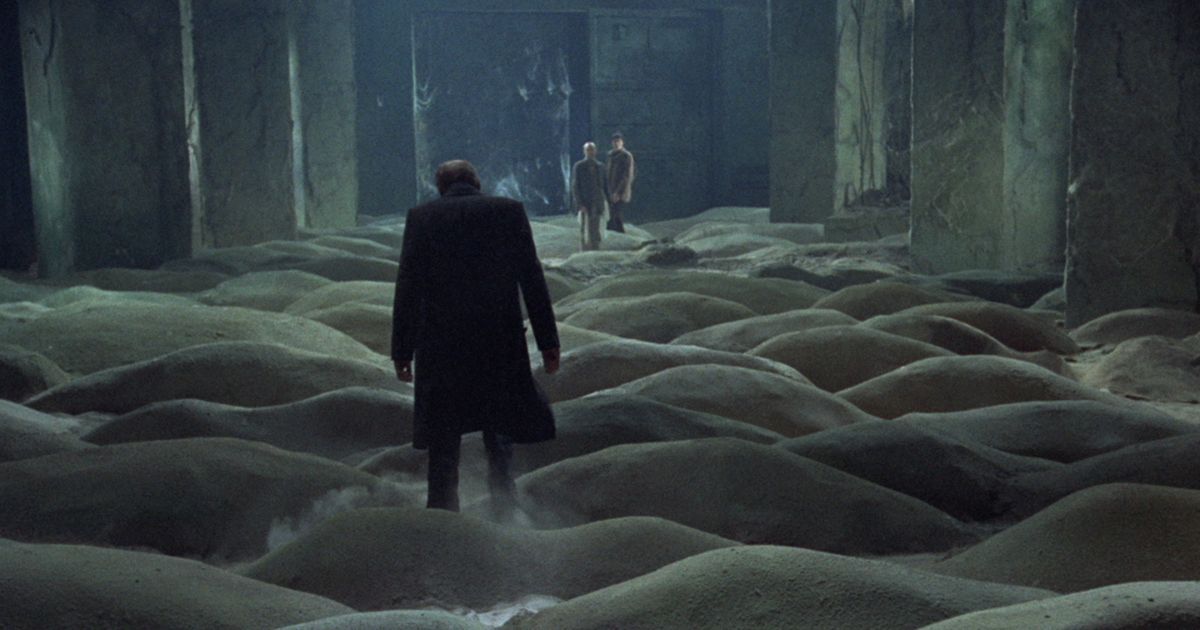
That’s exactly what Tarkovsky does very well. Especially in Stalker, he doesn’t go for a film that follows genre rules and standards. Neither his scripts nor his visuals are typical of what you can find in sci-fi. In Tarkovsky’s universe, philosophy and its offshoots are the basis of a radical study of the human mind and soul, and how characters perform in worlds that aren’t real but can be realistic and a reflection of us all.
Goskino
In Stalker, two men follow one another. They have been promised a visit to The Zone by a navigator (or ‘stalker’). The Zone is a site that exists only due to legends and stories told by the community of a nation that’s on the verge of self-destruction. A professor and a writer have different agendas that are only revealed in a mind-bending third act that portrays the three men in an impossible place, a room the stalker has taken them to where your desires can come true. The stalker’s realization is proof that this may be his first time in a place where the soul is subjected to an elevated experience. Or perhaps it’s his first time in this version of his existence. We may never know.
There’s nothing traditionally “sci-fi-sh” in Stalker. There are talks of extraterrestrial races and remains, but Tarkovsky doesn’t do this for the audience to indulge in the commercial nature of a genre that tends to be a window to the otherworldly. He decides to stay on Earth and explore more grounded themes such as existentialism, the boundaries of faith and religion, and yes, a social circumstance that’s slightly reminiscent of a very different country.
Why the Critiques of Stalker Don’t Matter
Goskino
In every review, article, video, or book, you will find something different about Stalker. People will say you’re dumb because you didn’t understand anything the first time, and others will say you’re an idiot because Stalker is literal. Pay no mind to those. Every experience is supposed to be different, and of course, you’re allowed to dislike Tarkovsky’s film. You may like its wonderful and gloomy aesthetic, but if you didn’t get it, that’s fine.
Perhaps a rewatch may result in a different experience. Stalker is one of those films you should watch a few times before trying to decide on what you like about it and what you simply don’t. You’re entitled to that wonderful realization. A self-awareness moment in which you’re able to transform an uncomfortable or pleasurable experience into an opinion about a film that represents different things for anyone who watches it. Just don’t deny the fact that Stalker is an interesting film to watch, an unforgiving exploration into what lies deep inside you.
Chances are you aren’t a film critic. It seems to be a practice heading toward extinction. That 100% score on Rotten Tomatoes was given by critics that had the chance to reflect on their opinion. But it’s just that. An opinion based on personal views that aren’t more important than yours.
If there’s a gift from Tarkovsky that remains valuable today is Stalker, a film that showed that everyone is on the same level of knowledge about its enigmatic existence. No one knows more than the other about what the film is supposed to mean. Critics are beside you when you stare in awe and disbelief at the possibly greatest sci-fi film ever made.
Starting on April 19 at 10am PT / 1pm ET / 5pm GMT and running for seven days, the trial will offer access to a limited selection of the game’s multiplayer content.
It will feature content introduced last week with Season 3, including the new core map Pelayo’s Lighthouse, which is set on a small, craggy island during an evening storm, and Gunfight mode.
BlackCell | Call of Duty: Modern Warfare II & Warzone 2.0
The full list of available maps and modes follows:
Activision launched Modern Warfare 2 and Warzone 2 Season 3 on April 12.
Resurgence, a streamlined spin-off of the regular battle royale with respawns enabled, made its debut on the Al Mazrah map in the form of Massive Resurgence, which is a much larger version of the mode supporting up to 150 players.
But shortly before publishing this article, Infinity Wardsaid it had disabled Massive Resurgence while it investigates an issue that was causing the gas circle to not align with the positioning of the gas itself. Resurgence Trios and Quads have been added in its place.
A cloud-based suite of virtual apps promises to leverage AI for remote studio production.
Using pre-built virtual environments, Vū Virtual Studio offers generative production tools for content creators to create virtual environments and manage projects through various applications.
Partnerships were also announced at NAB, including Cuebric Virtual Environment Generator and Showrunner remote studio operation tools, which are powered by Amazon Web Services.
Let’s get into what we discovered from Vū Virtual Studio at NAB 2023.
A Vast Virtual Network
Through a network of over twenty virtual studios spread out across North America and the United Kingdom, Vū has managed to fashion a powerful suite of virtual tools for creating affordable, high-quality virtual content.
With an expanding global network of Vū-operated and affiliate studios, an evolving set of software tools, and a team of creative storytellers, virtual artists, and technologists, Vū is advancing virtual production technology in a way that may standardize it in the near future.
Credit: Vū
Through their new Vū Virtual Studio production suite, users can now harness that network to create their own generative virtual content for use in a virtual production workflow.
The Vū Virtual Studio is described as a platform for controlling all Vū applications, as well as managing third-party applications for seamless incorporation. The suite offers a wide range of features and services, including Project Management for all media files, including project creation, file sharing, call sheets, storyboard creation, and digital asset management.
Remote Virtual Operation
Vū Remote VP projects leverage Unreal stage operation with the remote support of multi-user cloud connection, file sync, version control, and remote live camera feed management.
AI Generation
Vū’s AI Tool provides node-based creation of generative workflows through image and text prompting and includes multi-platform AI languages that can be chained together to create a custom AI-driven workflow.
Previz and Storyboards
Scene Forge allows users to creative pre-visualization and storyboards using Vū’s catalog of 3d models, third-party asset libraries, pre-built filming tools, animatics, and animations.
Scene Forge will be a free download for content creators to being designing Unreal-style environments, sets, and shots for Films, Immersive Experiences, and Attractions.
Credit: Vū
Third-Party Partnerships
Vū Virtual Studio will also work with third-party applications like Cuebric, a generative AI application that creates virtual environments and outputs them with a camera-ready resolution that is fully rotoscoped for concept and previsualization, or for filming on a volume soundstage (much like The Mandalorian) for volume stages, digital matte painters, concept artists, and VFX Houses.
The Showrunner app offers content creators the ability to control virtual and physical environments with stage lighting, scene selection, and virtual backgrounds, all from a smartphone. Content creators can manage virtual productions through a user friends interface, with digital controls, device snapshotting, and switching from Unreal Engine and plates from a mobile platform in real-time.
Where to Find Vū Virtual Studio
Vū Virtual Studio is open for beta users ahead of a formal launch in the summer of 2023.
As launch time gets closer, Vū will announce pricing details and availability. The company, however, will be demonstrating the suite at NAB, Las Vegas Convention Center, Central Hall, booth C8320 all this week. Showrunner will be demoed live on Monday, April 17th, while Cuebric will be demoed live Tuesday, April 18th.
To learn more and to join the waitlist for Vū Virtual Studio and the Vū Virtual network of virtual tools, visit the Vu.Network website.
Did you know Fox News and its parent company Fox Corp. settled its defamation lawsuit with Dominion Voting System on Tuesday afternoon?
Odd are if you only get your news from Fox News Channel or the conservative network’s website for information, you might have no idea that settlement happened. The network itself barely covered the story that it has agreed to pay roughly $800 million to avoid a trial over whether or not it knowingly spread lies about the 2020 election and the voting company that sued it.
Instead, the network’s primetime stars talked about other matters and later in the night, the channel’s late night news team focused more on a story about what it warned were out-of-control teens in Chicago over the weekend.
Meanwhile, on the network’s official website there wasn’t a single mention of the settlement. As of this writing, readers instead are being treated to stories about Joe Biden’s taxes, Tucker Carlson’s interview with Elon Musk, Ray Romano’s heart surgery, and yes, that story about a goose rescue.
Former Illinois congressman and now CNN Senior Political Commentator Adam Kinzinger was among those pointing out the omission on Twitter.
“Just looked at Fox News, no mention of the settlement on their website,” Kinzinger wrote.
Just looked at Foxnews, no mention of the settlement on their website. Hey @FoxNews
Kinzinger also retweeted a post that showed The New York Times, Wall Street Journal, and Washington Post front pages on their websites reporting the news.
The lack of coverage on the lawsuit doesn’t stop at the network level, even the owned and operated stations like WFLD-TV Fox 32 Chicago, KTTV-TV Fox 11 Los Angeles, have dozens of stories on their webpages, but only one mention of the settlement under the “national news section” – which requires quite a lot of scrolling down the page to see.
Interestingly enough, when the settlement was announced earlier Tuesday, Fox said in a statement that it “reflects FOX’s continued commitment to the highest journalistic standards.” It’s weird then, we’ll admit, that the network is choosing not to brag about that commitment on its own platform. Oh well.
Aaron Carter’s cause of death has been listed as an accident on the rapper and singer’s autopsy report.
Variety reports that Aaron Carter’s cause of death was “drowning and the effects of inhaling difluoroethane, and alprazolam, a generic form of Xanax,” with the information coming from an autopsy report that the outlet viewed. Drowning is listed as the first cause, while difluoroethane, which is found in cans of compressed air, and Xanax are listed as the second.
Carter passed on November 5, 2022 at the age of 34. He released his self-titled debut album at the age of 9 in 1997, which would go on to sell one million copies. Carter continued to release popular albums while also guest-starring on a number of television series, including Lizzie McGuire, Rocket Power and Sabrina the Teenage Witch. He also appeared on Dancing With the Stars and in his brother Nick’s reality television series called I Heart Nick Carter.
Carter faced a number of legal and health issues in recent years and disclosed on an episode of the talk show The Doctors that he had been diagnosed with schizophrenia and bipolar disorder. Carter’s final album, “Blacklisted,” was released two days after his death.
“Come on,” CNN anchor Anderson Cooper said on Tuesday in response to a bold claim Fox News made after agreeing to pay Dominion Voting System nearly $800 million.
Fox News was of course sued for defamation by Dominion because, as part of the conservative network’s support of Donald Trump’s lies about the 2020 presidential election, it allowed guests and even network hosts to falsely claim that Dominion had manipulated the election results. During the discovery phase of the lawsuit, a mountain of evidence came out proving that Fox News knew that the claims were false. Nevertheless, it continued to fight the lawsuit until Tuesday, when just before the jury trial was to begin, Fox and Dominion reached that settlement.
In a statement released as part of the settlement, Fox didn’t admit to any wrongdoing, and it offered no apology to Dominion. The closest it came was a passive, “we acknowledge the Court’s rulings finding certain claims about Dominion to be false.”
Immediately after this, Fox added, “This settlement reflects FOX’s continued commitment to the highest journalistic standards.” And Cooper, as you can see the video above (via Acyn on Twitter), found that particular claim risible, to put it mildly.
“As for the second part of that statement, that this settlement reflects Fox’s continued commitment to the highest journalistic standards,” Cooper said on Tuesday’s episode of his CNN show. “As Mike Wallace used to say when interviewing someone shoveling crap, ‘Come on.’”
Cooper continued, “If there is anything we learned from the depositions, texts, and emails that were released by Dominion in the lead up to this case, is that there was no commitment to even basic journalistic standards where the 2020 election was concerned.”
“Fox anchors said one thing on air to the audience – they feared might abandon them. Go over to some more conservative news channel and another thing off air in texts and emails to one another,” Cooper concluded.
As the defamation trial was set to begin, some of Fox’s biggest names like Tucker Carlson, Sean Hannity and Laura Ingram were expected to testify. Additionally, Fox News’ owner, Robert Murdoch, was expected to take the witness stand.
Cooper wasn’t the only person who was perplexed by Fox’s statement. Earlier in the day, CNN host Jake Tapper laughed during his show “The Lead” when he read that line in the Fox News statement.
“I’m sorry. This is going to be difficult to say with a straight face,” Tapper said.
“This is difficult to say with a straight face.” Jake Tapper laughs while reading Fox News’ statement on their “journalistic standards”. (Video: CNN) pic.twitter.com/ddmlxd3tqi
Some folks bemoan the loss of the Los Angeles Film Festival, claiming that without it, LA no longer HAS a flagship film festival. Pooeydorda! we say. From AFI to Dances with Films, from Method Fest to the TCM Classics Festival that just wrapped, Los Angeles likely has more film festivals of caliber than any other city, and, frankly, as befits the movie capital of the world. Many of them have been around for decades, hiding in plain sight—mainly at the TCL Chinese Theatres on Hollywood Boulevard. Thing is, on any given week, film fanatics can find showcases of new and classic works across the city.
So, what’s next? The Beverly Hills Film Festival—celebrating its 23rd year—and its first-in person festival since the pandemic running virtual editions from 2020 through 2022.
Festival founder, president, and philanthropist Nino Simone is brimming with excitement for the upcoming event, opening April 19th. He says, “We can’t wait to gather in person once again. Due to the pandemic, recent installments of the festival were virtual, but this year, the BHFF is returning to the red carpet. We are thrilled to get back to the original format and create an immersive experience that fully embodies the spirit of the festival. We look forward to reconnecting the festivalgoers and filmmakers in the heart of the entertainment industry to celebrate the art of film together.”
Betye Saar: Ready To Be A Warrior
“…look forward to reconnecting the festivalgoers and filmmakers…to celebrate the art of film…”
Simone says he watched a LOT of movies to winnow down selections to the 150 features and shorts unspooling April 19-22 at the TCL Chinese in Hollywood. There are also 150 screenplays vying for the top three spots for the fest’s Screenwriting Awards. “While the number of screenings scheduled for viewing varies each year,” he says, “I have sat down for a record 20 films in a row. I’ve probably watched over 15,000 films over the last 22 years.” The festival has estimated audiences in excess of 40,000 for its screenings and hosts post-screening receptions each night and a gala Awards ceremony at its conclusion on April 23.
While it has a focus on new work by up-and-coming talent, The BHFF has recognized some established filmmakers and hidden gems buried in filmdom’s past. From the first film ever shot in Hollywood—In Old California by D.W. Griffith—to discovering Federico Fellini’s last film Verso La Luna Con Fellini, BHFF has paid homage to past greats and rising stars. Last year’s selections included the feature documentary Roger Corman: The Pope of Pop Cinema with Ron Howard and Peter Bogdanovich; Root Letter, featuring Mark St. Cyr; The Sands Between with Jessica Chastain and James McAvoy; We Are Gathered Here Today with Danny Huston; Not to Forget, featuring one of Cloris Leachman’s last performances; and The 90s Club with Dick Van D**e, among others.
From the 150 films screening on the BHFF slate, seven highlights below—mainly documentaries celebrating underrepresented voices—provide a survey of this year’s feature slate to consider. Films are generally presented in blocks consisting of a feature and several shorts, so a favorite may bring some unexpected—but welcome surprises along with it.
In a season where almost everything has gone right, the Winnipeg Ice are now in the midst of some adversity.
The Ice were pounded on the road by the Moose Jaw Warriors 8-4 in Game 3 of the WHL Eastern Conference semifinal series and now trail the series 2-1.
It was the most goals the Ice had allowed in one game this season, and it was also their largest loss.
Winnipeg scored the game’s first two goals, in an 11-second span in the first period, as Zack Ostapchuk and Briley Wood scored at the 7:07 and 7:18 mark of the first frame to give the Ice the 2-0 lead.
But Moose Jaw would score the next three in the first period, driving Ice goalie Daniel Hauser from the game, before Vladislav Shilo’s first of the playoffs for Winnipeg tied the game at three after the first.
Netflix doesn’t want Hollywood writers to go on strike — but the streamer has a “pretty robust slate of releases” that will help it weather a walkout better than others, co-CEO Ted Sarandos said.
“We respect the writers, and we respect the WGA,” he said. “We couldn’t be here without them. We don’t want a strike. The last time there was a strike, it was devastating to creators. It was really hard on the industry. It was painful for local economies that support productions. And it was very, very, very bad for fans.”
Sarandos said “we want to work really hard to make sure we can find a fair and equitable deal so we can avoid one.” That said, “if there is [a strike], we have a large base of upcoming shows and films from around the world [and] we could probably serve our members better than most… We do have a pretty robust slate of releases to take us into a long time.”
Sarandos, asked about Netflix’s content spending, said the growth of that is tied to revenue growth. The company is still working through the effect of post-COVID “floodgates” opening on productions, which has made Netflix’s content spending “lumpier,” Sarandos said. In Q1, Netflix’s additions to content assets represented $2.46 billion in cash, down more than $1 billion from $3.58 billion in the year-earlier period.
Over the course of 2022-24, Netflix will average around $17 billion in annual cash spending on content, CFO Spence Neumann said, and then after that “there’s a big entertainment market to go after beyond that.”
“As we reaccelerate revenue [growth], we see a lot of opportunity to grow into that viewing and engagement and business opportunity ahead,” Neumann said.
Netflix believes it still has a lot of runway to grow engagement with viewers around the world. In its Q1 2023 letter to investors, it cited third-party estimates in five markets that show streaming remains a small minority of total TV viewing in each country (2% in Poland; 4% in Brazil and Mexico, 7% in the U.S. and 9% in the U.K.).
“We remain highly confident that streaming’s share of engagement will continue to grow at the expense of linear [television] since it offers a better experience (on demand, availability across devices). We believe this gives Netflix tremendous room for growth if we can continue to improve our service,” the company said.
“We spent most of Season 1 writers’ room writing every episode and every scene from the POV of a social media device ,” says Rap Sh!t executive producer and showrunner Syretta Singleton of the pivotal role social media plays in the HBO Max series from Issa Rae.
“What’s the story we want to tell and how do we see it through a device now,” Singleton added on a recent panel of the use of social media as a character unto itself on the Aida Osman and KaMillion-led Rap Sh!t. “And that got us thinking, what we show and what we don’t, what would they say on camera vs when the camera is off.”
As you can see in the video above, along with Singleton, the panel also included EP Rae herself plus cast members Osman (who is a writer on Rap Sh!t as well as portraying the character of Shawna), KaMillion (Mia) and Jonica Booth (Chastity).
In the eight-episode Miami-based first season of the renewed Rap Sh!t, Osman and KaMillion play two old friends who suddenly reconnect and join up to make it big in the music industry. Caught up in their mutual and individual ambition, betrayals, expectations and a whole lot of streaming, Osman’s once viral sensation Shawna and KaMillion’s tough Mia are forced to confront stereotypes about who they are and do they have the talent – confrontations that often occur through the gaze and demands of social media.
With music being such an important part of Rae’s Insecure, the NACCP Image Awards winner and past Emmy nominee want to pull back the layers on how friendship, music and gender function in a digitally dominated era.
“When I think about music now and the way we consume everything, that discovery happens through social media,” she told fans gathered for a FYC screening at the London West Hollywood. “There’s not the radio moment you get anymore. There’s not even word of mouth, there’s too much out there. But you find and discover so much music via social media, and sometimes you discover music through these antics,” Rae noted.
“Even thinking about how so many female rappers are successful, so many women rappers are successful, because of taking charge themselves, and marketing themselves, and putting their own narrative out there for people to identify with – and so, that to me made the ingredients of the show,” Rae told the crowd.
Having debuted with two episodes on HBO Max on July 21 last year, Rap Sh!t was officially given a second season on September 12, 2022. Set in Miami and the Sunshine State for Season 1, the show looks to move out to the Golden State for Season 2.
Rap Sh!t with is executive produced by Rae and Singleton along with Montrel McKay via Rae’s Hoorae Productions, Dave Becky and Jonathan Berry for 3 Arts Entertainment and Deniese Davis. Hip hop duo Yung Miami and JT of City Girls also serves co-EPs, along with Kevin “Coach K” Lee and Pierre “P” Thomas for Quality Control Films and Sara Rastogi for Hoorae. Sadé Clacken Joseph directed Rap Sh!t‘s pilot. Rae’s audio content company Raedio handled music supervision for the music rich series.
Editor’s note: With the 21st annual Rondo Hatton Classic Horror Awards fast approaching, we’ve decided to open up the work of some of our Rondo nominees to a wider audience here on RUE-MORGUE.com. This deep dive into the silent classic Hӓxan by contributor Dejan Ognjanović first appeared in issue #205.
A century ago, the art of cinema was still young but becoming ever more conscious of its possibilities. Visionary artists had a fresh, powerful tool at their disposal to paint with, and they used moving images and flickering interplay between the light and the dark to portray new, unseen worlds. Some of Europe’s greatest filmmakers of the time, though unrelated to one another and without conscious intention, actually brought the nascent horror cinema genre into adulthood by defining the basics of its language. This was achieved through four distinct masterpieces which premiered within two years of one another, three of which were German. The Cabinet of Dr. Caligari (1920) exemplified cinema’s ability to depict the distorted, irrational world of nightmares, while Golem (1920) embodied the possibilities of expressionistic painting with darkness and shadows, serving as a visual (but also thematic) template for Universal’s later horrors. Then came Nosferatu (Nosferatu, eine Symphonie des Grauens, 1922) which spread the stylized studio-shot horrors into the real-world exteriors of forests, castles, mountains and seas. Finally, 1922 also brought about a film that’s as accomplished as it is important, yet in many ways apart from the above – Hӓxan, also known asWitchcraft Through the Ages.
It was the third and by far the most ambitious film by the Danish director Benjamin Christensen – so ambitious that it took him more than two years for research and preparation, so demanding that it required a new, special, state-of-the-arts studio, so controversial in subject and approach that he could find no backers in Denmark for it, and so he ended up making it with Swedish producers. (As a result, its title remains embedded in history as the Swedish Hӓxan, instead of the Danish Heksen)
By any name, it remains a powerful piece of cinema with a lasting legacy. Its rerelease in 1941 was accompanied by William Sieverts’s book Witchcraft and Superstition Through the Times. In 1968, it was re-edited by Antony Balch into a version featuring a jazz score and narration by the cult author William S. Burroughs. In 1999, the makers of The Blair Witch Project named their production company after it – Haxan Films. The Norwegian black metal band Mayhem used a frame from Hӓxan depicting Devil for the cover of their 2004 album Chimera, and other examples of its influence abound.
But what is it that makes this film still relevant a full century later? Simply put, it was and remains revolutionary in at least three major respects.
Documentary Horror
First of all, Hӓxan was an early, pioneering mixture of horror and documentary. Conceived as a cultural-historic essay on the danger of delusions, it used moving images to describe the gruesome persecution of witches and the causes behind it, including the belief in demons and devils, and the psychological factors behind it all. Yes, the prologue, about worldwide demonologies, may be too general for today’s audiences (though modern horror fans can recognize some familiar faces in there, like Pazuzu), and truly, the epilogue about modern-day neuroses aged poorly and was rightfully criticized even upon the film’s premiere, but those odds and ends are easily overshadowed by the real meat – its large middle portion, which depicts the medieval superstitions attendant to the witches and how they were dealt with by the officials of the gynocidal society.
The horrors in this concept are twofold: on one hand, the supernatural frights evoked by the flying witches, Sabbaths and devils, and on the other, the very real, historically attested terrors of torture at the Inquisition. Hӓxan is a “documentary” which obeys the cinematic narrative law of “Show, don’t tell.” And so, it visualizes both types of horror – surprisingly, with equal success.
Those depictions of ritual re-enactments are where the real drama and cinema reside: folk magic, strange broths, animal skeletons, human body parts combined with snakes and frogs for potions, the hexing power of urine (!) and so much more, all of it derived from Christensen’s research into the old books on demonology. Of note: his main source, the notorious 1487 Inquisitors manual Malleus Malleficarum (Hammer of the Witches), was not available at the time in mass-market annotated paperbacks like it is today.
In his aim to be as authentic as possible, the director was aided by the prop master, Richard Louw, who created the sets and torture instruments based on medieval designs. There is no need to see them in action, as they strike the unfortunate flesh: the very sight of many of those sharp, spiky screws and pliers is enough to send chills down one’s spine (but modern audiences will remember seeing some of these implements applied in Ken Russell’s TheDevils, 1971). Also, the investment in a new studio was a risky bet, largely responsible for making this the most expensive film made at the time in any Scandinavian country, but it paid off in spades – the meticulous high-contrast lighting and photographic effects created by the DP, Johan Ankerstjerne, surpassed all that Hollywood’s expensive bells and whistles could offer at the time. Thanks to Christensen’s obsessive, perfectionist attention to detail, Hӓxan remains a first-rate visual feast in all its aspects, whether realistic or phantasmagoric.
Highlights include innovative visual effects of dozens of witches on broomsticks flying above the village to consort with the Devil and the actual Black Sabbath which includes grotesque demons in convincing full-body costumes, masks and highly effective prosthetic facial make-up for their leering close-ups. The shocking details in this sequence ranged from female nudity (no longer shocking today) through blasphemous acts like trampling and spitting on the cross and kissing Satan’s behind (which many would find offensive, even in this day and age), all the way to that evergreen shocker: the slaughter of a newborn. Of course, the baby that bled out above the steaming cauldron was a puppet, just like it was in A Serbian Film ninety years later but tell that to the appalled audiences lulled by the apparent realism preceding it!
Were it merely a documentary on witchcraft, Hӓxan might’ve remained a forgotten title, known only to a select few fanatics. Its effectiveness, however, is rooted in the fantastic scenes of the Sabbath, and even more – in the palpable atmosphere of superstition and dark forces at work, even when unseen. Especially when unseen. Christensen created a realistic setting through meticulous set design, props and costumes which surround skilled actors and their characters’ plausible motivations, resulting in a mise-en-scène in which forces of evil can be expected to rise from the shadows at any moment. The sense of an all-pervading paranoia is palpable. These were indeed the Dark Ages, and the director shows why.
Sympathy for the Devil
The second revolutionary aspect of Hӓxan worth stressing is its portrayal of the Devil, depicted here as ambiguous and even sympathetic.
In terms of iconography, the Devil appears with small horns and big, pointed ears, his face and body recognizably humanoid, a long tongue protruding lasciviously from his mouth. Basically, he is the pagan Pan as demonized by the Christians: a deity of carnal pleasure. He is a tempter and a seducer, and all the sins that he instigates in this film have to do with sexuality: a woman buys a love potion from another in order to seduce a friar, a novice is tormented by temptation in his monastic cell, not to mention the Sabbath’s orgiastic abandon. The Devil, as seen here, is hardly supernatural: he is all too natural, arising as he does from the body’s basic instincts. As Pinhead would say, “There is no Good, there is no Evil; there is only Flesh.”
At least two aspects of Hӓxan’sDevil make him different and special. Firstly, the Devil is treated as a metaphor, not a power actually existing outside of humans and their interrelations. This is most obvious in the fact that the entire Black Sabbath sequence is presented as a “confession” of a clearly innocent old woman, extracted under torture. All the wildly memorable images of Hӓxan’smost celebrated scene come from the testimony of a terrified person, telling her tormentors what they want to hear. The film is a critical strike against medieval superstition and ignorance and makes a point of showing the use of potions and ointments as another possible source of “visions” attributed to the Devil. When the crone confesses that her frail old body allegedly gave birth to a host of demons, Christensen shows two grotesque imps (probably children in full-body costumes) crawling from underneath her skirts. It is as if to suggest that if you could believe this, you could believe anything.
Secondly, and more subtly, this film’s sympathy for the Devil is expressed in the fact that he is played by none other than by Benjamin Christensen himself – and quite memorably so. His sudden appearance from pitch-blackness, behind a book that an abbot is reading, is one of the most effective jump-scares of all time. He is all at once lewd, playful, and provocative, a master entertainer. He is the one that guarantees ticket sales, not the pious priests – none of whom appear in this anticlerical film anyway. And our master of ceremonies, our Director, clearly embraces the exploitation behind his lectures and entertainment behind his sermons, identifying with the archetypal rebel and admitting, as William Blake did writing about Milton, with his meta-cinematic wink, that all artists are “of the Devil’s party.”
Sympathy for the Witch
Unlike many of his contemporaries, such as the scholar Montague Summers or author H. P. Lovecraft, the director of Hӓxan did not buy into any of the nonsense extracted under torture and verified as “fact” by the torturers. In his enlightened, positivist perspective, quite rare among filmmakers of the early 1920s, the witches were not perpetrators of evil, but clearly victims: sometimes of their own faults and delusions, but more often of other people’s malevolence. Predating Michael Reeves’s Witchfinder General (1968) for almost half a century, Christensen realistically depicts all the phases of the process, from a false accusation, through sadistic torture to execution. Furthermore, he makes the unfortunate woman’s plight even more touching by casting an old lady (non-actor, but with a highly expressive face), in the role of the “witch.” He refused to exploit the sadistic spectacle of a nubile young woman suffering that many others would cash in on later (e.g. Mark of the Devil, 1970) and selected a person who could not possibly be guilty of anything so heinous.
As it happens so often with filmmakers dealing with extreme, explicit imagery, his agenda was not immediately recognized, and as with Deodato and Spasojević much later, Christensen was accused of advocating precisely that which he condemned. The daily paper Social Demokraten wrote after Hӓxan’s premiere: “Many of the images exude such raw realism that the dominating reaction is one of nausea. The viewer suffers the torments along with the victims on the screen. The film seems itself a product of the beastliness, torture, bonfires and insanity that it means to critique.”
Basically, the film was condemned for being too powerful – that is, too cinematic. Its images were too strong, and this caused it many troubles. In English-speaking countries, no one dared show the film for many years. The New York Times at least recognized that the film was ahead of its time when it wrote: “Come back with your film in 25 years, Mr. Christensen, and maybe then America will be mature enough to understand your art.”
“After Hӓxan,” Christensen would recall, “I was out in the cold for two years. When I finally got a chance at UFA, I had to disprove that I was this ‘literary experimentalist’ that everybody said I was, and so I made these purely commercial films.” While Hӓxan did not actually end his career the way that, say, Peeping Tom (1960) would do to Michael Powell, its director was relegated to conventional films, now rightly forgotten, a partial exception being his decent Hollywood-made horror thriller Seven Footprints to Satan (1929). However, the power of Hӓxan was not repeated. But making even one film that is so incomparably unlike any other is more than most directors can dream of.
“It is a state of bliss,” he admitted, “for an artist once in his lifetime to get permission to do what he wants. That happened with Hӓxan.”
Adriana Caselotti, who voiced the titular princess in Snow White and the Seven Dwarfs, was offered a spot on Jack Benny’s radio show after the film’s initial release. However, Walt Disney himself reportedly blocked her from taking the job because he didn’t “want to spoil the illusion of Snow White.”
Either way, Deadpool’s connection to the team in the comics is a strong one—as is the same for both Wolverine and Cable, the time-traveler who previously featured in the second film.
While Josh Brolin’s Cable isn’t confirmed to return, it’s certainly likely if the movie is bringing back someone like Colossus. Having Cable, Deadpool, and Wolverine together could prove too tempting to not bring X-Force into the mix in some way.
This time though, he could either wipe the slate clean going forward or work close with Marvel Studios to start building the foundation for the X-Force for the MCU going forward.
After all, one day mutants will get their day in the spotlight… eventually.
The Guardians of the Galaxy are getting together for one last ride. As always with that group of unlikely heroes we expect Vol. 3 to be funny, exciting, and touching. Unfortunately, we also know not everyone will make it out alive. The original Groot sacrificed himself in the first film. Yondu did the same in the second. Thanos traded the original Gamora’s life for the Soul Stone in Infinity War. And they collectively killed Kevin Bacon’s icy heart in their holiday special. But we think their third and final solo film will be their saddest entry yet.
Who is most likely to say goodbye to the MCU for good and who will continue on in the franchise? We’ve given odds for each of them about who will die in Guardians of the Galaxy Vol. 3.
Rocket Raccoon – 100%
Marvel Studios
“What the hell,” said Rocket in the original film, “I don’t got that long a lifespan, anyway.” He’s right, and that life will come to a sad end in Vol. 3, a movie that will explore Rocket’s painful past. We thought that before seeing a single trailer for the movie. Now that every promo keeps teasing an emotional end for the beloved wiseass we’re convinced of it. It’s gonna freaking kill us. Only we didn’t mean to say “freaking.”
Drax the Destroyer – 100%
Marvel Studios
Rocket’s not the only one who all but told us how his story would end way back in Vol. 1. That’s when Drax said he would fight alongside his friends and see his wife and daughter again in the end. Dave Bautista might be ready for his character to bid the ultimate farewell to the MCU, but we’re not prepared. We doubt we will be even though we believe it’s definitely going to happen.
Nebula – 70%
Marvel Studios
Thanos’ other surviving daughter has had one of the most fascinating arcs in the entire franchise. She went from a terrifying villain to a slightly-less terrifying hero who dances. We don’t want to say goodbye to Nebula, but it would be fitting for her to go out in a blaze of glory. We’re also sure Karen Gillan wouldn’t mind saying goodbye to all those many hours in the makeup chair.
Kraglin – 50%
Marvel Studios
Kraglin might be a newer member of the Guardians, but Sean Gunn has been a major part of the group since day one. He physically plays Rocket. (Bradley Cooper voices the trash panda.) Kraglin is a sad character. He lost his best friend and captain and is still struggling to control Yondu’s arrow. It would seem cruel for him to die right when he’s likely to finally have a big breakthrough with his new family. However, writer-director James Gunn (now in charge of DC Studios) might also want to give his real-life brother an iconic death as they both say goodbye to the MCU. That’s why we think Kraglin’s fate is a total coin flip.
Peter Quill – 40%
Marvel Studios
The leader of the ragtag bunch nearly doomed half the universe to extinction in Infinity War when he couldn’t control his anger and grief at Thanos. If anyone owes the galaxy the ultimate sacrifice, it’s him. With this iteration of the group ending, it would also be fitting for Chris Pratt’s Star-Lord to say goodbye to the MCU, too. So we won’t be surprised if he dies, but if we had to pick, we’ll guess he lives and retires as a hero. At least he’ll retire until Marvel brings Peter Quill back.
Swoll Groot – 25%
Marvel Studios
We already had to watch one beloved Groot sacrifice himself. His death was powerful, of course, but it’s still painful. Are we really going to have to see his son, affectionately known as Swoll Groot, also die? After we watched him grow from a baby to a thicc tree!? We don’t think so. We certainly hope not. But we wouldn’t put it past Gunn either.
2014 Gamora – 10%
Marvel Studios
We can’t wait to see how Gamora and Peter’s story ends, specifically because this is not the Gamora he fell in love with. This is 2014 Gamora, who was never a member of the Guardians. That’s exactly why we doubt Zoe Saldana’s character will die a second time in the MCU. Not only would that be weird and unearned, it would diminish the impact of the original character’s own sad end. Gamora is dead. Long live Gamora!
Mantis – 5%
Marvel Studios
If we’re being honest, 5% is probably too high. Mantis is the best, an indisputable fact after Pom Klementieff’s star turn in The Guardians of the Galaxy Holiday Special. It feels like Mantis just truly got here despite this being the character’s fifth MCU movie/special. She’s too good to kill off now. The franchise needs more Mantis! If anyone else wrote this film we’d have her odds of dying at negative percent.*
(*What does a negative percent of dying even mean? Uh…it’s the same as saying there’s a positive percent chance the character gets a clone? Becomes an immortal god? Look, we’re not sure, just have some fun and don’t take things so seriously.**)
(**Unless Mantis dies. Then we have a very serious problem on our hands.)
Cosmo the Spacedog – 0.01%
Marvel Studios
Speaking of taking things too seriously, if anything happens to Cosmo we’re going to be so angry online they’ll have to shutdown the internet for at least a day. Maybe two. Wouldn’t even rule out three.
We know not every Guardian will survive Vol. 3, but the very good Spacedog better. There’s only so many characters we can handle dying.
Mikey Walsh is a staff writer at Nerdist. You can follow him on Twitter at @burgermike, and also anywhere someone is ranking the Targaryen kings.
Jonathan Majors was set to have a big year in 2023 thanks to the releases of Creed III and Ant-Man and the Wasp: Quantumania pulling in a collective $745 million. With his March 25 arrest on allegations of assault, however, Majors is seeing Hollywood pull away from him. Now, Majors has lost two movies and an ad campaign, according to Deadline.
Majors was to star in and executive produce The Man in My Basement, based on the 2005 novel by Walter Mosley. Deadline reports that a search for a new lead is underway, though notes that Willem Dafoe is still attached. Majors was also reportedly considering the lead role in an Otis Redding biopic called Otis and Zelma, but has been dropped from consideration.
Additionally, Majors was set to appear in an ad campaign for the Texas Rangers baseball team, with the first spot to air this Friday–but it was pulled at the last minute following the allegations.
Previously, Majors’ management company Entertainment 360 and publicist The Lede Company had both cut ties with the actor; Majors and fashion studio Valentino also “mutually agreed” that he would no longer be attending this year’s Met Gala. Marvel Studios has not yet made an official statement on whether they will continue with Majors as Kang the Conqueror after Ant-Man 3, though his scenes for Loki Season 2 on Disney+ have already been filmed.
Majors was arrested on March 25 on allegations of a domestic dispute with a 30-year-old woman, who was taken to the hospital with minor injuries to her head and neck. Majors is expected to appear in court on May 8, facing multiple counts of harassment and assault.
The products discussed here were independently chosen by our editors.
GameSpot may get a share of the revenue if you buy anything featured on our site.
Incoming Cannes Directors’ Fortnight Delegate General Julien Rejl has unveiled his inaugural line-up for the 55th edition of the parallel sidebar, running May 17 to 26.
Judging by his first selection, Rejl, who worked as a producer, distributor and sales agent at French film company Capricci for a decade before taking up his new role, seems intent on shaking things up.
He and his selection team have delivered a line-up featuring a raft of under-the-radar titles alongside confirmed directors and a handful of buzzed-about rising newcomers. See the full selection here
Deadline talked to Rejl about the line-up and his uncompromising vision for the Cannes parallel section.
DEADLINE: Congratulations on your inaugural selection. How did you find the process of pulling it together?
JULIEN REJL: It was a fascinating marathon. We received even more films than in previous years. This shows the vivacity of contemporary cinema creation but it also makes our work even harder. We received submissions from all over the world, many of them directly from directors and producers without representation by sales companies or distributors.
There were lots of surprises and the wealth of submissions also revealed creative hotspots all over the world, which is good news for cinema.
DEADLINE: The line-up features a lot of films that were not on the radar of prediction lists. Did you deliberately seek out films that were not expected?
REJL: Yes and no. My selection committee is very diverse in its profiles. I wanted to being together a group of experts with very different ideas on cinema around the table. We allowed ourselves to go and look everywhere.
I didn’t want us to jump on what the market was proposing and films that had already been identified, whether that was in co-production markets or state funding commissions. The idea was to remain open and watch films that weren’t on everyone’s radar.
We took the films we thought were the best. I was the first one to be astonished when I realised that the majority of films in our final selection did not figure on any of the prediction lists.
DEADLINE: You previously worked in production, distribution and international sales at French film company Capricci. Over the years, you must have tried to get films into festivals. How was it to be on the other side of the process?
REJL: It held similar challenges to those I encountered as a distributor. During my time at Capricci, I always tried to find original or audacious works outside the norm. But, as a distributor, I’d come to the conclusion in recent years that it was difficult to identify places and festivals where you discover really new and singular films. I think festivals need to renew how they program.
When we started to work on the line-up, we tried to be as open as possible to all the submissions that weren’t expected, films that hadn’t been talked about before in the media, or that the film industry hadn’t necessarily heard about before, because I think that is the role of Directors’ Fortnight.
DEADLINE: French sales agents and distributors lobby hard to get their films into Official Selection and the parallel sections. Producers and directors can also pile on the pressure. How did you deal with this?
REJL: I had a lot of requests and supplications but I held strong. I tried to say ‘no’ as early as possible if it was clear a film wasn’t going to be selected, to save everyone time, as well as indicate how I was building the line-up and avoid last-minute disappointments.
I kept my independence, even if I encountered a lot of disappointment, resistance and insistence. I tried not to be distracted by this and to stay faithful to the line we were building bit by bit.
DEADLINE: You said that the submissions revealed creative hotspots all over the world and in unexpected places. Were there any territories that particularly stood out?
REJL: We saw a particular vivacity in Asia, where young filmmakers have a very powerful cinematic language. I was astonished because in recent years the Asian presence at Cannes was relatively weak. I wasn’t looking specifically for Asian cinema, but we had such a rich offering that we were spoiled for choice.
Another example, which might not seem obvious, is Latin America. There was a rich offering there too, particularly from Brazil and Argentina. We don’t have films from the region for two reasons. Firstly, the films we identified ended up elsewhere. Then secondly, I didn’t want any quotas and to then take films for the sake of having something from the region.
It was the same for Africa. North Africa is very rich. We have a Moroccan film (Déserts) in the feature selection and an Algerian film in the shorts (The House Is On Fire, Might As Well Get Warm). Sub-Sahara Africa is also on the rise both for fiction and documentary and we have the film of Rosine Mbakam (Mambar Pierrette).
What we see is that there are territories all over the world where young cineastes are emerging with a unique language.
DEADLINE: One of the surprises of the selection was the inclusion of three titles by U.S. indie directors: Sean Price Williams’s The Sweet East, Joanna Arnow’s The Feeling That The Time For Doing Something Has Passed and Weston Razooli’s Riddle Of Fire. We often hear that the independent cinema sector in the U.S. is in crisis but your line-up suggests this is not the case.
REJL: I found the submissions coming out of America’s independent cinema scene incredible. I was also surprised. I also keep hearing that American independent cinema is dying, that it is becoming rarer and rarer. Even as a spectator of American independent cinema in France, nothing has really excited me of late.
But the selection process has been an eye-opener. These films arrive from nowhere. We’d never heard of them before. We watched them and were immediately swept away. Something is going on in the United States. There were a number of other really good American films, but we couldn’t take them all.
DEADLINE: Did the selection process give you any sense of what is behind this resurgence in U.S. indie titles?
REJL: I don’t know. I believe The Sweet East was shot over a long period of time, without much money. These are films that are carried by the force of the director with relatively few resources. We can see that when a filmmaker really wants to tell a story cinematically, they find a way.
Joanna Arnow’s film is similar. It’s very minimalist but it invents something in terms of cinema, comedy and auto-fiction. There is something astonishing and audacious about these works. Even with Riddle Of Fire which is more mainstream, the director dares to make a film for children in a way that has not been done since the 1980s. There is an energy in American independent cinema that needs support.
DEADLINE: Directors’ Fortnight changed its French name to La Quinzaine des Cinéastes, from La Quinzaine des Réalisateurs, this year in a bid to make its French banner more gender inclusive. This year, seven of the 21 directors with films in the line-up are women. Can you comment on the gender gap?
REJL: When you look at the submissions, 27% of the features and 37% of the short films were directed by women. The proportion of films directed by women in the line-up is above these percentages. I’d like to see more films directed by women submitted and I encourage all women cineastes to send their films to Directors’ Fortnight.
While we took special care to pay attention to all the films by women, our final choices were simply based on which films we thought were the most accomplished, original and audacious.
DEADLINE: The big names in the line-up are Michel Gondry with The Book Of Solutions and Hong Sangsoo with In Our Day? How did you secure Gondry’s film?
REJL: It’s a very sincere and very funny film. It’s also more personal and intimate and different in tone from his previous films. It felt like the right time for him to return to Directors’ Fortnight and his distributor and producer agreed.
DEADLINE: And Hong Sangsoo?
REJL: I’d never dealt with him directly but I’ve worked on the release of many of his films in the past. We were sent the film and loved it. For me, it is one of the lightest, most moving and funniest films he’s made in recent years. Given he is an established filmmaker, we thought it made more sense to propose an event like the closing film, rather than putting him the middle of the selection, and he accepted. He is very happy to come to Directors’ Fortnight.
DEADLINE: As you said, the selection features a number of under-the-radar titles. Can you tell us a bit more about Cameroonian director Rosine Mbakam’s film Mambar Pierrette? It is hard to find information…
REJL: It follows a seamstress in Cameroon as she deals with day-to-day economic and life challenges. The film follows her at work and home and also explores male-female relations at the heart of Cameroonian society. It’s a fiction that is strongly anchored in reality.
DEADLINE:The other film that is a bit of a mystery is Ilya Povolotsky’s Grace…
REJL: It’s a road movie where a father and his daughter cross Russia from South to North in a mobile cinema van. The mother has disappeared. We come to understand she is dead. The film – in a manner reminiscent of Tarkovsky or Béla Tarr – paints a picture of this relationship between generations and a divided Russia. The film was shot at the end of 2021 before the war in Ukraine. It’s a very gentle film, about the end of adolescence and the discovery of adulthood for a young Russian woman who finds herself in today’s world.
DEADLINE: Did you have any qualms about inviting a Russian director in light of the War in Ukraine?
REJL: No. The film shows that an independent spirit is alive in Russian cinema. I consider that it would be discriminatory and racist on my part to refuse the film on the pretext that it is Russian.
DEADLINE: This leads to another question that does not only concern Directors’ Fortnight. So far, not a single Ukrainian feature film has been selected for Cannes this year. Did you receive many Ukrainian submissions?
REJL: We received Ukrainian films. But for us, the message of a film, or what a film represents from a political point of view is not a reason for it to be selected. Alongside all the films we received touching on subjects related to conflict or other socio-political problems, we didn’t find among the Ukrainian submissions, films that were as strong as the titles we ended up selecting. That’s why there are no Ukrainian films in the lineup.
DEADLINE: Other intriguing titles include French experimental filmmaker Bertrand Mandico’s She Is Connan, in which he feminizes the figure of Conan the Barbarian and revisits the character at various stages of her life. What drew you to this film?
REJL: It’s a film I’ve been following for some time. He is one of the only French cineastes who makes an artisanal-style cinema in such a powerful and imaginative manner. He’s a figure who divides. Even in France, he has his fans and his detractors. It’s a cinema which either conquers spectators or completely repels them. It’s the sort of cinema, I want to give a life to at Directors’ Fortnight. The film is very rock, queer and wild. I think we need films that provoke a debate and divide the audience.
DEADLINE: There appear to be 18 actresses in the cast playing Connan at different stages of her life. Will they all attend the premiere?
REJL: Knowing Bertrand, I am sure he will bring as many of the people who worked with him as possible. It’s a cinema which is artisanal and as a result, all the people who work on his films are very close to him. So, I wouldn’t be surprised if all these actresses decided to accompany the film.
DEADLINE: And finally. What does the future hold for Directors’ Fortnight? The section was born in 1969 as an anti-establishment strand celebrating independently-spirited directors. Times have changed and Cannes’s Un Certain Regard is increasingly championing the type of cinema that previously gravitated to Directors’ Fortnight. Does this pose a problem for the section?
REJL: This is my first year so I cannot talk for my predecessors. As a spectator, I needed Directors’ Fortnight to position itself more clearly and to signal that its identity was distinct from that of Un Certain Regard, or even Critics’ Week.
With the line-up we presented today and judging by the reactions it provoked, people are sitting up and saying, they’re presenting us with films that are not on the prediction lists and for which we cannot find information.
Why is this? It’s because we did our job properly. We tried to go where people didn’t expect us to go. When a film is already known everywhere, through the markets or articles in the press, it means the film already exists, it’s already in the market, it’s already financed and its distribution is assured.
My work as head of Directors’ Fortnight, with its legacy of 1969 and mission to support independent filmmaking, is to find those filmmakers who are alone, who are trying to create and invent and who, without Directors’ Fortnight will not have international exposure.
This is how Directors’ Fortnight expresses itself differently from all the other Cannes sections.
Nude scenes have appeared in feature-length narrative movies since the 1910s, and the best nude scenes deserve to be considered alongside the fine arts.
“That’s not art. A striptease isn’t art. It’s too direct. It’s more direct than art.”
That line from Akira Kurosawa’s “Ikiru” sums up a lot of feelings people seem to have about nudity in film. The history of painting and sculpture is full of nude portraiture, which is regularly and comfortably classified as art. But the nude scene in movies is rarely discussed alongside a Canova marble statue or Manet’s “Olympia.” Movies blur the boundaries between “real life” and artistic indirection so thoroughly that people discuss nude scenes in movies as practically everything but art. It’s “content” that deserves an “advisory,” or something akin to “porn,” however the Supreme Court is classifying that these days.
As many have noted, the very nature of the actor’s job demands the audience look at them. So when nudity enters the (literal) picture, it complicates the relationship between viewer and viewed. Are we somehow invading their privacy? Are they invading ours? What should we feel about this parasocial interaction, particularly when it is presented in an overtly sexualized context?
Related
Related
At times, it can be difficult write about onscreen nudity in anything but jokey terms, especially since nudity has become a fixture of comedy. Nudity is most frequently used in mainstream entertainment as a punchline. It’s been a quarter-century since nudity was a central feature — and dramatic plot point — of what was then the most widely popular Hollywood film in decades: “Titanic.” Bared skin in a similar manner in a top blockbuster in 2023 or any other recent year seems unlikely. Although, the unsettling reaction nudity can elicit in audiences is once again getting explored with some frequency in the horror genre; see scariest scenes in the hugely popular “It Follows” and “Hereditary” for starters.
So maybe we should take nudity seriously again. One place to start that reassessment is to look at the history of the nude scene since the silent era. The best nude scenes convey vulnerability, intimacy, eros, and so much more. Below is an incomplete timeline of the nude scene throughout cinema history. All are movies that wouldn’t have the same artistic impact without these moments.
Christian Blauvelt, Christian Zilko, Jude Dry, and Kate Erbland contributed to this story.
[Editor’s note: This list was first published in March 2022 and has been updated multiple times since.]
“Intolerance” (D.W. Griffith, 1916)
“Intolerance”
It may surprise today’s viewers just how liberated many silent films are in their depictions of sexuality. In the U.S., the self-censorship of the Hays Office wouldn’t come about until the late ‘20s (and wasn’t enforced at all until Joseph Breen took charge in 1934). Silent movies and early sound films have all manner of transgressive content. D.W. Griffith’s “Intolerance” features a full-on orgy with women wearing see-through fabrics or bathing in the nude. (Later on, during the Siege of Babylon, there’s a kiss between two men.) Some of that libertinism would pop up again in Griffith’s later “Orphans of the Storm,” and it would carry on through the early sound era with Claudette Colbert famously taking a nude bath (though only seen from the back) in asses’ milk in 1932’s “A Sign of the Cross.” But even a couple of decades earlier, Griffith was pushing boundaries in his own right. —CB
The Master of Suspense seems almost prudish in a modern context, particularly when it comes to the relatively tame first death in “Psycho.” But make no mistake: Alfred Hitchcock’s 1960 serial killer shocker, featuring Janet Leigh at her most iconic, was groundbreaking at the time and remains compelling in context.
Every cinephile knows the black-and-white sequence: a naked woman, traveling home after a tryst with her married lover, showers at a motel before a knife-wielding silhouette emerges from behind a plastic curtain and — in perfect rhythm with a section of screaming violins — savagely stabs her to death.
The notorious slaying of Marion Crane, the helpless victim imagined first for Robert Bloch’s 1959 novel of the same name, includes limited nudity. You can briefly see out-of-focus breasts towards the end of scene, but by and large Marion’s nakedness is more implied than explicitly depicted with fast cuts forcing audience eyes from shadowy shots of the killer to Leigh’s “bloody” torso and limbs in rapid succession. Hitchcock’s atmospheric flare, sharp editing, and inventiveness allowed him to skirt censorship laws in many countries. Still, some movie-goers claimed upon viewing that they’d seen more nudity than actually exists in the film.
“I stopped taking showers and I only take baths,” Leigh has said of her experience following Hitchcock’s classic, per Women’s World. “And when I’m someplace where I can only take a bath, I make sure the doors and windows of the house are locked. I also leave the bathroom door open and shower curtain open. I’m always facing the door, watching, no matter where the shower head is.” —AF
“The Last Picture Show” (Peter Bogdanovich, 1971)
“The Last Picture Show”
Courtesy Everett Collection
Peter Bogdanovich’s wistful black-and-white portrait of the end of an era for two high school seniors and longtime friends (Jeff Bridges and Timothy Bottoms) remains best known as the hallmark of the director’s career. The film also launched the start of Cybill Shepherd’s career, when Bogdanovich’s then-wife Polly Platt thought Shepherd would be perfect for the role of Jacy Farrow, the smartest and prettiest girl in any room of the film’s declining northern Texas oil town.
But one scene got the film banned in part of the very state in which the film was set. After a Christmas dance, Jacy is invited to a skinny dipping party, uncomfortably undressing on the diving board as rowdy teens splash around below. Shepherd was 21 years old at the time of filming, but as her character is still in high school, this was met with ire from the public. “Last Picture Show” was actually deemed obscene by the city of Phoenix, requiring it to be judged by a federal court, which ultimately ruled the movie safe for viewing. Still, it was 1971, and so even the suggestion of nudity, let alone the full monty, managed to shock casual moviegoers. —RL
“Don’t Look Now” (Nicolas Roeg, 1973)
“Don’t Look Now”
Courtesy Everett Collection
One of the most infamous sex scenes of the 1970s is a fugue of grief and hope. Donald Sutherland and Julie Christie — neither overly eroticized with the lighting and staging here, and you would never confuse this for a porn film — seek solace in each other’s bodies after they’ve just had an epiphany about the death of their young daughter, who they’ve been mourning for months. It may be cinema’s greatest “sexual healing” scene, and the way director Nicolas Roeg intercuts their lovemaking with post-coital shots of them dressing and preparing to go out afterward somehow got it past censors in the U.S. and U.K. Salacious stories about Christie’s boyfriend Warren Beatty wanting control over the edit and rumors that the scene featured unsimulated sex dominated the narrative, but it’s really a deeply felt scene about two people finding hope in each other after the darkest time of their lives. —CB
“Fast Times at Ridgemont High” (Amy Heckerling, 1982)
“Fast Times at Ridgemont High”
Courtesy Everett Collection
Ah, nothing feels like summer more than pent-up hormones and a little red bikini. Judge Reinhold’s teen fantasy in “Fast Times at Ridgemont High” includes an infamous topless moment featuring Phoebe Cates stripping off her teeny crimson two-piece. The 1982 classic film also stars Jennifer Jason Leigh, Sean Penn, Forest Whitaker, Robert Romanus, and even a cameo by Nicolas Cage. Director Amy Heckerling made her feature debut with the dark comedy take on the pressures of adolescence; while Heckerling went on to helm the iconic (and nudity-free) “Clueless,” David Lynch reportedly was offered “Fast Times” first. And the film wasn’t Cates’ first time going “Fast.” She previously bared her breasts in “Paradise” when she was just 17. “The topless scene in ‘Fast Times at Ridgemont High’ was funny, which made it easy,” Cates said in 1982. “In this business, if a girl wants a career, she has to be willing to strip. If you’ve got a good bod, then why not show it?” Cates also revealed in 2018 during an interview with former co-star Leigh that it was “not that big of a deal,” per Leigh’s advice. Not a big to her, but a big deal in the history of bikini drops. —SB
It may be the ultimate in high-collared, petticoat-wearing, “tennis anyone?” escapism, the Merchant-Ivory classic that’s basically what every British period drama on “Masterpiece Theatre” has aspired to be ever since. “A Room with a View” is also the greatest of its kind because it’s so much more than those twee trappings. Case in point: When Julian Sands, Rupert Graves, and the immortal Simon Callow strip naked and frolic in a shallow Surrey pond. “Let’s have a bathe!” Grave asks his companions. The full-frontal escapade is an example for the ages of letting loose and communing with nature, and of British cinema’s greater willingness to feature male nudity than that of the U.S, ever since Ken Russell’s “Women in Love” was a male nudity milestone in 1969. —CB
Note: This story contains spoilers from “Ted Lasso” Season 3, Episode 6.
When James Lance read the name of his “Ted Lasso” character Trent Crimm, he did not think that was the name of a bully. But the “Independent” journalist’s behavior cast him as a shadow over the Apple TV+ series’ optimistic tone.
The actor took TheWrap behind the scenes of his performance of the journalist, who has traded in tabloids and deadlines for a more long-term project writing a book about AFC Richmond. Specifically, Lance traces the core of his character back to a conversation he had with creator Jason Sudeikis during Season 1.
“We had a three-minute conversation in the car park. I said, ‘Hey, I think the reason he’s the way he is, is because he’s got this kind of oppressive father,” Lance told TheWrap. “And he was like, ‘you know, this whole season this whole series, this whole show is about bad dads.’ (I did not know that.) I felt that he wasn’t living the life he wanted to live. OK. And he wasn’t being who he really wanted to be.”
Lance credits Trent’s father as an influence on Trent’s repression of his true identity, but Richmond player Colin Hughes (Billy Harris) cracks Trent’s facade.
At the end of the third episode of Season 3, Trent’s observations brought him to recognize that Colin is gay, but that he hasn’t come out to his teammates or coaches.
“It just creates space for imagination because everyone’s thinking ‘Oh my God, is he going to out him? Is he going to expose them? Is he going to be mean? Are we going to see the old Trent or what? What is Trent thinking?‘ I love the ambiguity of the way they left that last frame on Episode 3,” Lance said. “He’s really cautious and I think for really good reason. He’s dealt with it himself, but not in a homophobic sense.
“It’s been tough for him growing up and all of that, and not least, yes, because of his father. But because in the world of sports and football, there aren’t many that are out.”
Trent puts his cards on the table for Colin in Episode 6, revealing that he had to come out twice before a special woman in his life could believe him. He says that in reference to his daughter, who was able to give him the acceptance his mother couldn’t.
“He’s like the old guard a bit. Obviously there’s people before Trent, but he’s just taken much joy out of seeing this young footballer be himself,” Lance said. “It’s like a feedback loop because, by Colin being himself, Trent is allowed to be himself. There’s a beautiful harmony there.”
Lance shared that he first got an inkling of Trent’s sexual orientation in Season 2, while filming the scene where he runs into Ted at the Anchor and Crown pub, after Ted left a match due to a panic attack. His parental trauma runs back through the beginning of the show.
“Trent has been changing from the first time we ever see him actually. I had this feeling that the first time we see Trent, he is in the press room and he sets out to humiliate and shame Ted Lasso,” Lance said. “I quite liked the idea that that question ‘Is this a f—g joke?’ is something that Trent grew up with his dad [saying] to him a lot. And it was really shameful and really posing and painful and you know, the idea that hurt people hurt people. I think that trend is really just [that] he’s been trying to express himself and trying to fit in and trying to belong. And the way that he was formed was to become intellectually aggressive.”
“Trent constantly observes the way that Ted handles situations. This guy is not gonna get taken down by shame, and actually, it’s that feeling of like, ‘Wait, when did I become the bad guy? I’m the bad guy.’ He goes on [the same thing] on that day where he’s setting out again to eviscerate Ted with the with the article. He just can’t because the guy is pure and he’s loving, so it puts him through a massive spin.”
The ghost of Trent’s father factors into the spat Roy Kent has with him earlier on in Season 3 too.
“I had this sense that Roy Kent is everything that Trent’s dad would like Trent to be,” Lance said. “So when Trent finally bristled up into this tough young journalist, and he sees this amazing athletic prowess and everything that Trent isn’t in Roy Kent on the pitch, all his frustration and his pain comes out sideways and he takes it out on Roy Kent.”
“Ted Lasso” Season 3, Episode 6 is now streaming on Apple TV+.
Mark Hamill’s Joker from the Batman: The Animated Serieswill not return as the Clown Prince of Crime in the future according to the actor and it’s for a touching reason. Hamill, who is known worldwide for his role as Luke Skywalker in the Star Wars franchise, has developed another, just-as-iconic performance as Batman villain Joker over the years. Hamill first played the character in 1992, in the groundbreaking Batman: The Animated Series, and has since voiced the character in several spinoff series, video games, and films.
Batman: The Animated Series‘ Conroy version of Batman was extremely important to the future of the character, bringing directly to mainstream audiences the most faithful adaptation of the Dark Knight from the comics, perhaps to this day. The cartoon perfectly represented Gotham City, with its characters and storylines being so rich they would become default traits of some iconic villains, such as Mr. Freeze. Kevin Conroy’s Batman and Hamill’s Joker carried the show, with their interactions being lauded to this day as the best representation of the characters’ dynamic.
Why Mark Hamill Won’t Voice The Joker Again
Throughout his journey as the Joker, Hamill has had one constant partner in Batman voice actor Kevin Conroy. Sadly Conroy passed away in 2022. Speaking with Empire Magazine, Hamill reveals that he does not believe he will return as the Joker following the death of his longtime friend and collaborator.
Hamill doubts whether he’ll ever take up the Joker mantle again without Conroy there to trade lines with – it was heading that way anyway, he says. “They would call and say, ‘They want you to do the Joker,’ and my only question was, ‘Is Kevin Batman?’ If they said yes, I would say, ‘I’m in.’ We were like partners. We were like Laurel and Hardy. Without Kevin there, there doesn’t seem to be a Batman for me.”
The dynamic between Batman and Joker is one of the greatest hero and villain pairings in all of pop culture history. While there have been many pairings to bring this relationship to life, it is quite possible that Hamill and Conroy were the best team. It is understandable and a touching tribute that Hamill would choose to retire his iconic character once he no longer had that other half to play off of.
The Case For Mark Hamill As The Best Joker
Hamill developed a beloved version of Joker over the years, with famous character traits like the best Joker laugh belonging to Hamill. All in all, he has voiced the Joker across several animated series and films, including Batman: The Animated Series, Mask of the Phantasm, New Batman Adventures, Superman: The Animated Series, Batman Beyond, Justice League, and Justice League Unlimited. The actor manages to bring the chaotic side of the Joker to life perfectly every time he is on the screen. Be it whatever situation the character is put in, there has not been a single time when Hamill’s version of the Joker has not felt authentic to Batman’s greatest comic book villain.
Hamill has also expanded his voice role as the Joker to other forms of media, with his turn in the Batman: Arkham series of video games helping to modernize the villain and introduce new generations of DC fans to his version of the character. The first game in the series, 2009’s Batman: Arkham Asylum, was released 14 years after the ending of his first time playing the character in Batman: The Animated Series. Hamill beautifully did the job of breathing new life into his performance and making the case for why he is the best Joker of all.
Three other live-action versions of the Joker come the closest to comparing to Hamill’s. Jack Nicholson’s from 1989’s Batman was a member of Gotham’s mafia with a very deadly, yet campy, portrayal of the character. Then came the Oscar-winning Heath Ledger version of the Joker from The Dark Knight. Ledger’s Joker was beautifully addicted to creating chaos, with his darkly comedic take on the character being also a criminal mastermind, effectively beating Batman by successfully corrupting Harvey Dent.
Finally, the most recent version of the Joker, Joaquin Phoenix’s, was the focus of his own movie that told the villain’s origin story. Phoenix’s Joker was a compelling and tragic take on the character. However, Hamill’s version from Batman: The Animated Series is still the best, as the actor’s performance includes all the best parts from the other versions.
A Friend of the Family showrunner-creator Nick Antosca, stars Lio Tipton and Colin Hanks and activist and producer Jan Broberg, on whose life the series is based, joined Deadline’s Contenders Television to spotlight sexual-abuse awareness.
The Peacock true-crime drama series follows Robert Berchtold (Jake Lacy), a serial child kidnapper. After becoming close friends with the Broberg family, Berchtold kidnaps their daughter Jan (played by both Mckenna Grace and Hendrix Yancey) twice within the span of two years. Anna Paquin, Austin Stowell and Patrick Fischler also star.
During the panel, Broberg, whose harrowing life experience has been recounted multiple times across books and documentaries, made a passionate statement regarding the importance of the serialized drama series. “I’ve been telling my story for 30 years, never on purpose, never thinking this would happen, but just because I knew that by telling our stories, maybe we could help future children not experience this,” she said.
Broberg went on to detail the staggering statistic that 1 in 4 people will experience sexual abuse before they mature into adulthood. Tipton, who plays Robert’s wife Gail Berchtold, attested that their own experience with sexual assault fueled their desire to play the complicated role.
“Reading [the script] and being able to relate to it in such a personal way, then having to take a step back and truly have to take my own experience and learn from this material that I have in front of me and someone’s own personal experience in such an intimate way, it’s miserable, but you don’t get many chances [to depict a story] like that,” they said.
Broberg said she appreciates the hard work and intricate details that sprung from the cast and crew in bringing her unconventional story to life. Namely, she praised the show’s care in not graphically depicting the gruesome acts themselves in favor of showcasing how widespread this issue is.
“[The story] is told in a way that was not only correct, but also in a way you didn’t need to see the actual child abuse, because what you needed to do was relate to the story, and that to me was the home run,” Broberg said. “So if viewers can relate and go, ‘Oh, I see. [Is that] how I’m being groomed? Wait, the guy I’m dating, is he after my 9-year-old?’ When you can start doing that, then we made something that actually matters. I am telling my story to protect other children from monsters that look like somebody’s father, somebody’s best friend, somebody’s priest, somebody’s school teacher or sports coach. I’m telling the story for all those millions of people who relate to this story.”
I have heard some truly horrific music at the gym.
I am loathe to even tell you about it, but if I must: I have been subjected to an EDM remix of the Red Hot Chili Peppers’ “Under the Bridge” and a clubby re-imagination of Aerosmith’s “Dream On.” I have heard Iggy Azalea songs that are not “Fancy.” I have experienced things I have had to purge from my memory in order to carry on.
The pandemic forced me, like so many of us, to find ways to work out at home. This was sometimes difficult, and once involved lugging a 20-pound kettlebell nearly a mile home from Target — do not recommend — but it also meant I had much more freedom to determine what I listened to while swinging my new gear around. I started seeking out YouTube workouts without background music, or ones I could do with the sound off. And, naturally, I started making playlists. A bunch of them, actually.
For me, a successful exercise playlist combines novelty and familiarity. It mostly functions to distract my brain from the fact that I am exerting myself and sweating profusely and would much rather not be doing those things, so ideally I want to switch things up to help the time pass. But I also appreciate when a song I know and love comes on when I need some extra motivation. Whether dancing or working out, sometimes moving your body to a song you already know can make you appreciate it in new ways.
I’ve been fine-tuning this playlist for a while, rotating songs out when I get tired of them, or tinkering with the sequencing. I like the way it combines some more recent artists with their influences and forebears (a dynamic explicitly captured by Daft Punk’s great, shouted-out homage to its heroes, “Teachers,” from what itself is now a dance music landmark, “Homework,” from 1997). This is not the playlist I go to for my most high-intensity workouts or runs, though I’ll definitely share one of those in a future Amplifier. This is instead something slightly more sustained and intermittently low-key — a playlist I’d listen to when doing a strength-training routine, a jog or a very brisk walk.
Rest assured, you are not required to move a muscle while listening to it. Maybe you just need an energetic, gradually crescendoing pick-me-up in the middle of a long workday. But be forewarned: There’s always a chance these songs will inspire a spontaneous dance party.
1. Caroline Polachek: “So Hot You’re Hurting My Feelings (A.G. Cook Remix)”
A.G. Cook, one of the wily masterminds behind the PC Music collective, reworked this dreamy version of a fun, flirty Caroline Polachek single from her 2019 album, “Pang.” (Listen on YouTube)
2. Jessie Ware: “Free Yourself”
The British pop musician Jessie Ware — my personal favorite instigator of a recent disco revival — found a new groove with her great 2020 album, “What’s Your Pleasure?” She released this thumping, house-inflected jam last year as what seemed like a one-off single, but it will also appear on her next album, “That! Feels Good!,” which comes out later this month. (Listen on YouTube)
More on N.Y.C. Theater, Music and Dance This Spring
3. Anita Ward: “Ring My Bell”
Speaking of disco, why not go straight to the source with this blissful, weightless 1979 hit? I’m a fan of the eight-minute extended mix myself, but in the interest of keeping things moving, I opted for the three-and-a-half-minute single edit here. (Listen on YouTube)
4. Giorgio Moroder: “From Here to Eternity”
The ascending synthesizer arpeggios make this title track from Giorgio Moroder’s landmark 1977 album feel truly heavenly. (The opening vocoder line is a little callback to that A.G. Cook remix earlier in the playlist, too.) (Listen on YouTube)
5. Yaeji: “Raingurl”
The New York-born songwriter and D.J. Yaeji strays from her dance-music roots a bit on “With a Hammer,” the eclectic debut album she put out earlier this month. But for the purposes of this playlist, I prefer this playful and pulsating cult favorite from 2017. (Listen on YouTube)
6. Daft Punk: “Teachers”
The iconic French duo nods to the artists who inspire them on this fluid and funky cut from the group’s 1997 breakout album, “Homework.” (Listen on YouTube)
7. Robyn & La Bagatelle Magique featuring Maluca: “Love Is Free”
The euphoric 2015 EP “Love Is Free” marked the final collaboration between Swedish pop star Robyn and her longtime friend, the late producer and D.J. Christian Falk. This kinetic, house-inspired title track is the project’s undeniable highlight. (Listen on YouTube)
8. Alicia Keys: “In Common (Xpect Remix)”
A minor Alicia Keys hit that should have been a massive one, “In Common” inspired its own remix EP featuring re-workings by four different producers. I like this one by Xpect, which dials up the original’s Afrobeats sound. (Listen on YouTube)
9. Todd Edwards: “Shall Go”
The garage pioneer Todd Edwards got a shout-out from Daft Punk on the aforementioned “Teachers” — and then he started working with the group on later albums “Discovery” and “Random Access Memories.” I love this transcendent title track from his 2012 EP “Shall Go.” (Listen on YouTube)
10. Daphni: “Yes, I Know”
Also from 2012, here’s a soulful and transfixing track from the dance project of Dan Snaith (who also records as Caribou), centered around a memorable sample from Buddy Miles’s 1971 song “The Segment.” (Listen on YouTube)
“11 Songs That Will Make You Want to Move” track list Track 1: Caroline Polachek, “So Hot You’re Hurting My Feelings (A.G. Cook Remix)” Track 2: Jessie Ware, “Free Yourself” Track 3: Anita Ward, “Ring My Bell” Track 4: Giorgio Moroder, “From Here to Eternity” Track 5: Yaeji, “Raingurl” Track 6: Daft Punk, “Teachers” Track 7: Robyn & La Bagatelle Magique featuring Maluca, “Love Is Free” Track 8: Alicia Keys, “In Common (Xpect Remix)” Track 9: Todd Edwards, “Shall Go” Track 10: Daphni, “Yes, I Know” Track 11: Britney Spears, “Stronger”
Your workout mix
I’m always looking for new additions to my workout playlist, and would love to know the songs that help you forget the pain of a squat or push you through an extra mile.
So tell me: What’s a song that never fails to pump you up? And what is it about the song that motivates you?
Richard Kind plays a hit man on the cusp of an existential crisis in Elias Plagianos’ dramatic short film, Hit Man: Secrets of Lies. Warning: this short is loaded with some of Hollywood’s best character actors.
Based on Lawrence Block’s Hit Man book series, our story opens with hit man J.P. Keller (Richard Kind) with his therapist Jerrold Breen (William Sadler) dancing around the true nature of Keller’s job. After dozens of kills, Keller is not so much bothered by the work but questions some of the collateral damage because of his work.
We next move to a small town, and Keller’s next target is Ed Vandermeer (Peter Reigert), an accountant hiding in witness protection with his wife, Betty (Karen Allen). His first move is to get to know the couple at their office copy business to conclusively identify Ed’s true identity. Complications occur as Keller becomes curious about who ordered Ed’s assassination.
“Keller’s next target is Ed…an accountant hiding in witness protection with his wife, Betty…”
I don’t know if Hit Man: Secrets Of Lies is the first chapter of a continuing series, but writer/director Elias Plagianos starts strong with episode one. Known primarily for comedy, Richard Kind is perfect as the affable killer in this dramatic series. As Keller, he shows no emotion, remorse, or guilt about his line of work yet finds a crack in the emotional and psychological wall he’s built over time after discovering an old photo at the town’s thrift store.
It’s hard to find a more solid cast for a short film than in Kind, Sadler, Reigert, and Allen. However, even with a small story like Hit Man, our cast is doing much more than reciting lines from a script. Hit Man: Secrets Of Lies is essentially an assassin’s procedure. Keller is in town for a job, and interactions with his target Ed and Betty becomes this game of chess where each move reveals more about the secrets Keller and Ed are hiding from one another.
Running at less than nineteen minutes, Hit Man: Secrets Of Lies feels a bit rush, but honestly, it’s the feeling that I want more from this stellar cast. I suppose “leave them wanting more” is the operative phrase for this series. I want more.
The second episode of season 4 sees Barry get an unexpected visitor. Hank and Cristobal attempt to restart their operations, while Hank secretly tries to rescue Barry. Gene tells his story. Sally deals with now having everyone know she dated a serial killer. This episode continues to follow the events of the premiere and deals with the aftermath of Barry’s imprisonment and Sally’s explosion at Natalie in Season 3.
This particular episode is a very busy one for all our main characters as each one gets their own storyline that is key to the plot and each character is highlighted in this episode. Unlike the premiere which was a bit darker, this episode, is a bit more comedic. Mostly thanks to Noho Hank (Anthony Carrigan) and Christobal (Michael Irby).
SPOILERS AHEAD FOR BARRY SEASON 4 EPISODE 2
The episode opens with Barry (Bill Hader) standing in his cell with his back facing us, we then hear the sound of a boy playing, as Barry turns, you can see the injuries on his face from the beating the guard gave him in the previous episode. We then see that Barry is witnessing a flashback, as he sees his father introduce his younger self to Fuches for the first time. For one moment, we see Barry smile as he loses himself in the memory.
Courtesy of HBO
We then see Fuches speaking to the FBI agents to back out of the deal he made with them, a deal that they inform him is already in place, but Fuches refuses to betray his friend, again that is. Moving on to one of the funniest moments in the episode, while a group of inmates are watching Yellowstone, Fuches introduces himself as The Raven, and introduces Barry as a cop killer and tries to recruit inmates for a gang, giving them nicknames and as expected annoying them, whiles Barry watches from afar. Once that was over, and Barry and Fuches were alone, Fuches once again apologizes for trying to betray him, telling him the feds offered him a deal.
Now on to our favourite semi stable couple, Hank and Christobal who are, you guessed it, back in L.A., and ready for business. Cristobal who as you will remember wants to get in the sand business hopes to partner with local mob leader, Bong and the Guatemalans, the only problem is, they are at war, but according to Hank and Christobal, that’s nothing a trip to Dave n Busters cant fix. Cristobal and NoHo Hank deliver a compelling pitch to both gangs about joining forces for his and NoHo Hank’s latest business venture. This scene was so well written and hilariously excecuted by Carrigan and Irby. These two really are a great duo onscreen. Although there is something Hank is not telling Christobal, and that is that he is looking into getting Barry out of prison, after Hank gets a text from someone called Toro reading “It should be np to get your friend out, all I need is the manpower”, Later on Hank tries to convince the two gangs to help him break Barry out of Prison. Which does not go over well with Christobal.
Courtesy of HBO
In what was probably the best scene in the episode, Barry gets a very unexpected visitor in prison – Sally (Sarah Goldberg). At first Sally appears to be talking in code, asking Barry where their dog Muffin is, and if Barry had ‘taken care of him’, this of course is in reference to the man that Sally killed at the end of Season 3 whom Barry then had to dispose of in the dessert. Barry claims he’s safe and that Sally is okay. Things get emotional after Barry asks, “Is that the only thing you came here for?” Sally replies with a cold “Yeah”, but Barry asks “Then why arent you leaving?” After crying about her recent visit home, after an emotional conversation between the two, Barry goes on to tell Sally how he never deserved her, in what was a painful quote, Barry tells Sally “I am a piece of shit, and you gave me the life I don’t f***ing deserve.” After spilling his guts to Sally, she finally says, “I feel safe with you” which clearly means a lot to Barry as you can see him hold on to that, but sadly as soon as she says that she leaves before Barry can say I love you. At the start of the series, fans would ship these two, but later on it became more apparant what a toxic couple Barry and Sally are, and this season truly proves it. Each character is damaged, Barry longs for Sally’s affection and Sally longs for Barry’s approval. We saw this in season 3 and now in season 4 its clear that although they can do better, they wont. Once again we see a brilliant and emotional performance from Bill Hader, dialed down from the usual intensity of Barry to a more human, and such incredible work from Sarah Goldberg as well.
Lon O’Neil (Patrick Fischler), the writer from Vanity Fair receives a cryptic handwritten note which asks him to go to a secondary location, Canter’s Deli for a mindblowing story of his career. When he arrives he runs into Gene who had sent him the note, and was in the process of setting up the second one. he reveals the location of the meeting.
Once again we see Barry have another one of his musings as he watches his younger self play with Fuches, but that’s not all that is happening, we see a bridal party runs through the desert and into a wedding reception. This soon leads to a glimpse at an older Barry and Sally dancing together. Once again we see Barry smile as the thought of a perfect life crosses his head.
Sally is in a meeting with her ex agent Lindsay who tells Sally excatly how bad things have gotten for her and why her image is so tarnished. After Sally was caught on video shouting at Natalie in filth, she was known as “the c*nt girl”, now that Barry has been arrested, she is known asthe girlfriend of a murderer. Lindsay is honest about Sally’s career prospects and they don’t look good.
Lon finally arrives at the location, and would you beleive it, it’s the theater where it all started. Gene is on stage, ready to tell his story, or his version of the story of how he met and caught Barry Berkman, in the only way he knows how, acting.
Meanwhile Barry speaks to the FBI about snagging the same deal that Fuches had, offering up the Chechens, Bolivians, LA kings and more. He claims to have been a part of an international crime syndicate. He only asks that he is allowed to take one person with him.
After Gene’s long and somewhat fictional performance, Lon all he needs for his story on Barry Berkman for
Vanity Fair. After he leaves, Sally confronts Gene. “Why didnt you tell me about Barry? How could you know and now warn me?” She demands to know. At first he tries to make excuses, but then Gene questions how Sally never saw a single sign while they lived together. He claims they’re both victims. Gene believes the real reason Sally returned to the theater is because it’s home. He gives her the idea that maybe she should consider teaching “When the world is against you, your back is against the wall, there is only one thing you can do, teach.”
Fuches soon notices Barry’s is missing from his cell and learns he has moved to speacial housing, which can only mean one thing, he struck a deal with the FBI, the look on Fuches face says it all. We then see Christobal and Hank having a conversation about Hank wanting to get Barry out of prison, in trying to convince him of the fact Barry is not his friend Christobal goes on to tell Hank “Barry doesn’t care about you, he never has”, and in what can be considered perfect timing , Fuches then calls to tells Hank of Barry’s betrayal. More accurately he called because he had no one else to talk to, but once Fuches tells Hank that Barry is working with the FBI, Hank immediately changes his mind, instead of trying to mount an escape to rescue Barry, the episode ends simply with Hank saying the words “We need to kill Barry.”
Like I said, a lot happens in this episode, and it definitely sets up a lot in the upcoming episodes. For example, is Hank actually going to kill his best friend? Could that angry phone call from Barry to cousinea in the trailer be the result of that Vanity Fair article? Is Sally really going to be an acting teacher? So many questions such a little time.
Barry streams new episodes every Sunday at 10 pm on HBO and HBO Max.
No wonder they say that sooner or later old wounds will reopen, no matter how hard you try to hide them. And in the fourth episode, the secrets of the past do not leave our main characters alone. The darkest side of their past comes to light and they seem to have nothing to hide anymore. But this is far from the case. This series is so interesting. Viewers never know what to expect next and what mystery will be revealed again. This episode will be full of clues, but in addition, the series will present you with new riddles that will not be so easy to solve. And the unexpected appearance of new characters will not only surprise you, but also make you think how could this happen? Are you ready for a new adventure? Then, let’s take a look at what’s going on in this episode.
OLD WOUNDS NEVER HEAL…
From the very first minutes of the episode, viewers see that the main characters are trying to cope with their past from which they have no peace. And no matter how much they want to hide it, everything comes out. Old wounds will never heal, and this is not surprising considering what they had to go through 25 years ago. But what happens to each of them? Each of them tries to cope with everything as best they can. But will they be able to defeat the darkness or will it take them over again?
COURTESY OF SHOWTIME
Taissa, taking the keys from her assistant, goes to an unknown destination. But they give us a hint where she may go. She wants to seek the help of her friend, whom she has not seen for a very long time, after those events. Only she knows her dark side and can help her. Of course, the audience is given a hint that this is Van. And one way or another, we’ll see her. But Taissa falls asleep again and loses the thread of events that happened to her in the last hours. She finds herself on the road, in the car (the gas tank is empty). A passing car driver recognizes Taissa as an elected senator and gives her a helping hand (everyone has difficult days). Will Taissa get to Van?
Natalie still does not believe in the sincerity of Lottie’s intentions, and is trying to figure out what she is hiding from everyone. She sees Lottie going out (where?!) and asks her for the keys. Natalie wants to establish a connection with Lisa (Nicole Maines), and thus somehow help this community. She wants to go with this girl and refresh the supplies. Lottie gives the keys to Natalie. She doesn’t seem to believe Natalie, but she doesn’t try to stop her either. How will this trip end for Natalie?
COURTESY OF SHOWTIME
Shauna and her husband Jeff are trying to talk about what happened to their relationship. Along the way, Jeff wonders how their car ended up at their house. Shauna lies and says that by a lucky chance it was found by a tow company. Jeff didn’t seem to believe her. He says that the police know that Shauna had an affair with Adam (allegedly he heard conversations in the gym). Shauna doesn’t understand how they found out. Everything ends with a quarrel and mutual accusations. Can Jeff and Shauna not find a way out of this situation?
Misty goes on a trip with Walter. She still doesn’t believe that he is helping out of the kindness of his heart. He offers for her to choose the music they will listen to. And then Misty goes on the offensive! She is sure that Walter recognized her and will blackmail her with what happened to the Yellowjackets in the woods. Walter says that he doesn’t care about those events, and they aren’t the most interesting part of Misty’s life. Misty still can’t believe that by some chance Walter also likes music from musicals. But it’s true! Has Misty found her perfect soulmate and will be able to heal her old wounds?
COURTESY OF SHOWTIME
Lottie, after talking to Natalie, goes to her doctor to numb the old wounds that bother her so much. But what exactly is happening to her? She is surprised that her doctor took a sabbatical and didn’t warn her. But the doctor who replaces him assures her that she knows her whole story. Lottie asks her to prescribe more medication for her visions. She says she sees things she shouldn’t see again and wants to get rid of it as soon as possible. But the doctor pushes her to consider the idea that it’s worth thinking about what these visions want to tell her. Lottie says they are unreal and should not be taken seriously. But is it so? Will Lottie be able to cope with her visions?
THIS IS A FAIR GAME OR NOT?
In the woods, the main characters are still trying to somehow recover from the events that have happened to them all the time. But here, too, old wounds are making themselves felt. Shauna returns with food or rather with what is left of it. She’s furious as someone stole bear meat from the shed. But no one will admit it. Shauna says she could have taken more than she needed (for the baby), but she didn’t. So, who did it?
COURTESY OF SHOWTIME
Mari (Alexa Barajas) is trying to blame Coach Ben for this. He reminds her that he is not as agile as she thinks (after all, he is missing a leg!). Then Mari blames Natalie for everything and says that she is the only one who does not believe in Lottie. After all, the birds unexpectedly fell onto their cabin and Shauna’s nose bled at the mysterious sign on the blanket for her baby. It means something!
Taissa, Shauna and Ben are sure that this is a pure accident. But do not forget that Lottie was able to enchant or summon a bear, which she was able to kill with one blow. How is this possible? Then Natalie suggests a competition between her and Lottie — they will both hunt and whoever can get food first will win. Of course, Natalie is sure that Lottie cannot cope with this, because she is not a hunter. They negotiate the rules — none of the others should help them, and they go in different directions.
OLD WOUNDS START TO BLEED… ARE TAISSA AND LOTTIE CONNECTED TO THIS PLACE?
While Lottie and Natalie are trying to find some food for the team, Van helps Taissa understand exactly what is happening to her in a dream and how she is connected to this place. Van shows Taissa the map that Natalie and Ben made to find food. On this map, she shows all the places that Taissa showed her when she walked in her sleep. Mysterious signs are depicted on all the trees. But how could Taissa know about this?
COURTESY OF SHOWTIME
Van tries to hint that Taissa is connected with this place, but she does not believe in the supernatural and other nonsense. Then Van shows the map and the audience can see this mysterious sign again. She shows a specific place on the map and asks Taissa to check this place with her for the presence of a sign. But will they find what they are looking for?
At this time, Lottie is trying to figure out how to look for food, because she really is not a hunter. She turns to her natural gift and tries to hear the call of this woods, but it doesn’t work. Then she acts in an old traditional way — she makes a small sacrifice to the woods (cuts her hand). And then she sees the sunlight and goes out to the plane on which Laura Lee (Jane Widdop) died. But the plane exploded, how can she see it?
COURTESY OF SHOWTIME
The viewer realizes that this is again one of Lottie’s strange visions. She finds Laura’s cross and a mysterious underground passage. After descending, she finds herself in another reality, where she sees the girls from the Yellowjackets team. Laura Lee offers Lottie something to eat (yes, that’s what she needs!). From the whole dream, the viewer understands that Laura Lee is trying to warn Lottie about something and bring her out of the dream, because it’s getting colder and colder every hour.
COURTESY OF SHOWTIME
At the same time, Natalie notices footprints in the woods and follows them. She goes out to the lake and finds the same white moose on its surface (he is frozen and has been dead for a long time). But she definitely needs help, and the competition isn’t important anymore. She runs to the team for help and they all decide to help Natalie (after all, this is a chance for them!).
Only Mari tries to stop them, because there are rules. But no one listens to her anymore, because it doesn’t matter at all now. The guys are trying to pull him from the bottom, but the moose falls through the ice. It’s too hard and everyone’s strength is running out. Natalie tries to catch the rope, but in vain. Travis pulls her out of the cold lake, a little more and she would have fallen through the ice.
IS IT REALLY TRUE?
This episode is so full of events that take place both in the Yellowjackets’ present and the past that the viewer must follow everything very carefully so as not to miss anything. But how does Natalie and Lottie’s competition end? What do Van and Taissa find in the woods? And what is happening with the adult main characters at the present time? Let’s take a look.
COURTESY OF SHOWTIME
At the present time Natalie and Lisa get closer and keep a little secret between them. Lisa asks her not to tell anyone that she stopped by her house. Natalie doesn’t understand Lisa, because she says that they are free in this community and can do what they want and leave when they want. But is this really the case? Natalie begins to understand Lisa and why she ran away from home. This is similar to the situation with Natalie (only in her family everything was even worse). She defends Lisa in front of her mother and says that she is free to live her life and no one has the right to interfere with this. Is Natalie empathetic to Lisa’s situation or pursuing her own motives?
COURTESY OF SHOWTIME
Shauna and her daughter Callie are trying to establish a relationship. Shauna finds out that all this time her daughter has not spent the night at her friend’s. Then Shauna decides to tell the whole truth about Adam’s murder and what Jeff knows. At first, the daughter does not understand how her father could blackmail her teammates. Shauna confesses to her daughter that they did terrible things in the woods to survive and are very ashamed of them. She’s ready to tell her everything, but not now. Jeff doesn’t understand how Shauna could tell their daughter everything. But the daughter decides not to lie to them anymore and stays at home. Is everything going to get better for them?
Misty and Walter decide to go to a local cafe. Misty is sure that this is a small town and everyone will know everything about each other. She decides to ask the waitress about the strange people in purple suits. She informs them that they sell their honey at the local market every Tuesday. Misty and Walter go to this market and ask the locals if anyone knows where these people live. They get interesting information about these people and Misty wants to visit them immediately. But Walter suggests doing it in the morning and spending the night at a local hotel. This couple is perfect for each other!
COURTESY OF SHOWTIME
Taissa arrives at the place where she will definitely find her bosom friend Van. And yes, the theory turned out to be true, the audience sees an adult Van (Lauren Ambrose), who did not expect the arrival of Taissa in any way. How can Van help Taissa? And why did they stop communicating? Let’s hope we will find the answers to these questions. But that’s not all the surprises and unexpected appearances at the end of this episode. If the audience guessed who Taissa went to for help, then they definitely did not expect such a turn of events at the end of the series.
In the woods, the team is trying to recover after the competition. Natalie warms up in hot bath to recover. At the same time, a barely alive Lottie is brought to the cabin. Lottie says it was a good game, Natalie laughs and agrees with her. It seems the hatchet is buried? Van and Taissa are trying to find a tree on which a mysterious sign can be drawn, but their search leads to nothing. Taissa suggests exploring the area again so as not to miss anything.
COURTESY OF SHOWTIME
While Van is examining a strange tree (the snow is melting under it, although it is a cold winter), Taissa discovers a man in dark clothes and runs after him. They catch up with him and at this very moment the audience will be in complete shock — they bring Javi (Travis’ brother) alive and unharmed to the cabin. How can this be? How did he survive? Is this possible? Could Lottie really see things that others couldn’t?
We will learn all this from the next episode. But do not think that the creators will give answers to all questions. After all, there are even more questions. And the after-scene of the adult Lottie, who surrenders to her visions and again makes a sacrifice (bleeds) to a small altar on the community’s land. But will it be enough? We’ll see…