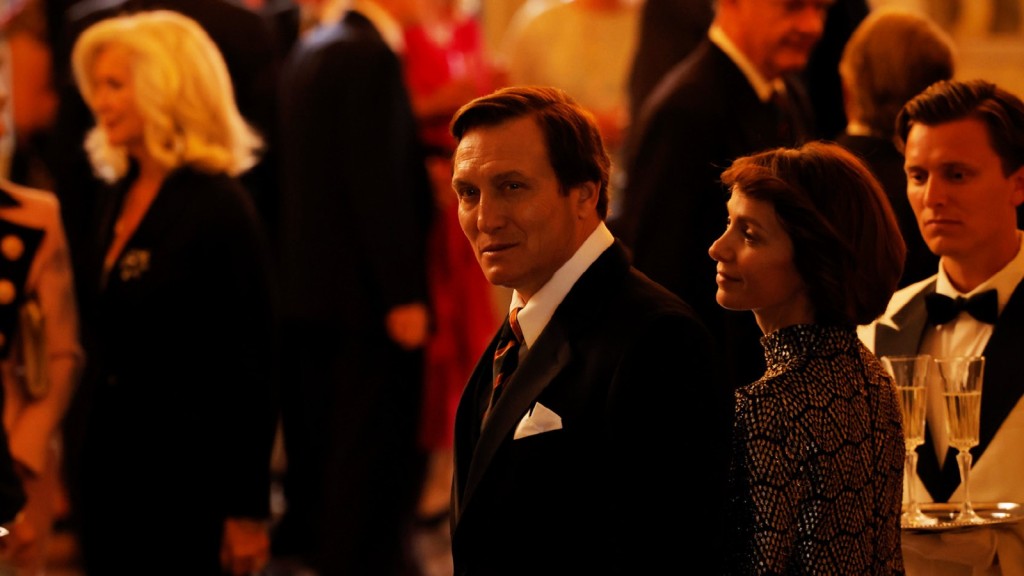
Ridley Scott’s upcoming sequel, which picks up two decades after the events of the Oscar-winning classic, is set to star Paul Mescal as a rising member of the Roman ruling class. Crowe will not be reprising his iconic role as Maximus, who died at the end of the first film. But that hasn’t stopped people from asking him about the movie.
At a press conference at the Karlovy Vary Film Festival (via Variety), Crowe complained about how much time he spends answering questions about a movie with which he has no involvement.
“They should be fucking paying me for the amount of questions I am asked about a film I am not even in,” Crowe said. “It has nothing to do with me. In that world, I am dead. Six feet under. But I do admit to a certain tinge of jealousy, because it reminds me of when I was younger and what it meant for me, in my life.”
He continued, “I don’t know anything about the cast, I don’t know anything about the plot. I am dead! But I know that if Ridley has decided to do a second part of the story, over 20 years later, he must have had very strong reasons. I can’t think of this movie being anything other than spectacular.”
This isn’t the first time Crowe has publicly distanced himself from “Gladiator 2.” In another recent interview, he wished the cast and creative team good luck but explained that the film does not involve his character.
“I’m sure at some point in time they’ll want to ask me about something, but they haven’t brought anything up in a while,” Crowe said. “It’s an extension of the narrative, but it is long beyond Maximus’ passing, so it doesn’t really involve me at all. I hear that young fella Paul is a good dude and I wish him the best of luck with it. I think where they’re picking the story up from, a young Lucius, stepping into the role of emperor. I think that’s a very smart idea within the world of the film that we created.”
Attention, Taylor Swift fans: Swift will be taking the stage one hour earlier than planned tonight (Saturday, July 1) at Cincinnati’s Paycor Stadium.
“Hey Cincinnati – Alas we’ve got another weather situation but this just means I get to see you sooner! I’ll be going on an hour early at 7pm – we’ll open doors at 4:30,” Swift wrote in an update to fans on social media around 4 p.m. ET, just a half hour before doors would open at the venue.
Swift and her tour crew seem to be taking precaution to get ahead of thunderstorms on the local forecast for tonight. Paycor Stadium is an open-air venue, and while Swift is happy to sing through a full-on rainstorm, events generally see delays if there is lightning in the area.
She usually takes the stage closer to 8 p.m. on The Eras Tour.
See Swift’s weather alert below.
Hey Cincinnati – Alas we’ve got another weather situation but this just means I get to see you sooner! I’ll be going on an hour early at 7pm – we’ll open doors at 4:30 ? See you then!
DANCES WITH FILMS 2023 REVIEW! Blake Leeper is a Paralympic sprinter and star of director Einar Thorsteinsson’s perceptive documentary, Abled: The Blake Leeper Story. The movie delves into Leeper’s drive and personality, particularly his conflict with the World Athletics (formerly IAAF), who disqualified him from competing for a spot on the U.S. Olympic team on the grounds of what they call “Technological Doping.”
The film opens with an overhead shot of Leeper running, coinciding with frequent cuts to home video footage of his younger self and archival footage of Martin Luther King Jr. The sequence is kinetic and affecting. An extreme close-up shows Leeper in deep thought as he takes the words of Martin Luther King Jr. to heart and, against all odds, keeps moving.
The introspective documentary follows Leeper as he works to secure a spot at the 2020 Olympics to compete against “able-bodied” athletes. Leeper is a double amputee and uses prosthetic legs, yet, he puts in the work to be an effective runner. His coach, Willie Gault, pushes him to be calmer and to practice smoother techniques.
With tightly edited, beautifully lensed moments of Leeper running and training with his coach under the scorching sun, Thorsteinsson highlights Leeper’s capacity to push himself to be better. Still, the filmmaker addresses Leeper’s upbringing and how even as a kid, Leeper bravely confronted every setback. Leeper was born without legs and has worn prosthetics since an early age. To see how he’s progressed over the years speaks to his optimism and willpower, although Thorsteinsson sensibly keeps the doc focused on Leeper’s main objective to be part of the U.S. Olympic team.
“…to secure a spot at the 2020 Olympics to compete against ‘able-bodied” athletes.”
Leeper’s story is inspiring, as he would go on to hold several world records and become one of the fastest runners in the world. During the Czech Republic meet, Leeper completed the 400m run in 44.42 seconds, beating the two-time world indoor champion by 2 seconds, and at the same time, his time happened to be fast enough to qualify for the U.S. Olympic team. But the World Athletics denied his score, asserting that his blades gave him an advantage, and thus began another battle entirely.
Thorsteinsson pulls you in initially with a stylistically compelling sequence that gets Leeper’s character across. Still, the film becomes increasingly less dynamic as it goes along and as scientific verbiage comes into play. However, Thorsteinsson pulls you back in with a stirring final act that cements Leeper as the winner that he is, regardless of what the sport’s governing organization believes.
Intriguingly, there’s a portion of the doc where Dr. Abu Yilla, a former Paralympian and professor at the University of Texas Arlington, claims the World Athletics’ reasoning doesn’t hold up. That said, he contemplates the advancement of prosthetic technology in terms of advantages and what it may look like in the future. But, at the end of the day, Abled is about Leeper fighting to be included in a sport, which he, without a doubt, deserves. “I have nothing to hide. My motivation comes from proving people wrong,” he says assuredly, and you feel for him because he fought so hard to get to where he is now.
Abled: The Blake Leeper Story is a powerful documentary about the undismayed Blake Leeper, who will continue to run and stun the crowd, maybe even break a few more records. While the film’s pacing stumbles halfway through, Thorsteinsson still upholds a moving depiction of resilience while exposing the ways that disability athletes are mistreated to this day.
Abled: The Blake Leeper Story screened at the 2023 Dances With Films.
On a side street about five minutes from the U.S. border, a two-story building rises in an empty, dusty lot in Mexicali, Mexico, where families fleeing persecution and violence arrive, wait and hope to be accepted as refugees in America.
Refugee shelter Cobina Posada Del Migrante in Mexicali, Mexico.
(Raul Roa / Los Angeles Times en Espanol)
Families from Mexico and Central and South America walk into Cobina Posada Del Migrante with little more than the clothes on their back and a dream to live in America in prosperity and peace. The shelter, which accepts only families, can house about 250 people, according to shelter director Elizabeth Gallardo, “but we’ve had up to 500 people at once,” she said in Spanish.
“This is a secure shelter,” she added, where no single men are allowed.
Refugee fathers pray during the Father’s Day celebration at refugee shelter Cobina Posada Del Migrante in Mexicali, Mexico.
(Raul Roa / Los Angeles Times en Espanol)
The number of residents can vary from 100 to 400 a month, depending on how fast their refugee applications are processed, Gallardo said. Families are given free room and board.
Rooms can hold four to six people. Women and children stay in the downstairs rooms and fathers or partners stay in rooms on the second floor of the building. There is a courtyard as long as the building, where events take place and children play.
Because the need for contributions is great, two groups — SoCal Immigration Task Force and Border Compassion — came together to bring supplies and gifts to the migrants for Father’s Day.
Refugee fathers were given shoes, clothing and toiletries at the Father’s Day celebration, held at refugee shelter Cobina Posada Del Migrante in Mexicali, Mexico, on June 24.
(Raul Roa / Los Angeles Times en Espanol)
Isaac Cuevas, director of immigration and public affairs for the Archdiocese of Los Angeles, said that the SoCal Immigration Task Force is made up of representatives from the Dioceses of Los Angeles, Orange, San Diego and San Bernardino. The task force contacted Sister Suzanne Jabro, founder of Border Compassion, who organizes visits to the shelter.
Border Compassion’s Sister Suzanne Jabro, left, greets Alejandro Iraldo Velazquez, of Colombia, at refugee shelter Cobina Posada Del Migrante’s Father’s Day celebration in Mexicali, Mexico, on June 24.
(Raul Roa / Los Angeles Times en Espanol)
“She had invited us to come join. When we heard that the men were not being celebrated on Father’s Day, it was a perfect time for us to lead that effort as a group,” said Cuevas. He added that celebrations for other holidays, like Children’s Day or Mother’s Day, have been common at the shelter, but not for Father’s Day.
The group traveled to the border from throughout Southern California and gathered in Calexico. There, they took a short cab ride to the border crossing, where they walked across with suitcases filled with the donations. Across the border, in Mexicali, they again loaded up in taxis for the short, five-minute drive to the shelter.
House of Ruth staff and Camp Mariastella counselors, part of SoCal Immigration Task Force, prepare to cross the U.S./Mexico border in Calexico, Calif., carrying clothing and toiletries to donate at a Father’s Day event at refugee shelter Cobina Posada Del Migrante in Mexicali, Mexico, on June 24.
(Raul Roa / Los Angeles Times en Espanol)
The items brought to the shelter included new men’s underwear and socks, baseball caps and personal hygiene products like shaving cream, razors, toothbrushes, deodorant and toothpaste.
Refugee fathers were given clothes and toiletries at the Father’s Day celebration, held at refugee shelter Cobina Posada Del Migrante in Mexicali, Mexico, on June 24.
(Raul Roa / Los Angeles Times en Espanol)
The group also brought items for the shelter’s children such as water toys, coloring books, crayons, watercolor paints and chalk, Cuevas said.
Long tables were set up where the fathers selected shirts, pants, shoes, socks and underwear. They also received toiletries.
Refugee fathers were given clothes and toiletries at the Father’s Day celebration at refugee shelter Cobina Posada Del Migrante in Mexicali, Mexico, on June 24.
(Raul Roa / Los Angeles Times en Espanol)
Eric Palacios, 36, of El Salvador, was thankful for the gifts and money.
“It will come in handy,” he said.
Another temporary shelter resident, Dario Rivera, 44, of Colombia, was glad to receive clothing. “We need to have these things and we are thankful to the group.”
Refugee fathers like Dario Rivera, 44, of Colombia, received clothing and toiletries at the Father’s Day celebration held at refugee shelter Cobina Posada Del Migrante in Mexicali, Mexico, on June 24.
(Raul Roa / Los Angeles Times en Espanol)
In their second year helping with donations, Cuevas said, the group collected items through an Amazon wish list, along with monetary donations.
Some members of the SoCal Immigration Task Force prepare to cross the U.S./Mexico border in Calexico, Calif., carrying clothing and toiletries to donate at a Father’s Day event at refugee shelter Cobina Posada Del Migrante in Mexicali, Mexico, on June 24.
(Raul Roa / Los Angeles Times en Espanol)
“Border Compassion is completing its first full year,” said Sister Suzanne. “We began in November 2021. We do not go in July, August and September due to extreme heat but we provide a food budget, pay an ESL teacher five days a week for three hours a day, stipend an assistant for statistic and financial support and needs all year, including the summer months.”
The day’s events began with introductions and a prayer. Every father was given a special gift: a new wallet with $60. After the formalities, everyone was treated to hot dogs, drinks and ice cream. Children played games and worked on arts and crafts. After lunch, some of the parents played water balloon toss with the children.
Refugee Abdiel Esau Cohello Gonzalez, 28, of Honduras, finds cash in a new wallet given to each father for Father’s Day at Cobina Posada Del Migrante on June 24.
(Raul Roa / Los Angeles Times en Espanol)
“I am very thankful for the support,” Gallardo said. “The migrants are always very happy with the items the groups bring but most of all, they are very happy with the volunteers and the attention they provide.”
Father Jay Cunnane blesses Eric Palacios during a Father’s Day celebration at Cobina Posada Del Migrante in Mexicali, Mexico, on June 24.
(Raul Roa / Los Angeles Times en Espanol)
Cuevas, who brought his wife and two children, said that he involved his family in this charity outing because, “As a family rooted in our faith, we understand that charity is part of who we are as a unit.”
“We are also a family with immigrant roots who want to support migrants and refugees in whatever way we can,” he added. “As an archdiocesan group, we’re grateful to Archbishop José Gomez” of Los Angeles “for his continued support of our efforts and for his continued advocacy for immigration reform.”
Archdiocese of Los Angeles director of immigration and public affairs Isaac Cuevas, left, emceed the fun and games for Father’s Day at Cobina Posada Del Migrante on June 24.
TLC wrote, “We are deeply saddened to learn of Caleb Willingham’s passing. Our condolences go out to Tammy, his family and friends at this difficult time.”
Tammy and Caleb met and wed at the Windsor Lane Rehabilitation Center in Gibsonburg, Ohio, last year.
People reported at the time that just 30 friends and family members were on hand to celebrate.
The day after Elon Musk challenged Mark Zuckerberg on social media to “a cage match” last month, Dana White, president of the Ultimate Fighting Championship, received a text.
It was from Mr. Zuckerberg, chief executive of Meta. He asked Mr. White, who heads the world’s premier mixed martial arts competition, which is fought in cage-like rings, if Mr. Musk was serious about a fight.
Mr. White called Mr. Musk, who runs Tesla, Twitter and SpaceX, and confirmed that he was willing to throw down. Mr. White then relayed that to Mr. Zuckerberg. In response, Mr. Zuckerberg posted on Instagram: “Send Me Location,” a reference to the catchphrase of Khabib Nurmagomedov, one of the U.F.C.’s most decorated athletes.
Since then, Mr. White said, he has talked to the tech billionaires separately every night to organize the showdown. On Tuesday, he said, he was “on the phone with those two until 12:45 in the morning.” He added, “They both want to do it.”
If you thought that a cage fight between two of the world’s richest men was just a far-fetched social media stunt, think again.
Over the past 10 days, Mr. White said he, Mr. Musk and Mr. Zuckerberg — aided by advisers — have negotiated behind the scenes and are inching toward physical combat. While there are no guarantees a match will happen, the broad contours of an event are taking shape, said Mr. White and three people with knowledge of the discussions.
The fight would be an exhibition match, Mr. White said, and outside official U.F.C. jurisdiction and rights deals, though he would help produce the event. The tech leaders have agreed there should be a charity component, Mr. White and a person familiar with the talks said, with details still being worked out. The preferred location is Las Vegas, which requires approval from the Nevada Athletic Commission. On Thursday, Mr. Musk tweeted that the event could also happen in the Roman Colosseum.
Mr. Zuckerberg’s friends and advisers have generally supported the match, two people close to him said, though others said a fight would be a distraction and not the best use of his time. One person close to Mr. Musk said that while he hated sports and didn’t appear to have the discipline to train regularly, no one could rule anything out with him.
If the matchup between Mr. Musk, 52, and Mr. Zuckerberg, 39, goes ahead, it would be a rare spectacle, even in the braggadocio-filled universe of the tech industry. While Steve Jobs and Bill Gates used to snipe at each other, the closest the tech world had before this to real sporting feuds was among billionaire yachtsmen like Larry Ellison of Oracle and Hasso Plattner of SAP.
But two wildly wealthy tech titans grappling, punching and kicking in a Las Vegas or Roman arena? No one would have dreamed it.
Meta declined to comment. Mr. Musk did not respond to a request for comment.
Mr. Zuckerberg and Mr. Musk have long teetered between being competitors, frenemies and outright enemies. The two have criticized each other over the years, including about Mr. Musk’s SpaceX rockets, data privacy scandals at Meta and more. Most recently, Mr. Zuckerberg dispatched a team at Meta to build a competitor to Mr. Musk’s Twitter, code-named Project 92.
If they take their rivalry beyond those jibes, the U.F.C.’s Mr. White said he had concerns about the physical gaps between the billionaires. Apart from their 13-year age difference, Mr. Musk is said to be at least 70 pounds heavier than Mr. Zuckerberg. In official mixed martial arts bouts, athletes are generally matched up by weight.
“We have two guys that have never professionally fought, and they’re in two completely different weight classes,” Mr. White said. Still, he said, “it will be the biggest fight in the history of combat sports.”
Mr. Zuckerberg is especially familiar with the U.F.C. world. Over the past 18 months, he has embarked on a personal journey to bulk up and dove deep into Brazilian jujitsu, a grappling martial art in which competitors try to submit their opponent and which is used in U.F.C. fighting.
Mr. Zuckerberg started training on a lark mostly in his garage in 2021, where he built what he called a “mini academy” with a circle of friends who spar with him. He has said he appreciated that Brazilian jujitsu required “100 percent focus” and strategic thinking to defeat an opponent, rather than brute strength.
Mr. Zuckerberg has sought out martial arts experts, including Dave Camarillo, James Terry and Khai Wu. In May, he competed in his first public martial arts tournament in Redwood City, Calif., which he attended undercover — up until the moment he took off his hat and sunglasses to fight. He won gold and silver medals in the challenge.
Last year, Meta also announced it had partnered with the U.F.C. to bring mixed martial arts fights to Horizon Worlds, its virtual reality app.
Mr. White said Mr. Zuckerberg was truly dedicated to the sport.
“I’ve been talking to Zuckerberg now for maybe close to two years now,” he said. “And there’s never like banter or we’re joking and laughing.” He said the Meta chief executive was “dead serious all the time.”
Mr. Zuckerberg is likely in fighting shape. He has been on a strict workout regimen, going for runs and challenging friends and colleagues to beat his times, two people close to him said. Last month, he posted a personal record for completing the “Murph” challenge, which requires completing a series of pull-ups, push-ups, running multiple miles and doing hundreds of squats, all while wearing weighted, military-grade body armor.
“Doing sports that basically require your full attention, I think, is really important to my mental health and the way to stay focused on everything I’m doing,” he said in a recent podcast episode.
Mr. Musk, on the other hand, has tweeted that he “almost never” works out and once suffered a back injury that required surgery after participating in an exhibition with a sumo wrestler. Last month, he said he had trained in “judo, Kyokushin (full contact)” — two Japanese martial arts — and “no rules streetfighting.”
“He made that very clear: ‘I’m not going to lose any weight,’” Mr. White said of Mr. Musk’s approach to the potential matchup. “‘Are we going to fight or are we not going to fight?’” Mr. White said Mr. Musk told him.
This week, Lex Fridman, a podcaster, posted photos of himself training judo with Mr. Musk. Mr. Fridman, who has also trained jujitsu with Mr. Zuckerberg, did not respond to a request for comment.
At least one person does not appear to be a fan of a fight: Maye Musk, Mr. Musk’s mother.
“Don’t encourage this match!” she recently tweeted, along with two frowning emojis.
In the past, consumers previously spent a lot of their personal time researching their purchases. First, they needed to be hear about a brand. Then, they had to learn about their products to see if it was worth their while, and finally they would go out to the store to purchase. But that’s all changed thanks to social media ads, explained Claudine Cheever, VP of global brand and marketing at Amazon.
“Of course, everyone’s talking about AI, but I think they’re also talking about the funnel being broken — this idea that customers move in a very orderly fashion from first being aware of a brand to considering it, to purchasing it,” said Cheever.
She sat down at Variety Studio, presented by Canva, at Cannes Lions to discuss current shifts in the way people consume products, and how social media influences a lot of instant shopping.
“If you think of things like direct to consumer marketing and all the social marketing and social commerce, it’s ‘see it, buy it’ for a lot of people,” Cheever explained. “So, I think everyone’s trying to figure out how to navigate that changing customer journey and obviously, the role of technology in doing that.”
She considers this break in the typical consumption chain to be a good thing because allows consumers to buy exactly what they want, and not be marketed with products brands think they need based on their demographic. Instead, she hopes technology can pick up on trends in what people search or browse so they can better determine how to market to them as an individual.
“I personally don’t like to be marketed to my age. I’d rather be marketed to whatever mood I’m in, or maybe the last thing that I bought, versus being told over and over again I’m a certain age,” Cheever explained.
But sometimes, that sort of hyperawareness in advertising can be off putting to consumers. “Sometimes you get [ads] so directly connected to something, it’s a little creepy,” she said. “So, I think that that’s one of the things too, where I see AI not so much writing my Super Bowl ad, but helping me make my media plan work a lot harder and the delivery of the ads being much more relevant.”
A company like Amazon still needs people to write ads like their most recent Super Bowl commercial about the family and their dog. “That inventiveness of when they go, ‘Oh, we’ll get another dog for the dog.’ And that a-ha moment, that’s how we drive our own culture,” Cheever said.
In the future, she hopes to see a smoother collaboration between tech and analog advertising strategies.
“I think five years out, you’re going to see much better marriage between technology and creativity. Hopefully, that will really be sinking together,” she said. “And certainly, technology is going to replace a lot of more mundane, rudimentary creative, but there’s always a role of judgment, and people pay attention to what’s distinctively different and they’ve never seen before.”
Willow Smith may have a multi-millionaire father, but she is making her own pathway to finding fame. The world witnessed the only daughter of Will Smith grow up and change her career from acting to singing. This creative artist is often seen sharing both her music and her emotions with fans on social media. But the humble entertainer owns a not-so-humble abode, enough to be called a rockstar’s house.
ADVERTISEMENT
Article continues below this ad
It is no secret that both she and her brother Jaden Smith have enjoyed a pampered life because of their parent’s stardom. Her father is one of the biggest stars in the world, with a net worth of over $350 million, but the ‘Whip My Hair’ singer is not too far behind on that path.
A look into Willow Smith’s $3 million home
ADVERTISEMENT
Article continues below this ad
When not performing at concerts, fans often see Willow Smith posting home recordings or practice sessions. According to HelloMagazine, the place where she performs these sessions is her home in Malibu, costing $3 million. Considering how much she believes in environmental preservation, her property is an eco home. This property has four bedrooms and four bathrooms for additional guests but is occupied just by her most of the time. The house is fitted with several eco-friendly amenities such as solar panels, charging ports for electric vehicles, and a water recycling system.
The Men In Black actor lives in his Calabasas neighborhood in a mansion priced at $42 million. That is where he and his wife Jada Pinkett Smith reside, and where the family occasionally gathers. Her elder brother and singer Jaden Smith, also moved out of their parents’ home and lives at Hidden Hills mansion which costs $4 million.
Despite living separately and having busy schedules, the Smiths have been a closely-knit unit.
Will Smith and the family have succeeded both personally and professionally
ADVERTISEMENT
Article continues below this ad
Just recently, Jada Pinkett Smith took the recording camera as Will Smith celebrated Father’s Day with Jaden and Willow, and eldest son, Trey. When not working, the actor also supports and attends his children’s events. When Willow Smith got the opportunity to perform at Coachella, her father teared up while her mother cheered from the audience.
Her efforts with music also proved fruitful as she won the Recording Industry Association of America (RIAA) award. While her music primarily grew through TikTok and live events, the entertainer eventually garnered an audience through her online presence. Now that Willow Smith is experimenting with her music, people can expect a growth in her net worth with time.
ADVERTISEMENT
Article continues below this ad
What do you think about Willow Smith’s $3 million home? Share it in the comments.
Parineeti Chopra and Raghav Chadha visited the Golden Temple. Ranbir Kapoor’s Animal is postponed.
Raghav Chadha and Parineeti Chopra visited Golden Temple together. Sandeep Reddy Vanga’s Animal postponed till December.
Raghav Chadha and Parineeti Chopra were recently spotted at the Amritsar airport. The soon-to-be-married couple recently visited Shri Harmandir Sahib to pay obeisance. CNN News18 shared a video of the duo entering the Golden Temple. While Parineeti kept it comfy in an off-white kurta pyjama set, Raghav on the other hand wore a white kurta with a grey jacket. The duo sought blessings. Have a look at the video.
While 2022 was all about Ranbir Kapoor’s Brahmastra, the actor has so much in store for us this year. Currently, the actor is filming opposite Rashmika Mandanna for Sandeep Reddy Vanga’s film Animal. The film which has already hyped up everyone with anticipation has seen a number of exciting developments in the form of Bobby Deol joining the film and some leak glimpses of Ranbir Kapoor’s character from the film. However, in a recent one, it came to light that the Ranbir Kapoor film might not be releasing on its scheduled date i.e. August 11. However, the reason might not be the clash with Sunny Deol’s Gadar 2 and Akshay Kumar’s OMG 2.
Ananya Panday and Aditya Roy Kapur’s dating rumours have been ruling headlines for a long time now. Even though the two actors have not officially confirmed their relationship officially as of now, their fans are convinced that they are a couple. Amid all this, the Gehraiyaan actress recently reacted to such speculations.
It was rumoured that actress Triptii Dimri was in a relationship with producer Karnesh Ssharma, brother of actress Anushka Sharma. They shared pictures together and Triptii even posted a picture of Karnesh kissing her on the cheeks, seemingly making it official. However, it seems like they have now gone their separate ways. Speculations are rife that the couple’s separation could be because of their difference in opinions, however, it is difficult to draw a conclusion at present since both the actress and producer have chosen to keep tightlipped about it. Neither of them ever openly discussed their relationship.
The much-awaited song from Alia Bhatt and Ranveer Singh’s Rocky Aur Rani Kii Prem Kahani released last week. Titled Tum Kya Mile, the love anthem of the year features Ranveer romancing Alia in the snow-capped mountains of Kashmir.The song has instantly gone viral, with the duo’s on-screen chemistry becoming the talk of the town. Alia recently shared a video of herself grooving to the song at her beach vacay. Now Ranveer too has shared a video of himself grooving, at virtual locations saying, “Alia ke reel jitna budget nahi thha #TumKyaMile #RRKPK @aliaabhatt.”
Yatamanyu is a multi-disciplinary Journalist & Photographer who dabbles in Films, Poetry, Music, Politics, Pop-Culture and everything in between. …Read More
Two bestselling novelists filed a suit against OpenAI in a San Francisco federal court on Wednesday, claiming in a proposed class action that the company used copyright-protected intellectual property to “train” its artificial intelligence chatbot.
Authors Mona Awad and Paul Tremblay claim that ChatGPT was trained in part by “ingesting” their novels without their consent. The generative AI is powered by two software programs known as large language models, which forgo a traditional programming method and instead extract massive amounts of text in order to produce natural and lifelike responses to user prompts.
When prompted, ChatGPT emitted extremely detailed summaries of Tremblay’s “The Cabin at the End of the World” and Awad’s “Bunny” and “13 Ways of Looking at a Fat Girl.” Both authors claim this is proof that their novels were used to train the chatbot, and the filing includes ChatGPT’s responses to prompts regarding their novels.
According to the suit, much of the material that OpenAI uses to train its generative chatbots comes from copyrighted works, including books written by Awad and Tremblay, “that were copied by OpenAI without consent, without credit, and without compensation.”
The lawsuit alleges that a variety of materials had been used to train the large language models, but books have been “a key ingredient in training datasets for large language models because books offer the best examples of high-quality longform writing.”
In June 2018, OpenAI revealed that it trained GPT-1 using BookCorpus, which the suit described as a “controversial dataset” assembled by artificial intelligence researchers in 2015, with a collection of “over 7,000 unique unpublished books from a variety of genres including Adventure, Fantasy, and Romance.
“They copied the books from a website called Smashwords.com that hosts unpublished novels that are available to readers at no cost. Those novels, however, are largely under copyright.”
Author Paul Tremblay.
(Allen Amato)
According to the complaint, later iterations of the company’s large language models were trained using significantly larger quantities of copyright-protected books. In a July 2020 paper introducing GPT-3, the company revealed that 15% of the training data set came from “two internet-based books corpora” that OpenAI simply called “Books1” and “Books2.”
The suit approximates that, based on numbers revealed in OpenAI’s paper about GPT-3, Books1 would contain roughly 63,000 titles, and Books2 would include approximately 294,000 titles.
“Because the OpenAI Language Models cannot function without the expressive information extracted from Plaintiffs’ works (and others) and retained inside them, the OpenAI Language Models are themselves infringing derivative works, made without Plaintiffs’ permission and in violation of their exclusive rights under the Copyright Act.,” the suit reads.
Also on Wednesday, a broader class-action suit was filed by Clarkson, a public-interest law firm, on behalf of a dozen anonymous clients, accusing OpenAI of lifting private, sometimes identifying information from Internet users “without their informed consent or knowledge,” according to a report in Rolling Stone. Experts have predicted more suits are sure to follow as AI becomes more adept at using information from the web to generate new content.
The reason, as revealed in Spider-Verse 2, is that the spider who bit Miles in Into the Spider-Verse was from Earth-42, removing the ability for a friendly neighborhood hero to exist.
Spider-Verse 2 Rejected Miles Morales Prowler Suits
As seen in the official Spider-Man: Across the Spider-Verseartbook, a variety of Earth-42 Prowler (Miles Morales) suits have been revealed.
In a very similar look to the final product seen in Spider-Verse 2, this iteration shows a maskless Miles, the pointed collared, the Prowler gloves equipped, but unclear if he’s wearing Nike Air Jordan sneakers as he did in the film.
Sony Animation
Showing from several angles, this purple-forward design has a revamped chest logo, knee pads, clunky claws, and what appears to be multiple variants on the villainous mask.
The name tag may also indicate that fans can expect another origin story told from Earth-42’s perspective in Spider-Man: Beyond the Spider-Verse.
Sony Animation
In action, this swinging version of Earth-42’s Miles Morales isn’t as detailed but clearly shows a similar style of hair as seen at the end of Across the Spider-Verse.
This version of the suit doesn’t appear as digital or electronic, especially in regards to the mask. While no logo is present, the kicks were likely supposed to be Jordan brand, a staple of the Miles character.
Sony Animation
Along with this image of Miles with a neon yellow Prowler logo, the official art book called this version of Miles G. Morales a “vigilante:”
“Miles G. Morales/The Prowler is the alternate reality version of Miles, who grew up completely differently from him. This version of the character was never bitten by a radioactive spider and doesn’t have any superpowers, but he has fallen into the role of becoming the vigilante the Prowler, under the tutelage of his uncle Aaron.”
Director Justin K. Thompson added the choice of adding Miles’ middle initial “to avoid confusion” as well as Earth-1610 Miles’ realization of the alternate reality he had swung into:
“Miles comes face to face with this other version of himself and realizes that because one thing dropped the other way, everything has changed due to the butterfly effect, where one small change can later result in larger changes to a determinstic nonlinear system-in this case an entire reality. Internally, we decided to call this parallel-world version ‘Miles G. Morales’ to avoid confusion!”
Sony Animation
The final image displays the most variance of all the Prowler artwork. The coloring is a key difference, focusing mainly on a bright red around his mask and other details.
Additionally, the bottom row of designs shows off a totally different style of hair, much messier than the final product. The suit itself also is much more minimal, this could possibly be an earlier version of the suit Miles wore as the Prowler, similar to Miles’ Spider-Man suit change between Into the Spider-Verse and Across the Spider-Verse.
Sony Animation
Miles Morales’ Future as Prowler in Spider-Verse 3
Powers points out that this version was mentored by his uncle and didn’t have his father in this “different world:”
“And to explore how Miles might have developed if he were in a different world where he didn’t have his father, he was mentored by his uncle, what kind of kid would he be?”
The director also warned not to “judge a book by its cover” in regard to this alternate version of Miles:
“For people who see Miles G. Morales at the end, don’t judge a book by its cover. There’s a lot to learn about that character. It’s a very, very interesting character.”
To say that actress Kiersey Clemons had a bad experience playing Iris West in the DCEU and The Flash movie would be an understatement. The actress recently broke her silence regarding her role and the problems she experienced behind the scenes. These ranged from fears that her role as Barry Allen’s love interest would be reduced or recast to coping with the controversy centered around co-star Ezra Miller.
Kiersey Clemons was originally set to make her premiere as Iris West in the Justice League movie,but her role was cut for the theatrical release. Her scenes were later restored in Zack Snyder’s cut of Justice League, making her one of many characters with larger roles in Zack Snyder’s Justice League. The Flash movie was meant to further establish her presence in the DCEU. Unfortunately, the dream role quickly became a nightmare for the young actress.
Kiersey Clemons spoke out about her ordeals in the DCEU. In an interview with Nylon, Clemons described how emotionally and spiritually draining working on the Justice League movie had been. Film work in an action movie can be stressful enough by itself, but Clmeons’ experience with The Flash movie was made worse by the high-profile nature of her role.
“Now that the movie’s out, I feel like for the last nearly 10 years, I’ve just been smiling and giving so much grace,” Clemons declared. “I think it was to protect my peace of mind. Now I can finally say and admit this whole thing made me cry more than it made me smile. I think I only smiled over this thing at the premiere.”
The problems began shortly after Clemons was originally cast as Iris West in 2016, when director Rick Famuyiwa (who had previously worked with Clemons on the 2015 film Dope) was still attached to direct The Flash movie. Despite feeling burned out on superhero films, having also auditioned for roles in Thor and Aquaman, Clemons decided to stick with The Flash so that she could work with Famuyiwa again. Unfortunately, Famuyiwa’s vision for the movie conflicted with that of DC Studios, leading to several years of uncertainty as the script for The Flash movie was reworked, and several new directors were considered.
“I was freaked out because at one point, there were rumors going around online that I was getting recast, which is humiliating,” Clemons recalled. While being cut from the Justice League movie bothered her, there was at least some logic behind her part being cut for reasons of time. The idea that she would be dismissed and replaced was far more personal and hurtful.
The criminal allegations leveled against Ezra Miller added another level of stress to the experience. Clemons stated that she felt forced to champion her co-star to ensure she kept her role. At the same time, Clemons refused to speculate on questions outside of her personal experiences working with Miller, saying that it wasn’t fair for her to “answer questions that aren’t mine.”
Thankfully, now that The Flash movie is out, Clemons is free to focus on her future. Clemons will be soon be starring in Susie Searches, a dark comedy about an awkward college student with a true-crime obsession, who sets out to solve the disappearance of a missing classmate. Clemons will also co-star alongside singer Leon Bridges in the upcoming dramaedy The Young Wife.
That’s according to Kotaku sources, who claim that a remake of the 2013 cross-gen PlayStation 3 and Xbox 360 game is currently in its earliest stages and will not be complete for “at least a few years”.
A team at Ubisoft Singapore, one of the studios that worked on Black Flag – specifically its boating gameplay – will reportedly be heavily involved in helping to modernize the game.
Publisher Ubisoft is currently doubling down on its biggest franchise. This year’s Assassin’s Ceed Mirage is one of six upcoming Assassin’s Creed games discussed during a Ubisoft product showcase last year.
The next flagship series entries after Mirage are codenamed Red and Hexe, and will be released as part of the new Assassin’s Creed Infinity franchise hub.
Home Free is the stoner college comedy designed to start a movement!
This post was written by Lenny Barszap and Aaron Brown, filmmakers of ‘Home Free.’
In 1997, as sophomores at the University of Texas at Austin, we invited an unhoused former professor living in the park to crash on our porch. Home Free is a retelling of that story for all to hear. It is a fun, silly, nostalgic, greatest-hits retelling of all the hilarious, dumb shit we did in college. But it’s also about homelessness, one of the biggest social crises facing our country today—a tragic subject we often witness and choose to walk right by. Unfortunately, no one wants to watch a movie about it.
Home Free is a Trojan horse social impact film disguised as a coming-of-age stoner college comedy. Our movie is unapologetically funny, but it’s also intended to be a catalyst for serious social change sharply focused on one of the most pervasive problems across America—the unhousing epidemic. It’s designed to not look like other social impact films—the depressing films that we all know we should watch but that sit in our queues for years.
We want the message to reach the audience that would never watch a sad drama or documentary about homelessness but would sure want to laugh. Humor is our spoonful of sugar.
But we wanted impact to be not just woven into the story of our film but in its very DNA. We knew we wanted it to have a tangible effect, add fuel to a conversation none of us are comfortable having, and actively take a role in getting people off the streets and into supportive and permanent housing. We wanted this silly film to start a movement!
We knew we wanted to align with a nonprofit that was on the front lines in the fight to end homelessness. We also knew we needed to raise a substantial amount of money to pull off making this movie. In the past, we enlisted investors to finance our films through an equity split. They own 50 percent of the equity by funding it, we retain 50 percent for making it. Sell it for a profit and we all make a little money. But this film was untraditional and felt misaligned with strictly being a for-profit entity.
We’d seen documentaries enlist a philosophically aligned nonprofit as a fiscal sponsor allowing them to raise money for their film through tax-deductible donations. The fiscal sponsor keeps a portion of every dollar raised giving them an immediate benefit and the film is able to raise funds through charitable giving. But we knew that it would be very challenging to raise our budget through only this method, so why not employ a hybrid fundraising model combining traditional investment with fiscally sponsored donations?
‘Home Free’Credit: Entertaining Entertainment
We then were introduced to The Other One’s Foundation (TOOF) through a creative friend, Jazz Mills, who was spearheading a collective of Austin creatives to reduce food insecurity at a 200+ resident homeless encampment called The Esperanza Community.
TOOF was supporting these displaced residents living on a seven-acre site on the east side of Austin, providing case management, low-barrier work opportunities, shower and laundry trailers, and organizing the community towards self-governance. The leaders behind TOOF were also a group of Austin creatives looking to find innovative ways to tackle and bring attention to this issue. We found our philosophically aligned partners.
TOOF was happy to help us and we, in return, committed to the following:
TOOF would immediately get 6% of all dollars donated (through this and other efforts we have shared over $16k+ to date).
Every dollar donated directly increases the profit share that we would earmark to our non-profit partners to lift our neighbors out of homelessness (e.g., if 20% of our funds come from donations, the equivalent of 20% of the investor profit would be donated back).
Our production was committed to a minimum 10% profit sharing. If we couldn’t raise it through donation, we’d cover it out of our production equity.
This allowed us to reach out to traditional and non-traditional film financiers. We could get grants from nonprofits, distributions from donor-advised funds, tax-deductible crowdfunding, etc. Everyone knew that their giving not only gets this film made to amplify the message but also increases profits for charitable organizations. And the film gets to profitability much faster. It was a win/win for everyone.
Filmmakers Aaron Brown and Lenny BarszapCredit: Courtesy of Aaron Brown and Lenny Barszap
Now, we have a film that shares a minimum of 10 percent of all profits with organizations that actively get our neighbors off the streets and into supportive and permanent housing.
When people watch our movie in a theater, buy it on a streamer, or tell their friends they know they are being entertained, enlightened, and increasing the tangible impact of the film. When we field offers from distributors, they’ll know if they lowball us, they’re also lowballing these nonprofits.
We did this non-traditional funding model for our non-traditional social impact film, but there is no reason why every film couldn’t do this. Why not raise money this way benefiting everyone involved?
It takes a Herculean effort to make a film, why not have that effort make an impact?
The film tells the story of Olfa Hamrouni, a Tunisian mother whose two eldest daughters left the country to join the Islamic State in Libya, never to be seen again. In her exploration of Hamrouni’s story, Ben Hania hires two actors to play Olfa’s missing daughters. The docu-drama hybrid premiered in Cannes, where it won the Golden Eye for best documentary (shared with Asmae El Moudir’s The Mother of All Lies).
Another hybrid feature from Cannes, The Buriti Flower, took Munich’s CineVision Award for best international emerging director for helmers João Salaviza and Renée Nader Messora. The film, made in close collaboration with the Krahô people of Brazil, is a fusion of ethnography and poetic narrative, exploring the group’s tribal memories.
Omen, the feature debut of Belgian-Congolese rapper-turned-director Baloji, another Cannes entry, took Munich’s CineRebels Award, with Agniia Galdanova’s documentary Queendom, about avant-guard Russian artist Marvin, taking a special mention.
The international film critics’ Fipresci prize went to Henning Beckhoff’s Fossil, a German drama about an aging coal miner and his environmentalist daughter.
The festival’s audience award, voted on by some 58,000 visitors to the Munich festival, went to Aki Kaurismäki’s Fallen Leaves. The first film in six years from the Finnish master also premiered in Cannes, where it won the festival’s jury prize.
The change produced many of the most iconic moments of Schwarzenegger’s film career — but the actor wasn’t convinced it was going to work.
At a panel discussion held at the Academy Museum of Motion Pictures before a screening of “Terminator 2” on Wednesday night, Schwarzenegger heaped praise on Cameron’s writing abilities before recalling his initial skepticism about the shakeup.
“The reason why it became a big hit was, number one, Jim Cameron. Jim Cameron is a genius writer. He came up with this brilliant idea, even though at the beginning I was suspicious,” Schwarzenegger said. “He said ‘I want to make you a good Terminator.’”
Schwarzenegger says that he tried to convince Cameron to double down on the brutality of the first film, but the action icon admitted that his desire for violence was partially motivated by his box office rivalry with Sylvester Stallone.
“I said ‘What do you mean a good Terminator?’ I was killing 68 people in the first one,” he said. “In the second one I have to kill 150. We go up! Cut their throats and shoot them with a cannon and run them over with a car.’ I had to outdo Stallone. I said that my whole mission was being number one at killing amounts of people on screen.”
Cameron was unconcerned about Schwarzenegger’s feud with Stallone and decided to move ahead with his initial plan. If anything, his pleas prompted Cameron to remove even more violence from the script.
“He said ‘Arnold, stop it. You’re a very sick guy. I am gonna make sure that in ‘Terminator 2,’ you’re not gonna kill one single person,’” Schwarzenegger said. “I said that’s the stupidest thing I’ve ever heard. How can this be ‘Terminator 2’ without me killing anyone? At least throw a few token bodies in there.”
In the 1997 blockbuster Titanic by James Cameron, an elderly woman by the name of Rose recounts her romantic journey on the Titanic and how she came to own a priceless diamond necklace (known as the Heart of the Ocean) to a gang of treasure hunters. As a young woman from the upper class who is traveling on the Titanic in 1912, she has a life-altering encounter with Jack, a rebellious starving artist. Rose is betrothed to snooty and affluent Cal, but she falls in love with Jack and decides to flee with him once they reach their destination on the ship. Cal’s plans and the potentially fatal event of the Titanic’s sinking, however, put their relationship to the test.
Because of their legendary portrayals of star-crossed lovers Jack and Rose, Leonardo DiCaprio and Kate Winslet attracted attention from all around the world. Due to the unrivaled chemistry between these performers, Titanic continues to rank among the greatest love stories in movie history and has inspired moviegoers to seek out more tales of love like Jack and Rose’s. If you fall into this category, go no further than these nine films, which depict similarly epic tales like Titanic.
Updated July 1, 2023: If you enjoy watching epic cinematic masterpieces just like the Titanic, you’ll be happy to know this article has been updated with additional content by Darren Gigool.
13 Braveheart (1995)
Paramount Pictures 20th Century Fox
Packed with patriotic zeal, Braveheart narrates the inspiring story of Scottish knight William Wallace, expertly weaving themes of freedom, love, and defiance against despotism. The film, both directed by and featuring Mel Gibson, brilliantly portrays the late 13th-century battle for Scottish independence. These themes lend the film a Titanic-esque grandeur.
Providing a remarkable stage for the intensely personal and emotional tales of love and defiance is the historical backdrop of the narrative. Performances in the movie are utterly captivating and indelible, especially Gibson’s embodiment of William Wallace. His fervid enactment, amalgamated with the film’s riveting battle scenes, produces an enigmatic cinematic journey that both entertains and profoundly moves its audience.
12 Atonement (2007)
Universal Pictures StudioCanal
Narratively intricate and thematically insightful describes this overlooked gem, Atonement. Atonement navigates through the complex themes of love and remorse. Through the film, a singular deception’s cataclysmic aftermath is exhaustively inspected. Amid the icy time of World War II, the budding love story of Robbie Turner and Cecilia Tallis unwinds, thwarted by an innocent but misconstrued lie. Reflecting the enormity and heartrending emotional breadth of Titanic, these themes are expertly portrayed by the film.
James Cameron’s sweeping tale likewise explored love, guilt, and unforeseen circumstances, establishing profound depth and fervor that this movie echoes in its plot too. It lures the audience, immersing them in the character’s world and cultivating a bond and emotional connection that persists until the final scene. Both Keira Knightley and James McAvoy deliver heartrending performances of yearning, regret, and sorrow. The powerful narrative, coupled with exceptional performances categorize this as an epic piece of cinema worth viewing.
11 The Godfather (1972)
Paramount Pictures
A Francis Ford Coppola classic, The Godfather is revered to be one of the most iconic movies to ever be produced. This movie plunges viewers into the heart of the Corleone family, an Italian-American criminal empire. Family complexities, the allure of power, and the gradual descent into ethical decay are all deeply probed in the movie. Unfolding in the setting of post-war America, where tradition clashes with ambition and loyalty is a dangerous gambit, this intricate story forms an epic tale that audiences had never seen before.
Echoing the reach and resonance of Cameron’s Titanic is this film’s larger-than-life story of power and downfall. The performances in the movie have become iconic. Particularly Marlon Brando’s intense representation of Vito Corleone and Al Pacino’s transformation of Michael Corleone. These potent performances created a pathway for a new generation of actors and cinema. The film’s influence extends beyond its unforgettable performances and dialogue—it essentially redefined the gangster genre, setting an incredibly high benchmark for future films. The movie remains a cultural landmark in cinema, continually entertaining and provoking awe among film aficionados.
10 Casablanca (1942)
Warner Bros. Pictures
A romantic story set during World War II, Casablanca follows former lovers Rick Blaine and Ilsa Lund as they reconnect in the Moroccan city of Casablanca. It is regarded as one of the best movies of all time. Veteran performers Humphrey Bogart and Ingrid Bergman, both of whom provide career-defining performances, are the stars of this timeless Hollywood classic from the Golden Age.
While younger generations continue to appreciate Michael Curtiz’s cinematic brilliance, their iconic and unsurpassed depictions of Rick and Ilsa have endured. In addition to its outstanding protagonists, Casablanca is still recognized for its award-winning writing, production, cinematic techniques, and screenplay, which gave moviegoers some of the most unforgettable lines in movie history.
9 Les Misérables (2012)
Universal Pictures
2012’s Les Misérables, which is set in 19th-Century France, tells the narrative of Jean Valjean and others around him as they navigate through a difficult time in that nation’s history. Jean Valjean is released from jail after serving 19 years, but he violates his parole to start a new life. Inspector Javert of the police will return Valjean to prison for violating his parole, thus, in order to avoid that, he must flee.
Meanwhile, Cosette, a small kid who was born to Fantine, a dying and poor laborer, is saved by Valjean. The film stars Hugh Jackman and Anne Hathaway in major roles, and their chemistry is something to behold. Any admirer of an epic love tale will be able to relate to the romance between Cosette and Marius, a military veteran during the post-French Revolution.
8 The Princess Bride (1987)
20th Century Fox
The timeless romance, adventure, and fantasy story The Princess Bride is based on William Goldman’s famous 1973 book of the same name. Cary Elwes and Robin Wright play the classic characters of Westley and Buttercup in actor-turned-director Rob Reiner’s near-perfect adaption, which is frequently cited as one of the best comedies of all time. A lovely woman named Buttercup falls in love with a farm boy named Westley in the 1987 movie.
As Westley chooses to depart to seek his riches elsewhere, their happiness is short-lived. Buttercup subsequently learns that he was slain by the terrible Pirate Roberts. Because of its absurdly quotable lines, the movie has maintained its relevance in mainstream culture despite initially enjoying only modest box office success. In 2011, the film’s cast even reunited (with Entertainment Weekly) more than 20 years after the movie’s debut.
7 The Notebook (2004)
New Line Cinema
The relationship of Noah Calhoun and Allie Hamilton, who, despite having very different socioeconomic statuses, fell madly in love with one another, is the subject of the 1996 Nicholas Sparks novel adaptation The Notebook. The movie starts in the summer of 1940, when Noah, a lumber mill worker, meets Allie, a wealthy woman, and they start a unique relationship. Their summer romance unexpectedly comes to an end when Allie moves back to the city, and Noah enlists in the military due to the displeasure of Allie’s parents.
Although earning mixed reviews from critics, this 2004 movie was a box office success. It resonated with viewers because of the lovely and heartfelt performances by the lead actors, Ryan Gosling and Rachel McAdams (a former real-life couple). “Teen girls hadn’t swooned like this since Titanic,” according to Moviefone, which deems The Notebook one of the “best romance movies of all time.”
6 Pearl Harbor (2001)
Buena Vista Pictures Distribution
This gripping dramatic war film, which Michael Bay directed, was written by Randall Wallace and released in 2001. Childhood buddies Rafe and Danny (Ben Affleck and Josh Hartnett) are followed as they enlist in the Army Air Corps in the World War II drama Pearl Harbor. Rafe and Evelyn (Kate Beckinsale) fall in love after meeting one another, but their romance is put on pause when Rafe decides to enlist in the British military.
Rafe is killed there, and Danny and Evelyn turn to one another for comfort as they cope with their loss. Yet they have to do that in the thick of the Pearl Harbor air raid. Pearl Harbor is one of the most epic movies ever, and although having a tragic love story, it also includes a lot of action, making it similar to Titanic.
5 Gone with the Wind (1939)
Loew’s Inc.
Gone with the Wind, which debuted in 1939 and starred Vivien Leigh, Clark Gable, Olivia de Havilland, and Leslie Howard, is today regarded as an American masterpiece. The film depicts the narrative of the volatile connection between Scarlet and a roguish guy and the chaotic American history of that era, focusing on the young Scarlet O’Hara’s life from the Civil War through the time of rebuilding.
Scarlet is a cunning and opportunistic lady despite her attractiveness. She does, however, manage to live and maintain her bravery in the face of the conflict. Yet she had a difficult existence. She gradually learned and grasped life and love as she transitioned from opulence to poverty and from her family’s plantation to the streets of Atlanta. Gone With The Wind is a must-see for anyone who enjoys epic stories.
4 Romeo + Juliet (1996)
20th Century Fox
How about a bit more DiCaprio for those Titanic fans? In his 1996 romantic drama Romeo + Juliet, director Baz Luhrmann updated William Shakespeare’s well-known tragic love story for contemporary viewers. The movie focuses on the Capulets and the Montagues, two powerful organized crime families from Verona Beach. Their children, Romeo Montague and Juliet Capulet, in particular, feel the effects of their bitter and protracted feud.
Romeo sneaks into the Capulet’s masquerade party, where they are meant to loathe one another but instead fall profoundly and passionately in love. Luhrmann’s movie keeps Shakespeare’s original dialogue while taking place in a more modern context, showing how the story transcends time. Both Claire Danes and Leonardo DiCaprio provide outstanding leading performances that perfectly capture the passionate and impressionable romance of their respective characters.
3 Moulin Rouge (2001)
20th Century Fox
The Moulin Rouge is a nightclub where everyone may be anyone they want to be, and director Baz Luhrmann takes viewers there in the film Moulin Rouge. Christian, a gifted writer who relocates to the magnificent city of Paris, finds himself at the Moulin Rouge, the greatest cabaret in the area, very fast in the center of the movie. Christian immediately develops a romantic interest in Satine, the club’s most sought-after performer. Ewan McGregor and Nicole Kidman are the stars of this excellent musical romantic drama, and it’s simple to get invested in their romance because of their brilliant and emotional performances and realistic chemistry.
2 Ghost (1990)
Paramount Pictures
The 1990 film Ghost tells the tale of Molly Jensen, whose young banker boyfriend, Sam Wheat, is killed by a friend when the two are out on a date. Sam discovers he is a ghost and turns to a psychic for assistance in reversing the situation and defending Molly from his friend’s bad intentions. Ghost earns a top rank despite not being as grandiose as some of the other choices on our list thanks to its fantastic score as well as the outstanding performances by Patrick Swayze (who passed away in 2009), Demi Moore, and Whoopi Goldberg. Fans of spectacular love stories (like Titanic) will want to revisit this sad romance time and time again.
Unverified Twitter users will only be able to view 600 tweets per day, executive chair Elon Musk announced Saturday, citing an effort to “address extreme levels of data scraping and system manipulation.”
Verified users will be able to view 6,000 posts per day, and new unverified users will be able to view just 300. Musk says the limit will be temporary, but gave no end date.
The decision is the latest effort to favor users who have subscribed to Twitter Blue, Twitter’s $8/month subscription service that verifies users. Manynowview the blue check as synonymous with right-wing extremism.
To address extreme levels of data scraping & system manipulation, we’ve applied the following temporary limits:
– Verified accounts are limited to reading 6000 posts/day – Unverified accounts to 600 posts/day – New unverified accounts to 300/day
It’s unclear what Twitter defines as “reading.” Users are questioning whether scrolling past a tweet will count towards their limit, or if they can avoid racking up viewed tweets by not clicking on anything.
Users will see “rate limited exceeded” on their feed when they have reached the cap.
Twitter has gone through numerous changes since Musk acquired the company last year. Friday, the company apparently restricted site content to those with accounts, making tweets unavailable to view for anyone who isn’t logged in.
Studies havenoted a significant rise in hate speech since Musk took over the social media giant.
First reactions to the decision appear to be mostly negative. Even verified users, whose tweets-read limit is substantially higher, are frustrated by the latest shift in the company’s policies.
“Stop making twitter pay to win,” one verified user wrote.
“Please stop punishing people who want to use your platform,” another wrote.
this is a joke right? so many mutuals cant even see any tweets just using the site normally today, please stop punishing the people who want to use your platform
Best guess: Twitter tried to do something stupid with their API, they messed it up in a way that will take days, so Elon is doing this new “you can only read 600 posts a day” thing as a cover, and he’ll say “after hearing your feedback, we’ve reversed the policy” when it’s fixed.
DANCES WITH FILMS 2023 REVIEW! To tackle the subject of grief is an enormous undertaking, and because humans are who they are, grief is different for every individual. In the documentary, Meet Me Where I Am, director/writer Grant Garry dives into suffering from a multifaceted perspective offering a deeper understanding of why we grieve, how it manifests, and how we cope.
Participants in this film, of mostly talking heads, include Anthony Rapp (RENT, Star Trek: Discovery), David Kessler (author of Finding Meaning and ABC’s Good Morning America contributor), Ron Marasco, Ph.D. (author of About Grief: Insights, Setbacks, Grace Notes, Taboos), and Dr. Donna Schurmaan (Senior Director of Advocacy & Training at The Dougy Center) among several others, whom all describe the many ways grief exists mainly from the loss of a loved one.
Each individual in Meet Me Where I Am shares their story of loss, love, and hope, and throughout the film, provides an understanding of how grief needs acceptance so healing can happen. Normalizing the grief process in the world in which we live is a step toward understanding how this emotional state of being can be handled.
Throughout Meet Me Where I Am, individuals have points of discussion about grief, including how you might define grief and how one cope with grief, such as wanting to run away, feeling on edge, being unable to speak or think properly, sleeping away the feeling of pain, or panic attacks. In describing grief’s impact or existence—messy, rugged, raw, unpredictable, not one size fits all—everyone experiences grief’s hurt and pain.
“…all describe the many ways grief exists mainly from the loss of a loved one.”
At one point, grief is described as a love that has no place, and once experienced, it profoundly changes an individual. However, how one handles grief is an individual situation, and Meet Me Where I Am points out that perhaps our society takes it poorly.
Garry brings up certain blanket statements such as “my condolences” and “sorry for your loss” is what we are taught to have good intentions forcing empathy, but the impact is not so much because we can’t fix death. We are disconnected from the experience as a society, and there’s no quick fix.
To give context and meaning and offer some resolve,Meet Me Where I Am offers ideas on how some assistance in holding space and being present for grieving people is good. Learning to engage is helpful to grief. To ask and talk about grief makes a difference, and it will help an individual get through the five stages—denial, anger, bargaining, depression, and acceptance.
Meet Me Where I Am is an intriguing documentary about a challenging subject that will be part of every individual’s life at some point, and the steps or actions taken by those in the film help. Aptly titled, Meet Me Where I Am hits the target for its purpose.
Hot dogs aren’t on the menu. Snoop Dogg is on the menu – and on the marquee.
Jack in the Box has opened a pop-up restaurant named after venerable rapper Snoop Dogg. The restaurant is open in Inglewood during the Independence Day holiday weekend, closing on July 2. The venue is named Dogg in tha Boxx and is located at 1220 Centinela Avenue.
The menu at the pop-up includes Snoopadelic Shakes and a Snoop Munchie meal that includes a spicy chicken sandwich, a classic taco, a “baked” brownie, and Sprite. Fans can also sit and take photos on Snoop Dogg’s throne, see the Snoop Dogg and Jack in the Box mural, see themed lowriders, and purchase ’90s themed merchandise.
“Snoop speaks directly to our late-night crowd – fans of our menu that are more inclined to pick up Tiny Tacos or Curly Fries from 10 p.m. to 4 a.m.,” spokesperson Mijal Tenenbaum said.
The company previously worked with Snoop in 2018 on a Munchie Meal launch, according to Tenenbaum.
“He’s a true fan of the brand and we wanted to welcome him back,” said Tenenbaum.
The Lord of the Rings: Gollum developer Daedalic Entertainment is leaving game development.
The Lord of the Rings: Gollum launched last month to broadly negative reviews, prompting developer Daedalic Entertainment to take to Twitter to apologize for the game, claiming that the team “deeply regret that the game did not meet the expectations we set for ourselves or for our dedicated community”.
Fast forward a month, and it seems the backlash hasn’t just affected the fortunes of Daedalic’s planned sequel, but the fate of the internal development studio itself. According to German website Games Wirtschaft, the sequel has now been cancelled, and the studio plans to let go of at least 25 of its 90-person team.
“We value each and every member of our team, and it is important to us that the transition goes as smoothly as possible,” Daedalic said, according to Google Translate. “Therefore, we will support our former employees in finding new opportunities within our network.”
The changes will reportedly have no bearing on the recently-announced Surviving Deponia, although that’s possibly because the external team at AtomicTorch will lead its development.
It’s unclear how, or even if, the team will continue to improve the story-driven, action-adventure game set in J.R.R. Tolkien’s classic setting with further patches or DLC, or if the game will still come to Nintendo Switch as planned.
“Our development team has been working diligently to address the bugs and technical issues many of you experienced,” the team said shortly after the game released in May. “We are committed to providing you with patches that will allow you to enjoy the game to its fullest potential.
“Once again, we deeply apologize for any inconvenience caused, and we appreciate your understanding during this time.
“We will continue to keep you updated on our progress and provide transparent communication regarding the upcoming patches and improvements. Your passion and dedication as players have been the driving force behind our determination to make things right.”
“Birds” was selected as a finalist in this year’s ShortList Film Festival, presented by TheWrap. You can watch the films and vote for your favorite here.
Austin, Texas has proven the cinematic groundswell for filmmakers from Richard Linklater, to Robert Rodriguez and Terrence Malick (more on him in just a sec). Los Angeles native Katherine Propper joins the fray with “Birds,” her supremely elegiac short about teens discovering themselves under the hot sun of an Austin summer.
“I definitely wanted to showcase some of my favorite spots, and it really started with me finding [actor] Payton Washington on Instagram, a cheerleader and tumbler,” Propper told TheWrap. “I DM’d her and asked if I could meet her, and if she was interested in maybe being in a student film?”
(If her name reads somewhat familiar, Washington was also the unfortunate victim of a violent incident in Elgin, Texas that made the news this year in which she and a friend were wounded by gunfire by a man in a supermarket parking lot after a misunderstanding. Their assailant was quickly arrested and thankfully both women survived the incident.)
This led to drafting a large number of youths to fill out her 14-minute short about flirting, foraging and fraternizing amongst a diverse lot in a series of spirited and observational scenes, including Washington, who was born with one lung and has a tense moment with an asthma attack in the film “that was scripted,” the writer-director assures us. There’s also more young people, many of whom went to school with her younger brother, who shared their stories and experiences with Propper which went directly into the film.
“[Those conversations] sort of sparked in me the idea of wanting to do something with young people that was about fragility and beauty coexisting together,” said Propper. “I know it sounds kind of abstract, but that was sort of how I was thinking about all the vignettes. I wanted it to be a joyful, romantic film that had some fragility, and risk and danger.”
The scenes in the film have a sun-blessed, innocent, unrushed sense about them, and even moments that feel like they will be tension-filled (as when an older squatter approaches a pair of boys looking through backyard trash), the outcome is often the opposite. They’re reminiscent of beloved American filmmaker Terrence Malick, who Propper actually worked for in his editing department.
“What I learned from him is that he is very playful,” said Propper, who worked on his long-gestating religious epic “The Way of the Wind” about the life of Christ. “He doesn’t come to the edit with a preconceived structure or plot regarding how it has to come together. That was really inspiring to me, because it inspired me to be really free about how I went about the edit. Being tethered by structure and plot can sometimes be very limiting in a short film.”
And Propper’s full-length narrative ambitions have already been achieved with her hip-hop-fueled debut movie “Lost Soulz,” which recently played at the 2023 Tribeca Film Festival, and continues her interest in depicting thoughtful young Americans in Texas. Said Propper, “It’s also a coming-of-age film and I think it also is a more sort of optimistic, joyful portrayal of young people that doesn’t lean in too much on the angst. I would say that it’s just the worldview I have for humanity.”
The 2023 ShortList Film Festival runs online from June 28 – July 12, honoring the top award-winning short films that have premiered at major festivals in the past year. Watch the finalists and vote for your favorite here.
Emily Ratajkowski showcased her incredibly toned stomach in a white crop top and a pair of low-waisted black pants while out and about in New York City on Saturday.
As she put her lean physique on full display, the 32-year-old supermodel turned the sidewalk into her personal runway as she strutted with ease in a pair of chunky, grey sneakers.
Her wavy brunette hair cascaded down her shoulders in loose waves as she went for a walk in her neighborhood.
Later in the day, the Gone Girl actress uploaded a sultry mirror selfie in the same outfit from her house as well as a picture with her two-year-old son Sylvester.
Wow: Emily Ratajkowski showcased her incredibly toned stomach in a white crop top and a pair of low-waisted black pants while out and about in New York City on Saturday
Turning heads: As she put her lean physique on full display, the 32-year-old supermodel turned the sidewalk into her personal runway as she strutted with ease in a pair of chunky, grey sneakers
Cool girl: The mother-of-one, who has been hard at work recording new episodes of her High Low podcast , accessorized her laid-back ensemble with a pair of black shades, a large red tote bag and gold watch
She shares her little boy with ex-husband Sebastian Bear-McClard, who she split from late last year.
While speaking about the end of their four-year marriage, she told Harper’s Bazaar that she was feeling ‘all the emotions.’
‘I feel anger, sadness. I feel excitement. I feel joy. I feel levity. Every day is different,’ she told the magazine in October.
That same month, she came out as bisexual, and has, more recently, revealed she’s keen to explore her sexuality but is waiting for the ‘right girl’ to come along.
When asked by HommeGirls, in May, if she’d ever date a woman, the best-selling author said: ‘I would love to.’
‘I’ve always been someone who’s more attracted to vibe than specifics of physicality so sometimes it’ll just randomly hit me, and I’ll be like, ‘Whoa, I’m attracted to this person!’ she explained.
She also stated that she refuses to settle down for the sake of being in a relationship.
‘Younger version of myself would have probably settled for some mid dude just to have a [boyfriend]. Glad I’m not in that era anymore,’ the catwalk queen mused.
Sleek: Her wavy brunette hair cascaded down her shoulders in loose waves as she went for a walk in her neighborhood
Heading home: After hanging out with her friend, she was seen out with her toddler
Elsewhere in the chat, Emily hinted that she was part of the mile high club, simply replying ‘Lol’ when asked if she had ever had sex mid-flight and also appeared to reference her tryst with Harry Styles.
The pair were spotted kissing on the streets of Tokyo in March and appearing to reference her hook-up with former One Direction singer, she described a recent trip to Tokuyo as impulsive.
She said when asked to describe the ‘most impulsive’ thing she had recently done: ‘Flown to Tokyo with my two best friends and two-year-old.’
Since her split from her film producer husband, Emily has also dated comedian Eric Andre, 39, DJ Orazio Rispo, 36, actor Pete Davidson, 29, artist Jack Greer, 35, and been linked to 59-year-old Brad Pitt.
Working it: Later in the day, the Gone Girl actress uploaded a sultry mirror selfie in the same outfit from her house
Doting mom: Additionally, she uploaded an adorable picture with her two-year-old son Sylvester
Previously, Ratajkowski confessed dating in the public eye has its challenges.
‘There’s been times where literally the first time that I’ve met someone, we spent two hours together, and there’s pictures on the Internet,’ she said earlier this year on her podcast.
She continued: ‘My close friends will be like, ‘Dude, that guy’s stoked, like, he’s stoked. He just got photographed on a date with you.’ And then that makes me feel gross; I’m like, ‘I wouldn’t want to be with somebody who is excited to be photographed with me,’ that’s not a good sign.’
Additionally, the star said it is ‘really hard’ that any of her dates can see if she goes out ‘to dinner with someone else.’
‘It’s also been tough because I’ve been trying to casually date and not get booed up, not get cuffed up, and it’s been hard to do that and be kind of mindful of the people that I’m seeing because I don’t necessarily want to know when they’re going on another date,’ she noted.
Hollywood’s track record for portraying people with disabilities has been sketchy at best. There have been inspirational figures, noble martyrs and lovable oddballs — some of these performances garnering Academy Awards — but there aren’t a lot of people simply living their lives.
The search for truly resonant disability representation in the history of cinema is continuing, but over the decades, many scholars keep returning to a perhaps surprising touchstone: a 91-year-old film set in a circus.
Tod Browning’s most widely known work is “Dracula” (1931), starring Bela Lugosi, but the next year, he broke new ground with a movie featuring an extensive cast of actors with disabilities. Browning’s “Freaks” (available on most major platforms) centers on a close-knit group of circus sideshow performers who rally around a friend after he is betrayed by his lover, a trapeze artist.
Despite the sensationalist spectacle, the sense of both community and agency among the characters is noticeable, with a variety of experiences represented (some of them extremely rare onscreen). For example, Harry Earles, a little person who plays the betrayed lover, Hans, by some accounts told Browning about the original story, “Spurs,” that “Freaks” adapts; Frances O’Connor, who plays a member of the troupe, was born without arms and had toured with Ringling Brothers; and the performer known as Schlitzie is one of a few cast members with microcephaly.
“It was really appealing to see that they have a recognizable disability culture and they form a community,” Carrie Sandahl, head of the Program on Disability Art, Culture and Humanities at University of Illinois, Chicago, said of the film. “They stand up for each other and have their own insights and humor.” Sandahl co-wrote and co-produced “Code of the Freaks,” a 2020 documentary that surveyed disability representation in Hollywood and held up the Browning film as a rare bright spot.
As a hero for disability representation, Browning could be a complicated figure. He came to moviemaking from carnivals, where he had worked as both a barker and a performer, and his interest in the macabre could sound voyeuristic. “Freaks,” for example, serves up a lurid revenge plot. But it also explores the quotidian offstage lives of the troupe in the film, and the villain of the story is the toxic trapeze artist, Cleopatra (Olga Baclanova), who is not disabled.
“What’s fascinating is their daily lives,” Kristen Loutensock, a cinema studies professor at the State University of New York at Binghamton, said. “We never see their actual acts. We see them doing laundry, eating with each other. It’s this idea of community as family, a space where you can do the things that are necessary for your life — like you can eat with your feet!”
Freak shows had declined by the 1920s after a movement to shut them down, not out of concern for the performers, but with the goal of keeping them from public view. Browning’s film ran into opposition, too: It was re-edited after test screenings, bombed at the U.S. box office and was banned in Britain. But in the 1960s and ’70s it resurfaced as a midnight movie and cult oddity, at a time that overlapped with the beginnings of film studies as a formal university program.
“Freaks” rose to further prominence in the 1990s with the emergence of disability studies as a field and the reappraisal of circus culture. Sideshows were re-evaluated as a possible site for expressing a kind of creative vision, and the film has its own ready-made taglines for solidarity, from the “one of us” chant — when they welcome Cleopatra as “one of” their community — to the group’s code of honor: An injury to one is an injury to all.
The over-the-top aspects of “Freaks” also gained their own kitsch appeal for some viewers with disabilities, Sandahl said.
“Embracing ‘Freaks’ is also about a form of humor called ‘cripping.’ It’s an outsider, edgy embrace of something that is clearly outsider and non-normative,” she said.
Detractors of “Freaks” and its inherently marginalizing context exist. But its re-evaluation seems to occupy an established place in disability studies that does not have any precise equivalents. Scholars I spoke with singled out moments in other films, ranging from the 1978 drama “Coming Home” (which depicts the aftermath of injury in war) to the 2019 “Chained for Life” (which stars Adam Pearson, an actor with facial disfigurements) and even the Farrelly brothers’ hit 1998 comedy “There’s Something About Mary” (featuring a boy with intellectual disabilities).
But none have quite the stature of “Freaks,” and sometimes redeeming other movies can be a reach.
“I’ve appeared with the Farrelly brothers on different panels and we’ve had this argument before,” David T. Mitchell, a leading disability studies scholar who is a professor at George
Washington University, said of their portrayals of people with disabilities. “They say that any representation is good representation and ultimately the films works its way around so you have sympathy for the character. But for me, that’s too low a bar.”
Reid Davenport, a filmmaker who charted his own experiences navigating the world with a wheelchair in the award-winning documentary “I Didn’t See You There,” recognizes the conflicting views of “Freaks.” It might be transgressive and offensive, yet it also demonstrates the agency of its characters in a society that has tossed them aside. (In his own feature, he also laments the sudden appearance of a big-top circus in his neighborhood, and the legacy it brings to mind.) But he maintains that the history of disability representation in film is simply dire across the board.
“There’s really very little to look back upon and say, ‘Oh, let’s keep this,’” he said. “There needs to be a complete overhaul, and I think there are signs that this is happening.”
Davenport’s work points one way to representations that are faithful to the experience of people with disabilities. Mitchell said he believed that the future of disability representation lies in works like Davenport’s and what he broadly calls independent disability cinema.
“Disability film tends to be about a creative, non-normative navigation of the universe,” Mitchell said. “And that is a kind of viable alternative ethical map to how to live differently, because disabled lives are so interdependent.”
Viewed in that light, the specific, antiquated world of “Freaks” can continue to spur better ways forward in artistic depictions of people with disabilities.
“That was the thing that really appealed to me: An offense to one is an offense to all. That’s my motto for disability activism,” Sandahl of the University of Illinois said. “Like, you may not have a ramp for me to get into this store, but it’s not just about me if I complain. You’ve offended all of us, and I’m going to do something about it.”
Indiana Jones has begun his last box office crusade, with the fifth franchise entry earning $24 million on its opening day from 4,600 theaters. It’s a figure that includes $7.2 million in Thursday previews.
The release from Disney and Lucasfilm is expected to debut near the bottom of projections, with a three-day opening of $60 million or so. It’ll be more than enough for the Harrison Ford action-adventure film to land in the top spot on domestic charts, setting itself up to draw crowds through the Fourth of July holiday — but it’s not exactly the victorious tone-setter for one of the 20 or so most expensive blockbusters ever made. With a whopping $295 million production budget, “Indiana Jones 5” faces quite the trek to theatrical profitability.
The skies have been cloudy for “Dial of Destiny” for some weeks now, ever since the franchise finale made a splashy debut at the Cannes Film Festival and earned reviews that could kindly be described as mixed. After weathering that mediocre buzz for more than a month, the film has balanced out at a 58% approval rating from top critics on Rotten Tomatoes. In Variety‘s review, chief film critic Owen Gleiberman wrote that “James Mangold’s action epic is made in the style of Steven Spielberg, but the exhilaration is gone.”
The first round of ticket buyers are more positive, as indicated by the “B+” grade through research firm Cinema Score, but that’s still not a level of excitement that’s appropriate for a beloved franchise homecoming, especially one of this scale.
The last feather in Indy’s cap was “Indiana Jones and the Kingdom of the Crystal Skull,” which opened to $100 million over the Memorial Day holiday in 2008 and legged out a $790 million worldwide gross. That film drew its own middling reception, which may have taken away some of the thrill of the franchise for audiences. It’ll be difficult for “Dial of Destiny” to match the final gross of its predecessor.
James Mangold took the director’s seat for this outing after franchise co-creator Steven Spielberg bowed out during a lengthy development process. “Dial of Destiny” sees a weathered Indiana Jones searching for a mystical artifact with the power to change the course of history. The professorial globe-trotter is accompanied by his goddaughter, Helena (Phoebe Waller-Bridge), in a race against a former Nazi (Mads Mikkelsen) for the treasure.
While Disney is facing an underwhelming arrival for “Indiana Jones,” it can take some solace in the fact that it’s not laying the biggest box office egg this weekend. Universal’s “Ruby Gillman, Teenage Kraken” is likely opening outside of the top five after earning $2.3 million from 3,400 theaters on Friday. A finish around $6 million over the three-day frame seems to be where things are headed.
Nobody in the industry has been projecting good numbers for the DreamWorks Animation film and this pin-drop opening represents the proverbial Band-Aid getting ripped off. Facing strong competition for family audiences in “Indiana Jones” and animated holdovers “Elemental” and “Across the Spider-Verse,” “Ruby Gillman” doesn’t have any hope to recoup its $70 million production budget. For what it’s worth, ticket buyers have been positive, as indicated by the “A-” grade on Cinema Score.
Sony looks to take silver with “Across the Spider-Verse,” projecting an $11.7 million gross for its fifth weekend of release. The “Spider-Man” sequel is looking at another soft drop around 40% or so; arachnids have eight legs and this movie is using all of them to keep its numbers climbing. Total domestic gross should push to $340 million through Sunday.
Disney and Pixar’s “Elemental” is looking at third place. The animated romance added $3.4 million on Friday to push its North American total to $80 million. “Elemental” still won’t be able to justify its $200 million production budget after debuting with the worst opening numbers in Pixar’s history, but it’s held well since then. The film will almost certainly push beyond a $100 million domestic gross — a milestone that seemed beyond reach two weeks ago.
Sony’s “No Hard Feelings” is projecting $7.1 million through the weekend, which would push its domestic total to $28 million. That would be a modest 51% drop from its opening numbers, but the Jennifer Lawrence comedy still cost $45 million to produce.
“Transformers: Rise of the Beasts” looks to round out the top five, projecting a 43% drop in its fourth weekend of release. The Paramount sequel should reach a $135 million domestic gross through the three-day frame.
Anthony Mackie is set to star as the titular hero in the upcoming Captain America: Brave New World, but it wasn’t the weight of the shield that made Mackie nervous, it was his new co-star Harrison Ford.
Brave New World will not only see Sam Wilson assume the role of Captain America, but it will see Ford take over the role of Thaddeus “Thunderbolt” Ross from the late William Hurt.
Image: Marvel
According to Mackie, working with the legendary actor was nerve-wracking, at least in the beginning.
“The first day was so intimidating,” Mackie said. “I was so [freaking] nervous I couldn’t remember my lines. He’s Harrison fucking Ford. There is this aura about him. But he dispels that really quickly because he’s such a cool guy. He’s everything a movie star should be. He would say, ‘Let’s shoot this [stuff].’ And everybody was like, ‘Yeah, let’s shoot this.’”
“We spent a good bit of time together,” Mackie added. “Ross and Cap have always had that relationship, where they were friends and they respected each other, but they always bumped heads. That’s their relationship in the storyline.”
Ford’s Thoughts On The MCU
While Ford may be a Hollywood legend, he is also new to the MCU. When asked if he was having a good time on the film, Ford said it was fun, for work at least.
“Uh, yeah,” Ford said when asked if he was having a good time. “I mean, there are tough days and easy days and fun days and all kinds of days. It’s a tough schedule and, yeah, it’s fun. But it’s not a walk in the park. It’s not fun fun. It’s work.”
Captain America: Brave New World will hit theaters on May 3, 2024.
Photo: Collider
Thanks for visiting MickeyBlog.com! Want to go to Disney? For a FREE quote on your next Disney vacation, please fill out the form below and one of the agents from MickeyTravels, a Diamond level Authorized Disney Vacation Planner, will be in touch soon! Also, thanks for reading!
Unstoppable Doom Patrol #4 sees our weird and wonderful heroes dealing with their demons and coming to terms with their trauma. The issue shifts focus to the new character Dr. Syncho (or Jerry when they’re working), the team’s resident therapist.
Yes… you read that right. The gang’s going to therapy!
Positives
This issue takes an interesting approach to telling everyone’s stories this issue. Instead of heading off on another adventure, we’re staying in-house, and talking through all the personal and mental issues that are clearly underlying, for the whole team. I’ve been saying it since my first review, these people are very broken, and an issue dedicated to them getting better is exactly what this series needs.
The inclusion of a therapist in this heavy a capacity is a bold choice for a superhero action comic, but it’s the perfect representation of everything the Doom Patrol and the creative team are trying to do. What could feel like a book about building a superhero fighting force and recruiting powerful individuals instead feels unique. The DP isn’t interested in building an army; they’re interested in helping people, not just physically, but by providing aftercare as well.
Superhero events and powers kicking in are life-changing events, and I can’t think of many other books that really deal with the trauma behind all that. Not since Tom King and Clay Mann’s Heroes in Crisis have I seen a wider interest in recovery and mental health, and it’s refreshing to see this point of view represented so plainly in comics.
The closest similar story I can think of right now would be Leah Williams and Marguerite Sauvage’s backup stories in Action Comics, Head Like a Whole (an excellent series and Nine Inch Nails reference), and even that doesn’t directly deal with these issues in the same way that Unstoppable Doom Patrol does.
As always, Dennis Culver does the job and he does it right; by perfectly nailing each personality and their struggles. What we have here is expertly choreographed character work and earned emotional beats, both of which have become the hallmarks of this series, with good reason.
The section focusing on Negative Man and his coming to terms with himself and his condition really had me feeling things, and in the hands of a less capable writer, this scene wouldn’t have done that. Culver continuously shows a deep understanding and relation to these characters and was the perfect choice of writer to bring the DP back to the DCU.
Guest artist David Lafuente had some BIG Chris Burnham-size shoes to fill in this issue, but with Brian Reber coloring his work, he more than met the challenge. The splash pages visually chronicling each character’s journey through their recovery are all done beautifully, and tell all their stories in a much more effective way than dialogue. A picture really is worth a thousand words.
I want to give a shout-out to letterer Pat Brosseau as well, his work is flawless and widely under-appreciated. A Good letterer can make or break a book, and Brosseau is doing great work with this title.
Negatives
This issue was added to the series quite late in the game, being announced just weeks before the first issue was released. This only further highlights that this series should be an ongoing title so that the plot has space to breathe and wrap up to its natural conclusion. 7 issues just aren’t enough, dammit!
The one is perfect, though, no complaints!
Conclusion
A short aside from the main story of the title, Unstoppable Doom Patrol #4 adds essential context and character development to all our heroes, new and old.
The hope springing forth from these pages is palpable, and the positive message behind the story is clear to see. If these guys can carry on after what happened to them, you can too!
Oppenheimer director Christopher Nolan says the upcoming biopic is “kind of a horror movie”.
During an interview with Wired, he revealed that some early viewers had a very emotional reaction to the film, which depicts the invention of the atomic bomb.
“Some people leave the movie absolutely devastated,” he revealed. “They can’t speak. I mean, there’s an element of fear that’s there in the history and there in the underpinnings. But the love of the characters, the love of the relationships, is as strong as I’ve ever done.”
He’s often credited as the father of the atomic bomb and spearheaded the ambitious Manhattan Project which saw the US scientific community come together with the goal of creating the world’s first nuclear bomb.
Obviously, the threat of nuclear war weighed heavily on the US throughout the Cold War, so it’s something that has long been part of the national consciousness. Now, Nolan is using it to unsettle and terrify his audiences.
“It is an intense experience because it’s an intense story,” he said. “I showed it to a filmmaker recently who said it’s kind of a horror movie. I don’t disagree.”
The film focuses on the lead-up to the Trinity nuclear test – the world’s first nuclear test.
“Oppenheimer’s story is all impossible questions,” Nolan added. “Impossible ethical dilemmas, paradox. There are no easy answers in his story. There are just difficult questions, and that’s what makes the story so compelling. I think we were able to find a lot of things to be optimistic about in the film, genuinely, but there’s this sort of overriding bigger question that hangs over it. It felt essential that there be questions at the end that you leave rattling in people’s brains and prompting discussion.”
Caleb Willingham, who appeared on the TLC realilty show “1000-Lb. Sisters” as the husband of star Tammy Slaton, has died at 40. The news was confirmed by his stepmother, who did not provide a cause or other details.
Caleb, known by the nicknames “Killa K” or “Double K,” was estranged from his wife at the time of his death.
The TLC show focuses on Amy and Tammy Slaton, sisters whose combined weight is more than 1,000 pounds. The show’s drama details their weight-loss efforts.
Willingham and Tammy Slaton were first introduced during a 14-month rehab stay. She was there in an effort to lose weight for bariatric surgery. Caleb was at the facility for obesity treatment.
The two wed in the fall of 2022 in Ohio. Fans of the hit TLC series witnessed the couple’s wedding during the season four finale, which aired in March 2023,
“Our wedding day was perfect, there was so much love in the room,” Slaton said to People in January. “I literally married my best friend.”
The couple reportedly parted in May. Details on the “why” are unclear.
Details on a memorial service or survivors have not been revealed.
SATURDAY AM:Refresh for chart…and more analysis Disney/Lucasfilm’s Indiana Jones and the Dial of Destinyis still bound to open at the bottom of end of tracking’s projection of $60M as this morning. I saw an estimate in The Flash vicinity of $55M last night and took an Alka Seltzer out of shock. Hopefully Dial of Destiny doesn’t fall apart tonight and at least stays on course for a Mission: Impossible – Fallout type opening in the $60M range over three days. That figure might be good for exhibition and popcorn sales over the five-day holiday weekend, but it stinks for a movie that has a reported cost of $250M to near $300M before P&A.
However, since the movie world premiered to lackluster reviews at Cannes, and landed like a wet towel on tracking three weeks ago and didn’t budge its projections despite having significantly louder marketing and publicity global campaign than The Flash, including $90M from promotional partners — it’s been baffling how a storied franchise can end on a downer note at the box office in its finale. I found the movie out of Cannes to be too plug-and-play, laden in tropes of the franchise from the kid sidekick to videogame-like action; completely lacking the breath and nuance that Steven Spielberg provided in action scenes of the older films. And I’m a James Mangold fan! He knows how to make a styled and dramatically charged movie just like Spielberg whether it’s Logan, Ford v. Ferrari and Walk the Line.
I’m not too far off in my take on the film: CinemaScore audiences gave Dial of Destiny a B+, which isn’t that far from the previous unloved 2008 installment, Indiana Jones and the Kingdom of the Crystal Skull which landed a B.
So what the hell went wrong here with Indiana Jones and the Dial of Destiny? Lucasfilm is so precious and fastidious when it comes to developing Star Wars properties, and the legend with Indiana Jones is that these movies could never be made unless George Lucas and Spielberg (and Harrison Ford) saw eye-to-eye on the script. Remember all the TLC that J.J. Abrams and Lawrence Kadsan took in hatching Force Awakens? There were stories of them walking down NYC streets, hatching storylines. Given the black eye that Lucasfilm took on Last Jedi, Rise of Skywalker and Solo from fans, they’re careful not to just rush and dump sequels nowadays (thus the safety of building out the franchise on Disney+), which is why it’s taken them so long to bake the next Star Wars sequels. Which makes the misfire here with Dial of Destiny so concerning.
I’m told from a few insiders that this movie did not have the behind-the-scenes calamity melodrama of such Lucasfilm titles as Rogue One (which had Tony Gilroy doing reshoots and rewrites on the Gareth Edwards film) and Solo: A Star Wars Story (which had the ungracious firing of Lord & Miller and Ron Howard rescue), installments that required major surgery during production. Spielberg loved and signed off on the script by Mangold and his Ford v. Ferrari scribes, Jez and John Henry Butterworth, and that’s a challenging enough bar to clear. At least from my end, I didn’t hear anything about Dial of Destiny having an impossible cut that couldn’t be cracked.
I’ve heard some scuttle bucket that one of the questions surrounding Dial of Destiny and Elemental were over-inflated test scores, which encouraged Disney to brazenly send both movies to Cannes — in hindsight, a huge mistake. I’m still looking into this, however, the studio with its top secret franchise MCU and Lucasfilm fare typically uses a ‘friends and family’ testing system so that no spoilers are leaked in advance. Perhaps, it’s time to look under the hood and see if that sampling is still working. It’s so not like Disney to stick their head out there on a chopping block with a movie on a global stage when it’s not ready. The studio plots the marketing campaigns for their tentpoles like D-Day. Both of these planned tentpoles’ commercial potential went out the window the minute Disney took them to Cannes. True, the band-aid would have been ripped off at some point in time, however, perhaps keeping the lid longer on these lukewarm movies from the press would have increased some box office revenue here on this crazy expensive sequel.
But here’s the consistent problem Indiana Jones has had at the box office, and with critics, and that is he’s always been in competition with himself. Raiders of the Lost Ark really blew audiences away back in 1982, bringing new life to the old adventure serial movies. The pic grossed over $212M in its initial release and had multiple reissues making its way to $248.1M. That’s been the gold standard against which all Indy sequels have been compared, and well, he generally comes up short. Read on.
I think to this day that part-two, 1984’s Indiana Jones and the Temple of Doom is still the best sequel to this day; it’s as edgy as hell. C’mon, it has a villain who pulls hearts of people and makes human sacrifices! It’s a PG movie that prompted the MPA to create a PG-13 rating because it scared the heck out of kids. However, I’ll never forget back then in the whip and buggy days before Rotten Tomatoes that critics loathed the movie. Variety’s then critic, Deadline’s current, Todd McCarthy slammed Temple of Doom, writing, “the pic comes on like a sledgehammer, and there’s even a taste of vulgarity and senseless excess not apparent in ‘Raiders.’” That sentiment played out at the box office where Temple of Doom saw its final domestic gross of $179.1M off 15% from Raiders of the Lost Ark‘s first-run gross. Temple of Doom didn’t receive the re-releases at the box office like Raiders did as it has its fans and non-fans. Spielberg and Lucas were able to please fans with the Sean Connery co-starring Indiana Jones and the Last Crusade which landed an A CinemaScore in 1989 (during the exit poll firm’s early days) and boost domestic box office by 10% to $197.1M.
So why did the critically not-loved Crystal Skull (77% on RT, just like Temple of Doom), wind up being the franchise’s highest grossing film with a massive $100M-plus opening, and 3x legout to $317M stateside? Because it was coming off of Last Crusade, which was quite beloved, and there was an appetite from moviegoers to see the sequel because there hadn’t been an Indiana Jones film in close to two decades. But despite its blockbuster success in a stadium-seating, vibrant exhibition era, not many people liked Crystal Skull — hello, B CinemaScore. And that sequel too also doted and joked around about Indy going gray. Unlike 007, the same actor has always played Indiana Jones. The franchise’s legacy with Ford has prevented it from being rebooted with a new leading actor.
Which leads us to Dial of Destiny‘s meh results. Why so low? Because it’s coming off of a sequel not many loved, and it’s playing the same game of Indiana Jones getting older. Couple that with sour reviews coming out of Cannes, plus the finale’s older skewing audience (42% over 45) who are slow to come to cinemas, and here we are with a less-than-stellar box office result.
While Comscore/Screen Engine’s PostTrak exits show a 93% recommending Dial of Destiny (combined from the yes or probably recommend category) and 8% not recommending, dig further in this AM’s report and you’ll find a more-telling stat about how no one is rushing to Dial of Destiny: Only 9% heard it was good from friends and family.
However, don’t be surprised if the long-in-the-tooth franchise sequel Transformers: Rise of the Beasts continues to uphold its reputation this summer of opening higher ($61M) than some of these more expensive, and glossier sequels (The Flash at $55M).
Dial of Destiny‘s problems to a certain degree aren’t that different from Flash‘s: More than Ezra Miller’s lack of publicity on that DC film and tabloid dilemmas, that DC movie at the end of the day was a B CinemaScore film and way too long at 2 hours and 24 minutes. Dial of Destiny has a similar grade and is also too long at 2 hours and 34 minutes.
More diagnostics on Dial of Destiny:
–PostTrak’s audience is 79% and four stars. The leading guy 25+ ticket buyers at 43% are giving it a 77% grade. That’s not good. Overall men at a 58% turnout are giving a 74% grade.
–Here’s what’s interesting: Even though 10% came to see Phoebe Waller-Bridge as the female lead in the movie, women like Dial of Destiny better than men with a 85% grade. Women over 25, who showed up at 35%, give it an 86%.
–The older Dial of Destiny‘s audience gets, the better the grades with the 45-55 sect (19% turnout) giving it 83% and the over 55 people (at 23%) giving it 89%.
All tickets sales for movies are at $127M off 33% from a year ago when the weekend counted $189.9M (per Boxoffice Mojo), led by Universal/Illumination’s Minions: Rise of Gru which racked up $140.6M over its holiday Friday-Tuesday (July 4th fell on a Monday). Indiana Jones is expected to be
1.) Indiana Jones and the Dial of Destiny (Dis) 4,600 theaters, Fri $24M, 3-day $60M/Wk 1
2.) Spider-Man: Across the Spider-Verse (Sony) 3,405 (-380) theaters, Fri $3.4M (-40%), 3-day $11.2M (-39%)/Total $340M /Wk 5
7.) The Little Mermaid (Dis) 2,430 (-845) theaters, Fri $1.55M (-42%), 3-day $5.2M (-37%)/Total $281.1M Wk 6
8.) The Flash (WB) 2,718 (-1,538) theaters, Fri $1.4M (-68%), 3-day $4.8M (-68%), Total $99M/Wk 3
9.) Asteroid City (Foc) 1,901 (+226) theaters, Fri $1.18M (-69%), 3-day $3.8M (-58%), Total $18.1M/Wk 3
10.) The Boogeyman (Dis/20th) 1,020 (-620) theaters, Fri $575K (-29%), 3-day $1.8M (-29%) Total $41M/Wk 5
MORE….
FRIDAY AFTERNOON UPDATE: Harrison Ford’s swan song as the man in the hat, the guy with the whip, Indiana Jones and the Dial of Destiny(read the review), is looking very similar to a pair of other older-leaning franchise pics aimed at guys, 2021’s No Time to Die and 2018’s Mission: Impossible – Fallout, with a Friday of $24M. That’s around the neighborhood of the first Friday of those two movies.
That means last night’s previews repped 30% of today’s gross. The $250M installment directed by James Mangold and produced by Steven Spielberg and George Lucas still is on track for a $60M-$65M 3-day and, rolling in Monday and July 4th Tuesday, should see around $85M for the 5-day. The Disney/Lucasfilm finale sequel is booked at 4,600 theaters.
Universal/DreamWorks Animation’s Ruby Gillman, Teenage Kraken(read the review) isn’t wowing as expected with a $2.5M Friday (including Thursday previews of $725K) and $6M Friday-Sunday take outside the top five.
We’ll have more as it comes. Here’s the chart:
1.) Indiana Jones and the Dial of Destiny (Dis) 4,600 theaters, Fri $24M, 3-day $60M-$65M/Wk 1
2.) Spider-Man: Across the Spider-Verse(Sony) 3,405 theaters, Fri $3.6M (-37%), 3-day $12.4M (-35%)/Total $340.7M /Wk 5
4.) No Hard Feelings(Sony) 3,208 theaters, Fri $2.3M (-63%), 3-day $7.6M (-50%), Total $29.4M /Wk 2
5.) Transformers: Rise of the Beasts(Par) 2,852 theaters, Fri $1.85M (-42%), 3-day $6.5M (-45%), Total $135.6M/Wk 4
UPDATED after EXCLUSIVE: Disney/Lucasfilm’sIndiana Jones and the Dial of Destinycame in at $7.2 million in previews Thursday, per Disney. We heard last night that the pic was heading for $6 million-$7.5 million. That’s where previous older-skewing action-guy comps live.
We’re specifically referencing the Thursday night starts of No Time to Die, which grossed $6.3M (started at 4 p.m.) before its $55.2M opening weekend in October 2021, and Mission: Impossible – Fallout, which made $6M before its $61.2M weekend start in 2018. Dial of Destiny, which started previews at 3 p.m. Thursday, is expected to gross between $60M-$65M at 4,500 theaters, making is the second-highest stateside opening for the Steven Spielberg-George Lucas franchise after 2008’s Indiana Jones and the Kingdom of the CrystalSkull, which posted a five-day opening of $151.9M, after a 3-day of $100.1M.
Crystal Skull didn’t have previews but opened fully on the Thursday before Memorial Day weekend with $25M at 4,260 theaters.
Dial of Destiny‘s Thursday night is below recent dude movies John Wick 4 ($8.9M, $74M 3-day) and Fast X ($7.5M, $67M).
‘Ruby Gillman, Teenage Kraken’
Universal Pictures /Courtesy Everett Collection
Also previewing last night was Universal/DreamWorks Animation’s Ruby Gillman, Teenage Kraken, with $725,000 from 2,700 theaters that started at 2 p.m. yesterday. No one is expecting this movie, which looks like it used the same animation style as Disney’s bomb Strange World, to do well, with an outlook in the single digits. Yes, original animation is hard to launch, but parents will see that 65% Rotten Tomatoes critics score and not waste their time. The pic’s Thursday is higher than the previews for Paramount’s toon misfire last July Paws of Fury: The Legend of Hank, which did $505K from previews that started at 3 p.m.; that pic opened to $6.3M and finaled at $17.8M.
Why aren’t weekend projections for Dial of Destiny up to the same level as the previous chapter? It’s twofold: Part of that has to do with this Indy getting the worst reviews ever at 66% coming out of its Cannes Film Festival world premiere, but also, its audience is graying and on par with 007 franchise. You can’t say that Mission: Impossible is getting older just yet because a franchise-best start is expected for Dead Reckoning, with more than $100M over five days starting July 12. That sixth sequel should nab a Top Gun: Maverick halo effect.
Harrison Ford and Ethann Isidore in ‘Indiana Jones and the Dial of Destiny’
Disney
Hopefully audiences are better on Dial of Destiny. Crystal Skull was slammed with a B CinemaScore after 1989’s Indiana Jones and the Last Crusade with Sean Connery landed an A. Dial of Destiny is OK so far: 88% with Rotten Tomatoes audiences. Screen Engine/Comscore’s PostTrak shows 78% with general audiences and 3½ stars and a 59% definite recommend, while parents and kids under 12 are slightly better at 4 stars apiece and 82%. Turnout on Thursday night was 59% guys to 41% women.
What’s social media saying about Dial of Destiny?RelishMix reports: “Chatter on Indy 5 runs mixed-leaning-positive with fans who think ‘this will be a masterpiece, filled with heart-pounding action’ and that Ford as Indy will be missed as one the best heroes ever — along with adoration for John Williams’ historic contribution and career. Plus, there’s excitement for James Mangold at the helm as fans talk about their lives over the 39 years [of the] franchise and wish there had been more episodes. Hecklers are taking pot shots at everything from the story, throwback elements and cliché comments about sequels, but are nowhere as loud as lovers of the franchise.”
Social media universe for Dial of Destiny counts 296.4M across Facebook, Twitter, Instagram, TikTok and YouTube views “predominately on Lucas channels and cross-promoted on several Disney movie channels with brand tie-in spots which are also well integrated into the push,” says RelishMix. That figure is above Fallout‘s SMU of 234M but well below that of No Time to Die (692.5M), Top Gun: Maverick (401M) and Hobbs and Shaw (961.4M).
No Time to Die‘s Thursday previews repped 27% of its $23.3M first Friday, while Fallout‘s previews repped 26% of its $22.8M Friday. Indy here will, of course, have the extra legroom of the Monday and Tuesday in the extended holiday, though July 4th is always a downer day for moviegoing. No Time to Die, released in October 2021, drew 64% guys, 57% over 35, and Fallout pulled in 58% men, 41% of that demo over 25, and 17% under 25. Crystal Skull skewed 66% over 25 and with a third of its audience comprised of kids under 12 and parents.
Dial of Destiny will have the exhibition treasures of 400 Imax auditoriums, 900 PLF screens, 280 D-Box theaters and 85 Screen X hubs in its theater swath.
Logan filmmaker Mangold took over directing the finale from longtime franchise architect Spielberg. In this latest installment, Indy teams with his goddaughter (Phoebe Waller-Bridge) and is on the search for a device which, as Cher has always sung, “can turn back time.” If you thought Indy was old in Crystal Skull, he’s even older here, with the action taking place in 1969. That said, he’s still dealing with Nazis, one of them played by Mads Mikkelsen.
The rest of Thursday and this week:
Sony Animation’s Spider-Man: Across the Universe (read the review) wins the week with an estimated $30.6M at 3,785 in Week 4 after a Thursday of $2.38M, -16% from Wednesday and a running total of $328.3M.
Disney/Pixar’s Elemental (read the review) is second with a Week 2 of $30.4M, a Thursday of $2.4M and running total of $77.4M, 22% behind last summer’s Lightyear at the same point in time. The pic is booked at 4,035 theaters.
Sony’s No Hard Feelings (read the review) at 3,028 theaters ends Week 1 with a hearty $21.8M. While The Flash‘s second weekend edged out No Hard Feelings, $15.1M to $15M, Flash‘s second week ends with $21.8M as well after a $1.1M Thursday, -29% from Wednesday at 4,256 theaters. No Hard Feelings‘ Thursday was $1.37M, -13%.
Paramount’s Transformers: Rise of the Beasts (read the review) at 3,523 theaters did $1.2M Thursday, -12%, for a third week of $17.7M and a running total of $129.1M.
Disney’s The Little Mermaid (read the review) ends Week 5 at 3,275 theaters with $14.2M after a $1.2M Thursday, also -12% for a running total on the Rob Marshall-directed musical of $275.8M. While his Pirates of the Caribbean: On Stranger Tides is his highest-grossing movie ever at $1.05 billion, stateside that title belongs to Little Mermaid.
Dear Cancer, you have an exciting year ahead. And your monthly tarotscopes—or tarot horoscopes, a combination of tarot cards and astrology—are here to help you make all the changes necessary for growth. Use the knowledge you glean from your tarot horoscopes to get clear on your intentions and find your highest vibrational self in 2023.
Read on to see what’s in store for your sign with your monthly tarot horoscope, Cancer. And if you’d like more guidance in the year ahead, check out Glamour’s weekly horoscopes or consult the other zodiac signs’ monthly tarotscope.
Meghan Rose is an astrologer, tarot reader, and writer based out of Los Angeles whose work bridges the magical and the material to create real change. Rose acts as a guide for her clients to help them navigate relationships, career, and everything in between. Learn more atthemeghanrose.comand follow her onTiktok,Instagram, andTwitter.
July 2023
Strength: Cancer, I see this month testing your patience—but it’s happening for your betterment. It seems like you’ve given a lot of chances to a lot of people, but the true lesson is learned from your ability to walk away from the wrong things and move on quickly down your destined path. Life is never going to be completely free and rid of challenges, but you have a choice over how you react to difficulty. You have the power to transform your life by regaining that control and choosing who (and what) can hurt your feelings and how long you sit in disappointment.
Instead of dwelling, the month of July seems to be one where you can more easily pick yourself up quickly and start to spend time on the right people in the right places. So remove yourself from one-sided relationships, and try to choose a new option of how to react when you would typically overcompensate for someone’s lackluster behavior. Keep your power by no longer saying, “They made me feel this.” Instead, set boundaries this month and prioritize yourself by managing your thoughts and not taking things as personally. You can experience more emotional freedom this month onward by reclaiming your power over your emotions and leaving relationships that are not reciprocal.
June 2023
Two of Cups: Cancer, this month you may find yourself asking the question, “What did I do to deserve a life this good?” For some of you, this is the start of a birthday celebration—and what a celebration it is! You’re going to be in your most powerful timeline from here on out, and much of that is coming from newfound recognition of who you are and what you want out of life. You are not defined by your past, Cancer, and this month you may start to become aware of just how far you’ve made it from the life you once had. Without the distractions of pain and suffering, you can start to see yourself for who you really are. When other people are bogging us down or reflecting back inaccurate depictions of us, it can make us question our worth and value. But it seems you have started to clear out the people who make you feel small and replaced them with people who are proud of you, supportive, and kind. With these people more accurately reflecting back how special you are, you can start to see it too.
“The Squid and the Whale” was produced by Sony Pictures, Destination Films, Samuel Goldwyn Films and Andrew Lauren Productions with a budget of $1.5m. With it’s initial release on October 5th 2005 it made approximately $11.1m at the Box Office.
“The day after Alfred Herrhausen’s murder, I wanted to make a film about it,” says German producer Gabriela Sperl. “Because I knew the official story we were being told just wasn’t the truth.”
This was back in 1986 and Herrhausen, the charismatic chairman of the board of German financial giant Deutsche Bank, had just been blown up, his armored Mercedes-Benz shredded by a 15 lbs bomb hidden in a bag on a bicycle parked next to the route Herrhausen and his security convoy traveled by every day.
It was a shocking and surprising act of assassination, quickly blamed on the Red Army Faction (RAF), a far-left German terror group which, a decade earlier, had killed a number of prominent capitalist figures, including Jürgen Ponto, the head of Dresdner Bank, and Hanns Martin Schleyer, the president of the German employers association. The RAF claimed responsibility, but the actual bombers were never found and many of the details of the case didn’t add up.
The RAF, by that time in its “third generation” — the original members were all dead, imprisoned or on the lam and younger extremists had taken up the cause — was not known for its tactical nous and an attack as sophisticated and technically complex as the Herrhausen bombing seemed beyond them. Then there was the question of the target: Herrhausen was a banker but he was a progressive who called for debt relief of third-world countries. At the time of his killing, he had pushed through an agreement — negotiated with German Chancellor Helmut Kohl and then-Soviet leader Mikhail Gorbachev — to secretly loan the Soviet Union 8 billion Deutschmarks to keep their economy afloat, in exchange for the Soviets looking the other way as Kohl and West Germany pushed for reunification with the Soviet-controlled GDR. Hardly the epitome of communist-bashing capitalist swine.
Over the years, the question of who killed Alfred Herrhausen and why has become an obsession for German true crime fans and the source of many a homegrown conspiracy theory. Andres Veiel’s award-winning 2001 documentary Black Box BRD looked at the lives of Herrhausen and Wolfgang Grams, an RAF terrorist thought to have been involved in the assassination, who was killed in a suspicious police shootout in 1993 but skimmed over details of the killing itself.
“There were many attempts to tell the story over the years but they never panned out,” says Sperl. “But I was in contact with Herrhausen’s widow over the years and finally, about 5 years ago, she said: ‘Ok,’ we can do this now.”
The result, five years later, is Herrhausen — The Banker and The Bomb, a new limited series that premiered at the Munich Film Festival this week, where it won the prize for best mini-series. The jury called the four-part speculative drama an “impressive” feat of storytelling. with an “authentic depiction” of German history combined with a “gripping narrative style.”
“This is a story that takes place at the end of the 1980s but it’s shockingly relevant to today,” says Pia Strietmann, who directed the series. “The challenge was to take this historic material, with all the research that Gabriela had done, and tell the story in a modern way for a modern audience.”
Produced by Sperl together with X-Filme Creative Pool (Babylon Berlin), the speculative drama stars Oliver Masucci, of Look Who’s Back and Netflix’s Dark, as Herrhausen. Fremantle is handling international sales.
Masucci spoke with The Hollywood Reporter from Munich about how he played a “heroic capitalist,” the dramatic power of conspiracy theories, and how the violence of the era shaped his own life.
You were born in 1968, you lived through the period depicted in the series. How did you experience that turbulent time, and the assassination of Alfred Herrhausen?
I was very aware of it, and also aware that we weren’t being told the truth about what happened. As we know now, because the case still hasn’t been solved, no killer has been brought to justice. The terror attacks at the time were very personal to me. Gerold von Braunmühl [a senior West-German diplomat] lived on the same street as my family in Bonn. His daughter was a friend of mine. I was coming home from my parent’s restaurant — my father owned several Italian restaurants in the city — and the street was blocked off. Von Braunmühl has been shot, assassinated, outside his house, on the street a few hundred feet from my home [by a member of the RAF]. It was the moment the world stopped making sense to me. The moment I swore off ideologies of all kinds. From that moment on, I’ve had a deep distrust of any kind of ideology, political or otherwise. A deep suspicion of authority and what we are being told about how the world works.
In your research for the role, did you find a personal connection to Alfred Herrhausen? Are you at all similar?
I think we have a lot in common. I’m also a very impatient person driven to protest social conventions and constraints. I want everything to happen faster, for systems to change for the better. And for it to happen now. If I can quote Nietzsche, the age of the master builders is over, the time when people tried to create something new, to form the future. We’re in the age of actors, of self-promoters. The time when people laid foundations, stone on stone, of ideas and structures that would last beyond their own death, into the future has been replaced by this, hopefully temporary, phase of populism, whether left-wing or right-wing populist, it doesn’t matter. But Alfred Herrhausen was a builder. He analyzed the socio-political processes of his time, he was aware of his responsibility as a capitalist and saw capitalism as a way to make society better, not as an end in itself. At some point along the line, capitalism lost that, that humanist drive, and it became all about profit. But Herrhausen was still thinking innovatively about the future. His idea of debt relief for poor countries was about the future. It was about creating the market in those countries, about building them up, so they can make money to pay off their debts. That was a really big and really radical idea at the time.
Having a character like him, a heroic capitalist, feels really radical at this moment in time, when bankers and corporate executives are demonized.
Absolutely, absolutely! But he was one of those people who could see the other perspective. It’s like the discussion these days about the need to stop growth, for us all to get by with less. That might be fine for the rich countries but it ignores the fact that there are a whole lot of people worldwide who don’t have the excess they can do without. It takes someone like Herrhausen to see the other’s perspective to really achieve progress.
You’ve played a lot of real-life figures from German history — from a fictional Hitler in Look Who’s Back to radical filmmaker Rainer Werner Fassbinder in Enfant Terrible, to a version of the artist Joseph Beuys in the Oscar-nominated Never Look Away. But here the story was based on exhaustive research in the real-life Herrhausen. Did that impact how you played the character, did you draw from that research?
No, not really. I always approach my figures in the same way, from their story, their character. There has to be something in them, in the story, that I can connect to myself. I’m always looking for a parallel with myself because I can’t play anyone else. I can always just be myself. The role helps me shed more light on a certain part of my personality. So with Herrhausen, for example, maybe I’m focusing more on my conservative side, but at the same time that impatient bit of myself, that wants things to go faster, wants the world to get better.
The series is set during the Cold War, when West Germany was trying to reach out to the Soviets, something Herrhausen supported. But shortly before you started production, Russia invaded Ukraine. Did that change your take on this story and on the history it portrays?
Yes, definitely. The Cold War is coming back, I think that’s Putin’s plan. Back then, the line was “Wandel durch Handel” (transformation through trade). The idea was if you do business with the Soviets, you can transform their society, and make Russia democratic. After the invasion of Ukraine, I told the director and the producers: “Well, how can we believe that now? It’s obvious it didn’t work.” But I think Herrhausen wasn’t someone who would have been in favor of abolishing the army eliminating the nuclear threat toward Russia. I don’t think he would have advocated what the German government did, when they tried to break away from the Americans, converting their military barracks into kindergartens, calling the Bundeswehr obsolete because Russia wasn’t a threat anymore. That peace would just happen on its own. Now we have a government that’s finding out we have no tanks, no weapons anymore, and we are completely dependent on the Americans when it comes to defense. I don’t think Herrhausen would have been that naive.
The series offers up a speculative theory as to what actually happened with the Herrhausen assassination, that the East German government provided the bomb and the training to the RAF to carry out the killing. That they wanted Herrhausen dead because they saw his support of the Soviet Union as a threat to their future, to the future of the GDR. Were you convinced by this theory?
Well yes and no. I never thought that the RAF acted alone in the bombing. For me, the third generation of the RAF was an organization that pursued terrorism as a business model. It was too weak and too disorganized — it didn’t get along with the other far-left terror groups in Europe, the Brigada Rossa in Italy, the ETA in Spain, the French terrorist groups — to be able to carry out something like this. And the bomb that killed Herrhausen was one that the RAF couldn’t have built themselves. It’s clear there were a lot of other people involved, people interested in getting rid of Herrhausen. What’s fascinating about the research they did on this series is the information that came from the Stasi archives, because those documents are publicly accessible in Germany. But then, when we looked at them, there was nothing on Herrhausen, even though he had been under constant surveillance. When we asked the Americans, the English and the Russians for information, we got these long letters back, saying not only is this information top-secret but if we continue to try to obtain these documents, they will take legal action against us. Even decades later, everything about this is buried under levels and levels of secrecy. So that’s where conspiracy theory comes in. There used to be a big tradition in Europe of doing these political conspiracy thrillers, which play with history to question the stories were have been told. Nowadays, the idea of conspiracy theories has become so negatively charged, and so associated with extremism, but conspiracy theories are incredibly good for playing with our ideas of the past. It’s easier to do this in America than in Germany because were are very sensitive about our past and anything that isn’t a documentary is viewed suspiciously. But I’m an actor and I’m interested in entertaining the viewers. We have a thesis here, that’s exciting and entertaining, that makes you think about the history you think you know. It’s a bit of a game, but I’m ok with that. I want people to come and play.
Some artists know immediately how to captivate their audience. One performer who comes to mind is Olivia Rodrigo.
While Rodrigo started off on Disney and blew up after being on a Disney+ show, she seemed to resonate with listeners of all ages. There is no denying the impact “Driver’s License” had when it was released in 2021.
You couldn’t turn on the radio without hearing that song and the success continued with the rest of her singles. Additionally, Sour ended up being a favorite album of many and really filled that void some listeners had been craving.
The release of her newest single, “Vampire,” gives us a good indication that we’re getting more of the same Olivia Rodrigo sound we’ve come to know and love.
“Vampire” by Olivia Rodrigo gives us a lot to be excited about.
Before getting into this, I wanted to link the video above so you can watch it if you haven’t had a chance or at least, take a listen to the song. Regardless if you’ve listened or not, I feel like it gives you a good idea of what this next album from Olivia Rodrigo is going to be.
After watching the video twice, I already have some huge takeaways and things I love which starts with the Twilight inspiration. I know Olivia Rodrigo loved Twilight so I feel like her outfit reminds me so much of Twilight. Additionally, the cover art and some of the pictures she shared reminded me of the iconic series.
With that being said, the references to Twilight and the song’s title make it seem as though this next chapter for Olivia Rodrigo is going to be transformative. When I think of vampires and Twilight, it’s all about change and becoming something new which seems like a plausible enough idea.
However, I also feel like she’s going to lean into her more dramatic side as we heard on songs like “Good 4 U” and “Brutal.” Additionally, the music video for “Vampire” is understandably dramatic and does feature some unique lyrics. I don’t know about you, but it gets me excited about what the rest of the album is going to sound like.
For lack of a better word, Rodrigo really leans into “emo” music. She’s not afraid to talk about how she feels. She doesn’t care what’s being said or how she has to say it to get her point across. She’s just not afraid to put herself on the page and that’s something I feel can be lacking yet it was abundant in the emo era.
While I don’t think she’s going to venture too far from her comfort zone, “Vampire” gives us a decent idea of what to expect from her. All I can say is that I can hope that GUTS ends up being just as successful as Sour was and still is.
What do you think? Are you excited about the latest from Olivia Rodrigo? Share with us in the comments.
Beyond a mark of celebration and acceptance, Pride Month is a time of reflection, acknowledgement and action. As we build a future of inclusivity and love, it is important to look back and know our roots. After all, pride isn’t just about where we’re going, but where we’ve been.
Queer theory and the history of gender identity are deeply complex, and as part of our celebration of the culture, and the recognition of the experiences, of the queer community, we would like to share some pieces of queer cinema that are vital to the exploration of queerness and it’s political and societal evolution.
Take a look at some of these must-watch LGBTQIA+ films and how they each represent one of the many facets of the community.
Moonlight (2016)
Barry Jenkin’s Oscar winning drama follows a gay African American man across three periods of his troubled life: his childhood where he is known as ‘Little,’ his adolescence where he is known as Chiron and his adult life where he is known as ‘Black.’ Moonlight is particularly impressive in how it balances themes of both homosexuality and race.
Carol (2015)
Based on the novel ‘The Price of Salt,’ Todd Haynes’ evocative romance stars Cate Blanchett and Rooney Mara as they engage in a budding romance that sees them suffer heart break, pain and agony.
Paloma (2022)
Paloma (Kika Sena) seems to have it all: loving boyfriend Zé (Ridson Reis), a daughter from her previous relationship and a good job as a fruit picker in the Brazilian countryside. However, one thing is constantly on her mind – she wants to get married in a church. When the local priest tells her it is unlawful to marry as a transgender woman, Paloma resorts to writing to the Pope. Despite mounting societal disapproval, her determination will not wane until she can finally say “I do”.
Paloma premiered at Raindance in 2022 and was nominated for Best Performance, Best Screenplay and Best Director.
Blue (1993)
Final film from gay British director Derek Jarman, Blue entirely consists of a single still image of the colour blue with a series of narrations over it. This extremely unique approach was done to emulate the living situation of Jarman himself, who due to his AIDS diagnosis was rendered partially blind and could only see in shades of blue. It is through Blue’s tackling of the subject of AIDS that makes it perfectly encapsulate the 1990s New Queer Cinema movement.
Paris is Burning (1990)
Paris is Burning is an observational documentary from Jennie Livingston and is set to the backdrop of the 1980s New York drag scene. Both informative and thought provoking, Paris is Burning shines a light on an often overlooked sub culture in modern society.
*While an important documentation of Black and Latino queer and ballroom culture, it is worth noting that Paris is Burning has been criticised for depicting the ritual of the balls as a spectacle to “pleasure” white spectators.
The Watermelon Woman (1996)
Another example of the 90s New Queer Cinema movement, The Watermelon Woman is directed by and stars Cheryl Dunye as an African American lesbian woman who sets out to make a documentary about an unknown black actress from the 1930s. Mirroring the quest of Dunye’s character herself, The Watermelon Woman seeks to both celebrate and reshape the overlooked history of black/homosexual figures in Hollywood.
The Queen (1968)
This documentary takes a look at the behind-the-scenes of a national drag queen contest in New York City, including the rehearsals leading up to the contest, the conversations in the dressing room and the distinct drag subculture.
My Own Private Idaho (1991)
Loosely based on the Shakespeare plays Henry IV parts 1 and 2 and Henry V, Gus Van Sant’s My Own Private Idaho follows River Phoenix’s Mike and Keanu Reeves’ Scott. They act as the heads of a band of merry male prostitutes, with their queer sexual exploits casting them almost as contemporary outlaws. The film touches on and contrasts a variety of different male to male relationship dynamics, such as transactional sex, friendship, unrequited love and father – son.
Philadelphia (1993)
Denzel Washington and Tom Hanks star in this legal drama about a lawyer (Hanks) who hires Washington to sue his former employers for wrongful termination on account of his HIV/AIDS diagnosis. Earning a Best Actor Oscar for Hanks and a Best Screenplay nomination, Philadelphia has been heralded as one of the most important movies of its period and a definitive statement on the AIDS crisis.
Portrait of a Lady on Fire (2019)
Set in the 18th Century, Portrait of a Lady on Fire tells a terrific lesbian love story about an artist commissioned to do a portrait of a noblewoman but who unwittingly falls in love with her. Playing on the viewer’s emotions throughout, Portrait of a Lady on Fire manages to culminate in an extremely powerful ending that will leave the audience heartbroken for months after leaving the cinema.
Raindance promotes and supports independent filmmaking and filmmakers.
From new and emerging to industry pros, Raindance connects, trains, supports, and promotes visual storytellers through every step of their career.
The Raindance Film Festival runs each Autumn in London’s Leicester Square.
A SINGLE mum who joined OnlyFans to support her children has shared the embarassing moment she accidentally shared nude photos at her son’s football game.
Holly Jane works full-time on OnlyFans from her phone on the go, and it’s landed her in hot water a few times.
6
Holly Jane still practises Mormonism, despite her careerCredit: Jam Press/@therealhollyj
6
She’s airdropped some saucy photos at her son’s football gameCredit: Jam Press/@therealhollyj
Whether she’s in the carpool line or watching her kids play sports, Holly is sending saucy messages to her fans and “doesn’t care” who is looking over her shoulder.
One embarrassing moment came at Holly’s son’s football practice, as she was watching the game while working on her two mobile phones.
She said: “I tried to airdrop myself some pictures of me with my legs spread and posing but I accidentally selected ‘send to all’.
“Any parent with their airdrop turned on would have received those images, but no one said anything. I think they felt lucky to get a freebie.”
The Mormon mum-of-four left her recruitment job in 2021 after signing up to OnlyFans, making more than her annual salary in just three months.
Now the 39-year-old makes an average of £40,000 a month working from her phone, and even does work while on the school run.
Holly said: “To everyone on the school run I look like a normal mum wearing yoga pants and texting but what they don’t know is that I am flirting with men all over the world for big money.
”I can make over £600 before lunchtime, just for being online at the right time.
“Just one friend knows what I do for a living.
”Most of my friends and family still think I work in healthcare recruitment.
“My family can get suspicious – my dad in particular says I don’t seem to spend much time talking on the phone for being a recruiter.
”Little do they know I have increased my income times 10 and now I can be present at home for my kids.”
Holly is the sole provider for her family since her husband, Stephen, tragically died after an accident in 2017, aged just 31.
She used to earn an above £80k in her old career, which included medical insurance – but says she hated being “chained to a desk”.
The model said: ”Sitting at a desk all day felt like imprisonment.
“I used to joke to coworkers that I needed to find an income through flirting because I’ve always been that sensual person who likes to make sexy jokes and tease.
“Then when OnlyFans came along I felt like I’d won the lottery, my prayers were answered.”
Holly Jane set up her OnlyFans account in August 2021 and by October she had quit her job to focus on content creation.
She said: “People think you just make videos and pictures to share, and that’s it but now I average around 80 hours a week, I’m constantly on my phone working.
”If my kids aren’t looking I’ll be sexting. It’s that simple.
”If I’m at a ball game or in the line at the store the people behind me will get an eye-full if they look at my screen.”
And the saucy mum does a lot of bikini photo shoots in public – giving an eyeful to the lawn workers at her local park, who she says aren’t subtle.
Even with her impressive monthly income, Holly Jane says she lives a conservative lifestyle and still lives in the same house she bought before her success with her four kids, who are aged 20, 14, nine and three.
She added: “I still drive a 2006 Lexus and my lifestyle looks the same except that I buy the more expensive designer mom leggings for the school run.
”I save most of my money to build a future for myself and my family.
“I pay for private tutoring for my kids at $1,000 a month, I have a nanny for my youngest and we love to go on vacations.
”We’ve been on five vacations in the past two months including Arizona, San Diego and at this exclusive coastal town that I love called Encinitas.
“The weather is always perfect, it’s a millionaire town so I love to splash out there and make amazing content in a holiday home.
”But the most important thing for me is being independent and providing a life for my children with everything they need.”
6
Holly sexts while on the school run and can make £600 before lunchtimeCredit: Jam Press/@therealhollyj
6
Holly rakes in over £40k a month with her OnlyFans side hustleCredit: Jam Press/@therealhollyj
6
The Mormon mum has raised some eyebrowsCredit: Jam Press/@therealhollyj
6
But she’s able to fully support her four childrenCredit: Jam Press/@therealhollyj
During a new interview on Sirius XM’s Radio Andy on Jun. 29, Sarah Jessica Parker, 58, who stars in the Sex and The City reboot And Just Like That, told Andy Cohenhow she felt after Samantha Jones’ cameo details were leaked. After the Bravo exec told SJP that he was “pissed” that the details were revealed, the 58-year-old said she “could not have been more upset.” The details of Kim Cattrall‘s reprisal of the beloved character were revealed via Variety‘s May 31 report on the hit series.
The blonde beauty, who plays the iconic role of Carrie Bradshaw, went on to call the leak a “big bummer” and said that now the show will lack those “fireworks” in the scene. “It’s a big bummer because it would have been so … like fireworks in the middle of it,” SJP said. She also went on to add that they wanted to keep the cameo under wraps to meet the viewer’s expectations. “Also, because we want to make sure that expectations are real,” the mother-of-three continued.
Sarah clued fans in on the moment and called it a “little exchange” between Carrie and Samantha. “It’s a little exchange that is happy,” she gushed. “It says everything about their relationship and other stuff that’s off-camera.” SJP revealed that Carrie and the PR maven “talk all the time” even though it’s not shown on-camera often. Finally, the SJP Collection founder expressed that Samantha’s cameo comes at a “significant moment in the series.” As loyal viewers of the series know, Season 2 of And Just Like That is set to see Carrie rekindle her romance with her ex fiancé Aidan Shaw (played byJohn Corbett).
Sarah Jessica Parker said she was ‘upset’ after Kim Cattrall’s cameo details on ‘And Just Like That’ were leaked. (Everett)
Just last week, SJP spoke to Entertainment Tonightabout Kim’s reprisal in the Max series. “I was really excited about the idea,” she told the outlet one day ahead of AJLT‘s Season 2 premiere. “I thought it was a really good idea and I was thrilled that, you know, we could make it happen and that it worked for her and it’s just really nice to see. It’s really nice. I was really pleased.” According to Variety’s report, Kim filmed the scenes on Mar. 22 “without seeing or speaking with the stars of the series.” They also claimed that the 66-year-old shot the dialogue without seeing showrunner Michael Patrick King.
One week after SJP broke her silence on Samantha’s cameo, Kim appeared on The View and revealed her thoughts on reprising the role. “It’s very interesting to get a call from the head of HBO saying, ‘what can we do?’ and I went, Hmm. Let me get creative,” she explained while on the talk show. “And one of those things was to get Pat Field back, because I just thought that if I’m going to come back I gotta come back with that Samantha style, I gotta push it. And we did.” New episodes of And Just Like That are available to stream on Max each Thursday.
Like a whole lot of people reading this, MSNBC’s Chris Hayes was displeased with the last two Supreme Court decisions of this judicial period — the rulings nullifying the Biden administration’s debt forgiveness plan, and allowing, literally, discrimination against LGBTQ people.
And while running down how groundless these rulings were, Hayes declared that the 6 justices appointed by Republicans “have granted themselves the authority to govern as a kind of unaccountable super-legislature.”
By now you’re familiar with these rulings, as well as the one on Thursday that gutted Affirmative action. But if you need a refresher, go here and here and here. The main thing you need to know right now is that critics of these rulings, in addition to pointing out that aside from Clarence Thomas, the court’s right wing majority were appointed by presidents who didn’t win the popular vote, argue convincingly that the conservative bloc has effectively acted to overrule policies they disagree with on purely political, not legal grounds.
That was the crux of Hayes’ discussion of the matter. He began by noting that as he sees it, the purpose of court trials is to resolve disputes between parties. “What makes today’s 2 cases so galling, is that there were no disputes. The court was not actually solving any problem between two parties. Instead, the conservative majority was functioning like a legislative body, pushing their preferred right-wing policy outcomes irrespective of the actual facts at hand,” he said.
To back this assertion up, Hayes noted the case that, again literally, ruled in favor of a bigot’s right to discriminate against LGBTQ people. The plaintiff is the owner of a Colorado-based web design business who was considering going into the wedding website market, and sued preemptively to keep from having to provide this service to same sex couples. To be clear, she didn’t have such a business, nor did any same sex couples ask her for her services.
“It’s almost as if this case was designed with the express purpose of moving this issue up through the courts, so the Supreme Court could rule on it,” Hayes said.
“What harm has she suffered?” Hayes asked, noting that she has not at any time experienced the hypothetical situation she sued over. She prevailed anyway, Hayes said, “because the conservative majority doesn’t care about the actual facts, and they don’t care about actually judging. They want to undermine Colorado’s anti discrimination law, making it easier for religious conservatives to discriminate against gay people.”
“That’s the policy outcome they wanted from the beginning. It’s why the case got to them” Hayes added. He then talked about the student debt forgiveness case, and how the facts of that case — the plaintiffs were not injured by the student debt, and claimed to represent a company that wanted nothing to do with the lawsuit and actually benefitted from debt relief — lined up very closely to the other case.
“The conservatives on the Supreme Court do not like Biden’s student loan forgiveness policy. It doesn’t matter if there was no injury, no one with standing, and there’s no real dispute. When you have judges that turn away from the work of resolving disputes and following precedent, they’re just not doing anything that’s recognizably judging anymore,” Hayes said.
“The problem is not just that I think the substance of these decisions are bad, although I very much do. It’s that this court has adopted a kind of imperial mindset that all decisions about public policy are actually theirs to make,” Hayes continued.
“6 right wing politicians in robes on the Trump Supreme Court are granting themselves the authority to govern as a kind of unaccountable super-legislature. At this point you’re well within your rights to start asking, ‘who elected these people?’ If they’re not bound by precedent, if they’re not bound by disputes and standing and all the trappings of judging, and they just say, ‘I don’t like this law, I don’t like this policy,’ who elected them?” Hayes Asked.
“What’s more, you would be forgiven for thinking the whole thing is corrupt and illegitimate, and wondering how long exactly this can continue without some seismic reform,” Hayes said.
Watch the clip here:
.@chrislhayes: “There were no disputes. The court was not actually solving any problem between two parties. Instead, the conservative majority was functioning like a legislative body, pushing their preferred right-wing policy outcomes irrespective of the actual facts at hand.” pic.twitter.com/vCBIRwLpO8
— All In with Chris Hayes (@allinwithchris) July 1, 2023
Hello and welcome to the Scene 2 Seen podcast. I am your host Valerie Complex and today we are talking to Screenwriter/director Steven Canals and Screenwriter Dani Fernandez.
Both are queer members of the Writer’s Guild of America and have a lot of thoughts about how this strike is affecting marginalized writers and that includes Black and Brown folks, members of the LGBTQ+ Communities, the disabled and anyone else in this industry who exists on the edge.
Dani Fernandez is an accomplished LA based writer and actress. She wrote in the anthology series The Good Immigrant USA about her life as a Chicana in America. She has hosted for E! News, iHeartRadio, Nerdist, The CW, and Disney. Dani can be seen in animated form, playing herself, in Disney’s Ralph Breaks the Internet as well as SYFYs The Great Debate. She wrote on the upcoming Max shows The Girls on the Bus and MORE as well as the WB drama Incarnate formerly at Netflix. She also sold a half-hour comedy pilot based on her life, 1% Happy to Max. The writer/actress recently wrote a Harley Quinn and Poison Ivy love story for DC Comics, and also wrote and starred in a short psychological thriller, In the Static premiering at multiple festivals this summer.
Steven Canals is the Emmy-nominated and Peabody Award-winning co-creator, executive producer, director and writer of the FX drama series, POSE. A groundbreaking Queer, Afro-Puerto Rican creator, Steven’s work on POSE has received a Peabody Award, two AFI Awards for TV Program of the Year, plus Emmy, Golden Globe and Critics Choice Award nominations for Best Drama Series, among many other accolades.
Steven is also the winner of the GLAAD Media Award for ‘Outstanding Drama Series,’ the 2020 Final Draft Awards’ ‘New Voice Award for TV,’ and The Point Foundation’s Horizon Award, recognizing a trailblazer who has taken a leadership role as an advocate of the LGBTQ community. He has also been featured on the cover of The Hollywood Reporter’s Pride Issue, named to their list of 2020’s ’50 Most Powerful LGBTQ Players in Hollywood.’ He is currently directing episodically for FX and Netflix, while developing projects that center the voices and stories of historically marginalized/underrepresented communities under his Story Ave. Productions banner.
Their combined industry experience provides an introspective look on the parts of the business that the regular person may not see. As long as the strike continues, Scene2Seen will chat with others from the WGA to get their perspectives on how things are being resolved. Watch
The audio is also available on online if you prefer to watch rather than listen.
If you like what you hear on the podcast, be sure to review, like, and subscribe to Scene 2 Seen on Apple and Spotify!
Are you ready for 2023, Scorpio? Your monthly tarotscopes—or tarot horoscopes, a combination of tarot cards and astrology—can help you make the changes necessary for growth, as long as you’re willing to put in the work. Together we can find your best path forward in the year ahead through tarot horoscopes.
Read on to see what’s in store for your sign with your monthly tarot horoscope, Scorpio. And if you’d like more guidance, check out Glamour’s weekly horoscopes or consult the other zodiac signs’ monthly tarotscope.
Meghan Rose is an astrologer, tarot reader, and writer based out of Los Angeles whose work bridges the magical and the material to create real change. Rose acts as a guide for her clients to help them navigate relationships, career, and everything in between. Learn more atthemeghanrose.comand follow her onTiktok,Instagram, andTwitter.
July 2023
The Lovers: Scorpio, I see this month being a total upgrade in regards to the relationships and opportunities that you’re allowing into your life. Instead of living in this space where you attach yourself to one-sided relationships, lackluster jobs and opportunities, or keep playing out old habitual behaviors that you’re ready to outgrow, the month of July will bring you an opportunity to let it go and start anew. You’re going to have several chances to meet new people who treat you the way you’ve always wanted to be treated.
You’re also building a new community from this perspective change, and I’m begging you not to go back to your old ways. Let others show up for you, let yourself be taken care of, and allow reciprocal relationships of all kinds to enter into your life. Whether this change came from putting on a fun new song, finding your new signature perfume, moving to a new city, or letting go of someone from your past once and for all, ride the wave of positivity and let the shift take you to where you were always meant to go: the center stage. You are the main character this month, Scorpio. Own it.
June 2023
Page of Swords: My Scorpions, this month is all about learning new things and starting to change your life from the inside out. Without new information, we cannot be expected to react and behave in different ways. We have to continually search for our edges and push past them in order to grow. This does not mean that you need to pick up another self-help book or listen to an endless stream of podcast episodes in order to find growth. Instead, what if you put yourself in new and uncomfortable situations?
If you’ve gotten comfortable with your hobbies, beliefs, and habits, maybe one of these aspects of your life could use a tune-up. Something as simple as taking an art class or dedicating one hour each week to learning a new language could jumpstart your life again and bring you in contact with the people and opportunities you’ve been working so tirelessly for. With the sun entering fellow water sign Cancer on the 21st, you may feel that life is flowing a bit more easily in the direction you desire toward the end of the month. So use the first few weeks of June to step outside of your comfort zone in order for life to feel like smooth sailing during the last week of the month and onward. Who knows whom you might be meeting in the class that you choose!
May 2023
Death: My Scorpions, the month of May is going to have you in full-blown Phoenix mode, and it seems you’ve been ready for this moment all your life. You don’t need to associate with the parts of your past that you’ve outgrown, especially if the issues and blockages you’re still identifying with are no longer present for you. A good example of this: If you have guilt or shame associated with parts of your past, May is the month to drop these feelings and finally allow yourself to transcend into a life full of self-acceptance.
The first episode of Marvel Studios’ Secret Invasion ends with a shocking twist: long-time S.H.I.E.L.D. operative and Avengers-ally Maria Hill is killed by the rogue Skrull Gravik amid a confusing scuffle. Hill, along with Nick Fury and the Skrull Talos, is trying to stop Gravik from carrying out an attack. The team is unfortunately not successful and as the dust starts to settle, Hill approaches who she believes to be Fury; unfortunately, it’s Gravik masquerading as him instead. Gravik, as Fury, fatally shoots her, leaving Hill to succumb to her wounds in the real Fury’s arms.
It’s a heartbreaking end, considering viewers have been watching Cobie Smulders’ Hill charge into battle alongside a wide array of Super Heroes since making her debut in The Avengersback in 2012. Now, a decade later Smulders is simply thrilled to have been a part of the Marvel Cinematic Universe for so long, and excited that Secret Invasion raises the stakes to new, grittier heights.
Following the first episode, Marvel.com jumped on a video chat with Smulders to talk through the series, Hill’s journey, and how all the kids in her life think she’s very cool.
MARVEL.COM: Before we even get to Secret Invasion, I’d like to look back on the last 10 years of Maria Hill in the MCU. Is there anything that stands out in your mind as being the best thing — a favorite day, a favorite moment throughout everything?
COBIE SMULDERS: Oh, it’s so hard to choose that, I can say thankfully, because there were so many wonderful moments. When I auditioned to play this role — I think you’re right, 10 years ago, maybe a little bit more — I just never expected to get to do so many different projects, and such a varied amount of projects, animated, television, film. It’s been really, really cool. I think this last series of Secret Invasion was really special. We got to do some more intimate scenes. We got to talk about emotions, or at least certainly acknowledge that they exist, which is great.
We just got off a plane yesterday and [my husband] was watching some of the Avengers films. It just really brought me back. And I went, oh, my God.
Just remembering going into those rooms, being on a flying aircraft carrier with the Avengers, just flying through the sky. And the scale— the scale of all those first Avengers movies was just huge. So to start my time as Maria Hill on these huge sets, tentpole movies, and then to seemingly get to finish doing a series where it was so much gritty. It was very much boots on the ground, humans talking to each other, it was marvelous.
That didn’t really answer your question, but it’s a hard one to get specific. It’s hard to pick and choose, but every experience I have has just been wonderful.
MARVEL.COM: No, that was the perfect answer. In interviews, you’ve been talking about your daughters and how all of this has made you very cool with your kids—
COBIE SMULDERS: Not just with my kids, I’ve got nieces, I’ve got nephews. Friends’ kids are excited about me. It’s one of the perks, one of many perks that you get when you’re asked to be in this world, which is this world is supported by such incredible fans.
I’ve witnessed that over the 10 years. And I’m really witnessing it now, too, just hearing the fans. It’s incredible. And I and I just love that this is a world started by artists, by comic book lovers, by these initial characters. I feel so lucky to have been a part of the world for as long as I have, just because it is such a magical, creative place.
MARVEL.COM: Have your daughters and the other kids seen the first episode of Secret Invasion yet?
COBIE SMULDERS: Our eldest has. Our youngest, no. But they don’t really watch a lot of my stuff, but I think it’s more just being a part of Marvel is cool, not necessarily me, but just that I’ve hung out with Captain America, I think they find it cool.
I don’t know if they can see me as super cool just because I’m their mom, but I do get that from a lot of their friends, and again, my nephews and nieces and stuff. That’s pretty cool.
James Gunn’s DCU looks like it will doing things its own way, reviving the comic book universe and attempting to make it the success that its previous iteration failed to become. According to director James Mangold, who will be helming the new Swamp Thing movie, that looks to include some potential changes to the origins of some characters.
Swamp Thing has been adapted previously as both movies and TV shows, and the origin of the plant-based character have always been roughly the same. That origin would be of a scientist who is caught in a laboratory explosion engineered by the character that usually becomes the villain of the story, and subsequently finds himself turning into the big green creature. However, it looks like Mangold is planning on making a little change to this when his version of Swamp Thing arrives. He told the Happy Sad Confused podcast:
“But to me, the idea of making kind of almost a kind of noir mystery horror film about a guy who wakes up and he’s this thing, and he’s… there’s this amnesiac quality of like “how did I get here and who did this to me.” So I’m envisioning a kind of horror noir film following a creature that can’t be seen trying to piece together from fragments of memory what happened and who did it.”
Changing Swamp Thing’s Origin Can Benefit the DCU.
DC Comics
Even though James Gunn and Peter Safran will be kicking off their run in charge of the DCU with the iconic Superman, Gunn does favor the more obscure characters that have a lot of room to play around with. Messing with the likes of Batman or Superman is going to end up alienating a lot of people, where are characters such as Swamp Thing have a dedicated but relatively small following and that means origin changes are not such a big deal.
Over the last decade, Marvel Studios have done this with many characters and storylines from their comic books in order to make things fit together in a way that works for the MCU storylines. If anyone is going to make those kind of decisions for DC, the James Gunn is probably the right person to do it. How successful it will be is something that will not be known for a few years yet, but it certainly cannot be less successful than the recent run of old DCEU movies.
The Flash is the latest DC movie to hit cinemas, and although early reviews called it one of the greatest superhero movies of all time, subsequent opinions have been more mixed, and its box office has been another smudge at the tail end of the DCEU. Blue Beetle and Aquaman and the Lost Kingdom are still to be released this year, but currently the expectations on both of these have taken a bit of a hit following lukewarm response to the once-certain success of The Flash.
Gaming peripheral company Razer has launched a new line of gaming mice with the Cobra Pro, a premium-style wireless mouse, and the Cobra, a more basic wired version that uses the same overall design. They’re now available on the Razer Store and on Amazon and retail for $130 USD and $40 USD, respectively.
The Cobra now sits alongside Razer’s already-wide roster of gaming mice such as the Deathadder, Viper, and Basilisk. However, this new mouse is intended to cover different preferences that the lineup didn’t already offer while including the high-end features of its other top-of-the-line mice. When it comes to grip-type and shape–Cobra mice have a symmetrical design intended for a fingertip or claw grip. You can check out the details on the Razer Cobra Pro and Cobra below.
Razer Cobra Pro (Wireless) Details
The Razer Cobra Pro is on the higher end of the spectrum when it comes to gaming mice. It sits at an MSRP of $130 USD, but comes a ton of fancy features. It uses Razer’s HyperSpeed wireless tech for the lowest latency possible (through 2.4 GHz connectivity)–the mouse can also be used via Bluetooth or wired through a USB-C cable. The Cobra Pro has Chroma RGB lighting and is designed to give the mouse an underglow around the base as well as the logo and scroll wheel, which can be customized in the Razer Synapse software.
When it comes to functionality, the Cobra Pro uses the company’s own Focus Pro 30K optical sensor for accurate tracking. Normally, the mouse has the standard 1000 Hz polling rate, and if you get the Hyperpolling wireless dongle (for an extra $15), it’s capable of a 4000 Hz polling rate. You also get 10 programmable inputs (including two side buttons) in total and five customization profiles you can save onboard the mouse.
As far as battery life goes, Razer states that the Cobra Pro can last up to 100 hours when using the 2.4 GHz connection or up to 170 hours via Bluetooth. The Cobra Pro can be charged wirelessly with Razer’s own wireless charging dock or the Mouse Dock Pro, both of which are sold separately. It’s relatively lightweight for a wireless mouse as well, coming in at just 77 grams / 2.72 oz.
Razer Cobra (Wired) Details
The standard Razer Cobra is a wired USB mouse that sports the same design but comes with fewer features. However, it’s much more affordable at just $40 USD. There are other key differences, though. It has eight programmable inputs and uses a more standard 8500 DPI optical sensor, and since it is a wired mouse, it “only” has a 1000 Hz polling rate (which is standard for most high-performance gaming mice). The RGB lighting is trimmed a little bit with the underglow only going around the palm area of the mouse. Since it does not carry a battery, the wired Cobra only weighs 58 grams / 2.04 oz (not including the cable).
For more on the current market of mice suited for PC gaming, be sure to check out our roundup of the best gaming mice that covers every preference and price range.
The products discussed here were independently chosen by our editors.
GameSpot may get a share of the revenue if you buy anything featured on our site.
What was your first Spike Lee movie? I came into his work in a pretty unconventional order, watching He Got Game before I knew who the director was and then circling back to Do the Right Thingwhen I got to college.
The thing about Spike Lee is that he’s got something to say, and he’s going to make you listen. His work is so singular and transformative. when you finish one of his films, it is hard to imagine anyone else being able to do what he does.
But I think if you study him and his work, you can emulate what makes him so great and apply those lessons to finding your own voice.
Let’s delve into the intricate process of how Spike Lee blocks and shoots a scene and examine the filmmaker’s signature techniques and his unwavering dedication to the craft.
Table of Contents
Pre-Production: Conceptualizing and Planning
One of the most important theatrical experiences in my life was seeing BlacKkKlansman. The movie closed with scenes from a Klan rally in Charlottesville, Virginia. It was a current event at the time, and it refocused the entire movie to show that we were not dealing with the past, but ongoing racism that doesn’t end when the movie ends.
It was so startling I sat through the credits in awe.
Lee has a knack for choosing stories that resonate with real-life events. For instance, in his 1989 film Do the Right Thing, the chokehold scene involving Radio Raheem (Bill Nunn) was inspired by the death of Michael Stewart, a graffiti artist who was strangled by 11 New York City transit police in 1983.
Similarly, the scene eerily foreshadowed the tragic death of Eric Garner in 2014. By drawing from actual events, Lee creates a sense of authenticity in his work, inspiring a deeper emotional connection with the audience.
Lee believes in collaborating closely with his department heads during the pre-production phase, ensuring that everyone is aligned with his vision.
For Do the Right Thing, he specifically instructed his Director of Photography Ernest Dickerson, Production Designer Wynn Thomas, and Costume Designer Ruth Carter to create an atmosphere that would make viewers feel the sweltering heat of a hot summer day in Brooklyn.
This level of collaboration ensures that each department contributes to the overall visual and emotional impact of a scene.
Location Scouting and Set Design
Lee is known for his meticulous attention to detail when it comes to selecting the perfect location for his films. In Do the Right Thing, the entire film was shot on one block in Bedford-Stuyvesant, Brooklyn. This location was later renamed “Do the Right Thing Way,” making it the only street in New York City named after a movie. The choice of location contributes to the film’s authenticity and sense of place.
‘Do The Right Thing’Credit: Universal Pictures
Crafting an Immersive Set Design
Sets are what sell worldbuilding, and it doesn’t matter how big or small the production.
In Do the Right Thing, the iconic Sal’s Famous Pizzeria was situated on the corner of the block, directly opposite the Korean fruit and vegetable stand. This deliberate placement allowed for the climactic scene to spill out from the pizzeria onto the street, involving the entire block in the narrative.
Working closely with his production designer, Lee ensures that each set contributes to the overall atmosphere and tone of a scene.
Think about how in Da 5 Bloods the club is set up to homage to Apocalypse Now, but also show the division of old and new Vietnam. It tells us so much about the society involved in the storytelling.
‘Da 5 Bloods’Credit: Netflix
Blocking: Positioning Actors and Camera
In Lee’s movies, the camera follows actors with dynamic and innovative blocking techniques, which serve to heighten the emotional and visual impact of a scene. Let’s go back to one of my favorites, He Got Game.
Camera Placement and Movement
He Got Game is about a talented high school basketball player who must navigate the pressures of his troubled past, his strained relationship with his incarcerated father, and the relentless pursuit of college recruiters as he faces a pivotal decision that could determine his future both on and off the court.
In one of my favorite scenes, Jesus Shuttlesworth (Ray Allen), engages in an intense one-on-one game with his incarcerated father, Jake Shuttlesworth (Denzel Washington).
As the scene begins, the camera captures the vastness of the court, surrounded by chain-link fences and dilapidated buildings, creating a sense of isolation and urban decay. The lighting is stark, casting long shadows on the court, emphasizing the tension and emotional weight of the encounter.
But the lighting is just on them, they’re the only ones who matter in all of this.
As the game begins, the camera starts to move dynamically, following the characters’ movements with smooth tracking shots and quick pans. The blocking allows us to witness the athleticism and skill of both characters, capturing their fluid basketball maneuvers. The editing is precise, cutting between wide shots to showcase the entire court and close-ups of the characters’ faces, capturing their determination and the emotions running through their minds.
Throughout the scene, the blocking creates a sense of rhythm and intensity. Jake’s aggressive and physical style of play is juxtaposed with Jesus’ graceful and strategic movements. They constantly challenge each other, and the camera captures their interaction with well-timed cuts and framing.
The scene culminates in a climactic moment when Jesus attempts a dunk over his father. The blocking intensifies, with Jake realizing he can’t bully his son anymore. He’s proud but also knows the power dynamic has shifted.
The “Spike Lee Shot”
Spike Lee is so cool he even has a shot named after him. The “Spike Lee shot” also known as the double dolly shot or floating dolly shot, involves the use of a specialized camera rig. This rig typically consists of a track or dolly system on which the camera is mounted.
The camera itself is attached to a separate platform or arm, which allows it to move independently of the main dolly.
The shot involves two types of movement. First, the main dolly moves forward or backward along the track, creating a smooth lateral motion. At the same time, the camera platform or arm moves up or down, creating a vertical motion that adds a floating or hovering effect.
The combination of these two movements creates a visually striking shot. The lateral movement of the dolly can be used to track characters or objects across the scene, following their actions or emphasizing their movement. The vertical movement of the camera platform adds a sense of depth and dimension to the shot, creating a unique perspective that draws the viewer’s attention.
Spike Lee has used this shot in many of his films to great effect, often employing it during moments of heightened tension or to emphasize a particular character or event. It has become a signature technique associated with his filmmaking style and has been widely adopted and emulated by other directors and cinematographers.
It is a prime example of how camera movement can be used creatively to enhance storytelling and visual impact in filmmaking. It adds a dynamic and immersive element to the viewer’s experience, making the shot memorable and engaging.
Lighting: Crafting Mood and Atmosphere
Spike Lee has used both natural and artificial lighting techniques to create a specific mood and atmosphere in his films.
Collaboration with the Director of Photography
As with other aspects of his filmmaking process, Lee works closely with his Director of Photography to ensure that the lighting choices align with his overall vision for the film. This collaboration ensures that each scene is visually cohesive and contributes to the film’s overall tone and atmosphere.
Think about how Lee collaborated with cinematographer Malik Sayeed to create a visually gritty and atmospheric depiction of the urban landscape in Clockers. They used a mix of natural and artificial lighting to accentuate the shadows and contrasts within the film, enhancing the dark and intense tone of the story.
Lee worked with cinematographer Ellen Kuras to craft the visual style of Summer of Sam, set during the summer of 1977 in New York City. They employed a mix of documentary-style handheld shots, vibrant colors, and period-specific lighting to capture the heat, paranoia, and cultural tensions of that time.
‘Clockers’Credit: Universal Pictures
Editing: Shaping the Narrative
Sometimes, the best blocking and shooting actually come out in the editing.
As with other aspects of his filmmaking process, Lee collaborates closely with his editor to ensure that each scene is cut and assembled in a manner that aligns with his overall vision for the film. This close collaboration allows for a seamless, visually cohesive narrative that resonates with audiences.
Lee is known for his distinct use of music and rhythm in his films. He often collaborates closely with editors to find the right pacing and rhythm for each scene. They work together to ensure that the editing choices align with the intended emotional impact and enhance the energy of the storytelling.
For example, in Malcolm X, the collaboration between Lee and editor Barry Alexander Brown resulted in powerful montages that depict significant historical events and the transformation of the central character.
‘Malcolm X’Credit: Warner Bros. Pictures
Sound Design: Enhancing the Narrative
You can change the whole atmosphere of a scene with music and sound. In Do the Right Thing, Public Enemy’s “Fight the Power” serves as the film’s anthem, playing throughout the movie and further immersing the audience in the story.
Collaboration with the Sound Designer
As with other aspects of his filmmaking process, Lee works closely with his sound designer to ensure that the film’s audio elements align with his overall vision. This collaboration allows for a cohesive and immersive audio experience that complements and enhances the visual narrative.
Spike Lee teamed up with sound designer Tom Fleischman for the intense heist thriller Inside Man. They worked together to create a detailed soundscape that heightened the suspense and tension of the film. From the precise placement of footsteps and gunshots to the nuanced use of ambient sounds in the bank environment, the sound design contributed to the film’s gripping atmosphere.
‘Inside Man’
Summing Up How Does Spike Lee Block and Shoot a Scene?
Spike Lee’s approach to blocking and shooting a scene is a testament to his dedication and passion for the craft of filmmaking. From drawing inspiration from real-life events to fostering collaboration with key department heads, Lee’s unique techniques and unwavering commitment to authenticity have solidified his reputation as one of the most influential filmmakers of our time.
By examining the various stages of his filmmaking process, we can gain valuable insights into the methods and techniques that contribute to the creation of a powerful and emotionally resonant film. Aspiring filmmakers can learn much from Spike Lee’s dedication to his craft and his unwavering commitment to telling authentic, impactful stories.
Let me know your favorite parts of his work in your comments.
In “Red Rooms,” Pascal Plante didn’t want to show explicit images of violent killings. He wanted to talk about them instead.
“During the pandemic, we have been spending all this time in front of our screens, consuming violent images in a very detached way. Realizing that led me to the dark web, basically,” he tells Variety.
His “sort of cyber thriller and sort of courtroom drama” – world premiering at Karlovy Vary Film Festival before opening Canada’s genre fest Fantasia – revolves around the high-profile trial of Ludovic Chevalier (Maxwell McCabe-Lokos), accused of murdering teenage girls and selling videos of his exploits.
“It was very deliberate not to show it. I have been listening to crime-related podcasts and they feel even creepier. This way, the audience almost wants to see them. In a weird, morbid way,” he says.
“This film is about the psychological consequences of extreme violence. I really don’t want it to be perceived only as controversial, but it can make you very uncomfortable.”
Plante wanted to take a closer look at people – especially women – who are attracted to darkness.
“It’s such a widespread phenomenon. Maybe it has something to do with their upbringing? With that ‘bad boy’ image pushed to the extreme, with a belief that ‘with my love and understanding, I can change him?’,” he wonders.
“Charles Manson kept receiving 20,000 letters a year until he died, including marriage proposals. We still glamorize these killers, so the goal was to flip that.”
Still, tech-savvy Kelly-Anne (Juliette Gariépy) is not a typical groupie. While she obsessively follows the trial and even befriends another one of Chevalier’s “fans,” she also knows where to look for the missing video of a murdered 13-year-old.
“We didn’t want a 2.0 version of Lisbeth Salander,” stresses Plante, mentioning the iconic “Millennium Trilogy” heroine.
“We were mostly inspired by witches. Here, hacking is modern witchcraft. It’s ambiguous whether she is a supervillain or a superhero. I didn’t want to label her, but there is this term ‘hybristophilia’ [sexual interest in those who commit crimes]. She is like Bonnie, when Clyde pulls out his gun. She is attracted to that.”
Admitting there is a “dash of Fincher” in the story, he also mentions Austrian auteur Michael Haneke.
“There is this thrilling play between the filmmaker and his audience in ‘Funny Games.’ We binge-watch so many true-crime shows about serial killers or investigations these days, but there is another element to this triangle: the people who are watching, and there are many of them.”
While trying to make his film seem authentic, Plante also kept his distance “in a sane way,” he notes.
“We see this story through Kelly-Anne’s point of view. At first, she just coldly observes everything, but she then dives into fantasy. It’s true-crime meets genre cinema, which I think is really thriving right now. It has the best audience. For them, when it’s weird, it’s good.”
Or when it’s ambiguous.
“All these killers, they’ve had enough attention already. There are enough people analyzing their background. I am against this Freudian concept of explaining everything. When someone asks about the root of evil, it’s much more disturbing if the answer is: ‘I don’t know’.”
“Red Rooms” was produced by Dominique Dussault for Nemesis Films.
The actor, known for going above and beyond with his stunts, learned how to do what director Christopher McQuarrie called “one of the most dangerous sports in the world” for the latest installment in the action franchise.
In a recent video giving a behind-the-scenes look at the movie, the filmmaker explained that since “there are no limits” with Cruise, “we become a little bit more adventurous every time.” And this time, the actor decided to do a “sport very few people on this planet do.”
McQuarrie went on to explain that “while it may look similar, speed-flying is not skydiving. Skydiving is fairly predictable. Speed-flying is incredibly unpredictable.”
The air sport, similar to paragliding, combines elements of parachute swooping to allow people to fly at high speeds down mountainsides while maintaining close to the slope.
In the footage, Cruise said of the stunt, “We’re gonna do spirals, and we’re landing at an incredibly high speed, over 80 kilometers an hour.”
McQuarrie added that although it “looks quite beautiful” when “flying very close to rocks,” the crew was in “absolute terror” behind the cameras. Especially since they had to overcome several technical challenges, including coming up with the stunt and finding the most dynastic way to shoot it.
The director called the whole experience a “one-of-a-kind adventure.”
Taking on death-defying stunts is nothing new to Cruise. Throughout his decades-long career, the actor has continued to look for ways to push the limits for projects, from scaling a skyscraper to dangling on the outside of a plane. In his upcoming film, he also drove a motorcycle off a cliff and parachuted to safety on the first day of filming.
Mission: Impossible – Dead Reckoning Part One is set to hit theaters on July 12.















 Facebook
 Twitter
 Mastodon
 Login or register for updates…