As photographers and Cinematographers, the power to capture and tell stories with our images is essential, and to do so we need to master some important concepts that will always come in handy in every job. The concept that we will study today is dynamic range.
By understanding and mastering the concept of dynamic range, we can learn how to properly expose every scene and get more information out of every camera sensor we will ever work with.
Let’s dive right into it!
What Is Dynamic Range
Dynamic range in digital sensors is defined as the range of signals from the strongest signal to the weakest signal. The difference between the photonic and/or electronic noise in the system with no signal present and the maximum signal the system can record without clipping or distorting the signal is considered to be the dynamic range of the sensor.
In more simple words, the dynamic range measures how well a camera can accurately record and display variations in brightness levels. High dynamic range means that there is more available detail in both bright and dark areas of an image. With low dynamic range, details get lost when they become too bright or too dark for the camera’s sensors to accurately record them.
This ratio is usually measured in f-stops of latitude.
Usually, the smaller a sensor of a camera, the lower the dynamic range of the camera will be. With such sensors, it is more difficult to properly expose the highlights and shadows. On the other hand, cameras that have bigger sensors can retain more easily information in the shadows and highlights.
As a photographer, it is essential to understand the importance of dynamic range since it will help to produce more accurate images with more depth and detail and as a Cinematographer, understanding this concept will help you adjust the exposure for different scenarios (as we will see later on).
Video dynamic range vs Film Dynamic Range
From the early days of film on into the digital era, photographers have been challenged by their camera’s inability to record the scene as their eyes see it. Those who were able to master the limitations of the camera learned to “see” as the camera sees and take better pictures.
However, for the large population of amateurs and serious hobbyists, many images continued to be a disappointment, with flowers and landscapes lost in murky shadows, and washed-out skies
that lacked the blue so vividly remembered.
Human vision is capable of sensing up to 30 stops of light. A dynamic range of such magnitude cannot be recorded by any current photographic device except by integrating numerous successive bracketed exposures.
The resulting high dynamic range (HDR) image can be contained in a 32-bit floating point file that preserves the values of the original scene ranging from the darkest darks to the brightest highlights, all with full detail.
Modern color negative films are capable of recording between 14 and 15 stops of latitude.
Both Film and Digital cameras can only pick up a limited portion of the dynamic range that human eyes would.
This simply means that something we perceive as a very light gray in a scene, will be then recorded by the camera as pure white, since that level of brightness is not seen by the camera.
Vice versa, if we perceive something as dark gray, it will most likely be recorded as pure black because the camera doesn’t have a high enough dynamic range to see that specific tone.
One of the benefits of shooting in film rather than digital is the quality of the dynamic range. By this, I mean that if we were to overexpose a scene shot in film by 3 or 4 stops, we would be able to recover all the information in post-production with minimal to no loss of information.
When we shoot in digital, we have a flexibility that goes to 1 to 2 stops max and we don’t have any certainty that we will recover that information in post-production.
That’s why, every time a film is shot in film, the Director of Photography decides to overexpose 1 stop the negative.
Relationship between Dynamic Range and ISO
The dynamic range of a camera is not something that we can change, but what we can do is adjust other settings in the camera to change the values of the dynamic range. This will all make more sense shortly but before we have to understand what is ISO.
What is the ISO?
ISO (which stands for International Standards Organization) is a number that represents the sensitivity of light for a specific film stock or digital camera. In detail, it means how much light we needed to produce a good image.
Obviously, it is always possible to shoot a scene in very low light conditions and then try to fix it in post-production, but the result you will get is most likely be with a lot of noise, low resolution and with very unusual contrast ratios.
Every camera has what’s called a native ISO. It represents the perfect parameter for the sensor for the camera to expose at without having any alterations such as gain. It is basically just the amount of exposure that fills the photosites, without over or underfilling them.
One important note when it comes to measuring ISO, is that 1 stop of light equals double the amount of ISO. So, for example, let’s say that we have an ISO at 800. If we want to gain 1 stop of light we can either open the aperture of 1 stop or increase the ISO to double the amount we have so in this case, 1600.
Dynamic Range and ISO
Now that we understand how ISO works, we can finally understand how it works in relationship with Dynamic Range.
To explain this concept, let’s take as an example the dynamic range of an Alexa Mini which has 14 stops.
Changing the ISO in the camera doesn’t change the dynamic range. It is 14 stops and it will remain 14 stops. What we can decide is where this dynamic range falls.
We can see the chart down to understand better this concept.
As you can see in the chart, changing the ISO doesn’t affect where the dynamic range fall. This might sound a little bit strange and backward, but if we increase the ISO we would get more information in the HIGHLIGHTS and vice versa, if we decrease the ISO we would protect more the SHADOWS.
If we, for example, are shooting in a living room and sunlight is coming in from a window, the first thing we might do is lowering the ISO, but doing the opposite would protect the highlights more, as we saw in the image above. What we can do to avoid it clipping is to add an ND filter.
This is very important to understand since it can really help you in post-production to actually adjust and change any information in the shadows or highlights.
Conclusion
In conclusion, dynamic range is a very powerful tool to understand and I hope that this article will make you experiment in your shoots with different ISO to see firsthand what we discussed in this article.
If you have any questions, feel free to comment below and I will be more than happy to reply!
Matteo Martignago is a Gaffer and Director of Photography based in Los Angeles. He has recently founded ArtisticHive which is an educational company and go-to resource for helping today’s artists and creators to build and grow their careers or simply start a new creative journey.
The war in Ukraine and the “Freedom Convoy” protests were overwhelmingly chosen by Canadians as the top news stories of 2022, a new poll suggests, with economic concerns like rising inflation not far behind.
The Ipsos poll conducted exclusively for Global News found 71 per cent of those surveyed said Russia’s invasion of Ukraine was the top international story of the past year, while 62 per cent said the convoy demonstrations in Ottawa and across the country was the top news story at home. Forty per cent said rising interest rates and inflation around the world was a number-one issue globally.
Ukraine and the convoy were “two pretty lurid stories that really captured a lot of attention,” said Darrell Bricker, CEO of Ipsos Public Affairs, but for different reasons.
The protests in Ottawa, particularly, was an “unprecedented story that Canadians couldn’t take (their) eyes away from,” he said.
“I think that was really more about values and how people were feeling generally about the direction of the country than it was specifically about the economy.”
Although the protests themselves lasted about three weeks in late January and early February, the government’s unprecedented decision to invoke the Emergencies Act to help clear the demonstrators ensured the story stayed in the headlines for months afterward — culminating in a weeks-long inquiry that wrapped public testimony last month.
The convoy protests, and the movement’s opposition to COVID-19 vaccine mandates, also likely helped ensure the pandemic remained top of mind for Canadians: 34 per cent said it remained the most important news story this year.
‘2023 won’t be much of a break’: Food prices expected to keep soaring in 2023
The war in Ukraine, meanwhile, has now dragged on for more than 300 days since Russian President Vladimir Putin launched his invasion in February. The conflict has had major implications on the global economy, energy prices and supplies, and food security, while Canada has joined Western allies in sending billions of dollars to help Ukraine’s war effort and humanitarian aid.
Beyond those concerns, Bricker says the “tragedies that we’re seeing in Ukraine” have continued to capture Canadians’ attention and sympathies.
“There was a lot of emotion around these stories and there continues to be a lot of emotion, particularly around the war in Ukraine,” he said.
Domestically, the widespread Rogers outage in July was ranked the second most notable news story of the past year, with 37 per cent of those surveyed saying it was a top issue.
Thirty-four per cent said the death of Queen Elizabeth II was the major international story of 2022, while 35 per cent said King Charles III being named Canada’s new head of state was the top Canadian story.
One in five Canadians said the U.S. Supreme Court overturning Roe v. Wade and removing abortion as a constitutional right was the biggest story in the world this year, rounding out the top five.
For Canadian stories, Fiona’s battering of Atlantic Canada and Pierre Poilievre’s election as leader of the Conservative Party earned 23 and 22 per cent support among those surveyed, respectively.
Notably, only seven per cent chose the reason for Poilievre’s campaign and victory — Erin O’Toole’s ouster as Conservative leader — as a top news story.
Story continues below advertisement
Guns, health care and inflation: Singh takes stock of NDP-Liberal agreement
Twice the number of Canadians polled (21 per cent) said they were more enamoured with Canada qualifying for the 2022 FIFA World Cup than they were with the competition itself (11 per cent).
Other top stories for Canadians domestically were Pope Francis’ visit to Canadian Indigenous communities (15 per cent) and conversion therapy becoming illegal (seven per cent), which younger respondents were twice as likely to see as significant than older Canadians.
Only six per cent of Canadians surveyed said Mattea Roach’s winning streak on Jeopardy! was the top Canadian news story of the year. Unsurprisingly, interest was far higher in Roach’s home region of Atlantic Canada, where 14 per cent of respondents chose the story compared to single digits across most other provinces.
These are some of the findings of an Ipsos poll conducted between December 14 and 16, 2022, on behalf of Global News. For this survey, a sample of 1,004 Canadians aged 18+ was interviewed. Quotas and weighting were employed to ensure that the sample’s composition reflects that of the Canadian population according to census parameters. The precision of Ipsos online polls is measured using a credibility interval. In this case, the poll is accurate to within ± 3.5 percentage points, 19 times out of 20, had all Canadians aged 18+ been polled. The credibility interval will be wider among subsets of the population. All sample surveys and polls may be subject to other sources of error, including, but not limited to coverage error, and measurement error.
2022 has come to an end, and with it a year full of video games news. A lot went on in the gaming space this year, with the industry seeing waves of acquisitions, the rise and fall of cryptocurrencies and NFTs, some game releases that took the world by storm and a casting choice for a video game movie that we all came together to dunk on.
Think you can remember all the big stories? Try our quiz below to see how well you know the gaming news of 2022.
Question 1 of 10
Which actor voices Mario in the upcoming “The Super Mario Bros. Movie”?
Nintendo showed the first trailer for “The Super Mario Bros. Movie” in October, giving all of us an earful of Chris Pratt (of “Parks and Recreation” and Guardians of the Galaxy fame) as the iconic plumber. Many fans were swift to decry the choice for the snub to Mario’s longtime voice actor, Charles Martinet, and for what they felt was Pratt’s uninspired voice acting (not to mention his ties to the controversial megachurch Hillsong). At least the non-English voices are fun.
Question 2 of 10
Which major tech company announced this year that it’s shutting down its cloud gaming service?
Google’s venture into cloud gaming came to an end this year, when in September it announced the shutdown of Stadia by Jan. 18, 2023. Released in 2019, Stadia promised the ability to play video games without needing a high-end console or powerful computer, using Google’s data centers. Stadia had a lot of potential, and it was, briefly and unexpectedly, one of the more reliable ways to play “Cyberpunk 2077” following the game’s rocky 2020 launch. Players can get refunds for their games and hardware, and several game developers are offering ways to transfer saves to a new device.
Story continues below advertisement
Story continues below advertisement
Question 3 of 10
Which video game studio — the first to unionize in North America — found itself back in the news this year when it announced it was shutting down?
Vodeo Games, developer of the game “Beast Breaker,” announced it was shutting down in September. Vodeo became the first officially recognized video game union in North America in 2021, part of a movement that swelled this year to include employees at studios such as Raven Software, Blizzard Albany, ZeniMax and others.
Question 4 of 10
Which popular game series’s next entry leaked this year, with large amounts of footage appearing widely online?
In September, over 90 clips of a new game by Grand Theft Auto developer Rockstar were leaked online, apparently in-development footage of “Grand Theft Auto VI.” Rockstar was quick to take them down, later confirming the leak was the result of a hack. The clips showed a potential female protagonist, a first for the popular crime/driving/doing-crimes-while-driving series. The “GTA VI” leak was one of the largest in the history of the notoriously secretive video game industry. The leaker, a teenager from England, was arrested and charged with computer misuse.
Story continues below advertisement
Story continues below advertisement
Question 5 of 10
Which of the following gaming acquisitions wasn’t announced this year?
2022 was a banner year for video game acquisitions, the biggest of which was Microsoft’s in-progress purchase of Activision Blizzard for nearly $69 billion. The FTC sued to block the deal in early December, and the European Union has been investigating it, with both governing bodies citing concerns over the deal’s impact on competition in the video game industry. Other acquisitions this year included Embracer Group buying Tomb Raider developer Crystal Dynamics and Deus Ex developer Eidos-Montréal from Square Enix (among many other studios), Sony acquiring Destiny maker Bungie, and Take-Two Interactive buying “FarmVille” creator Zynga. (Microsoft acquired ZeniMax in 2020, which was approximately 1 million years ago.)
Question 6 of 10
What was the name of the “Elden Ring” player who helped gamers across the world by taking on the tough boss Melania wearing nothing but a loincloth and a pot on his head?
Notoriously difficult game “Elden Ring” saw an unexpected hero in player Let Me Solo Her, whose avatar — naked except for a pot on his head — appeared in players’ games to take on the notoriously challenging boss Melania. Gamers came together in May to watch Let Me Solo Her kill Melania for the 1,000th time, a feat that earned him a special gift from “Elden Ring” publisher Bandai Namco and developer From Software.
Story continues below advertisement
Story continues below advertisement
Question 7 of 10
Which revived gaming-focused television network shut down this year after being brought back by Comcast in 2020?
The original G4 made popular many personalities gamers know today, such as Adam Sessler, Olivia Munn and Geoff Keighley. Fans were cautiously optimistic when Comcast announced it was reviving the channel in 2020. But the new G4 struggled to find its footing, facing shifting content priorities and several rounds of layoffs. Its owners abruptly closed the network in mid-October.
Question 8 of 10
Which cryptocurrency firm — which became mired in controversy at the end of this year — had a partnership with troubled esports organization TSM?
Esports organization TSM signed a 10-year naming rights agreement with cryptocurrency exchange FTX in 2021, but that deal dissolved this year when FTX founder and CEO Sam Bankman-Fried stepped down following accusations of misappropriation of funds amid broader declines in the cryptocurrency space. Most recently, “League of Legends” developer Riot Games ended a seven-year sponsorship deal with the now-bankrupt FTX (Bankman-Fried is, reportedly, a big “League” fan.).
Story continues below advertisement
Story continues below advertisement
Question 9 of 10
What longtime goal did Pokémon protagonist Ash Ketchum finally achieve this year?
After 25 years of trying while admirably remaining only 10 years old, the Pokémon anime’s protagonist, Ash Ketchum, became Pokémon world champion, finally becoming the best, like no one ever was. Perhaps as a result of this achievement, Ketchum won’t be the star of the Pokémon anime series moving forward. Maybe now he’ll finally be allowed to have a birthday.
Question 10 of 10
What was the best-selling game of 2022?
Call of Duty: Modern Warfare II released in late October, and in its short 2022 life span it managed to surpass previous bestseller “Elden Ring” to become the top-selling video game of the year. In its first weekend, the game made over $800 million dollars in sales, and the subsequent additions of multiplayer modes Warzone 2.0 and DMZ have kept players coming back.
You have to admit that David Magee is certainly versatile. In 2022 alone, the in-demand screenwriter has seen the release of the Netflix YA movie The School of Good and Evil, the sizzlingly hot adaptation of D.H. Lawrence’s classic Lady Chatterley’s Lover, and opening at the end of the month is the heartwarming American remake of the Swedish comedy A Man Called Otto starring Tom Hanks.
That might be enough for a career for some writers in Hollywood, but it is just another year in the life of this go-to talent. Magee first won acclaim, and an Oscar nomination in 2004, for Finding Neverland. He earned a second Oscar nomination in 2013 for adapting the book The Life of Pi. For the latter, Ang Lee-directed film, many thought it an impossible task to adapt the book for the screen, but Magee found a way and the film won four Oscars, and like Neverland was nominated for Best Picture.
Magee’s other credits include Mary Poppins Returns and the upcoming Rob Marshall version of The Little Mermaid. From Disney to D.H. Lawrence it seems nothing is too daunting for Magee, who also took on a challenge in living up to an enormous global bestseller and hit Swedish Oscar-nominated movie A Man Called Ove. But with the endorsement of Hanks and Rita Wilson, who are also producers, his A Man Called Otto works on its own terms.
Magee joins me for this week’s episode of my Deadline video series Behind the Lens.To watch, click on the video above.
Join me every Friday during Oscar season for another edition of Behind the Lens.
Edyth “Edie” Landau, producer of The David Susskind Show and Long Day’s Journey Into Night as well an executive at National Telefilm Associates, died in her home on December 24, 2022. She was 95.
The producer was born on July 15, 1927, in Wilkes-Barre, Pennsylvania. After graduating college she moved to New York City to pursue a career in entertainment where she became an executive at National Telefilm Associates, a company run by Ely Landau, who Edie ended up marrying.
Edie became Executive Vice President of the company, overseeing the station’s original programming including the anthology drama series The Play of the Week, The Mike Wallace Show, The David Susskind Sho, and Open End.
She and her husband continued to work together producing films like 1962’s Long Day’s Journey Into Night, an adaptation of the Eugene O’Neill play. Directed by Sidney Lumet, and starring Katharine Hepburn, Ralph Richardson, Jason Robards and Dean Stockwell, the film won Best Actor awards for all its leading actors at the Cannes Film Festival and earned Hepburn an Academy Award nomination.
Films like 1964’s The Pawnbroker followed for which Rod Steiger received an Academy Award nomination, and the landmark documentary King: A Filmed Record…Montgomery to Memphis (1970), about Rev. Martin Luther King Jr. The film was nominated for an Academy Award for Best Documentary Feature, and in 1999, it was added to the National Film Registry.
In 1973, the Landaus launched The American Film Theatre, bringing two seasons of outstanding stage plays to the big screen as part of a subscription series. The 14-film series included Edward Albee’s A Delicate Balance starring Hepburn, O’Neill’s The Iceman Cometh with Lee Marvin, Pinter’s The Homecoming with Vivien Merchant and Ian Holm and Robert Shaw’s The Man in the Glass Booth for which Maximilian Schell received an Academy Award nomination.
Edie would venture into cable television producing films for HBO, including The Deadly Game with George Segal and Trevor Howard, Separate Tables with Julie Christie and Alan Bates, Mr. Halpern and Mr. Johnson with Sir Laurence Olivier and Jackie Gleason and The Christmas Wife with Robards and Julie Harris.
At the age of 55, Edie became a member of the State Bar of California after attending the University of West Los Angeles School of Law. In 1989 she started an agency in Beverly Hills called Nannies Unlimited.
Edie turned to write poetry and published five original volumes titled “Smiles for Seniors: And Anyone Else Who Can Poke Fun at Themselves,” “Life in Two Lines: Poems to Make Seniors Smile,” “Life in the Coronavirus Era: Poems to Help Seniors Smile,” “Edie’s Book of Wisdom” and “Edie’s Anatomy Lesson.”
“I feel confident that you’ll never take part in violence / But I do worry that at some point you might resort to silence,” Edie wrote in one poem at the age of 93 about the importance of speaking up.
Edie is survived by her children Jon, Tina, and Kathy, her stepson Les, and their families.
It’s probably not fair, this season especially, to recoil at the remaking of a classic. “A Christmas Carol,“ for one, has been told and retold countless times, and who among us won’t jump at the chance to watch the Muppets or Bill Murray do their version of Dickens.
Akira Kurosawa’s 1952 film “Ikiru” has no holiday connection, but it likewise concerns the late-in-life redemption of an old man whose awakening comes amid softly falling snow. There’s a good case to be made that “Ikiru,” with its sublime sense of sorrow and compassion and its stunning third-act perspective switch, ought to be staged and restaged annually like “A Christmas Carol,“ to perennially stir our spirits. “Ikiru,” after all, drew from the at-death’s-door existentialism of Leo Tolstoy’s “The Death of Ivan Ilyich.”
And yet, I can’t help a “bah humbug” welling up in me over Oliver Hermanus’ coolly elegant “Ikiru” remake, “Living.” The film, written by the Nobel laureate Kazuo Ishiguro, is a handsome piece of work and finely acted, particularly Bill Nighy, who stars as a British civil servant named Mr. Williams.
But, well, it’s an inalienable right that if your heart belongs to a movie, you can skeptically eye any remake. My grip on “Ikiru” (which translates as “To Live”) may be too tight to loosen that bias and embrace this dispassionate, eminently British spin on near- sacred cinematic ground. But I found it too neatly arranged, too crisply composed to register as much more than a pale reflection.
“Living” is the story of an ordinary man, reduced by years of oppressive office routine to a shadow existence, who at the eleventh hour makes a supreme effort to turn his dull life into something wonderful.
The first thing you notice about “Living” is its starkly stylish photography. Hermanus, the South African filmmaker of last year’s striking Apartheid-era drama “Moffie,” and his cinematographer, Jamie D. Ramsay, open the film with a chorus of bowler hats and pinstriped suits on a train platform outside London in 1953. As exquisite as the images are, their formal beauty enhances the sense that “Living“ is more content at an artful remove from daily life than earnestly reckoning with it.
Of course, no one does repression quite like Ishiguro, author of “The Remains of the Day” and “Never Let Me Go.” In transferring “Ikiru” to midcentury England he’s taken dead aim at a traditional notion of gentlemanliness and a classic sense of Britishness. We’re introduced to this world not by Mr. Williams but a new hire named Peter Wakeling (Alex Sharp) in the Public Works department. It’s there where Mr. Williams quietly rules over a hushed corner of sprawling bureaucracy and “skyscrapers” of paperwork. On the train platform, some veteran colleagues hint at the severity Peter is walking into. After speaking a little too excitedly, one advises, “Not too much fun and laughter, rather like church.”
Much the same could be said of “Living,” more of a museum piece than its title suggests. Inside the Public Works office, Mr. Williams sits hunched over papers that either transfers to some other department or adds to the pile. “We can keep it here,” he says. “There’s no harm.”
It’s striking to hear Nighy’s voice so colorless and see his manner so stiff. His best performances are much more vibrant than his in “Living,” ironically enough. But Nighy has impressively drained himself of the wit and charm that usually flows naturally out of him, adding a tension to “Living.” We know that deep down there’s a more animated soul in Mr. Williams.
When Mr. Williams is diagnosed with a fatal cancer and given a few months to live, the way Hermanus and Ishiguro play the scene couldn’t be in starker contrast to Kurosawa. In “Ikiru,” Takashi Shimura’s Kanji Watanabe is told by a doctor that it’s just an ulcer, a lie that both he and we know to be a cover for stomach cancer. Despair is written all over Shimura’s face. In “Living,” the doctor gives it to him straight and unemotionally. “It’s never easy, this,” he says. “Quite,” replies Mr. Williams.
He is, as his young, livelier colleague Margaret Harris (Aimee Lou Wood) later describes her impression of him, “sort of dead but not dead.” With his life given an expiration date, Mr. Williams slowly begins to throw off his habits of propriety. A gentleman, he says a little regretfully, “is what I longed to be.”
In stolen moments with Margaret, he begins grasping his last bits of life. It’s here that you would expect most any modern telling of “Ikiru” to slide into sentimentality. The dryness of “Living,“ to its credit, avoids those pitfalls, and, overall, has trimmed Kurosawa’s tale into a more focused 102 minutes. But there’s a stale emptiness to “Living” that doesn’t entirely dissipate in even its most moving scenes. When Mr. Williams devotes himself to seeing through a local playground — his first and last bid to make something lasting outside of the daily grind — the crescendo is again both affecting and disquieting. Because it’s told, after his death, through the gossipy chatter of colleagues, “Living” leaves you with a melancholy puzzlement: Why does it take death to allow anyone to truly live?
“Living,” a Sony Pictures Classics release, is rated R by the Motion Picture Association of America for some suggestive material and smoking. Running time: 102 minutes. Two stars out of four.
Anyone can read Conversations, but to contribute, you should be a registered Torstar account holder. If you do not yet have a Torstar account, you can create one now (it is free)
Sign In
Register
Conversations are opinions of our readers and are subject to the Code of Conduct. The Star does not endorse these opinions.
Christo Grozev, the investigative journalist featured in the Navalny documentary, has been put on Russia’s “wanted” list.
According to the Russian Interior Ministry’s website, via CNN, Grozev is “wanted under an article of the Criminal Code,” but doesn’t further cite the article.
Grozev took to Twitter and said, “I have no idea on what grounds the Kremlin has put me on its ‘wanted list’, thus I cannot provide any comments at this time. In a way it doesn’t matter – for years they’ve made it clear they are scared of our work and would stop at nothing to make it go away.”
A general comment: I have no idea on what grounds the Kremlin has put me on its “wanted list”, thus I cannot provide any comments at this time. In a way it doesn’t matter – for years they’ve made it clear they are scared of our work and would stop at nothing to make it go away. https://t.co/fd4Evbd7gJ
Grozev has been reporting about Russian international crimes, including the poisoning of Alexey Navalny in 2020. The latter is the focus of the documentary film Navalny by Daniel Roher where Grozev is featured. Grozev recently talked to Deadline Contenders Documentary about the film, in particular, a scene where Navalny impersonated a Russian official.
“My God, this guy’s giving us much more data than we even had before the beginning of the phone call to somewhere midway through the call, I was starting to feel pity for him and sorry,” Grozev said. “I’m thinking what have we done to this killer or one of the killers? And then towards the end, I was already kind of jaded and thinking, ‘OK, I peaked. I’m never gonna see anything as good as this in my life. So what else is there to do for the rest of my life?’”
Navalny also recently made the Oscars shortlist for documentary feature.
Edyth “Edie” Landau, a producer who oversaw original programming like “The David Susskind Show” and the anthology series “The Play of the Week” during her tenure as executive vice president of the National Telefilm Associates, died in her home Saturday. She was 95.
Other series under Edie’s purview as EVP included “The Mike Wallace Show,” “Open End,” “The Bishop Queen Show” and “One Night Stand.” She remained at the television production company until 1961.
Born on July 15, 1927 in Wilkes-Barre, Pa. to a Jewish family, Edie moved to New York in 1948 to embark on a career path in entertainment. She first served as a production coordinator on radio shows like “Gangbusters” and “Mr. District Attorney” before moving into her executive position at National Telefilm Associates. At the time, the company was a start-up run by the late producer Ely Landau, who Edie ultimately married.
Edie continued to collaborate with her husband to produce original projects, such as “Long Day’s Journey Into Night” in 1962. Adapted from Eugene O’Neill’s play of the same name, the film secured acting awards for Katharine Hepburn, Dean Stockwell, Jason Robards and Ralph Richardson.
Features like 1964’s “The Pawnbroker” and the 1970 documentary “King: A Filmed Record… Montgomery to Memphis” similarly received critical acclaim, with both films receiving Oscar nominations. The latter was even added to the National Film Registry in 1999 for its illuminating first-hand footage of Dr. Martin Luther King’s contributions to the Civil Rights Movement.
Edie and Ely launched The American Film Theatre in 1973, an initiative that adapted dozens of plays into film for a series of brief theatrical runs. Totaling at 14 films, highlights from the series included Academy Award nominee “The Man in the Glass Booth,” “The Iceman Cometh” and “A Delicate Balance,” which once again starred Hepburn.
From the 1970s onward, Edie continued to produce films like “Hoscotch,” “The Chosen and “The Holcroft Covenant” along with made-for-television HBO features like “The Deadly Game,” “Separate Tables,” “Mr. Halpern and Mr. Johnson” and “The Christmas Wife.”
Edie later began instruction at the University of West Los Angeles School of Law and became a member of the State Bar of California at 55-years-old. Edie went on to start a Beverly Hills-based agency called Nannies Unlimited to help domestic guardians find trusted child care personnel.
In more recent years, Edie channeled her creativity through writing poetry. Her five original volumes are titled “Smiles for Seniors: Any Anyone Else Who Can Poke Fun at Themselves,” “Life in Two Lines: Poems to Make Seniors Smile,” “Life in the Coronavirus Era: Poems to Help Seniors Smile,” “Edie’s Book of Wisdom” and “Edie’s Anatomy Lesson.”
“I feel confident that you’ll never take part in violence / But I do worry that at some point you might resort to silence,” Edie wrote in one poem, reflecting on the importance of speaking out against injustice — an ideal she’s upheld throughout her own storied career.
Edie is survived by her children, Jon, Tina and Kathy; her stepson, Les; and her children’s families.
Every year, the NBC television network airs new and continuing TV series. Many are cancelled and many are renewed by the season’s end. Although everyone understands that Nielsen ratings usually play a big role in TV cancellations and renewals, most fans do not get to participate in that system. So, we are offering you the chance to rate NBC TV shows here, instead.
NBC TV series that have premiered (so far) during the 2022-23 television season:Capital One College Bowl, Chicago Fire, Chicago Med, Chicago PD, La Brea, Law & Order, Law & Order: Organized Crime, Law & Order: Special Victims Unit, Lopez vs. Lopez, New Amsterdam, Quantum Leap, The Voice, The Wheel, and Young Rock.
Here’s a ranking of how the NBC TV shows from the 2022-23 season (roughly September 2021-August 2022) stack up with our readers. Rate the TV series you watch via the “Vote Now” links, below. (You can see how all of the 2022-23 network shows rank here.)
What do you think? Which NBC TV series do you rate as wonderful, terrible, or somewhere between? If it were left up to you, which NBC TV shows would be cancelled or renewed for another season?
Check out our NBC status sheet to track the peacock network’s new series pickups, renewals, and cancellations. You can find lists of cancelled shows here.
Zack Ward and Yano Anaya were kept distant from the other child actors during the making of the Christmas film in order to create real hostility on set.
Holiday favorite “A Christmas Story” is the tale of a typical boy Ralphie Parker (Peter Billingsley) as he deals with the typical struggles kids face during the Christmas season. One of the many thorns in his side during the film is his issues with bullies Scut and Grover Dill, played by Zack Ward and Yano Anaya, who harass him throughout the movie. In order to create real tension between the two and the other child actors, they were kept separate from the rest of the cast, as Ward revealed in a recent interview with Insider.
“Most of the time Yano and I were not hanging out with the other kids. They had different shooting schedules than we did,” Ward said. “[Director Bob Clark] told our parents, ‘I just want Yano and Zack to hang out and be friends, and if possible, without being rude to the other kids, don’t really hang out with the other kids that much.’”
According to Ward, Clark made this decision in order to create “an innate nervousness” among Billingsley and the other child actors, including Ian Petrella, who played Ralphie’s brother Randy Parker, when “these two kids — the two bullies — show up on set like they’re not quite sure what’s gonna happen.”
Related
Related
In spite of the intentional separation of the cast, Ward said that the cast mostly got along whenever they were on set. Ward, Anaya, Billingsley, Petrella, and their costars Scott Schwartz and R.D. Robb all returned decades later to reprise their roles from the film in this year’s “A Christmas Story Christmas.”
“We liked each other,” Ward said. “And then as we grew up, we just always had this touchstone that we could relate to, and then we got to build that touchstone into another movie.”
“A Christmas Story Christmas” released this past November to mixed reviews. In her review for IndieWire, executive editor Kate Erbland wrote that “Despite the apparent warmth with which [director Clay] Kaytis, co-screenwriter Nick Schenk, and returning star and co-writer Peter Billingsley approach the material, whatever magic propelled the original to holiday film canon glory is sorely lacking.”
“A Christmas Story Christmas” is now streaming on HBO Max.
A rep for Marley confirmed his death to Rolling Stone. A cause of death was not immediately given.
Mark J. Golding, a Jamaican politician, the Opposition Leader, and president of the People’s National Party, mourned Marley’s death on Twitter, writing, “I’ve just learned of the tragic loss of Joseph “Jo Mersa” Marley. A talented young reggae artiste, son of Stephen Marley & grandson of Bob Marley at only 31 yrs old. The loss of a child is a devastating blow no parent should face, my condolences to Stephen & the entire family.”
Marley was born in Jamaica in 1992 before moving to Miami at age 11. He was surrounded by music and as a kid, even taking the stage with his father, as well as Ziggy Marley and the Melody Makers (the group comprising his uncle Ziggy and aunts Sharon and Cadella). Often, as Marley told Rolling Stone in a 2014 interview, he and his cousin Daniel Bambaata Marley (Ziggy’s son) were tasked with singing the Medley Makers’ 1989 song, “Look Who’s Dancing.”
Marley began writing his own music in middle school and released his first official song “My Girl” (a collaboration with Daniel Bambaata) in 2010. Four years later, Marley dropped his debut solo EP, Comfortable, and in 2016 he joined his father on “Revelation Party,” a song from Stephen’s album Revelation Part 2: The Fruit of Life. His most recent project, Eternal — which featured collaborations with reggae and dancehall artists like Busy Signal, Black-Am-I, and Kabaka Pyramid — arrived in 2021.
In the interview with Rolling Stone, Marley spoke about growing up in a musical environment. “It was a very magical thing, seeing those people come around to the house and how the whole work process would happen,” he said. “I would come home and try to do homework, but I’d end up getting distracted and go peek in the studio. You would always want to run in and run out to see what was going on.”
Trending
But for all the history he was steeped in, he was adamant about carving his own path: “I am one of the new generation of Marleys, but I am still experimenting at the same time,” he said “My plan is to do something new with my roots.”
Over time, live streaming has conclusively demonstrated to be the most efficient approach to communicating with audiences. It has aided businesses in boosting brand awareness, ensuring a safe engagement platform with their audiences, gaining valuable feedback from customers, and establishing good customer relationships.
This explains why Live Streaming Platforms are anticipated to generate $72.2 billion in revenue by 2021. UK residents subscribe to at least one streaming service uk because they are streaming addicts who are constantly looking for platforms that can offer them the most entertainment while yet being affordable.
Streaming junkies in the UK are unceasingly surfing the internet for tips on how to improve their streaming. Continue reading to learn how you can improve your streaming.
Perform a Live-StreamTest
Preparation corresponds to success. You already know why live streaming is a great opportunity for your brand; all you have to do now is prepare. Listed below are a few helpful hints to improve your streaming experience.
Consider making brief notes: Make a checklist of important points to help yourself stay focused.
Check that the wifi signal is strong: A brief broadband connection speed test will tell you whether your wifi and bandwidth are adequate for your live stream.
Look at the Camera Carefully
When communicating with everyone else, eye contact is vital, and it’s not distinctive when trying to speak in front of a camera. Look into the camera directly rather than looking at yourself on a screen. You not only will seem more honest,people will also listen to and remember what you say.
Interact with Your Live Streams in Real-Time
A live chat is an outstanding way to boost audience interaction and viewing figures during one’s live streams. Responding to questions live is a simple way to captivate your viewers and prevent drop-off. Below is a brief rundown on how to use live chat to start engaging your live streamers in real-time..
Involve your intended audience: Trying to call out live streamers by name is an amazing method of interacting with them and exemplifies their significance.
Ask pertinent questions: Simple questions with simple answers from live streamers can dramatically improve the flow of a live stream.
Develop a strategy: Allow the live streamers to understand what they can expect from the beginning so that they can make a decision whether to stay until the end to listen to all of the great points you’ve promised to cover.
Consistency is Key
Contemplate your followers to be new friends. If you enter your new friend’s life once and afterwards disappear overnight, they’re less likely to stay around there for long.
That’s no different with live streaming, whether you strategize to go live every week or once a month..It’s a good practice to establish a timetable so your live streamers understand when to expect your live broadcasts and video content.
Market in a Timely Manner
It’s essential to create awareness of your live stream debut beforehand. Utilize your current social channels as well as other marketing campaigns to raise public awareness and watch the number of live streamers expand. Check out some of the finest promotion strategies to use before a big event:
Consider making a virtual countdown timer: A live show would indeed be incomplete without a countdown for added suspense. Initiate a countdown to your live stream and cross-promote this to generate excitement and highlight the real FOMO that might take place if they aren’t there.
Focus on providing incentives: One of the best way to generate enthusiasm is by offering valuable incentives that nobody wants to miss out on, such as complimentary demos or discounts.
Take into Account Your Live Streaming Platform
It’s important to focus on your streaming platform; here are a few things you need to consider:
A video monetization and distribution platform: If you’re looking for a long-term solution, a platform such as Unscreen permits you to just go live and start charging real money for it.
With Uscreen, you can generate your own branded website to host professional live streams, add OTT applications so viewers can watch on the go, and offer on-demand content or live stream recordings for a one-time fee or signup.
Maintain a Straightforward Settings with Backups
When it comes to live-streaming remember that simple is best,this seems to be completely true.More equipment means more possibility of failure, which is the very last thing you need on a live set.
Using Backups of the equipment needed is a particularly smart move for going live. Things do happen, but you’ll feel proud of your accomplishments when you start replacing a cracked cable with the spare you bought prior to the event.
Pay Attention to Live Video Audio as well as Lighting
You probably want your live stream to look and sound great because that’s what your audience expects from you.Before you go live, keep the following audio and lighting tips in mind:
Be aware whenever a microphone is on: Those who are not on camera during a live stream should just save their discussions for later. Added noise from other people on set can be confusing to the individual on camera.You wouldn’t want your audience to hear what cameraman Mikey had for lunch yesterday.
Ending remarks
Live streaming is already becoming progressively popular throughout the world, including those in countries such as the United Kingdom.Above mentioned tips will help you on how to level up your streams.Happy streaming folks!
(WASHINGTON) — The Supreme Court is keeping pandemic-era limits on immigration in place indefinitely, dashing hopes of immigration advocates who had been anticipating their end this week.
In a ruling Tuesday, the Supreme Court extended a temporary stay that Chief Justice John Roberts issued last week. Under the court’s order, the case will be argued in February and the stay will be maintained until the justices decide the case.
The limits, often referred to as Title 42 in reference to a 1944 public health law, were put in place under then-President Donald Trump at the beginning of the pandemic. Under the restrictions, officials have expelled asylum-seekers inside the United States 2.5 million times and turned away most people who requested asylum at the border on grounds of preventing the spread of COVID-19.
Immigration advocates sued to end the policy, saying it goes against American and international obligations to people fleeing to the U.S. to escape persecution. They’ve also argued that the policy is outdated as coronavirus treatments improve.
The Supreme Court’s decision comes as thousands of migrants have gathered on the Mexican side of the border, filling shelters and worrying advocates who are scrambling to figure out how to care for them.
“We are deeply disappointed for all the desperate asylum seekers who will continue to suffer because of Title 42, but we will continue fighting to eventually end the policy,” said Lee Gelernt, a lawyer with the American Civil Liberties Union, which had been arguing to end Title 42′s use.
The ruling Tuesday said specifically that the Supreme Court will review the issue of whether the states have the right to intervene in the legal fight over Title 42. Both the federal government and the immigration advocates have argued that the states waited too long to intervene and even if they hadn’t waited so long, that they don’t have sufficient standing to intervene.
In a dissent, Justices Neil Gorsuch and Ketanji Brown Jackson said that even if the court were to find the states have the right to intervene and Title 42 was lawfully adopted “…. the emergency on which those orders were premised has long since lapsed.”
The judges said the “current border crisis is not a COVID crisis.”
“And courts should not be in the business of perpetuating administrative edicts designed for one emergency only because elected officials have failed to address a different emergency. We are a court of law, not policymakers of last resort,” the justices wrote.
A federal judge sided with advocates in November and set a Dec. 21 deadline to end the policy. Conservative-leaning states appealed to the Supreme Court, warning that an increase in migration would take a toll on public services and cause an “unprecedented calamity” that they said the federal government had no plan to deal with.
Roberts, who handles emergency matters that come from federal courts in the nation’s capital, issued a stay to give the court time to more fully consider both sides’ arguments.
The federal government asked the Supreme Court to reject the states’ effort while also acknowledging that ending the restrictions abruptly would likely lead to “disruption and a temporary increase in unlawful border crossings.”
The precise issue before the court is a complicated, largely procedural question of whether the states should be allowed to intervene in the lawsuit, which had pitted advocates for the migrants against the federal government. A similar group of states won a lower court order in a different court district preventing the end of the restrictions after the Centers for Disease Control and Prevention announced in April that it was ending use of the policy.
Until the judge’s November order in the advocates’ lawsuit, the states had not sought to take part in that case. But they say that the administration has essentially abandoned its defense of the Title 42 policy and they should be able to step in. The administration has appealed the ruling, though it has not tried to keep Title 42 in place while the legal case plays out.
The Prince and Princess of Wales — along with children Prince George, Princess Charlotte, and Prince Louis — joined King Charles and Queen Consort Camilla for Christmas Day service at Sandringham Estate.
The 2023 slate for Disney+ will kick off with the second season of animated “Star Wars” series “The Bad Batch,” which will begin streaming Jan. 4. From creator Dave Filoni, the spiritual spin-off of the popular “Clone Wars” series follows Clone Force 99 — otherwise known as the Bad Batch — a troupe of elite clone troopers with genetic mutations that take on dangerous mercenary missions. Dee Bradley Baker voices all members of the Bad Batch.
Also coming in January are more episodes of original series “Willow,” which serves as a sequel to the 1988 film of the same name. Jonathan Kasdan developed the series, which comes from executive producers Ron Howard and Brian Grazer and stars Warwick Davis, Ellie Bamber, Ruby Cruz, Erin Kellyman and Tony Revolori. The show premiered its first episode Nov. 30 and will air its final two episodes on Jan. 4 and 11.
HBO series directors Bill Hader, Miguel Sapochnik, Salli Richardson-Whitfield, Bridget Stokes and Antonio Campos joined a Meet the Makers panel at Variety‘s FYC Fest to discuss their origin stories in the entertainment sphere and tease the futures of their beloved programs.
The general consensus among panelists was that their seasoned careers began as production assistants on low-budget productions. The exception to the trend was “The Staircase” helmer Campos, who started making movies at 13 years old when he lied about his age to sneak into the New York Film Academy program.
Hader explained how his first PA gig was on a film called “Two Little Heroes,” followed by jobs on bigger-name movies like “Collateral Damage” and the original “Spider-Man.” As a PA on the film “K-PAX,” Hader was even advised to go home after he failed to lock up a set, resulted in two wandering monkeys from “Planet of the Apes” interrupting a take. “I was not a good PA,” he concluded.
Sapochnik cited his experience as a runner on the film “Transpotting” as “the most grueling experience” he’s ever had. He recalled, at one point, being asked by the crew to do research on what opium suppositories are supposed to look like — a task that required him to roam the city of Glasgow in search of a reference point.
Now, Sapochnik boasts director and executive producer titles on “House of the Dragon,” while Hader is the star, director, co-creator, writer and executive producer of “Barry.” In spite of the accolades possessed by each of the event’s panelists, “The Gilded Age” and “Winning Time” director Richardson-Whitfield emphasized that self-doubt never goes away.
“I’m always fascinated to know if other directors feel the same way when they see that first cut, because you see it and you go, ‘Well, I shouldn’t be directing because this absolutely does not look like what I thought we were shooting. This is terrible,’” said Richardson-Whitfield.
Post-production is already underway for upcoming episodes of shows like “Barry” and “Black Lady Sketch Show,” which are both entering their fourth season.
“We want this to be the most cinematic version of the show,” Stokes, director and co-executive producer of “Black Lady Sketch Show,” revealed of Season 4. “So that was our goal, is to go, “Well, we have 40 sketches, we want each one to have a genre and a tone and to build out the world for each sketch and not repeat ourselves and really dive into what that specific thing is.” And then of course the big question you’re always going back to is, ‘Is it funny?’”
Variety Awards Circuit section is the home for all awards news and related content throughout the year, featuring the following: the official predictions for the upcoming Oscars, Emmys, Grammys and Tony awards ceremonies, curated by Variety senior awards editor Clayton Davis. The prediction pages are Davis’ assessment of the current standings of the race and […]
Everyone loves a good plot twist — one that totally blows your mind, that you never could’ve seen coming.
But even when it’s done well, sometimes plot twists…well…they make no sense.
And sometimes they’re straight-up just bad. Here are 21 plot twists that raised wayyyy too many questions:
1.
In the Morbius post-credits scene, when Vulture appeared:
2.
In The Umbrella Academy, when Reginald was revealed to be an alien wearing a human mask:
3.
In Fantastic Beasts and Where to Find Them, when Percival Graves was revealed to be Grindelwald:
4.
And also when Credence was revealed to be a Dumbledore:
5.
In Star Wars: Episode IX — The Rise of Skywalker, when it was revealed that Palpatine had survived…with this shoddy explanation:
6.
And when it was revealed that Rey was a Palpatine:
7.
In Friends, when Rachel got off the plane:
8.
On Lost, when the smoke monster’s origins were revealed:
9.
Also on Lost, when it was revealed that Libby had been in the psych ward with Hurley:
10.
On Pretty Little Liars, when A/Charles was revealed to be Cece:
11.
On Skins, when Effy’s therapist was revealed to be evil, and then he KILLED FREDDIE:
12.
On How I Met Your Mother, when it was revealed that Robin and Barney got divorced and then Ted went after Robin:
13.
On The 100, when Clarke killed Bellamy:
14.
On The Vampire Diaries, when Stefan was revealed to also be a doppelgänger:
15.
On Game of Thrones, when Arya killed the Night King:
16.
On Gossip Girl, when Dan was revealed to be Gossip Girl:
17.
In Black Widow, when the Taskmaster ended up being Dreykov’s daughter:
18.
On Revenge, when David Clarke was revealed to be alive:
19.
On One Tree Hill, when Logan was revealed to be Clay’s son:
20.
In Frozen 2, when Elsa’s mom appeared and revealed that Elsa was the fifth spirit:
21.
And finally, I gotta end with the absolute worst one, that *technically* is in a play but could become a movie…when Delphi Diggory was revealed to be Voldemort’s daughter in Harry Potter and the Cursed Child:
What plot twist or character reveal always confused you? Let us know in the comments below!
TV and Movies
Get all the best moments in pop culture & entertainment delivered to your inbox.
As expected, “Glass Onion: A Knives Out Mystery” secured the leading position on Netflix’s weekly movie rankings in its opening weekend on the streamer. A sequel to Rian Johnson’s 2019 whodunnit “Knives Out,” “Glass Onion” was watched for 82.1 million hours in the Dec. 19-25 viewing window, during which it was only available for the last three days. By Netflix’s estimation, dividing viewing hours by the film’s 2.3-hour runtime, this means 35 million households tuned in.
The film arrived on Netflix after a limited theatrical release that began on Nov. 23, exactly one month before its streaming debut. The “Knives Out” franchise marked a major investment for Netflix, which in 2021 paid $450 million for the rights to two sequels, plus another $40 million to produce “Glass Onion,” the first. Whether or not the company will get a solid return on its investment remains to be seen.
82.1 million hours watched puts “Glass Onion” slightly behind the opening of 2021’s “The Unforgivable” (85.9 million) which is the lowest comparable title on Netflix’s list of its most popular movies of all time. (The Sandra Bullock movie sits at No. 8. “The Irishman” and “The Kissing Booth 2” are No. 9 and No. 10, respectively, but both premiered before Netflix began releasing weekly streaming data, so information about their opening weekends is not available.) Of course, this isn’t a perfect comparison: “Glass Onion” had a Christmas premiere, meaning that more people were home to watch movies, though they were also gathered together, translating to combined views instead of views on multiple devices. “The Unforgivable” premiered on Dec. 10, 2021, when viewers might have been busier but also would be more likely to watch the movie separately and contribute more viewing hours.
Additionally, “The Unforgivable” didn’t have as steep a rise as some of Netflix’s other most popular movies. For example, “The Gray Man” opened with 88.6 million hours watched in July, just 2.7 million more than “The Unforgivable,” but landed in the No. 4 position with 253.9 million hours watched after 28 days of streaming, almost 40 million more than “The Unforgivable’s” final tally of 214.7 million. And when “Purple Hearts” premiered the week after “The Gray Man” with only 48.2 million hours watched before skyrocketing to become the 7th most popular Netflix film of all time with 228.7 million hours after 28 days.
The Netflix Top 10 for the week of Dec. 19-25 also featured the debut of “Emily in Paris” Season 3 with 117.6 million hours watched during its first five days of availability, reaching the No. 2 position on the English-language TV chart. The dramedy starring Lily Collins is a heavyweight for Netflix, with the previous season having lasted on the Top 10 chart for five weeks, though Season 3 is already outpacing it with 10 million more hours watched than Season 2 debuted with. Also notable is that “Emily in Paris” Season 1 appeared in the No. 10 position this week with 11.5 million hours as fans rewatch or discover the series for the first time.
“Emily in Paris” Season 3 was only beat by “Wednesday.” With 118.5 million hours watched from Dec. 19 to Dec. 25, it is is now in its fifth week in a row as the No. 1 TV series on Netflix. Though it lost its chance to beat “Stranger Things” Season 4 for the title of most popular English-language series of all time, landing at 1.237 billion hours watched in its first 28 days, it still beat the series in other ways: “Wednesday” broke the record for most hours viewed in a single week with 341.2 million when it debuted, then reset that record with 411.3 million hours the following week. “Stranger Things” Season 4 also only achieved a maximum of four consecutive weeks in the No. 1 position, being usurped by “The Umbrella Academy” Season 3 for one week before debuting Volume 2 of Season 4 and coming back to the top for another three weeks.
All things considered, it’s fair to say that it’s only the longer runtime and segmented release of “Stranger Things” Season 4 that puts it over “Wednesday.” The former didn’t cross 1 billion hours watched until Volume 2 was released over a month after Volume 1 and reset the 28-day time frame Netflix uses to calculate its Most Popular list, whereas “Wednesday” got to 1 billion after three weeks. The fact that the Addams Family spinoff accumulated 1.237 billion hours watched with eight hours of content dropped all at once compared to “Stranger Things” Season 4’s 13 hours released over time is a major testament to the success of the former.
The royal-centered “Harry & Meghan” was usurped for the No. 2 position by “The Recruit,” which racked up 95.6 million hours watched in its first full week of availability, up from last week’s 52.3 million. “Harry & Meghan” was watched for 39.7 million hours watched in its third week, a drastic drop from the 97.7 million hours watched the week before. Overall, the documentary series about the Duke and Duchess didn’t perform as strongly as expected. Though it had Netflix’s strongest-ever debut weekend for a documentary project, it didn’t have significant staying power, jumping by less than 20 million hours watched for its first full week of availability, which also marked the debut of three new episodes. And while it still seems likely that the series will remain on the Top 10 in the coming weeks, having dropped below 40 million hours watched this soon after premiering doesn’t say much in favor of its impact as a whole, let alone the fact that it failed to make a dent on Netflix’s most popular list.
Elsewhere on the English-language TV chart was “Sonic Prime” (26.4 million hours), “Too Hot to Handle” Season 4 (16.6 million), “I Am a Killer” Season 4 (15.8 million) and “Firefly Lane” Season 2 (14.2 million).
See Netflix’s Top 10 lists for the week of Dec. 29-25 below, beginning with English-language series and followed by English-language movies, non-English-language TV shows and then non-English-language movies.
If you go to your local library and pick up an Agatha Christie novel from the shelf, you probably already have a vague idea of what’s in store. There will be a murder (or 5), everyone will look suspicious at one point or another, and an eccentric Frenchman will figure it all out in the end. It would be weird (and a little insulting) if they all had to be called something like Death On The Nile: A Murder On The Orient Express Mystery, right?
Die-hard Christie fan Rian Johnson certainly seems to think so. Speaking to The Atlanticabout the title of his new whodunit, Glass Onion: A Knives Out Mystery, the director bemoaned the fact that modern audiences apparently can’t be trusted to solve the mystery of which 2019 blockbuster this new film that just happens to be in the same genre with the same director and the same star could possibly be connected to.
“I’ve tried hard to make them self-contained,” he said of the two films. “Honestly, I’m pissed off that we have A Knives Out Mystery in the title. You know? I want it to just be called Glass Onion.”
He continued: “I get it, and I want everyone who liked the first movie to know this is next in the series, but also, the whole appeal to me is it’s a new novel off the shelf every time. But there’s a gravity of a thousand suns toward serialized storytelling.”
Luckily for fans of Daniel Craig’s Benoit Blanc (and his wild accent), Johnson isn’t opposed to making more sequels—even if he has to give them all the same unwieldy title. “If each one of these can really be what Agatha Christie did, if it can be not just in a totally new location and a new cast, but also trying something exciting, I’ll keep doing it as long as Daniel [Craig] and I are having a good time. I’ll keep making these as long as they let me,” he told Varietyback in October.
G/O Media may get a commission
Glass Onion: A Knives Out Mystery is now streaming on Netflix.
Well today is certainly going to be interesting. I shared the story last Thursday on both the podcast and the column about a woman that Aaron is involved with now that he seemingly was seeing right before Paradise as well. Since that story posted, another woman reached out to me who not only told me about her involvement with Aaron pre-BIP filming, but also got in touch with the woman I spoke with last week, they essentially compared notes and realized that Aaron was playing both of them. Yet the girl from last week is still with him. As you know, I don’t reveal stuff like this unless someone provides receipts. The woman I spoke on the phone with yesterday did. Her identity is being kept private because she wants to (as was the woman last week who had posted on her IG being with Aaron), however, to tell the story that she relayed to me yesterday, I had to give them both names for the sake of the story that aren’t their real names. So that was touched on in today’s podcast, but you’ll see the receipts below. Aaron was caught and I think this is pretty shitty he did this to both of these women. This isn’t just “Oh, he was dating someone pre-show.” No, he was lying and manipulating two women pre-BIP filming – and then went down to the beach and did the same to Genevieve.
Today’s Daily Roundup covers last night’s crazy BIP episode, Gabby & Rachel’s revisionist history, more on the Aaron story from last week, and TSwift tickets are out of this world.
You can listen to it on a number of platforms, but you can also tune in by clicking the player below:
So to catch everyone up on the Aaron story that didn’t listen to last Thursday’s podcast or read Thursday’s column, this is cut and pasted from there:
As I mentioned in both podcasts today, it was brought to my attention a couple days ago that Aaron Clancy seems to have a new gf. Because this girl is not Bachelor Nation, I will not reveal her name, her IG, or show her face. But I was told they were definitely dating/seeing each other/hooking up, and based on some of her IG posts, seems like this is someone who’s been around for a while. Her birthday was two days ago, and here were two pics she posted:
So I mean, I think at least she thinks she’s in some sort of relationship with Aaron. I doubt you’d post that if you were trying to keep things private. So, this is 5 months since BIP filmed, what’s the big deal? Well, there’s this photo she posted on her highlights from 18 weeks ago, which if my math is correct, looks to be right after he got back from BIP filming. 18 weeks ago from now is around beginning of July, and BIP filmed basically all of June:
Then, last summer, looks like they clearly took a trip to Tulum, Mexico when she posted this picture of them together:
That pic was from 42 weeks ago, so it’s from last summer. There’s nothing that I’ve found from right before he left for BIP filming, but I’m just being realistic here. Aaron is no different than a lot of the guys in this franchise. Plenty of them go on the main show and BIP with women back home that are basically put on “hold,” or they have in the back of their minds if things don’t work out. And knowing that he was with her last summer, then right after filming, and is currently with her, I don’t think it’s far fetched that Aaron probably was talking/hooking up with her pre-BIP filming. How they defined their relationship is beyond me. And to me, my opinion is that I think it explains a lot of his behavior with Genevieve that we’re seeing play out on the episodes now. It just seems like he was using Genevieve for roses, went down to BIP for fun, hang with James, gain some followers, be on TV, and just was never interested in being serious with Genevieve. Kind of explains hit hot and cold behavior with her. One minute he’s telling her he’s not just falling in love with her, but that he IS in love with her. Then a day later he’s fighting with her again. It just screams to me he knew he had someone back home and was just doing whatever he could to stay on the beach as long as he could. Nothing wrong with having someone back home. Most of them do. But now just finding this out a couple days ago, and being able to track this “relationship” going back all the way to last summer, I don’t think it’s far fetched to think 2 + 2 = 4 here. But hey, maybe that’s just me.
Well, after that story was posted, another woman reached out to me on Monday to share her relationship with Aaron pre-show. Since both of these women are non-Bachelor Nation, I will not be identifying either and will not be including any pics of their faces or IG handles to protect their anonymity. So lets call last weeks woman (the one he’s currently with) “Amy” and today’s woman “Beth.” A & B. Simple enough. Those aren’t their real names. If I didn’t give them names though, it’d get too confusing.
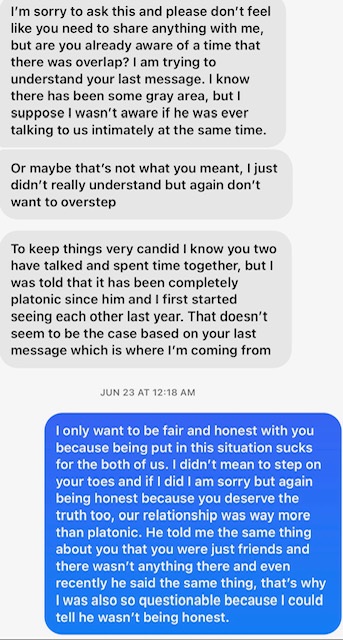
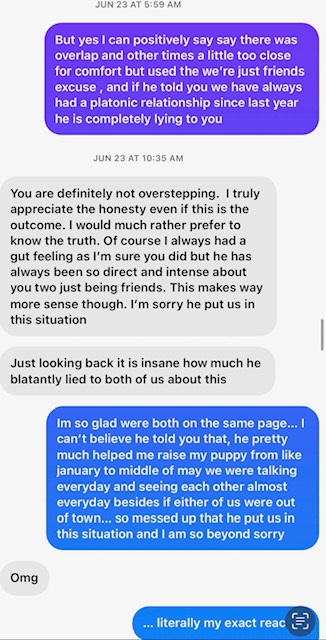
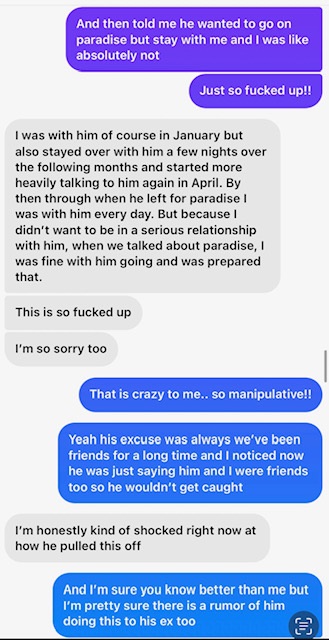
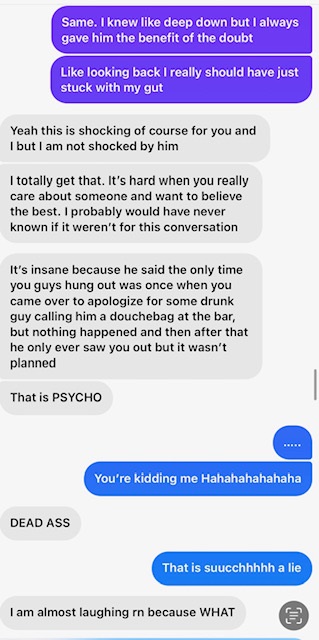
So Beth reached out to me after my story ran last week, and I had a FaceTime conversation with her yesterday. She started seeing Aaron in Sept of last year, right when last season of Paradise was airing. They dated from Sept thru around November, when they broke it off. In January of this year, they rekindled and started dating again, this time more serious. He even helped raise her dog with her (which she provided pics of). And Beth tells me they were basically together all the time from January through May, a couple weeks before he left for Paradise. Well, that is when she wasn’t out of town on a girls trip or traveling for fun. Because during those times, Aaron was still seeing Amy. The overlap is undeniable. And you’ll see that it’s undeniable, because once Aaron went off to film BIP in June, Beth had known Amy was in the picture, but was always assured by Aaron that Amy was just a friend and nothing was going on. Yet, he was telling Amy the same thing about Beth. Beth reached out to Amy in June because she felt she needed to know, and once they started sharing stories and timelines, they realized they were both being played by him. This is the conversation between Amy and Beth from June 23rd of this year that Beth screen shot and sent to me. Amy is in the gray on the left, and Beth is in the blue on the right.
I know people love to throw around the “Well, there’s three sides to every story: his side, her side, and the truth.” But I’m sorry, not here. This is two women having a conversation about Aaron while he’s off filming Paradise in June realizing that they were both played by him and he’d been caught. Now, as we know, while Amy seemed very upset and bothered by what Aaron did and she was gonna break it off with him once he got back from filming as she said in that exchange, clearly she didn’t. Who knows what Aaron said to sweet talk her to get her to go from how bothered she was in that convo to giving him another chance, but hell, we saw him do this with Genevieve. This is some serious controlling, toxic behavior in my opinion. Not much else to say other than he’s Amy’s problem now, and unfortunately she’s going to learn the hard way. She basically admits in that conversation she always had suspicions about him, as did her dad and friends, and she still chose to get back with him after knowing he kept a sexual relationship with Beth going behind her back? Not sure why and I’m sure she’s got her reasons but, ok. Good luck.
Just the extreme lying on Aaron’s part, I assume, just so he could have his cake and eat it too is really disturbing and a really shitty thing to do to these two women behind their back. Who has the time to keep that many lies going? There’s nothing wrong with being honest. And clearly Aaron had an issue with that and now he’s been exposed. And seeing the conversation between Amy and Beth, along with speaking with Beth yesterday and watching his behavior and how he treats Genevieve, my opinion is Aaron needs help. He doesn’t seem to realize how he comes across and how he treats women. But just based on his online persona and how he acts on TV, it doesn’t seem like he even cares to admit any wrongdoing in any argument he has. It’s unfortunate and you hope eventually he’ll see how disrespectful he comes across, but at this point, it seems like a lost cause. Guys like Aaron see apologizing or acknowledging bad behavior as some sign on weakness. He’s bro’ing out in San Diego with his boys and will just continue to go about things as if what he’s doing on TV isn’t highly toxic and should be addressed. Oh well. Only so much we can do.
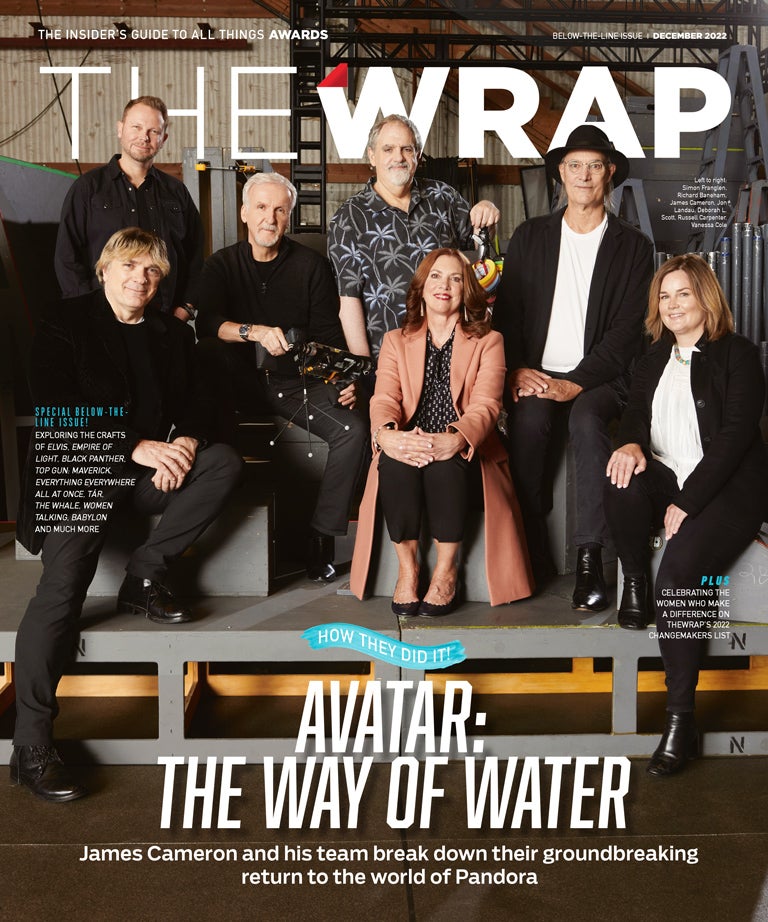
Never bet against James Cameron. Despite the freezing weather that has gripped much of North America — especially the Great Lakes — that led to a drop in box office projections, 20th Century’s “Avatar: The Way of Water” had a strong Sunday and Monday and finished the 4-day Christmas weekend with a $95.5 million domestic total and an overall total of $955 million worldwide, passing the run of “Doctor Strange in the Multiverse of Madness” in just 11 days.
That figure nearly matches the $96 million 4-day Christmas weekend total that “Rogue One: A Star Wars Story” earned in 2016, the last year when Christmas Day fell on a Sunday and hits the top end of the $85-95 million projections that had been set for “Avatar 2” before winter storms sent temperatures plummeting in much of the U.S. and Canada.
As the storms deepened towards the end of last week and daily grosses for “Avatar 2” between Thursday and Saturday slid below $20 million, 4-day industry estimates slid down to $82 million; still a good second weekend number for a holiday blockbuster but not what was expected for a film with a $400 million-plus budget that’s a sequel to one of the longest lasting films in modern box office history.
But on Christmas Day, moviegoers came back to Pandora with a stronger-than-expected $29.5 million second Sunday gross, just a 20% drop from its first Sunday in release. Monday was even better with a $32 million total, bringing its overall domestic cume to $293.2 million, just 5% behind the $308 million grossed this summer by “Top Gun: Maverick” through 11 days in theaters.
Are you a nonfiction filmmaker? An auteur of the unscripted? A vociferous vendor of vérité? Well, time dust off those release forms and double-check that the baseplates for your field rig are being stored with the tripods (not left on the cameras, dammit!) because it’s that time of year again: applications for the 2023 Film Independent Documentary Lab are now open! Which means if you have a nonfiction feature project in post production, here’s your opportunity to join an elite tradition of adventurous, innovative documentary storytellers.
Over the course of two weeks next May, Doc Lab Fellows will attend multiple workshops and sessions with guest speakers, established documentary directors, institutional funders, legal professionals, festival programmers and distributors. Fellows are paired with an experienced Creative Advisor who can provide one-on-one support and insight as they ready their projects for release. The Lab culminates in a final pitch event that offers further opportunity for individualized feedback and discussion with industry executives.
Does any of that sound like something you might be interested in? We thought so.
But you don’t have to take our word for it. In addition to the testimonials collected in the video above, we’ve collected a handful of firsthand experiences from past Doc Lab Fellows about their time in the program.
DOCUMENTARY LAB FELLOWS
‘Minding the Gap’
“This was a critical time for our film, just months away from picture lock, so having fresh eyes look at our film was welcomed. Over the course of the Lab, we shared our many frustrations and brainstormed solutions. Since the Doc Lab, Bing and I have been so grateful for the success of Minding the Gap. The response from audiences and the industry has blown us away. We premiered at Sundance in 2018, where we won the Jury Award for Breakthrough Filmmaking. We opened in theaters through Magnolia and premiered on Hulu. Bing was nominated for an Academy Award and won the Truer Than Fiction Award at the Film Independent Spirit Awards.” –Diane Quone, Minding the Gap
Where to Watch: Hulu
‘Through the Night’
“I was in the first ever (!) Documentary Lab in 2010, which was very early in my filmmaking career. I chose to apply because back then I had no idea how to finish, premiere, sell or distribute a film. The Lab introduced us to speakers who gave us a crash course in a lot of the essentials, but it also introduced me to a fantastic cohort and community of documentary filmmakers. To this day, I still regularly reference the fair use concepts and case studies that Michael Donaldson shared with us when he came in to the Lab, which I definitely put to good use while editing Through The Night.” –Malika Zouhali-Worral, Through the Night
Where to Watch: Kanopy
“The Lab afforded us exceptional, behind-the-scenes access to the American documentary industry. Thanks to personal conversations with a range of experts, we left with detailed knowledge of the challenges we face, as well as specific tools for best positioning ourselves as emerging documentary filmmakers. Film Independent has continued to be a steadfast partner as we’ve faced the creative and strategic challenges of bringing this film to life. They understand what makes our film special and have supported us in better articulating that identity. The Lab introduced a wide range of guests who spoke about the nuts and bolts of finishing a documentary film. IDA Executive Director Simon Kilmurry offered his take on how our film could fit into the documentary landscape—and even put us in touch with specific funding sources.” –Lucas Habte and Isidore Bethel, Shadow of His Wings
Where to Watch: Sundance TV
‘United Skates’
“We’re huge fans of Film Independent. We already had gone through Fast Track, and we hadn’t gotten a lot of support from granting organizations yet. Film Independent was one of the few organizations that believed in us very early on. When you have the support of an organization like Film Independent, it helps get the ball rolling. It was after Fast Track that the Film Independent team had encouraged us to apply to the Doc Lab. I think my favorite [mentor] was Jen Arnold, just really breaking down the hard facts of telling a story. She ended up working with us afterwards for another three days privately to help us with finding our story.” –Dyana Winkler, United Skates
Where to Watch: HBO Max
‘Duty Free’
“It was a pivotal moment for us when Film Independent accepted us into the Documentary Lab. That Film Independent believed in us as storytellers, even though we had come from outside of the film world, was a massive boost. Even better was being introduced to experts in all the areas we needed the most guidance in. Every day, we met with editors, producers, lawyers, distributors and financiers who offered advice and connections (and continue to do so even though we are no longer current Fellows.) But most importantly, Film Independent introduced us to our film family: the other filmmakers in our Lab.” –Meredith Chin, Duty Free
Where to Watch: Vudu, Apple TV
Film Independent Artist Development promotes unique independent voices by helping filmmakers create and advance new work. To become a Member of Film Independent, just click here. To support us with a donation, click here.
The union representing workers in Quebec’s pre-hospital emergency care sector is calling for more financial resources to avert what it describes as a “catastrophic” breakdown in services.
The president of the Fédération des employés du Préhospitalier du Québec (FPHQ) says emergency call centres are struggling with a staff shortage that has become unsustainable.
Daniel Chouinard says a lack of personnel is increasing response times, including for 911 calls, which means ambulances are taking more time to deploy.
He says some workers are working more than 70 hours a week, and some are quitting due to the poor working conditions.
Trending Now
Trending Now
The union, whose workers include paramedics and dispatchers, have been without a contract for the last nine months.
Story continues below advertisement
Chouinard says the call centre workers are paid only $21.37 per hour, which doesn’t reflect the difficulty of the job or their specialized knowledge of health services and emergency situations.
He’s urging the Quebec government to sign a new contract to restore some stability in the sector and avoid service disruptions.
Quebec expands 811 pediatric line to help ease burden on emergency rooms
In a typical World Cup year, fans and players have at least a few weeks to recover from the wild adrenaline rush of mainlining so many high stakes games all at once. This year, however, Qatar moving the tournament to the (slightly) cooler months of November and December means that the delirious hangover from Argentina and Lionel Messi’s victory over France will have only barely faded by the time England’s Premier League kicks back off — and I, with my deepest apologies to all the exhausted World Cup alums who have to throw themselves back onto the pitch, can’t wait.
Don’t worry: I’m not about to pretend I’m the first American who’s ever become a fan of Premier League men’s football (aka “soccer”). Even aside from from the World Cup, superstars like Cristiano Ronaldo and David “Bend It Like” Beckham captured stateside attention decades ago, Arsenal’s “Invincibles” remain the stuff of global legend, and FIFA’s wildly popular video game is the best-selling sports video game in the world, period. But as American television’s coverage of the sport keeps ballooning to previously unfathomable levels, there’s been an unmistakable spike in interest in watching and broadcasting these leagues, even while playing out on pitches thousands of miles away.
While the U.S. national men’s team and Major League Soccer have struggled to gain a regular foothold on domestic television, their English and European counterparts have managed to carve out powerful niches here in the States in the meantime. As new streaming platforms Peacock and Paramount+ bolster their platforms with exclusive league rights, U.S. billionaires buy legacy clubs outright, Americans have become more (literally) invested in international men’s football as both an irresistible narrative and an incredible business opportunity. (Congratulations to Michael B. Jordan, the newest minority owner of A.F.C. Bournemouth!) Meanwhile, shows like Apple TV+’s Emmy smash “Ted Lasso” is all about American football coaches taking on the Premier League, while FX’s “Welcome to Wrexham” documents how Ryan Reynolds and Rob McElhenney buy a small Welsh team. Documentarians have turned to soccer to tell stories like Netflix’s “FIFA Uncovered,” Amazon Prime Video’s “All or Nothing,” Disney+’s “Save Our Squad,” Apple TV+’s “Super League: The War For Football,” and so on (and on, and on…).
For fans both new and old, the wave is overwhelming. And from a TV criticism perspective, I’ve been floored by not just the sheer volume of football #content flooding my small screen, but the quality of the stories unfolding along with it.
“It’s genuinely remarkable how much coverage there is,” says Roger Bennett, co-host of NBC’s “Men in Blazers” show that breaks down all things football in podcasts, interviews, and even sold-out shows across the country during the World Cup. “You have the Premier League, Champions League, and La Liga. You have the NWSL and Women’s Super League, even the Colombian and Uruguayan leagues!”
It also seems relevant that in 2020, as the pandemic forced restless people like me to find entertainment within the confines of their own home, English and European football largely resumed regular play by June. And with every single Premier League and Champions League match now available for US viewers on Peacock and Paramount+, respectively, the beautiful game is more accessible for Americans than ever before.
“What Paramount+, ESPN+, Peacock have all realized is that what makes people commit to streamers is a deep, deep emotional commitment by niche audiences, and football is almost at the at the arrow tip of this streaming reality,” Bennett explains. The amount of football now available to watch across American networks is so overwhelming, in fact, that Bennett often marvels at how, in his earliest days in the U.S., he had to scour cities for a single bar that might be playing a game.
“This nation was always like space to Captain Kirk: Football’s final frontier. When I moved here [from Liverpool], the distaste was almost like, ‘you doth protest too much,’” he explains. “Many Americans didn’t just not like football — they had to actively hate it. And now you’re talking about a reality in which live football is everywhere. There’s nowhere better to watch football than in America.”
On an unusually warm October morning, just a few weeks before the World Cup was set to kick off, a growing cadre of football fans gathered in New York City’s Brooklyn Bridge Park under a prominent Paramount+ logo to watch their teams battle it out in the Champions League, Europe’s most prestigious football competition. As host Kate Abdo calmly took her seat on an elevated stage to run lines, her hair swept up in a glorious pile to the cloudless sky, former Liverpool defender Jamie Carragher joined her with the shit-eating grin that’s made him such a delightful chaos agent on Paramount+’s post-match panel show since it first began in the summer of 2020.
The two Brits looked out on the scene, amused and satisfied. “This is completely different from anything I do in England. Football is so serious there,” said Carragher, looking out at the fans co-mingling in Barcelona, Manchester City and Arsenal jerseys with seemingly no issue — a vanishingly rare sight outside the U.S., where football club tribalism still reigns supreme. Abdo nodded, fighting a smile as an admirer behind us frantically waved a wrapped bagel (lox, naturally) with her name on it. “I’ve done the Champions League at Fox, then TBS, and now CBS,” she said. “I’ve never seen a similar reaction to a show in the way this one’s had.”
Kate Abdo, Thierry Henry, Jamie Carragher, and Micah Richards on Paramount+’s Champions League panel
Carragher is a mainstay in the U.K. as a commentator on Sky Sports; Abdo lives in Los Angeles and has been broadcasting in the U.S. for years. But neither saw the American success of their Paramount+ show — a loose “Inside the NBA” style panel aimed at American fans of the Champions League, featuring exactly zero Americans — coming. And yet Abdo, Carragher, and their fellow analysts/former players Micah Richards and Thierry Henry have locked into a unique dynamic that neither condescends to old American football fans nor shuts curious new ones out. The resulting show, packed with games and raucous laughter, is an indispensable bolster for Paramount+’s Champions League coverage, which inspires the streamer’s third-highest number of signups behind the NFL and “Yellowstone.”
“We’re in America, right? Americans like to be entertained,” says Pete Radovich, VP of production and senior creative director at CBS Sports. “So, yes, you could be a serious sports show with highlights and analysis. But we started in the context of COVID, when everything was just so serious. No one lives or dies based on what we do — like, this is sports. At its core is entertainment…and at the same time, you want it to be treated with the respect that it deserves.”
Abdo, who plays the very tricky role of moderator on a show that prides itself on spontaneity, agrees. “Trying to kind of merge those two worlds where you make soccer accessible and fun, but still have a sense of depth, is really the kind of balance we’ve been able to strike.”
In that respect, she refutes the idea that American coverage of international football should assume its audience doesn’t know the basics. “Soccer fans in America are very picky,” she insists. “They’re super well educated about the sport and they feel really proprietorial, so they don’t want to be spoken down to.” Finding the middle ground between long-term fans and new ones is a constant challenge, but one Abdo and Rebecca Lowe, her counterpart on NBC’s “Premier League Mornings” show, have embraced.
“When I first started [in 2013], I knew that I didn’t need to explain too much, because the people watching would be those who already knew the game really, really well,” explains Lowe, who admits she took a risk by leaving a thriving career as a sideline reporter in her native England to host NBC’s coverage. “Then as the first few years went by, and the momentum took off, we were getting more and more new viewers. So I needed to talk in a way that could bridge both of those segments of the audience.”
Asked when he first became aware of the Premier League’s potential reach in the U.S., NBC Sports executive Jon Miller laughs. In the late 2000’s, he says, he used to leave for golf at 6 a.m. on weekend mornings only to run into his son, a teenager who would hunt down a streaming link to watch the Premier League before spending the rest of the day playing FIFA. In 2012, years after Miller’s son had moved out, NBC paid $250 million for the rights to the Premier League in a bid to capture the attention of engaged fans just like him.
“For Saturday mornings at 7:30 or 10, we felt that the competition was a little bit less, and that we could really create strong viewing patterns that would help us establish a strong following,” Miller explains. Ten years later, NBC re-upped the rights for another six years, beating out rival networks CBS and ESPN with a deal now worth $2.7 billion.
The gamble paid off. “The growth has exceeded my dream without a doubt,” Lowe says. “When I first came over, I would see maybe one or two Premier League shirts out and about over the course of a year. Last weekend, I got dropped off at JFK and four different people came up wanting to talk to me about Premier League before I got to my gate.”
Tim Howard, Robbie Mustoe, Rebecca Lowe, and Robbie Earle at NBC’s 2022 FanFest
Tim Howard, a former U.S. and Everton goalkeeper and Lowe’s current on-air colleague, has been floored by the evolution of football fandom in his home country. “I grew up in the game, I’ve been doing this for more than 30 years…and the following has become just even more fanatical,” he says. “We have these live interactive Fan Fests where we cover games and thousands of people are lining up at three o’clock in the morning to get through the gates. It’s incredible. Soccer has really come to the forefront of the sporting landscape in America.”
The fervor has even translated to the scripted side of TV, where “Ted Lasso” has now made its mark in Emmy history two years in a row. Says co-creator Brendan Hunt (who also plays taciturn Coach Beard and often acts as the show’s in-house football encyclopedia), “We do get people telling us a lot on social media, ‘I can’t fucking believe this, but I’m now liking soccer because of fucking ‘Ted Lasso.’ I now know what ‘relegation’ is. Go Leeds!’”
Leeds, for what it’s worth, now boasts several promising American players (including US captain Tyler Adams) on its roster, and its American manager Jesse Marsch keeps getting dubbed the “real life Ted Lasso” — a lazy comparison, given that Marsch is both very experienced and one of the saltiest managers in the league. But the point stands: wherever there’s a good story, there will always be an audience waiting to devour it.
“It really is a telenovela being played out live by a ‘Star Wars’ cantina worth of characters with the world watching under conditions of hysterical pressure — and that is utterly thrilling,” says “Men in Blazers” host Bennett. “I mean, football has so many bloody levels of humanity and psychology, sociology, politics. There’s an old saying that when two nations take the field, their nation’s history takes the field alongside them, and these games all just have history seeping through them.”
Bennett and “Ted Lasso” star Hunt are such enormous fans of U.S. soccer, in fact, that they co-hosted a podcast about it leading up to the World Cup. The duo agree that the ideal scenario would be to translate American enthusiasm for the Premier League into enthusiasm for growing the sport here, too. “That is my master plan,” says Hunt, dry but perfectly serious. “So if I’m contributing to that in any shape, or form, then I will truly feel like I’ve done something worthwhile.”
Brendan Hunt, Jason Sudeikis and Nick Mohammed star in “Ted Lasso”
Courtesy of Apple TV+
Until that tipping point when U.S. soccer gets proper systemic and popular support, there’s just something about English and European football that hits different. Even an ocean away, it’s easy to feel that history coming through the television screen and want to be a part of it. In adopting Tottenham Hotspur as my team, I knew that I was also adopting both a serious rivalry against Arsenal and general fatalism towards Spurs’ tendency to stumble at the most crucial moments. (I am, apparently, a glutton for pain.) As a TV critic, I also know I always want my stories to have stakes — and English and European leagues have plenty, in a way American ones simply don’t.
As alluded to by Hunt (and illustrated in the devastating first season finale of “Ted Lasso”), relegation is what happens at the end of a season to the bottom three teams, thus bumping them out of one league tier into the one below — a terrible blow on just about every emotional and financial level there is.
“When I look at certain leagues in American sports,” says former player Howard, “there are teams that get halfway through the year to the All-Star break and they’re out. It just becomes about how to plan for next season. But in the Premier League, every single game counts.”
Is this stressful? Yes, beyond words. As a dramatic conceit, though, you could hardly ask for better. “Relegation is so powerful, and so compelling,” says Hunt. “From an audience standpoint, it diminishes the amount of meaningless filler. It’s such a wonderful quirk of football and it really makes me wish we had it in America.”
Granted: for relegation to happen in American soccer, the MLS would have to invest in the kind of systemic support that international football has enjoyed for decades. But Hunt’s right in that relegation would quickly inject stakes where there currently are very few. “You know, the whole concept of the Chicago Cubs before 2016 is something that Europeans just can’t comprehend,” he continues. “This notion that you’re able to lose and lose and lose and lose and you just keep on losing and then you get known for losing. In Europe, they would’ve ceased to matter.” On the other hand, he adds, “how great would it be if the Yankees played the Mud Hens someday?”
The reality of relegation must strike fear in the hearts of American Premier League owners like Liverpool’s John Henry (also of the Red Sox) and Chelsea’s Todd Boehly (also of the Dodgers and — yes — the Golden Globes). If their teams can get bumped out of the most prestigious competitions of the Premier and Champions leagues, they could also lose many millions of dollars in revenue. But that threat of irrelevance is exactly what makes the league so riveting, week in and week out. As Hunt puts it: “You sure can get lazy with money, and relegation makes you earn it.”
On the other side of the spectrum is the Champions League, which pits all the top English and European teams against each other in a yearlong battle royale. This all-star quality made it an irresistible property for CBS Sports says VP Radovich, who grew up in a Croatian immigrant family obsessed with all things football. “We do the NFL, every three years we do the Super Bowl. When we do golf, we have the Masters. For college basketball, we have the NCAA Tournament. And as far as annual competitions, World Cup aside, which is every four years, there’s nothing that comes close to the Champions League in this sport, with the best players in the world,” he says. “It’s as big as it gets.” Now able to broadcast this competition in a way that was never possible when he was a kid in Queens, Radovich isn’t half as surprised as his on-air talent by the way it’s already succeeding.
Because for as exhilarating as international football can be, there’s also something to the basic fact that it is, after years of frustrating blackouts for stateside fans, very easy to watch. Peacock’s blanket coverage of the Premier League even outdoes that of the U.K. itself, thanks to a combination of several networks sharing rights and the league’s notorious “blackout rule” (which currently bans games played at 3 pm on Saturdays to be broadcast in the U.K., ostensibly to keep the in-person experience valuable). In short, as Hunt points out, “we have access to more games in America than they do legally [in England]! So we can kick back with our 10 am beers in Brooklyn and laugh at them from afar.”
He jests, but only barely. When Manchester United took on rivals Liverpool earlier this fall, I found myself wedged in between rabid fans at Brooklyn’s Monroe Pub, the borough’s official Liverpool bar that opens for every single game (yes, even the ones that start at 7:30 am EST, though those at least reward the diehards with some breakfast tacos). Surrounded by Liverpool scarves, Mo Salah jerseys, and semi-terrifying Jürgen Klopp cutouts, the only way you’d know the bar wasn’t in England was thanks to the occasional, very American outbursts of, “are you KIDDING, ref?!” when a call didn’t go the team’s way.
As might be expected of a crowd that turned out in force at 2 p.m. on a Monday, these fans were as knowledgeable as they were passionate about a team they may never see in person, but love to the death anyway. They, like me, had fallen head over heels for players, clubs and traditions that lay so far outside what they had come to expect from American sports, which wipe the slate clean every year as best they can. Good stories are good stories no matter where they come from, and these overseas leagues — monied, determined, wild and unpredictable — are home to some of the best.
Epic Games will issue the largest customer refund in history in connection with unwanted charges in Fortnite — $245 million — and pay a record penalty of $275 million for alleged violations of the Children’s Online Privacy Protection Act.
“Epic put children and teens at risk through its lax privacy practices, and cost consumers millions in illegal charges through its use of dark patterns,” said FTC consumer protection bureau director Samuel Levine in a Monday announcement. “Under the proposed orders announced today, the company will be required to change its default settings, return millions to consumers, and pay a record-breaking penalty for its privacy abuses.”
In its complaint, the FTC alleges that Epic put children and teens in harmful situations by allowing them to interact with adult strangers online without requiring parental consent, which is required under COPPA. And the FTC says Epic employees began flagging problematic default settings as early as 2017.
“Epic’s matchmaking children and teens with strangers while broadcasting players’ account names and imposing live on-by-default voice and text communications has caused substantial injury,” states the complaint. “Children and teens have been bullied, threatened, and harassed within Fortnite, including sexually. Children and teens have also been exposed to dangerous and psychologically traumatizing issues, such as suicide and self-harm, through Fortnite. And the few relevant privacy and parental controls Epic has introduced over time have not meaningfully alleviated these harms or empowered players to avoid them.”
FTC commissioner Christine Wilson issued a concurring statement emphasizing the dangers of ignoring children’s privacy issues when it comes to online gaming. She shared three examples of real underage users involving child pornography and sexual abuse and said she hopes it is “a wake-up call to skeptics who believe that invasions of privacy lead merely to targeted advertising.”
“No developer creates a game with the intention of ending up here,” it reads. “The video game industry is a place of fast-moving innovation, where player expectations are high and new ideas are paramount. Statutes written decades ago don’t specify how gaming ecosystems should operate. The laws have not changed, but their application has evolved and long-standing industry practices are no longer enough. We accepted this agreement because we want Epic to be at the forefront of consumer protection and provide the best experience for our players.”
The company also says that the gaming industry needs to make it standard practice to assume that kids are playing games above their age rating: “Fortnite is rated Teen and is directed at an older teen and college-aged audience. We recently rolled out Cabined Accounts, a new type of Epic account that provides a tailored experience that is safe and inclusive for younger players. Players under 13, or their country’s age of digital consent, whichever is higher, will be able to play Fortnite while they wait for parental consent, but in a tailored environment where certain features, such as chat and purchasing, are disabled.”
In addition to the monetary penalty, Epic will be barred from enabling voice and text communications for children and teens unless parents give affirmative consent, and the company will have to delete any personal information it has previously connected through Fortnite in violation of COPPA rules unless it gets parental consent to retain it.
“Epic used privacy-invasive default settings and deceptive interfaces that tricked Fortnite users, including teenagers and children,” said FTC Chair Lina M. Khan in a Monday statement. “Protecting the public, and especially children, from online privacy invasions and dark patterns is a top priority for the Commission.”
With regard to the game maker’s charging and billing practices, the FTC claims Epic “deployed design tricks, known as dark patterns, to dupe millions of players into making unintentional purchases” and “let children rack up unauthorized charges without any parental involvement.”
Epic notes that “games should go above and beyond to make sure players even more clearly understand when they are making a purchase with real money or with virtual currencies to prevent accidental purchases.”
The $245 million Epic pays in that part of the settlement will go toward user refunds. The FTC has created a page with details about eligibility and the refund process for users whose children made unauthorized purchases between January 2017 and November 2018 and others who were charged in-game currency or had accounts locked after disputing unauthorized charges with their credit companies.
When the clock strikes midnight on New Year’s Eve, there’s only one thing we’re thinking about: All the amazing TV that lies ahead for 2023.
Nowadays, TV is practically the only thing we can rely on; that new and returning shows will delight and unite audiences in otherwise confusing times. Whether your life is consumed by some newbie called “Severance” or invigorated by the impending return of U.S. Marshal Raylan Givens, TV will be unflinchingly at your side, as it has in years passed and will be in years to come. IndieWire’s TV team picked the series we’re most excited about — mostly new, but with a few oldies we couldn’t resist including — and already the year seems a bit brighter.
Here are IndieWire’s 11 most anticipated TV shows of 2023.
Erin Strecker, Ben Travers, and Steve Greene contributed to this article.
1. “Masters of the Air” (Apple TV+)
Following landmark television entries “Band of Brothers” and “The Pacific,” Steven Spielberg, Tom Hanks, and Gary Goetzman are reuniting for their third World War II limited series, this time at Apple TV+. “Masters of the Air” is adapted from Donald L. Miller’s 2006 book (subtitled “America’s Bomber Boys”), which chronicles the men of the Eighth Air Force and their aerial assaults above Berlin, Hanover, and Dresden during the world’s first and only bomber war. Further plot details are scant, along with a release date, but filming is completed (after beginning nearly two years ago, in February 2021), and Apple is heavily invested in the project — to the tune of $20-27 million for each of the 10 episodes. (“Masters of the Air” is also the first series greenlit with Apple serving as the studio.) The cast is led by “Elvis” breakout Austin Butler, alongside Callum Turner, Raff Law, Barry Keoghan, Bel Powley, and Anthony Boyle, with Anna Boden and Ryan Fleck (“Half-Nelson”), Cary Fukunaga (“No Time To Die”), and Dee Rees (“Mudbound”) directing. John Orloff, who wrote for the original “Band of Brothers” series, and Graham Yost (“Justified”) are the series’ writing EPs. “Band of Brothers” and “The Pacific” won 14 Emmy Awards, collectively, and the former is routinely listed among the best TV series ever made. —B.T.
Any time spent away from the scheming Roy family is too long. After Tom’s (Matthew McFayden) shocking moves in the Season 3 finale, it’s every Roy for himself or Shivself in the face of Logan’s wrath (Brian Cox). Even if Waystar Royco finds itself once again on stormy seas, Season 4 all but guarantees a heaping share of Kendall cringe (Jeremy Strong), Shiv grit (Sarah Snook), and freshly packaged horror we can’t help but root for courtesy of Roman (Kieran Culkin) and Gerry (J Smith-Cameron). Family really will always be there for us. —P.K.
3. “Justified: City Primeval” (FX)
Reviving one of the most acclaimed series of all time is no easy feat, but “Justified” fans have been clamoring for more since the FX drama ended in 2015, and “City Primeval” is their just (“Just”?) reward. Timothy Olyphant returns as Raylan Givens, the U.S. Marshall who’s left behind a life in Kentucky to raise his kid (played by the star’s real-life daughter, Vivian Olyphant) in Miami. But duty calls him back north — further north, to Detroit, Michigan, where a sociopathic criminal (Boyd Holbrook) needs to meet the long arm of the law. The cast also include Aunjanue Ellis, Adelaide Clemens, and Marin Ireland, who will be working from scripts by co-showrunners Dave Andron and Michael Dinner. (“Justified” showrunner Graham Yost is onboard as an executive producer.) “City Primeval” is adapted from Elmore Leonard’s novel of the same name (plus the subtitle: “High Noon in Detroit”), but the story has been altered to include Raylan as a chief protagonist. (The book followed another character.) No word has been given on if “Justified” favorites Walton Goggins or Jere Burns will return, as well, but given the outright success of Olyphant’s other recent revival — the long-rumored and beautifully realized “Deadwood” movie — hopes are high across-the-board for his next round of gunslinging. —B.T.
4. “Daisy Jones and the Six” (Prime Video), March 3
“Daisy Jones & the Six”
Lacey Terrell/Prime Video
Based on the beloved bestseller by Taylor Jenkins Reid, this drama tells the tale of a 1970s rock group (think: Fleetwood Mac) and the high profile relationship breakdowns and personal drama of a star on the rise. Starring Riley Keough and Sam Clafin this highly anticipated adaptation is sure to be a delicious treat for those who enjoy a titillating peek behind the velvet rope, as well as those who love some good heartbreak – or, at least, the powerful music that comes from it. — E.S.
5. “Wool” (Apple TV+)
Hugh Howey’s sci-fi series of novels and connected works will arrive on Apple TV+ after a decade-long journey to the screen. This season tracks a community of people literally forced underground when the Earth becomes inhabitable. Rebecca Ferguson, David Oyelowo, and Tim Robbins star as an engineer, sheriff, and tech specialist in a massive silo, where a new way of life leads to a new dystopian order. Harriet Walter, Common, Rashida Jones, and Iain Glen also play some of the silo’s other notable residents. Former “Justified” boss Graham Yost serves as creator and a writer on this series with “The Imitation Game” director Morten Tyldum serving in the same role here. —S.G.
Will the sophomore season of Ashley Lyle and Bart Nickerson’s plane crash survival smash hit live up to its debut? “Yellowjackets” Season 2 is as good at keeping secrets as its protagonists, but the breadcrumb trail is deeply alluring. Some of Season 1’s major questions could be answered — How did the girls get rescued? What does the symbol in the woods mean? — while casting announcements including more adult Yellowjackets (Van lives!) raise even more spine-tingling theories. —P.K.
7. “Secret Invasion” (Disney+)
Let’s be honest: Every Marvel project since “Avengers Endgame” has been some kind of crossover, and “Secret Invasion” is no different. Based on the 2008 comic by Brian Michael Bendis, the series centers mostly on Nick Fury (Samuel L. Jackson), who has been M.I.A. on Earth for years and grown increasingly enmeshed in the world of the Skrulls from “Captain Marvel.” The shape-shifting aliens have been secretly invading our planet (get it?) since the ’80s, but that secret is about to crack wide open. The trailer packages “Secret Invasion” like a “Captain America: The Winter Soldier”-esque spy thriller, with Ben Mendelsohn reprising his role as Talos and intriguing Marvel debuts from Kingsley Ben-Adir, Olivia Colman, Emilia Clarke, and more. —P.K.
8. “Mrs. Davis” (Peacock), April 20
“Mrs. Davis”
Colleen Hayes/Peacock
Picking the best reason to get excited for “Mrs. Davis” is impossible, so I’m just going to list all of them and let each of you, dear readers, decide for yourselves. The basic plot is option No. 1: “a nun goes to battle against an all-powerful Artificial Intelligence” called, you guessed it, Mrs. Davis. Option No. 2: Said nun (named Sister Simone) is played by none other than three-time Emmy nominee Betty Gilpin, in her first series lead role since “GLOW” ended. Option No. 3 is tied to Ms. Gilpin, in that “Mrs. Davis” marks her second collaboration with Damon Lindelof (the other being “The Hunt”), who serves as co-writer and executive producer here, alongside Tara Hernandez (“The Big Bang Theory”) as showrunner, executive producer, and co-writer. Option No. 4 is a bit more obscure, but anyone who read the special message “from Mrs. Davis” that was published with the release date announcement (April 20) may have delighted in the cheeky references to humanity’s demise, which sets a clever, biting comedic tone for the show, while also leading us to Option No. 5: another reference, intended or otherwise, to Eddie Murphy’s stand-up set about Mr. T. Hey, an A.I. algorithm has to pull its material from somewhere — why not “Raw”? —B.T.
9. “The Big Cigar” (Apple TV+)
After years of being one of the most dependable actors on the planet, from his impeccable work on “The Knick” to being the anchor on the undersung “The Eddy” to his impressive body of film work, Andre Holland finally gets a chance to be the main driver of a marquee TV series. Here, he’ll star as Huey P. Newton in a dramatization of the Black Panther Party founder’s mid-1970s attempt to avoid extradition by heading to Cuba. Alessandro Nivola co-stars as the Hollywood producer who, over the course of the six-episode series, works to find a way to get Newton out of the U.S. With Janine Sherman Barrois serving as showrunner and Don Cheadle directing the first third of the season, the series also features Glynn Turman, Tiffany Boone, Moses Ingram, and Noah Emmerich. — S.G.
10. “Queen Charlotte: A Bridgerton Story” (Netflix), May 4
“Queen Charlotte: A Bridgerton Story”
LIAM DANIEL/NETFLIX
No “Bridgerton” character deserves a spinoff more than Queen Charlotte (Golda Rosheuvel), the striking monarch who presides over Shonda Rhimes’ Regency reimagining. The eight-episode series will feature multiple “Bridgerton” actors, including Rosheuvel herself, Adjoa Andoh, Ruth Gemmell — as well as young versions of the characters as they appear in Charlotte’s past. If the series does well, it could lead to more “Bridgerton” spinoffs — in case the next six Bridgerton siblings worth of love stories don’t do it. —P.K.
11. Bonus: “Ahsoka” (Disney+)
It’s extremely likely that the Star Wars series about Anakin Skywalker’s former padawan will premiere in 2023, but it gets an honorary mention in case that doesn’t end up happening. Rosario Dawson reprises the eponymous role, which she debuted in live-action for “The Mandalorian” Season 2 back in 2020. Ahsoka made her debut as a precocious teen in “Clone Wars,” but “Ahsoka” catches up with her as an adult. Before “The Mandalorian,” she was seen in “Star Wars: Rebels,” flying off with Sabine Wren (played by Natasha Liu Bordizzo in “Ahsoka”) in search of their lost friend Ezra (Eman Esfandi). Hayden Christensen will reprise his role as Darth Vader, which means that master and padawan have not parted ways for the last time… —P.K.
Nickelodeon viewers will soon observe a tale of both comedy and caution, of satire and stupidity, where minds may switch, bodies may shrink, and robots may rise in SpongeBob SquarePants Presents The Tidal Zone, premieres Friday, January 13th at 7:00 p.m. (ET/PT). The first-ever SpongeBob Universe crossover special will encore on Saturday, January 14th and Sunday, January 15th at 7:00 p.m. (ET/PT) on Nickelodeon. The special will premiere across Nickelodeon’s international channels next year.
SpongeBob SquarePants Presents The Tidal Zone is a journey into an hour of television where two dimensions can become three, and French divers can wear black ties. Narrated by the French Narrator, the one-hour special encompasses all three animated series within the SpongeBob Universe, SpongeBob SquarePants, The Patrick Star Show, and the Paramount+ original series Kamp Koral: SpongeBob’s Under Years, the plot is said to be kept under wraps but it will follow GrandPat (The Patrick Star Show) as he makes his way through each dimension.
The special features legendary voice talent Tom Kenny (SpongeBob SquarePants), Bill Fagerbakke (Patrick Star), Jill Talley (Karen, Squidina), Cree Summer (Bunny Star), Tom Wilson (Cecil Star), Dana Snyder (GrandPat), Clancy Brown (Mr. Krabs), Mr. Lawrence (Plankton), Carolyn Lawrence (Sandy Cheeks) and Rodger Bumpass (Squidward).
Courtesy of Nickelodeon
Since its launch July 17, 1999, SpongeBob SquarePants has reigned as the most-watched animated series for nearly 20 consecutive years, while generating a universe of beloved characters, pop culture catchphrases and memes, theatrical releases, consumer products, a Tony award-winning Broadway musical and a global fan base. SpongeBob SquarePants is one of the most widely distributed properties in Paramount International history, seen in more than 170 countries, translated in 29+ languages, and averaging more than 100 million total viewers every quarter. SpongeBob SquarePants was created by Stephen Hillenburg and produced by Nickelodeon in Burbank, Calif. The character-driven cartoon chronicles the nautical and sometimes nonsensical adventures of SpongeBob, an incurable optimist and earnest sea sponge, and his undersea friends.Nickelodeon, now in its 43rd year, is the number-one entertainment brand for kids. It has built a diverse, global business by putting kids first in everything it does. The brand includes television programming and production in the United States and around the world, plus consumer products, digital, location-based experiences, publishing and feature films.
If 2022 will be remembered as the year that Game of Thrones won the battle to be crowned the next, uh, Game of Thrones, 2023 might go down as the year that Peak TV finally peaked. Yes, there are still literally hundreds of new scripted TV shows making their way to streaming platforms and many of them still cost an arm and a leg but as shows like Ted Lasso have proven, the ones with the biggest price tags don’t always guarantee success.
In keeping with THR’s tradition, we surveyed the scripted landscape for all the major players in town and have whittled down our annual list to a mere 10 shows that we’re going out on a limb to say will be the ones that cut through the clutter to become the talk of the town. We’ve got the obvious (a Shonda Rhimes-penned Bridgertonprequel) and the not so obvious (prepare to feel your feelings with Jason Katims again) as well as everything in between. One thing that’s new this year: Rather than doing 23 shows in 2023, our field of 10 also takes a larger look at what else is coming across a variety of platforms as cutting this tally made for some really tough calls. (With apologies to Disney+, we know there’s much more to come from Marvel and Star Wars so neither are included here.)
So without further ado, here’s our 10 picks for the can’t-miss new scripted series expected* to come in 2023. (Presented in alphabetical order, premiere dates included where available.)
*COVID-19 is still a factor, as are evolving slates as many platforms are undergoing slate reviews under new executive regimes so there are no guarantees.
Fresh off its $1 billion play in Lord of the Rings: The Rings of Power, Amazon has another bank breaker with Citadel, a so-called global event series from Avengers directors Joe and Anthony Russo that has been in the works since 2018. The series boasts a cast led by Game of Thrones grad Richard Madden and global star Priyanka Chopra Jonas and plans are already under way for local language spinoffs with an Indian installment of the mega-budget action spy series already casting. The U.S. installment has, like a number of other Amazon originals, changed showrunners and a round of expensive reshoots. The drama is already on track to become Amazon’s second most expensive show ever produced and the Jennifer Salke-led streamer hasn’t even gotten to marketing yet. While LOTR was greenlit under Amazon’s previous exec regime, Citadel is going to be a make-or-break moment for Salke, whose other big swings in the coming year include dramas starring Christoph Waltz (The Consultant, due this winter) and Rachel Weisz (Dead Ringers).
Why yes, we are indeed still upset that Amazon canceled Jason Katims’ extremely personal autism series As We See It, which marked a return to form for the Parenthood and Friday Night Lights showrunner. Next up for the king of the tearjerker (with apologies to Dan Fogelman) is Dear Edward, a weepy drama based on the best-seller by Ann Napolitano. Wonka’s Colin O’Brien stars as Edward Adler, a 12-year-old who survives a commercial plane crash that kills every other passenger on the flight — including his family. As Edward and a diverse ensemble of others affected by the tragedy try to make sense of life after the crash, unexpected friendships, romances and communities are formed. Like Katims’ FNL and Parenthood, Dear Edward is described as a “heartbreaking, life-affirming and uplifting story about survival, resilience, connection and the examination of what makes us human.” Further helping this show crack our top 10 is its killer cast, which features a reunion between Katims and his former FNL leading lady Connie Britton, as well as Taylor Schilling (Orange Is the New Black). Other highlights from Apple’s 2023 drama slate include Band of Brothers and The Pacific sequel Masters of the Air, Black Panther drama The Big Cigar featuring Andre Holland and LaKeith Stanfield in horror story The Changeling.
We strive to showcase programs from all the major conglomerates and streamers here and we’ll be honest: the Paramount+ bench is perhaps the weakest of all the major platforms when it comes to new arrivals in the coming year. Sure, there’s more of Taylor Sheridan’s Yellowstone “Dutton-verse” in store but outside of that? The closest thing we’ve got here is Fatal Attraction, which won us over based on its exploration of mental illness and the strength of its casting. Lizzy Caplan steps into Glenn Close’s shoes in this reboot of the 1987 feature with Joshua Jackson taking on the role previously played by Michael Douglas. As for the rest of the slate? HBO Max reject Grease: Rise of the Pink Ladies, an update on the MTV update of Teen Wolf and Kiefer Sutherland in Designated Survivor Rabbit Hole.
Consider us intrigued: Grammy winner The Weeknd stars in this L.A.-based music industry series that he co-created alongside Euphoria creator Sam Levinson. Lily-Rose Depp (yes, that Depp). The series has already undergone creative changes, including to its creative direction as it now centers on a self-help guru and leader of a modern-day cult who develops a complicated relationship with an up-and-coming pop singer. Other HBO originals earmarked for 2023 include The White House Plumbers and a Jodie Foster-led installment of True Detective.
5. The Last ofUs (HBO/HBO Max, Jan. 15)
We’re going out on a limb here and saying this will be one of the most talked-about new series of the year as the premium cable network courts diehard fans of the PlayStation game and new viewers alike. Pedro Pascal (The Mandalorian) stars in the series that is set 20 years after the destruction of modern civilization as Joel, a hardened survivor of the apocalypse who is hired to smuggle a 14-year-old girl (Bella Ramsey, Game of Thrones) out of an oppressive quarantine zone. The seemingly small job becomes a brutal journey as they come to depend on one another for survival. Craig Mazin (Chernobyl) serves as showrunner on the series, which counts the game’s writer and creative director, Neil Druckmann, among its exec producers. Elsewhere on HBO Max, expect Mindy Kaling’s animated Velma, Greg Berlanti’s The Girls on the Bus and limited series Love & Death.
Rian Johnson (Knives Out) and Natasha Lyonne (Russian Doll). Do we need to say more? OK, fine. The Star Wars: The Last Jedi director makes his TV debut with this character-driven, case of the week mystery series that sees the always fantastic Lyonne hit the road and cross paths with a new cast of characters (Adrien Brody, Chloë Sevigny, Dascha Polanco, Ron Pearlman, Lil Rel Howery, Joseph Gordon-Levitt and Tim Meadows to name a few) as she sets out to solve one bizarre crime after another. Will this be Peacock’s big must-see show? One other caught our eye: Mrs. Davis, the AI drama starring Betty Gilpin from creators Tara Hernandez (The Big Bang Theory) and hitmaker Damon Lindelof (Lost, Watchmen).
Shonda Rhimes knows a hit when she sees one. After a parade of missteps on broadcast after Scandal, the Grey’s Anatomy mastermind launched strong at Netflix with Bridgerton. Although Rhimes doesn’t serve as showrunner on the flagship series and didn’t write any of its episodes (so far), she’s the creative force behind prequel series Queen Charlotte. India Amarteifio plays the younger version of the character, with Bridgerton’s Golda Rosheuvel reprising her role in the spinoff. Rhimes serves as showrunner and is writing the series, marking her second original for Netflix following fellow hit Inventing Anna. While Bridgerton may have cooled, it’s fair to expect Rhimes to bring the heat back to the franchise with this love story.
Speaking of folks we wouldn’t bet against, FX CEO John Landgraf has been working to get his take on Shogun right for a decade when he originally set this project up at former corporate sibling Fox. After changing writers a couple times and officially migrating to FX in 2018, this limited series based on James Clavell’s 1975 novel promises to be the cable network’s largest international scale production to date. Unlike the former NBC take, Landgraf’s FX series will be told from the Japanese POV and has been updated to feature a more culturally sensitive and accurate portrayal. Shogun also boasts the biggest budget Landgraf has ever dedicated to anything in the network’s history and was cast out of Japan. Hiroyuki Sanada (Army of the Dead, Lost), Anna Sawai (F9, Pachinko) and Cosmo Jarvis (Raised by Wolves). Also on FX’s radar: The Full Monty update, a return to Justified and Retreat, The Sterling Affairs and Retreat, the new series from The OA duo Brit Marling and Zal Batmanglij.
Ted Lasso co-creator Bill Lawrence, Emmy winner Brett Goldstein, Jason Segel and … Harrison Ford. Where do we sign? This 10-episode comedy starring and written by Segel revolves around a grieving therapist (the How I Met Your Mother grad) who starts to break the rules and tell his clients exactly what he thinks. Ignoring his training and ethics, he finds himself making huge, tumultuous changes to people’s lives … including his own. Ford, who already has a Yellowstone prequel under his belt and dons his Indiana Jones fedora once again in 2023, plays a blue-collar shrink in the series that counts Ted Lasso’s Lawrence and Goldstein among its creative team. Apple’s comedy roster also features Strange Planet, a new animated series from Dan Harmon (Rick and Morty) that’s based on the graphic novel of the same name, the aspirational Chris O’Dowd series The Big Door Prize and retro-future dramedy Hello Tomorrow starring Billy Crudup (The Morning Show).
Game of Thrones co-creators David Benioff and Dan Weiss adapt Liu Cixin’s Hugo Award-winning trilogy in their first series under their nine-figure overall deal with the streaming giant. In the works since late 2020, Benioff and Weiss team with Alexander Woo (The Terror) on the sci-fi epic that tells the story of humanity’s first contact with an alien civilization. Exec producers include Rian Johnson and Brad Pitt, with a cast lined with familiar faces: Eiza González (Baby Driver), Game of Thrones grads John Bradley, Liam Cunningham and Jonathan Pryce, among others. Elsewhere at Netflix, keep your eyes peeled for All the Light We Cannot See, from Stranger Things exec producer Shawn Levy.
Directors: Dylan Mohan Gray, Johanna Hamilton, Nick Reed
There is no simple explanation why India and Indians stood as mute witnesses and callously ignored the excesses of Vijay Mallya, Nirav Modi and Subrata Roy! They could not have been hidden, given the way these men looted the nation, especially the very poor of their meagre incomes, earned through backbreaking sweat and toil.
Netflix’s docu-series, Bad Boy Billionaires, is now streaming with three segments, the fourth on Ramalinga Raju, former Satyam Computers head, having been withheld, at least for the time being. While Mallya and Modi are now in London fighting the legal process to extradite them, Roy is out on parole after being in jail for a couple of years.
Who would not remember Mallya and his unbelievably extravagant lifestyle awash with the grandest of parties? Dylan Mohan Gray explores this in The King of Good Times. The man is still having a whale of a time in London walking free and attending art exhibitions as well as parties. Gray uses archival footage and interviews with Mallya’s son, Sid, executive assistant Tushita Patel and family friend Kiran Mazumdar Shaw (Chairperson of Biocon, a Bengaluru-based biotechnology company).
The episode follows Mallya as he rises inheriting his father’s brewery business and later getting into racing, cricket and airlines. His downfall comes when he spends fortunes on racing and cricket impeding his payments to the Kingfisher Airlines employees. While they were protesting and marching on the streets, demanding their dues, Mallya was busy with his insanely lavish 60thbirthday bash, which also came as the turning point that drowned him.
He escaped to London hoodwinking the Indian authorities. He owes India Rs 9,000 crore, and mind you, this is the tax-payers’ hard-earned money. As one of the interviewees quips, “Vijay must be wondering every night why he did not return that sum”.
Johanna Hamilton’s Diamonds Aren’t Forever on diamantaire du jour Nirav Modi is the weakest of the three parts with a passing mention of his wife and uncle Mehul Choksi.
Born in Gujarat, Modi came into fame and fortune when he established his exquisite jewellery business. He had literally risen from nothing, and those who worked for him still hope that he would return and open his diamond factories. Modi loved a good life, and this needed enormous sums of money. His lifestyle was lavish, to say the least. However, all this came tumbling down when an employee of one small, insignificant branch of the Punjab National Bank in Mumbai retired after having sanctioned huge loans on very flexible terms. He is now awaiting trial.
Nick Reed tells us about the crazy sycophancy around Subrata Roy. He, bypassed banking systems and went straight to the masses, becoming a cult personality: his way of greeting, his dress code and the chit fund business that roped in millions of Indians, the poorest of the poor.
Titled The World’s Biggest Family, this part, the longest of the lot, says that there was a point in time when Roy’s chit fund venture had one in 17 Indians as his depositor! Eventually, when the depositors needed money for a wedding or college education or medical care, Roy failed them. Their God – whom people thought could do no wrong – was soon seen as a mere criminal. He took away the meagre earnings of the daily wage earner promising double dividends. But nothing came. And it seemed such a shame when Roy had yoga classes in jail!
The series had a certain potential, but it did not make use of it, maybe the ongoing legal cases were an obstacle. So, what we get is what we have in the public domain, newspaper reports and like.
To me, the episodes seemed like yet another PR exercise. It did not display hard criticism against men like Mallya, Modi or Roy – all whom literally stole public money. Men and women leading a life of grinding poverty lost the very little they had to fund Roy’s unreal ambitions and a life that spelt vulgarity. Mallya lived like a king, his grand parties, his calendar girls playing like a halo around him. Modi might have been a little more circumspect, but took away tax-payers money, and no small amount that was.
Bad Boy Billionaires has a cohesive narrative and highlights how institutional corruption and mismanagement are endemic in a nation where millions go hungry every night. Call it greed or complete lack of empathy for the downtrodden.
Finally, let us not forget that the system allowed these men to plunder and go scot free for a long, long time.
We first hear Jonathan Majors in Devotion before we see him, establishing the character’s idiosyncrasies. His Jesse Brown, the first Black aviator in U.S. Navy history, is muttering to himself inside the locker room, thinking he’s alone. Later on, that moment is expanded upon in a pivotal scene. Again he’s alone in the locker room, but this time he’s repeating all the racial expletives people have thrown at him. As the camera comes closer we see that he’s breathing sharply, tears coming out of his eyes and sweat from under his arms. Brown is trying to psych himself up before a mission. As the emotion plays on his face, Majors physically manifests the emotional turmoil his character’s going through. In a film where the battles and jet fighter planes should be the main attraction, it’s this moment that delivers the bombast, proving this is a, well, major actor whose star is rightfully on the rise. [Murtada Elfadl]
Everything seems topsy-turvy as well as timey-wimey in a new trailer for the Doctor Who episodes arriving in November 2023 and featuring the returns of franchise vets David Tennant and Catherine Tate.
Also glimpsed in the teaser above are Neil Patrick Harris as an as-yet-unspecified and OTT Big Bad, plus the live-action debut of Beep the Meep, an adorable E.T. who previously only appeared in the Marvel comics series based on the long-running sci-fi series.
Doctor Who left both its fans and a certain Time Lord remarking, “What?!,” as this year’s third and final special, which aired in October, came to a surprising close. The Power of the Doctor expectedly showcased Jodie Whittaker’s expected exit from the series, but as her Thirteenth Doctor regenerated at the end of the installment, it was none other than David Tennant who (re)appeared.
RELATED STORIES
Showrunner Russell T Davies confirmed that Tennant, who previously played the Tenth Doctor, now is playing the Fourteenth Doctor, meaning that series newcomer Ncuti Gatwa will eventually emerge as Fifteen. In turn, Millie Gibson, who is best known for her role as Coronation Street’s Kelly Neelan, will play the latest companion, the gloriously named Ruby Sunday. (See the dynamic new duo’s fresh fits here.)
“If you thought the appearance of David Tennant was a shock, we’ve got plenty more surprises on the way!” said Davies. “The path to Ncuti’s Fifteenth Doctor is laden with mystery, horror, robots, puppets, danger and fun! And how is it connected to the return of the wonderful Donna Noble (to be played again by Catherine Tate)? How, what, why? We’re giving you a year to speculate, and then all hell lets loose!”
The new episodes of Doctor Who will stream Stateside in November 2023, to coincide with the series’ 60th anniversary. And as well reported, Disney+ is now the exclusive home for Doctor Who‘s new adventures, for territories outside of the UK and Ireland (of course).
(HBO Max will continue to be the U.S. streaming home for the original seasons, 1 through 13, while BritBox will continue to stream S1-26.)
When Gabrielle Union realized she could take on a role like she does in A24’s The Inspection, playing the homophobic mother of a gay Marine, she felt “cheated,” she says. “I spent so much of my career thinking that I could do only one or two things.” Over Zoom, she refers to an axiom she used to hear about herself in the industry, which valued her for Black rom-coms, some action, television dramas and not much else. “They used to say, ‘If it doesn’t have a bikini and a gun, Gab’s not interested,’ ” she notes. “You go with it because my bills are paid.”
Ever since Elegance Bratton’s The Inspection premiered at the Toronto Film Festival, earning Union acclaim, the box she had felt put in for most of her career has begun to open up. She’s been nominated for Gotham and Independent Spirit Awards, and her name is in the Oscar conversation. “All of a sudden, presto change-o, I can act,” she says. “I’m being treated as an ingenue at 50. My name is in conversations that it had never been in previously — or none that made it to me.”
The Inspection is not just evidence of what Union can do as an actor — which is considerable — it’s also a sign of her power as a producer. On set, over the course of the 19-day shoot that was broken up by a COVID shutdown, she balanced some of the most intense onscreen work of her career with executive producer duties, thinking about daylight and budget even as she was going to harrowing emotional places. It’s helpful that she’s an inherent multitasker. “I could be extremely focused on one thing while doing other things,” she says. “And in this case it worked because I had no other choice.”
The screenplay — based on Bratton’s own life story — first arrived in Union’s hands as material for her to produce. “I knew immediately that it was a winner,” she says. But then Bratton asked her to play Inez, the mother of French (Jeremy Pope), who kicks him out of her home for being gay and remains at a distance even as he turns to military service to win her approval. The “big responsibility” of portraying her director’s mother gave her pause, and a complex situation turned even more so when the woman she would be depicting onscreen died shortly after the movie was officially greenlit in February 2020.
At that moment, Union was primarily concerned with taking care of Bratton — “just not being my usual producer self and putting on a mom hat and a decent human being hat and trying to be very respectful of the grief process when the relationship was fraught,” she says.
When it did come time for Union to prepare to play Inez, Bratton gave her some “artifacts” of his late mother’s life, including some costume jewelry she cherished as well as her personal Bible. Trying to understand Inez without the judgment to which she would inherently leap, Union studied the Bible, looking for highlighted phrases, worn pages and water damage —”that stuff that can give me a little more insight maybe into who she is and at least what words she held dear,” Union says.
Though Inez only briefly appears in a few scenes — most of the action stays with French at boot camp — Union wanted to know about her character’s youth and how her experiences as a teenage mother would have made her reach to organized religion, which in turn made her reject her child. She spoke to Bratton and then distanced herself from those conversations, as well. “And then I had to be like, ‘OK, his memories are his memories, and who she is is who she is, and they may intersect and they may not,’ ” she says.
Though brief discussions of Union “adding some bulk” to her frame to match the real physicality of Bratton’s mom were rejected, she did wear prosthetics on her face to re-create skin cratering, the result of acne scars. “Walking on set with pockmarked skin elicited a reaction that I had never experienced,” she recalls of the experience of moving through the apartment building that stood in for Inez’s. She adds: “It allowed me to not be me, or at least not be how I move around the world, generally speaking, and to fall in easier because I really wasn’t treated like me.” In the makeup and wig braids, Union was able to slide into Inez, as uncomfortable as that might be.
Her transformation hasn’t just placed her in the middle of this year’s awards race, it also has her fielding new offers from other parts of the cinematic landscape. “Somebody was like, ‘Would you ever be open to Marvel?’ ” she says. “I’m like, ‘Open to it? Yeah, if they would have me.’ ” She notes it’s been decades since her last franchise film: 2003’s Bad Boys II. “They have not been looking for me. No tentpole, blockbuster-type movie has come my way. And it’s not like I didn’t kill it the last time — that was 20 years ago.”
This story first appeared in a December stand-alone issue of The Hollywood Reporter magazine. To receive the magazine, click here to subscribe.
Jennifer Lopez Affleck is getting a jump start on the “new year, new me” of it all. In fact, she’s already got a fresh new haircut, and it’s only been like an hour since Christmas.
The “On the Floor” singer spent her first Christmas as Mrs. Affleck at her beautifully decorated home. In a teal dress with a bow pattern, she posed by a tree decked out with sparkly birds, and explained the special meaning behind her decor in her newsletter.
“To me, hummingbirds are messengers of love,” the Marry Me star wrote in On the JLo, per People. “They’re also the fastest bird but they always have time to stop, eat something sweet and smell the roses. I identify with them, but more than anything whenever I see one, I feel like it’s a sign from God that everything is going to be OK.”
Instagram content
This content can also be viewed on the site it originates from.
The budding ornithologist continued, “So, I decided this year that the hummingbird would be a perfect theme…We have blended families, doubled the fun, doubled the love, doubled the presents and triple the chaos!!” She also teased a song called “Hummingbird” in her next album, so keep your ears peeled.
For the holiday, Lopez wore her hair pulled back, but we know she’s currently rocking an Old Hollywood-style lob, which stylist Rob Zangardi debuted just ahead of the holidays. Red hot!
Instagram content
This content can also be viewed on the site it originates from.
“My fictional life in a Bellow novel put me in the public domain,” wrote Saul Bellow’s ex-wife Susan in “Mugging and the Muse,” an unpublished work quoted in Zachary Leader’s biography of the novelist.
Susan continues, “Not one of the outrageous questions over the years, however, asked about the dark heart of the matter. How does the prize winner’s young and vulnerable son feel when asked in school if his mother is really so awful? Or when told by a buddy, who had the word from his mother, ‘Don’t read it. Your father did a number on your mom.’” 1
Saul Bellow hurt people with his writing. He meant to do so.
I write these sentences as someone who loves Bellow’s writing, especially “The Adventures of Augie March” and Bellow’s descriptions of Chicago and its people. Bellow’s Chicago in “Augie March” is diverse, vivid, teeming, passionately in motion. It’s crowded. It’s hopeful. It’s democratic. Here’s Bellow’s evocation of public college, which Augie and Simon start after the Great Depression upends their employment:
“Considering how much world there was to catch up with—Asurbanipal, Euclid, Alaric, Metternich, Madison, Blackhawk—if you didn’t devote your whole life to it, how were you ever going to do it? And the students were children of immigrants from all parts, coming up from Hell’s Kitchen, Little Sicily, the Black Belt, the mass of Polonia, the Jewish streets of Humboldt Park, put through the coarse sifters of curriculum, and also bringing wisdom of their own. They filled the factory-length corridors and giant classrooms with every human character and germ, to undergo consolidation and become, the idea was, American. In the mixture there was beauty—a good proportion—and pimple-insolence, and parricide faces, gum-chew innocence, labor fodder. . . . ”
As a professor in Chicago, I love teaching “children of immigrants from all parts” of that city, who even today enter class “bringing wisdom of their own.”
Bellow describes college using a list, an important formal technique. Bellow lists, and there are many, equalize and flatten what snobbery, nationalism, class division, racism and xenophobia would separate and stratify. High learning leans on street smarts, “pimple-insolence” matters at least as much as beauty. A Bellow list is democratic, jumbled, wonderful.
S36 Ep7
A classic Saul Bellow rant about Chicago
But readers should consider that Bellow aimed some novels directly at real people’s lives, intending and accomplishing hurt.
Saul Bellow, Susan Glassman (his third wife) and their son Daniel Bellow, 1965
Writing in Slate in 2000, Brent Staples, a former graduate student at the University of Chicago, where Bellow taught, says he “learned to write by comparing Bellow’s novels to the people and circumstances he drew on when writing them. . . . Nor was I pleased with the way he portrayed his Black characters. And oh, by the way, yes, I am Black.” Bellow failed profoundly with Black characters, which are hollows webbed in stereotype.
And although there are delightful exceptions, such as hilarious, Machiavellian, worrying, multilayered Grandma Lausch in “The Adventures of Augie March,” Bellow’s female characters can be vacuous, especially if attractive. I suspect it’s no accident Grandma Lausch is past menopause. It seems much more difficult for Bellow to imagine humanity in a female who is a potential or former lover. When they are ex-wives in disguise, Bellow characters read as machines bent on ex-husband ruin.
Leader observes that Bellow came to see novels as weapons:
“In some novels and stories, people he knew, including friends and relations, were not only bound to see themselves depicted but they were meant to do so. ‘By the time I’m through with him,’ [Bellow] is reported to have said of the model for Valentine Gersbach in “Herzog” (1964), ‘he’ll be laughed right out of the literature business.’ ‘I’ll get you,’ he threatened his third wife Susan, before he ‘loused her up’ as the shrewish Denise in ‘Humboldt’s Gift.’”
Glaring through these quotes is Saul Bellow’s awareness of his novels’ unusual social power. At times, in my opinion, he betrayed his art.
Saul Bellow, Anita Goshkin (his first wife) and their son Gregory Bellow, c. 1940
The complexities of the sexism in “More Die of Heartbreak” and other novels have troubled me for decades.
In “More Die of Heartbreak,” the narrator nephew sees his Uncle Benn’s female lovers as interrupting his own (more valuable) intellectual bond with Benn. Characters in in this novel include Holocaust survivors. Bellow is well aware of the erasure of Jews as human beings that led to the Holocaust. Yet he wrote novels that deny women humanity, that question their intellectual capacity. He knew better.
Neither does Bellow suggest women have depth of thought in “Humboldt’s Gift.” “As a rule her own reflections satisfied her perfectly and she used my conversation as a background to think her own thoughts,” says Charles Citrine of his girlfriend Renata, a stand-in for Bellow’s real-life long-term mistress Maggie Staats, according to Leader.
“These thoughts, so far as I could tell, had to do with her desire to become Mrs. Charles Citrine, the wife of a Pulitzer chevalier. I therefore turned the tables on her and used her thoughts as a background for my thoughts.”
When Margotte tries to discuss Hannah Arendt’s work, in “Mr. Sammler’s Planet,” Sammler remembers his friend who “knew how to make Margotte shut up.”
Bellow’s wives were smart women, says Leader. Intelligent females sometimes appear in his fiction, such as Citrine’s ex-wife, Denise. But smart female Bellow characters usually propel inexorably toward ex-husband torment. Denise uses her smarts to sue Citrine. As “Herzog” opens, Madeline wrecks her husband’s academic career before divorcing him. These distorted ex-wife characters have counterparts in the real world. Any smart reader can figure out who they are.
RELATED POST
Saul Bellow wanted Jewish stories to be seen as American stories
Bellow was hardly the only mid-to-late 20th century writer to draw a sheer veil over real people as characters in his writing.
Mary McCarthy did it. So did Truman Capote in “La Côte Basque, 1965,” which cost him his New York social life and may have prompted the death of socialite Ann Woodward.2
A temptation-to-the-real conquered U.S. media culture starting in the 1990s, from “Cops” and reality TV to the rise of the memoir to the heyday of the true-crime genre (the modern version of which Capote invented in 1966 with “In Cold Blood”) to “The Crown.” Reality TV is famously cheap to produce. It makes money. The attraction is akin to gossip; it’s gratifying to watch proud people fall. None of this is at all new. But it’s newly pervasive.
Mediated reality, whether reality TV or a roman à clef,3 isn’t real, however. Reality shows steer towards conflict. “Cops,” one of the first of that genre, never showed the dull waiting that makes up much police-officer life; editing out the boring parts made crime appear more frequent. Memory studies imply serious problems with the whole memoir genre. And does anyone believe representations in “The Crown” rise above distortion?
S36 Ep7
The Adventures of Saul Bellow – Stream the documentary now!
Whether using real people as the basis for characters does harm, however, is the question that consumes me. The anguish of our 21st century “reality” moment may be something we learn to regret. But the costs of the savaging 20th century roman à clef are clear.
I will read Bellow for the wisdom and elegy, the perfect gesture, the Yiddish-inflected speech, the lost Chicago I never saw but miss because Bellow made it real. But I will read critically, with sorrow at Bellow’s inability to perceive whole portions of humanity, including many people he once claimed to love—he who sometimes saw Chicago so well.
1The Life of Saul Bellow: Volume One, To Fame and Fortune, 1915-1964 [Vintage, 2015], pp. 3-4
2 Editor’s Note: You can read “La Côte Basque, 1965,” here. This article would eventually become Truman Capote’s posthumous novel, “Answered Prayers.”
3 Editor’s Note: Roman à clef is a novel which presents real people or events as fiction, often using invented names.
Recession is coming and the global TV and film industries are far from immune. Inflation is rife in multiple international markets and consumers are feeling the pinch: in the UK, for example, almost one million households cancelled their streamer subscriptions between January and September. The cost-of-living crisis has been prominent in Deadline’s chats with producers, buyers and sales agents in recent months. Showtime Entertainment President Jana Winograde summarized the situation neatly at the recent Content London event when she said “belt tightening is coming.” Layoffs have hit the tech and entertainment sectors hard in the past quarter. Meanwhile, a recent survey from UK producer body Pact found that costs of production have already rocketed by 10% to 20%. Dozens of producers used the same survey to lambast networks for failing to help with rising costs. As energy prices soar, the industry will have to seek workarounds to a global crisis that will likely be felt for some time.
Box Office Returns?
The international box office is currently projected to see an 11.6% increase in 2023, reaching $20.4B, according to early estimates by film tech firm Gower Street Analytics. Regardless of whether the forecast stays precisely on track, industry execs we polled roundly anticipate a better 2023 than 2022 as most markets return to better form, and despite continued uncertainty surrounding China. To be sure, after a dearth of major new product from the latter part of the summer to mid-October 2022, next year’s calendar is jam-packed (some even say too packed) with potential blockbusters. That said, macro economic challenges are growing and consumption habits remain altered. Markets to watch will include Italy which is causing great concern on the part of distribution mavens; it’s down 50% in 2022. Saudi Arabia’s growth slowed, but that could partly be explained by Disney titles sidestepping the Kingdom due to censorship issues. Russia remains largely a no-go zone for studios following the invasion of Ukraine. While markets with strong local industries like France and Japan tightened the gap with pre-pandemic years and with Germany getting healthier, Korea is another to keep an eye on in 2023 as some homegrown titles — which help all boats to rise — were held back amid a Covid-cautious population. Still, it wouldn’t be surprising to see the usual suspects of China, Japan, UK, France and Korea in the Top 5 market rankings next year.
Streamlined Streamers
If the pandemic helped global streamers scale serious heights, 2022 brought them back down to earth with a thud. The once untouchable streaming biz is now looking more nervously towards 2023 as consumers are pushed to make hard choices amid economic woes. Netflix has continued to bullishly push ahead with its international original content strategy despite share price issues, while high-level sources continue to say Prime Video is scaling back its efforts in several key territories outside the U.S. – those rumors have been rubbished by Amazon Studios. Probably the biggest question mark, however, hangs over Warner Bros. Discovery, which will begin merging HBO Max and Discovery+ next year. With most of HBO Max’s international originals team now gone and commissioning power back with local country bosses, there’s a question over whether the new streamer is in the market for expensive, HBO Max-style scripted projects, or if it follows the lower-cost model of Discovery+’s unscripted commissioning focus. In 12 months’ time, the state of international streaming could look very different to where it is now.
Berlin Bounce?
Reality
Battle Row Group
Anticipation is growing around the upcoming Berlinale, which will run February 16 to 26 as its first fully in-person edition in three years. Appointed in 2019, festival heads Mariette Rissenbeek and Carlo Chatrian have overseen only one physical edition to date. The obvious challenges facing the duo have not stopped industry sniping around the festival’s need to up its game in terms of pulling in star power and higher profile titles. Whether it’s a deliberate move or happy circumstance, the Berlinale appears to be doing just that this year, securing A-listers Steven Spielberg as an honorary guest and Kristen Stewart as head of the jury. An early announcement for the Panorama section also augers a starrier presence thanks to Tina Satter’s Reality, starring Euphoria and The White Lotus’ Sydney Sweeney; Jennifer Reeder’s Perpetrators with Kiah McKirnan and Alicia Silverstone; Vasilis Katsoupis’ Inside, starring Willem Dafoe as an art thief; and Ira Sachs’ Passages, featuring Ben Whishaw and Adèle Exarchopolous in the cast. The fest announces it main Competition and Encounters selections on January 23.
Filmmakers Under Fire
“All Films Are Political” is an oft quoted phrase but it has held particular resonance over the past year with filmmakers around the world finding themselves on the frontline of social and political conflicts. In Ukraine, cinema professionals have joined war efforts against Russia, some in a military capacity, such as director Oleg Sentsov, who has been serving in the Donbas as a member of Territorial Defence Forces. Others are using their skills to document what is happening or continue to make films as an act of resistance. Tragically, there have been fatalities: Lithuanian documentarian Mantas Kvedaravičius was killed while filming in the besieged city of Mariupol, and U.S. filmmaker and journalist Brent Renaud died when he was caught up in heavy shelling outside Kyiv. In Iran, the cinema community has come under attack from its own hardline Islamist government. Directors Jafar Panahi, Mohammad Rasoulof and Mostafa Al-Ahmad were detained over the summer in a clampdown on dissent. Recent freedom demonstrations have resulted in a raft of figures from the worlds of art, entertainment, media and sport being rounded up. Detainees include actress Taraneh Alidoosti, singer Shervin Kapour and Kurdish Tehran-based rapper Saman Yasin as well as soccer star Voria Ghafouri. In neighboring Turkey, an 18-year-prison sentence for producer Cigdem Mater, on trumped up charges linked to a documentary about anti-government protests that never went into production, has sent shock waves through the industry. In Myanmar, the country’s indie film community has been caught in the crosshairs of the military junta since it seized control in 2021. There is particular concern for filmmaker Ma Aeint who was sentenced to three years in jail with hard labour in April. A new flashpoint in the region is also brewing in Indonesia, following the introduction of new rules banning sex outside of marriage. 2023 could be another bruising year.
China Challenge
There are several questions hanging over China heading into next year. Box office remains severely depressed and this isn’t expected to change in the near-term after authorities did an about-face on the zero-Covid policy, leading to concern among the population about leaving their homes. With no clear picture as to when infection peaks will give way to troughs — it’s been said there could be a surge as late as March — we hear there may be significant local movies pushed into the latter part of 2023. And, with Chinese New Year kicking off in January, it remains to be seen what becomes of the typically lucrative period which may (or may not) include anticipated sequel The Wandering Earth 2. So, what of imports? With exhibition in tatters, they need product, but China has been stingy with release dates for U.S. films in the past year. One expert tells us: “The market for Hollywood is not going to come back to what it was, I just don’t see that possibility.” Could returning Disney CEO Bob Iger work some diplomatic magic and smooth things out for Marvel titles which have been blocked from the Middle Kingdom since Avengers: Endgame? As ever, China remains a fascinating if confounding market.
Public Broadcasting In Peril
Public Service Broadcasters (PSBs) face a perfect storm in 2023. These cultural staples – which are worth around $33BN in Europe alone – are struggling to get a handle on the rising costs of production and the intensifying competition from the many streamers that have launched in recent years. These factors, in addition to political hostility from some governments, mean that pubcasters will be fighting to prove their worth more than ever. With future funding settlements still being ironed out in key nations such as France and the UK, the coming year will be vital in the futures of these institutions.
Africa Rising
Blood Psalms
Global streamers cranked up their investment in Africa in 2022 with a number of eye-catching talent deals and local projects set up across the continent. Netflix led the way, inking a third local talent deal in August via a deal with South African filmmaker Mandlakayise Walter Dube (Silverton Siege). Amazon was also busy on the continent, teaming up with Nigerian writer-director Jáde Osiberu (Gangs of Lagos) and her production company Greoh Studios. Amazon also inked a three-picture commissioning deal with the Lagos-based production house Nemsia Films. In response, local players like the South African-based streamer Showmax ramped up production to protect their share of the burgeoning market. In September, Showmax completed the rollout of its big-budget “Game Of Thrones-esque” historical drama Blood Psalms, billed as the streamer’s most ambitious production to date. With new investment, there’s a growing sense of competition on the continent in terms of attracting audiences. For the global streamers, the continent, particularly sub-Saharan Africa, offers an alternative to the stagnant growth in North America and Western Europe. For local talent, there is a growing opportunity to launch work to a global audience. Among questions for 2023 are where new investment comes from, what the continent’s first global hit will be, and which territories will pop.
Factual Boosts M&A Market
The international arena has become increasingly fertile ground as an M&A opportunity for the U.S. UTA’s deal for Curtis Brown was one of the splashier pacts in 2022. Conversely, international giants will not be shy about taking on U.S. assets: see CJ’s acquisition of Endeavor Content. High-end, international scripted producers tended to be the bread and butter of hungry studios. Companies like The Crown-maker Left Bank Pictures sold for big numbers. More recently, talent agencies have been in-demand. However, another change has crept in, as evidenced by ITV Studios paying well over $100M for natural history specialist Plimsoll Productions. European M&A sources are now sizing up the premium factual market and see it as the next big growth area. Premium documentaries are accounting for more viewing minutes on streamers. Fremantle bought a majority in Elephant prodco Wildstar Films in November and we believe more sizeable international deals will follow in 2023. Elsewhere in the M&A world, eyes will be trained on whether ITV Studios really is up for sale and whether the much-maligned UK-led government sale of Channel 4 is called off.
Saudi Surge Continues
When Saudi Arabia first announced in late 2017 that it was lifting its 35-year cinema ban, the move was greeted with cautious optimism by the international industry. However, less than a year later, many of the U.S. and European companies keen to expand into the territory froze their plans following the murder of dissident writer Jamal Khashoggi. Four years on, the raft of international guests attending the second edition of the country’s Red Sea International Film Festival suggests that international cinema professionals are warming to the territory again. The event, unfolding December 1-10 in the port city of Jeddah, welcomed a raft of high profile guests including Sharon Stone, Oliver Stone, Spike Lee and Bollywood stars such as Akshay Kumar and Shah Rukh Khan. Guy Ritchie was there scouting filming locations. Questions around culture washing and the country’s poor human rights record remain, but jury president Oliver Stone told the opening night that he was impressed by the pace of reform and change, saying the Kingdom was greatly misunderstood and that people needed to visit for themselves. We understand that some of the celebrity guests received hefty fees to attend but a raft of industry professionals we talked to were positive about the event and the opportunities in the country with some even pledging to come back and shoot in the territory. As Saudi Arabia continues to ramp up development of its facilities in Neom and Alu-Ula as well as its local film industry, the country’s designs to become a significant film and TV player in the region look back on track.
The Samsung Galaxy S22 FE trail had gone pretty cold, what with it not showing up in 2022 and everything – but the latest whispers emanating from the rumor mill suggest that the phone is indeed on the way and has a newly developed chipset inside it.
This comes from @RGcloudS (opens in new tab) on Twitter (via Notebookcheck (opens in new tab)): this is a source we haven’t heard too much from in the past, so bear that in mind. The tipster says the Galaxy S22 FE will show up in 2023, replacing the mid-range Galaxy A74 in Samsung’s line-up.
It will apparently be powered by a brand new Exynos 2300 chipset developed by Samsung itself, although other sources have suggested that the Exynos 2300 isn’t going to make an appearance in any mass-produced devices in the near future.
And a tablet too
If the rumor is right, the Samsung Galaxy S22 FE could show up at a second Unpacked launch event, scheduled in addition to the one we’re already expecting in February for the grand unveiling of the Galaxy S23 flagship phones.
The same source also suggests that we’re going to see a trimmed-down FE version of the Samsung Galaxy Tab S8, carrying the same Exynos 2300 chipset. This isn’t the first we’ve heard about this new tablet, though we were expecting to see it sometime this year.
There’s been a lot of uncertainty about whether or not we’d see an FE version of the Samsung Galaxy S22, and while nothing is official yet, it would appear that fans of this budget series might have something to look forward to again.
Analysis: on again off again
The FE or Fan Edition of Samsung’s flagship phones is something of a tradition: both the Samsung Galaxy S20 FE and the Samsung Galaxy S21 FE offered smartphone buyers a decent level of specs without a huge price tag, which is always a winning combination.
The Galaxy S21 FE arrived later than anticipated though – January 2022, some 15 months after its predecessor – and we’ve heard plenty of rumors that Samsung had decided to retire the FE line, with comparisons to the cancelation of the Galaxy Note series.
When the usual signs of an upcoming smartphone (like database model numbers) didn’t appear, it seemed as though the Galaxy S22 FE was destined never to appear. In fact, it might be that we were just looking for those signs too soon.
There was even talk that the Galaxy S21 FE wouldn’t see the light of day, which threw further doubt on a successor. However, the Galaxy S22 FE can be an important part of Samsung’s 2023 phone range – if the price is right, of course.
The “pick me! pick me!” bidding war for NFL Sunday Ticket has finally come to an end, and YouTube won big. The company announced a “multi-year” deal that will see it carry Sunday Ticket both standalone (as a YouTube Primetime Channel) and through YouTube TV. It’s a massive score for YouTube, which successfully fended off Big Tech rivals like Apple to land the deal, and a pivotal moment as live sports continue their transition away from traditional cable — DirecTV is the soon-to-be-former Sunday Ticket rights holder — in favor of major streaming platforms.
In one fell swoop, Google has solidified YouTube as a vital destination for NFL fans. And it has resoundingly committed to a long-term future for YouTube TV, which has over 5 million customers. The company isn’t revealing what it paid for this deal on the record, but according to The Wall Street Journal, it works out to roughly $2 billion per year — and the contract is for seven years.
DirecTV might not lose out on the package altogether; the NFL still needs a way to put Sunday Ticket on millions of sports bar and restaurant TVs, and as Amazon recently learned, the satellite provider still dominates that realm. But without AT&T’s coffers to pull from, DirecTV was in a vulnerable position to miss out on the main deal; it was already losing money on the existing Sunday Ticket contract.
For the NFL, the YouTube partnership is about expanding reach and giving Sunday Ticket a presence on an enormous global platform that’s synonymous with the internet as a whole. “It is a site where a lot of ‘Gen Z’ goes to get content,” NFL commissioner Roger Goodell told the Journal. Sure, and everyone else, too, Roger. The league has now divvied up rights among Big Tech, with Amazon locking down Thursday Night Football and YouTube winning the Sunday Ticket competition.
YouTube is aggressively circling back to the bundle
Football fans will be able to pay for Sunday Ticket as a standalone subscription, but that scenario isn’t what YouTube ultimately wants. Rather, it’s all about pulling consumers into some kind of bundle. Your first option for getting the package is buying it as an add-on to YouTube TV, which costs $64.99 all by itself. The company’s TV service has been praised for its user interface, streaming quality, and unlimited DVR functionality, but customers have also bemoaned the pricey monthly subscription, which has steadily risen in recent years.
You can get Sunday Ticket by itself, but that’s not what YouTube wants
Option two is buying Sunday Ticket through YouTube’s Primetime Channels, where you can also find subscriptions for Paramount Plus, Showtime, Starz, and other entertainment services. From Amazon and Roku all the way to Verizon, everyone wants to be the hub for most of your subscriptions — even if they don’t all have everything (i.e., HBO) — and YouTube’s effort is no different. If anything, it was late to this concept, but Sunday Ticket is a huge get to make up for that.
If you’re Google, YouTube TV is obviously the preferable route from a revenue perspective, and it’s likely that YouTube will offer a discount for pairing Sunday Ticket with live TV to sweeten the pot. CNBC’s Alex Sherman says that other NFL contracts prevent YouTube from “dramatically” undercutting what DirecTV has typically charged for Sunday Ticket, but I have to imagine there’s some wiggle room. I’d expect that the package will be most expensive when purchased through Primetime Channels since that comes with the least commitment from viewers. YouTube hasn’t revealed any pricing plans as of yet. There are no long-term contracts in either of these scenarios, but YouTube’s goal is to hook people into paying for more than just Sunday Ticket and create enough friction that they’ll stick around.
Want in-market games? That’s how they get you with YouTube TV
Sunday Ticket only lets you watch out-of-market NFL games. If you want to watch your local team, you’ll need to do so through whatever network is airing that game. But YouTube TV will be able to seamlessly send you to the right place, whether it’s Sunday Ticket or any channel that might be broadcasting a game on YouTube TV that weekend.
It’s not going to make the monthly $65 any easier to swallow for people with zero interest in sportsball — and I doubt YouTube TV is done with price hikes — but if you’re an NFL superfan, YouTube TV might start looking very appealing. And like I said, the service itself is excellent if you’re willing to pay for it. I’m looking forward to seeing what the Sunday Ticket interface is like.
After months of speculation that Apple and the NFL were thiiiiiis close to partnering on Sunday Ticket, it just didn’t pan out. With the ink now dry on the YouTube deal, more details are emerging as to why Apple and the league couldn’t get there. Last week, it was reported that Apple had wanted to include Sunday Ticket as part of Apple TV Plus at no extra cost. This seems incredibly naive and overly optimistic even by Apple standards; the NFL was never going to demote Sunday Ticket to “included for free” status. I’m curious as to what the full story is there.
The more significant impasse might have been related to Apple’s upcoming long-rumored mixed reality headset. According to The Athletic, Apple was trying to convince the NFL to let it “distribute Sunday Ticket on as yet non-existent platforms.” But the league wouldn’t budge on granting this “known and unknown rights” clause.
Once talks with Apple fizzled, YouTube didn’t miss an opportunity to snag Sunday Ticket and make it a cornerstone of the company’s subscription (and bundle) ambitions for years to come. Apple will just have to settle for soccer and baseball for the time being.
British actor Stephen Greif, who appeared in such series as the BBC’s Blake’s 7, Citizen Smith and EastEnders as well as Netflix’s The Crown, has died. His representatives announced the news in a Twitter post. No cause of death was revealed. He was 78.
Greif’s long career spanned theater, television and film. Born in Hertfordshire, he attended the Royal Academy of Dramatic Art and went on to become a member of the National Theatre Company at the Old Vic and Southbank, the UK Press Association reported.
Starring on stage throughout the 1960s and early 1970s, Greif segued to television and landed the role of space commander Travis in sci-fi adventure series Blake’s 7. The show ran from 1978-1981 and also starred Gareth Thomas, Paul Darrow, Michael Keating and Sally Knyvette.
Greif’s credits also included such other series as Citizen Smith, Tales of the Unexpected,Doctors, Coronation Street, The Bill and EastEnders. He also appeared in an episode of ABC’s Hart to Hart and inABCmini-series The Last Days of Pompeii. More recently, he appeared in TNT limited series The Alienist and in Season 4 of The Crown, he portrayed Speaker of the House Sir Bernard Weatherill.
Feature credits included 2015’s The Woman in Gold, 2005’s Casanova and The Upside of Anger and 2004’s Spartan.
A statement from his reps at Michelle Braidman Associates read, “With great sadness we announce the death of our wonderful client Stephen Greif… We will miss him dearly and our thoughts are with his family and friends.”
With great sadness we announce the death of our wonderful client Stephen Greif. His extensive career included numerous roles on screen and stage, including at the National Theatre, RSC and in the West End. We will miss him dearly and our thoughts are with his family and friends x pic.twitter.com/sYcwILCvNr
The daily soap marked the comeback of Ranjani Raghavan and Kiran Raj to the small screen.
According to the latest update, the show is all set to welcome a new actor to the cast, whose identity has not been revealed yet.
Kannadathi is currently one of the most popular Kannada television shows. The daily soap marked the comeback of Ranjani Raghavan and Kiran Raj to the small screen. Its plot revolves around the life of an ageing mother and her son. The serial’s current track shows how Varudhini (Sarah Annaiah) goes to great lengths to create problems in the life of Harsha (Kiran Raj) and Bhuvaneshwari (Ranjani Raghavan). Bhuvaneshwari then explains to Harsha that till the time Varudhini does not find her life partner, she will keep on creating roadblocks in their marital life.
Now, according to the latest update, the show is all set to welcome a new actor to the cast, whose identity has not been revealed yet. However, ardent viewers of the show opine that this actor will play the love interest of Varudhini. The identity of the actor will be revealed in today’s episode of Kannadathi.
The makers have been careful not to drop even the slightest hint about who will play the love interest of Varudhini in the show. And fans are every bit excited to know about the latest addition to Kannadathi’s cast. As of now, audiences have appreciated the riveting twists and turns introduced by the makers, which include Varudhini trying her best to end Harsha and Bhuvaneshwari marriage.
In the past episodes, viewers saw how she forged the signatures of Harsha on divorce papers and sent them to Bhuvaneshwari. However, by a stroke of good luck, Bhuvaneshwari was able to figure out it was a fake sign and decided that she had enough of Varudhini’s evil plans. Apart from Varudhini, Harsha’s mother Ratnamala’s death also marked an unexpected twist to the show’s plot. It led to a rift between Harsha and Bhuvaneshwari, as the former got to know that his mother had transferred her entire property in her daughter-in-law’s name.
Entertainment Bureau brings you all updates from the world of entertainment — breaking news, Twitter trends, features, movie reviews, exclusive inter…Read More
CARTOON SPRINGBOARD – 24-26 October 2023 – Madrid, Spain
ONTO A NEW YEAR! BACK TO MADRID FOR THE SECOND YEAR
At the turn of a new year, we often call for changes; but sometimes continuity can be very positive! We are therefore delighted to have the privilege to come back for a second time to Madrid after a first successful edition.
Our events for 2023 are already in the starting blocks. The fourth of the 5 Cartoon Events will be:
CARTOON SPRINGBOARD 24-26 October 2023 Madrid (Spain)
Cartoon Springboard was created in 2015; until 2022, we had a total of 190 pitched projects:
➤ 9 projects are now fully completed and distributed
➤ 60 projects are in active development with a production company.
This means that almost 36% of pitched projects are on track!
This interview with “Avatar: The Way of Water” costume designer Deborah L. Scott first appeared in a special section of the Below-the-Line issue of TheWrap’s awards magazine.
With a movie as effects and animation heavy as “Avatar: The Way of Water,” it’s easy to assume that physical costumes weren’t actually constructed. Instead, you can imagine, they were drawn on a tablet and fed to the wizards at Weta FX, who would make the clothes appear fully realized in the finished film. But that wasn’t the case. Instead, the film’s advanced technology necessitated that everything be created IRL.
“We built everything,” said costume designer Deborah L. Scott, a veteran of “Titanic” and the first “Avatar.” “We built every single Na’vi garment, every bracelet, every necklace. Because the technology is so good at capturing the image and the texture of these pieces, you can’t draw it in the computer and expect it to have the three-dimensional life it has. Give them a real piece of fabric so the computer can scan every rough spot, every worn spot, especially when you get into the very complicated Na’vi pieces which are hand-woven and beaded and bespoke. You can’t hand-draw a macramé knot and read it.”
For “Avatar: The Way of Water,” one new group Scott designed for was the Recombinants, bad Marines from the first movie who are now resurrected in avatar bodies. Aspects of their stylized, soldierly look included their tactical gear, the shade of camouflage they were wearing (Scott moved away from the more digital look of the first film’s camo after the U.S. army abandoned it) and the patches and insignias they wear on their vests. (“Deja-Blue,” a patch slogan riffing on how the Marines were back in blue Na’vi bodies, was an idea that sprang from Stephen Lang, who plays the villainous Quaritch.) And she also created a version of some of the pieces that could be worn while the actors were shooting their performance-capture footage, adding to the authenticity.
“Jim is a real believer that your clothing dictates your movement,” Scott said. “Whenever possible, we would take parts of a flack vest and build it around (the performance-capture) markers. They make you move differently, they make you bend over differently. You can see them hold onto the straps or hook their thumbs in. It’s hard to fake it, and Jim doesn’t fake anything.”
There is also the issue of water, both in designing the look of the new reef tribe (“they use their environment to create their clothing, that’s where you see the shells and coral and the sea grass,” Scott said) and figuring out how costumes would interact with the water.
“That started to inform the design early on because Jim being Jim, there’s no cheating,” Scott said. “I would never put the real things in the water but we would build replicas. We would make them all white because when we would film underwater it was easier to see the shape and the color. We did exhaustive tests. All of these things informed the digital artists to get it to look real.”
Today’s User Submitted Daily (USD) Poll was submitted by sky01 who was picked randomly from our Poll Submissions (see below). Want to see your Poll posted on the site? Click here to submit your poll.
Let us know in the comments what you voted for and why?
Edward Berger caused a splash in 2015 with the sleeper-hit TV series Deutschland ’83, a slow-build spy drama set in the deep freeze of the cold war. This year he went even further back into Germany’s history for All Quiet on the Western Front, a brutal retelling of Erich Maria Remarque’s First World War novel, first published in 1929. Many years in limbo, including a period of time with Daniel Radcliffe attached, the project received an adrenaline shot when Berger came on board to take the novel back to its German roots. The harrowing Netflix production has captivated audiences all over the world with the story of rookie soldier Paul Bäumer (Felix Kammerer), and has a strong shot at the International Oscar, having made the 15-title shortlist while opening up four further possibilities for music and craft.
DEADLINE: This project has been gestating for a long time. When did you first hear about it?
EDWARD BERGER: Just before the Berlin Film Festival in 2020, so, by now, it’s almost three years ago. Malte Grunert, the producer, called me and said, “What would you think if I could get the rights?” I thought, “What a great idea. It’s just been sitting there. Let’s do it!” So, the initial instinct was that it was a really good idea, but, of course, I wanted to go home and talk about it. I’m always riddled with doubt about what the next film should be, so I talk through it at the dinner table. Normally, the moment I bring up my next project, my kids disappear. They think, “Oh, it’s so boring.” But this time, my daughter heard the title and she whipped around and said, “All Quiet on the Western Front? You absolutely have to do it. It’s the book that’s touched me most. I cried three times. I just read it in school.”
DEADLINE: How old are your kids?
BERGER: She was 17 at the time. She’s now 20. I thought, “If a book still has such an impact on a 17-year-old girl something like 90 years after its publication…” — and it’s a war novel, it’s not really meant to entertain a 17-year-old girl — “there must be some relevance left to it.” And then I read the script and I felt it was a great basis to add to. What I wanted to bring to it is the German perspective… It was written by two British writers, and had been in development [for many years]. I actually don’t know much about that story, what happened before. I didn’t research it. I didn’t care, really. But the reason, I assume, why it had never been made was because it had always been an English-language script. Now, there’s already an existing English-language adaptation that is very famous and very good [directed by Lewis Milestone, 1930], so I imagine people would have been saying, “Why would we need to make this again?” For me, the big reason to make it again was to go back to the German novel and make a German film out of it. Which is something that no English or American filmmaker can theoretically do because they don’t have that heritage.
Edward Berger, center, on the set of All Quiet on the Western Front.
Reiner Bajo/Netflix
DEADLINE: What did the scriptwriting process involve?
BERGER: I took the British script that existed and imbued it with that sense that I just talked about, while taking things from the novel, taking things from research, and taking things from inside of me. There were also certain poetic elements that we added. For example, the scarf. Individual little things like that which make the characters dear to us, in a way. But mostly, there’s also an attitude in the novel that I tried to imbue into the rewrite of the script, and also into the filming. The attitude, or the style of the novel, is almost like a journalist describing — in a fairly unemotional, factual way — what’s happening to these kids. And as a reader, because he doesn’t dictate to you what you’re supposed to feel, you bring your own interpretations and you feel all the more, I think. We tried to do that a little bit, but the novel is also very brutal and visceral.
The north star during the rewriting and during the planning of the movie was always the novel, which has a really interesting reportage feeling. We tried to find a mixture of styles, and first of all we tried to hit that tone by saying, “Let’s grab the audience by the collar and drag them through the mud, make them feel that they are there. Make it a really subjective, visceral experience.” But it’s a hard balance to strike. At the same time, you have to stay five inches further back to get this kind of observational style, and maybe not use music that emotionalizes or sentimentalizes but which almost destroys the images and finds the guttural noise that is in Paul’s stomach and makes you feel it too.
But in terms of the scale of the film, I think a lot of it came in the writing, from that final script. James Friend, the cameraman, and I just sat down with it and asked each other, “What kind of shot would [this written scene] equate to?” There are scenes that are going to need a wide shot, and suddenly the scene feels big. But it needs to feel big, because the people in the story are, in a way, very small. They’re pawns. And so you need, sometimes, to get the feeling that you’re getting lost in the utter chaos that is all around you.
DEADLINE: Some of it does look completely miserable. Was it really as grim as it looks, or is that the magic of the movies?
BERGER: No, it was pretty miserable. We shot an hour outside of Prague in spring, and the biggest fear of the shoot, for me, was the looming summer. I really wanted to finish before May, and we just about made it. We filmed into May, but these were mostly summer scenes at the beginning of the film, when they’re leaving their town, and so forth. So, the weather there was fine to be getting warmer, but I really wanted this dreary winter feeling. And so, yes, it was very cold. It was very rainy. It was very muddy. Sometimes the prop person came to me at night and showed me his fitness band, saying, “I ran a half marathon today,” just running back and forth in the mud. It was very strenuous, very demanding, for everyone.
DEADLINE: How did you cast the film? Where did you find the boys, and what were you looking for?
BERGER: Well, I really believe in casting and spending a long time trying to find the right people. Not only actors, but also locations and crew. It’s about putting people together. Casting and spending a lot of time on prep really guides the film and guides the camera. A lot of the work you do on set actually is done already in casting, if you pick the right people: you might think, “Well, that person interprets this character the way I see it,” or, “This person is so surprising. They’ve brought something new.” [For the soldiers], it was important that you hadn’t seen these actors before. They’re so iconic, these roles, that it was important that you should meet them with a certain innocence, that you don’t go, “Oh, I’ve seen them in Harry Potter…”. I needed a new actor, a new face, to associate with Paul Bäumer. It’s such an iconic literary role. So that was important to me.
Felix Kammerer, who plays Paul Bäumer, had never been in front of a camera before. This was his first movie, and we found him in a theater in Vienna, because the producer’s wife works there. It’s the Burgtheater in Vienna, the pre-eminent theater in Europe, I would say. A very old institution. He usually plays small parts there, but he’s such a wonderful actor we invited him for casting maybe four or five times. The second time, we put a uniform on him, because he’s also very elegant — he can dance really well — so I wanted to ground him a bit more. As soon had the boots and the uniform on, he walked differently. And just from each casting, he started inhabiting this role more and more. By the fifth time or so, we knew this was the guy, even if he had never done it before.
Some of the [other cast] are known, like Daniel Brühl or Albrecht Schuch, who plays Kat, but they’re also the more experienced characters. Those were the two guys that I had in my mind while writing, but the others were all supposed to be very new, fresh actors.
DEADLINE: Did they have to do any kind of boot camp?
BERGER: Yes. They did, for a week or two. You have to learn how to salute and do these military things that none of us know how to do. So, there was a military advisor, and the stunt men put them through a physical boot camp so that they could get fit and wouldn’t hurt themselves when running across the field. Then there was the armorer, who taught them how to shoot and throw grenades. It was interesting when everyone came to set, especially the kids… I mean, I call them “the kids” but they were in their early 20s. We did a costume test, and that was the first time they had their uniforms on. They were very excited making this movie, this adventure we were about to embark on. They would soon find out that it was going to be a lot of really hard work.
DEADLINE: That must have been good for the film, surely?
BERGER: It was. I saw in their faces the same innocence that the kids have in the beginning of the film, going off to war back then. I thought, “That’s what it must have felt like to them.” Going away from their parents for the first time, into a foreign country, they treated it as an adventure. They were excited about it and very, very early on they found out that it was just … horror.
Felix Kammerer in All Quiet on the Western Front.
Reiner Bajo/Netflix/Courtesy Everett Collection
DEADLINE: How old was Felix when you shot the movie?
BERGER: Felix was about 23 or 24 when we made the film. He’s older than Paul Bäumer, who’s 18 in the movie. But I also cast a lot of 18-year-olds, and I felt like, “Well they’re just kids.” They’re almost too innocent. But at 24 you’ve been away from home for a little bit. You’ve had your first disappointments, maybe. There’s something in your eyes, a certain wisdom, that you’ve learned. So, Felix was exactly the right age to play both ends: to play the young, innocent kid who wants to go into this adventure, and the guy who’s aged before his time, who’s jaded and whose emotions are gone. You need to be able to play both those ends, and Felix was exactly at that right age.
DEADLINE: How do you approach violence in a film like this? How do you know how much is too much and how much is not enough?
BERGER: Well, the book is very violent. It’s really brutal. That’s, again, kind of the north star: to say, “OK, what can I read and what can I translate onto film?” I felt it had to be pretty brutal, because anything that feels sort of glossed over would be untruthful and therefore propaganda, kind of glorifying it. And so I wanted to make it a physical, visceral experience, putting the audience right into it. Which includes violence.
But what’s enough and what’s not enough? That’s so subjective. It’s just about having an inner compass, where you say, “Well, I don’t want to see this anymore.” But sometimes that can be good. Sometimes you need to be able to turn away from a movie, to be repulsed by it. I don’t want you to watch the whole movie and just go, “OK.” [He shrugs] You need to be physically attacked by the violence. You need to feel the impact of the violence. I mean, I’m assuming that some people do turn away, and I think that’s a fair reaction. I would turn away myself. Obviously, I’m numbed by [this movie now], because I’ve seen it so many times, but if I saw this in another movie, I would probably look away … Sometimes in movies when I see harsh violence, there’s a certain level where I can’t look anymore, and I like that. I want to be in shock of what’s happening on screen. So I’m trying to hit that spot. Whether I succeed or not, I don’t know. It’s probably different for everyone.
DEADLINE: The scene where Felix kills a French soldier is very difficult to watch, because there’s so many layers to it. First, he doesn’t see that he’s been programmed to kill, and then he realizes that he doesn’t want to kill … And then he tries to undo this terrible thing that he’s done.
BERGER: “Programmed to kill” is a great way of putting it. And then he suddenly realizes, “Why am I doing this? This guy’s just like me.” In that scene, I don’t think it’s so much the violence, because the scene isn’t really that violent. It’s just relentless. It doesn’t let you go. That’s part of a film like this that I think is important: a relentlessness that just keeps you, and that comes from not editing anything out. This scene is actually sort of shot in real time. He jumps in, stabs the guy, crawls away, realizes he’s still alive, tries to get out of the crater, gets shot, crawls back, tries to shut him up, tries to give him water, and we witness every second of it. For scenes like this, I like cutting in real time and not cutting a single step out. If the actor needs to take five steps to get to the guy, it’s got to be five steps. In other films, in other scenes, you might go, “Well let’s take one step and then cut to a close up and shorten the walk just to speed up the scene.” We didn’t do that in this scene. We just kept you there for every second of it. That gives the impression of relentlessness, where you feel you’re physically attacked. To me, it’s important to keep you there and not let you go.
That scene, by the way, was three pages long in the script, and, usually, a page is a minute. I’d rehearsed it before the shoot, in a rehearsal room, and then we rehearsed it on set. It was 10 minutes long, and we’d only scheduled a day and a half. The AD came to me and said, “Can you simplify this? Because if you shoot it like this, it’ll take three or four days.”
On the set of All Quiet on the Western Front.
Reiner Bajo/Netflix
DEADLINE: What did you do?
BERGER: I just ignored him because my daughter had singled out that scene. She said to me, “That scene in the crater when he kills the Frenchman is so hard to read.” It’s hard to read because you witness every second of it. And I knew I had to get this scene right in order not to disappoint her. And so we did, in the end, spend three days on it. It was very hard for everyone to achieve it, but it was really important to get every single step of it.
DEADLINE: The pacing of the film is interesting, because you often cut back from the frontline to show us what’s happening behind the scenes. Is that something you put in to break up the violence?
BERGER: It came from several impulses. First of all, I felt Remarque didn’t have this perspective. He wrote this novel in the ’20s. He didn’t know yet that there was going to be a Second World War. And so, as a modern audience, we have the perspective that the First World War was just the beginning of things, that there would be even bigger terrors ahead. And the story of Matthias Erzberger, Daniel Brühl’s character, is a reflection of that. Basically, the Prussian military said, “Let’s send a politician to appease the French.” But what they actually wanted to do was not take the blame themselves, because they wanted to save face. And after the signing of the Armistice, they turned around and said, “The politicians betrayed us. They stabbed us in the back. We would’ve won the war, had they not signed it away.” And they used this later. First of all, nationalists assassinated Erzberger in 1921, because they blamed him for the loss of the war. Then Hitler used it, and the Nazis used it, and the military used it to create the legend that they were betrayed, and that they now had the right to start another war. It’s a perpetually repeated lie that then became the truth in many people’s minds and started another world war. We wanted to shed a light on that.
But, also, you’re right: it’s a good contrast. The central battle scene is probably over half an hour, I assume. I don’t know how long; I’ve never timed it. Maybe 40 minutes, the whole stretch. That’s pretty long. At some point, you’re just numb and it just has no effect, so the film very much became about creating contrasts. Behind the scenes; on the frontline. Quiet; noise. Dark; light. Peace; war. Nature; destruction. Those contrasts became important. And so the behind-the-scenes moments, the pacing of them and the quietness, just are really important breathers so that we can then go back to hell. Otherwise, you’d just switch off.
DEADLINE: Are you going to become the go-to guy for German history now?
BERGER: I don’t think so, no. I mean, I’m planning a movie in English now that I’m shooting in Italy in January, so I’m going to steer away from German history for a little while.
Read the digital edition of Deadline’s Oscar Director magazine here.
DEADLINE: What can you say about your new project?
BERGER: I’m shooting a movie in Rome called Conclave with Ralph Fiennes. It’s about, basically, a spiritual journey of doubt, which Ralph Fiennes’ character has, but also about the election of a Pope. That journey of doubt attracted me, and also the fact that it’s an interesting story about vying for power and the power games that go on behind the scenes.
DEADLINE: What kind of setting? Is it modern day?
BERGER: Yeah, it’s now.
DEADLINE: And how did that go down at the dinner table?
BERGER: [Laughs] I don’t think I asked them about that one!
In late 2020, when the Kyiv club known simply as ∄ launched its in-house record label Standard Deviation, the Ukrainian capital was home to one of the world’s most celebrated club scenes. Today, living in the shadow of Russia’s war on the country, it has evolved. Despite an 11 p.m. curfew this summer, some revelers were making time for dancing during daylight hours; others—such as the ravers-turned-activists of the volunteer organization Repair Together—were reorganizing cleanup and rebuilding projects in villages that had come under Russian shelling.
Celebrating ∄’s third anniversary, From Ukraine, For Ukraine is Standard Deviation’s first release in nine months; the 20-track compilation brings together international artists like Detroit’s DJ Stingray and the Shanghai/Taipei producer Tzusing with Ukrainian fixtures like Katarina Gryvul. Much like her February 2022 album Tysha—the last thing the label put out before the invasion—her song “Ocean” feels torn between stately and disruptive moods. Her choral harmonies have a liturgical air, yet they are run through digital processing so fierce that it practically shreds them. An underlying bed of string synths conveys a neo-classical grandeur that’s battered by bruising metallic rumbling, like a chamber ensemble soldiering on inside the buckling hull of a damaged submarine. It’s the sort of gothic ambient pop you might have expected to find on 4AD in 1985—think Cocteau Twins or This Mortal Coil—updated with 21st-century sound design and hard-earned pathos.
Content
This content can also be viewed on the site it originates from.
Jasmín Mara López is a Mexican-American filmmaker living between Los Angeles and New Orleans. Born in the U.S. with familial roots in México, her childhood was affected by issues experienced on both sides of the U.S.- México border. This instilled in her a strong passion for immigrant rights, youth empowerment, and social change. Jasmín founded Project Luz, workshops which taught Mexican youth to document stories from within their community. Her audio documentary Deadly Divide: Migrant Death on the Border received the Society of Professional Journalists’ Excellence in Journalism Award. Most recently, she directed and produced Silent Beauty, a personal documentary about her family’s history with child sexual abuse. Silent Beauty had its world premiere at Hot Docs International Documentary Film Festival, and its U.S. premiere at BlackStar Film Festival. It was awarded Best Documentary Feature at Urbanworld Film Festival, and Best Cinematography Feature at the New Orleans Film Festival. Jasmín has garnered support for her work from New Orleans Film Society, Chicken & Egg Pictures, Black Public Media, Southern Documentary Fund, Sundance Institute, International Documentary Association, Latino Public Broadcasting, ITVS, Firelight Media, Creative Capital, and others. She is a current fellow of The Gotham and HBO Documentary Films’ Documentary Development Initiative.
IDA: It is a pleasure to speak to you Jasmin, would you mind telling us a little about yourself? How did you start your Documentary career?
Jasmín Mara López: Thank you! I come from a family of documentarians, though not in the traditional sense. I believe my documentary career was cultivated by my grandmothers. They were my first mentors in storytelling. My grandmother, Maria, spent most of her life as a housewife and would sometimes record the sounds of our home: our parakeets, cooking, conversations, and singing. I never asked her why she did it, but I learned to appreciate the practice, and still have those recordings today. In my mid-20’s, I ran around town with a group of photojournalists while living in San Francisco. I invited them to join Project Luz–storytelling workshops for youth in my family’s hometowns: Ejido Hermosillo and Nezahualcóyotl, Mexico. The students we worked with inspired me to become a journalist. Él Tecolote Newspaper in San Francisco offered me my first internship. And then I began to refine my craft in audio/radio storytelling. Several years later, I decided to move to New Orleans to be with my nephews and it’s there that I decided to make films. I started with Silent Beauty, and the New Orleans Film Society was the first to support me in that dream.
IDA: Congratulations on Silent Beauty! I was blown away by the film when I had the pleasure of watching it in NOFF this year. Please tell us a little bit about the film and your process of making it.
JML:Silent Beauty is a seven-year exploration of my family’s trauma, a vehicle that allowed me to face some of my greatest fears, and ultimately, found the beauty in all of us. It’s a project with many collaborators and supporters behind it. While not everyone lived my experience, so many held me, my family, and the vision for this work carefully. They shared their knowledge and encouraged me to keep going. I will never forget that.
I first pitched the film at the New Orleans Film Festival in 2016. I was terrified of going on stage before an industry I was new to, but my friends Annie, Weenta, and Liz sat in the audience believing in me, and that’s all I needed at that moment. I didn’t win, but the judges and fellow filmmakers came up to me afterwards and encouraged me to continue on my path, to tell this story, and I did.
I would soon meet Bron Moyi, a fellow survivor, who I believe I was meant to meet and significantly changed the journey for me. I didn’t know how to work with collaborators in film. In fact, I was afraid to. But Bron made it easy, he helped me to see my abilities by inspiring more. We explored together as creative collaborators and survivors. We spent a year working together before we met our editor, Sarah Garrahan. Three years later, we premiered a work of love at Hot Docs.
IDA: Silent Beauty is an immensely brave and personal film. What changed for you while making the film?
JML: I grew, in many ways. This film was a part of my healing process. I’m not the same person I was when I started this. I’m now a filmmaker, and someone who believes in her abilities. As a child that grew up in a working-class immigrant community, these paths were just dreams that you’d eventually have to let go of. These paths were for wealthy white people. I believed that for a very long time, and in many ways it’s still true in Hollywood, barriers exist, but I’m doing my best to break through them for the BIPOC storytellers to come.
IDA: You were also one this year’s IDA Sarowitz Project Completion Fund grantees. Would you tell us a little bit about your experience as a grantee?
JML: This grant was such a gift! It allowed me to complete aspects of the film that I didn’t know how I’d move past, and I was able to travel and engage with audiences and survivors in the U.S., Mexico, Ireland, and Italy.
IDA: What are you working on right now? Anything you would like to share with our members?
JML: I’m developing a film with my cousin Papi that looks at many things, including our family trauma, the incarceration of youth of color–it’s a continuation of my family’s story, our body of work, and a way to heal my family’s legacy. I also just became a fellow of The Gotham and HBO Documentary Films’ Documentary Development Initiative. I’m so excited to look within and tell the stories that matter to my communities, stories that I’m connected to.
IDA: Lastly, do you have any advice for emerging artists and filmmakers who are working on personal stories and projects?
JML: Do the work to care for yourself and your protagonists. Ask questions until you figure out what that means. Trust your process and hold your vision tight. Many in the industry will try to steer you in their directions, what they deem is right, but it is you who understands. They often don’t share these experiences with you, yet they are taking these stories from you. You are the storyteller. You are the artist. Finally, always talk to a lawyer before signing away your rights. I didn’t fully understand what I was doing in the beginning, I was just happy to have funds to make the work I knew would encourage positive change in people’s lives, but I didn’t think about my own sustainability as an artist.
Peel Regional Police say a woman is dead and three others are injured after a two-vehicle crash in Brampton on Monday night.
Emergency crews were called to Torbram Road and Balmoral Avenue at around 7;30 p.m. for reports of a collision.
Police said there were two vehicles and four people involved.
Two men were taken to a trauma centre in serious but non-life threatening injuries, police said.
A woman was taken to a local hospital in serious but non-life threatening condition as well. police added.
Another woman lost vital signs while en route to hospital, police said. She was pronounced dead.
Story continues below advertisement
The intersection was closed for the investigation as police gather evidence.
Trending Now
Trending Now
COLLISION: – Torbram Rd / Balmoral Ave in #Brampton – 2 vehicles involved – 2 adults taken to local hospital – 2 adults taken to trauma centre – Intersection is closed for further investigation – Use alternate routes – C/R at 7:31pm – PR22-0424648
UPDATE/ CORRECTION – 2 men taken to trauma centre have non- life threatening injuries – 1 woman @ local hospital non-life threatening injuries – 1 woman originally taken to trauma centre, lost vital signs enroute & was re-routed to local hospital where she passed away
The images of Selena Gomez and her ex-boyfriend Justin Bieber’s new wife, Hailey Bieber, have gone viral, and the singer would like to play them down.
In a recent interview, the actress stated that the photographs taken of her at the Academy Museum of Motion Pictures the previous month were nothing to worry about. While promoting her next documentary for Apple TV+ called My Mind and Me, Gomez told Vulture that it is not even a thing.
The public display of affection between the Only Murders in the Building actor, age 30, and the model, age 25, at the star-studded event in Los Angeles on October 15 sent fans into a frenzy. Even the photographer, Tyrell Hampton, who posted his comments on Instagram about the plot twist, stated that he was shocked by the couple’s pleasant show.
The spontaneous get-together took place just a few weeks after Hailey had stated on the Call Her Daddy podcast that there was no friction between her and Gomez, who had dated Justin, 28, on and off from 2010 until 2018.
It’s all respect; she responded in September when she was asked to clarify that she and the former Disney Channel star had communicated.
All that matters is love. There is nothing that each of us owes anyone else other than respect. I have a lot of respect for her, and I don’t believe either of us has any expectations of the other. She has my respect.
Continuing, the ex-Drop the Mic co-host lauded her spouse for “clos[ing] a chapter” with Gomez before the couple got engaged in July 2018 and secretly married two months later.
She claimed it was OK if the Baby singer’s fans wished he had ended up with someone else because they had their own lives to live. Of course, you can have as many hopes for it as you like, but the reality is that it is not the case.