Julianne Hough asked for prayers following news that her new sister-in-law, Hayley Erbert, 29, had an emergency craniectomy. “Please pray and send all your love, healing and light to Hayley and Derek,” Julianne wrote via Instagram Stories on December 7, along with a praying hands emoji. “Thank you from the depths of our families hearts!” She finished the somber post with a red heart emoji. Julianne’s heartfelt plea was captioned on a screenshot of her brother Derek Hough‘s announcement that his new wife had been hospitalized on Thursday.
“At the end of last night’s tout performance in Washington, D.C., my wife Hayley became disoriented and was taken to the hospital,” the Dancing with the Stars judge wrote via Instagram. “She was diagnosed with a cranial hematoma from a burst blood vessel and required an emergency craniectomy. She is in stable condition. I want to thank the first responders and medical personnel who have cared for and continue to care for her. I ask for your prayers and positivity during this time.”
Derek, 38, and Hayley married in a lavish forest ceremony in Carmel, California on August 26. Their friends and family, including Derek’s little sister Julianne, 35, were present for the happy occasion.
By all accounts, the Houghs are a tight clan. Derek and Julianne, who have both starred on and served as judges for DWTS, are especially close. And Julianne has fully embraced her new sister-in-law. On August 29, following the gorgeous wedding celebration, the Footloose star took to the comments of an Instagram post to call Hayley her “sissy.”
“The most breathtaking weekend filled with so much love and laughter,” Julianne wrote in the sweet comment in reaction to a post featuring Derek and Hayley’s gorgeous wedding photos. “I love you both so much,” she continued with a double heart emoji, “love your sissy.”
The streaming platform picked up the Anthony Mackie-led video game adaptation for Season 2, the star and executive producer announced Thursday at The Game Awards, hosted at the Peacock Theater in Los Angeles.
“I have to give a Sweet Tooth-sized thank you to our incredible fans — I read every comment and was so blown away by everyone’s love, support and rabid enthusiasm for a paper bag,” showrunner Michael Jonathan Smith said in a statement. “We are beyond thankful we get to continue the story of John Doe, Quiet and Sweet Tooth as they face off against familiar faces and new grim foes in the long-awaited Twisted Metal tournament. The mixtape is made, and I’m thrilled to get back on the road with our stellar cast and crew.”
The half-hour action comedy series premiered on July 27 and ranks as one of Peacock’s top three original series, according to the streamer. Based on the classic PlayStation game series, “Twisted Metal” is based on an original take by Rhett Reese and Paul Wernick (“Deadpool,” “Zombieland”) and written by Smith.
The first season followed John Doe (Mackie), an outsider offered the chance for a better life, after he successfully delivers a mysterious package across a post-apocalyptic wasteland.
Along with Mackie, the series stars Stephanie Beatriz, Joe Seanoa, Will Arnett and Thomas Haden Church.
“Twisted Metal” comes from Sony Pictures Television, PlayStation Productions and Universal Television, a division of Universal Studio Group. It’s executive produced by Rees, Wernick, Arnett and Marc Forman (Electric Avenue), Jason Spire (Inspire Entertainment), Peter Principato (Artists First), Asad Qizilbash and Carter Swan from PlayStation Productions and Hermen Hulst, head of PlayStation Studios.
Netflix released an action-packed trailer for The Brothers Sun ahead of its Season 1 premiere on January 4 (above).
From Brad Falchuk and Byron Wu, the series follows the legendary killer Charles “Chairleg” Sun (Chien), who heads to Los Angeles to protect his mother, Eileen (Yeoh) and younger brother, Bruce (Sam Song Li) following the murder of his father, the head of a powerful Taiwanese triad. Bruce has been completely sheltered from the truth of his family until his infamous and respected sibling shows up on his doorstep throwing him into a world he is vastly unprepared for.
But as Taipei’s deadliest societies and a new rising faction go head-to-head for dominance — Charles, Bruce and their mother must heal the wounds caused by their separation and figure out what brotherhood and family truly mean before one of their countless enemies kills them all.
Highdee Kuan, Joon Lee, Alice Hewkin, Jon Xue Zhang, Jenny Yang, Madison Hu and Rodney To also star.
The series is directed by Kevin Tancharoen who also executive produces alongside Mikkel Bondesen, showrunner Falchuk and writer Wu.
If you purchase an independently reviewed product or service through a link on our website, Rolling Stone may receive an affiliate commission.
Not quite jewelry, not quite tools in the age of smartphones, watches are weird. And that’s why we love them. The best watches for women deliver grown-up style that can pull together any outfit (not to mention start conversations).
If you’re currently pondering a new watch, you’re in luck: The watch world — like so many industries — is having an awakening around gender. Previously, women in search of a good timepiece had two options: They could dig through a meager supply of sparkly, dainty, second-rate watches in the ladies section, or they could try to find a men’s watch that didn’t look clownishly large. But that’s changing. Today, the best watches for women are just as good-looking and well-made as their men’s counterparts — if you know where to look.
Still, with so many brands, styles and specifications, shopping for women’s watches can seem like a lot of work. To help make the process a little easier, we’ve rounded up some of the best watches for women to pick up right now.
What to Know Before Buying a Women’s Watch Online
Watch storefronts are great, but web stores now offer more inventory and better deals on certified-authentic timepieces than physical stores. While perusing the best watches for women online, here are a few key specifications to keep in mind.
Style: Build quality and accuracy are important, but they don’t matter if you think a watch is ugly. Before picking up a new timepiece, consider your personal style and how you’ll typically wear a watch (say, to the office, while traveling, on dates or maybe everywhere). Then, pick a watch that’s suited to your personal style.
Size: As the main differentiator between men’s and women’s watches, size makes a difference. The key measurement is case diameter, which, for women’s watches, usually ranges from about 26 to 36 millimeters. Larger ladies’ watches have been trending recently, although we also love the vintage sixties/nineties look of a petite face.
Editor’s picks
Brand: Certain watch brands (and brand nationalities) indicate craftsmanship and a history of premium build quality. Plus, some high-end brands have proven that their watches value after purchase (for example, many Rolex models either hold their value or even appreciate over time). Therefore, the best watches for women usually come from well-known watchmakers.
Movement: A watch’s movement is its internal system that keeps time. Watch movements come in three varieties: mechanical, automatic and quartz.
Mechanical watches don’t require any kind of charging, but they need to be hand-wound every day or every other day. Automatic movements are similar to mechanical but, instead of hand-winding, they harness the kinetic energy of the wearer’s wrist movement to “charge” themselves. (However, if left stationary, automatic watches will run out of power and need resetting.) Quartz watches use a small battery that needs to be replaced every two years or so, but, while the battery is alive, the best Quartz watches are very accurate.
Water-resistance: Between rain, swimming, showers and splashes from the sink, your watch is likely to get wet at some point. However, a watch’s water-resistance rating can be misleading. If a watch is rated at 30 meters water resistance, it shouldn’t get wet at all. If it’s rated for depths of 50 meters or more, then the watch is safe for swimming or showering. Anything rated as water-resistant over 99 meters is ready for real diving.
The Best Watches for Women
Whether you’re looking to invest in an heirloom-worthy timepiece, bring tech to your wrist or spruce up daily outfits, there’s a great watch to make it happen. Below are some of the best watches for women that you can order online right now.
Related Stories
1. Cartier Tank Francaise
Jomashop
Few watches have the understated class of a Cartier Tank. A favorite of Michelle Obama, Jackie Kennedy and Princess Diana, the Swiss-made, French-designed timepiece is marked by a square case and crisp lines. It comes in a range of material options, including the old-school gold with a brown leather strap combo, but we’re big fans of this silver Francaise. Thanks to its unique look, the Francaise can be paired with everything from jeans and a tee to your fanciest getup, evoking vintage-inspired charm with contemporary cool.
2. Longines Mini DolceVita
Longines
The Mini DolceVita from luxury Swiss watchmaker Longines, bears a similarly-shaped dial, but the stunning timepiece was actually inspired by a rectangular Longines watch first released in 1927. Longines excels at quiet luxury and the company’s dedication to perfecting the details of watchmaking are on full display here, from the refined lines and contours of the dial to the steel blue hands and stainless steel bracelet (the watch comes in different colors and strap configurations too).
We like the so-called “Cosmo” circular dial inside the rectangular case, which adds visual intrigue and contrast. This is a watch that conjures elegance and class no matter how you wear it — or where you wear it to. Further proof of the Mini DolceVita’s versatility (and star power)? Jennifer Lawrence was just unveiled as Longines’ newest ambassador, starring in a new campaign video that shows the A-list star wearing her Mini DolceVita watch from day to night. As Longines CEO Matthias Breschan declared at the launch event for Lawrence’s campaign, “These stunning jewel watches are not only built on a rich heritage, they are also contemporary models for dynamic, spirited women such as our guests of honor tonight.”
3. Casio LA11WB-1 Sport Watch
Amazon
Seen on everyone from Kristen Stewart to Bill Gates to Serena Williams, Casio watches hold a special place in the hearts of watch enthusiasts and this LA11WB-1 model earns its place on our list thanks to its genre and generation-defying aesthetic.
The sporty watch is a great example with Casio’s throwback eighties vibe, a bang-on Japanese quartz movement and ribbed black resin wristband. Rock the watch with bold date night outfits (maybe a blazer and jeans) or wear it every day while traveling. All the features you grew up loving about a Casio are here too, from the stopwatch to the perpetual calendar. It’s water-resistant up to 100 feet too if you want to swap out your fitness bands for something a little more stylish.
4. Rolex Datejust Pink Dial Oyster Watch
Jomashop
Rolex is the most recognized name in luxury watchmaking for a reason. The storied brand’s pieces are timelessly elegant and incredibly robust, translating to watches that keep ticking and looking good for generations. Right now, we think this pink dial Oyster is one of Rolex’s best picks for women. It’s minimally styled, and the watch’s pale pink dial introduces a tasteful dash of femininity. The movement — a Rolex Calibre 2236 automatic — charges itself while on your wrist.
While Rolex watches are among the most expensive picks on this list, they also hold their value incredibly well, making the Datejust — and any Rolex watch really — a true investment pieces for years to come.
5. Seiko SWR054
Jomashop
Can’t swing a fancy Swiss watch? Seiko has you covered. This SWR054 brings throwback dress watch style at a very attainable price point. The watch boasts a gold-tone stainless steel case, a white face and vintage Roman numeral hour markers. Inside you’ll find Seiko’s highly-accurate Japanese quartz movement, and, surprisingly for a dress watch, this one boasts 50 meters water resistance (meaning it’s safe to bring in the shower or wear while swimming).
We love the way the leather band will patina over time, getting softer with each wear while achieving that desirable “worn in” quality. The gold-colored case adds a touch of luxury without going over the top.
6. Hermes Heure H Quartz White Dial
Jomashop
Clothing brands sometimes struggle to produce great watches. But not Hermes. Since the 1930s, the French label has been making elegant watches that straddle jewelry and time-keeping for something unique. The double wrap design, seen here in the Heure H watch, is one of the signature details you’ll see on Hermes watches. Plus, most of the components are actually crafted by a Swiss company, Vaucher Manufacture Fleurier, ensuring a high level of quality and accuracy.
The watch is in keeping with Hermes’ equestrian-inspired aesthetic, though it works as beautifully out of the field and at the office (or gala) as well.
7. Breda Revel
Amazon
Based out of Dallas, Texas, Breda has made a name for itself by tapping into our nostalgic side. The brand’s watches, such as this Revel, evoke mid-century cocktail parties and Mad Men office looks. The Revel measures a petite 14 by 18 millimeters, and its green hands complement the gold-tone case, bracelet and face. Better still, the watch keeps time with a reliable Japanese quartz movement from Seiko.
8. Timex Indiglo Easy Reader
Amazon
If you’re looking to nail a Nineties aesthetic, check out this Timex Easy Reader. The no-frills watch features a silver-tone 25-millimeter brass case and a delicate black leather strap. Together, these straightforward design notes make it one of the most wearable, casual watches you can get.
Timex makes a number of other models that we recommend, from their best-selling field and fitness watches to a limited-edition Pan-Am collection that launched over the summer. These are watches that are as versatile as they are stylish, and an easy pickup online.
9. Apple Watch Series 8
We love old-school analog watches, but smartwatches deserve a spot in everyone’s watch box. The best-selling watch in the world, the Apple Watch needs no introduction. With GPS and cellular, the newest Series 8 can do almost everything your iPhone can — as well as track health data like sleep, heart rate and blood oxygen levels. Plus, thanks to its customizable display, sleek case and ample color option, the new Apple Watch looks pretty great too.
10. Tissot Everytime Desire Dress Watch
Amazon
Tissot has over 160 years of expertise — far more than most budget-friendly watch brands. This Everytime Desire dress watch is a great choice from the celebrated Swiss brand, delivering an eye-catching stainless steel bracelet and minimal face. As the name suggests, the Everytime’s low-key, timeless style can really work with every outfit.
In our opinion, Tissot is one of the most underrated women’s watch brands out there and worth considering if you’re looking for a decent watch in the under $500 range.
11. Jaeger-LeCoultre Reverso Classic Medium Duetto
Jomashop
For something truly spectacular and eye-watching, consider upgrading to a Jaeger. One of the most prestigious watchmakers in the world, Jaeger-LeCoultre is an excellent source for classic, ultra-premium timepieces. The Reverso is one of the brand’s best-selling models, seen here in silver with a white dial and a black leather strap. It’s at home in board rooms and ballrooms, but we think the watch looks great with casual attire too.
Trending
12. Michael Kors Slim Runway Women’s Watch
Amazon
Michael Kors watches have long been a popular pick for women, but they often get a bad rap for being ostentatious and overly branded. That’s why we’re partial to this Michael Kors Runway Watch, which features a slim profile and minimalist design in a chic, rose gold colorway.
The watch itself is well-made, with a scratch-resistant mineral crystal glass and genuine Quartz movement. The textured links on the stainless steel bracelet are a perfect contrast to the smooth finish around the stainless steel case, and we like the slender hands on the dial. This is a great everyday watch that can be dressed up or down, depending on the occasion. Even better: as of this writing, it’s under $100.
Disha Patani channelled her inner Barbie at a recent event. (Pic: Viral Bhayani)
Disha Patani fails to impress social media users despite opting for a sexy pink dress for an event.
Disha Patani did not impress the internet with recent look. The actress stepped out on Thursday night to attend an event. The MS Dhoni star was spotted at a star-studded event wearing a short off-shoulder pink dress. The outfit featured a couple of heart shaped cut outs on the torso and long sleeves. While Disha pulled out the outfit, netizens noticed a couple of misses in the outfit which resulted in her getting trolled.
A social media user pointed out that the dress was hemmed badly. “The dress is folded up and hemmed by hand lol seriously why??? As a designer I feel it cud be finished better! This look like a long jeans that’s folded up! As a fashion icon she is – I wud expect better,” read the comment. Another believed that Disha was uncomfortable in her dress. “If you are not comfortable in a dress ..why do you wear it?” they another.
A few also confessed they did not like her choice of outfit. “Dressing up like a kid,” a comment read.
Check out the video below:
On the work front, it is reported that Disha is set to reunite with Tiger Shroff. Filmmaker Jagan Shakti earlier confirmed to ETimes that the duo would be starring in his upcoming film, Hero No 1. Initially, Sara Ali Khan was cast for the role but the actress opted out of the project due to scheduling conflict. “Disha is the fittest and apt to do action. Sara was definitely a part of it, but unfortunately, we couldn’t match the date,” Jagan said. Disha also has Yodha opposite Sidharth Malhotra. She also has Kalki 2898 AD with Prabhas, Deepika Padukone and Amitabh Bachchan.
It was also reported that Disha was initially slated to star in Karna opposite actor Suriya but has been dropped from the film. The decision has stirred intrigue within the industry, prompting speculation about the reasons behind this sudden change.
With close to 10 years of experience, Dishya has entertainment running in the blood. Her love for Bollywood, Hollywood, and Korean film industries has…Read More
Ahead is a list of every superhero confirmed to be part of the cast of Captain America 4, although more could be confirmed before the sequel hits theaters on February 14, 2025.
This will be Mackie’s second live-action appearance in the Multiverse Saga as he learns the responsibilities of being one of the leading Avengers.
Even though plot details for the movie remain under wraps, it has been revealed Mackie will don another brand-new suit as he takes on more of a figurehead-like role in the MCU.
Torres was last seen taking possession of Sam Wilson’s damaged Falcon wings in the hit streaming series, with him confirmed to take over Sam’s role as the Falcon now that Sam is Captain America.
Ramirez will also get his own new suit now that he’s taking on a new superheo moniker, although nothing is set in stone about whether he’ll get involved with Super Soldier Serum or gain any new powers.
Isaiah Bradley
Carl Lumbly
First seen on screen in Episode 2 of The Falcon and the Winter Soldier, Isaiah Bradley will make his theatrical MCU debut in Captain America 4 with Carl Lumbly returning to his role.
Isaiah was last seen visiting a new statue dedicated to his service at the Smithsonian with Sam, honoring his work in the Cold War after becoming one of the earliest Super Soldiers in the United States Army.
While his role in Captain America 4 still isn’t exactly clear, he and his grandson Eli are sure to strengthen their relationship with Sam, and Isaiah will likely serve as a source of emotional support for Sam with his new duties as Captain America.
Sabra
Shira Haas
The newest MCU hero coming to the forefront in Captain America 4is Shira Haas’ Sabra, who will also become Marvel Studios’ first-ever Israeli superhero.
Unfortunately, Sabra is entangled in some deep controversy due to her ties to the Israeli government and its special operations agency, Mossad, which is an even most-potent issue these days due to the ongoing conflict between Israel and Palestine.
Her role in the movie is still a mystery, despite set photos showing Haas on set in costume. But her inclusion alone is sure to give Marvel some challenges in the public eye when the sequel’s release gets closer.
Her background as a mutant will also further open the door to new kinds of powers in the MCU, although her specific powers aren’t confirmed yet.
Captain America: Brave New World will debut in theaters on February 14, 2025.
Zack Snyder has spoken with James Gunn about the future of the DCU, showing support for Gunn’s role in building a new franchise.
Snyder’s legacy lives on as fans continue to celebrate his vision of DC Comics characters and the success of the release of his version of Justice League.
Snyder has turned the page and wants the new DCU to be successful, marking a break in his career after the experience with Justice League.
Zack Snyder confirms that he has spoken with James Gunn about the future of the DCU, wishing him luck in the challenge of building a film and television universe along with Warner Bros. Discovery. After the release of Aquaman and the Lost Kingdom, the Snyderverse and the past DCEU canon will have officially ended to make way for a new franchise with Gunn and Peter Safran as the main leaders. But Snyder’s legacy lives on, especially in debates on social media, where his fans continue to celebrate his vision of the DC Comics characters, the actors he chose to play them, and the stories he developed. And, while he is very grateful for the love of the fans, and the support received for the release of his version of Justice League in Max, he has already turned the page and wants the new DCU to be successful.
In an article published by The Hollywood Reporter, Snyder shared details about his conversation with Gunn after being named co-CEO of DC Studios:
“I called him and said I wish all the best for him. I told him I wanted it to work.”
Snyder and Gunn have worked together in the past, as the Guardians of the Galaxy director wrote the script for 2004’s Dawn of the Dead, a remake of George A. Romero’s 1978 film that was helmed by Snyder. The Batman v Superman director later executive produced The Suicide Squad, Gunn’s first film for DC.
Like the Snyderverse, which began with the release of Man of Steel in 2013, Gunn’s franchise will officially kick off on the big screen with Superman: Legacy, starring David Corenswet as the iconic superhero.
Zack Snyder Recalls the Moment He Decided to Walk Away From Superhero Films
The story of Snyder, Warner and the DCEU is long and complicated, full of rumors, sudden changes in the movies the long-term plan of the franchise, problems with other directors, box office hits and severe criticism of some of the films. But there is no doubt that the critical point was reached with Justice League, a project that at the time Snyder could not finish due to a family tragedy and which was finished by Joss Whedon.
Years later, the original director was able to show his version of the story, which was a hit on the company’s streaming platform. In a conversation with Wired, Snyder recalled that dark moment in his life and how Justice League marked a before and after in his career:
“I think it might have been the studio, but also it was the work itself. Where I was with the project, and my relationship with the studio, that experience offered me nothing. Any kind of healing was impossible, and so therefore I had no interest in continuing with it. That was a real break for me. You live under this illusion that your art, and the way you express yourself, is a kind of therapy that you can always rely on. And then when the rubber hits the road, you’re like, oh, no, it’s not helpful at all.”
Zack Snyder will next return to franchise filmmaking with Rebel Moon. Rebel Moon – Part One: A Child of Fire is scheduled for a limited theatrical release on December 15, 2023, before its streaming debut on December 22, 2023, by Netflix. A sequel, Rebel Moon – Part Two: The Scargiver, is set to be released on April 19, 2024. Check out the trailer for Rebel Moon below:
Set for release on PC, PS5 and Xbox Series X/S on December 5, it will introduce “some of the most-requested features” including a metro system, portable radio player, repeatable car races, hangouts with romantic interests, and improved boss fights.
Notice: To display this embed please allow the use of Functional Cookies in Cookie Preferences.
Update 2.1 will launch alongside Cyberpunk 2077 Ultimate Edition. A summary of the update’s new features follows, via CD Projekt. You can read the full patch notes here.
Update 2.1 new features:
V’s issue with their NCART City Pass is resolved and they can now travel between the 19 metro stations located throughout Night City on 5 different lines via fast travel or riding the train itself while gazing out the window and watching the world go by.
V will now be able to invite their love interest to spend some time together in any of the apartments. Hangouts are a repeatable, unlimited event that become available once the romance path with a given character has concluded.
You can now listen to the radio while on foot (or while riding the NCART train) using the new Radioport feature. Available while you explore, it switches seamlessly to car radio whenever you get in a vehicle and turns off when quest-specific music starts playing. It is now also possible to adjust the volume directly in the radio window.
Added replayable car races V can take part in after finishing The Beast in Me. Look for race flag icons on the map and win the races to get eddies and a discount for the Autofixer website. Additionally, we improved the racers’ AI to make them more competitive and made enhancements so that the whole experience is much more fun!
Sightseeing binoculars in various scenic spots have been added as another way to appreciate Night City’s vistas.
Cyberpunk 2077 was billed as one of the biggest titles of the last console generation, but things went badly wrong for it at release.
Imagine you’re given a script containing a dialogue between two men that’s communicated through handwritten letters sent in the mail. The letters are penned in the script as VO but with very few stage directions or scene descriptions to match.
What we know: one man (a man of strong faith and God) heard the other man (the scientist) speak to a group of college kids about a subject that interested him. That man (of God) was so taken with the lecturer and his views that he shared his compliments and curiosities with the scientist by way of a handwritten letter. Flattered and intrigued, the scientist wrote back. Thus began a lengthy and powerful conversation between two intellectuals.
The director and I were tasked with portraying these interactions as a montage of their individual stories playing out alongside one another making their two separate worlds come to life.
Lessons in Chemistry, an Apple TV+ show, based on the NY Times best-selling novel by Bonnie Garmus, tells the life story of Elizabeth Zott (played by Brie Larson). As a woman living in the 1950s, Zott’s dream of becoming a scientist in a man’s world is challenged by a society that thinks a woman belongs solely in a domestic sphere.
Lessons in Chemistry — Official Trailer | Apple TV+www.youtube.com
Elizabeth is employed as a Lab Tech at Hastings Laboratory where she becomes paired with a Nobel Prize-nominated scientist, Calvin Evans (played by Lewis Pullman). Evans quickly realizes that Elizabeth is unlike any woman he’s ever met—she’s fiercely independent, wildly intelligent, hyper-analytical, and no BS. She was just like him.
While the show as a whole is structured around Elizabeth’s life in a linear fashion, the penultimate episode of the series (107) takes us back to the origin of Calvin Evans and continues to shed light on his side of the love story between Elizabeth and him.
Once we arrive at 1948 Calvin Evans, we get our first glance at Rev. Wakely a.k.a. the man of God (played by Patrick Walker) as he attends Calvin’s lecture at Harvard. Wakely felt so inspired and courageous enough to question Calvin’s scientific theories with his own ideas of God and how they might fit into Calvin’s world. So, he felt compelled to share his thoughts with Calvin. Intrigued, Calvin reciprocated leading to the interactions that we see and hear through VO.
These men seem to open up their minds to each other’s beliefs and worldviews. Their unlikely friendship grew as they challenged one another on various theories and understandings. They discussed family, friendship, and love. It was such a poignant display of respect and affection that they gained for one another.
Tara Miele, our director of episode 107, and I were both moved by this bond between the two men. The correspondence was so poetic and their descriptive language to each other felt so cinematic. We had to give these vignettes the photographic direction they deserved.
PREP
Tara and I discussed each interaction and broke down the emotional state as we would do with any other scene work. Whose POV is in the scene and what is the intention of the voice-over? We would then talk about the environments these men would be situated in and what their actions could be while the voice-over is recited. We found crossover with their words that created metaphoric meaning in the other man’s world. We pieced together a plan with a list of shots and locations desired for these shots.
Tara and I were shooting both episodes 107 and 108 together. Throughout our 20-day schedule, we would toggle between day-to-day shooting work in both episodes. We submitted a list of what our intentions were with how we wanted to shoot the letters as well as a list of ideal locations we felt they could take place in. Our ideas became puzzle pieces for our 1st AD (Katie Carroll); what could be paired with what to make the schedule work. This would also involve our location manager (Jesse Lorber) as he would work directly with us as well as our AD to find locations that were feasible for each idea and scenario on the same day. Taking into account that our show is set in the 1950s added even more challenges. Some conversations would have to involve our production designer (Cat Smith) in order to create the ideal sets for these scenes. We would give Cat an idea of what might be happening in Wakely’s world and see if it would line up with what she was already building. Did we need to change anything on our end or vice versa?
In general, a montage described in a script could be as short as 1/8 of that page. However, the work and the planning that goes into what needs to be shot and how involved that montage is, could take much more time than expected on set.
‘Lessons in Chemistry’ behind the scenes Apple
Below is an early example of how Tara and I used metaphoric imagery to portray the communication between the two men:
With Wakely in his study still captivated by the lecture he just witnessed, he felt compelled to sit down and write Calvin Evans a letter. We cut to a close-up of a delivery cart carrying our hero letter alongside a handful of others addressed to the people of Hastings. We then cut to Calvin at his home settled in with a whiskey as he reads Wakely’s letter while it’s simultaneously being recited to us in VO. It was meant to feel fluid like a dance.
Wakely states that “he is overlooking the mysteries of the divine” and “what if ‘HE’ is the spontaneous generation?” Tara and I thought it could be compelling to cut to a God-like high angle that’s slightly behind Calvin as he runs down the street. With another cut, the camera is now in front of him remaining high as we gradually crane down and tilt up to his eye level as he runs past the camera. We liked the action of Calvin running while deep in thought as if he’s listening to Wakely’s divine words. Creating height with our lens mirrored the words of Wakely’s state of higher being.
The script simply read that Wakely’s voice-over began as Calvin sits down in his study to read his letter. We’re then told that Calvin runs to work. There was a lot of room for us to play with ideas for what the best shots would be to elevate the visual language of this dialogue.
I love how filmmaking always creates challenges in the approach. Through prep, shot listing, blocking, and the execution of a scene, I am always thinking about the creative process while figuring out how to achieve this process with the tools and schedule at hand. Putting the puzzle pieces together is one of the many loves I have as a cinematographer. This episode was truly a fantastic challenge and I hope it shows on screen.
I’m so proud of our work on this episode as well as the rest of the show. It takes a village and everyone brought their A-game while making our visions come to life!
Kodak Black has run afoul of the law once again, being arrested in Florida on charges of cocaine possession, tampering with or fabricating physical evidence, and improperly stopping or parking a vehicle.
The 26-year-old rapper (real name Bill Kapri), was booked into a county jail in Plantation, FL.
He also received a traffic violation for obstructing the road. The arrest occurred after the Florida Highway Patrol allegedly saw a black Bentley SUV blocking a roadway.
The police said they found the rapper asleep at the wheel and smelled the strong odor of cannabis.
Awakened, Black admitted to the weed in the SUV. But police also noticed a Styrofoam cup that he believed contained an alcoholic beverage. When Black exited the vehicle, police say they saw a white powder fall to the ground from the musician.
Field tests allege the substance was cocaine, although Kodak said the substance was Percocet.
The arrest is the latest run-in with the law for Black, who was pardoned by former President Donald Trump after he was sentenced to prison in 2020 for making a false statement to buy a firearm. He served about half of his three-year term.
Closer to L.A., Justin Bieber and Kodak Black are among those being sued by two men who claim they were struck by bullets outside of a West Hollywood after-party held last year.
The shooting occurred after a private Bieber concert for A-listers. Two men claim they were shot and severely injured in the February 2022 shooting outside The Nice Guy venue following the party.
The lawsuit claims Kodak Black was largely to blame for instigating the shooting, which came as he was exiting the venue. Black himself was identified as one of the three people shot.
Ridley Scott’s Prometheus, starring Noomi Rapace and Michael Fassbender, adds a new lore to the Alien franchise. Rapace plays Dr. Elizabeth Shaw, who has been studying the origin of humanity with her partner, Dr. Charlie Holloway (Logan Marshall Green). But as the scientists lead a crew on a space expedition aboard the Prometheus, they uncover the true horror of their discovery. This is technically part of Scott’s iconic sci-fi franchise, but it functions as a strong standalone film, as well.
Ellen Holly, a stage and screen actor who became the first Black star of a daytime television series with her role as Carla Gray in ABC’s soap opera “One Life to Live,” died Wednesday at Cavalry Hospital in the Bronx, N.Y. She was 92.
Holly’s death was confirmed by a representative for the actor.
Cast on “One Life to Live” in 1968, Holly stayed with the long-running series through 1980, before returning from 1983 to 1985. Producer Agnes Nixon cast Holly in the role after reading the actor’s New York Times opinion piece “How Black Do You Have To Be?,” in which Holly recounted her personal difficulties in finding acting work as a light-skinned Black woman.
Carla Gray’s main conflict in the series regarded a love triangle between two doctors — one white, one Black. The arc predated storylines on “All My Children” and “General Hospital” that also directly confronted race. In her 1996 autobiography, “One Life: The Autobiography of an African American Actress,” Holly recounted how her and her Black co-stars were underpaid and mistreated by executives while working on “One Life to Live.”
Born on Jan. 16, 1931 in Manhattan, Holly’s family was prominent force in the local Black community, with relatives including the first African American woman to receive an M.D. in New York City, as well as the city’s first Black female principal and the first Black woman to be in the cabinet of the city’s mayor. Raised in Queens, Holly graduated from Hunter College before beginning a career in acting across the New York and Boston theater scenes.
Holly made her Broadway debut in 1956 in an adaptation of “Too Late the Phalarope” before starring in productions like “Face of a Hero,” “Tiger Tiger Burning Bright” and “A Hand Is on the Gate.” Her first television role came in 1957 on “The Big Story.”
After “One Life to Live” concluded, Holly continued to work, with roles on “The Guiding Light,” “In the Heat of the Night,” “10,000 Black Men Named George” and Spike Lee’s “School Daze.” In the 1990s, she became a librarian at White Plains Public Library.
Holly is survived by her grand-nieces, Alexa and Ashley Jones; their father, Xavier Jones and cousins, Wanda Parsons Harris, Julie Adams Strandberg, Carolyn Adams-Kahn and Clinton Arnold.
Donations may be made in Holly’s name to The Obama Presidential Center or St. Jude Children’s Research Hospital.
You might have seen some rumors floating around online Thursday (Dec. 7) that Selena Gomez is dating producer Benny Blanco — well, Gomez saw the rumors too. The pop star/actress went on an Instagram commenting spree Thursday, responding to social media reaction to the rumored pairing.
“He is my absolute everything in my heart,” she commented on this post, before replying to other comments on the account. “I don’t understand. If you actually care about me. This is my happiest,” she said to one commenter. “If you don’t, feel free to say whatever you want. But I will never allow your words to guide my life. Ever. I’m done. If you can’t accept me at my happiest then don’t be in [my] life at all.”
One commenter fired back: “If you can’t handle the hate then stop posting pictures of your boyfriend lol – it should be special between you two only. Don’t be mad at your fans. They love you.” Gomez countered by offering up a timeline of the new relationship, saying that they’ve actually kept things private for half a year. “Not mad. It’s been 6 months bb. I will always defend my friends family and fans till the day I die.”
Billboard has reached out to a rep for Gomez to confirm the validity of the comments.
Following the comments, Gomez took to her own Instagram Stories and shared a photo that appeared to be of her and Blanco. In a separate Story, she wrote: “Just a reminder of how much I appreciate and love each and everyone of you.”
Blanco co-produced Gomez’s most recent song “Single Soon,” which arrived in August and was a top 20 hit on the Billboard Hot 100. They also collaborated on Blanco’s “I Can’t Get Enough,” alongside Tainy and J Balvin, in 2019.
Aside from addressing Blanco rumors, she also responded to a fan who asked the status of her third solo album. “When is sg3 coming sel?” the comment read, to which Gomez responded: “in 2 months.”
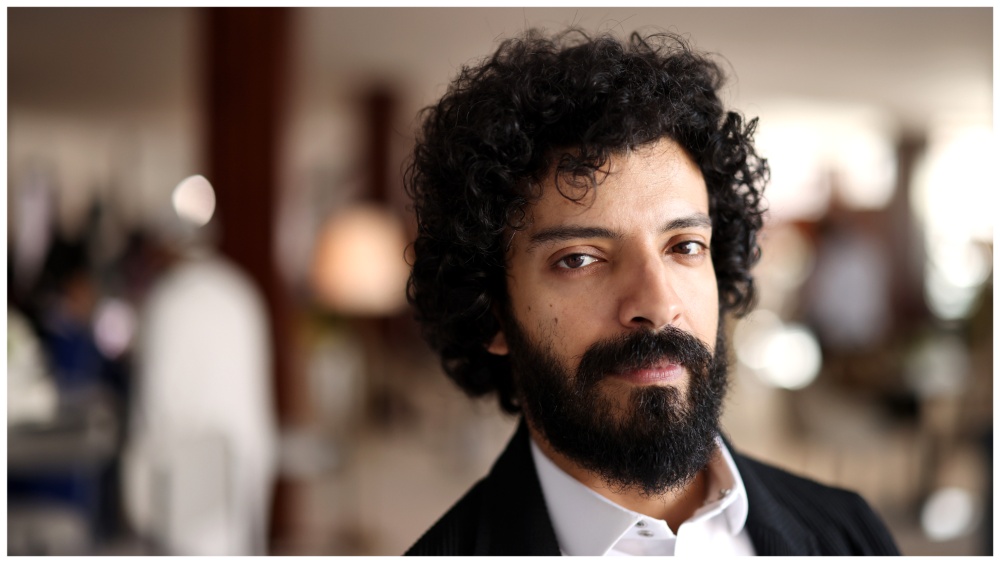
To make a film critical of oneself and the values instilled in you by family and society is not an easy task. But that’s exactly what Mohamed Kordofani set out to do with Goodbye Julia. “I wanted this to be a mirror for Sudanese people. I think we, as a community, care too much about how people view us but we don’t care at all about what the people we oppress think.”
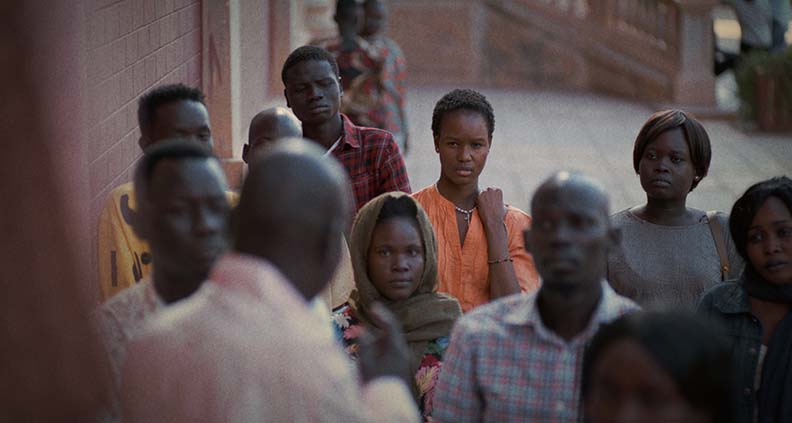
The film–screening for free this Tuesday, December 12 as part of Film Independent Presents!–tackles the macro issues of racism, colorism and prejudice within Sudan while concentrating on the growing friendship between two women in Khartoum. The first Mona (Eiman Yousef) is a privileged Sudanese housewife of Arab descent. The other, Julia (Siran Riak), is a poor woman originally from South Sudan and of African descent who ends up being her maid.
Like an Asghar Farhadi parable (one of Kordofani’s favorite filmmakers), Goodbye Julia starts with an accident that puts the two characters on an emotional and physical collision course. The accident is merely a catalyst for the writer-director to slowly unravel his protagonists’ inner thoughts and hidden characteristics while dismantling the lies that most Arab Sudanese tell themselves about equality and morality within their ranks. Mona is married to a man, Akram (Nazar Goma), who provides and protects but doesn’t support her career aspirations to become a singer. Julia finds herself widowed and struggling to take care of her young son. The job Mona offers Julia becomes the start of a friendship that both women need. They become each others’ biggest advocates and, in the process, Mona begins to question the inherent racism she never thought of before.
Kordofani says that Mona’s journey shadows his own. “I think 20 years ago I was a typical conservative, Sudanese man. I was a product of my society just like my father, my uncles and everybody around me. When the Southern Sudanese people voted for independence by 99% in 2011, that result was mind-boggling. It was one of the turning points where I realized that we are so racist. And becoming un-racist is not a button that you press, it requires an effort that requires that you check yourself. This transformation also mirrored my transformation from being an engineer to being an artist and this has significantly impacted my life. And in the film, you find Mona struggling to pursue her passion for singing despite what the community thinks.”
(L-R) ‘Goodbye, Julia” producer Amjad Abu Alala and director Mohamed Kordofani
An instrumental point in Goodbye Julia’s birth was when Kordofani connected with producer Amjad Abu Alala on social media. Abu Alala saw a short film Kordofani had made and recognized his talent. At the time Abu Alala was working on his own film as director, You Will Die at 20 (2019), and invited Kordofani to the set. That’s where the conversation about Goodbye Julia started. And now it is Sudan’s entry into the Academy Awards for Best International Film–just as You Will Die at 20 was four years ago.
Says Abu Alala: “The Oscars are an opportunity to make more Sudanese stories.” Kordofani agrees: “This gives hope to the people who are trying to make cinema in Sudan. Whenever one of us makes it, we know that it’s possible, that there’s a way, there’s a path.”
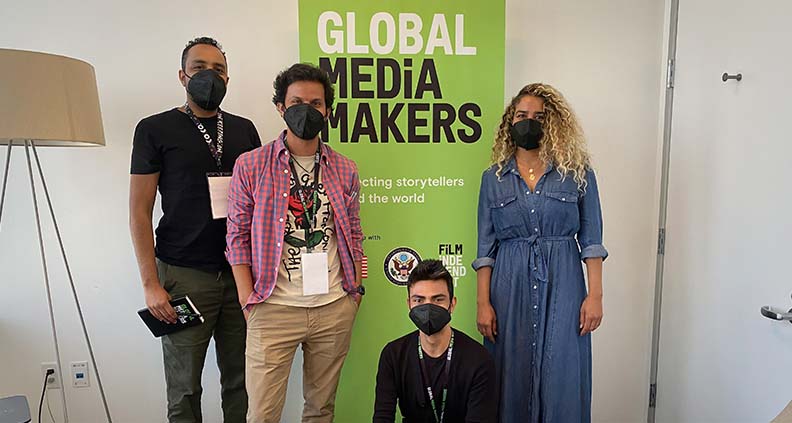
Kordofani and Abu Alala developed Goodbye Julia at Film Independent’s Global Media Makers LA Residency, where Kordofani was mentored by filmmaker Amman Abbasi (Dayveon and the upcoming The Quench). Abbasi says that working in the program is an “enriching” experience. “LA can be an insular film community and with Global Media Makers you get the multicultural aspects of what’s happening in cinema. Not only is it international cinema, but you also meet the next generation as they’re thinking through their new projects. A diaspora cinema club that decentralizes where movies come from, and the points of view.”
Though Kordofani came up with a uniquely Sudanese story rooted in his own personal experiences, it can connect with audiences everywhere. “I think these are universal issues. These are universal tropes. The patriarchy is everywhere, racism is everywhere and friendship is everywhere. So even if you don’t understand the political situation in Sudan, it would not hinder your watching experience.”
Goodbye Julia also proves prescient about the current situation in the country, where a violent conflict between two warring factions threw Sudan into a civil war that has been ongoing on since last April. One of the characters predicts that war is coming. “I knew that the war would come because the same reasons that started the first war are still valid,” says Kordofani. “Since the inception of Sudan as a nation, we have had a national identity problem. We tried to force the Islamic Arabic identity on the whole country. We’re a big country, where there are people who are non-Arab. There are people who are not Muslim, and yet we are trying to force that just because we can.”
‘Goodbye Julia’
Both Kordofani and Abu Alala remain steadfastly optimistic about the future of cinema in Sudan and take inspiration from Farhadi and other contemporary Iranian filmmakers. “Iranian cinema is unique for us because we look at it and see what can be accomplished despite all the red tape and restrictions,” says Abu Alala. “They have an Islamic regime, they are suffering as artists, as people. Like Sudan. Yet they still manage to make great cinema.”
To learn more about Global Media Makers, click here. Global Media Makers is supported through a partnership between Film Independent and the U.S. Department of State’s Bureau of Educational and Cultural Affairs. Film Independent promotes unique independent voices, providing a wide variety of resources to help filmmakers create and advance new work. Learn more online and become a Member of Film Independent today.
She became known as the lady in red and was one of the most hauntingly iconic images from the October 7 massacre.
A young woman, running for her life, fear etched on her face as twisted Hamas gunmen targeted the Nova rave festival in the early hours slaughtering at least 340 and taking 40 people hostage.
The last time she was seen, she wore a red shawl over her shoulders, and was surrounded by dozens of other terrified festival goers frantically running across a desert for safety, before climbing into the back of a car.
For weeks the world has wondered if she made it, whether she was alive or dead.
Now MailOnline has found her and, for the first time, Vlada Patapov – a 25-year-old Ukrainian-born mother of one – tells her story.
Vlada Patapov (left) is seen in a now-iconic picture fleeing the site of the Nova festival massacre on October 7, where Hamas gunmen opened fire on revellers, killing hundreds
MailOnline has found the woman in the red shawl and, for the first time, Vlada Patapov (pictured) – a 25-year-old Ukrainian-born mother of one – tells her story
Vlada became known as the lady in red and was one of the most hauntingly iconic images from the October 7 massacre. Here, she is seen wearing that same shawl again
Sitting on a bench by the sea at Ashdod close to where she works as a wedding planner, Vlada recounted her terrible nightmare
At points, Vlada broke down in tears as she relieved the horror of what happened on October 7
Sitting on a bench by the sea at Ashdod close to where she works as a wedding planner, Vlada recounted her terrible nightmare.
At points, she broke down in tears as she relieved the horror of what happened.
She got separated from her partner Matan for most of the day, saw friends shot and killed, and fled gunmen. It was to be almost 24 hours before she was able to finally cuddle her three-year-old daughter Romi in the safety of her home.
Vlada said: ‘I haven’t really spoken about what happened to anyone, it’s still very painful for me, I’ve shared with my family the horror of that day and I still thank God every morning that I’m still alive.
‘I sometimes feel guilty that I survived, and that others didn’t make it and what happened to me only lasted maybe 18 hours but for many the pain is still going on and I think about the hostages still in Gaza. We must not forget them.
‘The strange thing is I didn’t want to go to the festival. It was just a last-minute thing.
‘Matan got some tickets, and we went with a friend, but I had a feeling something wasn’t right when we left the Friday afternoon.
‘Romi was so quiet, she is always usually noisy running around playing with her toys but that day she was still, and I’m sure now she knew something terrible was going to happen.’
After arriving at the festival site at Re’im, just a mile and half from the border with Gaza, Vlada, Matan and her friend Mai set up camp and spent the evening talking, a chance to unwind from a busy week of wedding planning.
Vlada Patapov is seen with a friend at the Nova festival, which was attacked by Hamas terrorists in October 7, causing revellers to flee across desert fields
A picture taken by Vlada at the Nova music festival, the night before the October 7 attack
Pictures taken by Vlada on October 7 as people fled the Nova festival
Vlada captured a video early on the morning of October 7, in which rockets fired by Hamas can be seen flying through the air. These rockets signalled the beginning of the terror attack. Vlada and her partner can be seen left crouching down by a car, taking cover from the rockets (right)
Vlada said: ‘I remember the atmosphere was very strange, people were having fun and dancing but for me there was no energy, and I didn’t dance around as much as I usually do when I go to these festivals.
‘It got around 3am and I laid out on the mat to sleep.
‘I did think at the time it was weird to have a festival so close to the border with Gaza and rockets come over every now and then, but I thought the organisers must think it’s safe or they wouldn’t hold it.’
But that was not to be the case. Vlada’s slumber was suddenly interrupted at 6.30am when an air raid alarm app on her phone woke her.
She said: ‘I looked for Matan and Mai and I immediately heard shooting. It was loud and very close to us. For a few seconds I didn’t know what was happening and then Matan just screamed that we had to run for the car.
‘Missiles started coming over and the place just went crazy, the announcer said for everyone to evacuate and people just started running for their cars.
‘I think at first people thought it was just one of those routine rocket attacks from Gaza and it wasn’t until later when we looked at our phones we realised it was a proper invasion and these terrorists wanted to kill us.
‘But I don’t understand why, even now, it was just a music festival, it was peaceful, people were dancing and they came and murdered people, some of my friends, and for what?’
Vlada was among those who ran across the field and desert. She jumped into a car (pictured), but separated from her partner Matan
In footage posted to TikTok on October 7, revellers appeared to be oblivious to the impending terror that was coming towards them in the shape of the Hamas attack
The sound of gunshots and sightings of Hamas gunmen caused panic to sweep through the crowd. Hundreds of festival-goers fled into the surrounding fields and desert
Racing for her car, the trio jumped inside and sped for the exit but their way was blocked by other vehicles.
Vlada said: ‘Everyone was honking their horns, I was in the passenger seat and Matan was driving with Mai in the back and then we saw a man ahead of us dressed in a military uniform.
‘We thought it was an Israeli soldier and we would be OK, then a guy a few cars in front got out and the soldier, who I know now was a terrorist, shot him.
‘We all crouched down low, and bullets started hitting the cars around us but, I don’t know how, we didn’t seem to be hit, and Matan managed to reverse us away to try and get out the other side.
‘It was just chaos, there were abandoned cars everywhere and we managed to get to a shelter along the road, where a policeman screamed at us to keep on driving east if we wanted to stay alive.
‘Matan carried on driving, but we didn’t get far and then we just saw terrorists on cars, bikes and trucks heading towards us shooting, so we tried to drive across the field but we got stuck so we all just got out and started running for our lives.’
The image of Vlada fleeing for her life in her red shawl (seen wrapped around her shoulders during her time speaking to MailOnline) went around the world
The last time Vlada was seen, she wore her red shawl (pictured) over her shoulders, and was surrounded by dozens of other terrified festival goers frantically running across a desert for safety, before climbing into the back of a car
Blinking back tears, Vlada added: ‘This was where I got split from Matan and I didn’t know where he was.
‘I started running with Mai and we got to some trees and we were both crying.
‘We didn’t know what to do or where to go and all I could think of was Romi. I kept seeing her face and said someone has to survive for her.
‘So Mai and I started running again, and that’s when you see me in the video get into the car of my angel, a man called Yosef Ben Avu, he stopped and told us to get in and we did, all the time while shooting was going on.
‘There were eight of us in the car, it was a Kia Picanto and we were all on top of each other. I called Matan and told him I was OK and he said he had been picked up as well and he was safe.’
Vlada and Mai eventually made it to the safety of an army base at Tze’elim while Matan went to one 20 minutes away at Orim.
She said: ‘The whole thing had lasted three hours but it went by so quickly
‘The longest part was waiting at the base before I could be picked up and go home and see Romi, and I gave her the biggest hug ever.’
The image of Vlada fleeing for her life went around the world.
Vlada told MailOnline: ‘I haven’t really spoken about what happened to anyone, it’s still very painful for me, I’ve shared with my family the horror of that day and I still thank God every morning that I’m still alive’
Miraculously, Vlada was able to escape the terrorists and return home to her daughter
Vlada said of her harrowing ordeal: ‘The whole thing had lasted three hours but it went by so quickly ‘The longest part was waiting at the base before I could be picked up and go home and see Romi, and I gave her the biggest hug ever’
Last month local artist Karen Missk unveiled a painting that captured the moment, titling it ‘The Phoenix’.
Along with the image, the artists wrote:’ This is based on one of the images that day, beautifully young, full of life, people running away from pure evil savages.
‘I wish I knew her name and hope she made it out, but I really don’t know.
‘My heart broke to see them, realising that in the space of purest love and freedom, evil had arrived, but I know like a phoenix we will rise from these ashes.’
On The Bachelor, a winning couple didn’t get married until season 17. Sean Lowe and Catherine Giudici married in a TV wedding in 2014. However, the season 13 Bachelor, Jason Mesnick, did tie the knot — to his runner-up.
Although he chose Melissa Rycroft, Mesnick ended their relationship during the After the Final Rose special and in turn, proposed to Molly Malaney. The two tied the knot in 2010.
The Bachelorette has been a bit more successful. The first-ever lead, Trista Rehn, found her prince charming. She married Ryan Sutter in 2003. Since then, several other Bachelorette winning couples went on to say “I do,” including Desiree Hartsock, Rachel Lindsay and JoJo Fletcher.
Thank You!
You have successfully subscribed.
Scroll down to find out which Bachelor Nation couples have tied the knot!
Dust off those joysticks: Sega is rebooting a handful of retro franchises including Crazy Taxi, Streets of Rage, Golden Axe, Jet Set Radio and Shinobi.
The Japanese gaming giant announced the new initiative, which will “revive a number of IPs as all-new video games, developed for today’s audiences,” Dec. 7 at the Game Awards. Sega also showed the Los Angeles audience a trailer that previews footage of the new games, which are currently in development.
As two of the rebooted titles already have film adaptations in development, Sega eyes Hollywood ambitions beyond its successful “Sonic” movie franchise. A Shinobi movie adaptation from Marc Platt and Stories International was announced back in 2016, and Lionsgate landed film rights to Streets of Rage last year, recruiting “John Wick” writer Derek Kolstad.
“Sonic is definitely a blueprint for us,” Sega COO Shuji Utsumi told Variety in an interview before the Game Awards. “First, we really want to create the games and appeal to the gamers. The game is first. However, if we are creating the world and the characters that gamers love, that means if filmmakers love that kind of direction, [that can inspire] the movies. So, why not?”
With 2020’s “Sonic the Hedgehog” grossing $319 million at the worldwide box office and 2022’s sequel raking in $405 million, Sega is looking to spin new films, television series and licensed products off of other legacy titles. Beyond the five reboots announced, Utsumi says there are additional projects Sega is currently evaluating but has “not yet greenlit.” While nailing down specific release dates for the new Crazy Taxi, Streets of Rage, Golden Axe, Jet Set Radio and Shinobi games is a long way away, Utsumi estimates that the earliest reboot will arrive “in the range of two years.”
The reboots will feature all-new gameplay, and Utsumi promises they will appeal to both those who played the original titles and younger gamers who grew up clutching an iPad. The Sega COO, who also serves as CEO of Sega of America, said the company was inspired to mine its own IP from the ’80s, ’90s and early 2000s because it believes gaming’s footprint in mainstream culture is growing.
Utsumi, a key architect in the 1994 launch of the PlayStation, remembers pitching a movie based on the popular Crash Bandicoot game series. “I was in an elevator pitch position. I had to say, ‘Hey!,’ trying to get their attention. And movie guys treated us like s-word,” he laughs. “Like it was just a toy.”
“Nowadays, directors and producers play many of the games that I produced, and they respect us. They respect our games too,” Utsumi continues. “They understand the audience, they understand the spirit. That’s why more game-themed movies [have been] successful.”
He’s been encouraged by the success of non-Sega video game adaptations, as well, saying he “of course” saw Nintendo and Illumination’s 1.3 billion-dollar grosser, “The Super Mario Bros. Movie.”
“‘Mario’ pretty much follows the game, I would say. Ours have a bit [more] new fantasy added,” he says. “[Those filmmakers] approach it a different way, but they are still successful because they understand the value of the game. There are many different great approaches.”
The “Sonic” movies feature a computer-generated blue, speedy hedgehog (voiced by Ben Schwartz) alongside live-action actors Jim Carrey and James Marsden, while the Chris Pratt-starring “Mario” movie is fully animated.
“Sonic the Hedgehog 3,” which is dated for Dec. 20, 2024, features Sega mainstay Shadow, who was teased in the post-credits scene in “Sonic 2.” Given the company’s newfound cross-media approach, it wouldn’t be a surprise if the black and red antihero dashed into a new Sonic game.
“There is a lot of excitement around the appearance of Shadow,” Utsumi says with a proverbial wink. “Maybe we want to push that direction in other Sonic transmedia initiatives.”
The story of Willy Wonka seems to be ingrained in our collective DNA, believes arranger and composer Joby Talbot, who recently joined Variety’s Artisans Screening Series of “Wonka” in partnership with BSBP moderated by Variety‘s international correspondent K.J. Yossman.
Having grown up with the 1971 film “Willy Wonka and the Chocolate Factory” starring Gene Wilder, Talbot mentioned the “iconic memories” associated with the original film, including the songs, some of which the “Wonka” team were able to use in their prequel.
“We wanted to try and drive the story forward,” he said of incorporating music. “So we were trying very hard to make the different songs and the different melodies signify different things and be related to different characters.”
Talbot and the other artisans behind Paul King’s “Wonka” sat down to discuss how they brought the famous chocolatier’s origin story to life — from crafting fake chocolate to adjusting Timothée Chalamet’s hair based on varying temperatures.
The other panelists included visual effects supervisor Graham Page; special effects supervisor Hayley Williams; makeup and hair designer Ivana Primorac; costume designer Lindy Hemming; and set decorator Lee Sandales.
In one harrowing scene in “Wonka,” Willy (Chalamet) and his friend Noodle (Calah Lane) find themselves in a perilous situation involving a massive amount of melted chocolate.
Sadly, but perhaps more impressively, the sweet stuff wasn’t real.
“We had real chocolate as samples for the color and the texture and the way it glistens. Paul was very particular about how he wanted the chocolate to look,” Williams shared. “So in early stages we did lots of sampling for him to get the color right to make sure it looked good on camera, but it was actually manufactured by the company that made the coloring for the Johnny Depp version as well. So it was basically food-based, but it was water and color and thickening agent.”
Primorac discussed how Olivia Colman, who plays the antagonistic Mrs. Scrubbit, was eager to lean into her character’s less-than-desirable qualities, including yellowed and broken teeth.
“Olivia wanted more of everything straight away,” said Primorac. “More broken capillaries. There were hairy legs in the kimono, so we were laying on hair on her completely beautiful smooth legs. It was more of everything to be more of a character. The teeth there were less yellow teeth, and then she went for the bright yellow, nicotine-stained teeth.”
Yossman asked how Primorac worked to style Chalamet’s hair into the perfect Willy Wonka look, amid freezing weather and hot studio temperatures: “He’s got an incredible head of hair, not always easy to manage. We practiced a lot and tried to find something that’s wild and unkempt but also pleasing.”
Page discussed Hugh Grant’s experience playing an Oompa Loompa, who is digitally shrunken down to be much smaller than the rest of the characters.
“We basically photographed him in massive amounts of detail to be able to recreate him digitally. And there’s lots of technical things that we had to do, but we de-aged him,” Page said. “We wanted him to be the same age that he is in ‘Bridget Jones’s Diary 2.’”
Grant was extremely dedicated to perfecting his Oompa Loompa role, especially when it came to acting opposite Chalamet.
Page said, “He wanted to be talking to Timmy … He was doing some of it on his knees to try and replicate the right height and be acting in front of Timmy, and he wanted to embody the Oompa Loompa as best he could.”
Meanwhile, Hemming explained how the costume design process begins with cartoon-like sketches, which she sometimes feels hesitant to show actors given that she crafts them before casting is finished.
“But these actors were so receptive to fun — and everything generally — that we did show them all the early drawings, and then we work on from them to produce the costumes and some more drawings and the fabrics, et cetera,” she said.
Set designer Sandales discussed the inspiration for Wonka’s first shop, a childhood dream the chocolatier shares with his mother and eventually brings to life in the film.
“Everything is taken from the script and the idea of the chocolate shop itself. It’s conceived as a memory of his childhood and the love of his mother,” Sandales revealed. “You enter the shop and you see him on a river, on a barge, that’s the barge from his childhood … Everything is represented from what he remembered from his mother, and it just comes from love. So we took that and amplified it and amplified it and amplified it.”
A writer who claims the 2021 comedy “Don’t Look Up” was substantially similar to his self-published novel is suing writer-director Adam McKay and Netflix for copyright infringement.
Author William Collier says that in 2007, he sent his daughter, who was working at Mosaic Media division Jimmy Miller Entertainment, an email with the text of his novel “Stanley’s Comet,” for the company to consider as material. Collier alleges that his novel had numerous themes and plot points in common with “Don’t Look Up,” which McKay is said to have written in 2019. Jimmy Miller Entertainment was McKay’s manager at the time and collaborated with him on films such as “Talladega Nights.”
The lawsuit was filed in U.S. District Court, Central District of California on Wednesday. Collier is named as plaintiff, while McKay, his production company Hyperobject Industries and Netflix are defendants.
“The plot of both works is practically identical,” the lawsuit alleges. It goes on to describe the elements both the novel and screenplay have in common: “Low level scientists find a large comet that is headed straight towards Earth and is going to destroy the Earth and wipe out all humanity in a matter of time. In conveying this message to the public, the scientists go on a morning talk show (which undermines the urgency and nature of the matter) which then causes most people to be unbothered by it. Even the presidents and government leaders downplay the comet’s apocalyptic effect. Eventually, the comet is visible to the citizens of planet Earth and mayhem ensues as the comet is rapidly approaching.”
After sending the unpublished novel to his daughter, Adrienne Collier Florence (now Metz), Collier self-published “Stanley’s Comet” in 2013 in the book “In Extremis, Two Novels.”
“Don’t Look Up” was released to Netflix on Dec. 24, 2021. It went on to be nominated for four Oscars, including best original screenplay. The lawsuit alleges that McKay’s explanation of how he came up with the idea for the story was explained differently in several different interviews, and that his co-writer, David Sirota, had expressed surprise that he was given a story credit since his only contribution was a comment about climate change that he had made to McKay, musing “that it was like a comet (or an asteroid or a meteor, depending on the interview) hurtling toward the Earth, but no one seemed to care.”
“McKay credited Defendant Sirota as the co-author, even though, apparently, Sirota wrote not a single word or contributed anything at all to the writing of the script, other than his off handed climate change comment,” the suit states.
Collier is asking for a minimum of $5 million in damages.
Variety has reached out to Netflix and to McKay’s reps for comment.
Jane Wodening, the longtime collaborator and wife of Stan Brakhage, the avant-garde filmmaker, who flourished as an author after their divorce, writing stories about her years living on the road and then alone in a mountain shack, died on Nov. 17 at her home in Denver. She was 87.
The cause was cardiac arrest, said her daughter, Crystal Brakhage.
Mr. Brakhage, who died in 2003, was among the most influential experimental filmmakers of the 20th century, though his work could be considered an acquired taste. He made hundreds of movies, most of them silent, that were deeply personal, sometimes elegiac and very beautiful, though they dispensed with any recognizable narrative, often veering into complete abstraction.
For three decades, starting in the 1960s, he and Ms. Wodening (pronounced WOE-den-ing) lived a spartan life in a century-old cabin in a ghost town in the Rocky Mountains called Lump Gulch, sharing it with their five children and many animals, including a donkey and a pigeon named Fanny.
It was this world that Mr. Brakhage captured in his idiosyncratic, inscrutable way, in what the film critic J. Hoberman, writing in The Village Voice, described as “home movies raised to the zillionth power — silent and rhythmic, based on an invented language of percussive shifts in exposure or focus, multiple superimpositions, refracted light, and staccato camera moves.”
Ms. Wodening was the star of many of them. He filmed her delivering their first child in a bathtub in “Window Water Baby Moving” (1959), a startlingly lovely work that is considered one of his masterpieces. “Wedlock House: An Intercourse” (1959) is a kind of short horror film, with flickering images of the couple having sex interspersed with flickering shots of them having an argument.
The work didn’t sit well with feminists, who accused Mr. Brakhage of objectifying his wife. But Ms. Wodening didn’t see herself that way.
“Jane was committed to the filmmaking and the artistic enterprise,” said John Powers, who is an assistant professor of film and media studies at Washington University in St. Louis and working on a biography of Mr. Brakhage. “Stan felt he was in service to the muse,” he added, in a phone interview, “and she considered herself a loyal supporter of that muse, and the muse needed help.”
A lot of help. Ms. Wodening offered ideas, critiques and camera and sound assistance, along with running the day-to-day business that was “Stan Brakhage.” He signed his work “By Brakhage,” which he always said meant the two of them.
But Mr. Brakhage, never totally faithful, left Ms. Wodening for another woman, and in 1987 the couple divorced. The children had left home, the cabin was sold, as were the animals, and Ms. Wodening took off in a bright yellow Honda Civic kitted out so that she could live in it. (The back seat was removed, among other interventions.)
For three years she spent months at a time on the road, touring the country, camping in arroyos, mountain trails and friends’ driveways, even working for a spell as a tour guide at an archaeological site near Barstow, Calif., in the Mojave Desert.
“Driveabout,” a 2016 account of that time from Sockwood Press, one of the small presses that has published her work over the years, is charming, funny and often quite profound, like Thoreau but spiced with mild profanity and more drama, as Ms. Wodening faced perils as a single woman sleeping in truck stops, camping near sketchy characters and nursing an old friend through delirium tremens.
In this and other works, she came into her own. Her voice was as engaging and charming as her ex-husband’s was abstruse and highfalutin. Steve Clay, a founder of Granary Books in New York City, a small publishing house that is devoted to poetry and art books and that has put out works by Ms. Wodening, recalled his expectation that the wife of Stan Brakhage would be more “formally experimental” in her writing. “Instead, it was sort of folksy and straightforward,” he wrote in an email.
To film buffs, however, Ms. Wodening remained a mythic figure — an “Enigmatic Character in Film History” as one radio program described her in a headline.
“Driveabout” (2016) chronicled the years Ms. Wodening spent living out of her car and on the road after her divorce from Mr. Brakhage in 1987.Credit…via Sockwood Press
She was born Mary Jane Collom on Sept. 7, 1936, in Chicago, and grew up in Fraser, Colo., a small town in the Rockies about 70 miles northwest of Denver. Her parents, Harry and Margaret (Jack) Collom, were teachers at the local school, where Harry was also the principal.
Jane was a shy child who preferred the company of animals, especially dogs. (She wrote that she spoke canine sooner than proper English.) She worked in an animal hospital and enrolled at Colorado State University, in Fort Collins, thinking she would study to be a vet, before dropping out.
When she met Mr. Brakhage, “we were adolescent wrecks,” she told an audience a few years ago at Los Angeles Filmforum, a showcase for experimental movies. They married in 1957; she was 21 and he was 24, and “it was quite a relief for both of us.”
She recalled her first foray into his films, shortly after their marriage, when he declared: “You should take your clothes off, and we should make a film about having sex.” She balked at first — “I’m not that kind of girl!” — but he said, “I’m an artist, and an artist has to have a nude.” She thought about all the great nudes of history — from Raphael to Duchamp — and told herself, “‘I have an opportunity to join a group of people I quite admire,’ so I stripped and went to it.”
For most of her adult life, she was Jane Brakhage. When she returned from her car travels, transformed, she changed her name. She settled on Wodening, meaning child of Woden, the Anglo-Saxon god; since her family lineage stretched back to the early Britons, it felt somehow appropriate, she said. And she bought property near Eldora, Colo., about 20 miles west of Boulder, a mountainous site where she lived in a Hobbit-like shack with no electricity or running water — but thousands of books and a typewriter — living a hermit’s life for the better part of a decade.
It agreed with her.
When her family worried about communicating with her in an emergency, she became a ham radio operator, learning morse code to do so, and found community among other hammers, as they called themselves, who were mostly men and introverts like herself. Her call sign ended with the letters HPH, to which she gave the phonetics “Hermits Prefer Hills.”
“To become a hermit and at the same time to become popular was not only paradoxical,” she wrote in “Living Up There,” her memoir of her years in the mountains, “it was a tremendous delight.”
Ms. Wodening was the author of 14 books, including “Wolf Dictionary,” about how wolves communicate with one another. She had a loyal following and small but steady sales.
Toward the end of her decade at Fourth of July Canyon, as her mountain home was known, she connected with another hammer, Carlos Seegmiller, a computer programmer. He lured her back to civilization (and helped her trade her typewriter for a computer). They lived together in Denver until his death in 2008.
In addition to her daughter, Crystal, Ms. Wodening is survived by her daughters Myrrena Schwegmann and Neowyn Bartek; her sons, Bearthm and Rarc Brakhage; 14 grandchildren; and six great-grandchildren.
At her death, Ms. Wodening was working on a history of the world starting with the Big Bang.
The “When the Sun Goes Down” artist shared a sweet message for Swift after she gave him a shout-out in her interview for the annual honor.
“Taylor, I knew looking in your eyes that first time on stage with us, you had ‘it.’ The hunger, that something special… A gift not everyone has to connect,” wrote on Instagram Wednesday, alongside photos of him and a young Swift.
“It’s been awesome watching you shine!” he added. “Congratulations on being @TIME’s Person of the Year. I’m glad TIME sees what I’ve always loved about your music, your art and you as a human being. I’m so proud of you and I love you.”
In her Person of the Year interview, the “All Too Well” singer shared a story about scoring a gig as Chesney’s opening act when she was 17.
“This was going to change my career,” she said. However, the young singer-songwriter was ultimately unable to join the tour because it had been sponsored by a beer company and she was too young.
At her 18th birthday party, the “Cruel Summer” artist, who has since crossed over from country music to pop superstardom, was approached by Chesney’s promoter who handed her a card from the “You and Tequila” singer.
“I’m sorry that you couldn’t come on the tour, so I wanted to make it up to you,” the card read, as Swift recalled.
Inside the card was a check, she said, “for more money than I’d ever seen in my life.”
“I was able to pay my band bonuses. I was able to pay for my tour buses. I was able to fuel my dreams,” she added.
The “She Thinks My Tractor’s Sexy” singer told Time that he gave Swift the card and check because he believed in her gift of storytelling and felt she had a real future in the industry.
“She was a writer who had something to say,” he said. “That isn’t something you can fake by writing clichés. You can only live it, then write it as real as possible.”
After notching the Person of the Year honorific, Swift became the first woman to appear twice on the magazine’s annual cover since the series began in 1927.
The “Karma” singer, 33, made her Person of the Year cover debut in 2017 among the “Silence Breakers,” a group of women who helped spark a cultural reckoning around sexual harassment and assault. She appeared alongside California lobbyist Adama Iwu, actor Ashley Judd, a strawberry picker identified as Isabel Pascual and software engineer Susan Fowler.
“This is the proudest and happiest I’ve ever felt, and the most creatively fulfilled and free I’ve ever been,” Swift said in Wednesday’s cover story.
Even though Gwyneth Paltrow has largely stepped away from acting, Marvel fans continue to pepper the actress with questions about a possible return to the MCU.
Paltrow originated the role of Pepper Potts, Tony Stark’s assistant and eventual wife in Iron Man. She would then go on to reprise her role in Iron Man 2, Iron Man 3, Spider-Man: Homecoming, Avengers: Infinity War, and Avengers: Endgame.
It is not just Marvel that Paltrow seems to be avoiding these days. Outside of her work on the Ryan Murphy series The Politician, Paltrow has shied away from acting since Endgame and instead focused on her burgeoning Goop wellness brand.
“I just took a chance, and people were really surprised. They didn’t understand what I was doing,” Paltrow said of her transition from Hollywood to business owner.
Photo: Indie Wire
“I’m really happy I did it because I’ve learned so much through the process of growing this company and working with this team and all of the challenges, whether it be inventory management or Excel. I never thought in a million years I would have to learn how to read a P&L. It’s been so thrilling to build this business and still do what I love to do.”
The Beginning of Paltrow’s MCU Journey
In a recent interview at the Red Sea Film Festival in Saudi Arabia, Paltrow broke down her gradual disillusionment with the MCU.
According to Shakespeare in Love actress, she agreed to sign on for 2008’s Iron Man in order to work with her friend Robert Downey Jr. She also received assurances that despite being a superhero film, the production would be an “artistically stimulating experience.”
Photo: TCM
“The first film we did was very different from the rest because the studio didn’t think it was going to be a big hit,” she said. “They hired Jon Favreau to direct who was great. And they hired Robert Downey Jr., who was unhireable at the time. His career was at a very low point.”
According to Paltrow, because there were such low expectations for Iron Man, production on the film felt like an Indie project.
Photo: Marvel
“We improvised almost every scene of that movie. We would write scenes in the morning in Jon’s trailer. It was like doing an independent film. Then the movie was such a huge hit that then we didn’t make them like that anymore,” she said.
Growing Disillusioned With the MCU
As the Marvel movies got bigger and bigger, Paltrow had a harder time keeping up. As it turns out, she has never seen Avengers: Endgame.
“To be honest, I stopped watching them at some point. I’ve never seen End Game. I can’t keep track of who’s what. But I probably should at some point,” she revealed.
Tony Stark and Pepper Potts
While Paltrow would seemingly be happy never to act again, she is still leaving the door open for a possible return.
“I never say never. I’m really happy and busy doing what I’m doing. But if one of my best said, please come and do this, maybe I would consider.”
Thanks for visiting MickeyBlog.com! Want to go to Disney? For a FREE quote on your next Disney vacation, please fill out the form below. One of the agents from MickeyTravels, a Diamond-Level Authorized Disney Vacation Planner, will be in touch soon! Also, thanks for reading!
The Flash star Kiersey Clemons shared she is “so happy” to “move on” from the DC film’s troubled production.
Clemons was announced as the first choice to play Iris West back in 2016 when Rick Famuyiwa was set to direct. Over the years, many things about the film changed, leading to what fans eventually got in 2023.
In an exclusive interview with The Direct’s Russ Milheim, Monarch: Legacy of Monsters and The Flash star Kiersey Clemons shared thoughts about her experience on the Scarlet Speedster’s big solo outing.
Now that the movie is out, and there’s some distance since its release, the actress noted she is happy to be able to “move on” from the DC, and that she’s now “part of another universe” she “like[s] a lot:”
“I feel like I am so happy that I can move on from it and not answer questions about it anymore. That was years of my life. And that season is over. You know what I mean? And I’m also part of another universe now. And I like it a lot over here.”
That other universe is Legendary’s MonsterVerse, thanks to her role as May in the new Apple TV+ Monarch series.
May is one of the key protagonists of the show who is swept up into an unexpected conspiracy following the events of 2014’s Godzilla.
But, as for her role as Iris West, is she done with the character for good? Clemons made it clear that “[she doesn’t] make those decisions,” and that she “wish[es] that [she] could have done more” as her DC character:
“I don’t make those decisions. I love being Iris West. I wish that I could have done more being Iris West. There’s no part of me that does not appreciate that I got the honor of being cast as Iris, but now I’m May. And there are no superheroes. There’s monsters now.”
Kiersey Clemons’ New Chapter
Given the general reception of The Flash, Kiersey Clemons is not the only one ready to move on.
With James Gunn’s big DCU reboot just around the corner, Ezra Miller’s take on the character and the universe around them will almost certainly be a thing of the past.
However, out of all the problems the movie had, Clemons was not one of them. So it’s great to hear that she doesn’t hate the character or anything like that.
As the actress herself mentioned, no matter what happens with the DCU, her current focus is on a different cinematic universe: the MonsterVerse. Currently, Godzilla and his titan friends are her world, not superheroes.
Atlus has shared a closer look at its upcoming action-RPG Metaphor: ReFantazio in a new trailer titled “The Royal Tournament.” The studio revealed the trailer as a part of 2023’s Game Awards, as well as narrowed the title’s release window. Metaphor: ReFantazio is now scheduled to release Fall 2024 on PlayStation 5, PlayStation 4, Xbox Series X|S, Xbox One, Nintendo Switch, and PC.
Similarly to many of Atlus’ other RPGs, it appears that the studio will tackle power dynamics and corruption in Metaphor: ReFantazio, albeit with a more high-fantasy setting. Based on the trailer, it seems as though the game will follow its protagonist as they compete in a tournament to establish who will reign as king over a country in desperate need of new leadership. It then showcases lush environments, sprawling cities, both action and turn-based combat, what appears to be a small handful of mini-games (cooking, anyone?), and stunning art direction that is sure to be familiar yet exciting for Persona and Shin Megami Tensei fans.
Size:
Want us to remember this setting for all your devices?
Now Playing: Metaphor: ReFantazio — The Royal Tournament Trailer
Atlus studio legends Katsura Hashino, Shigenori Soejima, and Shoji Meguro are all attached to the upcoming title, as well as Nier: Automata’s Koda Kazuma and Neon Genesis Evangelion’s Ikuto Yamashita. The trailer ended with the announcement that Metaphor: ReFantazio will release on all consoles Fall 2024.
The products discussed here were independently chosen by our editors.
GameSpot may get a share of the revenue if you buy anything featured on our site.
Norman Lear was serenaded with the theme songs of his television life as he slipped away, his son-in-law has revealed.
Dr. Jonathan LaPook, Lear’s son-in-law and a chief medical correspondent for CBS News, said Lear’s family was with him and made sure to give him a “soft landing for the plane.”
Lear, the creator of The Jeffersons, Maude, One Day at a Time, All in the Family, and more died Tuesday at his home in Los Angeles at 101.
“The family was gathered around the bed, he was very comfortable and resting peacefully, and we did what we knew he would want us to do,” LaPook said today on CBS Mornings. “We were singing songs from Les Mis, which he loved, and also some of the songs from his TV shows.”
When they got to the theme for The Jeffersons, LaPook said he was overcome with emotion. “You never know when these moments are going to sneak up on you,” he said. “I kind of held it together, [but] then we were singing ‘movin’ on up to the East Side’ and I heard myself saying ‘to a deluxe apartment in the sky,’ I just lost it. Because he’s going to some deluxe apartment in the sky.”
Of that “soft landing,” LaPook said, “We wanted him to have a gentle landing and have no pain. If you were to say to someone in their 40s, ‘How do you want to die?’ [they would probably say,] ‘At age 101, surrounded by loved ones, with them singing to me and laughing and without any pain,’ and that’s exactly what happened. He had this expression: ‘Over and next.’ When something was over, it’s over, and it’s onto ‘next.’”
LaPook added, “It’s the best definition of living in the moment.”
Norman Lear’s son-in-law, Dr. Jon LaPook, reflects on the legendary TV producer’s final moments: “He was one of my best friends” https://t.co/7IwmP2nkW0
After “Their Algeria,” a well-received documentary from 2020 about the parents of her actor father Zinedine Soualem, France-born filmmaker-performer Lina Soualem turns her camera on her maternal relatives in “Bye Bye Tiberias,” in particular her mother, the Palestine-born actress Hiam Abbass. By telling their story, she hopes to reclaim and question the personal, historical and visual legacies she inherited and to answer the question “How does a woman find her place when caught between worlds?” a question that applies equally to her and her mother. After its world premiere at the Venice Film Fest, the essay film, with its mix of the personal and the political, has been a festival favorite, going on to win the Grierson award for best documentary in London and the jury prize ex aequo in Marrakech. It represents Palestine in the Oscar international feature competition.
The title gives a clue to what Soualem considers the critical turning point in the family’s fortunes: their 1948 expulsion from their home and farm in Tiberias during the war that followed the partition of Palestine and the declaration of the independent State of Israel. Relocating to the village of Deir Hanna, her great-grandfather lost his mind and died, leaving his seamstress wife Um Ali and eight children, including Soualem’s grandmother Nemat, a teacher. Restless Hiam, one of Nemat’s 10 children, always felt suffocated by village life, and managed to leave Deir Hanna to live abroad in her early 20s.
The backbone of the film’s script, credited to Soualem, Nadine Naous and Gladys Joujou, is a poetic essay from Soualem’s POV about her mother and her forebears that combines memory and fantasy and provides a jumping off point for discussing the various generations. With only a small number of photographs extant, the film’s visuals benefit most from lovingly shot home movie footage captured by Soualem’s father during visits to Deir Hanna when Lina was a toddler.
From Hiam’s sisters, we learn that Abbass was the one most popular with the opposite sex while growing up, inspiring some funny stories about how their stern father reacted to her many boyfriends. We also discover that she had a short-lived early marriage to an Englishman she met while acting at the Palestinian National Theater in Jerusalem, was a prolific writer of poetry as a teenager and studied photography in Haifa. Soualem continually tries to coax the no-nonsense Abbass to be more revealing, but her mother sometimes resorts to the family refrain, “Don’t open the gate to past pain,” or comes close to snapping at her.
If there is any one takeaway from the film, it’s the importance of family attachments and the succor they provide. Abbass confides that when she first moved abroad, she cut her ties to those back in the village, which left her feeling even more isolated after giving birth to Lina in France. After she started bringing Lina to Deir Hanna each summer, she reconciled with her beloved family. The visceral feeling related to family is reinforced by Abbass’ story of her aunt Hosnieh, an older sister of her mother, who in 1948 wound up on the Syrian side of the border, unable to see her family for 30 years. She describes their finally coming together with the force of magnets and the way the aunt sniffs and sniffs to absorb the smell of her loved ones.
The film also captures the passing of the torch between generations and the consciousness of mortality. We see the young and beautiful Abbass holding baby Lina as she interacts with the vital Nemat and aging Um Ali. Then we see the much older Nemat in a wheelchair, pushed by a 50something Abbass. The conversation between Abbass and Soualem gains an extra gravitas after the passing of Nemat.
Some viewers might wish for more political context as obviously Abbass’ first passport was an Israeli one. But all we get is a story about how she travels to Syria on her French passport to visit Hosnieh, shattering the barrier that “they” imposed. Likewise, it would have been interesting to hear more about Abbass’ desire to act and her start, but her career is barely mentioned apart from a remark that Nemat didn’t like her being an actress because she felt that Hiam preferred her work to her.
While the film’s tech elements are variable, the score by Amine Bouhafa is top-notch.
You are reading an exclusive WrapPRO article for free. Want to level up your entertainment career? Click here to subscribe.
“The Pike County Murders: A Family Massacre” has set a new record at Oxygen, TheWrap can reveal exclusively.
The special event documentary series, which aired Nov. 24-25, averaged 933,000 total viewers across its three episodes, according to Nielsen live-plus-same-day figures. The series has become become Oxygen’s most-watched program since “Aaron Hernandez Uncovered” launched on March, 17, 2018.
After landing on Peacock, the series brought in 259,000 viewers in its first seven days on the streamer, leading “The Pike County Murders: A Family Massacre” to become Oxygen’s most-watched current series on Peacock.
Produced by KT Studios, “The Pike County Murders: A Family Massacre” investigates the brutal murder of eight family members who were executed in four different locations in Ohio by another family they regarded as friends.
The first episode, titled “Bound by Blood,” plunges viewers’ into detectives’ determination to solve the murders as the community mourns. While a motive seems to be hidden, investigators analyze bloody footprints and follow the path to the killer.
By the second installment, “Raised to Kill,” the authorities zero in on the family they believe was behind the violet act — the Wagner’s — who feel the heat of the investigation and begin to undercut one another. Meanwhile, a message from victim Hanna Rhoden sheds light into a possible motive.
The series culminates in the third episode, titled “Power and Control,” which takes viewers into George Wagner’s trial, where a surprising testimony shocks community members and the true motive behind the complex murders is revealed.
Stephanie Lydecker and Catharine Park serve as executive producers for “The Pike County Murders: A Family Massacre.”
Oxygen is currently airing series “Prosecuting Evil with Kelly Siegler,” Saturdays at 8 p.m. ET/PT as well as “Fatal Family Feuds” Saturdays at 9 p.m. ET/PT.
“The Pike County Murders: A Family Massacre” is now streaming on Peacock.
“Science Fair: The Series,” a three-part documentary that airs in full on Sunday at 8 p.m., on National Geographic (and begins streaming Monday on Disney+ and Hulu), follows high school students from across the world who are vying for a spot at the International Science and Engineering Fair, which they consider their Olympics.
Each student has been conducting specialized and advanced research for years: eliminating micro algae from the backyard lagoon, turning reeds into biofuel, prototyping sustainable electric car batteries.
To a one, the students here are bright and charming, practically bursting with passion. And at a moment when vibes discourse would lead us to believe that every teen on earth has TikToked themselves into being a depressed robot who wants fast fashion and can’t do homework, it’s a treat — a relief, even — to encounter work that is so enthusiastic about young people.
Our main teacher-anchor here is Dr. Serena McCalla, a teacher in Jericho, N.Y., whose team is such a powerhouse that families move from other countries to put their kids under her tutelage. (McCalla was also in the 2018 film “Science Fair,” which is the inspiration for this series.) She drills students not only on their scientific work but especially on their sales pitches and their answers to the judges’ questions. She’s tough and judicious, and the biggest lesson she seems to impart to one superstar is not how to win but how to lose.
After the success of the 2003 documentary “Spellbound,” about competitors in the National Spelling Bee, there seemed to be a lot stories for a while about kids pursuing niche excellence. (I still think of you, teen magicians from the 2011 documentary “Make Believe,” who I guess are all adults now.) These days, we are never too far from a football or ballet documentary in which a stern talking-head reminds us that in real life, not everyone can win. All geeky enthusiasm and showmanship seems to have been conflated with musical theater since “Glee,” so it’s nice to see science research get its own moment of teenage glory.
Format-wise, “Science Fair” is standard fare, but that’s fine — it’s so earnest and endearing, and it even has those satisfying “Where are they now?” updates at the end. If you need a bubbly pick-me-up kind of show, or if you have fond memories of whatever your “thing” was in high school, watch this.
It’s hard to measure the full impact of the Hollywood strikes — mainly because the TV and film industry will be facing the ripple effects for years to come — but a new study has revealed one significant immediate hit: 17% of Los Angeles-based showbiz workers lost their jobs during the work stoppages.
According to the Otis College of Art and Design’s study, the first released under the college’s ongoing Otis College Report on the Creative Economy, following the WGA (which ran May 2-Sept. 27) and SAG-AFTRA strikes (July 14-Nov. 9), 24,799 entertainment industry employees in Los Angeles were let go, or more than 1.5 in every 10 workers.
While actors and writers were the workers that saw the “most rapid declines” during the April-October period period measured, other heavily affected roles included camera operators and editors, and “other media occupations,” which the study classifies as “a group that includes broadcast, sound and lighting technicians.”
The study notes that the writers and actors strikes of 2023 should be “understood as part of a longer-term decline in Hollywood employment,” including the decline of Peak TV, and states that film and TV industry’s employment has shrunk by 26% since the post-pandemic high point in August 2022. The strikes are framed by the study as a factor that “accelerated an industry contraction already underway.”
According to the report, additional challenges facing Hollywood that were exacerbated by the strikes include: oversupply, a weaker investment environment, technological disruption and foreign competition.
Per Otis College, for the study, the Westwood Economics and Planning Associates analyzed strike-period data from the Bureau of Labor Statistics (BLS) and California Employment Development Department (EDD), in addition to reviewing 11,186 job listings in entertainment (film and television) over 15 months, ending on Oct. 31, and interviewing industry officials, including above-the-line and below-the-line talent, producers, talent agents and policymakers.
The full study, the first of two from Otis College of Art and Design to focus on the entertainment industry, with the second to be released in early 2024, can be found here.
“The entertainment industry is a key economic driver for California, with impact felt across the world,” Otis College president Charles Hirschhorn said. “Analyzing the health of that industry is important for both our state and our students at Otis College of Art and Design, a diverse community of artists and designers planning careers across creative sectors. We’ve developed the Otis College Report on the Creative Economy as an essential resource to give our creative students and citizens the information they need to best plan for their futures.”
Defence lawyers are expected to present their case Thursday in the murder trial of a former Saskatchewan Mountie.
Bernie Herman, 55, has pleaded not guilty to first-degree murder in the death of 26-year-old Braden Herman.
The two men are not related.
Braden Herman’s naked body was found in a park on the outskirts of Prince Albert, Sask., in 2021.
Court has heard the two men met on Facebook and Braden Herman moved into the veteran officer’s family home in 2018.
Messages and images from cellphones entered into the trial show the two men had a sexual relationship that put a strain on the officer’s marriage.
Const. Riley Babott, a digital forensics examiner with Calgary police who analyzed the devices, read the messages in court.
Story continues below advertisement
Photographs of Snapchat conversations between the two men show them sharing feelings of love. The messages also show frustrations with their relationship and issues with Bernie Herman’s wife.
Janice Herman told court she kicked the younger man out of the home in 2019. Text messages between her and her husband show she was frustrated that he continued the relationship with the younger man.
“I was alone for seven months while you were having the time of your life,” Janice Herman texted her husband 20 days before the killing.
The Crown was expected to close its case Thursday.
Family have said Braden Herman was kind and thoughtful, a friendly giant who wouldn’t hurt a fly.
Janice Herman testified earlier in the week that Braden Herman was violent and unpredictable. However, she and her husband continued to socialize with him.
Janice Herman was having drinks with Braden Herman the night before his death.
She also dropped off alcohol for him and a friend on May 11, 2021, the day he was killed.
In text messages to her husband that day, she criticized the Mountie’s relationship with Braden Herman.
“You telling (Braden Herman) you want him and not your wife, that, too, hurts,” she said in a text to her husband.
Story continues below advertisement
Later that day, Bernie Herman sent a text to his wife saying he’d had enough and shot Braden Herman.
The message said: “Just so you know your life has changed from here on. I just shot and killed him.”
Christine Brown has no regrets about leaving behind her polygamist lifestyle. The 51-year-old Sister Wives star took to Instagram on Wednesday to share a beaming selfie while wearing a hot pink shirt.
“I was always concerned I would lose my independence in monogamy,” Christine captioned the photo. “I realized the other day, being married to the right person (David for me!) that I am more independent than I ever was! #strongwoman #independent #strongerthanever #blessed.”
Christine’s new husband, David Woolley, took to the comments section to praise his new bride, writing, “I had surgery last Friday I’ve never been taken care of like Christine has done for me I have the best wife and soulmate that anyone could have she is my angel love you so much Christine Woolley!!❤️”
Christine publicly split from Kody Brown, the father of her six children, in 2021. At the time, she was the first of Kody’s wives to leave the plural marriage.
She met David in late 2022, and the pair tied the knot this past October.
Shortly after Christine left Kody, Janelle Brown and Meri Brown followed suit, leaving Robyn Brown as Kody’s only remaining wife. All of the women have talked about their independence as a benefit of plural marriage, saying that not being able to depend on a husband they’re sharing has led them to be more self-sufficient through the years.
“I had no idea it felt like this or would feel like this. It really is a dream come true,” she gushed. “It’s amazing. It’s like we just kind of moved in side-by-side with each other and just continued moving on in our life, but we’re doing everything that the other person wanted to do but never did. So we travel so much and try so many new things and we have so many more kids now.”
The next episode of the Sister Wives’ One-on-One special airs Sunday, Dec. 10 at 10 p.m. ET on TLC.
TV giant Norman Lear, who died Dec. 5 at 101, leaves behind arguably the single most valuable body of work ever committed to the medium. On seminal series like All in the Family, Maude and The Jeffersons, Lear dared to tackle issues then considered unthinkable sitcom fodder — rape, abortion, homosexuality, racism, alcoholism — with a genius’ eye and ear for capturing their moral complexities while poking at the foibles of the American working class. These six episodes, however, stand out among the rest for having actively moved the needle on public opinion — and in doing so elevated Lear’s work from mere entertainment to timeless agitprop art.
1. All in the Family — Season 8 — “Cousin Liz” — Original Air Date: Oct. 9, 1977
Lear’s magnum opus, All in the Family, tackled the most hot-button issues throughout its nine seasons, from rape to racism to the war in Vietnam. But one particularly resounding episode was “Cousin Liz,” in which Edith overrules Archie’s boisterous protests and gives her deceased cousin’s lesbian partner a silver tea set that held deep sentimental value. The episode aired while Anita Bryant and her Save Our Children coalition sponsored ballot initiatives across the country that would ban LGBTQ citizens from working in public schools — and the defeat of one of those initiatives in California (the “Briggs initiative” named for state senator John Briggs) was credited in part to “Cousin Liz.” – Seth Abramovitch
2. Maude — Season 1 — “Maude’s Dilemma” — Original Air Date: Nov. 14 – Nov. 15, 1972
CBS only had one objection to the groundbreaking two-parter — which came a year before Roe vs. Wade, though abortion was already legal in New York, where the show was set — that brought the abortion debate into America’s living rooms: that both sides be represented. The episode, penned by future Golden Girls creator Susan Harris, follows Bea Arthur’s Maude Findlay, an outspoken liberal woman on her fourth marriage, discovering a surprise pregnancy at age 47. In the end, a deeply conflicted Maude decides to have the abortion, and cites her age as a key concern. The episode was aired by all but two of CBS’ nearly 200 affiliates. It was only when the episode was slated for a re-airing in August 1973 that the United States Catholic Conference mobilized, resulting in 40 affiliates refusing to air it and all corporate sponsors dropping their advertising. CBS could live with that: Maude finished the season at number 4 in the ratings. – Seth Abramovitch
3. Good Times — Season 1 — “Michael Gets Suspended” — Original Air Date: March 8, 1974
In the season one episode “Michael Gets Suspended,” the Evans family’s youngest and most politically engaged child, Michael (Ralph Carter), gets disciplined at school for saying that George Washington owned slaves and was a “white racist.” Throughout the series, Michael’s activist streak would frustrate his pragmatic parents, and in this episode, his father, James (John Amos), calls him “the militant midget.” But what stands out about the 1974 storyline is the timeliness of Michael’s critique of his school’s lessons. Nearly 50 years before the state of Florida adopted a curriculum that says some Black people benefited from slavery, an 11-year-old on Good Times was calling out his school for its failure to tell an accurate story about race in U.S. history. – Rebecca Keegan
4. The Jeffersons — Season 6 — “The First Store” — Original Air Date: April 6, 1980
An episode-long flashback tells the politically charged story of how George (Sherman Hemsley) started his first dry cleaning store. After meeting with a patronizing white banker and enduring a raft of micro (or, honestly, macro) aggressions, George is on the verge of securing a loan to open the store in Harlem — on the evening of April 4, 1968. As he shows Louise (Isabel Sanford) and Lionel (Mike Evans) the storefront he’s leased, a brick comes through the glass door and a protester informs the family that Martin Luther King, Jr. has been assassinated. The Jeffersons wasn’t usually as overtly political as some of Lear’s other shows, but Hemsley does a masterful job at playing George’s barely contained rage at the system, leading to a very satisfying (and, importantly, funny) second meeting with the banker the next day. – Rick Porter
5. One Day at a Time (Netflix, 2017) — Season 2 — “The Turn” — Original Air Date: Jan. 26, 2018
Lear’s reboot of his 1975 series — about a single mom raising two daughters on her own — was more overtly political than the original, reimagining the premise with a Latino cast (Justina Machado and Rita Moreno, with Todd Grinnell as Schneider) while tackling hot-button issues like racism and immigration. The first episode of season 2 had Penelope’s 13-year-old son Alex (Marcel Ruiz) urging his family not to embarrass him by talking loud or calling him “Papito.” Turns out that’s because Alex was told to “go back to Mexico” by a bully who heard the young man — born in America — speak Spanish to a friend. Gloria Calderon Kellett, herself from a Cuban-American background, created the series with Mike Royce, with a 95-year-old Lear executive producing. – Etan Vlessing
6. Mary Hartman, Mary Hartman — Season 1 — “130” — Original Air Date: July 2, 1976
Spoofing daytime serials and their endless melodrama, Lear boldly embraced their format, delivering half-hour episodes five times a week over two seasons via independent channels across the country. In his crazy, scathing satire of consumer culture, Mary is a small-town housewife convinced that TV and its bountiful commercials can provide the answers to such existential crises as waxy yellow buildup and the news that her grandfather is the Fernwood Flasher. Louise Lasser brought the perfect sensibility to the role, numb and glazed but pierced by a slow-dawning yearning for something better. Life keeps intruding on the delusions she’s embraced — especially memorably in Episode 43, when housewifely perfection proves fallible, and a neighbor drowns in a bowl of her chicken soup, and in Episode 130, the first season’s last, when Mary goes through the looking glass and has a full-fledged nervous breakdown on live television. – Sheri Linden
In the most recent suit, the unidentified woman says she was with friends at a lounge in the Detroit area when she met Harve Pierre, Bad Boy’s former president, who is also named as a defendant in the case and is accused of taking part in raping the woman. The woman, according to the court papers, said Mr. Pierre told her that Mr. Combs “would love to meet” her and then, in a bathroom at the lounge, Mr. Pierre “demanded” oral sex, before asking her to accompany him on a private flight to New York City.
While at the recording studio, according to the suit, the woman met Mr. Combs and took a photo sitting on his lap, which was included in the complaint with her face obscured. “Ms. Doe became more and more inebriated,” the complaint reads, “eventually to the point that she could not possibly have consented to having sex with anyone, much less someone twice her age.”
Eventually, the lawsuit says, Mr. Combs directed her into the bathroom, where he raped her, and then sat in a chair outside the bathroom watching as an unnamed man raped her. The suit says Mr. Pierre assaulted her last.
Mr. Pierre could not be reached for comment. He was named in an earlier case, filed last month, that accused him of grooming and sexually assaulting an assistant at Bad Boy.
A spokesperson for Bad Boy, which was also named as a defendant in that case against Mr. Pierre, has said the company was “investigating the allegations.”
The new suit says it is being filed under New York City’s Victims of Gender-Motivated Violence Act, which, for a limited period of time, allows accusers to file civil complaints involving sexual assault claims after the statute of limitations has run out. Mr. Wigdor said that the suit was filed in federal court because the plaintiff and the defendant live outside of New York.
In the latest suit, the woman said that she has suffered significant emotional distress in the two decades since the encounter and that reading about the cases filed by Ms. Ventura and the two other plaintiffs had led her to file her own.
Rising Saudi Arabian star Yaqoub Alfarhan, who is known for playing the titular drug trafficker and serial killer in hit MBC TV series “Rashash,” plays a very different role in the drama “Norah” by pioneering Saudi director Tawfik Alzaidi, which is set in 1990s Saudi Arabia when conservatism was at its height and all forms of art and painting were banned for religion-related reasons.
In “Norah,” which world premiered at the Red Sea Film Festival in Jeddah, Alfarhan plays an artist named Nader who has given up painting and moved to a remote village to be a schoolteacher. There he intersects with this film’s titular character, played by Saudi newcomer Maria Bahrawi. “Norah” is an illiterate orphaned young woman who faces an arranged marriage in which she will be trapped and has a need for self expression. Their chaste encounter unleashes in “Norah” a passion for art and, by extension, for a better life away from the village.
Variety spoke to Alfarhan at the Red Sea fest about the nuances of his powerful character and the film’s cultural context.
With “Norah” you’ve gone from playing an epitomal bad guy to a heroic repressed artist. In both cases against the backdrop of a more conservative Saudi society than today. How did you prepare for this role?
Well Nader is definitely closer to me than Rashash, that’s for sure. It’s funny, because I don’t know why, but I’ve always wanted to be a teacher. I’ve always had this vivid dream where I see myself teaching. And to play a teacher who is also a painter, or in this case an artist, that’s really pretty great. The other thing I want to point out is that Tawfik and I go way back. We’ve been friends for 15 years. We not only share the same experience in the [nascent] industry, we’ve also shared the same human experience as artists.
Tell me more about Nader. What’s his conflict?
Basically since he couldn’t express himself through his passion for art, he decides to go to this village where he can try to forget this dream and start over. It’s like a blank slate for him. I think he’s reconnecting with his own inner child through the kids [whom he teaches].
What are the dynamics of his relationship with Norah?
She ignites something in him through her mysterious background. So in a way you could say that they fall in love, but it’s totally platonic because it’s true to that period of time [in Saudi]. I know this because I have older brothers and sisters, and I know their [romance] stories from back then. The relationships they had with the people whom they had feelings for. They didn’t express a lot of words to each other. So you feel that there is this sort of connection, but it’s platonic. It’s not about sex. It’s about discovering the other. Because men and women during that period of time were totally separated from birth. So, when a man would see someone, feel something towards a woman who was not from his family….There was something pure about it. It’s something that I can’t describe. Nader and Norah feel drawn to each other. But at that time, they don’t know how to interpret that in a modern way, let’s say.
How significant do think this movie is in Saudi today?
I think Tawfik was very smart. He tried to tell the story being very fair and balanced and without being too forcefully direct about the film’s subject matter. He was trying his best to be fair to all the elements that are at play in this film’s [cultural] context. And he covered a lot of ground. But again [doing this] without being really too straightforward. That’s why I think “Norah” is a powerful film.
However, the released footage also showcased Kahhori, who will be debuting in the upcoming season of What If…?, and many fans are wondering exactly what can be expected from the new superhero.
Marvel Studios’ New Superhero in What If…?
Marvel Studios
Marvel Studios officially released the first trailer for What If…? Season 2, and even though it teased a lot of different elements of the upcoming installment, it put a lot of focus on Kahhori, who will historically be the MCU’s first original superhero.
Marvel Studios
Kahhori was spotlighted many times throughout the Season 2 trailer, and at one point was even shown alongside Captain Carter as the pair confronted Thanos.
Marvel Studios
It is important to note that Kahhori is Mohawk and that her heritage will play a big role in bringing her to life.
The trailer did a good job of showcasing this, especially by focusing on the Native American paint on her face and teasing that it will glow when she uses her powers.
Marvel Studios
It is unclear exactly how many episodes of What If…? Season 2 Kahhori will be in, but based on the released footage, fans can at least expect to see one that is completely devoted to her character and origin story.
Marvel Studios
One moment from the trailer that teased how she will get her powers showcased Kahhori sinking in water before being sucked into a blue source of light.
Check out What If…? Season 2’s trailer below, with most of Kahhori’s scenes appearing between the 1:35 and 1:47 marks:
Kahhori’s involvement in Season 2 creates an interesting situation for Marvel Studios seeing as how future projects can do anything they want with her since she is an original superhero who has never been featured in anything else.
It is also important to note that Kahhori’s creation came from Marvel Studios working closely with historians and members of the Mohawk people so that the character can properly represent that group of people.
Historian Doug George previously talked about the episode that will center around Kahhori, teasing that it will contain “breathtaking action,” characters that are “fully realized,” and “a new, challenging, and entertaining perspective on this land’s first peoples:”
“It tells a remarkable story from a Native-Mohawk perspective which is truly unique and historical, and will give the viewers a new, challenging and entertaining perspective on this land’s first peoples. The story is dramatic, the characters fully realized, and the action sequences are breathtaking. The episode is exceptional in another sense–it is done with the complete cooperation of the Mohawk people from dialogue to adornment.”
Since Marvel Studios collaborated with other Mohawks and crafted Kahhori with so much care, it seems almost inevitable that she will become a major player in the MCU going forward.
Despite What If…? being animated, since the Multiverse is currently the focus of the franchise, it has never been easier for a character like Kahhori to be pulled into live-action.
If she is as powerful as the trailer is building her up to be, then she will be a more-than-welcome ally to the rest of the MCU’s heroes.
Many fans are also wondering now if Marvel Studios will create more original characters.
While it is impossible to predict if it will or not, if fans connect with Kahhori and express a lot of interest in seeing her again in the future, then there is no reason for Marvel Studios not to create more heroes, especially later when some of the established superheroes are gone.
Fans can see Kahhori in Season 2 of What If…?, which will begin streaming on December 22 on Disney+.
We tend to think of movie villains in terms of black and white. We view them as absolute evil, without a single decent bone in their bodies. But some of the best movie villains are complicated figures who occupy a morally gray area. They exhibit humanity rather than inherent wickedness, displaying both the light and the dark, the good and the bad, of their personalities.
And although they may commit atrocities and even involve their kids with their criminal activity, some of these villains are actually good parents. They show their children love and affection and protect them fiercely — even, sometimes, a little too much. Despite all their flaws and questionable acts, here are ten movie villains who have proven to be loving parents.
Sean Penn, Tim Robbins, Kevin Bacon, Laurence Fishburne, Marcia Gay Harden, Laura Linney
Rating
R
Main Genre
Crime
The Academy Award winner for Best Picture Mystic River follows three former friends, whose paths have diverged significantly since childhood. Jimmy (Sean Penn) has become a gangster, Sean (Kevin Bacon) has grown to be a detective, and Dave (Tim Robbins) is a blue-collar worker, who’s haunted by his traumatic past. After the murder of Jimmy’s daughter, the three men are brought back together in this masterful neo-noir tale from Clint Eastwood.
Jimmy is really more of the film’s anti-hero, though you could argue that he’s a villain based on what he does in the end. Jimmy and his first daughter Katie (Emmy Rossum) have a close relationship. Although he doesn’t approve of her boyfriend, you can tell that Katie loves her father. In a famously powerful, heart-wrenching moment, Jimmy screams and sobs when he appears at the crime scene and learns of his daughter’s death. “Is that my daughter in there?!” he shouts over and over again. Distraught, Jimmy vows revenge on whoever killed Katie — but ends up making a grave mistake. Rent Mystic River on Prime Video.
Arnold Schwarzenegger, Sinbad, Phil Hartman, Rita Wilson, Robert Conrad, Martin Mull
Rating
PG
Main Genre
Comedy
Jingle All the Way is a classic holiday movie and a favorite among milennials. It focuses on the mad scramble of parents during the holiday season, searching for that one toy their kids really, really want. Absentee father Howard (Arnold Schwarzenegger) will do whatever it takes to get his son a Turbo Man, the hottest toy and action figure in stores — even if it means facing off with the local mail carrier, Myron (Sinbad).
Since this is a family-friendly comedy, Myron is relatively harmless as far as villains go. It wasn’t his fault that the package he left with the police department turned out to be a real bomb. Haunted by his childhood and driven by his own father’s mistakes, Myron is determined to find the Turbo Man doll for his son. Sure, he’s a little kooky and becomes an actual supervillain in the finale. But at the end of the day, Myron is a loving father who will do anything to ensure his son’s happiness. Stream Jingle All the Way on Disney+.
Tobey Maguire, Kirsten Dunst, James Franco, Thomas Haden Church, Topher Grace, Bryce Dallas Howard
Rating
PG-13
Main Genre
Action
Once upon a time, long before Tom Holland and the Marvel Cinematic Universe, there was Tobey Maguire and Sam Raimi’s Spider-Man franchise, with Spider-Man 3 was the final installment in the trilogy. Here, Peter Parker/Spider-Man takes on a new Green Goblin (James Franco), Venom (Topher Grace), and Spidey’s own inner demons. Unfortunately, struggling with too many villains and plotlines, Spider-Man 3 failed to live up to the massive hype and cut Raimi’s series short.
One of the many villains from Spider-Man 3 is Flint Marko, also known as Sandman (Thomas Haden Church). Marko was sent to prison for committing the robbery which resulted in the death of Peter’s Uncle Ben, and the creation of Spider-Man. After escaping from prison, one of the first things that Marko does is stop by his old apartment to see his sick daughter. “I’m not a bad person,” he tells her. “Just bad bad luck.” As it turns out, Uncle Ben’s murder was an accident. And Marko has only been stealing money so he could save his ill child. Stream Spider-Man 3 on Disney+.
Daniel Kaluuya, Allison Williams, Catherine Keener, Bradley Whitford, Caleb Landry Jones, Marcus Henderson
Rating
R
Main Genre
Horror
Known more for his comedic work, Jordan Peele shocked everyone in 2017 with his critically acclaimed psychological horror film Get Out. In this imaginative, creepy story that’s reminiscent of an episode of Rod Serling’s The Twilight Zone, a young, African-American man becomes a psychological prisoner of his girlfriend’s affluent white family, the Armitages. And he’s not the only one.
It’s clear from the Armitage’s wealthy community that their children are well-provided for. Sure, they are racist, evil people. And sure, Mommy and Daddy get their kids involved with their depraved scheme, which includes pimping out their daughter to ensnare innocent black men. But some families just have a different way of showing their love and spending time together. Board games aren’t for everyone, after all. Stream Get Out on Netflix.
Kick-Ass is a violent but comedic superhero film that’s grounded in reality, filled with costumed vigilantes who don’t have superpowers. Kick-Ass (Aaron Taylor-Johnson) thinks that being a crime-fighter is all fun and games — until he gets entangled with the local mob and a revenge plot involving murderous masked heroes.
Frank D’Amico (Mark Strong) is the villain of Kick-Ass, a mob boss who runs an underground empire. Despite his criminal tendencies and tough guy personality, Frank has a fairly close relationship with his son Chris (Christopher Mintz-Plasse). He allows him to become a part of his criminal organization and trusts Chris with helping him take down his enemies. It may not be the best parenting ever, but the love is still there. The film received stellar reviews, and its original director, Matthew Vaughn, is planning to reboot the series. Rent Kick-Ass on Amazon Prime Video.
Tom Holland, Michael Keaton, Robert Downey Jr., Marisa Tomei, Jon Favreau, Gwyneth Paltrow
Rating
PG-13
Main Genre
Action
Spider-Man: Homecoming was what every superhero fan had been waiting for: a solo Spider-Man movie set in the Marvel Cinematic Universe. Homecoming follows Peter Parker’s early high school heroics as Spider-Man (Tom Holland), pitting him against his first major adversary: Vulture.
Spider-Man: Homecoming brings Michael Keaton back to the mainstream superhero genre to play Adrian Toomes/Vulture. But in a shocking twist, Spider-Man and the audience learn that Toomes is also the father of the girl that Peter is romantically pursuing. It’s clear from their scenes together that Adrian and his daughter have a good relationship; he even has a pet name for her. And like any good dad, he drives the pair to their homecoming dance.
Toomes originally got involved in creating and selling advanced weapons in order to provide for his family, and he is determined to keep that truth from his daughter. “Nothing is more important than family,” he tells Peter — even though he says it while holding a gun and threatening Peter’s life. Stream Spider-Man: Homecoming on Disney+.
Jango Fett — Star Wars: Episode II – Attack of the Clones (2002)
Ewan McGregor, Natalie Portman, Hayden Christensen, Christopher Lee, Samuel L. Jackson, Frank Oz
Rating
PG
Main Genre
Action
Star Wars: Episode II – Attack of the Clones is the polarizing but pivotal second film in George Lucas’ prequel trilogy. All grown up, Anakin Skywalker (Hayden Christensen) wrestles with his inner demons while developing a romantic relationship with Padmé (Natalie Portman). Meanwhile, Obi-Wan Kenobi investigates a mystery that leads to the beginning of the legendary Clone Wars.
During Obi-Wan’s investigation, he comes across a bounty hunter named Jango Fett (Temuera Morrison). As it turns out, Jango’s DNA was used to create a clone army for the future Galactic Empire. One of Jango’s requests was to be given one unaltered clone for himself: the future Boba Fett. Jango raises this miniature version of himself as his own child and seems to provide a good life for him on the ocean planet of Kamino. Although he involves Boba in his criminal life, Jango also protects and cares for his son. Stream Star Wars on Disney+.
Uma Thurman, David Carradine, Lucy Liu, Vivica A. Fox, Chia Hui Liu, Michael Madsen
Rating
R
Main Genre
Action
Quentin Tarantino’s Kill Bill series introduces audiences to The Bride (Uma Thurman), later identified in Vol. 2 as Beatrix Kiddo. After being brutally attacked and losing her baby and husband-to-be on her wedding day, Beatrix embarks on a bloody, rage-fueled quest for revenge on her former lover, who orchestrated her wedding day massacre: a man known simply as Bill (David Carradine).
As a legendary killer and the leader of a lethal group of mercenaries, the Deadly Viper Assassination Squad, Bill serves as a dangerous adversary for Beatrix. When he learns that she’s pregnant with his child, Bill saves the baby’s life and has her removed from Beatrix’s stomach while she’s in a coma. Bill spends the next four years raising their daughter, loving and providing for her.
Beatrix is stunned to learn that their daughter is still alive. She’s offered a glimpse of Bill as a loving father, playing make-believe games and making sandwiches with their daughter. But not even these heartfelt moments are enough to make Beatrix forgo her desire for revenge. Stream Kill Bill on Prime Video.
Betsy Palmer, Adrienne King, Jeannine Taylor, Robbi Morgan, Kevin Bacon, Harry Crosby
Rating
R
Main Genre
Horror
Friday the 13th is an iconic slasher film that birthed one of horror’s most successful franchises. Most viewers associate Friday the 13th with its famous machete-wielding masked killer, Jason Vorhees. But in this 1980 original, it’s Jason’s mother Pamela Vorhees (Betsy Palmer) who turns out to be the villain, terrorizing and murdering the young counselors of Camp Crystal Lake.
Pamela was a loving mother to her young deformed son, Jason. She sent him to Camp Crystal Lake in the summer of 1957, trying to provide him with a normal upbringing. It was only after Jason drowned and died, due to horny and negligent camp counselors, that Pamela lost her mind. Devastated by Jason’s death, she spends the rest of her life murdering Camp Crystal Lake’s counselors in order to avenge her lost son. Stream Friday the 13th on Max.
The Malfoys — Harry Potter and the Deathly Hallows Part 2 (2011)
In the eighth and final movie in the Harry Potter franchise, Harry Potter and the Deathly Hallows: Part Two, our three heroes continue their search for the Deathly Hallows and Horcruxes. Their journey brings them back to the Hogwarts School of Witchcraft and Wizardry, where they join forces with faculty, staff, and students to defeat the evil Lord Voldemort (Ralph Fiennes) and his army of Death Eaters once and for all.
The Malfoy family — Lucius (Jason Isaacs), Narcissa (Helen McCrory), and their son Draco (Tom Felton) — are notable Death Eaters and Voldemort allies. With their prejudiced, snobby views and wicked acts, the Malfoys are despised for most of the franchise. One of their only redeeming qualities is their unwavering love for Draco, and no movie in the Harry Potter franchise encapsulates this more than Deathly Hallows: Part Two.
Narcissa is willing to risk her life and lie to Voldemort, just to confirm that her son is still alive. Sure, they later convince Draco to remain with them on Voldemort’s side. But they do this out of fear, not loyalty. And as soon as the Battle of Hogwarts takes a grim turn, the Malfoys abandon Voldemort and flee to safety. In the end, the Malfoys band together, more concerned with protecting their own than anyone else. Stream the Harry Potter movies on Max.
The newest chapter in Dead by Daylight brings The Good Guy into the Fog, and while he’s an absolute blast to play, you may already be tired of playing against him. Every encounter I’ve had playing against Chucky has resulted in a horrifying time, and not in a scary way. Even professional Dead by Daylight players like Otzdarva have noticed an increase in “Meta Builds” that drag matches on in the least fun ways possible.
Video by Otzdarva on YouTube
While we have our choices for great Chucky builds, it looks like a particular Meta has already started to form around Chucky, slightly souring his name just days after his release. Thankfully, Otz is here to showcase a few extra builds that give players a chance to switch things up and turn the tables on this, frankly, boring build.
In his video, titled “Don’t be a Chucky Meta Slave!”, Otzdarva showcases a few builds for players that will fundamentally change the way that this Stealth Killer can absolutely command the Trails that players find themselves in. Rather than relying on perks like Pop Goes The Weasel from The Clown, he showcases a variety of different builds to make matches more enjoyable not only for Survivors but for Killers, as well.
Utilizing Chucky’s natural skill set and his adorably terrifying stature to your advantage can make The Good Guy one of the most terrifying Killers in the game. Friends ‘Til The End, paired up with other Perks that help you take down the Obsession as quickly as possible, make each match tense and exciting, rather than worrying about knocking down Generator Progression as much as possible.
I normally partake in a few games of Dead by Daylight with one of my buddies, but lately, we’ve been considering taking a break because of the sheer number of sweaty Good Guys terrorizing every lobby we’ve jumped into. Seeing the same build over and over again can be exhausting, so I’m hoping as Chucky continues to grow over time that, players will start experimenting with their builds to make the matches more intense, rather than an exercise in frustration.
About the Author
Shaun Cichacki
As a fan of RPGs, Action & Retro titles, Shaun has been gaming since he was a young boy. With an overwhelming obsession involving Metal Gear Solid and Pizza Tower, you know you’re in for a wild ride when it comes to things he’s writing about.
Universal has long wanted to reboot “Scarface,” Brian de Palma’s 1983 crime classic starring Al Pacino as a powerful Miami drug lord. Multiple directors have circled the reboot over the years, including Antoine Fuqua, Luca Guadagnino and David Ayer. The latter director boarded “Scarface” the year after his “Suicide Squad” grossed $747 million worldwide despite negative reviews. Ayer boarded the reboot in May 2017 as Fuqua’s replacement, but come July 2017 he was already exiting. Some reports cited a scheduling conflict due to Ayer also working on his Netflix action movie “Bright,” but others claimed Ayer and Universal disagreed over his darker take on the material.
In a new interview with Total Film magazine, Ayer said that his script for the “Scarface” reboot was not “too violent” as some reports claimed in 2017, although he did suggest that his take on the gangster was too dark for Universal’s liking. The studio wanted a more fun and broad script than the one Ayer delivered.
“One of the best scripts I’ve ever written was my ‘Scarface’ draft,” Ayer said. “It gets passed around in Hollywood, underground. It’s funny when people talk about the project. ‘Is it the Ayer script?’ ‘No, it’s somebody else.’ ‘Oh, ok.’”
“It wasn’t too violent. Violence – I can cover it,” he continued. “If someone gets shot, I can photograph it where a head explodes and have a hard R, and it’s not going to alienate people. That’s easy. That’s filmmaker 101. I created this rich, soulful journey through the drug trade, and kind of what it is. The studio just wanted something more fun.”
Ayer has no hard feelings over Universal wanting a broader-appealing “Scarface” movie considering the gangster is the studio’s “biggest IP behind ‘Jurassic Park.’”
“They want to capture as big of an audience as possible,” Ayer said. “I fucking love Universal. Amazing people. I had this really honest conversation about the movie they wish they had, and the movie that I wished to make. There’s a lot of daylight between us. It’s just easier to be like, ‘Let’s park this.’”
Universal’s “Scarface” reboot still has never gotten of the ground. Ayer is gearing up to release his new movie, the Jason Statham-starring “The Beekeeper,” on January 12, 2024.
A funny thing happened when I checked in on the Frasier reboot, lo these past two months: I kept watching the damn thing.
Taylor Swift speaks at NYU graduation ceremony
I wasn’t expecting to. The whole thing reeked of a vanity project for series star Kelsey Grammer; the show’s first few episodes were hampered by editing weirdness and a certain stilted discomfort from some of its younger cast members; there was no David Hyde Pierce. None of it boded especially well, even for a dedicated fan of the franchise. But as much as I expected to hate the Frasier reboot, or maybe just to “nothing” it, like so many other revivals of shows I loved as an overly nerdy comedy snob kid—ah, whither Murphy Brown?—I kept tuning in, week after week, and laughing while I did it.
Now it’s December, and the show is zooming toward its first-season finale on December 7—Roz is back! Roz!—and I’m as shocked as anybody to report that I’m still getting laughs out of Dr. Crane’s efforts to reconnect with his son, Freddy (Jack Cutmore-Scott, who acquits himself surprisingly well as Grammer’s most regular sparring partner). The show remains an imperfect marriage between its classic sitcom DNA and more modern joke-telling trends—there’s a level of irony at work, often amongst the side characters and sub-plots, that sits ill-at-ease with the series’ strengths—but its basic core is shockingly good.
Grammer is the culprit, really. In the Frasier-obsessive essay I wrote back before the new series launched—raising several questions the show has handled surprisingly well in the meantime—I noted that Frasier was frequently the least-compelling character on Frasier. But Grammer genuinely hasn’t lost a step in the intervening decades: He’s very nearly always the most electrifying presence on the screen and remains beautifully willing to make Frasier look as foolish, childish, or obnoxious as necessary in order to make a good joke land. (A recurring early gag that notes the good doctor’s persistent irritation that his Harvard drop-out son is now “only” a fireman underscores the character’s delightful pettiness, before being expanded for better emotional heft.) Grammer’s continued capacity for silliness is the biggest revelation: The show’s sixth episode, which pays homage to the classic series and its love of farce, sees Frasier briefly wax nostalgic for his old days of complicated, idiotic schemes in order to defraud women into liking him—and there’s a real joy in his eyes as he hearkens back to those old, needlessly complex setups.
The rest of the cast remains a mixed bag, although one with an average that’s been persistently trending upward as the season has gone on. Nicholas Lyndhurst is a long-time veteran of the sitcom wars and acquits himself perfectly as Frasier’s new old best friend, mostly lobbing pithy one-liners from the sidelines and dealing out the occasional hard truth. Cutmore-Smith is more of a slow burn; he’s better at the show’s consistently good dramatic side than its taste for quick-fire comedy, but catches up after a few episodes, as the show eases up on holding Freddy up as a stolid hard-working everyman.
Frasier (2023) | Official Trailer | Paramount+
Fellow regulars Toks Olagundoye, Jess Salguiero, and Anders Keith, though, all struggle for large chunks of the season with the very strange TV comedy they’ve found themselves mired within, part throwback, part modern sitcom, and not always sitting at ease between its two poles. As Frasier’s boss, tenant, and nephew, respectively, they’re each asked to take on some very broad characteristics here—especially Keith, who’s essentially doing a Pierce impression for much of his screentime—while also dealing with a rhythm of writing that can uncomfortably jam strained wordplay up against moments of more modern meta commentary. All of them can get the laugh, and do, but unlike Grammer or Lyndhurst, they can’t pull it off when the script, and the editing, are working against them. They get better as the season goes on, but their performances still sometimes highlight the difference between lines that sound like the character being funny and ones where an actor is just delivering a joke from the script.
(It’s worth noting that the single biggestlaugh of the entire series for me, to date, came from a line delivered by a guest star, not any of the members of the main cast—although given that said guest star was the brilliant Bebe Neuwirth, whose single-episode appearance was an easy series highlight, it’s hard to necessarily fault the show for that.)
There are, to be clear, no perfect episodes of the new Frasier, or at least not yet (in marked contrast to the old Frasier, which had at least a few pieces of pristine clockwork brilliance spread across its 11 seasons on the air). The editing is messy, with scenes often trailing off to some meandering final joke that doesn’t justify the journey. Side characters (like Freddy’s various fellow firemen) are written with a joke-obsessed simplicity that belies the show’s genuine emotional intelligence. There is no David Hyde Pierce. (I know, I know, I’m harping; I just miss the guy!)
But when it hits—when Grammer and Lyndhurst are firing zingers back and forth at each other, or Frasier and Freddy are taking serious swings at a lifetime of familial resentments, occasionally involving an air-hockey table—it really, truly hits. Having watched nine episodes of it so far, I’ll be happily tuning in for the tenth. And if we hear those renewal blues a-callin’, I’ll be tuning in for a second season, too.
Season one of Frasier is available to stream now on Paramount+.
(from left) Chris MacNeil (Ellen Burstyn) and Victor Fielding (Leslie Odom, Jr.) in ‘The Exorcist: Believer,’ directed by David Gordon Green.
The cult horror classic makes its return with a brand new chapter in ‘The Exorcist: Believer.’ Helmed by director David Gordon Green (‘Halloween Kills’), the film follows two families connected by their daughters’ mysterious disappearance in the woods.
Where Can I Watch ‘The Exorcist: Believer’?
(L to R) Tony (Norbert Leo Butz), Katherine (Olivia O’Neill) and Miranda (Jennifer Nettles) in ‘The Exorcist: Believer,’ directed by David Gordon Green.
The film premiered in the United States on October 6, 2023, kicking off the horror season. Originally, ‘The Exorcist: Believer’ was set to be released on October 13, but shifted its date to avoid competing with ‘Taylor Swift: The Eras Tour,’ which became a mega box office hit, grossing over $92 million during the opening weekend.
Producer and Blumhouse founder Jason Blum acknowledged this on his X (formerly Twitter) account by quoting a Taylor Swift song, “Look what you made me do. The Exorcist: Believer moves to 10/6/23.”
‘The Exorcist: Believer’ became available on PVOD on October 24, 2023, only 18 days after its theatrical release. The reason may be due to the film’s poor reception with both critics and audiences alike, with 22% critics score and 59% audience score on Rotten Tomatoes.
For those who missed the movie on the big screen or just prefer to watch horror flicks at home, ‘The Exorcist: Believer’ is available digitally on services such as Amazon Prime Video, YouTube, Google Play, Apple TV, and Vudu. You can rent the film for $19.99 or purchase it for $29.99.
‘The Exorcist: Believer’ has a total runtime of 1 hour and 51 minutes.
When Will ‘The Exorcist: Believer’ Be Available To Stream?
Director David Gordon Green on the set of ‘The Exorcist: Believer.’
The movie was released by Universal Pictures, and the film will be streaming on its streaming platform Peacock on December 1, 2023. For other films in ‘The Exorcist’ franchise, you can find it streaming on platforms such as Peacock, Prime Video, Max, or Hulu.
(L to R) Victor Fielding (Leslie Odom, Jr.) and Chris MacNeil (Ellen Burstyn) in ‘The Exorcist: Believer,’ directed by David Gordon Green.
‘The Exorcist: Believer’ is technically a reboot, as it introduces brand new characters and stories. However, the movie very much exists within ‘The Exorcist’ world as director David Gordon Green brings Ellen Burstyn into the film to reprise her role as Chris MacNeil – Regan’s mother in the 1970 original.
Fans were delighted to learn about Burstyn’s return, as the trailer shows her speaking with a possessed Katherine, “We’ve met before. But I’m not talking to you now”. Katherine’s demonic voice responds with, “Are you looking for Regan?” alluding to her daughter’s brush with demonic possession and exorcism.
Much like horror icon Jamie Lee Curtis’ return to the latest ‘Halloween’ franchise (also helmed by David Gordon Green), fans may be expecting Burstyn’s appearance in the film to have the same effect. However, her role is not as significant as the trailer makes it out to be. Instead, the story focuses on the two families – Victor (Leslie Odom Jr.) and his daughter Angela (Lidya Jewett) and Katherine’s (Olivia Marcum) parents.
The film also explores other cultures’ ideas of exorcism, taking it beyond the Catholic church.
Watch the official trailers for ‘The Exorcist: Believer’ below:
The official synopsis for ‘The Exorcist: Believer’:
“Since the death of his pregnant wife in a Haitian earthquake 12 years ago, Victor Fielding (Tony winner and Oscar nominee Leslie Odom, Jr.; ‘One Night in Miami,’ ‘Hamilton‘) has raised their daughter, Angela (Lidya Jewett, ‘Hidden Figures‘) on his own. But when Angela and her friend Katherine (newcomer Olivia Marcum) disappear in the woods, only to return three days later with no memory of what happened to them, it unleashes a chain of events that will force Victor to confront the nadir of evil and, in his terror and desperation, seek out the only person alive who has witnessed anything like it before: Chris MacNeil.”
Who Is In The Cast of ‘The Exorcist: Believer’?
The movie stars Lesie Odom Jr as Victor Fielding, Lidya Jewett as Angela Fielding, Olivia Marcum as Katherine, Jennifer Nettles as Miranda, Norbert Leo Butz as Tony, Ann Dowd as Ann, and Ellen Burstyn reprises her role as Chris MacNeil.
Katherine (Olivia O’Neill) in ‘The Exorcist: Believer,’ directed by David Gordon Green.
Other Movies Similar to ‘The Exorcist: Believer’:
To watch our exclusive interview with director David Gordon Green and producer Jason Blum, please click on the video player below:
The Sports Illustrated article about volleyball was weird.
“Volleyball is one of the most popular sports in the world, and for good reason,” it began. “It’s fast-paced, has a high skill ceiling, and is generally an exciting sport to both play and watch.” It then pivoted awkwardly to: “Volleyball can be a little tricky to get into, especially without an actual ball to practice with.”
The article, deleted after its authorship was challenged as being AI-generated, is a recent example of how publications like Sports Illustrated and USA Today have begun experimenting with the technology, part of an ongoing shift at news publications driven by the breakneck speed at which AI is being developed, implemented and embraced.
Fri Forjindam has one of the most exciting and creative jobs out there. Her role in crafting immersive experiences for popular IPs offers fans the opportunity to become involved in their favorite worlds, from the Upside Down that Stranger Things made so iconic to the long-time fanfare that has followed a Galaxy Far Far Away since Star Warsbecame a massive franchise.
Mycotoo, as a company, develops the experiences fans wish they could have on an everyday basis, as they take you into your favorite worlds with the characters you love and allow you to embark on your own version of the hero’s journey. But what goes into everything from immersive experiences to live entertainment? Fri Forjindam explains the impact of her career.
Culturess: How did you build your career?
Fri Forjindam: First, I think it’s acknowledging that it is a career because, for the longest time, the idea of making fun and getting to play every day didn’t seem like work. So, I’m fortunate enough to be in themed entertainment and be in an executive position, and I think being able to connect the dots between my original passion, which was starting in the theatre as an actress, and loving storytelling, story building, story inhabiting, recognizing the power of story and connection in being able to affect other people. And then being able to translate that into commercial theatre, where you are still building worlds of different scales, but you’re still trying to connect with other people.
I think my career path really reflected that ability to recognize those moments no matter what I was doing, whether as an executive assistant or as a production manager or as a hostess when I was first starting out. I think ultimately and innately being able to recognize the ability to connect with people through stories, through emotion, through recognizing the worlds that we were in, and the roles that we play in that. I think that ability was what allowed me to excel in whatever role I was in and essentially grow or elevate my career.
Culturess: What advice would you give to women to “tap into their inner unicorn” to create their dream life?
Fri Forjindam: I love this question. I think, just, ultimately, being unafraid to take space, and I mean like boldly take space. Not being worried about being liked. Not being worried about fitting in and making yourself smaller, and cutting yourself up into little pieces. Just being okay with letting other people choke on you. And choke on your shine and choke on your energy, and also choke on your ability to bounce back from your failure because that’s also important.
I think being a unicorn just is recognition that you are unique, that your skillset falls on your ability to own that uniqueness, to own that weird non-mainstream approach or perspective to things that is based on your limited experience. And being audacious about it, you know, and whatever that means for you.
Culturess: What stands out to you about artists such as Taylor Swift and Beyonce?
Fri Forjindam: First of all, just how amazing they are to be able to completely own a name. Meaning when you share Beyonce, you know there’s one and only. And, quite honestly, when you hear Taylor or Swift or Swiftie, there’s a very specific image and energy that is associated with that because they’ve been really intentional about crafting their message. Being consistent with their artistry and being very intentional about connecting with their audience through their music, through outside fan engagement, through non-profit associations, through philanthropy, through brand awareness, and really making an impact across all of those channels, which has just reinforced their name. I think for me, the biggest takeaway from watching both of them is that women can be at the helm of multi-billion dollar brands. Women can drive culture and do drive culture and always have.
And when you look at the ecosystem around creativity, it goes beyond just being talent, it’s also the power and the mentality behind creativity. It’s the platform on which you elevate others or allow others to be seen. It’s the ability to control not just the narrative but the equity the financial reward, and the brand that you’re creating or capitalizing from. All of those things are important to women as well as others, not just in the music space. Those two women specifically demonstrate that it is possible and it can be commercially viable as well.
Culturess: How do you turn IPs into immersive experiences?
Fri Forjindam: You work with people who are passionate. At Mycotoo we’re an entertainment development company, and we work on global brands and really allow our brands to have a very strong connection with their fans in different ways. From theme parks to live events to live experiences, and no matter what the scale of those experiences are, it starts with a story. The story isn’t just about what we want to tell, but why that narrative is important, and that is what drives vision. It’s what drives your ability to stick to the north star in terms of what is going to be important to your audience, and that story, that vision, staying true to the why, which is very much a part of Mycotoo’s process, is what has allowed us to take intellectual property that is already well known but then give it a different flavor or allow fans and audiences in an intimate form into the worlds of those IPs so they also feel they have agency.
They also feel like they connect in a deeper, meaningful way, and we’re not necessarily trying to repeat what you would be able to consume on your phone or on TV, so our ability to work with all the major studios up to this point is based on trust. It’s based on them seeing how we value these IPs, how we pay meticulous detail to each character, ask questions, and put ourselves not just in the IP owner’s hat but in the fans’ hats. So that passion, that curiosity, that deep dive, and that recognition of your waiters who just want to have a good time, to your swimmers that wanna get deeper and ask more questions, to deep divers that are super fans and know more about the IP. All of those are important. All of those audience members or demographics matter.
So being able to put yourself in their shoes while celebrating and lifting the story that has been so beloved, whether it’s Stranger Things or Mandalorian, the experience of working with DreamWorks for the theme park, that precision to making the story and keeping the why elevated and at the forefront is why we’ve been successful connecting the dots with IPs of different scales to the fans.
Culturess: How do you view each project you participate in?
Fri Forjindam: I always see everything as a new opportunity. You never go in with the answer. You always come in open with questions. You obviously come in with an expertise that’s based on previous projects and you’re starting to look out for flags or places where you don’t want to repeat if there was a learning lesson. You’re truly coming in open, and I think that’s ultimately where the theatre mentality comes in of the show must go on, and let’s figure out the best way forward. Let’s not necessarily come in with an agenda that may or may not serve the IP or partners.
But let’s come in with an open mind. Let’s certainly be flexible in adjusting to whatever the parameters are. But just staying open to whatever’s going to unfold and never assuming that you know more about the IP than the owner does and certainly more about the IP than the fans do because that is such a nuanced thing. I think just openness and curiosity and passion. You know, viewing that openness is critical.
Culturess: How would you say that creating an immersive experience for Stranger Things would be different from Star Wars?
Fri Forjindam: First, you know, it’s just as much fun to go into the Upside Down as it is to go to a Galaxy Far Far Away. So both of those are equally compelling and challenging in their own right. You have fans who are ravenous in one situation where these are fans who span multiple generations. In another situation, you have multi-generational fans that are also tapping into nostalgia but they’re living in the present. Both have very meticulous fandoms that will hold you accountable and hold you to task on what you got right and what you sort of skirted. I think we, as a team, as designers at Mycotoo, we hold ourselves to a very high bar on making sure that our design team is also as ravenous about the IP and as meticulous about the details as our fans and our core audience will be.
As well as putting on a different hat of saying, but if I wasn’t a superfan, what still makes this a compelling experience? What is the heart? What is in the DNA of this that just makes it a resonante human story? Which ultimately is why there’s been so much appeal for both Stranger Things and Star Wars. There’s a core sort of emotional connection that transcends whether it was made today or if was made in the 70s, it’s still a hero’s journey. It’s still an opportunity to be seen. It’s still, you know, kinda like a mecca for geeks and geezers and outliers and unicorns as we talked about unlocking their better selves through these heroic quests, through these supernatural devices. Both IPs have been able to do that successfully. And the Star Wars Mandalorian experience was certainly a thank you to the fans to be able to allow them to get up close to over 600 screen-used artifacts at the Anaheim Convention Center.
The Stranger Things experience was equally a thank you, going from city to city and allowing fans to become heroes, unlock their own journey, and to follow El and her friends on these amazing quests. Ultimately, it’s about, again, celebrating the IP, and being respectful of the hero’s journey, which is universal to both of these. But also making sure that you are infusing in it some of the details that are specific to each of those worlds that just allows the fans to say, ‘Yeah, you got it right. You couldn’t do this anywhere else except here, and expect with this IP.’ And when those moments happen, and you’ve seen them happen for both of them, that’s always a wonder.
Culturess: How do you see the future of live entertainment?
Fri Forjindam: Gosh, I hope it just keeps happening and going. Everyone right now is freaking out over AI. Everyone is panicking. Is it going to replace human interaction? We’ll see that playing out as we speak in trade negotiations, and while I don’t have a crystal ball to see what the future holds otherwise, I’d be a bazillionaire, I can say that we can learn a lot from history and humans, humanity, our ability to exist as the dominant species is our ability and our priority on connections, on emotional connection and socialization, and I think we’re also one of the few species that values the arts and creative expression as a way to connect.
Something so profoundly human that certainly came to the forefront during the pandemic when we were starved of that, and it has come back with a force. We’re coming back into live events for concerts, festivals, experiential events, brand activations, and restaurant promise. What it means to go out to eat together and break bread is an experience, a social event that isn’t about eating food. So, you know, live entertainment has expanded significantly. It isn’t just about paying someone and then letting them entertain you. It is a dialogue. It is a transaction that goes both ways. It is a connection and brands are tapping into that in a profound way because they also understand the value of aligning with lifestyle as a way to grow and maintain audiences and fans that translate into better business.
So live entertainment is a really exciting space now because we’re kind of in this renaissance of redefining what it means to be a participant, to be a creator. What does it mean to give money to someone, and what does it mean for you to get back? What are you getting back? Who owns the entertainment? Who is really benefiting from that, in terms of creating it and reaping the rewards? All of those discussions, whether it’s long or short, at the forefront is what allows us to decide if you are going to participate in something, if we’re going to consume a product, if we’re going to support it with our dollars, with our hashtag, with our allyship. And when brands know that, and consumers know that, as a power, it is an exciting place because it just raises the bar with all of the content and stories that we collectively support.
So live entertainment isn’t going anywhere. It’s evolving, and we’re starting to ride that wave and see what role we fit in, as content creators, as owners, and certainly as technology providers and special effects. But I think it’s all moving in an exciting direction.
Culturess: How does your professional background help you in your current career?
Fri Forjindam: Who knew that acting and being a theatre artist would allow me to be able to design theme parks and create live experiences on different scales? I certainly didn’t. I am a Cameroonian-born American citizen, and growing up, the idea of the career that I’m in, location-based entertainment, was not something that was apparent or obvious. I think over time, just recognizing the value of storytelling, the value of authentic connection, and the value of entrepreneurship and business acumen and logistics and just melding all of those things together has just allowed me to be able to thrive.
And luckily fortunately, I’ve been able to do that with partners that recognize that and are also intentional about that vision, and have really made that the forefront of what Mycotoo is all about. So, in our DNA, it’s about supporting the best experience, the most viable creative product, and the logistics of the business acumen that makes the most sense. Being able to deliver it on time and under budget is not easy. But when you diversify your team and you’re always looking for solutions from different areas, from different perspectives, that just makes for a better work product, for a better work culture, and certainly translates into better collaborations. And hopefully, attracts the right kind of partners, which, so far, we’ve been very fortunate to have. So for me, it’s exciting to be part of that. And to be able to bring my voice and add diversity and perspective to success.
Culturess: What makes Mycotoo the company to team up with?
Fri Forjindam: Oh my gosh, why not? Mycotoo is short for my company too. It’s really based on our philosophy of ensuring that our partners are as much a part of our company as we are. There’s no process. As an entertainment and development company, we’re fortunate in just telling great stories and working with amazing partners who trust us because we value the art of theatre. We value artistry as a form of connecting, engaging, and certainly of driving the economy and championing that from the top down as well as from the bottom up. And I’m not just saying that for lip service. I’m one of the owners who started in the garage.
My kid, my second son, was born while we were in the garage, so I understand very well the challenges and the insecurities that people face are meant to be able to have that from the beginning and to maintain that circle of trust and inclusivity and certain championing of all the work-life balances everyone has to make, it allowed me to thrive.
So being flexible, being open, and certainly always starting with “yes, and” that curiosity I talked about earlier is what has allowed us to transfer our skills, starting from theme park design to brand experiences. Working with Netflix on Stranger Things, I translate that to working with legacy artists like Prince in Paisley Park and looking at how to bring and tell his story after he lived into a world-class destination. Working with iHeart Radio Music Festival and helping them leverage the artistry and the brand relationships that they have into a compelling house of music experience that really connects with fans. That ability to translate across different disciplines that it’s all about entertainment and enrichment. I think really just starts with a mindset, which is our company is your company and vice versa. Diversity, openness, curiosity, and passion, are all things that allow for an easy work process. So, why should people team up with Mycotoo, ultimately if you wanna have a compelling experience that’s commercially viable, that’s really where we excel. We don’t just believe in great concepts. We believe in execution. I can’t think of any brand that doesn’t want to have a return on impact.
Culturess: What makes Mycotoo a company that makes you excited to work?
Fri Forjindam: I would say excited to work, as in just getting out of bed and showing up every day is who I am. It’s the reason why Mycotoo has unlocked or allowed me to sort of embrace that enthusiasm because it’s really been a place for me to recognize the importance of the creative arts as a benchmark. It really is a catalyst for the economy, as a catalyst for culture, community, and education. We really are at the intersection of vision and story and how we want our stories to be told years from now, as well as sustainability.
How do we want to be relevant today? How do we want to keep our lights on and be commercially viable today? And it’s also a historical account. Our ability to tap into the past and retell these stories and maybe even the stories that aren’t often told in other markets, not just Western IPs. It has allowed us to be global and have an appeal that isn’t just domestic but a global sense of entertainment responsibility. So recognizing my role as Chief Development Officer in that and Mycotoo’s role in that bigger conversation puts a different emphasis on what we do, that it isn’t just consumerism.
There is a long-term responsibility that really allows us to be very intentional. So the short answer is it’s just made me more intentional about stories that matter and making sure that people who look like me also know that they matter, and ultimately just having fun. You know, it’s an honor and a privilege to be able to say I make fun and to make a theme park and call it a benchmark or call it “work,” you know, that’s rad, so there’s the bigger sort of impactful responsibility that I think it’s really made me more intentional about. And ultimately, it’s a flex for my kids. I get to, like, bring them to work, and they’re like, ‘This is work?’
In 2015, when Japan’s national rugby team, defeated South Africa, the most dominant team in rugby’s world cup history, three friends who were also fans of the sport knew the story had to be told. In the words of the producers themselves, the following is what it took to make, The Brighton Miracle.
Regarded as the greatest upset in rugby history, a true David and Goliath story in Brighton, UK, on 19 September 2015. Dubbed by the media as, “The Miracle of Brighton”, the game pitted a vastly superior team who were bigger, stronger, and faster, against a team who had won 1 solitary game in 22 previous world cup attempts, with a humiliating 145-17 defeat a part of their inglorious history.
Writer/Director Max Mannix, along with Emmy Award winning musician, Nick Wood, and colleague, Tim Farmer, decided “The Miracle of Brighton” had all the makings of a great film. The trio would be first-time independent filmmakers outside of Hollywood so as with many things, the first hurdle was money.
Max Mannix (MM): “We knew it was a great story. In rugby, the little guy doesn’t win these games, it just doesn’t happen, especially against South Africa in a World Cup. But Japan had won, and a quick online search would show that. We therefore took a TITANIC approach. Everybody knows the ship sinks. With Brighton, people knew the ending, but they knew little of the path taken to get there.”
Mannix, a former professional rugby league player, moved to Japan and became a screenwriter. His first screenplay was sold in a bidding war and his second script, TOKYO SONATA, directed by Kiyoshi Kurosawa, went on to win the Jury Prize at Cannes. While in Japan on another project, Mannix had a chance meeting with Eddie Jones, the coach of the Japan national team who then recruited Mannix to become the team’s defense coach.
How to Tell the Story
Sports stories are challenging because the outcome is typically already well-known and retelling them begs many questions – “why does this story need to be retold?” and “how do we do it?”
MM: “At the beginning of the process we kept asking ourselves if we could recreate the actual game. We studied more than thirty films about sports such as: JERRY MAGUIRE, ANY GIVEN SUNDAY, ROCKY… anything that we felt had showed believable sports action. Our mindset was on recreating the game and we would need heavy CGI. The potential costs were enormous. I looked at game segments of INVICTUS, over and over again. Although a lauded film, a common complaint from viewers was the game recreation itself.
History Collides With the Present
For Mannix and Wood, the more they learned about Coach Jones the more they were intrigued to tell his story.
TF: “Part of our ‘Titanic’ narrative was, yes, the team won, but let’s also look at what this guy had to overcome. What was his journey? That said, the clock was ticking and we still had no script, no permissions for life rights, and nowhere near enough money to make the film. I was starting to feel like I was on the Titanic.”
Coach and Captain
When Coach Jones selected Michael Leitch – who is half-Fijian, half-New Zealander – to captain the Japanese team, the decision was controversial in the Japan media due to the fact that he wasn’t Japanese although Leitch had lived in Japan since he was 14.
TF: “We got some traction with funding and things were shaping up, but time was now critical. We wanted to make the film and release it in the lead up to the following Rugby World Cup. Held every 4 years, the next was the first to be held in Asia, and Japan was the tournament host. We were 18 months from the event and still didn’t have all of our money or permissions. We were running against a clock we had no control over. We felt that if we missed the Rugby World Cup we would miss a fantastic marketing opportunity.”
Permissions & Rights
Jones’s agreed immediately to support the film but the three producers did not anticipate the challenges of acquiring permission from World Rugby and the Japanese Rugby Association.
NW: “World Rugby had a ‘one-out, all-out’ mandate meaning if one of their six partners declined us, the film was dead. Still, I wanted to ensure that we had music if things somehow came together. While Max worked on a pitch document, I experimented with sounds. I discovered that hitting a rugby ball with a solid wooden stick in a basement car park made the sound of bodies impacting. I had to convince myself I wasn’t reaching, or merely taking out my frustration! I played the sounds to Max and he agreed they sounded perfect. It was a camaraderie of hope that kept us positively active and moving forward.”
TF: “Waiting for responses from the six World Rugby partners was painful. Our money was coming together, but with the Rugby World Cup now 13 months away, we were still waiting for an answer. Regardless, we had to keep moving. We went after permissions from players via their agents with most of them asking the same question: ‘Does World Rugby support this?’”
Permission from all World Rugby Partners
When permission from World Rugby was finally secured, The Brighton Miracle film became real. It was now a question of casting with the most important role being Coach Eddie Jones.
TF: “We all offered up casting ideas. Max flew around and saw some actors but nothing was sticking. It was like we were filling a place for the sake of, rather than finding the right fit.”
MM: “I was on a limb so I sent project material out to some friends in the industry including WOLF CREEK director, Greg McLean who got back with somebody who had an uncanny resemblance to Eddie. His text was a one liner tagged to a photo, ‘This has to be your Eddie Jones actor.’ The actor was Temuera Morrison, known for his STAR WARS role of the iconic Boba Fett.
We All Thought Our Finance was Rock Solid
A mere 12 months out from the Rugby World Cup, and therefore 11 months from the targeted release, disaster hit the production- some of the funding commitments fell out.
MM: “The companies had promised to support the film, but in one of those vague explanations that sometimes happen in life, the funds were pulled due to what I was told were, ‘conflicting business structures.’ We’d learnt the hard way. No matter whom the promise is from, promised funds mean nothing until they’re in your account.”
NW: “Max and I met at a hotel that night. I don’t know who was more stunned. We just sat there thinking, ‘how did we stuff that up?’ In desperation, we started going through lists of people we might have overlooked when seeking support. We had a government rebate, a presale, and some real money, but we were still 50 percent short. It was a nightmare.”
The Ship Was Sinking
With the film pushed back, production start was a mere 5 months from the film’s release date. Funding for the film was still not locked, and to compound issues, the actor secured to play Michael Leitch had a conflict with the new shoot date so he had to withdraw from The Brighton Miracle.
A Bridge to Hollywood
Luckily at the last minute, schedules were sorted and funding came in so the film was a go. Nick Wood, called upon colleagues. Hollywood stalwart and marketing whiz, Milissa Douponce, jumped onboard and provided invaluable pathways.
NW: “I’d known Milissa for many years. She’s a straight shooter and well connected. She helped in so many ways and introduced us to another long term Hollywood executive, Dean Blagg. Through Dean we met Blue Sky Media. Everything was finally clicking together.”
Real Characters Mixed Amongst Actors
6 weeks from shooting, a key issue kept popping into Mannix’s head; “How do we transition the audience from dramatized recreations throughout the story, to real footage of the game?”
MM: “The thought of it felt clunky. On one hand I wanted this to be a true story, not just ‘based on,’ and the real game footage ensured that aspect, but there was something missing.”
NW: “I had a script that I really liked and my talks with Max helped me get back in the seat with making the score. Even though I knew the real music would be done to the edited film, I wanted to have different pieces to test-play for Max. I have a place in northern Honshu. It’s about 3 hours from Tokyo near beautiful Lake Towada. I was busy making music when Max called about a shift in the film’s structure.”
MM: “Jack suggested I watch AMERICAN ANIMALS a film based on a true story about a heist that incorporates the actual art thieves themselves in an interview manner intermittingly amongst the actual dramatized recreation. I thought, if we use the actual coach, captain, manager and players portrayed in our film, it would do two things, first it would reinforce that this is a true story, and secondly, I felt it would open the audience to a different manner of story telling.
NW: “It was a great concept that I jumped onboard with. It was an easy adjustment music wise, and it brought time within the film to shift the music around. I love this aspect of the storyline because we’ve all watched films that are ‘based on a true story,’ but how much of the story is actually true? This time also coincided with my business partner, Duran Duran’s Simon LeBon singing the film’s theme song. Titled, ‘The Story Of How,’ it’s a brilliant song that is so catchy it gets stuck in my head every time I play it. It was wonderful for Simon to be a part of this film. The other song I managed to secure for the film was, ‘Ue o Muite Arukō.’ Better known outside of Japan as, ‘Sukiyaki,’ it’s a recreation of the only Japanese song that went to Number 1 in America. I contracted the incredible Ichiko Aoba. Her rendition is beautiful. This is so much more than a film about sport. It’s about life and overcoming whatever’s thrown at you.”
TF: “We shot the film in Australia and Japan, with a pickup for an interview with Eddie Jones in Houston, and the same in Johannesburg for former South African rugby player, Joel Stransky. Overall, once we got finally there, the shoot went to schedule, and we went straight into post production.”
Covid
Like many projects and businesses throughout the world when Covid hit, The Brighton Miracle sat idle with an uncertain future, but the producers held firm and waited things out. Once the pandemic subsided, international sales agent, Blue Sky Media, timed the release of, The Brighton Miracle, to coincide with the 2023 Rugby World Cup.
MM: “I’m very grateful to Nick, Tim, Milissa, Dean and everybody at Blue Sky Media for the exceptional support they have given the film. I think everybody goes through a challenging time when making a film, but this project had hurdles we could have never anticipated. For Nick, Tim and myself, the process became a huge part of our lives. It’s about much more than sport. To be racially persecuted and never belong is something I can’t imagine, but rather than let this be demoralizing, Eddie Jones and Michael Leitch rose above it. Their stories are very inspiring.”
TF: “Thank you to Milissa, Dean and Richard at Blue Sky Media. As a producer on this project, it felt like we were all frantically baling water to stay afloat. It was an exceptional learning curve and one that I wouldn’t swap for anything. I’m very pleased the film will now see some well deserved light.”
Max Mannix (left) is a writer, producer and director of film and documentary who resides in Queensland, Australia. Beginning his career as an unrepresented writer, his first spec script, SUN TZU’S, THE ART OF WAR, was picked up and sold by Creative Artists Agency in 4 days after a bidding war. CAA then set up his second script, TOKYO SONATA. Returning to Australia in 2004 after living in Japan for 14 years, Max is highly acclaimed. With a deep knowledge of Japanese history, his work has won many awards including the Un Certain Regard Jury Prize at the Cannes Film Festival for Kiyoshi Kurosawa’s, TOKYO SONATA, Best Screenwriter at the Asian Screen Awards, as well as being nominated for an International Emmy in 2017 for best mini-series for the NHK/Netflix, TOKYO TRIAL. Max has also written projects for Australia’s ABC, and has ghost written other feature films in Japan. He adapted the novel, RAINFALL, for Sony Entertainment, Japan, and directed the feature film starring Gary Oldman. A regular guest on Japan NHK’s film review program, J-FLICKS, and an inducted member of the Asia Pacific Screen Academy, Max recently wrote, co-produced and directed, THE BRIGHTON MIRACLE, and is presently co-producing and directing a documentary series based on Japanese Shogun, Ieyasu Tokugawa. Titled, SHOGUN, the series includes support from the 19th generational Tokugawa family head, and last remaining direct bloodline family member, Iehiro Tokugawa.
Nick Wood (right) is the Producer of the film “The Brighton Miracle. Nick is a prolific record producer, songwriter, musician and award –winning composer and currently the CEO of Syn studios with locations in Tokyo, Los Angeles, Beijing, Shanghai and London.
Nick Wood’s industry roots date back to his start in music production at the legendary Marcus Studio in London. At the age of 19, Wood signed with Virgin Records as the founding member of Appassionata. In the early 90’s Wood ventured into film composition, creating the score for Dream Island, a joint venture with NHK and Sony and a production by the Oscar-nominated German filmmaker Wim Wenders. He went on to score movie soundtracks including 13 Kaidan (Masahiko Nagasawa’s award-winning thriller starring Tsutomu Yamazaki), animated film To-i Umi Kara Kita Coo, RAILWAYS 2 (starring Tomokazu Miura) and Love Kills (director Mario van Peebles). Additionally Wood’s work has been featured on a variety of network television shows including licensing songs to Sex and the City and AMC’s brand theme.
Nick’s eclectic music tastes have allowed him to collaborate with such diverse artists as Bebel Gilberto, Dr. John, Chris Corner, Graham Massey, Jon Hassell, Julian Lennon, Maxi Priest, Robert Palmer, Simon Le Bon, Tetsuya Komuro and Van Dyke Parks.
Nick has other scripted projects currently in development as well as a solo album, “Uncertainty Principle” to be released soon.