Taylor Swift is one of the most exciting pop artists of the last 20 years. The country darling turned full-fledged musical mogul is once again gracing us with some extras.
While Midnights was a surprise in itself, Taylor isn’t letting the fun end. If anything, she’s giving us even more love. Aside from releasing songs such as “Hits Different” and “You’re Losing Me,” she also announced a remix of “Karma” featuring Ice Spice included in the “Til Dawn” edition.
This isn’t the first time Taylor has featured a dynamic female performer with her, but we rarely see her team up with a rapper like Ice Spice. In addition, she and Ice Spice starred in a music video from “Karma”, which is one of Taylor’s most visually appealing music videos to date.
In honor of the new music video for “Karma”, I wanted to write an entire appreciation post for why this is such a good music video.
The music video for Karma with Taylor Swift and Ice Spice is iconic.
If you have yet to watch it, I’m going to feature it below because how could you not have seen it yet? This music video might be one of my new favorites from Taylor Swift but let me share the clip first before I talk anymore.
Let me start by saying that this remix is everything. I’d never listened to Ice Spice before now, so I had no idea what to expect. However, she brought the exact energy to “Karma” that it needed. Plus she’s an amazing rapper so I can see why Taylor decided to feature her on a song like “Karma.”
As for the music video, my favorite thing about this was easily the outfits. Somehow, Taylor and Ice Spice managed to outdo themselves. There was something so fun about seeing their outfits continue to change along with the backgrounds. I don’t know about you but I had to watch it two times before I finally got enough of it.
While Taylor was the featured artist on the track, I do feel like Ice Spice had her moments too which is always good. In recent albums, it’s felt like the featured artist didn’t get as much time as they should. This time though, it feels like a good amount of time for Ice Spice to do her thing and add something else to the song which is always appreciated.
Considering that Ice Spice joined Taylor Swift during her stop in New Jersey, I feel like we’re not going to escape this song anytime soon. I’m not mad about it because this music video is so much fun to watch. I especially loved all of the gold featured which feels like a throwback to Fearless. I’m so happy and pleasantly surprised by this remix and music video so I’m making sure everyone knows to check it out.
If you’ve watched the “Karma” music video, be sure to share your thoughts below and let us know your favorite moments from it.
President Biden and House Speaker Kevin McCarthy reached what both men called an “agreement in principle” on Saturday to raise the federal government’s borrowing limit and cut some spending, as they sought to end a months-long stalemate that brought the government to the brink of defaulting on its credit for the first time.
The deal must still pass Congress. Its failure could upend the global financial system, jarring markets from Tokyo to London, jeopardizing Medicare and Social Security payments and calling into question the United States’ role as the world’s most reliable economy.
McCarthy (R-Bakersfield) said that he and Biden had agreed to a two-year increase on the $31.4-trillion debt ceiling, extending the nation’s borrowing limit until after the 2024 presidential election. The White House said it would accept temporary spending caps on nondiscretionary funding, tougher work requirements on social safety net programs and permitting changes to speed up energy and gas projects.
Biden and McCarthy will need to sell the compromise to their respective allies in Congress, an uphill battle that includes convincing far-right GOP members who wanted McCarthy to go further in extracting spending cuts and progressive Democrats who say Biden caved to right-wing demands.
McCarthy said that he and Biden had spoken twice on Saturday and that “we still have a lot of work to do. But I believe this is an agreement in principle that’s worthy of the American people.”
The bill has “historic reductions in spending, consequential reforms that will lift people out of poverty into the workforce,” the speaker said.
He said he expected that the bill would be written and posted by Sunday, with a House vote on Wednesday.
Biden, in a statement late Saturday, called the agreement “an important step forward that reduces spending while protecting critical programs for working people and growing the economy for everyone.”
He said that the agreement protects his signature legislative accomplishments but conceded that it “represents a compromise, which means not everyone gets what they want.” He urged Congress to approve it quickly to avoid “catastrophic default.”
A source familiar with the pact said the new work requirements for safety net programs are limited, sparing Medicaid, for example. But they do include some new work requirements for people who receive SNAP benefits, known as food stamps. The source, speaking on condition of anonymity because they weren’t authorized to discuss the deal publicly, said the agreement does not curtail spending approved last year as part of the Inflation Reduction Act, Biden’s signature climate legislation.
House Republicans demanded sweeping spending cuts in exchange for raising the debt ceiling. The White House initially insisted that the once-perfunctory practice of raising the borrowing limit should be considered separately from the budget talks, since it allows the government to continue borrowing to pay bills it has already accrued.
A compromise is a political risk for McCarthy, who secured the speaker’s gavel in January by empowering right-wing House members and striking a deal that allows a single vote to oust him as speaker. Passing a brokered deal with Biden could avert an unprecedented default, but could also cost the California Republican his leadership post.
Several members of the Republicans’ hard-right faction have expressed frustration that McCarthy diluted a GOP debt limit bill passed in April that featured deep spending cuts, clawed back billions of dollars in funding for the Internal Revenue Service and unspent COVID-19 money, and repealed parts of the White House climate agenda.
McCarthy and the White House will need dozens of Democrats to back the bipartisan plan in order to pass it in the narrowly divided House. Both the House and the Democratic-controlled Senate need to pass a bill by June 5, when the Treasury Department projects the government will run out of cash to pay its bills.
A default could trigger economic chaos that could potentially cascade across global financial markets and devastate millions of Americans. The White House has warned it would disrupt payments to Social Security beneficiaries, government employees and members of the military.
A default would almost certainly knock the already fragile American economy into a recession and risk causing irreparable long-term damage to the credibility and safety of the U.S. dollar, the reserve currency that anchors the global financial system.
The U.S. has trillions of dollars in outstanding debt, and missing interest payments on its obligations would shock stock markets and sharply raise the cost of borrowing to finance Washington’s deficit spending, ultimately rippling through businesses and consumers.
The threat of a default has had Wall Street on edge — stocks have been trending lower in recent days — but the damage was mitigated by investors’ expectation that even die-hard partisan politics wouldn’t dare allow a breach to the debt ceiling. They knew that if there’s a default, “there’s no way to hide,” said Ryan Sweet, chief U.S. economist at Oxford Economics.
“Up and down the income and wealth spectrum, it would be an economic catastrophe,” Sweet said.
On Wednesday, credit rating agency Fitch placed the United States’ AAA rating on negative, warning of a potential downgrade if lawmakers fail to pass a deal. The agency said that “brinkmanship over the debt ceiling” threatened the U.S. rating — the highest available — but it expected a resolution before the projected June 5 deadline.
The government narrowly averted a default under President Obama in 2011, but Standard & Poor’s downgraded the U.S. credit rating as a result of that fiscal showdown.
Progressive Democrats have pointed to the 2011 debt crisis as an example of how GOP lawmakers have used the debt ceiling as a means of extracting policy concessions, noting that Republicans lifted the nation’s borrowing limit three times under former President Trump without issue.
Some progressive lawmakers have pushed Biden to invoke the 14th Amendment, which says the “validity of the public debt, authorized by law … shall not be questioned.”
Biden has said he believes he has the authority to use the amendment to bypass Congress and allow for more debt to be issued, but acknowledged that move would be challenged in courts.
Earlier this month, the president canceled a high-profile trip to Australia and Papua New Guinea following the Group of 7 summit in Japan, returning to Washington early to meet with McCarthy. The two men failed to make any immediate progress and negotiators continued haggling into Memorial Day weekend, telling congressional members to be ready to return to Washington to vote on a bipartisan bill ahead of the deadline.
“The American people deserve to know that their Social Security payments will be there, that veterans hospitals remain open, and that economic progress will be made and we’re going to continue to make it,” Biden said Thursday during a Rose Garden ceremony to announce Gen. Charles Q. Brown Jr. as his next chairman of the Joint Chiefs of Staff.
“Default puts all that at risk,” he said. “Congressional leaders understand that, and they’ve all agreed: There will be no default.”
Kelly Clarkson is opening up about the reason she is relocating her eponymous daytime talk show to New York City after four seasons in Los Angeles.
The American Idol winner was interviewed by Nancy O’Dell for TalkShopLive where the singer said she told the staff about her decision in January.
“I talked to them because I was like, ‘Guys, I need you to know what’s happening. It’s either I’m not going to be able to continue the show or I gotta go East Coast,” she recalled. “Covid, pointed out [that] being isolated and so far from your family… that’s not good for anyone. And my family is East Coast, they’re North Carolina based. So it was one of those things where I just had to… and also there was a lot of personal things going on, too.”
Clarkson went on to explain that she felt her kids and family also “really needed a fresh start” that she couldn’t make happen due to “hurdle after hurdle with things.”
The Since U Been Gone singer said that the move “was 100 percent my idea and it was really cool that NBC backed me because I was like, ‘Y’all, I love doing this show. I really do. I didn’t even know I would but I gotta make a change for me and my family. Any chance we could do this? I know we can’t do this from my ranch so any chance we could do it in New York [because] it’s at least closer to my family.’ That was really the main reason.”
Clarkson also hinted that another reason for her move to the Big Apple was because she loves theater and Broadway and would like to pursue an opportunity “to do anything related to that.”
Add “scroll-throwing” to the list of potential exercises for Jane Fonda’s next workout tape.
After the film legend presented director Justine Triet with this year’s Palme d’Or award at Cannes on Saturday, she noticed Triet was beginning to walk away without taking the traditional scroll that comes with the award. Fonda tapped her on the back to get her attention to take the scroll, but the “Anatomy of a Fall” director was already far from the podium. So, Fonda just flung it at her.
The scroll smacked Triet square on the back of her head but she still didn’t turn to Fonda in response. The audience and those on stage erupted into laughter. Fonda looked into the crowd below and stretched her arms out like, “WTH?” then marched upstage toward Triet, who was getting a congratulatory hug.
Check out the hilarious video below.
favorite cannes moment is officially jane fonda throwing the palme d’or certificate at justine triet because she forgot to take it pic.twitter.com/6tv8TEj8zw
Fonda, an honorary Palme d’Or winner herself, presented Triet the prestigious award for her dramatic thriller film “Anatomy of a Fall” (“Anatomie d’une Chute”). In her speech, Fonda reflected on the first time she attended the French film festival many years ago.
“There were no women directors competing at that time, and it never even occurred to us that there was something wrong with that,” Fonda said. “We have a long way to go. But still, we have to celebrate change when it happens.”
In addition to scrolls, Fonda has also been throwing shade at this year’s French festival. On Friday, the “Book Club: The Next Chapter” star spoke in a wide-ranging conversation at the “Rendezvous with Jane Fonda” event at the Salle Buñuel theater. During the interview, she dished about some of the biggest names she’s worked with over the course of her prolific career.
Regarding her former co-star Robert Redford, Fonda said the “Barefoot in the Park” star didn’t seem to enjoy their shared kissing scenes and “just has an issue with women,” per Deadline. Speaking of French filmmaker Jean-Luc Godard, Fonda deemed him “a great filmmaker. But as a man? I’m sorry. No, no.”
A reporter with ABC station WATN in Memphis, Tennessee, was interviewing a local woman about the rise in crime when a drive-by shooting erupted in their vicinity and they dove for cover.
“We report about the city’s crime problem almost every day, but today that problem hit home for one of our crews while doing a story about crime in Whitehaven,” WANT anchor Richard Ransom said. “We were interviewing a woman about the Memphis PD’s plan to enforce the city’s teen curfew when out of nowhere a drive-by shooting across the street.”
Yolanda Cooper Sutton was spelling her name for the on-the-scene reporter, Jay Jones, when the spray of bullets very close by stopped them in their tracks and they dove out of camera range.
“Get down, get down, get down, just stay down and get down,” she told Jones calmly. “That’s OK. Thank you, Lord Jesus. Stay down and get down.”
Fox News’ John Roberts spoke with community leader Cooper Sutton who said she was speaking with the reporter about the peak in crime in America. “It has extremely been hard here in Memphis, Tennessee, with the juvenile crime and the gun laws that have been instituted in the state of Tennessee. It’s absolutely reckless,” Sutton said.
She recounted how the interview was just getting ready to start when all hell broke loose. “All of a sudden, just out of nowhere, you hear gunfire and after that, you just see us hit the ground,” Cooper Sutton said. “I knew it was gunshots because it rings around the city like church bells on a regular basis. I just know — now it’s just having to practice to get down like a fire drill here in Memphis because the crime has escalated so much. And I just knew to get down because a moving target is a hit target. And so, the best thing for anyone to do is just to get down. And that was just instincts. Just my instincts kicked in immediately.”
Roger Waters has defended himself against a “smear” campaign that accused the singer of wearing a “Nazi-style” outfit during his recent concert in Berlin, which subsequently prompted a police investigation.
“My recent performance in Berlin has attracted bad faith attacks from those who want to smear and silence me because they disagree with my political views and moral principles,” Waters wrote in a statement Friday.
The “Nazi-style” costume in question was inspired by the uniform that featured prominently in the 1980 film The Wall, and at both Pink Floyd and Waters concerts in the decades that followed.
Waters had worn similar suits, which has the album’s signature “marching hammers” in place of the swastika, while performing The Wall songs at least 10 times in Germany — most notably, an all-star 1990 concert in Berlin that was released as a concert film — with no previous issues.
However, following this week’s Berlin concert, police chief inspector Martin Halweg stated, “The State Security Department at the Berlin State Criminal Police Office has initiated a criminal investigation procedure regarding the suspicion of incitement of the people… The context of the clothing worn is deemed capable of approving, glorifying or justifying the violent and arbitrary rule of the Nazi regime in a manner that violates the dignity of the victims and thereby disrupts public peace.”
“The elements of my performance that have been questioned are quite clearly a statement in opposition to fascism, injustice, and bigotry in all its forms,” Waters continued. “Attempts to portray those elements as something else are disingenuous and politically motivated.”
Given the controversy surrounding Waters’ alleged antisemitic and pro-Putin remarks in recent years, Waters’ This Is Not a Drill tour in Europe has faced additional scrutiny at nearly every stop, with some cities — like Frankfurt, Germany, and potentially Manchester, England — canceling the scheduled concerts due to Waters’ actions and comments.
Another point of issue at the Berlin show was an out-of-context photo of the name of “Anne Frank” shown on the concert’s video screen, which some people — perhaps unaware that Frank’s name appeared alongside many other notable victims of war — found offensive. (That segment, like The Wall suit, has featured at every Waters’ tour stop prior to the Berlin show.)
Trending
“When I was a child after the war, the name of Anne Frank was often spoken in our house, she became a permanent reminder of what happens when fascism is left unchecked,” Waters, who was five months old when his father was killed in World War II, wrote. “My parents fought the Nazis in World War II, with my father paying the the ultimate price.”
“I have spent my entire life speaking out against authoritarianism and oppression wherever I see it,” Waters wrote. “Regardless of the consequences of the attacks against me, I will continue to condemn injustice and all those who perpetrate it.”
The 76th Cannes Film Festival ended Saturday with the Palme d’Or awarded to “Anatomy of a Fall.” Directed by Justine Triet, this intellectual thriller centers on a woman who is brought to trial after the mysterious death of her husband. Written by Triet and Arthur Harari, the film was an early favorite with critics.
Triet is the third woman to have won the Palme; Julia Ducournau won in 2021 for “Titane,” and Jane Campion took the prize in 1993 for “The Piano.”
The Palme was presented to Triet by Jane Fonda, who noted the “historic” number of women — seven — who had films competing for the top honor. The strong main competition, with a jury led by the director Ruben Ostlund, effectively announced that the festival had returned to full strength after several unsteady pandemic years.
The Grand Prix, essentially the festival’s runner-up award, was given to “The Zone of Interest.” Directed by Jonathan Glazer and based on the novel of the same title by Martin Amis, the film centers on the commandant of Auschwitz and his wife, whose home is adjacent to the extermination camp. An icy exploration of the banality of evil — the family eats, relaxes and sleeps to the constant sounds of screams, shouts and gunfire — the movie sharply divided the critics here.
“Fallen Leaves,” the latest from the Finnish filmmaker Aki Kaurismäki, won the Jury Prize. A love story in a gently funny and melancholic key, the movie stars Alma Pöysti and Jussi Vatanen as a couple who meet one night in Helsinki. The actors accepted the award on behalf of their director, who sat out the presentation.
Best director went to the Vietnamese-French filmmaker Tran Anh Hung for “The Pot-au-Feu.” A sumptuous drama set in the late 19th century, the film stars Juliette Binoche and Benoît Magimel as a gourmand couple who live and cook in rural France. The movie’s focus on the sensual pleasures of food charmed many, though a less-enchanted critic likened it to a French Nancy Meyers movie.
The screenwriting prize was awarded to Yuji Sakamoto for “Monster.” Directed by the Japanese auteur Hirokazu Kore-eda, this touching drama centers on a boy whose sudden behavior issues at school escalate with profound consequences. “Monster” features a delicate score by Ryuichi Sakamoto, who died last month.
The best actor prize went to the great veteran Japanese actor Koji Yakusho, the star of Wim Wenders’s “Perfect Days.” The film centers on a loner who works cleaning (some amazing) public restrooms in Tokyo. His quiet, routinized existence is disrupted by an unexpected visit from a niece, an interlude that brings him joy but also anguish. Wenders, whose documentary “Anselm” was shown out of competition, watched with a broad smile as Yakusho received the award.
The best actress prize went to Merve Dizdar for her role as a teacher in “About Dry Grasses” from the Turkish filmmaker Nuri Bilge Ceylan. This slow-boiling drama centers on a male teacher, Samet, who becomes increasingly bitter about his job teaching in remote Eastern Anatolia. Dizdar’s character, Nuray, helps him through his crisis, a stereotypical role that the actress elevates with warmth and subtlety.
The prize for Un Certain Regard, a section that tends to feature younger directors and what the festival calls “more artistically daring” work than in the main competition, was won by “How to Have Sex,” the directorial debut from the British filmmaker Molly Manning Walker. The prize for first feature, the Caméra d’Or, was given to “Inside the Yellow Cocoon Shell,” from the Vietnamese-born director Thien An Pham. The Palme for the best short film was presented to “27,” from the Hungarian animator Flóra Anna Buda.
I reckon there are more ideas per second of screentime in “Elemental” than any other Pixar movie to date. So why does this imagination-teasing opposites-attract rom-com feel like a misfire?
No one can accuse director Peter Sohn (“The Good Dinosaur”) or his team of under-thinking the ultra-creative studio’s latest high-concept feature, which takes the four elements as identified by various ancient cultures — Fire, Water, Earth and Air — and reimagines them as uneasy neighbors in a crowded modern metropolis. But fun as it can be to soak in the movie’s cheeky sense of detail (from flame-retardant costumes to blink-and-you-miss-them background puns), the whole scenario seems forced: so much world-building to tell a story better suited to flesh-and-blood human characters.
In its over-designed, nuevo-New-York way, Element City feels an awful lot like Zootopia, but with gelatinous blue blobs (Water) and glowing orange torch-people (Fire) in place of animal species. Just as tensions arose between predators and prey in Disney’s dealing-with-differences allegory, even a toddler will get why it’s tough for Fire and Water to be friends: If one doesn’t accidentally extinguish the other, then the relationship’s bound to get uncomfortable once it reaches a boil.
Naturally, fear of either option poses a problem for lava girl Ember (voiced by Leah Lewis) and her aquatic new acquaintance, Wade (Mamoudou Athie), who meet when a pipe bursts in the basement of her father’s shop. Conventional wisdom says they can’t be together, further complicated by the expectations of Ember’s immigrant parents, Ernie (Ronnie Del Carmen) and Cinder (Shila Ommi), who expect their daughter to take over the family business.
The metaphor here is clear: Plenty of parents pressure their kids to partner up within their race or religion (“Marry Fire!” Ember’s grandmother insists on her deathbed), whereas Sohn wants to show that the alternative needn’t be a bad thing … which every child weaned on American TV and movies has heard a million times already. The message may be obvious, but it’s a little tricky to follow quite how Element City is supposed to correspond to the real world, since there are practical reasons these different characters can’t mix that no amount of rainbows and butterflies can fix.
By far the most volatile of the elements, Fire — flickering hot-heads who incinerate practically everything they touch — stays sequestered in the ghetto, where these highly combustible characters can smolder safely. Water tends to prefer the posh high-rises, flowing wherever it pleases. Those characters tend to be more sensitive, crying jets of tears at the slightest provocation. We see less of Earth and Air, who have almost nothing to do. The former look like dung-beetle balls, with stone noses and greenery sprouting from all parts of their brown-dirt bodies. Air people are shaped like cotton-candy clouds and dissipate on contact — close cousins with fluffy gray Gus from Sohn’s 2009 short “Partly Cloudy.”
Best known to Pixar fans as the employee who inspired the Russell character in “Up,” Sohn has a very particular aesthetic, different from the studio’s other directors, that plays funny tricks with characters’ proportions — which is doubly weird when they’re made of fluid, flame or puffs of smoke. It’s often said that Pixar doesn’t have a house style, but there’s a signature touch, evident from the care put into individualizing every background character, that makes “Elemental” instantly recognizable as coming from the studio that made “Inside Out” (where human emotions were the heroes) and “Soul” (in which death was just the beginning).
The project follows in the same abstract conceptual vein as those two films — standouts not only in the Pixar oeuvre, but 21st-century animation overall — though “Elemental” lacks the intuitive story logic that made them such original toons. Maybe it’s because no one thinks of the world in terms of “elements” (any more than they do the body’s “four humors”), the outdated nature of which seems at odds with the cutting-edge city and its computer-generated inhabitants.
For the longest time, Pixar’s formula involved letting directors pick a part of the world that interested them — à la Mexico in “Coco” or France for “Ratatouille” — and then appropriating as much culture as they could into the finished product. That was back when only the original “brain trust” (all white men) got to make features. To balance that out, Pixar has been grooming new voices through its shorts program, encouraging artists of different backgrounds to explore their heritage (as in “Sanjay’s Super Team” and “Bao”).
That mentality extends to the latest wave of Pixar originals (one-offs like “Luca” and “Turning Red,” breaking up a slate thick with sequels), in which the studio wisely encourages those same directors to get personal. This movie is no exception, drawing from Sohn’s second-generation immigrant status. Much of what works about the film is informed by his experience, and that of other Pixar employees.
The most emotional moment of the film occurs between Ember and her father, when the fiery young woman (who can melt glass with her hands and wants to be an artist) admits wanting to do something else with her life, and he tells her, “The shop was never the dream. You were the dream.” It’s a great scene — better than the set-piece where Ember and Wade visit an underwater flower garden together, or their first date, which becomes a kind of elemental fireworks display — and that’s because it seems to come from real life.
The element element, on the other hand, corresponds to practically nothing children know or recognize about the natural world. Instead of giving them a deeper understanding of Fire, Water, etc., the over-complicated premise creates all sorts of confusing new rules for them to learn — rules which don’t really apply outside the film. “Elemental” is so elaborate and calls for so much exposition that the briskly paced movie is still trying to shoehorn essential backstory into the film’s final reel. Sohn should have made the plot simpler, not faster. There’s poetry and soul here, but both are watered down by how much the movie seems to be multitasking. With Pixar, sincerity is elemental. The rest risks distracting from what really matters.
With the next generation of the hero set to hit theaters next year with Anthony Mackie’sSam Wilson, it’s time to take a look back at the history of the MCU’s Captain America with all the canon movies to watch in order.
Cap has come a long way, being one of the primary pillars of which Marvel Studios’ super-powered franchise. The role was originally played by Chris Evans, whose Steve Rogers went from plucky Brooklyn underdog to universe-saving superhero before ultimately getting his happy ending and passing the mantle off to another up-and-comer.
Now with seven impactful movie appearances across the franchise, here is how to watch every MCU Captain America movie in order.
Every MCU Captain America Movie in Order
1.) Captain America: The First Avenger (2011)
Marvel Studios
“Whatever happens tomorrow, you must promise me one thing. That you will stay who you are, not a perfect soldier, but a good man.”
Getting his start in the MCU, Chris Evans’ Steve Rogers put his body on the line and took on some Nazis in 2011’s Captain America: The First Avenger. This wartime adventure saw Evans’ scrawny Brooklyn native get a jolt of the mysterious Super Soldier Serum, becoming the adonis-like superhero fans know and love. Along the way, he came face-to-face with the villainous Red Mask, fell in love, and went down in the chilly waters of the Atlantic before waking up in the modern day at the movie’s close.
2.) The Avengers (2012)
Marvel Studios
“Put on the suit. Let’s go a few rounds.”
70 years and one freezing cold dip in the Atlantic Ocean later, The Avengers sees Cap coming to grips with having missed a lifetime of super-powered antics. While he largely worked alone in his first adventure during World War II, he must team up with five other heroes (Thor, Iron Man, Hulk, Black Widow, and Hawkeye) to for the Avengers and save the world from an alien invasion and the devious antics of Tom Hiddleston’s Loki. While the team is at odds at first, they come together with Steve Rogers helping lead the charge to take down the series’ first ‘Avengers-level threat.
3.) Captain America: The Winter Soldier (2014)
Marvel Studios
“I think it’s time to tell the truth. SHIELD is not what we thought it was.”
Captain America: The Winter Soldier sees Captain America going undercover alongside Samuel L. Jackson’sNick Fury and Scarlett Johansson’s Black Widow/Natasha Romanoff while going up against a familiar threat he thought long gone in his presumed dead wartime best friend Bucky Barnes (aka the Winter Soldier). After it’s revealed the dastardly Hydra has infiltrated SHIELD and Cap, Fury, Romanoff, and the newly-introduced Sam Wilson (played by Anthony Mackie) take down Project Insight, a SHIELD program that would have murdered thousands.
4.) Avengers: Age of Ultron (2015)
Marvel Studios
“I once had strings, but now I’m free… There are no strings on me!”
With SHIELD gone, Avengers: Age of Ultron sees Steve Rogers and co. looking for answers on how they can better protect the world from threats like a HYDRA infiltration into their most trusted government agency. Going against Cap’s wishes, this leads to the creation of rogue AI Ultron. Cap and the rest of the Avengers thwart Ultron in the fictional country of Sokovia, leaving hundreds dead and billions of dollars in damage. The film closes with Steve introducing audiences to a new generation of Avengers heroes including Anthony Mackie’s Sam Wilson/Falcon.
5.) Captain America: Civil War (2016)
Marvel Studios
“We’re outside the law on this one, so if you come with us, you’re a wanted man.”
Following the events of Age of Ultron, Captain America: Civil War divides the Avengers team with Captain America on one side and Iron Man on the other. The pair feud over government control of superheroes with Cap falling on the side of against the idea. The two teams of heroes come to blows on an airport tarmac in Germany, and Civil War finishes with Cap lodging his shield in Iron Man’s chest and breaking his friends out of the high-security prison known as the Raft.
6.) Avengers: Infinity War (2018)
Marvel Studios
“Evacuate the city! Engage all defenses! And get this man a shield!”
Avengers: Infinity War thrusts Captain America back into the spotlight after some time in hiding. With the Mad Titan Thanos on a conquest to collect all six Infinity Stones in an effort to wipe out half of all life, Cap teams up with a handful of Earth-based heroes, taking on Thanos’ armies in the wilds of Wakanda. Despite coming to blows with the Mad Titan himself, Evans’ Marvel hero loses, with Thanos snapping half the universe to dust.
7.) Avengers: Endgame (2019)
Marvel Studios
“Avengers! Assemble.”
Rounding out Chris Evans’ time as Captain America is the time-traveling epic, Avengers: Endgame. Five years after killing Thanos, Cap leads a Quantum-tech-powered mission back in time to collect the Infinity Stones to hopefully bring back those that were snapped. From there, he goes to battle again, this time against the 2014 version of Thanos and issuing a battle cry to the entire MCU. He helps take down the Mad Titan, bringing back everyone who was turned to dust. Evans’ MCU tenure comes to an end as he hands off the mantle to Anthony Mackie’s Sam and teleports back in time to be with his one true love, Peggy Carter (played by Hayley Atwell).
BONUS: The Falcon and the Winter Soldier (2021 series)
Marvel
The Falcon and the Winter Soldiersees the next generation of Captain America being officially crowned, as Anthony Mackie’s Sam Wilson grapples with taking on the shield and the legacy that comes with it. The Disney+ series ends with Mackie’s MCU hero sporting a new suit and officially stepping into the Captain America role full-time.
While Captain America has made his presence felt in some pretty major appearances across the MCU’s filmography, he has also popped up elsewhere in the franchise in a number of smaller roles.
Thor: The Dark World (2013)
Captain America proper does not appear in Thor: The Dark World; however, he does show up by way of a Loki-created illusion. Amidst Thor’s escape attempt from Asgard, Tom Hiddleston’s God of Mischief embodies Cap for a split-second, asking Chris Hemsworth’s Asgardian hero if he wants “to have a rousing discussion on truth, honor, [or] patriotism” all before Thor throws him against a wall.
Ant-Man (2015)
Despite not showing up throughout Ant-Man‘s 177-minute runtime, Steve Rogers is one of the main characters of the film’s post-credits stinger. Focusing on Cap and Sam Wilson as they seem to have Sebastian Stan’s Bucky Barnes imprisoned, the Star-Spangled Man ruminates on who can help them, to which Mackie’s Sam replies, “I know a guy.”
Spider-Man: Homecoming (2017)
Captain America may not be the funniest hero in the MCU, but he gets one of the biggest laughs in 2017’s Spider-Man: Homecoming. The great American hero cameos by way of a series of high school PSAs in Peter Parker’s gym class and again in detention. This joke is then called back to in the post-credits scene, playing on the Marvel Studios staple of staying to the end to get a tease of what’s next, with Cap teaching audiences about the virtue of patience.
Captain Marvel (2019)
Another post-credits appearance for Captain America comes in Captain Marvel. With much of the Brie-Larson-starring blockbuster taking place during the 1990s, the stinger sees the hero answer the call being sent by Cap and co. after half the universe was snapped away by Thanos at the end of Infinity War.
Loki (2021 series)
The only of these cameos in which no new footage was actually filmed came in Season 1 of Loki. Captain America appears alongside the other Avengers when Loki is being shown his memories by Owen Wilson’sMobius. This is done with archival footage from Avengers: Endgame and The Avengers.
When Will Captain America Next Appear in the MCU?
While fans may have seen the last of Chris Evans’ Captain America, that is not to say the character is done in the MCU.
Anthony Mackie’s take on the iconic character will next pop up in his first solo movie as the character in next year’s Captain America: New World Order.
Of course, with Steve Rogers seemingly still out there as well, there is also always the chance that he comes back to reprise his role for a mega MCU event (a la Secret Wars), potentially giving fans the chance to see two different Caps on-screen at the same time.
Captain America can next be seen when Captain America: New World Order comes to theaters on May 3, 2024.
Review: Nightwing #104 [Editor’s Note: This review may contain spoilers]
Writers: Tom Taylor and C.S. Pacat Art: Travis Moore and Daniel Hore & Jonan Trindade Colors: Adriano Lucas Letters: Wes Abbott
Reviewed by Matthew B. Lloyd
Summary
Bestowed with Superman-like powers, Nightwing must face Neron’s temptation- hand over Olivia and keep the powers.
Positives
Is there any question that Nightwing would know how to use super-powers wisely? Nightwing and Superman (Clark Kent) have very similar personalities and outlooks on life, despite their dissimilar origins and because of their similar origins. As this series has been all along, Nightwing #104 is character focused. Taylor doesn’t ever make the reader try and believe that Nightwing is actually tempted to keep the power, it’s not in his nature. The insight comes from seeing what Nightwing does with his short-lived powers and the obvious parallel that Taylor builds with the Man of Steel. Clark’s appearance is appropriate in the issue as it also turns the plot back towards the mission the Justice League turned over to the Titans back in Nightwing #100, to take over for the League while the League is on hiatus.
While Nightwing may not be tempted, the reader might be. Even some of Dick’s teammates seem to wish he had the powers permanently as they observe how well they suit him. This comparison to Superman runs deep in the Nighwing lore, Nightwing selected his name from Superman’s adventures in Kandor as Nightwing a Batman-like identity that Superman used for the first time back in Superman #158 (January 1963). The history of the Kryptonian Nightwing has been altered through the years, but it remains a deep point of connection between Dick Grayson and Clark.
Negatives
If there’s negatives in Nightwing #104 they are sins of omission as opposed to commission. Barbara (Batgirl/Oracle) Gordon while appearing in the background of the Titans’ fight with Neron’s hordes is missing in the wrap up. This series has used Dick and Babs relationship that it feels odd for her not to have a significant moment at the end of story arc.
While the editor’s note tells the reader when this story takes place, the timing doesn’t match up exactly with the publishing schedule. Most significantly, it was a little odd reading Titans #1 last week when this issue clearly concludes before the events of that issue.
Verdict
Overall, the negatives in Nightwing #104 are minimal at best and the “Rise of the Underworld” story arc concludes with a strong look at Dick Grayson’s character. Initially, while Neron seemed to fit as a villain for the Titans, he doesn’t seem like a proper antagonist for Nightwing. Despite this the finale provides a character driven story that does fit what makes Nightwing tick. The issue also utilizes the deep history between Dick and Clark to add depth to the events.
Will Ferrell is reportedly in talks to portray NFL figure John Madden in an upcoming theatrical feature titled Madden. Citing unnamed multiple sources, Deadline is reporting that the project is set to be directed by five-time Oscar nominee David O. Russell (American Hustle, Silver Linings Playbook), and a collaboration between Amazon and MGM.
While Amazon declined to comment on the news, the concept for Madden has reportedly been in development for some time. Based on a script by Cambron Clark, which appeared on the Black List, Russell had been working on revisions until the project was put on hold due to the writers’ strike.
Madden, categorized as a Prime Video Sports Original, aims to explore the life of the charismatic Madden, a prominent figure on NFL sidelines. Madden’s aspiration was to become a head coach, and he achieved great success in that role. However, the demanding nature of the job eventually took its toll, prompting him to step away from coaching.
The film will primarily focus on Madden’s friendship with Al Davis, owner of the Oakland Raiders, and how Madden found a new path that brought him even greater recognition. Despite having no personal experience with video games, Madden played a crucial role in revolutionizing the gaming industry as the figurehead of the popular Madden NFL franchise, which has consistently been a top seller published by Electronic Arts.
Produced by Escape Artists, with Todd Black, Jonathan Shukat, and Jason Blumenthal, Madden has high hopes of capturing the essence of one of the NFL’s most beloved figures. Notably, Steve Tisch, co-owner of the New York Giants, is also among the film’s producers.
The products discussed here were independently chosen by our editors.
GameSpot may get a share of the revenue if you buy anything featured on our site.
What has fallen flat at Pixar? This is the innovative animation studio that pushed all before it in the first decade of this millennium, that invented a way of turning the plastic finish of digital animation to its advantage in the towering Toy Story, that was prepared to start a film with a 20-minute scene with no dialogue in Wall-E – and revealed that kids didn’t care – and that would make an adventure film with a hero aged 78 years young in UP!. Kids didn’t care about that either, as it turned out, because Carl Fredricksen was a grumpy-gramps adventurer who also didn’t care what others thought of him. Pixar always had something new up its collective artistic sleeve. And yet here they are, coming out with a film as dull-witted and syrupy as Elemental.
The title suggests the kids will get a head start on the periodic table, which was apparently director Peter Sohn’s first idea, but no. The elements in Elemental, which closed the Cannes Film Festival this evening, are now the Ancient Greek ones: fire, water, air and earth. Element City, a candy-colored version of New York, is a watery city full of canals, drains and barrages; its citizens include earth people with flowers in their armpits and air people who billow like clouds. Its dominant liquid citizens look like balloons, moving humanoids made of water who can, when under pressure, dissolve into their natural element and then pop up in drainpipes, fully reconstituted, which is how Wade Ripple, city inspector of waterworks, arrives in the shop run by an elderly couple of fire people and meets Ember, their sparky daughter.
Fire people are dangerous goods. Water people, afraid of being turned into steam, ban them from public buildings. Nasty ones regularly tell them to get back where they came from, meaning Fireland. Ember’s family are immigrants who came to Element City from Fireland after storms laid waste to their hometown. “It was the only way to create a better life… it was the last time your father saw his family,” Ember’s mother says, her eyes squeezed tight even though her cindery eyes can’t cry.
The barely-tolerated fire people therefore stick with their own. They live across the river from the city and avoid taking trains where they might inadvertently turn the earth people’s leafy hair to ash or get sloshed with water from the overhead aqueducts. “The city isn’t made with fire people in mind,” says Ember as she sets out on a delivery run for her dad’s shop, which sells the kind of chili balls fire people like to eat. “It would take an act of God to get me over that bridge… everything I need is here.” That is until she meets Wade, a transparent sausage of wet love who cries at almost anything and really fancies Ember, even if he can’t touch her.
Wade takes her to the city, where they go to see the view from a very tall building — uh-huh, check the Empire State — and then go to the movies. Tide and Prejudice is showing. There is a sprinkling of these visual jokes, the customary game of Spotto provided for guardians sitting through family films; you can rely on Pixar’s rooms full of geniuses to come up with myriad quirky details. Let’s not shortchange it. There are also some wild explosions, particularly when Ember loses her temper. There are sensational floods and a colorfully conceived football match between aggressive clouds. There just isn’t a line or a situation that would make you laugh out loud. Not even if you were four.
Nobody knows anything, as William Goldman said. It is true that children were happy to watch a film about a tin box’s friendship with a steering wheel in Wall-E, which must have seemed unlikely before it happened. Even so, I am confident they will find the twee romance between the mismatched Ember and Wade simply icky. Because it IS icky.
Elemental, a film that starts out with a clever concept and proceeds to build a world full of invention – exactly what we expect from Pixar – then uses that world as a backdrop for a protracted will they-won’t they flirtation that could have been ripped from the script of a telenovela. I know kids are wise to the ways of the world these days, but that’s the kind of thing that makes them simply embarrassed to be alive, especially when it culminates in a big, gloopy fire-and-water kiss and their parents are in the room.
There are bits that are just plain dull. I wonder if the young audience will seize the proffered opportunity to learn more about the role of water pressure in a canal system, which certainly lost me. Perhaps the romance is aimed at girls, while the engineering snippets are a sop offered to the boys? That kind of gender stereotyping is supposed to have gone out with the Ark, but we know it still works and, after all, there are pesky (and currently difficult) market realities to consider.
Then there are the oft-repeated pieties about hard-working immigrants and moments when we see how nasty racists are, signaling a worthy message of inclusivity with all the subtlety of a pipe bursting under the sink. Smug moralizing is an enduring element of family entertainment, admittedly. Once again, kids won’t care, but seeing the genuinely wrenching experience of refugees spun into yet more sugar glazing, dolloped on top of the core romance, may prove too much for even the most sympathetically woke adults. Elemental could, in fact, simply have been called Sentimental. It would have saved time.
Title: Elemental Section: Cannes (Out of Competition) Director: Peter Sohn Screenwriters: John Hoberg, Kat Likkel, Brenda Hsueh, Peter Sohn VoiceCast: Leah Lewis, Mamoudou Athie Running time: 1 hr 42 mins
There were more than a few misty eyes in the audience at the premiere of Pixar’s animated adventure “Elemental,” which closed out this year’s Cannes Film Festival.
The sweet, opposites-attract love story proved charming to attendees, closing out the festival with a five-minute standing ovation. At least one grown man in the orchestra was wiping away his cascading tears as the credits began to roll. And it’s safe to assume he wasn’t alone in his emotional response to the film.
“My heart is about to explode,” said “Elemental” director Peter Sohn as the ovation began to die down. “This film has been about the richness of diversity. Our lives are better when there are different points of view.”
Prior to the screening, Jane Fonda, Quentin Tarantino, John C. Riley, “Game of Thrones” star Nikolaj Coster-Waldau, Orlando Bloom, as well as jury president Ruben Östlund and jury members Brie Larson, Paul Dano and Julia Ducournau walked the famed red carpet one last time this festival.
The closing night film was preceded by an hour-long awards ceremony, in which the Palme D’Or was awarded to Justine Triet‘s “Anatomy of a Fall” and the Grand Prix was given to Jonathan Glazer’s “The Zone of Silence.”
It was a long night for those at the Palais, who arrived at the call time of 7:30 p.m and left after the credits rolled just before midnight. But as they walked out, they were greeted with a spectacular, nearly-heart stopping display of fireworks over the Croisette. What’s that saying? Good things come to those who wait.
But before all the pyrotechnics brought the 2023 festival to a close, there was plenty of sitting around in the theater. During the 20 minutes in between the ceremony and the screening of “Elemental,” which began closer to 10 p.m., most of the room managed to stretch their legs as they dutifully filed out for a smoke break. Several audience members left the premises after the closing ceremony, so after the movie ended, those who were still in their seats were quick to run to the center aisles to get a better view of the voice cast and filmmaker.
“It’s an honor to bring this film to Cannes. Thierry, it’s an honor,” Sohn said as the festival chief Thierry Fremaux embraced him with a hug.
“Elemental” is set in a world inhabited by anthropomorphic elements of nature — some of which blend well together and some who don’t. The story revolves around the friendship between fire element Ember, a fearless and quick-witted young woman with a strong personality, and water element Wade, a sentimental, fun-loving, go-with-the-flow boy. Though their varying characteristics mean they cannot touch each other, they discover how much they actually have in common.
Sohn says “Elemental” draws inspiration from romantic films like “Guess Who’s Coming to Dinner,” “Moonstruck” and “Amélie.” It’s the fourth Pixar movie to screen at Cannes, following 2009’s “Up,” 2015’s “Inside Out” and 2020’s “Soul.” It’s scheduled to debut theatrically on June 16.
The voice cast, most of whom walked the carpet for Saturday’s premiere, includes Leah Lewis, Mamoudou Athie, Ronnie del Carmen, Shila Ommi, Wendi McLendon-Covey and Catherine O’Hara.
Several high-profile Hollywood movies premiered at this year’s Cannes, including Martin Scorsese’s “Killers of the Flower Moon” and James Mangold’s “Indiana Jones and the Dial of Destiny.” The 76th edition kicked off with Maiwenn’s “Jeanne du Barry,” starring Johnny Depp, on May 16.
Variety’s Actors on Actors series returns featuring the biggest stars in this year’s TV Emmys race for Season 18. The four episodes will debut on PBS SoCal on Thursday, June 15th starting at 8 p.m., followed by encores on KCET and public television stations across the country and the WORLD Channel (check local listings). All episodes will stream on pbssocal.org and the free PBS App following their premieres.
Variety’s Actors on Actors issue will hit newsstands on June 7th and the conversations will start airing on Tuesday, June 6th on Variety.com and its social media channels.
This year’s “Actors on Actors” lineup includes:
Katherine Heigl (“Firefly Lane”) with Ellen Pompeo (“Grey’s Anatomy”)
Jeremy Allen White (“The Bear”) with Jennifer Coolidge (“The White Lotus”)
Ali Wong (“Beef”) with Jason Segel (“Shrinking”)
Jenna Ortega (“Wednesday”) with Elle Fanning (“The Great”)
Kieran Culkin (“Succession”) with Claire Danes (“Fleishman Is in Trouble”)
Melanie Lynskey (“Yellowjackets”) with Natasha Lyonne (“Poker Face”)
Brett Goldstein (“Ted Lasso”) with Theo James (“The White Lotus”)
Steven Yeun (“Beef”) with Pedro Pascal (“The Last of Us”)
Diego Luna (“Andor”) with Hayden Christensen (“Obi-Wan Kenobi”)
Meghann Fahy (“The White Lotus”) with Elizabeth Olsen (“Love and Death”)
Sheryl Lee Ralph (“Abbott Elementary”) with Jennifer Garner (“The Last Thing He Told Me”)
Brian Cox (“Succession”) with Emily Blunt (“The English”)
Rachel Weisz (“Dead Ringers”) with Taron Egerton (“Black Bird”)
“Variety Studio: Actors on Actors” won a Daytime Emmy Award in 2019, as well as the Los Angeles Area Emmy Award for best entertainment programming in 2015 and 2016. The series is produced by PBS SoCal in partnership with Variety Media, LLC.
About Variety Now celebrating its 117th year anniversary, Variety is the leading and most trusted voice of the entertainment industry. Featuring award-winning breaking news reporting, insightful award-season coverage, must-read feature spotlights and intelligent analysis of the industry’s most prominent players, Variety is the trusted source for the business of global entertainment. Read by a highly engaged audience of industry insiders, Variety’s multi-platform content coverage expands across digital, mobile, social, print and branded content, events and summits.
About PBS SoCal
PBS SoCal is a donor-supported community institution that is a part of Public Media Group of Southern California, the flagship PBS station formed by the merger of PBS SoCal and KCETLink Media Group. PBS SoCal delivers content and experiences that inspire, inform and entertain – over the air, online, in the community and in the classroom. We offer the full slate of beloved PBS programs including MASTERPIECE, NOVA, PBS NewsHour, FRONTLINE, Independent Lens, a broad library of documentary films including works from Ken Burns; and educational PBS KIDS programs including Daniel Tiger’s Neighborhood and Curious George. PBS programming is available to stream on the FREE PBS App on iOS and Android devices, Roku, Amazon Fire TV, Apple TV, Android TV, Samsung Smart TV, and Chromecast.
When a man visits his ancestral village, where terror reigns after a chain of unexplained deaths, he must unravel mystical secrets before it’s too late.
Nobody can see everything that screens in competition at the Cannes Film Festival — there were 21 titles in the mix this year — and I certainly didn’t. So, without passing judgment on all of the titles that were recognized with prizes on Saturday, I must say that I am struck by the fact that all five of the eligible English-language titles — Wes Anderson’s Asteroid City, Jean-Stéphane Sauvaire’s Black Flies, Karim Aïnouz’s Firebrand, Todd Haynes’s May December and Ken Loach’s The Old Oak — were completely passed over by the jury.
Needless to say, it is not the mandate of the Cannes jury — which this year included the likes of Paul Dano, Brie Larson and recent Palme d’Or winners Ruben Östlund (2017’s The Square and 2022’s Triangle of Sadness) and 2021’s Julia Ducournau (Titane) — to try to presage the Oscar race. But it is still noteworthy, to me, that after several years in a row of considerable overlap between the picks of Cannes jurors and the picks of the Academy — most notably when Parasite won the top prizes of both — it seems unlikely that there will be much, if any, this year.
The Academy, of course, primarily gravitates toward English-language work, even as it becomes a more international organization. And there is a lot of Academy-friendly work in the five overlooked English-language titles, especially the outstanding performances of Natalie Portman and Julianne Moore as an actress and the woman she is set to play, respectively, in May December, which Netflix bought for $11 million at the fest and plans to push for awards; Alicia Vikander and Jude Law as Katherine Parr and King Henry VIII, respectively, in Firebrand, which is still seeking U.S. distribution; and Tye Sheridan and Sean Penn as a young man preparing for medical school and a veteran paramedic, respectively, in Black Flies, which Open Road will distribute in America.
Two other English-language films that played at the fest, albeit out of competition, that will surely receive major Oscar pushes: Martin Scorsese’s Killers of the Flower Moon, from Paramount and Apple TV+, which features standout turns by Leonardo DiCaprio, Lily Gladstone, Robert De Niro and Jesse Plemons (Scorsese and his backers opted to not screen it in competition); and Pixar’s latest, Elemental, which closed the fest.
What of the films that were honored?
The one with the greatest Oscar potential might be Grand Prix winner The Zone of Interest, British filmmaker Jonathan Glazer’s German-language portrait of the Höss family’s life just outside the gates of Auschwitz, a real study of the banality of evil. It will certainly get an Oscar push from A24, which also handled Glazer’s most recent prior film, Under the Skin, a decade ago; as was the case with that project, I have no doubt that this one will be widely embraced by critics — but I am not totally sold on it being the Academy’s cup of tea. Even the way it begins, with several minutes of a blank screen, struck many with whom I conferred as pretentious, and could lose the interest of Academy members who try to watch it at home on the Academy’s members-only streaming service.
It strikes me as unlikely that Germany would choose to submit, as its entry for the best international feature Oscar race, a film by a non-German filmmaker and/or a film that reflects this poorly on the behavior of the German populace during World War II. So the strongest Oscar prospect for the film may be its leading lady, Sandra Hüller, who plays Mrs. Höss in The Zone of Interest — and also stars in the film that won the Palme d’Or, Justine Triet’s Anatomy of a Fall, in which she plays a writer trying to prove her innocence in her husband’s death. (Had Hüller’s films not walked away with the fest’s top two prizes, it seems likely that she would have been recognized with the best actress prize, but Cannes juries generally prefer to spread around their honors.)
Anatomy of a Fall will be distributed in the U.S. by Neon, which also handled the U.S. distribution of the last French film to win the Palme, Titane, which ultimately was submitted by France as its Oscar entry, but wasn’t shortlisted. This season, France will have to decide whether or not to submit Anatomy of a Fall or the film for which Tran Anh Hung was recognized with the best director prize, The Pot-au-Feu, which stars French favorites Juliette Binoche and Benoît Magimel and may have more mainstream appeal. The Pot-au-Feu is still seeking U.S. distribution.
A jury prize went to Fallen Leaves, the latest film from Finnish master Aki Kaurismäki, who previously represented his country in the best international feature Oscar race with 1996’s Drifting Clouds, which was disqualified; 2002’s The Man Without a Past, which was nominated; 2006’s Lights in the Dusk, until it was withdrawn; and 2011’s Le Havre, which was not nominated. MUBI will distribute it in the U.S.
Best screenplay was awarded to Yuji Sakamoto for the Japanese film Monster, which was directed by Hirokazu Kore-eda, who previously represented his country with 2004’s Nobody Knows, which was not nominated; and 2018’s Shoplifters, which was nominated. It is still seeking U.S. distribution.
Merve Dizdar won best actress for her turn in the Turkish film About Dry Grasses, which was directed by Nuri Bilge Ceylon, who previously represented his country with 2003’s Distant, which was not nominated; 2008’s Three Monkeys, which was shortlisted; 2011’s Once Upon a Time in Anatolia, which was not nominated; 2014’s Winter Sleep, which was not nominated; and 2018’s The Wild Pear Tree, which was not nominated. It is still seeking U.S. distribution.
And then there’s the great Japanese actor Kōji Yakusho, who was awarded best actor for Perfect Days, a Japanese-German co-production directed by the legendary German filmmaker Wim Wenders. Neon is reportedly closing in on a deal for the film’s U.S. distribution rights. Wenders has previously represented Germany with 1977’s The American Friend, which was not nominated; 1987’s Wings of Desire, which was not nominated; and 2011’s Pina, which was shortlisted. But it remains to be seen if either Japan or Germany would submit a co-production this season.
Quentin Tarantino has been making the rounds at Cannes over the last few weeks, giving the kinds of interview you can give if you’re Quentin Tarantino, because, what are they gonna do, not let you make an 11th movie? (Which is to say that the director still seems very committed to his next film, The Movie Critic, being his last, even if, when pressed, he acknowledges that he might make some TV or something at some point.)
Robert De Niro to double our pleasure in upcoming film
Which has led to some pretty good France-based shit talking, including an interview that Tarantino gave to Deadline this week, in which he called out the basic disposability of your average streaming movie. And also talked some (slightly) apologetic merde about Ryan Reynolds by way of example, saying, “I’m not picking on anybody, but apparently for Netflix, Ryan Reynolds has made $50 million on this movie and $50 million on that movie and $50 million on the next movie for them. I don’t know what any of those movies are. I’ve never seen them.”
“I haven’t ever talked to Ryan Reynolds’ agent, but his agent is like, ‘Well, it cost $50 million.’ Well, good for him that he’s making so much money. But those movies don’t exist in the zeitgeist. It’s almost like they don’t even exist.”
Tarantino also threw some love at Sony, the only major studio that isn’t going in hard on the streaming wars, calling them, “the last game in town that is just absolutely, utterly, committed to the theatrical experience.” Stating that the studio is where he’s hoping to have The Movie Critic land, Tarantino said, “It’s not about feeding their streaming network. They are committed to theatrical experience. They judge success by asses on seats. And they judge success by the movies entering the zeitgeist, not just making a big expensive movie and then putting it on your streaming platform. No one even knows it’s there.”
Meanwhile, the buffet of spicy Tarantino Cannes takes is pretty full: He’s also expressed his irritation with British actors playing Americans: “I think when people look back on this era of cinema and it’s just all these British actors pretending to be Americans and all these Australian actors pretending to be Americans, it’s like phantoms. Nobody is acting in their own voice.” And gave a talk in which he gave his viewpoint on violence in film, and threatened to treat his audience to monologues from The Movie Critic. (He ultimately declined, saying, “Maybe if there were fewer cameras.”
John Slattery is an actor most famous for playing Roger Sterling on ‘Mad Men’
The Boston native played Iron Man’s father, Howard Stark, in the Marvel movies
He married fellow actor Talia Balsam in 1998
John Slattery will be a special guest at the the National Memorial Day Concert at the U.S. Capitol alongside fellow actors Gary Sinise and Joe Mantegna. The event, which “unites the country in remembrance and appreciation of those who gave their lives for our nation,” per the concert’s website, will take place on the West Lawn of the U.S. Capitol in Washington, D.C. on May 28.
Talia Balsam and John Slattery married in 1998. (Derek Storm/Everett Collection)
With all eyes on the Mad Men star for the celebration, fans want to know more about his personal life, including the marriage to his gorgeous wife, Talia Balsam. “We’ve been married 10 years and were together five years before we were married, and we travel a lot — sometimes alone, sometimes together — and I think that independence is a big part of it; having your own life is a big part of being happy together.” John said of his marriage to Redbookin 2009. Learn more about Talia, below.
Talia Is An Actress
Talia was was born in the Big Apple on March 5, 1959, to actors Martin Balsam and Joyce Van Patten, making Talia the niece of famous TV actor Dick Van Patten. She would find a recurring role on Happy Days to start off her career before finding parts on Family Ties, Magnum PI and Hillstreet Blues, per her IMDB. Later, she would find success in HBO’s Divorce and the movie No Strings Attached.
She Played John’s Wife On Mad Men
Talia landed a role playing John’s wife on Mad Men. “We enjoy working together very much. It’s not like I have to invent the history with Talia or Mona, her Mad Men character, because I know her so well,” John told Redbook. “There was a scene in the first season when she enters the room after Roger has had a heart attack, and just seeing her face, given the circumstance, it really made the scene a lot more loaded.”
Talia Was Once Married To George Clooney
Before she walked down the aisle with John, Talia was briefly married to one of the world’s biggest movie stars: George Clooney! The former couple wed in Las Vegas in 1989, but were divorced four years later. In an interview with Vanity Fair after their divorce, Clooney stated, “I probably (definitely) wasn’t someone who should have been married at that point. I just don’t feel like I gave Talia a fair shot.” George once told Vanity Fair.
John though appears to have given Talia a fair shot and seems to know here pretty well, as he once waxed on about how he romances his wife. “A trip to Paris is always a good idea, and doing things together that we both find interesting. Not taking each other for granted. And I like to buy her shoes. I even have a pretty good record of not having her return them!” he told Redbook.
She Is The Proud Mom Of One Son
On her Instagram, Talia loves to gush about her and John’s only child, son Harry. In one adorable snap, John and his lookalike offspring are enjoying ice cream cones. “Dudes eating ice cream…” Talia captioned the pic.
Prime Video has announced that “Citadel: Diana” will be the title of the next chapter of the “Citadel” Spyverse franchise and released a first look image of rising Italian star Matilda De Angelis who is its central character.
De Angelis made her international breakthrough in Susanne Bier’s “The Undoing,” alongside Nicole Kidman and Hugh Grant.
Prominent Italian shingle Cattleya, which is part of ITV Studios – and known for standout shows such as “Gomorrah” – produced “Citadel: Diana” which was created and filmed in Italy, where production wrapped earlier this year. Plot details are being kept under wraps though a tease of the next chapter in the “Citadel” Spyverse is featured at the end of the final episode of the first “Citadel” season.
Cattleya’s Gina Gardini (“Gomorrah,” “ZeroZeroZero”) served as showrunner and executive producer on “Citadel: Diana” along with Cattleya’s top execs and partners Riccardo Tozzi, Marco Chimenz and Giovanni Stabilini and Emanuele Savoini as co-executive producer.
AGBO’s Anthony Russo, Joe Russo, Mike Larocca, Angela Russo-Ostot, Scott Nemes, and David Weil (“Hunters”) executive produce on “Citadel: Diana” and all series within the global “Citadel” universe.
Midnight Radio also has executive producer credit on “Citadel: Diana” and all installments within the global Citadel universe.
“Citadel: Diana” is directed by Italy’s Arnaldo Catinari (“Suburra:Blood on Rome”) and developed by Alessandro Fabbri (“1992”) who is also the head writer and wrote the series with Ilaria Bernardini, Laura Colella, Gianluca Bernardini, and Giordana Mari.
Other previously announced “Citadel: Diana” cast members, besides Matilda De Angelis, include Lorenzo Cervasio, Maurizio Lombardi, Julia Piaton, Thekla Reuten, Daniele Paoloni, Bernhard Schütz, and Filippo Nigro.
All episodes of the first “Citadel” season are now streaming on Amazon Prime Video.
“Citadel: Diana” will be available exclusively on the streamer in over 240 territories in 2024.
For all the headlines about the U.S. box office’s erosion from streaming post pandemic, Italy has it far worse.
The homeland of De Sica, Bertolucci, Leone and Fellini has seen its cinemagoing struggle well into the 1980s and 1990s. Moviegoing has always been in the big cities, not the coastal towns. Summer box office season? Nah, Italians go to the beach. While the country has always been a pit stop for Hollywood, it’s never been as vibrant a market as say UK, Germany or France. Coming out of the pandemic, there’s been a significant closing of theatrical windows and shuttering of theaters; in fact 500 cinemas were lost in 2022 two years after 3,6k theaters were closed. Box office last year in the country totaled $328M with 44.5M admissions, close to a 50% drop next to 2017-2019 levels. It’s for this reason why we see Italian Oscar submissions being exported to the U.S. via Netflix (read, Paolo Sorrentino’s 2022 International Film nominee, The Hand of God).
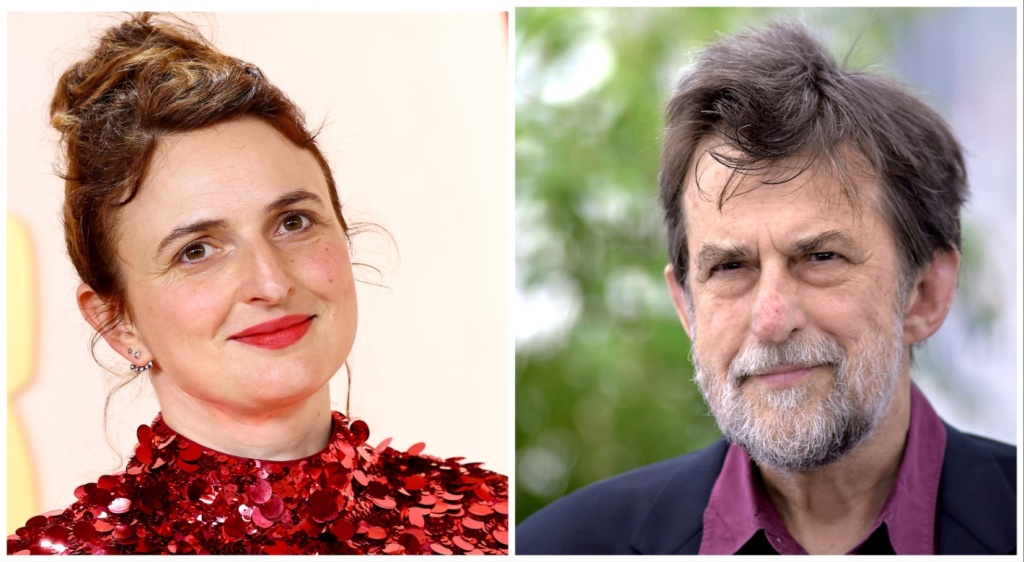
We caught up with two of this year’s Palme d’Or in the running Italian filmmakers, Alice Rohrwacher and Nanni Moretti, to chat about the state of Italian cinema. Moretti had the world premiere of A Brighter Tomorrow on Wednesday, the pic containing a swipe at Netflix and its algorithmic formula to grab audiences’ eyeballs in a pic’s first two minutes. Rohrwacher’s La Chimera makes it world premiere at Cannes this afternoon.
Moretti, for one, feels the pain personally:
“I have owned for 32 years now a cinema, and I know very well that the public is always less and less in the cinema,” says the 2001 Palme d’Or winner of The Son’s Room.
Still despite the bad news, Moretti believes that the cinema will “Keep intact. Is power, is energy, is strength.”
“In my opinion (streaming) platforms are okay for series, but for films and movies are adequate for cinema,” adds Moretti.
We’re in a time where it’s okay to be alone than with other people after this pademica,” reflects Le Pupille Oscar nominee Rohrwacher.
“(For) people, it’s very much better to see (a) movie in a collective experience. I do movies because I trust the collective experience. Maybe this is the main reason why I’m doing a movie. As part of the audience, not as director, for me it’s very important to go into a place, with people I don’t know and look all together at the same story and feel this view on this story all together, and exchange the feeling with people.”
Says Rohrwacher, “The cinema reunites the people.”
You can easily hear the impact of Tina Turner in the music of Yola, one of the greatest singers of our generation. But it goes far beyond any basic level of influence for this British-bred, now Nashville-based powerhouse. Before becoming a recording artist and Grammy nominee, back in her native U.K., she was a teacher and lecturer in vocal biomechanics who would instruct young singers in how to emulate Turner’s singular voice… or at least how to try.
Yola spoke with Variety about Turner, who died May 24 at age 83.These are some of her thoughts, on everything from Tina’s pure technique to the unique challenges she faced as a Black stylist without parallels or filters to her place in genre-bridging musical history.
In her progression of moving through R&B, becoming known as the Queen of Rock ‘n’ Roll, and then becoming this pop star, she was collecting these things along the way — not leaving any of them behind. Once she makes it to that point of being a pop superstar, the fact that you can hear the rock and the soul in her voice is what makes her pop interpretation that visceral, that urgent, that much richer for the journey.
I’ve talked about Sister Rosetta Tharpe and guitar and about the imagined riddle of how, if we took her out of the timeline, the number of things that would be changed would be terrifying. I posit a similar expression with regards to rock ‘n’ roll singing and Tina.
Tina always went down down big-time for us over in the U.K. “River Deep Mountain High” was huge there, even though it was a flop in the States. Of course she moved to Europe. I’ve literally done the anti-Tina thing, coming from Europe to the States. She actually inspired me directly to come to Tennessee, just to understand the backdrop of how someone like her is born and made. I visited a few places in Tennessee and eventually found myself in Nashville, but I made sure I got myself over in Memphis. There was something that out of her journey that drew me here. There’s not really a moment of her narrative that I can’t have some empathy for and be inspired by.
Yola performs onstage during MusiCares Person of the Year honoring Joni Mitchell at MGM Grand Marquee Ballroom on April 01, 2022 in Las Vegas, Nevada. (Photo by Kevin Mazur/Getty Images for The Recording Academy)
Getty Images for the Recording Academy
I spent a lot of time analyzing her voice; I was a voice scientist. If I want to be technical, she’s using parts of her voice that are often used in the operatic field. Opera singers always sound like they’re in full tears. It’s a technique called the crying tilt — a reflex in the musculature of your face that is designed to make babies loud and be able to cry forever without undue stress to the voicebox. It is highly favorable to recording and performance, and it’s been known to make people’s hair stand up on end, because of its proximity to crying, which is like a human alarm system that we are biologically predisposed to react to. Singers can put that on, but some people are more predisposed to that sob being heavy or being effective, and she had the bone structure to access that at such an extreme level.
I used to teach students Tina’s singing, saying, “Look at the posture she’s pulling in her face, and why” — like, what that does to the voice. Every time I had a student, I’d make them sit down and watch a video and really experience it and really eyeball what she’s doing. When they would actualy focus instead of just kind of watching it blithely, they would all say: I really felt that. What’s she doing? They would come away from watching the video with shivers. Very few singers can really really elicit involuntary feelings like that, whether it’s from music nerds or people that don’t even know what it is that they’re feeling. And it’s not down to a really massive social media presence!
There is a video of this alternative version of “River Deep Mountain High,” this kind of soul revue-type version, the Ike and Tina version [as opposed to the Phil Spector record], that I would zoom into. As she’s waiting for the next phrase, there are these three bars, where you can see her face is just searching for the tone; you can see her face moving before the vocal comes back. I watched that for years, just going: What’s she looking for? What she’s doing is as much of a feeling as it is a kind of technique. In fact, the feeling makes you find the technique, and the technique makes you find the feeling — and they’re not separate, conceptually. If you go into the crying tilt face, your body starts feeling a certain way so you can get yourself into a mindset. And that’s when I started realizing how it’s not just that we react to our biology, but we can create a reaction to our biology. I was like: Now, that’s good for performance! That’s good to know, that regardless of what is going on, I can get myself into a headset to be extremely present. That’s a really big part of what Tina gave to me. Being able to bring yourself out of whatever it is, be it a gazillion emails, be it a late arrival somewhere, traffic issues, or anything in life that could be distracting to you, and then being present to perform… she gave me a really great biohack for that. And anyone can try that. Literally anybody can try pulling a crying face, singing through it, and then moving their face around in a kind of cry-looking way, adjusting the different ways in which you can look sad through singing through it. Just the look alone, getting the reflex right, will start making you feel a certain way.
And that’s something that’s really important, I think, for people who have that kind of voice and haven’t found a place for it. They’re a rarer kind of voice. There aren’t a gazillion mes. I don’t have a lot of people to reference with regards to that kind of voice. And so she saved my life many times over, when it came to the what-to-do and the how-to-do-it.
Her kind of voice was welcomed during a certain R&B era, and certainly with the dawn of rock ‘n’ roll, to reference Sister Rosetta Tharpe and Little Richard and where the aesthetic comes from. That kind of blues-to-a-church-tempo wailing, it came from Black church; it’s African American history in its purest form. And as a result of it being that, it got whitewashed. People will say to to your face — I tell no word of a lie! — people will be like, “Could you lighten your voice up?” And they don’t realize what they’re mean. It’s almost like they’re saying, could you put some skin bleach on and be a white person? And I’ve been asked that personally as a session singer, before I was an artist, more times than I care to mention, for the idea of European appeal or European-descended appeal. And so there’s definitely an angle of leaning into that part of your voice that, for me, was like resistance to being whitewashed: No, look, I’m gonna show you the full range of what I am, what I can do, what my body does naturally. I’m not going to filter that for anyone else’s pleasure but my own.
You’d hear that in people’s narratives all the time. I think I remember seeing something saying that people tried to encourage Whitney to sweeten up her voice a little bit at times; she’d heard that narrative. You’ll hear across the ages of people where that’s been a note on their voice. I don’t doubt that part of the Motown dynamic of vocal production would’ve been: “If you wanna do that gravelly stuff, go down to Stax in Memphis.” And so there’s a really big part of Tina’s aesthetic narrative that provides a route to resisting that. Because you don’t always realize how much that kind of aesthetic erasure feeds back into this sense of disassociation from ownership of certain genres. The second that something gets whitewashed or colonized, you’ve ceased to be able to recognize your ownership of it or where you or your ancestors had anything to do with it. And so having people like Tina manifest the full range of their voice, and more importantly, have more than one tone in their voice… She had multiple tones as a singer, and such full expressive range. And to not be reduced to one or possibly two tones if you’re lucky, and that’s it… and if you sing these kinds of songs, “Don’t gravel it up too much,” because that’s terrifying! You need the examples of people to show you how to do that in a way that’s tasteful… and that it’s also not painful. Because, beyond seeing that style go out of fashion, if you have gravel, you’ve got a higher-risk voice.
In the ‘90s, when I was growing up, it wasn’t in-vogue to have that kind of breakup in the voice. The clean-voice generation knocked it out of me! At the high-frequency application of the crying tilt, Tina had this brilliant breakup that turned into a scream. It was like blowing an amp. The low-frequency application of that was a sob. And for me, it was essential to have a model who exemplified that style of singing, who was not unmelodramatic with it. She was a technical inspiration for me as well as a career-arc inspiration of how to keep on redefining yourself on your own terms. Even though it was arduous, the message was: Keep trying. Keep reinventing. Keep moving to whatever your true north is.
What she had was not down to any of the stylistic bells and whistles that people make you buy into — although she was always dressed to the fricking nines. Even with all of the glamour and the beauty, her artistic ability was so profoundly undeniable that it’s at your peril that you focus on that less than you do the acres of leg.
We can fall into a number of pitfalls talking about her — one being the “strong Black woman” paradigm. “Oh, wasn’t she strong and resilient?” It’s like if I said to you, “You are really great at taking a punch in the face.” It doesn’t sound like a compliment, does it? It’s preferable to not being good at it, but I know I don’t want that to be the overarching thing that people remember about or associate with me — there are more winning parts of my personality! The pornography of Black trauma for non-Black people is an unhealthy arc. And people don’t always realize that their attempts at what feels like co-signing, or supporting, or even activism can start masquerading their need to absorb Black pain, to feel like they’ve witnessed the process, as if that’s the work— and all the while, the person is having to relive the worst parts of their life. It’s a price that gets paid.
There were points at which Tina was like, “I don’t know if I wanna do this,” like with the documentary she recently did, because she didn’t want to just have to be perpetually reliving this shit. I never want to be dismissive of the impact of stories of coming out of abuse in a relationship, or in any dynamic; it’s something I feel very profoundly passionate about. But it can overshadow the greatness conversation. There’s something very heartbreaking about her loss because we feel like she deserved more joy in her life, and part of that root might have been saving less people and just being fucking happy, rather than reliving the worst parts of your life for the sake of other people’s entertainment. I posit we’ve had more documentaries about how hard Tina’s life has been than about how iconic her influence has been.
I project that concept outwards toward Tina and I go: Therein lies some really authentic genius. We struggle to talk about women and genius, and even more so Black women and genius. You know, the number of times I’ve heard someone talk about a white guy with a guitar that’s a genius that has literally written a C, D and G-chord song — and yes, maybe the words are super poignant and it’s well deserved, but it would be easy also to overlook it because it’s a , D and G-chord song. Yet we never miss the opportunity. And so when you look at something that is totally more complicated and we ain’t saying shit about genius… We talk about people like Sinatra when it comes to delivery. If we are to talk about Sinatra’s famous timing and how that was genius, then we have to be able to talk about Tina’s pioneering timing and tonality and how that was genius.
And, in the same way, how it was an aesthetic that became indelibly marked in popular culture. I’ve never seen so many different kinds of people on my timeline respond to someone passing. … Her singing was true to its roots by going, “Hey, you can hear the church in this, you can hear the blues in this, you can hear the soul in this, you can hear every stop — all the way to me being a pop star. You can hear every single permutation of music history in my voice.” It’s not like everyone has to do that, but it’s an important that we have someone that does that, so we can reference it at all.
One of the things that is really profoundly important is that idea of being able to be not necessarily genre-agnostic, but to be a person that is a collection of their life experience and musical experience, and to merge that into your identity to the point where you are irreplaceable and inimicable. And I think that’s something that gets increasingly discouraged in music, not being put in a box. It’s easy to convince people there’s no other way to operate and you have to conform. But if that isn’t the hardest thing you’ve had to deal with, then you just do it. Whoever those people were, they weren’t the pinnacle of her life challenge, or the toughest people to freaking negotiate with in her life. It’s almost like she’d been to the gym for bullshit, and she’d just done more squats than everyone else!
There’s something for me that was profoundly important with regards to her range and how, even in the hardest parts of her life, she never lost that sense of ownership of expression. Some singers are scared to be that emotional. When you sing like that, it physically feels chemically different in your body. It’s not easy if you are struggling to be that present with things. This was vulnerability from a Black woman. It’s a great sense of sacrifice, bravery, honesty and self-love to not filter that.
Recently, Reddit user friedbabiesfordinner (wow, what a name), asked the people of r/Disneyland if they knew any “useless Disney facts?” And, despite being categorized as “useless,” I actually found some of the info really interesting. Check it out:
Note: some of the info below couldn’t be verified because it’s based on personal/insider info, so take those with a grain of salt, ya know?
Venom is such an iconic villain within Spider-Man’s lore that he tends to crop up in many of the Webslinger’s stories. However, it wasn’t until the post-credits tag of the first game that he was properly teased for the gaming universe.
Peter’s outfit wasn’t the only difference for the webhead—he seemed far more aggressive than usual.
Yuri Lowenthal on Symbiote Spider-Man
Marvel
When The Direct was in attendance at Yuri Lowenthal’s MomoCon 2023 panel on Saturday, May 27, the actor behind Peter Parker in Insomniac’s upcoming Spider-Man 2 game teased what’s in store for his hero.
Lowenthal teased how fans “have no idea” and that “there’s a lot of colors” in his Symbiotic performance:
“You have no idea… I think they dropped that [footage]… and I’m so glad they finally showed something… We took extra special care for when Spidey is just regular go-happy-lucky Spidey and when Spidey gets something going on [with the Symbiote]. And there’s a lot of colors. You saw some of them in the trailer they just dropped, but you ain’t seen nothing yet.”
Lowenthal was then asked what the team’s direct inspiration for Symbiote Peter Parker was, explaining how it had to be “rooted in reality:”
“We worked really, really hard, as a team to find what was the right thing because sometimes it just sounded comical when I would just, you know, rage… We had to find the levels and we have to root it all in, even though it’s not a real thing, we need to be rooted in reality.”
The actor revealed that they “looked at addiction in people” and their behavior to best portray Peter’s compulsion to the Symbiote:
“And, a lot of it came from… We looked at addiction in people and what the behaviors of addiction are. That’s really what we went to for inspiration and to find the levels of it. It’s not always the same, you know, every time. So yeah, addiction would be my simple answer.”
As for his own process of performing those darker moments in any of his characters, accessing that anger is something the actor feels everyone has. But when he needs to utilize it, he does need to “dig a little harder” than his usual happy-go-lucky performances:
“I think we’ve all got [that anger inside]. Sometimes it’s just… it’s just harder to access or easier to access, you know, depending on how close to the surface it is… Before I started doing Sasuke, I had only played sort of like plucky young heroes that didn’t have anything bad happen to them. And so, to sort of turn that around, I had to dig a little bit, but I’m generally a happy guy. But, you know, I’ve got rage and anger and sadness, and you just gotta dig a little harder…”
Spider-Man Gets Aggressive
One of the most praised parts of the new footage from the game was not only the new Symbiote suit design and gameplay but how Yuri Lowenthal delivered subtle changes in performance.
He wasn’t comically enraged or full-blown emo like Tobey Maguire in Spider-Man 3–it felt natural. But the change was just enough to catch fans’ attention.
The footage from Spider-Man 2 ended just as Miles Morales started to notice how off Peter was, which indicated that it was just the beginning of Pete’s downfall with the Symbiote. But how much will he damage his personal life before realizing he needs to ditch the parasitic outfit?
Green Lantern #1: Spinning out of the events of Dark Crisis, the Guardians of Oa at the heart of the Green Lantern Corps have quarantined Sector 2814, home of the planet Earth—and its champion along with it! A heartbreaking defeat has sent Hal reeling, returning home to rediscover his roots…and find the man responsible for ruining his life: Sinestro. From the visionary team of Jeremy Adams and Xermanico omes a tale of redemption, loss, and finding out that maybe…just maybe…you can go home again. At least if you’re willing to hot-wire a power ring to do it. Also featuring part one of John Stewart: War Journal from writer Phillip Kennedy Johnson and artist Montos!
Positives
One thing that I’ve love about the Dawn of DC initiative is that DC is giving many of their long-time characters a more familiar status quo – but with new elements that show the characters have evolved and are still evolving. There is no wholesale retconning of DCU history back to the pre-Flashpoint era. Instead, their history through the New 52 and Rebirth eras are acknowledged and kept as part of each character’s backstory. However, some of the changes from those eras may be reversed or undone, they still happened.
After several years of Hal’s solo adventures centering around adventures in outer space and other dimensions, Jeremy Adams has brought Hal Jordan back to Earth, looking to resume his old job as a test pilot for Ferris Aircraft and rekindle his romance with Carol Ferris.
The issue’s introductory text gives us some interesting information. The Guardians of the Universe have disappeared, which seems a bit repetitive. How many times have the Guardians disappeared so far? But the important thing is that they seem to be out of the picture for the time being.
Positives Cont.
Also, the United Planets seem to have been making some surprising moves. They have seized control of the Green Lantern Corps. However, they seem to have a a secret agenda concerning Sector 2814, home of the planet Earth. They have declared it an “unsafe liability” and reassigned Earth’s Green Lanterns to other sectors.
This sounds somewhat nefarious. It seems someone powerful in the UP has plans for Earth, and they don’t want Earth’s Green Lanterns to interfere. This sounds very unlike the United Planets Brian Michael Bendis established in his run on the Superman books. The UP Bendis established was somewhat in awe of Superman and were generally well-disposed to Earth and its heroes.
It sounds like some corrupting influence has infiltrated the UP. While it’s spells bad news for Hal and his allies, it certainly provides a more fertile ground for interesting stories than Bendis’ original concept.
Also, we see that Sinestro is also on Earth. Is he mixed up in whatever is going on with the United Planets? Or is he got his own agenda. Whichever s the case, it’s only inevitable that he will be causing trouble for Hal in the upcoming months.
Positives Cont.
Given that Hal has been a full-time space cop for the past several years, younger readers might not be aware of Hal’s employment troubles. In the 60s and 70s Hal went through periods where he had been fired from Ferris Aircraft and tried a number of other day jobs to make ends meet. Carol doesn’t appear happy to see him and he gives a disastrous performance in the flight simulator this issue. So, it seems unlikely that he’ll be going back to his old test pilot job soon.
Speaking of which, the presence of the flight simulator was a nice callback to Hal’s origin story. In that story, Abin Sur summoned Hal to him, bringing along the flight simulator Hal was using along with him.
And the villain that Hal encounters, Steel Fury, is wearing armour created from a Manhunter robot. And the Manhunters were created by the Guardians as their first attempt at creating a cosmic police force. I wonder if this is just a reference to Green Lantern history or a tease that the Manhunters might be making a return.
This issue also includes a backup story featuring John Stewart. We are shown that John is also on Earth. This leads me to wonder if this story is set before the United Planets quarantined Sector 2814. Or if John has also quit the Corps and returned to Earth.
Positives Cont.
However, we only see John on Earth briefly before Phillip Kennedy Johnson moves the action to a parallel Earth. Here we see Guy Gardner and another unnamed Lantern attacked by a villain called the Revenant Queen, who is seeking revenge on John Stewart. Presumably, she would be after that Earth’s John, but I suspect she will be coming after his Earth-0 counterpart.
Negatives
Overall, I liked the Hal story in Green Lantern #1 better than the backup. But, it’s still unclear what’s going on in the latter, so I will have to reserve judgement on this story for now. What Johnson’s shown us so far is intriguing, and he is a capable writer, so I am optimistic he will deliver a great story. But will it outshine Adams’ main feature? That remains to be seen.
Verdict
Both Adams and Johnson provide intriguing jumping on points for their Green Lantern stories which are bolstered by superb artwork from Xermanico and Montos, respectively. While the John Stewart backup is intriguing, my attention is primarily drawn to the main story. Jeremy Adams has worked true magic for Wally West. So, I am eagerly looking forward to see if he can do the same for Hal Jordan.
During the PlayStation Showcase, we had our first glimpse at Destiny 2’s trailer for the Final Shape, the last expansion in The Light and Darkness saga. And while many expected to see the Witness, many were shocked to see Cayde-6 instead.
Cayde-6 Might Not Be Dead in Destiny 2
Guardians are defined by two things: their role as Chosen by the Traveler and their immortality. Immortality that is conditioned on the survival of their Ghost. Which makes losing a Guardian even more painful.
And few deaths rocked the Destiny 2 community, like the loss of Cayde-6, the Hunter Vanguard. Cayde-6 was there at the very beginning of Destiny 2, offering guidance and a sense of levity that balanced out Zavala and Ikora. And in times like the Red War, his ability to find humor and joy in things made him well-beloved by many Guardians.
Which is why his death in 2018, during the breakout of the Prison of Elders, shook so many to their core. But now it looks like Cayde-6 might be back. In The Final Shape trailer released during the PlayStation Showcase, we see Ikora speaking to Cayde-6 atop a lush mountain. Cayde-6 is geared with what looks like his iconic Ace of Spaces Hand Cannon. But now, it has the spectral Taken treatment, and in the sky above, there’s the pink triangular portal that the Witness cut into the Traveler.
Is this the other side of the portal? How was Cayde-6 resurrected? Where is his Ghost? Why does his weapon have that Taken sheen? How is Ikora there, or is she even there at all? There are so many questions, and we’ll likely have to wait to learn those answers. On August 22, 2023, Destiny will have its own showcase, which will delve a little more into this much-anticipated expansion.
My theory is that Cayde-6 has been teleported to a pre-Golden Age earth by the Traveler itself, which is why he has no Ghost. But that’s all based on less than a minute of footage, so take that with a grain of salt.
Destiny 2 has gotten quite a few updates recently, with its recent release of the Season of the Deep. This Season allows players to explore the methane oceans of Titan, and it’s handed quite a few new Exotics. Including the very Arc Exotic Auto Rifle, Centrifuse. Here’s how to make that gun yours: How to Get the Centrifuse Exotic in Destiny 2.
The U.K.’s London Indian Film Festival and Birmingham Indian Film Festival will work together to present a two-city, two-part panoply of feature and short films, kicking off next month with “The Storyteller.”
Directed by Ananth Mahadevan, “The Storyteller” sees Adil Hussain play a Gujarati businessman who believes that once physical wealth is accumulated, happiness will follow, but this proves not to be the case. Paresh Rawal plays the titular storyteller. The film is based on a story by the late, great Bengali filmmaker Satyajit Ray and contrasts the pursuit of material wealth with that of intellectual knowledge. Hussain, co-star Tannishtha Chatterjee and Mahadevan are expected to be on hand for Q&A sessions on June 22 at BFI Southbank and on June 23 at MAC Birmingham.
The “Storyteller” screenings represent the first element of a short summer season. The main festival in London, Birmingham, Manchester and Leeds will take place Sept. 7- 14, and is expected to showcase premieres of features, documentaries and shorts, as well as new South Asian series, gaming and XR.
The summer season also includes high-impact documentary “To Kill A Tiger,” a harrowing, but ultimately hopeful story of a village teenager and her loving father, who fearlessly take on their society, demanding justice; comedy drama “The Effects of Lying,” prior to its ITVX release; N Padmakumar’s anime-themed “Max, Min & Meowzaki”; the European Premiere of U.S. documentary “Call Me Dancer,” directed by Leslie Shampaine and Pip Gilmour; and debut feature “Amar Colony,” by director Siddharth Chauhan.
London’s Barbican will also host a showcase of “Fire” and “Earth,” by director Deepa Mehta and starring actor Nandita Das.
Completing the June in-cinema season is the festival’s most popular annual shorts program Too Desi Too Queer, which will include the world premiere of documentary “Discovering Kali – 25 years of the Legendary Club,” charting the ascent of the British Asian LGBTQIA+ scene.
Both festivals are backed by The Bagri Foundation, a non-profit organization.
Taylor Swift and rapper Ice Spice made their brewing partnership official last night, with Swift bringing out the “Munch” performer at her latest Eras Tour show in New Jersey last night. Swift busted out the surprise guest spot alongside premiering a new video prominently featuring the two of them in various fantastical scenes, in which, say, Ice Spice is a cloud floating genially over a Taylor Swift landscape, or serves as her personal musical gondola passenger, a prized position in the sprawling Gospel Of Taylor.
Taylor Swift ft. Ice Spice – Karma (Official Music Video)
As noted by Variety, Swift actually played her and Ice Spice’s new remix of tour-closer “Karma”—off of Swift’s latest, continually tinkered-with album, Midnights—twice for the crowd of people who managed to secure tickets to the show at Jersey’s MetLife Stadium. First, she played the above video, which was then released at midnight last night—because we don’t know if you’ve heard, but T-Swift is seriously into this whole Midnights thing—before bringing the rapper out on stage for a live performance. This, at the end of what was already a three and a half-hour concert, because say what you like about the blood sacrifices required to get those tickets, but Swift does seem bound and determined to give the lucky attendees their money’s worth.
Taylor Swift speaks at NYU graduation ceremony
Ice Spice burst onto the musical scene last year when “Munch (Feelin’ U)” began taking off on TikTok. Since then, she’s released an EP, January’s Like…?, and collaborated with Nicki Minaj for a remix of one of the songs off of it. The new version of “Karma”—in which Ice Spice adds to the list of things that are karma, which Swift has already explained is both her boyfriend and a cat—has been released on both of the special editions of Midnights, Til Dawn and The Late Night Edition.
Although a few prizes have already trickled out over the last few days, today marked the big awards celebration for the Cannes Film Festival, where the Palme d’Ors are separated out from the Palme d’Nors. (Sorry.) The festival’s jury got together today to highlight the best films from the fest, with the top honor ultimately going to Justine Triet’s Anatomy Of A Fall, one of two films starring Toni Erdmann’s Sandra Hüller to win big at this year’s festival.
Anatomy of a Fall (Anatomie d’une Chute) new clip official – Cannes Film Festival 2023 – 1/2
Anatomy received the prestigious Palme d’Or today, having previously drawn strong reviews for its courtroom drama depiction of a marriage that was already falling apart before the husband died in somewhat mysterious circumstances, leaving the wife (Hüller) to stand trial for his death. Jane Fonda presented the award to Triet, who becomes only the third female director (after Jane Campion and Titane’s Julia Ducournau), to receive the honor.
Why Christian Bale would love to be friends with Burt Berendsen
Hüller also starred in this year’s Grand Prix winner—typically thought of as “second place” for the films in competition: Jonathan Glazer’s Holocaust drama The Zone Of Interest, the director’s first film since 2013’s Under The Skin. Based on the book by the late Martin Amis, the film focuses on the day-to-day life of the family of the commandant of the Auschwitz concentration camp—who live in bland denial of the horrifying evil standing in the literal background of their supposedly idyllic lives. Christian Friedel co-stars as real-world Nazi Rudolf Höss.
As for the Jury Prize, the jury, having run out of Hüller to celebrate, instead gave it to Aki Kaurismaki’s Fallen Leaves. As for the directing and performance awards, Best Director went to Tran Anh Hung for The Pot Au Feu, Best Actor to Kōji Yakusho in Perfect Days, and Best Actress to Merve Dizdar for About Dry Grasses. Sakamoto Yûji won Best Screenplay for the Japanese drama Monster.
May December is an upcoming movie starring Natalie Portman and Julianne Moore that Netflix has just acquired the rights to at the Cannes Film Festival. The figure is said to be a whopping $11 million and just for North America.
The movie was directed by Oscar-nominee Todd Haynes (Far From Heaven, The Velvet Underground) and written by Samy Burch with the script selected for 2020’s The Black List.
Haynes commented on the Netflix news right on location at Cannes:
Article Continues Below…
Director Todd Haynes on Netflix’s overnight purchase of ‘May December’: “It’s just made all of us feel emboldened…” #Cannes
Netflix’s May December premiered at the Cannes Film Festival and, at the time of writing, has an 89% Rotten Tomatoes score based on 35 critic reviews. The Independent wrote: “May December is a film without frills or special effects. It’s a closely focused character study, galvanised by the tremendous performances from Portman and Moore, which delves into areas more conventional dramas don’t go near.”
Times also praised the film: “An intensely compelling film about Hollywood vanity, interpersonal sadism and the human capacity for self-deception.”
Filming for the movie took place in Savannah, Georgia, between October and November 2022, with the movie having a runtime of 113 minutes.
What’s the plot of May December?
Here’s the synopsis for Netflix’s May December:
“May December refers to the nature of a scandalous romance between a married woman and a 13-year-old that was a tabloid staple when it happened 20 years ago. As happened in the May-December romance between teacher Mary Kay Letourneau and Vili Fualaau, Moore’s character served time for seducing an underaged teen, but eventually married the youth, and they moved away to raise a family and live quietly. The film’s trigger is the interaction between the couple and an actress (Portman) who travels to Maine to study the life of the woman she will play in a film. Sparks fly between the three of them as unresolved issues resurface in a romantic drama.
Twenty years after their notorious tabloid romance gripped the nation, Gracie Atherton-Yu and her husband Joe (twenty-three years her junior) brace themselves for their twins to graduate from high school. When Hollywood actress Elizabeth Berry comes to spend time with the family to better understand Gracie, who she will be playing in a film, family dynamics unravel under the pressure of the outside gaze. Joe, never having processed what happened in his youth, starts to confront the reality of life as an empty-nester at thirty-six. And as Elizabeth and Gracie study each other, the similarities and differences between the two women begin to ebb and flow. Set in picturesque and comfortable Camden, Maine, May December is an exploration of truth, storytelling, and the difficulties (or impossibility) of fully understanding another person.”
In an interview with Haynes, the prolific director said the movie “explores one of the great capacities of the human species: our categorical refusal to look ourselves in the face.”
No trailer for the movie has been released as of yet, although a short clip was released to the public during the 2023 Cannes Film Festival:
More clips of the cast and crew can be found on the official page for the movie on the Festival-Cannes.com website.
Who is cast in May December?
Netflix’s May December is led by stars Natalie Portman and Julianne Moore. Portman, who has only starred in one Netflix Original called Annihilation (although it wasn’t available in the US), plays the role of Elizabeth and Moore (who starred in Netflix’s The Woman in the Window and narrated The Mind: Explained) plays Gracie.
They are joined by Charles Melton, Jocelyn Shelfo, Cory Michael Smith, and Piper Curda.
What’s the Netflix release date for May December?
Netflix hasn’t announced the release date for May December yet, but we are expecting some time this year. We must note that Netflix will only distribute the movie in North America.
UPDATE: French filmmaker Justine Triet has become only the third woman to win the Cannes Film Festival’s top prize Palme d’Or in the event’s 76-year history, scooping the award for Anatomy of a Fall. She joins Jane Campion (1993’s The Piano), and, more recently, Julia Ducournau who won for Titane in 2021 (Ducournau was also on the jury this year).
Anatomy of a Fall follows Sandra (Sandra Hüller), a German writer, her French husband Samuel, and their eleven-year-old son Daniel who live a secluded life in a remote town in the French Alps. When Samuel is found dead in the snow below their chalet, the police question whether he committed suicide or was killed. Samuel’s death is treated as suspicious, presumed murder, and Sandra becomes the main suspect.
In his review, Deadline’s Damon Wise called it “a cerebral smash” that “subvert(s) the pleasures of genre convention to explore issues of schadenfreude and plain morbid human curiosity.”
Neon picked it up during the festival, giving the distributor bragging rights to the four latest Palme d’Or winners including Triangle of Sadness, Titane and Parasite.
Triet was preceded on stage by Jane Fonda who spoke before jury president Ruben Ostlund announced the win. Said Fonda, “The last time I came (to the festival) was 1963, a lot of you weren’t even born yet… There were no women directors competing at that time and it never occurred to us there was something wrong with that… We have progressed, but we have a long way to go.” Still, she noted, perhaps presaging what was about to transpire, “We have to celebrate change when it happens. This year is the first time there are seven women directors in competition.”
Triet was emphatic in her acceptance, saying she couldn’t be content to only speak of the “joy” she felt, but also addressing the recent social unrest in France over retirement age reforms.
She said, “This year, our country has experienced a historic dispute… This dispute was denied and suppressed in a shocking manner, and this pattern of increasingly uninhibited dominating power is breaking out in several areas; obviously socially is where it is the most shocking, but we also see it in all spheres of society, and the cinema is no exception. The commodification of culture that the neo-liberal government is defending is breaking the French cultural exception. I dedicate this prize to all young female and male directors and to those who today are unable to make films. We see ourselves making room for them, this place that I took 15 years ago in a world that was a little less hostile which still considered it possible to make mistakes and start over.”
Earlier in the evening, Quentin Tarantino appeared on stage to introduce Roger Corman. The 97-year-old filmmaker and mentor to countless others, received a standing ovation and called Cannes “the most interesting film festival in the world.” To the audience, he said, “You are really lucky to be a part of it.”
Other winners included Jonathan Glazer’s The Zone of Interest which took the Grand Prize; Tran Anh Hung who scooped Best Director for The Pot-au-Feu; and an absent Aki Kaurismaki, whose Fallen Leaves was given the Jury Prize. (See below for the full list of winners.)
John C Reilly, meanwhile, introduced the prize for Best Screenplay (Yuji Sakamato, Monster) and, without directly mentioning it, made reference to the ongoing WGA strike. As he arrived on stage, he paused for a good while without saying anything. When he finally spoke, he said, “What we just experienced is what a movie would be like without screenwriters.”
PREVIOUS, 11:30AM PT: The 76th Cannes Film Festival is wrapping up this evening with the main awards, including the Palme d’Or, to be handed out by Ruben Ostlund’s jury inside the Palais. Scroll down for the list of winners which is being updated as prizes are announced.
It’s been a busy and buzzy fortnight here on the Riviera, kicking off with Johnny Depp-starrer Jeanne du Barry and continuing with the starry world premieres of Indiana Jones and the Dial of Destiny and Martin Scorsese’s Killers of the Flower Moon, all out of competition. In the main race are 21 films including titles from high-profile filmmakers like Wes Anderson (Asteroid City) and Todd Haynes (May December) as well as previous Palme d’Or winners Nuri Bilge Ceylan (About Dry Grasses), Nanni Moretti (Il Sol Dell’Avvenire), Ken Loach (The Old Oak), Wim Wenders (Perfect Days) and Hirokazu Kore-eda (Monster).
Receiving among some of the best notices have been Jonathan Glazer’s The Zone of Interest, Alice Rohrwacher’s La Chimera and Aki Kaurismaki’s Fallen Leaves alongside Perfect Days and May December.
Still, it’s all up for grabs as Cannes juries are anything but predictable. This year’s includes two-time Palme d’Or laureate Ostlund as well as director Maryam Touzani, actor Denis Ménochet, writer/director Rungano Nyoni, actress/director Brie Larson, actor/director Paul Dano, writer Atiq Rahimi, director Damián Szifron and director Julia Ducournau.
We’ll know more in just a little bit, so check back as we update the winners below:
Palme d’Or Anatomy of a Fall, dir: Justine Triet
Grand Prize The Zone of Interest, dir: Jonathan Glazer
Best Director Tranh Anh Hung, The Pot-au-Feu
Jury Prize Fallen Leaves, dir: Aki Kaurismaki
Best Screenplay Yuji Sakamato, Monster
Best Actress Merve Dizdar, About Dry Grasses
Best Actor Koji Yakusho, Perfect Days
Camera d’Or Inside the Yellow Cocoon Shell, dir: Thien An Pham
Short Film Palme d’Or 27, dir: Flóra Anna Buda
Special Mention: Far, dir: Gunnur Martinsdottir Schluter
The rapper (real name Clifford Harris) and Tiny (Tameka Cottle) initially sued MGA Entertainment for allegedly stealing the name, likeness, and trade dress of OMG Girlz — the pop trio Tiny founded in 2009 — when the company launched its “L.O.L. Surprise OMG” dolls in 2019.
The case first went to trial in January, but a mistrial was declared after T.I. and Tiny’s lawyer — who was previously warned about arguing that the toymakers “misappropriate the likeness of Black female artists” — accused MGA of “racist cultural appropriation.”
Following the verdict, MGA CEO Isaac Larian called T.I. and Tiny’s lawsuit a “shakedown.” “I’m not happy because I wasted a lot of time, energy — my employees’ time, energy — to deal with an extortion,” Larian said. “They knew from the beginning they don’t have a case, and they brought it anyways. And they picked on the wrong guy.” (Larian also quipped that he’d celebrate his victory by “going to go buy a yellow dress and color my hair pink,” a nod to one of the dolls in question.)
While their legal battle with T.I. has ended, MGA’s war over the Black Eyed Peas rages on: Back in January, BMG sued the toymaker, alleging that a jingle dubbed “My Poops” — used to market a line of slime-shitting unicorns — infringed on its copyright to the Black Eyed Peas’ 2006 hit, “My Humps.”
Directed by Matt Bass, Sk8face is the first of its kind: a documentary chronicling the history and pop culture prominence of skateboard art. The film begins with a brief overview of how skateboarding came to be and its rise to the mainstream. Then it launches into the art featured on the bottom of the boards. Who first put it there? Did anyone ever launch into the big time by doing skateboard art? How do the skaters feel about the images representing their beloved sport?
Bass wastes no time, as he expertly lies out the chronological history of art through sport. Featuring interviews with Tony Hawk, Neil Blender, Tony Alva (an original Z-Boy), and sports photographer Wynn Miller, no stone is left unturned. Every interviewee (and there are a TON of them) is excited to discuss skateboarding, art, skateboard art, or the general zeitgeist during any given era. See, the film goes all the way to the modern day, where the images that originated on boards can be readily worn on tee shirts. It is this wide-ranging coverage that makes the film so compelling.
“…the history and pop culture prominence of skateboard art.”
Also helping Sk8face keep viewers engaged is how it highlights all the various styles of skateboard art. The ending credits are a highlight reel of multiple artists’ images on boards. However one feels about the sport itself, it is impossible to ignore the impact and statement of these artworks. They are bold, colorful, playful, and crazy, much like the skaters themselves.
Sk8face is an interesting documentary chronicling an underrepresented art form’s impact. While it gets repetitive (seriously, every milestone is touched on in detail), Bass does a fine job letting the skaters, artists, skater artists, and everyone in between speak for themselves. But the ending credit sequence is worth the price of admission all by itself.
She added: “I always wanted to get married on June 21. It’s [the] summer solstice. I was like, ‘What if she doesn’t make it to June 21?’ She ended up getting really sick [in the] end of January. And so I said, ‘Let’s have a mini little wedding because she won’t be able to make it to Mexico anyway. A little mini wedding just for her. A special little one for us, for her.’”
Clare Crawley with her mother Lilia.Courtesy of Clare Crawley/Instagram
Crawley’s mother, Lilia, had previously been diagnosed with dementia, which took a turn for the worse amid her wedding plans. As a result, the couple decided to hold an intimate ceremony with just her mother and Dawkins’ two daughters from a previous relationship as witnesses.
“We wanted to make it tiny. Everybody [else] was going to come to the big wedding,” the hairstylist emotionally recalled to host Chris Harrison. “But my mom ended up getting really, really sick the day before. She wasn’t able to make it. She’s OK still, but she was just really sick at the time and couldn’t leave the nursing home.”
“Ryan, by nature, is an event planner, so he planned the whole wedding. I was kind of frozen with, ‘What do we do?’ It was very last-minute stuff and I was so worried about my mom,” Crawley added on Thursday. “But he took the reins, he planned everything.”
She continued: “We had a little ceremony. We had the best vows to each other, super personal. It was in the spot [where] we had our first kiss. It was just the greatest little spot.”
“I wasn’t ready to date again,” The Bachelor Winter Gamesalum exclusively told Us Weekly in October 2022 of meeting her now-spouse. “The second that I was single he was like, ‘Let me take you out.’ And he knew that I was in such a low point and I told him I wasn’t even ready to go out to dinner.”
John Allen, the former U.S. Navy SEAL turned hit podcaster known as MrBallen, is set to host an original audio series focused on medical horror stories and miracles that will debut later this fall.
The show, MrBallen’s Medical Mysteries, is the first co-production between Wondery and Ballen Studios, Allen’s content company that struck a major first-look and distribution deal with Amazon Music last year. Taking on a similar fascination for mysterious circumstances as the original MrBallen Podcast: Strange, Dark and Mysterious, which moved over to Amazon Music last November and has topped the company’s podcast charts, the new Medical Mysteries show will dive into stories of unexplainable deaths, unknown diseases and miraculous recoveries, according to Amazon.
New episodes of MrBallen’s Medical Mysteries will release early on Amazon Music and Wondery+ before going wide on all major platforms.
“Wondery knows firsthand from our success with our Dr. Death franchise how chilling and compelling medical stories can be,” Marshall Lewy, the chief content officer for Wondery, said. “No one can tell a story like MrBallen. That’s why he’s amassed such a beloved fan base.”
Medical Mysteries will serve as the latest content expansion for Ballen Studios, which was formed in 2022 by Allen and Nick Witters, a former talent manager at Night Media who now serves as the CEO of Ballen Studios.
Earlier this week, Ballen Studios also launched a management division, Ballen Management, for storytellers within the “strange, dark and mysterious” content genre. The division has signed, alongside UTA, the YouTube creators Ryan “Nexpo” Cantu and Nick Crowley for representation.
From the Palme d’Or for “Parasite” to a stint on the following jury to a Best Actor prize all of his own with last year’s “Broker,” Song Kang-ho has become a recent fixture at Cannes. This year he made a late-break for Croisette with “Cobweb,” a slight-but-entertaining film about the movies from director Kim Jee-woon. Premiering late and out of competition, “Cobweb” doesn’t equal the films that made Song the new king of Cannes, but it certainly has style to burn and plenty to admire.
Of course, the South Korean star and his “Cobweb” director go way back, as Kim first launched Song’s career with 1998’s “The Quiet Family” and then nourished it with blockbusters like “The Good, the Bad, the Weird” and “Age of Shadows.” Those intertwining paths certainly tangle in this latest collab, which finds Song playing a filmmaker also named Kim.
Don’t expect much autobiography in this ’70s-set exercise in style that tracks a beleaguered crew and the film they are making. While both pictures share the same title, only one could be described as a racy-drama-horror-creature-feature-disaster-movie hybrid (guess which). Moving between film-in-film in black and white, and Kim’s production travails in color, “Cobweb” plays with the codes of mid-century Korean cinema while setting them against the controlled chaos of the filmmaking process.
And, boy, is it ever chaotic. We open on (the fictional) director Kim as he’s already wrapped his latest potboiler, only something nags at the man whose career peaked with his first film and has gone steadily downhill ever since. Perhaps with a few days of reshoots, with just a tweak here and a new scene there, he might rescue his next film from the laughingstock and once again make his mark. But doing so will require calling the full cast back, holding onto the sets due for dismantling and – above all – getting his script revisions passed by the censorious Ministry of Culture.
As the color narrative thread tracks an unending process of problem-solving – a marathon of securing the sets, winning over financiers, dealing with actors too drunk to perform, and eventually locking the full cast and crew on set to force a mammoth 48h hours of reshoots – the black and white strain brings that vision to life to delightful effect. That this film-within-a-film already has a pitched and nervy string score is just one indication that this version of “Cobweb” is the finished film run in parallel, and not just the footage Kim and crew are capturing on set. Only, to the film’s slight detriment, the Movie Movie strand offers a far more interesting proposition.
The film’s flaws are very much inherent to the greater design because exploring the chaos and tradeoffs of a film shoot cannot yield that many surprises, whereas the black-and-white film-within-a-film marks new land. Every time we return to the marathon reshoot we basically know what to expect, where the story will go, and how Kim and his crew will react. And every time we plunge into a note-perfect recreation of mid-century outré fare we are once again subject to surprise as the fictional “Cobweb” revises and reforms on the fly.
Inspired to a certain degree by the 1960 film “The Housemaid,” the movie version overlays family melodrama with horror elements while echoing the general chaos of the set in often unexpected ways. Director Kim Jee-woon is alight within a stagy visual playground that offers a chance to let loose, fully merging with his on-screen avatar as directors fully at play.
Ingrid Haebler, a pianist who drew particular acclaim for her performances and recordings of the works of Mozart, impressing critics while still in her 20s with elegant interpretations that set her apart from other musicians of her day, died on May 14. She was believed to be 96.
Decca Classics, which last year released “Ingrid Haebler: The Philips Legacy,” a boxed set of dozens of recordings she made for the Philips label, posted news of her death on Facebook. The Austrian newspaper The Salzburger Nachrichten reported her death, attributing the information to her circle of friends, but did not say where she died.
Ms. Haebler was born in Vienna, probably on June 20, 1926 (some news reports said 1929). Her father was a baron. Her mother played piano and began teaching Ingrid when she was a young child; she gave her first public performance at 11. They lived in Poland when Ingrid was young but settled in Austria in the late 1930s.
As a teenager, she wrote poetry and dabbled in composing. But at 19 she decided to focus fully on piano — “I had to kill a lot of my interests,” she told The Sydney Morning Herald of Australia in 1964. She trained at the Salzburg Mozarteum in Austria and in the early 1950s began earning accolades at European piano competitions. By 1954, recordings she made for Vox with the Pro Musica Symphony of Vienna were drawing notice in the United States.
“Ingrid Haebler: The Philips Legacy,” a boxed set of dozens of recordings, was released last year by Decca Classics.
“A delicate — but not finicky, to make the distinction — articulation of Mozart that is uncommon today is the way Ingrid Haebler plays the A major (K. 414) and B-flat major (K. 595) Piano Concertos,” Cyrus Durgin, a music critic for The Boston Globe, wrote in August 1954, reviewing one of those records. “You will always find people (including musicians) defending or attacking this manner, but it does meet Mozart’s requirement that his keyboard music ‘flow like oil and water.’”
That same year she performed as a soloist in England with the Royal Philharmonic Orchestra. Mozart was her calling card, but she proved an adept interpreter of other composers as well, as she did in 1956 when she played a program of Mozart, Haydn and Schubert at Wigmore Hall in London. She “captured and held spellbound her audience,” The Daily Telegraph of Britain wrote.
By 1958, The Bristol Evening Post reported, her stature was such that, at the Bath Festival, she felt free to reject the Steinway that was provided to her during the practice session and sent the organizers scrambling to find another piano.
At that festival, she further showed that there was more to her than Mozart. She played Beethoven’s Piano Concerto No. 1 and impressed The Daily Telegraph of Britain. “Without ever invoking a spurious foresight of the Beethoven that was to come,” the newspaper wrote, “she placed the work in the 18th century, yet across the gulf that already separated him from Mozart.”
In October 1959 she made her American debut in Minneapolis with the Minneapolis Symphony, playing the Mozart Piano Concerto in B-flat.
“The acclaim of the audience brought the pianist back to the stage five times,” Ross Parmenterwrote in a review in The New York Times, “and the members of the orchestra joined in the applause.”
Ms. Haebler, who was a baroness but did not use the title, was still impressing audiences with her Mozart interpretations in 1976, when, at Hunter College, she played her first New York recital, augmenting her program with works by Schubert and Debussy but shining as usual on the Mozart selections.
“This was cloudless, untroubled Mozart,” Donal Henahan wrote in a review in The Times, “in line with the last century’s view of him as a miraculously blessed child.”
Ms. Haebler continued to tour until early in this century. On her numerous recordings, many of them for Philips, she covered a range of composers, but again it was often the Mozart recordings that stood out. Reviewing her recording of Mozart sonatas in 1990 for The Kingston Whig-Standard of Ontario, the critic Richard Perry zeroed in on what made her refreshingly different.
“In a concert world rife with pianists of dazzling technique who seemed forced by competition and cavernous concert halls to demonstrate their mettle at every turn,” he wrote, “the poise and simplicity of Ms. Haebler’s Mozart is a rare treat.”
Information on Ms. Haebler’s survivors was not immediately available.
Fardeen Khan poses with daughter Diani at IIFA 2023 red carpet.
Fardeen Khan and daughter Diani walked the green carpet for IIFA 2023 awards in Abu Dhabi.
IIFA 2023 is just a few hours away from unraveling. The celebration of the cinema that is taking place at Yas Island in Abu Dhabi is surely going to be a star-studded event as the celebs from the tinsel town are expected to put up a memorable show for everyone to remember. For the same, several stars walked the green carpet including some popular faces like Vicky Kaushal, Sara Ali Khan, Rakhi Sawant, Anil Kapoor, Rajakumar Rao to name a few. Gracing the show was also Fardeen Khan who was accompanied by her little daughter.
In a clip shared by the popular paparazzo handle, the No Entry actor can be seen walking hand in hand with a little daughter Diani. The father-daughter duo look smart and adorable in their respective outfits. While Fardeen Khan was dressed in a black tuxedo set with a bow tie, little Diani looked nothing short of elegant in a white dress. The two of them happily posed for the cameras before heading inside.
The heartwarming video was loved by many netizens as they recorded their reactions through lovely comments. One of them wrote, “Cute daughter”. Another one commented, “So pretty and innocent”. Someone else said,
“Look at the poise of the girl. How adorable she is!” A fan also stated, “So sweet!”
Fardeen Khan has delivered some major hits in his career like Pyaar Tune Kya Kiya, All The Best – Fun Begins and Heyy Babyy. He faded from the spotlight soon after. He was last seen starring opposite Sushmita Sen in Dulha Mil Gaya.
The International Indian Film Academy Awards are a set of awards presented annually by the International Indian Film Academy to honour both artistic and technical excellence of professionals in Bollywood, the Hindi language film industry. Apart from Fardeen Khan, Salman Khan is also expected to walk the carpet for tonight’s show.
Yatamanyu is a multi-disciplinary Journalist & Photographer who dabbles in Films, Poetry, Music, Politics, Pop-Culture and everything in between. …Read More
Gary Kent, a celebrated B-list actor, director and stuntman, died Thursday at Onion Creek Nursing and Rehabilitation Center in Austin, Texas. He was 89.
Born June 7, 1933, in Walla Walla, Wash., Kent’s earliest films include 1959’s “Battle Flame.” He went on to act in several films the following decade — including the 1964 horror flick “The Thrill Killers,” the original “The Black Klansman” in 1966, and the 1968 biker film “The Savage Seven.”
In 1969, he was the stunt double for Bruce Dern in the psychedelic cult classic “Psych-Out,” which starred Jack Nicholson and Susan Strasberg. In preparation for the film, Kent went full method and dropped acid. He told the Austin American-Statesman in 2018 that the most dangerous stunt he’d ever performed was on that particular set and no, it wasn’t the drugs.
“I had to climb into this building and hang by my hands on the edge of this glass dome at this old art museum in L.A.,” he told the outlet. “I had to hang by my hands and swing onto this balcony and because of where the camera was, they couldn’t put any pads down. I barely made it.”
Other films for which he performed risky stunt work include “Hells Angels on Wheels,” “A Man Called Dagger,” “The Return of Count Yorga,” and most recently Don Coscarelli’s 2002 film “Bubba Ho-Tep.” He retired from performing stunts in 2003 after breaking his leg while shooting.
“My first stunt was going down the cellar stairs and I broke my arm,” Kent said in the 2018 documentary “Danger God,” which follows his nearly five-decade-long career.
“I went down the stairs on my tricycle, and the only one around was my sister Patty, and my mother said, ‘You were always that way, that started your stunt career.’”
Kent came by it honestly, from childhood through his teenage years. He knew that his moxie exceeded the norm.
“There was a bridge that went across Cedar River [in Washington] and there was a pipe railing on both sides that people could hold onto, and during the winter that would freeze over,” he recalled in the documentary.
“It became a big thing, summer or winter: Who had the guts to walk across the bridge on that pipe? Of course several people did it, but I did it when it was frozen over.”
Acting in a small theater in Corpus Christi, Texas, Kent fell in love with Joyce Peacock. Fresh out of the Naval Air Corps, Kent married her in the same town they met and together they raised three children, Greg, Colleen and Andy. When Kent knew he had to follow his dreams to Hollywood, he, Joyce and the kids packed up their life and moved west.
Eager to break into the film industry, Kent spent all day working in a production office and attended small drama groups at night, acting in plays until 1 a.m.
“You wouldn’t get paid a lot, but you’d always get paid, and it was wonderful just to get a job,” Kent recalled of his early days in show biz.
Although Kent’s ambition eventually led to the demise of his first marriage, he stayed in Los Angeles for 40 years, and married and ultimately separated from “The Thrill Killers” actress Rosemary Gallegy, who went by the stage name Laura Benedict.
Just like Cliff Booth, Brad Pitt’s character in “Once Upon a Time … in Hollywood,” Kent had a run-in with Charles Manson and the “family” at Spahn Movie Ranch. A dune buggy that production was using as a camera car broke down on set, and Manson offered to repair it, but asked for a $70 advance. Kent paid up, but Manson reneged on his end of the deal until Kent threatened him.
“Charles got under the dune buggy and fixed it right away,” Kent said.
According to Joe O’Connell, the filmmaker behind “Danger God,” Quentin Tarantino interviewed Kent while working on the script for “Once Upon a Time … in Hollywood.” Stuntman and director Hal Needham has also been noted as an inspiration for the character of Booth.
Kent often portrayed thugs, rapists, outlaws and scoundrels in his films, but according to those who worked closely with him, his off-screen persona couldn’t be further from such “bad guy” roles. O’Connell became friends with the stuntman while filming his documentary, and they remained close for years. He told The Times, “Gary is the guy that guys wanted to hang out with. And women wanted to be near. Even as an old guy, he was just great. He just radiated a joy of life.”
In the 1970s, Kent traveled to Dallas to direct a film, but the funding fell through. He decided to stay anyway and went on to write and direct the dramatic 1976 film “The Pyramid,” which was recently included in the book “TCM Underground: 50 Must-See Films From the World of Classic Cult and Late-Night Cinema.”
He married the late dancer-turned-actress Tomi Barrett, who acted in “The Pyramid,” in 1977. She succumbed to lung cancer in 2005.
In 2009, Kent published a memoir, “Shadows & Light: Journeys With Outlaws in Revolutionary Hollywood,” detailing his colorful decades spent performing wild and high-risk stunts in cult classics and low-budget gems.
Toward the end of Kent’s life, O’Connell frequently visited him at his nursing home in Texas. And Sunday, Kent requested “puffy Cheetos and a Pepsi.” Ahead of the visit, O’Connell posted on Facebook asking fans and friends of Kent to leave messages in the comments.
“And so I sat on that Sunday and read all the nice things people were saying about him,” O’Connell said. “And I think he enjoyed it.”
At the end of “Danger God” Kent sat at a desk cluttered with papers and told the camera, “If you want to have a happy life, find something you love and do it until you die.”
MCU documentary series MPower and Voices Rising: The Music of Wakanda Forever were originally set for removal, but ultimately ended up sticking around while Marvel’s Project Hero was, unfortunately, cut.
Disney+ Removes Marvel’s Runaways Show
Marvel
The MCU’s Runaways series which was developed for Hulu under Marvel Television has been removed from both its original streamer and Disney+.
Runaways ran for three seasons on Hulu between 2017 and 2019 and was beloved by many, currently sitting with an 84% critic rating and 69% audience score on Rotten Tomatoes.
As Runaways never received a physical release, options to view the series have become limited after its streaming removal. However, episodes of the Marvel show can still be purchased on select digital platforms at this time.
Runaways saw six teenagers discover their parents’ supervillain identities, forcing them to unite to stop their nefarious schemes.
Does Runaways’ Removal Signal an MCU Reboot?
Runaways never directly had any crossover with an MCU project other than Cloak and Dagger, so its canon status remains just as disputed as other Marvel Television projects such as Agents of SHIELDand the Netflix shows.
Nonetheless, the loss of Runaways from every streaming platform with no physical purchase options available will prove disappointing to many, especially those who grew fond of the team of young heroes across their three-season run.
Disney+’s decision to axe the series will leave many thinking it doesn’t belong in the true MCU canon, and if that’s the case, the door is now more open than ever for the team to be rebooted under Marvel Studios in a movie or new series.
The show actually ended on a tantalizing cliffhanger that is doomed to go unresolved forever as that iteration of the Runaways is unlikely to ever return.
Given that the SnyderVerse is at its end, some of its talented actors could soon explore their unfinished business in the Fast & Furious franchise.
The SnyderVerse had a good run, but it’s now time to move on from that story. The DCEU’s end means that its core stars would now be allowed to seek new opportunities, and Fast Xhas seemingly started the major shift.
Before joining the DCEU, big names like Gal Gadot, Djimon Hounsou, and Dwayne Johnson were all featured in past Fast films. Fast X‘s new big bad Jason Momoa (who previously portrayed Aquaman) even joined the fun at the last minute.
Why Gal Gadot & Dwayne Johnson’s Returns in Fast X Are Perfect
Gadot’s return was particularly unexpected after seemingly dying in Fast 6. However, Gisele’s appearance in Fast X strongly indicated a much larger role for the character in the next installments of the franchise.
After a well-documented off-screen conflict with franchise star Vin Diesel, Johnson appears to have made amends with his co-star, meaning that his appearance in Fast X’s post-credits scene allows him to play a major role in future movies while also kickstarting the hype for a possible Hobbs & Shaw 2.
Jason Momoa’s incredible performance as Dante Reyes in Fast X, combined with the fact that he survived the events of this new entry, cemented the idea that he is likely the franchise’s ultimate big bad.
These three DCEU actors are now poised to play a bigger role down the line.
But Wait, Which DCEU Actors Will Not Likely Return?
Idris Elba as Brixton Lore
Before heading to heavy speculation, there are other DCEU actors who might not end up returning for the grand finale.
Djimon Hounsou’s Mose Jakande is good as dead after meeting his end in Furious 7 while Michael Rooker’s Buddy only had a minor role in Fast 9 (he could still come back, but the odds are unlikely).
There is also a slim chance John Cena’s Jakob Toretto (who portrays Peacemaker in the DCEU) will join the race party after sacrificing himself for Dom and Little Brian at the end of Fast X. The character’s return would ruin the impact of his sacrifice.
In Hobbs & Shaw, the titular pair managed to “decommission”Idris Elba’s Brixton Lore, ultimately defeating him in an epic final battle. Given that the character seemingly died, bringing him back for the last two movies would cheapen the stakes.
All Roads Lead to an Endgame Finale
Fast & Furious
In May 2021, during the lead-up to Fast 9′s premiere, Vin Diesel was asked by Entertainment Weekly what inspired the decision to wrap up the saga with two more films.
The Fast & Furious actor responded by saying that seeing how the MCU’s Infinity Saga ended with two films (Infinity War and Endgame) led to that decision:
EW: “The announcement was made a few months ago that you guys will do two more films after ‘Fast 9′ to wrap up the main series, as you still continue to build the world out via other spin-offs and vehicles. What went into that decision?”
Diesel: “Well, kind of because that’s always what was discussed. Even as far back as 2012, 2013, it was something that [Paul Walker] and I would discuss, finishing on the 10th one. That just always felt right. And being a part of the Marvel franchise, seeing that possibility that when you have that much story you can end with two films. It was something that we’d talked about that became real. It’s just been such a wonderful, wonderful run, and we’d always envisioned that 10 would be the farewell, the finale, and that is what our story is working towards.”
Looking ahead, the SnyderVerse actors are all expected to be pushed to the forefront, with Gal Gadot’s Gisele and Dwayne Johnson’s Hobbs all returning to reunite with Dom and his crew for one final push against Jason Momoa’s psychotic Dante Reyes.
While a portals moment (sorry, Marvel fans) is out of the realm of possibility for obvious reasons, a similar scene can still happen by cementing what the word family means for Dom and his crew.
Given that Diesel seemingly confirmed that there will still be two Fast & Furious movies after Fast X, it’s possible that Fast 11 will focus on addressing the team’s fate after the cliffhanger ending while also working towards a reunion to set up Fast 12.
Fast & Furious 12 (aka the final movie in the main saga) could be an all-out war between Dante’s forces and the newly-reunited crew of Dom alongside returning members Gisele, Hobbs, and many more surprises.
That said, every piece of the Fast & Furious puzzle appears to leaning towards a cameo-filled and action-packed finale in the final two movies, echoing what Avengers: Endgame did to the MCU.
A look into how these new generative AI tools are undoubtedly coming to video editing soon as well.
Like many who work in the film and video industry, I have plenty of friends who also work in design or creative services roles. And trust me, while AI is wreaking havoc on the professional video world, it’s absolutely demolishing the creative design profession as well. (After all, as we’ve established, there are indeed some elements of video editing which AI probably won’t ever truly replace.)
Still, with the news of a new Generative Fill tool coming to Photoshop, we can’t help but wonder not just what new generative AI tools Adobe (and other NLE manufacturers) plan to release to apps like Premiere Pro and After Effects here soon. And that’s really the takeaway from this news. It’s not a question of if anymore — it’s simply when.
Let’s take a deeper dive into this new Generative Fill tool for Photoshop and explore how it might be a good leader for what other generative AI tools we can expect to shape the future of video editing as well.
Generative Fill for Photoshop
Launched as a new beta tool in Photoshop, Generative Fill is designed to help creators “jump-start their creativity” by helping them make stunning updates to their images with simple text prompts. Just as you’ve seen with MidJourney or other generative AI apps like Runway ML (which is already a great case study for generative AI video editing), this new tool is just one of the first coming to Adobe’s new suite of AI-powered tools and features.
Generative Fill, in particular, is meant to add, extend, or even remove content from your images in a non-destructive way and by simply using text prompts. The results, when done correctly and for the right project, can indeed be quite impressive as Adobe’s AI attempts to match photo-realism with additions that can be rendered in seconds.
However, Adobe is being a bitwise here in this rollout. After announcing Adobe Firefly at NAB, there’s been a lot of speculation about what AI-powered tools the company will plan to weave into their apps first. And while Generative Fill is indeed quite impressive, it’s really only meant to be supplemental or additive to your projects; it’s not meant to replace design or photo work altogether — just yet.
Generative AI Tools to Come
Also, as we begin to dive into this new Generative Fill tool a bit more, it’s interesting to note what else this tool can do besides just the headline-catching elements. This new tool is actually a bit more powerful than its marketing is letting on. Along with the ability to generate object backgrounds on a text prompt, it’s also capable of generating objects (and possibly even people) while extending images and even removing objects (which, to be fair, Adobe has offered for some time).
Here’s everything Adobe promises Generative Fill will be able to do today.
Generate objects: Select an area in your image, then describe what you’d like to add/replace through a text prompt.
Generate backgrounds: Select the background behind your subject, then generate a new scene from a text prompt.
Extend images: Extend the canvas of your image, then make a selection of the empty region. Generating without a prompt will create a harmonious extension of your scene. Generating with a prompt will add content to your image while extending the rest of your scene.
Remove objects: Select the object you want to remove, then generate without a prompt to let the Generative AI technology make it disappear.
And more… Generative Fill is incredibly versatile. Experiment with off-the-wall ideas, ideate around different concepts, and produce dozens of variations in a snap.
The real question now is: what will Generative Fill AI be able to do with video editing tomorrow.
More generative AI is 100% coming to Premiere Pro soon too.Credit: Adobe
Generative Fill for Video
I have no doubt in my mind that if Adobe can roll out this Generative Fill tool for Photoshop today, a similar tool could be unveiled for Premiere Pro tomorrow. The limits aren’t necessarily on the AI side, but of course, rather on the processing side. This roll out of Generative Fill as a beta with Photoshop is most probably a great way for Adobe to judge interest and computing power before it ramps up generative AI tools into other programs.
However, as we’ve mentioned, there have been AI tools and other smart features in Premiere Pro and After Effects for years. And while some are indeed cool and useful for certain situations, I don’t think Object Removal and Content-Aware Fill tools in AE have broken the internet or the industry. Instead, they’ve been fun to try out and use occasionally, but most editing pipelines and workflows haven’t used them too much.
Even if Generative Fill were to be released for video editing tomorrow, I can’t think of too many examples of it being useful on a macro-scale. And, even if it were, the amount of micro-management you’d need to do frame-by-frame, even perhaps for, say, turning a vertical iPhone shot video into a 16×9 composition, would be possible — but quite time-consuming regardless.
Still, we can also probably rest assured that Adobe (and everyone else in this space) is doing its diligence and research to find the best ways to roll out more generative AI into their video editing products and services. And if you think this fad might pass by, you will be sadly mistaken.
What do you think of this new Generative Fill tool for Photoshop? Do you see yourself using something similar if it were to come to Premiere Pro? Let us know your thoughts in the comments below.
Leonardo DiCaprio, Martin Scorsese, Robert De Niro Incorporate story expressed by engagement with language. Truth, Freedom and Who didn’t do or create earnest prayer. Behind the humour is work.
Nesta
Nesta’s sketchbooks are full of the character and environment settings of both cinema and literary worlds, they are an original storyboard collection of festival travel sketches, with pen and paper.
Nesta’s Sketch Collection commenced in 2007 covering The Berlinale Talent Campus, Edinburgh Film & Literature Festival, Cannes Film Festival, Venice Film Festival, Viennale Festival, London BFI Film Festival, Discovering Latin America Film Festival, Hay on Wye Literary Festival at Hay … the International Film Festival Summit talks and the fictional San Lorenzo Festival… aswell as various Key London cultural events, Millers Academy of Arts and Science, Intelligence Squared, YouGov and TED Salon talks.
Friday, May 26, 2023 ratings — New episodes:(none). Sports: WWE Friday Night SmackDown. Specials:Star Trek: Into Darkness and The New Face of Hollywood — A Soul of a Nation Presentation. Reruns: 20/20, Dateline NBC, Penn & Teller: Fool Us, Whose Line Is It Anyway?, The Great American Joke Off, and That’s My Jam.
Note: If you do not see the updated charts, please try reloading the page or go here.
These are the fast affiliate ratings. The percentages represent the change since the previous original episode. (Percentages aren’t given for reruns or specials.) To see past ratings for a particular show, click the show’s link. The show pages are updated with the final daily ratings when they become available. Those pages include season averages to date.
What’s it going to take for “Better Call Saul” to finally win an Emmy? As we all know, this is the absolute last opportunity for the show to score a prize — any prize. Thanks to AMC’s decision to split the show’s final season into two halves, we still have the show’s final six episodes for your consideration — and even though we said goodbye to “Saul” nearly a year ago, it still deserves attention.
And of course, at the top of that list is star Bob Odenkirk, who turned what began as a guest spot on “Breaking Bad” into one of the most iconic characters in TV history. Last year we finally got an Emmy nomination for Rhea Seehorn, and the show overall has landed 46 noms over the years. But that’s not enough.
I don’t hide my love for “Saul.” I’ve been a fan of the show from the very beginning — which wasn’t hard, I know, since we were all “Breaking Bad” obsessives before that. But I’ve felt a special connection to the Vince Gilligan-iverse ever since I had the honor of moderating the first “Breaking Bad” panel at Comic-Con in 2012, and I’ve been moderating “Saul” panels from the beginning.
So yes, I’m biased. No bones about it. But don’t listen to me. Listen to American treasure Carol Burnett instead. The iconic superstar wound up in a pivotal role in those last six episodes of “Saul” as Marion, an elderly woman who winds up dropping a dime on Saul Goodman – by then going under the alias Gene Takavic — after he enlists her son in some crime.
“I was a big fan of ‘Breaking Bad’ and I knew Vince Gilligan, he’s a buddy and a friend,” Burnett recently told me. “When they started ‘Better Call Saul,’ I got hooked on that. We were having dinner one night and he said, ‘you know, maybe I’ll write something for you for Saul.’ I said, I don’t care if it’s one sentence. I’ll be there. Because I just love their writing. I spent two and a half months in New Mexico doing that and it was just a delight.”
Burnett is also a huge fan of Odenkirk, which makes complete sense: Two comedians who changed the game for sketch comedy — “The Carol Burnett Show” and “Mr. Show” among the most influential in history. Burnett says if she had a show today, Odenkirk would top her list of wish list guests.
Which is no surprise. Odenkirk can do it all. His memoir even eludes to that in the title: “Comedy Comedy Comedy Drama.” Odenkirk’s transition from sketch comedian to lauded dramatic actor to… action hero (“Nobody”) is now legendary. And by the way, Odenkirk’s physical transformation for “Nobody” – which gave him the best shape of his life – probably also saved his life, when he survived a serious heart attack on the set of “Saul.”
We’re lucky Bob Odenkirk is still with us. And lucky he even has another series for us to enjoy. And it’s even appropriately named “Lucky Hank.”
But back to “Better Call Saul.” Because Emmy voting is a bit of a crap shoot, sometimes the award misses out on recognizing a landmark show or actor before that series ends. Steve Carell never won an Emmy for “The Office,” and “Parks & Recreation” never won an Emmy at all (including for star Amy Poehler) — just two examples of Emmy injustices. I fear we’re about to experience another one. Odenkirk at least does already have two Emmys — both in writing for a variety or music program, via “Saturday Night Live” in 1989 and “The Ben Stiller Show” in 1993. That was 30 years ago — and it’s time. Somehow, somewhere, Emmy better award “Saul.”
In Ryan J. Smith’s thriller Lottery, the writer-director questions how far one would go to escape poverty and save their girl. Lee (Mitchell Fisher) is a young adult who hasn’t quite got the adult part of his life in order. At the start, his cop father, Jez (Ryan Davies), warns him that he needs to get it together, stop goofing off, and find some purpose in life. Soon Lee storms off to the local liquor store, where he meets Ruby (Niamh Branigan). After some idle chit-chat, Lee purchases a lottery ticket, and the two clearly hit it off. Ruby then gives Lee her phone number, writing it on the back of the lotto ticket.
Returning to his apartment, Lee turns on the TV for the winning numbers, and lo and behold, he just won a million pounds. Unfortunately, before he can enjoy his winnings, Ruby’s ex-boyfriend, Will (Neizan Fernandez), storms into Lee’s apartment, beats him up a bit, and warns Lee to stay away. He then takes the lottery ticket with Ruby’s phone number, not knowing it’s the winner. Now desperate, Lee finds Ruby and gets her and his friend Darren (Harry McLafferty) to help sneak into Will’s apartment. Unfortunately, the man shows up and, in a standoff, accidentally kills Darren.
I recently reviewed Ryan J. Smith’s film, Talking to Ghosts, and much of the same praise for that film also applies to Lottery. First, I admire any filmmaker who can make a film we thought only the big studios could make. In this case, it’s a thriller. The story is pretty solid in that it’s less about getting a lottery ticket back than the lead’s dead friend. It’s more about the power and control one can have over our lives, which comes into play when Ruby and Will enter the picture.
“…takes the lottery ticket with Ruby’s phone number, not knowing it’s the winner.”
As a low-budget thriller, the film’s missing a lot of action, which is expensive, particularly when stunts are involved. So any fighting is lightning quick, and there are no foot or car chases. But, like a good indie filmmaker, Smith finds a way to build suspense from the tension in the story. Like in Talking to Ghosts, the weaknesses of Lottery come in the fact that the film relies heavily on the drama more than the suspense to create its thrills. As a result, it begins to feel like a stage play rather than a cinematic thriller.
Smith does add a soundtrack to amp up the suspense, but in the end, he needs to heighten the character development. Yes, Lee wants that lottery ticket, and we know how he could use that money. That motivation to risk everything to get it needs to match the cost (i.e., his friend’s life). Lee acts violently out of jealousy. We know why and how Ruby is involved, but again the motivation needs to match the consequences of killing Lee’s best mate.
In the end, Lottery is a good thriller, but by raising the stakes even higher for the protagonist and the antagonist, you’ll have a thriller that can truly compete with the big boys.











 Not yet rated


 Facebook
 Twitter
 Mastodon
 Login or register to get email updates…