The proliferation of documentaries on streaming services makes it difficult to choose what to watch. Each month, we’ll choose three nonfiction films — classics, overlooked recent docs and more — that will reward your time.
The Film Group, the Chicago production company that made “The Murder of Fred Hampton,” began this documentary before Hampton, the chairman of the Illinois Black Panther Party, was killed in a police raid on his apartment in December 1969.
Because of the shift in course, “The Murder of Fred Hampton,” directed by an uncredited Howard Alk (who a decade earlier had been one of the original founders of The Second City), necessarily has a raw and bifurcated feel. It begins with Hampton’s death before flashing back to show him alive, making speeches, holding meetings, and in an electrifying section, acting as his own defense counsel in court while arguing that he is not guilty of robbing an ice cream truck. The film also features lengthy speeches from other Black Panthers, including Bobby Seale (of the Chicago Eight) and the future congressman Bobby L. Rush.
But “The Murder of Fred Hampton” takes an abrupt turn around the 50-minute mark, cutting from a call-and-response speech by Hampton to a moment of total silence as it returns to the scene of Hampton’s death. Much of what follows alternates between the police’s account of events and the Panthers’ contradictory evidence. Although the film is unabashedly pro-Hampton, the extensive analysis of bullet trajectories is portrayed as quite clearly giving the lie to law enforcement’s story.
If all you know of Hampton comes from “Judas and the Black Messiah,” which dramatized the lead-up to his death, this recounting, which caught events as they happened, is essential.
A flashpoint in Israel, Alon Schwartz’s documentary offers a sort of second chance for its central commentator, Teddy Katz. As a graduate student more than two decades ago, Katz wrote a thesis suggesting that, in 1948, after the Israeli Army had captured the Palestinian village of Tantura, it killed scores of Palestinians. This wasn’t merely a case of war being brutal. The implication was that the army had committed a massacre.
The thesis ignited a controversy at the time. Katz was sued and signed a statement disavowing his work, although in a contemporary interview in the movie, he says that releasing the apology, which he tried to retract, was the biggest mistake he ever made. According to the film, Katz was in effect prevented from having an academic career. But Schwartz plays excerpts from the interviews that Katz conducted. He also includes fresh interviews with Israeli former soldiers and looks at other potential evidence, such as aerial photographs of Tantura over time that may or may not reveal the location of a mass grave.
“Tantura” is pretty clear on what it believes happened in 1948, but it is also a fascinating film about how history is written. One of Katz’s naysayers, Yoav Gelber, a historian at the University of Haifa, where Katz had studied, dismisses Katz’s findings because he feels the thesis relied too heavily on witnesses. “I am considered a radical on this issue,” Gelber says in an incongruously upbeat manner. “I don’t believe witnesses.” On the other side are academics like Shay Hazkani of the University of Maryland, who makes the case that David Ben-Gurion, as Israel’s prime minister in the late 1950s, sought to create what would amount to a state-certified narrative of events in 1948 — an apparent goal that speaks to the power of cementing impressions early.
‘Turn Every Page — The Adventures of Robert Caro and Robert Gottlieb’ (2022)
By the end of “Turn Every Page — The Adventures of Robert Caro and Robert Gottlieb,” exactly how Caro has ever managed to finish a book is still a mystery. His research takes years. He sometimes writes out whole pages of adjectives just so he can find the right word, and this is for books that can run more than 1,000 pages. (His landmark Robert Moses biography “The Power Broker” was actually cut down by one-third.) Caro drafts in longhand before switching to a typewriter. He shoves carbon copies in a cabinet above his refrigerator that he says goes back about six feet. “Every so often I get up on a ladder and push,” he adds. He probably knows what he’s doing, but it really does look like that cabinet is about to spill, scattering the pages out of order.
In this documentary, viewers get a rare chance to see Caro at work on his latest Lyndon Johnson book, a tome that Robert Gottlieb, Caro’s editor since “The Power Broker,” and not a little bit obsessive himself, refers to as “volume five of a three-volume biography.” “Turn Every Page” is a portrait of both men and their eccentricities, directed by Gottlieb’s daughter, Lizzie, who is able to coax them into sharing at least slightly more about a writer-editor relationship than they would both prefer to keep confidential. They finally give her permission to film them while they edit, but with the proviso that she is not allowed to record sound — which means we don’t get to hear any of their fabled battles over semicolons. (Caro says that Gottlieb thinks he uses too many.)
Gottlieb estimates that he has edited between 600 and 700 books, and he says that the process depends on the author. “Sometimes it’s a highly emotional relationship because a transference gets made, as in psychoanalysis,” he says. It is also a wonder that Gottlieb reads as quickly as he claims. “When a writer or an agent has given me a manuscript,” he says, “I’ve read it overnight and gotten back to them the next day or at worst over the weekend.” Surely he can’t be talking about Caro-length books.
While many of the anecdotes here are not new, it is a kick to see Caro poring over holdings at the L.B.J. Presidential Library with his wife, Ina Caro, the only person he trusts to help him with research. And the research stories he tells — of how he got Johnson’s brother, Sam Houston Johnson, to open up; of how he came to the conclusion that Johnson had stolen the 1948 Texas senate election — would inspire any writer.
This is part of a series of accounts of the strike from Hollywood writers at different levels in their careers. The diarists have been granted anonymity to encourage candor. You can read previous entries by ‘Well-Known Creator’ and others here.
I wasn’t in production when the strike started nor was I running a writers room. For the last half year I have been solely “in development” and paying for my own Sweetgreen like a fucking Pilgrim. No one likes to hear how many projects I am currently Sisyphusing at various networks, streamers and studios because it either sounds like bragging or makes it clear I don’t really have a solid game plan for my career. I’m not even sure at this point which would be accurate because I suppose it’s all a matter of perspective. Is the person dating numerous people at once living the dream, nightly sampling from the romantic bounty or caught in a pathetic, frenzied search for The One, doomed to a life of awkward sex with little true intimacy? That said, while there seems, for those who hustle, who have a track record and a fairly good reputation, to be, in the streaming era, a bevy of opportunities, my experience of late has shown, to use old an Hollywood term: shit is crazy out there. I will describe the typical modern television development process…
A production company has a piece of I.P. and after eight other showrunner-level writers passed, they brought to you because they knew you would be perfect for it and were the first person they thought of. You are flattered because you are vain and willfully stupid, and you read the book or watch the Swedish series or check out the children’s drawing you’ve been brought in to adapt and you convince yourself it’s ripe for a reimagining and they are right, you are the exact person to do it!
You fake a deep, personal connection to the material and work up your take. The producers love your take because everyone else has passed and they are about to lose their deal and also because your ability to conjure enthusiasm where none actually exists is sort of all you have, so you absorb their wildly unhelpful notes and suddenly pitches are set up all over town (on Zoom, of course, because no longer having to have writers in their offices is, for executives, the single greatest thing that has ever happened to them and sort of worth having lost their great aunt to COVID).
Two minutes before the pitch, a handful of executives across town groan and tell their partners they have to hear some stupid pitch and log on, smiling like fearful children, making awkward small talk until the producers fumble an intro and you start talking, trying hard not to focus on the one executive who, from the reflection in their glasses, is clearly watching Love Is Blind while you pitch. You finish and each executive asks a very perfunctory question to show their boss how hard they were listening and after the Zoom ends, everyone waving goodbye like parents watching their children on a ferris wheel, you tell your agent you think it went, “Really well, they seemed really engaged and asked a lot of super-intelligent questions!” A few days later you hear, to your shock, they are buying it! But instead of celebrating, you obsess on why it took a few days and are they really just buying it because they have a deal with the producers? But those thoughts eventually go out of your mind because six months have somehow passed and the company’s business affairs finally close your deal for much less than your quote.
You finally have your kick-off meeting with the company, and three of the faces on the Zoom are new, the true champion of your project having departed the streamer four months ago to run DJ Khaled’s new production company. These complete strangers tell you again how much they love your project, then a junior executive tells you their core demo has proven to actually be 13-year-old females so could you set the show in junior high instead of at a newspaper?
You contort the premise of the show to fit all the precepts the algorithm has identified as necessary components for success on their platform, including now making the story engine completely episodic, because “attention spans.” And after only seven drafts of the outline, you are finally sent off to script. You finish writing on the year anniversary of your initial pitch and send it in on a Friday because they are “dying” to read it. Four weeks later a notes Zoom is set on which now all of the executives are new, the two most experienced of them having left to start Waze’s new streaming service; the junior executive is now running Freeform.
They spend one minute telling you about the four jokes from your draft that they love — one of which wasn’t in your draft but was actually from the Succession finale — and then inform you that it’s “totally your choice” but their latest software update on the algorithm revealed that in fact serialized shows create more emotional investment in audiences and also that 13-year-old females have been trending down and thus their new target demo are 48-year-old men.
So you completely rewrite the draft, turning it in on a Monday because they are “literally hyperventilating with excitement” over reading the new draft. Five weeks later a notes Zoom is set on which only your agent’s assistant appears to tell you the executives all had emergencies and the call will be rescheduled. Two minutes later you get an alert on your phone that Waze has just greenlit a show starring DJ Khalid set at a newspaper. Your show is now soft dead, which is just dead but without a body or a confrontation. Three months later your lawyer sends you the start paperwork.
Obviously, I’m downplaying the actual chaos and confusion of the current development landscape, but despite all of the frustrations, compromises and uncertainty of industry right now, I miss it desperately. Morale and solidarity within the WGA remains incredibly high, almost even more-so as the weeks have dragged on, but the impact of what we have lost is starting to really settle in. No matter how tedious it is to push a rock up a hill, no matter how many callouses develop or how much dirt gets under your fingernails and how deflated you feel as you time and time again watch as the rock begins its inevitable journey back down to the bottom, it is your ridiculous job and you deserve to be paid a fair wage to do it.
Gov. Philip D. Murphy of New Jersey, along with the first lady, Tammy Murphy, had a vision: A new performance festival in their home state that could rival South by Southwest in Texas or Bonnaroo in Tennessee. And they had a plan to distinguish it.
“Austin and Nashville are great towns,” the governor said, referring to two famous arts hubs that are connected to notable festivals. “But if you stop to consider the cultural priorities of the states that govern them, you say, ‘Wait a minute.’ You’re hoodwinked if you get taken by the coolness.”
A festival in New Jersey, they argued, would be produced in a state whose values align with issues like gun safety and reproductive rights, a bragging right difficult to come by in the south. But what organizers are really touting with the event, which is being produced for the first time this summer, is the mix of homegrown talent and national acts (Halsey, Santana, Jazmine Sullivan) performing across three different cities, from the state’s largest city to the coast.
The North to Shore Festival will roam from Atlantic City to Asbury Park to Newark throughout the month. Its inaugural run will feature more than 220 acts — including music, comedy, dance and film — in 115 venues. “When you combine all the talent we have in New Jersey with the fact that our values are on the right side of history, we thought, there’s no reason we couldn’t give this a shot,” Mr. Murphy said.
In May, the festival doubled in size, in part because of a commitment to local talent. Grants of up to $5,000 were handed out to 58 New Jersey-based artists.
“What I love about it is that it’s a combination of the biggest names in entertainment and comedy and film,” said John Schreiber, president and chief executive of the New Jersey Performing Arts Center in Newark, which is producing the festival, “but it’s also a chance to turn up the volume on the local folks I call the local heroes — the artists, the creators, the presenters, the producers — who work in these cities 365 days a year.”
One example of this kind of artistic convergence is “You Got VERRRSED: NJ Poets vs. New York Poets,” which will take place in Newark on June 24, the day after Marisa Monte, a Grammy Award winner, performs there.
In each host city, venues stretch beyond the familiar. Newark, for example, will host “Jersey Club 101,” a combination dance lesson and party, at Ariya Plaza Hall, a local dance club known for hosting private events and the occasional concert, on June 24.
On June 9 in Atlantic City, a brewery, The Seed: A Living Beer Project, will host a multidisciplinary event, “From Earth to Cup,” with live music, pottery making and samples of its craft beers. The following afternoon at Sovereign Avenue Field, a popular skatepark, local hardcore and punk bands will play free shows in the “Back Sov Bullies Concert.”
While Asbury Park’s famous rock club, the Stone Pony, will see its share of action — with Eric B. & Rakim, Brian Fallon, Demi Lovato and the B-52’s all scheduled to perform — stages at the lesser-known Watermark, down the street, will also be in heavy rotation and can expect to see more traffic than usual.
Alexander Simone and his seven-piece band, the Whodat? Live Crew, will play there on June 14. Mr. Simone, 34, who is from the area and the grandson of Nina Simone, won a grant to take part in North to Shore with the band, which leans toward funk and R&B, after being nominated by local fans. The recognition confirmed something he already knew: “I am definitely one of the most known bands in this community,” he said.
Now he hopes that other parts of the country will pay more attention to his music. “Artists are coming this way, to Jersey, and bringing people with them the way South by Southwest brings people to Texas,” he said. “They’re coming to see what we have to offer on this end.”
Billboards along the Garden State Parkway and the New Jersey Turnpike are promoting the festival. Mr. Schreiber said he expects more than 350,000 people to attend. The overall windfall for New Jersey’s economy, he added, could be $100 million. “We’re betting the economic impact in all three of these communities will far outweigh any of the investment we have to make,” Mr. Murphy said.
Natalie Merchant, accompanied by New York City’s Orchestra of St. Luke’s, will perform in Newark on June 25. “I think it’s really ambitious and impressive,” she said of the idea behind the festival.
But her decision to participate did not have much to do with performing in a liberal-leaning state, Ms. Merchant said. “I tend to not penalize my fans in states with political conditions like abortion restrictions.” Instead, “I talk about them onstage.”
The North to Shore Festival will take place June 4-11 in Atlantic City, June 14-18 in Asbury Park and June 21-25 in Newark.
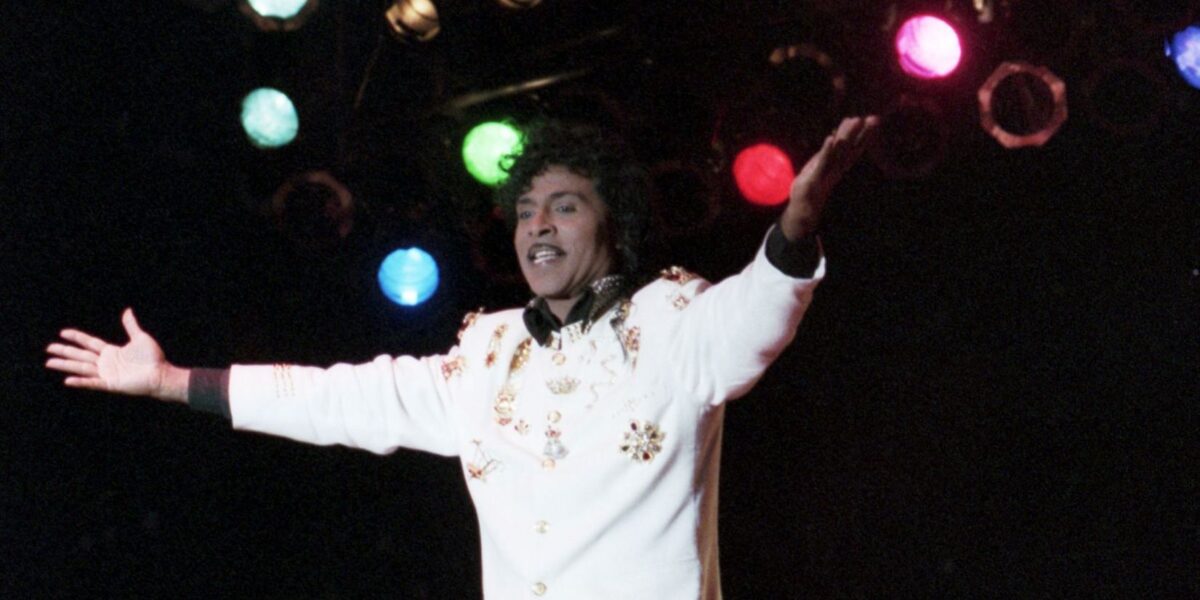
When Little Richard stepped onto the stage of the Radio City Music Hall on March 2, 1988, he came with something to prove.
Little Richard, courtesy of Alabama Media Group.
He had been tapped to co-present the award for Best New Artist at the 30th Annual Grammy Awards in New York City. That evening, he took the stage with Buster Poindexter, the alter-ego of New York Dolls lead singer David Johansen. As a lifelong Little Richard fan, Johansen was excited to co-present with one of his idols. That excitement waned as Little Richard addresses him and the audience. Pointing to Johansen’s towering pompadour, he reminds the crowd, “I used to wear my hair like that.” The playful moment quickly turns into a protest: “They take everything I get. They take it from me.”
Johansen responds with a half-hearted attempt at Little Richard’s famous whoop, immortalized in 1950s songs like “Tutti Frutti,” but the elder performer dismisses the imitation: “He can’t get that, though.” Johansen recalled decades later, “I was really excited, and then he kind of went crazy on television. He was telling me to shut up.”
But Little Richard was on a mission. He wanted everyone to know that he had not received proper credit for his influence on rhythm and blues and rock ‘n’ roll.
Born Richard Wayne Penniman on December 5, 1932 in Macon, Georgia, Little Richard left school to play music in medicine shows and perform in drag in vaudevillian theater troupes.
After making some records with RCA Victor and Peacock Records in the early 1950s, he scored his first hit with “Tutti Frutti” on Specialty Records in 1955. A string of hits followed in the next year, and in 1957, Specialty released his first album, “Here’s Little Richard.” Yet he watched Pat Boone’s covers of his records chart higher than his originals. He saw Elvis Presley crowned the King of Rock ‘n’ Roll. By the time he appeared at the 1988 Grammys, the 54-year-old veteran wanted the Recording Academy and the American public to recognize his role in shaping modern music.
After opening the envelope containing the winner’s name, he proclaims, “And the best new artist is . . . me.”
He continues as the audience laughs, “I have never received nothing—y’all never gave me no Grammys, and I’ve been singing for years! I am the architect of rock ‘n’ roll!” As the crowd leaps to its feet, he finishes like a Georgia preacher reaching the climax of a sermon. “And I am the originator!” He then lets out a whoop to show us how it was supposed to be done.
I was only 12 years old when Little Richard made his headline-grabbing statement at the Grammys, but I was already a fan. My grandfather, noticing my burgeoning love for music, gave me a Little Richard greatest hits compilation when I was in second or third grade. I was enthralled by the voice that spilled from my cassette player. The music was energetic, hard-driving and oozing with youthful exuberance. Although Little Richard had recorded songs like “Rip It Up” and “Lucille” thirty years earlier, I enjoyed his music alongside my 80s favorites like Janet Jackson, New Edition and Prince. So, I paid attention when he appeared on television. And he seemed to be everywhere—award shows, commercials and late-night TV.
In the 1980s, Little Richard had embarked on a new kind of tour, one designed to secure his legacy.
He spent much of the decade reminding the world of how much he had influenced the pop culture landscape we inhabited. He even managed to honor himself while celebrating his peers in the industry. While posthumously inducting Otis Redding into the Rock & Roll Hall of Fame in 1989, he pointed to other icons who had toured with him over the years—Jimi Hendrix, The Beatles and Mick Jagger.
Little Richard also noted his influence on artists who reveled in gender nonconformity, something that had made him threatening in the early years of the Cold War. He frequently mentioned his sexuality, claiming to be “one of the first gay people to come out” during an interview with David Letterman in 1982. And in Charles White’s 1984 authorized biography, “The Life and Times of Little Richard,” he openly discussed sexual encounters with men. Yet he struggled to reconcile his sexuality with his Christian religious convictions. By the 80s, he had once again left the rock world for the church, and he repeatedly told interviewers that he was no longer gay. As he explained to Richard Harrington in a 1984 Washington Post interview, “you cannot be gay in my church.” But as “the first androgynous superstar,” as Harrington described him, he had paved the way for the next generation of gender-bending performers.
“Michael [Jackson], David Bowie, Boy George, they’ve got my spot now,” he proudly proclaimed.
Little Richard also fought for financial retribution in the 1980s.
While his music had made him a household name, he had not earned much money from those records. Art Rupe, owner of Specialty Records, reportedly bought the rights to “Tutti Frutti” for $50 and Little Richard signed a contract that gave him half a cent per record sold.
Little Richard, courtesy of Alabama Media Group.
“I was a dumb Black kid and my mama had 12 kids and my daddy was dead,” he explained. “I wanted to help them, so I took whatever was offered. Rock ‘n’ roll was an exit for me.”
In 1984, he sued three record companies, including Specialty, saying he had not received royalties since 1955. He settled for an undisclosed amount.
As his speech at the 1988 Grammys indicated, though, the industry owed him more than money.
He also wanted the recognition. The Recording Academy finally honored him with a Grammy in 1993 when he won a Lifetime Achievement Award. He was also one of the first class of Rock & Roll Hall of Fame inductees in 1986, and he was inducted into the Songwriters Hall of Fame in 2003.
Little Richard was always convinced of his own greatness. And by the time he died on May 9, 2020, the rest of the world had acknowledged it, too.
Tom Holland was flying solo at the premiere of the series “The Crowded Room” in NYC after girlfriend Zendaya sent him a loving Instagram tribute for his 27th birthday.
“Extra” caught up with the star, who insisted, “I’m not a birthday person. I’m here for the show. I’m so proud of the show. I’m so excited for people to see it. So tonight is about ‘The Crowded Room.’ Tomorrow will be about me. I’m playing golf tomorrow.”
Tom also played coy with us about the big news he will be back as Peter Parker for a fourth “Spider-Man” movie.
“If we can find a way to make one that will surpass the third one, and be different and interesting and new, I’ll be there. And if not, I’ll swing off into the sunset and it’ll be the next lucky kid’s job.”
Tom’s latest job is starring as a young man who is arrested following his involvement in a shooting in New York City in 1979.
“We’re in a time now where asking for help is an act of bravery rather than something to be ashamed of, and I hope this show can be or serve as an education for people like myself.”
He continued, “I’m really proud of it. I’m super excited and hopefully the message travels around the world.”
Haters gonna hate, and Olivia Cooke is just fine with that. In fact, according to the “House of the Dragon” actress, that’s part of the fun of her job.
“I don’t want to play characters that have to be liked universally,” Cooke said on a recent episode of WrapWomen’s “UnWrapped” Podcast. “That’s sort of like the beauty of what we do.”
In the “Game of Thrones” prequel series, Cooke plays the adult version Alicent Hightower, the wife of King Viserys (Paddy Considine) and stepmother of Princess/former BFF Rhaenyra Targaryen (Emma D’Arcy, Milly Alcock). Cooke has earned a devoted fanbase for the character, but recognizes Alicent’s cunning demeanor and somewhat questionable decisions may also earn some critiques, and “that’s so fine.”
“I am fully aware that Alicent is a bit like Marmite,” she said.
Even with those devoted fans who love Alicent though, Cooke admits she still tries to stay off social media to avoid getting “sucked in.” But some situations are unavoidable…
According to the actress, she was out at a pub just a few months ago with castmates, celebrating the birthday of Fabien Frankel, who stars as Ser Criston Cole in the HBO series, when “some woman came up to me and was like… ‘your character is such a C-word.’”
When incidents like this happen, the actress tries to interpret it as a compliment. “You’re making people feel and I guess there’s some sort of impact that the story and the arc is pushing through…
Her trick is to “decompartmentalize” herself and her character. “I’m learning to have a bit more of a rhino skin, so I don’t really take it personally,” said Cooke. “I know, [Alicent’s] not the heroine. I went into that knowing that she’s a very flawed person, and she’s full of all these just different complexities.”
During this episode, Cooke also…
Reveals her go-to hangover cure after a night out with castmates: “milk thistle”
Chats about ~that~ foot scene between Alicent Hightower and Larys Strong: “I was number one on wiki feet for a while”
Says fame is “weird” and tries to stay off social media and apps to protect her mental health
Shares her drink(s) of choice this summer… besides a negroni sbagliato with prosecco
About “UnWrapped”
“UnWrapped” is a podcast produced by WrapWomen, dedicated to empowering the next generation of women in media and entertainment. Each episode “unwraps” topics from entertainment news and industry trends to career advice, Hollywood headlines and more.
Special guests include industry leaders, actors, producers and studio execs. The aim of the series is to connect those looking for knowledge and access to those with the knowledge and access, providing the WrapWomen community tools to succeed in their personal and professional lives.
When James Marsden wasn’t spotted by “Jury Duty” breakout star, Ronald Gladden, the production team had to implement their scripted plan B and hope the unknowing participant improvised, correctly, the second time around.
“We had the backup plan which we wound up using, which was to have this actress Sasha who comes up and says ‘I’m so sorry to bother you, but I’m such a big fan. Can you take a picture?’” said “Jury Duty” showrunner, Cody Heller at the Prime Video FYC panel on April 26.
“Jury Duty” follows the inner workings of a jury serving on a civil trial. But one juror, San Diego solar contractor Ronald Gladden, is unaware that the jury he is serving on is completely fabricated — the actors, the case, the courtroom. Everything that Gladden encounters in the three weeks is entirely fake and meticulously planned.
But with some relatively unknown comedic actors who starred as 12 members of the jury, one actor had to portray himself, all with the intention that Gladden would be a fan. That’s when the “Jury Duty” producers called on “semi-recognizable” James Marsden to join. But as the three weeks would unfold and Gladden would befriend the character of Marsden, it became increasingly clear how Gladden and the actor’s initial meeting would become a crucial plot point of the season, and their future friendship.
“I am not proud to admit how long it took me to fully recognize James,” Gladden told moderator Ike Barinholtz, whose father Alan Barinholtz played the court room’s judge. Gladden, defending how the situation was disorienting, explained, “The best way I can describe this is to imagine you’re going to get your oil changed and you’re waiting in the waiting room. You’re not expecting somebody you know to be sitting next to you, let alone a famous person. So when I [went] into this experience I [was] not prepared to see anybody I knew — let alone anyone on TV.”
Despite the production’s precautions in place to keep their unaware star in the dark, Gladden revealed he was on high alert. “Day two they got me on camera saying to James ‘Wow, this has been an interesting day.’ Because from the get-go I knew in my gut something was not right. [They] got me on camera multiple times saying ‘I’m on reality TV, this can’t be real. What is going on?’”
Barinholtz asked if Gladden ever registered what was secretly transpiring, Gladden described why he couldn’t entertain the thought that his reality was fake. “[If I asked] ‘Is this fake?’ I would have to question my entire reality. So it made much more sense that I was surrounded by weird people than that my whole world was fake,” he said. “What makes the most sense to you, that your whole world is fake? Or this guy’s weird?
But what convinced him to join the jury off of his own volition?
“I stumbled across this Craigslist ad that said, ‘We’ll pay you for your time if you participate in this jury.’ One of the requirements was you could have never served on a jury before,” explained Gladden. “So I approached this with the idea that I was going into this experience and will get something I’d never had before.”
“I was fully prepared for anything, and obviously, they more than delivered.”
During the Q&A, Marsden revealed what enticed him to join the project. As a comedic star, Marsden was ready to improvise for the irreverent sitcom, but once the producers explained it would be “‘The Office’ meets ‘The Truman Show,” that’s when Marsden said, “Where do I sign?”
“I got excited about lampooning the Hollywood-entitled actor,” said Marsden.
Marsden also knew that the premise could walk a fine line between making jokes at Ronald, rather than making jokes with Ronald. Recalling his initial conversations with the production team, Marsden revealed how he outlined a few boundaries, “We got to protect this guy. He’s never going to be the butt of the joke. He’s never going to be humiliated.”
While Marsden knew the show’s intention, sometimes the premise and execution left him unsure, noting how “it was fun for a while,” but after six hours a day for three weeks he began to raise the questions, “‘Is this even working? What is going on?’”
In the end, Marsden, the cast of improvisational comedians and the crew, managed to pull it all off, shocking themselves, and most importantly, the star of the show. As for that reveal, Gladden took it in stride. The unaware lead walked with the crew around the production set, alongside his newfound friends — whom he was meeting for the first time, again.
“The only thing I could do was accept my reality at face value. They were asking so much of me to process on one day, that my entire world for a month was fake. You can’t ask that, it’s too much. I got ‘Truman Showed’ in real life — ” said Gladden.
“I am so sorry about that Ronald,” interjected Heller.
Gladden jokingly quipped back, “They did not apologize enough, so thank you. But you can’t ask that of somebody, it’s too big of an ask. I couldn’t process everything. All I could do was accept it at face value and say ‘Well there’s nothing I can do to change this. So I’m just going to go with the flow.’”
The entire first season of “Jury Duty” is available on Freeve and Prime Video.
When Brooklyn’s Beach Fossils released their self-titled debut in 2010, frontman Dustin Payseur had given little thought to his band’s name, which he’d offhandedly pulled from a notebook. By the time Captured Tracks released the band’s second record, Clash the Truth, an entire cottage industry of surf-pop acts had emerged in their wake, including Beach Day, Beach Vacation, and Horsebeach, just to name a few. As this initial wave of coastal indie-pop has rippled to new generations—see the surprise resurgence of Surf Curse’s 2013 track “Freaks” on TikTok, for example—Beach Fossils have grappled with their own identity, exploring washed out post-punk, paisley-patterned jangle pop, and even vocal jazz in reinventions that never quite matched their debut’s allure.
Bunny, their first project since 2017’s Somersault, folds together the best of each album in their discography. The scrappy, Flying Nun-inspired guitar tones that defined the band’s infancy are once again at the forefront, now supported by the noisy crescendos of Clash the Truth and the lush string arrangements that appeared on Somersault. In retracing these steps, Payseur has ample space to reflect on Beach Fossils’ trajectory, and in turn, his own growth as a person.
Payseur’s daydreamy lyrics remain steeped in memories of aimless drives and city skylines, but on Bunny, Beach Fossils’ celebrations of slackerdom find a wiser perspective in a concrete present. “Run to the Moon” and “Dare Me” open with similarly rowdy scenes of parties and basement shows, but branch off into separate trains of thought. On the former—a slide guitar-infused song that recalls the Byrds’ flirtations with country music—Payseur equates the sense of purpose he derives spending time with his baby daughter to the guiding light of celestial bodies, while the latter portrays an existential crisis spurred by life on the road. “Kill the cliché for a moment, and I’ll tell it like it is,” he sings. “Dare me to say something stupid: I think I need more than this.” The hesitance to get sincere is baked into the music, his disclaimers and defenses shattering in real time. “Is this a meaningful moment?” Payseur asks, interrupting an early morning bike ride on “Don’t Fade Away,” an ode to friends who’ve moved and subsequently lost touch. It’s true it may read like cliché, but in the anodyne world of Beach Fossils, it comes as a radical (and welcome) dose of reality.
Like rubbing fresh baseballs with mud to prepare them for regulation play, Bunny’s sound scuffs up the pristine mixing and baroque flourishes of Somersault with the gritty, riff-forward production that typified the band’s earlier work. “Tough Love” and “Seconds” do the best job of bridging each era of the band. On both songs, Payseur crafts complex latticework out of intersecting staccato guitar parts that could easily be slotted into Clash the Truth, but rather than meander as that album’s weaker tracks tended to, these verse sections build purposefully toward towering choruses. This sharpened focus also allows outright experiments in shoegaze like “Feel So High” to hit with the force of their early ’90s influences, instead of getting lost in a dense cloud of reverb.
Two minutes away, the Uber app promises at one point in “Past Lives.” And if you’re like me, you may find yourself — perhaps for the first time in your Uber-riding life — hoping that promise is a bald-faced lie.
Because you’ll want more minutes, many more, for the couple presumably about to be separated by that Uber, even though they’re simply staring at each other on the street, saying absolutely nothing.
This is but one small moment of playwright Celine Song’s gorgeous, achingly wistful feature debut. But it highlights her striking confidence as a filmmaker. Time and again, Song, who both writes and directs here, makes the unflashy, understated choice — and in so doing, darned near breaks our hearts, with a tale that feels universal yet rich in detail, urgent yet unrushed. And if, also like me, you suddenly feel tears forming, they may surprise you, precisely because nobody’s been trying to force them.
We begin with a trio chatting in a New York bar — a woman flanked by two men. We’re too far away to hear what they’re saying or understand how they’re connected, and we hear distant voices speculating: “Maybe they’re tourists, and he’s the tour guide?”
Flashback 24 years to Seoul, where Nora (then called Na Young) and close friend Hae Sung, both 12, are walking home from school. Nora, her hair in long braids, is crying because she lost first place on a school assignment to Hae Sung. (She’s an ambitious sort.) The friendship — too early for romance — is about to be sadly interrupted, because Nora’s family is moving to Canada.
Twelve years pass. Nora ( Greta Lee, terrific in a smart, restrained performance that echoes her director’s style) has now moved to New York as an aspiring playwright (yes, much of this story is autobiographical.) On a lark one day, she tries to look up figures from her past. Searching for Hae Sung, she learns he was recently looking for her, too.
They schedule a video chat — at first halting, but soon they’re chatting day and night. Hae Sung (Teo Yoo) is still living at home, common for young Koreans, and studying at university. He has plans to go to China. Nora is moving ahead with her own dreams (her goal has shifted from a Nobel to a Pulitzer.)
When the distance becomes too painful, Nora calls for a break. Not long after, she attends a writing residency and meets Arthur (John Magaro), a fellow writer. And 12 years pass again. The two live in Brooklyn and have been married seven years.
Suddenly, Nora hears from Hae Sung. He’s coming from Seoul and wants to see her. Their meeting in a city park is nothing like the rom-com encounter it could be in another film. Song knows that in real life, there’s often an inability to react quickly or cleverly or even at all, for awhile. The director lets awkward silences stand.
Over the next few days the couple gets to know each other. Not surprisingly, Arthur feels somewhat threatened. Late at night he quietly tells Nora that she dreams in Korean, a language and world he does not know. He wonders if he’s “the guy you leave in the story when your ex comes to take you away.”
And suddenly we’re back at that restaurant bar scene, and now we understand. The three characters try to navigate the unusual circumstances. They discuss what-ifs, and zoom in on a Korean concept of fate, explained by Nora earlier as the connection between two people that has been influenced or determined by connections in past lives — hence the film’s title.
Without giving away the ending, it’s worth noting that Song has drawn much from her own life — down to that bar scene, and a similar visit from a long-ago connection from Korea.
She raises a number of lessons here, but one seems to be that choices, which seem so limitless in our youth, have consequences, even (or most especially) when we’re not noticing. No one choice seems irreversible, perhaps, but eventually they coalesce into a life path.
But the playwright also tells us that versions of one life can co-exist. Nora notes at one point that even if her older New York version is different, the younger Korean version is still real, and still exists on some other plane.
“This is my life, I’m living it with you,” she tells Arthur early on, trying to reassure him (and perhaps herself.) But one of the beauties of this film is how it allows for such an expansive, generous view of what one life can actually be.
“Past Lives,” an A24 release, has been rated PG-13 by the Motion Picture Association of America “for some strong language. “ Running time: 106 minutes. Three and a half stars out of four.
MPAA definition of PG-13: Parents strongly cautioned. Some material may be inappropriate for children under 13.
SHARE:
JOIN THE CONVERSATION
Anyone can read Conversations, but to contribute, you should be a registered Torstar account holder. If you do not yet have a Torstar account, you can create one now (it is free)
Sign In
Register
Conversations are opinions of our readers and are subject to the Code of Conduct. The Star
does not endorse these opinions.
It’s this very concept that will bring Hugh Jackman’s Wolverine back for his first appearance in the MCU, taking on a co-starring role in the threequel alongside Ryan Reynolds’ Merc with a Mouth.
While fans already shared their immense excitement for the news of Jackman’s return when it first dropped in September 2022, that anticipation isn’t absent from the MCU’s already-established team.
Tom Holland Hypes Deadpool vs. Wolverine
Marvel
MCU Spider-Man star Tom Holland spoke with Forbes about the upcoming battle that will take place between Ryan Reynolds’ Deadpool and Hugh Jackman’s Wolverine in Marvel Studios’ Deadpool 3.
Noting how big of a fan he is of both stars, Holland highlighted the efforts of stunt coordinator/second unit director George Cottle Jr., who’s working on Deadpool 3 after working on Spider-Man: Far From Home and Spider-Man: No Way Home.
He proceeded to exclaim how much he “can’t wait to see those two go at it” when the film arrives:
“Yeah, of course I have. I’m a big fan of both of those guys. I’m sure the film is going to be fantastic. I know they have George Cottle (Jr.) on their side right now as their stunt coordinator and second unit director. You couldn’t ask for a better guy. So I’m very excited for the film. I wish them all the best and I can’t wait to see those two go at it.”
How Big Will Deadpool vs. Wolverine Fight Be?
Tom Holland’s comments don’t come as too much of a shock considering how important Deadpool’s relationship with Wolverine is to the plot of this MCU threequel.
Jackman even shared how excited he is to explore the dynamic of the characters’ rivalry, as he shares the screen with Reynolds for the second time in these roles:
“When I keep thinking of me and Ryan, of Deadpool and Wolverine, which are classic comic-book rivals, there’s also a dynamic that I’ve never really got to do before as Wolverine. I just thought, ‘This is gonna be fun. Something I’ve never done before. I can’t wait.'”
Jackman also previously teased how Wolverine will want to “punch [Deadpool] in the head” on more than one occasion, only teasing further that their rivalry will drive the movie forward from start to finish.
And while specific story details remain mostly a mystery, Tom Holland already sees just how big this duo’s relationship will be as the mutants truly make their presence felt in the MCU.
A new Superman & Lois season 3 episode synopsis reveals when Michael Cudlitz will appear as Lex Luthor in the Arrowverse drama. One of Superman’s greatest enemies is coming to Smallville as Superman & Lois season 3 is getting closer to its end. Earlier in 2023, Cudlitz was revealed to have been cast as Lex, as he becomes one of the many actors to portray the legendary DC Comics villain.
SCREENRANT VIDEO OF THE DAYSCROLL TO CONTINUE WITH CONTENT
With only a few episodes left to go, The CW has officially revealed when Cudlitz is making his debut as Lex in Superman & Lois season 3. The network has released the synopsis for episode 12 of Superman & Lois season 3, titled “Injustice,” which is set to air on Tuesday, June 20. The episode description gives a tease of Lex’s upcoming arrival, as well as what the families in Smallville will be up to, as “Injustice” will focus on the following:
SUPERMAN & LOIS “Injustice” — (8:00-9:00 p.m. ET) (TV-14, LV) (HDTV) MICHAEL CUDLITZ “THE WALKING DEAD” GUEST STARS – Lois (Elizabeth Tulloch) and Clark (Tyler Hoechlin) clash with Jordan (Alex Garfin) over his carelessness around using his powers in public, while Jonathan (Michael Bishop) struggles with Kyle’s (Erik Valdez) change in behavior at the firehouse. Meanwhile, Sarah (Inde Navarrette) grows frustrated with Lana (Emmanuelle Chriqui) after she accidentally makes things more complicated with Jordan. And finally, after seventeen years behind bars, Lex Luthor (guest star Michael Cudlitz from “The Walking Dead”) is set to be released from prison. Sudz Sutherland directed the episode written by Michael Narducci (#312). Original airdate 6/20/2023. Every episode of SUPERMAN & LOIS will be available to stream on The CW App and CWTV.com the day after broadcast for free and without a subscription, log-in or authentication required.
How Lex Luthor On Superman & Lois Will Be Different From Previous Live-Action Versions
While Lex has been depicted in numerous live-action projects, Superman & Lois season 3 will portray the villain a little differently. With no ties to his Earth-Prime counterpart, this incarnation of Lex has spent almost 20 years in prison and has not taken on the Man of Steel in a very long time. According to The CW’s character description, this Lex is a lot more unhinged than previous live-action versions.
Even though Lex has yet to debut, throughout Superman & Lois season 3, it was revealed that he was actually framed for the crime that the character was sent to jail for in the first place. With Onomatopoeia having mimicked his voice, Lex is actually innocent, which will set up how he is getting released. At this point, it is a safe bet to presume that Lex will also factor heavily into the Superman & Lois season 3 finale, which airs the following week on June 27.
If Superman & Lois season 4 goes forward, it would be interesting to see more of Cudlitz’s Lex, especially after these two episodes that he is about to show up in. Given how much they have been building him up this year, it wouldn’t be shocking if Lex is actually already part of potential plans for Superman & Lois season 4. But for now, fans can look forward to catching him in mid-June in Superman & Lois season 3’s penultimate episode.
The PSVR 2 logo appears at the end of the trailer. Seemingly confirming it’s launch for PSVR 2 ahead an official announcement for a PSVR 2 version of the game.
Palm Springs International ShortFest has released its 2023 lineup, with nearly 300 films including over 50 world premieres, 10 international premieres and 33 American premieres. The 29th annual festival will take place at the Camelot Theatres in the Palm Springs Cultural Center from June 20-26. Juried awards will be given out on June 25.
Ana Fabrega, Edward Norton, Bobby Lee, Tom Holland and Whoopi Goldberg are just a few of the actors featured in these films. In addition, over 40 percent of films this year are by women directors and nearly half are by filmmakers are color.
“With such a large, high quality submission pool, the programming team had to make some difficult decisions, but we think these films represent the vibrancy and immense creativity in short films from around the world.” said Sudeep Sharma, ShortFest director of programming “We can’t wait to host the films and filmmakers at Palm Springs and are honored to be part of their journey.”
“Fanatic” by Taran Killam
This year, over 6,000 short films from 129 countries were submitted for consideration. The selected films will be judged across numerous categories, including the Oscar Qualifying awards, Student Short awards and Special Jury Awards. Each division has their own distinct subcategories and individual group of jury members.
“We are so thrilled to be bringing such incredible talent to Palm Springs to celebrate film and the craft of short filmmaking” said Lili Rodriguez, artistic director.
“We are honored to be sharing their work with our loyal Palm Spring audience and the world. We are looking forward to helping create the kind of experience only a film festival can provide.”
Polish box office king Patryk Vega has set his sights on Vladimir Putin.
Vega, who now goes by the artistic name Besaleel, is best known for his gangster films, including local hits Pitbull and Women of Mafia, which have grossed a cumulative $100 million plus at the Polish box office. But for his English-language debut, the director is taking on the man he sees as the world’s biggest mafia boss: The Russian President.
Putin is pitched as a political thriller and psychological portrait of the Russian leader for an international audience. Originally titled The Vor in Law, a reference to a Russian mafia term akin to “the godfather,” the film posits connections between Putin’s links to organized crime in his time as mayor of St. Petersburg and his approach to politics, both inside Russia and on the international stage. Besaleel has called the film an artistic protest against “the Russian dictator and the war in Ukraine” and argued, as a Polish filmmaker, he is ideally suited to make it.
“Americans and even Western Europeans fail to comprehend Putin,” Besaleel said in a statement. “I am a person stigmatized by communism, as I grew up in communist Poland. At the same time, I have been shaped by the audiovisual culture of Hollywood. For that very reason, I find myself capable of translating the intricacies of Eastern culture into the language of the West.”
Besaleel has released the first concept trailer of the film (see below). Stylistically, the director said he plans to “fuse characters from the real world” with more iconic figures taken from Russian and Western art, including the works of medieval Russian Orthodox painter Andrei Rublev and Italian Renaissance master Caravaggio. “I want the characters of saints and demons in my movie to be perfectly blended into the world of Saint Petersburg’s streets [full] of ragged and disheveled people with tormented Russian souls.”
The director is looking to cast a U.S. or international star to play Putin. The $12 million production is planning to shoot in Poland, Lithuania and Malta.
Nick Mohammed still can’t believe how lucky he was to have scored the role of Nate Shelley in Apple’s multi-Emmy Award-winning series Ted Lasso—but it almost didn’t happen. Mohammed had set his sights on a different role which he didn’t land but at the time he didn’t realize it didn’t work out for a reason.
Across three seasons, the British actor brought to life a hard-working man with a good heart who was trapped in the shell of an insecure and jealous bloke dealing with mental health issues that prevented him from finding happiness and fulfillment. He learned many lessons, though at the cost of many mistakes and hurt feelings. But in the end, he walked away with a renewed pep in his step, a lovely and understanding woman by his side and a fresh new opportunity to climb the ranks again while healing continues.
Mohammed spoke to Deadline on Thursday from Los Angeles where he spent time with cast and executive producers to say goodbye to Ted Lasso, and perhaps even the series.
DEADLINE: Tell me about your journey playing this character across three seasons.
NICK MOHAMMED: It was the funniest thing because I had not actually auditioned for Nate when it came about. I auditioned for Higgins actually and obviously didn’t get that, the role went to Jeremy [Swift]. It was probably a good month or so later that I got asked to go in for Nate. I couldn’t do it at the time, because I was filming something else. They were like, ‘Can you just do a tape on your phone?’ So I hastily put something together over a lunch break during filming. My friend read in, and it was kind of mad because I sent it off and didn’t really think anything of it. Then it wasn’t long after that I found out that I got the part and I was like, ‘Oh, God, that’s crazy.’
Then in August 2019, we started filming Season 1. I knew from even the small bits of scripts I’d been sent before it was going to be a really classy show. But I remember distinctly Jason [Sudeikis] taking me aside, I think while filming Episode 4, and saying, ‘If we get picked up for Seasons 2 and 3, this is where things are headed.’ And they were doing that not just for Nate, but Nate is a quite clear example of that, particularly his downfall having been promoted at the end of Season 1 to where he finds himself at the end of Season 2, ultimately betraying Ted. Obviously, there’s quite a visceral reaction to that from fans.
Ultimately, Season 3 is about our capacity to forgive Nate. We’ve given his background and his circumstances and tried to shine a bit of light as to where he came from. He clearly struggles with his mental health and has deep-seated insecurities, which undoubtedly come from a toxic relationship with his dad which I knew would be explored. It’s funny because I’d heard [the writers] were going to do that, but, it was then such a delight to see them genuinely commit to that on the page. Then in the filming process as well, they really stuck to it.
DEADLINE: There was plenty of fan reaction after the Nate episode specifically because of how easy it seemed he and his dad “fixed things” after so many years. What say you?
MOHAMMED: Everyone’s entitled to their interpretation of it, even I questioned it. When I read that speech that his dad gave I said to Jason, ‘Nate has put up with 30-plus years, of never being good enough. It can’t just be that.’ And Jason was clear that it’s not that at all. And that’s why there are no tears on Nate’s part and he doesn’t hug his dad. His dad doesn’t hug him. That’s all saved for Ted in Episode 12 and it was deliberate because it just represents the start of the healing process. It was not, ‘Oh, right. They’re fixed.’
There’s even, in the montage sequence of [Episode 12], they’ve moved on and now Nate is sitting with his family, and they’re in their seat at the restaurant, which is the one he used to try to get to impress his dad. I think I agree that some people probably did see it like that. But for me, I think they will always have issues because of the trauma to a degree and what he’s gone through for so long. I was keen that the apology wasn’t just enough, and then that’s it. But it has to represent hope, which I think it does. And that’s really important because that’s dramatically a strong part of the show.
DEADLINE: I heard there was a big watch party for the cast at a hotel room in Los Angeles. What all went down?
MOHAMMED: Yes, we watched it all together in the hotel. We were all an absolute wreck because it’s really so special. Who knows if we’ll make any more, and I don’t know if we will. Obviously, it’s such a special thing for all of us. It’s so rare that you’re in a show that suddenly takes off like that. None of us anticipated it. We just wanted to do a good job. We’re so indebted to it, and we’re a little family. I’ve never watched an episode with other people so it was quite nice to share it all together.
DEADLINE: That scene in the finale where you say you’re the Assistant to the Kitman, is that a nod to The Office?
MOHAMMED: Completely, to the first one, the British one. I know that line from like, literally when I was a student. I was obsessed with The Office when it came out and I’d just watch it again and again.
DEADLINE: There are so many little nods in the show that it’s inevitable to catch them all. What were some standouts for you?
MOHAMMED: Oh, I’m probably not the best person to say, but in terms of the football Easter eggs, there are tons in there. Like Brendan, who plays Beard, is an absolute football nut. Even in the background on the whiteboard, the gameplay and tactics. There are so many kinds of little clues and codes and things. [The writers] made the best possible show they could make. They just pulled absolutely everything into it, and it shows. It does translate, that stuff, when people care.
DEADLINE: Is there anything you wish would’ve been different for Nate?
MOHAMMED: No, I don’t think so. In Nate’s story, particularly in Season 3, he’s deliberately out on a limb and he’s abandoned. His screen time is quite minimal. So it was important to be really efficient. A lot of the time he is literally alone. He doesn’t have people to bounce off of. So I don’t know, I was kind of worried at the time that, ‘Oh, God, am I doing it right? Are people going to buy into a redemption story?’
Similarly, when he was being nasty in Season 2, you want it to feel believable. I still wanted people to at least see where he was coming from. I try not to really have any regrets. We were so lucky. We were surrounded by the creators and great writers and directors pretty much every day. So if there was any kind of query that we had, [we could] just drill into the detail of what they wanted out of the performances. I felt like we were really supported.
DEADLINE: Have you thought of Nate’s future once the show goes dark?
MOHAMMED: No, no, I haven’t actually. Well, occasionally I do. We always hear these rumors of a spinoff and I feel really wary of anything, because I feel like Nate’s story in particular just feels so complete. I feel like we don’t really need to see or know anymore. We just needed to just have those bits. I think we could leave it there, and I’d be very proud of it.
DEADLINE: Certainly people would love to see a wedding, Nate farther along in the healing process and thriving, maybe even some children. Could you be into that?
MOHAMMED: I still don’t think there’s definitely unfinished business to a degree there. He probably still needs to go to Dr. Sharon [Sarah Niles] for a little bit.
DEADLINE: We all need Dr. Sharon. [Laughs] Many speculated Nate would become the team’s new manager but it was Roy who was picked. Why was that the right decision?
MOHAMMED: I think Roy was the correct choice, because I think ultimately, Roy deserved it. When we see Roy and Nate and Beard together, I think that’s the perfect trio. I think it’d be too unbelievable if Nate took over that job. I think that’s asking a bit too much to think that, ‘Oh, not only has he redeemed himself, and he’s forgiven, but he’s literally back at the club and coaching.’ Roy definitely deserves that. I think Roy has been through a lot.
I really liked the fact that when they’ve just returned to Richmond, he’s the assistant to the kitman. I feel like it’s right that he should start back where he belongs but be happy because that’s always been the thing, hasn’t it? He’s always needed to be the best and have the fancy cars and be at the fancy club…But actually, I think in Season 3, he realizes that those things aren’t really as important as he thought they were. They’re very seductive, but they’re not the things that really truly make him happy.
So to see him happy back at Richmond, but just doing the lowly job that he was doing at the start of Season 1, I think that’s a great way to come full circle. And yet, now that Roy’s the big boss, he’ll get lots to do, because Roy and Nate never really fell out. I think Roy always loved Nate.
DEADLINE: We never saw Nate’s reaction to Rupert’s downfall. How do you feel about that?
MOHAMMED: It was really deliberate on the writers’ part to leave out key things. When we were filming earlier episodes, we were like ‘Oh, God, I wonder what that scene is going to be like.’ And then they didn’t include it. And we were like, ‘I wonder why.’ And then I had a really good chat with Jason about it and he’s like, ‘Why do we need to see that?’ It’s not important because the show is not about revenge. It’s about doing the right thing. It’s a lot more positive and optimistic.
So him just leaving and going straight to Jade, I felt like it was a really smart move. I think that scene would have just been too predictable. I think that’s what Ted Lasso does. It makes you think we might be going one way and actually then subverts it or does something different or unexpected. Suddenly, you’ve got this player singing ‘So Long, Farewell.’
When we watched the episode, the finale, I went onto the balcony of the little hotel room, because Jason was outside. And I was like, ‘Well done, Jason. It’s so good.’ And he was laughing like, ‘It’s a bit mad isn’t it?’ And I was like, ‘Yeah, it is a bit mad.’ There’s no ever show on telly where there can be a joke about someone sending a giant avocado, and then and then we’re all crying because he’s got a difficult relationship with his dad. It’s just such a ride.
As a writer, though I didn’t write on this show, I still don’t really know how they managed to balance that — the comedy and then the emotional storytelling and the dramatic storytelling. Because what the comedy does, it’s sort of slightly blind with you. So you’re laughing and then suddenly there’s this huge rug pull because the drama and the emotion are so impactful and you’re in too deep at that point. It really kind of smacks you in the gut. It’s really smart. I mean, initially, that season finale goes from hilarious to devastatingly heartbreaking to hilarious.
DEADLINE: I would have paid all the money in the world to see everyone’s reaction when Beard came out in the thong.
MOHAMMED: Oh, we were all just whooping and cheering. We couldn’t believe that. Even when Ted stepped out and it was the insinuation that he and Rebecca were together. It was playing with our emotions. We’re proper fans of the show. We love it.
DEADLINE: Earlier you mentioned that you weren’t sure if people would take to Nate having a redemption story, but he certainly was never a bad guy.
MOHAMMED: No, no. I mean, he made mistakes. I think some of his actions could be seen as villainous. And undoubtedly what he did to Ted revealing to the press that he’s having panic attacks and stuff like that, is quite pointed and cruel. But you can argue that he’s doing the best for Richmond, and he’s worked hard at that club, and he wants them to do the best. And he doesn’t feel that Ted is the best. He’s so insecure. He doesn’t have a support network. In my head, I was like, ‘Give the guy a break.’
The thing is, because Nate starts off as the underdog in Season 1, and because we rooted for him, we sort of feel, not that he owes us, but we feel like, ‘Hey, we’re on your side. We were there for you. We wanted to see you succeed.’ And he does. And then obviously, he starts his downward spiral in Season 2 and then betrays Ted.
I think redemption is a lot easier when your first introduction to a character is their behavior’s poor, and then they start to redeem themselves. It’s a really positive trajectory. But to kind of go that way, and then back down, it’s really difficult to recover from it. So that was definitely a challenge in Season 3, to allow people to question how they felt at the end.
DEADLINE: What is your take on whether or not this is really the end? When I spoke to Jason in May, he said that once we watch the finale we may be satisfied with the conclusion. Do you feel like the chapter is closed?
MOHAMMED: Completely. We obviously knew where it was headed, and we read all the scripts, and we were doing all these interviews. In our heads, we’re like, ‘Wait. Once you’ve seen the series, you won’t probably won’t want anymore because there’s so much closure, so much catharsis in it being three seasons.’
Ted’s not going to come back, because he’s not going to make that mistake. He’s got to stay with Melissa and Henry. That’s where his place is, and that’s where he’s happy. There’s always going to still be fixing for the characters to do. They’re not all of a sudden perfect. Ted’s still probably got his demons in there. But it is such a cathartic ending. I think it would be a shame to kind of be like, ‘And see you next year.’ It’s like, well, where are we starting off on that?
You know, I’m sure if we do anything — who knows — I’m sure there will just be a sizable break between them, especially if we film another series. I don’t know. But we’ll see.
DEADLINE: What are you taking with you from your time playing Nate?
MOHAMMED: I didn’t go to drama school or anything. But I believe that this is taught at drama school, when you first start out, you’re almost taught to assume the worst, assume that everything that you’re in is not really going to take off. It’s the same as doing live comedy actually. You have to approach it with an attitude that you’re probably not gonna get huge audiences. You might get mixed press, but it’s all about having thick skin. You’ve just got to keep at it. But what no one teaches is what happens when a show does well.
It was really interesting because I think we all realized that there was a slight duty of care to the show. There was a responsibility to the storytelling and the kind of characters we were playing. I’d never experienced that before. That was a big take home, the fact that people would come up to you on the street or get in touch on Twitter and say things like, ‘I want you to know that this has improved my mental health.’ Or ‘This got me through the pandemic.’ It sounds like a real cliché to say almost, but it really meant a lot to people and that is so touching. No one can take that away from us.
I really hope the show stands the test of time, but it felt like such a special period and as a cast, it’s simply the best. We are a family because we’ve been on that ride together, not just filming, but even doing press. Then the icing on the cake, getting to go to some of the award things, I would never have dreamt of. My first time in America was to go to the Emmys. I’ve never been before, even on holiday. It’s just been absolutely crazy. I will remember it forever. I’m sure it will never happen again in my career to be involved in a show like this because it’s so special. We adore each other. We’ve got lots of WhatsApp groups.
DEADLINE: Multiple groups? How do they differ from each other?
MOHAMMED: Diamond Dogs, of course. We’ve got one called Touchline Chappies, which was set up in Season 1, which is Jason, Brendan and me because we’re always on the sidelines of the football matches. So we just had our own. I think that then we added Brett to Diamond Dogs after he asked to join on the show—art imitates life. Then we’ve got our main one, which is with the whole cast.
We also have a little spin-off group from a few of us who took part in Hannah’s Christmas special. So there’s a few of us who were involved in that. So that’s a separate group called Hairless Penguins.
From ‘Sherlock Holmes’ to ‘Aladdin’ to ‘Wrath of Man’, director Guy Ritchie is no stranger to large-scale productions filled with action. In his latest movie ‘The Covenant’, he delivers a movie that packs a punch in both emotions and action.
The official synopsis for ‘Guy Ritchie’s The Covenant’ is below:
“’Guy Ritchie’s The Covenant’ follows US Army Sergeant John Kinley (Jake Gyllenhaal) and Afghan interpreter Ahmed (Dar Salim). After an ambush, Ahmed goes to Herculean lengths to save Kinley’s life. When Kinley learns that Ahmed and his family were not given safe passage to America as promised, he must repay his debt by returning to the war zone to retrieve them before the Taliban hunts them down first.”
‘Guy Ritchie’s The Covenant’ opened in theaters on April 21, 2023. The movie received an 83% score from the critics and a 98% score from audiences, making this Ritchie’s highest-ranked movie on the aggregator website.
Jake Gyllenhaal And Dar Salim Makes A Dynamic Team
Actor Jake Gyllenhaal is one of the best actors of his generation. On top of having experience with war movies, his resume is filled with a wide variety of roles – from crime videographer Louis Bloom (‘Nightcrawler‘) to Mysterio (‘Spider-Man: Far From Home‘), Gyllenhaal is a fantastic choice to play Sergeant John Kinley. Playing opposite Gyllenhaal is Dar Salim, as Afghan interpreter Ahmed. The two characters did not like each other at the beginning but were forced to work together. Through the movie, the bond strengthens as they learn to trust each other.
Salim talks about the key to playing Ahmed:
“He’s someone that you can relate to. He’s a guy who will do anything to keep his family safe. He just wants to give his children the opportunities that he doesn’t have himself. But even a man like that, when he’s faced with the ultimate choices, it’s a reminder that most of us have good in us and that we will do what’s right in that moment. That’s the mirror of the relationship between those two men. So that was the key to playing Ahmed, I think.”
Guy Ritchie Takes A Different Screenplay Process With This Movie
For this movie, director Guy Ritchie had a slightly different approach in the ways of the screenplay. It wasn’t a completely finished script but the director knew what story he wanted to tell and where he was going to go with it. Each morning, he would discuss the scenes with the actors – how to work on them, bouncing ideas off them. From there, the director would write scenes, making necessary edits or changes as they come up.
Jake Gyllenhaal talks more about his experience on-set and the different process:
“Then when we got there, it was a process of, “Okay, come to set. Here’s the scenes today. How do we start working on them? What are your ideas?” Then he would write in the morning. He writes very quickly. He’d write in the morning and write us the scene. He’d either change the scene or edit it, or sometimes write the whole thing out based on his thoughts from the night before or our discussions. Then we’d go out there and we’d play it. The next day we would add on to the board. As the board got bigger, he’d be able to have more to play with and references that we had done. Then we’d start telling the story that once existed as a foundation of a home.”
The film was released theatrically in the United States on April 21, 2023. While the movie is available to rent on digital, you can still enjoy it in the theater so be sure to check Moviefone‘s listings below for showtimes in your area. ‘The Covenant’ has a total runtime of 2 hours and 3 minutes.
Watch the official trailers for ‘The Covenant’ below:
Can’t make it out to the theater? You have the option to rent the movie on VOD. Services such as Amazon Prime Video, Direct TV, Google Play, Vudu, Microsoft, YouTube, AppleTV, and Redbox allow you to rent the movie for $19.99.
As for as streaming goes, an official date hasn’t been confirmed by MGM, since the film is still in theaters, but you will be able to purchase the movie digitally on June 20. For those looking to purchase a physical copy, DVD and Blu-ray will also be available on June 20.
In a studio overlooking Manhattan’s Fifth Avenue, Rian Johnson is strapped to a lie detector machine. Next to him at the controls sits Natasha Lyonne, twiddling the device’s knobs with all the sinister intent of a supervillain. This photoshoot tableau is, of course, ripped right from the Meet the Parents Ben Stiller-Robert De Niro interrogation scene. Next, in an homage to the pithiest of TV detective tropes, Lyonne will pose at a typewriter, fake-talking into a rotary-dial phone. The visual nod this time goes to Angela Lansbury as Jessica Fletcher in Murder, She Wrote.
In fact, the late, great Lansbury is connective tissue for Johnson and Lyonne. Lansbury and Lyonne appeared briefly together in Johnson’s film, Glass Onion: A Knives Out Mystery, on a Zoom call playing the mystery game Among Us with Daniel Craig’s Detective Benoit Blanc.
Little did we know back when that film premiered, that Johnson was sitting on an Easter egg with that scene. Only later, when he aired his debut television creation, Poker Face, would the presence of Lyonne in Glass Onion explain itself.
Poker Face creator Rian Johnson.
ANDREW ZAEH
In Poker Face, Lyonne plays Charlie Cale, a woman who just knows when a person is lying. Her savant skill allows her to clean up at — you guessed it — poker, and in the process, she makes an enemy of an undesirable casino boss. But in classic “mystery of the week” style, that’s just the “‘”B” plot rumbling in the background. As Charlie is forced to throw away her cellphone and go on the run, she cannot help but stumble upon liars at every small-town stop along the way. And where there are liars, there are, coincidentally, many murders for her to solve. From a couple of geriatric terrorists (Judith Light and S. Epatha Merkerson), to a tortured vegan BBQ chef (Larry Brown), a manipulative monster mastermind (Cherry Jones), and her victim (Nick Nolte) in an episode Lyonne co-wrote and directed, each episode is standalone satisfying and oftentimes hilarious in a way we haven’t seen since the likes of Magnum P.I., The A-Team or the original Quantum Leap.
With its Columbo-identical yellow title cards, Poker Face immediately announces its heritage. And with her self-effacing sensibility, Charlie echoes that wrinkly raincoated detective played by Peter Falk. But also, as Lyonne puts it, Charlie is sort of like The Big Lebowski’s Dude, approaching her murder-mystery cross-country odyssey with signature swagger and a Coors Light in hand.
Natasha Lyonne plays Charlie Cale in Poker Face.
ANDREW ZAEH
Part of the format’s appeal for Johnson lies in its revolving door of guest stars, and he recruited an impressive team of talent to fulfill the criteria. Some from his films, like Adrien Brody, with whom he worked on The Brothers Bloom, and Joseph Gordon-Levitt from his films Brick and Looper, Lyonne’s close friend and Russian Doll co-star Chloë Sevigny, starring as a dangerously embittered rocker, Dascha Polanco, Lyonne’s co-star in Orange is the New Black, Benjamin Bratt, Ellen Barkin, Hong Chau, Ron Perlman, Tim Blake Nelson, Stephanie Hsu and more.
Casting for the upcoming second season is ongoing, but there’s hope we’ll see more famous faces from Johnson’s films. As he says, “I’m calling every single one of them. I would love to get Kelly Marie Tran from Star Wars in there for an episode.”
When Johnson and Lyonne wrapped what Lyonne calls their “high concept day” shooting the accompanying photos for this piece, they sat down to discuss the fun and games of making Poker Face and its future.
DEADLINE: Rian, why do you think you gravitated to bingeing Columbo during the pandemic?
RIAN JOHNSON: It’s funny, I didn’t really watch Columbo as a kid. It was a little too mature for me. I was much more into The A-Team and The Incredible Hulk. But I think a lot of people did this over the lockdown. I binged the whole thing, and that’s where this whole thing really started. It was comfort food. The thing that really hit me was how much it is, at heart, a hangout show with Peter Falk. I wasn’t watching each new episode really for the mystery plot. It was for Falk and the guest star. It was, “It’s Oh, Dick Van Dyke, this will be amazing. Oh my God, Johnny Cash and Ida Lupino in this one, this is going to be phenomenal.” And the ‘howcatchem’ format allowed them to give screen time to the villain and to have them be built into a substantial character and play out the dynamic between them and Columbo, which is one of the things I love. In a way, these type of shows have more in common with sitcoms than they do with Agatha Christie books, in that you’re coming back every week to get a hit of something familiar, to hang out with a character or characters that you like, and to get something new in the same shape that you’re familiar with every single time.
DEADLINE: What does television mean to you as opposed to your connection to features?
JOHNSON: The same way that when I think about Star Wars, it takes me back to playing with Star Wars toys and seeing the movies and all of those tactile experiences and what that meant to me as a kid. When I think about TV, I think about sitting on the floor in front of my parents’ TV when I was a kid watching reruns during the middle of the day, and the relationship that I formed with those shows and what they meant to me, and how they mythologized in my head, and how they lived there.
There’s a very specific range of shows that we talked about, with so many of them shot on the Universal lot and having a slapdash kind of quality to them, even the better ones. There’s something incredibly joyful about that for me specifically. And that’s what latched in my head: if I’m going to do a TV show, I don’t want to do a nine-hour movie. I want to make a TV show, and I want to make something that feels that way to me and hits that pleasure center.
DEADLINE: Where was Poker Face in terms of development when you shot that Glass Onion Zoom scene?
NATASHA LYONNE: The running order is Rian shoots Glass Onion. Then Rian and I are having a lot of meetings and dinners and talking about the possibility of Poker Face. We end up selling it to Peacock while he’s in post on Glass Onion, and I’m in post on Russian Doll, I think. Good luck making sense of this. Suffice it to say that he already had a cut of Glass Onion by the time we shot the Angela Lansbury scene. He said, “Do you want to do this thing with me where we shoot this Zoom game during the pandemic with Daniel Craig?” Shooting it together was actually our first time working together, so we were excited about it. And he shot everybody separately because it was Zoom, meaning [Stephen] Sondheim and Kareem [Abdul-Jabbar] and Angela [Lansbury] and Daniel [Craig]. Then three months into shooting Poker Face, he was like, “We changed the dialogue for what Daniel is doing, so can I tweak it?” So, we actually reshot it while I was in my Poker Face trailer.
DEADLINE: People had no idea of the subtext at that point.
LYONNE: Yeah. I remember seeing on Twitter after Glass Onion came out, “Why was Natasha there? It doesn’t make sense.” But of course, Rian and I already knew about Poker Face, so it was just preemptively planting yet another person who’s involved in detective business, whether that’s Angela Lansbury or Kareem Abdul-Jabbar writing all those mystery novels. I was somebody who was busy playing Charlie Cale at work on a daily basis.
DEADLINE: You met through Rian’s wife, Karina Longworth because Natasha wanted to option an episode of Karina’s podcast You Must Remember This?
JOHNSON: Yeah. We had met through Karina a few times, and then I had this vague idea to do this kind of show in the back of my head. And I was like, “Yeah, but who can be Peter Falk today?” Then I watched Russian Doll and said, “Well, there you go, right there. This is it.” And not even like, “Oh, she’s acting like Peter Falk.” It wasn’t that at all, actually. It was finding somebody who had that charismatic draw of you can’t take your eyes off of her, and you just want to watch her. The answer to why viewers are going to keep tuning in is exactly that, is because it is to hang out with her. And I felt that watching Russian Doll, and that’s so rare. And it’s not about how good an actor someone is. It’s not about how attractive they are; it’s none of that. There is just an X-factor of somebody who you can tell has a soul on the screen that makes you lean forward and want to know more about them. So, I asked her if she wanted to get dinner, and then said, “I’m thinking of doing this type of show.” I think she thought it was just one of those bullshit Hollywood things, like, “Yeah, we should work together.” I think she was very surprised when I dropped the scripts in her lap six months later.
From left: Charlie Barnett and Natasha Lyonne in Russian Doll.
Netflix/Everett Collection
DEADLINE: Natasha, I remember interviewing you for Russian Doll, and you told me about the movies you watched over and over as a kid, and the male leads you identified with. With Poker Face, you have a protagonist who’s a woman, but she inhabits the kind of laid-back, confident space traditionally taken up by a male lead.
LYONNE: The secret to aging in Hollywood for women is to just start playing men [laughs], whether you write them for yourselves or find someone like Rian, and you get lucky enough that he writes it for you.
One of our shared favorite movies is The Long Goodbye. Elliott Gould’s performance in that… So, when we started having our conversations about The Long Goodbye, I’m like, “Baby, baby, I got you. In fact, let’s California split. Let’s talk about Gene Hackman, not even in French Connection, but in Night Moves.” We started talking a lot about The Dude [in The Big Lebowski]. Listen, there’s been so many great roles for men over the years, like Jack Nicholson’s done a wide spread of these pieces, to playing the Joker or starring in Wolf, a movie that doesn’t get mentioned often. They’re allowed to be lone wolves who have thoughts and just do their own thing. That really is historically a man’s game. It’s very Martin Sheen staring at the fan in Apocalypse Now and “The End” [by The Doors] is playing. I remember seeing that scene and being like, ‘This is the kind of acting I want to do someday.’ I wanted to be Brando with “The horror, the horror,” or Dennis Hopper being a photographer. And none of that was ever available to women. While I love Jessica Lange and Betty Davis and Barbara Stanwyck and, of course, Gena Rowlands and my favorite Giulietta Masina, where I really found my stride was sort of being without gender. I was allowed to essentially have an inner thought-life as opposed to this activated system of responses to a male protagonist.
JOHNSON: I will say that I think at least for me — I’ll talk about Russian Doll as opposed to Poker Face — my impression is that all the things you said are correct, but I don’t see that as playing a man. I think that character has a lot of sexuality to her.
LYONNE: Well, first of all, thank you.
JOHNSON: Yeah. I think it’s very essentially sexy, but I think it’s seeing a woman in the role that you’re used to seeing men in and having that autonomy.
DEADLINE: That’s exactly what I mean.
LYONNE: All my characters are sexy, baby. No, I’m just kidding around. But I just mean that they’re not following romance. That’s not dictating their journey. In other words, following their romantic life is not at the core. If Nadia [in Russian Doll] is having a sort of philosophical, existential psychedelic journey to wherever she needs to go, Charlie is actually this lone wolf who’s really fighting for the outsider, unlike Nadia, who’s so Lou Reed and a shoegazer in New York. I think Charlie has the sun on her back. She’s a desert rat, and she loves it, and she loves people. Their life choices are not run by chasing a boy.
DEADLINE: How did you two come to that together? Was it a discussion that you had early on?
JOHNSON: I mean that specific aspect of it, I don’t think it was any kind of strategic thing we had a conversation about. It’s just kind of our combined taste.
DEADLINE: Rian, you’ve said you wrote Charlie Cale for Natasha like “a bespoke suit”.
JOHNSON: Yeah. I literally built the show around Natasha. The reason for the show is seeing her in Russian Doll and thinking, “Oh, she could hold a show like this together.”
DEADLINE: You made the Poker Face era interestingly mutable. There are digital watch alarms, Charlie has no phone, Ron Perlman’s character uses an ancient cassette player, there are retro vintage cars, but there’s also super modern technology too.
JOHNSON: Yes, Charlie is completely buried in her phone, and that has replaced human engagement for her to some point in the pilot. And the whole thing of her smashing the phone at the end is the completion of this little character arc in the pilot, but it also detaches her from that, forcing her to get to know people in every new spot she’s living in.
The bigger answer to your question is that it’s very character-based for me. It’s not like I want to be in a world without technology. It’s fun to me to explore character. Like the Nick Nolte character who purposefully lives in the past, or Ron Perlman’s character. I guess a lot of the characters are people who live in their own little weird bubble. And that anthropological aspect of that is very Columbo, doing a deep dive into these little bubbles of workspaces or people’s lives.
The funny thing is, writing mysteries with Knives Out, I was kind of dreading like, ‘Oh God, is it going to be like in horror movies where they always have to figure out a way to not have cell service or something?’ The reality is with mysteries; I don’t think technology actually gets in your way the way it does with other genres. At least I haven’t found it to. So, it’s not that I feel like dodging around technology is something we had to do.
DEADLINE: It felt like a nod to the ‘mystery of the week’ era though. Especially the digital watch. I miss those.
JOHNSON: They say everything old is new again.
DEADLINE: I was reminded of Knives Out’s Marta (Ana DeArmas) climbing the trellis when we see Judith Light’s character climbing the old folks’ home trellis in “Time of the Monkey”, Episode 5. Was that deliberate?
JOHNSON: No. It’s a coincidence, and it’s entirely just because it came up in the mechanics of that [storyline], and I didn’t even think about it until I was watching the cut put together, and I was like, “Oh, that’s right.” But it’s also a little bit of a fun trope. That’s one thing that I try and do in writing both the movies and the show is to not be afraid of tropes. I think in trying to do something in a way that feels invigorated and fresh, there can be a tendency to throw away anything that feels too much like a ‘been there, done that’ kind of thing. But I love the ‘been there, done that’ stuff. That’s the meat of it, and that’s the original gears that made the machine work, and that’s what I’m after. So, embracing trellis climbing, I think, and embracing magnifying glasses and embracing…
Lyonne with Stephanie Hsu as Morty.
Peacock
DEADLINE: The old ice cube locked-room mystery trick? Except its dry ice you use to keep the trap door open in the “Exit Stage Death” episode with Ellen Barkin as your villain?
JOHNSON: One hundred percent. That’s the thing. You’ve seen it a thousand times. To me, that’s delicious, and I think not being afraid to lean into a good old-fashioned cliché and embrace that, I think it brings me great joy.
The episode where you turn a BBQ chef into a vegan because he saw Bong Joon-ho’s film Okja made me laugh out loud. What does Director Bong think of that?
JOHNSON: I remember I emailed Director Bong and asked his permission to use it. And I was like, “I’m not going to spoil it, but I think you’ll like what we use it for.” And he was like, “Yes.” It was very sweet.
DEADLINE: Have you spoken to him since?
JOHNSON: I haven’t. I don’t think it is playing in Korea yet, so I’m not sure if he’s seen it yet. But I should get in touch with him. That made me very happy when I came up with that. It was like, “Oh, this will be good.”
DEADLINE: And Charlie’s ability to read lies is reminiscent of Marta in Knives Out too. Marta vomits every time she lies. Obviously, you need a device to make Charlie a ‘detective’, but what is it about lying that keeps coming up for you?
JOHNSON: Well, I mean, in both of them, they’re mechanisms, but they’re two completely opposite ends. Whereas with the Marta character, it was an obstruction. It was something to make her life harder. It was a character we care about, and the only way they can get out of a horrible situation is by lying, and you take away their ability to lie in front of the detective.
So, it was an obstacle, whereas, in this one, it’s the exact opposite. It’s something to take the place of them being a detective and it being their job. And it’s something that explains to the audience why she’s specifically good at doing this, to give a little bit of a bridge into why she keeps getting into it every week. Now, we still — and this, to me, is a joyful thing because it’s one of the hallmarks of the type of mystery TV show that I loved growing up — require a buy-in from the audience. There’s still the Jessica Fletcher element of it. Yes, every place that she goes to, someone gets killed, and she discovers it, and we’re all going to agree that that happens and put our arms around it and have a good time watching the show. So, it doesn’t completely bridge the gap, but at least it gives some reason why she’s engaging with it.
DEADLINE: People think they’d love to have the ability to detect lies or force truth on people.
JOHNSON: No! Detecting lies, I think that would be hell. What was interesting about it to me was, I mean, first of all, having given her this gift for that reason, it presented a real problem. Which is, how is every episode not just over in five minutes? But that presented an opportunity — and this is one of the things I’m proud of, I think, working with the writers who were able to do this in the show — which was finding side doors into the gift. And in ways that explore with a little bit more nuance, the notion of lying, and the notion of what Charlie says in the pilot about how people lie constantly, but it’s generally not about big, nefarious things. It’s usually little white lies, and the notion of why somebody is lying about something is the actual key. So, that was a real beast to figure out in the writing room every day, but it ended up leading to something that was a little more nuanced and interesting and human than it just being a superpower.
I remember having a conversation about what it would be like if she was in a motel room, and she had a guy that she really liked, and he was sort of f*cking with her about being really into her? And she knew that he was f*cking with her, and how dark and what a bummer that would be as a woman, to know that the guy was being like, “Yeah, I’m super in love with you,” and that he was lying. I was like, that would really break her heart.
Lyonne and Johnson
Andrew Zaeh
DEADLINE: As much as I love that her life is not dictated by chasing romance, if there was a guy that was stringing her along, it would be fascinating to see her handle that.
JOHNSON: Well, that’s something I could see us getting into in the future. We did talk a lot in the writer’s room about what having this gift would mean to an actual human being. And I think the closest we got to really actualizing it in the show is with Clea [DuVall] ’s character, Charlie’s sister, and seeing a little glimpse of that, but we never really did a deep dive. I think that’s fertile ground for going forward.
LYONNE: Although I would say in “Escape from Shit Mountain”, which is easily one of the best episodes of the season, I think, what Rian and [the showrunners] Nora and Lilla [Zuckerman] did with it, it’s fascinating, right? Doesn’t that start with her really enjoying things with a guy, and the B-side of where that goes is the f*cking darkest journey in the entire season. It starts at the highest point, and it literally ends at the lowest of the low.
JOHNSON: Yeah, absolutely. And we almost did that on purpose because we thought, ‘Let’s see her a little happy here for a sequence.’
LYONNE: But it does, I guess, set her up for the vulnerability of Stephanie [Hsu] ’s character coming in. It’s also interesting the way she plays with boys a little bit in the show, whether that’s Adrien [Brody], or I guess not Benjamin Bratt so much, but…
JOHNSON: And I think that’s something that could be very, very interesting. To figure out a way to explore what her gift would mean with someone you actually want to be close to and showing maybe why she isn’t close to people, which is what the finale is about — why this life of unattached, keep-moving is the one that she’s chosen for herself.
DEADLINE: She can’t get close to people. Imagine how disappointing it would be to know every time they lied.
JOHNSON: Right. Absolutely. I think there are good people, but good people disappoint you. That’s also why she has such a water-off-a-duck’s-back type vibe to her. I think it’s a survival mechanism. It’s almost like you have to adjust by having a tremendous amount of generosity for human weakness.
LYONNE: That’s beautiful, actually. The truth is that, and I would say it’s something that I identify with greatly and love about playing Charlie, is this idea that all of those human failings that she’s seeing is something that she’s not blaming humanity for. You’ve never put it that way before. Rather than holding people to account or blaming them for it, of course, she wants to see justice around it. And especially for the little guy. There’s something really profound about not being in a state of judgment around that almost.
DEADLINE: It feels like Season 2 will really explore the blessing-versus-curse personal side of her gift.
LYONNE: Rian and I did spend a lot of time talking about — and I don’t even know if we want to talk about it here because who knows if that’ll be the thing we ultimately want to commit to in a second season — but we did spend a lot of time just talking about a core injury or something, or when was the moment where Charlie decided this is a double-edged sword and this is also something that can make my life crumble, so I’ve got to sort of keep it, but put it aside.
JOHNSON: Something involving her father, and I think we will inevitably get into that. I feel like both of us were also wary of doing the equivalent of a superhero origin story where suddenly you do the flashback to the thing that’s the equivalent of being in the gamma-ray chamber, but emotionally. I guess for me, I’m willing to take the time to get to that, to figure out the version of it that’s nuanced enough and interesting enough. That’s the other tricky thing, figuring out a way to explore that in the context of a Poker Face episode, I think. But anyway, it’s exciting to think about it.
LYONNE: I mean, life is more of a series of shitty events that lead you to have a personality change, ultimately, in a weird way. Oftentimes, I think people want to be reductive and make it this one thing that happened. I would say also one of the things I love about working with Rian is that confidence and resistance to traditional storytelling, essentially. You’re such a master of the classic form, it’s like you make it your bitch, and it’s like you know the information enough to know that it might not actually be the most fun thing for the audience to find out this backstory in this first season. I love that. It makes it so fun for me that you have the confidence of storytelling to say, “It’s going to be baked into the DNA.” You know so much about a person by the way they carry themselves and the things they do and don’t say.
Lyonne and Johnson
Andrew Zaeh
DEADLINE: What was the evolution of Episode 8 that Natasha directed and co-wrote with Russian Doll writer-producer Alice Ju?
JOHNSON: I mean, Natasha knew she wanted to do one of the episodes, and so I had this notion of doing something like a Phil Tippett-type character and doing something very based on movie monsters and stop-motion animation and having fun with that. And I also thought tonally, the episode would very much be sort of a Vertigo, Hitchcock-stylized thing. So, I threw it to Natasha, and I was like, “I think this could be really fun for you to do.” So, she was in the writers’ room and she and Alice wrote it. I think Natasha, as good a performer as she is, at her heart she’s a director. I feel like everyone is pushing her to make a feature. I think that’s really where she comes alive and where she really shines. And knowing how good she is, as a performer, that tells you something, that now she’s even better as a director. So, it was also really fun because I think the crew and everyone had known her as a performer, and then when we got to Episode 8 and she stepped up and took the wheel, everyone saw her for the first time, really, and that was pretty cool to see.
DEADLINE: Natasha, Cherry Jones has spoken so highly of your directing ability, that essentially you were inspiring and protective at the same time.
LYONNE: For Cherry to say those nice things, really, it’s very moving to me, because I’m a workaholic, and so that’s where I guess I’m getting my meaning of life, which is probably not a great idea.
I watched that incredible documentary on Phil Tippett, and it was just really this gift of, this is not something you usually do. And then it set us up as creative working partners for this thing that just really made [Rian and me] laugh constantly. The easiest way I can explain it is Hitchcock and Salvador Dalí having discourse around things. So, we were constantly having fun and then you add [Nick] Nolte, and Cherry is extraordinary. But a big thing for Rian was this kind of, “Let’s lean in and not be afraid of Vertigo.” So that was really where it was coming from that I was asking of Cherry to take the risk, to be a Hitchcock blonde, and be a faraway, distant thinker who periodically whispers to herself. Even in the costumes — she likes to wear her silk robes around the house, even if she’s committing murder.
DEADLINE: That is so Hitchcock. I want to be a woman that constantly wears a silk robe.
LYONNE: You can accomplish this goal. This is within your reach.
I will say that the joy for me in directing on this show was being able to text with Rian 24 hours a day. It gave me that additional confidence of, “Holy Shit, we really are getting it. The Nolte stuff is really working, the Phil Tippett stuff, the elements are gorgeous, and Cherry is doing it.” I’m sorry to be so almost emo about it, but if you’re obsessed with the arts in the way that I think we are, there’s something very peaceful about that. The inverse of it is a constant state of chaos: “We don’t know if it’s right, we don’t know if the choices are correct, we don’t know.” I’ve also been in those experiences with indecisive people, but the amount of fun that we were having getting to create this thing together was, I think, very rare.
And not to be weird about it, but I just think it’s worth mentioning because we’re talking about gender in some way. That is also a very feminist action, frankly. And obviously, Rian is married to one of the smartest women in the world, in my opinion, one of the coolest, and that’s how we even know each other. Karina is just an empirical genius. So, I do think that you see that in men who are not afraid of ‘big’ women and see women like that as a gift. Because boys rock, you know what I mean? It’s really fun to be able to play together in that way. I just want to make a mention of that because I think it’s so, so rare.
DEADLINE: What’s next for you?
LYONNE: I really want to write and direct my first feature. That’s become my priority, probably because I’m out here aging, and [thinking about] mortality, and I feel like I’ll be mad at myself if I don’t do it. I’m just a movie lover that got ensconced in this television run from Orange is the New Black to Russian Doll to Poker Face. I’m so grateful, and it’s been such an incredible time, but it’s sort of left behind my true love, which is Once Upon a Time in America, All That Jazz.
DEADLINE: What about Russian Doll Season 3?
LYONNE: I think I’m seeing Russian Doll more and more as a Fire Walk with Me or something like the Twin Peaks journey, so you can have this kind of legacy to it. And then you’re allowed to kind of make a movie about it whenever you want, on your own timeline.
I’ve had a very weird path, and I’m very aware that this is a very special time for me. I’m very grateful that it’s finally here. So, I just want to learn to develop some self-respect around that and play like the big boys, which is to follow where my instinct and interest is leading me. My job is to keep my head down and focus on the work. That’s what I do. I work really hard, and I love what I do, and Poker Face is hard as hell. I’ve got to memorize 60 pages a week. You have all these brilliant actors coming in who want to do an incredible job. So, you have to help them find the key of the music that the tone of Rian Johnson is in, because if it’s a guest director or something, they want to do a good job. It’s almost like you’re also the mayor in a weird way.
And I love these jobs. But yeah, I think I just want to take a few years for me, now that I finally have them, to really say, what the hell do I want? I see other people have the self-confidence to do that, and I think for so many years, I was just going where it was warm and taking what I could get and being grateful to have a job at all. So, I’m trying to really get quiet and figure out what this new iteration means.
Read the digital edition of Deadline’s Emmy Comedy issue here.
DEADLINE: And Season 2 of Poker Face?
JOHNSON: That’s something that’s really up in the air. I mean, a lot of it has to do with what happens in terms of the writers’ strike, and there’s so much that’s unknown at the moment. Also, right now my priority is getting the next Benoit Blanc movie going.
DEADLINE: Is that cast and ready to go?
JOHNSON: Oh, no. I’m still working on it. It’s very up in the air.
DEADLINE: Do you have an endpoint in mind for Poker Face?
JOHNSON: No. Because this all comes from the notion of those shows that were meant to go forever. We’ll always find ways to keep the ball in the air, and that’s its own fun challenge. It’s figuring out how do we keep evolving and keeping it fresh, but the object of that is always going to be so that we can have mysteries of the week, and so that she can be in a different environment every week and we can keep doing what the show does well and keep doing it as long as people want to watch it. And again, to me, there’s something very comforting about that. It’s not like we have a four-season arc planned out and some big dramatic ending. No, as long as this is fun and as long as people keep watching it, let’s give them new mysteries to watch and keep doing it.
Editor’s note: This interview and photo shoot took place before the start of the WGA strike.
Emily Ratajkowski somehow managed to weave multiple trends into one streamlined look.
On May 31, Ratajkowski stepped out in New York City wearing a corset vest that seamlessly ties together everyone’s favorite Bridgerton aesthetic with sleek, menswear-inspired tailoring. Yes, that’s two trends in one piece, but the 31-year-old model wasn’t done. She dressed down the look with a pair of baggy khakis, a ’90s choker-statement necklace-combo, and simple white sneakers. Hell, I’d even say Ratajkowski embraced the peplum renaissance given the petal-shaped tails at the bottom of the cropped vest.
Emily Ratajkowski in NYC on May 31, 2023.
MEGA
So, with all those trends going on in one look, how did she avoid looking trendy? Or drawing comparisons to Blake Lively’scontroversial wardrobe for It Ends With Us? The trick is a simple, neutral color pallet and attention to balance.
As many stylists would recommend, Ratajkowski paired her form-fitting top with a wide-leg bottom but took things even further by keeping her heavy accessories above the vest and her wrists free. And where a pair of heels would render the outfit top-heavy, she kept things grounded with a flat shoe.
NOW IN THEATERS! Let me just say that Spider-Man: Across the Spider-Verse would be a great film if it weren’t so damn long. That said, it’s pretty good. Taking place a few years after Spider-Man: Into the Spider-Verse, Miles Morales (Shameik Moore) is now a senior in high school, and his future is a bit daunting… mainly because he’s never around…because of all that crime fighting. His parents, Jefferson (Brian Tyree Henry) and Rio (Luna Lauren Velez) are having a hard time letting their little genius go, and also that Miles is hiding a huge Spidey-secret from them.
Meanwhile, the Spot (Jason Schwartzman) is causing havoc committing petty crimes through his dimensional portal powers given to him during the collider explosion in the first film. The Spot is stopped thanks to the help of Spider-Gwen Hailee Steinfeld, who can visit Miles’ dimension thanks to a technologically-advanced “watch” given to her by Spider-Man 2099 (Oscar Isaac).
Gwen Stacy (Hailee Steinfeld) and Miles Morales (Shameik Moore) in Columbia Pictures and Sony Pictures Animations’ SPIDER-MAN™: ACROSS THE SPIDER-VERSE.
“…an elite team of Spider-persons scour the Multiverse to plug up holes formed by dimensional jumping.”
It appears that because of the events in the first Spider-Man movie, an elite team of Spider-persons scour the Multiverse to plug up holes formed by dimensional jumping. The team is led by Spider-Man 2099, Jessica Drew (Issa Rae), Gwen, Spider-Man India (Karan Soni), and Spider-Punk (Daniel Kaluuya). Miles wants to be part of the team to prove himself to his parents, but there’s no more room on the team. It’s a ruse as Miles follows Gwen to the sanctuary of Spidey 2099 and all the Spider-people…like every single Spidey. From here, Miles is shunned by all the Spideys because he’s on the verge of collapsing the entire Multiverse and must be stopped.
There’s a lot more to this story, and I don’t have the word count or time to go through it all. Suffice it to say, this story is dense and features all the 30-second backstories from one Spidey after the other. I’m OK with dense, but there are storylines surrounding Miles and his parents that desperately needed to be tightened up specifically the entire cake incident.
AN ENTREPRENEUR has revealed how she quit her coffee shop job and became a self-made millionaire after barely lifting a finger.
The former barista took to TikTok to let her fans know the steps to becoming a savvy businesswoman through drop shipping.
8
Margarita Schneider, 25, explained how she became a self-made millionaireCredit: instagram/@missmargariita
8
She started her own Shopify store and made the big bucks through drop shippingCredit: instagram/@missmargariita
8
Margarita now enjoys a lavish lifestyle after years building her successCredit: instagram/missmargariita
Margarita Schneider, 25, known by her followers as @missmargariita1, posted the clip with the caption: “How I became a millionaire in my 20s.”
She begins the video with a clip of herself in a Dubai desert, followed by her story: “Instead of buying luxuries, I skipped that and started an online store.
“But instead of buying inventory, I did the drop shipping route, which means a customer buys a product from my store first, and then I purchased the product from a supplier.
“I got myself a computer, built my online store, found a winning product, [and] in no time 6 figure months turned into 7 figure months.”
She started her business in 2018, during her last semester studying marketing at university in the United States.
After four years of balancing her e-commerce business and barista jobs, she now enjoys big cash.
Margarita splits her life between Tampa, Florida, and Dubai.
She revealed she used social media to help her find a trending product and added it to her Shopify store.
To increase sales, the entrepreneur would post create TikTok content regularly to make her business go viral.
As a result, she was able to buy her dream Mercedes, retire her parents, and go on her first holiday in Dubai.
As well as investing in her business, the young millionaire shares her expertise to her 296,000 followers across her TikTok, Instagram and YouTube accounts.
Margarita also shows off her lavish lifestyle as she enjoys her millions with trips to the UAE, fast cars and giant yachts, Pilates, and personal training.
The Latina is one of many young entrepreneurs to get the big bucks without barely lifting a finger.
The BBC has appointed an acting replacement for departing Chairman Richard Sharp, with Dame Elan Cross Stephens set to take over for up to 12 months.
Stephens, who currently sits as the Welsh member on the BBC Board, will act as Chair for a year or when a permanent appointee is hired, whichever comes sooner.
She has spent her career working in broadcasting, the creative industries and academia and chaired the BBC’s commercial subsidiary from 2019 to 2022. She also has past experience as chair of BBC-backed Welsh-language broadcaster S4C.
Stephens replaces Sharp following the controversy over his involvement with a loan guarantee for former Prime Minister Boris Johnson. The scandal generated headlines for months and an excoriating review from the Public Commissioner’s Office in April led to his resignation.
Culture Secretary Lucy Frazer said Stephens will provide “stability in the leadership of the BBC while a process to appoint a new permanent chair is run.”
“I am pleased that Dame Elan will take up the position of Acting Chair of the BBC and has the unanimous support of the Board,” she added.
Stephens described the appointment as a “huge honour.” “As a board, we will champion the licence fee payer across all of the UK; ensure the BBC is a vital partner for the UK creative industries and maintain trust and drive change to make the BBC fit for a fast changing media landscape,” she went on to say.
In a symbolic rebuke of Netflix’s top executives, company shareholders voted against approving the compensation packages of leaders including co-CEOs Ted Sarandos and Greg Peters.
At the streamer’s June 1 annual shareholders meeting, investors failed to approve the proposed exec pay packages for 2023. But the vote was a non-binding “say-on-pay” advisory measure, meaning Netflix’s board can disregard the result. The board had unanimously recommended voting for the 2023 compensation plans.
The vote came after the Writers Guild of America had urged investors to vote against Netflix’s exec compensation measures in a letter Tuesday. That said, the majority of shareholder votes on the measure had already been cast prior to the issuance of the WGA’s letter — and most of those were “no” votes, according to a source familiar with the situation.
“While investors have long taken issue with Netflix’s executive pay, the compensation structure is more egregious against the backdrop of the strike,” WGA West president Meredith Stiehm wrote in the letter to Netflix shareholders. Stiehm continued, “Shareholders should send a message to Netflix that if the company could afford to spend $166 million on executive compensation last year, it can afford to pay the estimated $68 million per year that writers are asking for in contract improvements and put an end to the disruptive strike.”
WGA sent a similar letter Comcast investors, whose 2023 shareholder meeting is slated for next Wednesday, June 7.
Last year, 27% of the shareholder votes cast at the Netflix shareholders meeting were in favor of its 2022 executive compensation plans. The final vote tallies from this year’s meeting will be included in an upcoming Netflix SEC filing.
In 2023, Sarandos’ pay package will be worth up to $40 million (which would match his 2022 compensation plan), comprising $3 million in base salary, a $17 million performance bonus and $20 million worth of stock options. Peters, who was named Netflix co-CEO in January after Reed Hastings stepped down from the role, is set to receive as much as $34.65 million as co-CEO ($3 million annual salary, $17.325 million in options and a $14.325 million performance-based target bonus).
In addition Netflix CFO Spencer Neumann this year is to receive $14 million ($7 million in salary and $7 million in stock options), chief legal officer David Hyman will get $11 million ($4 million salary, $7 million in stock) and chief communications officer Rachel Whetstone is to receive $6.5 million ($5.7 million salary, $800,000 in stock).
Meta is set to temporarily block up to 5% of its Canadian users from accessing news content on Facebook and Instagram, Meta Canada’s head of public policy Rachel Curran told the Canadian Press Thursday.
The blocks, which the company says will last through the month of June, are the test version of a program Meta is threatening to make permanent if Canadian Bill C-18, known as the Online News Act, becomes law.
The act would require large tech companies like Meta to pay publishers for linking to or otherwise repurposing their content online. It’s similar to a proposed California law, the “Journalism Preservation Act,” that has also prompted threats of a total news block from Meta.
Under the test, roughly 1.2 million Canadian Facebook and Instagram users may be randomly selected to lose access to news links, reels and stories. Publications outside of Canada, including the New York Times and BBC, could also be blocked during the test should they be randomly selected.
Canadian Heritage Minister Pablo Rodriguez called Meta’s move an intimidation tactic, deeming it “disappointing,” though he said it will not sway lawmakers.
“The fact that Facebook still refuses to work with Canadians shows how irresponsible and out of touch they are,” Rodriguez wrote in French. “Again, this is disappointing from the web giants and Canadians will not be intimidated by these tactics.”
In a statement to the Canadian Press Thursday, Rodriguez added, “When a big tech company, whatever the size is, the amount of money and the powerful lawyers they have, they come here and they tell us, ‘If you don’t do this or that, then I’m pulling the plug,’ — that’s a threat and that is unacceptable.”
Google conducted a similar test on 4% of Canadian users in February, citing the same bill, per the Associated Press.
Meta also blocked news on its platform in Australia for a week back in 2021, before eventually reaching a deal with publishers.
Dirty dancing! Throughout Dancing With the Stars’ 16-year history, some pros have struck up romances with their partners, other contestants and fellow pros — and while some showmances didn’t stick, others are now happily married with kids.
Former wrestler Nikki Bella and her season 25 partner, Artem Chigvintsev, got together after they danced together on the ABC series in 2017. Us broke the news in January 2019 that the duo had been dating “for a while” after Bella’s split from John Cena in April 2018.
“I love my Val snuggles. I love just, like, touching him,” Johnson exclusively told Us in September 2020, after the pair moved into their first home. “He always jokes because he’s like, ‘You love to be alone, but with me next to you.’ And it’s so true. So I do miss my hubby!”
Maks, on the other hand, married Peta Murgatroyd in July 2017 after being linked to Willa Ford and ending an engagement to fellow dancer Karina Smirnoff in 2009.
On Saturday night, an eclectic art crowd was gathering outside an industrial garage in Amsterdam East, where Michel Houellebecq, the celebrated French author, was set to speak.
Houellebecq had on May 24 released “A Few Months of My Life,” a new book describing a tumultuous period from October 2022 to March 2023 when he collaborated with a Dutch art collective called KIRAC. Together, they worked on a film, shooting scenes that show the married 67-year-old author making out with young women.
Although Houellebecq had consented to making the film, he later changed his mind and tried to back out. Beginning in February, he brought court cases in France and the Netherlands to stop the movie from being shown. Last month, an Amsterdam judge upheld Houellebecq’s complaint and granted him the right to see a final cut of any re-edited film four weeks before release, giving him a chance to file another action if he doesn’t like what he sees.
In “A Few Months of My Life,” a 94-page autobiographical work, Houellebecq digs deep into his hatred for KIRAC. He names the group’s leader, Stefan Ruitenbeek, only once, describing him as a “pseudo-artist” and “a cockroach with a human face.” Female KIRAC members are referred to as “the sow” and “the turkey.”
According to the organizer of Saturday’s event, Tarik Sadouma, Houellebecq had not come to Amsterdam to promote his new book, but to talk about his work generally. As a condition of his participation, Houellebecq asked Sadouma to bar Ruitenbeek and his cohorts from the event.
Yet just as the audience took its seats inside, Ruitenbeek burst through the door, dressed as a giant brown cockroach, with bobbing antennae and a furry cape. He was trailed by KIRAC members, one wearing a false pig snout, another filming the whole thing.
“I’m here!” cried Ruitenbeek, taking the stage, to a mixture of jeering and cheers. “I’m the cockroach!”
A woman taking tickets tried to wrangle the camera from the cameraman and Sadouma shouted for the intruders to leave. Eventually, Ruitenbeek — pleading, “No violence!” — left with his entourage.
This was the latest episode in an ongoing, surrealistic conflict between KIRAC, a fringe art group that posts its films on YouTube, and Houellebecq, one of the world’s most famous authors.
Was it a performance? A marketing stunt? Or part of a genuine cultural feud? Who could really tell?
KIRAC, an acronym for Keeping It Real Art Critics, is often described as an art collective, but its creative center is Ruitenbeek and Kate Sinha, a writer who is also Ruitenbeek’s life partner. They make films that at first appear to be documentaries, or possibly mockumentaries, typically set in the art world. In them, the boundaries between reality and fiction are often blurred, narratives sometimes conflict and onscreen characters can appear to be playing a game with the truth.
It is also often difficult to discern KIRAC’s political views. In one of its films, the Dutch architect and curator Rem Koolhaas is criticized as “macho” and “patriarchal.” In another, KIRAC seems to decry diversity efforts, arguing that visitors to the Stedelijk Museum, in Amsterdam, were expected to be interested in a retrospective of the artist Zanele Muholi, “only because she is from South Africa, Black and lesbian.” (Muholi now uses they/them pronouns and identifies as nonbinary.)
Seen as provocateurs or pranksters, and sometimes art world trolls, KIRAC’s members often deliver critical monologues directly to the camera, usually in the form of articulate academic analysis from Sinha, or mocking insults from Ruitenbeek.
“In the broadest sense, we’re just trying to make great films, intellectual entertainment,” Sinha said. “I think we are primarily artists, interested in the object we make, which is always the film.”
In a joint interview, Ruitenbeek and Sinha said they developed the concept for the Houellebecq film with the author and shot 600 hours of footage of him, with his contractual consent. Houellebecq only objected when they put together a two-minute trailer for the work in progress, according to Ruitenbeek and Sinha.
In that clip, Ruitenbeek explains that a “honey trip,” or sex holiday, that Houellebecq had planned in Morocco had been canceled because the author feared being kidnapped by Muslim extremists. (Houellebecq has a long history of making critical statements about Islam, and some readers have found Islamophobic sentiments in his books.)
“His wife had spent an entire month arranging prostitutes from Paris, and now everything was falling apart,” Ruitenbeek says in the trailer, in voice-over. He then suggests that there are plenty of young Dutch women in Amsterdam who would have “sex with a famous writer out of curiosity,” and invites the author to visit.
In a French court, Houellebecq argued that the trailer violated his privacy and damaged his image. He asked the court to make KIRAC pull the trailer from all online platforms, remove any mention of his wife arranging prostitutes and pay her damages. The court rejected Houellebecq’s case.
Later, in the Dutch court, Houellebecq argued that KIRAC had violated contract law, and misled him so that he ended up “in a different film than the one originally intended,” according to his Dutch lawyer, Jacqueline Schaap. An appeal judge in that case found for Houellebecq.
The film is still unfinished and continues to evolve, Ruitenbeek said. After Houellebecq left the project, KIRAC filmed in and around the court proceedings, as well as shooting other moments, such as Saturday night’s cockroach show.
Ruitenbeek said he was now rethinking the material, and a final cut may not come for months.
“We started off this project in an open-minded attitude toward each other; we took each other as artists,” Sinha said of the collaboration with Houellebecq. “It feels like he backpedaled and put on a different coat.”
Houellebecq last week agreed to an interview for this article, but pulled out after learning that he would not be shown his quotes before publication. (At the event in Amsterdam, he again declined to comment, claiming that he did not speak English, although he speaks it in the KIRAC film.)
Ruitenbeek’s over-the-top voice-overs and willingness to play a goofball suggest that KIRAC is going for humor. But, often, the subjects of its films don’t find them funny.
“They point fingers at others, but carve out a safe space for themselves’,” said the artist Renzo Martens, who was the focus of an unflattering movie. “From this safe space they are brave enough to cut into other people’s flesh.”
Three Dutch institutions that KIRAC has lambasted — the Stedelijk Museum, the Van Abbe Museum and the Kunstmuseum, in The Hague — declined to comment for this article.
Thijs Lijster, a senior lecturer on the philosophy of art and culture at the University of Groningen, said that there is “something threatening in their ways of going about their work. They have a style of filming, and approaching and talking to people, which is, in a way, rather hostile.”
It is not just KIRAC’s targeting of artists and institutions that has been controversial. Over time, its films have evolved to enter the realm of social commentary, drawing ire from across the political spectrum.
Some viewers saw the group’s 19-minute film “Who’s Afraid of Harvey Weinstein?,” in which Sinha speaks about sexual power dynamics between the American film producer and his rape victims, as dismissive of the #MeToo movement.
A leading art school in Amsterdam, the Gerrit Rietveld Academy, canceled a KIRAC screening after dozens of complaints from students, former students and teachers about statements in the group’s films that they found sexist and racist. The Weinstein movie was championed on a right-wing populist Dutch blog, Geen Stijl. Suddenly, KIRAC became a magnet for conservative followers.
Although Ruitenbeek and Sinha said their personal politics are progressive, KIRAC didn’t disavow the attention, and instead produced a film called “Honeypot.” For that, the group convinced a conservative Dutch philosopher and activist, Sid Lukkassen, to have sex on camera with a left-wing student. The idea was to see if the intimate act would somehow bridge a political gap.
More backlash ensued. When an Amsterdam arts center called De Balie screened “Honeypot,” a feminist collective submitted a petition with more than 1,000 signatures that called the film “a glorification of sexual violence.” The petition’s signers also included the right-wing Dutch politician Paul Cliteur and some of his followers.
“It was interesting that these two sides teamed up against the film for opposite reasons,” said Yoeri Albrecht, De Balie’s director, who did not cancel the event. “I’ve never seen that happen in the more than a decade that I’ve been organizing events here.”
The ambiguity around the group’s motivations only feeds the interest in KIRAC’s work. Many who have been following the Houellebecq affair are unsure whether it’s real or a postmodern KIRAC fiction.
“Everyone is wondering, are they playing a game together?” said Simon Delobel, a curator who teaches at the Royal Academy of Fine Arts, in Ghent, Belgium, where he was introduced to the group’s work by his students. KIRAC and Houellebecq were surely “well aware that it can be interpreted as a stunt,” he added.
Yet Ruitenbeek and Sinha both said their clash with the author was no stunt. They don’t want to be in court with Houellebecq, whom they both described as “a genius.” They just want to be in conversation with him, Sinha said.
Ruitenbeek added that when he showed up at Houellebecq’s talk on Saturday, he thought there was a small chance that everyone would laugh and give each other hugs. He was “very happy the day he went to get the cockroach suit,” Sinha said. “After all these intimidating court cases,” she added, “we were back on our own territory again: making art.”
Léontine Gallois contributed reporting from Paris.
“We are deeply saddened by the passing of Jacklyn Smith, known to the world as Jacky Oh, a talented Wild ‘N Out family member whose impact will be forever treasured and missed. Jacky Oh was a loving friend and beloved colleague of the Wild ‘N Out cast throughout five seasons. More importantly, she was a tremendous mother to three beautiful children,” a BET Media Group spokesperson wrote.
“The BET Media Group extends our sincere condolences to the Smith family, DC Young Fly, B Simone, Nick Cannon, and all friends who loved and cared for Jacky Oh during this difficult time.”
The MTV “Wild ‘N Out” star reportedly died in Miami, where she had traveled to undergo a “mommy makeover” surgery, according to a since-deleted social media post. Her cause of death is not yet known.
Ms Jacky Oh! had been in a relationship with DC Young Fly since 2015.
They met while both starring in “Wild ‘N Out.” The couple shared three children, Nova, Nala and Prince.
The long-awaited sequel is finally here, and thankfully, it doesn’t seem to be disappointing those who’ve seen Miles Morales’ next Multiversal adventure. The movie itself is currently sitting at a solid 94% on Rotten Tomatoes.
Not only does the film seem to be an incredible story, but it contains a plethora of new spoilers, including fresh lore tidbits and reveals.
1.) Major Live-Action Cameos
Marvel
Across the Spider-Verse confirmed what everyone suspected: everything audiences know is canon.
The moment Miles Morales arrives at the Spider Society headquarters, fans are treated to countless fun Easter eggs. Among them are a handful of references confirming the existence of various other Spider-Man projects.
This includes Insomniac’s Spider-Man, Josh Keaton’s Spectacular Spider-Man, the MCU, Andrew Garfield, Tom Holland, and more. Sony even went above and beyond by including a live-action cameo for Donald Glover’s Prowler, someone fans haven’t even seen since Spider-Man: Homecoming.
Even Venom’s universe is connected to everything, though the big alien symbiote himself didn’t make an appearance this time around.
2.) Miles Has Been Spider-Man for a Year
Marvel
For all of Into the Spider-Verse, Miles Morales was a newbie. Even when he was going up against Kingpin, he was new to the game.
This time around, Miles has now been his universe’s one and only Spider-Man for over a year. He’s more efficient, experienced, and confident in his role. Even his local neighborhood seems to be friendly with the wallcrawler.
Additionally, it seems that Miles has continued working alongside his father, unbeknownst to Jefferson himself.
When Miles and Peter raided Alchemax’s lab in the first film, Parker decided it would be best to try and grab a bagel for himself. Instead of getting to eat it, he had to throw it at the pursuing Alchemax employees.
Little did they know the same employee on the receiving end of that bagel would be there the night Miles destroyed the supercollider. Thanks to being at the wrong place at the wrong time, The Spot was born.
It’s not clear what The Spot has been up to since the events of the first film, but it takes over a year for Miles to properly encounter him in Across. From there, the big bad only continues to evolve.
Now, not only is The Spot all juiced up, with his powers resonating on a Multiversal level, but he’s ready to take everything from Miles—most notably, his father’s life.
4.) Traversing the Multiverse
Marvel
The first film established that being in the wrong universe is bad on a cellular level. It’s why the likes of Peter and Gwen needed to get back home so badly in the first movie.
Thanks to Oscar Isaac’s Spider-Man 2099, that issue has been resolved. Each member of his special society gets a nifty watch (or day badge), allowing them to reside comfortably in any other universe that isn’t their own.
5.) Canon Events
Marvel
Across the Spider-Verse puts in a lot of work trying to explain the various rules of the Multiverse. Among them are the movie’s answer to fixed points in time relative to every Spider-Man: Canon Events.
These are moments integral to not only the Spider-People at the forefront of the story but their entire universes. If one of these events is changed or interrupted by an anomaly, then it could destroy the entire timeline.
The biggest example of these that the movie gives is the loss of someone like Uncle Ben and the death of a “captain.” For Peter, it was Captain Stacy—a loss played back to everyone in the form of a moment from Andrew Garfield’s The Amazing Spider-Man.
6.) Peter B. Parker’s Mayday & Many Other New Faces
Marvel
Jake Johnson’s Peter B. Parker isn’t alone this time around. Thanks to his adventure with Miles Morales, he realized that he did want to be a father.
Gwen Stacy shares a complicated relationship with her father.
At the beginning of the movie, her dad, who is Captain of Police, is hunting down Spider-Woman. He catches up with her just in time for Gwen to reveal her identity and jump into a portal with Spidey 2099 and Jess Drew.
Audiences don’t get an update on that situation until later in the movie when both he and Gwen have a heartfelt moment as their feelings are laid bare.
It’s here where Mr. Stacy reveals he’s no longer a captain—a twist that saves him from an inevitable death in the canon events of a Spider-Person’s life. Even better, he also makes amends with his daughter.
8.) Captain Morales Is in Danger
Marvel
While the former Captain Stacy might be safe, Miles’ father is still in danger.
He isn’t even sworn in yet, but according to Miguel O’Hara, he is destined to die in a Canon Event. The one and only Spot will even get the honor of doing so.
Fans will need to wait until next year’s Beyond the Spider-Verse to see what happens next.
9.) Stuck on Earth-42
Marvel
Miles Morales is a mistake—or that’s how Miguel O’Hara put it.
The spider that first bit Miles in the subway tunnels was not actually from his universe, aka Earth-1610. Instead, it was from Earth-42.
Now, because of that unexpected anomaly, Earth-42 doesn’t have its own Spider-Man to protect New York City.
Miles witnesses this himself when he’s sent back to the wrong universe, the one where that world’s Variant of him is the infamous Prowler. Then there’s the real kicker: on Earth-42, his father is already dead—while his Uncle Aaron still lives.
The movie ends on a massive cliffhanger, with the original Miles Morales stuck in the wrong universe, held captive by his alternate self, and has no way out.
10.) Gwen Assembles a New Team
Marvel
While Miles is stuck on Earth-42, Gwen Stacy works on crafting a new team to help Miles against Spidey 2099 and his Spider Society.
New faces such as Spider-Punk, Spidey-Byte, and Pavitr Prabhakar are among its ranks. There are more than a few returning faces as well, including Peter B. Parker, Spider-Ham, Spidey Noir, and Penni Parker.
Sadly, audiences won’t be able to see the team in action until next year’s sequel.
11.) Cliffhanger for Beyond the Spider-Verse
Marvel
With a cliffhanger ending like the one Across offers audiences, fans are going to be dying to see what comes next.
Not only will viewers get to witness a spectacular showdown between Spot and Miles, but there’ll no doubt be some tragic heartbreak and even more Spider-People. With the title of the sequel, Beyond, fans shouldn’t be surprised if Sony is holding back some big twists when it comes to the Multiverse.
Everyone wants to be Superman. There is no doubt that within the huge list of possible superheroes that an actor or actress would like to play, the Man of Steel occupies the top positions along with Batman, Wonder Woman or Spider-Man. That is why the casting forSuperman: Legacy is getting more and more interesting.
Weeks ago, The Hollywood Reporter shared a report detailing the alleged candidates for the lead role in James Gunn’s next film, which will officially kick off a new DCU. Names like David Corenswet, a fan favorite to take Henry Cavill’s place, appeared on the list along with names like Tom Brittney and Andrew Richardson.
MOVIEWEB VIDEO OF THE DAYSCROLL TO CONTINUE WITH CONTENT
Now, Variety reports that a new name has joined the fray, one that until now no one has mentioned. This is the model and actor Pierson Fodé (The Man from Toronto), who has sent his tape to participate in the audition.
Clarifying that there were no comments from Warner Bros. Discovery to confirm the information, the outlet reveals that its sources shared that Fodé detailed part of his past in the tape, since he grew up on a farm just like Clark Kent.
Since the announcement of the movie, Gunn has clarified that he will be the only one to confirm the final choice for the part and that he won’t be sharing any names from the actors that have participated or that have been considered for the role.
Would Pierson Fodé Be a Good Superman?
DC Comics
Fodé would definitely not be a bad choice. Like Corenwest, who appears to be the frontrunner, he fits the age Gunn and Safran are looking for for their franchise’s future lead. His acting career began in 2012, with appearances in the television movie Wrath of God: Confrontation and appearing in an episode of iCarly.
His big break came not long after, in 2015, when he joined the series The Bold and the Beautiful as Thomas Forrester, one of the main characters. As for the world of superheroes, Superman: Legacy would not be anything new for the actor, since he had a participation in The CW’s Supergirl. For his role in the popular sop opera series, Fodé was nominated twice for a Daytime Emmy Award in 2016 and 2017. Since then, he has participated in other interesting projects such as Dynasty or Animal Kingdom.
Superman: Legacy won’t be an origin story for the titular hero, since the story will find Clark already working as a reporter on The Daily Planet and also trying to balance his life as the world’s most powerful hero. No details have been shared about the plot so far, but Gunn has confirmed that characters like Jimmy Olsen and Krypto will be part of the film, and of course Lois Lane. Lex Luthor is also expected to appear. So there’s plenty of roles to cast.
Superman: Legacy will hit theaters on July 11, 2025 and will be followed by Batman: The Brave and the Bold and Supergirl: Woman of Tomorrow, the main film projects from the new DCU so far.
Last year, Rocket Lab announced that it would embark on an ambitious mission to send a small probe to Venus to hunt for organic molecules in its atmosphere. The launch was supposed to happen in May 2023, but now Rocket Lab has confirmed that it’s “not imminent,” TechCrunch has reported. While company didn’t provide a new date, a research paper published in July 2022 states that a “backup launch window is available in January 2025.”
News of the mission flew under the radar, as it were, but it’s rather ambitious. Rocket Lab plans to use its Electron booster and Photon spacecraft, sending a small probe into Venus’s cloud layer about 30-37 miles up, where temperatures are Earth-like. (Thanks to the planet’s greenhouse effect, temperatures on the surface are greater than 900 degrees F and pressure more than 75 Earth atmospheres.)
Rocket Lab
Once there, the tiny 40 centimeter diameter probe will search for organic molecules or other clues that the atmosphere could support life. Venus came into the news back in 2020 after researchers claimed to spot signs of phosphine, a chemical that’s typically produced by living organisms. While controversial, the findings sparked a new interest in the Venus atmosphere as a possible source for life, and Rocket Lab’s mission is centered around just that.
At the same time, it’s a way for the company to show off its Photon spacecraft designed to go beyond Earth orbit to the Moon and Mars. Last year, Rocket Lab successfully launched Photon on NASA’s CAPSTONE mission, designed to verify the orbital stability of the planned Lunar Gateway space station. The lunar satellite spent nearly six months in orbit and flew within 1,000 miles of the Moon’s North Pole in a so-called near-rectilinear halo orbit.
An LED stage lets you capture a golden hour that lasts all day, control the weather, or film actors anywhere in the world at the click of a button. To make the most of it, however, you’ll first want to learn a few lighting tricks first.
This post was written by Larissa Mori.
Anyone who watched the final season of Game of Thrones knows just how important it is to get lighting right. This becomes even more crucial when using new technologies like virtual production: On an LED stage, you can’t only rely on natural light or other traditional lighting techniques.
That’s why we’ve asked industry experts like Chief Lighting Technician Cullum Ross, Unreal Engine specialist Julianna Mercado, and disguise VP of Virtual Production Addy Ghani for their thoughts. Below, they share helpful tips for lighting an LED stage like a pro.
Credit: Disguise
7 Things You Should Know When Lighting an LED Stage
1. Know what you’re working with
Anyone who’s seen The Mandalorian or 1899 knows the potential of using a virtual production stage. But what you might not know is that there are many different types of LED systems, and each has its own lighting possibilities. It’s important to plan on whether you’re working with a standalone LED wall with a real-world HDRI backdrop, a curved mixed-reality stage with a completely CG backdrop, or anything in between.
This will help you to better optimize your scenes, as you’ll understand how many GPU and CPU resources you’ll need to display your virtual environment correctly.
“These days, you could always add more render nodes to display more demanding photorealistic visuals,” says Ghani. After a 12-year stint at DreamWorks, he’s familiar with the desire to render photorealistic scenes. “But it’s still best practice to optimize where you can. Think about practical lights: It’s best to know exactly what you’re working with to avoid setups that take up too much power or cause safety issues on set. It’s the same with virtual sets. More is not always better.”
2. Get creative with design
As a cinematographer or lighting technician, the biggest friend you’ll have on a virtual production set is often the volume itself. This is because it doesn’t just display images – you can also use it for lighting, which minimizes the amount of practical light you’ll need.
“Think of LED as fill,” explains Mercado, who specializes in creating Unreal Engine scenes for LED volumes. “You’ll still want to have key lights on your talent, but at the same time, you won’t have the restrictions that a green screen has. You’ll be able to include translucent or reflective practical props to your heart’s content.”
Ross, who has helped light Netflix shows like Man vs. Bee, agrees that using LEDs can open the door to more creative lighting on set. “Don’t be afraid to tile panels to whatever dimension you like. Or use an LED ceiling as your sky. Or have LEDs that wrap around your practical car, train, or ship,” he explains. “When a visual effects supervisor wants fire effects, you could simply put LED panels on dollies and wheel those around the set. That will let you replicate the lighting and reflections a fire would give, without any concern for on-set safety.”
Credit: Luka Cyprian
3. Don’t forget your shadows
When you’re lighting an LED stage, it’s important to make sure that your practical and virtual lights match. One way of doing this is to include spheres with different materials (white, black, and fully reflective) in the Unreal Engine environment to help see what the lighting looks like. Another great way to do this is to look at the intensity and direction of your shadows.
Matching shadows, however, can be difficult to do in an LED volume because of light spills. “An LED volume will be better for soft light, while practical lights are best for harder spotlights and shadows,” says Ross.
“That said, you can also use LEDs to draw or paint areas of light, dark, and any other color in between. So traditionally, if I wanted to add a shadow effect to a character that was sitting in direct sunlight, I’d use flags, nets, and other textiles. In an LED volume, you can create and drag those shapes around the screen and you can animate those as well. You can also simply make some of your LED pixels dark. There’s really clever stuff you can do to create great shadows without actually bringing in any additional lights.”
4. Understand practical lighting
You don’t always have to replicate practical lighting on an LED stage, but it helps to understand it. “Knowing how to use both LEDs and practical lights is the best way to tackle shooting with virtual production,” says Mercado.
“Learning about practical lighting will also teach you color theory, which is really important whether you work in the real or virtual world. Always think about an overall color palette and how this plays into mood and atmosphere. Looking at films, you’ll notice how horror movies might have a lot of greens and cool tones, or romantic movies are full of warm and saturated colors. Just remember, that no matter what lighting decisions you make, when setting key lighting on your talent, you need to be careful not to wash your LED out. Any light that hits the volume will be visible in camera.”
‘The Mandalorian’Credit: Disney Platform Distribution
5. Remember, it’s fake
Of course, while having a well-rounded knowledge of practical lighting is essential to working on an LED stage, it’s also important to not restrict yourself to only using practical lighting techniques alone. “I think the biggest sort of misnomer is that people believe you have to always try to emulate practical lights in your digital sets,” says Ghani. “You don’t have to do that. You can light the virtual world however you want. You have way more flexibility. It’s all fake, right? Nothing really exists. So you can use 100 lights if you want to.”
With tools like Unreal Engine, anyone can even group and control these lights through one clever script. DMX protocol can also be used to control the light or the color value using a device like an iPad on set.
“The reason why many film lights are so expensive is that they’re engineered to be color matched to camera chips,” says Ross. “LED panel technology is now advanced enough to do the same. That means you can control the exact color tint of the panel to ensure it’s accurate with what’s being captured by your camera. You can also use a lighting desk or media server to control the visuals being displayed and make sure they match the timecode of your audio track and lighting.”
6. Don’t forget to collaborate
Working on a virtual set normally means bridging the gap between traditional production and post-production. That means collaborating with different teams is essential to anyone who wants to get lighting right.
“It’s so important to work with a visual effects supervisor because they can advise on what they need from you to work in post,” says Ross. “At the same time, you also need to work with a lot of technical operators who run the screen and media servers on set; as well as the Unreal Engine designer that is making the visuals that you’ll see on screen.”
Credit: Blackmagic Design
7. Always do your prep
Last, but not least, it’s always important to prepare as much as possible to achieve the best LED stage lighting. “Have solid references, even if you think you know what something looks like,” adds Mercado. “Pull up references, examine the details, understand how light bounces off materials, and how sunlight shifts in color throughout the day.”
“On an LED set, it’s easy to get carried away with what you could do,” Ross agrees. “But it’s more important to have a storyboard, and just stay true to what you’re trying to achieve. For instance, if you want to project a real-world location onto an LED screen, you could start by using telemetry data and virtual mapping data from Google Earth. You can take those images and that mapping data and bring it into Unreal Engine to create an idea of buildings and structures and geometry. And then you can bring in a virtual camera and we can get as close to the real location as possible. That prep will help you minimize the work you need to do when on location and on the LED stage, which is really helpful.”
You have to have a thick skin when you’re an actor and auditioning.
Ryan Gosling revealed during a GQ cover story that his role in 2004’s The Notebook was not cast because he was perfect for the job.
“[Director Nick Cassavetes ] straight up told me: ‘The fact that you have no natural leading man qualities is why I want you to be my leading man,’” Gosling said.
Gosling compared acting to a different form of therapy.
“I was trying to find a place to put all these things that were happening to me. And these films became ways to do that, like time capsules. So you kinda make the movie for yourselves. Doesn’t matter if anyone else does, you know? But I think, having done a lot of that, I realize that I kind of feel like my job is for other people to feel it. And it’s cool if I do, but that’s really not the point. The point is that other people do.”
Gosling added of his current career outlook, “I treat it more like work now, and not like it’s, you know, therapy. It’s a job, and I think in a way that allows me to be better at it because there’s less interference.”
Netflixis to launch a new Japanese reality show “Is She the Wolf?” which was developed with broadcaster Abema and adapted from the original show “Who Is the Wolf” which previously ran for 13 seasons. The show follows five men and five women on a quest for love through dates and a group project. However, some female participants are “lying wolves” who cannot fall in love. They must navigate the entire season without being discovered or accepting any declarations of love. It includes a diverse group of participants aged 22 to 32, including actors, artists, models, and athletes.
“Is She the Wolf?” streams exclusively on Netflix in Japan beginning June 11, with new episodes streaming each Sunday. Outside Japan, all episodes will be released on Netflix in September 2023.
A trailer can be seen here:
JURY DUTY
Indian multihyphenate Anurag Kashyap will head the main competition jury at the Sydney Film Festival, which launches on Wednesday and runs to June 18. Some 12 films are competing for an A$60,000 first prize.
Kashyap will be joined by actor Mia Wasikowska (Australia), film curator and journalist Dorothee Wenner (Germany), writer and director Larissa Behrendt (Australia) and filmmaker Visakesa Chandrasekaram (Australia/Sri Lanka).
“Our 2023 jury is a remarkable ensemble of five film experts hailing from Australia and worldwide,” said Nashen Moodley, Sydney Film Festival director. “The Official Competition is rich with the world’s most ground-breaking and remarkable films and filmmakers currently. Thus, our jury face a challenging decision!”
Kashyap will also present his latest film “Kennedy,” which debuted last month in Cannes, at the SFF in an out of competition slot.
NEXT, PLEASE
Hybe, the talent and management company behind BTS, is planning to discover and launch its next girl group through a survival show called “R U Next.” It will be broadcast on Korea’s JTBC and Japan’s Abema. Belift Lab, the label jointly established by Hybe and CJ ENM, announced that production through JAMM Mushroom has begun. Contestants will face seven rounds of challenges intended to test everything from their uniqueness to their genre fluidity. Belift Lab previously launched boy band Enhypen through audition program “I-Land.”
One of the biggest shows to come out on the 2023 TV schedule so far has been Poker Face, which follows Natasha Lyonne’s Charlie Cale, a lie-detecting cocktail waitress who continually finds herself solving homicides across the country. Created by Rian Johnson, this show quickly earned critical acclaim following its debut Ian January, and it was renewed for Season 2 midway through Season 1’s run. However, Johnson has explained why it will be a while until this next batch of episodes will arrive to Peacock subscribers, while also sharing which Star Wars: The Last Jedi alum he’d like to bring in as a guest star.
That’s something that’s really up in the air. I mean, a lot of it has to do with what happens in terms of the writers’ strike, and there’s so much that’s unknown at the moment. Also, right now my priority is getting the next Benoit Blanc movie going.
Knives Out 3 has been in the cards ever since Netflix snatched up the rights to both it and what would become Glass Onion back in March 2021, and now that Rian Johnson is busy crafting the threequel, he’d rather focus on completing it before turning his attention to Poker Face Season 2. It’s unclear where Johnson stands with the Knives Out 3 script right now, but assuming he’d also like to shoot the movie as soon as possible, and factoring in the current writers strike, then it seems like Charlie Cale won’t return to the small screen at least a few years. It certainly wouldn’t be the first show to have years pass in between seasons, but it’s understandable for Poker Face fans to be saddened by such a long wait ahead of them.
Still, it’s not like Rian Johnson hasn’t given any thought to the next Poker Face season. One of the big ways the show stands out is with its impressive lineup of guest stars, including people Johnson has worked with before, such as Adrien Brody and Joseph Gordon-Levitt. With that in mind, the writer/director is already interested in reuniting with Kelly Marie Tran, who played Rose Tico in Star Wars: The Last Jedi, for Season 2, saying this when the topic of more faces from Johnson’s movies showing up on the series was mentioned:
I’m calling every single one of them. I would love to get Kelly Marie Tran from Star Wars in there for an episode.
At the end of Poker Face Season 1, Charlie Cale was forced to go back on the run after Rhea Perlman’s Beatrix Hasp, who’d been Sterling Frost Sr.’s rival in the casino game before paying Cliff LeGrand to kill his employer, threatened to kill her if she didn’t agree to come work for her. So now Natasha Lyonne’s character once again finds herself traveling across the United States and using her lie-detecting abilities to shed light on mysteries. When asked if he had an “endpoint” in mind for Poker Face, Rian Johnson responded:
No. Because this all comes from the notion of those shows that were meant to go forever. We’ll always find ways to keep the ball in the air, and that’s its own fun challenge. It’s figuring out how do we keep evolving and keeping it fresh, but the object of that is always going to be so that we can have mysteries of the week, and so that she can be in a different environment every week and we can keep doing what the show does well and keep doing it as long as people want to watch it. And again, to me, there’s something very comforting about that. It’s not like we have a four-season arc planned out and some big dramatic ending. No, as long as this is fun and as long as people keep watching it, let’s give them new mysteries to watch and keep doing it.
As soon as any concrete details about Poker Face Season 2 are announced, CinemaBlend will pass them along. For now, take a look at how we ranked the Poker Face Season 1 episodes, or head to Netflix to watch Glass Onion: A Knives Out Story and/or Natasha Lyonne’s other recent TV hit, Russian Doll.
It’s still unbelievable to think that Riley Keough didn’t have any real singing experience before starring in Amazon Prime Video’s “Daisy Jones & the Six.” Actually, most of the cast didn’t — which makes the tremendous sound of the band all the more impressive. “Daisy Jones & the Six” did what few other shows have done (perhaps “The Monkees” being the other most notable): turned a group of actors playing characters in a band… into an actual band.
But back to Keough for a second. Yeah, every story about her and “Daisy Jones” says the same thing: What? She hadn’t sang before? But she’s ROCK ROYALTY. (Granddaughter of Elvis Presley, c’mon, you know the drill by now.) Some might argue it’s in the genes, but that’s just a fraction of it. Don’t sell Keough short. It was hard work and talent. And a lot more hard work. Keough and the “Daisy Jones & the Six” cast also had a bit of weird timing on their side too, as COVID-related production delays forced them to keep practicing. And after all that rehearsal time, they got good. Real good.
On this episode of Variety’s award-winning Awards Circuit Podcast, Keough talks about the journey to making “Daisy Jones & the Six” and its lasting impact on her. But first, on the Roundtable, we get a Cannes recap, plus we talk “Succession” finale and a whole lot more. Listen below:
“I’m really touched when people say that, because I don’t hear myself that way.,” Keough says of the inevitable surprise from fans when they discover she doesn’t regularly sing. “And I I’m just so grateful that I slid on through feeling like a professional singer somehow. I mean, we had so much time rehearsing and we had a huge team of people who were helping us through… we had so much time together, and so much rehearsal time, that’s not typical. That really was extremely effective. And was the only way we were able to feel, in my opinion, like we knew what we were doing. Because some of us, especially Sam and myself, if you’d put us up on a stage, like two weeks after we were cast, it would have been very different than what you see in the show. And very embarrassing.”
“Daisy Jones & the Six,” the TV adaptation of Taylor Jenkins Reid’s bestselling novel of the same name, hit Amazon Prime Video back in march. The series, about the epic rise and fall of an iconic 1970s rock band, isn’t quite about Fleetwood Mac, but the similarities are there.
In the limited series , Keough stars as the singer and songwriter Daisy Jones, who teams up with the band the Six. There’s soon an intense rivalry between Daisy and the band’s lead singer, Billy Dunne (Sam Claflin). This volatility ultimately leads to a quick collapse for the band.
As our conversation begins with Keough, we pull out a copy of “Aurora,” the release from Daisy Jones & the Six, on vinyl.
“I feel like I’ve been listening to these songs for three years straight,” Keough said. “And over and over again. I’ve never listened to songs more. I mean, the songs are so incredible.”
When did Keough realize she wanted to be an actor? “Growing up, it was very rare that I wasn’t pretending to be somebody else,” she says. “Whether I was just in my house or, or playing in the backyard,. Like a princess in my castle, or, I was often prisoners I really liked that narrative for some reason. Being trapped. I’m, like, just sitting here thinking What was that about? Or a single mother, or just anything I could think of. I just wanted to be other people. And so I think that was very apparent in hindsight. And also, I remember, as a kid, I would, when I would cry, I would look at myself in the mirror and watch myself cry. And as an adult, I think that is like, a behavior of an actor child. I don’t know what that is, either. Human emotion, like watching it sort of happen in real time or something. I don’t know.”
Download or listen to the podcast for more!
Variety’s “Awards Circuit” podcast, produced by Michael Schneider, is your one-stop listen for lively conversations about the best in film and television. Each week “Awards Circuit” features interviews with top film and TV talent and creatives; discussions and debates about awards races and industry headlines; and much more. Subscribe via Apple Podcasts, Stitcher, Spotify or anywhere you download podcasts. New episodes post weekly.
Sinister forces are chasing after a missing stash of drugs in Sang-yong Lee’s thriller, The Roundup: No Way Out. Don Lee returns once again as Detective Ma Seok-do in the sequel to the 2022 Korean hit, The Roundup. Seok finds himself and his squad embroiled in an elaborate drug-running ring.
The film opens with the murder of Seok’s captain, who was undercover trying to find the source of the new and potent drug known as Hiper. Seok’s investigation leads to a club owner known as Ms. Jung, who reveals that trouble is brewing between the Japanese Yakuza, led by the Chairman and his henchman, Ricky, and a mysterious Korean figure in charge of distribution.
Tensions between the two brew when a large stash of Hiper was skimmed from the latest shipment, and now the bodies begin piling up as a result. Seok must employ a large cast of characters to beat the bad guys, all of whom straddle the line between good and evil. So who can he trust, intimidate, or bribe?
I’ve said this for a long time, but of all Asia, South Korea tends to produce the most “American” films on the continent. This certainly applies to The Roundup. Lee’s portrayal of Seok is reminiscent of the cop films of the 80s and 90s but totally disregards the Constitution. Here Seok is allowed to simply enter Ms. Jung’s office and look for drugs. Also, police brutality is not strictly frowned upon.
“…undercover trying to find the source of the new and potent drug known as Hiper.”
What makes Seok stand out as your typical movie cop is his body frame. He was a former boxer with the frame of a slightly smaller George Foreman, which means he could take down the average criminal with a single punch and, in return, withstand much physical damage. He’s a brute.
While Seok is a brute, his foes are deadly. No one likes to use a gun. The weapons of choice are fists, knives, and swords. While Seok tries to incapacitate, his enemies have no problems killing anyone they see fit…even cops.
There are really only two things that matter in an action film: story and action. The story is pretty simple. Most of it involves chasing the drugs from one set of hands to the other. However, the mystery has a few twists and turns involving the identity of the Korean distributor, which turns into a bit of cat-and-mouse between him and Seok. Add the rivalry between the Korean and Japanese gangs, and we have a complicated yet easy-to-follow plot.
Most of the action involves close hand-to-hand combat, which plays like a video game. Seok must quickly dispatch a legion of henchmen before taking on a few mini-bosses before getting to the main boss. Yes, Seok only needs a single punch to take out a henchman, but director Sang-yong Lee manages to find new twists and wrinkles with each subsequent fight. Add an occasional gruesome death and the ample use of fake blood, and you have an action thriller worth checking out and checking out (brain-wise) for.
If you miss the blatant disregard for one’s rights and a bit of brutality that came in the form of Lethal Weapon and Beverly Hills Cop, The Roundup: No Way Out is as good as it gets for those feelings of modern-day nostalgia.
At least 45 bags with human remains have been found in a ravine in the western Mexican state of Jalisco during a search for eight people reported missing last week, local authorities said Thursday.
‘Forty-five bags with human remains have been extracted that belong to both male and female people,’ the state prosecutor’s office said in a statement.
The gruesome discovery was made on Tuesday at the bottom of a 120ft (40m) ravine in the municipality of Zapopan, a suburb of Guadalajara, a large industrial hub.
The authorities had launched a search for two women and six men, all aged around 30 years, who had been reported missing since around May 20.
The missing person reports for each one had been made separately on different days, but investigators found that they all worked at the same call center.
Forensic experts work carry several bags of human remains extracted from the bottom of a ravine in the western Mexican state of Jalisco, Tuesday
A helicopter extracts bags filled with human remains from the bottom of a ravine in Jalisco, Mexico, Tuesday
The call center was in the same area where the human remains were discovered.
Forensic experts have yet to determine the number of victims or their identities.
Initial inquiries suggested the call center could have been involved in illegal activities, and local media reported that the authorities had found marijuana, a cloth and a cleaning rag with apparent blood stains as well as documents on possible commercial activities.
But relatives of the missing accused the authorities of seeking to portray the victims as criminals.
In recent years, human remains have been found in bags or unmarked graves in different areas of Jalisco.
In 2021, in the municipality of Tonala, in Jalisco, about 70 bags with the remains of 11 people were found.
And in 2019, the bodies of 29 people were found in 119 bags in an unpopulated area of Zapopan.
Another case that sparked numerous protests in Jalisco was the disappearance in March 2018 of three film students, whose remains were dissolved in acid.
Authorities and forensic experts in white lab suits gather around garbage bags filled with human remains in Jalisco, Tuesday
Two emergency service workers cling on as they are air lifted as authorities work with several bags of human remains, Jalisco, Mexico, Tuesday
Forensic experts work with several bags of human remains which were abandoned at the Mirador Escondido community in Zapopan, Jalisco, Mexico
An emergency service worker guides a bag filled with human remains as it is airlifted by a helicopter in Jalisco, Mexico, on Tuesday
At least 45 bags with human remains were found and airlifted in Jalisco, Mexico, on Tuesday
Also in 2018, media reported that three Italians disappeared, allegedly handed over by police to the Jalisco New Generation cartel, to whom they had allegedly sold faulty machinery.
The Italians have not been found despite massive searches by state and federal law enforcement.
According to local media, in the first two months of this year alone, the remains of 33 people were found in five makeshift graves in the Guadalajara area.
The Jalisco New Generation cartel operates in the state and is one of the most powerful organized crime groups in Mexico, and is embroiled in disputes with other drug syndicates.
Mexico has recorded more than 340,000 murders and some 100,000 disappearances, the majority attributed to criminal organizations, since the launch of a controversial military anti-drug offensive in December 2006.
After 4 seasons and a Netflix save, Manifest has taken its last fight. The final 10 episodes — Part 2 of season 4 — dropped June 2 on Netflix and finally gave us the answers we’ve been wanting. The Death Date has arrived and there’s no more running. So, who lived? Who died? What exactly happened in the series finale? Here’s a full explanation of Manifest’s ending:
Cal’s sacrifice has left Ben, Michaela, Olive, and the others unmoored. They’re hiding out at a campsite as the final Death Date approaches. While playing in the woods, Eden stumbles upon a rock with an engraving and inscription. Olive realizes the rock is inscribed with the World card, the volcano and everything.
They show the rock to Saanvi. No one can figure out the inscription. Now that the Death Date has arrived, Olive decides to find a clue about the inscription. Ben doesn’t want Olive nor Eden around if something happens. Jared and Drea agree to go with Olive and Eden to watch after them.
J.R. Ramirez and Melissa Roxburgh as Jared and Michaela. (Netflix)
Ben, Michaela, Saanvi, and TJ all realize they woke up that morning with the same symptoms of a panic attack. Michaela begins to believe that this is how they’re supposed to die. “As if we exploded in a plane crash,” Ben says.
Meanwhile, Angelina is on the run with her flock. There’s also a volcano rapidly emerging in the New York harbor. It could erupt at any moment.
The other passengers show up after seeing Cal’s beacon. They just knew where to go after they witnessed it. Everyone arrives except for Angelina and her 7 recruits. Cal stands up and makes a speech. He doesn’t know what they’ll face tonight, but he does know that his “son sent that beacon. He gathered us all here. And I have to believe it was important. That it was worth… worth his sacrifice.”
Suddenly, the ground rumbles from beneath them. Ben yells at everyone to get back. Lava erupts from the ground and Flight 828 emerges. Michaela is certain that they have to get on the plane. It’s the only way to survive.
Olive Puts The Pieces Together
Olive figures out what the inscription means: “Forgiveness lightens the heart.” As for the letters “PIXLAZ,” Olive points out that “AZ” stands for Al-Zuras. “PIX” must mean pictures. Al-Zuras has a journal full of pictures. She doesn’t know what the “L” means, but she knows where the journal is.
As Ben and Michaela are helping passengers onto the plane, Angelina shows up and demands they get off of her “ark.” Ben pleads with her to get on the plane as well. This is not about her.
Holly Taylor as Angelina. (Netflix)
“But it is Ben. God is ending the world just like he did in the time of Noah. And just as he saved Noah and his family, he will now save my family,” Angelina declares. She orders her crew to get on the plane.
While this is going on, Olive finds the journal and figures everything out as Drea goes into labor. The picture of Ben carrying Olive through the fire isn’t actually Olive, it’s actually Ben carrying Angelina. She immediately calls her dad, but he doesn’t answer. “The only way for you to survive your Death Date is to forgive Angelina.
Meanwhile, the ground begins to rumble where the plane is located. Ben and Michaela urge Angela and the others to get on the plane. Lightning strikes and Saanvi is injured. Angelina is knocked unconscious. Michaela runs into the cockpit. Instead of just heading onto the plane, Ben goes back for Angelina.
He grabs a gun and points it right at her. Olive begs him in her message to forgive Angelina for killing Grace. Angelina admits that she never intended to kill Grace and regrets what happened. Suddenly, there’s an explosion. Angelina is injured even more. She’s ready to die, but Ben refuses to leave her. He carries Angelina to the plane as the world around them explodes, just like the picture foretold.
Who Survives The Death Date?
In the cockpit, Michaela wonders if Amuta can get even get the plane off the ground. As she asks the question, the lava hardens in front of them. They’re able to take off. Outside, a subterranean volcano has exploded. It’s truly the end of the world just like Al-Zuras predicted.
When they’re in the air, Hector can’t seem to catch his breath. Other passengers start feeling the same way Ben, Michaela, TJ, and Saanvi felt earlier. Michaela believes this is their judgment. Paul begins to scream and bursts into ashes in front of everyone.
Josh Dallas as Ben Stone. (Netflix)
More passengers begin imploding to ash, dying as they would have on Flight 828. The passengers begin to wonder if they’ll all end up like that. Saanvi points out that only those that deserve it will meet that grisly fate. As the words leave her mouth, her arm begins to glow and crackle.
Adrian begins to show signs that he’s about to die. Eagan begs God to take him instead. In turn, Eagan starts to crackle. Eagan thinks he deserves to die, but Adrian tells him that any man who would sacrifice himself is not a selfish man. Saanvi is moments from death and tells Ben that she’s ready to die. Ben doesn’t want to let her go. Suddenly, Saanvi is okay.
Angelina starts to implode. She thinks because she’s an “angel” that she can’t die, but she still turns to ash. After Angelina’s death, a shadowy figure makes its way around the plane. This Grim Reaper surrounds the passengers. Michaela begs for everyone to be spared. They’ve done everything they can to prove they’re worthy of living. Suddenly, this shadow of death disappears.
Everything outside of the plane is silent. There’s no volcanic activity or explosions. The apocalypse is over. “I think we might’ve just saved the world,” Michaela says. She is called back to the cockpit. Michaela and Amuta see “the long, delirious burning blue” out in the distance. She tells him to take the plane to the middle of the glow. When he does, it feels like the plane has stopped moving. There’s nothing but light outside.
What Is The Final Ending Of Manifest?
The plane door opens. Michaela and Ben hold hands and walk outside, prepared for whatever awaits them. The other passengers follow them. They make their way off the plane, and they end up at the terminal. They look down and find themselves in the same clothes they had on when they first stepped onto the plane.
Grace is there waiting for Ben. “Are we in heaven?” Ben asks his sister. Michaela replies, “I think we’re in Queens.” Michaela runs over to her mother as Grace and Ben reunite. When Grace asks about Cal, young Cal comes running. Cal doesn’t remember anything that’s happened.
The passengers want to know where they are and whether this is real. They’re back on April 7, 2013, the exact day they were supposed to land. They begin to question if they were ever really gone. Was it all a dream? They soon realize that what they experienced was very, very real. Even passengers that died on the way to get to this point find their way to the terminal. “We thought it was a sacrifice, but… it was a gift,” Ben says.
Cal gets his childhood back. Everyone gets a second chance. They’re all in the same Lifeboat now. They just have to live the life they’ve been given as best they can. “They’ll try to explain it as a mass delusion, but we know the truth because we lived it every day for five and a half years. We earned this. The ultimate second chance,” Michaela says in the voiceover.
One notable person who does not get off the plane is Angelina. Her father comes looking for her. “Not everyone survived. But for those of us who did, Flight 828 and everything that came after, bound us together and changed us. It taught us how to live and what’s worth living for,” Michaela says.
Parveen Kaur as Saanvi Bahl. (Netflix)
At baggage claim, TJ runs into young Olive, who has no idea what they experienced together. While this reunion is bittersweet, there is hope for the future. He meets Violet.
Meanwhile, Jared is still waiting on an answer to his proposal. He tells Michaela that he proposed too soon. He wants to be her husband, but he wants her to say yes without hesitation. In that moment, Michaela knows what she has to do.
“I will always, always love you. This trip made me realize a lot, and it made me realize that we want different things, and I don’t wanna change, and I do not want you to change. I think there’s someone better out there for you. Someone who wants everything that you want,” Michaela says to Jared. She gives him the ring back. “I’m backing out because you guys are going to find a way to each other,” she says, talking about Jared and Drea.
Saanvi reunites with Alex, and they share a touching reunion. Alex professes her love for Saanvi and wants to be with her. Saanvi forgives her.
Ben looks over at Saanvi, and Grace wonders who this woman is. Ben reveals that Saanvi is going to be the one to cure Cal. Michaela comes up to them ready to leave after breaking up with Jared. Suddenly, she has a realization and runs out of the airport. Driving one of the cabs is none other than Zeke! She tells a potential passenger that Zeke is her husband, but he doesn’t remember her. She doesn’t care. She tells him to just drive because she has a lot to tell him. That’s an understatement.
Police show up at the airport, and that’s when Jared crosses paths with Drea. Everything has a way of working itself out. The agent in charge is there to investigate why 11 people have seemingly disappeared from an airplane.
Grace wonders what really happened to Ben on that flight. He’s so hopeful. He’s just happy to have his family back whole again. Everyone is with who they’re meant to be with: Ben and Grace, Jared and Drea, Michaela and Zeke.
“No one can explain what happened to us on April 7, 2013. Some people called it impossible. others called it a miracle. All I know is it was the day life changed forever,” Michaela says as Zeke drives away.
Jacky Oh, a former castmember on Wild ‘N Out and longtime partner of D.C. Young Fly, has died. She was 32.
A BET Media Group spokesperson confirmed Jacky Oh’s death, who’s whose real name is Jacklyn Smith, in a statement shared on the MTV show’s social media. According to TMZ, which was the first to report the news Thursday, the mother of three died in Miami. Her cause of death has not been released.
“We are deeply saddened by the passing of Jacklyn Smith, known to the world as Jacky Oh, a talented Wild N’ Out family member whose impact will be forever treasured and missed,” the statement on Instagram read. “Jacky Oh was a loving friend and beloved colleague of the Wild N’ Out cast throughout five seasons. More importantly, she was a tremendous mother to three beautiful children.”
The post continued, “The BET Media Group extends our sincere condolences to the Smith family, DC Young Fly, B Simone, Nick Cannon, and all friends who loved and cared for Jacky Oh during this difficult time.”
Jacky Oh shares three children with D.C. Young Fly, whose real name is John Whitfield. TMZ reported that the two met when the comedian-actor-rapper joined the improv comedy show as one of the recurring cast members in 2015 for season seven. At the time, Jacky Oh was featured as one of the Wild N’ Out girls on the Nick Cannon-created series.
The Hollywood Reporter has reached out to Jacky Oh and D.C. Young Fly’s reps for comment.
Editor’s note: We are experiencing an issue with the video for this post and will update once it is fixed.
“I see The Last of Us as a big story, like a Shakespearean play,” says composer Gustavo Santaolalla. “I think The Last of Us is a fantastic story.”
Based on the 2013 video game of the same name, The Last of Us takes place after a global pandemic has destroyed civilization. Joel (Pedro Pascal), a hardened survivor, is tasked with escorting 14-year-old Ellie (Bella Ramsey) across the country in one last attempt to save humanity from a deadly fungus.
The incredible story of survival and the relationship between Joel and Ellie first drew Santaolalla to composing for the game, which was the first video game he agreed to compose. “I’ve never been a player, I suck at playing games,” he admits, “but I have a son, who at the time was in his mid-teen years… and I always enjoyed watching him play.”
Composing for a video game was a special “point of departure” for Santaolalla’s career, as companies had been approaching him with work after he received his second Oscar. “Sure enough, Neil [Druckmann] comes into the picture,” he says. “So, when Neil told me the story, and also he made clear that part of the intention of the game was to connect with the gamer, [I thought] ‘This is it’… I wrote the music for a story, not for a video game.
When Druckmann approached him about composing for the series, Santaolalla was excited to revisit the story. “I never felt that this was a remake of the video game, and that’s also why we kept the themes,” he says. For the first season of The Last of Us, Santaolalla says that he didn’t need to “force himself” to create new themes. “I tried to stick to the score with melodies that somehow play around with or evoke themes that we already know,” he says. “I can see now, in a second season, that expanding because I feel that now we need to.”
Click the video above to watch the full interview.
The Australia Letter is a weekly newsletter from our Australia bureau. Sign up to get it by email. This week’s issue is written by Natasha Frost, a reporter in Melbourne.
Earlier this year, my colleague Hikari Hida and I reported on an amazing, improbable journey underway on Australia’s east coast.
Ryokei Mifune, a young Japanese backpacker who goes by Uni, was making his way from Melbourne to Cairns, via Sydney, on a flimsy nonmotorized child’s scooter, a journey of more than 2,000 miles.
He was, in every respect, underprepared — camping in urban parks, losing toenails to the tarmac (he wore sandals throughout) and communicating with strangers via Google Translate and the universal language of grateful smiles and nods. His ride, which was sorely inadequate for Australia’s gravel roads, broke on multiple occasions.
“I don’t think I prepared anything in particular for this trip,” he told us in February. “If I think too much, it’ll just complicate things and it’ll be hard to take a step forward, so I thought: If I jump straight in with no Plan B, I’ll somehow figure things out.”
Nearly four months later, Uni has done just that. As his journey received more media coverage, strangers began to look out for him on the road, offering him meals or a place to stay. Over 124 days, he learned a lot more English, saw more of Australia than many Australians and harnessed the attention on his story to raise thousands of dollars for refugees.
On Saturday, Uni rode into Cairns, holding a Japanese flag signed by his supporters aloft above his head. He hopped off his scooter, smiling and bowing, and thanked the waiting, cheering crowd.
Later, in a post on Instagram, he wrote: “When I finished my travel, I felt once again that I was supported by many people. I will continue to run toward my goal with your thoughts in the wind.” He plans to return to Japan later this month, he said.
Uni’s journey makes for an incredible story. But the vastness of Australia — which is only slightly smaller than the United States — can often make unusual journeys part of the everyday.
In January, heading from Broome to Kununurra, Chris English made a 3,000-mile detour through the outback after a bridge was closed because of serious flooding.
“I’m a seasoned driver,” he told me at the time. “As far as traveling through the center of Australia, off the beaten track and whatnot, goes, I’ve been doing it all my life. So to me personally, it’s just another trek.”
His son, Craig, posted updates from his father’s journey on Twitter, and thousands of people began to track his progress across the country, along a journey greater than the distance from Moscow to Gibraltar.
“I got a phone call from one of the kids, or my wife, saying ‘You’re famous!’” Chris English said. “I said, ‘What do you mean?’”
I had my own small taste of Australia’s tremendous scale this year while reporting in Western Australia.
I had planned to travel to Exmouth, on the Ningaloo Peninsula, to report on a rare total solar eclipse that had drawn thousands of visitors from around the world. Matthew Abbott, the photojournalist I was working with, suggested looking for other stories nearby to make the most of being in the region.
Places that seemed close together on the map, I quickly learned, were often days of travel apart. In the end, we used the trip to work on this story about lithium mining in Australia — a short hop of around 500 miles from Exmouth.
On a journey of this length, the risk of misadventure looms large. Matt and I traveled with extra food and gallons of extra water and refueled whenever possible to avoid running out of gas many miles from any services or cellphone reception.
I had recently read about one of the most famous stories of Australian expeditions gone wrong. In 1860, Robert O’Hara Burke and William John Wills traveled with 19 men — and a lot of camels and rum — about 2,000 miles from Melbourne to the Gulf of Carpentaria. The adventure ended with the pair dying of malnutrition within a few days of each other on the return leg, at the end of June 1861.
Burke, an Irish soldier, had no particular skills or experience as an explorer, surveyor or navigator, and the objectives of the mission were hazy at best, writes the historian Kathleen Fitzpatrick. The real gains — other than that it was the first time that Europeans had crossed the country from South to North — were made by the search parties that set out to look for them, and in the process found valuable new grazing lands.
The episode has been mythologized as a heroic failure in Australia — one that may get at a certain spirit of adventure that is part of how some Australians see themselves.
Leigh Swansborough, 51, is another Australian who has spent her life off the beaten path. Earlier this year, after returning from ten months of walking across Iran, she sought out Uni to pay forward the generosity she had experienced on her travels, she told me.
There was something infectious about big, courageous journeys like Uni’s and her own, she said. “When people find out what you’re doing and who you are and why, they all want to be part of it.”
Now for the week’s stories.
Are you enjoying our Australia bureau dispatches? Tell us what you think at NYTAustralia@nytimes.com.
Like this email? Forward it to your friends (they could use a little fresh perspective, right?) and let them know they can sign up here.
Paris Hilton has called on Kim Petras for the revamp of Hilton’s classic hit single “Star Are Blind.” The new collab, “Stars Are Blind: Paris’ Version,” was released on Thursday, over 15 years after the single’s first release in June 2006. The original debuted at No.18 on the Billboard Hot 100 and was featured on Hilton’s debut studio album “Paris.”
Since she became “famous for being famous” at the turn of the century, the hotel heiress has continued to remind everyone that she’s not just a pretty face. Hilton starred in the pioneering 2003 Fox reality series “The Simple Life” with Nicole Richie and the 2005 slasher film “House of Wax.” She’s a businesswoman, model, singer, DJ, media personality, socialite — and she’s also an inspiration for artists like Petras. In 2017, Hilton starred in the music video for Petras’ debut single “I Don’t Want It All.”
“She has just been such a supportive person for me,” Petras said about Hilton in 2022. “I mean, that music video that she’s in? I didn’t really have a budget, so her agreeing to be in it was amazing. I had, like, no followers, and I had no proof of concept. I had just put out a single, and ever since then she has just kind of been a little bit of a fairy godmother to me. She just really gets it and has been saying such nice things about my music and posting my music. I love her for that.”
Petras, a German singer and songwriter, has been on her own rise to fame since “I Don’t Want It All’s” debut, releasing mixtapes and EPs like “Clarity,” “Turn Off the Light,” and “Slut Pop.”
More recently, her single “Unholy” with Sam Smith won a Grammy for best pop duo/group performance, which made Petras the first openly transgender artist to win a major-category Grammy. Her debut studio album “Feed the Beast” is set to release on June 23.
In an interview with Variety, Hilton teased her own plans for original music — describing the sound as mostly EDM “with hints of pop sprinkled throughout” — and also said that she was learning to produce it herself. “It’s hard, it’s a very technical skill but I’ve made some songs already and I’m excited to see what else I can do,” she said. “I’ve got new songs on the way, and just a lot of new ideas and projects coming sooner than you think.”
Want to hear “Stars Are Blind” live? Hilton is set to perform on June 7 at the Fonda Theatre in Los Angeles. The concert is just the start of many events and product launches that Hilton has planned for this “Summer of Sliving” — you know, the kind of summer where you’re slaying and living your best life. The concert will also mark the launch of a new music division in Hilton’s 11:11 Media company.
Holland noted that they “have been having meetings” about the project, but they are putting those “on pause in solidarity with the writers:”
“I can’t talk about that, but I can say that we have been having meetings. We’ve put the meetings on pause in solidarity with the writers.There’s been multiple conversations had, but at this point it’s very, very early stages.”
With no end in sight for the WGA strike, this could mean Spider-Man 4 talks between the star, Sony Pictures, and Marvel Studios are put on ice for quite some time.
Right now, Spider-Man 4 has no currently announced release date, but wherever the studios were planning on putting it will likely get pushed as these conversations get moved further and further out.
As it stands, a 2024 release date feels highly unlikely for Tom Holland’s next web-headed blockbuster.
With a couple of empty release dates in 2025 for the MCU, perhaps Spider-Man 4 slots into one of those.
While the studios might try to get the film out for the currently-empty July 26, 2025 slot, it seems more likely (with the WGA delay) that it ends up coming later that year on November 7th, 2025.
But for now, like much of Hollywood, all Tom Holland and the Spider-Man 4 team can do is wait until the writers’ labor dispute is resolved.
Andy Muschietti, director of The Flash movie, commented on his film’s connections to the world Zack Snyder had built in his three DC offerings.
The Flash’s arrival on the big screen is imminent, with the Scarlet Speedster racing into theaters in two weeks as fans watch Ezra Miller reprise their role from both versions of Justice League.
Of course, it was Zack Snyder who laid the foundation for much of the current cinematic DC Universe that originally cast Miller in the role of Barry Allen. Not to mention that Flash is set to use several elements from the SnyderVerse, such as General Zod and Ben Affleck’s Batman.
“I would love Zack to watch this movie. I think we honored the part of the movie that he created in terms of characters and characterizations. And cast. So, I think he would enjoy it.”
Snyder initially cast several players in The Flash, including Flash himself, back when he was directing films for DC Warner Bros. It might come as a small surprise that he has not seen The Flash, but the director has been busy with his in-development Rebel Moon franchise for Netflix.
Additionally, another notable report mentioned that Henry Cavill made an appearance in the film, with Cavill being paid for the cameo before it was excised from the proceedings entirely.
Does DC Still Care About the Snyderverse?
The Flash star Ezra Miller previously claimed that Zack Snyder’s DC contributions could never be erased, but one can’t deny that the studio has attempted to distance itself from Snyder’s output in recent years.
WB finally released the much-ballyhooed Snyder Cut of Justice League back in 2021, it did feel like the last hurrah for the SnyderVerse, despite the fact that the movie clearly set up sequels.
Since then, there have been calls for DC to make more sequels to Zack Snyder’s Justice League so the director could finish his vision.
But Warner Bros. has obviously moved on, placing James Gunn and Peter Safran in leadership roles and handing them the keys to the DC Universe in multiple mediums such as film, animation, and video games.
With that in mind, coupled with the fact that several roles are set to be recast going forward (Including Superman and Batman) it feels like the DCU has left Snyder’s work in the rearview mirror. But at the end of the day, even though the full story was not completed, fans still have those movies to look back on and rewatch as many times as they like.
The Flash movie is apparently poised to deliver a soft reboot of the existing continuity anyway, setting the stage anew, as the DC Universe moves on to other projects.
Fans everywhere can catch The Flash in theaters on Friday, June 16.
The latest episode of VGC: A Video Game Podcast is now available on all major audio platforms.
This week, VGC’s Jordan Middler and Chris Scullion open the show with the week’s headlines including the troubles facing The Last of Us Multiplayer project, before VGC’s Andy Robinson sits down with Geoff Keighley to chat all things Summer Game Fest.
Notice: To display this embed please allow the use of Functional Cookies in Cookie Preferences.
VGC: A Video Games Podcast episodes are available weekly, hosted by VGC’s Jordan Middler, Chris Scullion and Andy Robinson, and broadcaster Pete Donaldson, featuring regular special guests from across the games industry.
The weekly show is produced by Stak, the company behind some of the UK’s biggest podcasts, including Football Ramble, JaackMaate’s Happy Hour and Abroad in Japan.
Wes Anderson’s “Asteroid City,” fresh from its triumphant world premiere at the Cannes fest, opens the 38th Guadalajara Film Festival (FICG) which touts new sections this year, including a branded series showcase and midnight screenings of Italian fright maestro Dario Argento’s horror films.
Eva Longoria’s feature directorial debut, “Flamin’ Hot,” which had its West Coast premiere at the LA Latino Film Festival (LALIFF) May 31, marks its Mexican debut at the fest.
The Series Showcase includes Patricia Martinez’s fact-based “La Narcosatánica,” which will stream on the rebranded Max, and Maite Alberdi’s “Libre de reir,” a Gato Grande production that centers on inmates in a Mexican prison who enroll in a stand-up comedy workshop. Alberdi’s Sundance-winning docu “The Eternal Memory” also vies for a prize in the festival’s documentary sidebar.
According to festival director Estrella Araiza, the festival has recovered its funding and will screen a total of 170 films in this edition. “Documentaries are very strong and prolific this year but the fiction films are just as good and varied,” she said.
FICG’s fast-expanding animation section is highlighted by the screening of the acclaimed “Black is Beltza II: Ainho,” Fermin Muguruza’s deep dive into Basque culture and the independence movements of ‘80s Spain. Rising Mexican animation talent Rita Basulto screens her short “Humo” in the festival’s Premio Rigo Mora sidebar which awards the winner with 200,000 Mexican pesos ($11,000+) and a statuette. The winner is eligible for consideration in the Academy Awards’ animated short film category.
The festival pays homage to its late founder and chairman of the board of Trustees, Raul Padilla, with various events, including the exhibit “Peninsula, Views of a Mexican traveler through Italy,” a retrospective of films that he supported, an exhibition of portraits and “Letters to Raúl,” an open space to share memories. The Premio Maguey “M” award will also be dedicated to him.
Lorena Padilla’s soulful “Martinez,” which shot in Jalisco, competes in both the Made in Jalisco as well as the main Premio Mezcal sections. Sold by Paris-based Luxbox, “Martinez” first screened at the festival’s pix-in-post showcase, Guadalajara Construye.
The Premio Mezcal also takes in Sofia Auza’s debut feature “Adolfo,” a Berlin Generation 14plus winner, and David Zonana’s well-reviewed military academy drama-thriller “Heroic.”
Adolfo
Aside from “Flamin’ Hot,” other films marked by galas are Berlin winner “20,000 Species of Bees” by Spain’s Estibaliz Urresola, “Strays” by Josh Greenbaum and “When you Finish Saving the World” by Jesse Eisenberg.
Italy is the Country of Honor for the third time, with helmer-scribe Paolo Genovese (“Perfect Strangers”) serving as a juror and delivering a Master Class along with Roberto Perpignani whose stellar editing credits include Bernardo Bertolucci’s “Last Tango in Paris” and Orson Welles’ “The Trial.”
This edition sees the return of Italian Screens, a showcase of the best of Italian cinema abroad.
FICG 2023 runs June 3 – 9.
38th FICG OFFICIAL SELECTION
PREMIO MEZCAL
FICTION
“Adolfo,” Sofía Auza (México, U.S.)
“Amor y matemáticas,” Claudia Sainte-Luce (México)
“Heroico,” David Zonana (México, Sweden)
“Martínez,” Lorena Padilla (México)
“Mujeres del alba,” Jimena Montemayor Loyo (México)
“Rabia,” Jorge Michel Grau (México)
DOCUMENTARY
“Ch’ul be, senda sagrada,” Humberto Gómez Pérez (México)
Tom Holland has given an update on the development of his fourth “Spider-Man” movie.
At the premiere of his new Apple TV+ show “The Crowded Room” in New York City on Thursday night, Holland told Variety that though he can’t share too much, he has “been having meetings” about the next chapter in the Marvel franchise. However, those conversations have been put on hold for now due to the ongoing writers strike.
“I can’t talk about that, but I can say that we have been having meetings. We’ve put the meetings on pause in solidarity with the writers,” Holland said. “There’s been multiple conversations had, but at this point it’s very, very early stages.”
Holland echoed what “Spider-Man” producer Amy Pascal told Variety on Wednesday night at the premiere of another movie in the Spidey universe, “Spider-Man: Across the Spider-Verse.”
“Are we going to make another movie? Of course we are,” Pascal said. “We’re in the process, but the writers strike, nobody is working during the strike. We’re all being supporters and whenever they get themselves together, we’ll get started.”
Holland stars in psychological thriller “The Crowded Room” as Danny Sullivan, who is arrested for his involvement in a New York City shooting in 1979. Through a series of interviews with an interrogator named Rya (Amanda Seyfried), Sullivan slowly reveals his darkest secrets.
In addition to starring in the series, Holland also served as an executive producer, which allowed him to help shape the show from the ground up.
“When we started ‘The Crowded Room,’ there was nothing but a beat sheet. There was nothing but, ‘This is what we think this show will be about,’” he said. “Developing that with Ellise Shafer Akiva Goldsman, figuring out how we should pivot to a piece of fiction, working on casting our wonderful cast, finding the locations, picking the costumes, being involved in all of that stuff was just a dream come true. I loved every second of it. It was also the hardest thing I’ve ever done, but I can’t wait to do it again.”
Tom HollandPhoto: Astrid Stawiarz/Getty Images for SiriusXM
Tom Holland confirmed this evening that development on a fourth film centered on his version of Spider-Man is in the works—or, at least it was.
The A.V. Club’s weekly film round up
Per Variety, Holland was doing the red carpet rounds for his new Apple TV+ show The Crowded Room, which unkind people might describe as Holland’s latest attempt to convince the world he can play creepy murderers, bank robbers, and more, just as easily as he plays fresh-faced superheroes or gives an elaborately impressive lip-sync performance. Conversation, naturally, turned to the Peter Parker of it all, which led the famously loose-lipped Holland to say this: “I can’t talk about that, but I can say that we have been having meetings. We’ve put the meetings on pause in solidarity with the writers, There’s been multiple conversations had, but at this point it’s very, very early stages.”
This isn’t the first indication we’ve gotten that Holland’s tenure in the role will continue past 2021’s highly lucrative multiverse adventure Spider-Man: No Way Home. MCU mastermind Kevin Feige has previously stated (back in February) that he and the studio “have the story” for a return engagement, but indicated that no script had been penned yet. And Amy Pascal, who’s been a producer on pretty much every Spidey-related movie since 2017’s Homecoming—give or take a Morbius—made comments similar to Holland’s at the premiere for new animated feature Across The Spider-Verseearlier this week, noting that, “We’re in the process, but the writers strike, nobody is working during the strike. We’re all being supporters and whenever they get themselves together, we’ll get started.”
Viewers will remember that No Way Home ended on a pretty weird storytelling note that could have served as an endpoint for Holland’s tenure as the character; it looks like it’ll instead be a jumping off point for a new set of adventures, presumably with a whole new supporting cast who hopefully won’t get subjected to that dang amnesia magic that screwed up Peter’s life the last time around.