The IndieWire staff pick five of the film and TV compositions that will forever transport us to a place where the birds sing a pretty song, and there’s always music in the air.
Composer Angelo Badalamenti has died, leaving behind a musical legacy that spanned ’80s slashers, holiday season slapstick, and, of course, his long running creative partnership with director David Lynch. In memory of the man who collaborated with a Beatle and Bowie and was responsible for so much of the unmistakable mood of the Lynch filmography, the IndieWire staff picked five of the film and TV compositions that will forever transport us to a place where the birds sing a pretty song, and there’s always music in the air.
“Blue Velvet,” “Main Title” (1986)
The first collaboration between Badalamenti and Lynch, “Blue Velvet” boasts a main title that sees the late composer wryly hinting at the devilish duplicity of Jeffrey Beaumont’s (Kyle MacLachlan) descent into a suburban underworld with characteristic brilliance.
Presented over a blue velvet curtain, with the embellished names of Isabella Rossellini, Dennis Hopper, and the rest of the singular cast fading in and out, the 1986 film’s opening is at first classic in its theatricality: robust, celebratory, safe. But as the orchestra swells and the warm brass builds atop a snowballing cascade of minor chords, Badalamenti introduces a vicious playfulness crystallized in the rest of the horror’s soundtrack. As the “Blue Velvet” main title slips into Bobby Vinton’s crooning take on the ’50s love song that gives the film its name, the literal and the ethereal collide at the dreamlike bedrock of what would become a decade-spanning collaboration. —Alison Foreman
“Twin Peaks,” “Laura Palmer’s Theme” (1990)
To hear Badalamenti tell it, “Laura Palmer’s Theme” flowed from his fingers while Lynch described the elemental imagery of his pioneering TV team-up with Mark Frost: trees, wind, an owl, the emergence of a lonely girl from the darkness. Given the way each section of the theme rolls into the next, it’s impossible to imagine it coming together any other way — just as it’s impossible to imagine a version of “Twin Peaks” without those ominously sustained chords, the modulations that feel like they could just keep building infinitely toward the heavens, and the cascading beauty and romance that sticks around for just a few short measures before the whole thing dissolves back into dread. It’s a versatile cue that underscored melodrama, terror, and the end credits throughout the show’s ABC run, and came back for a particularly poignant full-circle moment in its 2017 sequel. Things have a habit of repeating themselves in “Twin Peaks,” and “Laura Palmer’s Theme” portrays those cycles beautifully, forever fading between light and dark, never fully giving itself over to one or the other. —Erik Adams
Related
Related
“Twin Peaks: Fire Walk With Me,” “Theme from Twin Peaks – Fire Walk With Me” (1992)
The opening credits of 1992’s “Fire Walk with Me” — white, Lynchian, sans-serif lettering against the vibrating, bluish-white noise of television static — is essential to telling us what this prequel film is going to be. That is, total annihilation of the ABC broadcast version of “Twin Peaks” you’d cozily come to love. As the credits end, that TV set framing them is promptly smashed by a hammer, and a woman’s blood-curdling scream is heard out of view.
So begins “Fire Walk with Me,” in which audiences get to know what really happened to Laura Palmer. (It’s so much worse than you thought.) But it also begins with Badalamenti’s reinvention of the classic “Twin Peaks” theme, here a jazzy, lovelorn, Miles Davis-esque ballad with trumpet from Jim Hymes, slowed down to narcotized levels. It’s the sort of moody preamble you can imagine Laura, coked out in her bedroom or in sordid nightclub the Pink Room, vibing and writhing to in slow-motion. Musically speaking, “Twin Peaks” mainly exists in an electronic world, but punches of smoky jazz like this “theme” give a sense of Badalamenti’s real savvy for other genres — like much of his film music, this one stands on its own, outside of context, as a kind of uneasy listening. In context, however, it’s way more nightmarish. That oddly soothing sensation found within the inexorably awful and demonic defines Lynch’s body of work — white noise as nightmare — but that’s largely because of Badalamenti’s contributions. This one sticks in the mind: something horrible is coming, and it’s somehow calming. —Ryan Lattanzio
“The Beach” (2000)
Is “The Beach” an actual movie or is it a flimsy excuse to watch Leonardo DiCaprio, variously, hook up with Tilda Swinton and fight a shark? Who can really say. But there is a clarity and a lushness to Badalamenti’s score for this Danny Boyle directed/Alex Garland-penned adventure that feels quintessentially Hollywood at the turn of the millennium, a blend of thematic orchestrations with more atmospheric material that helps mark out the movie’s titular location as alluring and strange. Badalamenti leans on percussion and synths for the more unsettling aspects, but also employs echoing strings that feel as vast as a sunset in the more romantic moments. The score always matches the action onscreen, which means it’s often as goofy and taking big swings the way the movie is, but maybe even more successfully than the film itself, Badalamenti’s music always suggests that there’s something more going here, or some aspect of this place and these people still waiting to be discovered. —Sarah Shachat
“A Very Long Engagement” (2004)
Badalamenti might be more celebrated for the synth textures of his Lynch scores, but he operates with just as much precision when composing with a conventional orchestra in mind. Jean-Pierre Jeunet’s “A Very Long Engagement” is both a conventional movie and not at all, a love story bursting with the visual life and the kind of cheeky tangents that make “Amelie” so delightful, but also the film is set just after World War I and most of the characters introduced in the film’s opening are dead and everything is terrible. Badalamenti’s score perfectly captures the essential contradiction at the movie’s happy and sad heart. It’s somber in expected ways, with the mournful horns and swelling strings that seem to come standard issued with war pictures. But it’s also slyly curious and energetic in its rhythms and in the ways Badalamenti develops its themes. There’s a restless forward motion to it that makes the score feel different from a generic trudge through the trenches. The seven-minute end titles track is as good a primer as any for not just the depth but the nuance of feeling that Badalamenti could evoke with his music. That it also happens to be gorgeous is (and isn’t) a happy accident. —Sarah Shachat
National Geographic Films dominated the 2023 Documentary Motion Picture nominees for the upcoming 34th Producers Guild Awards. The studio landed three of the seven spots with “Fire of Love” from Sara Dosa, “Retrograde” from Matthew Heineman and “The Territory” from Alex Pritz.
In addition to the Nat Geo trio, other nominees included HBO’s “All That Breathes,” Netflix’s “Descendant,” CNN and Warner Bros’ “Navalny” and Showtime’s “Nothing Compares.” All seven are in the discussion for Oscar recognition this year.
The Producers Guild Awards honors excellence in motion picture and television productions, as well as the most notable names in the industry who are shaping the producing profession.
PGA nominees for docs haven’t had the best track record of translating to Oscar attention, which differs from the narrative feature category. However, it strongly correlates to appearing on the Oscar doc shortlist of 15 films, which began voting today. Last year, seven of the eight PGA nominees made it to the shortlist, and four were ultimately nominated by the Academy — “Ascension,” “Flee,” “Writing with Fire” and winner “Summer of Soul (…Or, When the Revolution Could Not Be Televised).”
When it comes to winners, in the last decade, four PGA winners became Oscar winners — “Searching for Sugar Man” (2012) “Amy” (2015), “O.J.: Made in America” (2016), “My Octopus Teacher” (2020) and the aforementioned “Summer of Soul.”
The nominees for sports, children’s and short form television programs will be announced on Friday, Dec. 16. For the theatrical motion pictures, animated features, television series and specials and televised/streamed motion pictures, they will be revealed on Thursday, Jan. 12. The winners will be announced on Saturday, Feb. 25, 2023.
The Producers Guild of America represents over 8,500 producers. It is a non-profit trade organization that represents, protects, and promotes the interests of all producing team members in film, television and new media.
The full list of nominees is below; all are being vetted for individual producer eligibility.
“All That Breathes” (HBO)
“Descendant” (Netflix)
“Fire of Love” (National Geographic Documentary/Neon)
Additionally, the Smile will broadcast a special film of the LP’s performed tracks along with one non-live album cut, “Bending Hectic.” The broadcast will be available to view for just 48 hours on the band’s YouTube channel, starting on December 13 at 3:00 p.m. EST.
Read about the Smile’s A Light for Attracting Attention on Pitchfork’s list “The 50 Best Albums of 2022.”
Content
This content can also be viewed on the site it originates from.
The Smile at Montreux Jazz Festival, July 2022:
01 Pana-Vision (Live at Montreux Jazz Festival) 02 Thin Thing (Live at Montreux Jazz Festival) 03 The Opposite (Live at Montreux Jazz Festival) 04 Speech Bubbles (Live at Montreux Jazz Festival) 05 Free in the Knowledge & A Hairdryer (Live at Montreux Jazz Festival) 06 The Smoke (Live at Montreux Jazz Festival) 07 You Will Never Work in Television Again (Live at Montreux Jazz Festival)
Raindance has always aimed to champion independent filmmakers regardless of if they are veterans or new to the industry. Our goal is to amplify voices and provide an avenue for independent cinema to be celebrated. Over the last 30 years, we have seen many of our alumni go on to do incredible work on the big screen and receive the recognition they deserve. Our alumni work so hard to get to where they are, and as proud supporters, Raindance wants to continue celebrating their successes.
One of our most recent inspirational success stories is Nadira Murray.
Having grown up in Central Asia, Nadira, the daughter of two theatre actresses, began her career in the UK 20 years ago on stage. She trained at the Drama Studio in London before soon finding her passion as a producer during her studies at the Media Business School in Spain.
In 2015, Nadira chanced upon Raindance, becoming a member and attending her first British Independent Film Awards (BIFA). An active member, Nadira attended several Raindance events and courses including “Budgeting and Scheduling for Your Movie”, which helped to further her educational and networking opportunities. In 2014, Nadira established her production company Sylph Productions, where she produced multiple acclaimed short films including “Baku, I Love You”, “Locked In” and “Stuk”. Since her humble start, Nadira has gone on to produce Winners (2022), directed by Hassan Nazer, which won “Best UK Feature” at the 30th Raindance Film Festival, and has been selected as the official UK entry for the Oscars. The film, set in a small provincial town in Iran, follows nine-year-old Yahya, a quick-witted film fanatic, and his friend Leyla as they find a prestigious international trophy. Sharing a passion for cinema, Yahya’s boss Naser Khan (Reza Naji) decides to help them find the owner. Winners will be screened in theatres all over the UK and Ireland.
In an Instagram Live interview with Raindance Artistic Director Malaika Bova, Nadira was asked about her experience putting a film together with people of several different nationalities. Nadira spoke on how being an outsider, and not from the UK, she wanted her company and the project to focus on involving people from outside the UK of different backgrounds, as with her platform, she wants to work towards providing opportunities and representation.
Nadira shared that despite her team not being UK locals, she believes that Winners is a British film, because she hatched visually and creatively in the UK, having begun her educational filmmaking journey in London. Winners has a sense of internationality that creates a sense of belonging for all those watching.
Another question posed by Malaika was how does one behave in the middle of an Oscar race. Nadira responded with a simple “stay humble”. During the process, the team didn’t think of the successes of the films, they just wanted to create the best film they could, Nadira shared. She added that they didn’t expect anything, and just went in blind, submitting to festivals to see how far it could go, but didn’t think anything big could happen. “Of course we have little dreams inside of us, but we stay humble and see what happens”.
Since completion of Winners, the film has been screened at several festivals, including the Edinburgh International Film Festival and Raindance Film Festival (where they won Best UK Feature). Winners also won the Breakthrough Producer Award and The Raindance Discovery Award at BIFA 2022, and is in the race for the Oscars, and will be in theatres, with help from UK and Ireland distributors from early March 2023.
Raindance is eternally proud of Nadira and her achievements. We cannot wait to continue to marvel at accomplishments.
Flames defenceman Chris Tanev was helped off the ice after taking a slap shot to the head in the second period of Calgary’s 2-1 shootout loss to the Montreal Canadiens on Monday.
During a 5-on-3 penalty kill, Tanev attempted to block a slap shot from Canadiens captain Nick Suzuki. The shot hit Tanev in the side of his head and the he fell on the ice as the Bell Centre crowd fell silent.
“It’s tough, I mean, he doesn’t stay down very often,” said Calgary goaltender Jacob Markstrom. “So when he stays down you’re worried. I haven’t talked to him after, but hopefully he’s OK.”
Although Montreal still possessed the puck, Canadiens right-winger Joel Armia asked the referees to whistle the play dead so Tanev could get medical assistance.
After team medics examined Tanev, he skated off the ice with help from his teammates. Before the injury, Tanev had 11:43 of ice time with one shot on net.
Story continues below advertisement
“I just talked to Tanev. I know the feeling and I know the sound,” said Calgary head coach Daryl Sutter.
“I told the players, the toughest guy in the building is Chris Tanev, let’s go do it for him.”
The Flames were left with five defencemen for the remainder of the game.
The 32-year-old Tanev has five assists, four penalty minutes, and a minus-1 rating over 23 games for Calgary this season.
Calgary Flames’ Chris Tanev is helped off the ice by teammates Rasmus Andersson, left, and Trevor Lewis after taking a puck to the head during second period NHL hockey action against the Montreal Canadiens in Montreal, Monday, Dec. 12, 2022.
SPOILER ALERT: This post contains spoilers for the Season 2 finale of Fox’s The Cleaning Lady.
Season 2 of The Cleaning Lady came to a close Monday night with a two-part finale that killed two key characters and left Thony (Elodie Yung) to pick up the pieces.
Despite warnings to stay away from Robert Kamdar (Naveen Andrews) as the FBI closed in on him, Thony once again took matters into her own hands. While Arman (Adan Canto) was eventually able to take him down, FBI agent Garrett Miller (Oliver Hudson) was also killed in the process — disintegrating Thony’s connection to law enforcement and ruining her chances of saving her sister Fiona (Martha Millan) from deportation after the two are caught stealing medical equipment and administering an experimental drug to Thony’s son to save his life.
Arman and Thony will have to work together to bring Fiona back to the United States, but Arman wants to keep their plan from Nadia (Eva De Dominici) — who has just inherited all of Robert’s wealth.
“It’s really resetting the board in an interesting way,” co-showrunner Melissa Carter said.
Carter and her co-showrunner Miranda Kwok spoke with Deadline about the decision to take a big swing by killing two major characters in one fell swoop, and how it will create a domino effect of consequences for those who are left standing.
DEADLINE: Talk me through the decision to kill off two big characters in that finale episode.
MELISSA CARTER: We always knew that Naveen Andrews’ character was going to be someone that was just going to be [in the series] one season, and we wanted it to be a thrill ride. We wanted him to really put Arman under his thumb. There’s this possibility of romance with Nadia, and so we wanted to feel that satisfaction that finally, [the story] brings Arman and Nadia back together to take revenge on him. I think the inspiration of taking out Garrett is the unpredictability of this world. We want to just show how unsafe the world of crime is and that anyone’s life is in danger at any point in time. So that was kind of the big, the big reason, and wanting a cliffhanger at the end of the season. But the other the other part of the motivation is that, with Fiona getting deported, Thony no longer has that law on her side. She no longer had that ability to get Fiona back, so that ultimately is going to push her deeper into crime.
MICHELLE KWOK: We absolutely love Oliver. He’s been such a supporter of the show, and I think that’s also part of that decision is that it would be so heartbreaking, so devastating to lose one of our leads. [It’s about] the importance of showing not only the unpredictability, but the consequences [of Thony’s actions]. Thony is a character who is always the smartest person in every room. She’s so resourceful. She’s got all the chess pieces moving, and [Garrett’s death] really shows her that she can’t control everything all the time. She isn’t in control, and that she’s going to make mistakes. Thony, for the past two seasons, has been on this tightrope of morality between the law and the criminal world and trying to navigate both. She’s always wavering in that and finally made these decisions that did not work out for Fiona or for Garrett.
DEADLINE: Is Garrett’s death and Fiona’s deportation going to help Thony realize she needs to take a step back and follow someone else’s lead at times?
KWOK: That’s the big question. What way is she going to go? Has she learned from her lessons or not? Garrett is somebody that kept trying to pull her out of this life of crime and pull her away from these these bad decisions that she keeps making. Now that he’s gone, what is she going to do? At the same time, with Fiona deported, she has to now make even more risky decisions and more potentially detrimental mistakes trying to get her back. It’s going to be this push-pull, but even more intense, even more elevated, and even more complicated.
DEADLINE: Naveen Andrews plays such a great villain. What do you think he brought to that character?
CARTER: When we saw Naveen in The Dropout, I got really excited because he really brought so many layers to Sunny Balwani. His portrayal really surprised me. We were looking for that nuance, and he embraces the bad guy character with such zest, such zeal, and he really enjoys it. It’s right on the edge like almost a little campy but not. It’s grounded. He was a delight to work with and just always on it. He was just game to try anything and so it was fun to create this character that really is so nihilistic.
KWOK: Robert is somebody who definitely amasses money for power, and he’s done that and so now he’s untouchable. Or he thought he was. It’s just that really lovely, nuanced character, somebody who’s so unpredictable, and a different kind of villain. Somebody who could be so calm and then just like snap at an instant is kind of what we were looking for that he really delivered for us.
DEADLINE: What are you looking for in future adversaries who you might add for later seasons?
KWOK: I think what we’re always interested is somebody who can challenge Thony and Arman and push them a little beyond their comfort zone to do things they wouldn’t normally want to do. But at the same time, hold a mirror up to them as well. Arman and Thony hold up a mirror to each other and show each other you know, who they are at the core. So I think with each villain that we bring in, we want them to bring something that is able to allow our characters to self reflect as well.
DEADLINE: So, Arman and Nadia are back together, but Thony and Arman are now embarking on this mission together. What does this signal about how this trio is going to fare moving forward?
KWOK: I think we’re going to continue to have a really interesting love triangle, and actually now the stakes are higher for everyone. Well, for Thony, she was always trying to save her son. Now she’s trying to save Fiona. And Arman is even more connected to her than before, and he also he does feel responsible, even though he knows Kamdar had to die in order for them to be safe. He knows that it was also his responsibility. It’s going to put all three of them at odds, which is just fun stuff to dig into.
CARTER: Also, Nadia is now in a place of power. Arman and Nadia are not legally married. She has inherited everything of Robert’s. I feel like there’s nothing quite like the aphrodisiac of power and money that’s going to keep Arman close to her as well.
Shaquille O’Neal emceeing a New Year’s Eve party — and you’re invited to experience it in VR.
“The Shaq-tacular Spectacular” is a one-hour special produced for Meta’s VR and social platforms. The recorded event will stream on Dec. 31 in a repeating loop — all night — featuring musical acts, celebrity entertainment and “an epic neon-light performance” complete with a DJ set from Shaq himself. The countdown special features performances by Cardi B, Ludacris, Lil Yachty, Killer Mike, Whipped Cream and DJ Diesel (O’Neal’s deejay stage name), along with appearances by former NFL player Rob Gronkowski and model Camille Kostek.
Shaq’s New Year’s Eve event will premiere Saturday, Dec. 31, at 3:30 p.m. PT, in VR in Meta Horizon Worlds and on Meta Quest TV, available in the Meta Quest 2 headset, as well as on O’Neal’s Facebook and Instagram pages and in Messenger’s Watch Together.
“This year we’re ringing in 2023 with new experiences and connections. I’m excited to celebrate with some of my favorite artists and athletes in a way that you can enjoy with friends and family in VR across the world,” Shaq said in a statement. “From music, laughs and much more, we’re celebrating New Year’s Eve and welcoming 2023 with a spectacular party you won’t want to miss!”
The set features a roller rink, basketball court and main stage. In addition to the featured performers, the festivities will include a marching band, cheerleaders, pro roller skaters, basketball players and fans. “The Shaq’tacular Spectacular” also will include dance-offs, which VR users will be able to replicate in the virtual experience.
“Virtual reality has become such an exciting new way to experience and participate in and engage with entertainment and culture,” Westbrook Media president Brad Haugen said. “We are thrilled to partner with Shaq, the team at Jersey Legends, Media.Monks and Meta and invite audiences to spend New Year’s Eve with some of their favorite performers and athletes in a way that truly allows them to feel like they are in the room too. The show has electrifying performances, hilarious and competitive games and it’s been so fun for us to explore all that we can do in this space.”
Watch the teaser trailer for “The Shaq’tacular Spectacular”:
Attention span is something “La Calesita” filmmaker Augusto Schillaci was aware of when making his short film thanks to test audiences. “If it felt like four minutes and a half, then I knew my pacing was good,” Schillaci said.
The director was joined by fellow short film contenders, PH Dallaire and Ben Therriault (“Canary”), Victor Gabriel (“Hallelujah”), George-Alex Nagle (“Mate)” and “We Are Here” directors Constanza and Doménica Castro to break down the difficulties of creating a short narrative on Variety’s Streaming Room.
When it came to telling the story of undocumented immigrants in “We Are Here,” Domencia Castro says the biggest challenge for her and her co-director Constanza was truncating such a huge conversation into a five-minute window.
“As we went into the interviews and as we delved into the stories, we realized that we needed more time because there’s the 30-minute cut, then there’s the 22-minute cut, and it was so difficult to scale back,” Castro said. “We knew that we had to be fair to the narrative, but also fair to the audience in terms of how much was enough to show without being self-indulgent.”
The idea of opening the world to shorter stories but with larger narratives that could impact real change is the ethos behind the Castros production company 271 Films. “We’re trying to change the lens of what storytelling in Hollywood have been,” said Castro. “We are committed to representation, both in front and behind the camera, to open doors and we are empowering the next generation of BIPOC filmmakers.”
Watch the full conversation about creating big waves with little time, above.
Tory Lanez’s felony assault trial opened in Los Angeles Monday with prosecutors revealing for the first time that key witness Kelsey Harris will testify she saw Lanez fire the semiautomatic 9mm handgun that wounded Megan Thee Stallion in both feet in the predawn hours of July 12, 2020.
Harris was Megan’s best friend and assistant at the time, and her first-person account is considered crucial considering Lanez’s insistence he’s not the triggerman. Harris was considered a wildcard leading up to trial, staying mysteriously mum over the last two and a half years and becoming estranged from Megan despite their prior close relationship.
“Kelsey will tell you that she just saw her close friend get shot by the defendant,” Los Angeles County Assistant District Attorney Alexander Bott told jurors in his opening statement, adding that Harris rushed to Megan’s side as the “Savage” rapper lay bleeding in a random driveway in the Hollywood Hills. Bott said Harris will testify she freaked out when Lanez approached the two women after he fired five shots.
“Kelsey, she’ll tell you she didn’t know if the defendant still had this gun. She didn’t know what the defendant was capable of, if he was going to continue his assault. Her defensive instincts kicked into gear, and she approached the defendant. She’ll tell you the defendant physically assaulted her at that point. He pulled her by her hair, and he either punched her or slapped her.”
According to Bott, Megan and Harris were both “terrified” at the scene when they both agreed to get back into the car before it was pulled over a short time later. Bott told jurors that Harris quickly sent three highly critical text messages to Megan’s bodyguard Justin Edison in the five minutes following the shooting.
“Help,” Harris texted Edison at 4:27 a.m. on July 12, 2020, according to a visual of the text chain shown on a screen in the courtroom. “Tory Shot Meg,” the next line read. “911,” the third bubble read.
Bott also played a recording of five gun shots for jurors and said Megan will testify that Lanez shouted “Dance, bitch!” before opening fire, an allegation first revealed at Lanez’s preliminary hearing last year.
Editor’s picks
In his dueling opening statement, Lanez’s defense lawyer George Mgdesyan urged jurors to keep an “open mind.” He said no one beyond Megan reported hearing the “Dance, bitch” line, and he said a neighbor who purportedly witnessed some of the incident from a nearby balcony reported seeing a muzzle flash closest to the non-victim female. (Prosecutors have said they won’t be calling the neighbor because he gave conflicting statements, including saying at one point that he was woken up by the sound of gunshots.)
Lanez, whose legal name is Daystar Peterson, has pleaded not guilty to three felony charges in the high-profile case: assault with a firearm causing great bodily injury; concealing a loaded, unregistered firearm in a vehicle; and the recently added count of discharging a firearm with gross negligence.
If convicted as charged, the Alone at Prom rapper is facing the possibility of 22 years and eight months in prison and subsequent deportation since he’s a citizen of Canada.
The case has drawn intense public scrutiny due to the outsized fame of its subjects, the hyper engagement of their respective fan bases and a series of disputed facts that link back to an outdoor pool party at reality TV star Kylie Jenner’s house.
According to prosecutors – and testimony at the preliminary hearing last year – Peterson and Megan were traveling together in a Cadillac Escalade along with Harris and Peterson’s driver, Jauquan Smith, when a heated argument caused Megan to exit the vehicle on a residential street.
At the time, Megan already was rocketing to mainstream superstardom thanks to her viral hit “Savage” and its Grammy-winning remix with Beyoncé. Lanez, meanwhile, had four albums under his belt and a Grammy nomination for his 2016 R&B single “Luv.”
Related
The exact details of the argument in the SUV remain in dispute. On Monday, Mgdesyan said the alcohol-fueled fight started when Megan purportedly became “jealous” that Peterson was spending time with Jenner in the pool and didn’t want to leave her house. He said Kris Jenner’s boyfriend Corey Gamble was a witness to the genesis of the argument and would take the witness stand.
Mgdesyan told jurors Peterson eventually agreed to leave the party with Megan and Harris, and that the fighting escalated in the vehicle when Peterson blurted out that he and Megan had been intimate. The lawyer said Harris, who initially took Megan’s side against Peterson, became enraged with her longtime friend from Houston because she also had been in a sexual relationship with Peterson. Harris allegedly complained, “Megan did the same thing to me when I was with DaBaby, another rapper, and when I was dating Ben Simmons, the NBA basketball player,” Mgdesyan told jurors.
In statements to the court last week, Mgdesyan said the defense plans to present evidence that Harris could have been the one to discharge the gun. Prosecutors sought to bar Mgdesyan from saying Harris was the shooter.
In his opening, Bott said a highly intoxicated Peterson brandished the gun after Megan dissed his musical talent. Bott conceded Megan and Peterson had “been intimate” at some point before the shooting, but he suggested Peterson’s bruised ego was the motive, not anything linked to jealousy.
“They’d all been drinking, emotions were running high. What Megan and Kelsey will both tell you is what really set off the defendant was when Megan insulted his skills as a musical artist,” Bott said.
The prosecutor said Peterson later apologized to Harris in a recorded jail call and tried to smooth things over with Megan in a text message that read, “I know you’re probably never going to talk to me again, but I genuinely want you to know I’m sorry from the bottom of my heart. I was just too drunk. Nonetheless, shit should have never happened, and I can’t change what did. I just feel horrible because I genuinely just got too drunk.”
Bott said that one day later, at about 3:30 p.m., Edison visited Peterson’s residence to retrieve some of Megan’s belongings. He said the bodyguard will testify that Peterson essentially confessed he was the shooter.
“Justin will tell you that the defendant admitted much of what he admitted in the call and the text, that he was the triggerman that night, that he did the shooting. But he said he was just shooting in the air, and shooting at the ground. But importantly, he told Justin he was the person who fired the gun,” Bott said.
Speaking to Rolling Stone for a cover story earlier this year, Megan said she was friends with Peterson at the time of the shooting, but they were not an official couple.
“That man was never my ex… never my man,” she told Rolling Stone reporter Mankaprr Conteh. Still, she believed at the time of the shooting that she shared “a real connection” with Peterson because they had bonded over losing their mothers.
“I thought he knew me. And I never would’ve thought he would’ve shot at me at all,” she said.
“I never put my hands on this man,” she said. “I never did anything to him. There was an argument. People argue every day. Friends argue every day.”
Megan, 27, is set to take the witness stand Tuesday. Harris is due to testify as well. According to Megan, Peterson offered both women money for their silence, an allegation Peterson denies.
Meanwhile, Megan’s recovery from the shooting and an emergency surgery was painful and long, she told Rolling Stone. She was discharged from the hospital with both of her legs in bandages.
“I could not walk. I still have bullet fragments in my feet right now. I was very scared that I was not able to be Megan Thee Stallion no more. And I was fucked up,” she said.
In interviews with police and media, she’s explained that fear, embarrassment and a feeling of loyalty toward people she considered her friends led her to initially tell police she stepped on glass. She was worried how police might respond if they knew there was a firearm in the vehicle.
“I feel shame, a little bit, because even after he shot me, I still was thinking about everybody else in the car,” she told Rolling Stone. “I thought everybody in the car was my friend, [and] the whole time, that’s not how they thought of me. That’s what really hurts.”
Through comments from his lawyers, posts on social media and in song, Peterson has claimed he was framed – that the investigating officer dropped the ball and should have investigated Harris as the possible shooter.
Mgdesyan told jurors that after former LAPD lead investigator Det. Ryan Stogner learned Harris and Peterson both tested positive for gun shot residue, he failed to test the firearm for Harris’ DNA or fingerprints. “Detective Stogner didn’t think it was important,” the lawyer said. “We’ll never know” what such testing would have shown, “because the detective on this case refused to do it,” he said.
For her part, Megan has held firm, questioning why Peterson hasn’t taken responsibility.
Trending
“You’ve already shot me. So, why are you dragging it out like this? Like, what else? Have you hated me this much the whole time and I didn’t see it?’” she said in her interview with Conteh.
“I want him to go to jail,” she added. “I want him to go under the jail.”
American pop icon and multiple-Grammy award-winning singer and songwriter Taylor Swift celebrates her 33rd birthday today. Born in Wyomissing, Pennsylvania, Taylor started her career as a teenage country singer whose songs resonated with an entire generation of fans who call themselves Swifties. Over the years, Taylor has dabbled in different genres of music and has used her song writing skills to define the heartbreak sorrows of a generation.
Taylor Swift attending the 2022 MTV EMA Awards. (Photo: Instagram)
Let us take a look at some of the memorable songs by Taylor that might make their way to your playlist:
The Lakes
From her Grammy-award winning album Folklore, The Lakes is a melodramatic poetic song which could be an anthem for introverts. Taylor brings in hues of modernism in this otherwise dreamy song. You may play this song when you wish to seek social media detox or just take a walk among the woods.
All Too Well (10 minute version)
Taylor recently released the ten-minute version of her heartbreak song which made its debut in 2012. The song reignited Swifties love for autumn, snow, and the red scarf as she sang about her heartbreak and the trauma of her past relationship. The song is an intricately woven story that depicts the beginning and the brutal ending of a romantic relationship.
Fifteen
From her 2008 album Fearless, Fifteen talks about teenage love and describes all the feelings that an innocent girl would undergo. Taylor also gives sound advice to her listeners through this song as she wrote, “In your life you’ll do things greater than dating the boy on the football team / but I didn’t know it at 15.”
Blank Space
Released in 2015 as part of her album 1989, Blank Space is Taylor satire on her man-eater image as the media depicted her dating famous men and then writing songs about them. Taylor demonstrated exactly what makes that image so appealing in the music video. The singer uses irony, wits, and her shrewd songwriting skills to pack a punch with this song.
Willow
From her latest album Evermore, Willow is a love song but not a typical one. It evokes a warm fuzzy feeling in you and may also provoke you to think long and hard as to how the singer wants her lover to be. The song was written for and inspired by her partner and actor Joe Alwyn.
“When I did direct, I just thought, ‘This is actually more fulfilling than I ever could have imagined,'” Swift said of her 2019 video “The Man.”
Taylor Swift rarely turns down a chance to be a multi-hyphenate.
The Grammy-winning singer-songwriter recently announced her feature film directorial debut with Searchlight Pictures. Swift is confirmed to be writing an original script for the feature after helming Oscar-qualifying short film “All Too Well” starring Sadie Sink and Dylan O’Brien. The “Anti-Hero” singer directed her first music video in 2019 for “The Man.”
“This actually came out of necessity,” Swift said during Variety’s Directors on Directors series opposite “Banshees of Inisherin” director Martin McDonagh. “I was writing my videos for years, and I had a video that was a very specific concept I had written [2019’s ‘The Man’], which was that I wanted to be prosthetically turned into a man and live my life as a man. And I wanted a female director to direct it.”
Swift continued, “And the few that I reached out to were fortunately booked. We like it when women work. So I was like, ‘I could do it, maybe.’ And when I did direct, I just thought, ‘This is actually more fulfilling than I ever could have imagined.’”
Related
Related
She added, “It was, sort of [by accident]. I think I’ve directed about 10 music videos and now one short. I’m just inching my way along toward taking on more responsibility.”
Swift recently directed Laura Dern and HAIM for the “Bejeweled” video and said she would want to trade places with Guillermo del Toro for a day. Also an actress, Swift appeared in David O. Russell’s “Amsterdam,” formerly stole scenes in Tom Hooper’s “Cats,” and infamously auditioned for Oscar-winning “Les Misérables.”
The Grammy winner recently shared behind-the-scenes footage of “All Too Well,” saying that the short film was over a decade in the making. “I loved every second of it and I will always remember it,” Swift captioned.
“I think I gave myself permission to completely make that jump into making a narrative short film because this is not a music video; we approached everything differently,” Swift said during a Tribeca Festival screening of the buzzy short. “You know, in shooting on 35 millimeter and all the decisions that were made to create these characters and dive into this world.”
Selena Gomez fans are not sure how to take the actor’s latest TikTok comment.
ICYMI: Gomez dated Justin Bieber and on and off for nearly a decade before a brief Jelena renaissance from 2017-2018. Bieber went on to marry Hailey Bieber (née Baldwin), while Gomez recorded “Lose You to Love Me” and called their breakup “the best thing that ever happened to me” in her recent documentary, My Mind and Me.
Now, Gomez is commenting on Jelena once again. In a recent TikTok video by a Selena Gomez fan account, user @donttellmymomma.fr posted a series of photos of Gomez from her time with Bieber, including an old comment Gomez reportedly made after one of their past breakups. “[He’d] rather models,” she supposedly replied to a fan. “I’m too normal.” The user titled the post, “The reason Selena is always skinny when she dates Justin,” and captioned the vid, “He rather models…my poor baby.”
While most celebs ignore videos like this, Gomez surprised her fans by commenting on the user’s feed with a sad face emoji. “Help no way she commented,” one of many fans replied.
TikTok
Though fans swarmed the comments with support, many debated whether her sad face was a confirmation of the video’s message or a show of disapproval. Some fans even suggested that @donttellmymomma.fr delete her comment so their fave doesn’t get hate and unsolicited comments about her body. Of course, the entire video is an unsolicited commentary on her body…
Godard told “King Lear” actress Molly Ringwald that “Pulp Fiction” lacked truth, despite being one of the most popular films of 1994 and winning Best Original Screenplay at the Oscars. Yet Godard was unimpressed while in conversation with Ringwald.
“We chatted about recent films. He didn’t think much of ‘Pulp Fiction,’ the movie of the moment,” Ringwald recalled in a New Yorker essay, noting that they stayed in touch after the 1987 “King Lear.” “‘Not authentic,’ he declared. (That word again!) However, we both liked ‘Thirty Two Short Films About Glenn Gould,’ a more obscure film by the French Canadian director François Girard.”
Ringwald played Cordelia in Godard’s “King Lear” and stressed authenticity on set.
“When I watch ‘King Lear’ now, I’m struck by how extremely still and vigilant I seem,” Ringwald wrote. “My back is straight and at times it almost looks as though I’m in a photograph — until I speak or move. Godard was exacting about every single gesture, and I found that it was easier to do precisely as he liked.”
Related
Related
The “Pretty in Pink” icon continued, “Once, before I filmed a scene of Cordelia waking up in bed, I asked if he wanted me to wake up slowly, and he looked at me as if the question were absurd: ‘No, you just wake up. Don’t act.’ He expanded on this a little, telling me that in American films people were always acting, which to him was a cardinal sin.”
It’s safe to say that the difference in taste was mutual with Godard and “Pulp Fiction” writer-director Tarantino.
“I’m not really a big fan of Jean-Luc Godard anymore,” Tarantino said in 2013. “I think Godard is kind of like Frank Frazetta. You get into him for a while and he’s like your hero for a little bit. You start drawing shit like him and then you outgrow. I think that’s what Godard is, at least for me anyway, as a filmmaker.”
Godard died at age 91 in September 2022. He died from assisted suicide in Switzerland, where the elective injection is legal. “He was not sick, he was simply exhausted,” a Godard family member told press outlets when he passed away.
Las Vegas is one of the world’s most popular and recognizable gambling locations. It is home to some of the biggest and most lavish casinos, hotels and resorts that all attract players and entertainment-seekers from around the globe.
One of the most iconic landmarks in Sin City is Caesars Palace. Built in 1966, the legendary location started as a small hotel and casino that wanted to highlight the Roman architecture. Through many expansion projects, an infamous fire and endless celebrity endorsements, Caesars Palace is commonly regarded as the most recognizable place on the strip.
The popularity of the casino is not, however, only due to its insistence on making every guest feel like Caesar. Over its almost 60 years, it has also been the shooting location for many Hollywood blockbuster movies — the most popular of which we’ve listed below.
Iron Man (2008)
The first movie set in the Marvel Cinematic Universe and still one of the most popular Marvel movies to date, Iron Man earned $585.8 million at the box office. Considering the budget for the movie was only $140 million, this was a decent return for the multiple production companies involved.
The story follows Tony Stark (Robert Downey Jr.), a spoilt playboy who makes his money running his father’s weapons and tech company, Stark Industries. After being kidnapped and forced to build a suit of armor that can fly him to safety, he rethinks how his company operates and faces incredible backlash from his trusted advisor.
The film takes place in multiple locations but clearly displays the Caesars Palace logo during an awards ceremony where the main character fails to arrive. Instead, he is shown playing craps on one of the many tables in the Caesars casino.
The Hangover (2009) / The Hangover III (2013)
If you’ve seen this movie, it is hard to forget the insane antics of a group of friends (Bradley Cooper, Ed Helms and Zach Galifianakis) who go on a road trip to Vegas for a memorable bachelor party. Unfortunately, the memory of the party gets erased by an incredible amount of hard liquor and a night of mischief.
The following day, the group runs around trying to discover what happened and correct all the mishaps they encountered along the way. With a budget of only $35 million, the movie pulled in an impressive $469.3 million, becoming the tenth highest-grossing movie in 2009.
Because there are few better places to party in Vegas, plenty of the movie takes place at Caesars Palace. The film includes shots of the casino floor, lobby, entrance, roof, Emperor’s Suite and a few other recognizable locations.
A few years later, the third movie in the Hangover trilogy returned to Caesars for a short bout of filming. This movie, which gained $362 million at the box office and had a budget of $103 million, again uses the penthouse and the roof.
One of the most memorable scenes involving the iconic building involves Chow (Ken Jeong) jumping from the penthouse balcony (which showcased the hotel’s stunning views) and parachuting down onto the Vegas strip.
Intolerable Cruelty (2003)
Following the lawyer behind the iron-clad “Massey prenup,” this movie follows Miles Massey (George Clooney) as he tries to woo gold-digger Marylin Rexroth (Catherine Zeta-Jones). The two meet after Marylin’s husband, Rex (Geoffrey Rush), hires Miles to represent him after he is caught cheating by a private investigator (Cedric the Entertainer).
After talks fall through, Miles manages to secure Rex’s fortune, and Marylin targets him for revenge. A conference in one of the many fantastic venues at Caesars Palace is the backdrop for the two to have a chance encounter where the savvy lawyer and scorned divorcée reconnect.
While he may know plenty about numbers and the law, Miles focuses less on the recommendations for playing at Caesars to win big and instead falls head over heels in love. He throws his keynote address at the conference into turmoil when he announces he believes in love and marriage.
The movie, with a budget of $60 million, generated $120.8 million at the box office and also featured a scene in one of the many fabulous Caesars hotel rooms.
Ocean’s Eleven (2001)
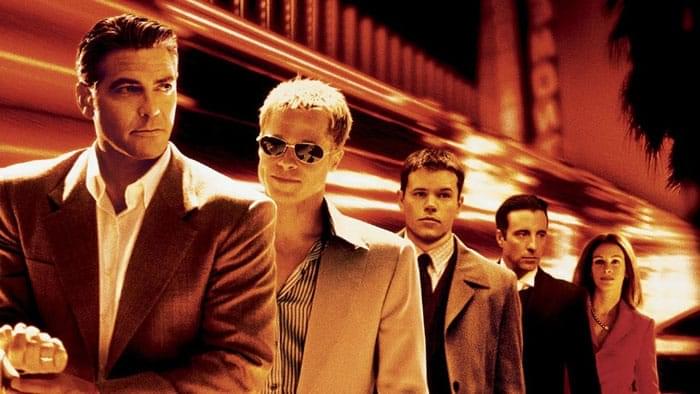
With a stellar cast of crooks and criminals that features the likes of George Clooney, Matt Damon, Brad Bitt, Andy Garcia and Julia Roberts, Ocean’s Eleven is one of many of Ocean’s movies with plans to score big. Danny Ocean and his crew use ingenious heists and trickery to rob the biggest casinos in Vegas.
While the central heist in the movie focuses on other Vegas hotspots like the Bellagio and the Mirage, Caesars Palace is one of the first casinos seen in the film. This cameo occurs during a flashback of a failed heist at the landmark establishment.
With a budget of $85 million, the movie proved that heists are worth it. It garnered $450.7 million at the box office and confirmed that fans love the idea of big casinos and elaborate scams.
The Guilt Trip (2012)
Originally titled My Mother’s Curse, this movie follows Andrew Brewster (Seth Rogan) and his crazy mother (Barbra Streisand) as they travel across the country. During their travels, the pair stay at Caesars Palace before continuing their journey.
Garnering a total of $41.9 million, the movie barely broke even, considering it had a budget of $40 million. Thankfully, part of what it did do is highlight a great location to film in Las Vegas and share some light on the funny relationships between mother and son.
Honorable Mentions
While the above films are some of the most popular and recent movies set at Caesars Palace, the casino has a long history of movie appearances. Amongst these includes a movie filmed the year after the iconic casino opened. Below are some more movies shot on location at Caesars:
Kylie Jenner held nothing back when she released her ‘My 2022 Year In Review’ video on Youtube and, for the first time, the makeup mogul revealed who her favorite sister is. As fans know, the 25-year-old reality star is close with all her sisters, including Kim, 42, Kourtney, 43, and Khloe Kardashian, 38, as well as Kendall Jenner, 27. So who was her favorite this year? In her own words, “It is really hard because I love them all right now. But I think that my favorite sister this year is probably Khloe. Or, yeah. I am going to go with Khloe. We got a lot closer this year. We are in this little mom club and it’s a whole thing.”
“My favorite sister runner-up. I don’t know. Maybe Kendall. I really love them all. Kim has been great. Kourtney, they are all my best friends. We have had a good year,” Kylie said in the video, which was shared on her YouTube channel on December 12. But that’s not all.
Read below to find out all of Kylie’s favorite things that she revealed in her ‘2022 Year In Review’ video.
Kylie’s favorite trip: “My favorite trip of 2022. My birthday trips are always really special. We went to the Bahamas. Before that, we did a really fun London trip to see Travis perform and I brought my kids. It was a lot of fun,” she told her fans in the video.
Kylie’s favorite movie: “My favorite movie from 2022. I really liked Elvis,” she said.
Kylie’s favorite TV show: “My favorite TV show this year is obviously House of the Dragon. I have watched the whole thing probably five times now,” Kylie said.
Kylie’s favorite event: “My favorite event. I loved the Ulta Beauty event with Kylie Cosmetics. That was really special to celebrate that collaboration,” she told her fans, referring to the collaborative event between Ulta Beauty and her own line of cosmetics products.
Kylie’s favorite outfit: “My favorite outfit of 2022 was this Paco Rabanne vintage chain-hooded cool shirt. I actually got it when I was pregnant and I was like ‘well I cannot wear this now, but I am going to save this. When I feel confident enough I am going to wear this piece. I think it turned out amazing,” she revealed.
Kylie’s favorite fashion trend: “My favorite fashion trend. I am loving the knee-high boots right now. A lot of black going on. I love any time I get to wear all black,” she said.
Kylie’s favorite TikTok: “My favorite TikTok is any TikTok that I have with my daughter I always think is really cute. She wants to do a lot more TikTok videos. She loves doing videos with me, but I try to limit her TikTok time for sure,” she said. Kylie was not the only sister that had a huge year on TikTok, as her sister Kim appeared in countless TikTok videos with her daughter, North West, 9.
Kylie’s favorite accomplishment: “My favorite accomplishment of the year is probably having another healthy baby and giving birth once again,” she said, referring to the son that she gave birth to in 2022 with rapper, Travis Scott, 31.
Kylie’s favorite memory: “My favorite memory is with my son. My kids are four years apart and it is like a whole new experience again watching them babble for the first time and even grab your hand and try to say words and crawl. It is just amazing to see them learn.”
Kylie’s all-time favorite moment: “My all-time favorite moment of 2022 would be watching my kids become best friends. This has been awesome,” she told her fans before thanking them for watching. “Thank you guys for tuning in. I had so much fun answering these questions with you guys and I will see you soon.”
He had spent several years toiling as a comic trying to make it in New York when he auditioned for a new app-based game show called HQ Trivia. Little could he have foreseen what was to come, as the startup — from Rus Yusupov and Colin Kroll, creators of Vine, who sold their company to Twitter for a rumored $30 million in 2012 only to see it shuttered in 2016 — snowballed into a global sensation.
Millions dutifully logged on via smartphones at 9 p.m. E.T. to play along as Rogowsky posed a series of multiple-choice questions, each round more difficult than the last. Any players still standing after the final question shared in a communal pot — usually somewhere between $750 and $2,000, but, as corporate sponsorship from the likes of Wendy’s and Nike joined the bandwagon, sometimes as high as $400,000.
Dapper, charismatic and quick on his feet, Rogowsky had stumbled into the break he was looking for.
His following, which dubbed him the “Quiz Daddy,” ballooned from a small, passionate tribe into a rabid fan army. Studios booked their stars — everyone from Dwayne Johnson to Robert De Niro — to appear alongside him. And his unusual rise to stardom made him catnip to morning shows, late shows and everything in-between.
Behind the scenes, however, HQ Trivia was coming apart at the seams. The app could simply not keep up with demand, crashing frequently and at the most inopportune moments and failing to deliver on promised payouts. Eventually, the fad began to wear off. After over a year of explosive growth, and despite a half-dozen attempted spinoffs, usage started to plummet.
Then the unthinkable happened: On Dec. 16, 2018, after the company holiday party, co-founder Kroll accidentally overdosed on fentanyl-laced heroin. He was found dead in the bedroom of his Soho apartment at age 34.
Already beset by low morale, HQ Trivia could not survive the loss of the genius coder who built it. The company announced it was ceasing operations on Feb. 14, 2020. (It has since found a buyer and still exists in some form, a shell of its former self.)
Rogowsky, meanwhile, saw the writing on the wall and — after clashing since day one with Yusupov — left the company in April 2019 to host ChangeUp, a baseball show on the DAZN streaming service. The entire saga will be retold in an upcoming CNN documentary, Glitch: The Rise & Fall of HQ Trivia, which will air in 2023.
Then the pandemic happened, and baseball didn’t, and Rogowsky decided it was time to shake things up yet again. So he moved to L.A. and opened up a vintage T-shirt store in Santa Monica (yes, really — it’s called Quiz Daddy’s Closet, it’s at 2525 Main St. and Rogowsky is behind the counter).
The time now feels right to get behind the camera again. So Rogowsky, 37, has joined Gamestar+ — another gaming startup, only this one based around TV sets, not smartphones. The company, which bills itself as the first “interactive streaming board game platform,” has also signed Steve Harvey and Ken Jennings to host play-at-home versions of Family Feud and Jeopardy!
Rogowsky’s game has not yet been revealed. But ahead of that announcement, the Quiz Daddy caught up with The Hollywood Reporter to unpack the strange journey his life has taken over the past five years — and underscore his dogged determination not to become the game show host equivalent of a novelty song.
Hi, Scott. What were you doing during the pandemic? It seems like it would have been the perfect time for HQ, yet HQ didn’t exist.
Man, what a year. What was I doing? So I was actually on my way to South by Southwest to do some activation for American Express, doing some panel. I was on my way to the airport when that whole thing got canceled. I turned around and went home.
In February, a month earlier, HQ officially shut down. A year prior I had left HQ. I left in March 2019 to do this baseball show on DAZN [pronounced “da zone”]. We were two weeks away from our season 2020 premiere and hey, no baseball season. So honestly, what was I doing? Not much. I’m sitting around watching a lot of movies.
Where were you?
I was in my new apartment in New York. I had broken up with my girlfriend. We broke up on New Year’s. So it was the breakup, Kobe [Bryant] dying, Australian wildfires, COVID — that was a heavy three months there. And I was in my new apartment alone.
2021 was more of a transitional period for me because that was like, “OK, now I don’t have the job in New York, I don’t have the girl. What am I doing here?” So that’s when I actually moved from New York to L.A. in April 2021 and started this new chapter in my life, my L.A. era. I’m thinking big things for 2023. I think this is the year that Scott Rogowsky could get back in households as a name. I’m hoping this is going to be a renaissance year for me in a way.
Let’s go backwards, if you don’t mind, to how you ended up at HQ Trivia.
I moved to the city in 2007 and was just doing open mics, that whole grind. I had a show called Running Late with Scott Rogowsky, which was a late-night talk show that I was doing in New York. It was finding an audience. I was all set to move to L.A. to try that route in 2017 when I got a call from this guy who I used to work with at The Onion back in 2008.
He said, “Hey, I’m working with the Vine founders. They got this game show they’re cooking up, some trivia show. It’s on a phone. You want to come in and audition to host?” I thought, “What the hell. I’ll do this, I probably won’t get it and I’ll just move to LA.”
I did the audition and didn’t really give a shit about it because I was thinking, “A game show on your phone, great, what’s next, maybe I’ll be on gas station TV after this.” To me, in 2017, in my old-soul show business mind, content on your phone was the lowest of low. I didn’t do Vine. I didn’t care for Snapchat comedy. I was a purist.
Anyway, I did the audition and because I didn’t care, I was cracking jokes that probably weren’t safe for air, but I was getting the room laughing. So they hired me. And that was it. It was just a total fluke thing. “OK. You’re the host now. Come on in and start writing some questions and start doing some beta tests.”
I was in there writing the questions in the beginning. It was such a small team, it was a startup. The blend of tech and media was always a bit of a tension, and it’s ultimately what led to the downfall, I think. But it’s also what made it successful to begin with. It’s the reason we had a professional looking show with a professional host with technology that was unmatched anywhere else in the world. It was a wild ride, man. I would have done it for 20 years. Unfortunately, it burned out almost as quickly as it shot up.
Rus famously regretted selling Vine. He wrote that famous tweet, “Don’t sell your company!” So they were probably pretty bitter about it and scorned by how the whole thing went down — selling their company and then Twitter basically shutting it down soon after.
Rus, his personality is not one to want to share the spotlight. He’s the kind of guy who wants to be taking credit for things that he believes are his creation. So when Vine was getting big, he was very thrilled. He was winning Webby Awards, all these things. But then all of a sudden the people on Vine started getting bigger than Vine itself. The Logan Pauls, all those Vine stars, racking up millions of followers, and they were getting all the power. They weren’t getting paid by Vine, they weren’t employees of Vine, they’re just using this platform and becoming celebrities, making millions of dollars.
I don’t think that sat well with Rus particularly because he didn’t have control. All of a sudden you lose control of your platform because now these people are controlling and they’re going to say, “Hey, I’m going to leave Vine and go here. I’m going to take my 8 million followers.” And all of a sudden if they have more power than the platform, then the business could be in trouble.
I don’t know exactly how things went down with the business, but that’s exactly what happened. All those Vine stars went on to continue their careers elsewhere.
So when it came to me and my celebrity growing with HQ, I think there were flashbacks to that — where he says, “I don’t want to let this guy get as big as Jake Paul, as all these Vine people.” And he tried to clamp down on me. For those first six months I was hosting the show, he had a gag order on me. I couldn’t do interviews, I couldn’t do what I’m doing with you right now.
I would get emails from GQ, Interview magazine, morning shows. I also wonder how many emails came into HQ’s office that I never saw. Rus said, “Every time you get a request for press, forward it to me immediately. You cannot do it.” And I dutifully followed his rules, forwarded the email, and the opportunity disappeared. So he controlled the narrative as much as he could until it just got too big. No one could control it.
What kind of contract did he get you involved in?
They were six-week, independent contractor contracts. I think I signed three six-week contracts, which ended up being the first six months of the show. He got me cheap, and no benefits, and no equity. Then I signed a bigger deal, once things got too big to deny. It was either sign me for a multiyear deal, or I’m not going to do it. At that point it was one of those things where I had realized I had some leverage here. I wanted to keep doing it, obviously, but I could play that card.
So I finally got a nice deal with benefits, I’m a salaried employee now, and that’s what I wanted. I left frankly because I had another job. I had this other opportunity, the DAZN job, which was a much better-paying show, and better hours. With all the drama going on, and Colin’s unfortunate passing, it was a really crummy place to be working at that point in early 2019. The morale was terrible, people were being fired, the writing was on the wall that the ship was sinking.
Did you have a decent relationship with Colin? What did his death bring up for you?
Basically, he was a great guy. He was a brilliant guy. He was really the coding genius behind all this stuff. That was an incredibly tragic thing, and came out of absolutely nowhere. I didn’t know him personally to the point where we were hanging out partying all the time, so I didn’t know about his habits. Apparently he was getting sober for some time.
But the bottom line is, I’ve learned this since, he had been a lifelong addict. And there are genetic reasons for that, a family history of these things. And then ultimately it was this fentanyl thing. You hear about this every week — these fentanyl deaths. So that’s what it was. There was some misreporting that it was suicide, a party guy just going crazy. No. He was using these drugs, but he was a smart guy, and he wasn’t going to screw up the doses and things. He knew what he was doing, he was doing it as responsibly as he could, and he just got a bad batch with fentanyl. There are many brilliant people who are succumbing to this fentanyl stuff. It’s just crazy.
Do you recall where you were when you heard?
I was on a little vacation visiting my sister overseas in Scotland. So I missed the holiday party. The holiday party was that night, which is when he died. Sunday morning I get back to the States, I’m ready to do my big first show back after three weeks off the air, and I get this news flash: “Colin Kroll, founder of HQ, dead at 34.” I was like, “What?” It was completely insane. Just totally shocking. Devastating. Not just for his family, his friends, but ultimately the company. You can absolutely pinpoint his death to be the nail the coffin for HQ because once that happened, Rus became a CEO again, and then within a year it was bankrupt.
But then there were some highs, right, for you? Meeting Robert De Niro …
It was mostly highs. De Niro, The Rock, John Mayer, Awkwafina, Keenan Thompson, LaKeith Stanfield, Danny DeVito, Kevin Hart, Mark Cuban, Gordon Ramsay. These were all co-hosts with me. Massive celebrities who were all of a sudden nervous entering my domain, my little shoebox studio, and they’re saying, “There are a million people watching right now?”
It was second nature to me. I started from zero, then 50 people watching, then 5 million people watching, but it happened gradually so I never got nervous. But for these guys coming in, first time, a million, 2 million people, that could be a little jarring. Live without a net. This wasn’t like TV.
How did you adjust to fame?
At the height, it was like Justin Bieber-level sometimes. You walk down the street and everyone’s trying to get a photo with me. The biggest response I ever got was at the B’nai Brith Youth Organization International Conference in Orlando, Florida. The Jewish teen organization. There was 4,000 kids, Jewish kids from all around the world, and now I’m the biggest Jewish celebrity of the time. They were losing their mind. You could not have that more perfect demo. I spoke at their convention and it was about three or four minutes of just sustained applause. There’s video of it on YouTube you could watch. I was blown away. I felt the sound waves knocking me back, and one kid rushed the stage and give me a hug — security had to pull him off.
So what can we expect to see you on now? What are the shows you’re doing on Gamestar?
We’re developing a trivia show, pretty much a proprietary show that’s going to be my take on trivia. Obviously, it’s not HQ. But it has the elements of Gamestar that make it, I would say, better than HQ. HQ was 9:00 p.m. every night, or 6:00 p.m. on the West Coast. If you missed it, you’re out. There was some excitement to that, obviously, but not everybody can make it at a certain time. Now with Gamestar, you can turn it on anytime you want. I’ll be there interacting with you, it feels live, and you can be playing with multiple people in your room across the world.
This is just the beginning of my relationship with them. It’s exciting to think that I’m in good company with Steve Harvey, Ken Jennings — they’ve got some heavy hitters they’ve signed up. It’s nice to be considered in that league now amongst all the other great, iconic hosts.
Gamestar’s going to be a place where, if you’re a show producer right now and you’re pitching to ABC and CBS and Game Show Network, you’re going to be pitching to Gamestar. It’s going to be happening quickly.
At the peak of HQ mania, you signed with Dixon Talent, which manages Stephen Colbert and Jimmy Kimmel, and ICM. Are you still with them?
I cleaned house at the top of this year just because I was moving to L.A. and I just wanted a fresh start on everything. It’s been actually nice. There’s a bit of a psychic weight with some of those things — the psychic payment of waiting to hear, and what are they doing for me this week? Who are they calling on my behalf? I’m very involved in my life and my career, and when I pass it off to some other group, I want them to be just as involved. And I wasn’t finding that with some of these big agencies. It was not maybe the best culture fit, ultimately.
Right now I’m independent and I’m enjoying it. I have my lawyer who’s been with me since day one, and he’s fantastic, and the two of us are taking on the world here. But I could be open to signing with an agency if I really feel like it’s a good fit because I’ve been with several over my career and I haven’t quite found that fit yet.
“Love Life” and “The Nevers” are canceled, and “Gordita Chronicles” is also getting taken off the service.
HBO Max is cleaning house again. After the Warner Bros. Discovery streamer removed over 60 titles from the platform without warning this August — many of which were originals developed for the service — a new batch of series are being prepped to be taken off in the next few days, sources have confirmed to IndieWire.
The most high-profile of these series is HBO sci-fi series “Westworld,” which was canceled this fall after falling ratings in Season 4. Other shows getting taken off include HBO sci-fi series “The Nevers,” and rom-com anthology series “Love Life.” In a similar vein to the Lionsgate series “Minx,” the pulling of these shows effectively doubles as their cancellation announcement. According to sources, other less-high profile titles will be announced to leave the service in the next few days.
In addition, on December 9 Claudia Forestieri confirmed via Twitter that her series “Gordita Chronicles” would be taken off the platform soon. The coming-of-age comedy premiered on the service in June, and was canceled a month later.
*Trying hard to not be bitter about this latest insult to injury, but real talk, it feels like an EX destroying your photos in an attempt to ERASE you from memory…
Although the removal of HBO Max titles from the service is nothing new underneath the David Zaslav WBD regime, “Westworld” and “The Nevers” are two particularly surprising cases because they were produced for the HBO channel proper, and by Warner Bros. Television — in contrast, “Minx” and “Love Life” come from Lionsgate TV while “Gordita Chronicles” hails from Sony. According to sources, both shows may end up on a FAST channel (or a free service with ads) that Warner Bros. Discovery is working on developing as their plans to merge HBO Max and Discovery+ continue. These cuts also occur as WBD undergoes an end-of-year financial review.
Prior to its cancellation, “The Nevers” aired “Season 1A” in 2021, with a six episode Season 1B expected to premiere later on. Production on the second half of the season, which will reportedly wrap up the storyline, has already occurred, and it’s unclear if the new episodes will premiere on the show’s new home. The series, which starred Laura Donnelly, Ann Skelly, and Olivia Williams as a trio of women working to support a superpowered underclass that emerges in Victorian England, has faced numerous difficulties during its run, from the pandemic halting filming to the departure of its creator Joss Whedon following allegations of workplace harassment on other projects.
“Love Life” is notable for being HBO Max’s very first original scripted series, premiering with the streamer in May 2020. Created by Sam Boyd, both seasons of the series focused on a different individual’s search for love. Season 1 starred Anna Kendrick as Darby Carter, while Season 2 was lead by William Jackson Harper as Marcus Watkins. The show received mostly positive reviews, with its second season being seen as an improvement on the first.
Deadline first reported the news of Westworld’s impending removal from HBO Max.
A new six-CD boxed set from the Beach Boys, titled “Sail On Sailor,” represents a point in time — specifically 1972 and the beginning of 1973 — when the venerable band was trying to get away from its classic image a bit and fit in more with some of the other rock music that was coming out of the post-counterculture era. They were serious enough about it that they even considered ditching, or altering, their world-famous moniker. As longtime member Alan Jardine explains it:
“At that time, we felt we needed to get away from the California culture and just start over. We were in the process of even changing our name. I had an idea to call ourselves ‘the Beach,’ you know? Take the ‘Boys’ out, because we were branded with that,” Jardine says. “There was always an identity crisis with the band in those years,” says Jardine. “’Who are they? What is this all about? This is another direction.’” In the end, boys would forever be boys, even if the “Sail On Sailor” era represents a strong example of the group growing up to be men, to borrow an earlier Beach Boys phrase.
“Sail On Sailor,” which is available on vinyl and download as well as CD, and also comes in more economical and condensed packages, is a must-have for any serious or even curious appreciator of the Beach Boys, representing the end of the era in which the band stretched its wings — or, sure, its sails — to try to be more of an FM act. This was right before the “Endless Summer” greatest-hits album put the public in the mood for ‘60s nostalgia again, which was a cue for the group to reembrace its original surfy appeal. But the more rocky and adventuresome side of the band produced some great music while that inclination lasted, in the form of two studio albums, “Carl and the Passions — So Tough” and “Holland,” the latter of which produced the classic number that provides this collection its title. The deluxe version also includes a never-before-released Carnegie Hall live album that captures the period when South Africans Blondie Chaplin and Ricky Fataar joined and invigorated the lineup. (It’s Chaplin who sang “Sail On Sailor,” something he still does on tour with Brian Wilson’s band.) Scores of outtakes fill out the collection.
Variety spoke with three key band members from that period — Mike Love, Jardine and Chaplin — about the new boxed set, personnel shifts at the time, and their memories of going over to Holland to record the album of that name. Condensed and edited versions of those three individual interviews follow…
MIKE LOVE
Is there anything that strikes you straight off about the new set, or the 1972-73 era it represents?
It’s 50 years ago — my goodness! … It’s pretty interesting because we are about to be playing in Carnegie Hall (in 2022). And on this collection, there’s a live album from Carnegie Hall that features Blondie Chaplin and his partner in the group the Flame, Ricky Fataar, playing drums, because at that time Dennis had screwed up his hand, so he couldn’t actually play. It was really unique because the Flame were from South Africa; there was still apartheid, when they joined our group. I think Blondie in particular gave a harder edge to the vocals, and he’s a great guitarist, too. So it was an interesting time period, that’s for sure.
Picking up roots and traveling to Holland to do the “Holland” album, living for six months in another country, was pretty amazing. The idea was that we’d always been in Southern California, in the studios on Sunset Boulevard or Brian’s place. We just decided we’d experiment and go overseas, and it was costly, but the music that came out of it was pretty darn cool, you know? I guess we were a little homesick because we did our “California Saga Trilogy.” I did this poem, “Big Sur,” about one of the most special parts of the world. And Al had read a book by a guy named Robinson Jeffers, and that contributed to his thought process. So it was an interesting thing to go all the way to Europe and yet write about something that was uniquely Californian.
There were some really definitely dramatic changes in the group and really profound experiences that led to the creation of some of these songs. There were so many things going on with integration and the Vietnam War and stuff like that — and also the influence of meditation. Alan and I ended up going to a (transcendental meditation) teacher training course around that early ‘70s period, and we were expressing some of our interest in meditation through “He Come Down” and “All This Is That.” So there are some different pursuits that took place in that very specific period of time, just before “15 Big Ones.”
It was a period when you and other band members came more to the fore as Brian receded a little bit.
Yeah, Carl did some great stuff with (then-manager) Jack Rieley providing a lot of the lyrics for Carl’s music. Alan Jardine wrote “On My Way to California,” and had me sing lead. And we both worked on together on “All This Is That.” Carl Wilson came in with a beautiful vocal part at the end of the record, and so that’s a very special song. I love doing that one in concert. It’s hypnotic, basically, and it’s from the Vedas. I first heard that saying from the Maharishi.
Talk about the spiritual elements that were key for you in some of those songs, like on “He Come Down” a sort of ecumenical gospel song on the “Carl and the Passions” album, which works Krishna and the Maharishi in there.
That was a special time, back getting initiated into TM on December of ’67, and then about a month and a half later there I was in India with Paul McCartney coming to the breakfast table singing “Back in the USSR.”
Because of growing up in a Christian environment, we became exposed to gospel music, which was great. And “He Come Down” is in this gospel-style format. The Maharishi talked about “drawing the arrow back,” meaning going within before you come out into activity. You take your 20 minutes in the morning and evening and you go within for that amount of time. That’s the TM to be practiced in the morning and the evening, as a preparation for activity. So we just put that into a gospel framework, and that was a fun song. Brian and I were at a meeting at one time, and he was saying how much he loved “He Come Down.” It’s just one of those things that was so different musically, and he absolutely loved it, and so that was nice. We all sang on it, but it really affected him.
You had a lot of input into the song “Funky Pretty.” Do you remember anything about that song?
I sure do. The woman I was with at the time was Tamara, who is the mother of our daughter, Summer. And she’s a Pisces, and she was the inspiration for the lyric for that song. Brian came up with the music part of it, and so it was a collaboration by Brian and I, which came out pretty nice. I wrote out the poem which became the lyrics, and we put it together musically. So that was like the old days, wasn’t it? Because Brian and I wrote so many great songs together during the ‘60s.
You never collaborated with Dennis much, but you did a little bit during this period.
“Pacific Ocean Blues” (which came out later on Wilson’s “Pacific Ocean Blue” album) —I did the lyrics on that, and “Only With You” (on “Holland”). He wrote a lot on his own, but he did ask me to contribute to “Pacific Ocean Blues.” We read about the slaughter of the dolphins that was pretty heinous. Dennis lived on a boat quite a bit of the time, the Harmony, and so we both had that interest in the environment. And Bruce (Johnston) and I have been on the advisory board of thee Surf Rider Foundation for many years. So we’ve all had a concern about the environment. And Al and I wrote that song together, “Don’t Go Near the Water” (on 1971’s “Surf’s Up). We all were concerned about it, and so some of that showed up with “Pacific Ocean Blues” and “Don’t Go Near the Water.” You know, it was nice to write basically with just about everybody in the group at that time.
You say in the liner notes you didn’t have a lot in common with Dennis because of the different paths you were on, but ecology was at least one area of overlap.
Right. The lifestyle choices were different. That is true. I got into meditation and I was invited by the Maharishi to go to India in the spring of 1968, and it was a really big influence on me, and still is. I mean, I meditate every day. And then some of the other guys went off into other directions, lifestyle-wise, which is too bad, because in Dennis’ case, it contributed to his early departure, you know? Which was sad.
Right now, you and the touring Beach Boys are doing a Christmas-themed tour, is that right?
Absolutely. With that pandemic, everybody got shut down, and I hated the fact that we couldn’t do music. That year that they shut everything down, we had (planned) the busiest year we’d ever had. So it’s nice to be back out to do live music for people. We’re with a small orchestra now, and we call it “Holiday vibrations” and everything sounds so great with the orchestra, particularly some of those “Pet Sounds” things like “God Only Knows,” “Wouldn’t It Be Nice” and “Sloop John B,” plus all the Christmas songs that we do from the original Beach Boys Christmas album. And there’s an album called “Reason for the Season,” which I did with most of my kids; four of my children played on it, and my sister played harp like she did on “Pet Sounds”back in the day. We are so happy to be back out doing it.
The Beach Boys’ “Sail On Sailor” 6-CD deluxe boxed set
ALAN JARDINE
There was a really fertile period of years where all the personalities in the band came more to the forefront as Brian receded a little bit, and you and Mike and Carl were really getting to do a lot more stuff and the band was maturing. And you had a manager at this time, Jack Reilly, who really was wanting to make the band seem more of its time, in the early ‘70s.
Yeah. We’ve outlived a lot of managers, too, with different ideas of who we were or who we could become. On this one, we had a manager/writer who worked with Carl, principally, and I think really helped Carl grow as a songwriter-musician. Really, I think a lot of people rediscovered or are rediscovering us through some of Carl’s songwriting, and some of my input as well, during that period. We moved the whole kit-and-caboodle over to Holland as a result of that management decision, and we had one of our best albums, I think, at least from a writing, compositional point of view.
Prior to that, “Carl and the Passions” was another example of booming creativity, when we brought a group over from South Africa called the Flame, and they contributed musically and sonically and lyrically to that album. So there was a lot going on. But unfortunately, we didn’t position ourselves too well as a recording group by calling ourselves “Carl and the Passions.” That took a little explaining, but I don’t know if the point ever got across that that was just a humorous (thing)… that was just like an anecdote that ended up being the title of that particular album. Probably nobody knew who the hell we were! [Laughs.]
I was impressed particularly with us writing some songs about more — shall I say — thoughtful and peaceful things, like from the meditation movement, because Mike and I had embraced TM at the time. And so there were a couple of things that I came up with, really from the old Indian, Hindu scriptures. One is called “All This is That,” which is a chant that I learned from Maharishi, and Mike helped me lyrically on that. So stuff like that was happening — we were a lot more introspective.
As you say, people might have been a bit confused because “Carl and the Passions” led people to think that would be a more nostalgic album — which applied to “Marcella,” but basically you were doing almost the opposite of that with more spiritual songs like “He Come Down” as well as “All This Is That.”
“He Come Down” was a great one. Another one of those (perfect) for the singers from the Flame; Blondie Chaplin sang that wonderful chant. … Ricky Fataar and Blondie were our backing band for “Holland” as well, so they were instrumental in making both albums. Ricky is one of the greatdrummers of our time, I think. Nobody could play a snare drum like Ricky Fataar.
Even in Holland, you ended up doing music about California.
By the end of the time we were over there in Holland, we were so homesick, my song “The California Saga Trilogy” kind of harkened back to our roots, actually. We were very cognizant of that. It was time to go home. One of the last vocals Brian did on the album is on the “California Saga” suite. He walked into the studio and marched over to the microphone in the middle of the mixdown — which is kind of unusual, because when you’re mixing down, you usually don’t record. You’re through recording! Brian walks in and goes, [sings] “On my way to sunny Californ-I-A.” It was cool and kind of lifted us all up, because we were on our way back home. That stands out as something I remember, because we’d done our thing, for so many months there; we were ready to go home.
Al Jardine’s ‘A Postcard From California’ CD cover
You have just released on CD a new version of your [formerly digital-only] solo album, “A Postcard from California,” with newly added tracks and remixes. It includes some songs that nearly count as Beach Boys tracks.
There’s material on my album that was originally supposed to be band material, which I was able to finish and produce with the fellas on it, from that period that we’re talking about. I rescued this one tune called “Don’t Fight the Sea,” and all the guys sang on it, and it just for some reason didn’t ever materialize, because it’s pretty serious, heady stuff, you know? I mean, the Beach Boys aren’t known for their thoughtful thinking about pollution and stuff like that. [Laughs.] So probably just thematically it wasn’t right for the Beach Boys, but it worked for me beautifully. And I encourage people to listen to the guys singing about something really important, especially now. … It’s unfortunately coming true — the polar bears are looking for places to sleep now.
How far back does “Don’t Fight the Sea” date?
The ‘70s. I just kept my original lead on it too. I couldn’t do a better job on the lead if I tried, so I just thought, no, I’m not gonna mess with this. And I got Brian, Mike, Carl and Bruce on the choruses. … On this album there’s a bonus track I remixed quite a bit, and the new version is pretty good. It’s called “Waves of Love,” another one that should have/could have, but due to all the complexities of being in a band of ourlongevity, there’s just not enough room for stuff, so you just have to find an outlet for it. But “Waves of Love” is really a Beach Boys song all the way through. And in fact, Carl Wilson sings one of his last leads on that, come to think of it, on “Waves of Love.” I’m very proud of that one. He was very generous with his time and helping each of his brothers and myself finish a song, and Carl was right there for me singing this beautiful bridge on “Don’t Fight the Sea,” as well.
Having finished touring with Brian Wilson early this year, you are back out on the road in December with your Endless Summer band, right?
Yeah, I’ll be out there in the snow drifts, bringing hopefully some joy to a few people, at places like Nashville’s City Winery. I’m back doing the low-key kind of tours where you get to meet people, which is a lot more fun than playing in a giant stadium, or the big shows that we do with Brian, where you don’t even hardly see the people. I like doing the real personal things where you can see the joy on their faces. I call it the Endless Summer Band, because… I don’t know why. Well, I guess it’s because I happened to trademark the name! [Laughs.] That would be a good reason. But I mean, hopefully we don’t have an endless summer. At the time, it seemed charming. It’s funny how with time, meanings change.
BLONDIE CHAPLIN
Beach Boys fans are really interested in hearing the Carnegie Hall recordings that have sat in the vault for the last 50 years. Do you have any memories of playing Carnegie Hall?
Yeah, I remember. I think that was a show where I did “Leaving This Town” for the first time, and I was as nervous as crap to do it. You can hear me breathing hard, being nervous. But it was a really good gig. At that time, the Beach Boys had been playing kind of nonstop, three weeks on, one week off, doing a lot of colleges, building it up, and then Nassau Coliseum and Carnegie Hall. And that gig was a real special gig because it was pretty rocking. The fans gave us some good confidence. It was different for them because it was different music compared to what all the other Beach Boy stuff used to be, but they seemed to embrace it pretty good.
Jack Rieley, the manager at that time, was really one of those forces who wanted to make the group more contemporary and relevant to the early ‘70s.
Yeah, he just figured they could kick into maybe a slightly rockier or harder… not harder, but I mean, this more energetic, rocking thing, getting away from the beach and the surf kind of stuff — although that would always be a part of it. Reiley just thought they needed a new direction, and I think Carl as well thought so. The other guys, you’d have to ask them, but I know those two were gung-ho in trying something different, and here are two young African guys that fit the bill. [Laughs.] Ricky had joined the band before me, and I was still in South Africa at the time — I think it was early ’72 — when I got a call from Reiley to come and get involved and then joined up with them in Europe. God, I wish he was around. Because he put a lot of things into perspective with what he was thinking and feeling. He had a lot to do with it, and I think Carl did too. And those are the guys that are not here.
The Beach Boys // Photographer Unknown // Circa 1972/1973 // Blondie Chaplin and Ricky Fataar
Photographer Unknown
“Sail on Sailor,” which you famously sang lead on, was such an outlier for the group. Actually, some of us of a certan age during that period got into the Beach Boys through that song, because it was such an FM-friendly, uncharacteristic track for the group, and then we went back into the earlier stuff, as opposed to the people who’d grown up with the band.
Yeah, I think that that happened a lot. It was so different. Just about everyone has heard, somewhere, that song. But at the time when it came out, it was no hit or anything. It was a “turntable hit,” as they used to call it in those days. It wasn’t even selling that many. But that song seemed to just kind of keep sailing — no pun intended — and keep going. And now, 50 years later, I’m going, oh, shit, that has some legs. But if you’d asked me at the time we were doing it, I would go, boy, I don’t know if this will (be around) 50 years later. But hey, I’m glad it did, because if that song wasn’t on the album, we wouldn’t even be talking.
It got on FM radio more than top 40, which was an interesting turnaround. As far as who sang it, we know that other people tried it before you did. Were you kind of surprised that a song that had its origins with Brian and had that much commercial potential, suddenly, it’s like, “No, let’s get Blondie to sing it”?
Well, the thing is, Dennis was there, and he was just preoccupied. He gave it a shot, but he was ready to go and check out his new board that was sitting in the back of his truck. That was where he was at. He was like, “OK, Carl, I gave it a shot. The surf’s up — I’m going.”That’s exactly what was happening. So he said to brother Carl, “You’re a better singer. You give it a shot.” So Carl tried it a couple times. He didn’t like the timbre of his voice. So there was only one other person in the whole room. And I had a feeling Carl would’ve liked me to have sang it anyway. So it landed in my lap and I sang it twice. I did it a couple of times and that’s what you hear.
It was a fun little track to do. It was just Carl on the electric piano initially; I played bass, and Ricky played drums and then sang something. It’s like a softer blues shuffle. If I go to a market or somewhere where it’s playing in the speaker, I stop and go, “OK, he’s not bothering me after all these years. He sounded OK then, and he sounds OK now.” And then you just keep going.
Your time in the band gets talked about a lot, for being such a short one. And then “Holland” there was almost a three-year gap between Beach Boys albums, and by “15 Big Ones” you and Ricky were gone and they’d shifted in a different direction, toward more of a nostalgic feel again. How did you feel about the the end of your tenure with the band?
Well, I look it as a short escapade, but there seemed to be quite a bit of music in there. The way it ended was a bit of a drag. Because I got into a bit of an argument with Steve Love, Mike Love’s brother, and that wasn’t any fun. And I think that’s what you are asking me, because that’s how it ended. There was a skirmish, so to speak, and people landed me a few blows, and I just said, “Screw it.” So however you can condense that so it doesn’t swallow the whole beautiful part of the music would be great. [Laughs.]
But it’s weird. There’s “Carl and the Passions.” There’s the “Holland” album, and then there’s “The Beach Boys Live.” That was in not even three years — like two and a half or something. I’m so amazed that people talk about it now. (“Sail on Sailor”) has got legs and it’s kind of gotten into the American psyche.I remember hearing it in, what was that movie with Scorsese and Jack Nicholson… (“The Departed.”) It’s in the background of one of those scenes, and when I was sitting and watching the movie, I go, oh man, that’s funny. So it stands up and I’m happy that people dig it. After all this time, it’s a pleasure to be thought of as a good thing in that era of the Beach Boys’ music.
Are there any other highlights you remember from the studio?
Well, I loved the “California Saga” stuff — that was a lot of fun doing vocals on that with Mike and Al and the whole band. I remember fondly “Funky Pretty,” which was a lot of fun when we did that in Holland. Because in the makeshift studio in Holland, it was all just a bunch of (equipment that had) just been flown from America and assembled over there and you’d trip over wires every which way. The train would come by and it would rumble the studio. We’d have to stop recording and then you’d start again. It was just so unusual to go bring all the equipment and start somewhere and do something in a barn — an adventure. I was, what? I was 21. I think Ricky was 20.
I’m still fond of going to Holland. Up until this pandemic, I was going there once a year, hanging out. I love going there and sitting on the boat, just going down the canal. It’s really mellow, and that’s what I liked about doing the “Holland” album. It was mellow to be there, and that’s a mellow place, so I had a lot of fun doing it.
So it had a lasting effect for you, in that it’s become a lifelong destination?
Yeah, I have some good friends there, and whenever I go to Europe, I stop there first and get acclimated, so to speak. But the barn where we recorded is not there anymore. I went there for a photo shoot with some people some years ago and went, “OK, that’s gone.” But one of the guys that runs the corner store who lives there was painting his fence, after 40-some odd years, still painting the fence the way he painted the fence back then, bent over in a certain way. And I’m going: God, could he be the same guy? Sure enough, it was the same guy! And I said, “Do you remember some of these people down here in the barn, making music?” He said, “Yeah, these American guys came and put in all this equipment and made a noise. They had a racket for three months, then they were gone.” It cracked me up.
The converted barn in Holland where the Beach Boys ‘Holland’ was recorded over many months
It’s easy to see how it must feel strange to talk about something you were only a part of for a couple of years, 50 years ago. And yet you have toured with Brian and his band in recent years, so in that sense it has to seem not such a completely foreign experience.
You know, Carl disappeared, and Dennis, and things do change. So I’m glad that this thing has come out the way it has, because it’s good to show what was happening with the band then, to show it was a good time creatively. Whatever happened later, it’s got nothing to do with me, because I wasn’t involved. … But with Brian… He flew over (for “Holland”), and that was something else, because he never did like to fly. So they got him there and it was a pleasure. Especially on “Funky Pretty” — it was a pleasure working with him on that. That one comes to mind a lot, with him.
And then working with him the last six, seven years, that’s been a gas, too. We get along. Because we were close for that one little time, Dennis, Carl and Brian, and he knew about the Flame and everything like that, there was like a mutual respect. I think I remind him of his brothers, with that connection, you know?
The center of gravity of “The Whale” is obviously the 600-pound man at its center. Look closely, though, and he’s the one with a soul as light as a feather.
Charlie is a reclusive, morbidly obese English literature teacher unable and unwilling to stop eating himself to death. As his health woes mount and his life expectancy is put at just a week, Charlie struggles to reacquaint himself with his estranged daughter. We meet him on Monday and the film goes day by day to Friday.
Charlie is a gentle giant, not raging at his fast approaching demise. He’s an optimist and a fierce believer in truth even though there is nothing in his world reinforcing either. “The Whale” is not always pleasant to watch but the payoff and performances make it an astounding film.
Stationary and wheezing on his couch, Charlie is repeatedly visited by a constellation of people — a friendly nurse, his teenage daughter and a young missionary from an apocalyptical church. They all need something from this well-meaning but broken man — spiritual, medical or familial. They are all broken, too.
The movie, based and adapted from the off-Broadway play of the same name by Samuel D. Hunter, is directed by Darren Aronofsky, who helmed such dark tales as “Requiem for a Dream” and “Black Swan.” Hunter’s depiction of the mortification of the flesh perfectly meets a director enamored by the grotesque.
Brendan Fraser has earned lots of Oscar buzz for playing Charlie, allowing his signature puppy dog face to remain despite a massive body suit and swelling prosthetics. And why not? It is one of the most moving performances in years, full of humanity and a redemptive triumph for an actor who hid his talent in quickly forgotten films like “Blast from the Past,” “Hair Brained” and “Airheads.”
The whole cast is perfect, from Sadie Sink as Charlie’s spiky daughter, Hong Chau as his foul-mouthed nursing angel, Ty Simpkins as the missionary with a hidden past and Samantha Morton as his ex-wife with simmering anger and yet still love. There are steady references to Herman Melville’s “Moby Dick,” which gives the film the title and its doomed vibe.
Charlie has ballooned ever since the death of his same-sex partner, who apparently willed himself to death by wasting away in starvation after their relationship was condemned by his church-leading father. Charlie has apparently decided to die the opposite way.
He is sadly apologetic to his nurse — “I’m sorry,” he says continually — and shuts the video camera on his laptop during his online classes. Even the pizza delivery man doesn’t know what he looks like. “Who would want me to be part of their life?” he asks.
There has been fear that the film might be fatphobic and it’s true that cinematographer Matthew Libatique often leans into unflattering ways to show Charlie, soaping in a shower, straining to stand up or touch the floor, covered in sweat and shoving pizza or fried chicken into his mouth. Maybe some of that could have been touched on instead of lingered on.
But body weight is not what the writer and director want to focus on here. It’s more the weight of guilt and love and faith. “I just want to know I did one good thing in my life!” Charlie shouts. One feels that the underlying issue in “The Whale” could have been obesity as easily as cancer or alcoholism or a blood disorder. Hunter is exploring salvation, redemption, determinism and family.
The play has been sharpened for the screen but there’s no escaping the fact that it is rooted inside Charlie’s Idaho apartment, which he shuffles about in on a walker or later a wheelchair. This doesn’t make for sweeping cinema. Sometimes the apartment feels confining like a ship, adding to the Melville theme.
Some of the filmic attempts are forced, like the symbolically heavy bird that Charlie feeds outside his window, the three times actors rush to leave the apartment only to stop and turn back, and the heavy rain that builds as the film’s climax nears. But this is a film that stays with you and changes you. It is heavy, indeed.
“The Whale,” a A24 release that is in movie theaters on Friday, is rated R for “language, some drug use and sexual content.” Running time: 117 minutes. Four stars out of four.
___
MPAA definition of R: Restricted. Under 17 requires accompanying parent or adult guardian.
Anyone can read Conversations, but to contribute, you should be a registered Torstar account holder. If you do not yet have a Torstar account, you can create one now (it is free)
Sign In
Register
Conversations are opinions of our readers and are subject to the Code of Conduct. The Star does not endorse these opinions.
Teen Wolf fans were thrilled to hear the show was coming back as a movie for Paramount+. The original series ended in 2017 on MTV, with Scott McCall and his Pack striving to find and save werewolves. The show’s ending suggested the adventure would continue off-screen but delivered a solid conclusion for its central characters.
Years later, the trailer for Teen Wolf: The Movie has dropped, revealing various faces and names familiar to the Teen Wolf franchise. However, as many of the original cast members had been confirmed to return already, it was not necessarily a shock to see them in the trailer. More surprising was the return of the fan-favorite villain, the Nogitsune.
However, given Stiles and Kira will be absent from Teen Wolf: The Movie and had been so integral to the Nogitsune plot, the film could take several directions with this antagonist and how it connects to Allison Argent’s somewhat miraculous return if she is indeed alive at all.
The revival movie does not hide that it has been years since the end of the series, and instead, the trailer shows the film thrives on delivering a more adult side of these characters, seemingly facing the old traumas of their youth.
What will it be like for Scott and Lydia to return to Beacon Hills, especially as Scott reveals he has not been back in years? What are everyone’s lives like years later? This group of people went through fire together, and, for the most part, many made it out to the other side.
However, Allison’s return, especially with the Nogitsune coming back, is bound to bring up old trauma and fears. However, although Teen Wolf: The Movie is bringing back beloved elements such as Stiles’ Jeep and introducing new characters, can Teen Wolf: The Movie escape Stiles and Kira’s shadows as it relies on the Nogitsune as a potential central villain?
Still, the trailer for Teen Wolf: The Movie brings back familiar faces, locations, and a sense of danger. Will everyone make it out alive?
Today’s trailer roundup includes Netflix’s Madoff: The Monster of Wall Street, Disney+’s Just Love and a Thousand Songs, HBO Max’s This Place Rules and Peacock’s Paul T. Goodman.
Madoff: The Monster of Wall Street comes to Netflix on Jan. 4, 2023. The 4-part docuseries reveals the truth behind Bernie Madoff’s infamous $64 billion global Ponzi scheme that shattered the lives of countless individual investors who had placed their trust in the revered Wall Street statesman.
Just Love and a Thousand Songs is now streaming on Disney+. Tinishares the Astor Piazzolla Theater’s stage in Buenos Aires with Jorge Blanco, Cande Molfese and Mechi Lambreto give fans an intimate and unforgettable musical performance that pays tribute to “Violetta.” The special features new versions of five well-known songs from the show and includes anecdotal stories and memories from fans.
This Place Rules streams on HBO Max on Dec. 30. Andrew Callaghan brings his gonzo-style reporting to HBO to explore the undercurrents that led to the January 6 Capitol Riot. The 25-year-old ventures on a wild RV journey through America to take the pulse of a divided nation.
Paul T. Goodman premieres on Jan. 1, 2023, on Peacock with three episodes and new episodes weekly on Sunday. In the style of Jason Woliner’s work on Borat Subsequent Moviefilm, the series is a groundbreaking project that mixes fact and fiction to tell a bizarre and incredible tale. The cast includes Paul T. Goldman, Rosanna Arquette, Melinda McGraw, Frank Grillo, Dennis Haysbert, Dee Wallace,Christopher Stanley, Paul Ben-Victor, James Remar, W Earl Brown, Josh Pais, Irina Maleeva and Hilda Boulware.
Netflix has just unveiled that it is diving into the world of My Hero Academia in the form of a new live-action movie with Joby Harold writing and Legendary Entertainment producing. Here’s what we know so far.
My Hero Academia is a manga series created by Kōhei Horikoshi and published in the Weekly Shōnen Jump magazine. Currently one of the most popular fictional franchises from Japan, as of January 2022 the manga alone has over 65 million copies in circulation. The anime is currently enjoying its sixth season, with fans returning en mass to watch new episodes week to week.
The story follows Izuku Midoriya, a “Quirkless” boy in a world full of superpowered beings, the greatest of which are superheroes. Midoriya dreams of becoming the world’s greatest hero, but in order to do so he enrolls at the prestigious U.A. High School, the number one hero school in Japan.
Who’s behind Netflix’s Live-Action My Hero Academia Movie
Joby Harold is on board to write. The writer, director, and producer is best known recently for his work on Disney’s Obi-Wan Kenobi limited series and worked alongside Zack Snyder on Netflix’s Army of the Dead.
Upcoming projects include Transformers: Rise of the Beast and Netflix’s Jennifer Lopez movie, Atlas.
Joby Harold attends Star Wars Celebration in Anaheim, California – Photo by Jesse Grant/Getty Images for Disney
Shinsuke Sato (best known for Netflix’s Alice in Borderland) is also involved in the live-action movie.
Legendary Entertainment’s Mary Parent and Alex Garcia are producers on the new project. They’re the same production company working on Netflix’s God Country and Gundam.
Is My Hero Academia anime streaming on Netflix?
If you’re looking to catch up on the anime before the movie arrives, Netflix isn’t exactly the best place to do so at this point in time. Seasons 1-6 of the main anime series and spin-offs are available in Asian regions such as Netflix Japan and Netflix India, while seasons 1-2 are available in select regions such as the United Kingdom, the Netherlands, South Africa, and France.
In the United States, the main show is streaming on Hulu and Funimation while some of the spinoffs can be found on Starz.
Will Netflix globally carry My Hero Academia?
Netflix will carry the new movie’s global rights with one notable exception.
It won’t be added to Netflix Japan and instead be distributed by Toho Co., Ltd.
Other Anime Live-Action Adaptations Coming to Netflix
This is just one of several anime adaptations either on or coming soon to Netflix, although it’s worth noting Netflix’s track record hasn’t exactly been the best.
Upcoming anime adaptations include The Duffer Brothers’ take on Death Note, One Piece, Gundam, Onmyōji,Zom 100: Bucket List of the Dead,BRZRKR, Mega Man, and Pokémon.
Are you looking forward to this new anime adaptation at Netflix? Let us know in the comments down below.
Bill Maher believes that the tribal mentality of hate of “the others” that is festering in this country very possibly could lead to a civil war.
“Everything that they say can’t happen here, of course it can,” the comedian said on his “Club Random” podcast. “They used to say terrorism couldn’t happen here and then that happened here. We’re not exempt. Americans, they think their s— don’t stink, and they think that they somehow live in this gilded cage, where the stuff that other countries endure, well, we’ll endure it too — and that could include authoritarianism.”
On this week’s episode of “Club Random,” Maher invited evolutionary biologist and critic of creationism Richard Dawkins, to discuss about science, COVID, vaccinations and such, but the conversation veered a little off track and led to state of the country and social behavior of those in it.
“There is much talk about [a second civil war] and there’s lots of people rooting for it,” Maher told Dawkins. “There [are] many people who think that we are so divided and they hate the other side. The term that both sides use: ‘one against the other.’” But the one thing they have in common, Maher said, is that it has become an “existential threat,” one in which he can “absolutely” imagine a civil war a part of it.
The Civil War of the 1860s was also known as the War Between the States with definite lines of battle between the sides and forays of each army into the other’s territory. “If they captured Washington, they’d win the war, and if we captured the southern Capitol, we would,” as Maher put it. But the tension between “the left” and “the right” nowadays has no boundaries. That might make some think a modern war would not be possible but, Maher said, it is still feasible, but with blurred lines.
“We’re all marbled together now. There’s 4 million Trump voters in California, the bluest state in the country. So we can’t have a battle there but could you have a battle, as many countries have, within the armed forces? Absolutely you could. You could have factions. Trump has factions also in police, the FBI,” he said. “That’s what you find out when the s— hits the fan, and we’ve seen it play out in many other countries.”
You can listen to all of “Club Random With Bill Maher” episodes, including the one above with Richard Dawkins, by clicking here. Or to see Maher’s entire interview with Hawkins, click here.
Welcome to Fiscal Spotlight, a special monthly round up of projects—at all stages of production—working their way through Film Independent’s Fiscal Sponsorshippipeline.
***
History is written by the winners. It’s a cliché you’ve heard before, its thesis seemingly irrefutable. The thing this six-word bromide fails to capture, however, is that just whom the “winners” are shifts over time. Or even that thinking of the long arc of human civilization in terms of a simple binary is like trying to rewrite The Iliad with a stocking-stuffer magnetic poetry kit. The greater truth is that as human thought progresses over time history comes into focus—revealing hidden stories charged with present-day relevancy and vitality. And documentary films, of course, are one of the key tools we have to uncover these hidden histories.
As you might expect, many of these stories—and the fascinating characters that populate them—originate from underrepresented communities who only in recent years have been empowered to rediscover, research and re-launch the legends, legacies and landmark moments of their community’s yesteryear. Take the three projects featured in 2022’s final edition of Fiscal Spotlight, which take us to America’s protest streets, B-ball courts and TV studios.
All three projects are supported by Film Independent’s Fiscal Sponsorship program, which enables filmmakers to solicit tax-deductible donations and seek organizational grants in partnership with Film Independent. Here’s how it works:
November’s featured projects are Compton’s ‘22, EJ Lee: All-American and Barrio Television. Read on to learn more about each project and how to support.
COMPTON’S ‘22
Project type: Documentary Short
Project status: Post-Production
Director/Director of Photography/Editor: Drew de Pinto
Producer: Azza Cohen
About the project: In this project trans and gender-nonconforming performance artists reimagine the historic Compton’s Cafeteria Riot from the testimonies of the legendary “Compton’s Queens.” Three years before Stonewall—on an unknown date in 1966—trans women at Gene Compton’s Cafeteria in San Francisco’s Tenderloin district rioted against police violence. There was no news coverage, and the arrest records no longer exist. Decades later, trans historian Susan Stryker unearthed the history of the riot and interviewed the surviving “Compton’s Queens.” Compton’s ’22 creates an intergenerational conversation between these archival interviews and young trans and gender-nonconforming artists today, using performance to imagine an interpretive archive that stands in for the absence of visual documentation. The film provides a rare opportunity for trans and gender-nonconforming people to learn about their history and reveals the powerful implications of intergenerational solidarity in the ongoing struggle for queer liberation.
Meet the filmmaker: To learn more about Compton’s 22, including how to support the project, click here. Filmmaker Drew de Pinto is a director and editor based in Queens, New York. As a teenager, they were drawn to film as a way to process feelings of gender dysphoria. Their work explores how documentary and experimental modes of filmmaking can build alternative frameworks for gender and other social structures that allow us to imagine better worlds. Drew is a recent graduate of Stanford’s MFA program in Documentary Film and has worked on projects with the Democratic Socialists of America, Kartemquin Films, Truth & Documentary, Group Nine Media and more.
EJ LEE: ALL-AMERICAN
Project type: Documentary Feature
Project status: Production
Director/Producer: Jason Rhee
Producer/Editor: Zoe Sua Cho
Producer: Razi Jafri
About the project: Before Jeremy Lin and Yao Ming, there was Eun Jung Lee. EJ Lee, a Louisiana legend nicknamed the “Korean Magic Johnson of NCAA women’s basketball,” despite being overlooked her entire career. Finally, at the age of 60, EJ receives her first opportunity to become a college head coach to lead an underdog university squad in West Texas. EJ Lee: All-American is a feature-length documentary that combines verité and archival footage of Lee, the “greatest player you’ve never heard of.” The film will be an intimate character study of this little-known Asian American superstar (with a Southern twang!) by interweaving the historical journey of EJ developing into one of the best players in both Korea and America alongside the present-day narrative tracking the final chapters of EJ’s 40-year-career as a first-time college head coach.
Meet the filmmakers: To learn more about EJ Lee: All-American, including how to support the project, click here. Filmmaker Jason Rhee is a Korean American writer and director with a passion for telling stories centered around his childhood and the AAPI community. Jason was selected as a script intern and writers PA for Conan, as well as a writing intern and contributor for The Onion. With a background in screenwriting, comedy and satire, he’s produced two one-woman shows with stand-up comedian Kellye Howard, which have been featured on ABC and described as “exposing admirable vulnerability and strength.” Jason directed a sold-out run of a third show with Kellye at the Steppenwolf Theater as part of its 2022 LookOut series. After three years as The Onion’s writers assistant, Jason is currently working on personal projects, including All-American, workshopped in the 2022 Kartemquin Diverse Fellows in Doc program. He is a proud member of the Asian American Documentary Network and the Writers Guild of America East.
BARRIO TELEVISION
Project type: Documentary Feature
Project status: Production
Writer/Director/Producer: Christina DiPasquale
Writer/Director/Producer: Neyda Martinez
About the project: Barrio Television is the untold story of a band of Puerto Rican filmmakers who refused to let the first all-Latino produced TV show in American history be canceled. In 1972, a band of Puerto Rican filmmakers in refused to take “no” for an answer. When New York’s local public television station WNET canceled their pilot (it touched on racism too much for their liking) the filmmakers padlocked the door to WNET’s live pledge drive and hijacked the event, filling the sidewalks outside their Columbus Circle office with protestors until the executives gave in. They finally got their own show, and got to make it the way they wanted. The show? Realidades—the first bilingual Latino TV show in American history.
Meet the filmmakers: To learn more about Barrio Television and how to support the project, click here. Christina DiPasquale has produced and scripted several short documentary films for the Youth First Initiative and Public Welfare Foundation. She is a Senior Fellow at the University of New Hampshire and serves on the Board of Directors of the Media Burn Independent Video Archive. Neyda Martinez is a producer and strategic communications and cultural consultant. Martinez is a Sundance Documentary Producing Lab Fellow. Her previous work includes Decade of Fire (2018), which won PBS’ Independent Lens 2020 Audience Award, and Lucky (2013). Martinez was Co-Executive Producer of Acuitzeramo (2020) and associate producer of HBO’s Habla Now and Habla Loud (2020 and 2022).
You can learn more about Fiscal Sponsorship, including its benefits and eligibility requirements, by visiting our website. Check out our Sponsored Projects page to see the projects are currently being supported.
Zaharie Ahmad Shah (pictured) was the pilot of the doomed flight
DID THE PILOT HIJACK HIS OWN PLANE?
Pilot Zaharie Ahmad Shah planned mass murder because of personal problems, locking his co-pilot out of the cockpit, closing down all communications, depressurising the main cabin and then disabling the aircraft so that it continued flying on auto-pilot until it ran out of fuel.
That was the popular theory in the weeks after the plane’s disappearance.
His personal problems, rumours in Kuala Lumpur said, included a split with his wife Fizah Khan, and his fury that a relative, opposition leader Anwar Ibrahim, had been given a five-year jail sentence for sodomy shortly before he boarded the plane for the flight to Beijing.
But the pilot’s wife angrily denied any personal problems and other family members and his friends said he was a devoted family man and loved his job.
This theory was also the conclusion of the first independent study into the disaster by the New Zealand-based air accident investigator, Ewan Wilson.
Wilson, the founder of Kiwi Airlines and a commercial pilot himself, arrived at the shocking conclusion after considering ‘every conceivable alternative scenario’.
However, he has not been able to provide any conclusive evidence to support his theory.
The claims are made in the book ‘Goodnight Malaysian 370’, which Wilson co-wrote with the New Zealand broadsheet journalist, Geoff Taylor.
It’s also been rumoured that Zaharie used a flight simulator at his home to plot a path to a remote island.
However, officials in Kuala Lumpur declared that Malaysian police and the FBI’s technical experts had found nothing to suggest he was planning to hijack the flight after closely examining his flight simulator.
And there are also theories that the tragic disappearance may have been a heroic act of sacrifice by the pilot.
Australian aviation enthusiast Michael Gilbert believes the doomed plane caught fire mid-flight, forcing the pilot to plot a course away from heavily populated areas.
IF NOT THE PILOT, WAS THE CO-PILOT RESPONSIBLE FOR THE MYSTERY?
Co-pilot Fariq Abdul Hamid, 27, again for personal problems, was suspected by rumour-spreaders to have overpowered the pilot and disabled the aircraft, flying it to its doom with crew and passengers unable to get through the locked cockpit door.
Theorists have put forward the suggestion that he was having relationship problems and this was his dramatic way of taking his own life.
But he was engaged to be married to Captain Nadira Ramli, 26, a fellow pilot from another airline, and loved his job. There are no known reasons for him to have taken any fatal action.
There have been a series of outlandish theories about the disappearance of the plane
Others have suggested that because he was known to have occasionally invited young women into the cockpit during a flight, he had done so this time and something had gone wrong.
Young Jonti Roos said in March that she spent an entire flight in 2011 in the cockpit being entertained by Hamid, who was smoking.
Interest in the co-pilot was renewed when it was revealed he was the last person to communicate from the cockpit after the communication system was cut off.
DID THE RUSSIANS STEAL MH370 AND FLY THE JET TO KAZAKHSTAN
An expert has claimed the missing Malaysia Airlines flight 370 was hijacked on the orders of Vladimir Putin and secretly landed in Kazakhstan.
Jeff Wise, a U.S. science writer who spearheaded CNN’s coverage of the Boeing 777-200E, has based his outlandish theory on pings that the plane gave off for seven hours after it went missing, that were recorded by British telecommunications company Inmarsat.
Wise believes that hijackers ‘spoofed’ the plane’s navigation data to make it seem like it went in another direction, but flew it to the Baikonur Cosmodrome, which is leased from Kazakhstan by Russia.
However, Wise admits in New York Magazine that he does not know why Vladimir Putin would want to steal a plane full of people and that his idea is somewhat ‘crazy’.
Wise also noted there were three Russian men onboard the flight, two of them Ukrainian passport holders.
Aviation disaster experts analysed satellite data and discovered – like the data recorded by Inmarsat – that the plane flew on for hours after losing contact.
Careful examination of the evidence has revealed that MH370 made three turns after the last radio call, first a turn to the left, then two more, taking the plane west, then south towards Antarctica.
MH370 WAS USED BY TERRORISTS FOR A SUICIDE ATTACK ON THE CHINESE NAVY
This extraordinary claim came from 41-year-old British yachtsman Katherine Tee, from Liverpool, whose initial account of seeing what she thought was a burning plane in the night sky made headlines around the world.
On arrival in Thailand’s Phuket after sailing across the Indian Ocean from Cochin, southern India with her husband, she said: ‘I could see the outline of the plane – it looked longer than planes usually do.There was what appeared to be black smoke streaming from behind.’
Ms Tee’s general description of the time and place was vague and she lost all credibility when she later stated on her blog that she believed MH370 was a kamikaze plane that was aimed at a flotilla of Chinese ships and it was shot down before it could smash into the vessels.
Without solid proof of the satellite data, she wrote on her blog, Saucy Sailoress, the plane she saw was flying at low altitude towards the military convoy she and her husband had seen on recent nights. She added that internet research showed a Chinese flotilla was in the area at the time.
While the debris proved the plane went down in the Indian Ocean, the location of the main underwater wreckage — and its crucial black box data recorders — remains stubbornly elusive.
THE JET LANDED ON THE WATER AND WAS SEEN FLOATING ON THE ANDAMAN SEA
On a flight from Jeddah to Kuala Lumpur that crossed over the Andaman Sea on March 8, Malaysian woman Raja Dalelah, 53, saw what she believed was a plane sitting on the water’s surface.
She didn’t know about the search that had been started for MH370. She alerted a stewardess who told her to go back to sleep.
‘I was shocked to see what looked like the tail and wing of an aircraft on the water,’ she said.
It was only when she told her friends on landing in Kuala Lumpur what she had seen that she learned of the missing jet. She had seen the object at about 2.30pm Malaysian time.
She said she had been able to identify several ships and islands before noticing the silver object that she said was a plane.
But her story was laughed off by pilots who said it would have been impossible to have seen part of an aircraft in the water from 35,000ft or seven miles.
Ms Raja filed an official report with police the same day and has kept to her story.
‘I know what I saw,’ she said.
THE AIRCRAFT SUFFERED A CATASTROPHIC SYSTEMS FAILURE AND CRASH-LANDED ON THE OCEAN
A catastrophic event such as a fire disabling much of the equipment resulted in the pilots turning the plane back towards the Malaysian peninsula in the hope of landing at the nearest airport.
Satellite data, believable or not, suggests the aircraft did make a turn and theorists say there would be no reason for the pilots to change course unless confronted with an emergency.
A fire in a similar Boeing 777 jet parked at Cairo airport in 2011 was found to have been caused by a problem with the first officer’s oxygen mask supply tubing.
Stewarts Law, which has litigated in a series of recent air disasters, believes the plane crashed after a fire – similar to the blaze on the Cairo airport runway – broke out in the cockpit.
After an investigation into the Cairo blaze, Egypt’s Aircraft Accident Investigation Central Directorate (EAAICD) released their final report which revealed that the fire originated near the first officer’s oxygen mask supply tubing.
The cause of the fire could not be conclusively determined, but investigators pinpointed a problem with the cockpit hose used to provide oxygen for the crew in the event of decompression.
Following the 2011 fire, US aircraft owners were instructed to replace the system – it was estimated to cost $2,596 (£1,573) per aircraft. It was not known whether Malaysia Airlines had carried out the change.
If either pilot wanted to crash the plane, why turn it around? So the turn-around suggests they were trying to land as soon as possible because of an emergency.
THE US SHOT DOWN THE AIRCRAFT FEARING A TERROR ATTACK ON DIEGO GARCIA
The Boeing 777 was shot down by the Americans who feared the aircraft had been hijacked and was about to be used to attack the U.S. military base on Diego Garcia atoll in the Indian Ocean. So conspiracy theorists claim.
And former French airline director Marc Dugain said he had been warned by British intelligence that he was taking risks by investigating this angle.
There is no way of checking whether Dugain received such a warning or why he believes the Americans shot down the plane.
But adding to the theory that the aircraft was flown to Diego Garcia, either by the pilot Zaharie or a hijacker, was the claim that on the pilot’s home flight simulator was a ‘practice’ flight to the island.
Professor Glees said: ‘The Americans would have no interest in doing anything of the kind and not telling the world.
‘In theory, they might wish to shoot down a plane they thought was attacking them but they wouldn’t just fire missiles, they’d investigate it first with fighters and would quickly realise that even if it had to be shot down, the world would need to know.’
Mr Rosenschein said: ‘The U.S. would not have been able to hide this fact and in any event, if it were true, they would have admitted their action as it would have prevented a successful terrorist action on this occasion and acted as a deterrent for future terrorist attacks.’
Finding The One! Sophia Bush has kept her romance with Grant Hughes relatively private since the pair were first spotted together in Malibu in May 2020. However, the FocusMotion Health founder has shared a few photos of the couple.
Ever since landing the role of Brooke Davis on One Tree Hill in 2003, Bush’s personal life has made headlines. That is something that the actress and activist has intentionally changed, she explained in June 2021.
“It’s hard to have nothing that’s yours. And when you are a person who lives in the public eye, everybody wants to pick over everything and that can be really tricky,” the False Positive actress told Entertainment Tonight at the time. “I also grew up in the early aughts when girls were raked over the coals for any choices that they made. And I just was like, ‘I don’t think I like this.’ I didn’t like having my private life lied about. There were times where someone would send through an article and be like, ‘Well, supposedly you’re dating this guy.’ And I was like, ‘I mean, I would. Who is he?’”
The Hitcher star, who was briefly married to Chad Michael Murray before later entering public relationships with former costars Austin Nichols and Jesse Lee Soffer, added that now, she only wants to speak about her projects and her advocacy.
“It would be, ‘What are you wearing? And how’s your boyfriend?,’ and it’s like, ‘What does that have to do with anything about my work, my life?’” she recalled to ET at the time. “I really think the kind of gamification of people’s private intimacy is just creepy to me. So I don’t really hide what’s going on in my life, but I don’t flaunt it.”
Hughes, for his part, shared a slew of photos from 2020 at the beginning of 2021.
“I posted only two photos in 2020 and averaged less than 5 minutes per day on Instagram. This wasn’t really intentional; I think it was just a year for me to be present in other areas of my life. However, social media documentation or not, the memories of life continue being made,” he began via Instagram in January, sharing multiple pics. “Somehow through all this I found my person @sophiabush. She was in my life as a friend for 8 years and the pandemic forced us to slow down and stay in one place long enough to realize what I’d been looking for all along was closer than I could have known.”
In August 2021, Bush finally shared a photo of Hughes — proposing to her while the couple were on vacation in Italy. “So it turns out that being your favorite person’s favorite person is the actual best feeling on planet Earth,” she wrote via Instagram at the time. “My heart. It bursts.”
Sophia Bush and Husband Grant Hughes’ Cutest Photos
Finding The One! Sophia Bush has kept her romance with Grant Hughes relatively private since the pair were first spotted together in Malibu in May 2020. However, the FocusMotion Health founder has shared a few photos of the couple.
Ever since landing the role of Brooke Davis on One Tree Hill in 2003, Bush’s personal life has made headlines. That is something that the actress and activist has intentionally changed, she explained in June 2021.
“It’s hard to have nothing that’s yours. And when you are a person who lives in the public eye, everybody wants to pick over everything and that can be really tricky,” the False Positive actress told Entertainment Tonight at the time. “I also grew up in the early aughts when girls were raked over the coals for any choices that they made. And I just was like, ‘I don’t think I like this.’ I didn’t like having my private life lied about. There were times where someone would send through an article and be like, ‘Well, supposedly you’re dating this guy.’ And I was like, ‘I mean, I would. Who is he?'”
The Hitcher star, who was briefly married to Chad Michael Murray before later entering public relationships with former costars Austin Nichols and Jesse Lee Soffer, added that now, she only wants to speak about her projects and her advocacy.
“It would be, ‘What are you wearing? And how’s your boyfriend?,’ and it’s like, ‘What does that have to do with anything about my work, my life?'” she recalled to ET at the time. “I really think the kind of gamification of people’s private intimacy is just creepy to me. So I don’t really hide what’s going on in my life, but I don’t flaunt it.”
[jwplayer v0hzcpXI-zhNYySv2]
Hughes, for his part, shared a slew of photos from 2020 at the beginning of 2021.
“I posted only two photos in 2020 and averaged less than 5 minutes per day on Instagram. This wasn’t really intentional; I think it was just a year for me to be present in other areas of my life. However, social media documentation or not, the memories of life continue being made,” he began via Instagram in January, sharing multiple pics. “Somehow through all this I found my person @sophiabush. She was in my life as a friend for 8 years and the pandemic forced us to slow down and stay in one place long enough to realize what I’d been looking for all along was closer than I could have known.”
In August 2021, Bush finally shared a photo of Hughes — proposing to her while the couple were on vacation in Italy. “So it turns out that being your favorite person’s favorite person is the actual best feeling on planet Earth,” she wrote via Instagram at the time. “My heart. It bursts.”
The pair were first photographed together in May 2020, wearing matching face masks and embracing.
Credit: Courtesy Grant Hughes/Instagram
A Blur
“Who needs a party to dress up for the holidays?” Hughes captioned a still of the pair sitting outside with their dog.
Credit: Courtesy Grant Hughes/Instagram
First Date
The entrepreneur revealed that the pair’s first date “was also our first Covid test,” posting a pic of the duo in masks.
Credit: Courtesy Grant Hughes/Instagram
Pup Parents
The duo proudly coparent their dog, Maggie.
Credit: Courtesy Grant Hughes/Instagram
Passionate Partners
The Love, Victor actress and the University of Michigan grad participated in a Black Lives Matter protest outside Mayor Eric Garcetti’s office.
Credit: Courtesy Grant Hughes/Instagram
Nature Lovers
“A Kern River nature retreat. Few flights this year meant much more road trip exploring,” Hughes captioned a cozy selfie.
Credit: Courtesy of Sophia Bush/Instagram
Italy Trip
“Dream Boat,” Bush captioned a selfie of the pair on a boat together in Italy in August 2021.
Credit: Courtesy of Sophia Bush/Instagram
Engaged!
Bush showed off her engagement ring via Instagram in August 2021 just weeks after announcing that Hughes proposed in Lake Como, Italy.
Credit: Courtesy of Sophia Bush/Instagram
Meeting the Family
The One Tree Hill alum shared a snap via Instagram in September with Hughes and her parents in honor of her dad’s birthday.
“My sweet Papa turned 74 yesterday,” she captioned her post. “He’s such a good man. And a great dad.”
She added, “Celebrating him brings me tremendous joy. I love watching him and Grant nerd out about wine. And watching him and my mom hold hands when they walk down the street even still, though they’ve been married over 40 years. … Happy birthday to my original ride or die. I love you. ???”
Credit: Courtesy of Grant Hughes/Instagram
Lucky in Love
The Hard Luck Love Song star gushed about her “life partner” during a September 2021 interview with Entertainment Tonight.
“I will say, I do feel lucky whether it’s my life partner or the wonderful group of men in my life, who make up my friends and allies, who make up my support system,” Bush told the outlet. “I feel really lucky that across the spectrum of the dudes in my life, I have a real group of good ones.”
The duo made their first official appearance as a couple in October 2021 when they attended the Veuve Clicquot Polo Classic in Pacific Palisades, California. They also coordinated their looks, with Bush choosing a yellow bag that matched Hughes’ sunflower-colored suit.
Credit: Courtesy of Sophia Bush/Instagram
A Coupled-Up Christmas
Bush raved over Hughes while sharing photos of their decorations on Christmas Eve. “I spent four days making 76 [mushroom] ornaments and then my husband-to-be surprised me with carved wooden mushrooms and honestly my dreams of disappearing in a garden to grow vitamin-D laden snacks/running a craft-Tok (because nothing else on the internet sparks this much joy) are all coming true,” she wrote in December 2021. “Happy Christmas friends, and to all celebrating!”
Credit: Courtesy of Sophia Bush/Instagram
Matching Mates
Bush shared a sweet photo for Valentine’s Day. “You are my favorite favorite. I can’t wait to marry you and be your valentine forever ♥️,” she captioned the pic, where they donned identical buffalo plaid pajamas.
Credit: Courtesy of Sophia Bush/Instagram
Wedding Date
Before their own wedding, they attended friends’ nuptials. “Loves love. Loves a wedding. Loves wearing anything but sweatpants after the last two years,” Bush captioned the snap.
Credit: Andrew Harnik/AP/Shutterstock
Exploring D.C.
The pair went on a public tour of the White House in April 2022 ahead of the White House Correspondents Dinner.
Credit: Courtesy of Sophia Bush/Instagram
Family Bonding
Hughes attended a Los Angeles play with his fiancée and her mom on Mother’s Day. “Mia famiglia. My favorite guy. My favorite folks. My favorite pastime; being a theatre-goer,” the actress captioned the May 2022 snap.
Credit: Courtesy Sophia Bush/Instagram
6 Months of Marriage
“Six months married to my favorite person,” Bush captioned a photo with her hubby in December 2022. “The one who will camp under the stars with me, and also put on a tux to celebrate the holidays at the Naval Observatory in our Nation’s Capitol with me ??✨.”
In order to view the gallery, please allow Manage Cookies
Many popular pieces of antivirus software such as Microsoft, SentinelOne, TrendMicro, Avast, and AVG can be exploited for their data deletion capabilities, a top cybersecurity researcher has claimed.
In a Proof-of-Concept document (opens in new tab) dubbed “Aikido”, Or Yair, who works for cybersecurity firm SafeBreach, explained how the exploit works via what is known as a time-of-check to time-of-use (TOCTOU) vulnerability.
Notably, in martial arts, Aikido refers to a Japanese style where the practitioner looks to use the movement and force of the opponent against himself.
How does it work?
The vulnerability can be used to facilitate a variety of cyber-attacks known as “Wipers” according to Yair, which are commonly used in offensive war situations.
In cybersecurity, a wiper is a class of malware aimed at erasing the hard drive of the computer it infects, maliciously deleting data and programs.
According to the slide deck, the exploit redirects the “superpower” of endpoint detection software to “delete any file no matter the privileges”.
The complete process outlined involved creating a malicious file in “C:\temp\Windows\System32\drivers\ndis.sys”.
This is followed by holding its handle and forcing the “AV/EDR to postpone the deletion until after the next reboot”.
This is followed by then deleting the “C:\temp directory” and “creating a junction in C:\temp –> C:\”, followed by then rebooting the machine.
Only some of the most popular antivirus brands were impacted, around 50% according to Yair.
According to a slide deck prepared by the researcher, Microsoft Defender, Defender for Endpoint, SentinelOne EDR, TrendMicro Apex One, Avast Antivirus, and AVG Antivirus were some of those affected by the vulnerability.
Luckily for some, products such as Palo Alto, XDR, Cylance, CrowdStrike, McAfee, and BitDefender were unscathed.
Interested in updating your cybersecurity tools? Check out our guide to the best malware removal tools
Stephen Sondheim’s 1981 musical “Merrily We Roll Along” has become as notorious — and beloved in some circles — as one of Shakespeare’s problem plays. The first Broadway production closed after just 16 performances, a high-profile flop that’s chronicled in the documentary “Best Worst Thing That Ever Could Have Happened,” and subsequent revivals have struggled to come to terms with its challenges, including a told-backwards narrative structure that introduces the three central figures in the bitter throes of middle-aged dissolution.
Maria Friedman, a British actress and Sondheim veteran, brings an actorly touch to the material in her professional directorial debut, which first played in London a decade ago and opened Monday at Off Broadway’s New York Theatre Workshop in a starry production led by Jonathan Groff, Daniel Radcliffe and Lindsay Mendez. That cast is one of the primary appeals of this revival, helping to soften the story’s central trio of striving and often unlikable creatives.
Groff in particular is a revelation as Franklin Shepard, a once-in-a-generation composing talent who morphs into a self-centered Hollywood producer barely clinging to his second marriage. The “Spring Awakening” and “Hamilton” alum is an irrepressible charmer, and it’s easy to see how he deploys his charisma and crystalline tenor to take the edge off his character’s inherent jerkiness. He’s a narcissist capable of flashes of regret.
In comparison, Radcliffe’s playwright character, Charley Kringas, initially emerges as the more obnoxious of the duo — bitter about the breakup of his creative partnership with Frank (despite his own success as a solo artist) — as he delivers his memorably Act 1 rant “Franklin Shepard Inc.,” in which he eviscerates his sometime collaborator in a live TV interview. (Radcliffe, whose second act solo is shakier vocally, has a solid American accent and an expressive face that recalls silent-film star Harold Lloyd.)
Mendez, meanwhile, strikes a more poignant note as Mary Flynn, an aspiring writer who’s carried an unrequited Bic lighter for Franklin since they first met in their 20s and whose personal arc is the most savage: She ends up a fall-down drunk whose career has nosedived from bestselling novelist to the ultimate punchline — critic. Even so, she’s the one who works the hardest to keep the old gang together through their ups and downs — and Mendez projects a vulnerable longing for companionship that is truly affecting, particularly in the Act 1 closer, “Now You Know.”
Reg Rogers is another standout as Joe, the hot-shot producer whose career (and wife) get usurped by Frank. And Krystal Joy Brown sings and vamps the hell out of that striving starlet, Gussie, despite a character who remains stubbornly one-dimensional (ditto for Beth Shepard, Frank’s unfortunate first wife, played with pluck by Katie Rose Clarke). The women in this show, including Mary, just can’t seem to catch a break.
Sondheim’s score is typically challenging and memorable — with standout tunes including “Not a Day Goes By” and “Old Friends” that have become standards in cabarets and revues. But the backwards structure of the narrative — chronicling Frank, Charley and Mary from the bitter dissolution of their friendship in 1976 to their wide-eyed mutual ambition on a Manhattan rooftop in 1967 — remains a challenge. As does George Furth’s book, an update of a George Kaufman and Moss Hart play, that’s deadened with some seriously clunky dialogue and exposition. (As Mary says at one point, “Success ain’t all it’s cracked up to be.” You don’t say.)
There are some other curious missteps in this staging. Soutra Gilmour’s set, which morphs from Southern California cool to Manhattan sleek, is efficient but underwhelming, while Amith Chandrashaker’s lighting design leaves the cast in shadows at inopportune moments. (The NYTW’s wide, shallow stage does nobody any favors.)
Given the A-list cast and the size of the space, this “Merrily” has become one of the hottest tickets of the season — and it’s easy to imagine a Broadway transfer in its future. Friedman works hard to blur the weaknesses of Sondheim’s biggest flop, and she mostly succeeds in delivering a psychologically coherent study of how youthful aspirations and good intentions can evolve over time into something less rosy but no less real. Still, even a perfect version of this material is unlikely to win over casual theater fans. “Merrily” is a show that is more likely to be admired than fully embraced.
Tracking down the best housewarming gifts can be almost as tough as finding the right space: How much should you spend? Do you prioritize the kitchen, the living room, or the bathroom? And after days of looking, should you just give up entirely? But folks, worry not: No matter your situation, the perfect present is out there, and we’ll find it together. (Consider us gift-estate agents.)
Like gifts for moms and presents for husbands, the best housewarming gifts should be useful, but still thoughtful and fun. The goal is to find a unique treat or a helpful gadget that the new homeowner or person settling into a fresh apartment will love, but would never think to buy for themselves. It’s like finding something for the people who have everything or your hard to shop for friends; a little luxury or an upgraded version of an item they already use always goes over well. Pro tip: You can never go wrong with a personalized present.
To make your search easier, we took it upon ourselves to scour our favorite retailers in search of the absolute best housewarming gifts. From high-end cookware sets to flower delivery services, there’s a little something to impress any new homeowner (or apartment tenant). Looking for a gift for a college student who recently moved out of the dorm? We’ve got inexpensive presents for them too. Since so many of these gems are universally useful, they also make great gifts for women, and they’ll help you check the men off your list too. These picks are so good, they’ll be homesick whenever they go anywhere else.
Top picks for the best housewarming gifts:
All products featured on Glamour are independently selected by our editors. However, when you buy something through our retail links, we may earn an affiliate commission.
[This story contains major spoilers from the season two finale of HBO’s The White Lotus, “Arrivederci.”]
The White Lotus opened its second season with a dead body to tell viewers that someonethey will meet at the HBO show’s resort dies. But after seven episodes of getting to know the ensemble in Mike White’s anthology return — this time, set in Sicily, Italy — the ending remained unpredictable.
Even if a viewer had guessed that heiress Tanya McQuoid, played by Jennifer Coolidge, was the one who would die in the end, there was no way to have guessed just how she met her end.
The only main character to return from season one, Tanya had moved on from the grief of losing her mother and was vacationing as a newlywed with husband Greg (Jon Gries) at the Sicilian resort at the start of season two. But Greg, who was overtly miserable and possibly having a secret affair, left Tanya mid-vacation for business, which led her to spend out the rest of her days with a rich group of gay men, led by Quentin (Tom Hollander). After a night of partying and a cocaine-fueled romp with another man, Niccoló (Stefano Gianino), Tanya came upon a picture of a young Greg and Quentin, which was the first clue that pointed viewers to the theory that Greg and Quentin were carrying out an extortion plot so Greg could divorce Tanya over an affair, which would nullify their prenup.
“I wondered if Mike White was reading [these theories] because he would be so impressed with people coming up with these incredibly smart analyses of the possibilities,” Coolidge tells The Hollywood Reporter of the online fervor that built week-to-week as the audience tried to figure out creator White’s whodunnit.
In the 77-minute finale, Tanya uncovered a more sinister plot after realizing, from a tip from her assistant Portia (Haley Lu Richardson), that Greg had actually hired Quentin to kill Tanya for the money. While sequestered on Quentin’s yacht with two of his friends, she tries to warn the captain (“These gays, they’re trying to murder me!”), but he doesn’t speak English. When Niccoló arrives to take her back to the hotel on a dinghy under the cover of the night, she makes a break for it. She steals his bag and locks herself in a room, only to discover rope, duct tape and a gun. When the men barge in, she fires the gun in rapid succession and miraculously kills three of the men, and sends one fleeing into the water.
Her final question for a dying Quentin: “Is Greg having an affair?” When she gets no answer, she nervously attempts to get off the yacht and climb down into the dinghy, but her heel catches the railing, and she is flung overboard, hitting her head on the boat and sinking to her death in tragic and operatic fashion — just like the visit to the opera to see Madama Butterfly in the penultimate episode had foreshadowed.
“Tanya was so close to having a victory. And, an unlikely victory for someone like her, that she would have been able to manage a gun and save herself. She’s such a sad character, wouldn’t it have been cool if she survived?” asks Coolidge, when chatting the day after the finale.
Below, in a conversation with THR, the now Emmy-winning star of Legally Blonde, American Pie and Best in Show fame reveals how Tanya’s utterly tragic ending was inspired by a trait that friend White noticed in her. She also shares one possibility for her to return in the already announced third season of The White Lotus and reflects on the wild last two years of her career: “My mind is blown every day.”
When I reached out for this finale interview, I really didn’t think your character was going to be the one to die.
Aw, thank you.
Now, looking back, the signs were all there. But Mike White planted too many distracting seeds, and I think we were all fooled because, how could Tanya not be a part of The White Lotus? So, what has the reaction been like for you overnight?
It’s so weird because I thought maybe my friends were faking it when they were all asking, “Who’s going to die?” I was just really surprised that it hadn’t been leaked, or that people hadn’t figured it out. But my friends called me this morning, and actually last night, they were like, “I can’t believe you wouldn’t have told us this. I thought we were going to have a fun night. We didn’t know we were going to have to feel weird at the end of the night.” So I’m glad that people didn’t know; I’m glad.
Creator White crafted this role for you a while back with the first season. And he now explains that he knew he wanted to center season two around Tanya’s death after you spoke the season one finale line about death being the “final immersive experience.” At what point did he clue you in about Tanya’s fate?
I don’t know for how much time I knew that I was going to be in the second season; I forget how many months it actually was. But last year, maybe a few months before this one, I got this phone call from him, and we were having sort of a social call, and he said, “I just want to let you know something about season two.” He said, “We found these great locations in Sicily, and you’re going to love it here … oh and also, you die.” I was like, “I what?!” He was like, “You die.” I said, “Oh, really? Aw, really?” He didn’t tell me how I was going to die, but he told me I was definitely going to bite the dust. I was very disappointed, but not everyone can live!
Did you have all of the scripts at once, so you were able to see Tanya’s full and tragic arc? Or, was it episode by episode?
I think I had a lot of the script. I think I had the whole thing. It’s so weird because I was doing another job at the time, and to be honest, I feel like my brain is a little fried [in remembering]. The other job, I was definitely getting the scripts sort of dribbled; I was doing The Watcher [with Ryan Murphy for Netflix]right before White Lotus 2. I think Mike must have had all the scripts done, and I guess I did have the whole thing. That first phone call, he hadn’t figured out how he was going to kill me. But, he did figure it out.
Quentin (Tom Hollander) putting the charms on Tanya (Jennifer Coolidge) in an earlier episode.
Stefano Delia/HBO
What was the most interesting part about playing out this whodunnit, where you know all along, but Tanya and the viewers are the last ones to figure it out?
It ropes you in. I love that Mike dribbled one episode out each week and that people didn’t get them all at once. I really did like that, because then people had these [watch parties]. I even remember that happening with White Lotus 1. I had neighbors who were putting together these White Lotus nights. And I went to a lot of these parties. Everyone was dressed in their Hawaiian gear and would cook a different dish. It was very social, and I was so impressed. Then that ended, and the parties were even more intense for White Lotus 2. So I really like that it became a very social thing.
What I like about all the theories on Twitter and the different explanations that everyone had, a lot of it was so smart. I would read them and think, “I guess Mike White did leave that clue.” And other things where the clues made such sense. I wondered if Mike was reading this, he would be so impressed with people coming up with these incredibly smart analyses of the possibilities. It was riveting to read this stuff. I would send it to my friends, and they would send me back something they’d seen, and it was like you’d spend the whole day reading this stuff. But it was so entertaining, and some of the stuff people were saying was so funny.
White described Tanya’s ending as a “derpy death,” which is such a great word to encapsulate how she accidentally dies, after becoming a near-hero in her own tragic heroine story. How did you react when you read her death scene and saw how she goes out?
My initial reaction was just, “Oh my God, Tanya was so close to having a victory.” And an unlikely victory for someone like her, that she would have been able to manage a gun and save herself. She’s such a sad character, wouldn’t it have been cool if she survived? But Mike White is one of those people where you’re shooting something, and he is all about the reality. Like in that part where I picked up the bucket and I went over and hit him on the head with it, Mike says, “No, it’s not believable Jennifer, it’s not believable.” So I think Mike wanted it to be about how not everyone really gets to win in the end, even a tragic figure.
It’s terrible that Tanya dies. Greg [her husband] gets all the money, and he doesn’t even have to share it with Quentin [who was carrying out the hit on her], because Quentin is dead. So it has a sad taste in your mouth. I guess I didn’t like that I was so close to prevailing. But I heard Mike White tell someone else in an interview that he sort of felt like that was stolen from stuff he’s seen about me. When he says, “Jennifer, you can handle the big stuff, but then some small thing will be the unraveling of you. Some small thing that someone else can handle.” He’s fascinated by my inability to navigate technology a lot of the time. We’re all looking at some app, and I can’t get into it. There’s something with me and technology. So it makes sense because I think he stole it from my own ability to ruin something.
Tanya unknowingly heading off to her final destination in the finale.
Fabio Lovino/HBO
What was it like to film her ending, where she is so desperately trying to figure out how to get off this yacht, and then falls into the dinghy to her death?
The whole gun scene, that actually didn’t seem that difficult. But what really threw me off, again — and I told Mike White about this — is that I get really nauseous on boats. I told him on White Lotus 1 when he got to experience that with me when I got very ill on that boat in Hawaii, where I had to throw the ashes in the water. I ruined the day of filming for so many people on that boat because I was just holding that bucket and making everyone else feel sick. So Mike was like, “Well Jennifer, just remember, I’ll never make you get on a boat again.” And then, here we were! Here we were, and I was just as sick, and I had two different boats and had to do two different days of filming on these boats, and it was just horrendous. So I think it was navigating the nausea with the shooting. The motion thing is really a bummer. I was already nauseous from the boat, and then it’s just an added complication you don’t want to have to deal with.
But it’s sort of funny when you’re an actress. The things that really mess you up are things you don’t think about. Like, “Can you leap from here to here?” That seems easy. And then it’s some other thing that ends up being the biggest challenge of the project. But we had to shoot a lot, it was seven episodes in a very short amount of time in Sicily, and then ending in Rome. And I have to say, I’m amazed Mike was able to make that all happen. To write it all and direct it all, and then be involved in the editing. I don’t know how he did it. But, he did it.
It’s sad to think you wouldn’t be a part of the third season. Have you and White spoken about a way you could still be involved in the show?
Yeah, I mean, Mike is someone where you can’t just talk him out of things. Most of the decisions he makes, I have to say, later I look back and I’m like, “Oh my God, Mike White was right again.” Who knows if people were going to get tired of Tanya? Who knows? My only bummer is that I guess any way to bring back Tanya would have to be a prequel to White Lotus 1.
Or, in flashbacks.
Or flashbacks (laughs). I’m just sad, you know, I’m just sad. There was a very depressed Tanya in White Lotus 1 and then for White Lotus 2 Mike says, “She’s recovered from her mother’s death when we start White Lotus 2, Jennifer.” But the most sort of continual emotion of Tanya was always grief. I’m sad I couldn’t have played a happier Tanya! Because there are so many possibilities when someone’s not depressed; when someone’s depressed, it’s hard to get through the day. Who knows what she could have done?
Tanya posing on vacation with husband Greg (Jon Gries), in a photo taken by White Lotus hotel director Valentine (Sabrina Impacciatore).
Fabio Lovino/HBO
White did hint that perhaps the murders would get traced back to Greg in the third season. Would that bring you some solace, if Greg doesn’t get away with it?
Yeah. I think Greg should get it. He should definitely have to pay for all the misery he caused Tanya. He should definitely get his comeuppance. But I wouldn’t even mind coming back as someone different. You know, you never know.
You’ve had such a successful year after winning an Emmy (for White Lotus) and coming off of Netflix hit The Watcher — another part that was written specifically for you, by creator Ryan Murphy. And, congrats on your Golden Globe nomination this morning.
Thank you!
I read in your EW “Entertainers of the Year” interview that you felt like your Hollywood offers were “flatlining” before Ariana Grande put you in her Thank, U Next video in 2019. How does it feel to be having such a moment at this point in your career?
I just like when life is unpredictable because it gives you hope, and I think it gives other people hope. It gives other actors hope. This moment is so unexpected. If you told me, “Sit down with a pad of paper and write down something you would expect to have happen in your life,” the very last page — on page 50,000 — would be that this moment would happen. This moment is just the last thing I ever thought of. It wasn’t even a possibility. If you told me to list the possibility of things you wanted to have happen, I wouldn’t have even put this on my possibility list, because it’s so unlikely. So I’m just blown away. My mind is blown every day about this run. And I’m so grateful for all of it.
The petition starts today for you to return to White Lotus 3 in a new role.
Sunday, December 11, 2022 ratings — New episodes: Family Law, Coroner, 60 Minutes, The Simpsons, Family Guy, Bob’s Burgers, and The Great North. Specials:Avatar, National Christmas Tree Lighting: Celebrating 100 Years and Must Love Christmas.Sports: NFL Football: Miami Dolphins at Los Angeles Chargers, NFL Overrun, The OT, and Football Night in America.Reruns: The Conners.
Note: If you’re not seeing the updated charts, please try reloading the page or go here.
These are the fast affiliate ratings. The percentages represent the change since the previous original episode. (Percentages aren’t given for reruns or specials.) To see past ratings for a particular show, click the show’s link. The show pages are updated with the daily final ratings when they become available. Those pages include season averages to date.
Few documentaries have ever featured as inspiring a subject as Gabby Giffords Won’t Back Down, through which the Oscar-nominated directors of 2018’s RBG, Julie Cohen and Betsy West, profile the eponymous former U.S. congresswoman who was shot in the head while meeting with Tucson constituents in 2011 — and who has since fought her way back from the brink of death to become a leading advocate for gun safety measures.
Giffords, Cohen and West traveled to the SCAD Savannah Film Festival in October to screen their Oscar-eligible doc feature and then discuss it in front of a packed Lucas Theatre audience with The Hollywood Reporter. You can watch video of that conversation, which closes with a deeply moving sing-a-long that illustrates just how much progress Giffords has made in her recovery, at the top of this post.
Gabby Giffords Won’t Back Down, which was co-released by Briarcliff Entertainment and CNN Films, is now available for streaming on numerous VOD platforms.
Angelo Badalamenti in 2015Photo: Kevin Winter (Getty Images)
Angelo Badalamenti, the composer who won a Grammy for his iconic, haunting work on Twin Peaks and who regularly worked with David Lynch both before and after, has died. This comes from The Hollywood Reporter, which says the news was confirmed by the composer’s family, but a specific cause of death was not given. Badalamenti was 85.
Born in Brooklyn in 1937, Badalamenti started playing piano as a child and later earned a full scholarship to the Eastman School Of Music in Rochester, New York. He later received bachelor’s and master’s degrees from the Manhattan School Of Music, having spent his college years playing pianos at resorts in the Catskills, learning all of the old standards and becoming adept at various different styles of music.
He got a job as a professional composer in the ‘60s while teaching music at a junior high school, with a local PBS station airing a Christmas musical that he had composed for his students. He worked with artists like Shirley Bassey, Nina Simone, Nancy Wilson, and more before doing his first film scores: Gordons War in 1973 and Law And Disorder a year later. He didn’t do another movie until 1986, when he was asked to serve as Isabella Rossellini’s vocal coach on the film Blue Velvet (he also makes a cameo as a piano player in the movie).
Isabella Rossellini: Blue Velvet / Blue Star / Blue Velvet (reprise)
When director David Lynch couldn’t get the rights to a song he wanted for the film, he and Badalamenti wrote their own track, “Mysteries Of Love,” which was sung by Julee Cruise and kicked off a string of collaborations between the three of them. Badalamenti scored A Nightmare On Elm Street 3 and National Lampoon’s Christmas Vacation before reuniting with Lynch and Cruise for Twin Peaks, Lynch and co-creator Mark Frost’s legendary horror/drama/mystery series from 1990.
Badalamenti had said that he scored most of the pilot for Twin Peaks without ever seeing any footage. He simply sat at his piano and listened to Lynch describe his ideas for the show while coming up with music to accompany Lynch’s vision, as he explained in this beautiful video included on one of the Twin Peaks DVD sets:
Angelo Badalamenti explains how he wrote Laura Palmer’s Theme
An instrumental version of Julee Cruise’s “Falling,” written by Badalamenti and Lynch, was used as the theme song for Twin Peaks and won a Grammy. Cruise, who died earlier this year, made several cameos on the show and its prequel/sequel Fire Walk With Me. Badalamenti’s moody music, meanwhile, is as much a part of the show’s DNA as anything else—be it the central mystery, the unforgettable imagery, or the beloved-yet-inexplicable tonal shifts. Lynch and Badalamenti would also work together on Wild At Heart, Lost Highway, The Straight Story, Mulholland Drive (in which Badalamenti also makes a cameo), short-lived HBO project Hotel Room, and Showtime’s Twin Peaks revival series (which featured new and old compositions from Badalamenti. In what was perhaps a nod to Badalamenti’s death, the ever-enigmatic Lynch noted in his regular weather report on YouTube today that there would be “…no music,” followed by a long pause.
Twin Peaks Theme (Instrumental)
Outside of his iconic work with Lynch, Badalamenti also worked with Paul Schrader (on The Comfort Of Strangers, Forever Mine, Auto Focus, and Dominion), Jean-Pierre Jeunet (The City Of Lost Children and A Very Long Engagement), Jane Campion (Holy Smoke), and Danny Boyle (The Beach). He also worked on the score to surprise hit Quantic Dream video game Indigo Prophecy in 2005. Badalamenti received a lifetime achievement award from the World Soundtrack Awards in 2008 and the Henry Mancini Award from ASCAP in 2011. He is survived by his wife and daughter.
National Medal of Arts-winner Navarro Scott Momaday is a Kiowa novelist and poet. His Pulitzer Prize-winning novel “House Made of Dawn” led to the breakthrough of Native American literature into the mainstream.
In these highlights from an extensive interview conducted by director Jeff Palmer, Momaday reflects on the success of “House Made of Dawn,” the importance of oral tradition and wisdom for the future.
“I think man, mankind, has a tremendous capacity for adjustment and survival,” says Momaday.
S33 Ep12
Words From a Bear | Trailer
In the 1960s, when you were writing “House Made of Dawn,” did you ever expect that it would win the Pulitzer?
No, no. I had no idea that it was under consideration at all. It came to me as a complete surprise. People don’t believe that but it’s true. I picked up the phone one day and my editor at Harper and Row, Fran McCullough said, “Scott, are you sitting down?” And I wasn’t but I should have been. She said, “You’ve been awarded the Pulitzer Prize.” I thought she was kidding and it took a while for it to dawn on me, and then people started coming to the door and it was a strange time in my life . . . As I say it came as a complete surprise, I was not thinking in those terms at all. But it became an important event, it changed my life in certain ways, as you might understand.
About the Master
N. Scott Momaday • Writer • Born: Dec 27, 1934
How did winning the Pulitzer Prize change your life?
Well immediately, I was a young professor at the University of California. We were all laboring under what was called, “Publish or Perish.” We were struggling to produce scholarship in order to maintain our careers. And so immediately the thing that changed with the Pulitzer Prize is I didn’t have to worry about publishing or perishing anymore. I had made my reputation, as it were, overnight. That was a big thing.
On the downside, or the other side of that coin, it was a little bit inhibiting. I had a hard time getting back to work after that. I suppose in my soul, or in my mind, I was saying, “How do you top that? What do you do next?” And so there was a kind of barrier to my work for a time. I overcame that luckily and of course it happens naturally.
It was an accident as far as I’m concerned. It was a great surprise to me, and I go on with my writing.
S33 Ep12
Clip | The First Native American to Win the Pulitzer
Did you go back to poetry or did you immediately go into writing another novel?
Yeah, you know, “House Made of Dawn” was kind of an aberration. I had been writing poetry exclusively. And in fact I went to Stanford to do my graduate work as a Creative Fellow in poetry. So I spent my whole time there writing poetry. And I worked myself into a corner, so I wanted more elbow room and I started writing a novel. And I did, I wrote the novel. But when I finished it, and when it was awarded the Pulitzer, I went back to poetry. . . I don’t consider myself a novelist. I spend most of my time writing poetry and painting. The Pulitzer Prize was a great thing in my life, of course.
In thinking about the oral tradition and landscape, and sovereignty [of Native people and Indigenous people], all of these things seem to be intertwined in some capacity in your work. How do those things work together?
I think that the landscape is a kind of sounding board for the oral tradition. The two things are inseparable really. We don’t know how old the oral tradition is. It’s probably as old as language itself. The landscape, which is the embodiment of spirit, in my view, is somehow informed with language and oral tradition. I think the voices of ancestors going back into geologic time are there. They’re in the landscape and when called upon they can be – they proceed out of the landscape and into the hearts of people. So I think there’s a definite correlation there.
Sovereignty, I think the Native American has lived on this continent for many thousands of years, since the last ice age certainly. So in that tenure, he has become one with the landscape, he has become a guardian of the natural world. It is his domain. So those things are all combined, it seems to me, in the oral tradition, the landscape, sovereignty.
S33 Ep12
Indigenous Groups at the Forefront of Climate Action
When you think about your legacy, what is the one thing that you feel should be impressed upon? What would be the thing that you would want the youth to know or instill in them?
I would want them to be mindful of that fact that at the beginning of the 20th Century say, I was born in a house in Oklahoma, which had no electricity, no plumbing. We would be considered at the very bottom of the scale in terms of land and poverty. I came from that by the virtue of good luck and perseverance into a kind of existence that has been visible. I have achieved a kind of reputation and I think the legacy has to do with what is possible. It is possible to overcome great disadvantage. You know the Indian people, at the turn of the 20th Century, were terribly defeated. They had a sense of defeat. They had been conquered and put down and held down. And it was terribly hard for them to come out of that, to survive that kind of poverty of the morale, let’s say.
S33 Ep12
How N. Scott Momaday Connected with his Kiowa Ancestry
But they have done it to a large extent. There’s still a ways to go. I want my legacy to be the example of how one can survive against those odds. I think it gets easier all the time. The Native American is coming more fully into the general world than he was before and that is to the good. There’s still a lot to be done, as you say. . . to speak of Native Americans is one thing, but to speak of other cultures and populations in the world, we’re all facing a kind of crisis, it seems to me, at this point in time.
We’re threatened with warfare, general poverty that is decimating populations in the world. So, I don’t know. We’re at a crucial point. We talk about artificial intelligence and we have robots and all kinds of mechanical things going on that will change the world certainly, beyond our recognition. In another 50 or 100 years, we’re going to look back on this period of time, and that’s ancient history. It’s going to be a different world, and the question is how are we going to accommodate ourselves to it? How can we adjust to it?
I think we can. I have that much faith in humanity. I think man, mankind, has a tremendous capacity for adjustment and survival. It’s been true in the case of the Native American certainly. One could not see how he could survive 100 years ago. But, look, he’s there. And I think he will be there in the future. In what appearance, what guise, what costume, I don’t know. But I think he’ll be there. It’s the spirit that counts and the spirit is indomitable.
I want to give you the opportunity if you’d like to make a statement that you may have on your mind to put out to the world.
One of the things that I would like to say is that I think that storytelling is one of the great inventions of man. The acquisition of language itself, the oral tradition which goes back to the beginning of time, beginning of the acquisition of language. When somebody calls me a storyteller, I am just delighted. I can think of no greater name than that, the storyteller.
Is your will up to date? Are your retirement savings protected? Is there a tax hike on the horizon? Did you know there is an easier way to plan your estate? Planning to leave the family cottage to the children?
MacMillan Estate Planning invites you to join them for an upcoming event hosted by their estate planning experts. Please note that all events are now taking place virtually until further notice.
If you wish to learn more on how to safeguard your estate, please join us at one of the upcoming estate planning seminars. Discuss the core elements of estate and business planning vital to a proactively planned estate, with a particular focus on how to protect your estate’s value as well as benefit from the ‘silver linings’ the current market presents.
(This post contains spoilers for HBO’s “The White Lotus.”.)
When Portia arrived at “The White Lotus” lamenting over wanting an adventure that would take her away from the existential dread creeping in from being constantly plugged in, she probably couldn’t imagine that she would be both “fulfilled and humbled” by what Haley Lu Richardson calls “the most twisted adventure ever.”
“I do think it checked off this like extreme box of being shaken up by life, because even though it was so twisted and heavy and dark — what was really going on with Jack and Quinten and everything — she still did get this adventure,” Richardson told TheWrap. “It was like the most twisted adventure ever, but she got it.”
After Sunday’s riveting finale killed off Tanya, leaving Portia’s future to hang in the balance, Richardson sat down with TheWrap to walk through those final moments when Portia’s doubts about Jack’s intentions crept into her mind and how she felt when she first learned Tanya’s fate.
Mike White hinted that somone might track down Greg in Season 3. Are you coming back for Season 3?
I haven’t heard anything, but sure, obviously, I’ll do it. You don’t have to ask me twice!
What was your reaction when you first learned that Tanya dies in the last episode?
When I was reading it, I was like, there’s for sure no way she’s actually dead. She’s gonna open her eyes and then just, come up [for air], or, in Season 3, she’s gonna come back as a ghost or she has a twin. Jennifer, in my mind, she just is so much the show, I just couldn’t believe it. But also, you got to keep people on their toes.
Why did Portia choose to take Jack’s advice and not return to the hotel?
Because it’s so scary. I don’t think I would have not taken his advice, because it seems like even though she’s realizing, throughout the whole episode, just how dark the situation is and how like fucked up these things could be going on are, Jack didn’t hurt her. He didn’t kill her. He didn’t pull out a gun or something. Even though it’s so ominous, I think that it’s clear to Portia he is giving one last thing to try to help her out. I think that she feels like he’s being honest about that to try to save her.
So instead she buys a really cute hat and sunglasses — actually, did she buy the sunglasses or was she stealing them? It looks like she just puts the sunglasses on in the airport and then walked away without paying for them.
When Portia arrives at the airport, she definitely suspects something nefarious happened to Tanya. When does it settle in that Tanya is probably dead, if it does at all?
When Albie says, “Did you hear one of the guests drowned in the ocean,” there’s like five seconds where Portia starts putting all that together and then processing that it’s most likely Tanya, or something to do with Tanya and the guys — or the gays.
The second she starts feeling the weight of that, she shuts down and disassociates, and then immediately asked him for his number. It’s like too much for her to fully comprehend and accept in that moment. I think that’s a really funny scene and moment.
Although she’s initially suspicious that Jack took her phone from the get-go, when does it really hit her that Jack can’t be trusted?
When she finds out that he’s not on Instagram. Honestly, I don’t know. She’s a bit slow to start putting everything together, obviously, because she’s very blinded by the excitement of him. She really starts feeling the severity of it that night at the end of Episode 6, when he’s telling her all of this dark, deeply dark truth about him and Quinten, and these very vague, twisted things. I think that’s when she’s obviously like, “Something is really wrong here.”
There was actually a moment at the end of that in Episode 6, where after Jack falls asleep, Portia quietly gets up and walks over to his shorts and pulled out his wallet from his shorts, and then looks at his ID and sees that he has a different last name than Quentin. The wheels start turning for her then of like, “Oh, they’re not related.” But then obviously, that was cut, which I think makes sense that it’s cut because it makes it a little bit less obvious and [prompts] more questions as it goes on without that information. But that night in general was a wake-up call for her.
When Portia confronts Jack and asks him to as she says “cut the shit,” her illusion is shattered as she realizes he was assigned to her the whole time. Can you walk us through how she’s feeling in that moment?
She’s feeling like she’s very much about to die, or something really bad is gonna happen to Tanya. She’s not a horrible person, she cares about Tanya.
I remember when playing those scenes, I always felt as her I guess, just frozen in this purgatory of like, “Am I literally about to die? Or am I going crazy? What’s happening?” I was in that constant state of that feeling of impending doom creeping in, but you don’t really know the truth, which is a terrifying place to be — very unsettling.
I don’t know if this came through at all, but I remember feeling in the scenes when I confronted him in the car, and then when he dropped me off in the middle of nowhere, I remember feeling like a little bit of sadness, like, so this guy never really liked me? [She feels] sadness and hurt and betrayal and like a little bit of pity.
It’s almost parallel to Tanya — these guys are try[ing] to kill her and steal all her money and then the thing that she asks while she’s killing all of them is, “Is Greg having an affair?” I feel like Portia and Tanya are actually very similar and in that moment, I remember feeling a little bit just hurt by the fact that this guy who I’ve been sleeping with, who I thought I had this whirlwind romance with, actually never really liked me and was just getting paid to hang out with me.
How have Portia’s feelings toward Albie changed since they first met? Would she want to pursue a relationship with him?
I honestly feel like with everything that Portia has gone through, and is still going through, and is about to go through even when she goes back home and does whatever she does with the aftermath of this whole death, like murder, and death, and kidnapping, and all of it, she walks into the airport, and she’s on edge and she sees Albie and he feels so safe for her. In that moment, for her, it’s like, “Oh thank goodness, this person who I can just go to and feel like safe with all this s— going on.”
I don’t know if there’s hope for them. They both definitely gone on their own journeys and had big things happened to them both that will most likely affect the trajectory of their lives and their perspectives on life and all of it. I don’t know if they’re more compatible than they were at the beginning or less. Maybe they’re a little more compatible at the end.
After this experience, do you think Portia’s existential dread is finally solved?
I don’t think it’s solved. But I do think that this whole experience she had was fulfilling and humbling in the same breath. I do think it checked off this like extreme box of being shaken up by life, because even though it was so twisted and heavy and dark — what was really going on with Jack and Quinten and everything — she still did get this adventure. It was like the most twisted adventure ever, but she got it.
On one hand, that’s so fulfilling, but then it’s also so humbling for her because she got what she wanted, but she almost died and, and her boss died and now she’s left with absolutely nothing. So it’s like, “Be careful what you wish for.” I think that hopefully she she grows from this experience. I think it could go either way.
There has been a huge craze about Portia’s fashion this season. How do you understand her style?
I care about Portia and I cared about her from the very beginning, and the very beginning started with developing her as a character and what my place was, what I could creatively and personally bring to this person on the television show. Something that I love to do is creating what they look like, what they wear, what their makeup is, everything about her and how that informs for me, and then also hopefully audiences watching, who she is.
I really think that we did that. I think that how she styles herself from her nose ring and her kinda frizzy, chaotic hair and her micro-trend, kinda cute, kinda off, so messy, unpredictable fashion. It informed me as an actor, and helped me understand her better.
I also think even the fact that people are having conversations about her style, and what that means, and how that represents her, shows me that it did what I would want it to do at the end of the day, with the actual show is like, making people see this person and have conversations and reflect on why she is the way she is, and does the way she does, dresses the way she dresses. I feel pretty good about it all.
This interview has been edited and condensed for clarity.
“The White Lotus” is now streaming in its entirety on HBO Max.
Meg Smaker’s hoping for some redemption after a nightmare year endured on her documentary The UnRedacted: Jihad Rehab. She premiered her film as a hot sales title at Sundance, only to watch the festival apologize twice after angry charges were leveled by six Muslim directors that Sundance had rejected their work but allowed a white filmmaker to perpetuate Islamophobia. That led to backers like Abigail Disney disavowing the film when social media criticism reared up, and SXSW rescinding an invite. Smaker is taking her last shot at getting her fascinating docu considered as voting for the Oscar docu shortlist begins today.
Smaker released a new trailer reflecting a new title for the film — the original Jihad Rehab became part of the film’s problematic narrative. She has gotten a second wind thanks to a GoFundMe campaign that among other things allowed her to hire a publicist and set a limited qualifying theatrical run. This was made possible by the investigative work by a few respected journalists who largely debunked the allegations made online against the film often enough to be accepted as fact. Everything from “how could a white woman direct a film that perpetuates Muslim terrorist stereotypes” to warning that the release of the film would endanger the men who took part, to questioning whether the four participants who form the film’s core were coerced into participating. But Smaker says she continues to communicate with three of the four Yemeni men who were the only ones to open up to her about why they joined Al Qaeda and the Taliban, and how they were then held and allegedly tortured at Guantanamo, and now were trying to prepare for civilian life in a rehabilitation facility run by Saudi Arabia.
Smaker’s taking a longshot last ditch attempt to regain some stature for a film rendered radioactive by the online criticism and rejection by the docu establishment that continues even now. Just the other day the IDA email blasted an article that referred to The UnRedacted as “a film whose very existence endangers the lives of four Yemeni men at the film’s center who were unlawfully detained at a Saudi carceral institution.” Smaker has tried to draw Oscar Docu branch voters to see the film on the Academy Screening Room, and is in the middle of a weeklong run at the Laemmle Monica Film Center in Santa Monica, taking part in post-screening discussions. The first round of docu voting opened today, and Smaker believes the only path to vindication is building awareness to get the film on the Docu shortlist.
The journalists who wrote about the film’s demise are estimable. A New York Times story by Michael Powell gave Smaker the momentum to start a GoFundMe page to hire a publicist and set up screenings. A National Review cover story by Sebastian Junger, an investigative article by Graeme Wood for The Atlantic, and a podcast by Sam Harris called “A Tale of Cancellation” (the GoFundMe campaign grew from $3000 to $750,000 following Harris’ podcast) have all helped give a dismissed film a new reckoning. But the only thing that matters is, will voters watch the film and make up their own minds, which is how it is supposed to work?
Junger’s journalism work informed the blockbuster The Perfect Storm. Restrepo, a docu he made with the and whose film with fellow war correspondent Tim Hetherington — they spent a year with a platoon in a bloody valley in Afghanistan — won a Sundance Grand Jury Prize and was Oscar nominated. After publishing his eye-opening article, Junger just moderated an interview with Smaker at one of UnRedacted screenings. He finds himself incensed by what he discovered had been done to Smaker, her film maligned in such a shadowy way, especially by left leaning entities that are supposed to stand up for and protect worthy docus that are provocative by nature. Taking a position like this isn’t something Junger does often, but here he wanted to right what he considered an injustice.
“As a journalist, I had to walk a fine line. I couldn’t sound like a subjective advocate, I had to be impartial,” Junger told Deadline. “But you can be impartial and come to a conclusion. I had to make it clear I wasn’t putting my thumb on the scale to do a friend a favor. Essentially, this was unbelievably unfair [the maligning of Smaker’s film], and there was so much cowardice on the part of powerful people. I was just, wow, what a coming together of ghastly things, vengeful, petty malicious people who don’t really have a case, and fearful powerful people looking to protect themselves. It’s grotesque.”
Junger said he didn’t know Smaker well, but wrote the article after she reached out, full of despair.
“She said, I’ve had the worst six months imaginable. I’m really depressed that I got completely canceled,” Junger recalled. “I’d moved off the film industry so I wasn’t really focused on it. When she sent me the documentation, I was like, God, this is terrible. I’m a Democrat and some of the right wing stuff going on in this country is pretty upsetting. This is exactly the same thing. Suppression of the truth, and the indignation of some people who want power rather than truth, this is horrendous. The right wing does this, and if the left wing starts doing it, then the country is doomed. I was really shocked by the bad faith and dishonesty of the attacks.”
Smaker’s no shrinking violet, and she came to Sundance last January with a life backstory that seemed sure to establish her as a breakout coming in Park City. She was kidnapped in Colombia for a tense two weeks in 2003, where her captors brutally killed seven hostages in front of their families; she trained in Cuba to be a boxer and found the only female boxer in that country and turned it into the docu short Boxeadora, which won a Student Academy Award and the SXSW prize. She left her job as a firefighter after 9/11, on a search for how such a hateful act could happen, and she spent a decade living and working in the Middle East teaching firefighting in Yemen. She learned the local language and studied Islam, all to seek the answer of how terrorists could fly passenger planes into buildings and kill so many innocent people. She found the handle in the rehab facility. Now , all this character building through adversity has strengthened her resolve to not have her film be a casualty of cancel culture.
Here quest is a longshot, seeking validation from a docu division that has rejected her, and also entering her film in the Best Picture category. Junger acknowledges the Don Quixote-esque nature of what Smaker’s doing, but believes it is admirable.
“Sometimes, the defense of human dignity is Don Quixote-esque, and that means we should do it anyway,” Junger said. “I have never seen a film more Oscar-worthy than Meg’s film.”
Even though the concept of Sony LIV’s latest offering Welcome Home is not entirely new, giving credit where it is due, the treatment of Pushkar Sunil Mahabal directorial is certainly fresh and has an edge that will creep you out in bits and pieces. An oddball ensemble lends sincerity to this thriller, thus making it one of the movies to look out for if you are game for some eerie, indie drama this weekend.
Set in Nagpur, Welcome Home does well with themes of household abuse and emancipation, while it bares patriarchy that normalises gender bias. Through one of the dialogues uttered by actress Swarda Thigale (Neha), it becomes evident how domestic violence is an accepted norm, as she casually questions her colleague, “Your father did not beat up your mother?”
Faceless men openly threaten women with dire consequences if they go against their will. Instances such as these are numerous throughout the film and the writer makes it certain that albeit the storyline takes a vengeful turn in the second half of its runtime, there are varied ways through which it is implied that gender stereotypes are here and quite in the open.
Neha and Anuja (Kashmira Irani) are census workers and chance upon a property that is in a secluded spot. The dungeons here run deep and bitter realities are waiting to reel them in a trap. Will they manage to outsmart the perpetrators is what the two-hour-long movie aims to answer.
Home here becomes a metaphor for horrors that go into subduing women. You seem to get a drift of where the plot is headed but there are ample twists at every corner to keep the suspense quotient alive. It also invests us in the movie and forces us to engage with it beyond the superficiality of viewing. This becomes the biggest takeaways of this revenge drama.
Since Welcome Home is inspired by true events, it will certainly reaffirm the saying for you, “Reality is stranger than fiction.”
Welcome Home is not just another movie but carries gracefully a narrative that seeks transformation and liberation from victimhood, which as Anuja points out, does not rest upon gender, but can happen with anyone.
This tour de force of crafts features stop-motion puppets and tons of practical effects done in camera, as well as visual effects. A Museum of Modern Art exhibit called “Guillermo del Toro: Crafting Pinocchio” will begin press previews Dec. 7 and open Dec. 11.
FILM EDITING
Top Gun: Maverick
Thirty-six years after Top Gun was nominated in this category, it’s hard to imagine that its sequel won’t be. Cut by Eddie Hamilton, who also edited Tom Cruise’s Mission: Impossible — Fallout, the movie features aerial action sequences that alone are as thrilling as anything onscreen in 2022.
PRODUCTION DESIGN
Bardo, False Chronicle of a Handful of Truths
Eugenio Caballero, who previously worked on Alfonso Cuarón’s Roma, teams up with Alejandro G. Iñárritu for the first time. On this project, he helps bring everything from a circular apartment to a flooded subway system from Iñárritu’s imagination to the screen.
COSTUME DESIGN
Elvis
Catherine Martin, who has won this award for her work on husband Baz Luhrmann’s films Moulin Rouge! and The Great Gatsby, could pick up a third statuette for re-creating some of the King’s iconic outfits and making new ones. Austin Butler wears a total of 90 in the film!
MAKEUP/HAIRSTYLING
The Whale
Brendan Fraser was made to look like a 600-pound man using digitally created prosthetics — some weighing 300 pounds and taking up to four hours to apply — thanks to innovations created by director Darren Aronofsky’s frequent Oscar-nominated collaborator Adrien Morot.
VISUAL EFFECTS
Everything Everywhere All at Once
The directors Daniel Kwan and Daniel Scheinert (aka Daniels) wanted a small VFX team after working with a big one on their previous film, Swiss Army Man. The off-the-wall effects in this effort were achieved by a core team of just five working under first-time effects supervisor Zak Stoltz.
This story first appeared in a December stand-alone issue of The Hollywood Reporter magazine. To receive the magazine, click here to subscribe.
NBC renewed hit freshman seriesQuantum Leap, its reboot of the popular 1990s sci-fi drama, for a second season, the network announced Monday.
The renewal comes midway through the series’ first season which has seen solid ratings. Starring Raymond Lee, the Quantum Leap pilot is currently up to a 2.0 rating in the 18-49 demo and 10.8 million viewers across linear, digital and streaming platforms, according to Nielsen and the network. The reboot is NBC’s best-ever drama launch on Peacock and is the #2 new broadcast show of the season in the 18-49 demo.
“We’re leaping into a second season thanks to the incredible work by our cast, producers, writers and everyone who has played a role in giving this iconic NBC series a new life,” said Lisa Katz, President, Scripted Content, NBCUniversal Television and Streaming. “As we continue to bring audiences to our must-watch dramas, it’s gratifying to know Quantum Leap will have a prominent place next season both on our NBC schedule and next day on Peacock.”
Per the Season 1 logline: it’s “been 30 years since Dr. Sam Beckett stepped into the Quantum Leap accelerator and vanished. Now a new team has been assembled to restart the project in the hopes of understanding the mysteries behind the machine and the man who created it.”
In addition to Lee, Quantum Leap stars Ernie Hudson, Caitlin Bassett, Mason Alexander Park and Nanrisa Lee.
Martin Gero serves as executive producer along with Dean Georgaris, Don Bellisario, Deborah Pratt, Chris Grismer, Steven Lilien and Bryan Wynbrandt.
Universal Television, a division of Universal Studio Group, produces in association with I Have an Idea! Entertainment, Belisarius Productions and Quinn’s House Productions.
A lot to cover today as today’s podcast is in direct response to Aaron Clancy’s appearance on the “Almost Famous” podcast yesterday. I’ve been talking about “Beth,” one of the two women very involved in Aaron’s life from Sept. 2021 to around about a month before he left for BIP filming in June. At no point did I ever say Aaron had one or two girlfriends when he went to Paradise. He seems to be defending himself on the wrong charges. The whole point was while he was away filming, two women who HAD been seeing him and were intimately involved with him in the months leading up to him leaving for BIP found out about each other, compared timelines, and realized he’d played both of them. He was never asked this directly or read back the messages they were sharing back and forth to get some sort of clarity. All he did was say Beth wasn’t credible, based on a charge from a story he had – which never happened, and Beth will explain the story. I appreciate Beth sharing her story and giving more clarity to what her and Aaron’s relationship really entailed, something which he completely discredited during his appearance on the “Almost Famous” podcast.
You can listen to today’s podcast on a number of platforms, but you can also tune in by clicking the player below:
(SPOILERS) I begin by giving the background of how the “Beth” story came to be, then “Beth” joins me (11:34) to talk about how and when her relationship with Aaron started, the numerous inaccuracies in his story on the “Almost Famous” podcast, & much, much more.
Also, released earlier this morning was Today’s Daily Roundup.
(SPOILERS) Today’s Daily Roundup covers what you’ll hear from “Beth” on today’s Thursday podcast, is FBoy Island really done?, Amazing Race answers, & two bizarre NFL games in 4 days.
You can listen to that podcast on a number of platforms, but you can also tune in here:
Here are some pictures and screen shots of convo’s that back up some of the things you heard Beth talk about in the podcast. Remember, Aaron said on the “Almost Famous” podcast that after January of this year, he was basically done with Beth, their relationship only consisted of texts and any occasional time he ran into her in San Diego that wasn’t planned. That couldn’t have been further from the truth. They were in an intimate, sexual relationship well past January. So while he likes to discredit her over a claim of calling him a homophobic slur (which never happened and could be proven if he’d release the text she sent him), anything he claimed on that podcast in regards to them ending in January kills his credibility since they were certainly in much more contact than texts and/or occasional unplanned run ins in San Diego.
______________________
This pic on April 28th was taken by Aaron of Beth with her dog. Aaron then used this pic of Beth to post on his IG story wishing her a Happy Birthday in early May. The 3rd and 4th pics are him sending her a pre birthday message and his message to her when he posted her on her birthday to his IG story
______________________
A pic from a video of them together on Valentine’s Day.
______________________
In the podcast, you heard Beth talk about how he helped her raise her dog. Here’s pictures of Aaron with her dog after January, when he said their relationship was just text messages and the occasional unplanned run in. Beth said they literally would go to the dog park with her dog on numerous occasions.
______________________
In the podcast, Beth told a story of how when she was in Scottsdale in February and posted a picture, Aaron commented on it and she made reference that they should go there some time. Here is that exchange:
______________________
Another one of the messages between Amy and Beth that took place while he was away filming that I never posted before. Beth told the story on the podcast about how when Aaron did post that Happy Birthday to Beth pic on his IG story, he blocked Amy on IG from seeing it for obvious reasons. This is Amy confirming that story to Beth. In addition, it also confirms that back on June 23rd when this conversation took place, she told Amy the story of how she saw the two of them in the car driving by the day after her birthday, another story she told on the podcast, and Amy confirms she was with him on Beth’s birthday.
Typically, Deadline and other media outlets are overwhelmed with requests after the Golden Globes to talk to giddy actors and actresses who just received their first (or repeat) nominations from the Hollywood Foreign Press Association. But not this year. Despite a new level of transparency by the HFPA and promises that it has cleaned house, everyone still remains in a veritable “wait and see” state when it comes to the new and “improved” Golden Globes.
There were a few actors who took the time to say thanks for the recognition after Monday’s nominations were revealed. Kevin Costner went on social media and released his own statement that read: “Working on Yellowstone has been a truly fulfilling project, and it has been enormously gratifying and humbling that audiences have embraced the show and its’ characters the way that they have over the past five years. To be recognized for this performance is the cherry on top, and I share this nomination with everyone who contributed to the show especially my fellow cast mates, the producers and the crew.”
The few other actors who wanted to give the HFPA a shoutout just relied on social media. Niecy Nash — who will likely earn some nods from the Screen Actors Guild and the TV Academy for her role as Glenda Cleveland in Dahmer – Monster, called herself a “Golden Girl.”
Hugh Jackman took it step further and shot a thank you video.
And Henry Winkler, Hollywood’s menschiest of mensches, thanked the HFPA for “including me in a wonderful bunch of actors.”
Andor star Diego Luna tweeted his gratitude in Spanish. Translated, his tweet read, “thank you very much for such beautiful messages. What a fortune to feel so much affection here.”
Jerry Bruckheimer opted to go old school by simply releasing a statement about Top Gun: Maverick receiving a Best Picture nomination. “Thank you so much for this honor. Top Gun: Maverick brought audiences back to theatres at a time when we needed entertainment the most. I am overjoyed to share this nomination with Paramount, Tom and the entire cast and crew who made this possible.”
The stars of The Banshees of Inisherin also released statements. This, from star Brendan Gleeson, for the movie getting a nod in the Best Picture – Musical or Comedy category: “This is sensational! I’m thrilled and grateful, thanks Golden Globes. It’s joyous to be able share the good news with Martin (x2), Colin, Kerry, Barry and Carter on behalf of everyone involved in The Banshees’. Doubly so with my lovely Domhnall. Happy Days!”
And this from star Colin Farrell, who got an actor nod for starring in the movie: “What a team effort and a joy it was to bring The Banshees to life…to be able to celebrate with the whole gang like this and represent all the crew members who are watching at home, makes the whole thing all the sweeter! As Brendan said, ‘Happy Days’ and thanks Golden Globes!”
Angelo Badalamenti, the Grammy-winning composer whose synthy soundtracks for Twin Peaks and Blue Velvet ushered dream pop into the mainstream, has died. Rolling Stone confirmed the composer’s death with his manager, Kraft-Engel Management. He was 85.
“Angelo Badalamenti was a composer, loving husband, father, and grandfather,” his family tells Rolling Stone via Kraft-Engel Management. “The family confirmed he passed away on Dec. 11, 2022 at 85 years old peacefully due to natural causes and was surrounded by his loving family. The family appreciates their privacy at their difficult time.”
The composer received widespread recognition in the mid-Eighties for his intriguing scores for David Lynch’s films that built on the legacy of Bernard Herrmann’s shadowy string arrangements with gauzy synths and expressionistic jazz outbursts. His work on Lynch’s Blue Velvet led to a collaboration with singer Julee Cruise, who died a few months ago, that set the tone for Lana Del Rey, Massive Attack, and Au Revoir Simone, among other acts. His theme for Lynch’s TV series Twin Peaks won him a Grammy, while his scores for Mulholland Dr., The Straight Story, and various Twin Peaks sequels earned him Emmy, BAFTA, and Golden Globes nominations. His many scores also include National Lampoon’s Christmas Vacation, Cabin Fever, Dark Water, and the theme to Inside the Actors Studio. He also composed the intro to the Olympics in Barcelona in 1992.
Outside of film composition, Badalamenti wrote or cowrote songs recorded by Nina Simone, Shirley Bassey, and “Spanky” Wilson. In 1989, he and Lynch co-produced and cowrote Cruise’s debut LP, Floating Into the Night, which contained “Falling,” a version of the Twin Peaks theme with vocals. The track was a hit on Billboard’s Modern Rock chart and a Top 10 single in the U.K. The three artists followed it up in 1993 with The Voice of Love. That same year, he collaborated with thrash metallers Anthrax on “Black Lodge,” a song inspired by Twin Peaks.
Editor’s picks
Badalamenti also produced and cowrote all of Marianne Faithfull’s 1995 album, A Secret Life, providing suitably dramatic music for her recitations of poems by Dante and Shakespeare, as well as several original songs including the single “Bored by Dreams.” In 2018, Badalamenti and Lynch released their long-awaited, self-titled debut as Thought Gang, which blended their jazzy aesthetic with spoken word.
“The sounds that came out of Thought Gang were a cacophony,” Badalamenti told Rolling Stone. “It was an incredible, organized cacophony. The players all were one, feeding off each other.”
Before his career in film, Badalamenti — who was born in Brooklyn on March 22, 1937 — had studied composition, French horn, and piano at the Eastman School of Music and the Manhattan School of Music. He taught music while also playing piano regularly at gigs. He entered Lynch’s orbit as a vocal coach for Isabella Rossellini on the set of Blue Velvet. The filmmaker liked what he heard.
“When the tape was finished, [David] took off his headphones and he said, ‘That’s the ticket. This is peachy keen,’” Badalamenti recalled in a 2014 Rolling Stone feature. “And I said to Fred [Caruso, producer], ‘What does that mean?’ You know, I’m from Bensonhurst — we don’t use those words. And then Fred responded, ‘He adores it.’” Badalementi went on to score the picture, as well as several other Lynch films, as their working relationship blossomed.
Writing the theme to Twin Peaks was almost as surreal as one of Lynch’s scenes. “David said, ‘Start it off foreboding, like you’re in a dark wood, and then segue into something beautiful to reflect the trouble of a beautiful teenage girl,” Badalamenti recalled. “Then, once you’ve got that, go back and do something that’s sad and go back into that sad, foreboding darkness.’ Maybe it was luck, but literally, in one take, I translated those words into music.”
Trending
A few years ago, when Lynch and Badalamenti released their Thought Gang album, Lynch told Rolling Stone he hoped the collaboration would continue. “It was done a long time ago, and I would really like to do more work with him,” Lynch said. “The one thing we did I just really loved. … I can’t say enough good things about Angelo Badalamenti.”
The composer, too, knew that his collaboration with Lynch was special and appreciated how their legacy has continued. “Groups like Massive Attack, and people all the world, tell me, ‘Angelo, it’s amazing,’” he told Rolling Stone. “There’s something about the identity of the sound, or the kind of music. I could be in one room and my wife would have the TV on and I hear the background music and say, ‘Oh, my God, that’s something that I did with a couple of notes changed.’ … I think it’s flattering.”






 Not yet rated

 Facebook
 Twitter
 Login or register for updates…





 Not yet rated

 Facebook
 Twitter
 Mastodon
 Login or register to get email updates…