There’s an exciting future ahead for Anthony Mackie‘s Sam Wilson in the Marvel Cinematic Universe. Following the events depicted in the Disney+ series The Falcon And The Winter Soldier, the hero has fully accepted the mantle of Captain America, and next summer we’ll get to see him at the center of a major blockbuster for the first time in Captain America: Brave New World. Possibilities for the character seem very open ended at the moment – but if it were up to the actor, one thing we would see in the not-too-distant future would be an adventure featuring Sam Wilson, Steve Rogers, Bucky Barnes, and Thor.
In a wide ranging recent interview with Inverse, Anthony Mackie spoke to his future playing Sam Wilson and teased his relationship with Harrison Ford’s President Thaddeus “Thunderbolt” Ross in Captain America: Brave New World. As for what could be in store beyond his 2024 Marvel movie, Mackie said that he wants the opportunity to create some MCU chaos alongside Chris Evans, Sebastian Stan and Chris Hemsworth:
I would like for the three of us to get in a situation with [Chris] Hemsworth. I think the four of us would literally cause so much havoc.
Anthony Mackie and Chris Hemsworth have technically be in three movies together – Avengers: Age Of Ultron, Avengers: Infinity War, and Avengers: Endgame – but Sam Wilson and Thor have spent virtually zero time together. Not only would it be fun to see how their personalities pair together, but it is worth noting that they would make a good pair to work with Steve Rogers and Bucky Barnes, as they can handle any action going on in the sky while the two pals from mid-20th century Brooklyn handle things on the ground.
Of course, whether or not we’ll ever actually get to see the Captain Americas, The Winter Soldier and Thor team-up on a mission is an unknown at this point… and Anthony Mackie also admits that he isn’t wholly up to speed on everything that is on the way from the MCU. At last year’s San Diego Comic-Con, Marvel Studios President Kevin Feige dubbed the new post-Infinity Saga era of the franchise as The Multiverse Saga, but Mackie still isn’t totally clear on what that means:
I’m still trying to figure out the Marvel-verse, or whatever. I don’t know. I don’t even know what the multiverse is. Dude, I have no idea what it is. I’m still trying to figure that shit out.
Naturally, the best way to figure out everything that is being cooked up in the Marvel Cinematic Universe is by watching everything that has been going on since the release of Spider-Man: Far From Home. With the exception of Spider-Man: No Way Home and Guardians of the Galaxy Vol. 3, every movie and TV series from Phase 4 and Phase 5 are available to stream with a Disney+ subscription, and you can keep track of everything that is on the way from the franchise with our Upcoming Marvel Movies and Upcoming Marvel TV guides.
One of the homes that was created as part of the set for Tim Burton’s 2003 fantasy drama Big Fish has burnt down.
Jackson Lake Island, a private island in Elmore County, Alabama, that is home to the film’s fictional “Town of Spectre,” announced the structural damage in a Facebook post on Monday. The town is not regularly inhabited beyond a community of goats, and serves as a regular tourist attraction after
“We lost a house in the Town of Spectre tonight after a lightning strike,” the post reads. “All the goats were safely under the church. Thank you Millbrook Fire Department.”
On Tuesday, the island was confirmed as open. “It’s the morning after losing one of our houses in Spectre to fire,” the Fourth of July post reads. “The remainder of the town is fine, and we will be open every day as usual.”
Spectre is the town Ewan McGregor’s Edward Bloom stumbles upon within a haunted forest. Custon built for the film, the “town” featured a number of houses, a church and an overhead wire from which shoes dangled. Upon his return to the town years later, Bloom finds the quaint community has fallen into disrepair.
Following the end of filming, Spectre was abandoned before it was renovated for as a tourist attraction. The now privately owned island, which was purchased by former Montgomery Mayor Bobby Bright and retired Judge Lynn Bright in 2015, spans around 60 acres and is open to the public who can camp, picnic, fish and more in the area.
The Hollywood Reporter has reached out to the city of Millbrook and its fire department for comment.
NOW IN THEATERS! The great indie boomerang has brought another great director back to where it all began in the gritty drama Prisoner’s Daughter, directed by Catherine Hardwicke. Max (Brian Cox) is a former prizefighter who is in prison for horrible things he did for the mob while he was using. He finds out he is dying of pancreatic cancer, so the prison is willing to consider letting him serve the rest of his time under hospice house arrest. He just needs to convince his daughter Maxine (Kate Beckinsale) to agree to take him in.
Maxine’s life keeps smashing into asphalt over and over, with lots of thanks owed f****d up Max for her f****d up childhood. She is so desperate she has to cut the pills in half that keep her kid, Ezra (Christopher Convery), from having seizures. She has to raise him by herself as his father, Tyler (Tyson Ritter), is a drug-addict musician who lives in a homeless squat with other narcotic enthusiasts. When Tyler has a dope-fueled outburst at Maxine’s job and gets her fired, she is looking at a fast-approaching brick wall.
That is when Max calls from prison with the big news. The whole thing seems like a s**t sandwich to Maxine, but with nothing else to eat and being offered help financially, she agrees. However, as she tells Ezra that her father died years ago, Max has to pretend to be Maxine’s “uncle.” Ezra is having a tough time, as he is getting beaten up regularly by Dennis (Cooper Nelson) and his gang at school because they don’t like the way he has seizures. So it makes sense when Ezra asks the mysterious Uncle Max if he knows anything about fighting.
“…willing to consider letting him serve the rest of his time under hospice house arrest…”
With Prisoner’s Daughter, director Hardwicke delivers her edgiest movie since Thirteen, her groundbreaking indie debut twenty years ago. Like that film, Prisoner’s Daughter highlights the perpetual struggles of American families headed by single moms. We don’t see this enough in movies, as daily survival for many involves a constant reality of ends never meeting. The excellent screenplay by Mark Bacci illuminates the endless pressure points these families endure with an iron spine. Something that rings this true is usually drawn from real life, and if it wasn’t, I was totally fooled. It also looks very real, thanks to the production design work of Pele Kudren and the set decoration by Limenea Crabtree.
The verisimilitude of the decor of the drowning class is astonishing, with everything peeling in the right direction. The surreal graffiti jungle of the father’s squat will summon reverberations of the now classic look of Hardwicke’s Lords of Dogtown. If you are like me, you were thrilled by Hardwicke’s earlier work in the indie sphere. Let it be known that everything you liked back then is back in Prisoner’s Daughter.
Prepare to see all previous vanishing points of Kate Beckinsale’s abilities as an actress be obliterated. Her master turn as Maxine shows a genuine nervous system of chronic frustration dipped in shining chrome. Each move is both real but also calculated for maximum response from the audience. Beckinsale’s intensity in her acting has the same impact one gets from the work of director Samuel Fuller: real and relentless.
Cox once again shows us the kind of hard sorcery he delivers dependably. He is perfect for Max. Like many of his roles, you are teetering on a rickety bridge of his kindness over an endless black sea of his ruthlessness. Convery kicks a*s as Ezra and comes off like a real kid over and over, whereas others would have disappeared in a cloud of cute. We also have the pleasure of the great Ernie Hudson in a key supporting role as Hank, the gym owner who owes Max. Hudson brings that warm wave of familiarity beloved character actors exude. Hardwicke gets all her players to all dance on the lip of doom to the beat, and it is fantastic. Prisoner’s Daughter is a drama that stings hard but also unleashes a lot of hope. It is a great reason to be excited about the great American indie tradition again.
In Edmonton, the vacancy rate rose to 24.1 per cent, compared to the national average of 18. 1 per cent.
With hybrid work becoming more popular and businesses looking to downsize office space, Puneeta McBryan with the Downtown Business Association said fewer business owners are re-signing their leases when they come up for renewal.
“Even if a company is renewing a lease, often they are often renewing for a smaller footprint than they previously had,” she said.
Even now, the vacancy numbers are not “catastrophic,” she said, unlike in Calgary where the sheer volume of office space left the city with record vacancy rates amid the pandemic.
Story continues below advertisement
As for Edmonton, the effects of the vacancies haven’t quite kicked in completely, she said.
“I think city council and Edmontonians across the city are going to start feeling the pain of what it looks like when your downtown isn’t thriving and property values have started to depress a little bit.
“We definitely haven’t seen the peak of that yet.”
The reason, she said, why discussions around grants and investments in infrastructure and safety are so important is because there is a lot at stake for the city.
“It’s not whether office buildings are full or not — (the question is) does our city have the tax base to support a big city and a big city economy?” she said.
What the Bank of Canada’s rate hike means for consumers and businesses
Jeremy Deeks, vice president of CBRE, was also not surprised by the rise in vacancies, as there has been a nationwide upward trend for the past three years. He said numbers were already inching closer to 19, 20 per cent pre-pandemic.
Story continues below advertisement
What’s happening, he said, is that the majority of companies are going through organizational transitions in which they are looking at work-from-home and hybrid models.
“They’re rethinking the way they look at the office,” he said. “If you were a downtown company before, you are typically still a downtown company — with the odd exception to that — but I wouldn’t necessarily say there’s a trend to move from downtown to suburban.”
One trend, he said, is flight to quality: businesses are moving to new, nicer spots with better rent within the downtown area. This started around 2018, but the pandemic has made it more affordable now for more businesses.
Is enough being done?
McBryan said she doesn’t feel the province, police or city are doing enough to make the changes needed to attract businesses back into the downtown core.
“I don’t know if everyone has fully accepted the reality of how much investment is needed to actually get us to a place where our downtown and our city is where it needs to be coming out of COVID,” she said.
Deeks said public safety is a big issue when it comes to potential renters passing on a space.
“We’ve had tours where they’ve think the building is good, (but) walk out and staff don’t feel safe,” he said. “Safety is definitely a concern. It’s something that — it’s kind of the chicken or the egg – we need people downtown to make it feel more safe, actual people in the office, but there’s also this factor of we need to make it safe as well so that people come downtown.
Story continues below advertisement
“I think that’s a balance that’s a real big focus of the city.”
Business mogul Michael Rubin’s bash in the Hamptons, which included performances by Jack Harlow, Ne-Yo and Usher, was attended by actors, athletes and musicians alike, with Leonardo DiCaprio, Odell Beckham Jr. and Travis Scott among the names at the Monday, July 3, party.
“Might need a whole year for my liver to recover Incredible night with incredible people ! ps good news – we didn’t need the medical tent this year, no major injuries lol,” the CEO of Fanatics wrote via Instagram on Tuesday, July 4, referring to his girlfriend, designer Camille Fishel, falling off the stage and being rushed to the hospital during last year’s festivities. “Big thanks to everyone who joined us – hope you’re hurting less than I am today lol In all seriousness, it’s an honor and a privilege to bring together so many amazing people each year.”
Scroll through to see snaps from the stars celebrating Independence Day:
Kim Kardashian
Kim and sister Kendall Jenner made appearances in Lori Harvey’s TikToks from Rubin’s party. Courtesy of Lori Harvey/TikTok Kendall Jenner
It’s unclear if Jenner had any run-ins with ex-boyfriend Devin Booker, who was also at the bash, or sibling Kylie Jenner’s former partner Scott. Courtesy of Lori Harvey/TikTok Tom Brady
The former quarterback was spotted in snaps with Bennfier, James Harden, Booker and New England Patriots owner Robert Kraft. Michael Rubin Jennifer Lopez and Ben Affleck
The couple brought Affleck’s 17-year-old daughter, Violet, along for the fun at Rubin’s white party. Michael Rubin Jay-Z
The rapper was at the white party with wife Beyoncé. Michael Rubin Winnie Harlow and Dixie D’Amelio
The model and the influencer posed for a pic. Elder Ordonez/Splash News Carl Radke and Lindsay Hubbard
The Summer House OGs were noticeably missing from the Hamptons as cameras started to roll on season 8, opting to spend their holiday in Washington D.C. Courtesy of Lindsay Hubbard/Instagram Justin and Hailey Bieber
The twosome were in the Hamptons for Rubin’s party. Elder Ordonez/Splash News Andy Cohen
The Bravo host brought daughter Lucy (pictured above) and son Ben to his beach house in the Hamptons. Courtesy of Andy Cohen/Instagram Emily Ratajkowski
The model opted for a sheer dress for the star-studded affair. Elder Ordonez/Splash News Zach Shallcross and Kaity Biggar
The Bachelor season 27 couple hit the lake in Austin, Texas. “4th of July with my Canadian ????,” he captioned a sweet snap. Courtesy of Zach Shallcross/Instagram Melissa Gorga
The Real Housewives of New Jersey star hit the beach in Montauk. Courtesy of Melissa Gorga/Instagram Jana Kramer
The pregnant One Tree Hill alum hit the lake in Michigan with her kids Jolie and Jace.
“After packing up our house in a week and a half and then learning a movie to filming for 3 weeks all day … this is everything I was looking forward to at the end of it … My kiddos, family and rest on my favorite lake,” she wrote via Instagram. “Grateful for it all and this season of wild and peace.” Courtesy of Jana Kramer/Instagram Hannah Ann and Jake Funk
“Happy 4th of July from our little family! ??♥️??,” the Bachelor season 24 alum captioned snaps in Maryland with her fiancé, football player Funk. Courtesy of Hannah Ann Sluss/Instagram
Dubai-based pay-TV and streamer OSN launched its rebranded OSN+ streaming service in March 2022 — and then lost some momentum when Disney+, the following June, pulled out its premium content and started a standalone platform in the Middle East.
However, OSN remains a leading small-screen outlet for prime Hollywood scripted fare in 22 territories across the Middle East and North Africa. In March 2023, they extended their relationship with Warner Bros. Discovery, forging a new multi-year licensing deal that makes them the exclusive home for HBO content such as “Succession” in the region. And, they’ve retained rights to Paramount+ shows, plus a slate of Sky Studios and Peacock Originals produced by NBC Universal — among other Hollywood deals firmly in place — as well as recently expanding their exclusive partnership with ITV Studios in the U.K.
OSN has has also been producing high-end Arabic originals, such as the Arabic adaptation of NBCUniversal’s hit legal drama “Suits,” though they are less active on this front than its main competitors.
Roughly a year after beginning to bear the brunt of the disruption caused by the Disney+ launch in the Middle East, OSN CEO Joe Kawkabani spoke to Variety about how he’s bolstering other Hollywood ties while navigating the region’s increasingly crowded premium TV field.
How have things been going over the past year in terms of subscribers?
We’ve seen more and more subscribers come to the platform. According to many studies, we are one of the top three services in the region in terms of top of mind, awareness and propensity to buy. And we’ve seen great engagement. I think in the last 12 months, our engagement measured by hours viewed is up by 40%. And we’re still trending upwards. We’re not where we want to be yet; but I think all trends, all numbers, are pointing in the right direction.
Can you give me a figure for your streaming subs?
I am not allowed to disclose that information. But what I can tell you is that OSN as a business overall is especially driven by the growth in streaming in addition to what we have on the linear side. Combined, we are now at the highest number of subscribers we’ve ever had. I think that’s a good indicator of how healthy the business is right now, at least in terms of subscribers and people buying our services.
What’s the balance in terms of relevance between OSN’s pay-TV and streaming sides?
We have two products effectively on the market right now. We have OSN+, which is a pure streaming service as you would know it. And that’s the product we’ve discussed. But we also rebranded recently our [linear] air business as OSNtv and we’ve launched a new box. Now, customers don’t need a satellite and cables to enjoy our content. They can all enjoy it on the box, which they plug into the internet. In terms of relevance, that part of the business, the OSNtv part, is still relevant for us. Whether it is the product we sell directly via our boxes or whether it is done through partners like the telcos, it is still relevant from a revenue perspective. However, having said that, the growth that we are seeing in subscribers is mostly on the streaming side.
In terms of brand identity, OSN has always been associated with Hollywood. Is this starting to change after losing premium Disney content?
OSN is primarily known for its great Western content and it still is. Historically, that’s the genesis of the company itself. And we find ourselves right now, two-and-a-half decades later, still having a very strong relationship with the Hollywood studios. That’s been a good advantage that we benefit from and we’ve preserved this position. Yes, it’s unfortunate that we did lose the Disney exclusivity. We still carry Disney channels on OSN. But you’re right, Disney launched its own streaming service [in the Middle East]. They decided they didn’t want to work with partners and wanted to go global and also do that here in the B2C market. But I’m glad to report that that’s not the attitude that all studios have. Good for us, and good for our subscribers as well because the last thing you want is a plethora of another 10 streaming services coming up [in the Middle East] offering Hollywood content. The customer doesn’t want that, and the studios are not going to be able to all compete. So OSN still has a great value proposition sitting in the middle and saying: “We aggregate, we create and we present; we localize and then we serve the audience here.” And a testament to that is our ability to not only extend but expand our relationship with Warner Brothers Discovery, obviously also on the HBO side, which is among the most sought out content. Their series do fantastically well here in the region. We’ve also announced an extended and expanded deal with NBCUniversal, which also has Sky and Peacock. And we did the same with MGM, and so on. We’ve managed, if you will, to solidify our position as the platform for premium Western content in the region.
What are the top Hollywood shows on OSN?
Over the last year, I think the combination of “Game of Thrones” and “House of the Dragon” has done very well. People continuously rewatch these shows and we have a lot of interaction. And if I look at this year in particular, “The Last of Us” was the biggest show we’ve had at the beginning of 2023. And now more recently, the last season of “Succession” has been a big hit.
Studiocanal UK has revealed the trailer for Ken Loach and Paul Laverty’s Cannes 2023 Palme d’Or contender The Old Oak, ahead of its UK and Ireland release on September 29.
Starring Dave Turner (Sorry We Missed You) and newcomer Ebla Mari, the film revolves around the titular The Old Oak, the last remaining pub in a declining town in northeastern England.
Turner plays pub landlord TJ Ballantyne who is hanging onto The Old Oak by his fingertips and faces fresh challenges when the pub becomes contested territory following the arrival of Syrian refugees, who are placed in the village without any notice.
He forms an unlikely friendship with a young Syrian woman ( Mari), who documents her new life with her camera, in a development that begins a difficult journey towards understanding between the two communities.
The film sees Loach return to the North East following his previous two films I, Daniel Blake, winner of the Palme d’Or and Bafta Outstanding British Film awards, and Sorry We Missed You, for which both also shot in the region.
Shooting took place across County Durham last year in locations including Murton, Easington Colliery and Horden.
Prior to the film’s world premiere in Cannes, 87-year-old Loach suggested The Old Oak would be his last film.
Once at the festival, however, Loach told the press conference that he was not sure whether it would be his final time behind the camera for a feature, although he suggested it would be a challenge as he approached his 90th birthday.
The film is directed by Loach, written by Laverty and produced by Rebecca O’Brien for Sixteen Films, continuing a long collaboration for the trio, which previously produced award-winning titles Sorry We Missed You, I, Daniel Blake and Looking for Eric.
The film is a Sixteen Films and Why Not production made with the support of the BFI, awarding National Lottery funding, and BBC Film, in co-production with Les Films du Fleuve.
Fox to be the U.S. home of The Floor
Talpa’s The Floor is headed to the U.S. courtesy of Fox, marking the game-show format’s sixth international adaptation.
Fremantle label Eureka will produce …
If you purchase an independently reviewed product or service through a link on our website, Variety may receive an affiliate commission.
Few things are as essential these days as a good air purifier. With threats of Covid still lingering, and air quality concerns being triggered by the wildfires in Canada, a portable air purifier will go a long way toward ensuring that the air in your space is clean, smoke-free and germ-free too.
The Shark HP102 Clean Sense Air Purifier uses a powerful HEPA filter to trap and eliminate 99.98% of harmful particles in the air. In addition to capturing dust, dander, pet hair and smoke, the air purifier can filter out particulate matter as small as one micron in size, including common allergens and germs. An activated carbon filter helps to eliminate cooking odors, fumes (I.e. from paint) and potentially dangerous formaldehyde gasses.
Each Shark Air Purifier can provide coverage for a room up to 500 square feet in size. The compact design and light weight (under six pounds) makes it easy to move the portable purifier from room to room as needed.
The Clean Sense Air Purifier offers four different fan speeds that you can set yourself using the digital control panel. Shark’s “Clean Sense IQ” can also automatically track the air quality in your room, to quickly adjust power and purification levels.
We’ve personally tested this Shark Air Purifier and like how quickly it gets to work, especially to remove dust in the air and annoying smells. We also like how discreet it is: the fans are whisper-quiet and you can dim the lights on the control panel so they don’t blink and keep you up at night.
Don’t just take our word for it: the Shark HP102 Air Purifier is one of the best-reviewed models online, with a 4.7-star rating (out of five) from hundreds of verified shoppers.
It is unknown if the actor’s comments allude to Doctor Strange 3, but the actor did confirm that he would “love to do another one,” citing the fact that there is still “so much more to explore” with the character.
Benedict Cumberbatch Shares Exciting Marvel News
Marvel
Speaking as a guest in the JW3 Speaker Series, MCU star Benedict Cumberbatch confirmed that he will return as Doctor Strange to film scenes for an upcoming Marvel film that is set to start filming “next year:”
“There are some Marvel capers in the making next year.”
It’s possible that Cumberbatch is likely referring to filming for Avengers: The Kang Dynasty, but the movie’s recent delay may hint that this may not be the case anymore.
This story is developing. Please check back for updates!
It’s the age of change, and it’s enough to make your head spin. Streaming platforms and network television have been at odds since their inception. By and large, streaming is now a part of most people’s everyday lives, but despite rumors of its demise, network and cable TV continues to hang in there. But that doesn’t mean everything stays just the same, as we saw on Deadline. In a mind-bending move, the Paramount+ streaming channel and the Showtime network channel will merge together to create two platforms named Paramount+ with Showtime. And this merge has officially happened in the US as of June 27.
Paramount
Of course, this will impact the content available from both platforms as the trend of removing series and movies continues… And it will impact the subscription price consumers will have to pay. Confused yet? Let’s break it down.
Paramount+ with Showtime to Replace Separate Streamers and Showtime Channel
On the streaming side, there was once the Showtime streaming service and the Paramount+ streaming service. But now these products are going to come together to create Paramount+ with Showtime (the streamer). The premium tiers of Paramount+ with Showtime have Showtime content available alongside Paramount+ content. And, officially, the standalone Showtime app will cease to exist by the end of this year.
Meanwhile, Showtime is also currently a cable network. Over time, that network will no longer be Showtime and will instead eventually become Paramount+ with Showtime (the TV channel). On that end, the TV network’s profile will receive a boost by also airing “Paramount+ originals in addition to the SHOWTIME originals, as well as Paramount Pictures movies that come to the services.” This change is still in the works.
Subscription Price Increases for Paramount+with Showtime
Paramount+ with Showtime will see a price increase from Paramount+’s current cost. The premium tier, which previously cost $9.99 on Paramount+ has risen to $11.99 for Paramount+ with Showtime’s ad-free offering. Of course, this will contain both Paramount+ and Showtime content. And, it is important to note, the price of Paramount+ with Showtime remains lower than the previous cost of purchasing both platforms.
Meanwhile, the essential Parmount+ plan, which contains ads and will not include Showtime content, will see its subscription cost increase from $4.99 a month to $5.99.
Content Changes for Paramount+ with Showtime
Paul Sarkis/Showtime
Content-wise, cancellations at Showtime have begun to occur, according to Deadline. The shows Three Women, Let the Right One In, and American Gigolo are reportedly canceled or heading for cancellation. According to Deadline, Showtime has also officially scrapped the anticipated Gattaca series that was in the works. The series would have been based on the ’90s hit movie taking place a generation later. Showtime will also pass on the Mandy Patinkin comedy Seasoned and several other shows.
Additionally, it was reported that Dexter: New Blood received a cancellation at Showtime. However, this may no longer be the case. Regardless of the fate that awaits New Blood, it sounds like a Dexter prequel series is coming. This Dexter outing will focus on a younger version of the character. Executive Chris McCarthy notes, “The origin story will be set in Dexter’s hometown of Miami, and will touch on stories of real-life serial killers of the time period.” Additional Dexter spinoff series could also hit the new streamer. These could focus on “the back stories of compelling Dexter characters,” including one featuring the Trinity Killer.
Meanwhile, Paramount+ is also removing content from its platform. Per Deadline, among other things, Jordan Peele’s The Twilight Zone, which ran for two seasons, is no longer available on the platform. Also missing are The Real World: Homecoming, Coyote, No Activity, Guilty Party, and The Harper House. And the content purges are continuing. By far one of the most shocking decisions made by Paramount+ was to cancel and remove Star Trek: Prodigy from its platform. The series hopes to find life elsewhere, but the decision came with loud fan outcry. The Game, Grease: Rise of the Pink Ladies, and Queen of the Universe also met a similar fate.
For the moment, our personal favorite Showtime offering, Yellowjackets, seems thankfully safe. According to executive Chris McCarthy, it exemplifies one of Showtime’s strengths (complex characters) alongside shows like Billions.
Now that we’ve mostly wrapped our heads around this change, we’ll have to wait and see what these latest landscape shenanigans bring to all of us. We’ll cross our fingers for only good things.
The bucket o’ deals, Xûr, is now live in Destiny 2 for the weekend until next week’s reset. If you’re looking to get you some shiny new Exotic armor or weapons for your Guardian, look no further.
Each week, Xûr has a random assortment of Exotic armor, one for each Guardian class, as well as a random Exotic Weapon and an Exotic Engram available for purchase. In addition to his Exotic wares, he’s got a random collection of Legendary weapons and armor to deck out your Guardians.
We’ve rounded up all the info on Xûr for the week including where to find Xûr, which Exotic weapons and armor are available, as well as which Legendary weapons you should pick up, either for PvE or PvP.
Where Is Xûr Today?
Xûr’s location today can be found at Watcher’s Grave on Nessus on June 30 through July 4. To reach him, travel to the landing point at Watcher’s Grave. When you arrive, make for the red moss-covered tree straight ahead. Climb up the roots and you’ll find Xûr waiting at the top to sell you exotic items and legendary weapons.
Xûr can be found atop the trees in Watcher’s Grave on Nessus.
What Is Xûr Selling This Weekend?
Xûr’s Exotic offerings this weekend.
Exotic Engram
Crimson – Exotic Hand Cannon
Orpheus Rig – Exotic Hunter Leg Armor
14 Mobility
14 Resilience
7 Recovery
2 Discipline
20 Intellect
9 Strength
Total: 66
Helm of Saint-14 – Exotic Titan Helmet
14 Mobility
8 Resilience
11 Recovery
2 Discipline
20 Intellect
9 Strength
Total: 64
Claws of Ahamkara – Exotic Warlock Gauntlets
7 Mobility
11 Resilience
16 Recovery
16 Discipline
14 Intellect
2 Strength
Total: 66
There are some okay exotic options this week, with Warlock and Hunters both having some decent armor options. Crimson is also a fantastic exotic weapon if you don’t already have one.
Exotic Weapons
Each week Xûr sells Hawkmoon & Dead Man’s Tale.
Hawkmoon – Exotic Hand Cannon
Paracausal Shot
Fluted Barrel
Alloy Magazine
Eye of the Storm
Smooth Grip
Dead Man’s Tale – Exotic Scout Rifle
Cranial Spike
Corkscrew Rifling
Accurized Rounds
Outlaw
Fitted Stock
Neither of these exotic weapons has a particularly inspired roll this week, but they might do in a pinch! If you aren’t champing at the bit for one, I’d suggest waiting for a better roll in both cases.
Legendary Weapons
Xûr’s Legendary Weapon offerings this weekend.
Sweet Sorrow – Auto Rifle
Arrowhead Brake/Fluted Barrel
Appended Mag/Steady Rounds
Perpetual Motion
Tap the Trigger
Land Tank
Reload Speed Masterwork
Judgement of Kelgorath – Glaive
Low-Impedance Windings/Auxiliary Reserves
Alloy Magazine/Swap Mag
Overflow
Wellspring
Ambush
Charge Time/Shield Duration Masterwork
True Prophecy – Hand Cannon
Steadyhand HCS/Hitmark HCS
Accurized Rounds/Extended Mag
Rangefinder
Demolitionist
Reload Speed Masterwork
Corsair’s Wrath – Linear Fusion Rifle
Fluted Barrel/Full Bore
Enhanced Battery/Liquid Coils
No Distractions
Kill Clip
Charge Time Masterwork
Night Watch – Scout Rifle
Corkscrew Rifling/Full Bore
Appended Mag/Extended Mag
Outlaw
Moving Target
Range Masterwork
Seventh Seraph SI-2 – Sidearm
Arrowhead Brake/Fluted Barrel
Accurized Rounds/Appended Mag
Field Prep
Zen Moment
Range Masterwork
Extraordinary Rendition – Submachine Gun
Corkscrew Rifling/Fluted Barrel
Appended Mag/Alloy Magazine
Zen Moment
Multikill Clip
Stability Masterwork
My top picks this week are Nightwatch with Outlaw and Moving Target (always good), Extraordinary Rendition with Zen Moment and Multikill Clip (for cleaning up adds), and Corsair’s Wrath with No Distractions and Kill Clip (for blasting through majors whilst under fire).
Warlock Legendary Armor
For Warlocks, Xûr is selling the Lightkin set which include:
Xûr’s Legendary Armor for Warlocks this week.
Lightkin Gloves
2 Mobility
11 Resilience
18 Recovery
10 Discipline
2 Intellect
16 Strength
Total: 59
Lightkin Chest Armor
6 Mobility
20 Resilience
6 Recovery
12 Discipline
7 Intellect
10 Strength
Total: 61
Lightkin Helmet
2 Mobility
11 Resilience
18 Recovery
11 Discipline
2 Intellect
16 Strength
Total: 60
Lightkin Leg Armor
25 Mobility
2 Resilience
6 Recovery
12 Discipline
6 Intellect
12 Strength
Total: 63
Lightkin Bond
The streak of Warlocks having good rolls has ended this week, with only the leg armor being somewhat mid. Has Xur’s hot streak ended?
Titan Legendary Armor
For Titans, Xûr is selling the Lightkin set which include:
Xûr’s Legendary Armor for Titans this week.
Lightkin Gauntlets
25 Mobility
2 Resilience
6 Recovery
14 Discipline
7 Intellect
6 Strength
Total: 60
Lightkin Chest Armor
2 Mobility
25 Resilience
6 Recovery
12 Discipline
8 Intellect
10 Strength
Total: 63
Lightkin Helmet
15 Mobility
10 Resilience
6 Recovery
2 Discipline
17 Intellect
11 Strength
Total: 61
Lightkin Leg Armor
6 Mobility
6 Resilience
20 Recovery
12 Discipline
13 Intellect
6 Strength
Total: 63
Lightkin Mark
Titans have some halfway decent rolls, especially the chest piece with the lowest Mobility possible and sky-high Resilience, but stat totals across the board aren’t anything to write home about.
Hunter Legendary Armor
For Hunters, Xûr is selling the Lightkin set which include:
Xûr’s Legendary Armor for Hunters this week.
Lightkin Grips
10 Mobility
12 Resilience
11 Recovery
17 Discipline
6 Intellect
7 Strength
Total: 63
Lightkin Chest Armor
25 Mobility
2 Resilience
6 Recovery
6 Discipline
17 Intellect
7 Strength
Total: 63
Lightkin Helmet
2 Mobility
15 Resilience
16 Recovery
12 Discipline
6 Intellect
10 Strength
Total: 61
Lightkin Leg Armor
25 Mobility
2 Resilience
6 Recovery
6 Discipline
6 Intellect
16 Strength
Total: 61
Lightkin Cloak
Hunters also got some just okay options this week, confirming Xur’s streak of providing some pretty interesting armor rolls is finally at an end. Here’s hoping his luck returns next week!
That’s a wrap on Xûr for this week, Guardians! Are you excited for the return of a certain Destiny character revealed in this week’s story? Let us know in the comments! You might also want to check out the raid guide we put together to guide guardians through Lightfall’s endgame activity.
Adele has some strong words for fans who are thinking of throwing things at artists onstage. Don’t do it. Armed with a t-shirt cannon, the Grammy-winning singer shot out t-shirts to concertgoers in the audience at a recent “Weekends with Adele” concert in Las Vegas, and railed against those who may be tempted to throw something at performers.
“Have you noticed how people are like forgetting f***ing show etiquette in America, they’re just throwing s*** on stage Have you seen that?” she asked as she walked the stage with the t-shirt gun, occasionally shooting out t-shirts to fans in the audience.
“I f***ing dare you,” she said. “Dare you to throw something at me.”
Watch the video below.
There has been a recent, odd spate of concertgoers throwing things onstage at performers, raising concerns about the safety of artists as well as audience members.
Bebe Rexha was recently hit in the eye with a fan’s cellphone and required stitches. A couple days later, singer Ava Max was slapped by a fan. A fan at a Pink concert in London threw what appeared to be a bag with her mother’s ashes onstage, Lil Naz X paused a show performance when a fan threw a sex toy on stage, and most recently, a fan threw a bracelet at country singer Kelsea Ballerini during a concert in Boise, Idaho, hitting her in the eye. She briefly left the stage, then returned and addressed the audience, saying, “All I care about is keeping everyone safe. Don’t throw things…I want it to be a safe place for everyone. We have little kids here, and can you help me do that tonight?”
In late 2022, Harry Styles was hit with Skittles while performing in L.A. and also was hit by a flying object during a concert in Chicago.
Margot Robbie is about to debut her portrayal as one of pop culture’s most iconic blondes. The Babylon star is playing everyone’s favorite doll Barbie in Greta Gerwig’s live-action, big-screen adaptation of the plastic princess. The film, which releases on July 21, 2023, follows Barbie and Ken, played by Ryan Gosling as they embark on a journey into the real world.
While portraying an iconic figure seems to be all fun and games, filming wasn’t without some interesting challenges. Read below for some insight into what it was like to film the scenes!
Margot Robbie revealed how she perfected Barbie’s heel arch
Robbie is accustomed to playing iconic characters such as her previous roles as DC’s femme villan Harley Quinn and the infamous ice skater Tonya Harding. As with any role, Robbie may be required to physically transform herself to get into character.
For Barbie, Robbie had to perfect the doll’s famous heel arch. In a trailer for the upcoming film, a closeup shows Robbie’s feet maintaining Barbie’s arch as she steps out of a pair of heels.
Filming the foot scene was no easy feat for not only the actress but the crew as well. In a recent interview with Fandango, Robbie revealed secrets from the scene, which took eight takes to film. Getting Barbie’s heel arch required some assistance, and the crew came up with creative ways to land the pose.
“I walked up, we had little sticky bits on the floor, for the double-sided tape for the shoes so they wouldn’t come off – so I could get my feet out of them. I was holding onto a bar, but that’s it. I wasn’t in a harness or anything like that. I just walked up, kind of held onto the bar above camera.”
While many actresses would opt for a stunt double, Robbie refused, insisting to do the scene herself.
“I always try and do my own inserts. I hate when I watch a movie and I know it’s not my hands. I hate that so much, I always say to the director, ‘Please, let me do all my own things.’ I don’t like it, knowing that I didn’t do it.”
Fans can see Robbie’s dedication to her craft when Barbie hits theaters next month on July 21.
Are you just as surprised about the heel arch scene as we are? Keep up to date with Culturess for more Barbie news and coverage.
Jennifer Lopez’s ”The Mother“ became one of the streamer’s most-watched films ever under its new guidelines
You are reading an exclusive WrapPRO article for free. Want to level up your entertainment career? Subscribe to WrapPRO.
“The Witcher” Season 3, Volume 1 debuted Tuesday to the top spot on Netflix’s most-watched TV list, logging 15.2 million views since its June 29 release.
As viewers tuned in to Henry Cavill’s last season as Geralt, fans of the fantasy series caught up with the first installment of “The Witcher,” bringing in 2.2 million views this week. Behind “The Witcher” Season 3 on the English TV list was sci-fi anthology series “Black Mirror” Season 6, which logged 5.4 million views this week after leading last week’s list.
Season 3 of “Catching Killers” secured the No. 3 spot on the list with 4.1 million views, while Kim Cattrall-led “Glamorous” came in at No. 4 with 3.5 million views. Next in line was “Our Planet II,” which hit No. 5 on the TV list with 2.9 million views while the fourth and final season of “Never Have I Ever Season” took sixth place on the list with 2.9 million views this week.
This week’s viewing also notched Jennifer Lopez’s action thriller flick “The Mother” in the streamer’s newly modified list of the top 10 most popular movies of all-time. After entering the most-popular list under the Netflix’s previous guidelines, “The Mother” re-entered the grouping at the No. 10 spot with 128.7 million views since its May 12 premiere based on the new guidelines, which include 91 days of viewing.
In terms of the week’s film hits, Chris Hemsworth’s “Extraction 2” maintained its lead on the English Films list for the third week in a row, logging an additional 17.5 million views this week. Book adaptation and rom-com “The Perfect Find,” which stars Gabrielle Union and Keith Powers, made its way to the No. 2 spot on the list with 11 million views while new titles “Run Rabbit Run” and “Nimona” entered the list with 8.4 million views and 3.2 million views.
The Non-English Films List saw Spanish movie “Through My Window: Across the Sea” remain atop the list with 10.4 million views, while Turkish rom-com “Make Me Believe” maintained its No. 2 spot with 9.6 million views and South African drama “iNumber Number: Jozi Gold” came in third place with 5 million views.
On the Non-English TV list, Korean drama series “King the Land” returned to the list with 4 million views this week, followed by German thriller series “Sleeping Dog,” which brought in 3.8 million views, Mexican drama series “The Surrogacy,” which logged 3.1 million views, Korean series “Bloodhounds,” which drew in 2.6 million views, and “See You in My 19th Life,” which logged 1.9 million views this week.
We stand at a cinematic crossroads, folks. Movies no longer possess the power they once wielded in the old days when Jurassic Park and Star Wars captivated audiences for months on end despite playing on regular-sized theater screens. With the surge of technology enabling average consumers to own an 85-inch TV and an incredible 7.2 surround system, only the most grandiose event films can entice us to leave the comfort of our homes and venture into theaters strewn with popcorn, litter, and sticky floors.
Sure, we witness numerous record-breaking blockbusters. Top Gun: Maverick soared past $700M in the United States, while James Cameron’s Avatar: The Way of Water amassed an astounding $2.5 billion in ticket sales. Recently, Universal/Illumination’s Super Mario Bros. Movie struck gold with a staggering $1.33B worldwide, and Sony’s Spider-Man: Across the Spider-Verse has already raked in nearly $500M worldwide in less than a month.
Yet, I believe these movies could achieve even greater success if given more time to flex their muscles. Top Gun performed exceptionally well, but its impact was diminished when Jurassic World: Dominion stole some of its thunder a few weeks later. Just imagine if the runway had been cleared for a few more weeks, allowing the Tom Cruise epic to remain on large-format screens like IMAX for a little longer.
Avatar and Super Mario Bros. reached unprecedented heights mainly because the competition was as dry as Gandhi’s flip-flops. Avatar, in particular, enjoyed a robust run on IMAX, allowing people to wait a few weeks before returning to the enchanting world of Pandora.
This summer, movies are clashing, competing for a fleeting moment in the spotlight before being relegated to the cheaper seats or dumped onto video. Across the Spider-Verse only had a two-week stint on IMAX before Transformers: Rise of the Beasts ousted it. Then, The Flash arrived a week later, pushing Optimus Prime to the darker corners of cineplexes. Hopefully, you had the chance to catch it on IMAX during the opening weekend because the opportunity came and went faster than a minnow can swim a dipper.
And it gets worse.
Indiana Jones and the Dial of Destiny is now in theaters, followed closely by Mission: Impossible Dead Reckoning Part One, Oppenheimer, Barbie, and The Haunted Mansion. There’s been a fair share of controversy surrounding Cruise’s action thriller and Christopher Nolan’s highly anticipated biography, both demanding viewers to see them on the largest screens possible to fully appreciate their grandeur. However, only a few weeks separate these two big-budget features. They will undoubtedly make money, but slower viewers striving to avoid the masses will be left behind, forced to spend their hard-earned money to watch Dead Reckoning on regular formats.
The same goes for Oppenheimer, which faces tough competition with Barbie and might see its IMAX screens snatched by Haunted Mansion, The Meg 2, or one of the other August releases on the schedule.
But why is there such a logjam?
Mission: Impossible was initially scheduled for release on July 23, 2021, before COVID caused numerous delays. At this point, I’m sure the studio just wants the damn thing to make money. So why not wait until October, where Cruise could command IMAX screens without interference?
This still doesn’t explain why Fast X, The Little Mermaid, Spider-Man, Transformers, The Flash, and Indiana Jones were released in such close proximity. I understand that summer is the movie season, but if Hollywood wants people to experience these event films on the largest screens possible, it needs to provide more time for them to do so. Instead of releasing five films targeting the same audience, why not stagger the big tentpole releases and offer counterprogramming? Release Spider-Man, then, two weeks later, Jennifer Lawrence’s comedy No Hard Feelings, a film that won’t require larger screens. Then, release Transformers alongside Wes Anderson’s Asteroid City. Let them simmer for a while before unveiling The Flash and Indy.
Hollywood used to be more strategic. Now, it feels like there’s a high-budget premium release popping up every week.
And what’s with the limited theatrical window? Fast X sped into theaters in early May and crashed onto streaming platforms less than 30 days later. It’s no wonder it flopped in the US. Perhaps if Vin Diesel had more than a week to showcase his prowess on IMAX, more people would have given the sequel a chance. No one wants to bother watching Fast X on a regular-sized theater screen when they can purchase it for $19.99 and watch it from the comforts of home.
Quality is certainly a problem. The Flash didn’t live up to lofty expectations. Mission: Impossible, according to all accounts, is amazing enough to warrant repeat viewings, but you have to squeeze them into a brief 14-day timeframe, a problem that Cruise is trying to address. Oppenheimer will likely enjoy the longest run on IMAX, but even then, we’re talking about maybe three weeks instead of two, and that’s only if it performs well.
Perhaps the answer lies in eliminating regular screens altogether and constructing more IMAX locations, thus providing more opportunities for the premium format. Can theaters afford to do this?
Or perhaps Hollywood should do a better job managing its blockbusters.
In 1993, Jurassic Park premiered in early June and enjoyed a year-long run in theaters. During the same month, only two other high-profile films were released — Last Action Hero and Sleepless in Seattle. All three played for months. Of course, IMAX wasn’t a thing back in the early ’90s, and we accepted whatever quality our local theaters had to offer.
Times have changed. If Jurassic Park were released today, it would only be granted a two-week window before three more large-scale productions entered its path. Then, regardless of being a blockbuster or not, we would have to spend the remaining summer days watching Steven Spielberg’s classic on a small screen tucked away at the back of the cinema. By then, it would just as likely be available on digital on demand.
I’m not a businessman, but this does not seem like a sustainable formula for success. Fast X, The Little Mermaid, Transformers, The Flash, and Pixar’s Elemental struggled to generate substantial revenue. Audiences were spread too thin, and neither film had the opportunity to linger in the public consciousness for more than a week. In 1993, we were still talking about Jurassic Park well into the holiday season, and maybe even longer. By comparison, The Little Mermaid dropped off the face of the earth a week after its debut.
Hollywood has a problem. It’s releasing far too many expensive films and not giving audiences enough time to enjoy them. Studios need to slow down and stop making so many damned movies! Give us one or two tentpoles per summer that demand the IMAX experience, followed by a healthy offering of smaller-scale productions designed for regular theater screens. Like the good ole days.
Perhaps that model doesn’t work anymore, especially with the influx of TV programming demanding our attention. Would you rather battle crowds for The Flash or stay home and watch Extraction 2?
Hollywood has a significant problem. It releases an excessive number of expensive films without allowing audiences sufficient time to savor them. Studios must slow down and stop making so many damned movies! Instead, they should provide one or two tentpole films each summer that truly warrant the IMAX experience. Following that, they can offer a diverse range of smaller-scale productions intended for regular theater screens, reminiscent of the good old days.
It’s possible that this traditional model may no longer be effective, especially with the influx of TV programming demanding our attention. Would you rather endure the crowds for The Flash or comfortably stay at home and watch Extraction 2?
Regardless, the current approach is clearly flawed. Studios are suffering significant financial losses, and moviegoers like myself are left in a race against time, desperately trying to catch the latest blockbuster before it vanishes from IMAX screens.
During a recent interview with Australia’s Channel 10 talk show The Project, Australia-born Margot Robbie had a brief home-country memory slip while promoting Warner Bros’ upcoming Barbie in which she plays the titular character.
When The Project co-host Sam Taunton mentioned that the word “barbie” doesn’t always refer to the iconic doll in Oz, Robbie asked, “What does it mean here?” Shocked, others in the studio exclaimed, “A barbecue!”
Robbie blurted out “Oh!,” as she covered her face amid lots of good-natured laughter. Robbie explained her momentary lapse saying, “I’m so Barbie now, I can’t even… You’re right, a barbie, having a barbie.” She added, “I’m blaming the jet lag, by the way. Don’t blame the blonde hair, blame the jet lag.”
The term “barbie” was popularized outside Australia in a series of 1980s TV ads by the Australian Tourism Commission which were presented by Crocodile Dundee himself, Paul Hogan, who spoke of slipping “an extra shrimp on the barbie for you.”
On The Project, it was pointed out that there had been no promotional tie-in for Barbie and a “barbie” during the film’s tour in Australia, to which Robbie said, “I’m deeply regretting that there’s not, now that you mention it. What a wasted opportunity… Grrr, I’m really annoyed we didn’t do something like this.” Chimed in Barbie director Greta Gerwig, “We’re going to make you grill after this.”
Barbie, which in fairness has had a very strong marketing campaign sans Oz barbecue tie-ins, begins international rollout on July 19 and heads to North America on July 21.
You can watch the fun interview exchange below:
Aussie Margot Robbie tells Greta Gerwig the other meaning of ‘Barbie’ in Australia, but has Margot forgotten what a barbie is? pic.twitter.com/ZUeQsdlwtV
“People are like, forgetting fucking show etiquette at the moment? People just throwing shit on stage, have you seen them?” singer says
Adele has had it with the news of people throwing crap at artists while they are performing. While at her Las Vegas residency, Adele called bullshit on an alarming trend that’s endangered artists and disrupted several shows over the last few weeks.
“Have you noticed how people are like, forgetting fucking show etiquette at the moment? People just throwing shit on stage, have you seen them?” Adele said to the audience while touting a T-shirt gun during one of her “Weekends With Adele” shows. “These people have lost it, could you imagine?”
Fans throwing items on stage isn’t particularly new; Tyler, the Creator told fans last year during his “Call Me if You Get Lost” tour to stop the behavior, asking “what’s the logic?” Last November, Harry Styles was hit in the eye with a skittle while performing in Los Angeles. However, In recent weeks, Bebe Rexha needed three stitches after an attendee threw their iPhone at her. Nicolas Malvagna, the man who allegedly threw the phone, told the Manhattan District Attorney’s Office that he “was trying to see if I could hit her with the phone at the end of the show because it would be funny.”
Kelsea Ballerini got hit in the face after a concertgoer threw a bracelet at her, Ava Max was assaulted by a man who crashed the stage at an L.A. show and slapped her, and Pink was interrupted mid-song when someone apparently threw a bag of their dead mother’s ashes onstage.
Trending
Rolling Stone has also addressed the idiocy of throwing things on stage and discussed the rise of concert misbehavior and some of the factors behind it in the new episode of Rolling Stone Music Now.
“I fucking dare you,” she said with a chuckle, per a video shared by Pop Crave. “Dare you to throw something at me and I’ll fucking kill you.”
Adele talks about concertgoers throwing things at artists:
“I fucking dare you. Dare you to throw something at me and I’ll fucking kill you.” pic.twitter.com/vy680y8ekm
From the fiery sparks singeing the palms of Roman candle wielders nationwide, to the turgid temps threatening to burst the bulbous skulls off of every analog thermometer, to the spicy Scoville units lustily applied to backyard barbecue options, July is all about heat. And if like David Johansen’s alter ego, you like your Don’t-Miss Indieshot, hot, hot, well… Just keep reading. Just don’t go anywhere without sunscreen!
FLAMIN’ HOT
When You Can Watch: Now
Where You Can Watch: Hulu, Disney+
Director: Eva Longoria
Cast: Jesse Garcia, Annie Gonzalez, Dennis Haysbert, Emilio Rivera, Tony Shalhoub
Why We’re Excited: Most famous for her role as feisty and stunning Latina housewife Gabrielle Solis in the ABC megahit Desperate Housewives, Eva Longoria’s directorial debut is a biographical dramedy based on Richard Montañez’s (admittedly disputed) memoir, A Boy, a Burrito and a Cookie: From Janitor to Executive. The film follows Richard (Garcia), a janitor at Frito Lay, who leans into his Mexican-American background to turn the Flamin’ Hot Cheetos into a popular snack phenomenon. Written by Film Independent FellowLinda Yvette Chávez (Netflix’s Gente-fied), the movie screened as part of the Film Independent Presents series last month, followed by a panel discussion with the cast and filmmakers.
MAMA BEARS
When You Can Watch: Now
Where You Can Watch: PBS online, Independent Lens (PBS)
Director: Daresha Kyi
Why We’re Excited: A Film Independent Fellow twice over thanks to the 2020 Documentary Lab and Fast Track programs, director Daresha Kyi’s newest nonfiction feature chronicles a cross section of women representing the “Mama Bear” community. Conservative Christian moms Sara Cunningham and Kimberly Shappley grew up as evangelicals, but later found themselves turning into passionate advocates for the queer community when they have to fight for their LGBTQIA+ children. While Kimberly tackles political systems on behalf of her transgender daughter, Kai, Sara embraces her gay son, Parker, and becomes a positive fixture of support in the larger queer community. The film also follows a young Black lesbian, Tammi Terrell Morris, and her relationship with her mother for an additional point of view. The film premiered in June as part of PBS’s prestigious Independent Lens series and is currently streaming on the PBS app. Producer Laura Tatham is also a 2020 Doc Lab Fellow.
I’M A VIRGO
When You Can Watch: Now
Where You Can Watch: Amazon Prime
Creator: Boots Riley
Cast: Jharrel Jerome, Olivia Washington, Mike Epps, Carmen Ejogo, Walton Goggins, Brett Gray
Why We’re Excited: A 2019 Film Independent Spirit Awards Best First Feature winner for his surrealist black comedy Sorry to Bother You, rapper-turned-filmmaker Boots Riley’s new outing is an absurdist comedy series. The seven-part Amazon series follows Cootie (Jerome, Moonlight and When They See Us), a 19-year-old Black man in Oakland whose height measures 13-feet tall (!). His adoptive parents, Martisse (Epps) and Lafrancine (Ejogo), keep him hidden inside the house for fear of the cruel behavior with which society generally responds when confronted with the Other. The physical comedy inherent in Cootie’s towering size delivers the hilarity that one might expect with such a conceit. When he decides to sneak out one day, his world suddenly opens up when he is discovered by a group of political activists who see an opportunity to use the naïf for their own agenda.
GEORGE & TAMMY
When You Can Watch: Now
Where You Can Watch: Showtime
Creator: Abe Sylvia
Cast: Jessica Chastain, Michael Shannon, Steve Zahn, Tim Blake Nelson
Why We’re Excited: Creator Abe Sylvia is one of the co-writers behind Chastain’s Oscar-winning turn in the 2021 biopic The Eyes of Tammy Faye. Here, the duo collaborates once more on a project that calls for the two-time Spirit Award nominee Chastain to test her vocal virtuosity: as one-half of the legendary (and legendarily troubled) country music power couple, Tammy Wynette and George Jones (Spirit Awards alum Shannon). We begin as the couple first meets in 1967, when the immensely talented Tammy is a housewife chasing after a dream and George is already established. Hired to open for the self-destructive older singer on tour, Tammy drags her three children and freeloader husband along on the road. Both leads deliver sublime musical performances as they belt out mesmerizing and heart-wrenching country ballads that chart the couple’s tumultuous relationship. The pilot screened last month at the Landmark as part of Film Independent Presents series—check out the post-screening Q&A with the two leads and the series’ music producer, Rachael Moore.
BIOSPHERE
When You Can Watch: July 7
Where You Can Watch: Theaters (Limited), VOD
Creator: Mel Eslyn
Cast: Sterling K. Brown, Mark Duplass
Why We’re Excited: A three-time Spirit Awards alum, writer-director Mel Eslyn co-wrote this, her feature directorial debut, with lead actor and two-time Spirit Award nominee Mark Duplass. After an unspecified global catastrophe, Billy (Duplass) and his fellow resident in an apartment-sized biodome, Ray (Brown, This is Us), are the only humans left alive on Earth. A brilliant scientist, Ray had designed the biodome to contain everything needed to sustain life on a planet that no longer works—the world outside their biodome is perpetually dark because the sun literally no longer exists. Later, we get a hint that Billy might have had a hand in whatever had led to Earth’s ruin, among other secrets (he might have been America’s President at one point?).
EARTH MAMA
When You Can Watch: July 7
Where You Can Watch: Theaters (Limited)
Director: Savanah Leaf
Cast: Tia Nomore, Erika Alexander, Doechii, Keta Price
Why We’re Excited: A London-born volleyball player who was raised in California’s Bay Area, writer-director Leaf competed in the 2012 Olympics before expanding her considerable talents to filmmaking, directing a series of music videos and short films. Based on her own 2020 nonfiction short The Heart Still Hums (co-directed with Taylor Russell), her feature debut follows young single mother Gia (newcomer Nomore), who is pregnant with her third child after her older children land in foster care. Between court-mandated counseling classes and her job at a portrait studio, she does her best to make ends meet in mid-2000s Oakland. The A24 release premiered at Sundance earlier this year.
AFIRE
When You Can Watch: July 14
Where You Can Watch: Theaters (Limited)
Director: Christian Petzold
Cast: Thomas Schubert, Paula Beer, Langston Uibel, Enno Trebs
Why We’re Excited: In his third collaboration with actress Paula Beer following the critically-acclaimed Transit and Undine, German director Petzold’s latest offering is a relationship drama wrapped up in social commentary and climate change. When novelist Leon (Schubert) is pressured by a deadline to deliver his second novel, he retreats to a remote cabin by the Baltic coast with best friend, Felix (Uibel). When they arrive, the men are surprised to find the cabin already occupied by a carefree and lively young woman, Nadja (Beer), who cooks scrumptious meals and plays music late into the evening before frolicking with local lifeguard, Devid (Trebs). Meanwhile, wildfires breakout nearby but the quartet are too wrapped up in their own drama, failing to heed the warnings until it is too late …
THEATER CAMP
When You Can Watch: July 14
Where You Can Watch: Theaters (Limited)
Directors: Molly Gordon, Nick Lieberman
Cast: Molly Gordon, Ben Platt, Jimmy Tatro, Amy Sedaris, Ayo Edebiri
Why We’re Excited: Gordon and Lieberman’s directing debut is a feature adaptation of their 2020 short film by the same name. Acquired by Searchlight Pictures for $8 million after this year’s Sundance premiere, the comedy follows an eccentric group of budding performers and staff at a scrappy theater camp in upstate New York. When the founder Joan (Sedaris) falls into a coma, her clueless son, Troy (Tatro), must join forces with instructors, Rebecca-Diane (Gordon) and Amos (Platt), to keep the outfit from turning into a financial disaster. The feature also costars recent Spirit Award winner, Ayo Edebiri.
20 DAYS IN MARIUPOL
When You Can Watch: July 21
Where You Can Watch: Theaters (Limited), PBS
Director: Mstyslav Chernov
Why We’re Excited: A co-production of Frontline PBS and The Associated Press, Ukrainian journalist and director Chernov’s film documents the 20 days he and his colleagues spent in Mariupol as the city was besieged by Russian forces during the early days of the invasion of Ukraine. Winning the Sundance World Cinema Documentary Competition earlier this year, the film follows Chernov, photographer Evgeniy Maloletka, and field producer Vasilisa Stepanenko, who offered the world an unflinching account of the invasion from inside the conflict zone. Bearing witness to the atrocities first-hand, their coverage of the bombings of apartment buildings and a maternity ward has since been awarded the Pulitzer Prize for Public Service.
STEPHEN CURRY: UNDERRATED
When You Can Watch: July 21
Where You Can Watch: Theaters, Apple TV+
Director: Peter Nicks
Why We’re Excited: Emmy-winning doc filmmaker Nicks—a 2012 Film Independent Truer Than Fiction Award winner for 2012’s The Waiting Room—incorporates cinéma verité and plenty of archival footage to present an intriguing coming-of-age story of one of the most famous players in NBA history. The Apple Original Films and A24 collaboration documents how the undersized North Carolina native defied expectations and rose from Division I underdog to four-time NBA champion. Premiering at Sundance earlier this year, the film’s producing team includes 2014 Spirit Award winner for Fruitvale Station, director Ryan Coogler.
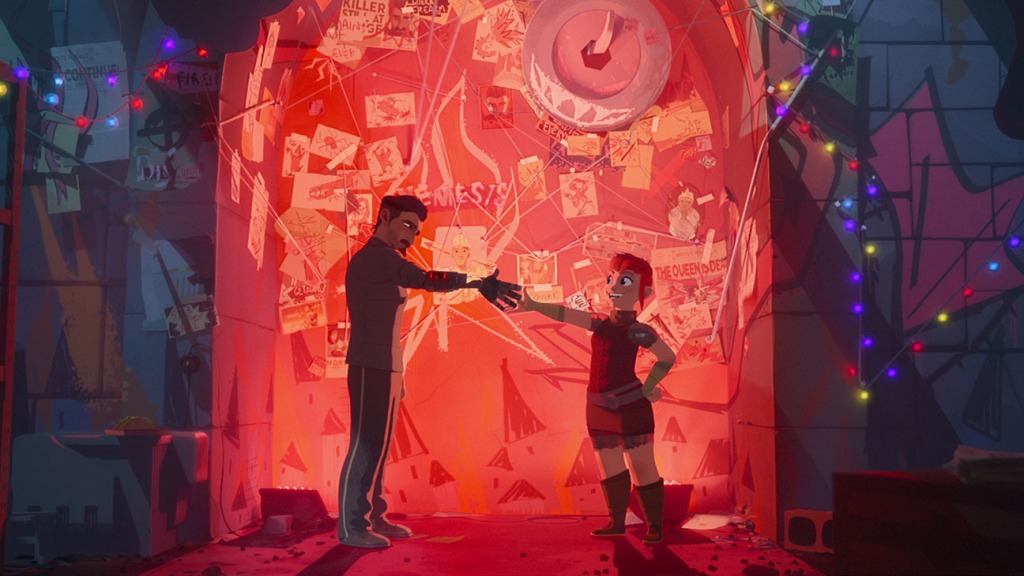
Nimona voice actress Chloë Grace Moretz “loves” that pink is the sole color embraced by the titular shapeshifting hero behind the Netflix animated film.
“When I was younger, I shirked pink like crazy. I remember being like, ‘Pink’s not cool. I’m going to wear everything other than pink,’” she recalled on the pink carpet of the movie’s New York screening. “Then I grew up, and I was like, ‘I can wear pink. I can do this.’ Those colors were gender-neutral for many years until like the 1940s. It’s a color that I think we should gain more ownership over and be able to wear it whenever we want it, however we want it, in all its different shades.”
In America, pink is a color that has spanned the gender spectrum at various points in history, having spent decades not being associated with any particular gender, before being ascribed in the 20th century first as a masculine and then, later, a feminine color. But with the new Annapurna Pictures film, which debuted on the streamer June 30, pink is associated with only a single binary-breaking character in this inclusive action-adventure that co-producer ND Stevenson says has “always had this transness and gender fluidity at its heart.”
“Growing up AFAB [assigned female at birth], everyone is always like a pink, pink, pink. As a kid, I was like, ‘I’m not like other girls. I hate pink. No pink for me.’ Then, when I was designing her, I wanted to reclaim pink in a way that I liked,” Stevenson, who wrote and illustrated the award-winning graphic novel Nimona is based on, told The Hollywood Reporter. “It was one of those stereotypical tropes that I just wanted to turn on their head and make it something totally new.”
Ballister Boldheart and Nimona in their evil lair.
Netflix
In the comic, which sees the fiery shapeshifter team with knight Ballister Blackheart (Riz Ahmed) after he is accused of a crime, Stevenson embraced pink as a way of shirking gender expectations around a character he previously described as a personal power fantasy. But the award-winning comics writer also used the color more practically, as a way to “track Nimona through the comic when she’s always changing shape.”
“You can’t literally watch her transform in action. You have to watch her move from one panel to another. So pink was a way of saying this rhino’s Nimona, so you always knew where she was. But she also starts subverting that,” he told THR. “Really, she doesn’t actually have to turn into pink things. At a certain point, she changes her hair color to purple. It’s really shocking because we always assumed that she had to have that color [pink], but she chose it. It’s something that starts questioning what we think we know about her, and what her default really is, and we realize she doesn’t have one.”
On Nimona’s journey to becoming a film, Stevenson said the color shape-shifted again to represent “acceptance, loving yourself and being true to yourself,” alongside themes of hope and self-expression. “When she becomes a shadow monster she loses that color, but when she’s accepted, she turns into a being of pure light and pure pink,” he explained of the film’s climax. For co-director Troy Quane, pink serves throughout the film as a visual signal of a hero whose “bold, bright, noticeable color” embodies a refusal to conform to anyone’s expectation.
“Pink represents individuality. She’s a character who could be anything or anybody, but she wants to make sure that you know who she is and that she chooses the form that she’s taking, whether that’s the teenage punk we’ve come to love and know, or whether it’s a giant rhino or a dragon,” he said. “It really is a way of saying, I’m not going to conform. I’m not going to do this by anybody else’s standards. I’m going to be unapologetically me.”
Ballister Boldheart and Nimona as whale in the Institute.
Netflix
Pink isn’t the only color the Netflix animated film uses to make a statement. Like Stevenson’s comic, a palette of shades is part of the film’s visual language, in a story that explores the “classic princess fairy tale versus futuristic dystopia,” according to Aidan Sugano, a production designer and the film’s art director of characters. Where the “salmon” pink represents Nimona, acceptance, freedom and change, “classic hero colors” like gold, white and blue stand for non-acceptance, social rules and the Institute’s rigid ideals.
Blue is also a marker of the kingdom’s royal social class, while green represents the fusion of technology and magic in Nimona’s techno-medieval society. But the film’s starkest color representation comes in the form of the white and gold of Ambrosius Goldenloin (Eugene Lee Yang) and the black of Ballister Boldheart, two knights, former boyfriends and now seemingly (reluctant) enemies, who — along with the Director (Frances Conroy) of the Institute — explore storytelling’s long history of tropes around colors both light and dark.
Leaning into Stevenson’s own interests, which frequently center around the themes of good versus evil, hero versus villain and “the ways that that is not always what it seems to be,” the movie’s art team call up audiences’ stereotypical color associations to uncover who characters “really are versus who we think we are,” according to Stevenson. That’s alongside efforts to visually define (and redefine) power, illustrate societal control and even externally portray a character’s internal development.
“These characters were all representations of the two opposing ideologies in the film, so we structured everything off that shape language,” said Sugano during a press day for the film. “That was instilled in the environment design and the costume design, and in the form of color through our lighting.”
Ahead of Nimona‘s release, THR spoke to Sugano about this and more, including how the film uses color to not only express but subvert Western animation’s gender, power and color binaries, stereotypes and expectations around its heroes, villains and society.
Pink is Nimona’s primary color. What was her specific pink, and what was the breadth of pinks the team was working with?
There’s one “hero Nimona pink,” which we leveraged off of the pink ND [Stevenson] used in the graphic novel as a starting place. We had to do some tweaks for the film space, but we have burned into our heads that Nimona pink is Pantone 2348C. That pink specifically is very tricky from a cinematic perspective because it very quickly, depending on the light conditions, can change. We were managing a lot of the perceived color. So we had to make sure that in a situation where it started to skew more purple and that wasn’t actually feeling like Nimona’s color, that we shifted things back. And when we were using pink, it was very geared toward illustrating a specific beat. Because of that, there were like 10 different pinks, and also things that felt like pink that we used adjacently. Red is a color that we found really quickly and came to also represent her in that way. It fit this spectrum, this range, of that Nimona color, which make sense with the theme too, because Nimona isn’t this one thing. She’s this spectrum of things that change based on the situation.
An Institute knight and Nimona as a rhino.
Netflix
Pink has a specific trajectory in the U.S. in terms of gender expression. Nimona’s specific pink is a bit bolder than a pastel, the latter of which can evoke a more feminized interpretation. How did you think about the spectrum of pink with this character and the film to reinforce this binary breaking character?
She is this complex character, so having her only be one single shade never felt right. It goes against literally everything she is. But we were doing so many others things in the world to normalize gender expression. From the standpoint of the society, colors were tied less to gender and more to class. For example, with our [background] characters, we were leaning on sumptuary laws from the medieval era. We were reserving certain colors for certain echelons. Our nobles could only have certain colors in this limited palette, plus white, black and gray, and it was all in the more bold, primary space. The citizens’ colors, which was the majority of the population, were a lot broader. There were neons and colors that could be associated with athleisure wear. Then with the bottom end, the peasants, things were a little bit more desaturated, more hand, organic, natural dye based because of the materials they would have had at that point in time. But we didn’t really assign color to gender, even in our background tool. This applies to our clothing design as well. We set up a system where there was not really a delineation from an expression standpoint, as men could only wear these garments or women could only wear these garments. It was across the board, if a guy wanted to wear a dress? Good. He wanted it to be pink? Excellent. It was built into the foundation of how we treated this society. I don’t want to say gender was not a thing, but the issues that we have around gender in our current society were way different than in the society that we built.
Red emerges in different situations, including things like juice, fire, the kingdom’s warning signs and blood. Some of those things have much scarier connotations than Nimona and her pink. How did you work to distinguish those moments of red from the moments of pink, particularly when Nimona’s treated as something to fear?
We were fighting against, at least in the Western world, the emotional reaction that those kinds of colors have. And honestly, we were playing with that purposely with the villain trope versus the hero trope. We were using a lot of those colors — the red, the black, the abrasive combination of those — to put you in that headspace purposely and to then flip things on its head. Whenever you are with our heroes who are seen as the villains, we’re living in the villain color space. Making sure it played into those fears — that emotional reaction — was the driving force behind that red. You had that visceral reaction at the beginning, but then the characters on screen, their personalities start to change as you move through the film, so we were able to flip the emotional color. When you saw that red or that black, it might still give you that visceral reaction, but it was, “Oh, we’re with the characters we love.” Whereas you see gold, white and blue [of the perceived heroes] — it’s bright and shining — and you’re all of a sudden, like, “Oh no, the knights are here.” We were very much speaking to the graphic novel. It was a purposeful choice to play with the tropes in order to play with audience expectations.
Ballister Boldheart and Nimona.
Netflix
The movie’s color play feels most obvious when Nimona becomes the shadow monster before transforming into that intensely pink phoenix creature. In this moment, black seems to evoke fear, hurt and pain while the creature’s inner light — which is more white — leans into more positive color stereotypes. Can you talk about reinforcing color stereotype before eventually subverting itin this sequence?
That goes back to the concept that we used as our master rule for all of our lighting and color choices, which was the light and shadow concept. We wanted light to represent acceptance, but also it had this dichotomy in there that was exposure. Because when you’re in the light, you’re also at your most vulnerable, your most exposed. The reverse is that the shadow represents nonacceptance, concealment — whether that’s a purposeful choice by the character to not want to share themselves or whether that’s being forced on them by society or another external force. So when Nimona becomes the shadow creature, she has that glowing heart, that glowing white light that represents the acceptance that she just so desperately wants first from this one person and then from other characters. Then when she has that trauma when Ballister cut ties with her — where he pulls the sword to show that his feelings haven’t really changed, and once again, she’s betrayed by this person that she’s put her trust in — that’s where we literally turn her into a visual representation of the opposite of that light and acceptance.
We turn her into a creature of shadow, whose essence sucks light away. At the same time, she has this shell of roiling oil fire, of black smoke, that is concealing this heart inside. We always thought that this trauma was so powerful that it actually almost burnt her away. Those emotions were so strong that it burned her into this creature of pain and isolation. When we first see it, we wanted to play it so that you can actually see the creature when it started walking forward, and it just starts blotting out the stars — they’re disappearing first before you actually see the character’s eyes open. We wanted to set her in a place that was pitch black with a few points of light and even pull those out and destroy those because it’s the lowest point of this character’s journey in relationship to that concept of light and shadow, acceptance and non-acceptance.
Black is more explicitly Ballister’s color, but it operates uniquely with pink, which functions across the film as light and shadow in many scenes — a space that black would normally help occupy. How did you think about black in terms of the character, but also environmentally when you’re already using so much pink?
Carefully. (Laughs.) Because it’s an animated feature, and it’s geared toward a specific audience, there’s always this concern of going too dark. We knew very quickly that we wanted to throw that out because this idea of color was tied to the story. We did have to maintain a little bit of it just to preserve lighting, so it didn’t flatten out and crunch together, but the main reason that we needed to choose black goes back to the graphic novel. Ballister had to represent that villain. It leaned into those visual tropes where black has been historically used as the color of evil, especially in the West. It is perceived as dark and scary. In the graphic novel and in this film, [Ballister’s] the black knight. He is supposed to represent that villain, not only as the outsider in the society, but also the classic villain trope. In the graphic novel, he was assigned the role of villain, and in the film, he was assigned it in a different way, where it was foisted upon him. What we needed to do is make sure that we were using it to turn things on its head again. Yes, black is usually referred to and known as a color that represents these very specific things, but those are a label that’s being put upon it.
Ballister Boldheart in Nimona.
Netflix
In regards to how it interacted with pink, Nimona led more than Ballister did, and that influenced our use of it. We have these two tent poles — the use of color and our use of light and shadow — and Nimona’s color pink was a purposeful hero choice storytelling-wise that had to be considered first before we considered Ballister’s color, and then had to be considered with the idea of light and shadow. Also, the pink, obviously, does represent light because it’s a lighter value of a color. As soon as you start pulling that down into a darker value, it’s just red or burgundy. We use that pink more so in moments tied to Nimona, when her voice and spirit — that idea of acceptance — needed to be present in that moment. When she shares a moment with Ballister under the overpass, and he’s pulling out the arrow, when they first land it’s in one kind of pink space and by the end of the sequence, it’s in Nimona’s Pantone 2348C. It has shifted because the scene started in a place where the characters are disconnected and Ballister is not ready to accept something, and then he realizes his own flaw and faults while poking and prodding. They have that moment of connection, of togetherness.
Still speaking to shadow and light, it’s a space we might see gray typically occupy in the white-black color binary. But it’smostly associated with the Institute, the knights,’ the suppressive, towering city walls. And with the director, gray isn’t just in her outfit or her office, but literally in her eyes. How important was that color to illustrating the film’s messages around power, control and fear?
We never really assigned a meaning to the color, outside of the use of light and shadow. Gray was more important for these characters and their relationships to be seen through that idea that there are many shades of acceptance. But I love the metaphor you said about the wall. A lot of that stuff I think wasn’t purposeful, but because we have this general structure, that comes out. Also, in thinking about the tropes in the separation of colors, we had Nimona’s color as one side of the spectrum. Then we had the classic hero colors on the other side of the palette — white, golds, blues. White was an interesting thing because white became shades of gray in how we had to use it, to do our environments and our characters. You couldn’t just put white on the screen. It’ll blow out every single time. You won’t be able to light that. So even though the Institute, the wall, all the statuary is white, they’re all really shades of gray because they have to be. It’s marble and cement and other things to fit within that color palette of white, gold and blue to go with that white knight vibe.
The director has gray on her, but we tried to keep her as white as possible, to push her as close to that upper spectrum as possible. The director’s eyes — and remind me to talk about eye shapes later — are like blue gray. The director’s dress and Gloreth, all of those were purposeful choices to land in that space, too. When Nimona and Gloreth are walking in the flashback through the woods, there are blue flowers. The reason why Gloreth’s hair is gold, and her dress is blue, is to represent all of this ideology that the Institute needs to function as within the story. Same with the Director. She’s the epitome of that, so she’s the white dress, gold diamonds, gold hair and pale complexion. Even her office, there’s nothing dark in it whatsoever. It’s white, gold and blue. In the scene where she reveals herself as the villain and stabs Goldenloin, we didn’t put a single shadow in that entire place. Everything was super bright until Ballister steps in to reinforce that ideology that needed to sway.
The Director (voiced by Francis Conroy) and Ambrosius Goldenloin (voiced by Eugene Lee Yang).
Netflix
That happens a few other times. When we show Goldenloin at the end of the third act, and he steps out in front of the bikes — full frame backlit by the headlights — it’s all blue, and he’s gold. The next frame we’re seeing Nimona’s shadow creep into frame because it’s a colliding of these two ideologies. In the beginning when the queen is killed, Ballister goes last into a stadium that’s all gold, and the lights go down, and it’s blue and white until he shoots the queen. Green gets introduced as an abrasive color before lights go down, and it’s black. That’s how we used the gray. We kind of separated the binary to say, if it falls above 75 to 100 percent — that lighter gray to white spectrum — that’s the Institute. If it falls below that, it falls within the light and shadow piece.
You mentioned green, which also makes a few appearances, mostly in relation to the Institute and its weapons. What’s the differentiation here between the green and white-gray? And what does that mean for the use of green in character like knight Todd’s eyes?
In the graphic novel, there’s jade root and it’s green. For a lot of the film’s versions, jade root was a huge story point because in the comic, it’s the only thing that Nimona is kind of vulnerable to. It sucks away her powers. But as they did more drafts, they kept getting notes where people needed it explained, and they felt like it was distracting. So they took out the larger concept of jade root, but we kept it in the story as the color of the weapons that cause all of this pain, evil, hurt and trauma. That is why when you get to the weapons that are tied to character related plot moments, they’re all green. Ballister’s sword is green; the Director’s scepter is green; the cannon at the end is green — even though all of the Institute weapons are blue.
Riz Ahmed as Ballister Boldheart in Nimona.
Netflix
That was a purposeful choice to make sure that we knew that this is the weapon that is going to cause the most amount of damage, and you can ascribe whatever meaning you see in there. So it was derived from the concept of jade root, but then it becomes this ambiguous motivator. When you see this, it’s because this is a moment that is going to be forced on our characters that is outside their choice or that acts as the epitome of this nonacceptance. Now, having Todd’s eyes be that tint, he represents another one of those characters that’s not as bad as the director, but he’s living in this bigoted space and is going to be very, very difficult to change. He’s a weapon of that opposing ideology to Nimona. That’s what all of those weapons are, that opposing ideology come to life.
You mentioned the character’s eye shapes earlier. Can you elaborate on that?
Pay attention to the highlight shape in the eye. Because the shape that we had for the actual highlight — the eye-ding, the little white speck — was specifically designed to be different depending on the ideology that was present at that moment of the story. So if the Institute’s ideals were flowing and the director was giving her speech to all the guards in the room, everyone had diamonds in their eyes. In the beginning, in the locker room, when Ballister still believed in the Institute ideals, he has diamonds in his eyes. When he becomes himself a little bit later on, it changes to a square because that was the shape that we assigned his character. Later on, when Nimona is influencing him, we put the Nimona shape in his eye, which is a little flame. If you go back with a fine-tooth comb — and there are a few areas where we missed because that just happens (laughs) — sometimes they switch, too, depending on what is happening in that scene. That also goes with the lens flares and any of the lighting camera effects. You’ll have a lens flare that blasts across the screen, and it’s in the prison where the director has the power in the scene — it’s all diamonds.
[Editor’s note: The following post contains spoilers.]
It’s not exaggerating by much to say that there have been as many versions of “Spider-Man: Across the Spider-Verse” as there are Spider-Men/Women/Dinosaurs in the film itself. The film went through at least 50 or 60 iterations, according to co-director Kemp Powers, to say nothing of the variations in theatrical cuts that made it into theaters. The work of an animation director, as you can see in the video above, is a massive lift. But a key choice for the film’s final section — spoilers, obviously — was to version Miles himself.
While Mahershala Ali returns to voice Uncle Aaron in Universe 42, the film doesn’t ask Shameik Moore to pull double voice-acting duty when Miles Morales is confronted by a version of himself who has embraced the mantle of The Prowler. Miles G. Morales is voiced by Jharrel Jerome, and the choice adds audible texture to the film’s cliffhanger ending.
“For years, we internally called him ‘Wiles,’” Powers told IndieWire of Miles G. Morales’ (behind-the-scenes) villain origin story. “It was really important that that character’s voice be incredibly distinct.” Some of the need for a distinct voice arises out of the process of voice acting for animation, where actors are often recording alone in a booth without seeing or even meeting their actual scene partner; different vocal qualities can do additional work and add layers to performance when character voices are finally connected to each other.
But in the case of Miles G. Morales, that isolation from Moore’s version of the character really helped highlight just how different “Wiles” is.
“He’s going to have a totally different perspective [so] he should have a different intonation; and if I’m being perfectly honest, I thought it would also be exciting to get an Afro-Latino actor,” Powers said. “We’ve joked about Miles’ grasp of Spanish and, among other things, to have [Miles G. Morales] just have the natural inflections where it’s obvious this is a person who knows how to speak that language. It’s a very subtle thing, but it really excited me.”
There is indeed an extra hit to the moment Jerome’s Prowler enunciates Morales differently from Brooklyn’s finest Spider-Man played by Moore, and the difference speaks to the life experience that has formed their identities in different ways and the potential clash in their worldviews. The viewer doesn’t just see but hears and feels a difference between Miles and Wiles, setting up yet one more universe Spider-Man is going to have to save.
“At least for me personally, what I’ve enjoyed and what I’ve leaned towards in terms of our casting choices — and you see it not just with Jharrell, you see it with Daniel Kaluuya [who plays Hobie] — is that we are interested in people’s natural speaking voices,” Powers said. “Historically, when you think of animation, you think of voice actors doing all different kinds of funny voices. But I’m drawn to dramatic and comedic actors’ natural voices in the process. And, again, it really excited me to have Jerome.”
Even without putting on an affectation, there’s still plenty of ways that Powers, alongside fellow co-directors Joaquim Dos Santos and Justin K. Thompson, can help construct vocal performances so they continue to serve the story as it evolves, version after version. “I would usually block out like two hours, usually in the morning, to shop takes before I went into edit or did something else,” Powers said of the process where directors listen to hundreds of takes in order to stitch together performances, sometimes taking only a phrase or a word from one take and kludging it onto pieces of others.
But Powers found that, at least for “Spider-Man: Across the Spider-Verse,” artificially constructing the best performance through editing wasn’t always the way to go, especially for key dramatic moments. If fans chafed at waiting so long for another entry in the series, Powers points out that the delay allowed actors to record in person instead of over Zoom. “When you’re in person more, and I’ve experienced this a lot on this film, you have a much better chance of getting full takes that are just straight performances. And I think that plays out a lot in what you see in the film,” Powers said.
Powers pointed to the moment where Miles’ mother, Rio (Luna Lauren Velez), tries to give him the support and guidance he needs before he goes off after Gwen (Hailee Steinfeld), which, among other things, formed the anchor of the first teaser trailer. “During COVID, it would’ve [taken] like 20 different takes to [create] that speech. But instead, [in the film] it was one. It was a single take that we used unbroken,” Powers said. “While you technically can’t hear the breaks when we kludge [takes] together, I do think you can tell [that moment is a single take] because you go on the emotional ride with the actor doing the performance, understanding that the vocal performance is only half of it. The other half is the performance of the animators.”
COVID restrictions are not, that willingness to commit to a single version of the performance is a strong choice for a kind of filmmaking that constantly morphs and changes just like edges and panel lines bleeding through the multiverse when Miles travels across Mumbattan and to the Spider-Society. But it’s also the correct one, providing a central throughline that allows the audience to connect to the characters.
“On animated films, especially one with so much action, the thing that people are the least excited about are the people in rooms talking. [But] the people in rooms talking were the bedrock of the entire film. They were some of the best moments that were connecting with the audience, and we built those performances with the time and care that someone would build an action sequence,” Powers said. “Every gesture, every blink, every shoulder shrug: We built those like they were Shakespearean plays.”
Sometimes the voice acting itself even got to work like a play. For maybe the biggest moment of emotional catharsis in the film, when Gwen finally confronts her father (Shea Whigham), ”we actually put Shea and Hailee together for that,” Powers said. “We did it separately, then to get even more emotion out of the scene, we put them together in a room to re-record it.”
Most of the work of that moment comes from the animated performance and the final, dramatic shift as Gwen’s world drains to white. The image is fraught with the terror of a blank canvas and the promise of a completely new start. But there’s also a tiny electrical current between the voices that can’t be engineered. “We want to tell an emotional, exciting story and blow people’s fucking wigs off at the end. And what’s wrong with trying to do that?” Power said.
Cocaine may have been found inside the White House this weekend — and it appears to have been discovered in an area where President Biden frequents a lot on the job.
The Secret Service says it discovered a white powdery substance Sunday night in the West Wing during routine rounds. It’s unclear where exactly it was in the West Wing it was found — but a spokesperson for the agency will only say agents stumbled upon in a “work area.”
The SS rep also notes that any notion the substance might’ve been found in the executive mansion is false. POTUS was not at the White House during this whole ordeal, BTW.
The discovery of the unknown powder prompted an increased security alert and a brief evacuation of the premises, and tests are being done to decide what it might be. WaPo, citing sources familiar with the matter, say preliminary tests suggest it is, in fact, blow.
According to dispatch audio detailing the find … it seems that a firefighter who was on the ground thought cocaine was the culprit — telling the department’s hazardous materials team that a test they’d conducted indicated “cocaine hydrochloride.” No ambiguity at all.
Officials are saying the substance did not pose a threat, and an investigation is underway as to how it made its way into the White House … and, obviously, who brought it in.
Biden and his family left the White House Friday and returned Tuesday. The White House punted in a response to us — saying they’re deferring to the Secret Service on this.
Shah Rukh Khan injured; Rocky Aur Rani Kii Prem Kahani trailer out
From Shah Rukh Khan being hospitalised after meeting with an accident to Alia Bhatt and Ranveer Singh’s much-awaited film Rocky Aur Rani Kii Prem Kahani’s trailer release, here are the biggest headlines of the day.
Bollywood superstar Shah Rukh Khan reportedly met with an accident in the US and hurt his nose. He has now undergone a minor surgery for it. E-Times reported that the Pathaan actor was shooting for one of his upcoming projects when he met with a minor accident on the sets in Los Angeles. However, King Khan is now back in India and is recovering.
Rocky Aur Rani Kii Prem Kahaani trailer: Days after superstar Shah Rukh Khan dropped the teaser of Rocky Aur Rani Kii Prem Kahaani, Karan Johar has released the trailer of the film and it looks promising. Starring Ranveer Singh and Alia Bhatt in the lead, Rocky Aur Rani Kii Prem Kahaani offers a family drama we’ve all been craving for years now. The film also stars veteran actors like Shabana Azmi, Dharmendra and Jaya Bachchan, who play Rocky and Rani’s grandparents.
After almost a decade, Aamir Khan and Rajkumar Hirani are reuniting for another massive entertainer. Reportedly, the duo are in talks for a biopic. If the movie comes through, this will be the director-actor duo’s third outing after the success of 3 Idiots (2009), PK (2014). A source close to the production house informed Pinkvilla that, Hirani has recently narrated a script to Aamir which has got him all ‘excited’. Most likely, the upcoming project will be a biopic.
Salman Khan has reportedly reached out to Sanjay Leela Bhansali after the failure of his last movie Kisi Ka Bhai Kisi Ki Jaan. Rumours are rife that Salman Khan wants to experiment with his image and work on fresh subjects instead of usual action films.As per a report in KoiMoi.com, Salman, who is known for his big heart, has also decided to stop doing films as “a goodwill gesture or overloading the cast with favour-seeking strugglers.” The actor is reportedly look for “the right scripts”.
After months of speculation, Tamannaah Bhatia recently admitted to dating Vijay Varma. Tamannaah revealed that their relationship began on the sets of Lust Stories 2 “organically”. Lust Stories 2 marks the first collaboration between Tamannaah and Vijay. Now, Tamannaah has opened up about her relationship with her Lust Stories 2 co-star and why she chose Vijay as her partner. “I cannot enter any equation where women are expected to compromise on their most basic feelings,” she told Mojo Story.
Aditi Giri, Senior Sub-Editor at News18. She is a Bollywood and Biryani enthusiast. She loves talking to your favourite BTown celebrities, and brings …Read More
Murray’s role was a big mystery going into the franchise’s third entry. Eventually, audiences learned that the iconic actor was playing a fringe comic character named Krylar—one who didn’t even make it very far into the film
In a previous interview, Ant-Man 3 actress Katy O’Brian shared details on how at one point in the film’s development, instead of being killed off, Bill Murray’s character “did a whole space pursuit and then wound up with Kang.”
The Lost Bill Murray Ant-Man Scenes
The Japanese Twitter page for Marvel Studios revealed a new behind-the-scenes look at Ant-Man and The Wasp: Quantumania, and with it, a glimpse at Bill Murray’s deleted scenes.
The first new clip takes place during an alternate version of the scene between Scott Lang, Kang, MODOK, and Cassie.
Marvel
The new featurette shows Murray’s Krylar standing on what seems to be the same platform, with both MODOK and Kang behind him.
Marvel
The video then sees Murray throw a mystery alien off the cliff.
This seems to happen before Kang sends Paul Rudd’s hero to get the villain’s Multiversal core.
Marvel
The second brief new clip shows another version of Katy O’Brian’s Jentorra’s big prison break.
Marvel
At one point and time, Krylar was part of the same prison scene, but it’s unclear what the character would‘ve been doing.
Either way, Murray living that long certainly wouldn’t present a significantly different version of Quantumania.
Marvel
The entire clip can be seen below:
Shrinking Bill Murray’s Quantumania Role
It’s truly a shame that Bill Murray’s role was shrunk so much. Knowing how he actually shot more significant scenes, which were then completely scrapped, makes it hurt even more.
While it’s hard to imagine that Krylar’s fate would’ve changed the movie enough to alter its divisiveness amongst critics and fans, more Murray couldn’t be a bad thing.
In the same interview where she revealed details about Bill Murray’s cut scenes, Actress Katy O’Brian made mention of Marvel Studios “adding stuff to the script until the last day of shooting.”
At the end of the day, Marvel Studios could find any number of reasons to bring back Bill Murray’s Krylar in a future project—even if for just another quick Multiverse gag.
Ant-Man and The Wasp: Quantumania is now streaming on Disney+.
James Gunn elaborates on why Superman: Legacy will not feature Clark Kent’s origin story for the DC Universe reboot. The DCEU is finishing its run after ten years to pave the way for the new DC Universe from DC Studios, with Gunn and Peter Safran running it as co-CEOs. Superman: Legacy will properly be the film to kick off Chapter 1, “Gods and Monsters,” with several other DC Universe movies and shows also currently in development.
While Superman: Legacy will be a fresh start for the Man of Steel, Gunn has previously talked about not doing a Superman origin story. The CEO (via @HomeOfDCU) has now expanded on why they are not focusing on telling Clark’s backstory in the movie, as he took to Bluesky to disclose more thoughts on the matter.
This comes shortly after DC Studios made it official that David Corenswet and Rachel Brosnahan as Superman and Lois Lane, respectively. Superman: Legacy, which still has several other characters left to cast, is currently on track to start shooting in 2024.
How Skipping Clark Kent’s Origin Story Helps Superman: Legacy Standout
When it comes to Superman’s origin story, his journey to becoming a superhero has, without a doubt, been retold several times more than most DC characters. Superman: The Movie and Man of Steel both explored how Clark discovered his Kryptonian heritage and became the world’s greatest protector. But in general, Superman’s origin story is also, at this point, so well-known that it doesn’t really benefit Superman: Legacy to have to find another way of retelling it.
There is also the fact that Smallville, a show which ran for a full decade, also focused on exploring how Clark became Superman. With various live-action Superman movies and TV shows having already gone as deep as they can with Clark’s days before becoming a superhero, Superman: Legacy is clearly taking some inspiration from The Batman and Superman & Lois, which both focus on the heroes already being established.
However, that doesn’t mean that Superman: Legacy can’t reference things that happened in Clark’s life before he suited up. Future Superman: Legacy sequels could also potentially include flashbacks if there are crucial moments from Clark’s life that serve more of a purpose for the DC Universe. Hopefully, Gunn will have more details to share about Superman: Legacy and where he is taking the reboot sooner rather than later.
Every year, the Fortnite summer event becomes one of the game’s biggest and most beloved attractions, and this year’s Summer Escape event may result in more of that same fervor. With many free cosmetics to earn from event challenges, two new breezy skins coming to the shop, a bonus reward for Fortnite Crew members, and some island makeovers, here’s everything you need to know about Fortnite Summer Escape.
Map change: Sunswoon Lagoon
In the thick of this season’s jungle biome, a new temporary party headquarters has cropped up. Sunswoon Lagoon will be present on the island until the event ends on July 18. While much of the season has been built on opening seemingly ancient vaults and introducing the Transformers to Forntite’s catch-all mythos, loopers look primed to take it easy for a few days.
Gameplay changes: Ice cream buffs and fireworks flare gun return
If you’ve participated in past summer events in Fortnite, you’re likely familiar with the ice cream cone items, a lineup of different flavors that grant heals and other buffs, like low-gravity jumping. The full freezer of flavors returns in the form of Normal Ice Cream Cone, Frozen Ice Cream Cone, Guzzling Ice Cream Cone, Spicy Ice Cream Cone, and LiL Whip’s Special Serve.
I scream, you scream, we all scream for unvaulted items.
Additionally, the flare gun will get a makeover and adds the summer-exclusive fireworks effect when fired into the sky. Now you can ping enemies or enjoy the light show–or why not both?
Summer Escape challenges and free cosmetics
It wouldn’t be a Fortnite event without a bundle of in-game quests doling out a bunch of new character cosmetics, like back bling, a glider, and more. For Summer Escape, nine free rewards await those who complete a series of challenges over the course of the two-week event. They’re broken up into different categories, with a new set becoming available every few days. Here’s the schedule:
Quech Quests: Progressively available between July 4-7
Lagoon Party Quests: Progressively available between July 8-11
Make an Entrance Quests: Progressively available between July 12-16
In addition to universal XP rewards, players will also unlock the Nanners wrap for the first set, the Treezy back bling for the second set, and the Blossoms Drop contrail for the third set. Additionally, accumulating event-wide quest completions will unlock even more, including the Wild Fronds back bling for 14 completed quests, the Bugsy glider for 18 completed quests, and the Toasted Coconut emote (inspired by that one Leo DiCaprio gif) and the Lagoon Escape loading screen for 24 completed quests.
If all that wasn’t enough, even more free rewards can be had when you complete specific (and very simple) quests:
Destroy 10 stones – Artifact Axe pickaxe
Mantle within 30 seconds of busting through a door: Starry Sea wrap
Here’s to you, looper.
Gallery
As always, we’ll have guides on site for any and all challenges that may stump you as the event unfolds.
Summer Showdown in Creative mode
For those looking for summer vibes outside of the game’s main attraction, Creative mode features the Summer Showdown series of Epic-curated islands made by the community. Head into the game’s Discover tab to browse some of the many new player-made modes the developer-publisher is teaming with for this year’s summer event.
New summer skins and Fortnite Crew bonus
Two more skins have been revealed for this year’s summer event item shop, too. Opal, a brand-new character to the lore; and Chaos Explorer, a deep sea diving-themed reimagining of an earlier character, will debut in the item shop during the event. They will surely be flanked by past years’ summer event skins too, like the ever-popular Beach Midas and Beach Jules.
Summertime and the living’s easy.
Gallery
The challenges for Purradise Meowscles, the latest midseason battle pass skin, will also go live during the event, giving battle pass owners even more challenges to chase and cosmetics to unlock. Meanwhile, Fortnite Crew members will unlock an exclusive bonus item, the Nanner Buddy back bling.
When does Fortnite Summer Escape end?
This year’s summer party ends on July 18 at 6 AM PT / 9 AM ET. Be sure to complete any related quests before then, as once the event ends they will disappear from the game–and so will the ability to unlock the cosmetics tied to them.
The products discussed here were independently chosen by our editors.
GameSpot may get a share of the revenue if you buy anything featured on our site.
The good news is, a better version of the No Film School website is coming soon. The bad news is, the comments won’t make it. Here’s how to save yours.
TL;DR: go to your profile page and click “Comment History.”
A brief walk down memory lane
The current version of the No Film School website, launched all the way back in 2014, is definitely showing its age. What I originally started as a blog in 2010 with no byline (because I wrote every article myself and “by me” seemed redundant) had grown to a multi-author site with millions of pageviews. For the relaunch in 2014, I wanted to turn NFS into a full-blown community site, which would hopefully give rise to active, helpful discussions among filmmakers.
It didn’t work.
Our forums were inundated by spam almost immediately, and we lacked a number of features that would’ve been crucial for the community to thrive (notifications, messaging, moderation tools, etc). Despite our lofty ambitions, the site continued largely as before — as a blog, not a forum.
We continued making improvements over the years, like launching our podcast, and redesigning the article page — but for the most part, developing new features on a Drupal-based website was slow and costly, and I soon regretted moving off of WordPress.
Our new, faster, better website is almost here—currently scheduled to launch July 17. We’ve been working on it for the past several months. More on that soon!
In the meantime, when we finally bid the old site adieu, we will unfortunately also need to say goodbye to the comment history on this site. The new CMS (Content Management System) won’t play nicely with our past comments, so we’ll be starting from a clean slate as far as comments are concerned.
But fret not! If you’ve made valuable contributions to our articles over the years, we’ve built a tool for you to access and download your commentary so you don’t lose it.
How to download your comments
It’s easy. Just login to the site, click on your profile pic at top right, then on your own profile page, under DOWNLOADS on the left, you’ll see a link labeled “Comment History:”
Click that, and voilà. The entire history of you (at least as far as your comments on NFS are concerned) will be downloaded as an html file, complete with links to the original stories for context.
We wish we could bring everything over to the new site, but since that unfortunately isn’t feasible, this is the best we could do. If you’ve commented here over the years, we greatly appreciate your voice, and we hope you join us on the new site, coming soon!
If you have any issues accessing your comment history, let us know… in the comments!
Wimbledon is famous for its strict insistence on exclusively white clothing on the tennis court. However, when it comes to outfits on the sidelines, there’s more room for self-expression, even though there are still common trends that emerge. From Sienna Miller’s linen two-piece suits to Alexa Chung’s mid-length cream pleated dresses, spectator looks are often inspired by on-court fashion and have a sense of tradition and formality. However, Kate Middleton’s recent look adds an ’80s-inspired twist to the classic Wimbledon style.
On the second day of the Wimbledon championships, the Princess of Wales, who is both a patron of the All England Lawn Tennis and Croquet Club (AELTC) and a skilled tennis player herself, made her first appearance at the tournament to watch British player Katie Boulter. Her outfit drew inspiration from on-court fashion, as she stuck to a white and green color palette and wore a preppy white pleated midi-length skirt.
The Princess of Wales with Roger Federer.
Clive Brunskill/Getty Images
The ensemble consisted of a mint green double-breasted Balmain blazer adorned with ’80s-style contrasting white buttons and a white lapel, a white midi-length pleated skirt, and a pair of white leather Gianvito Rossi court shoes. To top it all off, she accessorized the look with knotted pearl drop earrings by London-based independent jewelry brand Shyla that she has worn several times before, a gold Sézane cuff bracelet, and a white Mulberry Amberley crossbody bag.
Once again. “John Wick: Chapter 4” (Lionsgate) ($5.99) is #1 at iTunes and Google Play, while “The Super Mario Bros. Movie” at $19.99 (Universal) is #1 at Vudu (which calculates by revenue, not transactions).
Like most weeks, Netflix’s top 10 movie list is topsy-turvy. New at #1 is “Run Rabbit Run,” an Australian horror film the streamer acquired out of the Sundance Film Festival’s Midnight section. It stars “Succession” actress Sarah Snook as a fertility doctor who notices her daughter’s strange behavior.
Beyond that, “Mario” is in two second-place spots while “Fast X” is #2 at Vudu, helped by its $19.99 price. “The Covenant” (MGM) is #3 at iTunes, “The Machine” (Sony) at $19.99 #3 at Vudu, with “Fast X” taking third at Google Play.
“Guardians of the Galaxy Vol. 3”Courtesy of Marvel Studios
The #1 summer release (for now), “Guardians of the Galaxy Vol. 3” (Disney), is set for release July 7, a generous 63 days after its theatrical release. It should have no problem taking over at #1, possibly for multiple weeks.
New this week are “Are You There, God? It’s Me, Margaret” (Lionsgate), boosted by its lowered $5.99 price. It’s #5 at iTunes (#11 at Google Play) after a lackluster reaction at $19.99. “Knights of the Zodiac” (Stage 6), a live-action, Hungarian-filmed anime adaptation, is #7 at Vudu at $14.99.
Along with “Rabbit,” other Netflix originals on the chart are “Extraction 2,” now #3 after two weeks at #1, “The Perfect Find,” which had a nice run at #2 and is now #8, and an animated original at #9.
Six just-added theatrical titles are in the Netflix top 10, with Sony’s 2013 hit “White House Down” in second place and “Thank You for Your Service” at #4.
iTunes and Google Play rank films daily by number of transactions. These are the listings for Monday, July 2. Distributors listed are current rights owners. Prices for all titles are for rental.
iTunes
1. John Wick: Chapter 4 (Lionsgate) – $5.99
2.The Super Mario Bros. Movie (Universal) – $19.99
3. The Covenant (MGM) – $5.99
4. Fast X (Universal) – $19.99
5. Are You There, God? It’s Me Margaret (Lionsgate) – $5.99
6. 65 (Sony) – $5.99
7. Spider-Man: Into the Spider-Verse (Sony) – $3.99
8.Hypnotic (Ketchup) – $5.99
9. BlackBerry (IFC) – $6.99
10. Renfield (Universal) – $5.99
Google Play
1. John Wick: Chapter 4 (Lionsgate) – $5.99
2. The Super Mario Bros. Movie (Universal) – $19.99
3. Fast X (Universal) – $19.99
4. Spider-Man: Into the Spider-Verse (Sony) – $3.99
5. The Covenant (MGM) – $19.99
6. Dungeons & Dragons: Honor Among Thieves (Paramount) – $5.99
7. 65 (Sony) – $5.99
8. The Pope’s Exorcist (Sony) – $5.99
9. The Machine (Sony) – $19.99
10. Renfield (Universal) – $5.99
Vudu
Vudu ranks by revenue, not transactions, elevating premium VOD titles. This list covers June 26-July 2.
1.The Super Mario Bros. Movie (Universal) – $19.99
2. Fast X (Universal) – $19.99
3. The Machine (Sony) – $19.99
4. John Wick: Chapter 4 (Lionsgate) – $5.99
5. Evil Dead Rise (WBD) – $5.99
6. 65 (Sony) – $5.99
7. Knights of the Zodiac (Stage 6) – $$14.99
8. The Covenant (MGM) – $5.99
9. Sisu (Lionsgate) – $19.99
10. Hypnotic (Ketchup) – $5.99
Netflix Movies
Most viewed, current ranking on Netflix’s daily chart on Monday, July 3. Originals include both Netflix-produced and acquired titles it initially presents in the U.S. Netflix publishes its own weekly top 10 on Tuesdays based on time viewed.
1. Run, Rabbit, Run (Netflix Australian original)
2. White House Down (2013 theatrical release)
3. Extraction 2 (Netflix original)
4. Thank You for Your Service (2017 theatrical release)
5. Monster Trucks (2016 theatrical release)
6. The Huntsman: Winter’s War (2016 theatrical release)
The 2023 R-rated comedy with a female cast debuts exclusively in theaters first, but here is when and where Joy Ride will be released on streaming.
A new R-rated comedy arrives in theaters first, but here is where and when Joy Ride will release on streaming afterward. The new movie directed by Adele Lim, who is best known as the writer of Crazy Rich Asians and Raya and the Last Dragon, follows a group of friends as they travel to China. The movie follows Audrey Sullivan (Ashley Park) and her best friend Lolo (Sherry Cola) as they go overseas to find Audrey’s birth mother. The R-rated female-led comedy also features Everything Everywhere All At Once breakout star Stephanie Hsu as a key character in the Joy Ride cast.
Although movie theaters are now dominated by superhero movies and franchise fare, Joy Ride is an example of the original movies that various studios are still making with theatrical audiences in mind. Comedies in particular have become increasingly less common on their own, as Lionsgate’s The Blackening brought a horror spoof to theaters and Sony’s No Hard Feelings delivered a raunchy rom-com. Joy Ride‘s excellent reviews have given it some hope to find an audience and be deemed a financial success at the box office. Even if that does not happen, it will be given a second life on streaming. Here is when Joy Ride 2023 will release on streaming.
Joy Ride Might Not Release On Streaming Until Early 2024
Stephanie Hsu, Sabrina Wu, Ashley Park, and Sherry Cola in Joy Ride
Those wanting to see the R-rated comedy should prioritize seeing it in theaters, as Lionsgate’s movies typically take months to get streaming release dates. The studio has been consistent about waiting six months from a movie’s theatrical debut to make it available on a streaming service. John Wick: Chapter 4 debuted in theaters in March 2023 and will not be streaming until late September. The same six-month window was utilized for 2022 releases The Unbearable Weight of Massive Talent and Clerks III. Lionsgate is expected to do the same for The Blackening‘s streaming release window too.
Joy Ride releases in theaters on July 7, 2023. If Lionsgate continues their usual practices, Joy Ride‘s streaming release date will not be until January 2024 potentially. That would be six months from the movie’s theatrical debut. It is possible that the studio moves up the timetable for when Joy Ride will be on streaming to line up with the holidays, allowing the R-rated comedy to be available in late 2023 instead. Considering Lionsgate has rarely wavered on this stance regardless of box office performance or critical acclaim, interested parties will have to wait a long time to watch 2023’s Joy Ride movie on streaming.
Joy Ride Will Stream On Starz (& Eventually Peacock)
As for where Joy Ride will release on streaming, Lionsgate’s involvement as a distributor means that it will begin on Starz before going to Peacock. Lionsgate owns Starz, which is why the studio’s movies always begin streaming their first. However, Lionsgate also struck a deal with NBCUniversal and Peacock in 2022 to have all the studio’s movies begin streaming on Peacock during the Pay 2 window. This means that viewers will be able to watch Joy Ride on Starz in early 2024 before its streaming home moves to Peacock at some point later in the year.
The most important thing about “Rock Hudson: All That Heaven Allowed” is that, within the essential act of reclamation it provides for the star, it doesn’t just write off the Hollywood icon’s life as sad. That’s a remarkable thing for a documentary in which its last 40 minutes are as harrowing a depiction of AIDS in the ’80s there’s been in a film since “How to Survive a Plague.”
Certainly, it’s infuriating and upsetting on many levels: that Hudson wasn’t allowed to fly on a commercial airliner because of his diagnosis and had to rent an Air France Boeing 747 at the cost of $250,000 to return home to Los Angeles from Paris as it became clear his experimental treatment there had failed. And the revelation that his friend Nancy Reagan even urged her husband to deny him treatment at a military hospital is beyond enraging.
Stephen Kijak’s documentary does an illuminating job, however, of suggesting that Hudson lived, for the most part, a happy life. Being closeted to the general public did not mean that he was not out to a large group of people — he certainly expressed his sexuality, and with many partners, some of whom appear in Kijak’s film to share their memories of him.
Often in cinematic depictions, gay men have not been allowed to be sexual, and the frank descriptions of his liaisons with numerous men (during one segment, Hudson is heard setting up himself over the phone in his Grand Canyon-majestic voice conveying explicit detail) speak to the degree to which he really was liberated. Doris Day may not have known he was gay, but many, many others in his orbit did.
Kijak even goes so far as to imply that there have been few Hollywood celebrity deaths ever to have more meaning than Hudson’s, in the way it helped to normalize homosexuality and being HIV positive and spur action to improve the survival rate. To the homophobic public, if Rock Hudson, the ultimate example of movie god Americana, could be these things, so could anyone.
Where Kijak’s film falls short is in its consideration of Hudson as an actor. Allison Anders praises his performance in “Giant,” but there’s little consideration of what a precise, methodical performer he was. It’s a shame because the documentary would have been a natural place to do that, and it’s hard to imagine any other documentary on the horizon that would.
Even at the time of his greatest success in the late ’50s, Hudson’s acting gifts weren’t celebrated in the way they could have been. He was cool and reserved, inherently embracing the idea that navigating American life is all about the wearing and swapping out of masks.
He’s the actor who comes the closest to embodying the idea of Don Draper. What, I’m comparing him to Jon Hamm’s aggressively hetero “Mad Men” character? Yes, because that character was all about wearing masks, having invented his persona from the ground up, literally assuming someone else’s identity. There’s an element of self-invention that’s always essential to the idea of the midcentury American dream: You were simply who you said you were. Jay Gatsby was that on the page. Rock Hudson lived it.
Hudson was that in every sense. Not just because he was gay and projected an image of straightness, but in all the other ways his persona was manufactured. There’s a legend, possibly untrue, that he developed his mellifluous voice by screaming at the top of his lungs on a mountaintop while suffering from a head cold, breaking a vocal chord so that it artificially lowered his voice for the rest of his life. What a mad, mythic story. It’s not presented in the doc, again probably because it isn’t true, but it’s reflective of the unique place Hudson occupied between legend and reality.
In so many of his films, Hudson’s characters are navigating reality by projecting their own image of reality. There’s as much role-swapping, misdirection, and mistaken identities in “Pillow Talk” or “Lover Come Back” as in a Shakespeare play. “Magnificent Obsession” is all about him becoming a better person by being increasingly inauthentic; his authentic self is an asshole. His mysterious tree farmer in “All That Heaven Allows,” not at all an unambiguously noble hunk, seems committed to exchanging one cage for Jane Wyman’s character for another.
Issues of authenticity are at the core of Hudson’s roles in a way that speaks deeply to the American character. But he was cool and reserved where James Dean and Marlon Brando and Paul Newman burned hot. A twinkle in his eye and a wry smile as Brad Allen in “Pillow Talk” convey an internal life you have to work a bit to access — you come to him, not him to you, as he’s always going to withhold himself a bit. The Method guys? They’re all on the surface, their inner lives made external through eruptions of emotion. One of these styles of acting was thought to be “acting,” the other merely stardom.
That narrative has remained largely unchanged since the ’50s. Kijak’s film suggests that the flirtations with homosexuality in “Pillow Talk” and “Lover Come Back” was producer Ross Hunter making fun of Hudson being closeted (though the incessant use of clips from his movies to imply gay undertones, which most audiences wouldn’t have detected at the time, seems almost like Kijak doing the same). But look at Hudson’s comic timing in those movies. Look at the very self-aware (and contemporary) way he projects toxic masculinity in those films. It’s performance and critique at the same time. Dean and Brando delivered rawness; Hudson delivered irony.
For me, the ultimate example of an actor’s greatness is when he or she can elevate an otherwise bad movie. Look no further than Hudson in “The Mirror Crack’d,” a film entirely omitted from the documentary. This Agatha Christie adaptation is bad. Even Angela Lansbury (as Miss Marple) is bad in it, which almost never happened. Elizabeth Taylor turns in a forgettable performance. But… Hudson is electrifying. Yes, once again he’s a man with a secret. And he almost single-handedly elevates that movie to something grand and tragic, acting circles around his dear friend Taylor. He was a serious artist capable of delivering serious art even when serious art was very much not expected.
That Hudson is missing from “All That Heaven Allowed.” I wish it had been there. Luckily, Hudson’s films are still there to be discovered and enjoyed anew. Watch them for what’s there, not what you think is there.
The American holiday of the Fourth of July, being well celebrated in The States for their independence, is one full of barbecues, swimming, and fireworks. Many also reflect on the growth and progress of the country, but often from only a single point of view.
For many, July 4th isn’t something always worth celebrating. Not everyone in America gets to celebrate having the same independence. For immigrants, black and people of color, the LGBTQIA+ community, women, religious and ethnic minorities, and so on, “independence” isn’t something yet in full grasp.
Looking at American history and political conflicts from a narrative other than your own is important, and these films give the opportunity to do so, representing different communities within America.
Last Black Man in San Francisco (2019)
Based on a true story, Joe Talbot directs the story of Jimmie Fails’ childhood home. With themes of racial inequity and the gentrification in San Francisco which led to eviction, Fails tries to get the house built by his grandfather back.
The Trial of the Chicago 7 (2020)
Directed by Aaron Sorkin, the film is exactly about what the title suggests. One of the most significant trials in American history, where anti-Vietnam War activists were charged following a riot at the 1968 Democratic National Convention.
13th (2016)
13th is a powerful documentary from Ava DuVernay, titled after the 13th amendment to the U.S. Constitution, which abolished slavery. It focuses on the history of racial inequality in the U.S., specifically within the racially disproportionate prison system.
The Post (2017)
Steven Spielberg’s The Post details the efforts of Katherine Graham, the first woman publisher of an American newspaper, and her editor at The Washington Post, as they are able to expose and publish The Pentagon Papers, which reveal horrid truths about America’s involvement in Vietnam that were covered up by the government. Their career risking efforts show the power of journalism.
Milk (2008)
Milk, about Harvey Milk, directed by Gus Van Sant, tells the story of the first openly gay elected official in the United States, in 1977. His election was an important step in American history.
Miss Juneteenth (2020)
Channing Godfrey Peoples’ Miss Juneteenth is an empowering story about the relationship between a mother and daughter, while preparing for the Miss Juneteenth pageant, which represents the holiday that remembers and honors emancipation and black history.
Boys Don’t Cry (1999)
From Kimberly Peirce, a biographical story based on the real life of Brandon Teena, a trans man in middle America trying to find his identity but being interrupted by receiving hate and threats from people around him.
She’s Beautiful When She’s Angry (2014)
A documentary by Mary Dore, visualizing the modern women’s movement in the late 60s to 70s and highlights the many activists. It was the first film to document the Second Wave feminist movement in America.
Never Rarely Sometimes Always (2020)
Directed by Eliza Hittman, the film tells a story of the current crisis for reproductive rights in America, and it serves as just one example of thousands of different experiences women in America are facing.
Kaleen Gendreau is an intern at Raindance, and she previously earned her BA in Mass Communications and Production from the University of South Florida, Tampa, in the spring of 2023. She’s written and directed two student film projects, and spent a lot of her time at university working and filming in a virtual production studio.
A heavily armed gunman wearing a bulletproof vest shot dead five men and injured two children in a mass shooting in Philadelphia on the eve of the Fourth of July.
Wielding an AR-style rifle and handgun, the 40-year-old male suspect, who has not yet been named, began shooting seemingly at random as he stalked the streets of the largely residential neighborhood of Kingsessing for more victims to kill.
The mass shooter is now in custody after he tried to outsmart cops by using a police scanner but within 10 minutes of launching his spree he was tracked down in an alley and arrested, Police Commissioner Danielle Outlaw said at a news conference.
The killer left five men aged between 16 and 59 dead. The fifth victim wasn’t found until several hours after the shooting when an unnamed man returned home and found his 31-year-old son dead of multiple gunshots wounds.
Two children, aged two and 13, were rushed to hospital following the mass shooting but are in a stable condition, cops said.
Families had been enjoying the July 4 festivities when the gunman began opening fire at his unsuspecting victims. The motive for the shooting is not yet known. It is not clear if any of the victims are connected.
A second person who cops believe had ‘picked up the gun and returned fire in the direction of the shooter’ was also in custody, Outlaw said, but did not know whether there was a connection between that person and the mass shooter.
Police have cleared the scene in Kingsessing neighborhood of Philadelphia after a heavily armed gunman wearing a bulletproof vest killed five men and injured two children in a mass shooting in Philadelphia on the eve of the Fourth of July
Police place a rifle in a bag on the scene of a shooting on July 3 in Philadelphia, Pennsylvania
‘At this point all we know is that this person decided to leave their home and target individuals,’ Outlaw said.
Security camera video shows the shooter walking down the street calmly while firing at people before responding officers chased the suspect as he continued to fire.
Outlaw said she did not know if the suspect was firing from his rifle or handgun at the time he was chased by cops, but confirmed he was ‘actively shooting’. She said officers managed to corner the suspect in the alleyway before ordering him to show his hands and arresting him.
‘Thank God our officers responded as quickly as they did. I can’t even describe the level of bravery and courage that was shown,’ Outlaw said.
Officers were flagged down at about 8:30 p.m., and multiple calls of shots fired came in from the Kingsessing.
Philadelphia police were dispatched to 56th Street and Chester Avenue, where they found several victims – some of whom were fatally wounded.
Security camera video shows the shooter walking down the street calmly while firing at people before responding officers chased the suspect as he continued to fire
Officers were able to apprehend the suspect in the rear alley of 1600 block of Frazier street and found he was armed with the rifle, handgun, multiple magazines and a police scanner
The officers then heard multiple gunshots further up the street on Kingsessing Avenue where they found ‘multiple casings’. The cops advanced further down the street before hearing more gunshots in the area of 1800 block of Frazier Street.
‘At some point, they locate the suspect and the officers were able to pursue him on foot,’ Outlaw said. ‘They pursued him from Kingsessing along Frazier Street to Springfield while the male was shooting.’
Officers were then able to apprehend the suspect in the rear alley of 1600 block of Frazier street and found he was armed with the rifle, handgun, multiple magazines and a police scanner. The police did not fire any shots themselves.
Police spokesperson Jasmine Reilly told the network four victims were taken to Penn Presbyterian Medical Center and two were taken to the Children’s Hospital of Philadelphia.
Outlaw said at a news conference that all of the victims of the mass shooting were male, including the two-year-old and the 13-year-old. A mass shooting is defined by the FBI as an incident in which at least four people are murdered with a gun.
The total number of victims increased overnight and police said a fifth male victim was found four hours after the shooting when a man returned home and found his 31-year-old son dead in the living room with multiple gunshots wounds.
‘We believe because of where he was found and where his house is on 56th Street and the fact that we found ballistic evidence that matches the ballistic evidence we found on the street a few hours earlier, we believe this homicide is related,’ Philadelphia Police Chief Inspector Scott Small said.
Responding officers chased the suspect as he continued to fire, and he was arrested in an alley after surrendering, Police Commissioner Danielle Outlaw said at a news conference
Gunman had a bulletproof vest, magazines, an ‘AR-type rifle,’ a handgun and a police scanner
The total number of victims increased overnight and police said a fifth male victim was found four hours after the shooting when a man returned home and found his 31-year-old son dead in the living room with multiple gunshots wounds
Distraught family and friends of the victims gathered outside Penn Presbyterian Medical Center on Monday night.
Juliet Clarke told ABC Action News that her grandchild’s father was one of the victims.
‘I just came to get my grandbaby and my daughter and take them to the hospital. I came back and my house is in a crime scene. I can’t even go into my house,’ Clarke said.
‘I think the man just ran up and started shooting people that were outside. Imagine if it was the 4th and everybody’s out – it’s just not safe anywhere.’
One neighbor said he heard the gunshots and knew it wasn’t fireworks.
‘I heard shots. I heard like 30 shots,’ he said. ‘And then the second I had a discussion with somebody, we heard about 20 more shots.’
Officials had described the scene as covering an area of two by four blocks and said around 50 spent shell casings were found.
‘At this point you can see there are several scenes out here,’ Outlaw said. ‘We’re canvassing the area to get as much as we can, to identify witnesses, to identify where cameras are located and to do everything to figure out the why.’
Philadelphia Mayor Jim Kenney, a Democrat, tweeted about the shooting about two hours later.
‘Horrified by the reports of a shooting in Southwest Philadelphia,’ he said. ‘My heart is with the loved ones and families of everyone involved, and I send my prayers to the victims.’
‘My sincere thanks to @PhillyPolice for their brave response and successful apprehension of a suspect.’
Philadelphia police were dispatched to 56th Street and Chester Avenue, where they found several victims
The suspected shooter was identified as a 40-year-old man. One other person was in custody, but no other details were immediately available
The Philadelphia violence is the country’s 29th mass killing in 2023, the highest on record by this time in the year.
And the Kingsessing neighborhood is becoming more and more dangerous, locals say.
‘It’s getting worse,’ Emma Hilton, 70, who lives on the 1600 block of South 56th Street, told the Philadelphia Inquirer. ‘My kids [are] getting ready to take me up out of here.’
She said that with mass shootings on her doorstep, she is now thinking of moving further south to be with her children. They have been trying to convince her to do so for years.
‘It’s never been on this block,’ Hilton, who has lived in her home for 11 years, said. ‘It’s really gotten worse. It’s time to go.’
Officials had described the scene as covering an area of two by four blocks and said around 50 spent shell casings were found
Police spokesperson Jasmine Reilly told the network six victims were taken to Penn Presbyterian Medical Center and two were taken to the Children’s Hospital of Philadelphia
The mass shooting occurred a day after gunfire erupted at a holiday weekend block party in Baltimore, about 100 miles to the southwest, killing two people and wounding 28 others.
The wounded in that shooting ranged in age from 13 to 32, with more than half of them minors, according to officials.
The Philadelphia violence marks the country’s 29th mass killing in 2023, according to a database maintained by The Associated Press and USA Today in partnership with Northeastern University.
So far this year, the nation has witnessed the highest number on record of mass killings and deaths to this point in a single year.
There have been more than 550 mass killing incidents since 2006, according to the database, in which at least 2,900 people have died and at least 2,000 people have been injured.
Just across the river, the Kensington neighborhood, which is known as ‘ground zero’ for the city’s drug epidemic, is seen strewn with trash and addicts injecting drugs in the middle of the day.
The disaster has been fueled by the rise of the drug Xylazine, known as ‘tranq’ – a lethal sedative that is used to enhance the effects of heroin, fentanyl and cocaine.
Disturbing images show a depressing sight in Philadelphia as drug users and the homeless litter the streets of the City of Brotherly Love over Fourth of July weekend
It’s a situation fueled by the rise of the drug Xylazine, also known as ‘tranq’ – a lethal sedative that is often used to enhance the effects of heroin, fentanyl and cocaine
Footage by Dailymail.com back in May revealed the scale of Philadelphia’s untamed ‘tranq’ epidemic, which has transformed the city’s streets into a drug-infested hellhole.
Just two months later, images show that the situation is the same.
Gruesome scenes in the ‘City of Brotherly Love’ show droves of homeless addicts aimlessly staggering through the streets, surrounded by tents and scattered trash.
One person gave Dailymail.com an inside look into the harrowing situation, explaining ‘people are starving, people are overdosing.’
National trends indicate the numbers of drug deaths continue to soar, with tranq and fentanyl ‘zombies’ slumped on streets across America.
Edward Fredkin, who despite never having graduated from college became an influential professor of computer science at the Massachusetts Institute of Technology, a pioneer in artificial intelligence and a maverick scientific theorist who championed the idea that the entire universe might function like one big computer, died on June 13 in Brookline, Mass. He was 88.
His death, in a hospital, was confirmed by his son Richard Fredkin.
Fueled by a seemingly limitless scientific imagination and a blithe indifference to conventional thinking, Professor Fredkin charged through an endlessly mutating career that at times seemed as mind-warping as the iconoclastic theories that made him an intellectual force in both computer science and physics.
“Ed Fredkin had more ideas per day than most people have in a month,” Gerald Sussman, a professor of electronic engineering and a longtime colleague at M.I.T., said in a phone interview. “Most of them were bad, and he would have agreed with me on that. But out of those, there were good ideas, too. So he had more good ideas in a lifetime than most people ever have.”
After serving as a fighter pilot in the Air Force in the early 1950s, Professor Fredkin became a renowned, if unconventional, scientific thinker. He was a close friend and intellectual sparring partner of the celebrated physicist Richard Feynman and the renowned computer scientist Marvin Minsky, a trailblazer in artificial intelligence.
An autodidact who left college after a year, he nonetheless became a full professor of computer science at M.I.T. at 34. He later taught at Carnegie Mellon University in Pittsburgh and at Boston University.
Not content to confine his energies to the ivory tower, Professor Fredkin in 1962 founded a company that built programmable film readers, allowing computers to analyze data captured by cameras, such as Air Force radar information.
That company, Information International Incorporated, went public in 1968. With his new fortune, he bought a Caribbean island in the British Virgin Islands, to which he traveled in his Cessna 206 seaplane. The island lacked potable water, so Professor Fredkin developed a reverse-osmosis technology to desalinate seawater, which he turned into another business.
He eventually sold the property, Mosquito Island, to the British billionaire Richard Branson for $25 million.
Professor Fredkin’s life was filled with paradoxes, so it is only fitting that he was credited with his own. Fredkin’s paradox, as it is known, posits thatwhen one is deciding between two options, the more similar they are the more time one spends fretting about the decision, even though the difference in choosing one or the other may be insignificant. Conversely, when the difference is more substantial or meaningful, one is likely to spend less time deciding.
As an early researcher in artificial intelligence, Professor Fredkin foreshadowed the current debates about hyper-intelligent machines a half-century ago.
“It requires a combination of engineering and science, and we already have the engineering,” Professor Fredkin said in a 1977 interview with The New York Times. “In order to produce a machine that thinks better than man, we don’t have to understand everything about man. We still don’t understand feathers, but we can fly.”
As a starting point, he helped pave the way for machines to checkmate the Bobby Fischers of the world. A developer of an early processing system for chess, Professor Fredkin in 1980 created the Fredkin Prize, a $100,000 award that he offered to whoever could develop the first computer program to win the world chess championship.
In 1997, a team of IBM programmers did just that, taking home the six-figure bounty when their computer, Deep Blue, beat Garry Kasparov, the world chess champion.
“There has never been any doubt in my mind that a computer would ultimately beat a reigning world chess champion,” Professor Fredkin said at the time. “The question has always been when.”
Edward Fredkin was born on Oct. 2, 1934, in Los Angeles, the youngest of four children of Russian immigrants. His father, Manuel Fredkin, ran a chain of radio stores that failed during the Great Depression. His mother, Rose (Spiegel) Fredkin, was a pianist.
A cerebral and socially awkward youth, Edward avoided sports and school dances, preferring to lose himself in hobbies like building rockets, designing fireworks and dismantling and rebuilding old alarm clocks. “I always got along well with machines,” he said in a 1988 interview with The Atlantic Monthly.
After high school, he enrolled in the California Institute of Technology in Pasadena, where studied with the Nobel Prize-winning chemist Linus Pauling. Lured by his desire to fly, however, he left school in his sophomore year to join the Air Force.
During the Korean War, he trained to fly fighter jets. But his prodigious skills with mathematics and technology landed him work on military computer systems instead of in combat. The Air Force eventually sent him to M.I.T. Lincoln Laboratory, a wellspring of technological innovation funded by the Pentagon, to further his education in computer science.
It was the start of a long tenure at M.I.T., where in the 1960s he helped develop early versions of multiple access computers as a part of a Pentagon-funded program called Project MAC. That program also explored machine-aided cognition, an early investigation into artificial intelligence.
“He was one of the world’s first computer programmers,” Professor Sussman said.
In 1971, Professor Fredkin was chosen to direct the project. He became a full-time faculty member shortly thereafter.
As his career developed, Professor Fredkin continued to challenge mainstream scientific thinking. He made major advances in the field of reversible computing, an esoteric area of study combining computer science and thermodynamics.
With a pair of innovations — the billiard-ball computer model, which he developed with Tommaso Toffoli, and the Fredkin Gate — he demonstrated that computation is not inherently irreversible. Those advances suggest that computation need not consume energy by overwriting the intermediate results of a computation, and that it is theoretically possible to build a computer that does not consume energy or produce heat.
But none of his insights stoked more debate than his famous theories on digital physics, a niche field in which he became a leading theorist.
His universe-as-one-giant-computer theory, as described by the author and science writer Robert Wright in The Atlantic Monthly in 1988, is based on the idea that “information is more fundamental than matter and energy.” Professor Fredkin, Mr. Wright said, believed that “atoms, electrons and quarks consist ultimately of bits — binary units of information, like those that are the currency of computation in a personal computer or a pocket calculator.”
As Professor Fredkin was quoted as saying in that article, DNA, the fundamental building block of heredity, is “a good example of digitally encoded information.”
“The information that implies what a creature or a plant is going to be is encoded,” he said. “It has its representation in the DNA, right? OK, now, there is a process that takes that information and transforms it into the creature.”
Even a creature as ordinary as a mouse, he concluded, “is a big, complicated informational process.”
Professor Fredkin’s first marriage, to Dorothy Fredkin, ended in divorce in 1980. In addition to his son Richard, he is survived by his wife, Joycelin; a son, Michael, and two daughters, Sally and Susan, from his first marriage; a brother, Norman; a sister, Joan Entz; six grandchildren; and one great-grandchild.
By the end of his life, Professor Fredkin’s theory of the universe remained fringe, if intriguing. “Most of the physicists don’t think it’s true,” Professor Sussman said. “I’m not sure if Fredkin believed it was true, either. But certainly there’s a lot to learn by thinking that way.”
His early views on artificial intelligence, by contrast, seem more prescient by the day.
“In the distant future we won’t know what computers are doing, or why,” he told The Times in 1977. “If two of them converse, they’ll say in a second more than all the words spoken during all the lives of all the people who ever lived on this planet.”
Even so, unlike many current doomsayers, he did not feel a sense of existential dread. “Once there are clearly intelligent machines,” he said, “they won’t be interested in stealing our toys or dominating us, any more than they would be interested in dominating chimpanzees or taking nuts away from squirrels.”
“Barbie” director Greta Gerwig said Mattel was “incredibly open” to including the “counterargument” of women who found the dolls oppressive in the Warner Bros. Picture movie, noting that “it’s a lie any other way.”
“It felt like we had to give the counterargument to Barbie, and not give it short shrift, but give it real intellectual and emotional power,” Gerwig told Rolling Stone in a recent interview. “And Mattel was incredibly open to it. I said, “We have to explore it, because it’s a lie any other way. And we can’t make it a lie.” I think they heard it.”
Hitting theaters July 21, “Barbie” centers on the perfectly pink and picturesque Barbieland, where everyday is a party until one Barbie (Margot Robbie) has an existential crisis that prompts her to embark on a journey to the real world. Upon arriving in reality with Ken (Ryan Gosling) — who unknowingly snuck into her car — Barbie begins to meet women who provide this counterpoint by making the views about the dolls crystal clear.
While Gerwig’s iteration of “Barbie” is already being praised for its feminist messaging, the director noted that she sees the flick as “humanist” above all else.
“How Barbie operates in Barbieland is she’s entirely continuous with her environment,” Gerwig said. “Even the houses have no walls, because you never need to hide because there’s nothing to be ashamed of or embarrassed of. And suddenly finding yourself in the real world and wishing you could hide, that’s the essence of being human.”
In fact, beyond grappling with inequitable power structures that leave women marginalized, “Barbie” also asserts that “any kind of hierarchical power structure that moves in any direction isn’t so great,” according to Gerwig.
“You go to Mattel and it is really like, ‘Oh, Barbie has been president since 1991. Barbie had gone to the moon before women could get credit cards,’” Gerwig said. “We kind of extrapolated out from that that Barbieland is this reversed world [where Barbies are in charge and Kens are subordinate]. The reverse structure of whatever Barbieland is, is almost like ‘Planet of the Apes.’ You can see how unfair this is for the Kens because it’s totally unsustainable.”
Beyoncé is kicking off the North American leg of her Renaissance World Tour in fashion: She’s partnering with Canadian retailer Holt Renfrew to launch merchandise for her recent album and tour.
The Renaissance Flagship, an installation that celebrates the fashion of the singer’s Renaissance era, album and tour, will transform the third floor of Holt Renfrew’s 50 Bloor Street West store in Toronto from July 5-11. The merchandise launch coincides with Beyoncé’s two-night stint at Toronto’s Rogers Centre on July 8-9.
This is the first time the 21-piece collection, priced from about $20 to $250, will be available in North America. Beyoncé first launched the Renaissance Flagship in London as she toured the European leg of her world tour in May.
“We, at Holt Renfrew are thrilled and honoured to be the home to the RENAISSANCE FLAGSHIP in Toronto. At Holts, we stand behind empowering self-expression and igniting positive change and we truly believe that the RENAISSANCE FLAGSHIP is an incomparable Illustration of this spirit,” Sebastian Picardo, president and CEO of Holt Renfrew, said in a statement. “We can’t wait to welcome all to this unforgettable experience in partnership with one of the greatest icons in entertainment.”
Items in the collection include Beyoncé’s signature silver Renaissance cowboy hat; a “Summer Renaissance” hoodie featuring an oversized “B”; a white T-shirt with artwork inspired by a segment from the tour; a long-sleeved T-shirt featuring the Renaissance album cover but in green screen form; an 80-page Renaissance World Tour art book; and a “We Shut This City Down” T-shirt in homage to the singer’s Toronto takeover.
The Renaissance Flagship will also include an exhibition of Renaissance Couture by Beyoncé x Balmain, which is making its North American debut. The star announced the collaboration, which she co-created with Balmain creative director Olivier Rousteing, in March. It includes 16 couture outfits dedicated to the 16 songs on Renaissance and the collaboration marks the first time a Black woman has overseen the couture offering from a historic Parisian house.
In addition to Renaissance Couture by Beyoncé x Balmain, the singer is launching a four-piece, limited-edition product extension titled Renaissance: Beyoncé with Balmain. Drawing inspiration from the couture pieces that will be on display at Holt Renfrew, it includes two oversized tees, a dropped-shoulder hoodie and giant tote emblazoned with the collection’s moniker. They will be priced from about $150 to $450.
Beyoncé launched her Renaissance World Tour on May 10 in Stockholm, Sweden. After two nights in Toronto, she will also visit stadiums in Philadelphia, New Jersey, Chicago, Atlanta, Inglewood and Houston, her hometown. The tour will wrap on Sept. 27 at the Caesars Superdome in New Orleans.
There will be no “Barbie” world in Vietnam this summer.
The Southeast Asian nation has banned the release of “Barbie,” the upcoming film directed by Greta Gerwig, because of a scene that includes the so-called nine-dash line, a U-shaped dotted line on a map showing territory in the South China Sea that both China and Vietnam claim as their own.
The nine-dash line is used in Chinese maps to mark its claim over as much as 90 percent of the South China Sea.
While an international tribunal at The Hague ruled in 2016 that China had no legal basis for its claims, Beijing has yet to concede to the ruling and has instead sought to dominate the waters, carrying out aggressive incursions and developing military installations.
Vietnam, with its long-held acrimonious ties to China, said on Monday that the new film would not be released in the country because of its use of the line, according to Vi Kien Thanh, the head of the Vietnam Cinema Department. The decision was made by the National Film Appraisal and Classification Board, which is responsible for licensing and censoring foreign movies in Vietnam.
Responding to state media on Monday, Mr. Thanh confirmed that “Barbie” was banned because of “the illegal image of the ‘cow’s tongue line’ in the film,” using the common Vietnamese phrase for the nine-dash line.
Vietnam Plus, a state newspaper, wrote that the decision to include the line “distorts the truth, violates the law in general and violates sovereignty of Vietnamese territory in particular.”
China, Vietnam, the Philippines, Taiwan, Malaysia and Brunei all have territorial claims in the South China Sea, which include islands and other strategic maritime features.
“Barbie,” which stars Margot Robbie, Ryan Gosling and a host of other celebrities, was scheduled to be released in Vietnam on July 21. Some moviegoers in the country welcomed the government’s ban. Hoang Xuan Bach, a 23-year-old university student, said the producers should have known better than to include the map.
“I hope this movie will flop,” he said.
This is not the first time Vietnam has banned films for including scenes with the nine-dash line. “Uncharted,” a 2022 action film by Sony featuring the actor Tom Holland, and DreamWorks’ 2019 animation “Abominable,” were both dropped from the nation’s box offices for the same reason.
Vo Kieu Bao Uyen contributed reporting from Vietnam.
Lawrence Turman, the Oscar-nominated producer of “The Graduate” and “American History X,” has died. He was 96.
Turman died Saturday at the Motion Picture & Television Fund’s Country House and Hospital in Woodland Hills. His son John Turman confirmed his death to The Times.
The veteran producer was born in Los Angeles on Nov. 28, 1926, to Esther Goldberg and Jacob M. Turman. “An L.A. boy through and through,” according to sons Peter and Andrew Turman on social media, he graduated from Los Angeles High School, served two years in the U.S. Navy and then pursued a liberal arts degree at UCLA. After graduating from college, Turman worked for his father’s fabric and upholstery shop in downtown L.A., which he said was not the line of work for him — he’d always had stars in his eyes for theater and film.
Turman broke into the business in 1955. He was flipping through the pages of Variety when he came across a job posting — the Kurt Frings talent agency, which represented Elizabeth Taylor and Audrey Hepburn, was looking to hire an agent’s assistant. He responded to the ad, writing that, although he had no experience, he was full of energy and would work cheaply.
He was quickly promoted to agent and represented actors who starred in Alfred Hitchcock’s “North by Northwest” before pivoting away from representation and becoming a producer.
“He leapt to producing by partnering with a seasoned producer and cut his teeth making a handful of films you’ve never heard of,” Peter Turman said, as quoted on brother Andrew’s Instagram. “Branching out on his own, he optioned a book that spoke to him, and pulled in a stage director who was unrated in film and scraped together financing. That film was ‘The Graduate.’ ”
His zest for the film industry carried him through a prolific career that spanned more than six decades. He produced more than 40 films, two of which he directed, and in 1991 he signed on to head USC’s esteemed Peter Stark Producing Program, a post he held until he retired two years ago at 94.
Among his most-well known films are “The Graduate” (1967), “The Great White Hope” (1970), “The Thing” (1982), “The River Wild” (1994) and “American History X” (1998). He also wrote a book, “So You Want to Be a Producer,” in which he detailed the tricks of the trade.
“He married my mother in 1958. After a rollicking time in a great, rambling house in Brentwood, they divorced” in the early 1970s, the brothers Turman wrote. His father remarried twice, “had another significant relationship, and flirted embarrassingly but successfully till the end.”
He noted that his father ate a papaya daily “despite the fact that he did not like fruit but because he believed it was healthy for him.” He also swam laps to keep fit. “I remember him, in his 90s and yes, in his speedo (yikes), crossing the large bay in front of Hotel Mauna Kea. Amazing.”
Turman credited his gray hair to producing Judy Garland’s last film, 1963’s “I Could Go On Singing.” In 1974, he and producer David Foster linked up and would remain partners for 20 years. In 1994, Foster told The Times, “Larry is the opera and the symphony.” Together they produced “The Drowning Pool,” a whodunit starring Paul Newman and Joanne Woodward; “Heroes,” starring Henry Winkler; “Mass Appeal,” starring Jack Lemmon; “The Mean Season”; “Running Scared,” with Billy Crystal and Gregory Hines; and “Short Circuit” and its sequel.
Dustin Hoffman looks over the stockinged leg of Anne Bancroft in the 1967 film “The Graduate.” Producer Lawrence Turman bought the option to the novel for $1,000.
(Associated Press)
“I was famous after ‘The Graduate’ for about 20 minutes,” Turman said in a 2017 interview. “It’s nice to get a better table at the restaurant, but basically, that doesn’t motivate me. I never even thought about fame. I was inundated with telephone calls and letters and scripts after the film’s success. That’s Hollywood. Fame is ephemeral and gives us life. I was asked to run a few studios, be head of production. But that lasted for nearly a year, then the next flavor-of-the-month producer would come through.
“A good producer is a creative person. The top people in the field are creative. But producers do not receive a lot of respect,” he said. “Go out in the street and stop a dozen strangers and ask what a writer does, what a director does, what an actor does, and you’ll get a correct answer. If you ask what a producer does, you’ll get a blank look. Nobody knows what we do. My definition is it’s the person who causes the film to be made.”
Turman’s son John Turman, a screenwriter known for “Hulk” and “Ticking Clock,” told The Times via email that growing up, he was “lucky enough to eavesdrop on his father’s conversations with friends who were some of the great writers, William Goldman, Ernest Lehman, Lorenzo Semple Jr., Neil Simon, so many more.”
“My father’s career really tracked the golden age of Hollywood cinema. His prime was the ’60s, ’70s and ’80s. He was passionate about the art as well as the business and used to say that it all begins with a good script. He would have advised today’s producers, as he did his USC students, to respect your collaborators. His passing marks the end of an era. For anybody who loves cinema, it’s maybe worth reflecting on these values in his memory, as the industry he loved looks for a way forward.”
Tributes for Turman flooded social media after the news of his death. Former students, colleagues and relatives shared anecdotes and accolades, heralding the filmmaker for his passion and kindness. “RIP Larry Turman. You were special. And I will never forget how you drilled in me two very near and dear lessons: 1) Personal life and family above movies … always. 2) It will take time, this business is more about the stomach you have than the talent,” wrote former student Iram Parveen Bilal on Facebook.
“I worked with Larry Turman on ‘American History X.’ He was a considerate, thoughtful and wise producer, insightful on the process,” Michael Mandaville wrote on Facebook. “Always remembered for getting behind ‘The Graduate’ novel as a movie, his experience and his telling of it to me made me realize how one’s belief overwhelms the obstacles. RIP Larry Turman.”
David Kirkpatrick, who produced “Rasputin” and “Big Night,” also memorialized Turman on social media, writing, “One of the kindest producers I have ever met. He put down his own $1,000 to option the novella, ‘The Graduate’ by Charles Webb. . . When I last spoke to him, when he officially retired from USC, he told me he was ‘just waiting for the horses and chariots of fire to take him away.’ I hope he had a good ride. He certainly had a good one on Earth.”
A service will be held at the Motion Picture Home at a later date. His family told The Times that, in lieu of flowers, donations may be made to the Larry Turman Endowed Fund for the Peter Stark Program – USC School of Cinematic Arts.
Turman is survived by three sons, John, Andrew and Peter; four grandchildren; and two nieces, Katherine and Suzanna.
The premiere episode of Secret Invasion started by solving the mysteries of Agents Everett Ross and Nick Fury.
We learned that one had been a Skrull for an unknown amount of time. Meanwhile, the other returned home after an extended space trip.
Image: Marvel
Now, let’s talk about Secret Invasion Episode 1-2, which starts with something the premiere lacked: An explanation.
Past Is Prologue
The story reminds the viewer of the introduction of Skrulls in Captain Marvel.
Enemies of the Skrulls had chased them across the universe, forcing the aliens into hiding. They were fractured and alone.
Image: Marvel
Fury and Carol Danvers became allies of the Skrulls and their leader, Talos.
As part of their agreement, the humans agreed to find the Skrulls a new home.
The premise of Secret Invasion hinges on the fact that this hasn’t happened yet.
Image: Marvel
The Skrulls had already fallen into factions. Now, some are in open revolt. We’re dealing with the fallout from that in this series.
First, as a reminder, Captain Marvel took place in 1995, according to the MCU timeline.
After the prologue, this story begins in 1997, making it a sequel to Captain Marvel but a prequel to most of the events in Secret Invasion.
Image: Marvel
Yes, that’s a strange thing to say about something that happens in a Secret Invasion episode, but comic stories are weird. Just go with it.
The place is Brixton, London, where many Skrulls approach Nick Fury. One of them is Varra, who introduces the agent to an orphan named Gravik.
While the boy is young, we learn that in the wake of his parents’ death fighting the Kree, he escaped imprisonment and flew a ship to safety.
Image: Marvel
In other words, Gravik is a merciless child of war, which aligns with what we witnessed in the series premiere.
Importantly, Varra appears to have Nick Fury’s ear as well, which will tie into the episode’s big surprise.
A Promise Made But Not Kept
In 1997, Talos rallies his remaining troops, those “who braved the journey here to Earth.”
Image: Marvel
After Talos speaks, Fury asks the Skrulls to take “the pledge.”
The promise he offers is, “While you work to keep my home safe, Carol Danvers and I will find you a new one.”
Eventually, every Skrull in the room agrees, with the first of them being G’iah’s mother, Soren.
Image: Marvel
For whatever reason, G’iah and Gravik are already exchanging looks as the children in the room. So, they already have a relationship.
Fury thanks everyone and states, “If you keep your word, I’ll keep mine.”
The camera pans in on Gravik, who takes these words to heart. It’s obvious that terrorist Gravik is harboring a grudge for Fury breaking this pledge.
Image: Marvel
The episode demonstrates this in several ways. At one point, Gravik confirms he could have killed Fury, but he found the idea pointless.
Instead, hurting the man who has betrayed the Skrulls is more important to him.
Speaking of which, we return to the present and the aftermath of the Skrull terrorist incident.
Image: Marvel
The Skrull we watched claim the mind of a human last week gets thrown in a van. It turns out Talos is the one who has taken him. Hold that thought.
We cut to a Russian train where soldiers go from car to car as they search for Nick Fury. A gorgeous woman blocks one from entering her room.
After some flirtation, the soldier leaves, and the obvious happens. The woman returns to her natural form as Talos. And yes, he’s harboring Fury.
Image: Marvel
When someone as famous as Nick Fury gets captured on camera at the scene of terrorist activity, everyone presumes it’s him. Fury is on the run.
Reunions and New Alliances
During their train ride, Talos and Fury catch up after years apart. It becomes clear that Talos feels Fury abandoned the Skrulls as well.
During this conversation, Talos shocks Fury with a revelation. A million Skrulls, “all of us,” live on Earth after Talos sent out the signal.
Image: Marvel
As the Skrull explains the matter, everyone who isn’t part of Emperor Drogge’s colony has come to Earth. Who is Emperor Drogge? We don’t know.
For the moment, the bigger reveal is that about one out of every 80 “people” on this planet is a Skrull. That’s…disconcerting.
Furious, Fury kicks Talos off the train, which raises questions about how the S.H.I.E.L.D. agent exits the train.
Image: Marvel
We gloss over that, though. He’s an espionage master, and I’m sure it’s fine.
Anyway, the next cut involves Fury speaking with Maria Hill’s mother and revealing that she’s dead specifically because of him. The mother takes this…poorly.
We’re stripping Fury of all his allies in Secret Invasion, which will make him that much more dangerous later in the series.
Image: Marvel
Meanwhile, Gravik is consolidating his power and influence. He and G’iah arrive at a clandestine meeting.
Once Gravik enters the room, the other faces are recognizable from quick appearances.
One is an obnoxious news host, while another is the Secretary-General of NATO. Eep!
Image: Marvel
As expected, the Skrulls have usurped control of many power players in society.
While the conversation starts as a lecture against Gravik’s terrorism, he’s clearly in control the entire time.
By the end, the council names him Skrull General, a role whose “war power is total and unchecked.” We’ve got ourselves a villain.
Image: Marvel
And yes, the Skrull secret council declares war on Earth during this meeting.
Seeding the Skrull Plans
Some events happen during the episode that merit special attention.
First, one Skrull – and only one – refuses to bow to Gravik. He allows her to leave safely and continue in her role, believing he can trust her to act in the Skrulls’ best interests.
Image: Marvel
Before this Skrull departs, she chastises the others with what I believe is foreshadowing regarding what we should expect next in the story.
“We (the Skrulls) did not end up homeless refugees because we were unwilling to wage war. We ended up homeless refugees because we were too willing.”
After this Skrull departs the meeting, “Shirley” immediately calls Talos and alerts him that the council has voted Gravik Skrull General.
Image: Marvel
Talos asks for Shirley to set up a meeting between Gravik and him. The subject is allegedly about G’iah. We’ll see whether that’s true.
Also, the one challenge to Gravik’s plans centers on the Avengers. The Skrulls worry that if they raise the ire of Earth’s mightiest heroes, their plans will collapse.
Gravik acts insulted by this, and we later understand why. Once G’iah returns to their base, she scans through their system.
Image: Marvel
G’iah discovers genetic research being performed on creatures like the Frost Giants and Groot.
There are four different species under study, which means yes, we’re getting a Super Skrull.
Since we don’t have the Fantastic Four in the MCU yet, this Super Skrull will take other powers instead. But I’m 99 percent sure it’s coming.
Image: Marvel
Also, imagine the rage people are gonna feel when someone subverts Groot’s DNA into something evil.
The Spy Stuff
Remember that spy Talos captured earlier in the episode?
We circle back to that character once again, discovering them in a Russian meat locker.
Image: Marvel
Also, this seems like a good time to remember that there’s a third player on the board.
Yes, Sonya Falsworth returns and demands that the many Russian mobsters exit the torture scene.
Falsworth’s only question is where the emergency exit is. So, you know she’s gonna do something good.
Image: Marvel
Once the spy is alone with the Skrull, she poisons him in a manner that’s quite painful to his species.
Eventually, he talks…moments before Gravik attempts a rescue attempt.
Falsworth proves remarkably efficient, gains the intel she needs, and then escapes.
Image: Marvel
In between, she verifies the existence of evil scientists who are a married couple with the last name of Dalton. They’re the ones creating the Super Skrulls.
Meanwhile, James Rhodes faces a whole lot of diplomatic blowback from Fury’s presence in Russia. Rhodes swears he has no idea where Fury is.
Once a UN meeting ends, Rhodes receives a call from…Nick Fury. Awkward.
Image: Marvel
The two meet at a private restaurant that’s closed to everyone. The only other person there is Rhodes’s security guy.
Let’s just say that the meeting goes so poorly that Fury breaks the security guy’s arm.
Ultimately, Rhodes fires Fury as a government employee, espionage agent for the United States/Avengers, and any other role.
Image: Marvel
Fury’s attitude is very much, “You can’t fire me. I’m everybody’s boss.” I loooove him for that.
Still, Nick Fury is no longer an agent of S.H.I.E.L.D., S.W.O.R.D., or anything else.
Image: Marvel
He’s one old man facing the thought of an alien invasion against creatures who can mimic anyone’s appearance.
Speaking of Skrulls…
Image: Marvel
I almost finished that thought by saying that without the Avengers, Maria Hill, Talos, or S.H.I.E.L.D. connections, Fury has lost everything.
I’m not sure that’s true, though.
The episode ends by showing a Skrull chopping vegetables as she prepares dinner.
Image: Marvel
Then, Nick Fury enters this home and kisses the same individual, who has since taken on a human form.
Secret Invasion desperately wants to think that a Skrull has replaced Nick Fury’s lover.
I think that’s a swerve, though.
Image: Marvel
The Skrull in question is Varra, and I suspect Nick Fury and she have been together for a very long time, maybe even since the 1990s.
Remember that joke in Captain America: The Winter Soldier? Fury said that his wife had kicked him out, leading Rogers to quip, “I didn’t know you were married.”
Since Fury is the world’s greatest spy, we weren’t sure whether Fury was lying. He clearly wasn’t.
The only question is whether Varra in the kitchen at the end of the episode is his wife or a replacement.
Either way, this woman won’t allow Fury in her kitchen until he wears his wedding ring, and you gotta love that.
Image: Marvel
Next episode, we’ll probably learn whether Fury has been married to a Skrull for 20 years or had his significant other Secret Invaded.
Either way, Nick Fury does still have connections that keep him attached to Earth.
Image: Marvel
As the episode ends, he only looks like a man who has lost everything.
We’re getting strong signals that the old Nick Fury is rising to the surface, though. And I can’t wait to see that guy crush an alien invasion.
Thanks for visiting MarvelBlog.com! Want to go to Disney? For a FREE quote on your next Disney vacation, please fill out the form below, and one of the agents from MickeyTravels, a Diamond-Level Authorized Disney Vacation Planner, will be in touch soon!
Kyle Gallnermay have excelled as a speedster in Smallville, but the actor is very clear that if he returned to the DCU, Green Arrow would be the character he would choose to play.
Gallner was one of the members of the beta version of the Justice League featured in the hit WB television series that centered on a young Clark Kent before donning the Superman suit and becoming the hero of Metropolis.
The show also presented its own version of Oliver Queen, with This Is Us star Justin Hartley playing the character. For a moment, the network considered giving Hartley his own spinoff as the famous archer, something that didn’t happen but kickstarted the development of Arrow and, eventually, the birth of the Arrowverse.
Since James Gunn and Peter Safran were announced as the co-CEOs of DC Studios, who will develop a new extended universe that integrates series, movies, animated productions and video games, Gallner has been postulating himself as the candidate to play the new Green Arrow.
Earlier this year, the actor published a video showing his bow and arrow skills on his social media, and now he used his Twitter account again to upload an image that shows him as a very good option for the role, not only for his skills, also for his look:
Gallner isn’t the only one who has been linked to the character, DC fans have come up with their own candidates, with Austin Butler and Charlie Hunnam topping the list. Another one who has been mentioned many times is Alexander Ludwig. So the competition is fierce.
Despite the fact that the character did not appear in the list of heroes that will be part of the first projects of the first phase of the new DCU, titled Gods & Monsters, Oliver Queen is one of the most popular DC heroes and will surely have his moment to shine in the future of the franchise like he did on TV for years with Arrow thanks to Stephen Amell.
Created by writer Mort Weisinger and artist George Papp, Green Arrow made his first appearance in 1941 in Fun Comics #73. With a story similar to Batman’s in many ways, Oliver was a successful businessman and celebrity in Star City until he was shipwrecked after an accident on his ship.
While the rest of the world thought he was dead, Oliver had to revive his bow and arrow skills, something he had learned as a child thanks to his love for Robin Hood, another character with whom the hero has much in common. After going through all kinds of adventures on an island, he finally returned to Star City and opted for a hidden identity, becoming a vigilante in search of criminals.
Green Arrow has been a member of the Justice League for many years, working alongside Superman, Batman, Wonder Woman and many other heroes.
It’s already here, Honkai: Star Rail’s next livestream is right around the corner, and this time, it’s called “Even Immortality Ends,” indicating that we will indeed be continuing the story come 1.2. Yes, the story isn’t quite over yet, Honkai: Star Rail follows the same sequence of updates that Hoyoverse’s other games do where they will release characters, events, and story updates each patch so that you won’t ever be bored and always have something to look forward to.
When is Honkai: Star Rail’s 1.2 Stream “Even Immortality Ends”?
Oh, the favorite thing I love about Hoyoverse games is trying to figure out when these live streams happen in accordance with “server time” and in accordance with my time. For some people following Hoyoverse, this may be easy for you to find out if you live closer to Hoyoverse headquarters, but for those who live in the North American server, here’s what time it’ll be in Central Standard Time.
Depending on where you live, it might be off by an hour or two, but the Honkai: Star Rail 1.2 Special Program “Even Immortality Ends” will premiere on July 8 at 6:30 a.m. Our cast this time around will include the Radio Anchor Host Owlbert, featuring the voices behind Bladie, sorry- Blade, Kafka, and Welt. Because Welt and Luocha couldn’t be on the same couch, Luocha would be on one side and Welt would be in Owlbert’s seat after kicking the bird out trying to get as far away from him as possible.
Where to Watch Honkai: Star Rail’s 1.2 Stream “Even Immortality Ends”
The best places to watch Honkai: Star Rail’s livestreams are going to be on the game’s official YouTube Channel where it’ll appear live and you can even sign up for the notification to appear so that you are alerted once the video goes live. The other place you can visit is Honkai: Star Rail’s Twitch channel where the video will appear at the same time in Central Standard Time converted to whichever timezone you are watching the stream in. YouTube is a bit better in terms of dealing with any technical issues that may arise, but Honkai: Star Rail’s YouTube will also show many more videos, including trailers and videos of characters already in the game.
Official Sites to Watch Honkai: Star Rail Live Streams
There are plenty of things to look forward to once the live stream is finally aired and something you should check out is our theories on Honkai: Star Rail’s drip marketing where we believe Blade will be the first character to debut before Kafka releases with Luka on her banner. To see who else will be featured on the banner, we may already know/have strong speculations about the Four-Star characters who will be attending each banner. If you’ve already checked out these guides or know about the character then there is always the Honkai: Star Rail game tag just below this article you can click on to see what other news or guides are on the site. And as always, Happy Trailblazing!
BBC Unveils Trio Of Animation Series As It Steps Up Search For British ‘Simpsons’
The BBC has unveiled the trio of projects that it hopes could fulfil the search for a British Simpsons. Coming from the Ignite animation program, the corporation has greenlit Duck and Frog, The Underglow and Captain Onion’s Buoyant Academy for Wayward Youth. The former is a slacpstick comedy with a modern British setting and an energetic anarchic sense of humor, The Underglow is a preschool series with little creatures and characters that come out to play when the sun goes down and the latter follows Marvin and his friends on their boat-based boarding school, the Unsinkable II. The projects were greenlit after producers submitted ideas to the BBC and have been chosen following an 18-month development process. BBC Children’s boss Patricia Hidalgo has made clear her ambitions for UK animation and used her first setpiece to say she was seeking a British verison of The Simpsons two years ago. “The reason we chose these three is because they all have a clear sense of the audience they are trying to target and a strong creative vision,” she said. “The ideas, stories and characters felt truly British and very original but they hold a sense of the familiar which is what usually makes a show successful amongst kids.”
UK Indies Strike MoU With Northern France
Producer trade body Pact has struck a Memorandum of Understanding (MoU) to increase opportunities between the UK and northern France. Pact has signed the MoU with the UK business center in Lille in order to “facilitate cooperation and mutual exchange in the film & TV content industry.” The agreement, which will run for an initial period of three years, promises to increase opportunities for UK indies to grow their businesses and operations in France and the EU more broadly. A series of activities including webinars, surgeries and joint events in both the UK and Hauts de France region will follow. “France is our third largest TV exports market and our closest neighbour in mainland Europe, so it’s a no-brainer for us to strengthen our ties and explore mutually beneficial opportunities for further collaboration,” said Pact Managing Director of Business Development & Global Strategy Dawn McCarthy-Simpson.
ITV News has forged a Head of Content Role and appointed Ed Saunt to fill it. Saunt, who is promoted from Senior Programme Editor of the Evening News, will oversee the delivery of content across all ITV News platforms, including TV, ITVX, and digital. He joined ITV more than a decade ago and has worked across elections in the UK and U.S., along with helming daily coverage. ITV News Editor Andrew Dagnell said his “strategic vision and creative leadership have made him an invaluable asset to ITV News.” The news comes one day after Channel 5 poached Channel 4’s Debra Ramsay for its vacant News Editor post. ITN produces the ITV, Channel 4 and Channel 5 daily news shows.
The Nurse Jamie UpLift Massaging Beauty Roller became an instant sensation when it first launched a few years ago, with stars like Kim Kardashian and Jessica Alba quickly snapping up the face roller to help de-puff and refine their skin. Now, a rare Amazon deal gets you the best-selling Nurse Jamie Roller on sale for just $58 — 15 percent off the regular price.
At $58, this is the lowest price we’ve ever seen for the UpLift Beauty Roller, and the Amazon deal gets you the device for even cheaper than Nurse Jamie’s own website.
LA-based nurse and skincare expert Jamie Sherrill’s signature product is embedded with 24 tiny stones that help to shape and massage the face. Users say they’ve noticed an immediate improvement in the smoothness of their skin and better clarity in skin tone and tightness.
Sherrill’s brand says the massaging stones and the unique hexagon shape of the roller can also be used to massage and sculpt “problem” areas around the cheeks, neck, forehead, browline, under the chin and over your decolletage.
Users meantime, give the Nurse Jamie roller a solid 4.4-star rating (out of five) from thousands of verified reviews online. In addition to its anti-aging benefits, users recommend the beauty roller to help rid your face of redness and puffiness, with one even dubbing it the “lazy girl’s gua sha” (referring to the popular facial stone beloved by Asian beauty fans).
The Nurse Jamie roller is safe to use daily, and it’s portable enough to take with you on your travels too. Regularly $69 and up, get the Nurse Jamie UpLift Massaging Roller on sale for just $58 now on Amazon.com. While Amazon is expected to unveil its Prime Day beauty deals soon, it’s unclear if the Nurse Jamie roller will still be discounted by then, so we recommend adding to cart while the deal is still live. See full details here.
Reality TV connoisseurs are used to seeing Kim Kardashian cry about some pretty incomprehensible experiences—for example, losing a pair of $75,000 diamond earrings in the ocean—but there is one breakdown that the 42-year-old credits with making her appear more relatable to her biggest fan: 10-year-old North West.
Of course, North is the eldest child that Kardashian shares with her ex-husband Kanye West. Their other children include seven-year-old Saint, five-year-old Chicago, and four-year-old Psalm. During a recent interview with Vogue Italia, the Skims founder opened up about a vulnerable moment with North that helped her see more of herself in her mom.
Specifically, Kardashian discussed passing the “baby bar” back in 2021, marking her first major step towards becoming a lawyer. “My daughter was there with me,” Kardashian told the publication. “For a long time, it was difficult for her to understand why I was studying all the time. She saw me fail and cry, she saw how I was no different than her when she was worried because of a test.”
Kim Kardashian failed California’s First-Year Law Students’ Examination three times before succeeding. “When [North] saw me cry from joy, I knew she understood how important that achievement was to me personally,” Kardashian continued.
Instagram content
This content can also be viewed on the site it originates from.
That doesn’t mean the mother of four lets her children witness every emotional expirience she goes through, particularly when it comes to her tumultuous divorce from West. “I think I’m a mix. If it’s something concerning my kids’ dad and I’m upset, I try not to show as much emotion,” she told Vogue Italia. “I have to be ready to explain why I’m upset and it might not be appropriate for them to know. There’s nothing worse than, ‘You’ll understand when you’re older.’ I don’t want to be that person.”











 Incredible night with incredible people ! ps good news – we didn’t need the medical tent this year, no major injuries lol,” the CEO of Fanatics wrote via Instagram on Tuesday, July 4, referring to his girlfriend, designer Camille Fishel, falling off the stage and being rushed to the hospital during last year’s festivities. “Big thanks to everyone who joined us – hope you’re hurting less than I am today lol In all seriousness, it’s an honor and a privilege to bring together so many amazing people each year.”