One of Diane Keaton’s new favorite pastimes is going for walks by herself, taking pictures of abandoned storefronts.
“You can see sadness, but you can also look at the attempts that they made when they were selling whatever they were selling,” she said in a phone interview from her home in Los Angeles. “One place will look like one thing, and another, you could tell that it had clothes or some sort of fashion with it. It’s fascinating for me.”
Keaton’s solitude is broken up by acting, which creates opportunities for her to make friends and meet new people, including on her latest movie, “Book Club: The Next Chapter.”
Out Friday, it is a sequel to the 2018 film “Book Club,” and reunites Keaton and her friends, played by Jane Fonda, Candice Bergen and Mary Steenburgen. This time they are coming out of quarantine for a trip to Italy, and the movie is peppered with references to “The Alchemist,” Paulo Coelho’s best-selling novel about a young shepherd in search for treasure and his “personal legend.”
“The movie’s fine,” Keaton said. “I did what I could, you know, sort of.”
The 77-year-old Oscar-winning actress talked about Goodwill fashion, Miley Cyrus and tortillas. These are edited excerpts from the conversation.
1
Visual Books
I have a whole room full of visual books. They’re engaging in a way that moves me. Somebody recently sent me this amazing book of Lee Friedlander’s photographs, “Lee Friedlander Framed by Joel Coen.” It just takes me back to how the world looked — our world, our country, our cities and people’s homes.
2
Fashion
My interest in fashion goes back to my mother. When I was in junior college, or even younger, and I was consumed by what people were wearing, there were other girls who had more money, and they were able to have clothes that I envied. My mom and I would go around to the Goodwill and we would buy old clothes — an old skirt, a blouse — and she would make it into a better version of that.
3
The Beach
My father loved the ocean. He would gather us together constantly to explore all kinds of places that have oceanfront. For almost a year, I’ve been trying to buy a beach house. It’s not like it’d be a grand beach house, but everybody’s holding on to their homes. If you go to Laguna Beach, which I love, you can’t buy anything.
4
Family
I had this dinner with my children last night, and we were all together, and my daughter’s husband was there. It’s just wonderful that I have that opportunity. Even as a young adult, I really needed my mother and my father a lot. When I had problems, they were there, both of them. I loved them. They were very much an active part of my life.
5
Miley Cyrus and Ashe
These are two really interesting young women who are taking over music, who I have been lucky to encounter and to get to know a little bit. I like both of these two young women because they’re both unique.
6
My Golden Retriever
I have a golden retriever named Reggie. Somebody gave her to me as a gift. Reggie’s been a bad girl today. I’m so happy that I have enough room out in the backyard for her to just destroy all the plants. Right, Reg? I love that dog. There are things that just take your heart and your breath away.
7
Tortillas
I like tortillas. I buy tortillas. Just the tortillas. I slap a bunch of stuff inside of it and I eat it and love it. I love tortillas.
8
Comedies
I do feel more comfortable with comedy than drama. I like the mess of it and that it can kind of crop up on you and then you’re free to play around.
9
Movie Theaters
It’s been a while since I’ve been to the theater, but I love to go to movie theaters, and it’s been really interesting the way it’s just kind of fallen apart, but now it’s very slowly coming back. I love that. I’m glad it’s coming back.
10
My Collage Wall
I have a massive wall of images that I’ve cut out of magazines or that I’ve kept. Right now I’m looking at a picture I cut out of a magazine of Buster Keaton. It’s so great. What a beautiful face. One is of a truck that has a huge sign that these men are trying to hold onto that says, in large letters, “Damaged.” Go figure.
For the final time, Guardians have geared up to save the galaxy from another existential threat.
Yes, the James Gunn era in the Marvel Cinematic Universe has ended. But did Gunn and his team of superheroes go out with a bang or a whimper?
Image: Marvel
Here’s my review of Guardians of the Galaxy Vol. 3, which is objectively Gunn’s best movie thus far.
A Direct Sequel…to a Christmas Special?!
Image: Marvel
When last we left Peter Quill and his friends, they were possibly introducing themselves to Gamora, saying goodbye to Thor, or spending Christmas together.
That odd but factually accurate statement explains why you may need to do some homework before you watch Guardians of the Galaxy Vol. 3 (GOTG3).
Here’s a quick refresher:
Since the Mary Poppins bit at the end of the last official Guardians movie, the team has overcome Thanos, adventured with Thor, and danced to this weird Christmas song:
Those of you who missed The Guardians of the Galaxy Holiday Special won’t feel lost, although a couple of quick references may fly over your head.
The gist is that Mantis turned out to be the half-sister of Quill on their God-Planet side of the family.
Image: Marvel
Meanwhile, Gamora isn’t around because this character isn’t the one who died during Avengers: Infinity War. She’s a time-looped one from Avengers: Endgame.
Got all that?
Image: Marvel
If not, don’t worry! All you need to know is that the Guardians are once again one big happy family, although some of the names have changed.
Kraglin remains, and he’s picked up a pet, a sentient, telekinetic dog named Cosmo.
For her part, Gamora has joined the Ravagers, or as you may remember them, the Sylvester Stallone/Michelle Yeoh group of bandits and bounty hunters.
Image: Marvel
So, Quill and his ex (?) no longer live together on a ship or even in their new home, Knowhere, which is a hollowed-out head of a dead deity.
All this backstory underlines Marvel’s current problem. Some of the story ideas are in danger of collapsing under their own weight.
Thankfully, director James Gunn came up with an excellent plan.
The Worst Villain Possible
Image: Marvel
Ostensibly, the Guardians face several antagonists in this film, as that’s kinda their shtick. They alienate many of the powerful people they meet.
Some of those dangerous beings appear in GOTG3, and while they don’t quite work together, they create multiple dire threats.
Ayesha, the leader of the Sovereign, hasn’t forgotten that the Guardians failed her in the second film. She creates a son named Adam Warlock.
Image: Marvel
Comic book fans are giddy over the character’s arrival in the MCU, and actor Will Poulter proves perfect for the role. He’s just the right level of angry-funny.
Warlock isn’t the most formidable foe, though. That title goes to the High Evolutionary, whom you will despise in this film.
Image: Marvel
In storytelling, writers recognize that two kinds of villainous acts are unforgivable. One involves cruelty to children, and the other entails cruelty to animals.
The High Evolutionary does both.
Actor Chukwudi Iwuji fearlessly throws himself into the role of a mad scientist who happily plays God.
Image: Marvel
This being creates new species of genetic abominations, creatures with cybernetics forced upon them. And yes, Rocket Raccoon is one of them.
From the earliest stage of GOTG3, it becomes clear that we’re watching Rocket Raccoon’s origin story and possibly his revenge as well.
A clever storytelling decision ensures that Rocket doesn’t participate much in the present.
Image: Marvel
Instead, Gunn takes the Baby Groot approach by showing an adorable baby raccoon suffering at the hands of a highly motivated sociopath.
The High Evolutionary treats all his subjects as genetic failures, which places him in the crosshairs of the Guardians.
An Emotional Resonant Story
Image: Marvel
The first Guardians of the Galaxy movie proved so popular because it told a story about the family that orphan Peter Quill made along the way.
In the second movie, family once again played an integral role, as Quill met his super-strange father.
Even the holiday special told a gentle story about Quill learning that he had a long-lost sister.
Image: Marvel
In GOTG3, we learn how Rocket Raccoon met his first and second families. Without spoiling, this story even includes a teaser about a third.
Obviously, you’ll suffer through a bit of sadness along the way, as the High Evolutionary behaves monstrously at times.
For this reason, those of you who have strong connections with animals may struggle at times here. It’s an emotionally manipulative story…but in a good way.
Image: Marvel
We know the Marvel formula by now, and the villain has only won once. Even that one was somewhat debatable, as that character still went to prison.
So, I doubt you’ll feel unsafe here, but you absolutely will despise some of what transpires.
Humans are hardwired to dislike brutality, especially against children and animals.
Image: Marvel
Gunn knows this and gleefully manipulates the emotions of the audience throughout the story.
However, for the first time, the director tells a complete story. He demonstrates a confidence with this project that he’s lacked in the past.
You will care about every resident of Knowhere and worry for their safety at various points in GOTG3.
Image: Marvel
Even worse, since Marvel describes this as the climatic tale for the departing Gunn, you’ll feel a growing sense of dread that various Guardians may die.
Few movies over the past decade have made me feel the way that GOTG3 did.
A Movie with a Message
Image: Marvel
All the characters on the side of the Guardians feel fully formed and well-utilized.
Chris Pratt’s comic vulnerability shines through here, while Zoe Saldana relishes an opportunity to take a second approach to Gamora.
The trio of Mantis, Drax the Destroyer, and Nebula work together to highlight the story’s strongest message.
Image: Marvel
What is the nature of intelligence? Nebula’s cyborg nature and Thanos-based upbringing have altered her worldview.
The naturally optimistic, not always brilliant Drax perplexes Nebula, while Mantis appreciates both sides of this philosophical debate.
Their story resolves in a way that could cause you to reevaluate some of your relationships, as well as how you perceive loved ones.
Image: Marvel
For all the many impeccable qualities in Marvel movies, they’ve rarely made me think. The final Guardians movie did. In fact, I’m still thinking about it.
To his credit, Gunn clearly held a vision for how he wanted his Guardians story to end. And it’s a spectacular one.
This isn’t a run-of-the-mill superhero movie wherein the heroes and villains fight, with the outcome painfully obvious from the start.
Image: Marvel
GOTG3 is arguably the most challenging Marvel movie to date in that it aims higher. Impressively, Gunn sticks the landing, too.
You’ll exit the theater smiling even as you wonder what the future holds for some of these characters.
Image: Marvel
Guardians of the Galaxy stands unchallenged as the best (Disney) MCU movie since Avengers: Endgame. It’s a terrific film and a solid 9 out of 10.
Photo: MickeyBlog
Thanks for visiting MickeyBlog.com! Want to go to Disney? For a FREE quote on your next Disney vacation, please fill out the form below, and one of the agents from MickeyTravels, a Diamond Level Authorized Disney Vacation Planner, will be in touch soon!
Not only did the former DCU director acknowledge the problems with AI in film, but also what this technology can’t do.
Zack Snyder’s Issues With AI Movies
DC
In discussing AI at his Full Circle Event, Zack Snyder addressed other filmmakers, pointing out what AI “doesn’t have the ability” to do onscreen:
“I would say to any filmmakers out there, whether it’s a movie or a painting or a photograph, whatever you’re doing, you are also a prism for the thing. AI doesn’t have the ability. I, as a viewer, I want this prism between me and the reality that the filmmaker puts up.”
The director went on to explain how filmmakers experience the world “goes through you and onto the screen,” showcasing their “personality. Your way of seeing:”
“You have your experience. You walk around the world, you see things, you feel things. And when you make a movie, it goes through you and onto the screen. I as a human being want that. I want your touch. Your personality. Your way of seeing on screen so I can have an empathetic human experience by what you put on screen. I think that is the way I try to think about the way I photograph things.”
Snyder shared a lesson from one of his teachers who said “all that matters is your point of view.” Unguided artificial intelligence, meanwhile, is a collective of everyone’s point of view:
“I had a teacher here at Art Center. This guy named Paul Jasmine. Amazing photographer. He said it doesn’t matter – the camera – none of it matters. Like the quality of the camera. All that matters is your point of view. That’s it. That’s all you have as a filmmaker and as an artist is the way you see. No one can know the way you see. The only way to get into your head and see how you see is for you to make something that allows me to sort of experience that in some small way. That’s the job of you filmmakers. Let me see through your eyes.”
At the same event, where AI was again being discussed, the Batman v. Superman: Dawn of Justice director responded to the point that of AI art is too perfect, saying,
“The very thing we would say like ‘Oh look at the personality of this piece’ would be the thing that AI would say like ‘God d**n it,’ like ‘I f***** up’.”
Zack Snyder’s Advice for Filmmakers
For artists and creatives, AI is a real and growing concern.
The fear is that this technology can do the job of writers, photographers, visual effects artists, directors, and – at times – even actors.
While the threat of AI appears to be with the industry for the long haul, Zack Snyder’s comments aren’t only encouraging but also words of advice.
AI can’t create a human being’s unique voice and personality, nor can it generate what’s inside an artist’s mind that’s been shaped by personal experiences.
As the Justice League director was told by his teacher, cameras and tech don’t matter. The job of filmmakers is to “let [audiences] see through your eyes.”
If anything good comes from the threat of AI, perhaps it will be less spectacle and formulaic storytelling in exchange for original films from filmmakers with signature voices and styles, such as James Gunn, James Mangold, and, yes, Zack Snyder.
We finally have our first look at the upcoming Peacock series, Twisted Metal. A teaser recently released features Anthony Mackie’s John Doe as he races out of the gate with guns blazing, seemingly shooting at absolutely nothing, and a very very quick glimpse of everyone’s favorite ice cream truck-driving clown. The official synopsis of #TwistedMetal mentions how the series will follow John Doe as he races across an apocalyptic wasteland to deliver a package to some mysterious person lurking in the shadows. Plus,We’ve got another R-rated Winnie the Pooh project in the works, a Vampire Survivors series headed to TV and so much more in today’s fix.
The Cannes Film Festival will pay tribute to iconic late director Jean-Luc Godard, following his death last September, with a trio of works in its Cannes Classic cinema heritage line-up.
A highlight of the homage to Godard, who died last year at 91, will be the world premiere of the 20-minute trailer he created for a film that will never get made: ‘Drôles de Guerres (Phoney Wars).
“Jean-Luc Godard often transformed his synopses into aesthetic programs. Phoney Wars follows in this tradition and will remain as the ultimate gesture of cinema,” said the festival.
It quoted the text that accompanies the short work to give an indication of the director’s intention. It reads: “To no longer trust the billions of diktats of the alphabet to give back freedom to the incessant metamorphoses and metaphors of a true language by returning to the places of past shoots while taking into account the present stories.”
The film will be screened in the presence of Godard’s longtime collaborator, the filmmaker Fabrice Aragno, who worked with the late director on Notre musique (2004), Film Socialisme (2010), Les Trois Désastres (2013) and Goodbye to Language (2014).
The tribute will also feature a screening of a 4K restoration of Godard’s 1963 classic Contempt and the documentary Godard by Godard.
Written by Frédéric Bonnaud and directed by Florence Platarets, the one-hour documentary is described as an archival self-portrait of Godard, retracing his life and filmography through his own words, gaze and work.
Other Cannes Classic highlights include Lubna Playoust’s documentary Room 999, which revisits Wim Wenders’s 1982 work Room 666 in which he put the question, “Is cinema a language about to get lost, an art about to die?” to 16 directors in room 666 of the Hotel Martinez.
Exactly 40 years later, during the 2022 edition of Cannes, Playoust put the same question to Wenders and filmmakers including James Gray, Rebecca Zlotowski, Claire Denis, Olivier Assayas, Nadav Lapid, Asghar Farhadi and Alice Rohrwacher.
The section will screen a newly restored version of Man Ray’s 1923 improvised first film Return to Reason, featuring a new score by Jim Jarmusch and Carter Logan, created under the banner of their rock band group Sqürl. They will both be in attendance.
Cannes Classics will also pay tribute to iconic actor, writer, director, author and activist Liv Ullmann with a screening of the bio-doc Liv Ullmann – A Road Less Travelled, featuring contributions from close friends including Cate Blanchett, Jessica Chastain, Lena Endre, Pernilla August and Jeremy Irons. Ullman will attend the screening with director Dheeraj Akolkar.
The line-up also includes a celebration of Japanese director Yasujirō Ozu, to mark the 120th anniversary of his birth in 1903 and the 70th anniversary of his death in 1963, which will unveil new restorations of Record of a Tenement Gentleman (1947) and The Munekata Sisters (1950).
If you like best £5 deposit bonus uk, you know that casinos have always been a passionate draw for gamblers and a constant inspiration for the film industry. These movie scenes are usually full of excitement, drama and intrigue. A variety of cinematic techniques help create unique moods and emotions that are transmitted to the audience. This article introduces you to some of the most popular cinematic techniques used in casino scenes in films.
Montage
Montage plays an important role in the creation of these scenes. With editing, directors can show different facets of the gameplay by showing the parallel actions of characters and the dynamics of the game. Fast-moving sequences interspersed with slower shots can create a sense of tension and action.
Camera
Special attention is given to camera work in the casino scenes. The camera can be used to immerse the viewer in the atmosphere of the establishment and convey the mood of the game. Different camera angles and movements can be used to show important details of the game, the actions of the characters and their reactions to the action.
Lighting
Lighting plays a big part in creating the mood and atmosphere of the gambling scenes. Casinos are traditionally associated with bright lights and glitter. Lighting can be used to accentuate important elements of the scene:
Often contrasting shades of light are used, softened by light sources such as chandeliers or table lamps. This creates a sense of luxury, glitz and sophistication.
Music and sound design
These are also important in creating the atmosphere of casino scenes. Music can heighten the tension and drama of the action as well as conveying the emotions of the characters. Sound design includes the sounds of conversations, the noise of chips, equipment and many other elements that create the unique atmosphere of the establishment.
Script and dialogue
These, too, play an important role in casino scenes. Typical gambling phrases and terms such as “betting’s done”, “blackjack” or “roulette” add authenticity and realism to the scene. The same authenticity is also present in establishments offering the best bonus money. And the interaction between the characters and their dialogues can be filled with
intrigue, manipulation or strategy, which makes the scene more engaging for the audience.
Acting
This is a key component in creating compelling scenes. Actors must convey the emotions of their characters, whether it’s the joy of winning, the disappointment of losing, or the tension of betting on a last chance. Charismatic actors such as James Bond, Frank Sinatra or Robert De Niro make the casino scenes unforgettable.
The sets and costumes and the make-up of the actors
Scenery and costumes contribute greatly to the atmosphere of casino scenes. Lavish interiors, gaming tables and accessories such as chips and cards enhance the viewer’s immersion in the world of gambling. Gaming tables, machines, chips, cards and other elements should look realistic and match the overall style and era of the film. In addition, the decorations and furniture should match the level of luxury and sophistication inherent in the establishment. Character costumes, from classic dinner jackets to evening gowns, also contribute to the style and atmosphere of the scene. And the make-up of the actors can accentuate certain facial features or emphasise the emotions of the characters at key moments in the scene.
Color correction
It allows to emphasize the mood of a scene and add visual contrast. Typical colours for casino scenes are gold, red and green shades that represent wealth, passion and luck. Colour correction can also help to create moods such as making scenes cooler and more intense, or conversely warm and relaxing.
Visual effects
In some cases visual effects are used to create casino scenes. For example, films about superheroes or sci-fi creatures may use unique ways of presenting casino scenes that involve special abilities of the characters or technology. Visual effects can also be used to create unusual or futuristic casino atmospheres.
Plot twists and drama
Plot twists and drama also play an important role in these types of scenes. Decisive moments in the game, last card bets, deception and intrigue all create additional tension and dramatic effect. Characteristic moments in casino scenes often become turning points for the film’s plot or character development.
Conclusion
The cinematic techniques used in casino scenes in films serve to create an atmosphere of excitement, drama and intrigue. Various elements such as editing, camera work, lighting, music, script, acting, sets and costumes interact with each other to deliver a unique experience that makes the casino scenes unforgettable.
BLACK IS KING, a film by Beyoncé | Official Trailer | Disney+
When [Beyoncé] released The Lion King: The Gift, a collection of original tracks inspired by the film, it became clear that it would function as something deeper than a soundtrack. Songs like “Bigger” and “Brown Skin Girl” embraced Blackness so intentionally, expressing sentiments that extended beyond a single film. Black Is King, a nearly 90-minute-long visual companion to The Gift created by Beyoncé for Disney+, recontextualizes the album as a broader celebration of Black identity…
Through a parade of breath-snatching vignettes filmed across a number of continents, the visual spectacle reveres the inherent beauty of the Black diaspora. Appearances from Lupita Nyong’o, Wizkid, Kelly Rowland, Naomi Campbell, Adut Akech, Pharrell, Tierra Whack, and others inject the effort with the kind of star power that one would expect from a project of this magnitude. It’s the latest from an artist who continues to place culture directly at the center of whatever she touches, a bold choice in an industry that often discourages aggressive cultural expression from anyone who isn’t white. [Shannon Miller]
Black Bear International has announced that Henry Cavill (The Witcher), Jake Gyllenhaal (Ambulance), and Eiza González (Baby Driver) have signed on to reunite with director Guy Ritchie‘s in his next action movie. The film is expected to start filming this summer in Spain.
Gyllenhaal worked with the English filmmaker in the recently released action thriller The Covenant. Meanwhile, Cavill and González have just wrapped up production on Ritchie’s upcoming spy film The Ministry of Ungentlemanly Warfare.
“There’s something special that happens when you collaborate with the same partners regularly: you build a shorthand and a trust that lets everybody do their best work,” Ritchie said in a statement. “Jake, Henry and Eiza are all astonishingly talented, committed, and engaging actors. This is going to be an action-packed movie that is both intellectually stimulating and physically exhilarating.”
Who’s Involved in Guy Ritchie’s Next Movie?
The untitled project will be written and directed by Ritchie. Further details about its plot and characters are still being kept under wraps, but it is being described as a big-budget action spectacle laced with Ritchie’s trademark humor. The Aladdin filmmaker serves as a producer along with Ivan Atkinson, and Black Bear International’s John Friedberg.
Before starring in Ritchie’s next movie, Cavill will first reprise his role as Geralt of Rivia in the upcoming third season of Netflix’sThe Witcher. This season is expected to be last time he’ll play the hero. He is also currently attached to star in Amazon Studios’ adaptation of Warhammer 40,000, a tabletop game Cavill is a lifelong fan of.
As for Gyllenhaal, the Oscar nominee will be leading Amazon’s Road House remake and Apple TV+’sPresumed Innocent. Meanwhile, González will next be seen in Netflix’s The Three-Body Problem series from Game of Thrones creators.
For Tony Award nominees, the next 37 days will be the usual long slog of interviews, parties, nerves and anticipation. But for producers of the ceremony’s June 11 broadcast on CBS, the date carries a new cause for insomnia: Who will write the thing?
With the Writers Guild of America strike showing no signs of an immediate resolution, the organizations behind the Tonys – The American Theatre Wing, The Broadway League and exec producers White Cherry Entertainment – will have some decisions to make.
This year’s Tony nominations were announced Tuesday, the very same day the WGA went on strikeagainst the Alliance of Motion Picture and Television Producers (AMPTP). The latter organization includes, among its members, Paramount Global, owner of CBS and Paramount+, broadcast and streaming homes of the Tonys.
As of today, the Tonys are set to take place at the United Palace in New York City’s Washington Heights on Sunday, June 11, airing live on CBS and streaming live and on demand on Paramount+ from 8-11 PM ET/5-8 PM PT).
Without WGA members writing the introductions, the jokes and the seemingly off-the-cuff patter that fills space between performances, host Ariana DeBose and all of the as-yet-unnamed presenters would be left to their own devices and improv skills.
That’s assuming, of course, that they’d be willing to cross any potential picket lines, or that the League and the Wing decide to go through with the ceremony as planned. Neither organization has yet commented on the strike’s potential impact, and a Tony spokesman did not immediately respond to a request for comment Friday. Though the organizers, including CBS, have not disclosed contingency plans, sources tell Deadline that the strike is top of mind.
Among other things, the strike raises questions about whether other theatrical guilds and unions would take part in the Tony broadcast. The New York City musicians union, AFM Local 80, has pledged solidarity, but Actors’ Equity has not yet made a statement.
Deadline has reached out to spokespersons for the Tony Awards, including the League and the Wing, as well as Equity, and will update this story if and when responses are made.
As of today, DeBose remains the ceremony’s host (her return to the gig after last year’s well-received performance was announced with considerable ballyhoo last month.) Another upcoming awards show, this Sunday’s MTV Movie & TV Awards, has announced that it will go on without a host after Drew Barrymore dropped out in support of the striking writers. The WGA plans to picket the show nonetheless.
The only other precedent for an awards ceremony taking place during a strike occurred back in 2008, when the Golden Globes, denied a WGA waiver, opted to downscale their typically raucous event to a simple press conference announcing winners. It is unknown at this point whether the Tony producers have sought a WGA waiver to stage the show with union writers, or, if they have, whether the union will grant such a request.
Without a waiver – or a quick end to the strike – Tony producers could be faced with limited options: Outright cancellation is highly unlikely, but postponement possibly less so. Even that prospect no doubt sends shivers up the back of an industry that remembers all too well the negative impact of the year-long Tony delay for shows that opened during the Covid-hit 2019-2020 season.
Some sort of scaled-back ceremony could be an option, something between the 2008 press conference Globes and a full-scale event.
But even a compromise like that could be detrimental for the Tonys and even Broadway itself. The coast-to-coast live event on network television is by far the industry’s biggest opportunity to promote itself, a three-hour-long entree into homes and viewing devices that, for staged theater, has no rival. Musicals make their cases for ticket sales with performances during the ceremony, and all Broadway productions, musicals and non-musical plays alike, use wins as advertising tools throughout the summer months and beyond.
“It’s a unicorn,” one insider said of Tonys’ unique nature.
The broadcast would be especially beneficial for musicals without big-name stars or recognizable brands, nominated shows like Shucked and Kimberly Akimbo that could make fine use of several nationwide minutes to sell themselves to tourists looking for directions. While it’s certainly possible that a writer-less Tony broadcast could happen – and perhaps even include more musical numbers than usual, given the extra time to fill – it’s hard to imagine what, exactly, it would look like. Or sound like.
Last year, Shane Boris received two Oscar nominations for producing National Geographic’s “Fire of Love” and CNN Films’ “Navalny.” In March he garnered an Academy Award for his work on Daniel Roher’s “Navalny,” about anti-Putin freedom fighter Alexei Navalny. During a Hot Docs Industry talk, the producer spoke about a wide variety of topics, including his latest documentary, “King Coal,” what he’s looking for in a docu, and nonfiction’s current distribution landscape.
Boris made his first documentary “You’re Looking at Me Like I Live Here and I Don’t” in 2010. The film, which aired on PBS’s Independent Lens, follows Lee Gorewitz as she struggles to navigate the increasingly confused and confusing landscape of Alzheimers.
“That doc began as a fiction film,” Boris said. “But we went into the Alzheimer’s unit to scout our location, and the person that took us around was starting to repeat herself and was making statements that didn’t quite make sense. We eventually realized that she wasn’t the nurse that was supposed to guide us through the unit. She was actually a resident. And we were like, ‘We have to make a movie about her. She’s way more interesting than the script we had created.’ So, we dropped everything and asked the crew if they would be interested in making a documentary instead of a narrative film and they came onboard.”
The experience made a lasting impression on the producer.
“It showed me the permeability of documentary and fiction,” Boris explained. “You can have an idea about one (genre) and then realize that the other (genre) is more suitable. That’s been my approach to filmmaking. Stories require new ways of telling stories. I think that the ways that we’ve thought about documentary and fiction are constantly needing to evolve. I’m excited to be a part of that process.”
Following “You’re Looking at Me Like I Live Here and I Don’t,” Boris produced several docs including Petra Costa’s Oscar nominated “The Edge of Democracy,” Sara Dossa’s “The Seer and the Unseen,” and Elizabeth Lo’s “Stray.”
The producer explained that while he is “agnostic” to subject matter, he relies on three principles when choosing a project to work on.
“The first one is, does the film have a chance of being amazing?” Boris said. “You never know, but I want to get into a project that just feels like the sky’s the limit. The second thing is a shared creative energy with the filmmaker. Can we see each other? Can we see what gifts we have to give in the world? And do the gifts that we have complement each other? The third thing is, are we aligned in terms of our values, in terms of who else we want to bring into the film? What do we want this film to do in the world? What kind of impact do we want it to make?
Boris added: “I’m happy to work on any type of subject if those three things are in place.
When it came to choosing to work on “Navalny,” the producer explained that he didn’t immediately board the project.
“Daniel presented this film and everybody that he talked to was just like, ‘Yes. Let’s do it.’ But I was sort of the holdout. One of the reasons was because I needed to read a lot about Alexei and try to understand him as a politician, as a human, and as a character, better before it was something that I wanted to participate in.”
His primary role on “Navalny” was to formulate questions for Roher to ask the Russian dissident.
“It was a great situation for me because I could, through the interview, ask him every question that I had in my mind about who he is and what he stood for. After reading the transcript, it became clear that he was a person who I wanted to make a movie about.”
The CNN docu was distributed theatrically by Warner Bros. in over 800 theaters in North America before it won the Oscar.
Boris said that he felt “fortunate” that the political film was on the market in 2022, as opposed to 2023 when the doc distribution landscape did a one-eighty and streamers started to steer clear of political fare.
“It can’t completely be left to companies and corporations to decide what people do and don’t see,” Boris said. “This idea that we can just tolerate that, and that no political documentaries are going to be bought or seen is outrageous. That’s fundamentally untenable. I’m glad we are all not revolting in our seats right at this moment, but thinking thoughtfully and strategically about what we can do about that.”
The producer’s latest project, “King Coal,” which premiered at Sundance 2023, is a hybrid docu that views Central Appalachia through a kaleidoscopic lens that layers the past, present, and potential future of a coal mining community.
As I was saying earlier, “King Coal” is a film that required a new way of storytelling.
Vladlen Tatarsky was killed last month. The blogger had reported from the Ukraine front line and gained particular notoriety last year after posting a video filmed inside the Kremlin in which he said: “We will defeat everyone, we will kill everyone, we will rob everyone as necessary. Just as we like it.”
When frigid weather caused rolling blackouts on Christmas Eve across North Carolina, Eliana and David Mundula quickly grew worried about their 2½-week-old daughter, whom they had brought home days earlier from a neonatal intensive care unit.
“The temperature was dropping in the house,” said Ms. Mundula, who lives in Matthews, south of Charlotte. “I became angry.”
But her husband pulled out a small gasoline generator a neighbor had convinced them to buy a couple of years earlier, allowing them to use a portable heater and restart their refrigerator, keeping them going for much of the five-hour outage.
North of Charlotte, in the town of Cornelius, Gladys Henderson, an 80-year-old former cafeteria worker, was less fortunate. She did not have a generator and resorted to candles, a flashlight and an old kerosene heater to get through a different recent outage.
“I lose power just about all the time,” Ms. Henderson said. “Sometimes it goes off and just stays off.”
Ms. Henderson is on the losing end of a new energy divide that is leaving millions of people dangerously exposed to the heat and cold.
As climate change increases the severity of heat waves, cold spells and other extreme weather, blackouts are becoming more common. In the 11 years to 2021, there were 986 weather-related power outages in the United States, nearly twice as many as in the previous 11 years, according to government data analyzed by Climate Central, a nonprofit group of scientists. The average U.S. electric utility customer lost power for nearly eight hours in 2021, according to the Energy Information Administration, more than twice as long as in 2013, the earliest year for which that data is available.
Outages are becoming so common that generators and other backup power devices are seen by some as essential. But many people like Ms. Henderson cannot afford generators or the fuel on which they run. Even after strong sales in recent years, Generac, the leading seller of home generators, estimates that fewer than 6 percent of U.S. homes have a standby generator.
Energy experts warn that power outages will become more common because of extreme weather linked to climate change. And those blackouts will hurt more people as Americans buy electric heat pumps and battery-powered cars to replace furnaces and vehicles that burn fossil fuels — a shift essential to limiting climate change.
“The grids will be more vulnerable,” said Najmedin Meshkati, an engineering professor at the University of Southern California and an expert in disaster response. “That furthers the divide between the haves and the have-nots.”
The old, the frail and people who live in homes that are not well protected or insulated are most vulnerable, along with those who rely on electrically powered medical equipment or take medications that need to be refrigerated.
Power outages make heat, already a major cause of avoidable deaths, even more of a threat, said Brian Stone Jr., a professor at the Georgia Institute of Technology. He has done research estimating how many people in Atlanta, Detroit and Phoenix would be exposed to extreme temperatures during power outages.
“A concurrent event where you have an extensive blackout during a heat wave is the most deadly type of climate threat we can imagine,” he said, noting that the cooling centers in those cities would be able to house only a fraction of the people at greatest risk.
Ashley Ward, a senior policy associate at Duke University’s Nicholas Institute for Energy, Environment & Sustainability, has studied how heat affects communities in North Carolina. Her research indicates that high temperatures cause more preterm births. She said that even healthy people who work in high temperatures often suffer heat-related illnesses, particularly if they cannot cool their homes overnight. “A power outage,” she said, “is, in many cases, a catastrophic event.”
The most recent power crisis in North Carolina, the one on Christmas Eve, occurred when the temperature fell to 9 degrees Fahrenheit in the Charlotte area.
The state’s primary utility, Duke Energy, began cutting power to customers to ensure the grid kept operating after power plants failed and customers cranked up the heat in their homes. About 500,000 homes, or 15 percent of the company’s customers, lost power in North and South Carolina, the first time the utility used rolling blackouts in the Carolinas.
The Mundulas had been through other weather-related power outages since moving into their suburban home. After renting generators during previous outages, the couple spent $650 to buy one in August 2020 to keep parts of their four-bedroom, two-and-a-half-bathroom house powered. A chorus of engines typically fills their neighborhood when the power fails. “It’s just the hum of the generators,” Ms. Mundula said, adding that she never heard generators in the lower-income neighborhood of Greensboro where she grew up.
The couple has considered bigger systems like solar with a battery, but those options would cost a lot.
Ms. Henderson, the retired cafeteria worker, lives alone in her three-bedroom home. She relies on family, friends and community groups to help her maintain the house, which gets its electricity from a community-owned utility. Frequent power outages are one of several problems in her historically African American neighborhood, which also floods frequently.
Developers have offered to buy her home, but Ms. Henderson wants to stay put, having lived there for 50 years.
“My problem really is the electrical problem,” Ms. Henderson said. “It’s very scary.”
Duke said it was aware of the risks people like Ms. Henderson faced. The company tracks recurring outages in vulnerable communities to determine if it should bury power lines to reduce the likelihood of blackouts. The company is also developing and testing strategies to ease the strain on the grid when energy demand exceeds supply. Those approaches include having electric cars send power to the grid and installing smart devices that can turn off appliances, reducing energy use.
“So when an extreme weather event hits, we have a grid that can withstand it or quickly recover,” said Lon Huber, a senior vice president for customer solutions at Duke Energy.
Other threats to the grid are harder to protect against.
In early December, somebody shot and damaged two Duke substations in Carthage, roughly 90 miles east of Charlotte, cutting off power to thousands of homes for several days. The emergency services received panicked calls from people whose oxygen machines had stopped working, requiring someone to visit those homes and set up pressurized canisters that don’t require power, said the town’s fire chief, Brian Tyner.
The chief’s home doesn’t have backup power, either, and he estimates that two-thirds of homes in the area do not have generators. “We couldn’t ever justify the price,” he said.
Backup power systems can be as small as portable gasoline generators that can cost $500 or less. Often found at construction sites and campgrounds, these devices can power only a few devices at a time. Whole-home systems fueled with propane, natural gas or diesel can provide power for days as long as there is fuel available, but these generators start at around $10,000, including installation, and can cost much more for bigger homes.
Solar panels paired with batteries can provide emissions-free power, but they cost tens of thousands of dollars and typically cannot provide enough to run big appliances and heat pumps for more than a few hours. Those systems are also less reliable during cloudy, rainy or snowy days when there isn’t enough sunlight to fully recharge batteries.
Some homeowners who are eager to cut their carbon emissions, reduce their electric bills and gain independence from the electric grid have combined various energy systems, often at a substantial cost.
Annie Dudley, a statistician from Chapel Hill, N.C., slashed her energy consumption a few years ago. She installed a geothermal system, which uses the earth’s steady temperature to help heat and cool her home, replacing an aging system that came with the house. She later added 35 solar panels on her roof and two Tesla home batteries, which can provide enough power to meet most of her needs, including charging an electric Volkswagen Golf.
“The neighborhood has lost power a whole lot, but I have not,” Ms. Dudley said.
She spent about $52,000 on her solar panels and batteries, but $21,600 of that cost was defrayed by rebates and tax credits. Ms. Dudley estimates that her utility bills are about $2,300 a year lower because of that investment and her geothermal system.
Generator companies believe that growing electricity usage and the threat of outages will keep demand high for their products.
Last year, Generac had $2.8 billion in sales to U.S. homeowners, 250 percent more than in 2017. In recent years, many people bought generators to ensure outages would not interrupt their ability to work from home, said Aaron Jagdfeld, the chief executive of Generac, which is based in Waukesha, Wis. Many people also bought generators because of severe weather, including an extreme heat wave in 2021 in the Pacific Northwest, and winter storm Uri, which caused days of blackouts in Texas and killed an estimated 246 people.
“People are thinking about this,” Mr. Jagdfeld said, “in the context of the broader changes in climate and how that may be impacting not only the reliability of power but the things that they need that power provides.”
“S.W.A.T” will end its run on CBS after six years with its current season’s finale, the network announced on Friday. The final episode, written by Brandon Margolis and Brandon Sonnier, airs May 19, 8 p.m. ET/PT.
“For six seasons, the amazing talents of the S.W.A.T. cast led by Shemar Moore, the writers, producers and crew guided by executive producers Shawn Ryan, Andy Dettman and Aaron Rahsaan Thomas brought us compelling, action packed episodes that also addressed important social issues and contributed to the success of our primetime line up,” said Amy Reisenbach, president of CBS Entertainment.
“We sincerely thank them for their incredible work and passion and also thank our dedicated fans who tuned in every week.”
The Los Angeles-based series starred Shemar Moore as a former Marine turned S.W.A.T. Sergeant Daniel “Hondo” Harrelson and co-starred Alex Russell as Jim Street, Jay Harrington as David “Deacon” Kay, Kenny Johnson as Dominique Luca, David Lim as Victor Tan, Patrick St. Esprit as Commander Robert Hicks, and Rochelle Aytes as Nichelle.
In the two-part series finale, which airs May 12 and 19, the team works with the DEA and agent Mack Boyle (guest star Timothy Hutton) to stop a ruthless cartel boss waging war on the streets of Los Angeles as he exacts revenge on those who killed his son.
Prince Harry attended his father King Charles’ coronation ceremony today, and the Duke of Sussex managed to avoid a face-to-face reunion with Kate Middleton and Prince William. He didn’t, however, completely evade cameras catching a more candid glance William’s way. Harry, seated two rows behind William, was photographed seemingly side-eyeing his brother at one point.
WPA Pool//Getty Images
WPA Pool//Getty Images
Harry’s appearance was otherwise quite standard and drama-free. He was photographed interacting with Princess Beatrice and her husband Edoardo Mapelli Mozzi at one point, who he arrived with:
WPA Pool//Getty Images
He also had a warm moment with his aunt Princess Anne:
WPA Pool//Getty Images
Harry and William’s relationship is allegedly frostier than that of Harry and Charles’ currently. Royal reporter Omid Scobie discussed the state of affairs between Harry and William during a Wednesday interview on ITV’s This Morning.
“Obviously, this is the first time he sees his family face-to-face since the release of Spare [Harry’s memoir], but I don’t think people know that there has been somewhat regular […] conversation between him and his father since the release of that book,” Scobie said. “Now, have they discussed the details and the points that he wanted to go into? From what I hear, no. But he has had contact with his dad and, of course, there have been some negative moments with the loss of Frogmore Cottage. They lose the keys to that any week now at this point, and of course he would’ve spoken to his father about that, but also discussed his attendance at the coronation with his dad and made it clear that he wanted to be part of it, and I think that was really well received as well. So it’s interesting to now compare that to where William and Harry are, which is still in the exact same place that we last saw them. There has been minimal contact since the Queen’s funeral.”
Kate was last reported to be upset with Harry and his Spare revelations about her. A source told Us Weeklyon January 8 that “Kate feels that Harry’s actions are atrocious. She is appalled at him for dragging her name through the dirt and is finding it hard to forgive.”
Senior News and Strategy Editor
Alyssa Bailey is the senior news and strategy editor at ELLE.com, where she oversees coverage of celebrities and royals (particularly Meghan Markle and Kate Middleton). She previously held positions at InStyle and Cosmopolitan. When she’s not working, she loves running around Central Park, making people take #ootd pics of her, and exploring New York City.
If you thought Fox News would take a new direction in prime time following the ouster of conservative provocateur Tucker Carlson, the choice for fill-in host in the hour next week suggests otherwise.
Kayleigh McEnany, who served 10 months as press secretary in the Trump administration, is getting a weeklong tryout in the high profile 8 p.m. Eastern hour starting Monday.
The network is searching for a replacement for Carlson, who was fired April 24 amid revelations that he made racist comments, promoted a conspiracy about the Jan. 6, 2021, insurrection and sent texts critical of Fox News correspondents who fact-checked the unfounded election fraud claims on the network, even though he did not believe them himself.
But there are no signs Fox News is giving up on provocative and inflammatory viewpoints in the hour. McEnany comes in with a head start on creating controversy as she made a racially offensive crack Friday on “Outnumbered,” the Fox News daytime show where she is a co-host.
McEnany introduced a discussion of a New York City protest over the May 1 killing of a Black homeless man by a Marine veteran on a subway train. Jordan Neely, 30, who had a history of mental illness and multiple arrests for assault, ranted and allegedly terrorized passengers before the veteran put him in a choke hold that police have determined caused his death.
After coming out of video showing a drum-beating mixed-race crowd chanting about Neely’s death, McEnany said “Justice or burn it down — well at least they have rhythm,” evoking a stereotype about Black people.
Through a Fox News representative, McEnany said she did not know the racial make-up of the protesters. She said she heard singing in her ear through the segment and did not see the video.
But her remark was not lost on critics who saw it on Twitter. Many said it showed how McEnany is ready to pander to the MAGA element in Carlson’s audience, which has fled in droves since the host was ousted.
During her tenure at the White House, McEnany had a reputation for perpetuating Trump’s falsehoods from the lectern of the White House briefing room.
Fox News even cut away from her during a Nov. 9, 2020 press conference, when she repeated Trump’s unfounded claims of voter fraud in the election he lost to Joe Biden.
Carlson was under fire throughout his Fox News run for racist and extremist comments he made on air. He once described white supremacy as a “hoax” and complained that immigrants across the Southern border make America “poorer and dirtier and more divided.”
He was particularly critical of the Black Lives Matter movement after the police killing of George Floyd in 2020. He sowed doubt about the circumstances of Floyd’s murder and said Derek Chauvin, the Minneapolis police officer convicted of taking his life, was subjected to a “lynching” by the media.
A leak of redacted texts and testimony gathered in evidence for the Dominion Voting Systems case against Fox News showed he expressed similar views off camera.
Tucker described his enthusiasm, followed by ambivalence, while watching a video of Trump supporters beating a member of the left-wing group Antifa. He remarked, “It’s not how white men fight,” the New York Times reported.
Dan Webb, an attorney representing Fox News, sent a formal letter to Claire Locke, one of the firms representing Dominion, asking that it investigate the source of the Carlson-related leaks that have appeared in the press.
Dominion issued a statement saying the company had nothing to do with the disclosures.
“Nobody associated with Dominion shared these confidential materials with the press,” a representative said.
Fox News lawyers are also looking to shut down leaks by liberal watchdog Media Matters, which has been posting video of Carlson on the set while getting make-up.
Carlson is seen in one video asking the female make-up artist if “pillow fights ever break out” in the ladies room. In another clip he is bantering about sex before going on with British host Piers Morgan. A third clip shows him complaining about the Dominion attorney who questioned him in court.
Fox News sent a cease and desist order to Media Matters on Friday, saying the organization is unlawfully using its intellectual property by presenting the videos, which did not appear on the network’s air.
A representative for Media Matters said “reporting on newsworthy leaked material is a cornerstone of journalism.”
The finality of the Guardians’ journey will help bring many people to the theaters during the month of May, but long-term, when can Marvel fans expect to be streaming Vol. 3 from home?
When Will Guardians of the Galaxy Vol. 3 Be Streaming Online?
Marvel
Predicting when an MCU movie will release on Disney+ has never been an easy task. Disney has never released one Marvel movie the exact same days after hitting theaters as another, as evidenced below:
When Quantumania begins streaming to Disney+ on May 17, it’ll break a frustrating record for the longest wait between a Marvel movie’s release and hitting the streamer.
Previously, the assumption would be if a film wasn’t received well by critics and didn’t perform well at the box office, it would hit streaming sooner rather than later.
Conversely, Black Panther: Wakanda Forever earned 84% on Rotten Tomatoes and earned $854 million at the global box office (the 6th-highest-earning film of 2022).
So regardless of Guardians 3‘s performance, it’s a safe bet that it’ll be a few months until Vol. 3 hits Disney+.
Guardians of the Galaxy 3 Most Likely Release Date
Exactly 89 days after Vol.3‘s May 5 release date in theaters is Wednesday, August 2. This would put it on an identical timeline as Quantumania; consider that Wakanda Forever and Ant-Man 3 both began streaming on Disney+ on a Wednesday.
Projecting a potential pattern here, Wednesday, August 9 could be an even more accurate prediction (96 days after release). This would truly begin a trend of extending the wait between theaters to Disney+ by seven days (or one week).
Disney shouldn’t be in any rush to put Vol. 3 on the streamer. The Marvels was pushed back to November, giving impatient audiences to buy the digital VOD beforehand.
What else will be coming to Disney+ in August? That would be Star Wars’ latest series, Ahsoka, starring Rosario Dawson. The series will begin in August, but an exact premiere date has yet to be confirmed.
Don’t let that scare you off, as Disney isn’t scared to release new content by some of its biggest brands on the same day. The streamer even overlapped MCU and Star Wars shows She-Hulk and Andor last fall.
Having the complete James Gunn Guardians trilogy on Disney+ will help bolster the streamer for years to come, as the franchise has become one of the most iconic over the past decade.
Guardians of the Galaxy Vol. 3 is now playing in theaters worldwide.
It’s human nature to be afraid of what’s lurking around when the lights are off. However, some movies disagree; sometimes, the dark is the only safe place left to hide. Rather than indulge in darkness and shadows, some horror films like to keep things bright and full of colors. However, a little cheery background isn’t going to stop the monsters anytime soon.
There are many reasons why a scary story wants to embrace the colors of the world. It could just be the look the director wanted. It might have a hidden message, like not trusting your eyes. Sometimes, it’s just practical to film during daylight hours.
10 Suspiria (1977)
Produzioni Atlas Consorziate
Dario Argento’s horror classic Suspiria sees Suzy Bannion enrolls at the Tanz Akademie, a German dance school, only to learn it’s a front for murderous witches. The school naturally appears cheery and ornate to hide its true nature. Suspiria even makes special use of lighting throughout. Blue and green light appears when the characters aren’t supposed to see what’s going on, but the audience can.
Interestingly, Suspiria‘s most colorful, and arguably darkest, moment doesn’t take place at the school. Early on, a student, Pat, escapes to her friend Sonia’s crimson apartment complex. Only then, an unseen threat comes for Pat, pushing her through a rainbow-colored window in the process.
9 The Wicker Man (1973)
British Lion Films
The Wicker Man‘s Sergeant Neil Howie is tasked with researching a missing person case on the remote island of Summerisle. During Howie’s stay, preparations are underway for a local harvest festival where a May Queen will be crowned. However, amidst all the singing, dancing, and pretty landscapes, one soul may not survive the event. A sacrifice will be made in a blaze of fire.
If things can hide in the shadows, light exposes things for what they really are, and The Wicker Man makes good use of this. The villagers’ festivities arguably become all the more horrifying by being carried out in the open.
8 The Masque Of The Red Death (1964)
Anglo-Amalgamated Warner-Pathé
The Masque of the Red Death is a film adaptation of the Edgar Allan Poe story, starring horror icon Vincent Price. Even amidst a plague, the Red Death, the Satanic Prince Prospero’s court is filled with color and pageantry. This is especially true at the titular masquerade ball, where a mysterious figure appears dressed all in red.
This figure is none other than the Red Death itself. In fact, deaths of other colors also apparently exist. At the end, the Red Death is greeted by similar figures in orange, yellow, blue, and violet, practically making an entire rainbow of deaths, as well as white and black.
Carriemakes good use of color to set the mood. Cool blue appears on characters sympathetic to the lonely Carrie, like Sue Snell and Tommy. Red appears when Carrie is in danger, from Norma’s red cap to the famous bucket of pig’s blood. Naturally, it’s when Carrie is covered in red does she awaken her full power and becomes the real danger of the story.
Carrie‘s famous ending, where Sue has a nightmare of seeing an arm emerge from Carrie’s grave and grab her, is filmed in broad daylight.
6 The Love Witch (2016)
Oscilloscope Laboratories
The Love Witch revolves around Elaine, a witch in the modern world, moving to a new town after her husband’s mysterious death, which she might have had a hand in. Soon, other men find themselves falling in love with Elaine and losing their lives.
Despite the modern setting, The Love Witch is a visual tribute to Technicolor films from the 1960s and 1970s. For one example, Elaine takes part in a Renaissance Faire mock wedding which is patterned off of the wedding scene in Jean Cocteau’s fairy tale film, Donkey Skin.
5 Rosemary’s Baby (1968)
Paramount Pictures
In Rosemary’s Baby, Rosemary and her actor husband Guy move into a New York City apartment building. Their elderly new neighbors seem friendly, but after a nightmare, Rosemary soon finds herself in a plot involving a cult of witches.
Rosemary’s Baby makes good use of the color yellow, especially in scenes involving Rosemary and the apartment. This helps give the film an aura of deceit and sulfur. The witches also make good uses of color, dressing in bright and colorful clothes, allowing them to hide their true colors. Even the movie’s title is presented in bright neon pink.
The Shiningis a 1980 film based on the eponymous Stephen King novel. Writer Jack Torrance takes a job at an old hotel, bringing his wife Wendy and son Danny along with them. In this new setting, the supernatural soon becomes apparent, especially as Danny develops strange powers. Meanwhile, Jack may soon follow in the footsteps of the previous caretaker, who took the lives of his family.
The hotel setting is filled with all sorts of colors at times, with oranges, yellows, greens, and blues. However, the color that gets the most focus is red, notably in a sequence involving an elevator filled with blood.
3 Cannibal Holocaust (1980)
Shudder
Italian horror filmCannibal Holocaust sees a group of filmmakers go missing while working on a documentary in the Amazon rainforest. When a rescue team looks into the matter, the true horror of the story comes to light. Amid two warring cannibal tribes, however, the lost filmmakers prove to have been the real villains of the story.
As Cannibal Holocaust‘s film within the film is shot mimicking a documentary, it takes place in the bright sun. This also has the added effect of some of the film’s gorier moments being shown in all its horror.
2 Pearl (2022)
A24
Pearl: An X-traordinary Origin Storyis a prequel toX, revolving around the early life of the villainous title character. In the late 1910s, Pearl is a young farm girl living with her immigrants parents while her husband Howard serving in the war. Pearl dreams of living a glamorous life like in the movies. When she gets a chance to join a dance troupe, Pearl won’t let anything get in her way.
Pearl is visually a tribute to films of Hollywood’s Golden Age and Technicolor films. In particular, Pearl herself is stylized as sort of a dark parody of Dorothy Gale from The Wizard of Oz.
1 Midsommar (2019)
A24
Midsommar is a 2019 film depicting a young couple, Christian and Dani, who travel to Sweden for a midsummer festival that takes place every 90 years. The setting promises a seemingly endless amount of sunshine, as the sun never completely sets during the midsummer. However, the event quickly proves sinister, as participants are ritualistically sacrificed. It soon becomes apparent that even outsiders aren’t spared from the killings. As Dani is crowned the May Queen, she will soon be tasked with choosing who gets to live and die.
Midsommar is seen as an example of the folk horror genre, making use of folklore and superstitions. In particular, Midsommar was especially been compared to The Wicker Man.
GameSpot is proud to debut Spot On, a new weekly news show featuring managing editor Tamoor Hussain and senior producer Lucy James. We know that the internet is full of daily and weekly news shows that recap the goings on in the games industry, so we’re opting to dive deeper on a single issue, theme, or topic to present our perspective and encourage conversation.
For the first episode Lucy and Tamoor are tackling the dangers of chasing trends, specifically forcing games to be Destiny-like in their design and attempting to be a games as a service. Although this is a timely discussion because of the launch of Redfall, many games over the last few years have also chased the same trend, for better and for worse.
GameSpot has a number of new shows on YouTube for you to check out. If you haven’t already seen it, check out GameSpot’s History of Legend of Zelda video here. If video essays are more your speed, make sure to watch Kurt Locker, which is looking at the place remasters and remakes have in the industry. You can check out No HUD, Experts React, How It Saved, and more on our YouTube channel.
The products discussed here were independently chosen by our editors.
GameSpot may get a share of the revenue if you buy anything featured on our site.
This captivating film has recently earned 2023 Sports Emmy nominations in Outstanding Cinematography and Outstanding Post-Produced Sound.
You’ve seen Driven with Sylvester Stallone, right? It’s kind of like that — only we had permits.
Much like the sport of Formula 1 itself, this production served up engineering and performance challenges at nearly every turn. Here are some of those technical challenges, how we engineered the solutions, and how the creative concept drove much of the gear and technology we used. Hopefully, sharing this experience will inspire you to get out and shoot.
At the Starting Line of This Red Bull F1 Road Trip
“Race to Miami” is the third in a Red Bull F1 Road Trip USA series that began in 2017. The premise: Take the classic American pastime of the road trip and combine it with the most absurd way to take one — in the highest performing motorsport racing vehicle, a Formula 1 car.
The story: An honest misunderstanding between F1 driver Sergio Perez and F1 team boss Christian Horner sends the car racing across Manhattan, Florida’s Everglades, and downtown Miami before ending up at the Hard Rock Stadium to take the first lap of F1’s newest race venue.
Early storyboards for the Miami sceneCredit: Red Bull Content Pool
We knew we wanted to juxtapose high-action sequences with more approachable and awkward situations you’d find on the road while featuring our F1 car as the constant throughout. Our team worked traditionally with storyboards during pre-production and referenced classic American films. At this point, much of our thinking was around dreaming up the most absurd comparisons possible between a clinical race track environment and the city streets of our two primary locations.
Sorting out some of the more specific shots, including the opening Manhattan helicopter scene, the Everglades alligator scene, and the miscommunication’s payoff at the end, required having detailed storyboards and ideas ahead of time.
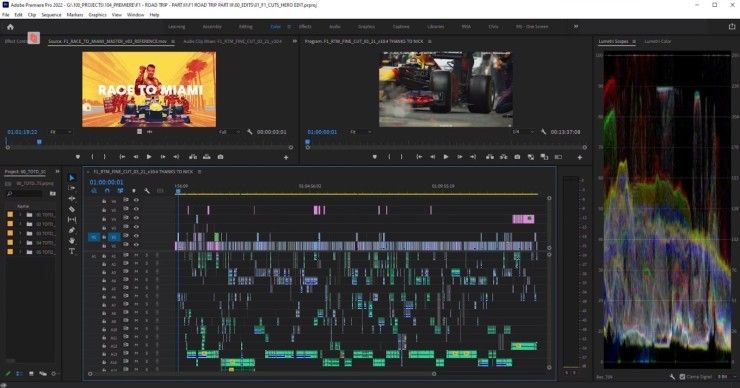
Like most productions, variables changed daily. Having a solid basis of story and concepts ahead of time allowed us to react. In particular, running a solid visual paper edit allowed us the flexibility to efficiently use our resources on things that would make the final cut.
To make things even more challenging, shooting time with the F1 car was extremely limited. It’s like working with a child actor, unpredictable and on a short timeline. How do you maximize what you’re able to get in the field? It’s here that our problem-solving began.
Film grab from the RED Monstro as Parks Bonifay avoids the gator, all captured practicallyCredit: @willroegge
Location Problems and Finding Efficiencies
The most important thing was to showcase the true performance of these cars by shooting practically — no camera or post tricks. We engineered everything around capturing the speed of an F1 car. However, shooting with one of these cars isn’t straightforward. They are incredibly complex machines with many specific requirements and procedures.
We were shooting with the Red Bull Racing RB7, the world constructor and driver’s championship-winning car from 2011. It weighs just 640 kg (1400 lbs) but packs a V8 engine producing 750HP at a max RPM of 18,000. This thing sounds like a demon stepping on a Lego, mixed with the highest-pitched scream you’ve ever heard. It’s a thing of engineering wonder and completely captures the feel of motorsport, but there were production challenges to pay for that performance.
First AD Jeremy Robinson, and 2nd AD Daniel Williams with the race team waiting for traffic to hold on the FDR highway in New York CityCredit: @brandonkado
First, every time the car shut off, it takes a team of eight people and a computer to restart it. Second, there is the heat generated by that ferocious V8 engine. F1 teams design their cars to go fast, not wait around for cameras to move into position or for traffic to move out of the way. If you want to put it in neutral and hold for a shot, you might have just seconds before the car overheats.
Then, there’s the speed. For an F1 car, 60 mph is slow. It’s not exactly easy to control on the tight and bumpier-than-a-racetrack streets of New York City. Finally, that sound that I mentioned before — the demon’s scream? It’s enough to get noise complaints from a mile away and stun anyone nearby.
Because it was such an incredible and attention-grabbing scene, we needed every sidewalk and area safe and clear. If the car had to shut down for a take, the whole AD/PA team would be physically pushing it back to its starting area.
On this shoot, a typical day would see four company moves to separate locations, with a 0.5 to 1-mile shooting route. Each take would have between 15-40 PAs and a whole team of assistant directors (lead by our 1st AD Jeremy Robinson or Franco Parente). Such fast-moving complexity calls for an incredible level of collaboration on the day, but it also pushes everyone to sort out as much as possible in pre-production.
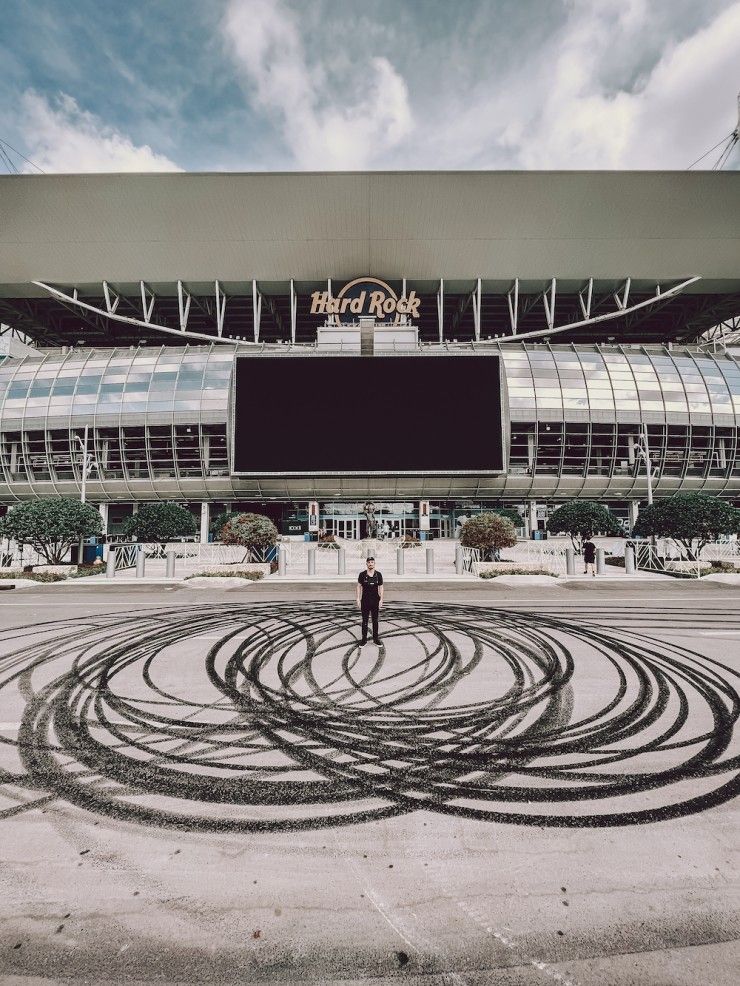
Aftermath of one take, Hard Rock Stadium, Miami. Credit: @austingager
Building the Team
A certain amount of flexibility and familiarity is needed to work within the tight boundaries of a production like this. We brought on Will Roegge as our DP to draw from his motorsports experience and ability to work quickly. Will and I agreed on specific tech and creative decisions/references in pre-production and then separated duties on-site so he’d manage the camera department, and I’d work directing the AD team and driver.
Time constraints meant that we didn’t have the usual wireless monitoring from all cameras, so a combination of trust and quick feedback allowed us to make sure we had the shots needed. I usually wouldn’t see any footage until around midnight every night because it was too fast-paced to slow down.
Director of Photography Will Roegge with the handheld RED Monstro and 24mm Masterbuilt Soft Flare prime lensCredit: @austingager
When collaborating with a DP, I look for someone who is technical and has a good eye for editing. A lot of what Will did was make sure that we’d have coverage to get into and out of scenes with our camera placement. I found it helpful to talk through the editing style and specific aesthetic (including grading and picture finishing), so he could enlist his team to make sure exposure/composition and overall coverage were solid.
With our ground angles covered, the additional camera platforms offered up what I call the “candy on top,” which are the FPV drone and camera car shots. Confidence in our strong ground coverage allowed the drone and camera car operators to take more risks, knowing that a scene wouldn’t be lost if they broke frame, missed focus, or if their timing was off. It was a privileged place to work from, but it took a lot of pre-production planning to achieve.
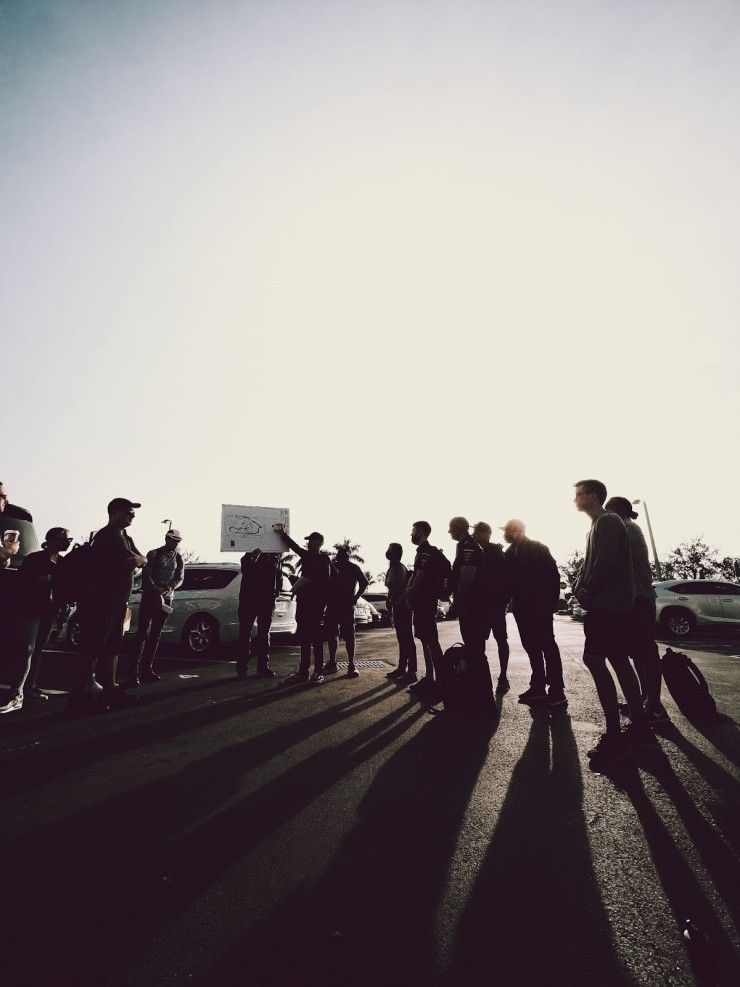
Safety meeting with the crew, second day of shooting at the Hard Rock StadiumCredit: @austingager
Measure Twice, Cut Once
If there’s one takeaway that summarizes this shooting style, it’s that planning is everything. There’s a kit that we always bring to a shoot like this:
Large area boards printed from Google Earth Pro with sun direction plotted
Toy models of the different elements
A reMarkable tablet, iPad Pro, or simply laminated maps with dry-erase markers for quick alignments in-between takes
We would do a traditional location scout that was followed weeks later by a tech scout, and then we’d usually roll right into actual shooting on the following day. The three items in that kit allow everybody to collaborate and put their expertise forward. I’m a believer that the best productions are collaborations, and facilitating that was my most important role as a director.
For example, in the opening driving scene where the car was lit from above by the helicopter, our helicopter pilot could easily coordinate the light sourcing with the camera car to ensure that the light was a backlight for the ground angle.
Another instance was working with the (outstanding) NYPD officers, which provided flexibility and ideas on where the car could turn around and loop back to the start of a shot without opening up our closure. Depending on the location, these planning meetings would have between 6-20 people and would take between 5-10 minutes. Our camera team would always do a specific meeting the night before, while the larger team of police officers and safety teams (fire/rescue/police) would meet the moments right before the first take.
As a filmmaker, you’re always looking to push the creative and the look, but you can’t underestimate the complexity and potential danger of these shoots. Everything has to be 100% safe, or nothing moves. Without the above planning tools, you’re limited to shouting over the engine noise, which only serves to raise tensions. Not ideal.
We used this planning method for everything from visualizing sun direction between NYC buildings to light sourcing into the Hard Rock Stadium for the final shot and everything in-between.
Even with those levels of planning, there are always time and resource limitations. We averaged two to three “runs” of the car in each location, which is not ideal for risk-taking with shots. We had to find some unique tech solutions to give the film a look and feel, while still making sure we were covering our story.
Our DP Will Roegge and I had worked together on the previous F1 Road Trip USA series and had several discussions about what we wanted to achieve with this one. The goal was to really capture the speed and maneuverability of the car, without resorting to the usual shots of a race broadcast.
How do you take that more considered cinematography of a film like Rush or Ford v. Ferrariand capture the speed and agility of these cars authentically, while making it feel like you’re there? There were a few technical solutions that helped us along the way.
This was our camera plan:
RED Monstro setup with 14mm Masterbuilt Soft Flare prime lens for handheldCredit: @austingager
The camera team consisted of three ground-angle operators. They moved between handheld RED Monstros fitted with wide primes, a Canon 50-1000mm (usually on a high-hat and an OConnor 2572 head) to cover inserts and scene entrance/exit, and a lightweight kit that was fluid enough to move around a scene capturing context. Our DP would operate our camera car platform or occasionally step into gimbal opp on the Inspire drone.
For audio, we had to use specific high-SPL dynamic microphones that could handle the incredible noise of the car. Some of these were coupled with remote record packs to ride on-board the car, while boom operators at camera positions captured the unique reverb of the V8’s sound in the city, country, or whatever unique place we were in.
The fastest way to move at the pace of this car was to outfit it with onboard cameras. Our POV camera expert Collin Harrington had worked with us before, and we exclusively used GoPros for smaller cameras with the occasional RED Komodo.
We did a lot of work that I’ll let Collin explain:
“My standard base settings for GoPros are—bit rate high, shutter auto, ev comp -0.5 (adjust accordingly for interior car shooting), white balance 5500 for daytime, iso min/max 100 (adjust higher for darker conditions), sharpness low, color flat.
And my biggest thing: HyperSmooth is always off! When trying to get the fast feel of a powerful vehicle, you want the added shake and feel of the speed. Only rarely will I put HyperSmooth on, for only very particular shots.
I use NDs as much as possible, depending on the light. Lighting is always changing, so I ND enough to get near a 180 shutter and just let the auto shutter keep it close. That way, we get the blurred surrounding for the added feel of speed.”
In some situations, we would use specially modified GoPros to get a more pronounced DOF and find focus on the driver and the driving inputs. My favorite shots were the actual driver POV shots where we’d get a camera right on eye level for their perspective. It was pretty wild seeing just how intense the driver’s inputs are. We love giving the audience that direct POV of what it’s like to drive these cars.
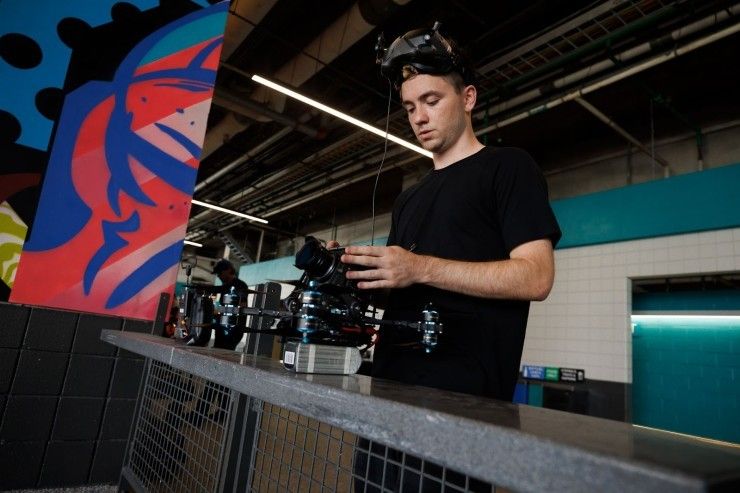
Drones at F1 Speed
Our FPV drone pilot was Johnny Schaer, also known as JohnnyFPV. While still in California before the shoot, we did virtual scouting of all locations via Google Earth Pro and came up with a few conclusions. We would use a combo of converging shots and working the corners, where the FPV drone, whose max speed is about 110 mph, would have a chance to catch up with the even faster car.
We did run into one issue generally on the shoot. To show the car’s speed and make it look its best, we wanted to be as low as possible. The problem is the average height of an F1 car off the ground is about 2.9 inches (75 mm). FPV was our best bet to get that shot. Johnny would pick a path towards the car, start his orbit on the car’s deceleration, and then speed up to chase away. He’d fly just a few inches off the ground, which was really intense to watch live.
He used a 5100 6-cell battery, which could take a lot of abuse on the throttle, and 8-inch prop setups on his custom-designed carbon drone frame.
Coordination with the driver was a key part of making the FPV shots really work since solely reacting to his driving would have made for less-than-desirable results. In what was one of the more intense moments on the film, we had the F1 car on a public road straightaway pushing 180+ mph. We were going to showcase this by having the drone converge at car level doing its max speed of about 120 mph, for a relative convergence speed of 300 mph. We did extensive planning so that the driver would know exactly where and what the drone was doing, as, in his words, “It looked like a speeding meteor of metal” coming at him.
Ultimately, we used different lanes of traffic and a short pop of elevation to make sure everything was safe along with an extra spotter for both the driver and drone pilot.
Johnny flies a RED Komodo, and we used custom modified 14mm Laowa and 18mm Zeiss lenses to take the sharpness down and let the global shutter on that camera flare and blur with motion. That heightened feel was a combination of flying, lensing, and camera. We also used the Freefly Wave camera for a few shots with the barefoot skiing, shooting 4K at 420 fps right into the water.
You can check out the reel of his shots here:
A Fast Camera Car
For the bread and butter of shooting, we used a camera car with a flight head V and a MoVI XL. We were committed to using large format cameras on this for the added resolution and added shallow depth of field in the wides, which is a crucial advantage of the larger sensor size of the V-Raptor or Monstro. However, the problem we ran into was the need for a zoom lens on these platforms.
Filmotechnic camera car and flight head outfitted with RED V-Raptor and Masterbuilt 25-125 lens, along with Canon still camera with a fixed 24 for action shooting and analog shaker boxCredit: Chris Tedesco/Red Bull Content Pool
The critical issue was to find glass that wasn’t clinically sharp, but large format zoom lens options aren’t numerous like the S35 ones. In the film world, where every takes counts, you want professional glass that can hold up to the environment. Unfortunately, there are only a few options.
We tried the Fuji Premista and Zeiss Signature zoom options but felt that while beautiful, they lacked some character that we wanted to inject into the picture. Instead, we decided to use Masterbuilt Soft Flare primes for ground shooting and the Masterbuilt 25-125mm zoom for the camera car. The Masterbuilts had more character but would still resolve in 8K, and they would flare without fully punching the sensor. Depending on the shot, we’d usually shoot between an F/4-5.6.
For this project, we shot on a pre-release V-Raptor that RED helped us out with. We shot with it for five days and put it through its paces without issue. Usually, we shot at a 180-degree shutter, occasionally going to 135 when the action was too quick and 180 would just net us a blurry mess of a shot. We’d push the sensor to 1600 ISO for night shooting, and it was squeaky clean.
With the Flight Head V that we used on the track in Miami, we wanted to integrate an analog shaker box to heighten the energy in some shots without using a digital solution. One key piece of our testing was with CMOS wobble or rolling shutter in a moving image.
Previous generation cameras with CMOS sensors would wobble too much in aggressive pans or converge shots, but we found both the V-Raptor and Komodo to be outstanding in this regard. While the Komodo has a global shutter that negates all of these issues, the V-Raptor, while technically a rolling shutter, didn’t exhibit the issues that past cameras had. The issue is that in action shooting when sometimes a shot can be less than a second, the subject moves so quickly that the shutter can “step” or warp, and it lessens the impact of the scene. If you look at the FPV drone with the global shutter on the Komodo, the energy feels substantially more heightened than with rolling camera systems.
Director Nicholas Schrunk with POV rigger Collin Harrington in Little Havana setting up for a final takeCredit: @hobolife
Production Reality
So, you show up the first day with your maps, expecting everything to go to plan, right? Well, it’s never that easy. There are always problems you’ll have to sort out on the fly. Our first shot was next to Wall Street with the driver arriving at the car and a helicopter with a light mounted to the bottom of it illuminating his way because an F1 car doesn’t have headlights. Funny, right?
Funnier still, when the car was en route to location, the transporter caught a nail on the West Street highway. After unloading and completing the warm-up, we were left with only about 20 minutes to shoot before the sun came up.
Jump forward a few hours, and we were scheduled to have only two chances to shoot the car crossing the Manhattan Bridge. Unfortunately, this became just one chance because of the traffic that instantly built up during the road closure.
Finally, we ended the day doing a pit stop on historic 5th Avenue next to Billionaires’ Row. Midway into shooting our pit stop, a protest marching up the street shut us down. All of this was just on our first day!
Long story short, we had to be flexible and make sure we got the shots because who knew what was coming next.
Our team responded well to all of the production challenges thrown at us, but we still needed to be flexible in post to make sure we accomplished everything we set out to do.
Final Premiere Pro timeline pre-conformCredit: @99jackals
Post-Production
Getting into post, there are so many elements that make a project successful. You have the music, sound design, editing, VFX work, and graphics. For us, we really wanted everything in our story to feed into the idea of what it’s like to actually be there with a Formula 1 car, so, in order to stay authentic, there are no CGI cars in this film. It’s all real environments with real stunts and driving, and everything pushes towards capturing that real-world experience.
Workflow-wise, we edited everything in Premiere Pro with a lead editor and two assistants pulling selects/organizing footage and syncing audio. We did an offline/online workflow where we had an Autodesk Flame artist who would take the final cut and conform everything using the original raw camera files, before going to DaVinci Resolve for color and then back to Flame for output.
Since we shot multiple formats, we used Flame’s color-managed workflow to maintain each file’s specific color science until it went to Resolve, so we could non-destructively work on all the shots with both VFX touch-up work and other elements to enhance the picture. I’ll let our VFX artist Jeremy Hunt describe the rest:
“The key to keeping everything looking its best was maintaining the 16-bit color out of the RED cameras. To that end, we did all of the work at 16-bit float. Since we try to squeeze everything out of the 8-bit sources, any work done to them also happens in a 16-bit floating point workflow to ensure that all of the data we have can get pushed through to color. Ultimately Flame is caching and rendering to uncompressed EXR or DPX and uses EXR 16-bit floating point for delivery to and from color. For RED sources, we used the IPP2 color science log3G10 to preserve every bit of range needed for an HDR grade.”
We used so many different camera formats in production to open up flexibility and preserve resources for post. This workflow helped us find a way to match everything together, so that it didn’t look disjointed.
Race to Miami Autodesk Flame workspace. Credit: @sdmfx
One of the VFX tricks we used was to de-grain any shot with noise, and then re-grain the entire film after it was color corrected. In some instances, where the shutter wasn’t a perfect 180-degree (mostly POV shots), we would add motion blur in post to these shots. The downsampled V-Raptor 8K footage to UHD looked incredible, and, if we needed to re-compose some shots, they would work well and not lose any apparent resolution.
We had to do quite a bit of specific work so the film grain would come through, even though a compressed YouTube deliverable would be the main export the grain would aggravate the compression codec, so a balance of it was decided and tested before we committed. Even on iPhone or Android viewing the compression looks good, a tough feat for so many layers of finishing.
Putting It All Together
While tech and gear are a driving force for getting your story on screen, they are ultimately just something you put on top of your main creative story. We had a great concept, great performances by our driver Sergio and our team principal Christian, and a solid plan of ideas from the team. The execution and equipment are really just amplifying what our team put together. In the end, I’m thankful for the opportunity to tell such a fun story, and I hope you enjoyed learning a bit more.
At the beginning of “Guardians of the Galaxy Vol. 3,” the latest (and last) space opera from writer/director James Gunn, the familiar Marvel Studios logo plays over images from the previous films. But there should be another logo preceding the latest galactic as well — only this one should be for PETA, the People for the Ethical Treatment of Animals — as “Guardians of the Galaxy Vol. 3” is perhaps the most pro-animal rights movie in recent memory. And it stresses its point in potentially upsetting ways. It’s so militantly pro-animal rights that it makes “Avatar: The Way of Water” seem like a quaint afternoon special by comparison. To be clear, this is not a bad thing – the brutality of “Guardians of the Galaxy” is exactly the point.
Warning: This post contains major spoilers from “Guardians of the Galaxy Vol. 3”
One of the most touching moments from the first “Guardians of the Galaxy,” released nearly a decade ago, is when Peter Quill aka Star-Lord (Chris Pratt) and the rest of the gang are getting dressed in a floating space prison. He looks over and spies Rocket (performed by Sean Gunn and voiced by Bradley Cooper), whose back is pockmarked and scarred with electronic equipment and the clear abuses of medical experimentation. It was a tender little moment, one amplified by the fact that, by the end of the movie, you grew to really care about the little critter and all that he’d been through.
But what had he been through?
While 2017’s “Guardians of the Galaxy Vol. 2” largely sidestepped this question (instead focusing on the character’s emotional insecurity), it looms large above almost everything else in “Guardians of the Galaxy Vol. 3.” The movie, in fact, starts with a flashback of a young Rocket, back then just an ordinary kit (that’s a baby raccoon), being taken out of a cramped cage by an evil being called the High Evolutionary (Chukwudi Iwuji). The High Evolutionary is hellbent on creating a perfect society of genetically modified citizens. To that end, he performs monstrous experiments, not only on Rocket but on a host of other animals, including a rabbit named Floor, an otter named Lylla and a walrus named Teefs.
These sequences are, as you can imagine, pretty hard to watch – especially if you are an animal lover and are constantly picturing your beloved pet as one of the animals getting experimented on. And this is only the beginning – there is a sequence where Rocket attempts to free the other animals, only to be met with an irate High Evolutionary, who tries to murder all of the creatures and successfully kills Floor, Lylla and Teefs. Rocket escapes, sees his felled family and claws at the High Evolutionary’s face (we don’t see the extent of the damage until later in the movie but it’s bad).
All of these flashbacks are happening while Rocket is fighting for his life, after getting mortally injured in a tussle with new baddie Adam Warlock (Will Poulter). The sight of the little raccoon on a hospital bed fighting for his life is bad enough, knowing what he already endured makes the entire situation even more upsetting.
Rocket, of course, eventually gets better, although the Marvel Studios marketing department has done a great job convincing the entire world that Rocket will, in fact, bite the dust. And during the big melee with the High Evolutionary and his goons (it’s a little involved to get into right now), Rocket makes the proclamation that they aren’t just saving the humans that have been experimented on by the High Evolutionary – they’re saving all of the creatures on the High Evolutionary’s ship/headquarters/testing lab, including the Abilisks, those giant, tentacled monsters from the beginning of “Guardians of the Galaxy Vol. 2” (they eat batteries).
It’s a beautiful ending, one that reinforces the movie’s deep humanity and its commitment to the thematic importance of animal rights. On Instagram, Gunn posted a selfie with this message about the movie: “At the end of the day, this is a movie about joy and compassion and learning to see beyond the rim of our own worlds and having empathy for all living things. Rocket’s journey is my own and I’m so happy to have had him help me to learn a better way of living over the past 11 years, as well as all of you.”
In order to get this message across, the movie has to go to some uncomfortably dark, if not outright bleak, places. But that’s okay. We have to feel what he felt in order to get to the light.
“I didn’t ask to get made! I didn’t ask to be torn apart and put back together over and over, and turned into some… some little monster!” Rocket screams in the first “Guardians of the Galaxy.” Now we know the real pain and hurt that is behind that exclamation. And it makes where he ends up even more powerful.
As players make progress through the main story of Star Wars Jedi: Survivor, they are able to unlock a new fighting style for Cal called the Blaster Stance that uses both a lightsaber and blaster pistol in combat. Combining short-range lightsaber swings with long-range blaster fire, this stance is far from conventional. Players can explore different skills that expand this stance’s abilities, giving more ways to approach a fight.
While some may call using a blaster “uncivilized”, the main gimmick behind the Blaster Stance is a special pistol that players can use to shoot enemies from afar without having to close the distance with their lightsaber. Players have the option to charge a blaster shot to deal more damage, but this does take up more ammo when firing. However, hitting enemies or bosses with the lightsaber restores the blaster’s ammunition, encouraging a really fluid game plan that combines the best of both weapons.
How to Get the Blaster Stance in Star Wars Jedi: Survivor
Thankfully, it’s very easy for players to get the Blaster Stance naturally by progressing in the main story until they complete the “Koboh – The Forest Array” objective. From there, players can go back to the Mantis before traveling to Jedha and reuniting with Merrin. Before players embark on their next story mission, Bode offers their blaster pistol to Cal, which permanently unlocks the Blaster Stance.
Players can unlock the Blaster Stance by receiving Bode’s Pistol after reuniting with Merrin on Jedha after the “Koboh – The Forest Array” main story objective.
Like the other four stances in the game, players are able to select the Blaster Stance by choosing it at a Meditation Point. An immediate skill tree for this fighting style is shown once players sit down at any Point with the stance unlocked. With plenty of enemies in the upcoming mission to build skill points from, players have a great opportunity to upgrade the Blaster Stance right away if they want.
How to Use the Blaster Stance
Unlike the heavy swings of the Crossguard Stance in Star Wars Jedi: Survivor, the Blaster Stance is quick, using swift thrusts that almost look like fencing. The best way enemies for this stance are weaker opponents like basic Stormtroopers and B1 Battle Droids, who can be picked off with one shot from the blaster. Juggling the blaster ammo to thin crowds of enemies while using the fast strikes of the lightsaber to take down tougher foes is the core strategy behind this stance.
Once players learn how to unlock the Blaster Stance in Star Wars Jedi: Survivor, they can equip it along with one other style to switch between whenever they are in a fight, leading to a lot of flexibility with the right skills.
Following up after the events of Star Wars Jedi: Fallen Order, Star Wars Jedi: Survivor continues the journey of Cal Kestis after surviving the aftermath of Order 66 and the mass execution of the Jedi. Five years after barely escaping the clutches of Darth Vader and the Galactic Empire, Cal continues to live on the run with his robot companion, BD-1. Players will now assume the role of Cal Kestis as no longer a Padawan but a Jedi Master. Spanning several planets and further refining and evolving the lightsaber/force-powered Jedi combat in Fallen Order, Survivor will once again put players back into the ever-expanding Star Wars Universe.
Showtime has successfully petitioned the Television Academy to switch its Emmy submission for the acclaimed docuseries “Couples Therapy” to outstanding structured reality program, Variety has learned exclusively.
During its two previous seasons, the series had been offered in the unstructured reality category, where it competed with shows such as National Geographic’s “Life Below Zero,” TLC’s “90 Day Fiancé” and Hulu’s “The Kardashians.” However, it failed to receive recognition during its respective years. Notably, the show did win a major prize from the Television Critics Association (TCA) Award in 2021 for outstanding achievement in reality programming.
“Couples Therapy” follows Dr. Orna Guralnik, a world-renowned psychologist and psychoanalyst, as she guides couples through real-life therapy sessions. This second installment of the third season follows four couples, with all nine episodes premiering on the Showtime app on April 28.
In addition to the outstanding reality program category, the cable network has also put the show up for consideration for outstanding cinematography (Armaan Virani), directing (Joshua Altman and Bennett Elliott) and picture editing for an unstructured reality program (Delaney Lynch, Helen Kearnes and Katrina Taylor).
The documentary original is the latest in a series of shows that have sought approval from the TV Academy to move categories. Food Network’s “Diners, Drive-Ins and Dives” convinced the TV Academy to move from hosted nonfiction to structured reality, where it will face Netflix hits such as “Love is Blind” and “Queer Eye,” in addition to Showtime’s “Couples.” Recently, Apple was denied by the TV Academy to switch its musical-comedy “Schmigadoon!” into the scripted variety race.
“Couples Therapy” is produced by Matt Parker and Bennett Elliott, with Eli Despres, Josh Kriegman, Elyse Steinberg and Vinnie Malhotra serving as executive producers and Kim Roberts and Maya Seidler as co-executive producers.
Submissions for this year’s Emmys are due on May 9, with nomination voting opening on June 15.
Connie Converse was a pioneer of what’s become known as the singer-songwriter era, making music in the predawn of a movement that had its roots in the Greenwich Village folk scene of the early 1960s.
But her songs, created a decade earlier, arrived just a moment too soon. They didn’t catch on. And by the time the sun had come up in the form of a young Bob Dylan, she was already gone. Not simply retired. She had vanished from New York City, as she eventually would from the world, along with her music and legacy.
It wasn’t until 2004, when an N.Y.U. graduate student heard a 1954 bootleg recording of Ms. Converse on WNYC, that her music started to get any of the attention and respect that had evaded her some 50 years before.
The student, Dan Dzula, and his friend, David Herman, were spellbound by what they heard. They dug up more archival recordings, and assembled the 2009 album, “How Sad, How Lovely,” a compilation of songs that sound as though they could have been written today. It has been streamed over 16 million times on Spotify.
Young musicians like Angel Olsen and Greta Kline now cite Ms. Converse as an influence, and musical acts from Big Thief to Laurie Anderson to the opera singer Julia Bullock have covered her songs.
“She was the female Bob Dylan,” Ellen Stekert, a singer, folk music scholar and song collector told me during my research for a book about Ms. Converse. “She was even better than him, as a lyricist and composer, but she didn’t have his showbiz savvy, and she wasn’t interested in writing protest songs.”
Seventy-five years ago, Ms. Converse was just another young artist trying to make ends meet in the city, singing at dinner parties and private salons, and passing a hat for her performances.
She knew that her songs did not jibe with the saccharine pop of the day. “This type of thing always curdles me like a dentist’s appointment,” she wrote to her brother before an audition at Frank Loesser’s music publishing company, where she predicted what executives would say of her songs: “lovely, but not commercial.”
In January 1961, the same month that Dylan arrived from the Midwest, Ms. Converse left New York for Ann Arbor, Mich., where she reinvented herself as an editor, a scholar and an activist.
In 1974, a week after her 50th birthday, she disappeared and was never seen again.
Ms. Converse lived in New York from 1945 to 1960, and though she was intensely private, she kept a diary, scrapbooks and voluminous correspondence that were left behind after she drove away for good, offering clues about what the Manhattan chapter of her life was like. Here are some of the neighborhoods, venues and sites around the city that provided the musician with a backdrop for her short but trailblazing stint as a songwriter.
The 1940s: Bohemians of the Upper West Side
Riverside Park
In 1944, after dropping out of Mount Holyoke College in Massachusetts, Ms. Converse moved to New York. Her first job was at the American Institute of Pacific Relations, where she edited and wrote articles about international affairs. “I am struck by the breadth of the topics she covered,” said the contemporary international relations scholar Michael R. Anderson, who calls her writing and reporting “remarkable.”
She lived on the Upper West Side. The image of her in Riverside Park, above, was found in an old filing cabinet that belonged to the photographer’s widow. It is one of the first known images of Ms. Converse in New York.
The Lincoln Arcade
Some of Ms. Converse’s closest friends lived and hung around the bohemian enclave known as the Lincoln Arcade, a building on Broadway between West 65th and 66th Street. With a reputation as a haven for struggling artists, it had been home to the painters Robert Henri, Thomas Hart Benton and George Bellows, the last of whom had lived there with the playwright Eugene O’Neill.
The group was a hard-drinking lot, given to holding court late at night. One surviving member of that crew, Edwin Bock, told me that Ms. Converse would often be clattering away at a typewriter, at a remove from the rest, though sometimes she did things he found shocking, like climbing out the front window well past midnight to stand on a ledge, several stories above the street.
The 1950s: Making Music in the Village and Beyond
23 Grove Street
Ms. Converse lost her job when the institute landed in the cross hairs of the anti-Communist House Un-American Activities Committee. Sometime late in 1950, she moved to the West Village and began a new phase of her life as an aspiring composer and performer.
She bought a Crestwood 404 reel-to-reel tape recorder and began making demos of herself singing new songs as she wrote them. It was here, while living alone in a studio apartment at 23 Grove Street that Ms. Converse wrote almost all of her “guitar song” catalog (including everything on “How Sad, How Lovely”).
The Village at that time “was the Left Bank of Manhattan,” the writer Gay Talese told me, and it had “whiffs of the future in it” in terms of its permissiveness about lifestyle choices. Nicholas Pileggi, a writer and producer, suggested that given her address, Ms. Converse, a loner, would have had no problem hanging out by herself at Chumley’s, a former speakeasy.
The upstart book publisher Grove Press was also just down the block, and she was close to The Nut Club at Sheridan Square, where jazz musicians often played, as well as the more respectable Village Vanguard.
Grand Central
Her first and only television appearance was in 1954, on the “The Morning Show” on CBS (hosted that year by Walter Cronkite), though how Ms. Converse secured the appearance and what she played and talked about may never be known (shows at this time were broadcast live; no archival footage exists). Because the program was staged in a studio above the main concourse at Grand Central and shown live on a big screen in the hall, everyone bustling through the station that morning could have looked up and caught the young musician’s one and only brush with success.
Ms. Converse was extremely close to her younger brother, Phil. When he visited her in the city for the first time, Ms. Converse described the reunion in her irregularly kept diary, noting that the two “met like strangers at Grand Central, and fell to reminiscing over oysters.”
In 1955, Ms. Converse took up residence at 605 West 138th Street, in Harlem, a block away from Strivers’ Row. There, she shared a three-bedroom flat with her older brother, Paul, his wife, Hyla, and their infant child, P. Bruce, a situation she called “a cost-saving measure.” The new apartment had an upright piano, which Ms. Converse used to compose an opera (now since lost), a series of settings for poems by writers like Dylan Thomas, E.E. Cummings and Edna St. Vincent Millay, and a song cycle based on the myth of Cassandra who, according to Greek mythology, was given the gift of prophesy and then cursed to be never understood.
Circle in the Square
An avid theatergoer, Ms. Converse attended Jose Quintero’s 1956 revival of “The Iceman Cometh,” which made Jason Robards a star and effectively launched the Off-Broadway movement. “Did I mention that I saw an in-the-round production of ‘The Iceman Cometh’ last month?” she wrote to Phil and his wife, Jean, that October. “Some four and a half hours of uncut O’Neill, but only the last 15 minutes found me squirming in my seat.”
The Blue Angel
At this erstwhile nightclub on East 55th Street, unique at the time for being desegregated, Ms. Converse met the cabaret singer Annette Warren, who expressed interest in covering Ms. Converse’s songs, and who would make at least two of them, “The Playboy of The Western World” and “The Witch and the Wizard,” staples of her show for decades to come.
1960: The Lost Tape; Goodbye, New York
National Recording Studios
National Recording Studios, at 730 Fifth Avenue between West 56th and 57th Streets, had been open for only a year when Ms. Converse showed up in February 1960 to record an album. It was a solo session that, because she did just one or two takes of each tune, only took a few hours. The recording was a rumor until 2014, when Phil Converse unearthed a reel of it in his basement. An adman who was a fan of Ms. Converse’s music had procured the recording session for her for free. That album, the only one she made, remains unreleased.
Ms. Converse closed the circle of her peripatetic Manhattan existence by moving back to where she’d started: the Upper West Side. This time, she lived in a brownstone on West 88th Street, a half block from Central Park. This was her last known New York address; by 1961, she was gone.
Her music, mostly made in isolation or at small gatherings, was nearly lost but for the efforts of her brother Phil, who archived what he could; David Garland, who played her music on WNYC in 2004 and 2009; and Dan Dzula and David Herman, the students who, decades later, introduced her work to a new generation.
“The first time I played a Connie Converse song for a friend, she sat silently and cried,” Mr. Dzula said. “From that moment I knew Connie’s magic would reach at least a few more people in a deeply personal and special way.”
He added: “Could I have envisioned her blowing up like this when we first put out the record? Absolutely not. But also, yeah, kind of!”
Howard Fishman is the author of the new book “To Anyone Who Ever Asks: The Life, Music, and Mystery of Connie Converse.”
Fireworks can significantly add to a movie. Most of the time, they symbolize celebration and love when the story wraps up. Maybe the protagonist finally claims victory or the villains fall to justice.
If you plan for fireworks, there are some precautions you need to take. Remember these six safety tips when you film your fireworks scenes.
1. Research the Laws
The first tip is to research the laws in the city and state you’re filming. Most states allow people to use fireworks recreationally, but some exceptions exist. For example, Massachusetts bans all fireworks for private use — you can’t even use sparklers. Only professionals are allowed to perform fireworks displays.
Do you want to film in New York? You’ll need to obtain a permit through a local agency. The person in charge of the firework display needs a pyrotechnician certificate of competence to comply with state law. Most states allow typical consumer fireworks, but filmmakers must know the rules. Otherwise, they risk penalties and law enforcement shutting down the set.
Some filmmakers and directors feel the need to do everything themselves. However, in this circumstance, it’s best to let the experts handle it. In fact, some filming locations may require you to hire a pyrotechnician. They’ll ensure your display detonates correctly on the first try.
2. Find a Suitable Location
Once you determine the city and state, you must find a suitable location for a fireworks display. Two decisions are necessary here — where the fireworks display will happen and where the cameras will be.
You must be conscious of the skyline when filming fireworks in the city. Are there tall buildings blocking your view? Where can you get the best shots of the fireworks without them being too far away? Scouting is essential for the fireworks scene, just like the other shots in the movie. Use a few fireworks to take a few test shots before deciding on a location.
3. Properly Store the Fireworks
Once you have your fireworks, you must store them safely until it’s time to film. Overlooking this step could lead to disaster. At worst, the fireworks could detonate and cause destruction.
Start by placing the fireworks in non-flammable containers with tightly closed lids. It’s best to put the fireworks in a cool, dry atmosphere away from electrical appliances, cardboard boxes and plastic bags. It may go without saying, but keep the pyrotechnics away from open flames like a stove. Even being in a hot garage can be detrimental to the fireworks.
When outside, protect the fireworks from precipitation. Employ waterproof gear like tarps to keep everything dry. You may also need to resort to unconventional sources. For example, cling film effectively keeps fireworks dry and many people use it as a temporary bandage when they get hurt.
4. Check the Weather
Weather can significantly hinder filming. Rain and thunderstorms can destroy your equipment, and extreme heat can cause dehydration and heat stroke for the filming crew. You’ll also need to be vigilant of the weather for your fireworks scenes.
Launching fireworks is best with clear skies and low humidity, but you might not be fortunate enough for these conditions. Droughts bring the risk of large fires and moisture can reduce the brightness of the fireworks display. The worst-case scenario is lightning strikes and starts a fire on the ground. Filmmakers can’t control the weather, but they can plan around it by checking the weather forecast and preparing for schedule shifts.
5. Get Creative
Independent films often have tight budgets, so an hour-long fireworks display might not be in the cards. Your budget may only have enough money for one shot to film the fireworks. Modern technology lets you get creative and save money while getting the best shots.
For example, some filmmakers have started using computer-generated imagery (CGI) for their fireworks displays instead of real pyrotechnics. Weather and safety can be problematic, so CGI comes to the rescue by generating realistic clips of fireworks for any film. Remember the 2008 Summer Olympics in Beijing? Some opening ceremony fireworks were CGI and prepared months before the event.
Switching to CGI fireworks can be an effective cost-saving measure because the average viewer will have difficulty differentiating between real and fake pyrotechnics. It also makes your filming plans more environmentally friendly, making it easier for you to round up investors in the project.
6. Monitor the Animals
Animals are often integral parts of films. Though, they’re much more challenging to manage than humans — especially if your film includes animals outside of cats and dogs. Fireworks startle many animals and can cause them to run away or attack others. Be mindful of the on-set animals and the native species. For example, bald eagles feel threatened by fireworks and could permanently abandon their habitats.
It may help to have an on-site expert to monitor the animals through the scenes. These trainers can provide medication to alleviate anxiety and ensure they don’t run off. It’s also wise to watch the animals to ensure they don’t eat or chew on the fireworks.
Ending With a Bang
Fireworks create terrific scenes. Filmmakers often use them for celebration and comedic relief. Remember when Pippin and Merry launched the dragon firework and nearly ruined the birthday party?
Fireworks add a lot to films, but they require special planning. Use this guide for safety tips and protecting everyone on set, including animals.
Oscar Collins is the editor-in-chief atModded. He’s passionate about films, filming techniques and the finer details of filmmaking. Follow him on Twitter@TModded for frequent updates on his work!
For the first time in 70 years, the United Kingdom, Canada and the entire Commonwealth will celebrate a new monarch as 74-year-old Charles is formally crowned King.
Global News’ live coverage of the coronation will begin at 5 a.m. ET (2 a.m. PST) in the video player at the top of this page. You can also get the latest updates from our reporters both on the ground in London and in Canada in the live blog at the bottom of this page.
The ceremony is expected to begin at 6 a.m. ET, with Charles being crowned at approximately 7 a.m. ET while in the presence of the Stone of Destiny.
Trending Now
After Charles is officially crowned, the procession will depart the abbey and return to Buckingham Palace where there will be a salute from the guard and a balcony appearance with the King and his family at approximately 9:15 a.m. ET.
You’ll be able to watch all of Global News’ live coverage beginning at 5 a.m. ET (2 a.m. PST) on Globalnews.ca, YouTube, Facebook, the Global TV app and Global TV on your TV and your preferred streaming device.
Microsoft appears to be pushing forward with its Windows 11 widget masterplan in recent times, and here’s yet another piece of evidence to that end.
Zac Bowden, a well-known leaker of Windows Central (opens in new tab) fame, tells us that his sources within Microsoft have said that Windows 11 users will be given the ability to pin widgets straight onto the desktop.
Microsoft’s goal with this is to increase engagement with widgets, as clearly, when on the desktop, they’ll be utilized more – being right in the line of sight all the time, rather than being confined to the widgets panel (fired up from the taskbar) as they are currently.
When will this move happen? Bowden can’t tell us that, but what the leaker does point out is that Windows 11’s widgets are being treated to a dedicated session at Microsoft’s Build 2023 conference (later in May). So, there seems a fair chance that this move might be talked about then, and if so, it may not be long before we see the feature in testing for Windows 11.
All of this comes off the back of Microsoft introducing a new widget earlier this week in testing, but it’s a major one – Facebook.
If the above guesswork of a vague timeline pans out then we should see the functionality to move widgets onto the desktop in Windows 11 appear later this year.
That’s our gut feeling, anyway, as Microsoft appears to be focusing quite strongly on this area of the interface (widgets and File Explorer are undergoing a fair few changes in testing, and pretty major ones, currently). Furthermore, developers are very much being encouraged by Microsoft to implement widgets for their apps.
Also, Bowden has mentioned the idea of shifting widgets onto the desktop before (in March), so it feels like the concept is progressing forwards at Microsoft, for the leaker to be bringing it up again now.
It’d certainly be a useful bit of additional functionality for those who find widgets useful – to have them right there on the desktop. And if you don’t like widgets, well, you can still just ignore them. It isn’t like they’ll make their way onto the desktop of their own accord.
With the ability to transfer them to the desktop if desired, Windows 11’s widgets are going to start to feel a lot more like the gadgets we had with Windows 7.
“All Quiet on the Western Front” is the sole non-English language nominee for Best Picture and a strong frontrunner for Best International Feature; it also stands a good shot at winning in several other categories. While it certainly wouldn’t be the first war epic with serious Oscar season momentum, it brings a unique perspective to the genre as the first adaptation of the 1928 novel told from a German perspective.
That specificity is what drew writer-director Edward Berger to the material, but it also created a challenge for his young cast. “I was afraid it might become some sort of heroic war film,” said Felix Kammerer, who plays the young, idealistic WWI recruit Paul, in a conversation with Berger for IndieWire’s Awards Season Spotlight series.
That wasn’t in the cards. Growing up in Germany, Berger was very aware of the shadows cast by the country’s roles in two world wars. However, when he started working on his “All Quiet” adaptation, he realized that his young cast didn’t have the same connection to the past. “We have inherited the DNA of starting two world wars,” Berger told Kammerer, recalling their conversation early in the casting process. “There’s a lot of guilt and shame associated with that and responsibility towards history. … I don’t know if you have this in your generation.”
Kammerer agreed. “In my generation, it’s more of a rational thing,” said the 27-year-old actor, who had previous experience in theater but made his screen debut with the movie. “There’s so much guilt that you understand and feel responsible for, but not in a personal, emotional way.”
However, Kammerer added, Berger made it clear that they would confront the darker aspects of the story through the prism of history. After their initial conversation, “I knew it never, ever was this going to be a hero story,” Kammerer said. Berger nodded. “It cannot be a hero’s journey,” he said. “As a German, there’s nothing heroic about that part of history.”
Kammerer created a unique approach to delivering his character’s conflicted emotional state throughout the movie. “It’s basically an Excel spreadsheet,” he said. “It combines categories for the character with numbers of scenes and levels of energy. If you put in the numbers in preparation, you come up with some kind of graph that looks like a tax return sheet. It shows you in a very mathematical and rational way the development — somehow, the evolution — of the character.”
Berger said he had no idea about Kammerer’s meticulous approach, but was impressed by the actor’s investment in the role. “I put Felix through a really hard casting process,” he said, recalling how he called the Kammerer back for several auditions in costume. “Anyone else would’ve walked away, but because Felix had never been through casting before, he thought this was normal.”
The movie required major physical investment by Kammerer and the other actors tasked with dashing through muddy, claustrophobic trenches in 90 pounds of clothing as the cameras sprinted alongside them. Rain was a frequent presence on the set. “You are running with that weight all day long through the trenches,” he said. “It really took something for us to do this over and over again. At the same time, you feel it’s worth it.”
Watch the full conversation above and check out other Awards Season Spotlight conversations here. “All Quiet on the Western Front” is streaming on Netflix.
The Netflix reboot of the hit 2004 series Rebelde has ended after two seasons.
Technically being the fifth iteration of Rebelde, the show took you back to Elite Way School as a new generation of students hopes to win the Battle of the Bands.
The show starred Azul Guaita, Sergio Mayer Mori, Andrea Chaparro, Jerónimo Cantillo, Franco Masini, Lizeth Selene, and Alejandro Puente, first premiering on January 5th, 2022, with the second season releasing in July 2022.
16 episodes were released in total at Netflix, which is a far cry away from the 450 the original series released.
The news of the cancelation comes via Hola! Mexico in an interview with actor Sergio Mayer Mori whereby he told the outlet (translated from Spanish via Google Translate):
“It would be an honor for me to be able to do the third, fourth and fifth, the thing is that it hasn’t been done anymore. It was Netflix, it was the producers who told us: ‘thanks for everything guys, and the third time, there is no more’”. He added that he does not know the reasons why they made that decision: “Why I have no idea (…) it was definitely not my decision.”
Why was Rebelde canceled at Netflix?
Cancelations usually come down to a number of factors and while we don’t have an official reason for the cancelation, we can have a quick look at the numbers and point to a few possible reasons why the show may not be returning for future seasons.
FlixPatrol data, sourced from daily top 10s in regions worldwide, suggests that the show didn’t get off to the best of starts in the first season, and season 2 fared even worse.
You can see from the graph below that the first season only stayed in some top 10s for around three weeks, and season 2 had all but left the top 10s just a week after its debut.
Picture: FlixPatrol
Their data also suggests the show failed to make sizeable impacts outside of Latin America, with Brazil and Mexico being the show’s top-performing countries.
Netflix’s official top 10 hourly data also backs up the decline in popularity between seasons 1 and 2, with the second season only debuting with around half the viewing hours of season 1. Worst of all, the show demonstrated no staying power either.
Rebelde: Season 1
Week Period
Hours Viewed(M)
Rank
Week in Top 10
January 2nd, 2022 to January 9th, 2022
33,180,000
2
1
January 9th, 2022 to January 16th, 2022
23,880,000 (-28%)
3
2
Rebelde: Season 2
Week Period
Hours Viewed(M)
Rank
Week in Top 10
July 24th, 2022 to July 31st, 2022
15,310,000
7
1
July 31st, 2022 to August 7th, 2022
8,760,000 (-43%)
9
2
So if we had to guess, it’s almost certainly the case that Rebelde was canceled due to poor viewership.
Katrina Kaif will next be seen in Tiger 3 with Salman Khan.
Katrina Kaif recently shared a bundle of no-make-up selfies on Instagram.
Time and again, Katrina Kaif shares her no-make-up photos on Instagram for which she enjoys a massive fan following. Apart from being a stellar actress, the actress is also known for her radiant beauty. Having said that, she recently shared a bundle of no-makeup photos, garnering love from fans.
Not just the no-makeup glow, Katrina also aced the messy-bun look. She donned a striped blue shirt and posed with elegance. She posed amid the backdrop of her balcony garden. Fans are now wondering if she’s wearing her husband Vicky Kaushal’s shirt. One of the fans even commented, “If u r wearing Vicky’s shirt its heart-melting photo ❤️.” “How can someone be this gorgeous!!!❤️,” read another one. Meanwhile, Shweta Bachchan also took to the comments section and wrote, “Love these .”
Earlier too, Karina shared a bundle of no makeup photos, which not only made fans swoon but also her hubby Vicky Kaushal. In the pictures, Katrina is seen wearing a beige tank top with a knit pullover and is posing in the natural light. Sharing the pictures, she wrote, “Gd Morning” and added a sunflower emoji to it. She is not wearing any makeup and flaunting her natural blemish-free skin. Well, Vicky Kaushal couldn’t stop himself from dropping a bunch of melting face and red heart emojis.
Katrina and Vicky got married on 9 December 2021. They had an intimate wedding with close friends and family in attendance.
Meanwhile, on the work front, Katrina is gearing up for major exciting projects, including Tiger 3 with Salman Khan, Merry Christmas with Vijay Sethupathi, and Jee Le Zaraa with Alia Bhatt and Priyanka Chopra. Farhan Akhtar announced the film with an interesting poster that hints at the girls’ trip. Meanwhile, Vicky has also a promising line up of films. He will be seen in ‘Sam Bahadur’ Laxman Utekar’s romantic comedy, and Dunki, which is being produced by Shah Rukh Khan and directed by Rajkumar Hirani.
Aditi Giri, Senior Sub-Editor at News18. She is a Bollywood and Biryani enthusiast. She loves talking to your favourite BTown celebrities, and brings …Read More
As the pomp and pageantry are underway in London, some are raining on King Charles III’s coronation parade.
London’s Metropolitan Police have arrested republican protesters at Trafalgar Square. The protests appeared to be peaceful, according to reports, and the protesters were arrested while unloading placards.
Shelly Asquith, health, safety and wellbeing officer at the Trade Union Congress, posted on Twitter:
“Outrageous scenes of cops arresting anti-monarchy protestors and stealing their placards. So we are not allowed to show public opposition to a bloke being crowned head of state for having been born into unimaginable wealth while ppl line up at food banks and schools fall apart.”
Outrageous scenes of cops arresting anti-monarchy protestors and stealing their placards
So we are not allowed to show public opposition to a bloke being crowned head of state for having been born into unimaginable wealth while ppl line up at food banks and schools fall apart pic.twitter.com/klkSjLMAmL
The Metropolitan Police tweeted a statement: “A significant police operation is under way in central London. We have made a number of arrests in the area of Carlton House Terrace. The individuals have been held on suspicion of breaching the peace.”
A significant police operation is under way in central London.
We have made a number of arrests in the area of Carlton House Terrace.
The individuals have been held on suspicion of breaching the peace.
The police had earlier tweeted: “We will deal robustly with anyone intent on undermining this celebration.” Also among those arrested are four people in the area of St Martin’s Lane who were held on suspicion of conspiracy to cause public nuisance and lock-on devices were seized from them; and a further three people were arrested in the area of Wellington Arch who were held on suspicion of possessing articles to cause criminal damage.
Among those arrested have been members of the Alliance of European Republican Movements and Graham Smith, the chief executive of republican group Republic, who was arrested along with five members of his team during an anti-monarchy protest.
The movement has condemned the arrests, saying: “In a democracy, there should be a right to protest.”
We strongly condemn the arrest of @RepublicStaff peaceful protesters. In a democracy, there should be a right to protest.
— Alliance of European Republican Movements (@AERMorg) May 6, 2023
In a significant change to traditional procedure, instead of hereditary peers swearing allegiance to the King, members of the public – including those present at Westminster Abbey and those watching from home – will be invited, rather than asked, to recite: “I swear that I will pay true allegiance to Your Majesty, and to your heirs and successors according to law. So help me God.”
The wording was initially asking the public, but when that was objected to by members of the public, it was changed to a milder invitation.
The coronation ceremony will be presided over by the Archbishop of Canterbury, whose London residence is Lambeth Palace. A “chorus of millions” is how a Lambeth Palace statement described the collective swearing of allegiance.
A spokesperson for the Archbishop said: “Our hope is at that point, when the Archbishop invites people to join in, that people wherever they are, if they’re watching at home on their own, watching the telly, will say it out loud – this sense of a great cry around the nation and around the world of support for the King.”
With Gunn’s exit, fellow Guardians of the Galaxy cast members Zoe Saldana and Dave Bautista have already gone on record that they too will be leaving the franchise.
Chris Pratt Could Return
While two Guardians may be flying off into the sunset, Chris Pratt, who portrays the intergalactic team’s leader Star-Lord, would be willing to continue portraying the character. Although, he admits that it would be strange to do so without Gunn.
“It would be strange to continue [Star Lord’s] story without James,” Pratt said. “He’s done such a masterful job in the first three films. We really found the voice of Peter Quill together and without him, obviously, I would never have had this opportunity. He writes it, he directs it, he dreams up the music, it’s his imagination on screen.
So, to continue to tell the story, it would really be important to honor what he’s done in the first three films and to honor what the fans have grown to love about the character and not simply do it because people might show up to pay for it, you know?”
Others Have Directed The “Guardians”
While the Guardians of the Galaxy franchise was created under the watchful eye of Gunn, he was not the only director to handle the team.
The group appeared in supporting roles in Joy and Anthony Russo’s Avengers: Endgame and Avengers: Infinity War, in addition to Taika Waititi’s Thor: Love and Thunder.
Photo: Marvel
“I don’t want to be cynical in the approach and if that’s the case, I just wouldn’t do it at all. So maybe down the road if something makes sense I would do it but it would really have to check a lot of the right boxes.” Pratt explained.
Two Guardians Jump Ship
As for his fellow co-stars, both Bautista and Saldana have been adamant that they are done with the franchise.
“I don’t think this is the end for the Guardians. It is the end for me, for Gamora.” Saldana stated.
Bautista for his part has long expressed no interest in continuing on without Gunn. The director’s exit, combined with the time-consuming makeup process needed to create Drax, has left the actor somewhat disillusioned.
“I’m so grateful for Drax. I love him. But there’s a relief [that it’s over],” Bautista recently said. “It wasn’t all pleasant. It was hard playing that role. The makeup process was beating me down. And I just don’t know if I want Drax to be my legacy — it’s a silly performance, and I want to do more dramatic stuff.”
Photo: Marvel
While the team may look different in the future, with the introduction of Adam Warlock and Chris Pratt’s potential interest in returning, maybe we will see the Guardians again after all.
Guardians of the Galaxy Vol. 3 opens in theaters nationwide on May 5.
Photo: Disney
Thanks for visiting MickeyBlog.com! Want to go to Disney? For a FREE quote on your next Disney vacation, please fill out the form below and one of the agents from MickeyTravels, a Diamond level Authorized Disney Vacation Planner, will be in touch soon! Thanks for reading!
With Guardians of the Galaxy: Volume 3, and the team as we knew them saying farewell, it leaves a spot for some new cosmic heroes in the Marvel Cinematic Universe. Yes, we know The Marvels is going to be pretty cosmic. But the adventures of Carol, Monica, and Kamala will at least partially take place on Earth. We are talking total outer space adventures here, Star Wars/Star Trek style. And these are our picks for the cosmic Marvel heroes we would like to see fill the Guardians’ slot in the MCU.
Marvel Comics
The StarjammersCould Be the MCU’s New Cosmic MisfitHeroes
Marvel Comics
The Guardians of the Galaxy were the MCU’s resident spacefaring band of rogues, scoundrels with hearts of gold. But in the pages of Marvel Comics, there’s another gang of intergalactic misfits who travel the spaceways — the Starjammers. These rebel pirates travel Shi’ar space in their ship, the Starjammer, from which they took their name, helping the helpless and making a little coin where they can.
Yes, there are strong similarities to the Guardians of the Galaxy, with a crew of ragtag aliens led by a human captain from Earth. But these guys, with names like Ch’od and Raza Longknife, are even rougher around the edges. And the Starjammers have strong ties to the X-Men mythology, as their leader Corsair, a.k.a. Christopher Summers, is actually the father of X-Men brothers Cyclops and Havok. We could see the Starjammers being a new MCU cosmic crew of heroes.
The Silver SurferCould Glide Into Action
Marvel Comics
There is no bigger cosmic superhero in Marvel Comics than the Silver Surfer. And fans have long been clamoring for the MCU arrival of the former Herald of Galactus, who turned over his existence to the Devourer of Worlds save his home planet. The logical place for this cosmic hero to arrive would be in a Fantastic Four film. After all, that’s where the Surfer first appeared in the comics, and he has ties to that team.
However, Norrin Radd (that’s the Sentinel of the Spaceway’s true name) could appear in a solo project first. Rumors continue to make their way online that he might be the subject of a Marvel Studios Disney+ Special Presentation. Or he could get his own big-screen solo project at last. But he should definitely show up soon. The Silver Surfer remains one of the biggest Marvel Comics characters yet to appear in the MCU. And we’re just throwing this out there, but Keanu Reeves would be perfect in this role.
NovaCould Finally Arrive in the MCU as an Anticipated Cosmic Hero
Marvel Comics
Marvel Studios keeps teasing plans for Nova, and they still have yet to come to fruition. In the comics, Nova is a human teenager named Richard Rider, who becomes the last member of the intergalactic Nova Corps. A dying member of the planet Xandar’s Nova Corps turned over his uniform to the New York high school student, giving him the powers of a Nova Centurion. Yes, it’s basically DC’s Green Lantern mashed up with Spider-Man, but it works.
There’s actually already a perfect setup for this cosmic character in the MCU because we met the Nova Corps in the first Guardians of the Galaxy film. And we know Thanos destroyed Xandar right before the events of Avengers: Infinity War. The table is perfectly set for Nova to arrive on the scene. In fact, they almost included his origin in Endgame. Of all the cosmic heroes yet to turn up in the MCU, Nova is one of the characters it seems fans want to see the most, behind only the Silver Surfer.
The Imperial Guard Could Appear in Live-Action
Marvel Comics
One of Marvel Comics’ biggest interstellar empires is the Shi’ar. The avian-humanoid race lords over thousands of worlds across the galaxy and are ruled by the Empress Lilandra… Who occasionally dates X-Men founder Charles Xavier. But the Shi’ar were protected by the Imperial Guard, a mini-army of characters who showcase different powers. And who were based not-so-loosely on DC’s Legion of Super-Heroes. The most famous Imperial Guardsman is Gladiator, a mix of Superman and, well, a Roman gladiator (hence the name). We’re not sure these cosmic heroes are meant to carry their own movie or series, but they should appear somewhere in the MCU.
The Phoenix ForceIs a Cosmic EntityWorthy of an MCU Adaptation
Marvel Comics
You’re probably thinking, “Didn’t we do the Phoenix in not one, but two X-Men movies? That were not all that great?” Well, technically, yes, we did. But the X-Men movies chose to translate Jean Grey’s Phoenix identity as a result of her mutation alone. Dark Phoenix hinted at something more cosmic, but just barely. But in the pages of Marvel Comics, the Phoenix Force is a cosmic entity that can swallow suns and destroy worlds. It would be cool to see that version in the MCU—long before the entity connects with a young mutant girl named Jean Grey.
QuasarShould Fight Marvel Space Baddies
Marvel Comics
Quasar is one of Marvel’s most prominent cosmic heroes, and he’d fit right into the MCU. Quasar was an Avenger for many years and headlined their own ongoing series for 60 issues in the ‘90s. Wendell Vaughn was a S.H.I.E.L.D. agent who was studying the Quantum Bands, alien bracelets of incredible power. Think Thanos’ Infinity Gauntlet, only shaped like Wonder Woman’s bracers. When he put them on, he became Quasar, Protector of the Universe.
There were reports that the hero Quasar was going to appear in Ant-Man and the Wasp: Quantumania, and that turned out to be false. Then we heard Quasar would pop up in Guardians of the Galaxy: Volume 3. Phyla-Vell, who once went by the name Quasar in the comics, did appear. But she wasn’t Quasar yet. So there is still room for the original Protector of the Universe to appear somewhere in the MCU. Perhaps as a future Avenger? But what we really want is to see him out in space fighting alien baddies.
Jokes aside, in Honkai: Star Rail’s latest trailer, we are introduced to a whole new character who hasn’t been seen before in any of their previous videos. But she may come to be very important.
Who is this New Character and Why is She Important to Honkai: Star Rail?
This trailer has only been out for a short while and already there are theories eluding as to who this mystery character veiled in a hood might be. She talks about the Aeons from a diviner’s perspective while playing with cards, much like how Kafka would in the last trailer by Honkai: Star Rail, Interstellar Journey.
While she informs the viewer about the many paths of the Aeons, she also points to a few that you might not be so familiar with or have only seen in passing through Herta’s Simulated Universe. Aha, the Elation, the Voracity, the Beauty, the Propagation, the Enigmata, the Equilibrium, and lastly, the Trailblazer, Akivili. These aren’t exactly hidden paths to the player, they are still only hinted at throughout the story and have not been officially revealed yet.
This is as much as the YouTube trailer reveals, but wouldn’t you know it, you’ve already met this person before.
In one of Herta’s Memory Bubbles, one placed directly outside her office titled Aeons, you are privy to a conversation between Herta and a hooded woman in a silk cloak. She claims to be an “Emanator and Mirror Holder,” reflecting the vision of the Aeons to Herta and revealing their form to her.
“Staring at the woman’s surreal face concealed under the wide brim of her hood, you can hardly believe the bizarre stories she has just told. God really exist, and they are elevated from mortals? Gods aren’t almighty, but each holds different authorities and walks different roads? This is too ridiculous! She even claims to be some sort of Emanator and Mirror Holder…”
-Herta Memory Bubble, Honkai: Star Rail
One theory suggested that she must be an Aeon herself for her to reveal such knowledge. Though she talks about the Aeons, she doesn’t refer to them as close allies but rather as distant observers.
Personally, I’m not of the mind that she herself is an Aeon, but as a Diviner that uses magic through mirrors and stars, I can’t help but wonder if the whispers of her being Mona the Magician’s teacher might be true. It would be up to Hoyoverse of all people to reveal the mysterious woman through another game rather than the original where she came from.
Already, we have seen connections between Honkai: Star Rail and its sister games, what do you think of the trailer and the clues at hand? We can only await the next part and hope that Hoyoverse will release more crumbs for us in the future.
For more news and updates about Honkai: Star Rail, be sure to check out the tag just below this article. If there are any more guides and theories about the game’s lore, you can count on us to follow up on them.
Vertical fully financed the pic and has taken North American rights, with Voltage Pictures locking down rights for all international territories, preparing now to present the film to buyers at Cannes.
In the film written and directed by Mukunda Michael Dewil (Collide), a young couple (Phillippe, Suvari) is forced to flee their Christian missionary post in the Kalahari Desert aboard a rickety plane after an extremist militant group threatens their lives. Piloted by a corrupt smuggler (Hirsch), the plane loses power and crash-lands in the middle of an animal preserve populated by lions, leopards and hyenas. Injured, frightened, and being tracked by the extremists, this ragtag group must fight for their survival from both man and beast where only the strong will survive.
Kalahari also stars Dylan Flashner (The Card Counter), Tristan Thompson (The Tutor), Jeremy Tardy (Dear White People) and Michaela Sasner (Aftermath). The project reteams Vertical with The Barnum Picture Company following the companies’ work together on the Dewil-helmed Collide starring Phillippe and Flashner; Abandoned starring Emma Roberts, John Gallagher Jr. and Michael Shannon; and the recently released The Tutor starring Garrett Hedlund, Noah Schnapp and Victoria Justice.
Producers are The Barnum Picture Company’s Robert Ogden Barnum, Green Light Pictures’ Lucas Jarach, and Christian Ackerman. Exec producers include Luke Daniels, Vertical’s Peter Jarowey, Rich Goldberg and Kristin Harris, and Voltage’s Nicolas Chartier and Jonathan Deckter, and Andrew Davies Gans. Sammi Farber is the film’s associate producer.
Said producer Barnum, “Kalahari has been a great experience. Mukunda created a visual, and visceral, experience for moviegoers. And with our many collaborations, I know the project is in great hands with Vertical and Voltage taking it on.”
“With the launch of Vertical’s production division last year, we are thrilled to have Kalahari be one of our first fully financed films from that initiative. The cast really delivered terrific performances, and at times, under some grueling conditions. We have worked with Rob Barnum on numerous, successful, projects in the past and glad that we are partnered on this one as well,” remarked Vertical Partner Jarowey. “We are excited that Voltage, another long-time partner, has taken on International sales this early and will be able to present in Cannes this year. We envisioned this film for the big screen and that’s exactly where we will play it later this year.”
Added Voltage’s President & COO Deckter, “We love working with Vertical, Rob Barnum, and Lucas Jarach. Between the Leopards, the Lions, the Hyeneas and the terrorists, Kalahari‘s going to be wild edge of your seat thrill ride sure to appeal to the global marketplace.”
An award-winning actor known for films ranging from Crash to Gosford Park and Cruel Intentions, Phillippe has in addition to Collide, most recently been seen in titles including The Locksmith and American Murderer, as well as Showtime’s I Love That for You and Peacock’s MacGruber. The actor will next be seen starring in Michelle Danner’s drama Miranda’s Victim, which opened this year’s Santa Barbara Film Festival. Also coming up for him is the horror thriller Saint Clare with Bella Thorne and Rebecca De Mornay.
A SAG Award nominee known for work in films like Into the Wild and Once Upon a Time in Hollywood, Hirsch’s most recent film credits include Devil’s Workshop, Dig, The Price We Pay, State of Consciousness, Pursuit, The Immaculate Room, American Night and Midnight in the Switchgrass. He’ll next be seen in the K. Asher Levin titles Good Side of a Bad Man and Helen’s Dead, as well as Danny A. Abeckaser’s crime thriller The Gemini Lounge and other projects.
A BAFTA Award nominee of American Beauty and American Pie fame, Suvari’s most recent credits include Kevin Lewis’ horror pic The Accursed and Elizabeth Blake-Thomas’ action thriller Hunt Club. Among the actress’s other upcoming projects are the action thriller The Wrecker with Danny Trejo and Harvey Keitel, the sci-fi thriller The Dresden Sun with Christina Ricci, Sean McNamara’s drama Reagan with Dennis Quaid, and James Rowe’s thriller Breakwater with Dermot Mulroney.
Dewil is best known for writing and directing the thriller The Immaculate Room starring Hirsch, Kate Bosworth and Ashley Greene, as well as the thriller Collide.
Jarowey and SVP of Production & Development Harris negotiated the Kalahari deal on behalf of Vertical, with Deckter and EVP of Legal Affairs Sean Walsh on behalf of Voltage Pictures, and Barnum and Carissa Knol of Knol Law on behalf of the filmmakers.
Dewil is repped by UTA; Phillippe by Gersh, Mgmt Entertainment and Sloane, Offer, Weber & Dern; Hirsch by UTA; and Suvari by Innovative Artists, Management Production Entertainment and Jackoway Austen Tyerman.
Regardless of where you’re celebrating Mom’s big day, a thoughtful present is a must. And if you’re a down-to-the-wire shopper, the best last-minute Mother’s Day gifts are here to help you cover your tracks. Send these thoughtful, unique picks straight to her door for delivery by Sunday, May 14, to let her know just how much she means to you—no e-gift cards necessary.
Mother’s Day gifts run the gamut from huge gestures to cheap presents, but the intention is all the same: to honor the most important women in your life with tokens that are just as special as they are. Whether you go with pajamas, flower delivery, or silk pillowcases, all of the gifts on this list feel intentional, not like afterthoughts—and they’re guaranteed to make any mom, wife, or daughter feel appreciated.
Now’s the time to go with sites that you know can either deliver quickly (hello, Amazon Mother’s Day presents) or with retailers that allow you to buy online and pick up in-store (like Nordstrom, Sephora, and Target). From washable silk robes to coffee mugs that’ll brighten every morning, these are the very best last-minute Mother’s Day gifts to give this year. The only thing left to do is get shopping—and maybe DIY a Mother’s Day card. It’s the little things.
Our top picks
All products featured on Glamour are independently selected by our editors. However, when you buy something through our retail links, we may earn an affiliate commission.
At a concert in Nashville Friday night, Taylor Swift revealed that the next installment of her “Taylor’s Version” series of re-recorded classic albums will be “Speak Now (Taylor’s Version),” and that it will be available for sale starting July 7.
Following the announcement, Swift elaborated with a message posted to her Instagram. “It fills me with such pride and joy to announce that my version of Speak Now will be out July 7 (just in time for July 9th, iykyk ) I first made Speak Now, completely self-written, between the ages of 18 and 20. The songs that came from this time in my life were marked by their brutal honesty, unfiltered diaristic confessions and wild wistfulness. I love this album because it tells a tale of growing up, flailing, flying and crashing … and living to speak about it,” she wrote.
Swift also revealed that “Speak Now (Taylor’s Version)” will also feature 6 extra songs “I’ve sprung loose from the vault.”
After the show in Nashville, billboards went up advertising the album. Fans of course took pictures:
Swift is of course re-recording her old albums because her former manager, Scooter Braun, bought her back catalogue and then sold it for a reported $300 million. Prior to that, Swift said that he was actively preventing her from performing her own music. She had been trying for years to purchase the rights to her early albums, as her original record deal, signed when she was 14, gave the rights to the master recordings to the label.
Now however, the version fans will be able to buy will belong to her.
The wait for the highly anticipated Spider-Man: Across the Spider-Verse, the sequel to 2018’s Spider-Man: Into the Spider-Verse, is on the home stretch! With a June 2nd premiere date, fans are getting all the more hyped! Now, Tastykake is offering another way for those fans to celebrate with colorful packaging featuring Miles Morales and his friends, along with a few more cool offers along the way! Check out the packaging below!
Spider-Man Tastey Kakes
The special packaging will stretch across the brand’s vast selection of products, including favorites like Tastykake single serve mini donuts, multipack mini muffins, pecan swirls, and glazed honey buns. Tastykake brand manager, Ashley Hornsby, spoke up in anticipation for the big crossover.
MOVIEWEB VIDEO OF THE DAYSCROLL TO CONTINUE WITH CONTENT
“With so much excitement and momentum behind the Spider-Verse saga, we were thrilled for the opportunity for Tastykake to collaborate with the upcoming film, Spider-Man: Across the Spider-Verse. This collaboration was created with a great amount of attention and detail – and I’m confident fans will be even more excited by the bonus of the included trading cards featuring the beloved characters from the Spider-Verse films.”
The fun packaging isn’t going to be all that the crossover will be offering. Fans will also be able to participate in a live sweepstakes that is not only free to enter but already open! Individuals who enter SwingIntoTasykake.com will have a chance to win such prizes like one year of Tastykake products, two Fandango movie tickets for Spider-Man: Across the Spider-Verse, an official film poster from Sony Pictures, and a $1,000 cash prize! Runner-up winners will have a chance to snag one of six prizes; $100 cash, $20 worth of Tastykake products, or two Fandango movie tickets of Spider-Man: Across the Spider-Verse! The sweepstakes permit only one entry per day, per person, until June 16th at 11:59AM EST.
Spider-Man: Across the Spider-Verse has been hyped up as far back as 2018, when the after-credits footage revealed the antagonist of the next chapter. The first film, Spider-Man: Into the Spider-Verse, introduced audiences to Miles Morales, a young boy who witnessed the untimely death of Peter Parker. But after a night involving a strange spider, Miles is soon tangled up in the antics of a team of universe-jumping Spider-Men. Eventually, Miles discovers how he can become the best Spider-Man he can be, and earns his own title. Spider-Man: Into the Spider-Verse was widely praised by critics, comic fans, and general audiences alike for its colorful animation, soundtrack, and powerful superhero message. The film won the Golden Globe, Critic’s Choice Award, and Academy Award for Best Animated Feature.
In Across the Spider-Verse, Miles is back and ready to face the next chapter of his story. After reuniting with Gwen, Miles is introduced to a special team of Spiders tasked with defending the Multiverse from all kinds of danger. But after a conflict involving different options on how to handle a new villain, Miles becomes the new target of millions of different Spiders! Considering the fame of its predecessor, Sony is promising big things with Across the Spider-Verse. With a 140 minute (2 hours and 20 minutes) runtime, Spider-Man: Across the Spider-Versewill be one of the longest running major studio animated films.
When childhood friends Gael García Bernal and Diego Luna starred in the steamy Mexican drama “Y tu mamá también” in 2002, they spent a year traveling the globe, attracting Hollywood attention and dreaming of the future. “We were always fantasizing about what’s next,” said Luna, now 43, in a Zoom interview from his home in Madrid. “We hoped one day we could own a soccer team. That hasn’t happened. But everything else, we managed to achieve.”
Those plans included starting their own production company (they co-founded Canana Films in 2004, then La Corrientes del Golfo in 2018) and a film festival (the itinerant documentary festival Ambulante). They didn’t, however, have anything to do with “Star Wars” or superhero movies.
Yet with Luna starring in the Disney+ “Star Wars” spin-off “Andor” in the same year that García Bernal makes his MCU debut in the Disney+ medium-length feature “Werewolf by Night,” they have arrived at a turning point on their winding journey through popular culture with blockbuster undertakings of a most unusual sort. Both projects are the kind of complex swings with large-scale properties only viable in the streaming era — and enable two of the most famous Latino actors working today to sneak into Disney’s biggest endeavors.
“I grew up in theater in a very loud community where everything done for TV was a disaster and selling out,” Luna said. “You had to lose your integrity to do big commercial projects. I grew up thinking that what I liked as an audience — the tone of acting, the kind of stories, the darkness, the political aspects — all that was opposed to popularity.”
He shrugged. With “Andor,” a show that delves into the radicalization of a future Rebel Alliance leader, he’s at the center of the first serious attempt to make “Star Wars” for grownups. “I’m not bullshitting here,” he said. “I do thank this show because at this moment in my life, it has proven me wrong.”
García Bernal struck a similar note when discussing the transition into blockbuster territory while speaking with IndieWire at the Sundance Film Festival earlier this year. In “Werewolf by Night,” he plays the titular man-beast Jack Russell in an ambitious black-and-white homage to classic monster movies that would have been unthinkable in a blockbuster context a few years ago. “Our experience has been, ‘I’ll show you mine if you show me yours,’” he said. “We don’t have to be exiles. We can live in Mexico and do these projects and we can still go back to Mexico.”
“Andor”; “Werewolf by Night”Des Willie / Lucasfilm Ltd.; Courtesy of Marvel Studios
In the aftermath of their work on “Andor” and “Werewolf by Night,” the busy pair managed to reunite in their home country last fall to shoot the Spanish-language Hulu series “La Máquina,” in which García Bernal star an aging boxer and Luna plays his manager. In reality, they have coached each other’s career choices for years. “I have a good friend who shares the sort of journey, an experience of what comes with this great chance to be able to do what you want, but at the same time, has a lot of solitude and a lot of loneliness and reinvention,” García Bernal said. “We feel less alone together.”
Of course, Luna took the first ambitious step toward franchise territory when he first played the resistance fighter Cassian Andor in 2016’s “Star Wars” standalone “Rogue One,” which sets the stage for the original 1977 “Star Wars: Episode IV – A New Hope” by showing how the rebels smuggled out plans for the Death Star. At the time, he was attracted to the representational possibilities of playing the first Latino hero in the “Star Wars” universe, but also that it wouldn’t tie him down for long. “I was pitched from the beginning that the movie had a quite definitive end,” he said, noting the character’s martyrdom at the end of the movie. But it didn’t take a lot of cajoling from showrunner Tony Gilroy, who directed much of “Rogue One” after original director Gareth Edwards exited over creative differences, to make the case to Luna for the prequel series.
“These characters never get to have films about them,” Luna said, referring to Cassian’s origin as a lower-class smuggler well outside the arena of lightsaber showdowns. “They’re never the center of them. It is the most modern take on ‘Star Wars’ possible. The mixture of accents, people being refugees, not having the freedom to choose their conditions.” Cassian begins “Andor” ambivalent about the Empire, but as he grows to understand its damaging effect on his community, he gets radicalized. “The show is trying to explain how a revolution erupts from scratch,” Luna said. “You have to understand what oppression is. That’s what the show is aiming for.”
Similarly, García Bernal told the Latin American culture site Remezcla that “Werewolf by Night” attracted him in part because the character bore a resemblance to Latin American folklore. “There’s not a part of our imagination, the mythology, that doesn’t feel close to us,” he said. “That’s why I feel it’s natural.”
But the timeline is a different story. García Bernal hasn’t been saying much about future commitments to playing Jack Russell in future MCU installments. (Regardless, he won’t be in contention for Emmys this season, unlike “Andor”: As a 50-minute special, “Werewolf by Night” comes in under the 75-minute requirement for TV movies and hasn’t been submitted in other categories.) However, Luna knows for certain that the next season of “Andor” (which has two months of shooting left in London) will be its last.
Diego Luna and Tony Gilroy speak onstage during the Emmy FYC Q&A for “Andor” at the DGA Theater in Los Angeles, CaliforniaAlberto E. Rodriguez/Getty Images for Disney
While the first season covered a year in the life of the character, the next one covers four of them, leading up to the start of “Rogue One.” The breakdown was a relief to Luna after the first season took two and a half years to complete. “Four more seasons would have been another 10 years,” he said. “I would have been 52. My son would be finishing college. That would have been impossible.” Instead — faced in part by looming production costs and Disney’s uncertain long-term “Star Wars” plans — Gilroy conceived of a second season in which every four episodes covered one year. “That comes with a very interesting narrative device,” Luna said. “Each block has a beginning and an end, then a time jump. It means we can approach them like movies.”
And what movies: The depth of the rebel struggle in “Andor” marks a rare effort to leverage massive IP toward a polemical goal. “It’s an anti-fascist show,” Gilroy said at a recent FYC event. “The show is about oppression and imperialism and the destruction of community and the destruction of free will.” Yet it also portrays the potential for fighting back against those forces, as Cassian develops an increasing interest in the efforts of Stellan Skarsgard’s Rebel Alliance leader Luthen Rael. “This project has been a very good tool to talk about what matters to me without having to pause that in my life and commit to a job about something else,” Luna said. “This job is about that, too.”
Luna’s previous excursions into projects that deal with underclass revolt include the 2014 biopic he directed, “Cesar Chavez,” a story of a burgeoning rebel not unlike Cassian’s own plight. “Every time we’re in front of an issue, we have to think about those who don’t have the privilege of witnessing the problem,” Luna said. “That’s what makes these characters interesting, nothing else but that.” He was especially gratified by the portrayal of Cassian’s experience in an Empire prison, where he’s forced to participate in the development of Empire weaponry. “It’s a fascinating comment on what this world of consumers has wrought,” he said. “The prison is a place where you are clean, healthy, fed, and very active because you’re producing for a market that needs this thing to be done. I mean, it’s not just a cool idea of jail. No, man, jails are factories! The whole time, I was going, ‘Holy shit!’”
Still, he was thrilled to get back on set with García Bernal before the “Andor” shooting schedule came calling again. “I didn’t know exactly what it would be like until I was living it,” Luna said. “It’s so nice to have this possibility of going back to the core and finding the energy is still there — the chemistry, the humor. It doesn’t matter where you go because you can come back to that. It makes me realize that this is where I belong. So I can go out and experience all this other shit, because this will always be there.”
Like Taylor Swift, I just wanna stay in that lavender haze. Of course, the singer was talking about the brain fog of being in love, but I’m speaking more literally about my obsession with purple blush. The unexpected shade is the spring and summer beauty trend bringing a melted-Popsicle-style flush to my cheeks, eyes, and lips.
From lilac and orchid to grape and plum, there is a flattering purple blush out there for every skin tone—even my chalky mug. That said, purple can look particularly stunning on brown and black complexions.
Peep this viral TikTok of Indian makeup artist @vilcreates professing her love for Fenty Beauty’s discontinued Cheeks Out Freestyle Cream Blush in Drama Cla$$, a neutral amethyst shade that transforms into a fresh pink reminiscent of Dior Rosy Glow when applied. But the shift isn’t a gimmick; it’s just color theory at work.
TikTok content
This content can also be viewed on the site it originates from.
All skin tones correlate roughly to yellow-orange and red on the color wheel. Look directly across from those colors on the wheel and you’ll see their complementary counterparts: purple and blue-violet. If you were to seamlessly mix equal amounts of yellow and purple together, they’d cancel each other out and create brown—the same way translucent lavender primers can be used to brighten sallow skin and orange color corrector can be used to neutralize bluish-purple shadows under the eye. But when they’re juxtaposed instead of mixed, complementary colors amplify one another. That’s why the right shade of purple blush pops instead of disappearing. The opacity allows the color to layer and create contrast instead of blending into the skin.
On certain skin tones, purple blush reads even pinker than pink blush. To demonstrate why, TikTok’s “color nerd” in residence—artist Peter Donahue—took it upon himself to map Fenty’s discontinued shade of purple blush against a fellow creator’s skin tone on the color wheel. By drawing a line between the two hues, Donahue makes it easy to see that bright pink is the midpoint. It’s a simple yet effective way to visualize how various colors could appear on the skin versus in the pan, and how to find the most flattering makeup shades for any skin tone. But it can also be used to demonstrate why certain shades of pink blush seem to dull rather than enliven deeper skin tones—a hurdle Priyanka Ganjoo ran into repeatedly before founding Kulfi Beauty, the first South Asian brand to grace Sephora’s hallowed shelves.
TikTok content
This content can also be viewed on the site it originates from.
“Many pink blushes tend to have cool undertones and have white pigments to reduce depth,” Ganjoo tells Glamour. “The cool undertone washes out deep skin tones with warm undertones, while the white pigments appear gray on deep skin making them look unflattering.”
Purple may seem unexpected, mostly because it’s an uncommon shade to find in makeup. Purple products are more difficult to formulate due to a very limited amount of natural resources to use for pigmentation. Purple eye shadows, for example, have a reputation for being tough to blend. Makeup artist Sabu Suzuki says there is some truth to that perception with matte purple in particular.
Writer-director Jacob Michael King’s cinematic debut, Caviar, is a conspiracy-tinged thriller. Antigone (Betsey Brown) is mourning her brother’s death, well-known political pundit Jeremiah (Al Warren). This tragedy happens as their father, Eddie (James Healy Jr.), is slipping further into the stages of dementia. To honor her brother, Antigone has decided to keep his YouTube show going as best she can.
However, Antigone receives a video from her alive-brother. In it, Jeremiah claims to have uncovered a vast conspiracy that has grave implications for his sister and the whole world. This sends Antigone on a quest to discover the truth for herself. At every turn, she is wary of who to trust. Is Jeremiah’s good friend Tim (Jacob Michael King) in on this? Does the seemingly well-meaning Mark (Aaron Pruner) actually want to help Antigone, or does he just want to keep an eye on her for his own means? No matter what, Antigone’s life will never be the same.
Caviar is quite the wild ride. It opens up with a disclaimer about how nothing seen is real and all the public figures were deepfaked. Said deepfakes range in quality a bit. Some are very good, moving fairly naturally, while others, especially with more than one deepfake character on screen, enter the uncanny valley. Plus, the voices of several of these political figures, such as AOC, don’t quite sound authentic. Still, the sheer ambition to make a film with so many deepfakes, chasing down conspiracies, and creating an engaging story utilizing both must be applauded. While not everything totally fits together story-wise, King has a vision and sticks to it.
“…uncovered a vast conspiracy that has grave implications…”
Luckily, the filmmaker has a perfect cast to aid him. Brown is impeccable as the grieving, confused, but resolute lead. She grounds every twist and turn, no matter how out of left field they seem to come. Warren is engaging, and buying him as a social media star is easy. Healy Jr. wonderfully underplays what his character is going through, making Eddie even more sincere and sweet. King is fun, while Pruner effectively plays a creep.
Beyond that, the plot is also fascinating. While I don’t prescribe to anything outlandish, the structure of the film allows all watching to buy into what’s happening. When owls and UFOs enter the picture, it actually makes a sort of internal logic. King ensures his narrative is also consistent, even at the surprising conclusion.
Caviar is an audacious first feature. But King’s confident direction and bold storytelling give way to a thrilling experience. While the deepfake technology ranges from good to not, the cast more than makes up for it.
UPDATE: Texas medical examiners said Friday that 30-year-old Sara Lee’s death was a suicide. The 30-year-old ingested a fatal combination of alcohol and drugs.
Lee died last October in her San Antonio, Texas home. The medical examiners said she had a mixture of amphetamines, doxylamine and alcohol in her system, a spokesperson for the Bexar County Medical Examiner’s Office said.
Lee won a one-year, $250,000 WWE contract in the “Tough Enough”competition’s sixth season.
EARLIER: Sara Lee, winner of Season 6 of the WWE’s reality series Tough Enough, died today at age 30, her mother said. No cause was given.
“It is with heavy hearts we wanted to share that our Sara Weston has gone to be with Jesus,” Terri Lee wrote on social media. “We are all in shock and arrangements are not complete. We ask that you respectfully let our family mourn.”
Lee recently battled what she called a sinus infection but posted earlier this week that she was feeling well enough to work out.
“Celebrating finally being healthy enough to go to the gym 2 days in a row,” she wrote on Instagram. “First ever sinus infection kicked my butt.”
Lee earned a WWE one-year contract after her 2015 win on the reality series but was released in September 2016. She went on to wrestle on the independent circuit.
Fellow wrestler Bull James organized a GoFundMe for Lee’s family. He wrote:
“We’re all shocked and saddened by the sudden death of Tough Enough winner Sara Lee. As her loving husband, Cory, picks up the pieces and continues to raise their 3 children, the last thing anyone in that position wants to be worried about is money and paying for a funeral and everything else that comes along with it.
“The wrestling community has always been one to come together in the wake of tragedy and this is no different. Every penny raised from this will go directly to Cory and the kids. Thank you all in advance. RIP Sara, you were one of the good ones.”
Lee married fellow WWE wrestler Cory James Weston, who worked under the stage name Wesley Blake, in 2017. They had two children, daughter Piper and son Brady. No memorial plans have been announced.
The marketing campaign for “Guardians of the Galaxy Vol. 3,” savvily cooked up by the Marvel Studios and Disney teams, has positioned it as the last hurrah for the team that formed in 2014 with the first “Guardians of the Galaxy” and who have endured for two sequels, appearances in both “Avengers: Infinity War” and “Avengers: Endgame,” as well as “Thor: Love and Thunder” and their very own seasonal celebration, 2022’s “The Guardians of the Galaxy Holiday Special.” (They also have theme park attractions at Disney’s California Adventure in California and EPCOT at Walt Disney World in Florida.)
Now that the final installment is here, we thought we’d break down what happens at the end of “Guardians of the Galaxy Vol. 3” and its implications for the larger Marvel Cinematic Universe (or is it Multiverse?)
Major spoilers for “Guardians of the Galaxy Vol. 3” follow (obviously).
How does “Guardians of the Galaxy Vol. 3” end?
With a dance party, of course.
Wait really?
Yes.
What song?
Florence and the Machine’s “Dog Days Are Over,” the 2009 single that later appeared on her debut studio album in 2009. It’s a good one.
How did we get there?
Well, after defeating the evil High Evolutionary (Chukwudi Iwuji) and rescuing the animals and aliens on board his flying fortress/laboratory, the Guardians regrouped on Knowhere. (Knowhere is the floating Celestial head where the Collector once lived; it was introduced in the first “Guardians of the Galaxy” and later showed up in “Avengers: Infinity War.” The Guardians now run it.) Nebula (Karen Gillan) decides that she is going to be the sheriff/mayor of Knowhere; Drax (Dave Bautista) is going to be a dad to the lost young aliens that they rescued from the High Evolutionary; Mantis (Pom Klementieff) is going to go off and find herself; and Peter Quill aka Star-Lord (Chris Pratt) will travel back to earth to reconnect with his grandfather. And Gamora (Zoe Saldaña) has already decided to stay with the Ravagers. The Guardians of the Galaxy, as we know it, have disbanded. Very Beatles.
So the Guardians of the Galaxy are done?
Well, not exactly.
Explain.
The Guardians know that they already have a new leader amongst them: Rocket (voiced by Bradley Cooper). He agrees to lead a new team, comprised of telepathic space dog Cosmo (Maria Bakalova); villain-turned-ally Adam Warlock (Will Poulter); one of the High Evolutionary’s child experiments Phyla (Kai Zen); former Ravager (and Yondu’s protégé) Kraglin (Sean Gunn); Warlock’s furry, freaky alien pet Blurp; and Groot (Vin Diesel), now a giant mountain of a tree-man.
Okay but what about the dancing?
Before Quill heads back to Earth, he gives Rocket his Zune. Earlier in the movie, we saw Rocket sing along to Radiohead’s “Creep,” which is a profoundly touching moment that says a lot about his character and his emotional journey. (Remember in the first movie he was utterly baffled by Quill’s love of pop music?) At the end of the movie we see Rocket with the Zune; he toggles down to 2000s music and selects Florence and the Machine’s sing-along barnstormer. It’s a moment where all of the Guardians, together for one last time, can let out all of their nervous, joyous, pent-up energy. It’s really, really wonderful.
But the Guardians will be back?
It’s unclear!
Really?
Yes!
How so?
At the very end of the movie, after a mid-credits scene that introduces Rocket and the new Guardians line-up and a funny moment with Quill and his grandfather (Gregg Henry), there’s a title card that simply says: “The Legendary Star-Lord Will Return.” It doesn’t say anything about the rest of the Guardians or whether they’ll make it back to the Marvel Cinematic Universe. Our guess is we’ll probably see them (there are two more “Avengers” movies on the way after all) but Star-Lord is the guarantee.
When will we know more?
Probably Comic-Con in July. But this is the end of the road for James Gunn and the initial line-up of the team. Maybe the marketing was right after all?
The coronation of King Charles III, the ceremony in which he and Camilla will officially be crowned as King and Queen, takes place Saturday, May 6 in the U.K. Westminster Abbey in London.
Here’s what you need to know about when and where to watch, who’s covering, and who’s expected to attend.
Is the coronation streaming?
Yes, the coronation will be live-streamed via the Royal Family’s YouTube channel and also on CNN.com, which will not require a cable login for the occasion. ABC, NBC, CBS, and Fox News will also be streaming via their online affiliates, such as NBCU’s E! Online.
What time will the coronation begin?
Live coverage on broadcast and cable TV begins at 10 a.m. BST/ 5 a.m. EDT/ 2 a.m. PDT and will run for five hours. The King’s Procession, which brings Charles and Camilla to Westminster Abbey in a modernized horse-drawn carriage, will begin at 10:20 a.m. local time. The coronation itself starts at 11 a.m.
Which networks and anchors will be covering?
ABC’s coverage will be anchored by “Good Morning America” co-hosts Michael Strahan and Lara Spencer; on CBS, the hosts are Michelle Miller, Dana Jacobson and Jeff Glor of “CBS Saturday Morning,” with experts such as royal biographer and former Vanity Fair editor Tina Brown; Anderson Cooper will chair CNN’s coverage; Martha MacCallum and FOX & Friends co-host Ainsley Earhardt will cover for Fox News, with Piers Morgan joining from outside Buckingham Palace; and NBC’s coverage will be led by “Today” host Savannah Guthrie.
Who is expected to be there?
Members of the royal family — yes, including Prince Harry — are expected to be there, although his wife Meghan will stay in California, The Telegraph reports. Several heads of state from around the globe, including Canadian Prime Minister Justin Trudeau of Canada, will attend, but President Joe Biden is sending First Lady Jill Biden in his stead.
The following celebrities will also be in attendance: Tom Cruise, Rowan Atkinson, David and Victoria Beckham, “Absolutely Fabulous” star Joanna Lumley, fashion designer Stella McCartney, Australian musician Nick Cave, Edward “Bear” Grylls, former Pussycat Doll Nicole Scherzinger and “EastEnders” actress Rose Lucinda Ayling-Ellis. And, as previously announced, Winnie the Pooh.
Which musicians are performing?
A coronation concert featuring Katy Perry, Lionel Richie and Andrea Bocelli will be held on the grounds of Windsor Castle on Sunday night. Monday, May 8, is a bank holiday in the U.K.
Pete Davidson passed out free pizzas to picketers in New York City on Friday as he continued to support the Writers Guild strike that has brought Hollywood to a standstill.
The 29-year-old comedian – who recently lost his beloved dog Henry – delivered a stack of authentic pizza pies from the landmark Brooklyn eatery Spumoni Gardens.
In footage uploaded to Twitter, Davidson strolled up in a black hoodie and matching sweatpants as hungry picketers greeted him with open arms and grateful smiles.
‘You got Spumoni’s!?’ marveled one picketer, to which Davidson replied: ‘I got Spumoni for everyone. You gotta support the writers, man. No shows without the writers.’
What a guy: Pete Davidson, 29, passed out free pizzas to picketers in New York City on Friday as he continued to support the Writers Guild strike that has brought Hollywood to a standstill
Saturday Night Live will air reruns for the foreseeable future amid the labor dispute, according to The Hollywood Reporter.
The shutdown comes as thousands of Hollywood writers have closed their laptops, leaving viewers to wonder what will happen to their favorite shows.
It erupted over writers’ low pay in the streaming era could have a significant impact on what millions of viewers watch every day.
The Writers Guild of America launched the strike on Tuesday, sending nearly 12,000 unionized screenwriters to the picket line for the first time since 2008.
The labor dispute could have a cascading effect on TV and film productions depending on how long the strike lasts, and it comes as streaming services are under growing pressure from Wall Street to show profits.
The Writers Guild of America’s screenwriters prepared to picket after negotiations with studios, which began in March, failed by Monday’s deadline to yield a new contract. All script writing is to immediately cease, the guild informed its members.
The guild is seeking higher minimum pay, less thinly staffed writing rooms, shorter exclusive contracts and a reworking of residual pay – all conditions the WGA says have been diminished in the content boom driven by streaming.
Picket pals: The Meet Cute star joined forces with Tony winner Marissa Jaret Winokur
All smiles: Pete brought his famous grin to picket lines, brightening up the protest for all involved
Big disappointment: The strike has freed up the funnyman’s schedule this week as his debut SNL hosting gig has reportedly been canceled
Great combo: The SNL alum was slated to host for the first time, with Lil Uzi Vert as musical guest
More late night hosts united on the West Coast this week as Jimmy Fallon, Stephen Colbert, Jimmy Kimmel, Stephen Colbert, Seth Meyers and John Oliver joined forces to sent a gourmet waffle food truck to the cause.
On Friday’s episode of Late Night, Seth Meyers, a WGA member who said he supported the union’s demands, prepared viewers for reruns while lamenting the hardship a strike entails.
‘It doesn’t just affect the writers, it affects all the incredible non-writing staff on these shows,’ Meyers said.
‘And it would really be a miserable thing for people to have to go through, especially considering we’re on the heels of that awful pandemic that affected, not just show business, but all of us.’
Broadway legend Patti LuPone wants to do film, but has spent the majority of her career on stage. In writer/director Ari Aster’s new movie, “Beau is Afraid,” LuPone says that it’s the “absolute best role” she’s ever been given.
“Beau Is Afraid,” which is now playing in theatres, follows the titular paranoid man (Joaquin Phoenix), who embarks on an odyssey to get home to his mother (LuPone). But mayhem ensues, sending his life in a new direction. He is forced to confront the lies he’s been told by those closest to him. It also stars Nathan Lane, Amy Ryan and Parker Posey.
“Everybody thinks of me only in musical theatre terms, and not my history as a straight actor,” LuPone said in a virtual interview. “Beau is Afraid” is the “best role I’ve ever been handed on film; it’s a complete role that I’m able to call upon my emotional capability, and Ari’s very specific, very fantastic writing. It’s a big achievement for me. I hope it opens more doors for me as an actor on film. I was so fortunate that Ari cast me in the role. I don’t get these roles on camera.”
In the third act, audiences finally get to see LuPone, 74, make an entry. She is fierce and commanding, delivering a monologue that, in lesser hands, wouldn’t have landed the same.
“Ari wrote a great role for a woman and how many great roles for women my age, or even 50 years old, are there?” The Tony winner for her turn on stage in productions such as“Gypsy,” “Company,” and “Evita,” was surprised when the filmmaker reached out to her. Turns out, he saw LuPone in a David Mamet play on Broadway and the rest, as they say, is history.
The level of intensity that the New York-born actor and Phoenix share in a dialogue-heavy final act is one that won’t easily be forgotten. Both actors impressively pull their weight. For LuPone, understanding Phoenix’s style of working helped her give it her all.
“It was important for me to understand how Joaquin worked. I was not about to impose my working process on him. I am there to serve him. I don’t want to sound obsequious in any way, but I didn’t know his process, and I didn’t want to interfere with his process. I think I’m a flexible enough person to understand how to work with any actor that way. Once … I garnered his trust, and I think I did, then we were able to play.”
She continued, “I gave Joaquin those speeches, I gave it to him every take we had. I gave him the same intensity of that dialogue … I just continued to give him the intensity of that scene in all of the takes.”
It was while filming in Montreal that LuPone bonded with Aster and Phoenix over early morning coffee, and that downtime proved essential prior to filming the intense scenes.
“We dealt with each other as people and talked with each other as just regular people so that when we got to that intensity, Joaquin knew me a little more as Patty, as opposed to the actor coming at him with those lines,” she said. “I think that was very essential, very important. I saw Joaquin with his wife and his little dog and his little baby. It was a sweet experience before we had to dive into something that was terrifying and disturbing.”
The actress loved filming in Canada: “I’ve worked in Canada before and the crew is fantastic, Montreal was great. We went to Quebec City, which was fantastic.”
After asking me where I was located, she enthusiastically added, “I love Toronto. I’m singing in Toronto. I think we moved it to November. It was going to be next weekend. I shot in Toronto a couple of times and in Edmonton, (in) Nova Scotia. The only place I haven’t shot is Vancouver.”
Taking a spin off the title, I asked, “What is Patti LuPone afraid of?”
Without missing a beat, she said, “The dark. I’ve always been afraid of the inside dark, not the outside dark. Somebody read me a book when I was in elementary school that scared the sh** out of me and so I’m still afraid of the inside dark.”
Then she got more personal as she pondered the question: “I’m completely terrified in my life and I am fearless on stage. That’s just the way it is. I am more terrified now in the world we’re living in than I’ve ever been. I have honest to God fear for my son’s life, fear for my husband’s life, fear for my life, fear of falling, fear of anything. I have fear. I don’t deny it. But put me in front of a camera or put me on stage and I’m fearless about it. That’s why it’s where I belong. It’s my happy place.”
“Beau is Afraid” is now playing in theatres.
SHARE:
JOIN THE CONVERSATION
Anyone can read Conversations, but to contribute, you should be a registered Torstar account holder. If you do not yet have a Torstar account, you can create one now (it is free)
Sign In
Register
Conversations are opinions of our readers and are subject to the Code of Conduct. The Star
does not endorse these opinions.