
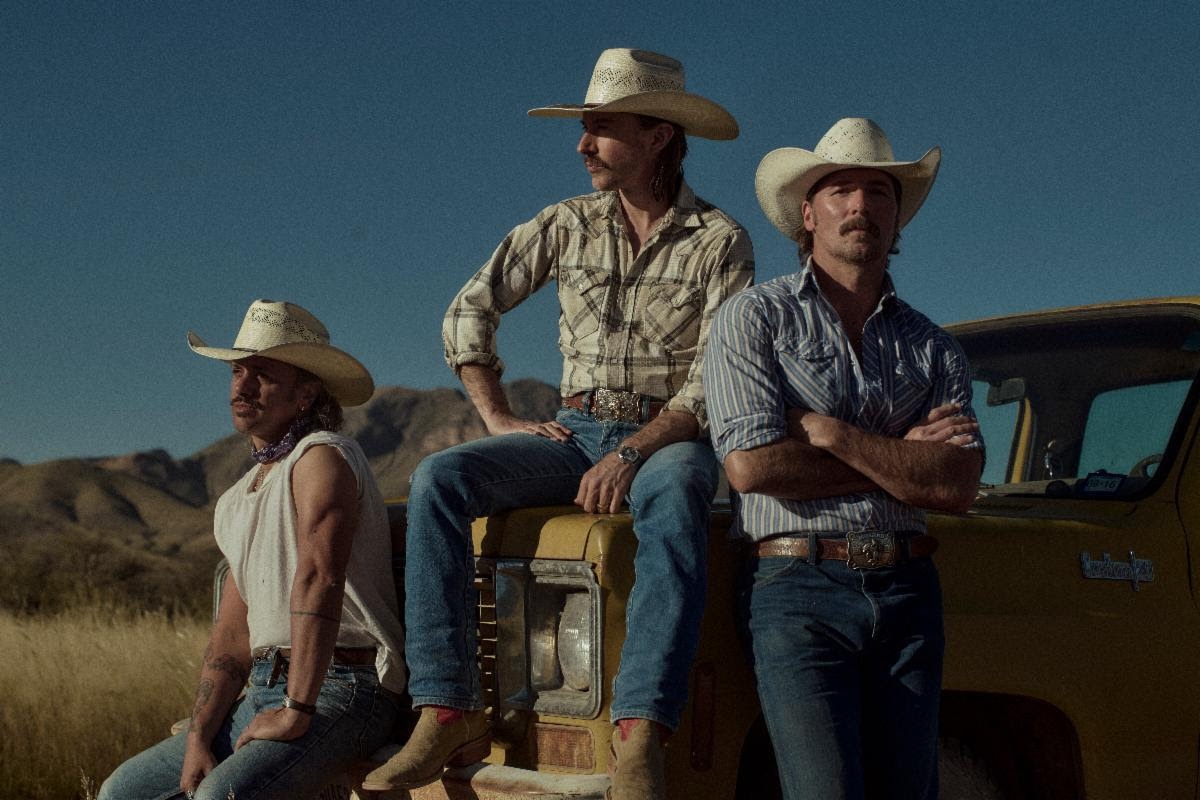
Back in June, the Texas country trio Midland played a show at the Grammy Museum in Los Angeles, playing songs from their fifth album, Stages, when singer Mark Wystrach forgot the words to “Drinking Dark Whiskey.” It’s a nightmare scenario for any artist, especially at such a vaunted venue, and the best bands either fess up to the flub and start over (think Patti Smith at the Nobel ceremony) or find a way to make the screw-up look intentional.
Midland opted for the latter: “We vamped for 16 bars or so,” Wystrach recalls, more amused than embarrassed. “Everybody was looking at me and then we were all looking at the guitar player, who did a solo. They were all total pros about it. They covered for me, and I don’t think anybody noticed. Nobody in the crowd was clutching their pearls.”
It wasn’t nerves, he insists, but Sudafed. “That stuff turns your brain off! Usually we just stick to tequila, beer, and the green leaf.”
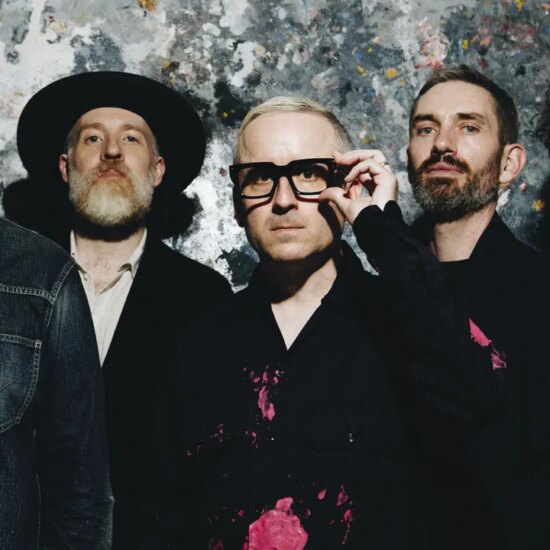
Midland—which also includes guitarist/vocalist Jess Carson and bassist/vocalist Cameron Duddy, along with a troupe of touring players—embrace the goofs. They savor the possibilities of a mistake, readily confessing they’ve had more than their share over the last 12 years. “Sometimes it ends up being a big moment,” says Wystrach. “Hey, maybe we should do that on purpose. It gives the song a little character. That’s what we love about the live show. It keeps us in the moment.”
Ever since they formed the band at Duddy’s wedding a dozen years ago, the three Midlanders have written a handful of country hits—including the instant classic “Drinkin’ Problem.” They’ve recorded five studio albums, one live album, and one documentary soundtrack. They’ve made movies as both actors and directors. But as they add it up, they’ve spent more time onstage than they’ve spent just about anywhere else, save maybe the tour bus and the green room.
Stages is not, as its title might imply a live album, but it is about live shows: a survey of all the stages they’ve played over the years, a retrospective of the different stages of their lives and career, from the throwback twang of their early material to the dusty storytelling of 2024’s underrated Barely Blue. Full of big moments, rousing choruses, barstool sing-alongs, and even a few weepers, Stages is an album calibrated to the live experience. “We’ve grown up onstage,” says Duddy, “so we set out to make the album through the filter of our shared experiences as performers.” It’s a full-circle moment for the band, a return to the sounds and ideas and stages that first inspired them.
Because so many of those stages were located in Texas, Stages is also a lively ode to the Lone Star State and its culture of live music. They bonded over a shared fondness for all kinds of country music and discovered that the friction between their individual obsessions generated a very intense chemistry.
“Midland is the triangulation of the three of us and all our tastes,” says Carson. “In my mind the California influences comes from Cameron, who’s a massive Eagles fan and knows all that Laurel Canyon stuff. Mark is down-the-middle classic country stuff, like Haggard. I like a lot of left-of-the-dial stuff like Gary Stewart and Townes Van Zandt.” In that bluebonnets-and-Shiner-Bock context that album title could be a shout-out to Willie Nelson and his 1974 album Phases and Stages.
Borrowing their band name from Dwight Yoakam’s song “Fair to Midland,” they came up playing honky-tonks first in Austin and then all over the Lone Star State, which suffers no fools when it comes to live music. They had to have good songs, of course, but they had to play them with energy, charisma, and something else that’s impossible to put into words. It was a rigorous apprenticeship, but it served Midland well as they graduated to bigger and bigger stages. “We still play the lion’s share of our shows in Texas,” says Carson. “Our biggest audiences are still for our hometown shows, but that’s where that Texas sound comes from—from living it and being surrounded by it so early in our career.”
After touring with Dwight and then Willie, the band headed south to El Paso to record their debut at Sonic Ranch (Bon Iver, Beach House, Fiona Apple). The sessions, Wystrach recalls, were fast and “fueled by tequila and madness.” Released in 2017, at the height of the Nashville insurgency—when Sturgill and Margo and Kacey and Isbell and other local misfits were pushing country in new directions—Midland’s debut, On the Rocks, sounded both old and new, rooted in traditional country but aimed at the radio mainstream.
Early on, Midland did such a precise job reviving country tropes that their songs almost sounded like parodies. Just look at the cover of their second album, 2019’s Let It Roll, or listen to their biggest hit, “Drinkin’ Problem.” “People say I’ve got a drinkin’ problem,” Wystrach sings on the chorus, “but I’ve got no problem drinkin’ at all.” Somehow those words in that order had never been used in a country song before, which seems miraculous. It’s a perfect throwback to countless drinking songs, like Willie’s “Bubbles in My Beer” and Merle’s “I Think I’ll Just Stay Here and Drink.” It’s so perfect, in fact, that it almost feels like a bit, but there’s a sly kind of humor to their wordplay, especially their penchant for dual meanings and ambiguity. Is it a celebration of sad-ass alcoholism, or a commiseration, or are they just lifting a glass in honor of all those other songs?

“Some people think it’s a depressing song, and some people think it’s an irreverent party anthem,” says Wystrach. “It’s a Rorschach test. If you’re in Texas, you can’t go to the river without hearing ‘Drinkin’ Problem.’ But the other night we were doing a meet-and-greet and a guy came up and said, ‘That was my experience with drinking. I knew I had to pull back when I couldn’t catch a buzz.’”
After recording subsequent albums in California and Nashville—both places with country history as deep as Texas—Midland conceived Stages as a trip back home. They returned to Sonic Ranch, older and, they hoped, a little wiser, certainly more road-tested and ready to record songs that would sound right at home in those old honky-tonks. “Stages is the album we set out to make 12 years ago,” says Wystrach. “It’s an homage to the Texas music scene, and to the landscape, to the sounds, the vibes, and the hundreds, maybe even thousands of shows we’ve played there.”
There was a good bit of tequila but a lot less madness to these sessions, which were overseen by songwriter and producer Trent Willmon. An Amarillo native now based in Nashville, he’s been instrumental in popularizing the Lone Star sound with albums by Cody Johnson and Drake Milligan. He helped the band tighten these songs and root them deep in the Texas sound. Another vital component of that sound was the fiddle, played by the bluegrass legend Stuart Duncan and five-time CMA Musician of the Year Jenee Fleenor. That instrument, so prominent on Midland’s debut but less so on subsequent albums, is synonymous with Texas country, dating back to Bob Wills and the heyday of Western swing. “If you have the fiddle in there, it gives you a very Texas feeling,” says Carson. “There’s definitely a red-dirt thing going on.”
Wystrach elaborates. “It’s an instrument that really inspires. It can do a lot of shapeshifting. It can sound like a honky-tonk. It can lay you flat or lift you up. It adds so many amazing layers to the music.” Fleenor adds graceful flourishes to closer “Vaquero,” ghosting Wystrach’s vocals like a sympathetic hand on a shoulder. She plays like she’s buying the next round.

“Vaquero” is another Rorschach song. Is it a bleak reminder that a way of life is coming to an end? “Where oh where will you go, vaquero, when the Cuervo runs dry?” Or is it more hopeful, a promise that there is real meaning to be found out there on the road? The fiddle doesn’t settle the matter, but it does keep that ambiguity intact. That makes it one of their most poignant songs as well as a perfect closer.
“That song reminds me of Marty Robbins,” says Wystrach. “It reminds me of the old cowboys I grew up with. It makes me emotional and a little melancholy, and I enjoy accessing those emotions onstage. I wouldn’t want to do that for 90 minutes. But I love the different colors and emotions that go into a good setlist.”
That closer, much like the album opener “Marlboro Man,” represents another country trope: the touring musician as cowboy. Artists have been making that connection for nearly as long as country’s been called country, whether it’s Willie or Garth or even a rock band like Bon Jovi. Midland put their stamp on the idea by maintaining those mixed emotions of melancholy and excitement; the romance but also the rootlessness of a life spent on the road. “Those songs convey what it’s like and the sacrifices you make to be in a traveling band,” says Carson. “They’re about the strain it puts on all your relationships.
“We all gravitated toward ‘Vaquero,’” says Wystrach. “It’s a song that just made sense to us and felt like it would fit well in the Book of Midland. To me it’s about the inevitability of time. It’s coming for us all. You can’t fight it or escape it. So it’s a reminder to live in the moment. As sad as it may sound, especially on this album—which feels like a restart for us—I find that uplifting.”