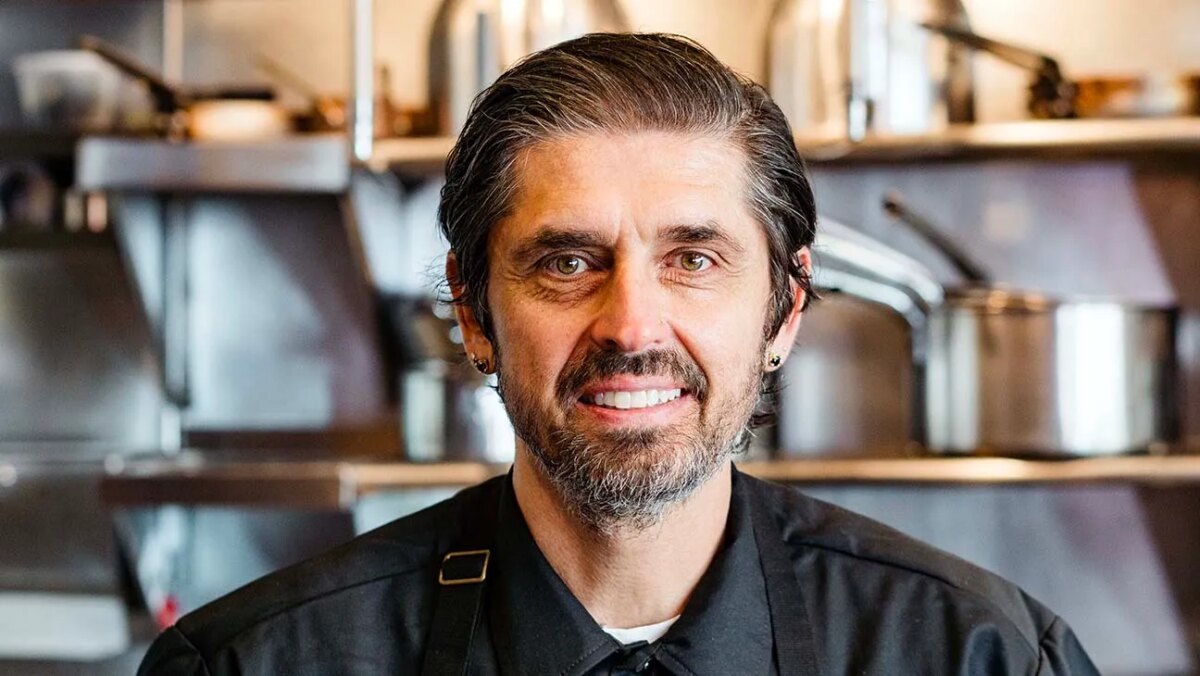
Ludo Lefebvre’s French accent hasn’t thinned much since the Burgundian’s arrival in Los Angeles three decades ago. Within a year of joining L’Orangerie, then the city’s finest temple of haute cuisine, in the mid-’90s, he had become its head chef at 25 years old, serving the likes of Kirk Douglas, Frank Sinatra and Michael Jackson. Soon his talent, charm and looks catapulted him to industry awards as well as TV, including several seasons of ABC’s The Taste alongside Anthony Bourdain and Nigella Lawson, plus cookbooks like Crave, featuring a mix of recipes and chiseled pecs.
“L’Orangerie, I’ll never forget,” says Lisa Kudrow. “My husband’s French, and his parents were visiting when we went. He was so young and good-looking — I gasped. And, of course, the food was absolutely thrilling — just unbelievably good.”
After L’Orangerie, Lefebvre became L.A.’s pioneering practitioner of molecular gastronomy at Bastide. “Ludo was way, way, way ahead of his time, doing things like a deconstructed Bloody Mary, or foie gras lollipops, or mustard ice cream,” explains its owner, film and TV commercial director Joe Pytka. Later, Lefebvre legitimized pop-up dining with his roving, nationally acclaimed LudoBites dinners. “He brought this creative energy and nomadic spirit and classical training to places that had never seen it before,” says chef and restaurateur Jon Shook, who later partnered with him on the bistro Petit Trois (there are now locations in Hollywood and the Valley) and the since-shuttered avant-garde endeavor Trois Mec.
French food is no longer peerless in L.A.’s now-pluralistic fine dining scene, in which the most buzzed-about restaurants are riffing on Swedish, Korean and Mexican traditions. Compatriots such as Michel Richard and Alain Giraud once had the city saying oui, along with the town’s superstar French-trained chefs like Thomas Keller and Wolfgang Puck.
“I’m the last Jedi,” jokes the famously intense Lefebvre, who apprenticed under French masters including Alain Passard, Guy Martin and Pierre Gagnaire. Notes chef and restaurateur Nancy Silverton: “There are just so few people, particularly in Los Angeles, who have his knowledge. He really is the last of it — and yet he’s still doing it.”
Lefebvre, now graying and mellowed, is on the verge of opening several fresh French concepts, including Hancock Park’s Le Petit Den, a glammed-up Chinese place inspired by Paris’ Yam’tcha and Le Cheval d’Or, where he’ll be serving such dishes as fried rice with bone marrow, orange chicken sweetbread and fried wonton boudin noir. (Lefebvre’s restaurant group also includes outposts in Denver, Dallas and Baja California — plus stalls in L.A.’s Crypto.com Arena.)
The upcoming slate also includes a casual deli called Cornichon in Sherman Oaks as well as an opulent Provençal-style restaurant in Brentwood, to be called Ludo, featuring tableside preparations and multiple courtyards. “I’ve wanted to do a restaurant like Maxim’s for a long time, where people want to dress up nice,” he says of the venerable Parisian high-society haunt.
By Lefebvre’s reckoning, the new restaurants are less about peacocking than in the past. “I used to be about my ego — I was competitive with myself,” he explains. “I’m 55 now. I just want to cook what people like.” His wife and business partner, Krissy, adds: “He’s not as interested in shocking the palate and pushing limits as before. But you still don’t go out to eat Ludo’s food thinking you can eat the same thing at home.”
His rendition of the classic noodle dish Ma Jiang Mian at his new French-Chinese restaurant in Hancock Park.
Jesse Hsu
Lefebvre’s shift follows a stint in rehab several years ago, in the wake of the pandemic’s severe stresses on the restaurant business. He says he’d become dependent on prescription pills and alcohol. For a time, he’d lost his lifelong devouring passion. “I was not seeing enough happiness in my cooking,” he explains. Eventually, an encounter with a tomato on a trip to the farmers market brought him back: “I got excited again, thinking, ‘What can I do with it?’ I thought about the techniques I could use, the seasoning.” He adds, “I realized that I just wanted to give pleasure to people with my food again.”
His time in recovery has had him reflecting on his culinary education. “I was raised in these three-Michelin-star restaurants,” he says. “There was abuse: punching, screaming. I have PTSD about that. It did make me a tough chef and very demanding. I’m a perfectionist.” Lefebvre acknowledges, “I would scream too — I lost it sometimes,” adding, “I don’t lose it anymore.”
While Lefebvre traffics in Francophilic pleasures, he has spent more than half his life in L.A. and now considers himself far more American than French, just another successful Angeleno chauffeuring his children far and wide to their weekend sporting tournaments. He has no interest in repatriating in his retirement. “My dream is to buy a house in Montana,” he says. “You’ll find me in a pickup truck out there. I’ve always loved that cowboy life.”
This story appeared in the Nov. 12 issue of The Hollywood Reporter magazine. Click here to subscribe.