

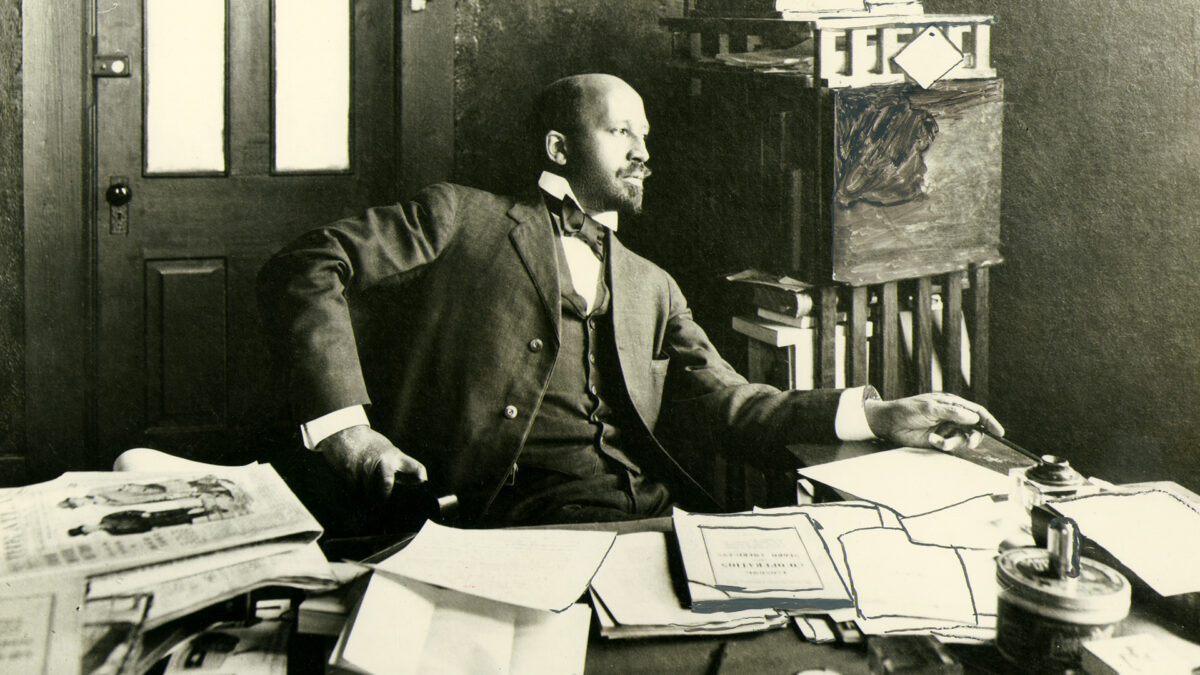
W.E.B. Du Bois (1868–1963) was one of the most influential intellectuals in the fight for civil rights.
Born just a few years after the Emancipation Proclamation and dying on the eve of the March on Washington, he left behind a rich body of work that merged artistry with a clear political purpose. “I do not care a damn for any art that is not used for propaganda,” he famously declared. Here are eight key works that exemplify how Du Bois turned art into activism.
1. The Paris Exposition (1900)
In the 1890s, while studying in Berlin, a young Du Bois began to establish himself as a sociologist. Those two years abroad were formative, exposing him to life beyond the United States and a different vision of how Black people could be perceived and treated. Less than a decade later, he crossed the Atlantic again for the Paris Exposition.
For the event, Du Bois curated “The Exhibit of American Negroes,” a groundbreaking display of Black American life and achievement. Over a period of six months, more than 50 million people passed through the Exposition, where he showcased albums, photographs, and remarkable visual work.
He turned data visualization into an art form, creating colorful hand-drawn charts, graphs, and maps that illustrated Black progress since emancipation in education, land ownership, and business. At a time when white supremacist narratives sought to depict Black Americans as inferior, Du Bois used art and data to challenge those myths before an international audience. The exhibit earned widespread praise in the American press and won a grand prize, while Du Bois himself received a gold medal.
2. The Souls of Black Folk (1903)
This landmark work by Du Bois was far more than another book in his growing body of scholarship. It blended essays, history, personal reflection, Negro spirituals, and fiction, merging art and intellect in a way that had not been done before. Early in the book, Du Bois introduces some of his most influential ideas, including double consciousness, twoness, and the veil. These were concepts that would shape Black thought for generations.
Each chapter opens with quotations from Negro spirituals, emphasizing Du Bois’s belief in music and oral tradition as forms of history and cultural memory. As poet and scholar Elizabeth Alexander explains, “He is saying Black people not only have a literary heritage, we also have a sung and spoken heritage, an oral tradition.”
Du Bois also used fiction as a form of protest within the book. Its thirteenth chapter, “The Coming of John,” tells the tragic story of a Black man whose education and ambition are crushed by the realities of white supremacy in the Jim Crow South, showing that education alone could not overcome structural racism.
3. The Crisis (1910–Present)
One year after helping found the NAACP, Du Bois became the founding editor of its official magazine, The Crisis. The title was intentional. As he wrote, “the problem of the twentieth century is the problem of the color line,” and the crisis of the color line was the crisis of America. The magazine reached a broad audience, blending photography, visual art, poetry, and literature to celebrate Black achievement across economic, political, and cultural life. It also served as a platform to confront injustice. Sociology professor Aldon Morris observes, “In many Black homes, there were two publications that stood above all others. One was the Bible and the other was The Crisis magazine.”
As editor, curator, and writer, Du Bois used The Crisis as both a cultural showcase and a political sounding board during some of the most turbulent moments in American history, from World War I to racial riots and lynchings after the war. He also helped lay the groundwork for the Harlem Renaissance by publishing emerging writers such as Langston Hughes, Countee Cullen, and Zora Neale Hurston.
The Crisis remains a powerful political and cultural tool and the oldest continuously published Black-oriented magazine in existence.
4. The Star of Ethiopia (1911)
When the state of New York sought to commemorate the 50th anniversary of the Emancipation Proclamation, Du Bois envisioned and constructed a massive historical pageant called The Star of Ethiopia. The production traced the history of African peoples from pre-colonial civilizations through emancipation, serving as a direct corrective to racist depictions of Black history and culture. With more than 1,000 performers, it ran for several hours and required an enormous team to bring it to life.
Staged in baseball fields and large venues in cities such as New York, Philadelphia, Washington, D.C., and Los Angeles, the pageant drew tens of thousands of spectators. For Black audiences, it offered a new way to see their history through a more positive and imaginative lens. For white audiences, it provided a broader and more accurate understanding of African and African American history.
5. The Brownies’ Book (1920–1921)
In 1920, Du Bois founded another magazine and served as its editor-in-chief, this time creating one specifically for children. The Brownies’ Book was the first magazine aimed at Black children. Through vivid imagery, essays, poetry, and stories, it captured young imaginations while teaching them about their history, African roots, and cultural traditions.
Artist Charly Palmer explains, “He wanted these beautiful children to know how great they are, to know how brilliant they are.” Du Bois sought to instill confidence, pride, and joy in Black children. The magazine was also deeply personal, allowing children to write directly to him for advice on a wide range of topics. He often responded and even offered guidance to parents on child-rearing.
Though short-lived, The Brownies’ Book created a space where Black children could see themselves reflected with pride, shaping how identity and possibility were imagined at an early age.
6. “The Comet” (1920)
In the aftermath of World War I, Black Americans returned home from fighting alongside white soldiers only to face continued violence and inequality. In 1919 alone, at least 77 Black Americans were lynched, including 11 veterans, a blatant reminder they were still not safe in their own country.
In response, Du Bois wrote Darkwater, one of his most radical works, a collection of essays on race and power. In “The Souls of White Folk,” he argued that white rule, built on violence and brute force, could not endure forever. Its most surprising chapter is “The Comet,” a work of science fiction. Long before the term Afrofuturism existed, Du Bois used speculative fiction to imagine a world transformed by catastrophe and to ask how race might function if society suddenly collapsed.
The story follows Jim, a Black man who survives a comet strike and believes he and a white woman may be the last people alive. In this new world, she sees him simply as a human being rather than through the lens of race. Through their bond, Du Bois explored race, equality, and possibility in ways only fiction could. As Professor Autumn Womack notes, “It is a world where Black people can be something that they are not in this world as we know it.”
Subscribe to our Newsletter
7. Dark Princess (1928)
Du Bois extended his influence into the Harlem Renaissance through his novel Dark Princess, which centers on an Indian princess who falls in love with a Black physician, making it one of his boldest and most unexpected works.
For a man so closely associated with sociology and scholarship, turning to fiction was a daring move, especially with a novel that was interracial, romantic, and at times erotic. In Dark Princess, Du Bois explored defining themes of his work, including double consciousness, racial solidarity, and global anti-colonial resistance.
The novel allowed him to reach readers beyond academic circles and extend his ideas through storytelling. Though it surprised critics and audiences, it remained one of his favorite works.
8. Black Reconstruction in America (1935)
Du Bois understood that racist historical narratives had long shaped how Americans understood the past. He wrote Black Reconstruction in America to challenge those narratives and counter racist portrayals such as The Birth of a Nation. At the time, the dominant Dunning School interpretation framed Reconstruction as a failure caused largely by Black political participation. Even Woodrow Wilson, in his earlier historical writings, reinforced white supremacist views and minimized the contributions of Black Americans.
In this groundbreaking work, Du Bois reexamined Reconstruction by centering Black agency and arguing that formerly enslaved people were active participants in democracy, labor movements, and the rebuilding of the South. He famously called the end of Reconstruction a “counter-revolution of property.”
With Black Reconstruction in America, he challenged the historical record and reclaimed the story of Black Americans in the nation’s past.
From his early days as a sociologist to his later work in pageantry, fiction, and history, W.E.B. Du Bois expanded what activism could be, using every medium available to challenge injustice and reshape how Black life was understood. His legacy endures as a reminder that art is never neutral, and that storytelling, scholarship, and creativity can challenge power and help drive lasting social change.
The views and opinions expressed in this article are those of the writer.