When American Football reunited in 2014, they had to strike through certain milestones. First: a fan service comeback album that met the moment, inched the band’s sound forward, but largely stuck to the coveted LP1 format that was resonating more than ever. That’s LP2. The band ventured inside the Urbana, Illinois, student house/place of worship for the cover shot, but tellingly didn’t have the mettle to leave the premises.
Despite the fanbase’s approval, the band perhaps started to catch heat over playing it safe, so they moved to assert their credibility and converse with the mainstream emo/post-Hot Topic crowd as well as in-vogue emotion-forward music more generally. Bringing on Hayley Williams, Land of Talk’s Elizabeth Powell, and Slowdive’s Rachel Goswell to guest on LP3 did the trick there, as did covering Mazzy Star soon after. Instead of “Steve Reich but on guitars”—LP1’s well-documented M.O.—LP3 brought things full circle to, at times, pretty much just Steve Reich, exploding their historically limited guitar-guitar-drums palette with glassy vibraphones and magnificent choral vocal layers.
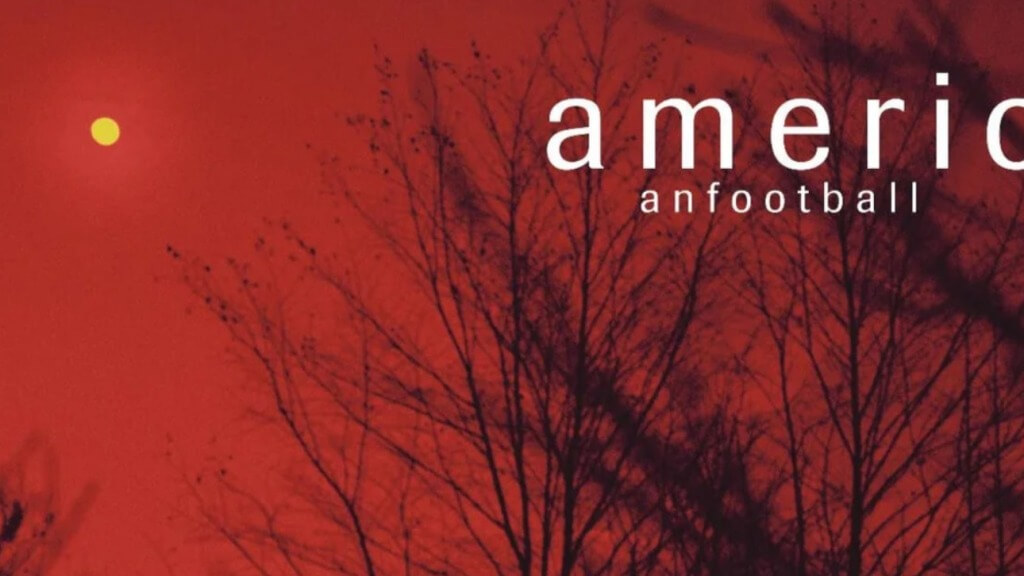
Then, in 2020, American Football had to split up again and eventually return with a fresh resolve and love. That would’ve been the by-the-numbers biopic angle, but the band had its biopic moment already—when a throwaway teenage project helped invent a genre movement, created cult heroes, and pulled 2/3 of the band members out of day jobs (Kinsella has been making music as Owen ever since American Football split up). And it’s not just that: any fan knows by now that things are never neat and rosy for American Football. The apocalyptic, blood-red sky on the cover of the new album confirms this, too.
“The story of my life is in disarray / It’s written in ink that never dries / What a mess I’ve made,” Kinsella sings on “Blood On My Blood.” The song features Caithlin De Marrais of the brilliant, underrated emo band Rainer Maria, for which Kinsella used to sling merch on the road—one of many ways in which American Football brings with it a history that has been recontextualized and renewed. Marrais doesn’t wail her guts out as she did on Look Now Look Again, but solicitously, ethereally fills in the gaps. That lyric above is one of countless times on the record where Kinsella jabs himself in the ribs or the eye or anywhere he can with his words. But perhaps there are benefits of wet ink: the story, though smudged, can continue advancing across the page. It isn’t formalized in stone, in the past, or in a confusing, nihilistic bardo. It’s like that quote from Grayson Haver Currin’s recent dishy, novella-length GQ profile: “In disappearing, American Football had existed as a perfect, phantom idea; in reappearing, they had to reckon with their own accumulating flaws, to figure them out in order to go forward.”
Seven years after the last record, this is the space LP4 both writhes and grooves in. American Football can’t help but turn their disgust at their own flaws into some of the most impressive, progressive, winding, melody-rich songs of their career. Half-familiar flavors of the Cure, Steve Reich, Mazzy Star, West African rhythms/percussion, and funereal fanfares filter through arena-rock textures, baroque-pop grandeur, and twee-pop playfulness. It’s a difficult record, to be sure; made in the midst of two members’ divorces, familial pressures, alcoholism for some, sobriety for others, and alarmingly bleak discussions of lost hope and rock bottom. At the same time, LP4 adds water back onto the canvas to reshape the colors—sonically and thematically. Long gone are the days of a band having to build on the legacy of LP1 or else pivot to outrun it. Here, they use the framework at their disposal to outgrow everything. This is the record that makes the most sense for American Football. The record they had to make to survive.