
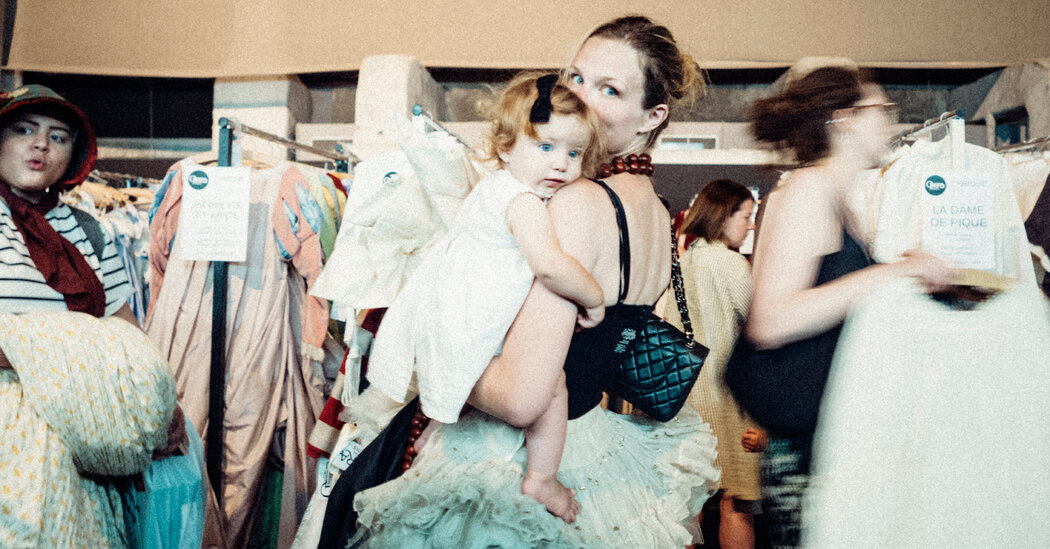
Rows of costumes stood arrayed in neat, silent lines on the ground floor at the Opera Bastille, like rows of dancers in a corps de ballet waiting for the curtain to rise. Voluminous ball gowns stood next to military uniforms and jewel-encrusted robes. Diaphanous tunics shimmered near braided folk tale dresses. A row of potbellied fat suits stood sentry at the entrance, flanked by breastplates and helmets.
On the other side of the opera house’s glass facade stood another line — this one of people patiently waiting for the doors to open, fanning themselves in the 93-degree heat.
It was Friday afternoon, an hour before the start of a three-day public sale of costumes at the Paris Opera. On offer: about 5,000 costumes and 2,000 accessories from opera and ballet productions from the 1960s to the present, priced from 2 euros ($2.30) for accessories like belts and scarves to 800 euros ($935) for elaborate outfits.
At 5 p.m., the curtain rose. (That is, the security guards opened the doors.)
The ticket holders, who had booked the coveted two-hour opening slot for 10 euros ($11.70) on the Paris Opera website, streamed in and began to peruse the rows of garments, each neatly labeled with the name of an opera or ballet, its director or choreographer, costume designer, year of production and — sometimes, fascinatingly — the name of the person who had first worn it.
Sophie Boissel, 43, who was sorting through a row of voluminous dresses, said, “I find it moving to see these costumes that remind me of shows I’ve seen — I definitely want to buy something.” Would she wear one of these elaborate brocade dresses? “Maybe just to put on in my living room, twirl around and sing an aria,” she said.
In a nearby aisle, Franklin Habit, 50, an American living in Paris, was trying on a waistcoat. He belongs to “Carnet de Bals,” he said, a historical re-creation society that stages grand costume balls, with 18th- and 19th-century dances. “There is so much here that will work for us,” he said.
Since 1999, the Paris Opera has held occasional public costume sales to create more storage space, Christine Neumeister, the Opera’s director of costumes, said in an interview. While there is some room for storage at the Palais Garnier and the Bastille opera houses, she said, most of the costumes from past productions were kept in much bigger spaces at the Ateliers Berthier in the 17th arrondissement, and in a warehouse outside Paris.
When productions are retired, some costumes can be reused or repurposed, and others go to the national costume and stage museum, Neumeister said. “But that still leaves a lot of costumes.”
Organizing a sale needs at least three months preparation, said Coralie Cadène, the head of heritage at the Opera: “We have to decide which costumes will go on sale — that’s the hardest part, because you often feel emotionally attached to a production or a costume. We would like to keep everything!”
Once those decisions are made, the costumes are inventoried and categorized, Cadène said, adding that faded or absent labels can make it hard to identify some costumes. (Since 2020, every costume has had a bar code.)
“A costume has a particular value; it’s tactile, material, with a history and symbolism,” she said. “I find it touching that people can have a piece of the opera.”
Her words were echoed by many. “I am an opera devotee, and I love the knowledge and craft behind the costumes,” said Elise de Vidas, 38, who was examining a shimmering gold dress, with a breastplate encrusted with large blue stones, from Saint-Saëns’s “Samson and Delilah,” a production she had seen. “I wanted to buy something that has some meaning for me,” she said, “and I am going to a wedding. I think it will be special to wear this.”
Nearby, Étienne Baillet, 47, was holding an armful of costumes while his son Luc, 12, tried on a military-type jacket from Poulenc’s “Dialogues des Carmélites.”
Luc said he hadn’t seen much opera yet. “I love theater, and I act in French and English,” he said. His father smiled. “Perhaps we will do some shows at home,” he said.
Everywhere, people were milling about in ornate hats and turbans, trying on brocade jackets and cloaks, slipping a ball gown over street clothes. Avalon Alexander, 32, posed in front of a mirror with her baby on one hip, contemplating a tutu she had put over her skirt. She had flown to Paris from Malta that morning, she said, after finding a ticket for the opening slot on a resale site the previous day.
“I am absolutely passionate about ballet and I have found a costume from ‘Onegin,’” she said, cutting the conversation short to move on as the time ticked down.
The rails began to thin out and the opera staff started to gently urge people to move to the tills. Laurence Marsal, 62, pointed at a beautifully embroidered peasant blouse she was carrying. “It really is couture,” she said. “Would I wear this? Of course!”