
There’s a particular kind of performance that doesn’t get enough attention. It’s the supporting role that doesn’t try to steal the movie and somehow does it anyway.
Joan Cusack has made a career out of exactly that. Over decades of work alongside some of Hollywood’s biggest stars (Julia Roberts, Melanie Griffith, her brother John Cusack), she has delivered performances so specific, so alive, that audiences walk out remembering her. Sometimes even more than the lead characters.
She’s been nominated for two Academy Awards for Best Supporting Actress (for Working Girl in 1988 and In & Out in 1997), and if you’ve seen those performances, neither feels like a surprise.
But even in films where she wasn’t on the ballot, she was often the most memorable thing on screen. Here are five films where that was especially true.
Working Girl
– YouTube www.youtube.com
Mike Nichols’ Working Girl is a seriously great film, one of my favorites, and an easy rewatch. Harrison Ford, Sigourney Weaver, and Melanie Griffith all do some of their best work, and Cusack nearly walks away with it, playing Cyn, Tess’ best friend and the biggest Staten Island personality you’ve ever seen.
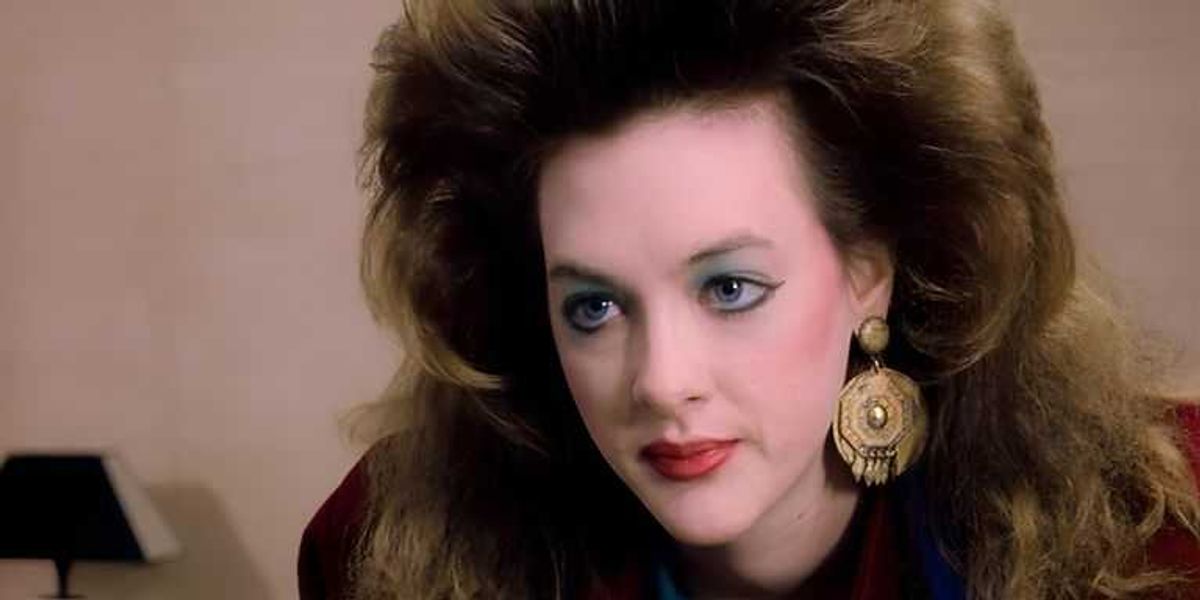
Cyn is big-haired and big-hearted, and deeply practical about the ways the world works for women like her. She dances in her underwear. She dispenses Valium at engagement parties. She has the movie’s funniest line, delivered with magnificent exasperation. “Whaddya need speech class for? You talk fine!”
The look was intentional and famously over-the-top.
Costume designer Ann Roth, a Nichols collaborator across multiple films, described the Staten Island secretaries in Dressed: A Century of Hollywood Costume Design (via Atlas Obscura), “It was the 1980s [with] a Staten Island flavor. They usually don’t come to Manhattan, but those girls who come and work as secretaries, getting off the boat, their shoes would be in their purses … and they were sexy. That’s the point. They were very sexy.”
Cyn has huge earrings, gaudy makeup, and shoulderpads galore. But what keeps her from being just comic relief is a moral clarity that complicates Tess’ story.
Addams Family Values
– YouTube www.youtube.com
What an icon. Cusack delivers some of the most quotable, memeable moments in this movie.
The original Addams Family is a fun enough film. The sequel is one of the sharpest, most anarchic comedies of the ’90s, and a big part of why is Cusack as Debbie Jellinsky, a serial killer posing as the family’s new nanny.
The role was originally offered to Kathleen Turner, according to AFI, who passed.
Screenwriter Paul Rudnick designed Debbie as a satirical stand-in for a specific American respectability politics. He told The Hollywood Reporter that the character was written as a spoof of the “family values” rhetoric of the George H.W. Bush era, all surface warmth masking something awful underneath (via AV Club).
Cusack plays Debbie as a woman straining just barely to keep the sunny veneer intact over her sociopathic goals. Her late-film monologue, delivered while the entire Addams family is strapped into electric chairs, is a performance of pure unhinged commitment that honestly is some of the best villainy around.
High Fidelity
– YouTube www.youtube.com
John Cusack’s High Fidelity is a movie about a man who needs someone to tell him the truth. His real-life sister provides that someone. She plays Liz, a mutual friend of Rob (John Cusack) and his ex, Laura, and serves as the film’s designated truth-teller. It’s a small role in screen time, but the movie wouldn’t work without it.
John Cusack breaks the fourth wall and talks directly to camera throughout.
“The fourth-wall approach was my decision, but it never felt like a big risk—the first draft had it as a voiceover, and it felt just too easy to miss that way. The likes of Groucho Marx often talked to the camera,” director Stephen Frears told The Guardian.
We’d say Joan Cusack’s scenes largely work in counterpoint to that technique. Where John narrates and justifies endlessly to camera, Joan cuts through it in person, no monologuing required. She provides a harsh reality check.
In an NPR Fresh Air interview Cusack gave in 2000, she was asked about supporting her brother and whether she expects to have a role in his films.
“You know, I don’t assume it, but I always hope it, because I love working with him, and I love supporting him, because he’s always done sort of more leading roles than I’ve done, and it’s just a hard — I think it’s a hard job to do that, and it’s nice to have people around you to support you.”
Runaway Bride
– YouTube www.youtube.com
I’ll be honest, Garry Marshall’s Runaway Bride is not a great movie. But it has its moments as a film very much of its period, with some solid performances from its cast.
In a 2001 interview with NPR’s Fresh Air, she acknowledged that the role was a little overfamiliar, so she had to find something in it to grab hold of.
I actually have come to really like the best-friend role. At first, I think I—because I did it in Working Girl, too, and I’ve done it before. And in Runaway Bride I thought it really wasn’t worth it for me to do it again unless I could sort of make it meaningful for myself in some wayand really say, ‘Wait a minute, if I’m going to be the best friend, I want to be what a best friend really is and like really say something to my friend that a best friend would say, or behave in a way that was meaningful in thatway.’ In that way the part became meaningful to me.
Peggy, Cusack’s character, is funny, grounded, and completely unfazed by the chaos around Maggie (Julia Roberts). In a film that sometimes strains for charm, Cusack just has it.
School of Rock
– YouTube www.youtube.com
I love this role. Cusack plays the uptight principal of a prep school, and is desperate to have a little fun.
Richard Linklater’s School of Rock is a Jack Black showcase, but Cusack’s performance as Rosalie Mullins is a standout.
Linklater has said he wasn’t even sure he wanted to make the movie. In Rolling Stone’s oral history of the film, he said that when the script arrived, “I read it and passed. It was cheesy; there was a formulaic quality to it.” Producer Scott Rudin refused to accept the pass, and eventually Linklater found a way in that felt like his own film.
What he ended up with included one of Cusack’s best scenes. Rosalie, several drinks in, explains to Dewey (Black) that she wasn’t always wound this tight. “There was a time where I was fun. I was funny!” she says loudly. It’s both hilarious and heartbreaking.
What Cusack roles did we miss?