

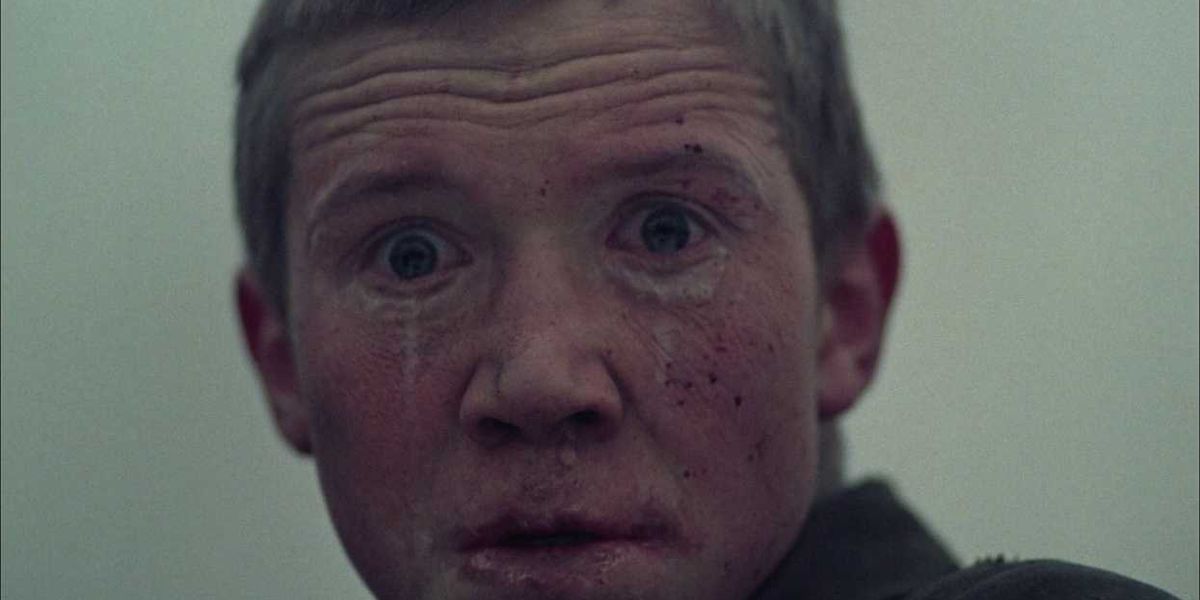
The American perspective on war films is an interesting one, and it’s not one that general audiences tend to shy away from when experiencing war films.
With that said, Elem Klimov’s 1985 Soviet masterpiece, Come and See, offers perhaps the most terrifying glimpse into the horrors of war in cinematic history.
Let’s talk about how and why.
The Perspective of a Child
There are very few war films that attempt to explore the horrors of war, primarily from the eyes of a child, particularly in America. A few years after the release of Come and See, Japanese animation studio Studio Ghibli famously released Grave of the Fireflies, which followed a young brother and sister during the final months of World War II. While a devastating film, it still has the barrier of animation in front of it, which keeps the viewer from reckoning with the realities of war to the fullest potential.
Come and See breaks down every single barrier with regard to what children experience on screen, and what we see them reckoning with in real time. The main character of Flyora in the film is desperate to join the Resistance fighters in Belarus, despite the reproach of his family. He escapes into the forest, bright-eyed and full of whimsy, ready to fight for his country. By the end of the film, he has the wrinkles of an old man, completely greyed hair, and his eyes are almost completely devoid of light. He becomes utterly unrecognizable within the span of a few months.
He meets a young woman, Glasha, on his journey who also experiences unspeakable acts of violence against herself and her people. The toll the war takes is explored, not just from the eyes of a naive young man in the fray, but a helpless young woman who simply lived in the wrong place at the wrong time.
The Harshness of Production
‘Come and See’Credit: The Criterion Collection
While there is undeniable movie magic present in the film that gives it its raw, unflinching nature, the production process of the film was also fraught with danger, and the terror of the cast and crew often made the final cut.
For one thing, the script wasn’t accepted to be produced by the Soviet government for eight years because it was deemed so graphic and disturbing that it crossed the line into propaganda. The original title of the film was also set to be Kill Hitler, a change that was made during production in 1984.
Klimov made the very conscious decision to shoot the film chronologically, which, for a film of this scale, is a Herculean task, not only logistically, but for the cast and crew’s physical and mental health. Some of the aging on Flyora’s character isn’t even makeup, because Aleksi Kravchenko was left so mentally traumatized by the shoot that his hair was said to have naturally gone grey.
The film utilized live rounds of ammunition during shooting, with actors literally fleeing and hiding for their lives in various sequences throughout. Real animal carcasses were also used, making for a particularly disturbing production process.
What Makes a Film “Anti-War”?
This is a conversation that has been had since the dawn of cinema itself. Famously, filmmakers Steven Spielberg and François Truffaut had polar opposite philosophies when it came to this debate. Spielberg claimed every war film was inherently anti-war, and Truffaut argued the exact opposite. That by simply depicting the act itself, you glorify it.
Obviously, like any sort of debate like this, the real answer likely falls somewhere in the middle, and comes down to several key decisions a filmmaker has to make. How much is the score utilized and where? How romantically do you depict the combat? Are there clear “good” guys and “bad” guys? The list goes on.
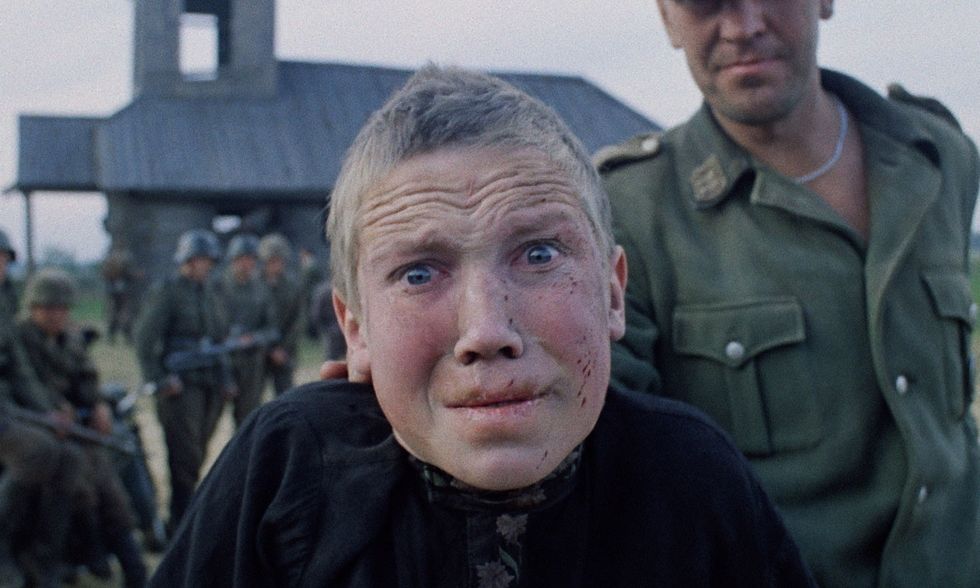 ‘Come and See’ Credit: Janus Films
Come and See, evidently, is a prime example of a film being staunchly anti-war. The title itself functions almost as an act of taunting to a potential viewer. Characters, regardless of party or country affiliation, commit real atrocities in the name of it throughout the film. The score is never romantic or whimsical, and would fit just as well in The Shining as it does here. There isn’t a single character in the film that ends in a better place than they started as a result of the conflict. There are survivors, yes, but they are scarred irrevocably. The conflict also doesn’t really end. The one occurring in the climax technically dissipates, but the final image is soldiers running into the dark abyss, clearly headed for the next bloodbath. Despite the real-life hindsight that the war really did end, the film implies the horrors will never cease.
So, no, the film does not subscribe to the traditional American war movie narrative in the slightest. Where most of the war films coming out of America generally deal with some form of patriotism, hope, and general reverence for the men and women who serve, outside of that bubble, films tend to be far more cynical.