
With Women Of Action, Caroline Siede digs into the history of women-driven action movies to explore what these stories say about gender and how depictions of female action heroes have evolved over time.
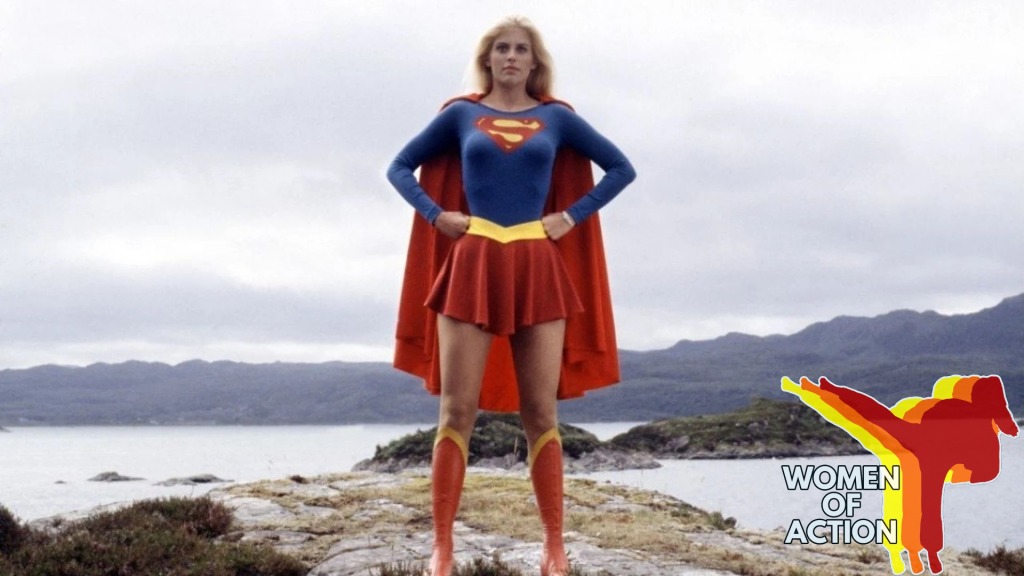
There have been plenty of bad superhero movies, but it’s rare that one is so poorly received that it not only staves off more female-led superhero movies for two decades, it also kills off an iconic comic book character for 20 years. Fairly or not, that’s the legacy of 1984’s Supergirl, the first and for a long time only big-screen female superhero in American cinema—at least until Halle Berry’s Catwoman arrived to extend that drought even further. Superman’s cousin Kara Zor-El had been a mainstay in DC Comics since 1959, but her series abruptly ended two months before her film’s release and then she was killed off in 1985’s Crisis On Infinite Earths crossover event, not to be revived until 2004. No matter how Milly Alcock’s new take on the character does this summer, it can’t be worse than that.
1984’s Supergirl both does and doesn’t deserve its terrible reputation. Released between the third and fourth installments of the Christopher Reeve Superman franchise, it feels like it was made from a script written in a foreign language and translated back and forth into English at least half a dozen times. The saga opens in the weird, cultish world of Argo City, where Peter O’Toole is asked to deliver buckets of dry exposition about transdimensional space and Omegahedrons, ostensibly to explain how the Guggenheim Museum-esque city survived Krypton’s destruction by hiding away in a pocket of “Innerspace,” although you’ve got to be pretty locked-in on comic book lore to understand any of that. From there, the film jumps to Earth where Faye Dunaway is introduced as the glamorous witch Selena, no further explanation given. By the time Kara (Helen Slater) is manifesting clothes and wigs out of nowhere with her Kryptonian powers, it’s clear that you just have to roll with whatever Supergirl is doing.
At its best, there’s some camp fun to be had in the story of Kara making her way to her cousin’s homeworld, disguising herself as an orphan named Linda Lee, and joining an extremely queer-coded all-girls boarding school. There’s even a terrific set piece where Kara soaks up the power of the yellow sun and tries out her new flying abilities in balletic fashion. But trying to actually follow the plot or character arcs of this movie feels a bit like what Kara tells O’Toole’s Zaltar when he asks if she knows six-dimensional geometry: “I know the equations. I just can’t see them in my head.”
The biggest problem with Supergirl is that it transparently doesn’t find a reason to exist other than because someone thought “Superman but for girls” might sell well. Producers Ilya and Alexander Salkind wanted the film to be a fresh start after the poorly received Superman III, but they failed to find a meaningful take on their central heroine. 1978’s Superman wanted to make you believe a man could fly. Supergirl wants to make you believe a girl can go to math class. It seems like director Jeannot Szwarc and screenwriter David Odell made a list of all the stuff they imagine girls like (Witches! Love potions! Softball! Stuffing their bras! Kissing boys!) and put all those ideas into one movie, with little regard for whether or not they made sense together.
Ostensibly, Kara hops in a spaceship to Earth because she accidentally sends the all-powerful Omegahedron flying out the window and needs to get it back before Argo City loses power and everyone there dies. But once she actually lands, the movie becomes a fish-out-of-water comedy in which Kara is a wide-eyed babe in the woods à la Splash, which came out the same year. It’s not totally dissimilar from what Patty Jenkins did with her much more successful take on another iconic DC heroine. Only where Wonder Woman balanced its woman-out-of-time comedy with the stakes of World War I constantly whirring in the background, Supergirl straight-up becomes a 1980s teen comedy for a while.