
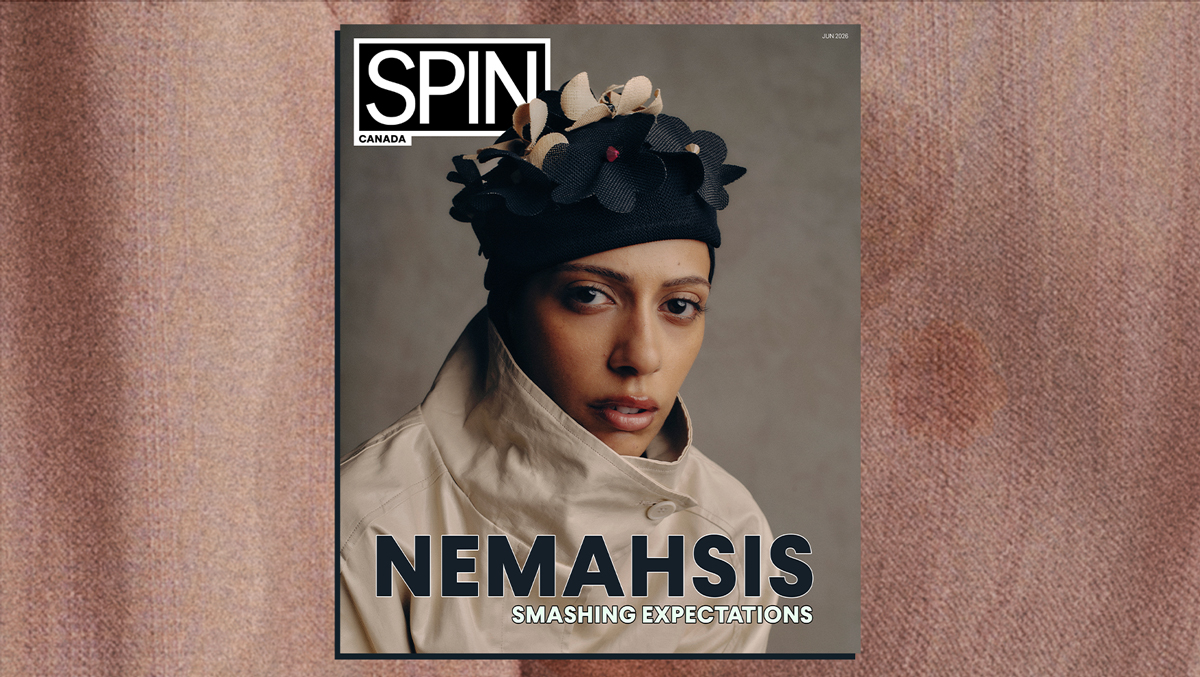
Who: Nemahsis (Nemah Hasan)
Sounds like: Kate Bush, Sarah Harmer, Feist
Essential spins: coloured concrete; what if i took it off for you?; stick of gum; i wanna be your right hand.
Most recent album: Verbathim, (Sept. 2024)
Most recent single: team (Oct., 2025)
Next: Headlines SPIN Canada magazine launch at NXNE, Sun. June 14, SOUNDSTAGE, W Hotel, 90 Bloor St. E., sixth floor; new album in the fall
Growing up as a Muslim girl in mostly white Milton, ON, in the 2000s, mega-talented Palestinian-Canadian singer-songwriter Nemahsis (born Nemah Hasan) was used to being bullied, used to being an outsider, a “weirdo,” so much so that her immigrant parents forbade her to wear a hajib to avoid further bullying — she did so anyway, in secret. What she didn’t expect was that her songs about being the “other” would connect her with a massive population of fellow “weirdos” worldwide.
Perhaps it wasn’t obvious to assume that her deeply personal, beautifully sung songs about isolation and alienation and her experiences as a young Muslim woman would connect with a world of “outsiders,” especially among the LGBTQ+ community, but Nemahsis learned that in telling her story, she gave voice to many other “voiceless” folks who suddenly felt less alone hearing her songs.
Along the way, she gained millions of fans, including Stevie Wonder and Elton John, and she set a JUNO award record receiving three nominations as an emerging artist in 2025, picking up Breakthrough Artist of the Year and Alternative Album of the year for her 2024 debut release, Verbathim. Wonder even attended her first ever show in Los Angeles in 2023 and came backstage to tell her how much her music meant to him, especially her song what if i took it off for you? They’ve stayed in touch ever since.


Photo: Norman Wong
Speaking with SPIN at the new SOUNDSTAGE venue in Toronto’s W Hotel, where she will perform at NXNE as part of the SPIN Canada launch on Sunday, June 14, Nemahsis explains, “My story and my narrative was never shared before, so I thought it was just a ‘me’ experience, a ‘me’ problem. ‘Oh, pity me, love me because I don’t love myself because nobody loves me.’
“But seeing the movement and seeing how many people resonate with my music, even people who don’t wear the hijab — just people with identity issues or ostracization, being the weirdo, the freak or the outcast — seeing those people connect with me, I write entirely differently now. I don’t think I’m able to write ‘you/me’ anymore; now I write very ‘we.’”
And the songs Nemahsis writes are intimate and deeply personal but have somehow proven universal. Her rich gentle voice powers songs reminiscent of Kate Bush, Sarah Harmer and Feist, though a feistier Feist. She doesn’t create loud, revolutionary bangers but conducts her revolution through representation, creating intimate songs exploring issues generally not raised in mainstream music. Songs like what if i took it off for you?, about removing her hijab and so much more, which caught Wonder’s attention and i’m not gonna kill you, about people being intimidated by her look, which Elton John featured on his radio show.
Breaking into an almost ever-present smile, Nemahsis says, “I can’t help but be ‘we.’ There’s an army behind me. There are people that I’m speaking on behalf of, whether it’s politically, honestly, in every way shape or form. It’s not me alone anymore.

“I’ve always looked at pop songs and wondered how do they generalize it to the world when my experiences are so specific? But I found a way to generalize it because I’m not speaking to one person or two people now; there’s a whole bunch of people. Seeing what if i took it off for you? connect with people with identity issues, like transitioning issues, all of these things. It’s not just about hijab, but at the time I didn’t realize that. I didn’t know how to connect hijab an identity with other experiences that weren’t my own. But through my fans and through my listeners and through the DMs that I get and the messages and the talking to people after shows, seeing them look nothing like me but hearing them say the same things and experiencing the exact same things when they don’t wear hijab was one of the most eye-opening things — where I can write those things and make it a general thing on the radio and anyone will interpret it.”
But Nemahsis didn’t always feel so connected.
“I think every moment of my life has built me up to become who I am today. I was hated for 20 years of my life and then, out of nowhere, a lot of people really like me,” she chuckles.
Nemahsis remains strategic and carefully determines how she presents herself to the world.

“I know how to be on stage. I also know how to work the rooms when I’m not. I do my research before I attend events and I know when to wear hijab, when to wear a turban-style hijab, when to wear a hat that covers most of my hijab. And when to wear a hood. I know how to manoeuvre in rooms as a survival mechanism.”
Today, Nemahsis stylishly wears a dark brown scarf on her head with large earrings and discreet makeup for a natural vibe.
She says she wrote what if i took it off for you? as a girl thinking that “you either wore hijab and didn’t get any opportunities, or you took it off and got the opportunities you deserve.”
“But I found a middle ground: You can make it look like you don’t wear hijab but still be modest and wear a hood with earrings and nobody’s even going to tell — they just think you’re fresh, you’re stylish. And they won’t notice until they look you up the next day, and by then they’ve already realized they liked me.
“My truth is modesty. My truth is covering my hair personally because it’s important to me. But I think that is an effective tool to wear it whatever way I need to, to survive. I think that I personally love wearing it the traditional way, I feel the prettiest, I feel the coolest. I feel the freshest. But it’s not a perfect world and I have to play smart. So, I do what I can. I’m going to do what I need in whatever rooms I need to be in, how I need to be. Whether it’s a hat, whether it’s a hijab, whether it’s a hood. And then later when I’m big enough and I sell out enough rooms, you’ll only see me in a hijab,” she chuckles.
As a little girl in Milton, her parents had already experienced her older sisters getting bullied for wearing hijabs, so they agreed to let them stop wearing them. Then they forbade their young sister from wearing one.
“I was also really bullied, and I had a lot of issues in school. I was very introverted and didn’t really talk to people and stuff. My parents were just like, ‘It’s going to make your life harder, and you already don’t have any friends. Nobody wants to hang out with you.’ I saw it as a form of protest.”
She was nine years old and after leaving home for school without a hijab, she would put one on before getting on the school bus — every day.
“As you can tell, I’ve had this fire in me from the start. I thought, ‘They don’t like me anyway.’ And I put it on a year or two after 9/11. I was just like, ‘They already don’t like us, they don’t like me. Nobody wants to be my friend, so I might as well just make them hate me more.’ I got addicted to making people not like me more. I got addicted to the idea of being invisible and not being liked. Might as well do what I want to do. And I wanted to wear the hijab, and I kind of loved provoking.
“After a while, the school called my mother and they said, ‘We’ve noticed such an improvement in Nemah’s social skills; she’s talking to people, she’s doing group projects, she’s reading out loud.’ I was very mute as a kid; I didn’t talk much. ‘And she’s engaging with people; she’s making people laugh. At first when she showed up a couple weeks ago with the headscarf on, we were worried.’


Photo: Norman Wong
“Then they realized as the days went on that there was a part of my personality that started shining that didn’t exist before that.”
Her mom played along, pretending she knew about the hijab at the time and later having a conversation with her daughter. Nemhasis shared a journal she was keeping about her hijab journey.
“She saw that I had written how I felt like I took away something so that I could put something else forward. I took away my physical appearance so that I can put my personality in front of people and let that speak for me. And in the end, I started making friends after that. I was still bullied for hijab and there was a lot of Islamophobia, but it was always, ‘Oh my God, you’re so funny. You’re so talented, but, you know, my parents… you can’t come to my birthday.’ I didn’t care. I was just happy to realize that I was likable.
“I think I also carried that into becoming an adult, wanting to become an artist. I know I’m talented. I know I have a lot to say, but my hijab will stop me because I never got the invites to the birthday parties to things like that. Or I wasn’t allowed to publicly be people’s friends, but I knew that I was enough to be that friend if I wasn’t wearing hijab. I noticed that people were okay with hijab a bit more by the 2020s.”
I attended the first of Nemahsis’s two incredible shows at the Danforth Music Hall on Feb. 18, 2025. It was a stunning show made all the more incredible considering she has only played live around two dozen times. I note how powerful it was to see so many young women in hijabs having the best time at her show — and how many seemed to be her long-time friends. Turns out they were just fans, but she can’t resist greeting them from the stage like old friends.
“My shows are a lot of people’s first concerts,” she says. “Not necessarily because they love me, but music is such a taboo topic within the Muslim community. When you go to church, there’s singing, there’s choirs. Our mosques are very quiet. You’re not supposed to chat too much. You’re supposed to meditate and pray. Holiness is connected to silence and meditation. Asking your parents to go to a concert is something that you wouldn’t even really try to do. But I think for the first time, they could show a picture to their parents and be like, this is what I’m going to go listen to. And for their parents, I’m like the gateway to music for Muslim women or hijabi women; it’s the first time they get to approach the idea of ripping the band-aid off about music and celebrating that.
“I would say for at least 30, 40 per cent of my show, it’s the first show they’ve ever been to. And then I get DMs being like, ‘OMG, I’ve been to three shows since’; it changed their life. And it’s not necessarily because it was the best show they’ve ever seen, but I was the perfect gateway transition to normalizing music, and I guess concerts, to a Muslim family.
“I didn’t go to my first concert until I was like 19. I’d never seen a show live, nothing. And I didn’t tell my dad. I just said I was at school and I bought the ticket. It feels good to know that people are experiencing music a bit earlier on than I did.”
And that first show was?
“Marina and The Diamonds at Echo Beach. I think 2014 maybe. it was a great show. I’ll never forget it. It was pouring rain. It was so good.”
For all the momentum Nemahsis appears to have, she knows it can stop abruptly, which it did on Oct. 7, 2023, when the war between Hamas and Israel began. She was dropped by her record label that day, all of her support disappeared with only her manager sticking with her and all the anti-Muslim hate she had experienced after 9/11 was back.

“In addition to the catastrophe happening in your homeland, it felt like middle school all over again. It felt like 9/11. It felt like when I first put on the hijab. It felt like everything compiled into one.
“I remember when I found out that my label dropped me, and nobody was working with me anymore, and people weren’t following me. I kept laughing because I’m addicted to being the problem. My manager was asking, ‘Why are you laughing right now? This is a big problem.’ It was serious, and I was laughing and crying, laughing on the phone. And he thought I had a mental breakdown,” says Nemahsis chuckling, as if to prove her point. “To be honest, mentally, I was not doing well. It was probably more the weeks after that. But I was laughing that nothing changed, It’s still 2001. It’s still 2003, whatever. And I was a fool to think that anything really changed. I think going into this new phase of my life and moving forward, I have absolutely no hope for humanity. Anyone can turn on you at any point. And that’s why I know I’m more hated than loved, and I’m totally okay with that,” and she laughs again.
“I’m a villain in a lot of people’s stories, and it’s fine. A hooded villain,” says Nemahsis with a smile that should be able to disarm any hateful vibe.
Yet, minutes later, Nemahsis, who oozes positivity says, “I have a lot more hope now, but I think that hope is dangerous. So, I can’t lean into it too much. Especially because hope is the very thing that I had before Oct. 7, and the rug was ripped from under. I will never have that much comfort again in society. I’d be a fool. I’m really happy every day I scroll and I see someone else speaking on behalf of us so that we don’t have to do everything. And I feel a bit hopeful. But at the same time, for my own sanity and everything, I keep it realistic. That crash really messed me up. I’m not even the same person. My God, I’m never going to be the same person again. Never.
“To see something so obvious — you’re seeing genocide and to be screaming genocide from the rooftops — and not only are you being silenced, but people are like ‘Freak, freak, freak. Not real, not real.’ You’re just being gaslit for two plus years and for the whole narrative to switch two years later and people saying exactly what I was saying and what everyone was saying, like it’s been obvious and everyone’s known about — it is really weird.”
Nemahsis’s songs express personal politics through intimate storytelling, not revolutionary anthems. Revolution through representation: seeing a talented woman in a hijab, hoodies and more rocking any stage is still a big statement in itself.
At her superb Danforth show last year, Nemahsis didn’t make speeches, but at the end of her show, she briefly rushed off stage, returned and wrapped herself in a flag of Palestine, like an athlete who had just won a gold medal.
“That was really fun,” she says, the smile returning, yet again. “That was spontaneous. I didn’t think of that idea until just after everything. I was thinking, ‘I don’t really want to have a speech. I just want to show where I stand and what I do.’ But I also wanted it to not make me feel stressed out, or I didn’t want think about what I have to say and stuff. I was just thinking, ‘How do I incorporate it into the set in a protesting way?’”
Sitting in the crowd that night with a smile as big as Nemahsis’s? Her proud, hijab-wearing mother, Saud Hasan.
“She was so happy,” says Nemahsis beaming recalling this full circle moment.
Despite the nightmares she has faced along the way, Nemahsis remains a dreamer.
I ask her what her perfect show would look like and, eyes growing bigger, she says, “I would have set design, I would have choreography. I love dancing. I’m also being realistic so I could achieve it. Maybe an outfit change or something, that’d be cool. I think that would stimulate me enough to feel like, ‘ooh, fun’ “.
As Nemahsis’s personal stories gain momentum and new listeners hear her songs that can feel like confessions shared from a new friend, we are certain she will get that big stage she is dreaming of.

Photo: Norman Wong