
“In New York noir, the camera tilts; in West Coast noir, the camera pans,” the writer Eddie Muller explained, when asked during a recent video interview to explain the regional subtleties of the genre. “You do not see any shots in an L.A. noir where the camera is tilting up to look at some majestic building,” he said. “It pans to show you how there’s nothing out there. Look at that, we’ve reached the end of America … We’ve achieved nirvana, and then it’s about the rot at the center of it.
“This is going to sound horrible,” he said, but New York noir is “about too many rats in the cage. How do you survive in the urban jungle?”
If anyone would understand these distinctions it’s Muller. He’s the author of multiple books about film noir, the face of the form at Turner Classic Movies (where he’s affectionately called “the czar of noir”) and the programmer and host of “Noir City,” an annual festival in Los Angeles. He’s taken that show on the road, to San Francisco, Chicago, Philadelphia and beyond. But this year, for the first time, “Noir City” will come to New York City, with a 10-day run at the Paris Theater.
The first half of the festival, “Face the Music,” is the program Muller is taking around this year, spotlighting films about music and musicians. But the back half, “Dead End Streets,” was programmed especially for New York audiences and includes several films shot or set in Gotham.
“You know, there’s something that gets me about this town on a hot Saturday night,” marvels Scott Henderson (Alan Curtis) early in “Phantom Lady” (available to rent or buy on major platforms), a jazzy, fleet-footed example of the most reliable of noir tropes: the innocent man, wrongly accused. “Phantom Lady” is noteworthy for the striking compositions of the director Robert Siodmak, who would later direct such noir classics as “Criss Cross” and “Cry of the City” (also screening in the “Dead End Streets” program). He has a gift for unconventional, even dreamlike imagery — an eye shared by the director Boris Ingster, whose thriller “Stranger on the Third Floor” (major platforms) is another highlight of the series.
Its 1940 release date makes it one of the earliest films designated as film noir, and it is rife with genre conventions: urban setting, voice-over narration, copious flashbacks, another wrongfully accused man desperate to prove his innocence. It’s one of the films in which the influence of German Expressionism is most keenly felt, particularly in an extended dream sequence of cockeyed angles and harsh shadows that makes the surrealism of Hitchcock’s “Spellbound” feel like child’s play.
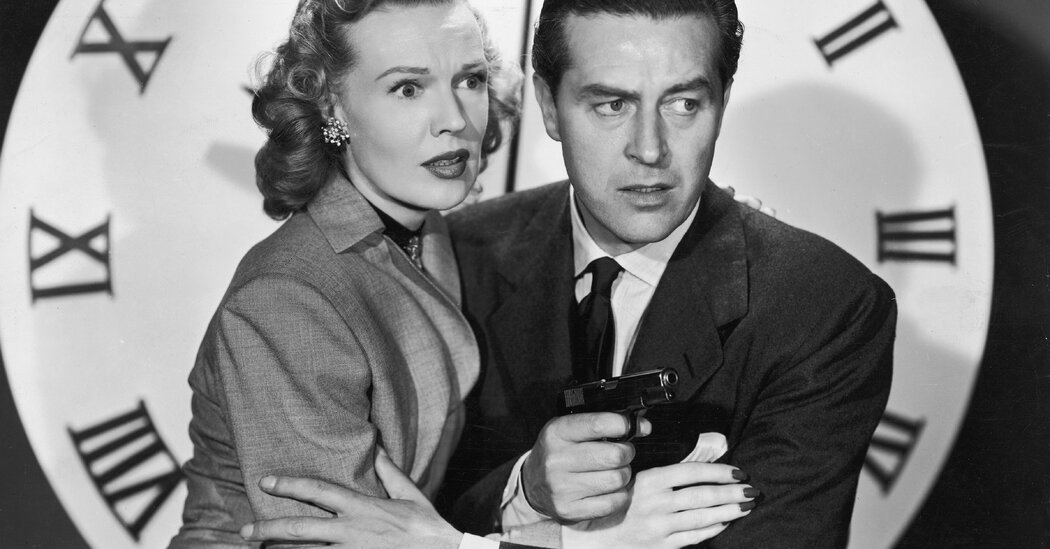
These films, and other noirs like John Farrow’s “The Big Clock” (streaming on the Criterion Channel) and Anatole Litvak’s “Sorry, Wrong Number” (streaming on Kanopy, Hoopla and major platforms), both from 1948, are set in New York City but shot primarily on Hollywood sets, with stock footage or second unit crews providing establishing shots and rear-projection images; the logistics of location shooting in New York were so complicated that studios rarely went to the trouble. But some faked it more convincingly than others; the 1953 film “Pickup on South Street” (streaming on Tubi) was shot almost entirely in Los Angeles, but the director Sam Fuller was a longtime New York newspaperman, and he conveys the sound, feel and even the smell of the city in every frame.
Some independent productions, or those made for smaller studios, were able to shoot in the city proper, and benefited greatly from the verisimilitude allowed by that choice. Alfred Hitchcock created an entire Greenwich Village block on a soundstage for “Rear Window,” but the earlier, similar 1949 movie “The Window” (major platforms) — directed by Ted Tetzlaff and adapted, like Hitchcock’s film, from a Cornell Woolrich short story — uses its real locations to create a semidocumentary feel that maximizes the tension and suspense. At the same time, its tiny, specific urban details (like sleeping on a fire escape in hot weather, as a boy does when he accidentally witnesses a murder) add narrative authenticity.
The Bronx native Stanley Kubrick used his Times Square and old Penn Station locations to add production value to his low-budget 1955 sophomore feature “Killer’s Kiss” (streaming on YouTube TV), even shooting guerrilla-style without permits, creating a chaotic quality that the precise and exacting director would mostly eschew in the ensuing years. Abraham Polonsky, also a native New Yorker, would use less familiar locations both uptown and downtown to give his tense, sharp-edged 1948 gem “Force of Evil” (streaming on the Roku Channel and Fandango at Home) its worn-down, lived-in specificity.
From its inception, Muller has balanced his programming between established noir classics and lesser-known deep cuts; Allen Baron’s 1961 tone poem “Blast of Silence” (streaming on Fawesome and major platforms) was once a secret shared among cinephiles, noted for not only its location photography (as its hitman-for-hire wanders the grubbier corners of the city at Christmastime), but its unique second-person voice-over narration and grotesque supporting characters. But it eventually broke out of the darker corners of the rep scene and acquired the ultimate sign of cinematic respectability: inclusion in the Criterion Collection.
One of Muller’s favorites of the festival, Joseph Lerner’s 1950 thriller “Guilty Bystander” (streaming on Mubi), could meet a similar fate. “It has such a grungy, grimy quality,” he said, of the story of an alcoholic ex-cop who has to pull himself together long enough to find his kidnapped son. “In terms of its depiction of alcoholism, I think it’s actually a little better than ‘Lost Weekend.’” But with that framing, it becomes perhaps the quintessential Gotham noir — a story of struggling in the urban jungle, overcoming not only nefarious exterior forces but the traps of one’s own fear, weakness and paranoia, traversing dark corners and dank subway tunnels and ultimately, at great personal risk and against all odds, rising to the occasion. What could be a more New York story than that?