
It’s “speak-up season” in “Noah Kahan: Out of Body,” the new Netflix documentary from director Nick Sweeney about the celebrated musician. Kahan has been frank about the ups and downs in his emotional life, which was part of the essential appeal of “Stick Season,” one of the most unexpected and wildly successful breakout albums of the 2010s. But for Kahan there was still the slightest of removes in presenting those feelings to an audience through the filter of songwriting, as opposed to appearing completely unfiltered over a period of months of filming in which some old mental health concerns and some brand new anxietiess rose to the fore along with his growing public profile.
Some of the usual issues arise as they would with a newly minted star, like how it feels to go from zero to hero while still harboring some insecurities that don’t really square on the inside with the public adulation. But Kahan goes way beyond vague discussions of depression and anxiety, getting into the specifics of personal issues like a body dysmorphia that he’s struggled with most of his life. There are also practical issues that veer over into poetic difficulties, like the writers’ block he contends with after he’s removed himself from his beloved Vermont to be closer to the music-industry action in Nashville. Throughout “Out of Body,” Kahan is a fascinating mixture of rock-star confidence and small-town-lad humility, and again establishes himself as one of pop’s funniest and most self-deprecating quipsters, even as he leads fans through dark moments he hopes will shed some light on their own.
Kahan and Sweeney spoke about the Netflix film with Variety, as the singer also provided some insight into how he broke a creative logjam discussed in the movie to come up with the goods for his new album, “The Great Divide,” out this Friday.
This documentary probably began like most music documentaries do — with producers or executive producers who are involved in the artst’s business. How quickly did the most personal themes come into view, as opposed to more generic themes of touring success and follow-up albums?
Noah Kahan: I will say that I did initially think we were kind of planning on doing a tour documentary, and when Nick came in, he started to pick up on deeper themes and subjects, and we went there. Nick, I would love to hear how you developed that idea.
Nick Sweeney: I heard that Noah was interested in doing a documentary, and his music is very cinematic, so I was like, that could be really fun. But obviously the big question for me was, was Noah really ready to let somebody in? Because what’s really interesting as the filmmaker is seeing people at a kind of crossroads as they grapple with the big questions in their life. As soon as we started having discussions, it was really clear that there were all of these big challenges that he was dealing with beyond just the music — things to do with his family and hometown and identity and grappling with his mental health. At that point, as a filmmaker you’re like, how much of this am I gonna be able to show? What became really clear, as I was testing the waters and we were having the first discussions and first shoots, was that there was nothing off-limits. Anything that I would ask Noah when I would see what he was going through or what his challenges were, he never pushed back. He always answered very honestly. That was when it was really clear that this was so much more than kind of a tour doc, that it was really a very intimate and relatable story, or series of stories.
Noah, you’re a candid person to begin with. Was there a moment when you kind of realized, this could address some of the stuff you’ve already talked about in songs, but in a more literally revealing way?
Kahan: It happened pretty naturally. Like you said, in my life, I’m pretty open about things I’m going through or the dynamics of my life and my career and my family, and my family is very open with it. So when you start just capturing some of that stuff, it never seemed like, “OK, today is the day we’re gonna go talk about sad stuff with your dad.” What I think is great about the documentary is that you can be laughing hysterically and then kind of crying in the same few minutes. So it really kind of captured the natural way that I live my life. That comes from having honest conversations with family. We address things in our family every day that are tricky to talk about, which is a total privilege. Nick did a great job of allowing it to feel normal and not like “Here’s the scene we need to get.”
In a lot of ways it was therapeutic for me, making the documentary. I didn’t really think about it coming out. In my head I was like, “OK, this is gonna help me address some things within my family, and within myself, that I might not have talked as much about without this spark.” But watching it at the premiere at South by Southwest, seeing people react to it showed us that this wasn’t just gonna maybe help just me or my family. It might actually help some other folks who are going through something similar. So any insecurity or fear that I might have had feels pretty small now compared to the potential impact. … I had some high-level industry people that came into the room and pulled me aside, and I thought I was gonna get “This is gonna be huge.” But they were like, “Look, that part where you talked about not recognizing your body or yourself, I feel that.” And to hear these people that you think have it all together really opening up to you after seeing something like that, I hope that’s the result for everybody, not just music fans or fans of mine. Man, I hope they come out of this being like, “I wanna talk about this,” or “I want to make that phone call.”
Sweeney: There’s this really interesting line that Noah says towards the later part of the movie, where he’s talking about some of the mental health challenges that he’s going through. He says, “I’m not curing it, but I’m definitely walking near it and I’m poking up with a stick and saying, ‘What are you?’” I remember when we were filming, thinking, that’s such an interesting way to think about it.
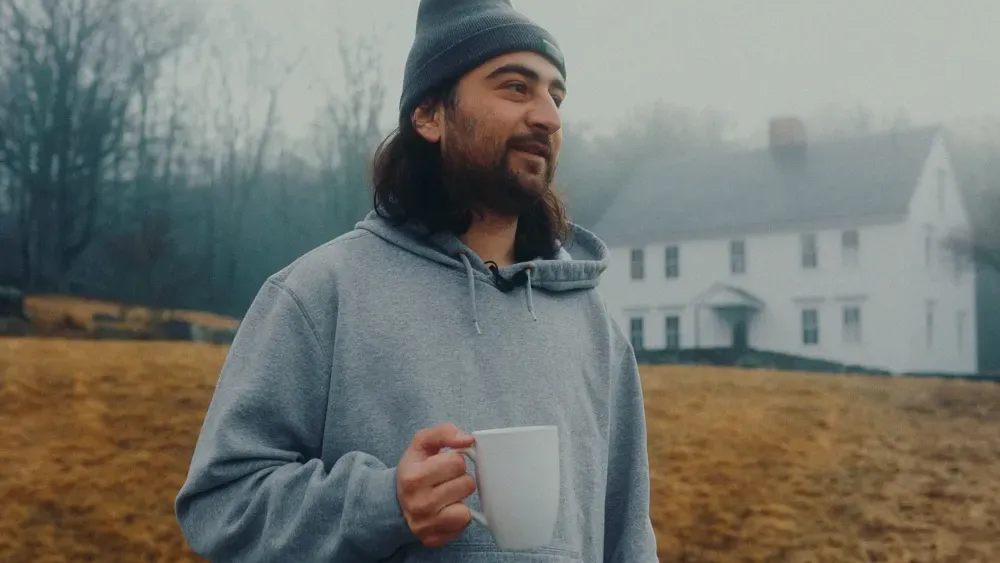
Noah Kahan in Noah Kahan: Out of Body.
Courtesy of Netflix
After dealing with writers’ block, the film ends with kind of a suggestion that a move away from Nashville back home to Vermont might help. This comes after having that blocked moment where you just declare, “I don’t even care about music right now.” If any of your professional associates were seeing you say that on camera, they must have thought, “Ohhh, interesting.”
Kahan: “Oh, how am I gonna get my beach house?” [Laughs.] Yeah. I thought Nick and the team did a brilliant job ending it. I had no idea how it was gonna end. We were filming at so many different times, and there were so many different scenes that I was thinking, “Maybe that’ll be the ending of the movie.” But I thought it was a really beautiful, understated way to finish the movie in a way that didn’t give you a happy ending, but it gave you a step forward and enough of a hope at the end to show that life moves on and creativity returns, and you can have your issues, but the things that make you happy are still there for you. I love the ending because it captures me in a moment where I’m most happy and most myself. But Nick, I would love to hear from you about what drew you to that ending, specifically.
Sweeney: I just remembered that quote about “I don’t give a fuck about music anymore.” And there’s this other moment where you’re saying, “I just don’t have a vision for what’s next. And I feel the darkness approaching.” I remember just thinking, oh my God. This feeling that I was observing you going through felt very heavy, and from the outside, it looked like to some extent you saw it as insurmountable. I remember feeling for you in those moments and being really shocked at the kind of language that you were using to describe this. One of the things you say is, “I’ve gone from 100 to zero after Fenway,” and just that feeling of feeling adrift. So then when we then saw you in the studio, which I really never thought we were gonna be capturing in this documentary, recording in this completely different state, with energy and momentum, I was like, “Oh, this feels like the place that we leave this story.”
Noah, you are worried during the movie about how you can write a new album from such a different place, literally and otherwise, than where you were in creating “Stick Season.” Now a new album is coming out — spoiler alert — so something that was in the wheels starting to spin again at the end of the film worked for you.
Kahan: Yeah, it did. It took a long time. It definitely took longer than I wanted it to. I just wanted the process to be the same so badly, because it was so pure and important to me, and it just felt like the perfect way to make an album. I was kind of trying to fit my new life back into my old life, and it didn’t fit anymore, and I had to start trying new things. I had a phone call with Marcus Mumford, which was helpful for me. I was really lost. It was right around after we finished filming and I was still kind of just feeling like, “I don’t know what I’m gonna do … I don’t know if I can do this again.” And he told me, “The process is never going to be the same again. You can’t get that back.”
It was just letting go for a little while — letting go of the idea of making it a great album, or an album, even. I was just like, “What makes me want to be creative?” It required taking some time and being down to explore new places and to work with different people and to rethink what my principles on creativity were. It was realizing that it doesn’t have to be like drawing water out of a rock — it doesn’t have to be painful or scary all the time — and letting myself try to find what I enjoy about it. When I let go and when I had those conversations is when I started to be creative again.
What you see in the documentary speaks to what worked so well about the process for this album and why I think the album is really cool: there’s a community around it. There’s people that have been through this experience with me. My producers and my band are playing all over the album. My wife helped me write a song on the album. I brought in community that let me feel like I was getting outside of myself, so I really do feel like the creative mojo returned. It still hasn’t left. I’m still feeling very creative, and I’m much more aware of how important it is to nurture that creativity. I think I really took too much time stepping away from what made me creative and trying to do what would make me bigger as an artist.
People who got to know you through your albums, or through interviews, have probably had at least some mild curiosity about who your family and these other people in your life were and how they affected you. So to meet them as characters is really fun and enjoyable. But when you are talking with your mom late in the film about, you say something to the effect of: “Maybe I should have asked you guys before I revealed your lives to the world.” Of course, you are saying that with cameras watching, which heightens the irony. So, how were they all with this?
Kahan: I think one thing I learned from the “Stick Season” experience, which Nick was able to capture me learning in real time, was how important it is to let people have agency over what is described about them to the public. I didn’t realize how big of an album “Stick Season” would be, so I was just writing these feelings down just to get ’em out. Suddenly the album’s huge, and I’m having to grapple with my family being like, “What the hell?” So when we started thinking about a documentary, I feel like the first thing I wanted to clear with everybody is, “Are you comfortable with this?” And I think they all were. I think it’s always uncomfortable to have cameras around you. It’s always weird to see yourself back on screen. After we all watched it together, we were like, whoa — like, this is kind of crazy. It was maybe freaking us out a little bit. But what the documentary really did bring us was this ability to observe the love and the support we have for each other, and the really, really special family that I think we are. That overrides that discomfort, being able to just say, “Hey, we got to get closer as people because of this documentary. And this is going to show people how much we love each other.”
I think everybody comes off so well in it. They all appear happy and funny. I think it’s naturally scary to open up like that, but for the most part, they’ve been absolutely down for the ride, and the communication has been very clear and honest from the beginning. I would never put out anything in the world if they didn’t like it, and they know that. So it’s been special to have their blessing.
Sweeney: One thing I loved filming with Noah and his family is that Noah is having these types of conversations with them that I think many of us will do anything to avoid having. He says in the film at one point, “You may never have the conversation with your parents that you want to have, or that you know you should have.” And we see him having those conversations with them in this film in real time. Noah’s mom says, “Noah’s music makes our family’s dirty laundry seem like being human.”
Noah has a well-noted sense of humor, so you knew there’d be a lot of laughs in the movie, so you at least had that security. But there’s a moment where Noah says, it’s one thing for him to joke about myself, but indicating it still stings when it comes from other people. So there’s that whole self-deprecating “beat them to the punch” sense of humor.
Sweeney: I think Noah really exists in this kind of sweet spot between painful and funny. A lot of us use humor as a way to sometimes deal with some of the painful things in our life, and we see Noah doing that in the film. There’s this really hilarious joke that I’ve always loved that he says on stage at Fenway, which is like, “If your parents are split up, let me hear you say, ‘Two Christmases!” And so much of the audience yells back “Two Christmases!,” because they’re children of divorce too. It was a great tool in our belt that we did have this underlying humor that we see in Noah’s life, often going between struggle and pain and then very absurd moments.
Kahan: One of my favorite moments captured on film is when we’re talking about body dysmorphia in my backyard, near the bonfire, and the chair breaks under me. There’s that moment where it’s very serious, and then that happens in real life, and I could tell everyone around us wanted to start laughing, but it was so intense… Just having the permission to laugh at yourself is something that I’ve always been really lucky to have, even in moments that are hard. I think Nick allowing that to be part of the movie instead of making all the sad parts be sad and all the funny parts be funny is what makes it a unique documentary.

(L to R) Lauri and Noah Kahan in Noah Kahan: Out of Body.
Courtesy of Netflix
There are certain tropes you expect out of a doc about this, because they are a part of real life. Like the exhilaration of playing Fenway Park immediately followed by the isolation out on the pond, which could be taken as an “it’s lonely at the top” thing. But it’s something so-called normal people may be able to relate to, as well — because when you maintain a very busy life, what happens when you’re alone and have to deal with yourself? That’s a universal theme.
Sweeney: We see Noah coming off stage at Fenway, a venue that’s hugely significant in his life, with fireworks and screaming, and he’s in a van and completely hyped up, and then the following day — I mean, hours later — standing at the kitchen counter, emptying cinnamon into this weird coffee drink he’s making. I was really kind of surprised how kind of extreme these contrasts in his life were.
Kahan: You don’t want to be “woe is me” about a lot of this stuff. And I feel like allowing those moments of silence in the sound editing, and the silence of that moment right after Fenway, where it’s just completely quiet besides the bugs and the wind — that tells that story without having to be me sitting there being, “It’s so hard.” There’s a lot of “show, don’t tell” in the documentary, which I love in movies.
There’s something about Noah’s popularity that is intrinsically tied to the sense of place people get about Vermont, whether they’ve ever been or just imagine it as a state of mind based on his music — a place that is mundane and relatable and yet maybe a little bit exotic to them at the same time. That’s a big part of this film. People could listen to the songs and sort of get an idea of what that landscape was like and how it affected Noah, being in the kind of small towns where people either want to stay forever or can’t wait to get out. Having interviews with some of the townspeople brings it all home.
Kahan: The comment I’ve seen is, Vermont is as much a character in the documentary as anything else. I think they did a really great job capturing what it’s really like but also capturing… not the indifference, but the forward-moving way of Vermonters. They’re not sitting around considering my music all the time. And I think breaking up the idea that like there’s Bernie Sanders, maple syrup and “Stick Season”…. There’s so much depth to the people in Vermont, and I really love that we had scenes where people were like, “Yeah, I don’t know. I knew him growing up, but I don’t really listen to his music.” I just think that’s so quintessentially New England and Vermont. And getting footage that isn’t just summertime or changing leaves, but getting that dirty, muddy snow in March and the cold and all of that, I feel like really captured where I’m from. You could talk about it in music, but showing them is a better way to do it. We did get really dirty making this film! When we were up there filming in the winter months, we came back really caked in mud, literally.
Do you ever have any regrets, even momentary, when you’re as candid as you are? Making an album, you have time to think about it before it goes out, but it might feel different when it’s something being captured on film and you’re not completely in control of whether anyone else at all hears it.
Kahan: It has been difficult, I think more so than with music, just because there’s so much you can obfuscate with music. You can kind of hide behind lyrics or melodies or characters. I have been anxious about [the film] — not because there’s anything that I’m worried about the world seeing; I like to be an open book. But it is vulnerable, and that feeling is a little anxiety-inducing. I think it’s OK, because I know that at least one person is gonna watch this and it’s gonna make them call their dad or their mom or their friend or confront something within themselves. That is worth the discomfort. It’s also a really great tool to tell people about my music and the album and the tour, and I just think overall it’s gonna be more helpful than the feeling of being anxious about it.