
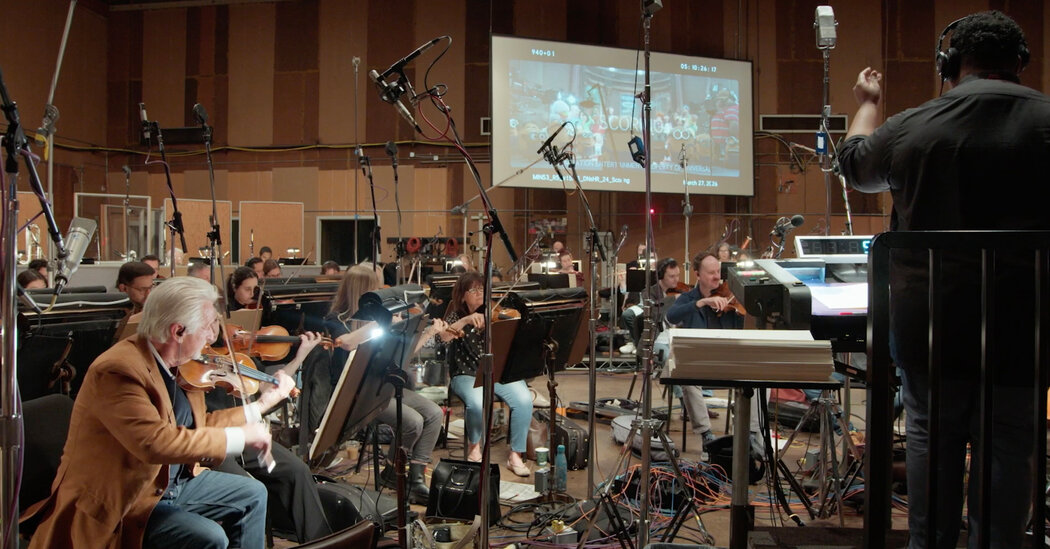
The mics were nearing 100 years old. So were the lamps. The wooden music stands were as old as Hollywood itself, complete with small indentations where the musicians used to rest their cigarettes while they performed.
This is the scoring stage on the Sony Pictures lot in Culver City, Calif., which used to be the home of MGM back in the 1930s. On a sunny day in mid-April, 76 of the top string, woodwind and harp musicians gathered to play the kinetic, high-energy score by the composer John Powell (“How to Train Your Dragon”), intended to evoke the golden age of cinema.
“Do as you can strings, here we go,” boomed the conductor Anthony Parnther (“Sinners”), before the musicians started on a sequence that the concertmaster Bruce Dukov called “not possible.” They played the ebullient, dynamic piece involving rapid-fire, short notes that get faster and faster until it stops. The musicians burst out laughing.
And they should. For they were scoring “Minions & Monsters,” the seventh movie in the franchise of “Despicable Me” and “Minions” releases. The newest may be the most original of the films featuring the pill-shaped creatures since 2010, when the first “Despicable Me” introduced the supervillain Gru’s eager henchmen to the world. (They remained underlings in the following three “Despicable Me” movies until spinning off into their own set of movies in 2015.)
“Minions & Monsters” is directed by Pierre Coffin, the voice of the creatures and co-director of four of the entries in the series.
“Pierre and I agreed that basically I should treat this as if the Minions hired me,” Powell said. “It gave me a different perspective on everything.”
“Minions & Monsters” has also given Coffin a different perspective on everything. The 59-year-old Frenchman, who is as integral to the franchise as the color yellow, did not want to make another feature with a Minion. Tired and burned out, he wanted to try something new while he still could. Then, in 2022, Chris Meledandri, chief executive of Illumination Entertainment, pitched him a new idea: a Minion wants to make a monster movie.
Coffin sparked to the concept immediately, specifically placing the Minions at the start of Hollywood, when slapstick reigned. “That’s where they come from,” Coffin said of the beloved characters’ wild antics. “That was all the background I needed to find creative ways to have the Minions fit into that world where they did not really belong.”
Then his challenge was “to convince the 300 people (301 people counting John Powell) to embark on the thing I wanted to do that was not going to be more of the same, but something with a different feel to it.”
“Minions & Monsters” follows the travails of a creative Minion named James, who is obsessed with storytelling. While his gibberish-speaking brethren are looking for a new master to follow, James is searching for his artistic breakthrough. The frenetic creatures land in Hollywood after a thrilling chase involving a bandit on horseback, a single-engine airplane and a runaway train and become giant stars just as the silent era is ending. Like Douglas Fairbanks and Harold Lloyd before them, the Minions are felled by the introduction of sound. (Minionese doesn’t comply with scripted dialogue.) The film is full of references to early Hollywood, like “Casablanca” and “Citizen Kane.” Not exactly fare for the under-10 crowd.
Yet in the case of “Minions & Monsters,” the success of the overall franchise (most of the movies in the series have neared or surpassed $1 billion at the box office) has encouraged the filmmakers to strive for more originality rather than less, as is often the case with sequels.
“What we found is that if you are in your sixth or seventh movie, you better find ways to be surprising, because if you’re not, the crew is going to get bored before even the audience gets bored,” said Meledandri, the producer who took a more hands-off approach to this film, stepping back to allow Coffin to behave more as a live-action auteur than as one member of a large committee, the norm in animated filmmaking.
“I think Pierre has done things that have been motivated by artistic aspiration in ways that we might not have taken the time to do in the past, Meledandri added. He was referring to, among other things, the way Coffin lighted the film, mimicking the lighting in early cinema, and the scoring, which also evoked early Hollywood with music more in line with the animated films of the 1930s and ’40s than today’s movies. Unlike most subsequent films in a franchise, this score also doesn’t feature any of the original “Despicable Me” theme. Parts of the movie even cut to black and white.
“None of these things are obvious commercial choices, Meledandri said, but “knowing that we have audiences that have loved these characters, we felt confident to support Pierre.”
Early reviews have been positive, with The New York Times’s critic Brandon Yu calling it “far and away the best of the bunch” and noting that it is “surprisingly uncynical, while allowing room for more real jokes and imagination.”
Coffin, who has been working on these movies for close to two decades, is a little anxious about the strong notices.
He said that after the first “Despicable Me,” the films, while warmly received, were often dinged for being more “like products” than movies. “Maybe they had too much of a recipe to them,” he admitted.
Now, though, with critical acclaim, he wonders if he can still achieve the box office heights of the previous films.
“I’m scared that it’s going to be the opposite, because we’re getting really good reviews,” he added. “And I’m thinking, what does that mean? Does that mean the movie is not going to be successful?”