
It begins with Baranov’s student days in the early 1990s, in the heady “new Russia,” just after Soviet communism had collapsed. Everything felt possible and money flowed freely. As Baranov recalls it, those days felt like a never-ending bash, or maybe an orgy, where you might watch a naked man on a leash follow a punk rock singer around at a house party. As an avant-garde theater student and then director, Baranov lived a life of art and poetry with his girlfriend, Ksenia (Alicia Vikander). When the vulgar but fun Dmitri Sidorov (Tom Sturridge), the inventor of Russia’s first commercial bank, enters their lives, things grow brighter, then more sour.
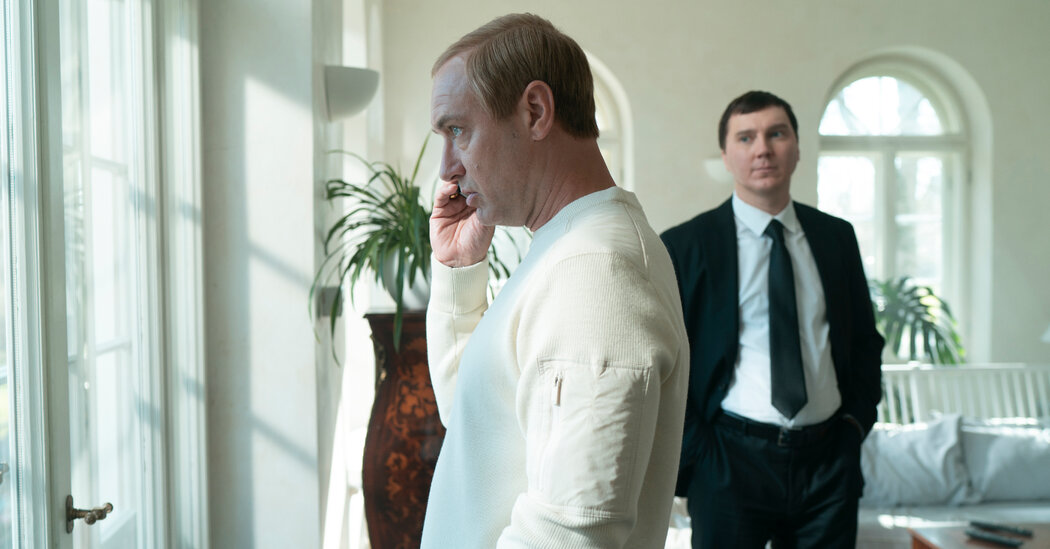
But Baranov moves on, taking a job in trashy reality television production, and this is where the historical tale begins to take shape. “The Wizard of the Kremlin” is really a movie about how Russia went from those heady post-Soviet days to the rise of the oligarchy to, eventually, the establishment of Vladimir Putin (a mostly chilling Jude Law) as president, a former K.G.B. officer who valued power over money. The oligarchs who choose Putin as Boris Yeltsin’s successor realize too late that this man will not be their pawn. “What interests me is restoring integrity to the Russian Federation,” he tells Baranov. And that means consolidating power — in himself.
Baranov, with his talent for weaving a story, is useful to Putin, and at this point he has little idealism left. As he grows nihilistic, believing that truth is whatever he wishes to make of it, so does his country. A background in theater and reality TV proves useful: He turns out to be a communications genius, figuring out how to manipulate political theater to not just represent reality, but invent it. They call him “the new Rasputin.”
As you may already have surmised from the casting, “The Wizard of the Kremlin” is not in Russian; the actors speak in English, which suggests this is an account of Russian history intended for non-Russian audiences. Even with its 136-minute running time, that’s a lot of ground to cover, so it moves at a good clip. This has an interesting dramatizing effect: We see history progress through Baranov’s eyes in broad arcs, and figures like Putin, who often occupy daily headlines, become more like characters in a play.
And while that can result in the oversimplification of a person, it can also be useful when trying to figure out why a person does the things they do. In a play or a movie, people have roles, psychological traits and motivations that drive their character arcs. Here, the lightly fictionalized version of an authoritarian is driven not by the desire for something like money, like the oligarchs, but by the desire for power. Projecting an image of strength is part of that desire; propaganda is the means by which one does this.