
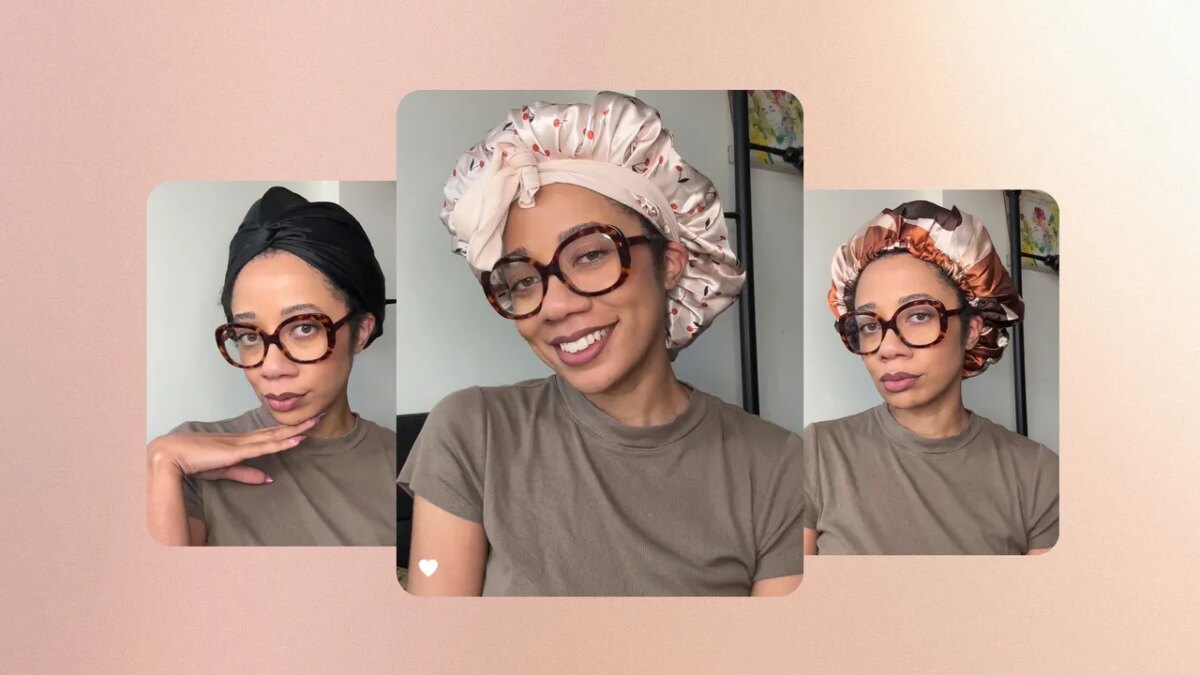
Grace Eleyae’s Adjustable Satin-Lined Cap has a sneaky little drawstring at the back, so you can resize based on your head size, hair, and desired tightness—which, per Nolan, is ideal for protecting delicate edges. That customizable fit ensures your edges are covered all night, and the satin lining prevents the friction that leads to frizz and breakage. It’s got plenty of stretch and can easily accommodate long hair or rollers. Another big pro is the design: While the interior consists of a strand-friendly satin, the exterior is a casual jersey, styled as a beanie that can easily be worn out and about with a tee and jeans.
Frequently asked questions
Are silk bonnets good for your hair?
Minimizing frizz and avoiding breakage while sleeping isn’t always easy, but that’s where silk (or satin) bonnets come in handy. “When you sleep, your hair is rubbing against the pillow throughout the night, which can create friction,” says hairstylist Vanessa Ocando. “A silk bonnet minimizes the rubbing and helps you wake up with frizz-free hair.”
How often should I wash my silk bonnet?
How often someone chooses to wash their silk bonnets boils down to a few lifestyle factors. For Ocando, she washes her silk bonnet based on how often she wears it and how much product she has in her hair. “I usually wash my bonnet twice a week when I’m wearing it every night and have my hair curly, which means more curly-hair product,” she says. “When I’m wearing my hair straight, I can get away with washing it once a week.” However, not washing a bonnet enough can cause some unpleasant side effects. Tukia Allen, a hair educator coach at the Aveda Arts & Sciences Institutes Atlanta, says, “Product transferred from bonnet to skin could lead to more oiliness of the skin, skin irritations, and pimples.”
Should I sleep with a silk bonnet every night?
Ocando points out that it’s not always necessary to use a bonnet every night. However, wearing it while trying to prolong a style like a silk press or twist-out is a great idea. Allen says wearing a bonnet every night to “keep hair in order, sleek, and shiny” is what works for her.
Are silk bonnets better than silk pillowcases?
Ocando and Allen agree that silk bonnets and silk pillowcases serve the same purpose. However, Allen says the bonnet “provides more focus on keeping hair in place while sleeping.” So when it comes to maintaining a style, a bonnet might be a better choice, although both options can help protect the hair and cause less friction and frizz. “Personally, I find it easier to commit to sleeping on my silk pillowcase every night versus using a bonnet,” says Ocando. “The pillowcase is lifesaving for my curls, and I would recommend investing in a silk pillowcase before a bonnet.” You could also use silk sheets for even more frizz protection.
Does a silk bonnet work better than a satin bonnet?
In a word, yes. “I always recommend silk over satin because it is softer and a lot more breathable,” says Gutterman. “You will feel the difference right away, because most satin bonnets are overly produced and will have polyester in them.” That said, “a satin bonnet is better than not using anything,” she says. “It really depends on what your budget is, and if you can afford a silk bonnet, go with that one. Your hair and your skin will thank you.”
Is a silk bonnet good for all hair types?
Though they’re most closely associated with the curly and natural-hair communities, all hair types can benefit from wearing a bonnet to bed, says Gutterman: “Whether you’re preserving a curl or just trying to keep your skin clean, consider adding [one] to your routine.”
To compile our list of the best silk and satin bonnets, we considered the materials, size, fit, and perhaps most importantly, how well the bonnets stayed on overnight. Aesthetics were also taken into consideration. We also tapped a professional cosmetologist for her professional recommendations.