
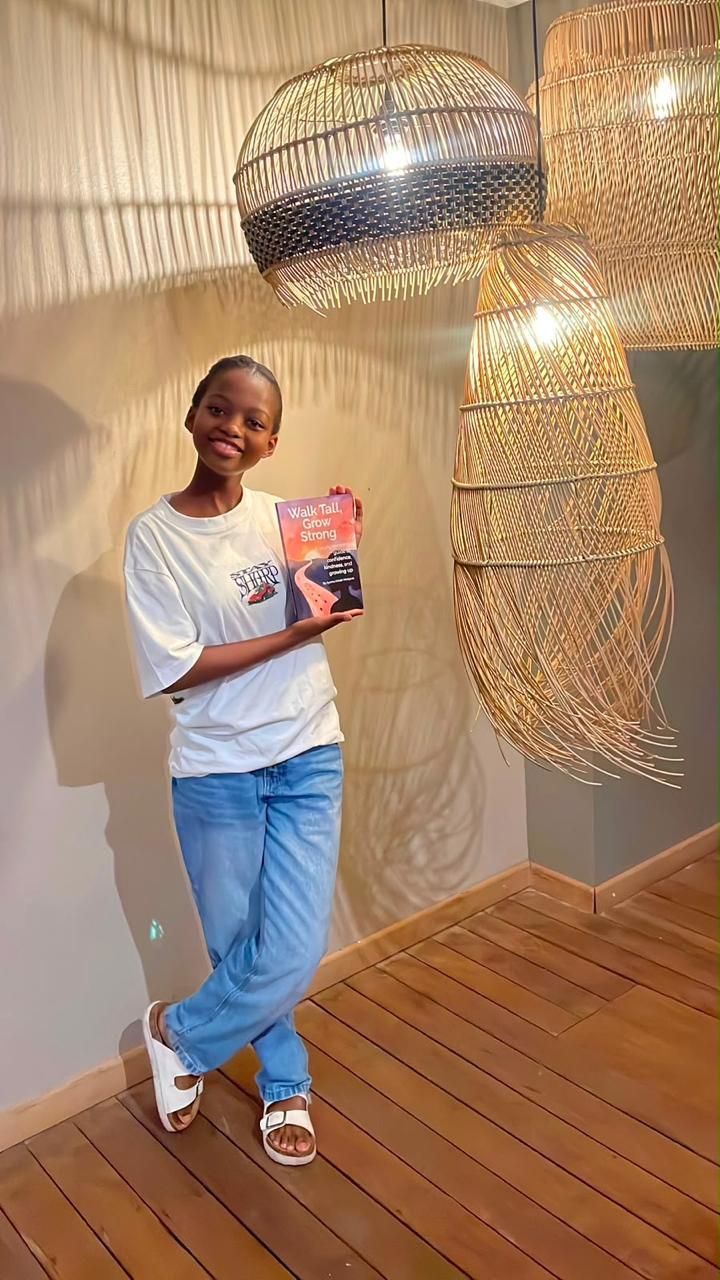
What started as private thoughts written in a journal has grown into something much bigger for young writer Ayema Mtotywa.
Her book, Walk Strong, Grow Strong, transforms her personal reflections, experiences and lessons about self-confidence, kindness and personal growth into advice aimed at encouraging teenagers to believe in themselves, respect others and learn to set boundaries.
The 12-year-old from KwaZulu-Natal began writing simply as a way of expressing her thoughts. Her journey towards becoming a published author was encouraged by the people closest to her, particularly her mother and aunt.
Her original title was A Better You, but she later realised that other books carried the same title. Wanting something more personal and authentic, she reconsidered the name and decided that the book should reflect the idea of growth.
“I was honestly just writing things in my journal and talking to my mom about them,” she said.
The idea of turning those thoughts into a book became more real after her aunt, her mother’s sister, told her that she could see Ayema becoming an author one day.
When Ayema eventually showed her mother some of her journal entries, her mother was surprised by how thoughtful and meaningful the writing was and encouraged her daughter to continue.
Ayema also wanted to create something teenagers could relate to, drawing on her own experiences rather than simply offering advice from a distance.
Turning self-doubt into something positive
Like many young people, Ayema has experienced moments when her confidence has dipped.
Rather than allowing those feelings to define her, she has tried to approach them with positivity. One saying in particular has become a source of encouragement for her.
“You don’t have to be everyone’s cup of tea to be the person you want to be,” she said.
That message of self-acceptance runs through her approach to writing and is central to what she hopes young readers will take from her book.
Her message is focused on self-respect, respecting others, remaining positive and understanding the importance of boundaries.
For Ayema, one of the most important lessons is learning that young people have the right to say no without feeling pressured to justify themselves.
“Most importantly, I want them to understand that ‘no’ is a full sentence, and they don’t have to explain themselves if they don’t want to do something,” she said.
Two years in the making
The book was not an overnight achievement.
Ayema spent two years working on it, mostly writing in her bedroom and drawing on her own experiences. Schoolwork and spending time with friends were never major obstacles, but turning personal experiences into a book took time.
There were also moments when procrastination got in the way.
Her mother’s repeated encouragement eventually helped her cross the finish line.
Ayema did not have a strict writing routine. Instead, she would listen to music or a podcast while putting her thoughts on paper.
The young writer also found inspiration in Charlotte Freeman, author of Everything You’ll Ever Need, a book that focuses on self-love, personal growth and learning to value yourself.
Reading it helped Ayema recognise the power books can have when readers see their own experiences reflected in the advice they contain.
That realisation encouraged her to create something of her own for teenagers.
Words can build people up
Kindness is another theme close to Ayema’s heart.
She believes words have the power to influence how people see themselves and that something said casually can sometimes have a lasting impact on another person.
“Kindness is so important to me because the things we say to one another can either break someone down or build them up,” she said.
Her mother played an important role throughout the writing process, not only encouraging Ayema to begin but also pushing her to finish when she considered putting the project aside.
Without that support, Ayema believes she may not have discovered just how much she enjoyed writing about her feelings.
Her family’s encouragement also became particularly important when she began questioning whether anyone would actually read or connect with her work.
“When everything was about to come out, I started thinking, ‘I don’t think anyone is going to buy this, and no one is going to relate to it,’” she said.
But rereading the book reminded her why she had written it in the first place: it was honest, personal and rooted in her own experiences.
A message for young dreamers
Ayema hopes her story will encourage other young people not to abandon their dreams simply because others fail to believe in them.
Her advice is to protect their plans, remain focused and understand that criticism does not have to determine their direction.
“Don’t let other people’s opinions stop you from doing what you believe in,” she said.
The young author is now looking forward to seeing where her book takes her and, most importantly, who it reaches.
She hopes the words that began as private thoughts in a journal will eventually find their way into the hands of young readers across KZN and SA.
“I’m really excited to see what comes next and where my book is going to end up,” she said.
IOL