


As Canadians close the door to 2022 and look ahead to the new year, many may be hopeful they can also look forward to good news when it comes to COVID-19.
But will 2023 be the year the emergency phase of the pandemic is declared over and that Canada recognizes the virus as endemic?
It turns out, declaring or deciding that a virus is endemic is not a straightforward or clearly-defined practice.
But if such a declaration is made in Canada in the coming year, some infectious diseases experts say they are concerned about how this could affect people’s attitudes and behaviours regarding the virus.
While the definition of COVID-19 endemicity may be unclear, SARS-CoV-2 has proven it is capable of presenting new surprises and challenges that can have significant impacts on the health of Canadians and the operation of health-care systems across the country, says Dr. Raywat Deonandan, epidemiologist and associate professor at the University of Ottawa.
“I think we’ve learned that there’s still a lot more to learn.”
How does a country determine if a virus is endemic?
An endemic virus refers to the “constant presence and/or usual prevalence of a disease or infectious agent in a population within a geographic area,” according to the U.S. Centers for Disease Control (CDC).
But making the official designation of a virus as endemic is not necessarily a scientific endeavour, but rather is more “political” and can vary, says Dr. Giorgia Sulis, an infectious disease epidemiologist based out of Toronto General Hospital.
“There is not a set of criteria that we can use to define endemicity,” she said.
“It is very different from defining a pandemic.”
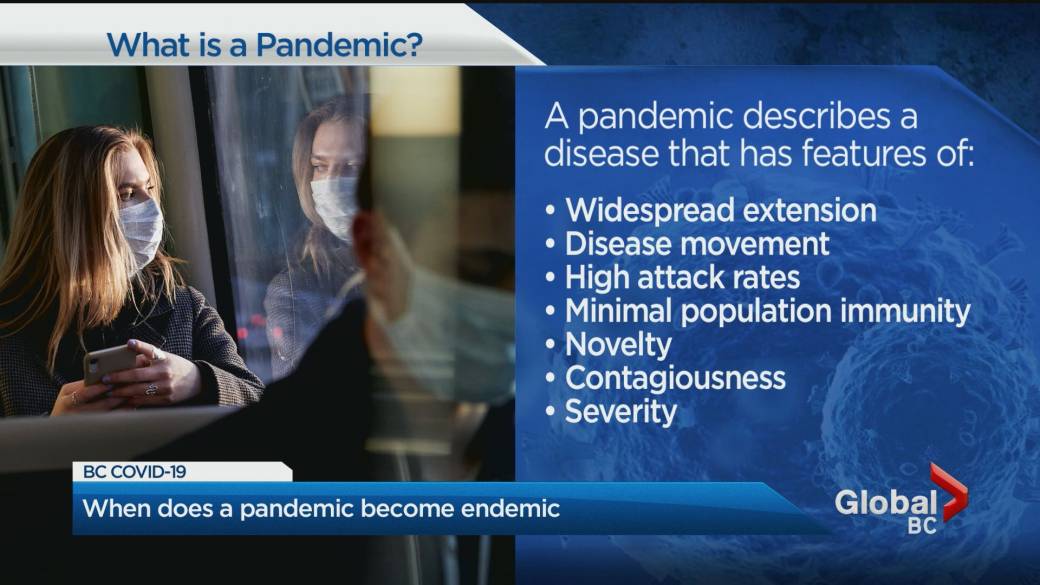
Infectious diseases specialist Dr. Isaac Bogoch agreed, saying the official designation of a virus as endemic in a country is “not all scientific.”
“A lot of it is based on politics, on perception, and different places might come up with different definitions,” he said.
Related News
“I don’t know how globally we’re going to define this, but I do know that it’s important that we not bury our head in the sand and ignore that it’s there.”
The last year has proven the most deadly for the disease in Canada, with over 19,000 deaths recorded to date, according to federal data.
2022 also saw a massive increase in the number of Canadians infected with the virus after the Omicron variant emerged in late 2021 and tore through communities and countries across the globe.
More than 70 per cent of Canadians have likely been infected with COVID-19 since Omicron arrived, compared to less than five per cent of the population who had contracted COVID-19 before Omicron, according to blood test studies funded by the federal government through the national COVID-19 Immunity Task Force.
In addition, Dr. Theresa Tam, Canada’s chief public health officer, told Global News in a year-end interview new federal data also shows about 15 per cent of people in Canada who self-report contracting the virus can experience prolonged symptoms.
While the risks of contracting long COVID are still unknown, the high numbers of Canadians who have been infected with the virus coupled with the fact 83 per cent of Canadians have received at least two doses of the vaccine means many people have acquired so-called hybrid immunity, which some studies have shown provides enhanced protection, Tam said.
And while this is good news for Canada, the fact that COVID-19 immunity wanes over time means it’s still too early to declare the emergency over, Bogoch said.
“The virus continues to mutate as viruses do, and we aren’t entirely sure if another variant will emerge that might undo some of the good that we’ve seen happen through vaccination… and hybrid immunity,” he said.

“Is there going to be another variant that emerges that causes more widespread harm? The answer is maybe. And I think it’s unwise to be overconfident that the worst is behind us.”
What role does data play in determining if a virus is endemic?
Data and surveillance that provides information about how a virus is behaving and changing in a population is key to determining responses, including on decisions about whether it remains an emergency situation, Deonandan said.
But Canada is among many countries that have seen a significant reduction in testing for COVID-19, due to provinces and territories adopting testing policies that rely mainly on rapid tests to detect the virus, which are not tracked.
That means there is less data available to track and understand the impact of the virus, he said.
“It hobbles our ability to explain to the public the status of the disease.”
While some surveillance of the virus does remain, including wastewater testing and some official PCR testing, the only significant signal that a new wave of the virus is present is hospital admissions, Deonandan said.
“That reduces all of the arguments down to what we see in the hospital, which is unfortunate because the argument should be about what we see in the community, but we don’t have a sense of what’s happening in the community.”
The World Health Organization (WHO) has been raising concern about a global drop in surveillance of COVID-19, and has warned this could open the door to a new variant of concern that could cause “significant mortality.”
For the last several months, WHO officials have been urging countries to beef up tracking, testing and sequencing of COVID-19, following a marked decline in surveillance measures as public health restrictions have been relaxed worldwide.
WHO has even added caveats to its weekly epidemiological reports on global COVID-19 circulation and case numbers, noting that any trends “should be interpreted with due consideration of the limitations of the COVID-19 surveillance systems.”
Bogoch says this drop in surveillance and data collection is “problematic” and a “major issue” in Canada and around the world.
“The less data we have, we’re wandering blindly into who knows what, and that can only harm us,” he said.
How declaring COVID endemic could affect responses to the virus
Given that virtually all former public health restrictions have been lifted across Canada, an official declaration of COVID-19 being endemic is unlikely to change much, Sulis said.
But she is concerned about the message such a declaration could send to the public.
“It is important to understand that saying that a disease is endemic doesn’t mean it is no longer a public health problem, because it is,” she said.
Diseases like tuberculosis and malaria are considered endemic in parts of the world where they continue to infect and kill millions of people.
When people talk about Canada moving into an endemic phase of COVID-19, it implies a level of success over the virus, Sulis said.
“But it is not, because endemic diseases still require policies, still require a structured response,” she said.
“It doesn’t mean we can stop bothering about those responses.”
If governments decide to change their messaging to say the virus is endemic, she believes the result could be “problematic.”

Deonandan echoed these concerns, saying he worries about the way the word endemic is used and the implications it can evoke.
“It seems to be an excuse by policymakers to do nothing just because something is endemic… hands up, we can’t do anything about this,” he said.
“High levels of endemicity are not good, and there are things we can still do to push those numbers down if we want to.”
How COVID-19 might impact Canada and the world in 2023
Health Canada says surveillance indicators, including clinical and wastewater testing, show that SARS-CoV-2 is still circulating across the country, and while Canada is past the peak of the last COVID-19 resurgence, “it is too soon to let our guard down.”
The federal agency also said variations in population-level of immunity and current global trends suggest that an uptick in COVID-19 could occur in the new year.
Genetic sequencing data that is available shows continuing increases in immune evasive variants, notably BQ.1 and BQ1.1, while the previously dominant BA.5 lineage variants are declining, said Anna Maddison, a spokesperson for Health Canada and the Public Health Agency of Canada, in a statement to Global News.
“With the increased prominence of these variants in Canada, at a minimum we could see a slower decline and higher plateaus in the number of infections as well as hospital admissions in Canada, as this respiratory virus season plays out.”
The situation in China could also play a major role in the evolution of the virus, as millions of people are now suddenly being exposed to the virus following the decision by the Chinese government to abandon its zero-COVID policy.
Dr. Monica Gandhi, an infectious disease doctor and professor of medicine at the University of California, San Francisco, says she is “very worried” about the situation in China, and how it could lead to new variants of concern that could pose a global threat.

“It’s true that variants do emerge when there’s rapid circulation among a lot of people, and as it is, it is very likely that there could be a new variant emerging from China,” she said.
Deonandan noted that the outbreak in China means about 10 per cent of the world’s population is about to become exposed to COVID-19 for the first time, due to low vaccination levels in that country.
This could have an impact on western countries like Canada that are now taking a “laissez-faire approach to COVID management,” he said.
“I think it’s likely that a new immune evasive variant will emerge, causing further waves,” he said.
“But the good news is that the vaccines continue to work against the worst outcomes. And if we continue to boost and we don’t see any bad effects from boosting, then the ability to curtail transmission should be maintained to some extent as well.”
Bogoch says the key message about the coming year when it comes to COVID-19 is that a lot of uncertainty remains, which means ongoing vigilance is necessary.
“Of course, we all hope that the worst is behind us, and we know that the vaccines have stood the test of time in terms of protecting us against hospitalization and death throughout the entire pandemic, regardless of what variant we’re dealing with,” he said.
“But I think we still have to communicate uncertainty as to what lies ahead, because the virus does continue to mutate as expected. And there may be other variants that emerge that are unfortunately more harmful than normal right now.”