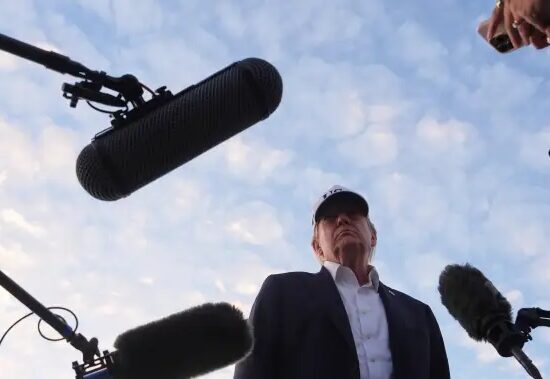

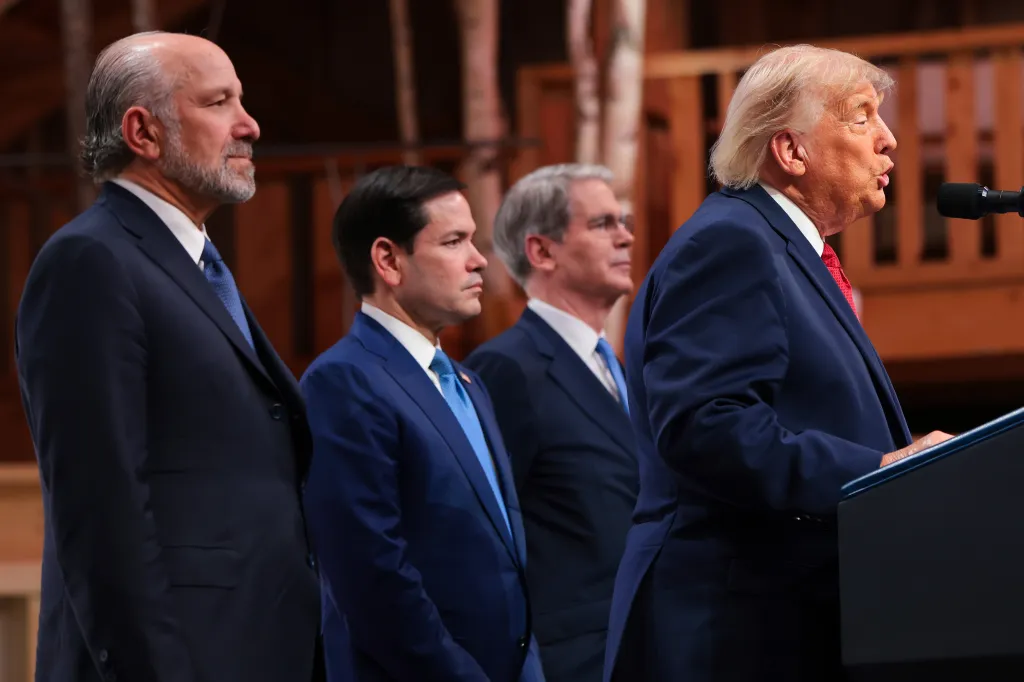
Near the end of a 90-minute press conference in which Donald Trump explained, among other things, why he thinks the current Tehran regime will behave differently, the president indicated what he would do if the deal to end the war ultimately fizzles.
Already, as word of the details of the memorandum have leaked out, Trump has faced skepticism and criticism on the right, including from figures like Erick Erickson, that the deal is essentially a U.S. retreat, falling far short of the original aims of the war that started in February.
Fox News’ Peter Doocy asked Trump, “There’s some element to this where, if you send the vice president [to sign the deal], great, you’ll look like a genius for sending him. And if it doesn’t work out, it’s the vice president.”
Trump responded, “I like that idea. This way, if it works out I am going to take the credit. If it doesn’t work out, I’m blaming JD. You better be careful JD.”
Vance, in the midst of a book tour, has been defending the deal and is tasked with signing it, in a ceremony scheduled for Friday.
Trump’s comment may have been a joke, but it reflected some of the heat the administration has taken in recent days.
At the press conference, Trump tried to take a victory lap, repeatedly referring to his order to take out influential General Qasem Soleimani in 2020 as part of a lengthy effort to take on the Iranian regime. He again bashed Barack Obama’s Iran deal reached in 2015, in which Tehran agreed to curb its nuclear program, coupled with some unfreezing of assets.
Unsurprisingly, Trump also criticized news coverage of the war and the agreement, bashing ABC, NBC, CBS and CNN as well as The New York Times.
But skepticism is hardly just coming from mainstream media commentators. “This is an American surrender,” Erickson posted on Wednesday afternoon.
Trump’s agreement — a memorandum of understanding before more complex talks begin on Iran’s nuclear program — has been criticized for the notion that the current regime will be rewarded.
Trump said that the U.S. would not be sending Iranians cash, but he offered a defense of the notion of unfreezing of Iranian assets, of the country needing access to funds to rebuild, and even to the idea of the Tehran regime maintaining some missiles. “They have to have some, because other people have some,” Trump said.
“Missiles aren’t the problem. Missiles, they hurt a little location, but they don’t blow up the planet,” he added.
At another part of the press conference, Doocy told Trump, “A wise man once said in January of 2020, Iran never won a war but never lost a negotiation.”
“Who said that?” Trump asked.
Doocy responded, “Donald Trump.”
“Oh, that is what I thought you were going to say.”
Then, Trump expressed his frustration. “If [the Iranians] raise the white flag of surrender, and if they say, ‘Praise be to Allah. Donald Trump is the greatest president ever. We totally concede. We totally give up. This war is over. We have failed.’ The New York Times and CNN and a couple of others … they would say, ‘Iran had a great victory.’”
Trump made it pretty clear his motivation for entering into the agreement: the economy. As the closure of the Strait of Hormuz created an energy shock that sent gas prices soaring, Trump’s polls numbers took a beating.
Without a conclusion to the war, Trump said, would have perhaps meant a global depression. He also name checked one of his predecessors, Herbert Hoover. “He was always the one I didn’t want to be,” he said.
The MOU calls for a reopening of the strait and an end to the U.S. blockade, but much is unresolved. Trump said that the deal would prevent Iran from ever obtaining a nuclear weapon; the MOU language, obtained by Axios and other outlets, “reaffirms that it shall not procure or develop nuclear weapons.” Remaining details are to be worked out.