
Someone on social media recently left a comment on one of my old Film Threat articles that I had reposted on X, called “Why Can’t 2025 Comprehend Sexy Stories?” His assumption stopped me in my tracks, because in my mind, it shot so far past the mark as to make me realize how misdirected we really are as a culture.
In the article, I had been trying to address why modern cinema seems fundamentally incapable of telling hot, passionate, high-stakes romantic stories that aren’t afraid to show a little skin and incorporate the bedroom, the kind where electric human chemistry drives the plot, and desire carries actual, permanent consequences, for good or for ill.
His response was simple, well-meaning, and echoed a sentiment you hear everywhere nowadays:
“I’m pretty sure it’s because of the high cost of living. People don’t even think about sex. They worry about low-paying jobs… working two part-time jobs just to pay rent, with no place of their own. Between two jobs and bills, there’s no time for sex or babies.”
I replied to him immediately: “Here’s the thing: poverty and the cost of living have been historically worse throughout human history than they are now, yet birth rates were much higher.”
It sounds logical on the surface, doesn’t it? It’s comfortable to blame the economy. It’s neat, clinical, and excuses us from looking in the mirror. But the second you open a history book, or look at global demographic data, the “high rent kills the libido” argument collapses completely.
During the Great Depression, when 25 percent of the country was unemployed, when families lived in shantytowns and stood in breadlines, culture didn’t stop being romantic. In fact, the 1930s gave birth to some of the most intoxicating, sensuous, high-voltage romantic cinema and pulp fiction in American history. People didn’t retreat from intimacy because times were tough; they ran toward each other. Intimacy, passion, and family weren’t luxury goods; they were the antidote to a cold, unforgiving world.
Conversely, if we look even further back, the late Roman Empire suffered a catastrophic demographic collapse and plunging birth rates, yet that happened in a period of thriving economic growth.
So if it isn’t the rent, what happened to us? Why has modern society become so sterile, so risk-averse, and so profoundly terrified of genuine sexual chemistry?
The answer isn’t in our bank accounts. It’s in our pockets, in our culture, and in a collective surrender of real-world human risk.
1. Crowd-Sourced Totalitarianism & The Biological Trap
Let’s talk about the elephant in the room: the pocket-sized surveillance camera.
Courtship, the simple, timeless act of a man approaching a woman, striking up a conversation, asking for a dance, or offering a bold compliment, requires vulnerability. It requires the willingness to take a small, human risk. Sometimes it works and electricity crackles; sometimes it doesn’t: you get a polite decline, you blush, you laugh it off, and everyone moves on with their lives.
Historically, that interaction was ephemeral. It existed only in the physical memory of the two people in the room. It carried zero long-term social penalty.
Enter the smartphone camera, social media algorithms, and the era of crowd-sourced totalitarianism.
When people think of authoritarian control, they imagine Orwell’s 1984: a top-down state forcing compliance through a massive secret police force. But history shows us that’s not how it actually works. The Communists, the Nazis, and the Fascists never had the resources or personnel to police every street corner, kitchen, and parlor. They depended entirely on community policing, getting ordinary neighbors, coworkers, and citizens to watch, report, and destroy one another for social credit.
Today, we’ve digitized that exact mechanism. Today’s reality is worse than Orwell’s vision: Big Brother is watching you. Log on, and you can watch, too.
Every public space, from a gym to a local bar, a coffee shop, or a park, has been converted into an uncredentialed live production studio. Over the past few years, an entire genre of viral “shame content” exploded online: people recording someone attempting to initiate small talk or make eye contact, posting the video without consent, and serving them up to millions of online strangers to be branded a “creep” or a “predator” for clout.
It has even reached the level of technological insanity where AI eye-tracking software is used to analyze video frame-by-frame. You can see clips posted online where a program overlays a glowing target on a man’s face the moment he is introduced to an attractive woman. The second his eyes drift to her cleavage, the shape of her breasts, or her hips, the software highlights it, and the comment section descends to destroy him.
This ignores two fundamental truths of human existence:
- Women dress intentionally. Selecting clothing that highlights form, beauty, and health is an intentional, biological display of magnetism that human beings have engaged in for thousands of years.
- Biology is hardwired. When a man is presented with a female form, his brain is biologically programmed to take note. His eyes will drift for a split second. It is an involuntary, instinctual reflex shaped by millions of years of human survival and reproduction. Most normal men take that microsecond note, adjust, and resume respectful eye contact.
Subjecting an involuntary, split-second biological impulse to frame-by-frame forensic analysis isn’t about enforcing “respect.” It is a deliberate attempt to grind a man’s spirit into the ground. It creates a sadistic and cruel state of perpetual, neurotic hyper-vigilance where simply possessing human eyes inside a human body feels like a legal liability.

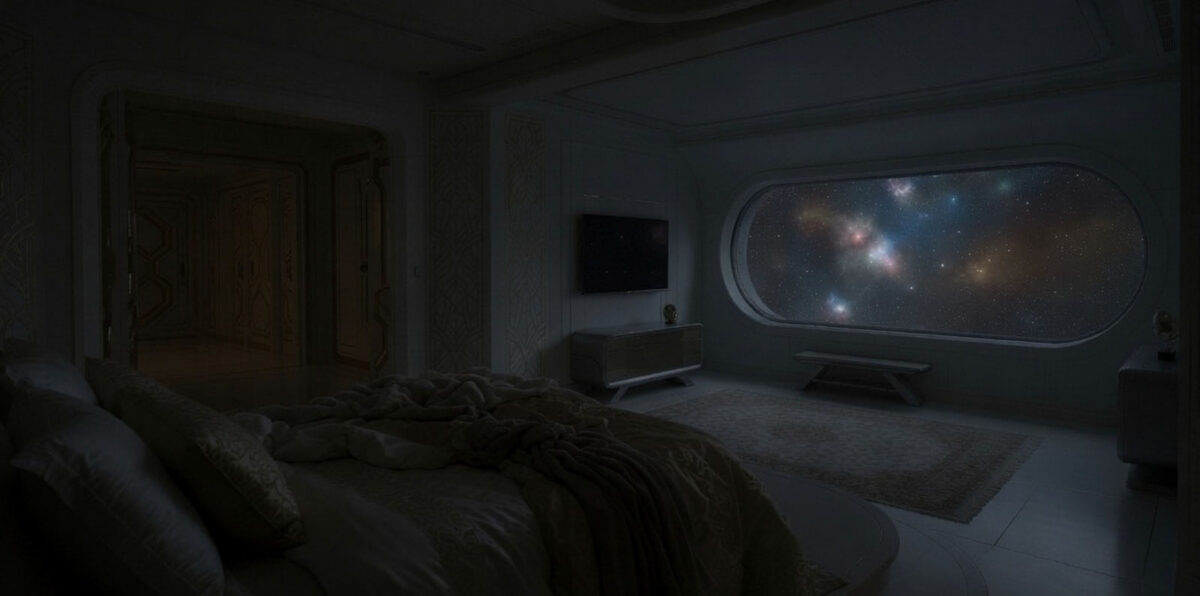
Tara watches over Brio as their ship drifts past a distant galaxy in Escape From Planet Omega-12.
“Tara and her husband Brio weren’t just casually dating; they were engaged in raw, passionate, sweaty, intentional creation.”
When every human awkwardness, natural impulse, or earnest attempt at connection can be digitized, weaponized, and broadcast globally, a chilling effect paralyzes the culture.
We traded the messy, electric freedom of the public square for digital surveillance. My wife wanted cameras on our front and back porches for security, and I get it. But look at where that mindset ends up: now we have Flock cameras tracking everything from license plates to greenbelts, on every corner because we as a society are no longer willing to hold our culture accountable for crime, enforce basic standards, or do the hard, courageous work of building a high-trust community.
Robert A. Heinlein hit on this in his famous sci-fi novel (ironically labeled Fascist by people who don’t actually have any idea what the word means) Starship Troopers: a society that abdicates personal responsibility, refuses to confront real bad actors, and fears necessary conflict eventually surrenders its sovereignty to total institutional surveillance.
You cannot have heat without a little spark, and nobody wants to strike a match in a room full of gunpowder and recording lenses.
2. Guilt on One Side, Tollbooths on the Other
Because real-world connection now feels like walking through a social minefield, both men and women have been nudged into sterile, risk-free proxy traps.
On one side, men have had to contend with a weaponized strain of generational guilt, not feminism as a healthy path toward mutual respect, clear communication, and appreciation between the sexes, but as an inescapable tax of imagined historical sin. When men are conditioned to believe that their natural desire, their drive, and their pursuit of a woman are inherently oppressive, the safest option appears to be total retreat. They pull back, shut up, and are made to feel that they must apologize for existing.
On the other side, opportunistic digital platforms stepped in to monetize that isolation.
Women are told to turn their natural magnetism into a purely transactional business model, while men are offered a sterile, paywalled proxy for intimacy. Pay $10 a month for a messaging queue; pay $50 for a custom video; keep an electronic barrier between you and another human being forever. It promises the illusion of connection with zero risk of rejection, zero vulnerability, and zero emotional cost.
It is a digital tollbooth where men pay for the shadow of a woman, and women are taught to treat their allure like an ATM.
On top of that, look at how younger generations process conflict today. We see a rising epidemic of risk aversion masquerading as courage. People put on theatrical costumes, glue themselves to roads, or vandalize art galleries under banners like “Stop Oil/Data Centers/Free Palestine” or “Protect Trans Kids.” They lash out at commuters, small-business owners, and museum guards, people who are civilized, bound by rules, and guaranteed not to hit back. It gives them the cheap dopamine hit of playing the heroic revolutionary without facing an ounce of real danger.
Notice how quickly those same crowds vanish when it comes to confronting actual, ruthless evil: child trafficking rings, violent cartels, totalitarian regimes, or deep-seated government fraud. That would require confronting people who don’t care about social media PR, taking them far outside their comfort zones into spaces where real physical danger exists. They’ll even turn on those who do, just to keep their boat from being rocked, because even that requires no risk.
It’s all the same illness: we have become a culture terrified of real risk, real danger, and real consequence. And a society that retreats from real-world risk can never sustain real-world passion.
3. “Slop” Was Here Long Before AI
When people look at the state of modern movies, they love to complain about “slop.” And lately, the anti-tech crowd loves to blame Artificial Intelligence for the flood of soulless content.
Let’s set the record straight: corporate Hollywood has been pumping out soulless, algorithmic slop for at least fifteen years. They’ve been edging up to it for much longer than that.
The endless, focus-grouped superhero sequels; the sterile, de-sexed blockbusters where gorgeous actors are uglified and then made to look at each other with all the romantic intensity of two coworkers reviewing a spreadsheet; the live-action remakes stripped of grit and wonder… that wasn’t generated by neural networks. It was generated by risk-averse studio executives, legal departments, and corporate boards terrified of offending a single demographic.
They sanitized our stories because they were terrified of heat. They took sex out of the movies, removed raw physical tension, and replaced genuine desire with ironic quips. They sanded the danger, the longing, and the consequence out of the frame until the only thing left was brand-safe competence.
And now those same institutions have the nerve to point at independent creators using new tools and scream “soulless.”
The people who spent over a decade running every script through sensitivity readers, market-testing the life out of characters, and treating chemistry like a liability are suddenly the guardians of authentic human art. The same system that decided audiences couldn’t handle real lust, real risk, or real moral ambiguity now positions itself as the last defense against creative emptiness.
That is not a defense of art. That is a defense of monopoly.
The slop was already in the pipeline. The legacy studio system simply ran out of ideas because its business model depended on avoiding risk at all costs. Open-source tools and local compute didn’t create the emptiness. They just made it possible for people outside the system to stop asking permission to put the heat back in.
4. The Uncomfortable Truth: What Real Tension Looks Like
If we want to break out of this rut, we have to stop making sterile, safe, intimacy coordination-ruled cinema. We need stories that explore the raw, uncomfortable, high-stakes friction of human desire when all the social rules are stripped away.
That is the narrative core of what I’m exploring in my upcoming animated sci-fi movie, Escape From Planet Omega-12. This isn’t just a movie I want to make. It’s something I think we all need.
My team and I aren’t interested in safe, sanitized characters exchanging canned quips in a pre-canned, formulaic void. We are focusing on two characters: Tara and Brio.
In the story, right before the tragic disaster that maroons her on a hostile alien world, Tara and her husband Brio weren’t just casually dating; they were engaged in raw, passionate, sweaty, intentional creation. They were having sex with the explicit intent of bringing a child into the world, building a future, and founding a family. That anchors their connection in primal human drive, not disposable hookup culture.
Then disaster strikes. Brio is killed, or rather, in his death, his body is transformed into a grotesque “monster” form (Blob).
Down on the surface of Omega-12, marooned in a brutal environment, there are no smartphones, no recording lenses, no social media hall monitors, and no societal rules. It is just the two of them. And between Tara and this creature, who still carries the soul, memories, and physical echo of the man she loved, there is an intense, deeply uncomfortable, undeniable sexual tension.
It’s a story that is sure to make modern corporate executives deeply uneasy, because it forces desire, grief, physical attraction, and survival to collide in a place where no one is watching to give them approval. It asks what happens when two people with a profound need for physical and emotional connection are forced together without the buffer of society to tell them how to feel.
That is what storytelling is supposed to do. It’s not meant to scrutinize the audience or hand them moral disapproval. It’s meant to remind people what it feels like when the air between two human beings gets thick, the tension becomes unbearable, and you remember, deep down in your chest, why being human is so damn electric.
Open-source tools and local compute give independent artists the power to bypass the corporate gatekeepers and put that kind of un-sanitized, high-stakes passion back on screen. When anyone can achieve visual scale, the corporate slop-factories lose their only advantage. The playing field levels, and the only thing left that can tip the scales is a killer story told by someone who isn’t afraid to take a risk. They call it slop because they want to accuse their newly rising competition of that which they have been guilty of for years.
5. How We Take It Back
So how do we fix this? How do we rebuild a high-trust society and bring real passion back into our lives and our art?
It doesn’t start with passing laws or waiting for Hollywood to fix itself. It starts with a conscious, courageous choice by men and women to step out of the digital panopticon.
Put the Cameras Down
We need to reclaim physical spaces, our local theaters, workshops, music venues, and living rooms, as zones of presence. We need to make it cool again to leave the phone in your pocket, to look people in the eye or even the cleavage, and to live a moment without feeling the urge to broadcast it to a crowd of online hall monitors.
Give Each Other Grace
Men need to stop carrying the burden of generational guilt for simply desiring romance, beauty, and connection. Women need to reject the cynical trap that reduces intimacy to a digital subscription model, or men need to see being with them as a burdensome task. Rejection isn’t an attack; an awkward attempt at small talk isn’t a crime. They are just the necessary, beautiful, slightly messy steps of human beings trying to find each other in the dark.
Demand Heat in Your Culture
Stop settling for sanitized, risk-averse art. Support independent creators who are building in their own humble studios, telling stories with real passion, and refusing to bow to the moral auditors.
The Spark in the Dark
Intimacy isn’t a luxury for prosperous times. It is the fundamental engine of human existence.
There is nothing quite like the feeling of real, un-sanitized attraction, the catch in your throat when someone catches your eye across a crowded room, the electric charge when skin touches skin for the first time, the complete and vulnerable surrender to a physical and sexual act, the fierce, protective instinct that comes from wanting to build a life and a family with someone who looks at you like you’re the only thing that matters in the world.
That heat is what built civilization. It’s what inspired the greatest paintings, wrote the greatest songs, and fueled the greatest stories in human history.
The panopticon only has power if we keep logging on to watch each other. Turn off the screens. Look at each other instead. Take the risk, feel the spark, and let’s make culture sexy again.