
“I was very successful since I was a kid,” Tom Cruise told a full house at the Academy Museum’s 945-seat David Geffen Theater following a screening of Digger. That stardom has led him in search of ever bigger challenges, learning new skills and finding opportunities to apply them.
As he put it: “OK, the door’s open. Now I want to push it again.”
He has certainly done that with Digger, Alejandro G. Iñárritu’s wildly ambitious, deeply weird and extravagantly mounted comedy, in which Cruise plays a Texas oil tycoon forced to face the music after an environmental disaster puts the world at risk.
The Warner Bros. release, arriving just as Paramount nears its takeover of Warner Bros. Discovery, carries a reported $125 million production budget.
At 64 and 63, respectively, Cruise and Iñárritu are near-exact contemporaries taking this leap together. Cruise has ventured into similarly offbeat territory before, memorably in an Oscar-nominated turn in Paul Thomas Anderson’s Magnolia and beneath the prosthetics of Ben Stiller’s comedy Tropic Thunder.
But he has spent much of his recent career delivering increasingly elaborate Mission: Impossible spectacles, taking extraordinary physical risks within a franchise whose appeal he understands intimately. Digger requires a different leap of faith, both from Cruise and from the audience he hopes will follow him.
Among critics, the film has proved wildly divisive, with some reviews positively savage, The Hollywood Reporter’s among them. I understand the objections to Digger; I was also quite happy to have seen it. There is something invigorating about watching this much talent and money committed to a movie this peculiar, even when its considerable parts refuse to cooperate.
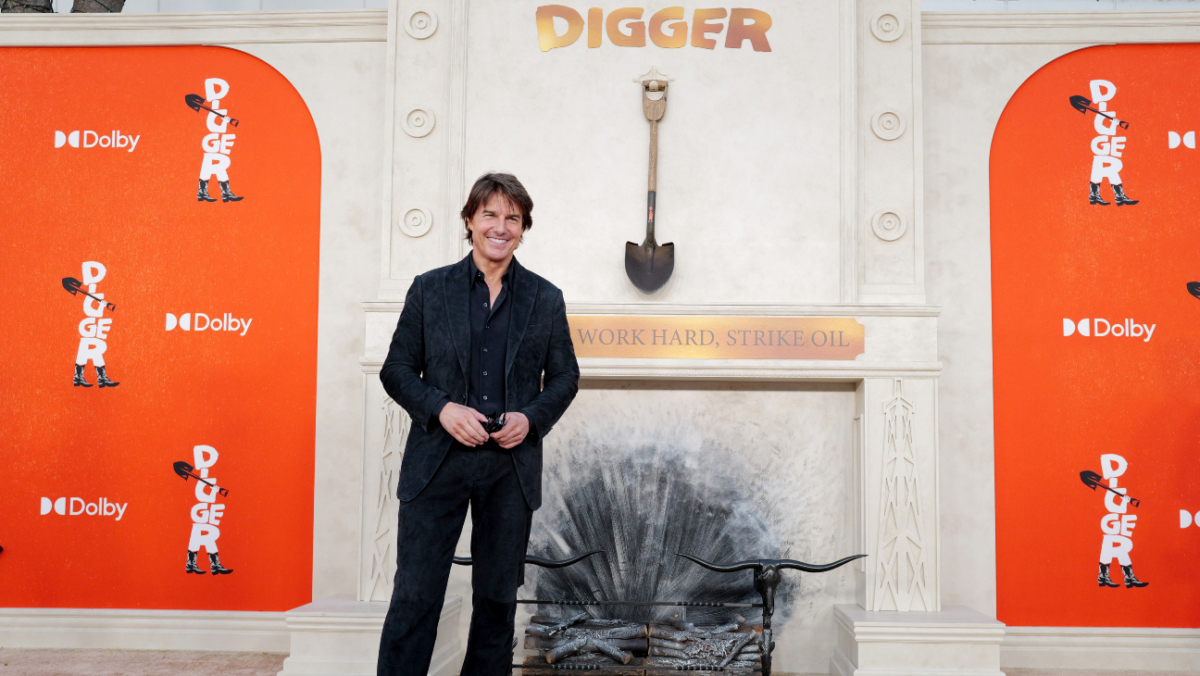
Tom Cruise talks to the audience at Academy Museum’s ‘Digger’ screening.
Seth Abramovitch
Iñárritu offered a remarkably candid account of the challenges during the discussion. Making this trompe-l’œil of a film required a constant negotiation between theatricality and the camera. What felt inspired on set could look very different the following morning.
“We were laughing all day,” the four-time Oscar-winning Mexican filmmaker said. Then he would watch the dailies: “Oh my God,” he recalled thinking. “This is not working. This is shit.” Adjusting the performance could send it too far in the other direction: “It’s too naturalistic. It’s not so funny.”
In sharing that, Iñárritu was describing the search for the film’s highly unusual tone, not conceding that the finished movie had failed. But the anecdote gets at the precariousness of the enterprise. The actors had to find that tone in their bodies and voices, he explained. “Nothing can be written in tone. It doesn’t exist,” he said.
Iñárritu compared the precision of Cruise’s acting to the “micro decisions” he makes during a dangerous stunt, when “one second is the difference between life and death.” On set, the director watched that attention extend to where Cruise placed his hands, when he winked and when he stayed silent. “Every take he’s just present and observing naturally,” he said.
Cruise, meanwhile, seemed delighted by the company he was keeping. He repeatedly jumped in to praise his fellow actors, recalling how difficult it was to stop laughing around John Goodman. Of Sandra Hüller, he said, “What an extraordinary actress,” before settling on a succession of wows.
His enthusiasm was considerably easier to pin down than his acting techniques. After Cruise gave a drawn-out answer about a life spent observing humanity to explain his character work, Iñárritu teased him: “He keeps the secret. He don’t answer.”

Tom Cruise and Alejandro G. Iñárritu at the Academy Museum’s ‘Digger’ screening.
Seth Abramovitch
By the end of the conversation, Cruise was making a broader argument about what audiences want, and what filmmakers should give them. “This film is handmade,” he said. He described stopping on set with his colleagues to look around and appreciate the skill that had gone into the physical world surrounding them. “People want to see real things,” he said. Then, a little later: “People want real things and they want real experiences.”
Cruise never mentioned artificial intelligence, but the repeated emphasis on “real things” and “handmade” filmmaking could readily be heard as an implicit rejoinder to it. His remarks placed the value in the people doing the work, the skills they had acquired and the pleasure of being together to make something. “It was never handed to any of us,” he said.
For all his confidence, there was also an acknowledgment that the opportunity to keep doing this depends on people buying tickets. “My hope is always that the films would do enough that I’d have that opportunity to do it again,” Cruise said.
Whether audiences follow him into Digger remains to be seen. For now, he seemed grateful to have made the leap. “It’s not like I don’t have challenges, we don’t have challenges,” he said. “But I really choose to be joyful about creating.”
After posing for a cast and crew photo, Cruise, ever the audience pleaser, spent 15 minutes mingling with fans who rushed the stage for selfies and a few words with a movie legend. Four decades into his career, he’s still finding new ways to make it in this risky business.
He clearly loves the job.