
When production designer Nina Ruscio returned to the set of “The Pitt” for Season 2, she made subtle changes that weren’t necessarily visible to the audience, but for the cast and crew, they played a major role in making the Pittsburgh Trauma Medical Center feel larger, more immersive and more alive.
The set now spans over 24,000 square feet and introduces several new locations, including the karaoke bar, the wing where Frank Langdon checks on one of his patients and the parking garage. And with practical lighting embedded throughout the set, the cast and crew had greater freedom to move throughout the space.
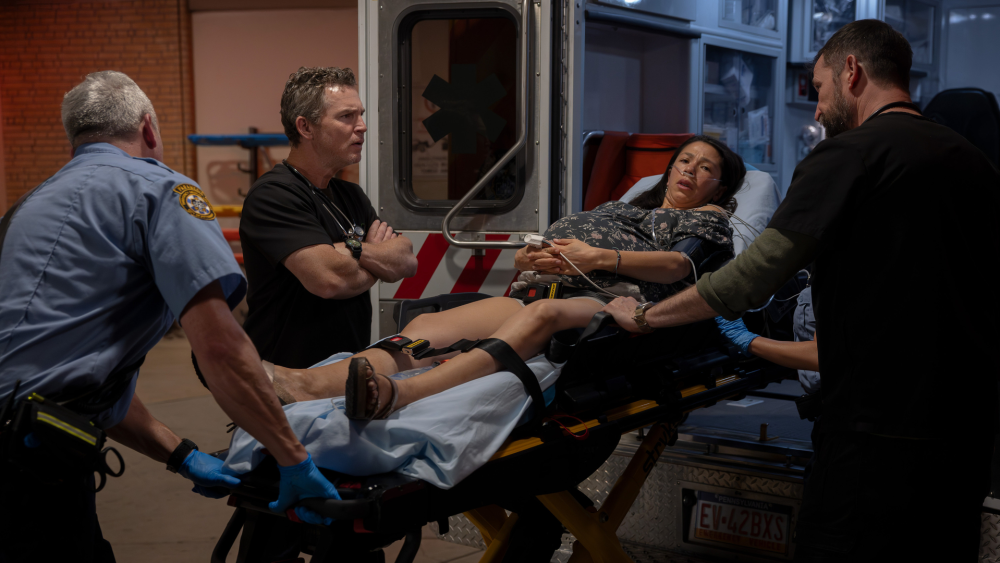
Following the success of Season 1, Ruscio entered the sophomore season determined to expand the triage without altering its now-familiar look. One of the most evident changes was building beyond the fire lane where ambulances drop off high-priority patients so the hospital wouldn’t feel confined. “You never had a feeling that the set ended,” Ruscio tells Variety.
The HBO series was the most nominated show of the year at 25 nominations, with Ruscio earning a nomination for Outstanding Production Design for a Narrative Contemporary Program for episode 15. Ruscio believes the season finale stood out because it highlighted the evolution of the hospital while expanding the show’s world.
“Many of the episodes could have applied, but this particular one really felt like it had a bow around it that showcased the new work. It showcased the additions and extensions, and there are a handful of sets that opened up the perspective a bit more,” she says.
Each new location was designed with a careful attention to detail. Lighting effects mimicked the glow of neon lights spilling into the karaoke bar, and “moments of release” were created via the rooftop when staff gathers to watch the Fourth of July fireworks, which was filmed at Allegheny General Hospital in Pittsburgh.
Ruscio wanted to make the emergency department feel alive. “The idea that the emotional state of the people is mirrored in the environment from the get-go has been something that’s very important to me. The emergency department has an energy and a dynamic to it that’s as a supporting character almost for the whole show,” Ruscio says.
This philosophy extended to even the briefest moments. Frank Langdon’s (Patrick Ball) supervised drug test lasts just 46 seconds in the 54-minute finale, but the bathroom was intentionally designed to contrast the open, sterile feel of the emergency department. Dark-paneled walls and a small space highlighted the intimacy and Langdon’s unease of having another doctor watch him provide his urine sample.
Baran Al-Hashimi (Sepideh Moafi) returning to her car after her shift received just over a minute of screen time, but it showcased her against the backdrop of Pittsburgh sitting alone in her “sad, little car,” physically unable to drive away from the trauma of the day.
“Her as this lonely person inside of a tin can having an emotional breakdown is not dissimilar or metaphoric from the whole experience of being in a hospital where you’re just a tiny little speck of it all,” Ruscio says.
By the time viewers reach hour 15, the staff has spent an entire shift navigating a cyberattack that forces the emergency department to abandon digital systems, a nonstop influx of Fourth of July emergencies and an abandoned baby. To demonstrate that chaos, there “was crap everywhere,” with papers and folders scattered to reflect the emotional clutter the doctors were experiencing.
But “crap” may not be the best way to describe what comprises the set’s design; intent was the foundation of demonstrating the trauma center’s unease, and no detail was too small. Bookshelves were filled with actual paperwork and documents used by medical professionals, while even the hairline fractures visible on X-rays were created with the guidance of real-life practicing physicians.
“There’s not one thing that’s random about any item or aspect of that set. We always quadruple down on doing research and speaking with doctors and getting clarity as to how they would handle this,” Ruscio says.
The openness of the set is designed to feel like a real emergency room while granting cameras the freedom to move without restriction. “You can go wherever you want to go without restraints,” the production designer says. “That’s so connected to the ethos of the show — that you’re in it. That you’re experiencing it intimately. It feels like a beautiful bow to have put on the set for Season 2.”