
Few moments in film history will be remembered with as much delight as great filmmakers giving subtle nods to each other through classic films. In Star Wars: Episode I – The Phantom Menace (1999), George Lucas hid what is now an iconic Easter egg as a tribute to his colleague Steven Spielberg.
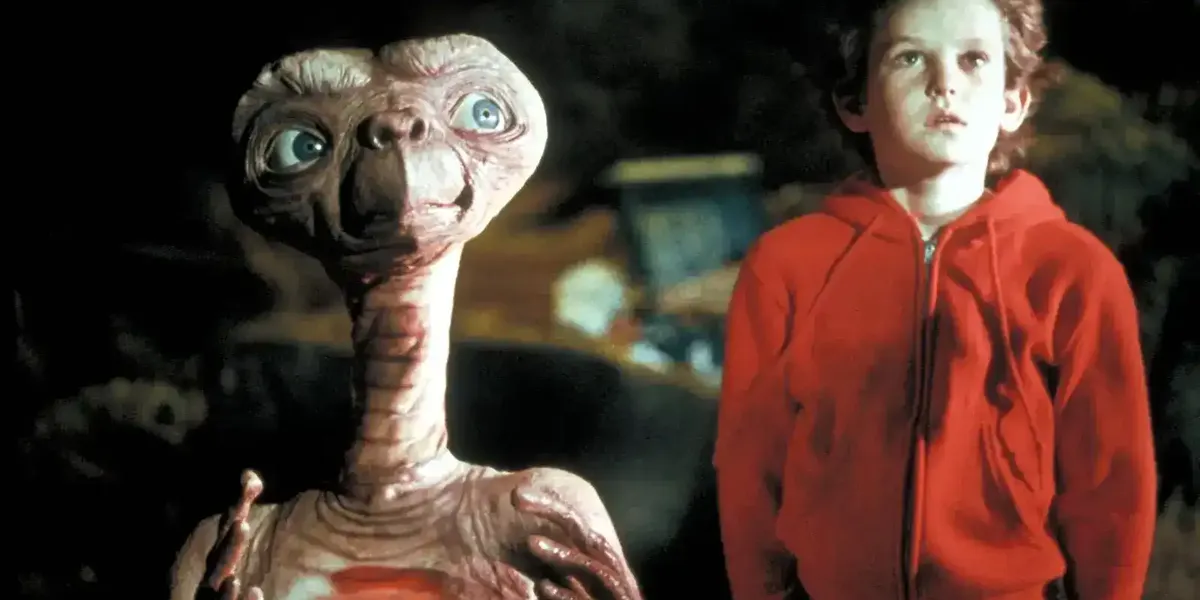
In the movie’s sprawling galactic system, a short, quiet moment that is filled with alien species and hidden details, a very familiar alien race made an appearance. These weren’t just random creatures; they were a deliberate nod to Spielberg’s 1982 film, E.T. the Extra-Terrestrial.
These creatures, the Asogians, closely resemble E.T. from the 1982 classic. This cameo isn’t just meant for fans to pause and smile; it reflects the long-standing creative friendship between two great filmmakers.
So, how did George Lucas give a subtle nod to Spielberg? What can this teach us about combining movie universes?
Let’s jump right in and explore.
E.T.’s Iconic Cameo
In Star Wars: Episode I – The Phantom Menace, the moment unfolds during a heated Senate session early in the film. Queen Amidala, played by Natalie Portman, addresses the Senate. In what may seem like a routine scene, as Amidala makes her dramatic plea, the camera sweeps across the chamber’s floating pods.
While it is likely that the audience might not be alert enough to notice specific details, Lucas brings our attention to multiple pods which feature various alien races, one of which closely resembles E.T. These brown-skinned beings with elongated necks and large, expressive eyes are unmistakably of the same species as the one in Spielberg’s all-time classic.
Members of this species, sometimes called Asogians, appear as peaceful Republic representatives. However, what’s most important here is that George Lucas does not linger on them for too long. In fact, it is quite literally a “blink, and you’ll miss it” situation.
Not only does this species add layers of political intrigue just like the others, but it also rewards sharp-eyed viewers by reminding them of the Spielberg movie and Lucas’s long-standing association with him. This moment does what all great Easter eggs do – without a serious plot impact, it showcases how even the largest movie epics have room for innocent crossovers.
When Movie Universes Quietly Collide
When movie worlds combine in this manner, it feels like a giant creative handshake between vividly enjoyable cinematic spaces and their creators. Perhaps, the effects of this are amplified by the fact that both these films belong to distinct, massively successful franchises.
These crossovers blur the lines between starkly different realities in the most charming way. The playfulness in the very thought of something like this begins with mutual respect. None of this is possible without two filmmakers openly admiring each other’s craft. Both films exist in entirely different narratives, but quiet moments such as this make their boundaries disappear.
Movie-world collisions like these do not “officially” indicate plot overlaps, and movie fans understand that without the need for explanation. It is quite understandable that such subtle nods are more about creating a fun, meta-layer for audiences to see through and be surprised by. Most importantly, movie crossovers celebrate cinema by inviting every viewer into their worlds in audaciously enjoyable and creative ways. These exchanges always feel organic, subtle, and refreshing to those who watch them.
How Two Masters Subtly Exchanged Easter Eggs
If you thought this was exciting, let me tell you that Steven Spielberg gave George Lucas a subtle nod years before in Raiders of the Lost Ark (1981). In the film, when Harrison Ford finds himself in the Well of Souls, we can actually see an engraving of R2-D2 and C-3PO in the background. While it is true that this one is a lot easier to miss, it is also a very clever nod to a Lucas classic in a film and a scene where the filmmaker deliberately draws our attention to wall engravings.
So, clearly, this creative exchange goes both ways. In Raiders of the Lost Ark, the hidden engravings aren’t really acknowledged. They quietly appear in the background in the most rewarding manner for those who spot them organically. Similarly, in this sequence, the Asogians make a subtle appearance.
Personally, I believe that it is this subtlety that makes both these Easter eggs special. They are a quiet indication of overwhelming mutual respect and recognition, and an attempt to create meta-layers for the audience. Neither of them breaks the rhythm of the scene. This is what makes these appearances feel rewarding and organic: the fact that they do not coerce us into paying attention to what’s being shown.
Steven Spielberg and George Lucas reflect the powerful spirit of collaboration and playful rivalry. These hidden details in their films remind us, first and foremost, of how the two filmmakers valued each other’s friendship, creative collaboration, and, most importantly, their movies.
Summing It Up
The hidden E.T. cameo in Star Wars: Episode I – The Phantom Menace stands out because of how it quietly blends the universe of another classic film into its own. Without emphasis or overexplanation, E.T.’s species adds political layers, intrigue, and playfulness to a classic saga. Steven Spielberg and George Lucas’s friendship, collaboration, and mutual respect are evident in the movies they made together and in tiny, special moments such as this.
Which is your favorite hidden detail in Star Wars? Tell us in the comments below.