
Emilie Tommasi’s The Gliwensbourg Chronicles turns a small French mining town into an old-time Western powder keg, with a fortune in stolen gold that has the townsfolk, the government, and half the immigrant population looking over their shoulders. So what happens when a time traveler wanders straight into the middle of the fuse?
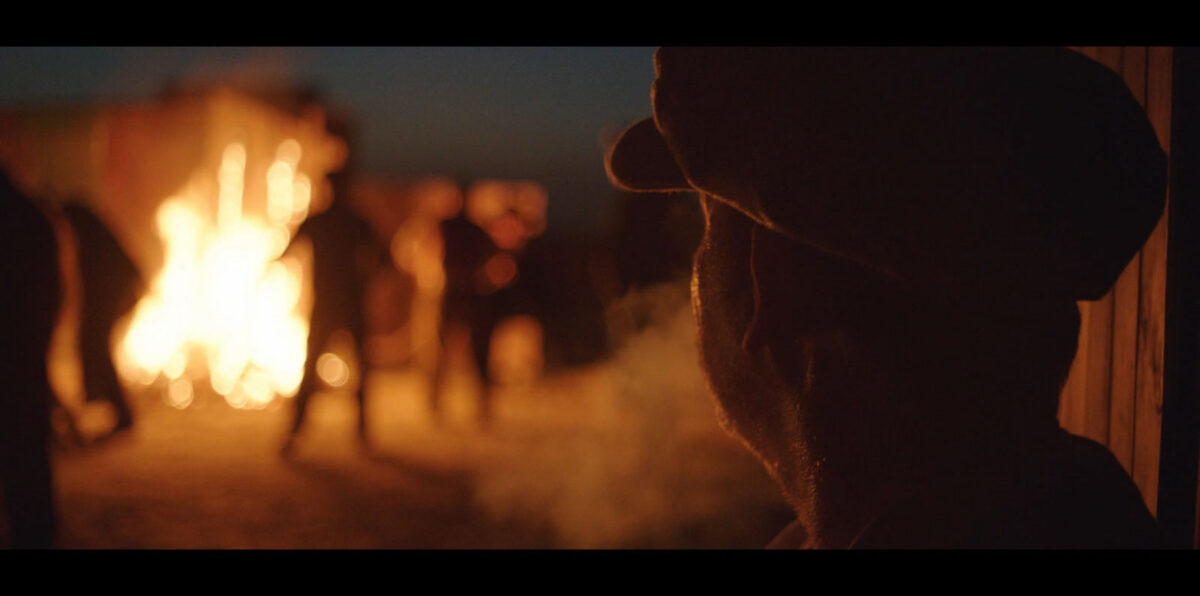
Somewhere on the front in France during World War I (1915), a French soldier finds himself trapped in a collapsed trench after German bombardments. Thinking he hears a cat purring, he leaves his squad for a moment to investigate, but something is watching him, and in a flash, the soldier is transported ten years into the future, near a small town called Gliwensbourg.
Meanwhile, months before this event in 1925, a small group of villagers stumbled across an ambushed transport with all of its soldiers dead. The villagers discovered a stash of gold and decided to take it and bury it in an abandoned mineshaft.
Back in the “present,” the town of Gliwensbourg is in trouble. Unsavory people are looking for the loot, including the mayor, who has hired an outsider to find it. This pisses off the Flemish, who realize he wants it for himself. Then there is the youth in town who would rather play cards and hustle than hold down an honest job. Marcus is one of them, and he finds himself in debt to the wrong people.
Compounding the problem is the owner of the mining company the entire town is built on. He is demanding that people get back to work digging up coal, or he’ll foreclose on everyone. On the other hand, the people complain about the mine’s dangerous working conditions and remind him of those they lost in the tunnels. The owner doesn’t care.
On top of that, the government is leaning on the mine owner to produce enough coal to sustain France’s economic recovery after the devastating impact of the war. While the owner reassures the emissary that coal is being produced, the government has decided to send men down to make sure he’s keeping his word.
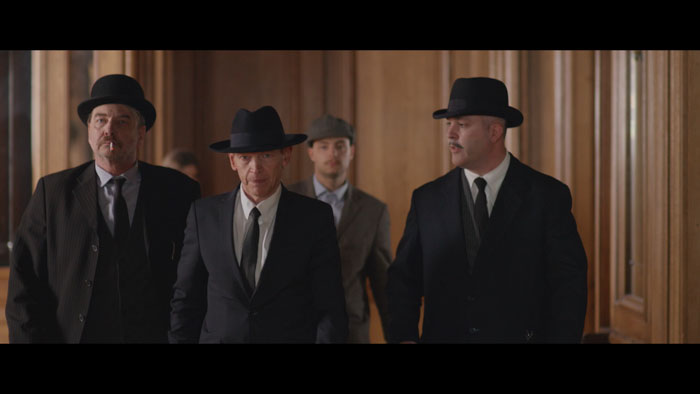
Three men in dark suits and hats walk down a wood-paneled hallway in The Gliwensbourg Chronicles.
“…in a flash, the soldier is transported ten years into the future, near a small town called Gliwensbourg.”
Oh yeah, remember that time-traveling soldier. He’s still trying to get his bearings, thinking he is now a deserter. While he wanders the outskirts of town, a ghostly figure leads him to the camp of a group of Moroccan refugees living nearby.
The Gliwensbourg Chronicles caught me off guard, for a simple episodic series. This seven-part French miniseries plays like the sharper, more satirical stuff HBO used to put out — except dressed up as a Western, soundtrack and all. The twist is that it’s set in a small village in northern France, a century ahead of the U.S. Old West. There’s a lot going on: an oppressive mining company, a bureaucratic government, a mob-adjacent crew, four ethnic factions — French, Flemish, Polish, Moroccan. Then there are class divides between owner and worker, anarchist kids, and a time-traveling soldier dropped in the middle. It’s a lot to track, especially through subtitles, which is exactly why this works so much better as a miniseries than a two-hour movie.
This is a fight for status, to use an improv term. What I like is how everybody’s fighting their own battles from a different rung on the ladder. There’s always somebody above you looking to take a chunk out of your hide, and your only move is to take a chunk out of whoever’s beneath you. It’s dressed up as ethnic tension and gold-fever plotting, but underneath it’s the same status fight at every level. And the satire is grounded, as it’s baked into the situations, not the jokes.
The time-traveling soldier is the most interesting piece of our tale. He has no skin in the game, so he gives us fresh eyes on every clash between the people on top and the people getting stepped on. In the end, it’s a thoughtful and satirical piece about how we treat each other with and without power, done in a way only a Western can. Here, the laws of the land aren’t enforced evenly, and each faction runs by its own rules, enforced through intimidation or the barrel of a gun. Take my advice: give Emilie Tommasi’s take a go, because it harkens back to the way good stories used to be told — a complex story about class and troubles that have existed for millennia.
For screening information, visit the The Gliwensbourg Chronicles official website.