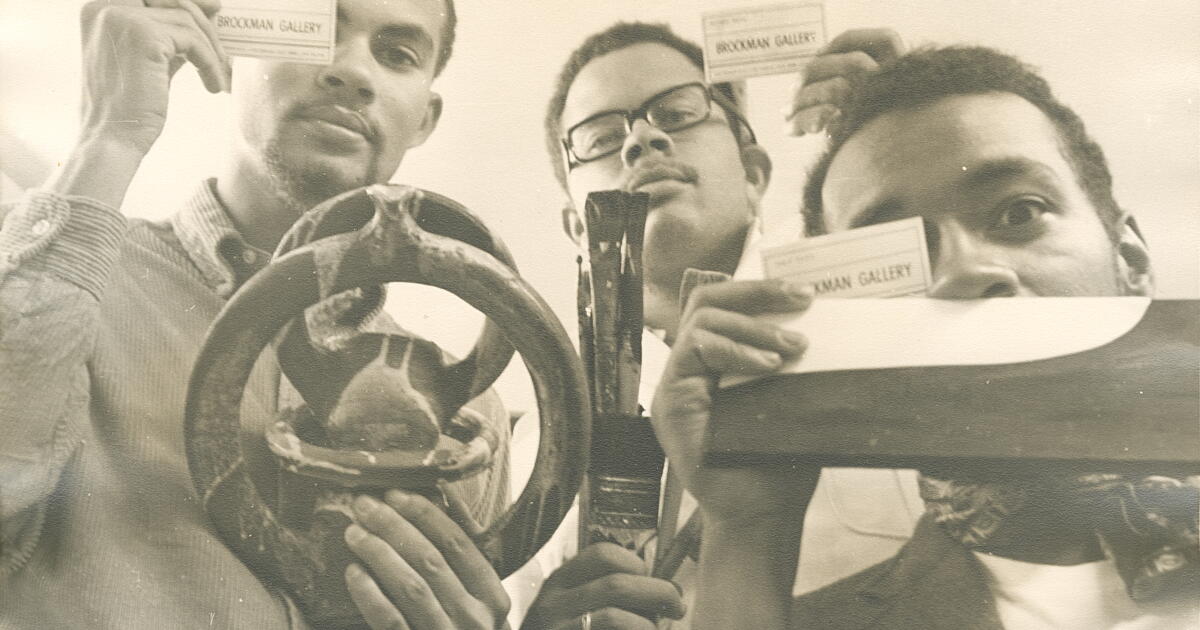
The year after the 1965 Watts rebellion, Alonzo and Dale Brockman Davis, two brothers from Tuskegee, Ala., who had moved to South Central a decade prior, traveled cross-country to visit and discover Black artists, activists and students. Dale was studying art at USC and Alonzo had studied art at Pepperdine.
The following year, on March 25, 1967, the brothers opened the Brockman Gallery on 4334 Degnan Blvd. Alonzo and Dale had looked for a location in Crenshaw and Silver Lake but settled on a storefront in Leimert Park. It was the first Black-owned art gallery in L.A. They were 25 and 21, respectively.
“As soon as we opened we were aware of the lack of opportunity for the entire minority community,” said Dale, 80, in a recent interview. “It was definitely the mission.”
Alonzo and Dale named the gallery after their grandmother, Della Brockman, and designed a logo that combined the male and female gender symbols with the letter B and an arrow. They spent the next 23 years exhibiting and cultivating more than 200 underrepresented artists of color, from emerging names to more established, now-widely recognized ones, including John Outterbridge, Noah Purifoy, David Hammons, Betye Saar, Judy Baca and Elizabeth Catlett.
“It was a mix of young artists and artists who had been doing it for a long time,” Dale said. “They had not received any recognition for their efforts. We were all new to the business. The artists that we met then are now the primary artists representing the African American community.”
Brockman Gallery grand opening, March 25, 1967.
(Tony Bishop / Brockman Gallery Archive, Los Angeles Public Library Special Collections)
LACMA is celebrating the brothers’ history with its new exhibition, “The Brockman Gallery: Los Angeles, 1967-1990,” which opened Sunday and runs through Jan. 24. It was curated by Lauren Hanson, with contribution by Dale (Alonzo died in 2025). The show features more than 60 paintings, prints, sculpture, assemblages, mixed media and related objects culled from the museum, as well as private collectors, the Los Angeles Public Library and the David C. Driskell Center at the University of Maryland. Organized chronologically, the collection traces the gallery’s evolution and influence from local artist space to cultural hub.
“Black artists had only shown in libraries, church basements and other community spaces,” Hanson said. “Brockman was really a leader. It was at the forefront of Black-owned spaces.”
A life-size photograph of the brothers and Hammons from 1968 hangs at the exhibition’s entrance, making way for works by artists who appeared at the gallery during its early years, including Purifoy who used debris and found objects taken from the Watts rebellion in his assemblages. Purifoy’s “(Untitled) 66 Signs of Neon” and “Watts Uprising Remains,” are part of the show — the latter looks like a large charred rock embedded with a pocket-sized Bible.

John Outterbridge, “Alonzo Davis at an Opening,” 1971.
(Tami Outterbridge / Estate of John Outterbridge / Parrasch Heinen)
Hammons is known for his series of body prints, which he created by greasing his body and printing it onto newspapers and paper. For “Injustice Case,” he framed the American flag around a figure who’s bound to a chair and gagged, a reference to Black Panther Party leader Bobby Seale who was imprisoned for conspiracy and inciting a riot at the 1968 Democratic National Convention.
In his own assemblage, “Home Is Where You Make It,” Dale placed a doorknob, textiles, handmade vase and cast-iron tools inside a wooden frame as a poignant interpretation of home and the transient history of Black families in America.

Alonzo Davis, “Eye of Consciousness (study),” 1983.
(Ed Mumford / Parrasch Heijnen)
“That piece is about my entire background,” Dale said. “It’s about being comfortable where you are. If you’re limited economically speaking or politically, it’s still your life and you still have to make the most of it. It was my way of saying that no matter what, I’m gonna make it. It was a proud moment. It was a personal affirmation.”
Another one of Dale’s mixed-media works, “Viet Nam War Games,” however, is more of a “political critique.” The clay, ceramic and metal sculptures look like munitions and rockets; one features a red handprint that symbolizes blood.
“It’s a pretty overt reference to the deaths of young Black men in Vietnam,” said Hanson. “There’s a sense of mourning, of fight and of objection. There’s a tension in something that’s this beautiful that’s also about decay and destruction.”
Elizabeth Catlett’s trio of wooden sculptures is another instance of art as social commentary. Her iconic, two-sided “Black Unity” features two faces on one side and on the other a raised fist, the enduring representation of the Black Power Movement and anti-racism.

Noah Purifoy and David Hammons, Brockman Gallery poster, 1969.
(Los Angeles Public Library / Brockman Gallery Archive)
In 1973, Dale and Alonzo launched Brockman Gallery Productions, a nonprofit that produced outdoor exhibitions, film festivals and community classes. They also created a jobs program for unemployed artists using government funding from the Comprehensive Employment and Training Act.
In 1984, the city commissioned 10 artists from Brockman to paint 10 freeway murals for the Summer Olympics. Drawings of Baca’s 100-foot-long mural, “Hitting the Wall: Women in the Marathon,” commemorate the first women’s marathon in Olympics history. And a canvas study of Alonzo’s own mural, “Eye of Consciousness,” incorporates the five Olympic rings, an arrow, a trumpet and Egyptian iconography.
A small room within the exhibition displays archival materials, such as books, posters, fliers, press releases, an invitation to the gallery’s grand opening and photographs, including one image of Sidney Poitier and his family attending a 1981 show.

Alonzo Davis at Brockman Gallery, circa 1980s.
(The Driskell Center / Alonzo Davis Collection)
The brothers closed the gallery in 1990; Alonzo had relocated to Sacramento, and Dale was busy working as a full-time teacher at Dorsey High School and pursuing his MFA at UCLA (though he did not complete the program).
“So many things were going on simultaneously,” Dale said. “Needless to say, we were both tired of it. It got in the way of your own personal progress.”
But the Brockman’s legacy endured long after the space shuttered.
In 2019, the Los Angeles Public Library acquired the Brockman Gallery Archive. And in the last year alone, the Brockman has been the subject of shows at the Lancaster Museum of Art and History, Vincent Price Art Museum, University Art Gallery at Cal State Dominguez Hills and Lore Bookstore, which occupies the gallery’s old address in Leimert Park.
“I want the participants of the exhibit to have a real understanding of the importance of Brockman Gallery in the position of the art world and not just in the Black community,” said Dale. “Because the expansion of Black artists over the years is truly significant.”
“Perhaps a name like Betye Saar or David Hammons might bring people through the door,” Hanson added, “but I hope they leave wanting to know more about the collage paintings of Dan Concholor, the prints of Ruth G. Waddy and the sculptures of Charles Dickson and John Outterbridge. The exhibit is as expansive as the viewpoint of Brockman was itself, and it’s a reminder that most artists are not working in a void, but working in relation with each other — and their work is stronger for it.”
‘The Brockman Gallery: Los Angeles, 1967-1990’
Where: Los Angeles County Museum of Art, 5905 Wilshire Blvd., Los Angeles
When: Oct. 18 to Jan. 24, see website for times
Cost: $15-$30
Info: lacma.org