
On a balmy July evening in New York City, I was lucky enough to be wandering around Greenwich Village with a coffee in hand, down a narrow street to the Minetta Lane (now Audible) Theatre to see Gloria Steinem speak.
Those two shows on July 14 and 16 turned out to be her last major public event appearances before her passing on Sept. 2. She spoke on a range of topics, and the program will soon be released as an Audible Original on Sept. 17. Steinem recounted her early career in journalism and was asked about her ex-lovers, but what I walked away with was her enduring messages on the importance of being understood, community and togetherness. “We acquire a certain group of people who understand us and that’s what keeps us going,” she imparted.
The event was titled “Yes to the Unknown: A Night with Gloria Steinem.” After reading her work for years, if anyone could help me face some unknowns in my own life it would be her. Maybe just being in her presence would give my brain the sort of aha moment I was seeking. But rather than the imagined epiphany, I felt a sense of calmness and joy hearing her speak and being in her presence — an energy shift.
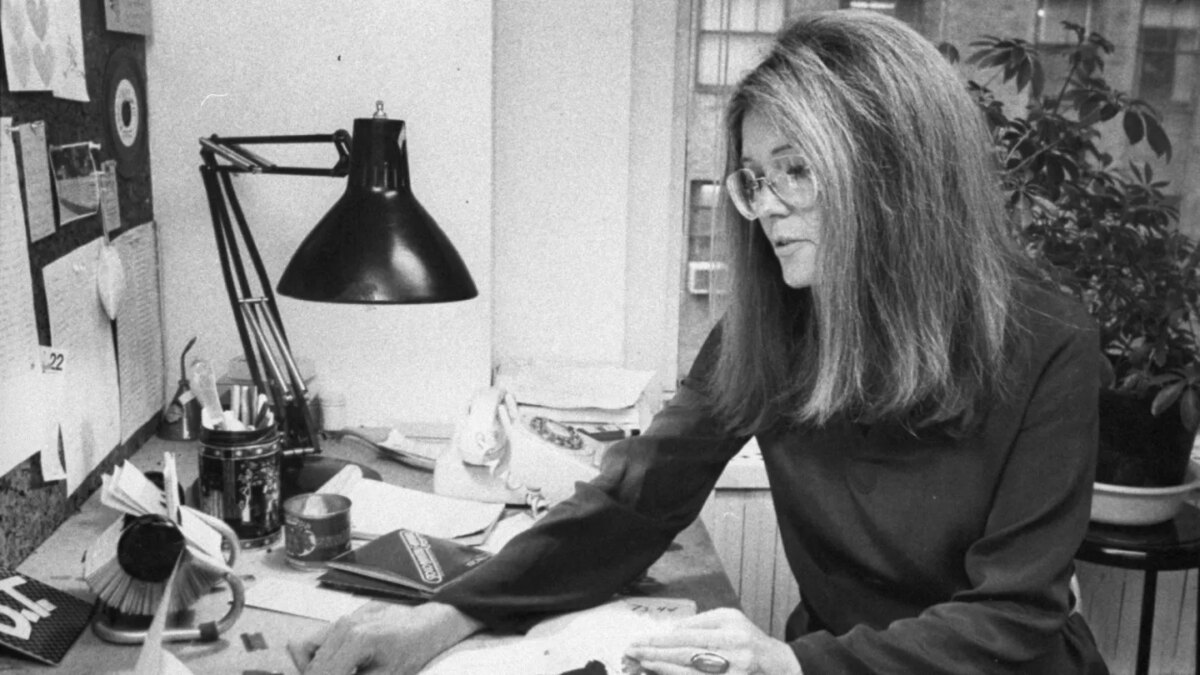
“Somewhere between poetry and journalism lies the magical land of quotes,” Steinem once wrote in her 2019 book The Truth Will Set You Free, But First It Will Piss You Off!. She offered many of her own quotes that evening that have stayed with me. In that spirit of sharing quotes, those bits of humanity, I’d like to recall a few from her final event. Her strength and wisdom is apparent in her facial expressions — she is as thoughtful as she listens as when she speaks. What I remember from the event is how her genuine smile transcended time.
A recording of writer, activist and longtime friend Alice Walker opened the night to a darkened room, her voice reverberated over the speakers with a moving poem that begins, “She is the one who will notice that the first snapdragon of spring is in bloom…” Lights illuminate back on to Steinem sitting on an orange velvet chair in a salon-like setting with photos and posters from her past on the backdrop.
The moderator, Amy Richards (a close friend and collaborator of Steinem as well as a writer and producer), opened the event by talking about her career in journalism, from her beginnings as a “girl reporter” to helping start New York magazine, which gave her a platform to help amplify the women’s liberation movement and co-found Ms. Magazine. Given there weren’t many serious opportunities for women writers when she got started, Steinem remarked, “That’s part of the reason we started New York magazine — to have a place where unexpected, diverse writers could actually write.”
In working her way to breaking through in journalism, she wrote profiles, including on Barbra Streisand, Barbara Walters, James Baldwin and John Lennon (the 1964 Cosmopolitan cover of her profile of Lennon was on display at the event’s backdrop, “Beatle with a Future”). In talking about how she learned more about the broader landscape of this musical world through writing this Lennon piece, she said, “That’s the joy, actually, of being a writer, especially a freelance writer of diverse things, you get to learn continuously through your life.”
She underlined her reverence for Baldwin, someone who she was able to profile early on for Vogue and report on at the 1963 March on Washington. “I hope just saying his name again tonight causes those of you who might not yet have read his words to discover him,” Steinem said.
“How I thought of writing as the main way of expressing myself, I’m not sure. I think partly because my mother had been and loved being a reporter for the Toledo Blade and I think I must have got infected with it then,” Steinem said. She spoke about her mother and how much she loved writing and reporting — and how she had to give that up, much to her regret: “She should’ve been able to do what she loved.”
Steinem has a way of giving hope when times feel hopeless, especially for writers and artists. She encouraged at the event, “We need your voice. We need your eyes and your heart and your way of seeing things that otherwise might never be known. So remember your favorite authors, whoever they are, and follow them and give us your voice.”
When asked about still living independently at 92, and if she ever gets lonely, she said there’s “a difference between lonely and free.” And expressed gratitude again to her chosen family of friends: “We need to support each other in our choices — that’s what friends are for, that kind of support that allows you to become the unique individual that you are.”
Richards said that Steinem recently made a list of all the former men in her life — they then went through and tried to fill in the gaps. As Richards went through some of the list that evening and named these men and asked Steinem about them, she responded with ease and a dry sense of humor. Steinem recounted a story, told a couple times, about being engaged but trying not to get married, so she made an escape to India for a couple years — which, she shared, was a very formidable time in her life as a writer and activist.
She didn’t seem to be carrying any weight of these men around — not defining herself by them or her past but embracing them for the chapter they had in her life. She had nothing but positive things to say about each, saying she still is in touch with many of their families and created her chosen family through her relationships with them and many other close friends she made over the years.
Actress Keri Russell appeared a few times during the program to read former journalistic pitches of Steinem’s from decades ago (including Vogue expressing interest in her article suggestion of “how to watch professional football games” or her pitch of “interesting bathrooms of interesting people”), letters to and from her ex-boyfriends as well as correspondences between her and Jane Fonda (Steinem, writing as part of a letter to Fonda: “It’s odd how we only realize how powerful a force was in our lives after it is gone…”).
In tying in why solitary confinement is the worst possible punishment, Steinem spoke strongly about how “we are social creatures and we need each other” — the oxytocin that is generated from us being together, that allows us to empathize. “When I was home a lot and missing community, when I first left my apartment on the street, I would experiment with just talking to the first person I saw,” she said. “And I recommend this as an experiment. Because it’s a surprise, it’s a connection, it’s empathy, it’s countering isolation.”
If anyone takes anything away from this article, it may be to try that exercise. In recent months, whenever I’ve reached out to an old friend or colleague who I’ve only met online to meet up in person, most of the time, the other person is excited to meet. It helps get past the overthinking that can sometimes come with online-only correspondence and forms a deeper connection.
Steinem has encouraged generations to nurture their relationships and build community. When asked about what we can do in these trying times she again said, “What’s precious is your feeling of being understood. You can’t live without that.”
The last words read at the “Yes to the Unknown” evening I attended was a poem titled “Fair Play” written by Steinem and pitched to The New Yorker in 1993 which, as Richards noted, the magazine rejected. (On Sept. 3, a day after her death, The New Yorker published what it billed as “Gloria Steinem’s Final Essay,” in which she writes, “Standing up for your own full humanity is an example you can give to others.”)
For me, the news of her passing hit just days after my own deep personal loss (my beloved dog, Leo, or as his friends called him, Camille). My heart already felt shattered yet completely open all at once. And Steinem’s words have felt reaffirming in this time.
I am drawn to the imagery of what she noted at the July event when asked about making friendships across generations. She poetically said, “I think there’s an essence of us that comes along pretty early — different times for different people — and it’s like reincarnation — we’re not so much needing that person or learning about that person but remembering that person, and that is so precious.”
When asked about how she not only makes friendships but also keeps them, she said, “Making friendships is a little bit like falling in love. And even after maybe the love affair is over you still retain a deep sense of connection and personal recognition and understanding of that person.” In remembering her mother and grandmother’s beliefs in reincarnation, she added, “I hope we’re recognizing it more now that it’s not just relations or marriage or obviously long friendships — that each of us leaves an understanding, a memory, a touch — something with each other.”