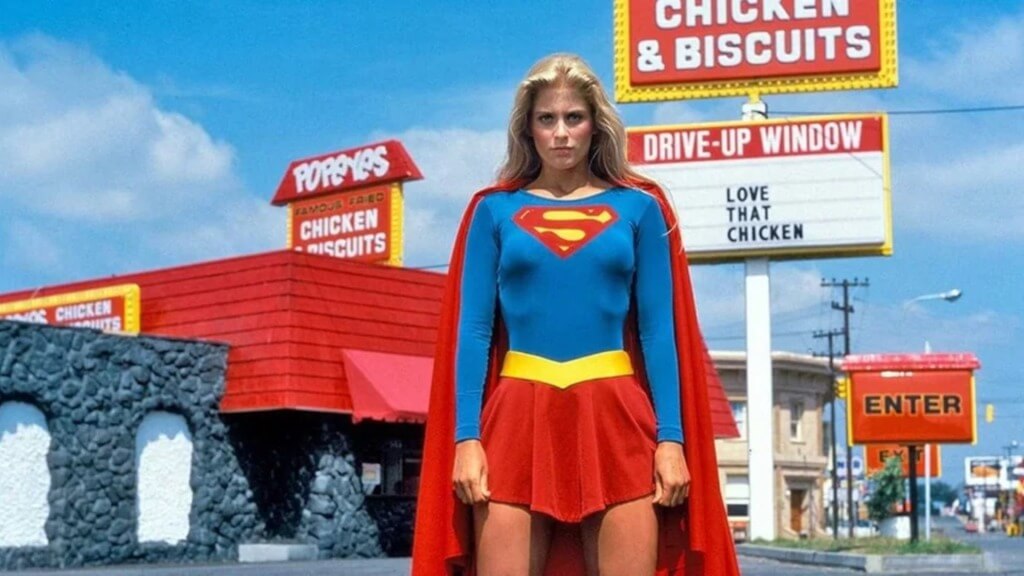
If you’re a person of color and a longtime Popeyes customer (like myself), seeing an alabaster superhero on top of the same place you regularly go to get the two-piece dark special on Tuesdays—along with one of their buttery yet notoriously dry biscuits—will never not be funny. Even critics back then recognized how much this reeked of product placement. “If the Popeye’s [sic] people didn’t cover a seven-figure chunk of the production cost for the beautiful downtown Midvale scenes, the producers were taken,” wrote one reviewer.
While Popeyes is known more these days and the place where you could get beat up for a chicken sandwich, 42 years ago, the Southern restaurant chain was a burgeoning fast-food enterprise. (The same year it appeared in Supergirl, Popeyes opened its first international location in Toronto.) A few years before Supergirl, they got into the movie tie-in game by handing out free posters for Robert Altman’s musical version of Popeye—of course!—with every purchase of a box of chicken. Back then, Popeyes hoped a cameo in a movie would get them more customers and franchises—and the people behind Supergirl were happy to oblige. “Pierre Spengler, who was the producer of the film, suggested that obviously they get money from Popeyes to help make the film,” supervising art director Terry Ackland-Snow, who was also an art director on the Superman sequels, tells The A.V. Club.
As one of the surviving members of the Supergirl crew (Ackland-Snow’s wife Rita also served as a film editor), Ackland-Snow mostly remembers how the filmmakers had to build a Popeyes from scratch. With the film mostly shot at London’s Pinewood Studios (where the Superman movies were shot), a replica—assembled by the veteran production designer Richard Macdonald (Marathon Man, Coming To America)—had to be constructed for Supergirl’s small-town setting. A Popeyes rep was also flown in to make sure everything was legit. “They sent a guy over to watch all the menus and all of that, to make sure it looked real inside,” he says. “Obviously, we can only do it by photographs. They sent the guy over deliberately, so that they got the right prices on it and everything was correct.”
This was back in the good ol’ days when product placement in major studio films was on the rise. A year before Supergirl‘s release, The New York Times reported on the dough studios were getting from companies—going from $5,000 to $50,000—in exchange for having their products appear in a movie. And Supergirl is a film that features many odd cameos from big-name brands, from the A&W logo that appears on the shirt of a creepy trucker (a pre-Max Headroom Matt Frewer) Kara encounters to the box of Kellogg’s Frosted Flakes located in Lucy and Kara’s room. Several other brands, like Tylenol and STP, also appear during the runaway-backhoe scene.
But not all companies wanted to take part in the chaos. Ackland-Snow remembers having to redesign an easy-to-obliterate gas station for the backhoe scene when a major gas giant backed out. “The gas station was Exxon at one time, and they pulled out for some reason,” he says. “I had no idea why—we built the whole set. There was going to be a fire there and I think they didn’t want to be involved with it.” Yet Popeyes was still the undeniably dominant takeaway from the film. While there’s no recorded evidence of Popeyes coming up with contemporary themed meals to coincide with the movie’s release, the most lasting promotional photos from the film are of Slater in her superhero garb, proudly standing in front of the built-for-the-screen Popeyes. (The A.V. Club reached out to Slater, but her rep stated “she really has no insights on this.”)
Now that a new Supergirl is in theater, the great Supergirl/Popeyes team-up of ’84 has been a fun thing for a few geeky observers to revisit, but Ackland-Snow (who still has never been inside an actual Popeyes) just remembers how he and his fellow Brits worked to make superhero pictures like Supergirl look as American as possible. “When we did Superman, we had New York City,” he says. “We built it, but we had different companies support by giving money and that sort of stuff, just to help build the set. I mean, if you did a Bond film and you saw a TV set that had Sony on it, Sony would give you money and they would give you the Sony things. So, Popeyes is sort of similar, really.”