

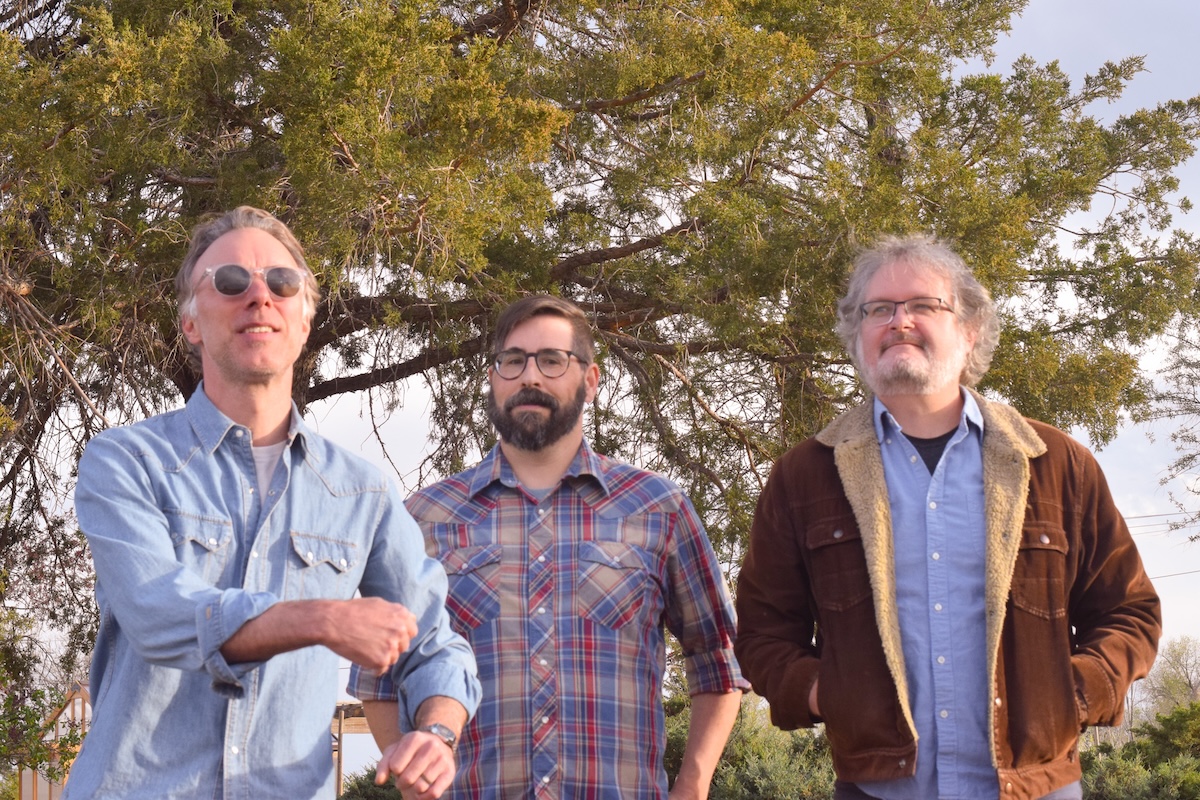
Consider the phrase “in the zone.” Usually, it refers to a state of concentration that enhances productivity. From a musical standpoint, it suggests the locked-in flow that musicians can achieve when riding a juicy groove or digging into a wicked series of riffs. To “zone out,” on the other hand, evokes a blissful state of ethereal detachment in which such things as rhythm and momentum are left behind or transcended. Colorado trio Prairiewolf operates in both these realms, creating limpid yet propulsive instrumental music that faces the stars while remaining focused on doings on the ground.
For their first two albums, Stefan Beck (guitar), Jeremy Erwin (keys/synths), and Tyler Wilcox (bass) created retro-futuristic lounge music for lonesome interstellar commuters—think “Music for Spaceports.” The gentle contrast between the burbling electronic percussion, warm keys, and nodding bass held your interest even as it lowered your blood pressure. Beck’s use of sunset-hued lap steel and the band’s general adherence to relaxed tempos aligned them with the emerging country ambient scene, but the electronic colors and textures—humming with the midcentury grain of transistors and tubes—hinted at something beyond low-key pastoral atmosphere. Prairiewolf has always seemed bent on finding new territory while being in no particular hurry to get there.
On Zone Poems, the ‘wolf continue their gradual exploration by trying something a little different. The six tracks originated as live material, all previously unreleased, from two shows in 2025, one in the spiritually eclectic hamlet of Crestone (once home to the Love Has Won cult), the other in Denver. The band then overdubbed, cut, and combined the concert tracks, essentially making them into fresh creations. (A bonus CD contains earlier, rawer versions of the songs, for the real ‘wolf heads.)
This modern methodology, also frequently employed by ascendent jazz jammers SML, adds artful friction to the Prairiewolf terroir. Tracks like the 10-minute opener “The St. Vrain Method” (named for a French-American explorer, not a religious figure) manifest the band’s usual easygoing sprawl, but with richer tones, stranger timbres, and more vibrant details. The crisp cymbal sound of the drum machine now cuts through the bed of glowing guitar and Tangerine Dream-inspired keys like scissors through a sheet, while also having more to slice— the melodic motifs and harmonic patterns have grown much denser. A dub component features heavily—the midsection of the initially swanky “Modifications” takes a turn into echo and delay, piling up melodic figures and endlessly reflecting Beck’s brittle licks, while the percussive keyboard arpeggio that opens “Burning Edges” is accompanied by a whirring, spectral drone that gives its Germanic edge an unsteady (Jah) wobble. Sometimes, detours threaten to take us off the map—”Edges” shifts into a dangerously chillwave-adjacent tropical groover after its cool, streamlined beginning—but Prairiewolf usually finds its way back to solid ground, even if that terrain, though familiar on the surface, proves utterly transformed once it’s lit upon.