
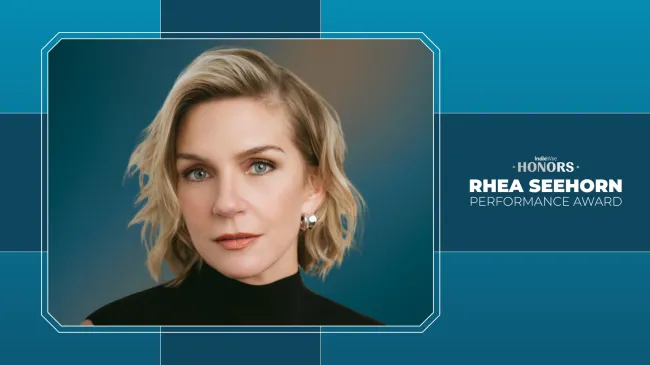
On June 4, the IndieWire Honors Spring 2026 ceremony will celebrate the creators and stars responsible for crafting some of the year’s best television series. Curated and selected by IndieWire’s editorial team, IndieWire Honors is a celebration of the creators, artisans, and performers behind shows well worth toasting. In the days leading up to the Los Angeles event, IndieWire is showcasing their work with new interviews and tributes from their peers.
There’s a moment early in Rhea Seehorn‘s career on “Better Call Saul” that she still thinks about. She was filming an argument scene with Jimmy McGill (Bob Odenkirk), and at the very end of the take — instinctively, without realizing it — she smiled.


Showrunner and director Peter Gould came over afterward and said, gently, that he’d loved the way she ended it in rehearsal, without the smile.
“I realized I had done that to soften it,” Seehorn said. “Because I got very hot in the arguments and instinctively, because of things we’re told in this business as women, I softened it when it came time to film. And I hadn’t even realized it.”
It was, she said, the beginning of something. “That was the beginning of me starting to trust that they just want me to play this role. It is not my business to worry about whether people like her or not.”
That trust — built scene by scene, script by script, over more than a decade with Vince Gilligan and most of the same crew — is the invisible architecture of “Pluribus,” the show Gilligan built around Seehorn and for which she’s receiving an IndieWire Honor.
The series asks her to carry nearly every frame, including long passages with no dialogue at all. It is, by any measure, an extraordinary piece of work. And Seehorn will tell you, with complete sincerity, that she couldn’t do it alone.
“I am not alone,” she said. “I have 250 people doing a dance with me with lights and sound and dolly and all of that stuff.”
Collaboration is not a word Seehorn deploys casually. It is the organizing principle of how she thinks about her work, rooted in her theater background. The knock on stage actors, she said, is that they’re “too big” for camera. “Then you’re watching bad theater,” she said.
What theater actually taught her is the same thing that makes “Pluribus” work: how to hold a space, how to breathe with an audience, how to invite people in without telegraphing where you’re going. “I’m just thinking the thoughts,” she said of the silent passages in “Pluribus.” “And I’m kind of trying to invite this audience through the lens to go down this rabbit hole with Carol.”

When Gilligan first told her he’d written something for her, he offered almost nothing by way of pitch. It has nothing to do with the “Breaking Bad” world, he said. It has a slight sci-fi bent. He wasn’t ready to send the script yet. That was it.
She waited a month on pins and needles. When she finally read it, she went through the same experience she imagines viewers did — funny, then strange, then mysterious, then suspenseful, then deeply upsetting. “I thought: ‘This wily monster. I would be obsessed with this show if I watched it,’” she said. “And then I’m like, ‘Oh, wait — I’m gonna be in it.’”
Being number one on the call sheet — in almost every scene, first up and last up, day after day — is a different kind of obligation. Seehorn describes it in almost athletic terms: the prep, the sleep, the discipline required to show up with ideas rather than just open eyes. But she also describes it as a responsibility to the crew whose names are unlikely to appear in awards coverage.
She tells a story about the show’s sound mixer, Phil Palmer, who figured out a way for Seehorn to speak to another actor through a television screen in real time — the actor standing just offstage, connected by phone, while the camera rolled — because he thought it would free her performance.
“I just wanted to cry,” she said. “He’s doing that so my performance could be as great as it could be, and he’s never going to get credit for that. There’s not going to be any footnote at the end of the episode. That’s just him going the extra mile because it might help tell the story better and give me the chance to soar.”
She learned this model, she said, from watching Odenkirk on “Better Call Saul” and from theater, where the ensemble was always the point.
“One of my favorite things about my job is that it’s a collaborative art form, not a solo art form,” the actress said. “Whenever I can invest in that, my work gets better and the joy in it grows bigger.”
Gilligan, for his part, has a strict no-asshole policy on his sets and means it. Seehorn endorses it with the fervor of someone who has seen both sides. The rare times she has witnessed genuinely bad set behavior, she said, her first instinct is always to laugh — not because it’s funny, but because she assumes it can’t be real.

“I always think it’s a joke first,” she said. “Because it’s like, ‘Are you a character in a movie about bad actors?’ I never think it’s real first and then I’m like, ‘Holy shit.’”
She’s thought about why behavior like that persists, and why it gets rewarded. “Don’t tell me you can’t be successful and a brilliant genius without being a dickhead,” Seehorn said. “Obviously that’s not true.”
She’s been contacted recently by people she worked with decades ago, people who wanted to say they were glad to see hard work and decency recognized. “It’s really great to see people work their ass off and get rewarded for it,” she said, “rather than the people we all know where you’re like, ‘Hmm, why did that person get rewarded for that behavior?’”
The practical case, she argued, is pretty simple. Scream at people and you might get compliance. Treat them like partners and you get something else entirely. “Your crew and your cast — they will go to the mat for you,” she added.
The bar, she acknowledges with some weariness, is not actually that high. “We are three-dimensional humans with ideas and bad days and breakups and people go through everything,” she said. “It’s sad that that has to be the line we shouldn’t go below, but really, that is the line. Just don’t be an asshole.”
For Seehorn, it circles back to the same place everything does: the 250 people who set their alarms, showed up, and are waiting. “I still ran away with the circus,” she said. “And I know so many people out of work right now. I owe it to the spirit of all of that to be aware that this is still icing on the cake.”
It shouldn’t sound radical. In 2026, somehow, it still does.
Season 1 of “Pluribus” is now streaming on Apple TV.