
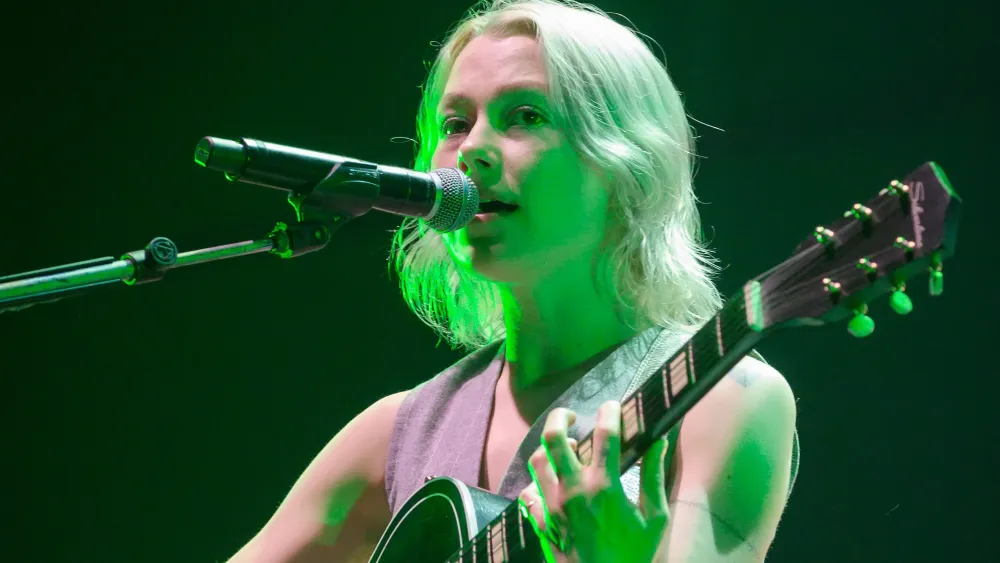
“It’s weird not having a phone, isn’t it?” said Phoebe Bridgers to the 18,000-or so strong audience who’d willingly had their devices locked up for Thursday night’s special acoustic concert at Madison Square Garden. “I love it. I appreciate you allowing this to be an internet-free zone.”
She added with a smile, “And if any of you stuck an Apple Watch up your ass to record this, please don’t post it on the internet — I’m trusting you.”
The rules for this concert — the first phone-free arena show we’ve ever attended, and possibly the biggest ever — were posted in a sternly worded statement on Madison Square Garden’s website when this $1-per-ticket benefit for the Community Justice Exchange’s Immigration Bond Freedom Fund (which provides bail money for ICE detainees), sponsored by the Tidal streaming service, was announced on Monday.
“Device Free Show,” it read. “Per the artist’s request, no recording devices will be allowed at this event, including but not limited to the items listed below: No cellphones No cameras No tablets No laptops No smart watches No bluetooth enabled headphones. Upon arrival, small devices will be secured in Yondr pouches that will be unlocked at the end of the event. Guests will maintain possession of their Yondr pouches throughout the night, and if needed, may access their devices at designated Yondr unlocking stations in the lobby. We appreciate your cooperation in creating a device-free viewing experience.”
Reporters covering the show were told that pens, pencils and paper were not allowed either, apparently because inaccurate lyrics and song titles were being posted on the internet.
Similar rules were in place for the dozen-odd shows Bridgers had played leading up to this one, but they were all in club-sized venues in third-tier markets like Fargo, North Dakota and Huntington, West Virginia — and suddenly they were trying to do it at Madison Square Garden.
Precious and/or obnoxious as it all may sound — not to mention logistically challenging — she and the venue pulled it off remarkably smoothly. The lines to pouch the phones were long but moved efficiently, and the extremely polite staffers wrote your section, row and seat numbers onto custom tickets before pouching your phone, and simply asked if you were carrying any of the other contraband (although security were scanning the audience with handheld telescope devices throughout the show).
And as the show began, the objective almost seemed to be less about preventing premature publicity for the many unreleased songs that Bridgers performed than evoking a long-gone era that most of the audience never experienced: a time when an artist could road-test new material without it being available to millions within seconds, and audience members could see a concert without having their view obscured or completely blocked by multiple people taking video they probably never will watch.
More importantly, that intimacy extended to the show itself. Bridgers performed on a small circular stage set up to look like a 1970s rec room. She and guitarist Christian Lee Hutson sat on a couch covered by a cheesy patterned knit blanket, with lamps on either side, as well as a boxy old TV, black-light posters, a lava lamp and candles. Live video of the performance (and occasionally the TV) was broadcast onto the scoreboard screen hanging from the middle of the arena ceiling, but the picture was intentionally grainy, like an old television broadcast. Keyboardist Nick White was the only other musician; the only percussion was an occasional bass drum that Hutson operated with his foot. The set’s vibe was very “Stranger Things,” an impression amplified when, during the show’s more intense moments, the lamps flickered like Vecna was approaching.
In an unplanned throwback to that earlier era, at one point during a particularly emotional song, a hundred or so audience members across the arena held up cigarette lighters instead of phones.
Bridgers, accompanying herself on a succession of acoustic guitars and a Mellotron keyboard placed in front of the couch, opened with fan favorites “Motion Sickness,” “Waiting Room,” Kyoto” and “Moon Song.” But most audience members knew a heaping batch of long-awaited new songs was coming — Bridgers’ first new material since the Boygenius album in 2023.
She reeled off seven new tracks in a row, which journalists were politely asked not to reveal much about. Several are of a piece with her previous work, with her trademark melodies, whip-smart wordplay and emotional vulnerability; at least one seemed to be about a painful breakup. Yet a few explore new territory: She introduced one as “a country song” that found her adopting the style and cadences of the genre with impressive ease; another featured a menacing and intense finale with her voice soaring to the top of its range.
She talked to the audience often, asking if they had “defective parents” and spoke about how her late father (with whom she had a troubled relationship) managed to transcend his conservative upbringing. She thanked Tidal for sponsoring the show and “paying artists more than any other platform.” She announced that she’ll be touring this fall — with dates coming on Friday morning. And although she twice referenced the fact that she was performing in the home of the city’s beloved New York Knicks, an audience member didn’t shout “Let’s go Knicks!” until the end of the show.
But most poignantly, she thanked the crowd for supporting the cause that the show benefits: “I fucking hate ICE agents.”
And in a surprise, she added “a song we’ve never played before” toward the set’s end — “So if I fuck it up, don’t tell anyone.” We won’t reveal lyrics, but there were references that made the New York audience cheer.
Bridgers closed by thanking the musicians, the sound and lights guys and her guitar tech — all by name — and encouraged the audience to sing along and get their screaming out on the closer, “I Know the End.” At the song’s frantic finale, she got off the couch and walked to the front of the stage, banging her head for the evening’s only big rock moment — a cathartic way to close an otherwise low-key show that asked a lot of her audience.
And for all the corny comments one could make about What Really Matters when experiencing art in the Instagram age, it was a welcome change to enjoy a show without trying to impress the internet. Bridgers’ MSG set was a new peak in a year that has seen artists like Justin Bieber and Olivia Rodrigo play such fan-centic shows where not only phones but journalists aren’t officially allowed, and now that Bridgers has pulled it off at Madison Square Garden, it’s likely to be adopted by many more.
Indeed, our only regret after this ambitious concert is that we didn’t invent cell-phone pouches years ago…