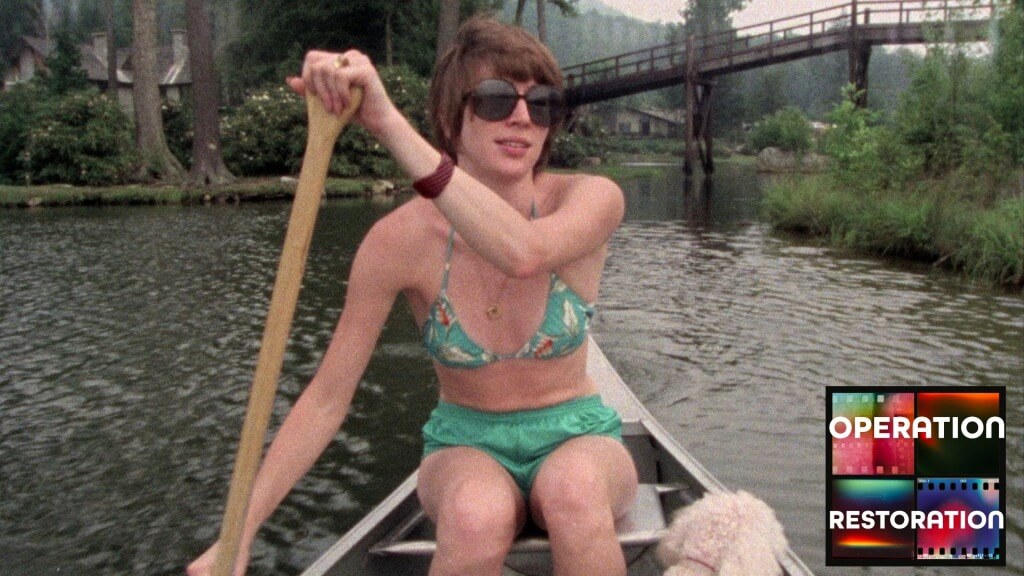
There’s Pat, a lively girl-next-door and aspiring actress who dreams of Burt Reynolds, not of settling for just any good old Southern boy. When he’s getting his car fixed, McElwee meets Claudia, a religious mom, and later ventures out to the rural wonderland a linguist named Wini calls home. As his road trip continues, his friend Charleen introduces him to a Mormon singer named Dee Dee, but McElwee’s attention soon follows a hot rocker named Joy, before trying his luck again with a former flame, Karen. As his series of romantic prospects fizzle out, McElwee muses directly to the camera on various topics including love, faith, family, nuclear anxieties, and of course, General Sherman. Today, his conversational diary-like entries could fit in alongside any number of creators sharing their day-in-the-life observations in an endless feed, but this was a groundbreaking formal move in a documentary field that almost never saw the director in front of the camera, let alone got to be privy to his love life. Even though McElwee starts the project from a place of heartbreak and worry, the tone remains mostly upbeat, enamored with each new person that greets McElwee’s camera and amused by the ironies of life, such as when one of his former dates calls her boyfriend over to help him with his car.
Revisiting Sherman’s March for its restoration, McElwee notices that much has changed since he started filming in the early 1980s. “Back then it was possible to get the kinds of material or the kinds of scenes that you can’t possibly hope to get now with the same approach,” he says. “I did no location scouting. I did not do pre-interviews for anything. In fact, there are no formal interviews in the whole film. It’s really a matter of just drifting around with the camera, following my instincts and responding to people.”
Like in John Wilson’s series, each person who steps in front of McElwee’s camera adjusts to speaking to him through the lens, candidly sharing secrets or passing thoughts. Some conversations between the director and his dates get deep and emotional, some reveal early on that their personalities or goals clash, and their time together will be short. McElwee’s narration, although calmly recited, holds onto the hopes of romantic sparks and captures his crestfallen reaction when those hopes are dashed and his romantic interests move on without him. Even if he only appears briefly to talk to the camera or in a mirror holding his camera, the way he uses the camera to view the world tells the story.
“Now,” McElwee explains, “the other side of the equation is that people, at least down South, were so much more relaxed about being filmed. That’s just not true anymore over the entire United States, including the South. The internet has changed things tremendously. I see it in the students, their frustrations with trying to make films and discovering that often people change their mind about being filmed partway through a project, and they have to start over on some totally different topic, mainly because people start thinking about how this will be perceived when it’s seen online. The political environment has changed a lot for the worse, in my opinion, and people were simply more relaxed and seemed to be enjoying their lives more as I filmed in the South, which is also where I’m from. Everybody’s so self-conscious about how they’ll appear on film and with good reason. I think they’re wary of cameras.”
One of the major players to emerge from the succession of would-be dates is McElwee’s former teacher-turned-confidant, Charleen Swansea. The subject of his 1980 graduate thesis, Charleen appears in a number of McElwee’s movies. She’s a star of her own, a source of comic relief against McElwee’s insecurities, chiding him for being “camera shy in a reverse way.” She’s unafraid of making dirty jokes and scolding McElwee for filming everything. “This is not art! This is life!” she tells him after trying to get him to put the camera down. She’s the life of the party, doling out unsolicited romantic advice and support.
Most of McElwee’s movies center on people like her, subjects he knows and loves, giving each film a deeply personal touch that feels at home in the digital age. Sherman’s March is also the key to Remake, the new film he’s releasing on July 10. Remake traces the attempt to give Sherman’s March a Hollywood makeover and reexamines the director’s films after the death of his son, Adrian. Charleen features prominently in the new film, from her scenes in Sherman’s March and his earlier movies. “Without Charleen and without the humor that’s implicit in the notion of trying to turn Sherman’s March, a documentary, into a Hollywood fiction film, Remake would be unbearable watching [sic], because it’s just so tragically sad,” McElwee says. “There’s a writer named Christian Metz who’s written a lot about movies. One of the things he writes about is how the absence of someone on screen, the absence becomes a presence. What he means by that is that nobody lives forever… The Lumiere brothers were very dedicated to filming their own families and similar things. But by now, all of those people are dead, and yet there they are.”
McElwee’s idiosyncratic, first-person approach to documentary storytelling set him apart from his peers and challenged the nonfiction field to allow for different modes of personal storytelling. In today’s tell-all internet age, his work may seem tame, but there’s an artistry to the way McElwee explores his musings and insecurities, from his romantic shortcomings to his sleepless nights. He leads his audience through these many threads, weaving them together to make a full, complicated picture. With his camera, his calm presence allows his dates to open up and become themselves, relating to him—and by proxy, his audience—in a way many viewers hadn’t seen in a time before the heyday of dating reality shows. Sherman’s March may be a time capsule of the 1980s South and a pre-internet age, but it also foretold the ease with which everyday people could film themselves talking about themselves.