Yet Disney kicked off the 2010s with Tangled, and the Rapunzel retelling became the biggest-grossing Disney cartoon since The Lion King. Three years later, Frozen obliterated those records with its innovation of including two Disney Princesses in a single film (and giving one of them superpowers; very au courant in a post-Marvel world). Three years after that, Moana completed this unofficial trilogy of computer-animated movies that didn’t just include princesses, but were actively about them, attempting to represent a fuller spectrum of life experiences than the marriage-centric concerns of even the more progressive ’90s characters. With The Princess And The Frog serving as a transitional text, Disney had finally made princess movies as strong as their fanbase’s devotion to them.
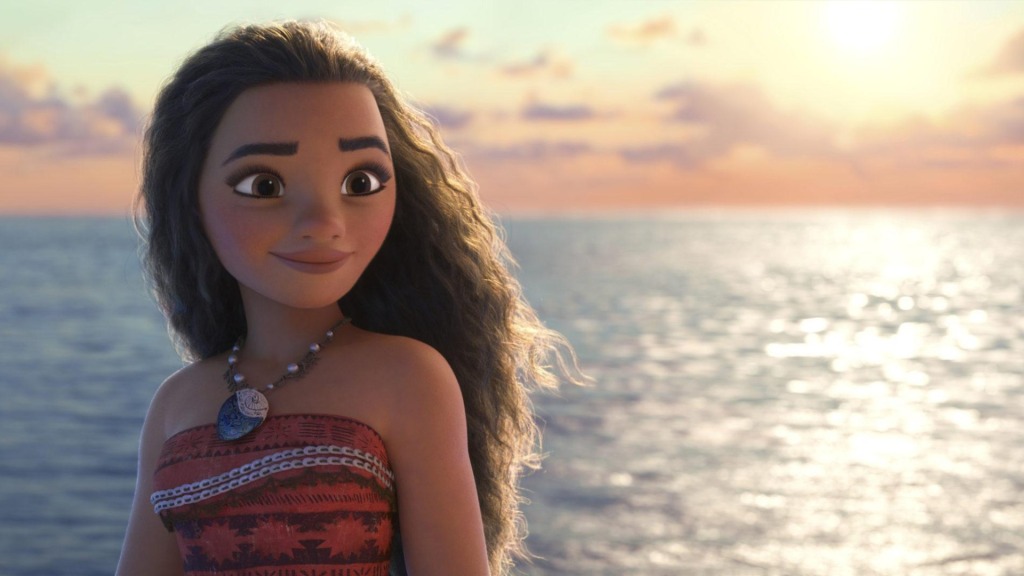
Among these three very good CG-princess cartoons, Moana stands out because its growing pains are vastly less obvious on screen. The hero’s-journey story of Moana (Auliʻi Cravalho) defying her chief father to venture onto the high seas and find Maui (Dwayne Johnson) in order to save her ailing island proceeds smoothly on a screenwriting level, with the heroine eventually summoning the self-confidence, ability, and humility to match her wanderlust. The seams on Tangled and Frozen are far more visible, sometimes to those films’ advantage: The odd rhythms of Frozen make it particularly unpredictable, as if the characters (and filmmakers) are finding themselves in real-time alongside the audience, unconsciously aware that it could easily all fall apart before the climax. But on a level of pure, confident craft, Moana is the apex of the Disney Princess form. Even so, the movie is slightly sheepish about that label; in response to Maui calling her a princess, Moana herself protests that she’s actually the “daughter of the chief.” Maui’s retort, though, cleverly serves as both a critique of Disney stereotypes and a just-go-with-it entreaty: She’s got a dress and an animal sidekick; in Maui’s eyes, she counts.
Johnson’s Maui is key to the movie’s success, not because he overshadows Moana but because Cravalho is allowed to overshadow a performance from the biggest movie star in the world at the time. Maui might even be Johnson’s best performance; he’s certainly one of his best-rounded characters, and gives Johnson the opportunity to do comic wisecracks, show genuine emotion, and bring the house down with a showstopping musical number. Yet the emotional core of the movie belongs to Cravalho’s Moana, in large part because the movie takes the formal responsibilities of a princess seriously; Moana grapples with how to express her love for her people (adventuring versus traditional obedience), rather than yearning for a fairy-tale ending or an escape from that obligation. It is genuinely thoughtful without resorting to corporate-driven girlboss clichés; Maui’s more self-regarding starting place for his own journey, more conscious about his own supposed heroism, serves as a productive contrast. In fact, their contrast encapsulates the appeal of the Disney Princess in general: The princess characters are more connected to the worlds around them—whether the animal kingdom, an outside world that they yearn for, or a greater kingdom—than to their own egos (even if that means earlier princesses expressed their connections and kindness during their long wait for a princely boyfriend). By the time the princess movies reach Moana, they’ve reconciled how a Disney Princess would involve genuine leadership rather than making baby-steps away from passivity.
The quality of those movies, Moana in particular, also underlines the difficulties of translating the Disney Princess into live-action. Some of those difficulties are the unavoidable and unfortunate byproduct of the scrutiny women receive on and off-screen; look at Rachel Zegler, who gave a perfectly charming movie-star performance in Snow White, only to become the poster child for the movie’s financial woes and the target of a bunch of anti-woke grifting. (It didn’t help that she was stuck in a benign-nightmare theme-park version of an animated classic; at the same time, it’s not as if the forgettably likable fellow who played Aladdin faced that level of vitriol.) More broadly, though, Disney characters are often caricatured by design, and a real actress embodying those qualities must jump through near-impossible hoops. Lily James got better notices for her 2015 version of Cinderella than Zegler did as Snow White, largely focusing on the radiant sunniness of her portrayal, but then, those earlier caricatures of trilling femininity have a lot more room for expansion than their 2010s counterparts.
As much as the ghastly Lion King remake proves that talking animals are far more expressive and emotionally “realistic” in a cartoonier context, the modern Disney Princess may be an equally difficult type of cartoon to translate into live-action. It’s not the fault of Catherine Laga’aia, the young actress tasked with bringing Moana to life in 2026, that the character doesn’t work in live-action. Laga’aia is poised, likable, and has a nice singing voice. She also doesn’t have room to move like Moana, with the cartoon’s mix of youthful bravado and knockabout slapstick; she often looks frozen in place by comparison. That points to flat direction, but also animation’s facility with showing a character so connected to her environment. It’s hard to portray Moana’s one-ness with the living ocean when she looks like a person and the ocean looks like a bunch of shiny pixels.
The Disney Princess age range—old enough to read as responsible and self-sufficient, but young enough to read as innocent and not fully formed—also presents a problem. It means whoever embodies Moana must put forward some form of gawkiness while nonetheless hitting their marks with precision; a true novice would seem too literally lost at sea, while child-actor polish would be off-putting. The interplay between Cravalho’s vocal performance and the physicality supplied by the animators results in the ideal give-and-take that allows bigger, broader gestures than can comfortably exist in live-action. For anyone, kid or parent, who has seen Moana a dozen times or so, Laga’aia is competing with Cravalho’s line readings; it often feels like she’s shrinking from them. For a cartoon princess to become live-action without reading flat probably requires something like Amy Adams’ work in Enchanted: high-wire performing with notes of satire. The older model of Disney Princess provides more to work with; there’s nothing about Moana, Elsa, or Rapunzel that begs for sly satire.
Ultimately, the reasons that Disney Princesses are such tricky live-action propositions are similar to those cited as the difficulties of existing as a woman in the live-action version of Barbie. That movie’s climactic speech about the impossible contradictions of womanhood easily applies to the fictional women of Disney, who are expected to endear global audiences while maintaining some degree of cultural specificity, to delight stereotypical girls without alienating stereotypical boys, to preach individuality while adhering to rigorously high standards of adventuring and singing. Perhaps that’s why, even faced with the global success of Frozen and Moana, Disney could barely bring itself to make another unabashed princess movie (Wish has more of the trappings; Encanto more of the spirit). Mostly, the studio fixated on Frozen II, Moana 2, and so on. The 2016 Moana may have been the last time a Disney Princess could function as her own person: Comfortably feminist, largely insulated from culture-war nonsense, yet not dismissive of previous movies’ forms of femininity. Plenty of younger viewers may get that from the live-action Moana, but they won’t be watching nearly a century of animated tradition come together. They’ll be watching a brand built on past triumphs.