
How a Marvel fan edit that inspired and challenged me, creative debates with Adela, and two years of after-hours experiments turned a side project into a personal laboratory for rhythm, emotion and story.
“For me, music-driven editing became less about cutting on the beat and more about hearing when to cut – and, sometimes more importantly, when not to cut.”
It started as a challenge
I did not start Movie VS Song with a manifesto. I started with a very simple reaction: I watched madxthing’s MARVEL | Blinding Lights and thought, ‘I could try this too.’ It inspired me, but it also challenged me. It was the kind of edit that made images and music feel as if they had somehow been waiting for each other, even though they came from different worlds. I did not want to copy it. I wanted to understand why it worked and whether I could reach that same feeling of inevitability through my own instincts.
My first experiment was Marvel Cinematic Universe vs Bones, using Imagine Dragons. Legends Never Die followed. At that stage I was playing more directly with energy: impacts on drums, entrances on choruses, movement carried between different Marvel films, and a gradual increase in scale until the climax. Looking back, Bones is honest about where I began. You can feel the pleasure of discovering synchronization. Sometimes I cut very explicitly on a musical accent. At other moments, without yet having a theory for it, I held a shot a little longer, especially around the Endgame portals or Tony Stark before the snap. The seed of what would matter to me later was already there: not only where the beat lands, but how long an image needs to live.
I was not starting from zero as an editor. I had close to two decades of professional editing behind me. What I was starting from zero with was something different: a personal voice that no brief had asked for. At work, an edit answers a defined need. On the channel, the question was mine. What happens if I take a film I love and a song with the same emotional temperature, then try to build a new story between them? The satisfaction after finishing an edit was so strong that after the first one, I simply did not stop.
Adela, my first audience and our home laboratory
Many of the early combinations began as a game between Adela and me. We would throw films and songs at each other. Some ideas died in ten seconds. Others seemed to magnetize. When we felt that pull, the debate began: which character should lead the song, where the chorus should enter, whether a lyric was becoming too literal, whether a beautiful shot deserved to stay or had to be sacrificed for rhythm. We disagree often. That is part of why the process works. An idea I love has to survive her eyes as well as my own enthusiasm.
Adela is one of the reasons the channel exists at all. I wanted to impress her with every edit, and over time she became more than the first viewer: a creative partner, counterpoint and muse. She contributes with as much passion as I do, even when that passion puts us on opposite sides of the timeline. I like that the journey is not perfectly harmonious. It is more truthful that way. Beyond all the arguments about frames and songs, I love her very much. For me, part of the channel’s identity is inseparable from the ritual we built around it together.
At the same time, I was sending edits to my colleague Alin Surdu, one of the people I consider a mentor in my study of editing. His feedback often pushed me beyond the first ‘acceptable’ version. I tried to listen to other colleagues too, especially when their notes were uncomfortable. I am not saying this to construct the image of a very self-assured editor. It is almost the opposite. I doubt what I do a lot. What I have learned is to tolerate that doubt long enough to keep working, to avoid repeating the same mistake and to try one more version.
Hearing the instrument, not only the beat
Over time, the most important change was not a new effect or a more spectacular transition. It was the way I listened to music. In the beginning, a kick or snare was an obvious invitation to cut. Later I started hearing layers: the attack of a guitar, a bass line pulling the image forward, a synth tail asking for continuity, an orchestral rise capable of holding a shot, a pause in which the absence of a cut becomes the accent.
This is still the hardest part for me to explain technically because it feels almost physical. I listen to an instrumental again and again until the sound begins to suggest movement, weight and duration. Sometimes a drum asks for an impact. Sometimes a musical phrase says, ‘not yet.’ Sometimes a movement that begins in one film can continue in another, and the ear accepts the connection before the mind does. In the best moments I feel as though I am translating sound into emotion, then searching for the image that carries the same emotion.
That gradually became my personal rule. I do not want the viewer to notice every synchronization and think, ‘there, he cut on the beat.’ I want the rhythm to be felt before it is analysed. Sometimes the montage should dance with the music. Sometimes it should resist slightly, delay, allow a look to hurt or a gesture to finish. If I had to describe the channel’s development in one technical sentence, it would be this: I moved from enjoying synchronization to accepting the responsibility of deciding when not to synchronize literally.
Wanda: when synchronization became psychology
Doctor Strange in the Multiverse of Madness vs Papercut was one of the moments when I felt Movie VS Song could become more than an energetic montage. Linkin Park’s song is full of paranoia, inner voices and the idea of another face beneath the visible one. Wanda already contained all of that dramatically. I used Jung’s idea of the ‘shadow’ as a lens, not as a diagnosis and not as an academic claim: the repressed part of the self that can begin to control us if it is never acknowledged.
In the edit, I built two Wandas visually. Xavier approaches the vulnerable Wanda who appears trapped, while her corrupted form breaks through barriers in a parallel line of action. The psychic space is bright even while the lyrics speak about darkness. To me, that contrast says the night is not in the location. It is internal. When Xavier fails, I do not see the moment only as a Scarlet Witch victory. It becomes evidence that Wanda’s destructive self has taken control.
Doctor Strange follows the opposite trajectory. With Zombie Strange, the part of him that should be rejected or feared becomes literally visible. He falls through darkness, then uses the souls of the damned instead of simply fleeing them. In my reading, it is a form of shadow integration: he does not become ‘pure’; he recognizes something frightening in himself and places it in the service of a conscious choice. Wanda moves the other way, increasingly governed by what she cannot accept about her own grief.
America Chavez becomes the mechanism of clarity. She does not defeat Wanda with a bigger punch. She opens a door to reality. When the children in the alternate universe recoil from Wanda, I slow the montage down. After so much rhythmic aggression, I let the reactions last. The emotion changes from supernatural spectacle to shame, guilt and self-recognition. For me, the ending works because it refuses to be the loudest moment of the edit.
In the Behind the Edit video I made this construction explicit because I wanted to show that the synchronization was not decorative. The symmetry of the two Wandas, the doorway, faces, eyes, falls, colour contrasts and the deceleration at the end were parts of one idea. If Bones was mainly about the energy of a universe, Wanda was trying to change the way we emotionally read a character: not simply villain or victim, but someone split between desire, loss and a part of herself she can no longer control.
The Tomorrow War: when the music began writing the structure
With The Tomorrow War vs Formula of Fear I pushed that experiment further. I opened near the emotional peak: Dan falls through the sky and tries to catch his adult daughter. Then I cut back twenty-eight years to his family life. That decision changes the meaning of every peaceful image that follows. The viewer knows there is a fall somewhere in the future and, even without an immediate explanation, begins looking for the road that leads to it.
Here I did not want to rely on a chain of synchronized impacts. Formula of Fear gave me long phrases, electronic textures, piano passages and rhythmic explosions. I held on the laboratory work, glances and goodbyes; I accelerated through alien attacks, aircraft and collapse. The recurring hand and falling motifs keep returning until the opening gesture gains a different meaning at the end. An action that begins as failure and separation can later become action and survival.
The Tomorrow War Behind the Edit was important because it forced me to verbalize decisions I had previously made mostly by instinct. Why begin with consequence before cause? Why repeat a movement? Why cut from one fall into another gesture travelling in the same direction? Why allow the piano to empty the frame before the next explosion? Once you can explain a choice, you also start judging it more severely. For the viewer, I hope the result moves the material away from simply ‘science-fiction war’ and toward a story about a father trying to save a daughter he has not lost yet.
When I began trusting the pause
Fight Club vs Where Is My Mind? marked another shift. Instead of compressing the film into chronology, I tried to rebuild it as an internal psychodrama. Telephones, windows, hands and Tyler’s appearances become recurring motifs. The cinematic cover lets me hold longer on waiting, on the Narrator’s stare, on the sensation that reality does not quite connect. Violence appears as a controlled release rather than the permanent state of the piece. When the gunshot hits the musical peak, it is not just an impact. It is the collapse of a projected identity. The final image with Marla, the hand-holding and the falling buildings allowed me to read Fight Club less as cool rebellion and more as a story about loneliness and a very fragile human connection.
In X-Men: Days of Future Past vs Time, the lesson became even simpler: sometimes a small gesture should weigh more than an explosion. I cross-cut the Sentinel battle in the future with Mystique’s decision in 1973 so that every sacrifice in the future feels like time being purchased for a moral choice in the past. When her gun falls, the musical accent gives it weight, but what matters is that the decision remains readable. After so much spectacle, history changes through restraint.
Thunderbolts* vs Overflow continues that direction in another key. Bob, Sentry and the Void gave me another divided character, but this time the ending is not about destroying the dark part. It is about other people reaching the human being trapped underneath it. The alternation between quiet sections and eruptions was essential because I wanted the embrace and the connection to carry more force than another demonstration of power. If Wanda ends with painful self-recognition, Overflow tries to leave the viewer with the idea that something that ‘overflows’ may not need a bigger weapon. It may need human contact.
From combination to point of view
Looking through the long-form work chronologically, I do not see a perfect upward line. There are experiments that work better than others, and edits I would cut differently today. But I do see a change in the question I am asking. In Terminator Genisys vs The Emptiness Machine, lyrics about surrendering identity become the voice of John Connor’s tragedy. In Avengers: Endgame vs Skyfall, the scale of the battle is pushed toward the inevitability of Tony’s sacrifice. In The Creator vs Dream On, the human-AI war is rebuilt around the contradiction between military language and the innocence of a child. Prince of Persia vs Divinity pushed me toward trailer structure, dialogue and the idea of destiny; Alita vs Speed toward identity discovered through motion; TRON: Ares vs World in My Eyes toward perception and the crossing of worlds; Predator: Badlands toward something more physical, based on pursuit and survival.
I am not claiming that these edits ‘improve’ the original films. I do not think that should be the goal. The films already have editors, directors, composers and a structure that belongs to them. What I can do is smaller and, to me, more interesting: choose one emotional axis and see what happens when another piece of music illuminates it. Sometimes the change is one of energy. Sometimes it is perspective. An action film can temporarily become an elegy, a superhero conflict can become a story about repression, and an apocalyptic sequence can become about a single act of restraint.
That is probably the closest definition of what I do on Movie VS Song. I do not simply place a song over a film. I look for a hypothesis: what is the song saying about this character, scene or theme that the images are not saying in quite the same way? Then I try to prove that hypothesis through rhythm, order, repetition, movement, eyelines, contrast and, importantly, silence.
Copyright: the less romantic part of the experiment
There is an uncomfortable reality I do not want to polish away. I work with existing films and music, and the rights to those works belong to their creators and rights holders. Over the life of the channel I have repeatedly encountered Content ID, claims, restrictions and the constant uncertainty around what can remain online or be monetized. It has been one of the most discouraging parts of the journey, especially when you spend days shaping an edit and the platform immediately reminds you that passion and commercial exploitation rights are two different things.
My intention has always been in good faith: respect for the original works, credit for artists, and using the channel as an editorial exercise, reinterpretation and portfolio. Where music licensing has been available to me, I have used it. I have also learned that transformative intent is not a magic phrase that cancels copyright. I do not claim the source material as mine, and I do not want my edits to replace the originals. They exist because I care about the films and music they are built from.
Eventually I made peace with the possibility that the channel’s main reward would not be monetization. I began valuing the interaction around the videos more: a comment that notices a connection, someone suggesting a combination, a debate about an editorial choice, a share that carries the edit to another viewer. It does not solve copyright, but it changes the question. Instead of ‘what can this video earn?’, I am left with ‘did it make someone feel this scene differently for a few minutes?’ That has become a real reward for me.
Where I am now, for the moment
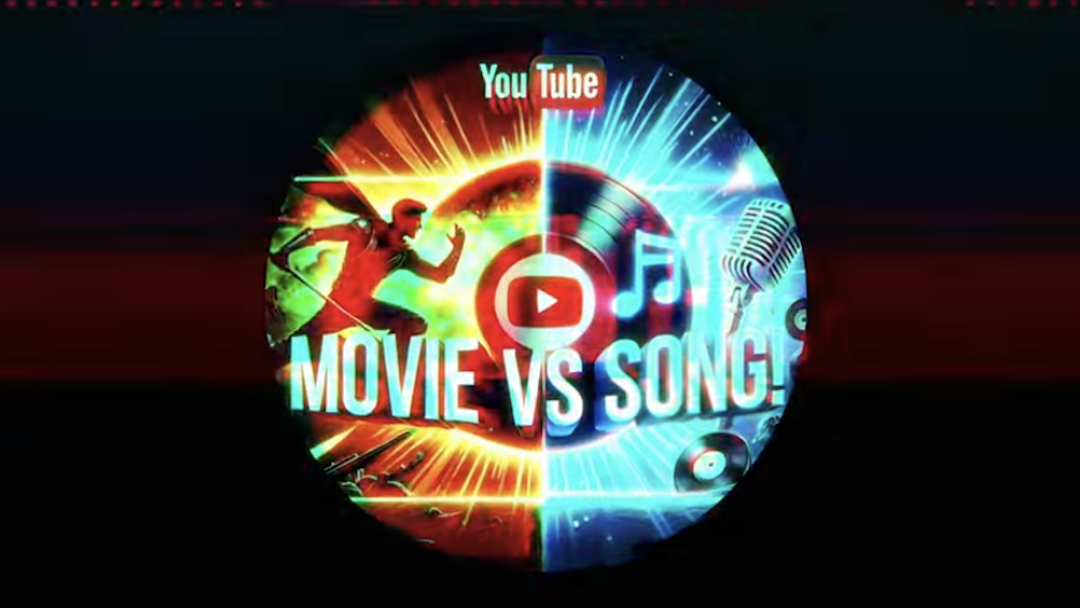
Movie VS Song is a testament to perseverance for me. Across a little more than two years, the channel has been in almost continuous testing. I have changed how I select scenes, how I listen to a song, how I build a climax, how much dialogue I keep, how hard I push synchronization and how much silence I allow myself. All of it happened outside my day job, inside a personal laboratory that has also had difficult periods. There were videos where the effort and response seemed completely out of proportion, periods of doubt, copyright walls and days when I asked whether continuing made any sense. That is why the path carries emotional weight for me.
I do not think I have arrived at a final formula. I hope I never do. I still doubt cuts, move a shot by a few frames and listen again, disagree with Adela, and remember Alin’s and my colleagues’ feedback when something feels too easy or too demonstrative. The difference is that I now know more clearly what I am looking for.
At the beginning the question was, ‘Can I do this too?’ Today it is, ‘Can I make this combination feel inevitable?’ If the answer gets close to yes, it is not only because an explosion lands on a drum. It is because the song changes the meaning of a look, because a shot stays one second longer than my first instinct wanted, because one movement crosses two different scenes, or because the silence after a climax says more than another ten shots could.
And in a way, Adela is still exactly where she was at the beginning: my first audience. Movie VS Song may have grown from the desire to impress her, but it stayed alive because I also wanted to keep surprising myself. I still return to the timeline for that rare moment when film and song stop feeling like two things layered on top of each other. For a few seconds, they seem to breathe together. That is why I continue.
Selected edits referenced
Direct links to the projects and editing breakdowns discussed in the article.
Alex Tanu is a video editor and creator with nearly two decades of professional experience in film, television, advertising and digital content. He is the creator of the YouTube channel Movie VS Song, a personal project exploring the relationship between film, music, rhythm and storytelling through transformative edits and visual reinterpretations. His work focuses on how editorial choices and music can reshape the emotional perspective of a scene, character or story.
Related