
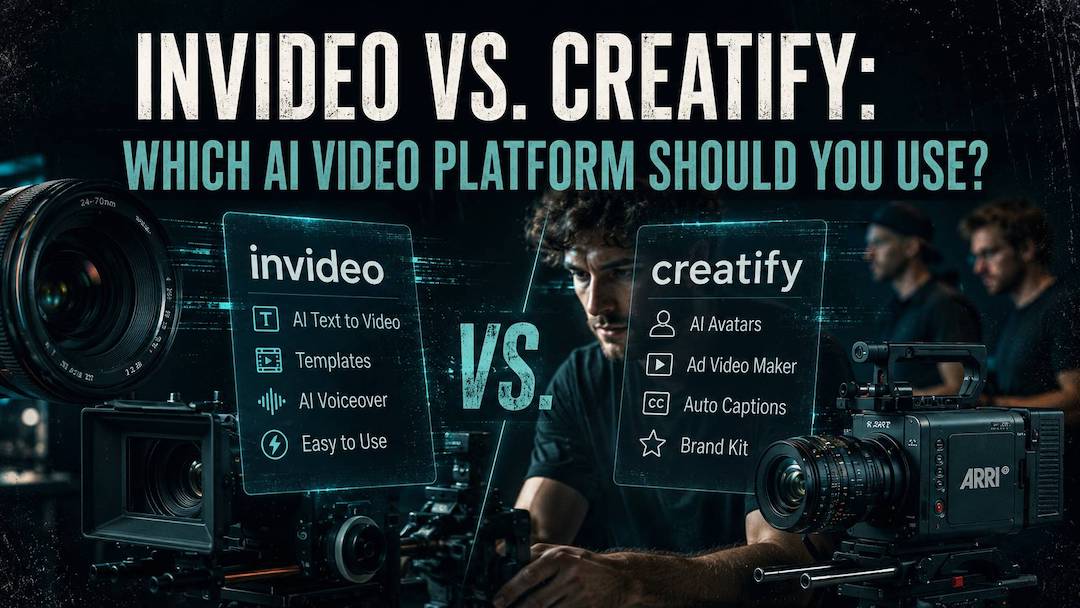
Creatify built its entire product around one specific workflow: paste a product URL, and get a short-form UGC-style video ad back, fast, without filming. invideo Agent is built around a broader job, holding a project’s context, characters, and product references across an entire production, where a single ad is one output among many rather than the platform’s whole purpose.
These solve genuinely different problems most of the time, which is what makes this comparison useful: knowing whether fast URL-to-ad volume or full-production consistency matters more for your specific needs than which platform actually fits.
This covers Creatify’s real, documented strengths and gaps, and where invideo Agent’s approach to AI filmmaking differs structurally rather than just competing on ad-generation speed.
Both platforms fall under the same broader category of AI filmmaking and video generation tools, even though they’re optimized for different jobs.
invideo vs. Creatify Quick Overview
Creatify pastes in a product URL from Shopify, Amazon, or any ecommerce site, then generates short-form video ad drafts using AI avatars, scripts, and voiceovers, a workflow built specifically for performance marketers, ecommerce brands, and agencies that need many ad variations fast.

invideo Agent works from a different premise: rather than one specific URL-to-ad workflow, it holds a project’s brand guidelines, product references, and visual style as shared context across an entire production, routing each piece of content to whichever of 200+ underlying models actually fits.
Pricing: What the Credit Math Actually Costs

Creatify’s free tier gives 10 credits (roughly 2 video ads), watermarked. Starter runs $39/month for 100 monthly credits, watermark removal, 300 AI actors, and 75+ languages, capped at 2-minute videos on a single seat. Pro runs $99/month for 300 monthly credits, 1,500 AI actors plus 3 custom avatars, a competitor ad tracker drawing on a 10M+ Meta ads database, and team collaboration up to 5 seats.
The advertised “2-20 credits per video” range is worth reading carefully: independent analysis describes it as technically accurate but practically misleading, since achieving output quality comparable to Creatify’s own demos requires the higher end of that range.
At 20 credits per quality video, Starter’s 100 monthly credits yield roughly 5 usable videos, and Pro’s 300 credits yield roughly 15, a meaningfully lower real output than the credit numbers suggest at first glance. Unused credits also expire on a rolling two-month cycle rather than banking indefinitely.

invideo’s plans start at $17/month (Plus tier, 75 monthly credits) and scale to $900/month (Elite tier, 4,250-8,500 credits), with every tier including the full 200+ model library and no separate custom-avatar tier gate.
Where invideo Agent Two Pulls Ahead
This is the part a pure speed-and-volume comparison misses, since it’s a difference in what layer of the ad-production problem each platform solves.
Product accuracy in the actual shot. Independent reviews specifically flag that Creatify lacks generation for product-holding shots, an avatar actually holding and demonstrating the product, and can’t generate try-on images for fashion and apparel brands, both common ecommerce conversion drivers.
invideo’s AI ad films approach, one of the specific techniques invideo Agent uses in AI filmmaking, handles this by locking a product’s packaging, palette, and every angle it needs to be seen from as a base reference every subsequent shot gets checked against, directly addressing the product-accuracy gap Creatify’s reviews consistently point to.
Reading an existing winning ad. The newer invideo Agent Two model can read an uploaded reference ad directly, identify its structure, a cut, a lighting change, an outfit swap, and rebuild the same format with a different product swapped in.
Creatify’s workflow starts fresh from a product URL each time rather than reverse-engineering an existing ad’s proven structure.
Persistent project memory. invideo Agent holds a brand’s guidelines and product references as shared context across an entire production.
Creatify’s single-seat Starter tier and per-video credit model are built around producing individual ad variants rather than holding continuity across a larger, ongoing campaign.
Where Creatify Genuinely Wins: Speed and Ease of Use
It’s worth being direct here, because it’s real: Creatify holds a strong 4.8/5 rating across more than 1,500 G2 reviews, and the specific pattern in that feedback is telling, 647 unprompted mentions cite ease of use, against only 315 addressing output quality, which is a fairly clear signal of where the platform’s actual strength lies.
The URL-to-ad workflow genuinely removes manual asset-gathering for a straightforward ecommerce ad, and Pro’s built-in competitor ad tracker and Meta/TikTok ad launcher add real value for a performance marketing team that wants creative production and competitive research in one place.
A Documented Weak Point: Avatar Lip-Sync
Independent reviews consistently flag lip-sync inconsistencies in Creatify’s avatars, mouth movements not quite matching the audio, an effect described as noticeable even to casual viewers, alongside the platform’s comparatively smaller avatar library and lack of access to premium underlying models like Sora 2, Veo 3.1, or Kling.
Who Each Platform Actually Suits
Creatify suits a performance marketer or ecommerce brand that specifically wants fast, high-volume UGC-style ad variants from a product URL, values having competitor ad tracking and direct Meta/TikTok launch built in, and is comfortable with a credit system that requires careful math to estimate real monthly output.
invideo Agent suits a brand or agency doing serious AI filmmaking work, where product accuracy in the actual shot, holding brand context across an entire campaign, and reusing a proven ad’s structure with a new product matter more than the fastest possible single-ad turnaround from a URL.
Common Mistakes When Comparing the Two
- Judging Creatify’s credit allowance at face value. The advertised “2-20 credits” range is misleading for quality output, budgeting around the higher end of that range gives a more realistic monthly video count.
- Not accounting for Creatify’s two-month credit expiration. Unused credits don’t bank indefinitely, which matters for teams with variable month-to-month content needs.
- Assuming any UGC ad tool handles product-holding or try-on shots equally well. This is a specifically documented gap in Creatify’s current feature set, not a universal limitation across the category.
- Treating avatar realism as solved everywhere. Lip-sync inconsistencies are a real, independently documented issue in Creatify’s avatars specifically, worth checking against a project’s specific quality bar.
- Comparing raw ad-generation speed without factoring in project-level brand consistency. Creatify’s per-video workflow is fast; invideo Agent’s persistent context is built for a different problem, holding a brand consistent across an entire campaign.
FAQ
Is Creatify or invideo cheaper?
It depends on real usage. Creatify’s Starter tier is $39/month for roughly 5 quality videos once realistic credit consumption is factored in; invideo’s tiers start at $17/month with the full model library and no separate custom-avatar tier gate.
Does Creatify generate product-holding or try-on shots?
Independent reviews specifically note this as a current gap, Creatify lacks generation for an avatar holding and demonstrating a product, and can’t generate try-on images for fashion and apparel brands, both common ecommerce conversion drivers.
Why do Creatify’s avatars sometimes look slightly off?
Independent reviews consistently flag lip-sync inconsistencies, where mouth movements don’t quite match the audio, an effect described as noticeable even to viewers who aren’t specifically looking for it.
How does invideo Agent Two help with replicating a proven ad format?
It can read an uploaded reference ad directly, identify its structure, a specific cut, a lighting change, an outfit swap, and rebuild that same format with a different product swapped in, rather than starting fresh from a product URL each time the way Creatify’s workflow does.

Gaurav Sharma is the founder and CEO of Attrock, a results-driven digital marketing company. Grew an agency from 5-figure to 7-figure revenue in just two years | 10X leads | 2.8X conversions | 300K organic monthly traffic. He also contributes to top publications like HuffPost, Adweek, Business 2 Community, TechCrunch, and more.
Related