

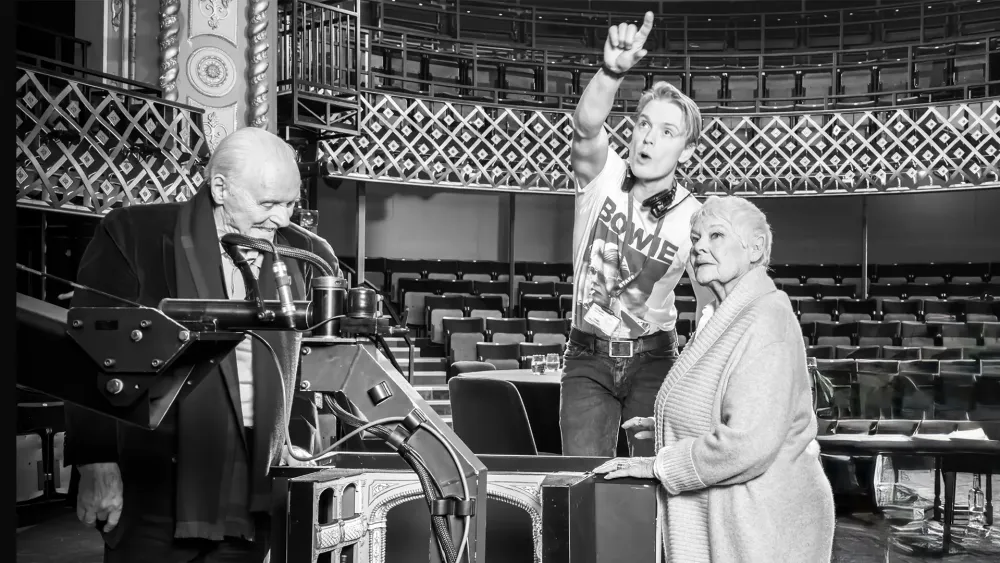
The self-professed “story of a theatrical revolution and how it shaped a nation,” Freddie Fox’s documentary “Into the Breach” attempts to chronicle the impact that British theater has exerted on art, culture and politics over the last century. Assembling a roundtable of acting legends that includes Judi Dench, Anthony Hopkins, Gary Oldman and co-producer Kenneth Branagh, Fox injects anecdotes and insights into a history lesson written by Richard Fullerton that, for better or worse, invites more curiosity than it satisfies. Suffice it to say that these are performers who are not only full of great stories but know how to tell one. Yet the film’s obligation to historical detail renders slightly bland what could have been a tasty trip through 20th-century theater.
Backtracking to the beginning of the 1900s, Fox catalogues the major players who defined, and in many cases changed, British theater: Lilian Baylis, Derek Jacobi, John Gielgud, Paul Robeson, Claire Bloom, Laurence Olivier, Joan Plowright, Richard Burton — the list is considerable. Baylis, a producer and manager, pioneered Shakespeare at the Old Vic theatre in Waterloo, the eventual site of London’s storied National Theatre. Among the performers who became famous on its stage were Gielgud (an eventual EGOT winner) and Olivier, as well as Michael Redgrave and Ralph Richardson. Later came theater director Peter Hall, impresario Andrew Lloyd Webber and performers such as Peter O’Toole, Helen Mirren and Stephen Rea.
As Fox charts their accomplishments, the panel looks back at their professional and personal intersections with them, from compliments to rebuffs. As necessary as the broader context may be, it’s the personal stories, big and small, that resonate and reveal the most. Gielgud was arrested in 1953 for homosexuality at a time when it was illegal in Britain, and he feared that it would ruin his career; his transgression was reported by the press, and it took the support of his costar Sybil Thorndike to help him go out on stage that night. Rather than a rebuke, Gielgud received a standing ovation, highlighting the almost transcendent affection that some of these performers generated from their fans. Meanwhile, despite treating Hopkins with cheeky kindness early in the future Oscar winner’s stage career, Olivier earned a reputation for cruelty.
Further, rivalries like the one between the British theater community’s two pillars, the National Theatre and the Royal Shakespeare Company, could probably provide enough material for a film on its own. While the National Theatre Company, founded by Olivier, focused heavily on classic material, the RSC, created by Peter Hall, took chances on a wide variety of challenging contemporary and even avant-garde material. Hall being named director of the National Theatre in 1973 was a devasting blow to Olivier, but the film moves on fairly quickly in order to ensure it covers what is, admittedly, a lot of material. Plowright’s adulation of her husband Olivier is sweetly affecting, but let’s hear more about the many young actors, themselves now household names, whom he dismissed or dressed down in their nascent years.
Fox traces the community’s sociocultural impact with moderate efficacy — not just the introduction of plays like John Osborne’s “Look Back in Anger,” which marked a shift in focus on working-class characters, but the campaigning and promoting for gay rights by figures like Ian McKellen. Former prime minister John Major, for example, recounts how a meeting with McKellen over the issue permanently changed his perspective, leading to new legislation. (McKellen, on the other hand, remembers identifying that Major was the only straight person in the room where they met, even if his counterpart wasn’t aware.) Stephen Rea’s Irish acting troupe, meanwhile, explored the complexities of the Troubles in their work, spotlighting the conflict in new ways. And British theater was a receptive community for African American actor Paul Robeson to demonstrate his incomparable stage presence after he struggled to find work in the U.S.
Extraordinarily, but perhaps unsurprisingly, many of the roundtable participants are able to recall meaty chunks of dialogue from plays they did decades before, and cheerfully deliver them here to the admiration of their colleagues — who in several cases were present to witness their original performances. Upon remembering Hopkins playing Lambert LaRue in “Pravda,” a role that reportedly helped him land the part of Hannibal Lecter in “The Silence of the Lambs,” Oldman says, “I knew I was in the presence of the one of the greatest performers of the 20th century.” With a laugh, Oldman also rhapsodizes about his acting heroes all being drunks, but the net result of the conversation is a thumbnail master class in inspiration and perspiration, about how these individuals became great actors.
Though the film provides an overview of a century in this community and the cultural evolution of an art form, overall that’s all it can do given its single-serving running time. Give us a docuseries or an extended cut, please: There are so many different threads to follow – past or present — that, again, probably deserve their own films, or at least more of a direct focus. Thatcherism and its devastating effect on the theater community at the same time as the rise of Lloyd Webber-style spectacle certainly merits a more incisive look than it receives here. On top of the history itself, not simply sitting a camera in front of these acting legends — including some no longer around like Plowright — to hear as many stories as they would share about their life and work feels a bit like a missed opportunity. Ultimately, “Into the Breach” covers a topic of undeniable importance. But it doesn’t go into it deeply enough.