
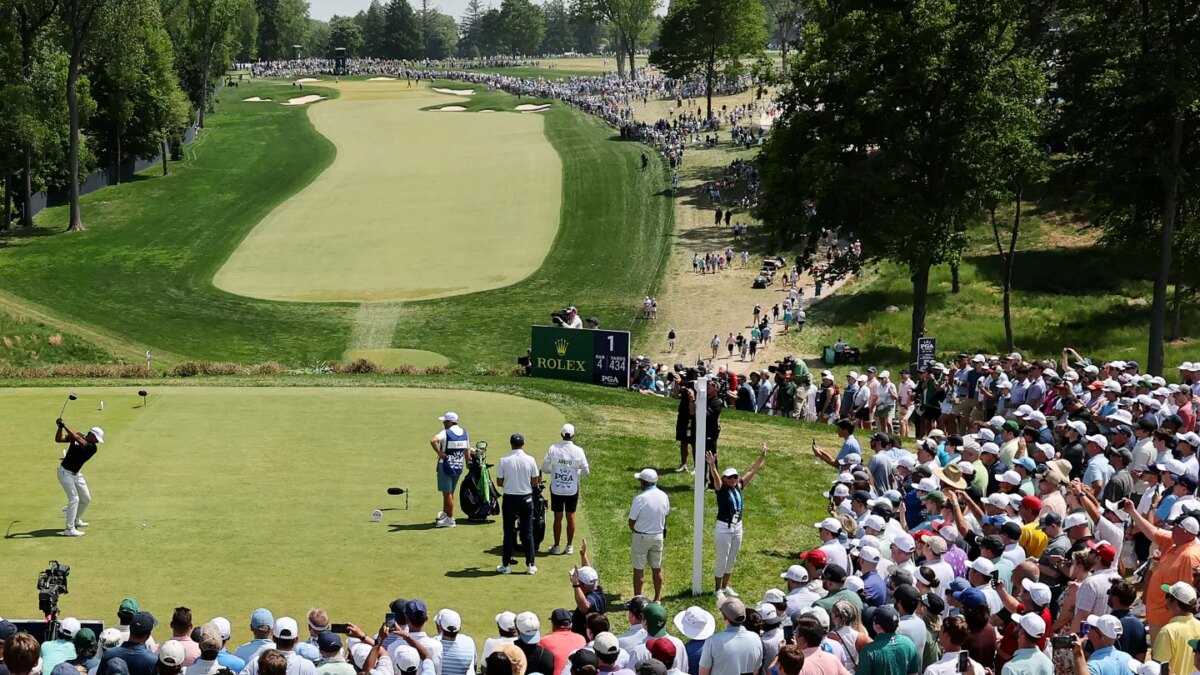
In the fall of 2025, the PGA Tour created something of an in-house skunkworks, meant to transform the way the golf tour organizing body operated. That effort, called the Future Competition Committee, was chaired by Tiger Woods, who, with PGA Tour CEO Brian Rolapp, would undertake an effort to reimagine professional golf.
Like all professional sports, that means it is about media, and TV, and how consumers watch their favorite athletes compete at the highest level. So PGA Tour chief commercial officer Dhruv Prasad tells The Hollywood Reporter that “the first step that committee actually took was inviting in both current as well as potential future media partners to share with us their thoughts on what was good and what was not so great about the PGA Tour’s current model.”
Prasad didn’t name names, but one doesn’t have to use too much imagination to suspect that the likes of NBC Sports, ESPN, Netflix, Golf Channel, CBS Sports and other networks were participating.
“I think we’re pretty transparent about what we’re trying to do,” Prasad says. “We’re trying to create a more compelling media product that results in more viewership, that results in greater fan affinity, a larger, more diverse, younger fan base that leads to more value in in our media rights and in our economic model overall.”
In a sports media environment where the big get bigger (looking at you NFL and NBA) everyone else is rethinking how they operate, and for the PGA Tour, led by Rolapp, a longtime NFL media executive, that means transforming the PGA Tour itself.
“We also exist in a really competitive sports world,” Rolapp said at a press conference unveiling the format. “Whether you’re competing for fans’ attention, if you’re competing for media dollars, which is the economic lifeblood of every sport in this country, you need to be constantly improving the product. I think we looked around and we saw what we need to do to increase fans’ attention and create more value for our partners and felt this was necessary.”

The result of that effort was revealed last week, and it will change the sport entirely beginning in 2028: There will be two series of events having concurrently, a Champions series with the best players in the world, and a Challenger series with up and coming players. Notably, as with European soccer, there will be a relegation and promotion system, with the best Challenger series players being elevated to the Champions series, and the bottom ranked Champions series players being relegated to the Challenger series. There will also be a made-for-TV “last chance” series, where Champions players that have been relegated and some top Challenger players compete head to head for spots in the top league.
“A lot of the themes they [the current and possible future media partners] identified are the ones that are the ones that we acted upon and turned into principles for the Future Competition Committee from a from a design perspective,” Prasad says. “That is bigger season culmination, a more consistent product a season long narrative, a simpler point system, opening big with a series of tournaments that really matter on iconic courses, those are all things that are going to be carried through into the new model, and they come from direct feedback and counsel from our media partners.”
The PGA Tour, of course, has its current deals locked upn through 2030, and while Prasad says they have not had any discussions about new deals just yet, he adds that, “I don’t think we have any preconceived notions about what the future packaging is going to be, and what the elements of each of each package will be for our media distribution partners.”
“It’s possible we could continue with the current partners,” he adds. “It’s possible new partners could come in at some point in the future. I don’t think we know yet.”
But Prasad, who worked with Rolapp at the NFL, acknowledges that the changing media environment played a big role in shaping how the PGA Tour tackles that future.
“I think we’re at a very interesting time in history from a media environment standpoint, because you have experienced sports broadcasters who deliver, I think, incredible productions and broad reach, and have experience — you know, sports broadcasting is a skill, it’s a capability and a competency that not everyone has — and so you have partners who’ve been in this space for a long time, who deliver a great product, and then at the same time you have new partners that are coming in, taking what seem to be increasingly bigger bites of the sports media pie, whether it’s NFL football games, whether it’s Major League Baseball or hockey, Formula One, you’re starting to see bigger and bigger bites from the likes of YouTube and Netflix and Amazon Prime Video and Apple,” Prasad says. “What’s been interesting about that is this focus by the new entrants that’s been on tentpole events and discrete identifiable properties within maybe an overall ecosystem… I would expect that that changes in the future.”
But to start, the PGA Tour has to execute on the new vision articulated by Rolapp and Tiger Woods, who remains arguably the most famous golfer on planet earth, and a liaison between players, fans, and the Tour itself.
“What makes the best sports great from a fan perspective is when every game matters, every week matters, and in our case every tournament matters in an overall competitive system,” Prasad says. “And what I think the PGA Tour lacks today in our current model is a fan understanding of how each tournament fits into the overall system, so we’re trying to evolve to a system where every week, every tournament matters from a competitive standpoint, whether it’s in the Championship series where players are battling for a season-long championship, or in the Challenger series, where players are trying to get promoted up into the Championship series, and that’s the primary thing that they’re playing for.”


Prasad says that longtime PGA Tour sponsors are on board too, noting that the changes will bring “much more clarity for our corporate sponsors into the product that they’re investing in” in both series.
And the “last chance” events could become must-have TV itself: “The stakes in that event, or in that series of events, could not possibly be higher because people are literally playing for their competitive future and which tournament track they’re going to be on, so that that’s an entirely new platform that didn’t exist before,” he says.
It’s the sort of structure that could shake new media partners out of the woodwork, or allow the Tour to lean into new media in a way that the NFL did with its bevy of deals, slicing and dicing for maximum reach and maximum revenue.
“I’m very bullish on the opportunity on new partners, and we saw how that expanded the distribution framework at the NFL, and I think it can now do the same thing in golf,” Prasad says.