
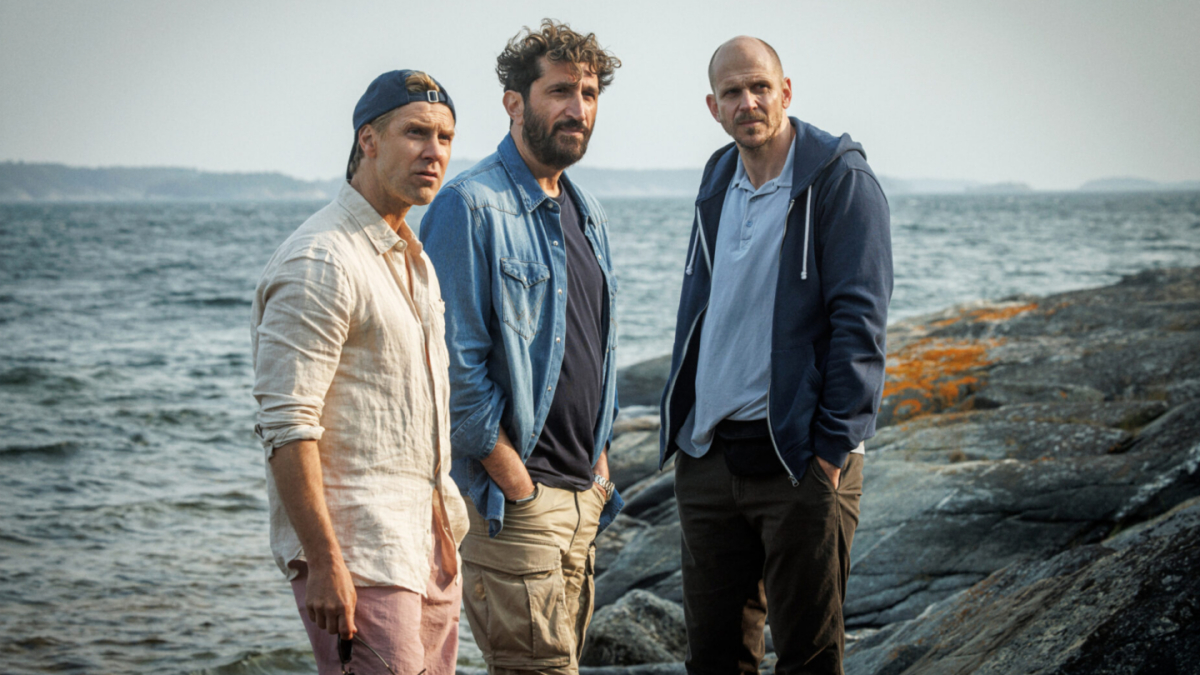
It is equally as intriguing as it is concerning that so much of Alex Schulman’s debut feature, Adult Supervision, is inspired by real-life events.
Like his protagonist, Bill, the first-time filmmaker — also a famed author, journalist and podcaster in his native Sweden — chaperoned a school trip to the Stockholm Archipelago in a bid to reconnect with his daughter. “We had such a close, close relationship when she was a child, and then all of a sudden, I just noticed that as I got into her room, she left it,” Schulman tells The Hollywood Reporter outside Zurich‘s Hotel Ambassador this week. “It was the saddest thing, and then I said to my wife, ‘I’m going to go on the trip because I need to get her back.’”
Thankfully, now 17, Schulman’s daughter has resurfaced from under the choppy waters of teen angst and rediscovered that precious connection with her father. But the aforementioned class excursion had already left a profound impact on Schulman. It not only served as the basis for an entire film about the particularly chaotic trifecta of paternity, masculinity and childhood trauma, but would also make an Oscar hopeful out of the newly anointed director, whose Adult Supervision — premiering at the Zurich Film Festival this week — has been selected as Sweden’s official pick for best international feature at the Academy Awards.
It also gave him the irresistible opportunity to work once again with Gustaf Skarsgård (son of Stellan, brother of Alexander and Bill), with whom Schulman once had a complicated relationship. “We were very bad friends because I have a podcast, and we were making fun of him on this podcast,” he begins.
The long-running Alex & Sigges podcast is, according to Schulman, the biggest pod in Scandinavia. So when this particular member of the beloved Swedish acting dynasty released a rap song, Schulman’s mocking of the video played out pretty publicly in the press. “I get so angry, offended, proud and sad and a little murderous,” Skarsgård reportedly told Swedish press about Schulman and his co-host Sigge Eklund some years ago. “And then I think: ‘But what the hell, come on, laugh at yourself a little and have a little distance. [And] fuck those two.’”
Schulman smiles as he talks about it now. “Gustaf was very angry, so he went out publicly and [said] what he thought about us, and then we had a war for a couple of years,” he explains. But in 2022, Schulman had written a monologic stage show, Comfort Reports, and was directing it at Stockholm’s Royal Dramatic Theatre. He needed a heavyweight actor to lift the performance to the great heights he believed it could reach. “I thought, ‘There’s no one that can do it as good as Gustaf.’” But he couldn’t contact Skarsgård because the tension between them was so rife. “So I sent [the script] to the head of the theater, and Gustaf read it and liked it,” he says. “Then after being public enemies for so long, we met in this restaurant. I remember him coming in, and I rose from the table, and we just hugged. Then it was over.”
Adult Supervision marks Schulman and Skarsgård’s second collaboration. It follows Skarsgård as the anxiety-ridden Bill, who accompanies his daughter and her school friends on a remote trip, desperate to repair their icy relationship. He is joined by two fellow fathers: the secretly domineering Bobo (Fares Fares) and Pontus (Linus Wahlgren), who takes a fancy to one of the camp counsellors. The men believe themselves to be up for the task of handling an unruly class. But tensions quickly escalate and their grip on the situation begins to slip. As buried memories resurface, games turn into power struggles — and power into violence. Soon, no one can tell who’s in charge and who’s in danger.
From left: Director Alex Schulman with stars Gustaf Skarsgard, Linus Wahlgren and Fares Fares at the Zurich premiere of ‘Adult Supervision.’
Courtesy of Getty
Perhaps Schulman can do the best job at putting into perspective how authentic his script is: “You know the scene with the name [introduction] game, with the throw of the ball, and the students say, ‘I’m Leopold Dogfucker’? That actually happened.” Just as Bill does in the film, Schulman turned to his daughter and asked for the misbehaving kid’s name. “You can imagine that my daughter hated me. [She was] so embarrassed.”
It isn’t the only real-life event that Schulman wove into this deftly crafted portrait of authority, anarchy and the unpredictable nature of children. Adult Supervision opens with a school teacher showing parents anonymous screenshots from the kids’ Snapchat conversations, in which they hurl unfathomably vicious and antisemitic abuse at one another. Another scene on the trip depicts a student spraying an antiseptic cleaning bottle into his peer’s water, before Fares’ character comes and, in what he believes is an astute bit of discipline, slams his palm on the table so hard that the whole room stops. Many of these incidents were inspired by Schulman’s experience. “There were so many things happening on that trip,” he remembers. “And when I came home, I remember I was crying in my wife’s lap for hours. And then after a couple of weeks, I thought that this is a story that I want to tell.”
The director likens his own role on the trip to that of Bill, who is slowly driven to madness by worrying about a particular child, the class punching bag Kenneth (Olof Olingdahl). “I am very much like Bill in the movie. I’m not a conflict guy,” says Schulman. “And I always believe in discussing a conflict with kids, but that didn’t work.” He is admittedly relieved that Skarsgård was able to bring alive Bill’s gentle, yet neurotic nature. “It must be hard for an actor to play a person who’s struggling so much,” wonders the director. “And it’s a big challenge because he’s in almost every frame. It’s completely his movie […] and for me, I think it was obvious that [no one] in Sweden can do it as well as he did.”
Skarsgård’s performance completely anchors the gradual descent from decorum to disorder. He is a man acting out of parental responsibility, while carrying his own baggage from being bullied as a child himself. But Kenneth, to Bill’s dismay, is not your usual victim. “You see so many bullied boys and girls in movies that are just so one-dimensional,” says Schulman. “They’re bullied and they’re victims. But I know from being bullied when I was young, [that] I was also bullying. That’s how you survive, right? It’s very, very complex,” he continues. “I liked the idea of one thinking that this boy is a victim, but he’s also a perpetrator.”
The finished product is, oddly, very aesthetically pleasing. Schulman enlisted one of Joachim Trier’s most trusted cinematographers, Jakob Ihre, who also worked with Fares on HBO’s Chernobyl. Together, they came up with replacing bog-standard drone shots of the island with miniature models — fake trees and tiny cabins — which help evoke a sense of childlike play.
Adult Supervision has so far been described as a dark comedy, but it’s quite the mash-up of genres. Schulman blends light-heartedness and discomfort to create something of a thriller. Those moments of humor are, for Schulman, when all esteem for the art form went out the window. “When I write books, I can’t write comedy. I don’t know why. It’s so sad,” he explains. “Books are divine for me. I can’t soil them by writing comedy. When I started to write a movie script, I had no respect. So I could finally do the things that I wanted to do.” He did show the film to Ruben Östlund, he adds, who told him it was a relationship horror. That feels right for Schulman.
Perhaps a one-two with prolific auteur Östlund is standard practice for one of Sweden’s most famous journalists, but an ensuing Oscar campaign? Now that has stumped the self-assured Schulman. “I can’t even describe it,” he beams. “It’s crazy that I’m now going to L.A. to do screenings for Academy members.” He just about understands the hype: “It’s an arthouse movie, but it’s also quite commercial. It’s a perfect mix. And they test fun, those scenes. But almost all scenes are from my life in some way.”
Viewers will be relieved to know that the last few minutes — in which Schulman delivers us a shocking act of violence — are fiction. Producers weren’t immediately convinced, but the filmmaker was delighted to have final cut on his first feature and insisted that Adult Supervision had to go there.
And now, after its award-winning world premiere in the Next Wave competition at Fantastic Fest and a major screening at Zurich Film Festival, Schulman is slowly but surely relinquishing control. “I’m not nervous,” he says. “I love seeing the movie with other people, just to be there and to see where it works and [doesn’t]. But the last time I did it was in the test screenings, and then I could always go back to the editing room and fix things. And now I obviously can’t fix anything because it’s done.”
He has definitively caught the directing bug and has plans for a second feature (you might not be surprised to learn it’s another story inspired by a trip away for Schulman). With Adult Supervision, at least, this debut filmmaker has a whole nation behind him: “Now it’s the Oscars submission, I can go to festivals,” he grins. “And I might be able to do one more movie.”