
Independent filmmaking has a habit of disguising itself as something manageable.
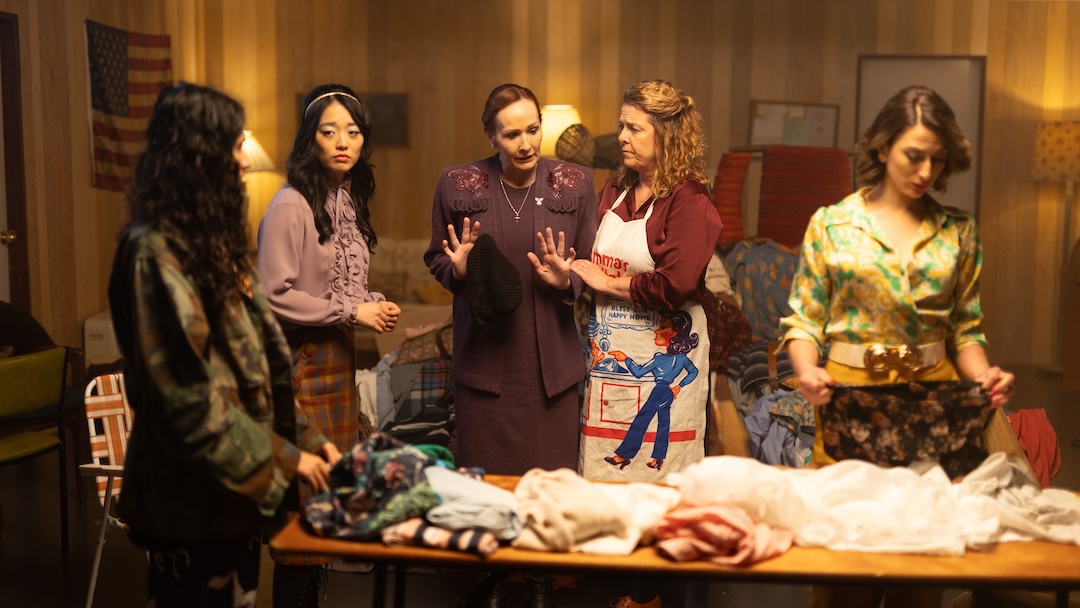
In our case, it began with a play: five women, one location, a church basement, and a story driven almost entirely by dialogue and performance. As Producer and Director, I found myself drawn not just to the apparent simplicity, but to the pressure that simplicity creates — the sense that everything would have to work because there was nowhere to hide.
What drew me in were the characters. They weren’t just functional, they felt lived-in, contradictory, often funny, occasionally difficult – but flawed and real, three dimensional. And what speed! the source material reads like a 1950s movie, galloping along at quite a clip! The dialogue has a rhythm to it too — fast, slightly heightened — and that gives the piece a natural momentum. It felt cinematic, even before it was a film, thank you author Bo Wilson!
The original plan was to make the project in the US or the UK. Like many films, it began with energy — conversations, early interest, a sense of movement — and then gradually it slowed. Not because of any one obstacle, but because of many small ones. It was only after relocating to Australia that things shifted in a meaningful way.
A meeting with Sydney Film School proved to be the turning point. The Waterloo studio offered more than just a location; it provided a framework and access to crew, a controlled environment and, crucially, a defined window of time between end of term and the end of the year…. The project moved from something abstract into something practical almost overnight. The question was no longer whether the film could be made, but how….
The answer, somewhat alarmingly, was ‘in five days’.
That decision only makes sense if everything else is designed around it. Rather than shooting in fragments, we approached the film more like a performance — running it end-to-end with multiple cameras, capturing wide passes first and then returning to focus on individual characters. It allowed the actors to stay in the rhythm of the piece and gave us a way to build the film through repetition rather than traditional coverage.
Knowing this would be a hard sell I reached out to a local management company with a preexisting relationship with the film school – at least they would take my call. The pitch? A small budget, not much time but heaps of creative freedom – and oh yes, we’re running all 90 pages twice per day!
And you know what, it worked! Shot at Christmas time the actors weren’t very busy and they loved the idea – escaping into a role for nearly two hours, just like theatre – what a challenge! Of course there were nerves but our five wonderful actors rolled up their sleeves and got to work. And work they all did: Kathryn Hartman, Libby Fleming, Helen Kim, Kelly Monisse and Dilroop Khangura, hardest working actors in Sydney!
We shot on two Sony FX3 cameras in 4K, not out of luxury but necessity. Because we weren’t capturing conventional coverage, the resolution became part of the process — allowing us to reframe, push in, and refine moments later in the edit. From the outset, the film was being designed with post-production in mind.
The world itself — the church basement — had to feel real enough to hold the performances. That meant building it.
Over the course of a week, again due to careful timetabling of the studio, our art team, lead by Production Designer Matt Bonnici & Props Mistress Gema Fernández, worked intensively inside to construct and dress the set. It wasn’t just about creating a backdrop; it was about building a space the actors could inhabit fully. Depth was designed into it so the camera could move within the environment without the image flattening out — something that often happens in single-location films.
The cast had been preparing long before we arrived on set. Over two months, they met regularly — often daily — running lines, connecting, and building a shared understanding of the material. By the time we began shooting, there was already a rhythm between them.
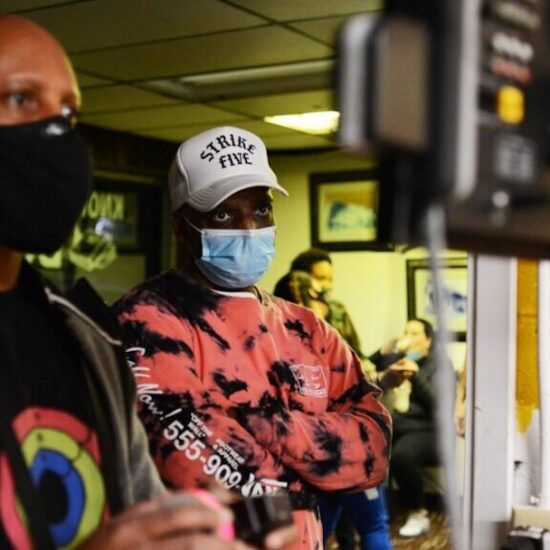
Production itself was intense — exhausting and exhilarating in equal measure. There’s a particular energy to a compressed shoot: everything matters, all the time Speaking of time, thank God for our AD, Magdalene Phillips! I shared a car with our Unit Production Manager, Vanessa Perdriau, which became an unexpected extension of the process. Mornings were spent preparing, evenings unpacking what had happened — moving between producer and director perspectives depending on what was needed. That shift often happened quite literally as I stepped out of the car.
On set, the atmosphere was notably collaborative. With a crew that was more than fifty percent female, there was a different tone — less ego, more communication, and a stronger sense of shared responsibility across departments. Same level of noise but the loudest voices were women, thankfully I am quite used to being bossed around by a lady – and more than happy to comply! There were, inevitably, moments of pressure, but they were resolved quickly, and the work continued…
Technically, the setup was lean but deliberate. The camera team was small but perfectly formed in the shape of Luke Field, our DP, and Bradley Conomy. The sound team, lead by Jye Cork of Jyenormous Soundwaves were kept very busy, every actor was mic’d with lavaliers and supported by boom coverage. Two booms. The reasoning was simple: audiences will tolerate imperfect visuals, but they won’t forgive poor sound, we couldn’t re-shoot and we couldn’t mess up… did I mention we had no insurance?
Lighting was largely practical, built around motivated sources within the scene. Rather than flattening the space, we allowed it to fall into pockets of light and shadow, which helped shape both the image and the tone.
And then, almost as quickly as it began, it was over.
I was handed a small pile of drives and wished good luck… it went rather quiet, the warm lights of the studio went dark and I was alone gigabytes of footage – so I went back to the basement…
The first stage was technical: syncing footage, assembling full runs, and organising the material into workable timelines. After that, it becomes editorial — shaping rhythm, selecting performances, and building the film moment by moment. I soon became aware I was spoilt for choice.
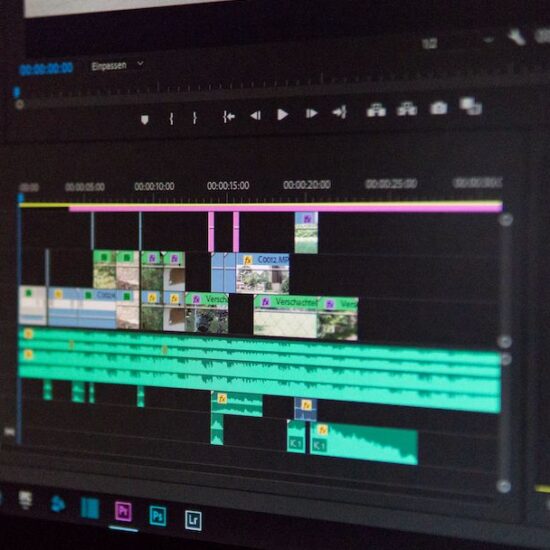
I took on the edit myself in Adobe Premiere Pro, which allowed the decisions made during production to carry directly through into post. The visual aesthetic was refined there as well, by NB Performance, introducing subtle texture and grain to give the film a slightly aged, lived-in quality. Sound design and mixing proved to be one of the strongest elements of the process, culminating in a full 5.1 mix – thanks to Abe’s Audio, I could not have managed the soundscape as well!
The first real test comes when you show the film to an audience. Initial screenings for cast and crew were followed by smaller industry screenings in Sydney, Los Angeles, and London. Watching how people responded — not just what they say, but how they sit with it — provided a clarity that’s difficult to find elsewhere.
Final refinements followed before the film moved into the film’s festival run. The response so far has been encouraging, with selections, mentions, and awards beginning to build momentum. Like most independent films, its journey is still evolving, shaped by how audiences engage with it.
Looking back, the most useful lesson is also the simplest: constraint forces clarity. Every decision — from how the film was shot to how it was edited — was shaped by limitation. Those limitations didn’t restrict the process; they defined it.
And ultimately, they made the film possible.
The Charitable Sisterhood of the Second Trinity Victory Church will screen at selected festivals and cinemas in 2026, before streaming on ee.watch. Sign up at ee.watch/sisterhood for updates.
Dean Owen-Sims is a Producer/Director based in the UK, where he is currently developing multiple projects for his production company, Eternal Entertainment. When not writing or making films, Dean lectures on movie-making around the world and serves on the advisory board of indie film streaming platform PAUS.TV and the Sydney Film School.
Related