I recorded the most important voiceover in my film on a crappy laptop mic in a hotel room in Southern California. I had a rough script for a pivotal fire truck scene, a turning point that carries a lot of emotion for the story and for me, and I wanted to hear it against the day’s rough cut, so I read it in a single take. It was not an easy read. My eyes teared up hearing myself say the words out loud, maybe for the first time ever. My voice breaks twice. I got through it, and you can hear the weight of it in that take.
Later I recorded the same lines on a proper mic in a proper room, and the rawness was gone. I did not want to lose it or fake it; that goes against everything the film had become. So the take with the echo and the air conditioning in the background, contrary to every quality standard in filmmaking, is what audiences hear. With no studio and no investors forcing decisions, I got to choose vulnerability over cleanliness.
That is what finishing a film alone looks like. Nobody in the room to tell you the good take is the bad one.
Two merry idiots and a truck
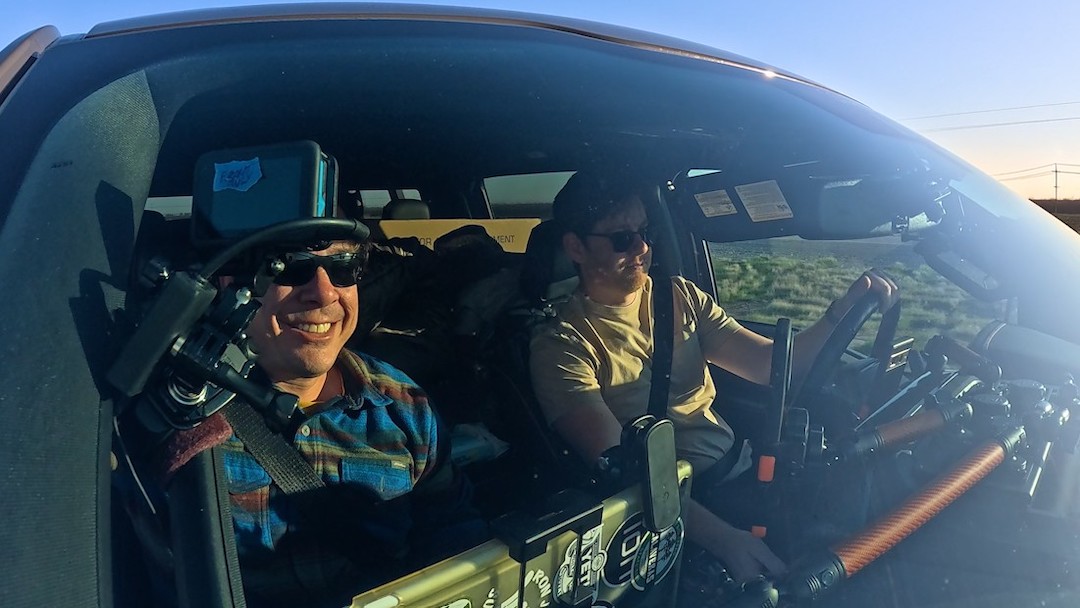
Into Uncertainty is the story of two under-prepared, merry idiots who naively dove into Baja planning to shoot a masterpiece, and every bit of it fell apart in the most perfect way. My co-director Derek Bays and I entered the 2025 BajaXL, a ten-day unsanctioned expedition rally down the peninsula and back, with cameras rolling on everything. We both had some limited production experience, never a full film. We were the entire crew and the subjects, and we had to capture the story and survive it at the same time. Derek shot half of it, lived every day of it, and wrote and recorded the voiceover with me. The cutting room, the sound, the color and the graphics were mine, and that is what this piece is about.
Handing the story to a post-production team that had not lived it would have unraveled the very thing that makes it work. It is dirty, it is sloppy, the camera work is choppy, and you ride with us and hear our thoughts unfiltered. It is a participant-led production, and that put the responsibility on us to preserve what made the story.
What it cost, the least of which was dollars
We came home with about two terabytes of raw footage, nearly 200 hours across more than a dozen capture devices. There was no logging on the trail; as navigator, comms guy, spotter and relief driver, taking my eyes off the trail to stare at a screen risked our safety. So the first logging happened on the I-5 northbound after day ten, and continued for months after I returned to Los Angeles for full-time wildfire recovery work: dozens of full SD cards, logged at night in hotel rooms after full workdays, and on weekends if I was willing to forgo rest. It was four months before I even started a timeline.
The first cut began in June of 2025, in the Beverly Hills Marriott, looking out at the Fox building from Die Hard, thanks to a film industry professional named Dexter at the hotel bar, whose astonishment that I was sitting on an entire uncut film was equaled only by his insistence that I start. That first version took over a year and was finished in another Marriott, in Newport Beach. It was far too long and very rough, but the length was by design, if not necessity: it gave us the full story, the sequence, the arcs, the subplots, and where we had the footage to cover them.
Somewhere around 1,000 hours went into that first cut and another 1,000 into the cuts that followed, all of it late at night and on weekends after 50-to-60-hour weeks on disaster recovery work. We are finally locked at version eight. As first-time filmmakers, Derek and I believed the hard part was finished when we wrapped on the return leg from Baja. We were about as prepared for post-production as we were for the rally when we reached the border.
In actual dollars, the whole film cost less than $10,000, insurance, travel and the rig build included. What it cost beyond dollars was more than I expected to pay: the exhaustion, the burnout, the desire to walk away. But then a segment would come together, or a perfect shot, or a gasp of fear, all of it something we lived, and the spark stayed lit.
The tools, briefly
Within a few hours of day one our entire production strategy was worthless; running Baja trails takes both people’s full attention, and there was none to spare for pulling focus on a rig. Rethinking the gear strategy on a dry riverbed was sub-optimal, but the best worst idea became our comfort zone for the next ten days. A dozen-plus GoPros and two Sony FDR-AX700s became the kit; the Panasonic AG-DVX200 we called Doc Brown, the tripods, the jib and the light kits never left the bag.
The edit was cut entirely on a laptop, an ASUS ROG Zephyrus G14 with the RAM doubled to 32 GB and everything on external SSDs, because I travel for work. Adobe Premiere, each day rendered as its own segment and stitched so we could watch a cut without a full render; color in Lumetri, shot by shot, by hand, because LUTs across a dozen devices under wildly changing conditions were never going to work.
The thing I got wrong
Sound is where we took the biggest hit. We hard-wired lapel mics into the truck, with adapters for the GoPros, so we could capture everything without stopping to sync the wireless mics we had brought. We even road-tested configurations for months before the rally. What we never tested was that configuration in a truck loaded with loose gear, off-road. The hard-wired mics picked up every rattle in the cab, and our audio is close to unusable in a lot of places. That is the one piece that will always bother me as a filmmaker failure. Sync the wireless mics. Even when there is no time.
Building the story instead of writing it

We had a plan for the story, a written voiceover and even some storyboards, and it proved exactly as effective as our shooting strategy. Somewhere around cut two or three it became clear that we could not write the story and then edit it. We had to build it day by day: find the strongest moments, stitch them into a sequence, then decide what stayed. We would start cutting a storyline for a crew or a character and discover that by day nine we had never captured the footage to close it, or find something amazing on day eight that nothing in the earlier days had set up. The moment I realized the only honest way to tell it was to abandon the plan, cut everything into a hyper-inflated long cut, and build the voiceover around what was actually there was overwhelming and rewarding all at once. It is also the moment I fell in love with the film.
The voiceover followed the same trajectory. I wrote it from notes, Derek and I tweaked it, and we recorded it. Then every cut changed the context, which meant a rewrite, which meant a new track, and two full-time jobs did not allow a proper recording for every iteration. So I re-recorded every segment as a down-and-dirty laptop capture to hear it over the footage. Around version six the story finally held and we could record properly, and with me in Los Angeles and Derek in Sacramento, even that was sub-optimal: we each recorded a full version and the best pieces were stitched.
The compromise had an upside. I sent Derek the full script and told him to do a cold read with no visuals; I wanted his deadpan delivery and his honest reaction as he remembered each moment. The real gold is where he went off script and roasted me. There is a point in the film where we meet a stranger on the trail celebrating his graduation, and as we drive away I triumphantly announce, “congrats on the gradulations.” When Derek hit that line in the recording he lost it, went off on a tangent ripping on me, and re-created my blunder in a character voice. It was so funny in post that it stayed. Accidental magic no post-production team could have understood in context.
What I would hand off next time
What we were able to put into this film comes from being subjects and crew at the same time. Hand off any part of the driving or the capture and you lose the nuance that only comes from being in it. A support team would have bought us time and cost us the fear, the exhaustion, and the moments where we showed the audience our vulnerability and ignorance. A film crew would have fixed the production quality and pulled us out of Baja to stand in front of a lens.
With no script and no crew, we rolled on everything all day because we were afraid of missing something, and more than once the audience gets real, undesigned moments that are perfect precisely because the filmmaking is not. That was possible because we simply forgot the cameras were there.
My pitch for this piece suggested three things I would hand to someone else. True to form, like the rally plan, the shooting strategy and the post plan before it, that plan goes on the cutting room floor. The honest answer goes against most filmmaking best practice and against every sensible fix for the problems this production had.
What would I hand to someone else? For this particular film, nothing. The final is sub-optimal for all the reasons above, and for all the reasons above, that is what makes it special.
Into Uncertainty is finished, 108 minutes, version eight, and submitted to Sundance, SXSW and Big Sky for 2027. The fire truck voiceover is still the laptop take. Hell of a way to make my first film.

Ryan G. Christen is an independent filmmaker and former Battalion Chief whose work looks at the point where preparation ends and uncertainty begins. After more than 25 years in emergency response and disaster recovery across 27 states, he directed Into Uncertainty, his feature debut, shot inside the 2025 BajaXL rally and finished single-handedly through his company, RGC Media Inc.
Related